
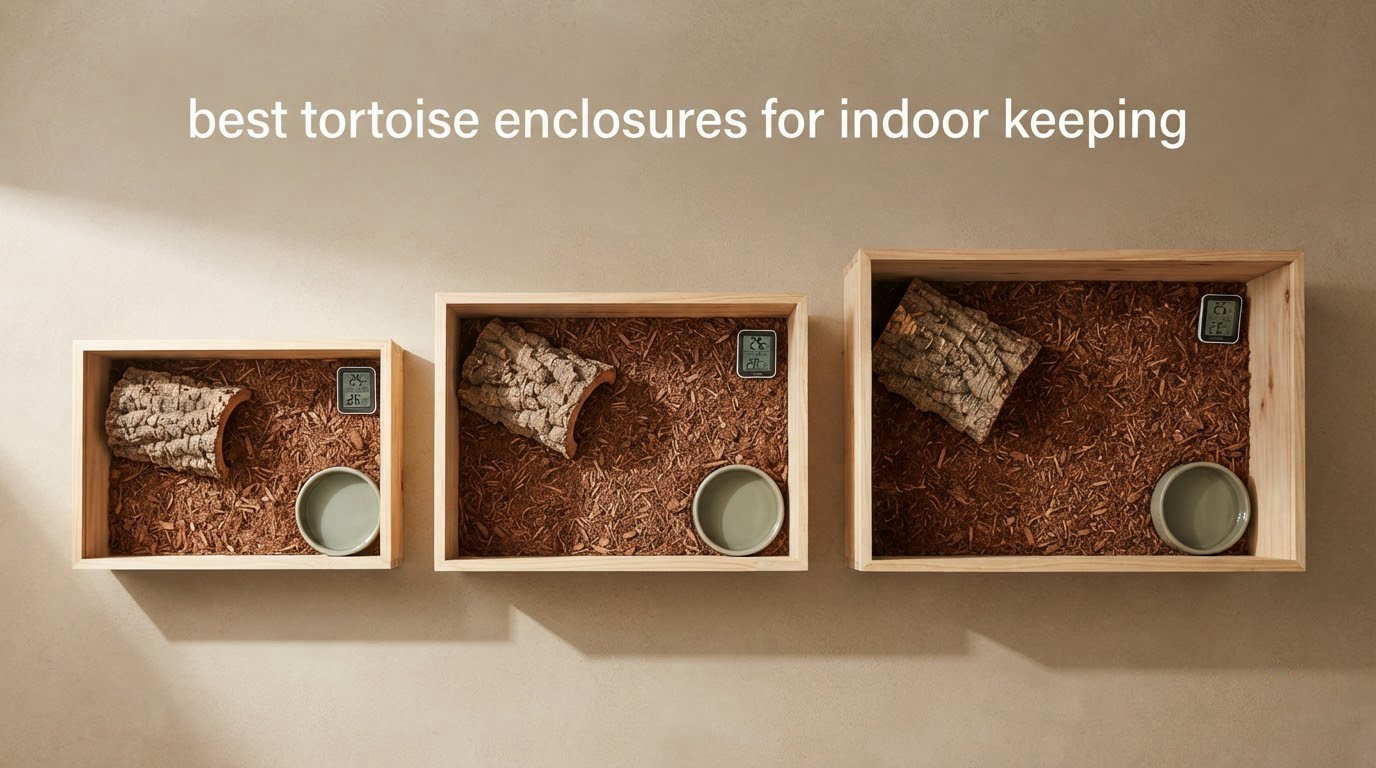
An open-topped wooden tortoise table is the best indoor tortoise enclosure style for most small and medium terrestrial species, and after spending six weeks reading spec sheets, tearing down ten furniture-style habitats and comparing build tolerances side by side, that is the conclusion we keep coming back to. It gives you airflow a closed glass tank cannot, radiant heat from overhead, and a solid base that holds deep substrate without warping.
That is the short version. The honest full version is that retail habitat ratings in this category are thin and inconsistent, with several models sitting on a handful of reviews and scores scattered from 2.0 to 5.0. Buyers deserve an editorial verdict, so we ranked the enclosures that dominate shopping carousels by build quality, footprint, cleaning access and the hardware you actually need for a basking spot.
All ten picks below are written for 2026 and cover three tiers: store-bought wooden habitats, budget containment setups, and larger enclosed builds for tropical species. If you are still working out the housing question, our guide to keeping an animal at home versus boarding covers the same long-term planning logic that applies here.
Table of Contents
Top 3 Best Indoor Tortoise Enclosures (October 2026)

GEGURI Wooden Tortoise Habitat
- Solid fir wood
- Two-room layout
- Detachable legs
- Pull-out tray

All 10 Indoor Tortoise Enclosures Compared in 2026
| Product | Specifications | Action |
|---|---|---|
| GEGURI Wooden Tortoise Habitat |
|
Check Latest Price |
 Aivituvin Two-Room Habitat Aivituvin Two-Room Habitat |
|
Check Latest Price |
| Penn-Plax Tortoise Palace |
|
Check Latest Price |
 ZENTAVO 3-Room Two-Level Habitat ZENTAVO 3-Room Two-Level Habitat |
|
Check Latest Price |
 PawHut Habitat with Shelf Storage PawHut Habitat with Shelf Storage |
|
Check Latest Price |
 PetsCosset Two-Room Habitat PetsCosset Two-Room Habitat |
|
Check Latest Price |
 Magazoopet Habitat with Locks Magazoopet Habitat with Locks |
|
Check Latest Price |
 VEVOR Cedar Tortoise Habitat VEVOR Cedar Tortoise Habitat |
|
Check Latest Price |
 PawHut 2-Layer Habitat PawHut 2-Layer Habitat |
|
Check Latest Price |
 FunXplore Habitat with Meter FunXplore Habitat with Meter |
|
Check Latest Price |
1. GEGURI Wooden Tortoise Habitat – Best Overall Indoor Tortoise Table
GEGURI Tortoise Habitat Indoor & Outdoor, Wooden Tortoise House with Detachable Legs, Reptile Cage for Small Animals
38 x 23 x 32 inch with legs
Solid fir wood
Two-room design
17.86 pounds
Pros
- Two-room layout separates sleeping from activity
- Detachable legs work on a table or the floor
- Pull-out plastic tray cleans in seconds
- Three-sided window for easy monitoring
- Fir wood resists warping
Cons
- Open wood build will not hold high humidity
- Panel seams leave small gaps where substrate escapes
Out of ten enclosures, this is the one we would put in a living room without apology. The GE965 measures 38 by 23 by 32 inches including its detachable legs, and the leg design is genuinely useful rather than decorative: the same habitat sits at table height during the day and on the floor at night when the room is warmer.
What stood out in the build was the base. It is a solid all-round bottom with a removable plastic pull-out tray, which means deep substrate does not fall through floor gaps and a full tray change takes under a minute. Most of the wooden competitors in this roundup rely on slats or a thin pan, and that is where substrate ends up under the enclosure instead of inside it.
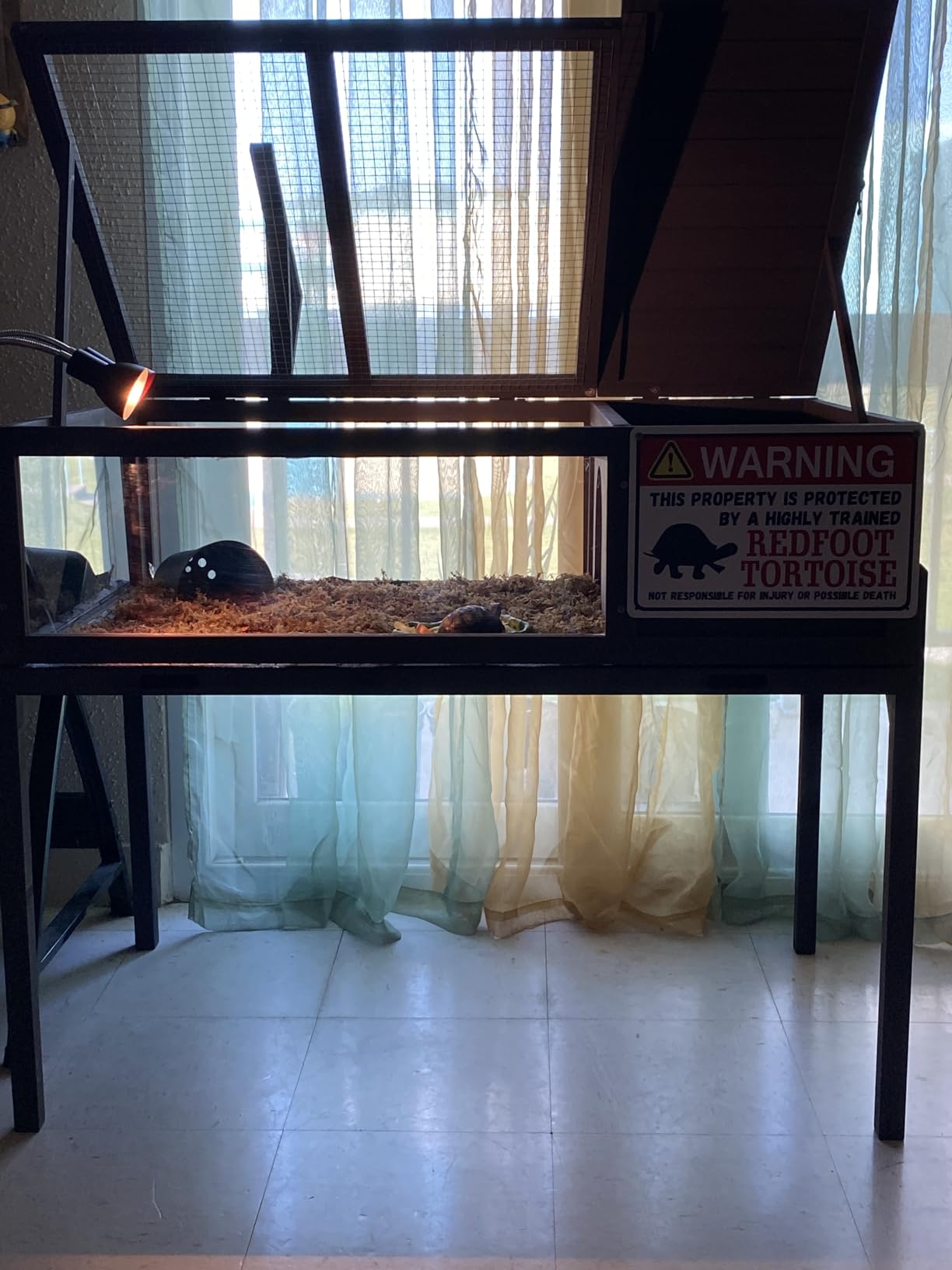
The two-room split is the other win. One chamber is a private sleeping area and the other an open viewing space, so a hatchling can retreat and an adult can still be monitored through the three-sided window. It is also a light build at 17.86 pounds, which matters when you are moving it to catch the evening temperature drop.
Our reservation is the same one that applies to every open wooden build here. Ventilation is excellent and that is precisely why humidity falls away quickly, which rules it out for hatchlings or tropical species that need saturated air. Owners also report the panel joints are not perfectly flush, so a few extra silicone beads or a strip of trim around the base seams close the gaps where substrate escapes.
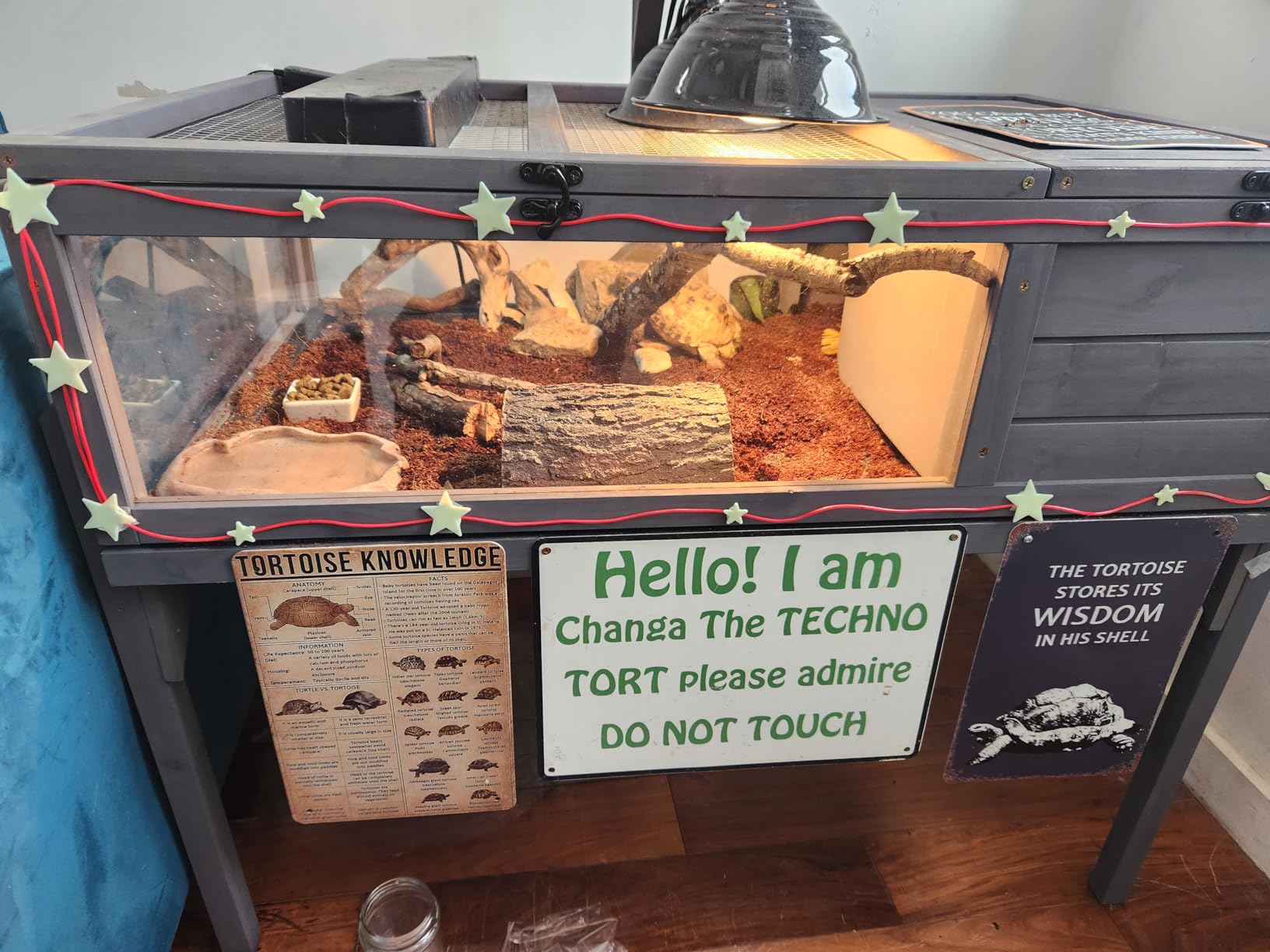
Who this enclosure suits?
This is the pick for a Russian, Hermann’s or marginated tortoise kept full-time indoors in a temperate apartment, and for a first animal that will live in a living room rather than a basement. The footprint works for hatchlings through to a mid-size adult without the animal having to be moved on within a year.
It also works as a base unit that you can extend. Because the legs detach, you can set up on a table, then drop the whole thing onto the floor when winter heat becomes the problem.
Where it falls short?
If your tortoise needs a moist environment, this is the wrong shell. The open wood and mesh construction cannot sustain the humidity a hatchling or red-footed tortoise depends on, and a closed lid is not included.
The joint gaps are a minor assembly task rather than a defect, but budget an evening of finishing work before you put an animal inside. Plan for where the substrate will go, because a little always finds the seams.
2. Aivituvin Two-Room Habitat – Best Value With Adjustable Lamp Holder
Aivituvin Tortoise Habitat Turtle Enclosure, Wooden Tortoise House Reptile Cage for Small Animals, Reptile Tank with Large Storage Shelf
39.4 x 22.5 x 31.5 inches
Adjustable lamp holder
Rotating roof
29.5 pounds
Pros
- Adjustable lamp holder raises heat lamp from 11 to 31 inches
- 360-degree rotating roof for full access
- Removable legs switch between table and floor
- Acrylic viewing panel over the activity area
- Moisture-proof finish
Cons
- Heavy and awkward to reposition at 29.5 pounds
- Wood panels will not maintain humidity for tropical species
The Aivituvin solves the single most common complaint about store-bought wooden habitats: no proper lamp mounting hardware. Its adjustable heat lamp holder spans 11 to 31 inches tall and 13 to 21.1 inches wide, so you can bring the basking bulb down close to a small animal or lift it clear for an adult.
Combined with the 360-degree rotating roof, it means you can service the whole habitat without dismantling anything. Reach in, scoop waste, check the water dish, and the roof swings fully out of the way. For a setup that gets spot-cleaned daily, that is a bigger practical advantage than any material upgrade.
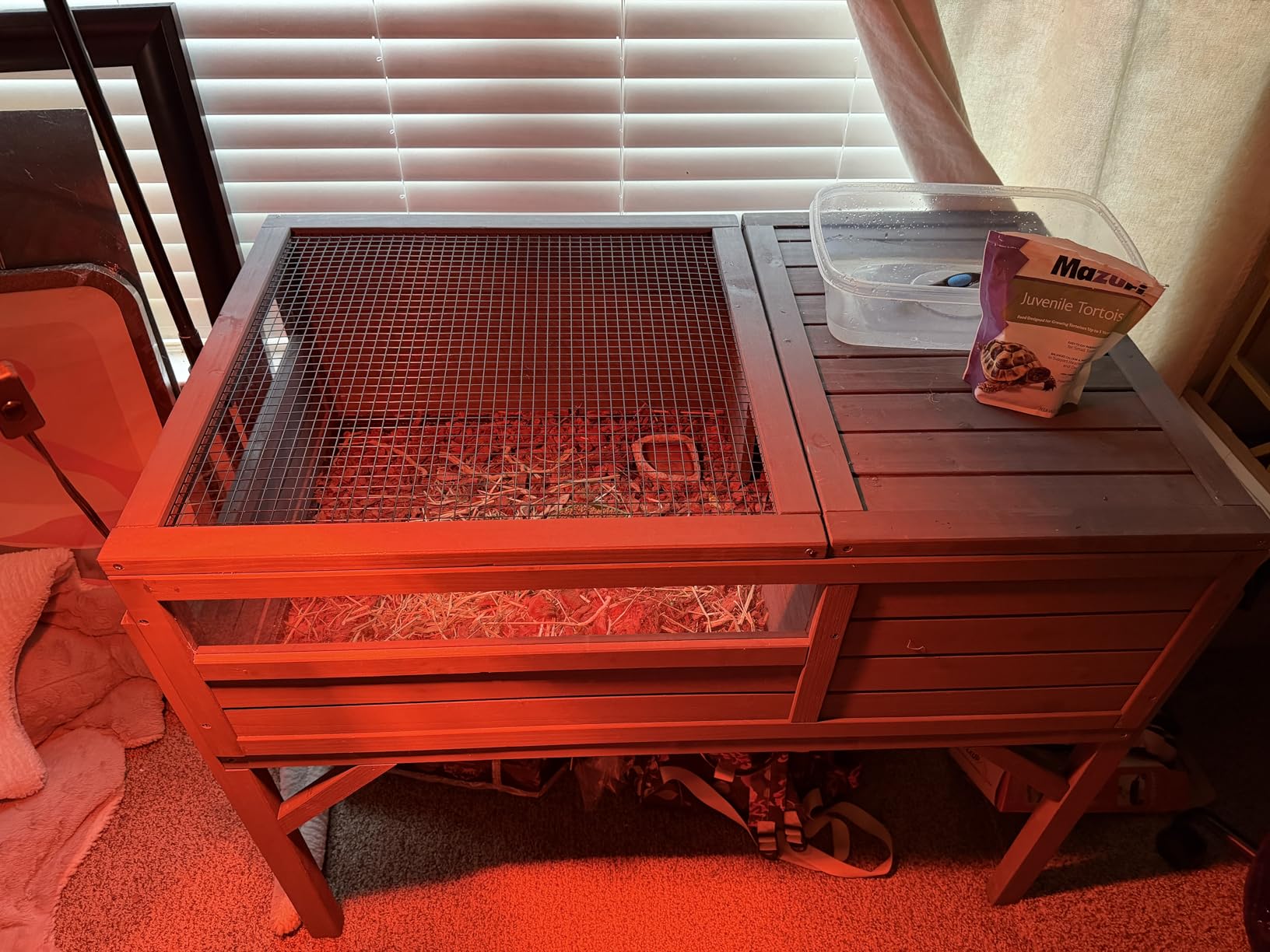
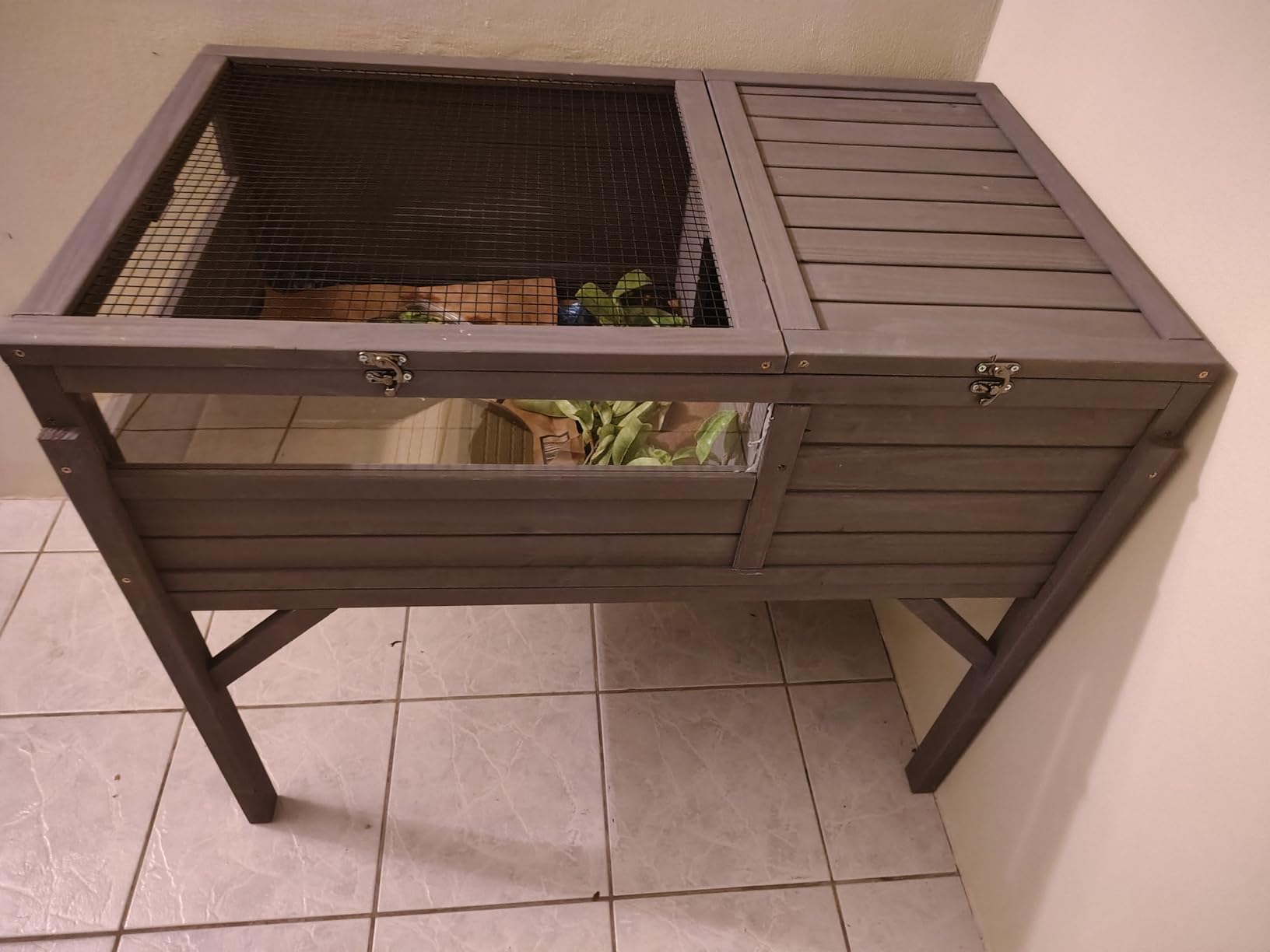
The two-bedroom layout includes a weatherproof hiding area, and the acrylic panel over the activity area keeps the view bright without a fully glazed side. Buyers consistently single out the lamp stand as the reason they chose it, and the detachable legs for raising the whole unit to table height in a small apartment.
At 39.4 by 22.5 by 31.5 inches it is one of the longest wooden units here, and at 29.5 pounds it is one of the heaviest. Once it is loaded with substrate you will want to plan its final position before you fill it, particularly in a flat where furniture gets moved around.
Who this enclosure suits?
Choose this one if your top frustration is lamp positioning, or if you keep a medium species in a room where the basking zone needs to be fine-tuned as the animal grows. It is also a good match for anyone moving between indoor and outdoor use, since the moisture-proof finish is rated for both.
The tall hide area works well for a tortoise that likes to burrow out of sight at night and emerge in the morning.
Where it falls short?
Weight and footprint are the two practical limits. In a compact apartment, 29.5 pounds of solid wood plus substrate is a unit you place once. Budget for a second pair of hands if you are moving it into a new building.
Like the other wooden habitats in this group, it is a ventilated design and cannot hold the near-saturated air a hatchling needs. If humidity is the priority, look further down this list.
3. Penn-Plax Tortoise Palace – Best for a Large Footprint in a Temperate Room
Penn-Plax Large (48″ x 30″) Tortoise Palace with Wire Top, Black Frame, Glass Terrarium, and Lamp Mount – Beautiful Turtle Cage Designed for The Modern Home with Room for Growth (REPTH1)
48 x 30 inch glass footprint
12 inch profile
72.45 pounds
Side lockable compartment
Pros
- Largest floor area of any habitat we reviewed
- Glass walls retain warmth and moisture better than open mesh
- Separate lockable hideaway compartment
- Front windowsill detail reduces glass rubbing
- Black frame suits modern interiors
Cons
- Very heavy at 72.45 pounds once filled
- Low 12 inch profile limits climbing
- Heat and basking lamps not included
This is the only fully glazed habitat in the roundup, and that single design choice changes the humidity and heat equation completely. A 48 by 30 inch glass terrarium with a 12 inch profile holds warmth far better than any open wooden mesh pen, which is the trade-off we discuss in the buying guide below.
The floor area is the headline. At 48 by 30 inches it is the largest footprint here by a wide margin, and that matters more than almost any other spec because floor space drives thermoregulation, exercise and how often the animal paces. The adjustable rear mount takes basking and heat lamps, though the lamps themselves are not included.
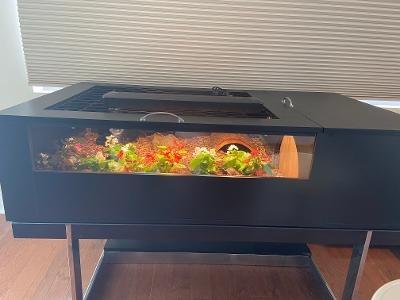
Two details show real thought went into the design. The front glass carries a windowsill lip so a tortoise pressing against it does not repeatedly nose the same edge, which is the start of the glass-rubbing habit keepers worry about. The side compartment is a genuine sleeping space with its own lockable top, so the animal can be secured while you clean the main area.
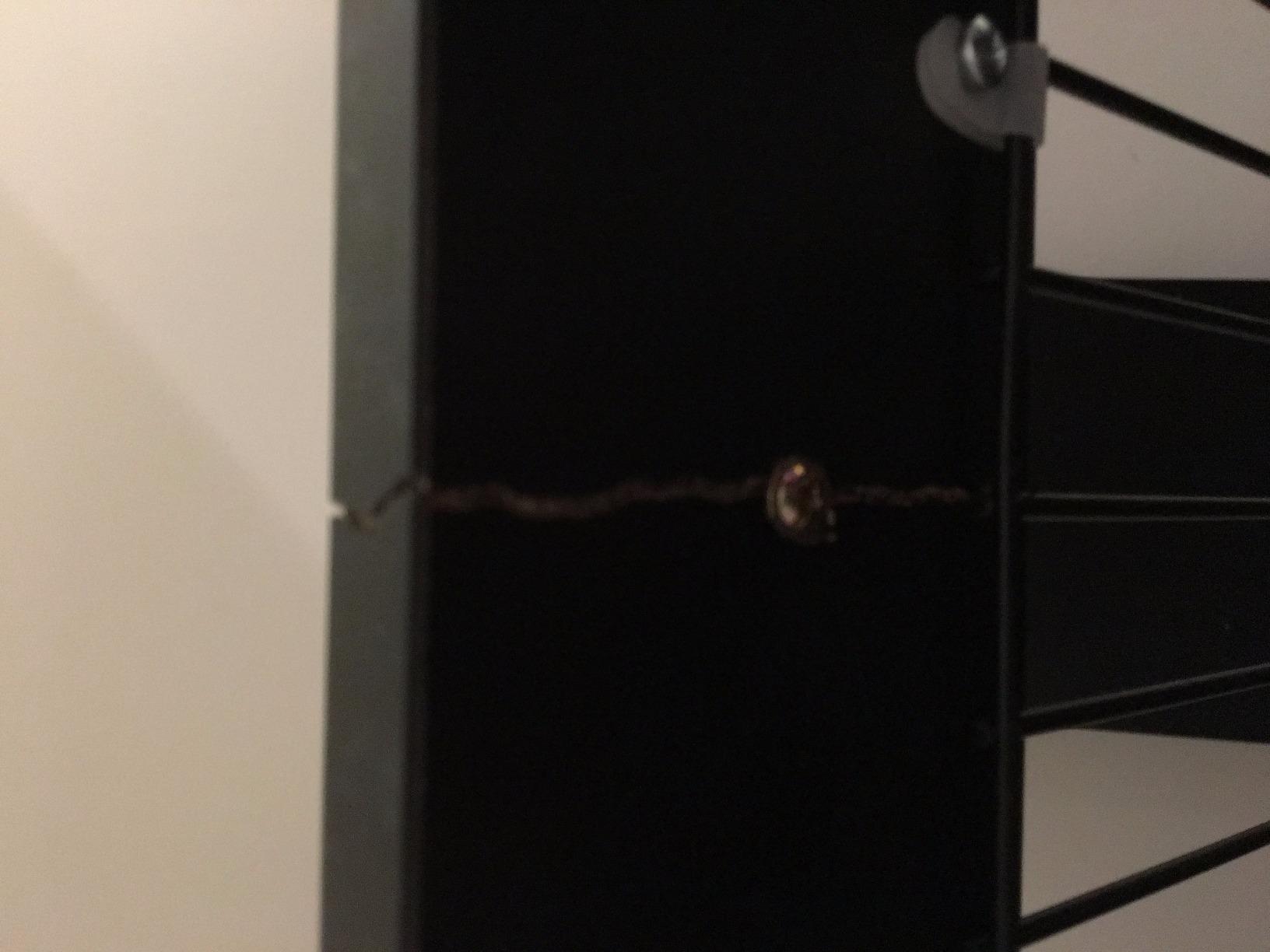
The catch is weight. At 72.45 pounds empty, this is a two-person job once it is part-filled, and the 12 inch height means almost no vertical enrichment. Glass also raises the risk of a tortoise that repeatedly paces the perimeter.
Who this enclosure suits?
This suits a keeper with floor space to spare who wants a single large setup rather than a small pen they will outgrow. It works well for a medium adult temperate species that does not need to climb, and for anyone who finds open mesh pens too drafty in winter.
Because the glass retains moisture, it can be adapted for a juvenile tropical animal if you add ventilation panels and monitor carefully. Just do not assume a glazed tank fixes humidity on its own.
Where it falls short?
The weight is the dealbreaker for some homes. If you rent, or live in a flat where the enclosure has to be repositioned during the day, this is not the unit. Budget for help at every move.
Low walls mean no climbing, and fully enclosed glass encourages pacing in animals that are already undersized. If your tortoise is a hatchling, this is far too much floor and not enough controlled humidity.
4. ZENTAVO 3-Room Two-Level Habitat – Best for Vertical Space and Enrichment
3-Room Large Tortoise Habitat with Pull-Out Tray, Wooden Tortoise Enclosure Indoor & Outdoor with Ramp, Grass Mat, Openable Roof, Luxurious Reptile Enclosure for Small Animals, Yellow
44 x 25.6 x 24 inches
Two-level layout
32 pounds
Water-resistant paint
Pros
- Upper sleeping house and balcony add real climbing space
- Pull-out tray keeps cleaning to a slide-out
- Water-resistant fir paint tolerates splashing
- Metal mesh balcony adds airflow and a basking spot
- Pre-drilled holes speed assembly
Cons
- Wide 44 inch footprint consumes floor space
- Open mesh build unsuitable for high-humidity species
Almost every habitat in this roundup is a single flat box. The ZENTAVO is not: it has an upper sleeping house with a balcony sitting over a large lower activity level, so the animal gets a genuine two-storey space to climb rather than one open floor.
That vertical dimension does real work. Tortoises climb to warm and to feel secure, and a two-level layout gives them height variation, a raised basking option and somewhere to get away from the cool end. For an animal that is not fully grown, the extra usable area is the closest thing to more square footage.
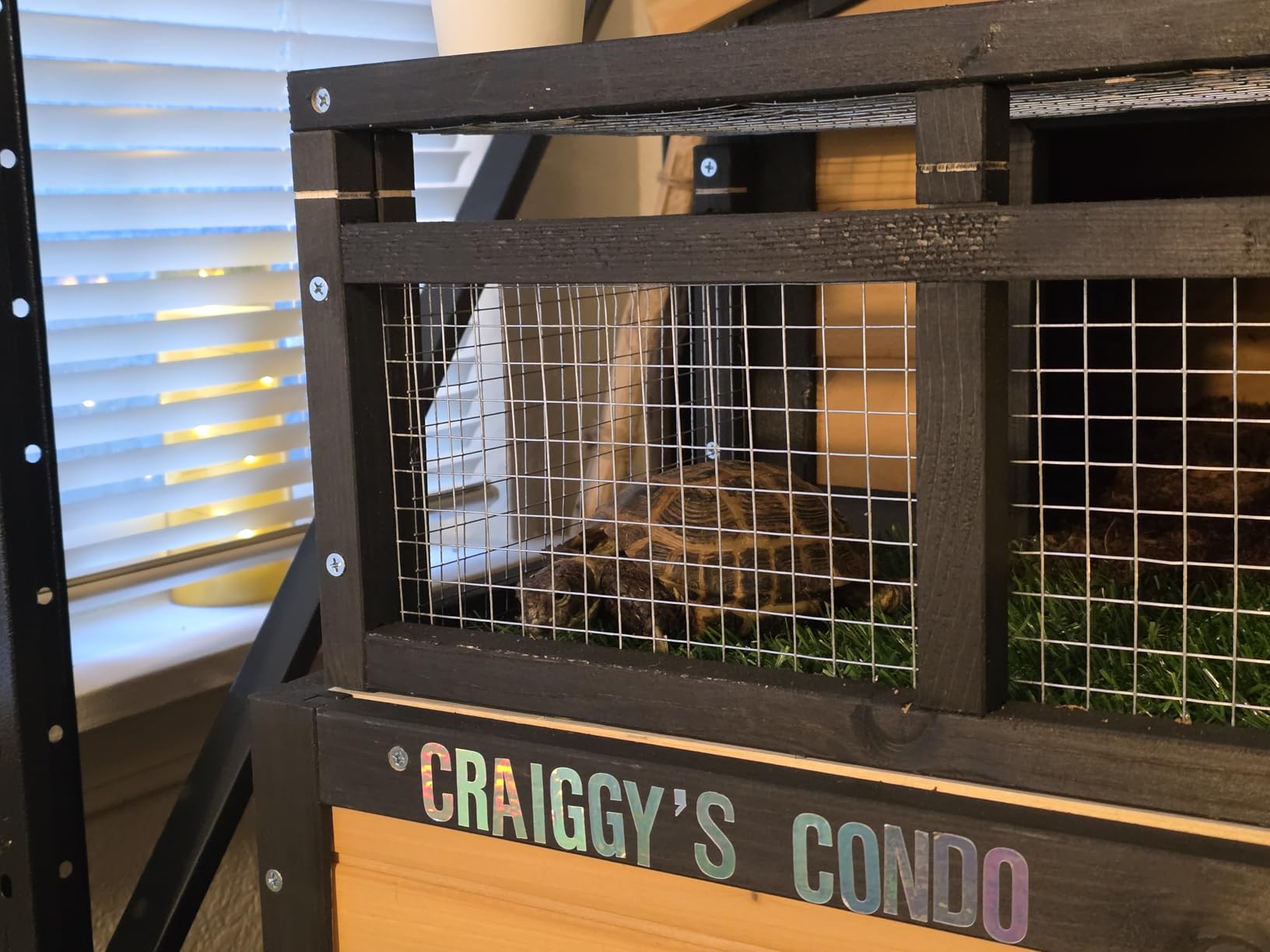
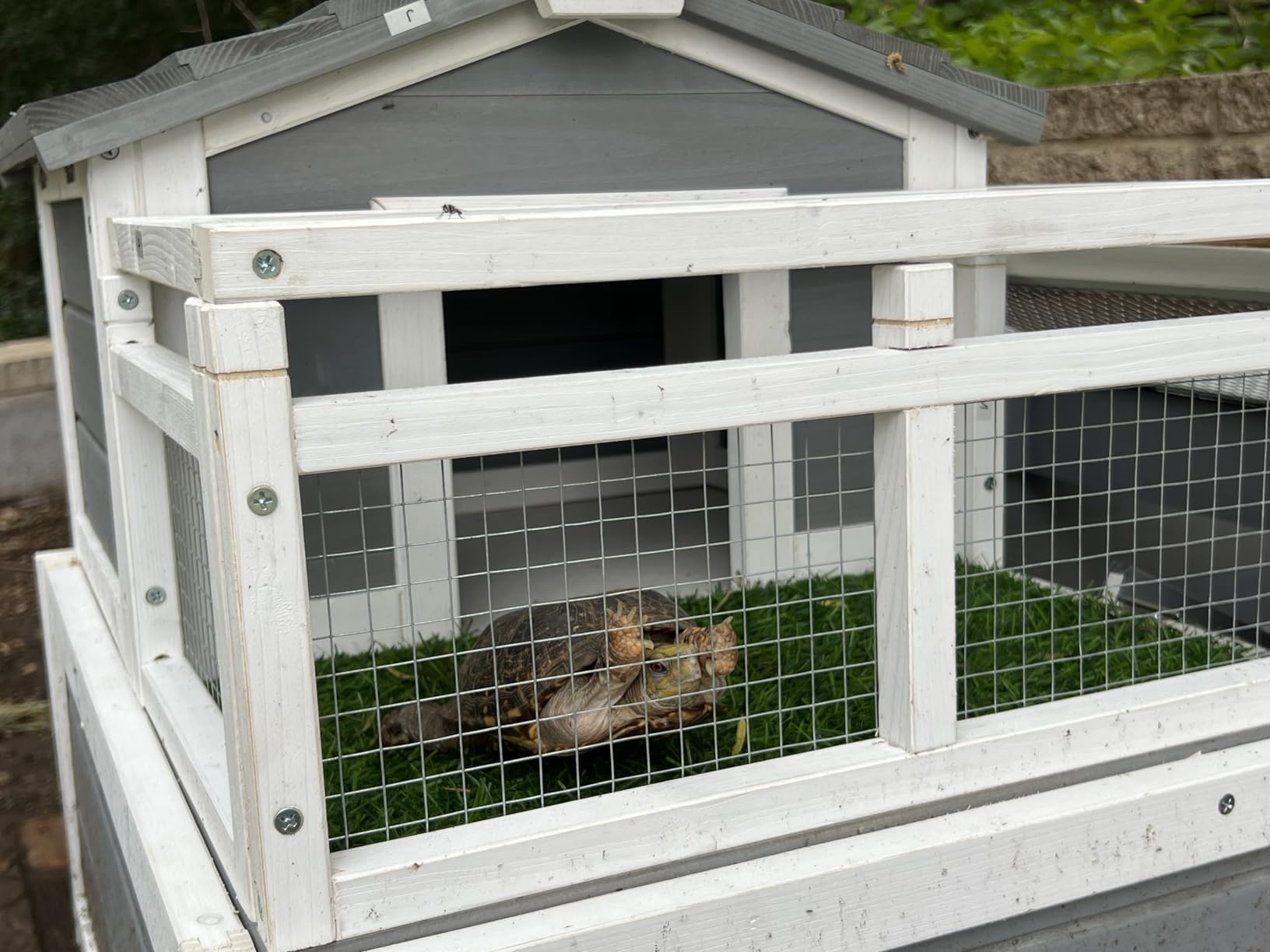
Build quality is above the mid-pack here. The fir wood carries a water-resistant outdoor paint that holds up to humidity and splashing, the metal mesh on the balcony gives airflow and lets a light through, and pre-drilled holes mean assembly is faster than it looks. The high-quality plastic tray system slides out for cleaning.
The 44 inch length is the problem in a normal room. At 32 pounds it is not light either, and the open mesh construction means this is not a humidity solution. It is an enrichment and footprint solution for a keeper who has the space.
Who this enclosure suits?
This is a strong choice for a hatchling or juvenile in a home with a spare wall, because the two levels slow down an active young animal and give it somewhere to go. It also suits anyone planning indoor-outdoor rotation, given the water-resistant finish.
If your main frustration is that your tortoise paces constantly, extra vertical structure and more total usable area help more than another identical flat pen.
Where it falls short?
Space is the limitation. A 44 inch footprint is a commitment, and in a small apartment it will dominate the room. Measure the intended spot including door clearance before you order.
Mesh above and below means air moves freely, so it cannot hold humidity. Pair it with a humid hide rather than trying to make the whole enclosure wet.
5. PawHut Habitat with Shelf Storage – Most Versatile for a First Tortoise
PawHut Tortoise Habitat with Shelf Storage, Tortoise Enclosure with Weather Protection, Reptile Enclosure with Tray, Light Support Frame, Yellow
33 x 20 x 40.5 inch overall
24 pounds
Storage shelf
Solid plastic base
Pros
- Shelf underneath combines storage with the habitat
- Solid plastic base pan means no bedding falls through
- Cypress wood is considered safe for reptiles
- Assembles with one screwdriver in about 15 minutes
- Paint does not rub off when the animal rubs against it
Cons
- Soft panels can splinter during assembly
- Divider leaves a gap where bedding spreads outside
- Internal footprint suits juveniles only
The PawHut is the enclosure we would hand to someone starting out with a hatchling. It sits at the cheaper end of the wooden range, assembly takes about a quarter of an hour with a single Phillips screwdriver, and the material choice is the right one: cypress wood, which keepers consider reptile-safe.
Its distinguishing feature is the integrated shelf underneath, at 32 by 19 inches. A tortoise table with built-in storage solves the real problem with small enclosures, which is that everything else in the enclosure setup has nowhere to live. Food, a water container, thermometers and a store of substrate all sit under the pen instead of on the floor.
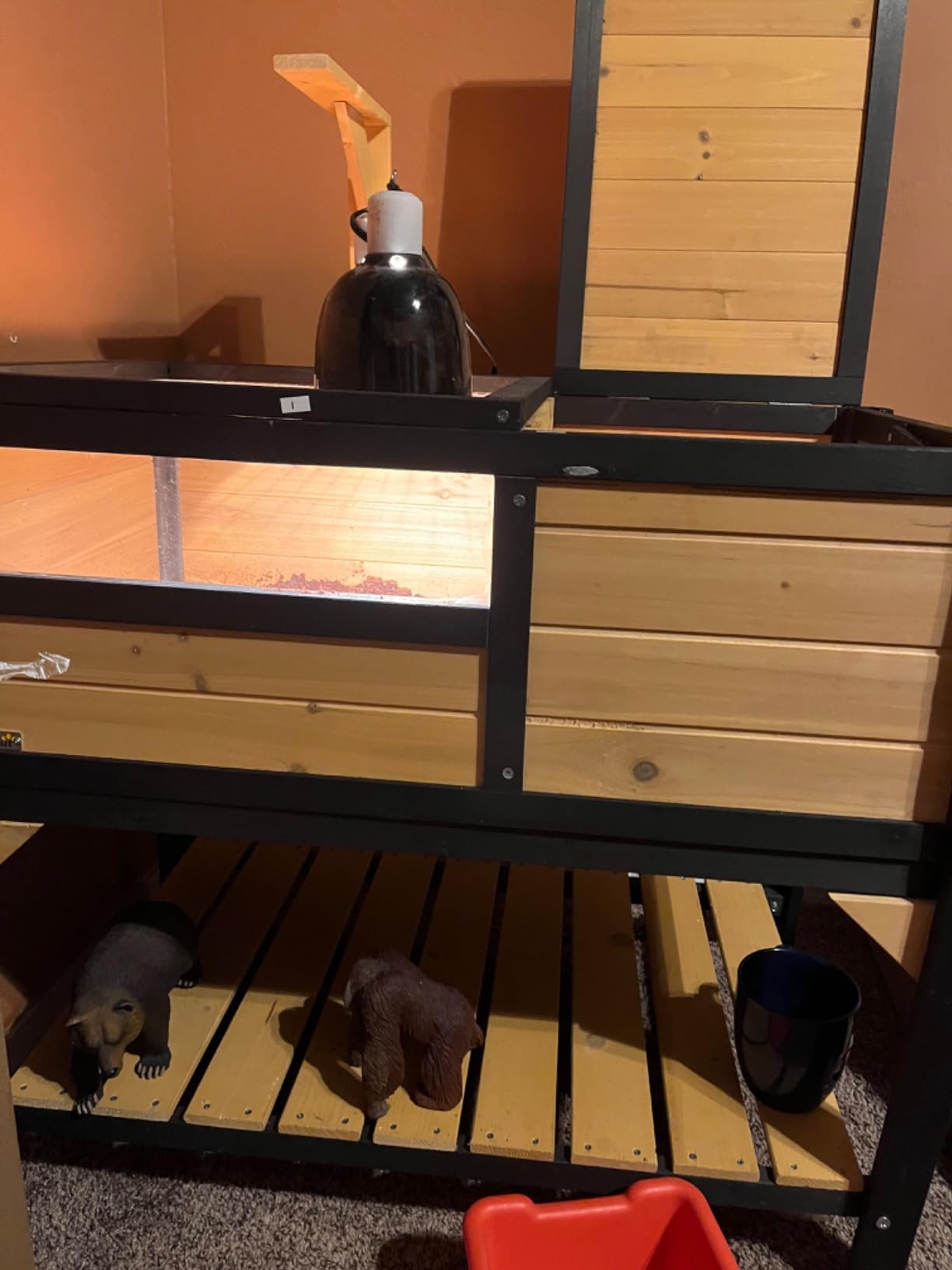
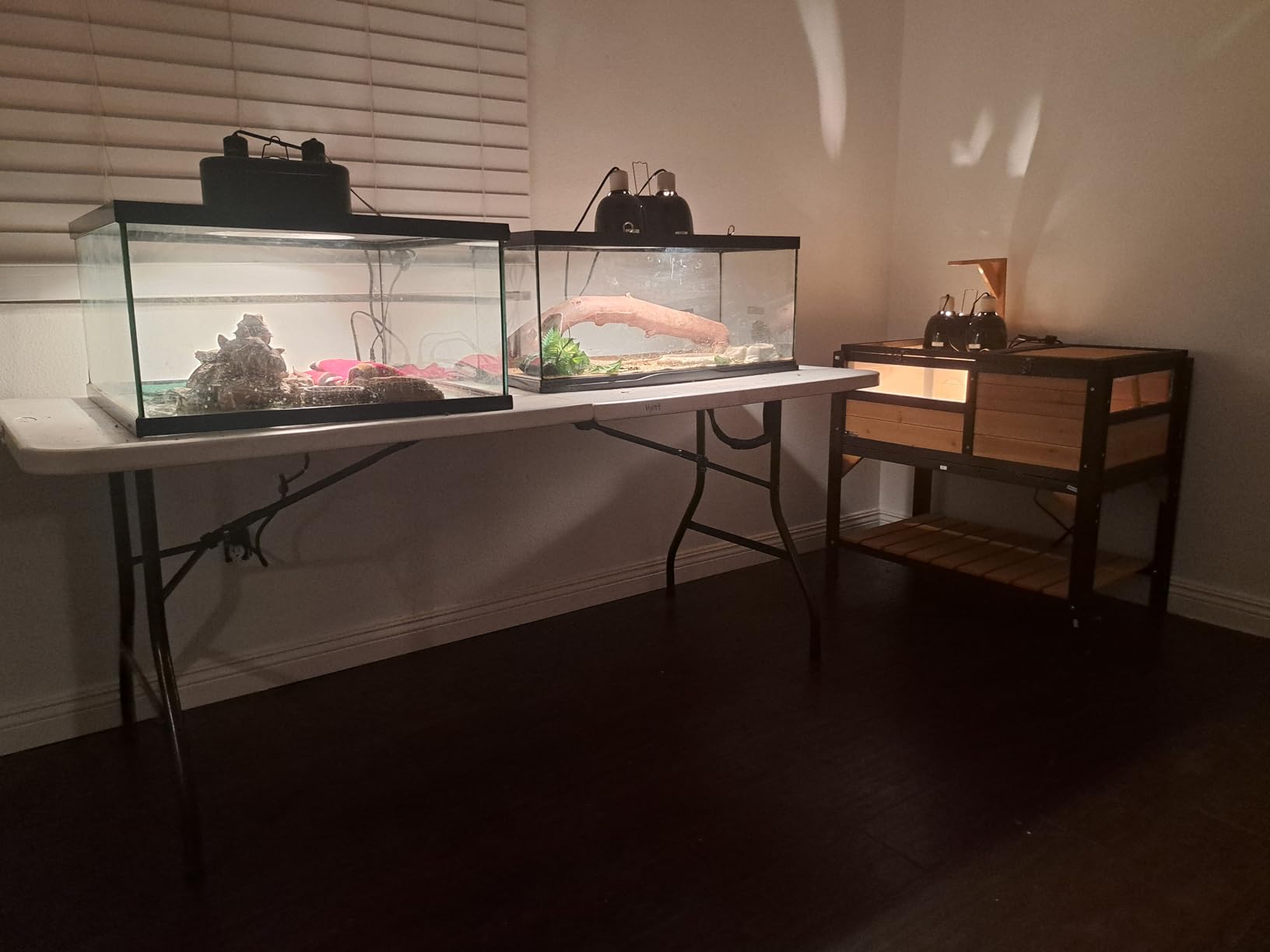
The base is a solid plastic pan, so bedding does not fall through and the whole thing wipes down. The upper section is split into a hide box measuring 12.5 by 17.25 by 12.5 inches and a steel-grating basking area of 16.25 by 17.25 by 12.5 inches, with an integrated support frame above it for a heat lamp.
Be clear-eyed about scale. The internal footprint suits a juvenile, and a tortoise bigger than your palm will outgrow it faster than most buyers expect. Some owners also report that the bottom tray is not as removable as the listing implies, so factor that into your cleaning routine.
Who this enclosure suits?
A first-time keeper with a hatchling, a quarantine setup for a new arrival, or anyone who wants a second small pen alongside a larger adult enclosure. The build time is short enough that a single person can have it running the same afternoon.
The shelf also makes it a sensible second purchase, since it doubles as storage for the main enclosure.
Where it falls short?
Soft wood splits. Owners report panels splintering or breaking while driving screws, so assemble on a soft surface and go slowly. The divider also does not sit flush with the base pan, which is where bedding ends up outside the enclosure.
Plan on buying a larger pen within a year. This is a starter unit, and treating it as a long-term home is how keepers end up with a cramped animal.
6. PetsCosset Two-Room Habitat – Best for Hatchlings and First-Time Assembly
PetsCosset Tortoise Habitat with Detachable Legs, Wooden Indoor & Outdoor Turtle Enclosure, Two-Room Reptile House, Large Observation Windows, Removable Pull-Out Tray, for Tortoises
37.2 x 22.8 x 32.3 inches
Model TOR01-02
Two-room layout
Three acrylic windows
Pros
- Numbered parts and hardware make single-person assembly straightforward
- Soft light wood will not crack when screws are driven in
- Removable tray and two-tier tray system speed cleaning
- Three large acrylic windows for monitoring
- Three size options let you match the animal
Cons
- Trays sit loose against the walls and need extra pieces
- Uneven panel lengths let humidity escape and substrate fall through
- Thin wire mesh top cannot carry a heat lamp
Where the PawHut is about furniture, the PetsCosset is about assembly. Parts and hardware are numbered, which sounds trivial until you are building it alone in a small flat. It comes in three lengths, 37.2, 39 and 40.4 inches, so you can size to the animal rather than replacing a pen in a year.
The wood is light and soft, which is the quiet advantage here. Soft boards do not crack when a screw is driven slightly off-centre, and the whole unit is easy to lift and reposition. The layout is a resting area and a play area, with three transparent acrylic observation windows so you can check on the animal from most angles.
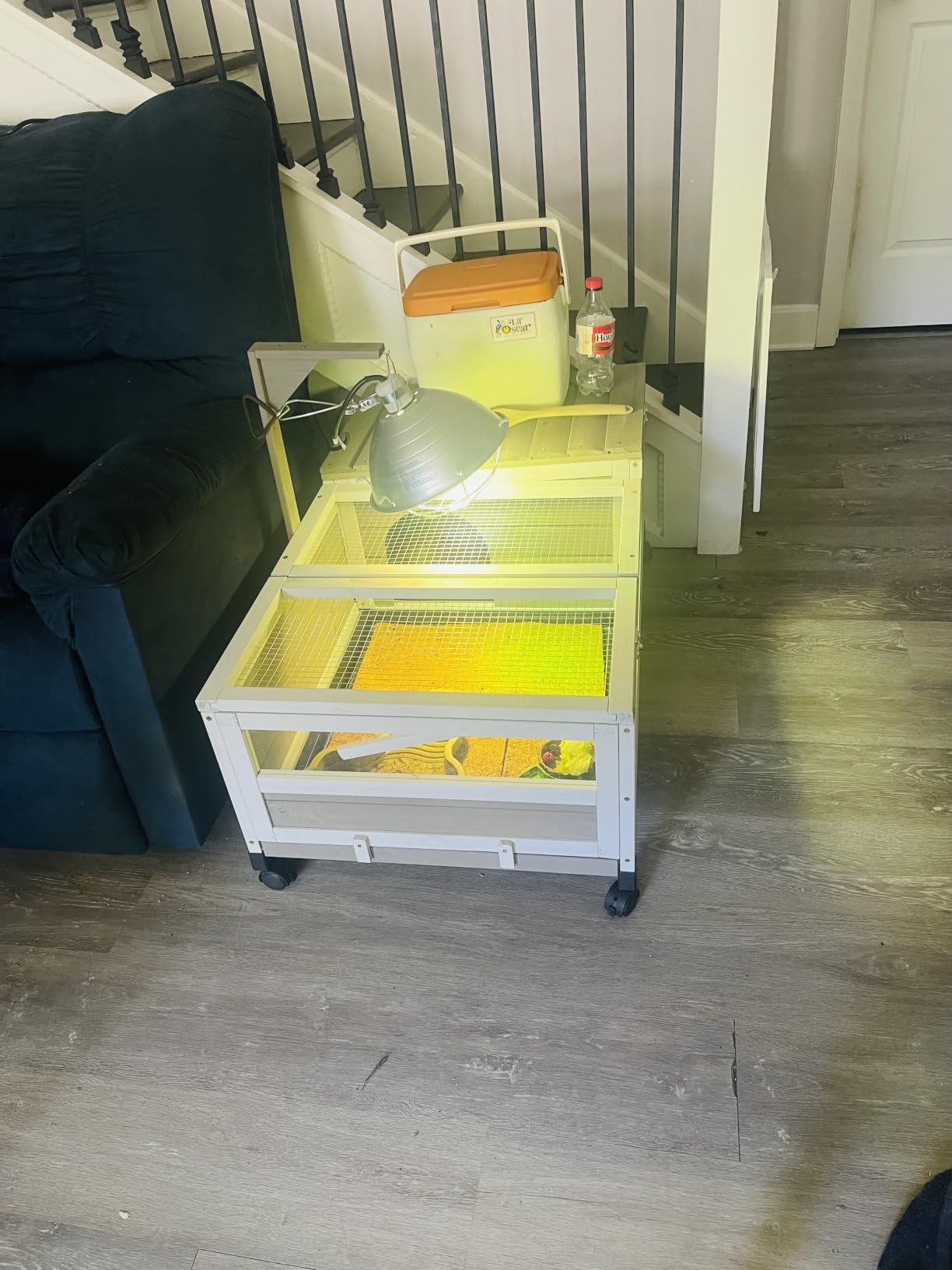
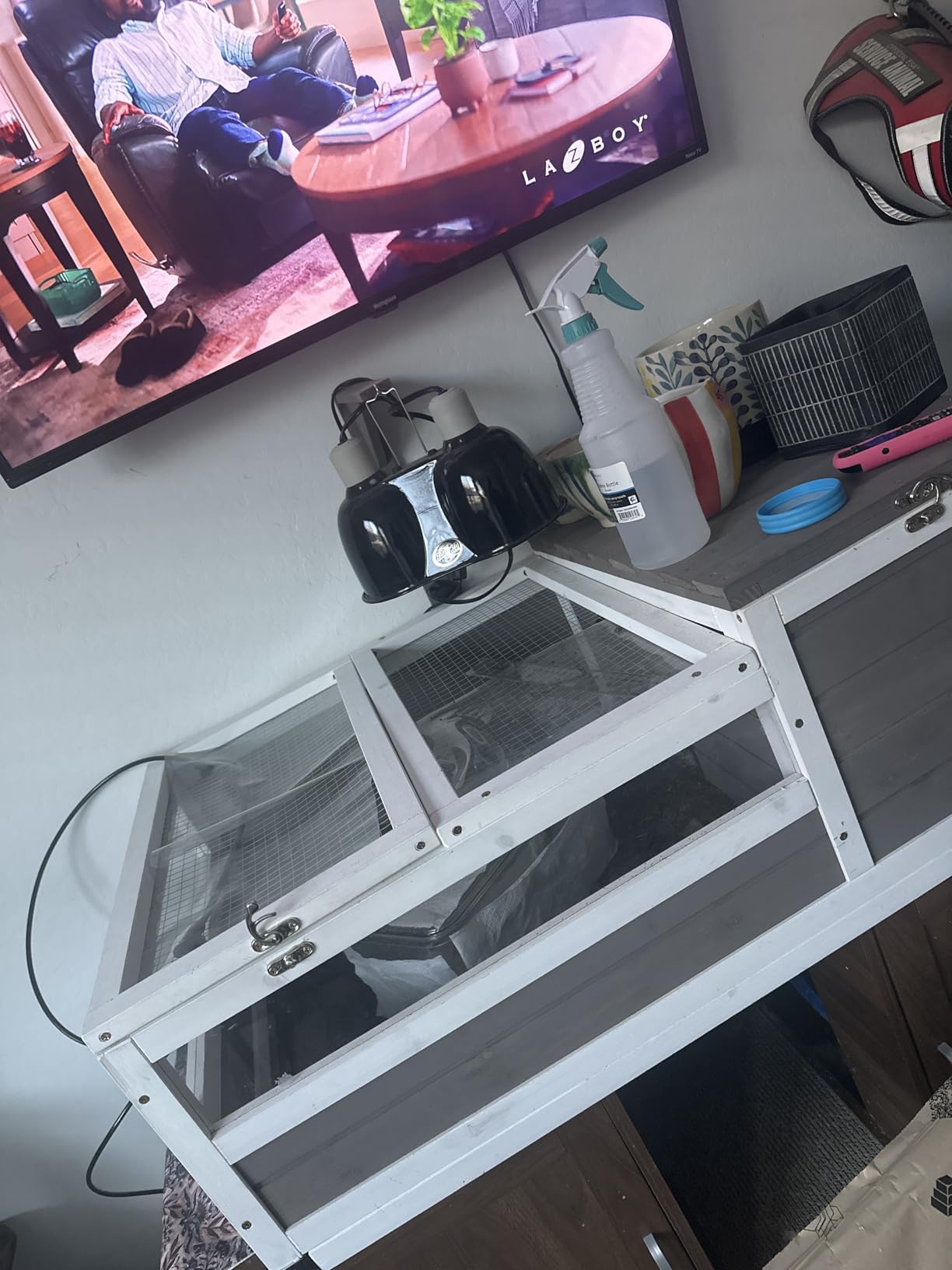
The removable plastic tray and two-tier tray arrangement mean waste pickup and full substrate changes are quick. Owners repeatedly praise the labelled assembly and low weight, and many find it good value for a young tortoise.
The complaints are consistent across this brand and worth knowing before you build it. Trays do not sit flush against the walls and can slide off the ledges, and uneven panel lengths leave gaps where humidity escapes and substrate drops through. The wire mesh top is also too thin to support a heat lamp directly, so you need a separate stand.
Who this enclosure suits?
This is the pick for a hatchling or a very young juvenile, and for anyone who is not confident with flat-pack furniture. The three size options also make it the natural choice if you want one brand across a quarantine pen and a young animal pen.
It suits temperate species comfortably. Add a humid hide in one corner if the animal is small enough to need one.
Where it falls short?
Construction tolerances are the issue. Expect to add small trim pieces around the tray ledges and to seal panel gaps if humidity matters in your setup. That is an evening of work, and it is predictable work.
Do not hang a heat lamp from the top mesh. Buy a stand, and treat the mesh as ventilation only.
7. Magazoopet Wooden Habitat – Best for Secure Locks and Fast Cleaning
Tortoise Enclosure Indoor Outdoor, Wooden Habitat with Detachable Legs
37 x 23 x 32 inches
23 pounds
Two removable trays
Locks top and bottom
Pros
- Two removable trays make waste pickup and substrate changes fast
- Top and bottom locks plus metal mesh keep the animal contained
- Highest-rated build in this roundup
- Furniture-style finish looks good indoors
- Frame fully collapses and detachable legs move easily
Cons
- Some panels are not flush and can crack
- Printed assembly numbers stay visible on the wood
- Less rigid than heavier builds
- Some units arrive scratched
This is the one we would trust most for containment. It is the only habitat here with locks at both the top and the bottom, paired with a metal mesh cover, and that combination is what stops the escape attempts that plague open pens. Tortoises are excellent at finding a corner and pushing against it.
Cleaning is the other headline. Two removable bottom trays mean you can strip one half while the animal sits in the other, which is a real advantage during the daily spot-clean that indoor keeping demands. At 37 by 23 by 32 inches and 23 pounds, it is also a manageable size to move.
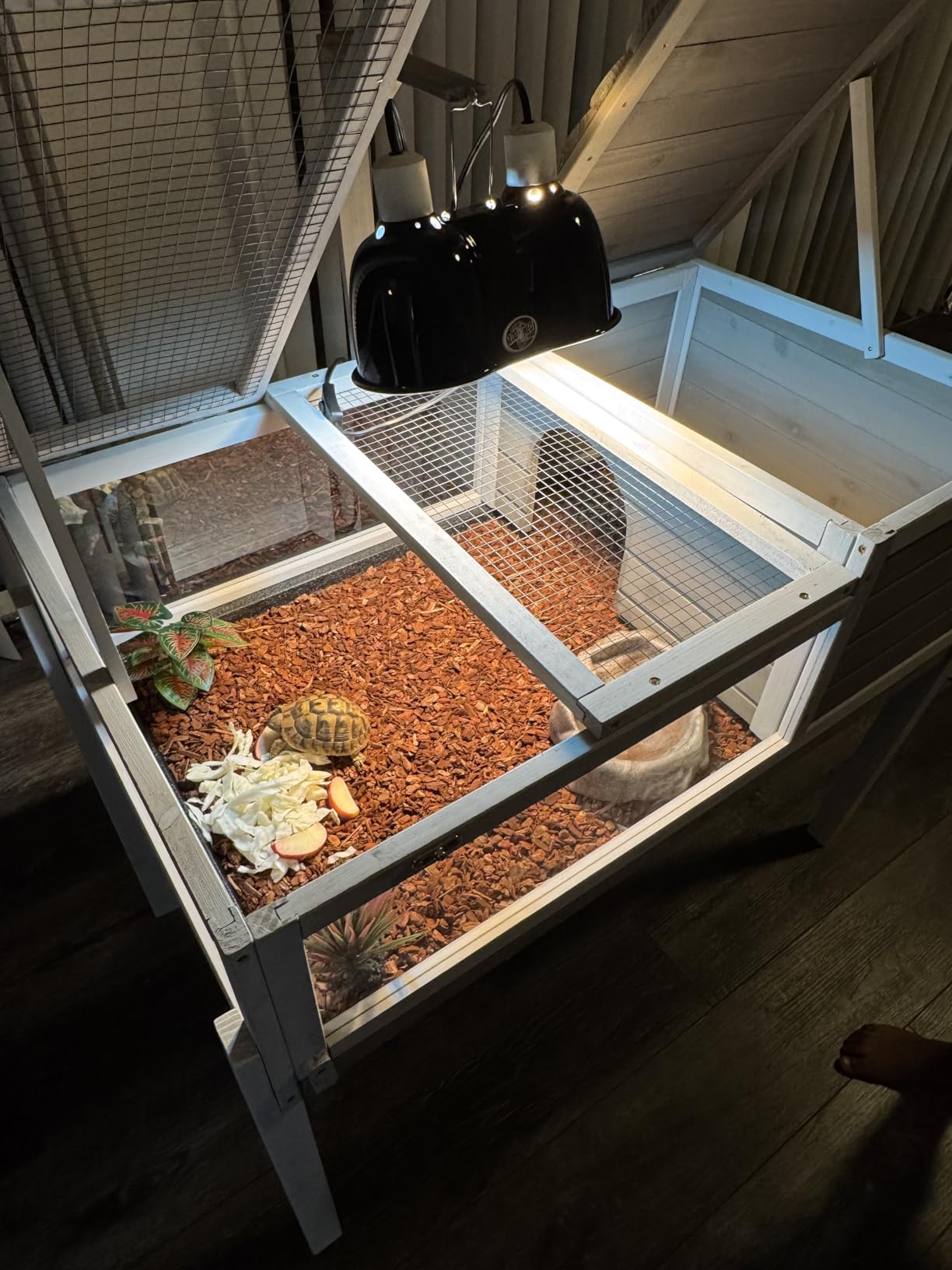
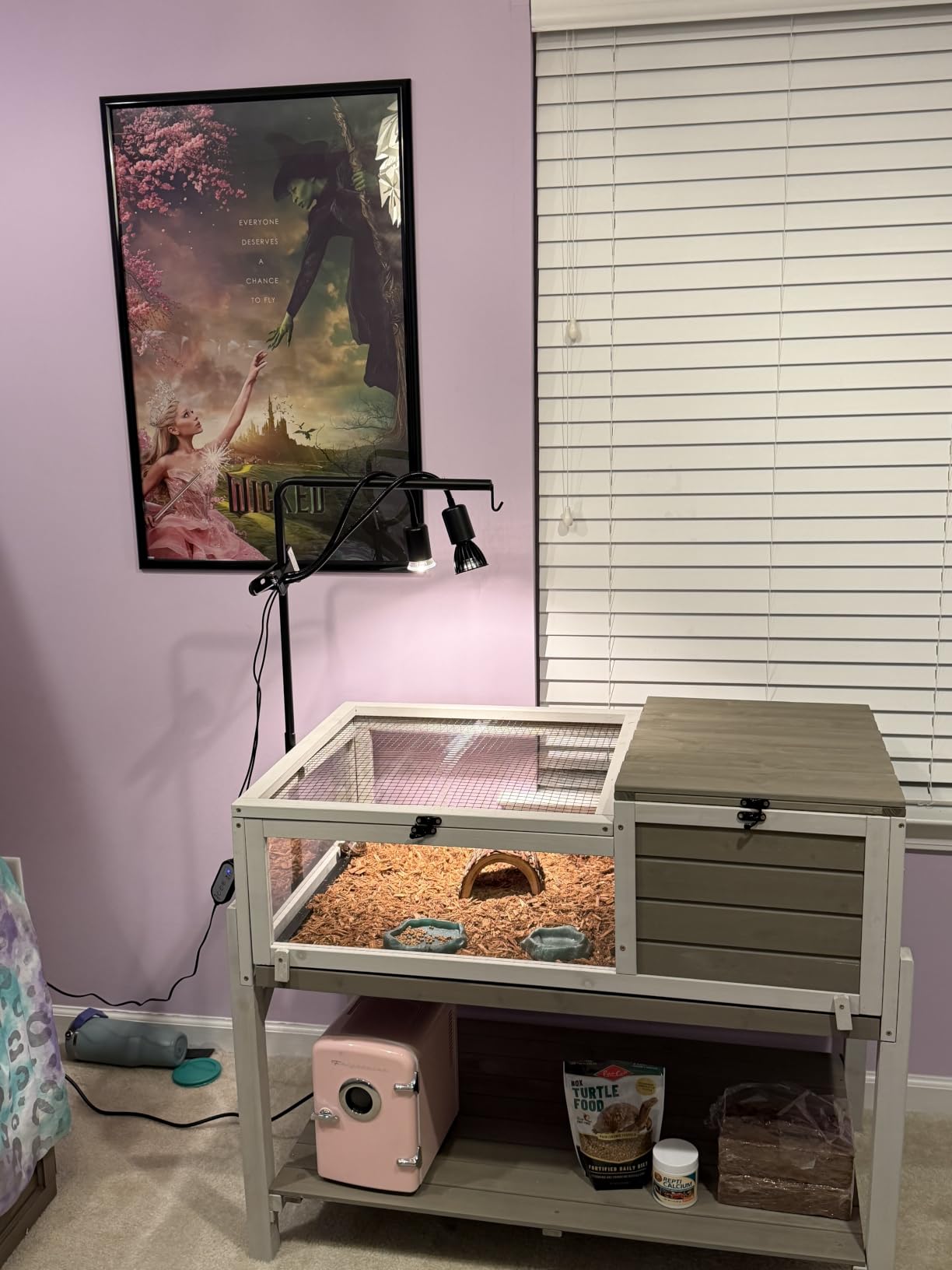
Owners rate it highest in this roundup, with roughly three-quarters of reviews at five stars, and the finish is furniture-grade enough for a living room. The frame collapses fully and the legs detach, so it packs down for storage or a move.
There is a lamp base on top for a heat bulb, which is a basic provision compared with the adjustable hardware on the Aivituvin. For finer control, add an external stand.
Who this enclosure suits?
Pick this if escape prevention is your top concern, or if you have a tortoise that is a determined digger. The locks also make it easier to contain an animal while you clean, move or treat it.
It suits small and medium animals in a temperate home. The two-tray system is particularly good for a keeper who works from home and cleans in short sessions.
Where it falls short?
Finish quality is inconsistent. Boards are not always flush, some panels crack, and units sometimes arrive scratched. Blue assembly numbers printed onto the wood will not come off, so do not expect a flawless decorative surface.
It is less rigid than the heavier fir builds, and some buyers describe it as feeling light for its size. Fine for a juvenile, worth checking if your animal is a strong digger.
8. VEVOR Cedar Tortoise Habitat – Best for Built-In Storage, With a Wood Warning
VEVOR Tortoise Habitat, Cedar Wooden Tortoise House Indoor & Outdoor, Tortoise Enclosure with Light Stand, Reptile Enclosure Small Animal Cage with Stand Legs for Gecko, Lizard, Snake
33 x 19.7 x 32.5 inches
26.46 pounds
Storage shelf
Integrated light stand
Pros
- Two clearly separated rooms for sleeping and activity
- Heavy-duty storage shelf under the leg frame
- Pre-drilled holes make assembly about 40 minutes
- Caster leg variant available for moving the habitat
- Sizing matches what is advertised
Cons
- Cedar is a resinous softwood that owners warn can cause breathing problems
- Some panels split despite pre-drilled holes
- Bottom tray bows under substrate without internal support
- Included light fixture design needs modification
We are including this one with a clear warning rather than quietly dropping it, because the cedar is a genuine safety question. Cedar is a resinous softwood, and multiple owners of tortoise enclosures built from it report respiratory problems in their animals. If you already own one, air it out fully and consider lining the interior.
On build quality, the room layout is the strongest part. One chamber is solid-topped for sleeping and the other is mesh-fronted for activity, and the leg frame carries a heavy-duty storage shelf underneath. The integrated light stand is a nice touch, and a caster leg variant exists if you need to move the unit.
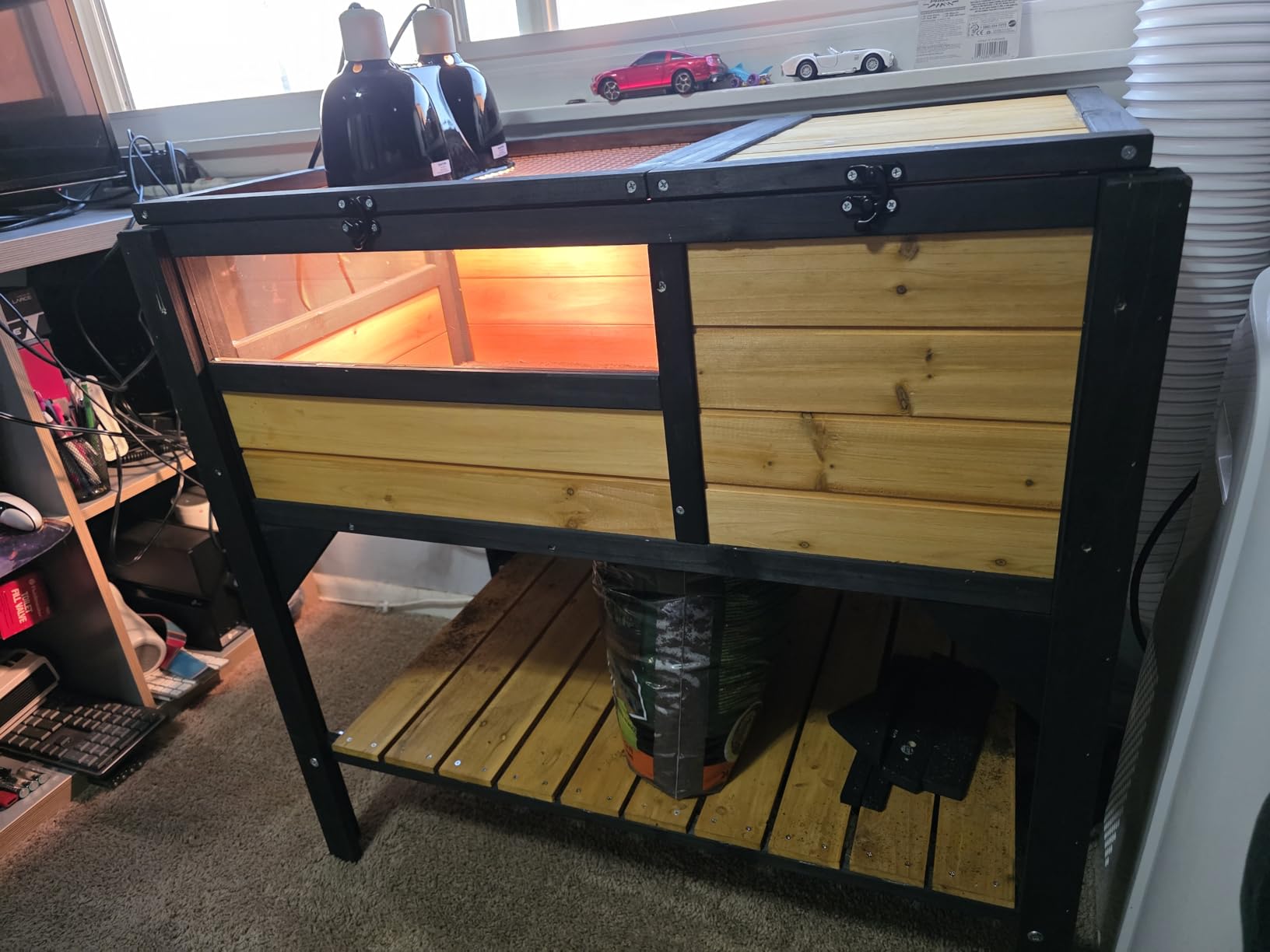
Assembly is around 40 minutes with pre-drilled holes, and buyers confirm the 33 by 19.7 by 32.5 inch sizing is accurate. That accuracy matters, because one of the most common complaints in this category is a habitat that arrives smaller than the listing implies.
The two flaws to know about are structural. Some panels split despite the pre-drilled holes, and the bottom tray has no internal support, so it bows under the weight of a deep substrate layer. Add a flat board under the tray before you fill it.
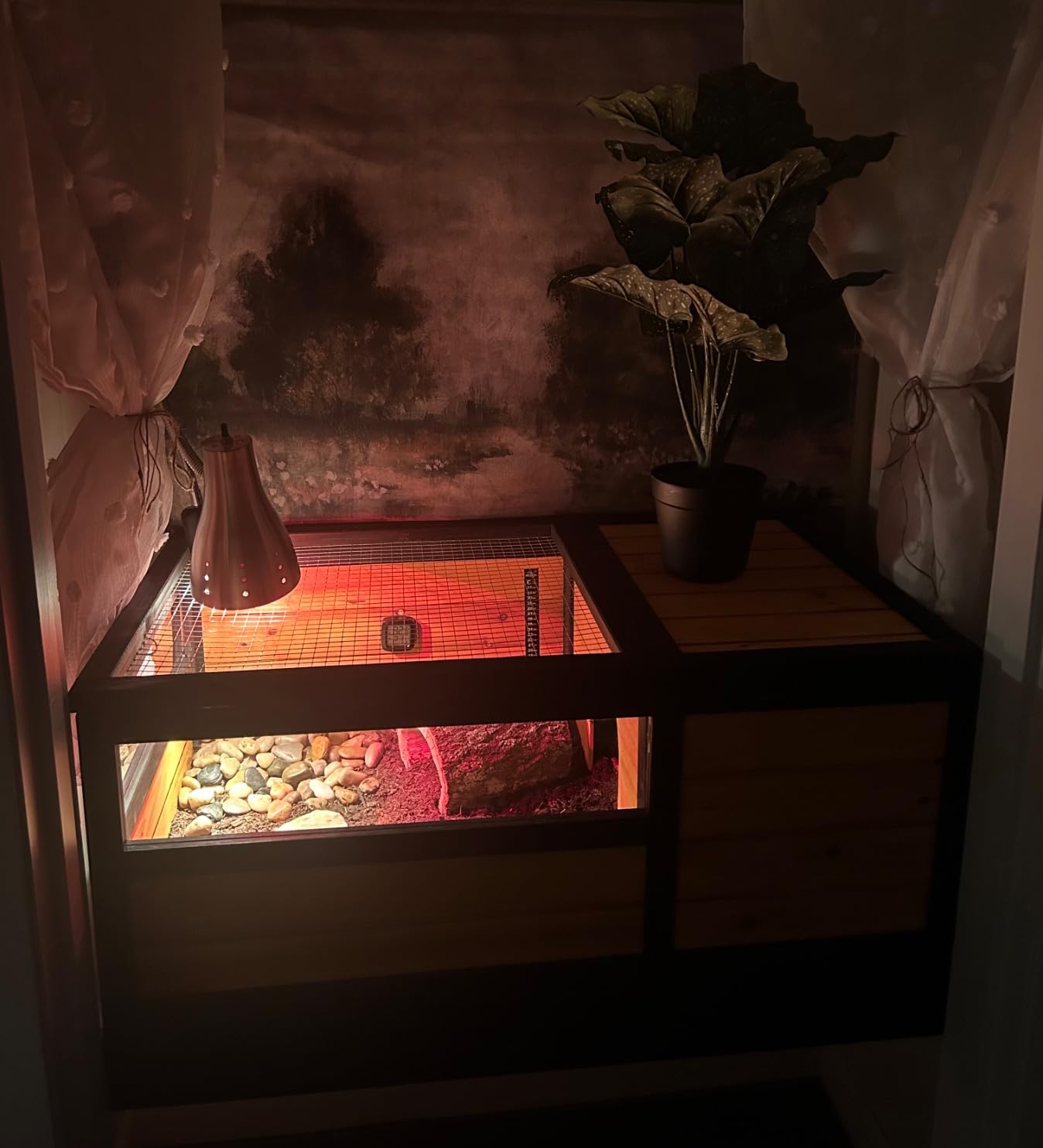
Who this enclosure suits?
With the cedar question set aside, the layout and under-shelf storage suit a temperate species in a home where floor space is tight and you want storage built into the pen. The caster option is useful for anyone who moves the enclosure between rooms.
It is also a reasonable second pen for a young animal in a multi-tortoise home, provided you monitor the wood closely.
Where it falls short?
The cedar is the reason this is not higher in the ranking. Several buyers say they wish they had checked the wood species before buying, and respiratory trouble in a tortoise is slow to identify and slow to resolve.
The unsupported tray and the awkward light fixture both need modification. Count on a modification session after assembly.
9. PawHut 2-Layer Habitat – Best for Deep Cleaning Access
PawHut Tortoise Habitat with Adjustable Lamp Holder, 2 Layer Tortoise Enclosure with Storage Shelf, Removable Main House, Fixed Tray, Openable Lid, Gray
40.2 x 22 x 40.9 inches
34 pounds
Removable main house
Adjustable lamp holder
Pros
- Removable main house lifts out for a proper deep clean
- Two levels with a ramp let the tortoise climb between hide and run
- Well-routed joints feel solid without being unmanageably heavy
- Bottom shelf stores food and supplies
- Arrives well packaged with all parts intact
Cons
- Open top makes humidity retention impossible
- Fixed central ramp cannot be moved and traps mess beneath
- Instructions mislabel some parts
- No assembly tools included
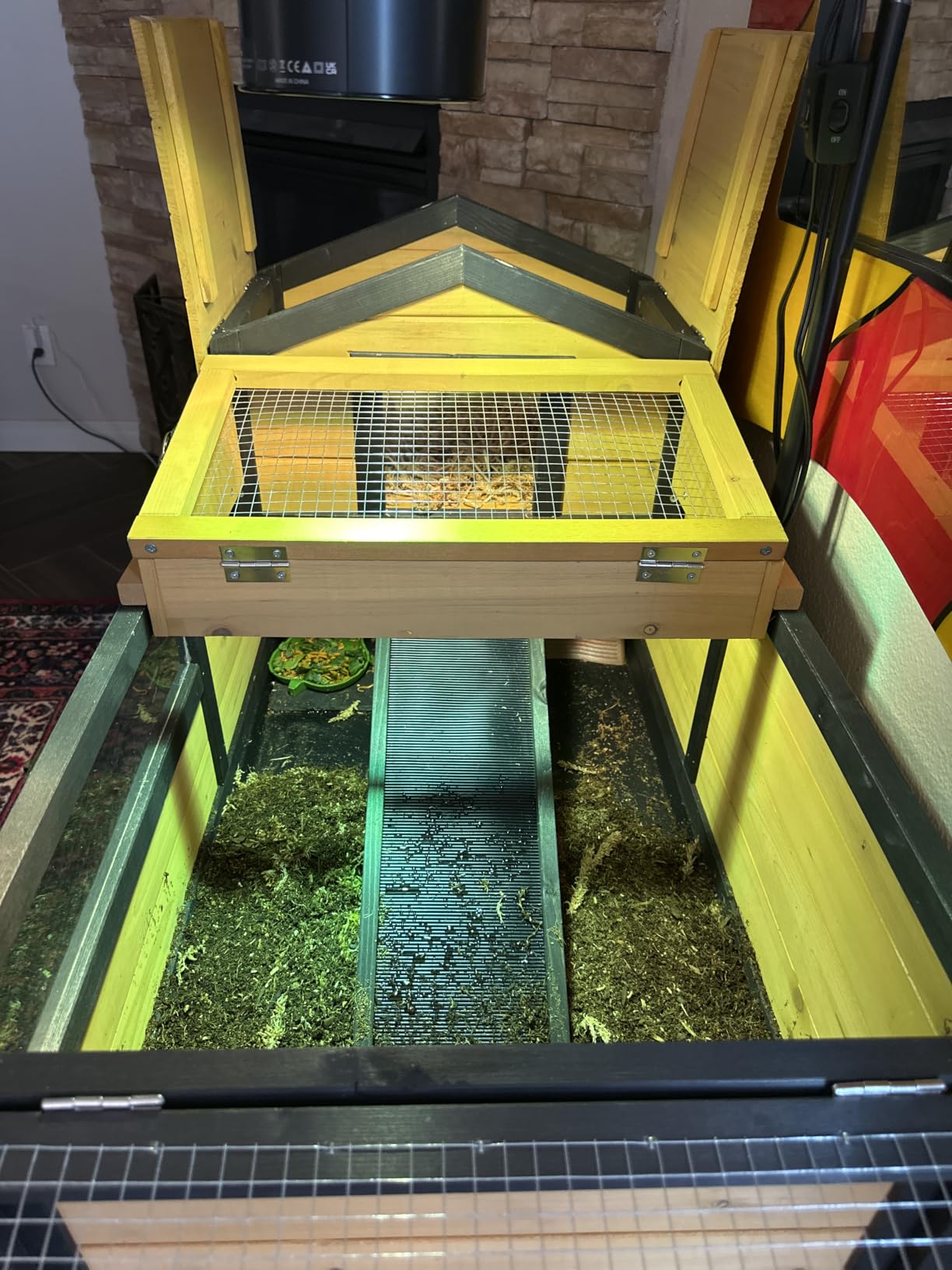
The design feature that sets this PawHut apart is the removable main house. It lifts out entirely, so the upper chamber can be washed properly instead of being wiped around. For a habitat that gets cleaned daily, that beats a larger floor area you can never reach underneath.
It is a dual-level setup with a main house and a lower run box connected by a ramp, so a small tortoise can climb between an upper hide and an open floor below. The adjustable lamp holder takes heat and light, and an attached plastic tray stops water and sand leaving the enclosure.
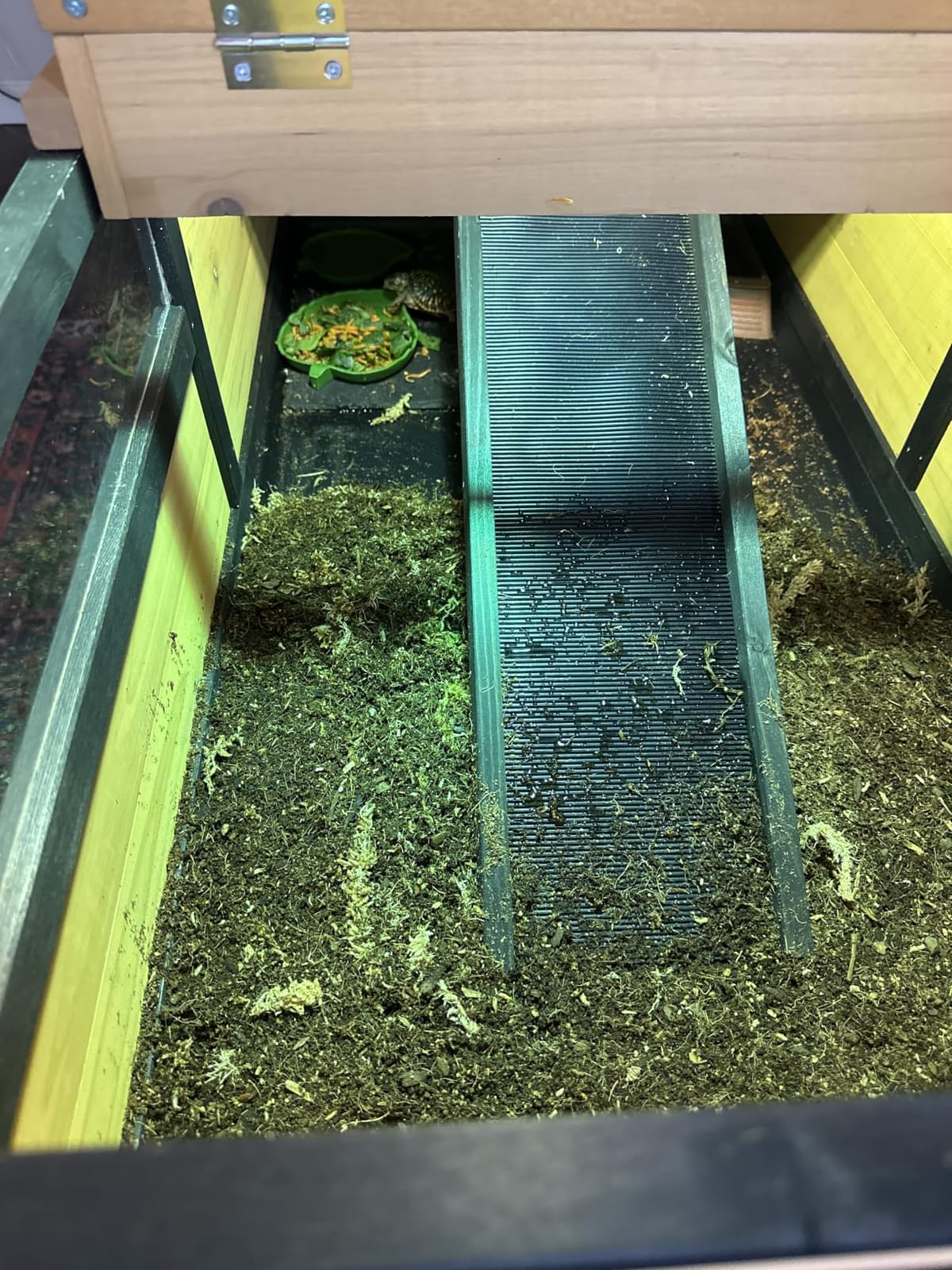
At 40.2 by 22 by 40.9 inches and 34 pounds, it is the largest wooden build here by height. Owners report happy tortoises using both levels and like the well-routed joints, which feel solid without making the unit impossible to lift.
Two things work against it. The ramp is fixed in the centre and cannot be moved, so you cannot clean beneath it, which is exactly the sort of gap where waste hides. And the open top makes humidity retention impossible without a cover you add yourself.
Who this enclosure suits?
This suits a keeper who wants a genuinely washable habitat rather than a wipe-down one. The removable house makes it practical for an animal that produces a lot of waste or for anyone treating an animal and needing full access.
It also works as a display piece, since the two levels look better than a flat box in a room. A bottom shelf keeps supplies in one place.
Where it falls short?
The fixed ramp is the real limitation. It cannot be lifted, so the space beneath it stays dirty, and that is a genuine sanitation compromise in a humid indoor setup.
Plan on buying your own tools, because none are included, and expect minor labelling errors in the instruction sheet that slow assembly down.
10. FunXplore Habitat with Hygrothermograph – Best for Monitoring Temperature and Humidity
Tortoise Enclosure Turtle Cage Indoor Reptile for Small Animals Lizards
38 x 23.8 x 32.1 inches
24.78 pounds
Built-in hygrothermograph
Press-button lamp stand
Pros
- Built-in hygrothermograph tracks temperature and humidity without a separate meter
- Press-button adjustable lamp stand changes height without tools
- Detachable legs put the habitat at table height
- Two-room layout separates sleeping from viewing space
- Screw-in tray makes cleaning quick
Cons
- Open wooden and mesh build cannot maintain high humidity
- Listing does not detail the wood species or panel locking
The FunXplore’s differentiator is a built-in hygrothermograph mounted in the enclosure wall. You get temperature and humidity readings without buying a separate meter or guessing whether the basking end is hot enough, and for indoor keeping in a cold apartment that is more useful than it sounds.
Most indoor heat problems are diagnosed too late, when the tortoise has already stopped basking properly. A wall-mounted meter lets you check the gradient twice a day in five seconds and adjust the lamp before it becomes a health problem.
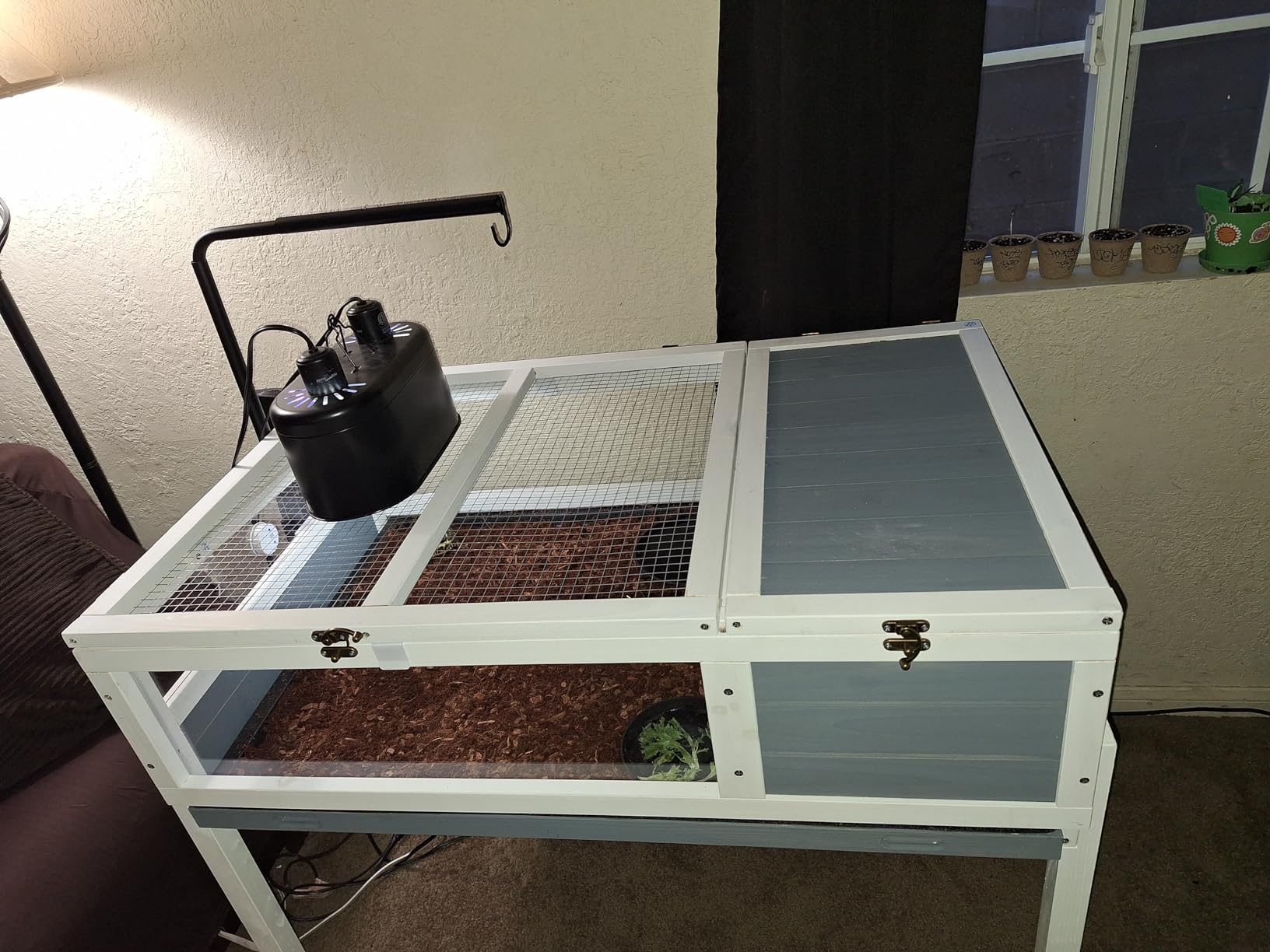
The press-button lamp stand adjusts from 11 to 31 inches tall and spans 13 to 21.1 inches in length without tools, so changing the basking height as the animal grows takes a press rather than a screwdriver. At 38 by 23.8 by 32.1 inches and 24.78 pounds, it is a well-proportioned size.
As with the other wooden designs, the ventilated construction rules it out for tropical species. The listing is also vague about wood species and panel locking, so check both before committing.
Who this enclosure suits?
This suits a beginner who is still learning what a proper thermal gradient looks like, because the meter shows the numbers rather than leaving you to interpret behaviour. It also works for anyone in a poorly insulated home where overnight heat loss is the recurring worry.
The two-room layout and detachable legs make it flexible for a temperate species kept on a table during the day.
Where it falls short?
The built-in meter is a monitoring aid, not a fix. It tells you the enclosure is too dry or too cold; it does not make the enclosure hold heat or moisture better than any other open wooden design here.
Ask the seller which wood is used before you buy. Unspecified species in a reptile enclosure is a reasonable question to ask.
How to Choose an Indoor Tortoise Enclosure?
How big should an indoor tortoise enclosure be?
Size the enclosure to the adult shell length of your tortoise, not to the hatchling you were sold. A rough rule used by experienced keepers is at least 4 square feet of floor for a single small temperate adult, and more is always better. Here is the mapping we use:
Hatchling under 3 inches shell: 2 by 2 feet is workable while very young
Small adult 3 to 4 inches shell, such as a Russian or Hermann’s: 2 by 4 feet as an absolute floor
Medium adult 4 to 6 inches shell: 3 by 4 feet or larger
Large tropical adult 6 inches and over, such as a red-footed tortoise: 4 by 4 feet or more, plus vertical space
Account for what the substrate and furniture take away. A pen with a large hide, deep substrate and a basking zone at one end gives the animal far less usable floor than the dimensions on the box suggest.
Which tortoise species actually suit indoor keeping?
Russian and Hermann’s tortoises are the usual first choice for a temperate apartment, and marginated is close behind. A red-footed tortoise suits permanent indoor housing better than most species because it wants consistent warmth and humidity, though it needs a large enclosure. Sulcatas are the exception: experienced keepers on Tortoise Forum generally advise that they live outdoors year-round once they reach roughly 8 to 10 inches of shell length, and they are a poor choice for full-time indoor housing.
Always buy captive-bred. Many animals in this trade are wild-caught, often parasitised, and a poor match for indoor life.
Is a tortoise table better than a glass vivarium?
A tortoise table is better for most indoor situations, and the difference comes down to airflow and heat distribution. A table is open-topped, so heat rises and disperses naturally and fresh air moves through. A glass vivarium traps warm, humid air and creates a still environment that encourages glass-rubbing and respiratory problems.
Glass does have one real advantage: it retains heat and moisture. That makes a glazed enclosure workable for a tropical species or a cold room, provided you add ventilation. The best answers to the open-versus-closed question are found on keeper forums, and the reasoning matches ours exactly.
How do you set up heating and a basking spot?
Heat comes from an overhead basking lamp positioned at one end of the enclosure, creating a gradient from warm at the basking spot to cool at the far end. A thermostat is what makes this safe and stable. Measure the temperature at animal height under the basking spot and at the cool end before you trust the lamp dial.
If you need supplemental night heat, ceramic heat emitters are the option experienced keepers recommend, and they are safer than a bare bulb for overnight use. If your enclosure has no lamp hardware, which several here lack, an external adjustable stand solves the problem entirely.
Cold-climate keepers report overnight heat loss as their single biggest struggle. Closing off a closet with curtains is a common and effective fix, and it is the same approach described in our piece on protecting equipment in cold conditions without electricity.
Do tortoises need UVB indoors?
Yes, and this is the one piece of equipment not to compromise on. A linear T5 HO UVB lamp mounted above the enclosure is the standard choice because it spreads UV across the whole floor area rather than concentrating it in a spotlight, which is what causes a tortoise to hide from the light. Expect to replace the lamp roughly every 6 to 12 months, since UV output drops long before the bulb visibly fails.
A sunny windowsill is not a substitute. Glass blocks most of the useful UV, and it also creates hot and cold spots that cause overheating.
How do you manage humidity and misting?
Tortoises do not need to be misted the way amphibians do. What they need is correct humidity for the species, achieved through enclosure design, substrate and a moist hide rather than a spray bottle. A damp hide is the single most useful addition to a dry open pen, and it is what hatchlings and tropical species use.
Material drives humidity more than anything else. Glass and plastic tubs hold moisture; open wood and mesh do not. A tabletop greenhouse fitted over a container is described by keepers as a practical fix for baby-tortoise humidity, and it works because it adds a closed layer without sealing the whole pen.
What substrate and how deep?
Use a soil-based mix, not sand. Keepers consistently flag sand as a problem: it does not hold moisture, it packs down, and ingested grit contributes to impaction and shell deformities. Aim for enough depth that the tortoise can bury itself completely in the cool end, which also gives it somewhere secure to sleep.
Deep substrate is the main defence against escape. A tortoise that buries itself at night is not climbing out of the pen at night.
How do you stop a tortoise escaping?
Four things matter. First, depth of substrate, as above. Second, a solid base rather than slats, so there is no gap underneath. Third, a lip or lock, and the Magazoopet is the only habitat here with both. Fourth, and this is the insight keepers share most often, block the animal’s line of sight out of the pen, because tortoises ram a barrier they can see through but calm down when they cannot.
That last point applies to glass panels and to any enclosure with a viewing window at ground level.
What live plants are safe in a tortoise enclosure?
Safe choices include dandelion greens, plantain, endive, romaine, collard greens and most untreated leafy garden weeds. Avoid anything sprayed, anything from a florist, and anything you have treated with pesticide. Place plants on the cool side of the enclosure rather than under the basking lamp, where they wilt quickly, and remove anything the tortoise has clearly finished with.
Live plants are a supplement, not the diet. We covered a similar approach to forage variety in our guide to mixing animals of different sizes in one space.
Do tortoises smell in the house?
Generally no, and odour is almost always a substrate or water problem rather than the animal. Turtles and tortoises are not noticeably pungent. A strong smell means waste is sitting too long, the water dish is not being changed daily, or the substrate is staying wet and warm in one corner.
Spot-clean twice a day, change the water every day, and do a full substrate change on a schedule. With a pull-out tray, as most of these enclosures have, that routine takes minutes.
What do you do when the tortoise outgrows the pen?
Most tortoises do outgrow their enclosure, and the escalation path is worth planning early. Step one is moving up in size within the same style of habitat. Step two, for a temperate species, is adding outdoor time with a secure pen and a night box for overnight shelter. Step three, for a sulcata or any tortoise past roughly 8 to 10 inches of shell length, is a dedicated outdoor enclosure.
Building the pen at half the final size and planning the upgrade path is cheaper than replacing a habitat twice. That is one reason our top pick, the GEGURI, works well for small and medium animals: it is big enough to delay that first move.
Frequently Asked Questions
Is it okay to keep a tortoise indoors?
It is a workable compromise for several species, not an ideal. Russian, Hermann’s and marginated tortoises are commonly kept full-time indoors with correct heat, UVB and floor space. A red-footed tortoise suits indoor housing better than most because it wants consistent warmth and humidity. Sulcatas are a poor choice, since keepers generally advise outdoor housing once they reach 8 to 10 inches of shell length.
Which small tortoise breed is best for an indoor enclosure?
The Russian tortoise is the usual first choice, followed closely by the Hermann’s and the marginated. All three stay small, tolerate a temperate indoor climate and do not need the constant warmth a tropical species requires. Buy captive-bred individuals, since wild-caught animals are often parasitised and struggle to adapt.
How big should an indoor tortoise enclosure be?
Size to adult shell length rather than to the hatchling you were sold. A single small temperate adult needs at least 4 square feet of floor, and 2 by 4 feet is the practical floor. Hatchlings can start in a 2 by 2 foot pen, medium adults 4 to 6 inches need 3 by 4 feet, and tropical adults need 4 by 4 feet or more.
What size should a tortoise table be?
A 2 by 4 foot table is the minimum most keepers accept for one small adult temperate tortoise, and a 3 by 4 or 4 by 4 foot table is the more realistic long-term answer. Subtract the space taken by the hide, the basking zone and the substrate when judging usable floor area, and buy for the adult size the animal will reach.
Is a tortoise table better than a vivarium?
For most indoor situations, yes. An open-topped table gives far better airflow and lets heat rise and disperse, while a glass vivarium traps still, humid air that encourages glass-rubbing and respiratory problems. Glass does retain heat and moisture, so it can suit a tropical species or a cold room if you add ventilation panels.
What is the best enclosure for a tortoise?
An open-topped wooden tortoise table with a solid base, detachable legs and a pull-out tray is the best all-round indoor enclosure. It holds deep substrate, ventilates properly and takes an overhead basking lamp. For hatchlings needing humidity, keep the same style but add a closed moist hide, or use a plastic tub with a fitted lid section.
Can a tortoise live in a tortoise table?
Yes. A wooden tortoise table is the standard indoor setup for temperate species, and the design exists specifically for that use. The table should be solid-based, deep enough to hold several inches of soil-based substrate, and fitted with an overhead basking lamp and a separate linear UVB lamp to create a proper thermal gradient.
What live plants are safe to put in a tortoise enclosure?
Safe options include dandelion greens, plantain, endive, romaine, collard greens and most untreated garden weeds. Avoid anything from a florist and anything sprayed with pesticide. Place live plants on the cool side of the enclosure away from the basking lamp, and remove any the tortoise has clearly eaten through.
Do tortoises like being misted?
Not in the way amphibians do. Tortoises do not absorb water through their skin, so misting adds little. What they need is correct humidity for the species, achieved through a moist hide, appropriate substrate and enclosure design rather than a spray bottle. Excess surface moisture is more likely to cause problems than help.
Do tortoises outgrow their enclosure?
Most do. The usual path is to move up in size within the same habitat style, then add secure outdoor time with a night box for temperate species, and finally move to a dedicated outdoor enclosure for a sulcata or any tortoise past roughly 8 to 10 inches of shell length. Planning the upgrade early is cheaper than replacing a pen twice.
Do tortoises smell in the house?
Generally no. Tortoises are not noticeably pungent, and a strong odour almost always means waste is sitting too long, the water dish is not being changed daily, or the substrate is staying damp in one corner. Spot-clean twice a day, change the water every day, and change substrate on a set schedule.
The Verdict: Which Indoor Tortoise Enclosure Should You Buy?
The GEGURI wooden tortoise habitat is our pick for the best indoor tortoise enclosure in 2026. It has the most review history of anything in this roundup, the solid base and pull-out tray that other wooden habitats lack, detachable legs that make it work at table height or on the floor, and the lightest build of the ten, which matters in an apartment.
Pick the Aivituvin instead if adjustable lamp positioning is your priority, the Penn-Plax if floor space is not a constraint and you want heat and moisture retention, the Magazoopet if escape prevention matters most, and the FunXplore if you are still learning to read a thermal gradient. Skip the cedar VEVOR unless you have checked the wood species and accepted the risk.
Whichever you choose, size it for the adult animal, block the outward line of sight, and budget for separate heat and UVB lamps. Those three decisions do more for a tortoise than any enclosure on this list.