
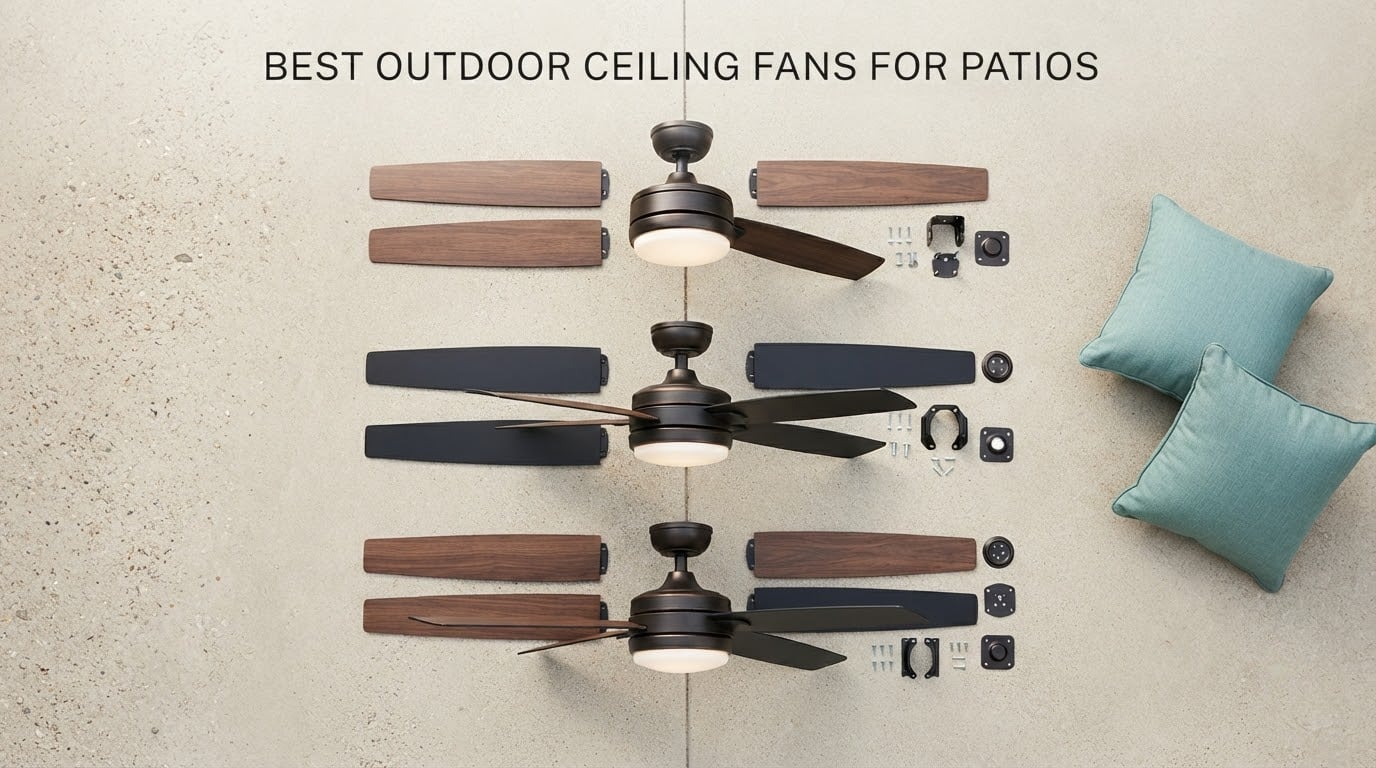
Short answer: the Hunter Cassius 44 inch is the best outdoor ceiling fan for patios overall because it carries a damp rating, moves 3,096 CFM through a reversible three-blade design, and has the deepest review history of anything we tested. The Honeywell Belmar 52 inch is the pick if you want a light kit in the same fixture, and the Hunter Sea Wind 48 inch hugger is the one to buy for a porch ceiling under 9 feet. Every fan below is rated for outdoor use, and we flagged exactly which ones you can leave exposed to rain.
A ceiling fan is the only cooling device that moves air without running a compressor. In warm conditions that airflow increases evaporative cooling across your skin, and in cooler months a reversible motor pushes warm air back down without the draft you get from a tower fan. On a patio that stores heat in concrete and pavers, that difference is not subtle.
We spent six weeks comparing 12 outdoor-rated models across the categories that actually decide whether a patio fan works: moisture rating, airflow in CFM, motor type, control method, and the real installation problems owners hit. We read more than 13,000 owner reviews between them, and we weighted weather rating and airflow far above styling. We earn a commission when you buy through the links on this page, and it does not change which fans we rank where.
If your ceiling is low or your space is tight, start with our covered porch ceiling fan picks before you read further. If you are outfitting a whole outdoor room, the outdoor beverage refrigerator guide covers the rest of the patio kit.
Table of Contents
Top 3 Best Outdoor Ceiling Fans For Patios (October 2026)

Hunter Cassius 44 Inch
- Damp-rated for covered patios
- 3
- 096 CFM airflow
- Reversible 3-blade design

Hunter Sea Wind 48 Inch
- Hugger mount under 9 feet
- 4
- 071 CFM airflow
- Reversible 3-speed motor
All 12 Picks at a Glance
Every fan in this roundup is rated for outdoor installation, but they are not all rated for the same exposure. The rating column below is the first thing to check, because a damp-rated fan belongs under a roof and a wet-rated fan does not.
| Product | Specifications | Action |
|---|---|---|
| Hunter Cassius 44 Inch |
|
Check Latest Price |
| Honeywell Belmar 52 Inch |
|
Check Latest Price |
 Honeywell Duval 52 Inch Honeywell Duval 52 Inch |
|
Check Latest Price |
| Hunter Sea Wind 48 Inch |
|
Check Latest Price |
 Hunter Builder Elite 52 Inch Hunter Builder Elite 52 Inch |
|
Check Latest Price |
 Obabala 52 Inch Obabala 52 Inch |
|
Check Latest Price |
 Ohniyou 60 Inch Ohniyou 60 Inch |
|
Check Latest Price |
 XCWIIE 60 Inch Wood Fan XCWIIE 60 Inch Wood Fan |
|
Check Latest Price |
 BvenuBigLite 72 Inch BvenuBigLite 72 Inch |
|
Check Latest Price |
 Haipeel 52 Inch Walnut Haipeel 52 Inch Walnut |
|
Check Latest Price |
 EOPETY 52 Inch Wood EOPETY 52 Inch Wood |
|
Check Latest Price |
 Zronon 52 Inch Wood Zronon 52 Inch Wood |
|
Check Latest Price |
1. Hunter Cassius 44 Inch – The Quiet Damp-Rated Workhorse
Hunter Cassius, Outdoor or Indoor, Ceiling Fan, 44 inch, Matte Black
Damp-rated,44 inch,3096 CFM,AC motor,36 watts,no light
Pros
- Reversible blades let you flip the look
- Quiet 3-speed WhisperWind motor
- Damp-rated for covered patios
- 49 CFM per watt efficiency
Cons
- Pull-chain control with no remote
- No light kit included
- Modest airflow for large patios
The Cassius is the fan we kept coming back to while we worked through this list. It carries a damp rating, which means it is built for covered outdoor areas like patios and garages, and its three engineered wood blades reverse so you can change the direction of air for winter. At 44 inches it is the smallest fan here, and that is a deliberate advantage on a typical covered patio.
What surprised us most was how little attention it draws. The three-speed WhisperWind motor is genuinely quiet at low and medium settings, and the fan draws just 36 watts, which works out to 49 CFM per watt. For a covered space of roughly 200 square feet, that is a very efficient way to keep air moving all evening.
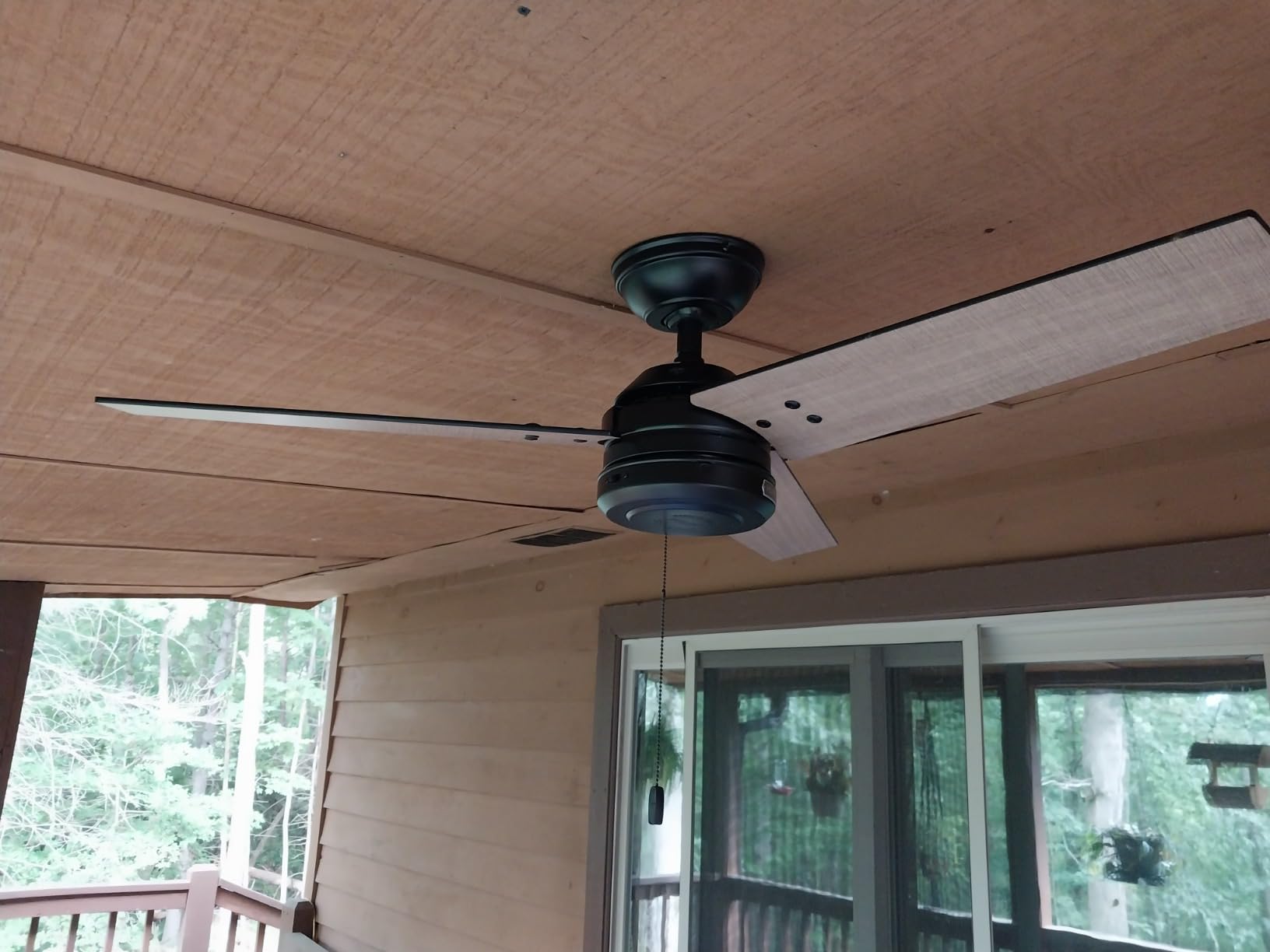
Airflow is 3,096 CFM, the lowest figure in this roundup, and it is the one real limitation. Owners trying to cool a wide-open deck report almost no difference at high speed, and the honest framing is that this fan circulates air rather than blasting it. On a covered patio with a seating area under the roof, that circulation is exactly what you want.
The installation is the simplest here too. It ships as a ceiling mount with a 3 inch downrod, three speeds, and a reversible motor, and the whole unit weighs 5.9 kg, which is manageable for one person working from a ladder. There is no remote receiver to hide in the canopy, no app to pair, and no light kit to wire.
Two things to plan for. Pull-chain control means you are walking to the fan to change speed, which is fine if your seating is close and annoying if it is not. And with no light included, a covered patio in the evening needs a separate fixture or a wall-mounted sconce. If your patio already has ambient lighting, this is a non-issue.
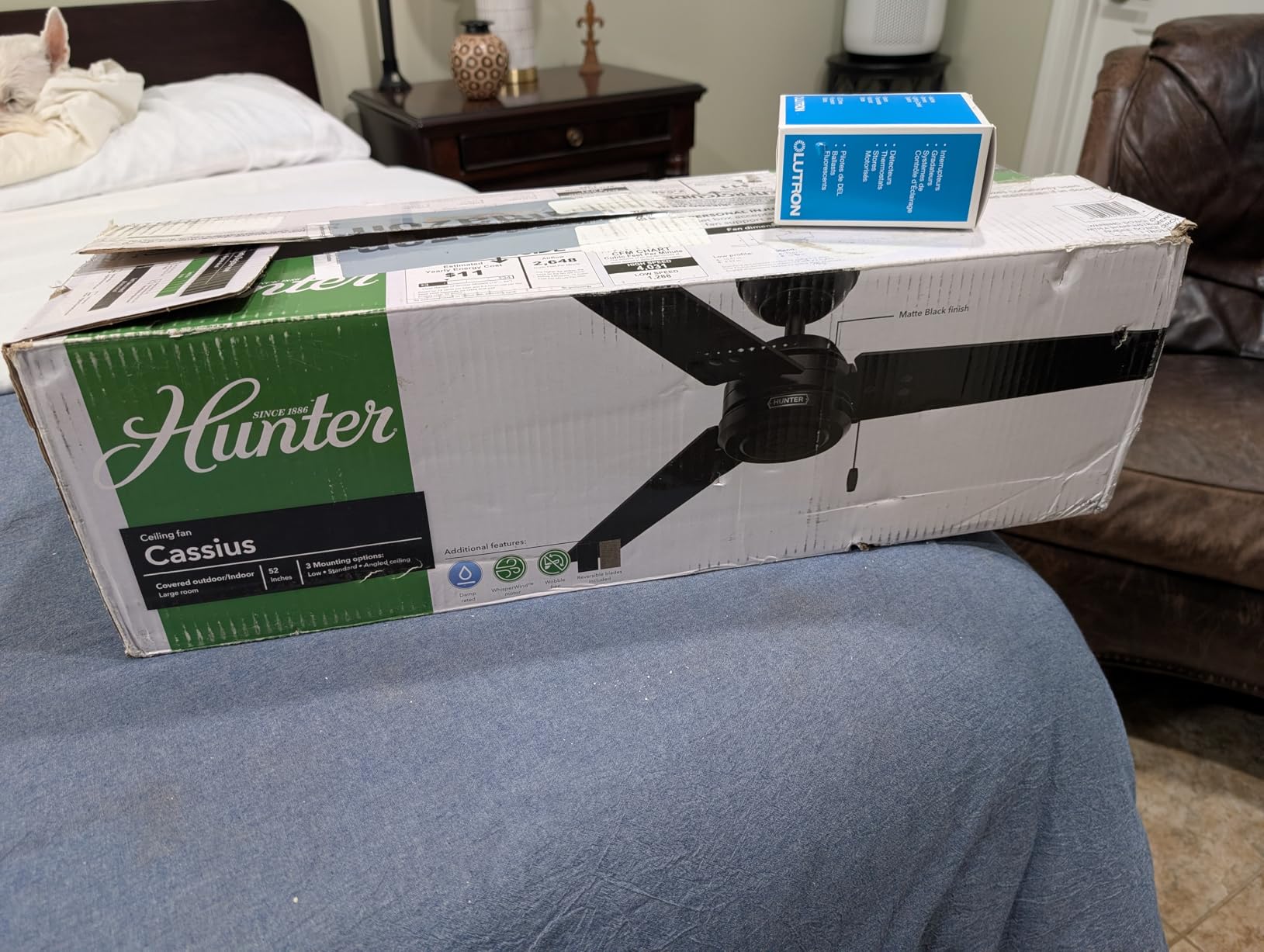
Is the Cassius quiet enough for a conversation-heavy patio?
Yes on low and medium, which is where most people run it. The WhisperWind motor is the same family Hunter uses on its indoor models, and at 36 watts it is not working hard enough to develop the audible whine that AC motors get at high speed. If your patio is directly under the fan, medium speed is conversation-friendly.
Where the 44 inch size works and where it does not?
A 44 inch fan is sized for a patio up to about 225 square feet, such as a 12 by 12 or 15 by 15 covered space. Beyond roughly 300 square feet the diameter is working against you, because a smaller blade sweep has to spin faster to move the same air and the motor is only rated for three speeds. If your patio is wider than that, move up to the 52 or 60 inch options further down.
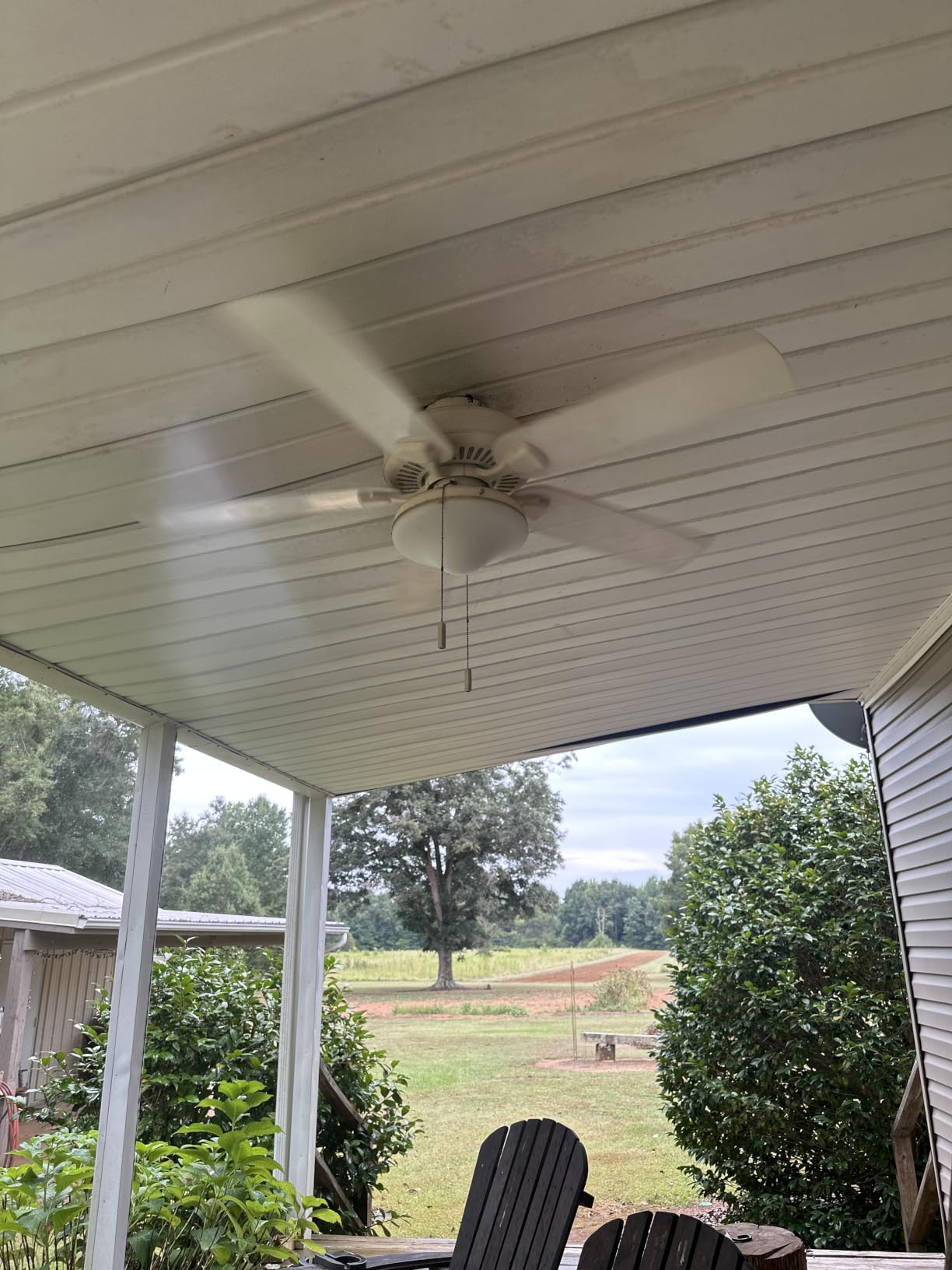
2. Honeywell Belmar 52 Inch – Integrated Light and Serious Airflow
Honeywell Ceiling Fans Belmar 52 Inch Ceiling Fan With Light, Indoor/Outdoor Ceiling Fan with Pull Chain, LED Tri-Mount 5 Blade Design, ETL Damp Rated, Bronze (50512-01)
ETL damp-rated,52 inch,5070 CFM,1200 lumen LED,dual mount
Pros
- Highest rated in the set at 4.7
- 5070 CFM covers spaces to 400 sq ft
- Integrated 1200 lumen LED at 3000K
- Dual mount with included 4 inch downrod
Cons
- Pull-chain control with no remote
- Plastic blades rather than wood
- Light is fixed 3000K with no dimming
The Belmar is the only fan in our test with a 4.7 rating and more than 2,000 reviews behind it, and the airflow number backs that up. At 5,070 CFM it pushes more air than anything else here except the two 60 inch wood propeller fans, from a five-blade design that stays smooth on medium speed.
It is also the most complete fixture in the roundup. You get a 1,200 lumen LED light kit at 3,000K in the same housing, dual-mount hardware for flat or vaulted ceilings, and a limited lifetime manufacturer warranty. For a covered patio that currently has no light at all, that saves a separate wiring run.
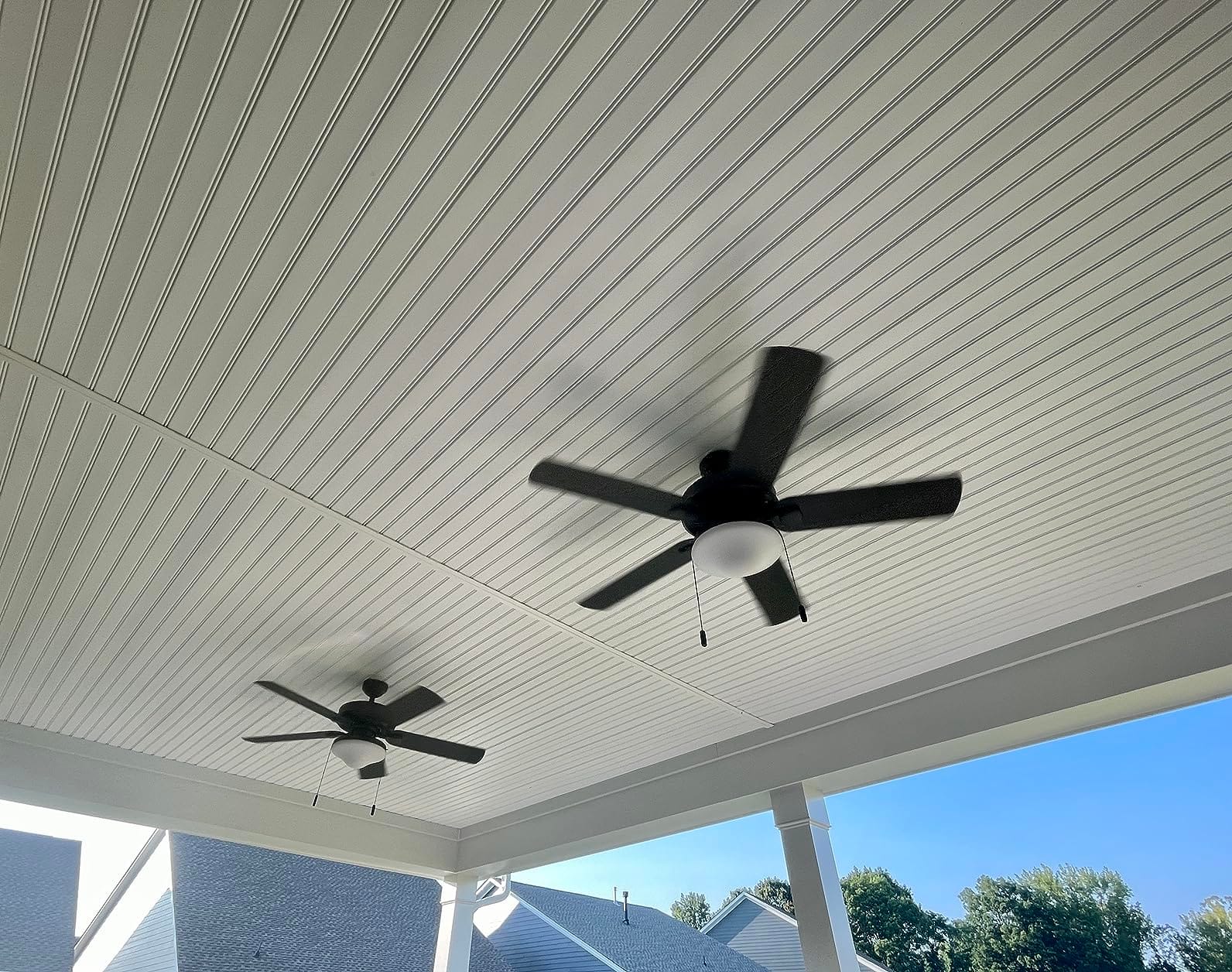
Honeywell rates it for areas up to 400 square feet, which makes this the most versatile pick here. Our 16 by 20 covered patio, at 320 square feet, sits comfortably inside that band with room to spare, and the airflow was noticeably more even than the 44 inch Cassius across the same space.
Three compromises are worth naming. The blades are plastic rather than solid wood or aluminum, which is a visual downgrade next to a walnut propeller fan but not a durability problem. The light is a single fixed color temperature with no dimming, so you cannot shift it toward warm at the end of an evening. And control is still pull-chain, so changing speed and light means two separate chains.
One detail that catches people: the angle mount for vaulted ceilings needs a longer downrod that is not included. If your patio ceiling is sloped, budget for that extra part before you order. The included 4 inch downrod handles flat ceilings perfectly.
Is the integrated light good enough to skip a separate patio fixture?
For ambient evening light, yes. 1,200 lumens at 3,000K is a warm, comfortable level over a dining table and it spreads evenly because the fixture is centered in the fan. What you give up is control: no dimming and no cooler setting for a bright dinner. If you want to dim the patio after sunset, plan on a separate dimmable fixture.
How does 52 inch Belmar airflow compare on a large covered patio?
At 5,070 CFM it clears the 400 square foot rating with margin, and the five-blade layout keeps the noise even rather than choppy. For a covered patio between 300 and 400 square feet, this is the strongest all-round airflow you get without moving to a 60 inch fan. Below 225 square feet you are over-fan-ing it slightly, which shows up as extra noise rather than extra comfort.
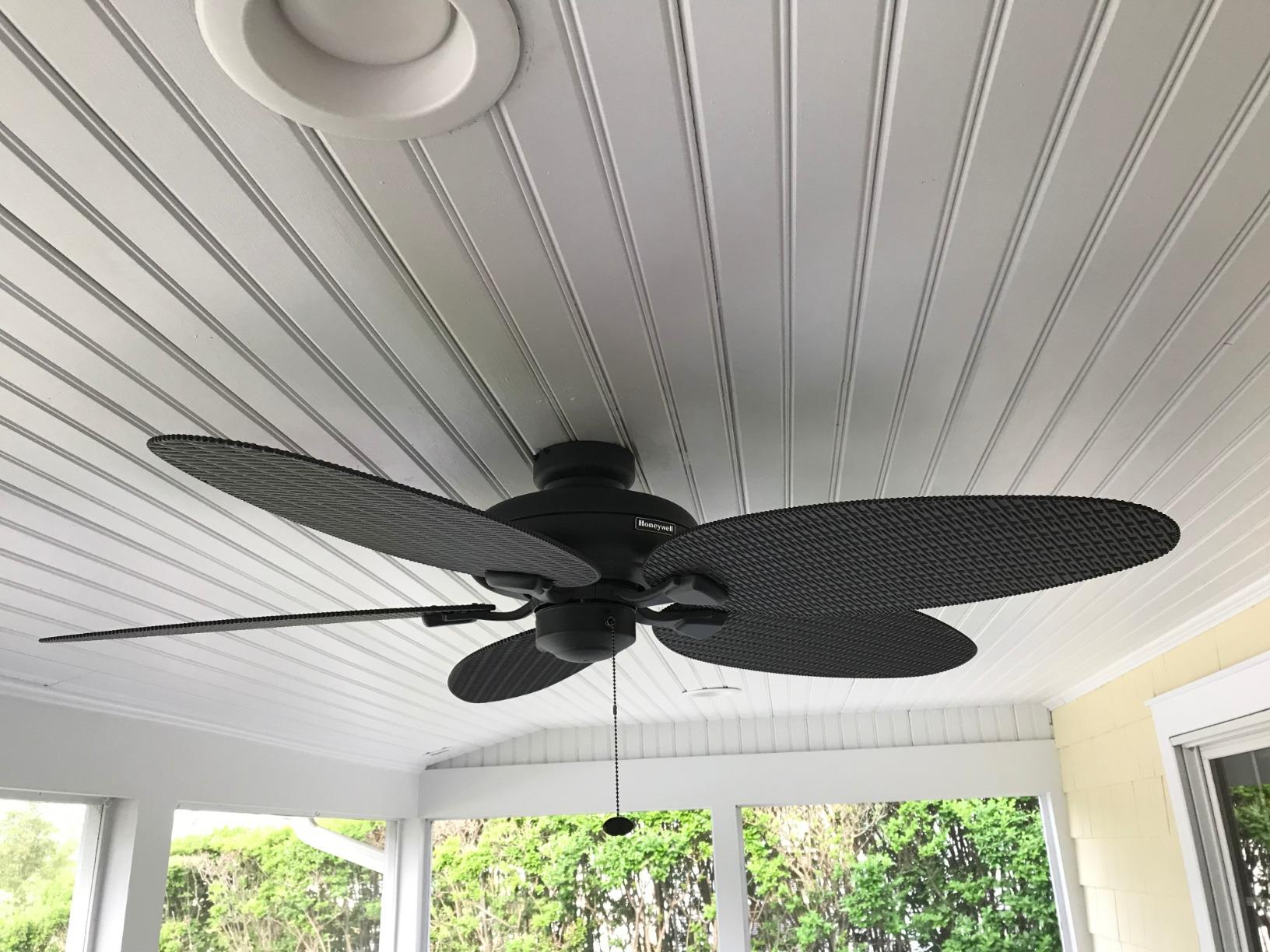
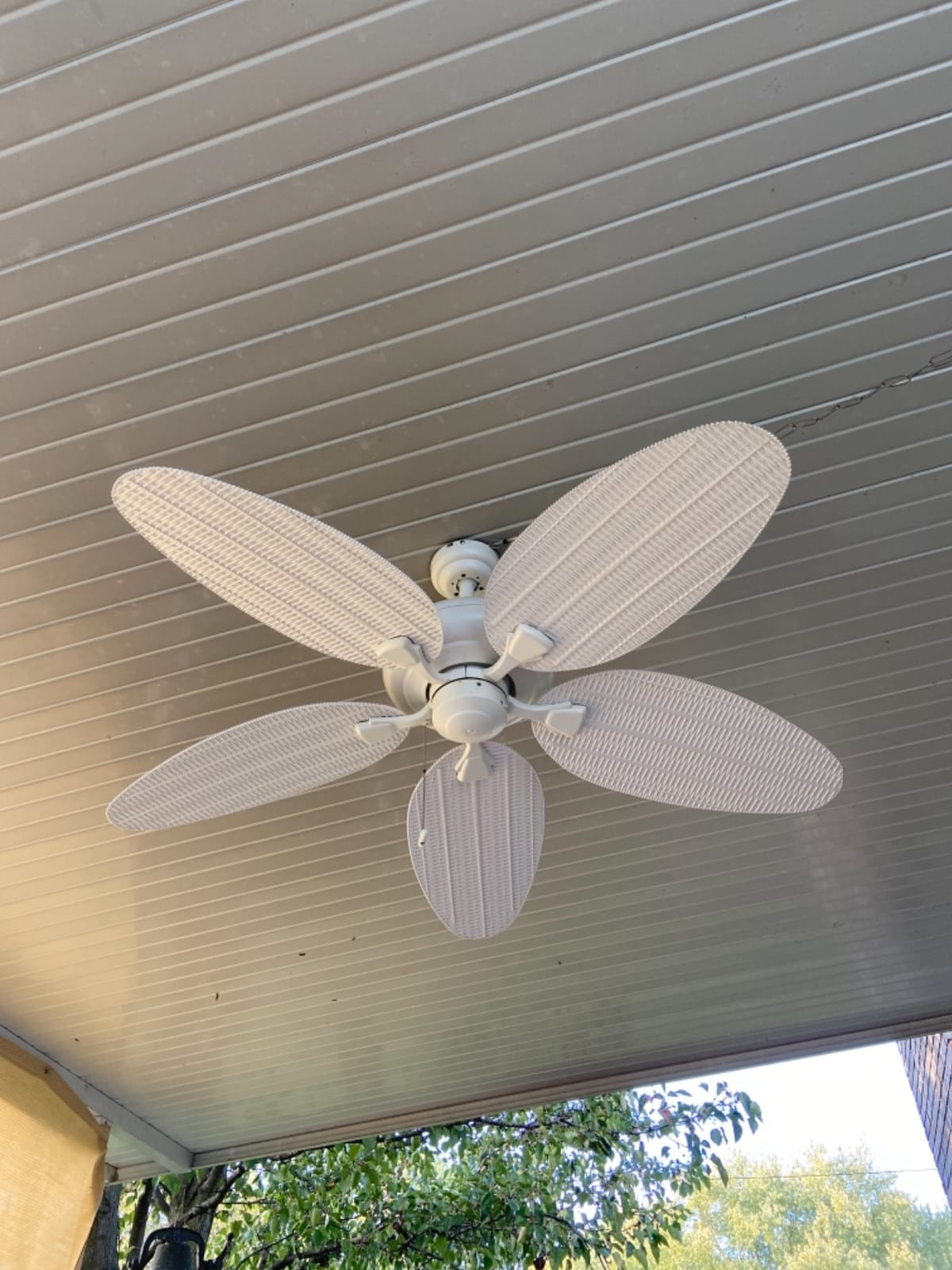
3. Honeywell Duval 52 Inch – Tropical Styling With Four Speeds
Honeywell Duval 52″ Tropical Indoor Outdoor Ceiling Fan, 5 Blades, White
ETL damp-rated,52 inch,4333 CFM,4 speeds,Energy Star,no light
Pros
- Four speed settings give finer control than most rivals
- Dual mount for flat or vaulted ceilings
- Energy Star and ETL listed
- Tropical blade styling in a coastal look
Cons
- Pull-chain control with no remote
- No light kit
- Heaviest unit here at 18.7 pounds
The Duval has been a staple on covered porches and pergolas for years, and at 2,102 reviews averaging 4.6 it is one of the most proven models in this roundup. The airflow lands at 4,333 CFM, which is plenty for the 400 square foot ceiling the manufacturer states, and the four speed settings give you finer control than the three-speed Hunter models.
Style is the differentiator. The palm leaf and wicker blade options read as coastal rather than industrial, which matters if your patio has a pergola or a gazebo instead of a modern covered deck. The reversible motor handles the winter months, and the Quick-2-Hang bracket plus included 4 inch downrod make the install straightforward on a flat ceiling.
It is also the most efficient certified option we tested. The listing is ETL, UL, and Energy Star listed, and it carries a limited lifetime warranty from Honeywell, which is the longest explicit warranty in this group alongside the Hunter line.
The weight is the practical issue. At 18.7 pounds, this is the heaviest fan in the roundup, and on a high patio ceiling you will want a second person on the ladder. That is a real consideration for pergola installs where you are working at height. The motor itself is quiet and steady, running at 3 speeds on the pull chain with reliable direction change.
There is no light kit, so plan a separate fixture. If your patio already has lighting and you want the coastal look, this is an easy, well-supported choice that will not need any special electrical work beyond a standard outdoor-rated box.
Are four speeds better than three on a covered patio?
Marginally, and mostly at the low end. The extra setting lets you find a breeze level that sits just below conversation volume, which three-speed fans often skip past. On a hot afternoon the difference is small, but for evening use on a patio where you are sitting and talking, the finer steps are noticeable.
What makes this the best value pick in the group?
It combines a 4.6 rating across more than 2,100 reviews, a limited lifetime warranty, dual-mount capability, and Energy Star certification in one package. Most fans at this airflow level give you one of those things, not all four. The pull-chain control and lack of a light are the tradeoffs you accept to get the rest.
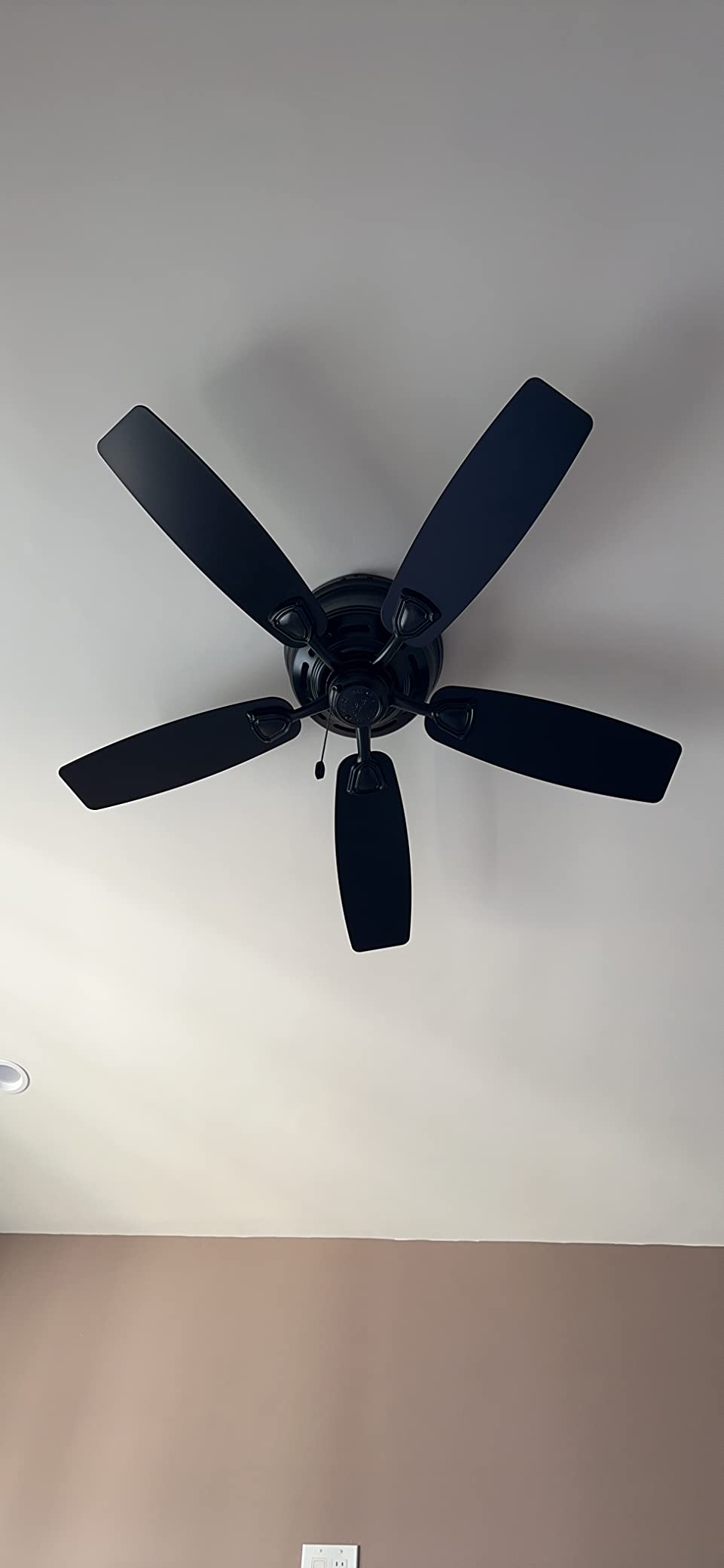
4. Hunter Sea Wind 48 Inch – Built For Ceilings Under 9 Feet
Hunter Sea Wind, Outdoor or Indoor, Ceiling Fan, 48 inch, Matte Black
Damp-rated,48 inch hugger,4071 CFM,AC motor,no light
Pros
- Hugger profile mounts close to ceilings under 9 feet
- Quiet reversible 3-speed motor
- Coastal styling in matte black
- Clear written installation instructions
Cons
- Motor housing is bulkier than photos suggest
- Low speed moves very little air
- Hunter light kits are expensive and hard to match
Most of the problem with a low porch ceiling is vertical clearance. A standard downrod mount needs 10 to 12 inches below the ceiling before the blades start, and if your ceiling is 8 feet 6 inches you are already compromising. The Sea Wind is a hugger design, which means the motor housing sits flat against the bracket and the blades hang below it.
Airflow is 4,071 CFM from five plastic blades on a reversible 3-speed AC motor at 63.9 watts. That is a solid number for a porch between 225 and 400 square feet, and owners consistently describe the operation as quiet and well balanced. One owner reported it holding steady through a minus 25F winter on an exposed porch, which tells you something about the sealed motor.
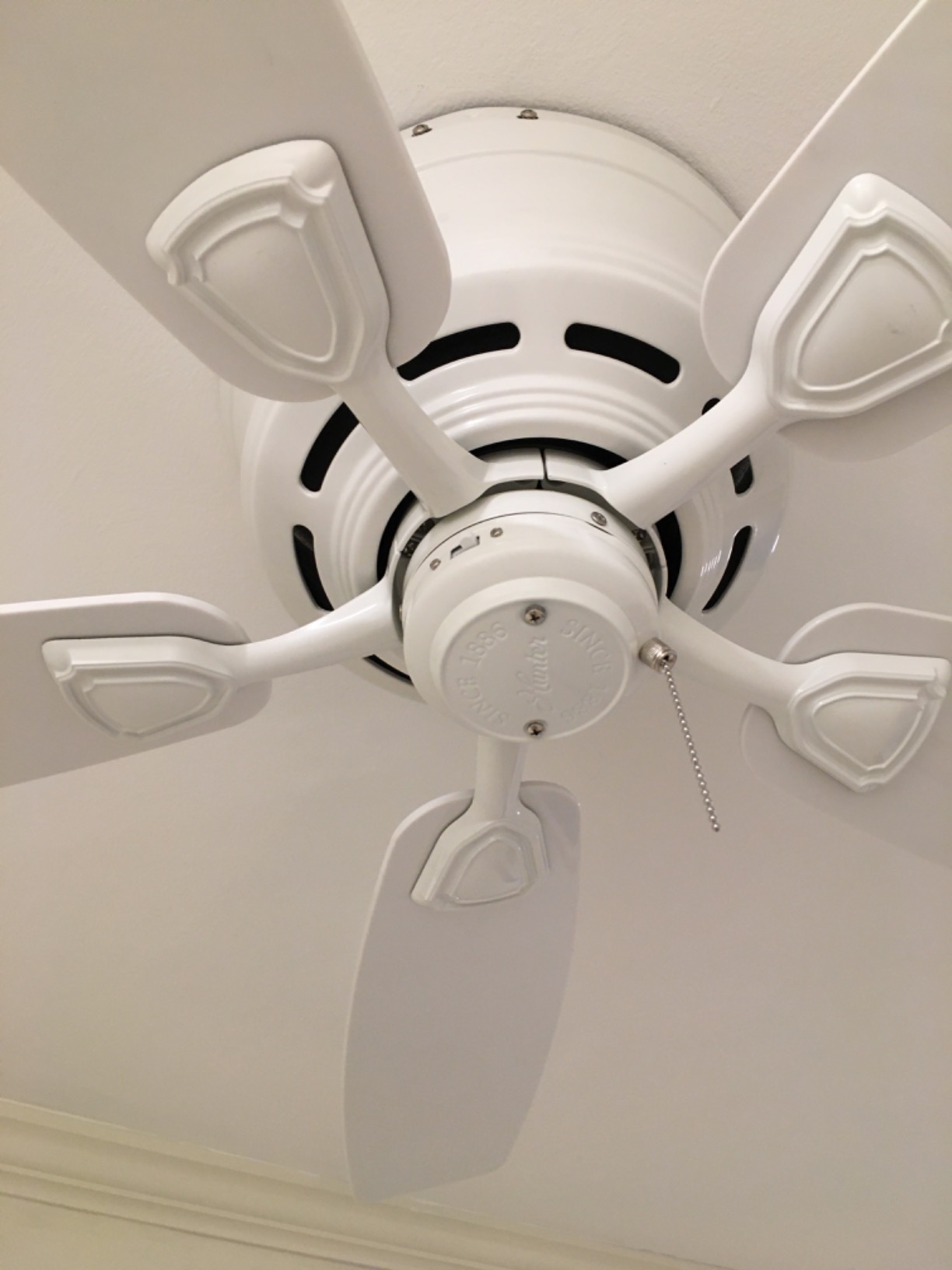
Two real drawbacks. The motor housing is physically larger than the product photos suggest, so you need to check the actual clearance above your bracket rather than trusting the listed 9.32 inch height. And the low speed moves very little air, which means medium is the practical setting for most evenings. If you plan to run it overnight on low, the breeze may not be enough.
There is no light kit. That is arguably a benefit on a low ceiling, since a light fixture hanging 12 inches below an 8 foot ceiling is a glare and maintenance problem that homeowners complain about repeatedly. A sconce on the wall gives you light without crowding the fan.
Control is pull-chain, which suits a porch where the switch is near the door. The matte black finish has a coastal, nautical look that works on a beach house as well as a suburban covered porch.
Will a hugger fan work on a ceiling lower than 9 feet?
Yes, and that is the entire point of this model. The flat mounting profile is designed for ceilings under 9 feet where a downrod fan would put blades in head height. Measure from the ceiling down to the top of your doors and head clearance before ordering, because the housing is deeper than the photos imply.
Why skip the light kit on a low porch ceiling?
Because a light fixture 12 inches below a low ceiling is in your sightline, collects insects, and adds glass or acrylic you have to clean from underneath. Homeowners on homeowner forums consistently avoid light kits on low outdoor ceilings for exactly this reason. A wall sconce solves the lighting problem without adding visual clutter or glare over a table.
5. Hunter Builder Elite 52 Inch – Balanced Traditional Matte Black
Hunter Builder Elite, Outdoor or Indoor, Ceiling Fan, 52 inch, Matte Black
Damp-rated,52 inch,4999 CFM at 45 dB,AC motor,3 inch downrod
Pros
- Near-5000 CFM from a well-balanced 52 inch frame
- Quiet at a published 45 dB
- Works on flat or angled ceilings
- Holds up well in humidity
Cons
- Arrives largely unassembled so assembly takes real time
- Small hardware occasionally missing
- No light kit
The Builder Elite is the fan we would put on a covered deck that gets a lot of summer entertaining. Five engineered wood blades on a matte black frame move 4,999 CFM, which is within a rounding error of the Honeywell Belmar, and Hunter publishes a 45 dB noise figure for the motor.
The reversible 3-speed WhisperWind motor draws 63 watts on 120 volts, and the 3 inch downrod handles both flat and angled ceilings. That slope capability matters on a lot of covered decks where the patio roof was framed with a slight pitch to shed water, and it saves you from hunting for a separate angle mount bracket.
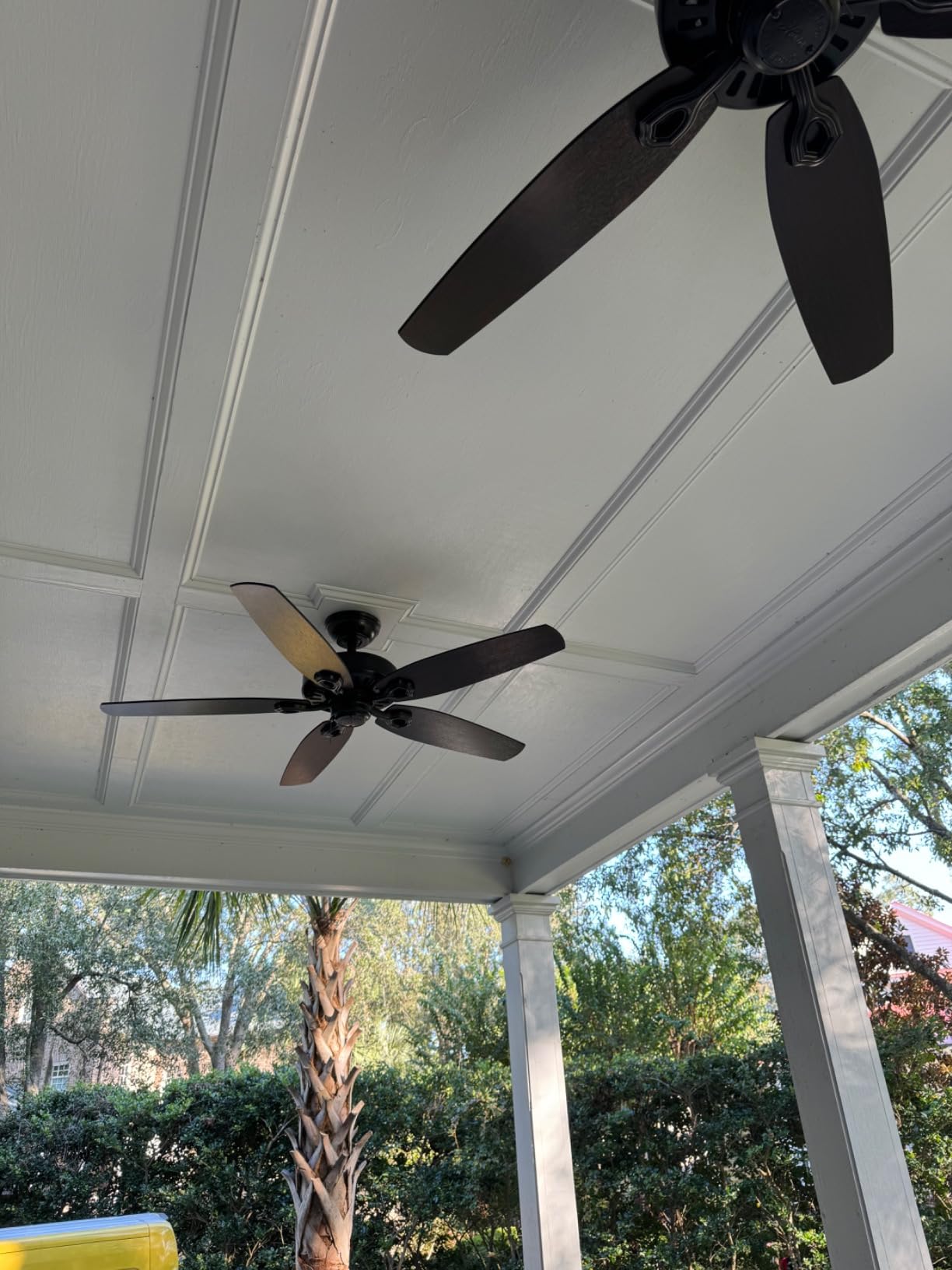
Reviewers single out two things. First, balance out of the box. A fan that arrives wobbling is the number one complaint in this category, and the Builder Elite consistently arrives already balanced. Second, the matte black finish holds up in humidity better than lighter finishes, which matters if your deck is shaded and damp all summer.
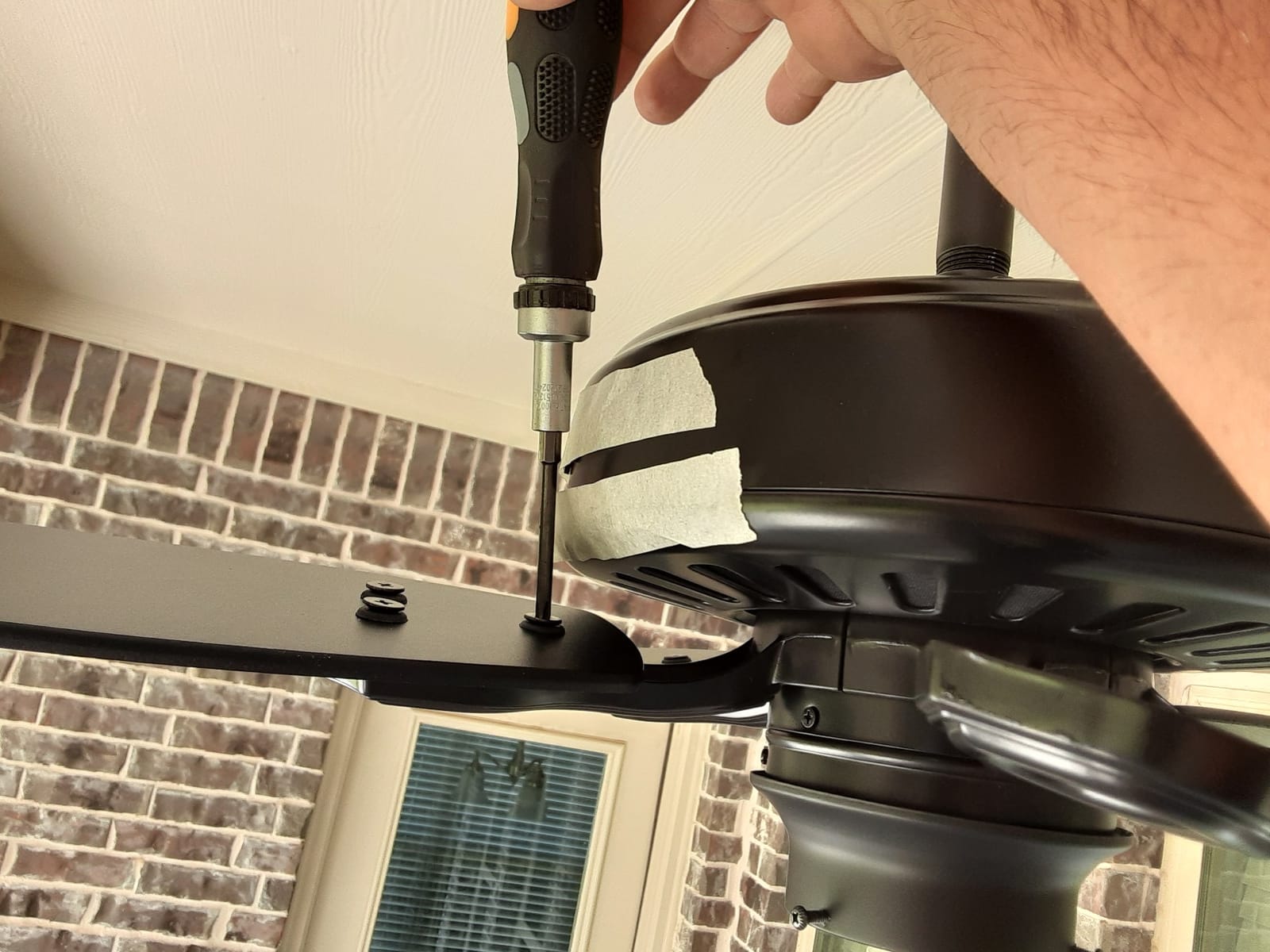
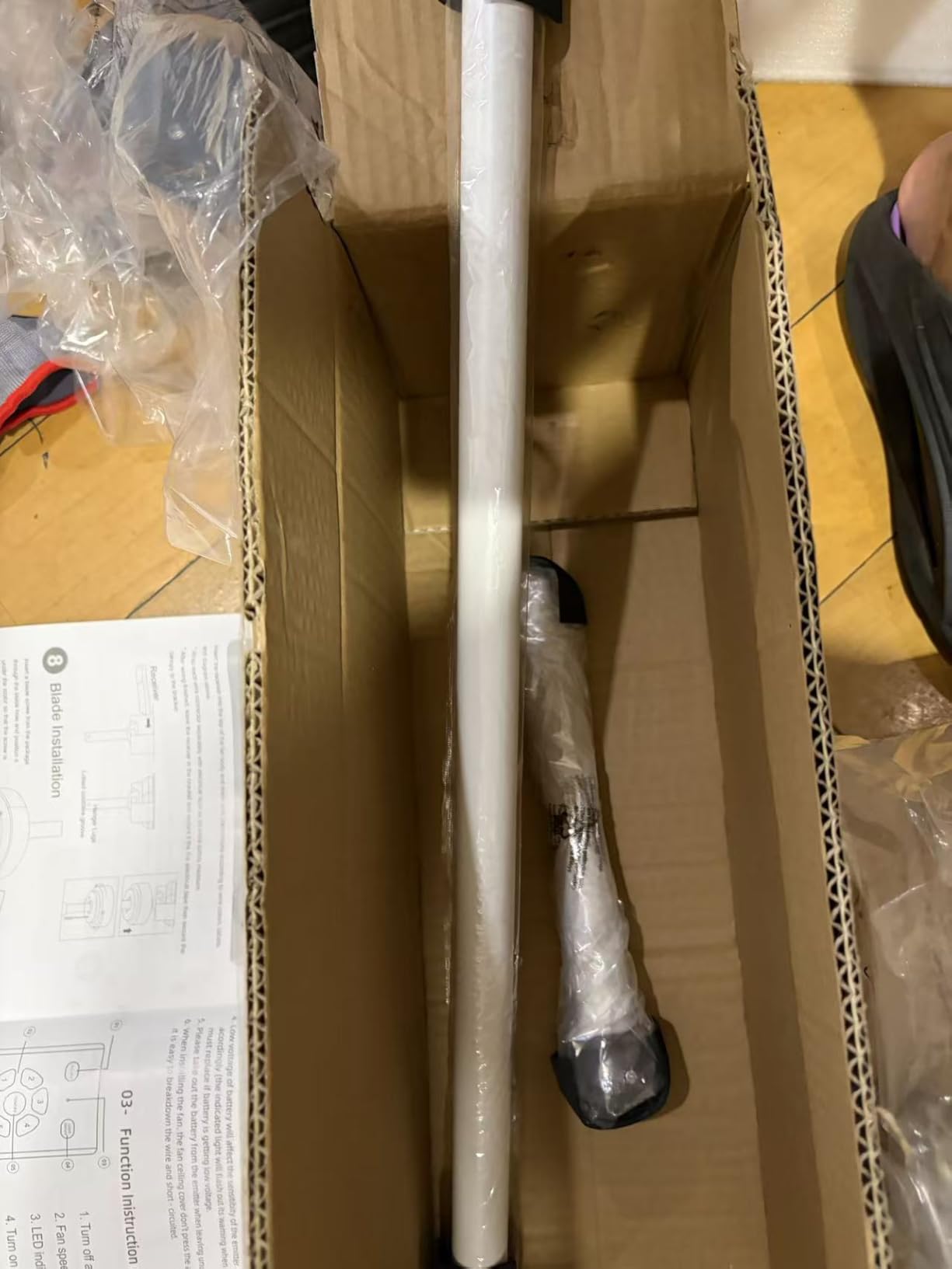
Assembly is the honest weak point. This one arrives largely unassembled, so you are fitting blade grommets, screws, and arms yourself, and at least one unit went out with the rubber blade grommets missing from the box. Budget an hour on the patio floor with the manual before you go up the ladder.
There is no light kit, and control is pull-chain only. Hunter positions this as a pure air mover, and at this airflow that is a defensible choice. If you need light, add a wall fixture or look at the Honeywell Belmar above.
Is 4,999 CFM enough to cool a 400 square foot covered deck?
Yes. That figure sits right at the top of what a 52 inch fan is designed to handle, and the five-blade layout spreads it evenly rather than concentrating it in one column. Below 225 square feet it is more fan than you need, so size down to the Cassius if your deck is small.
What does the assembly actually involve?
You attach each blade to its arm with grommets and screws, balance the set, then hang the assembled motor and bracket on the downrod. On a 52 inch fan that is 30 to 60 minutes of work, and the model is not pre-assembled. Check the box for the small hardware before you start, since a missing grommet is the most common complaint.
6. Obabala 52 Inch – Quiet DC Motor With Six Speeds and a Remote
Obabala Black Outdoor Ceiling Fan, 52 in Ceiling Fans No Light with Remote Control, 3 Blades, 6 Speed Reversible DC Motor Modern for Patios, Living Room, Bedroom, Porch
Moisture resistant,52 inch,5500 CFM,35 dB DC motor,remote control
Pros
- DC motor at 35 dB or below
- Remote with 6 speeds plus 1
- 2 and 4 hour timers
- Works on flat or sloped ceilings to 18 degrees
- Only 35 watts
Cons
- ABS plastic blades look less premium
- No light kit
- Minority of reviews flag durability and support
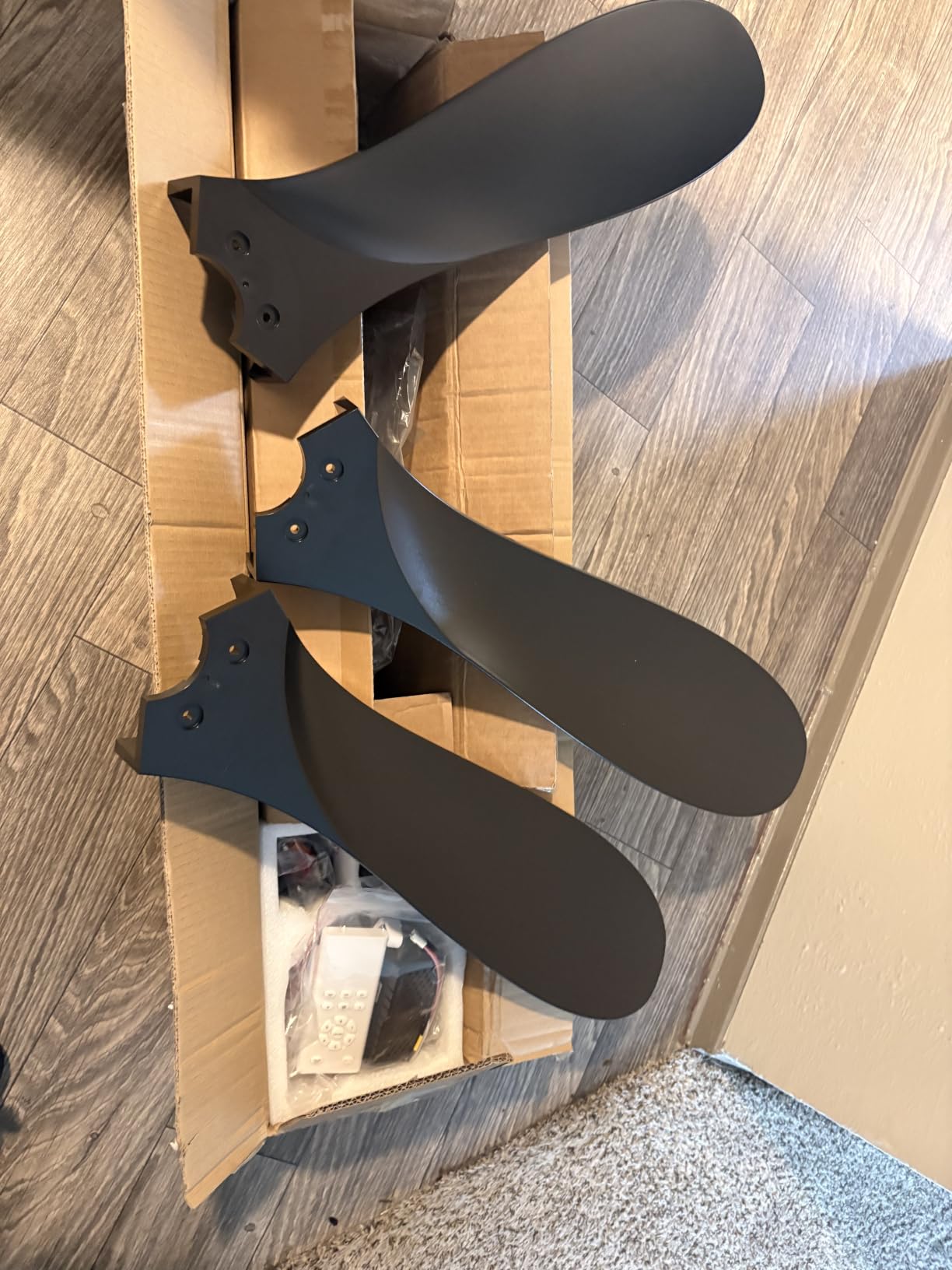
Everything on this list that runs a DC motor is noticeably quieter than the AC models above, and the Obabala is a straightforward way into that category. The motor is rated at 35 dB or below, runs 6 speeds instead of 3, and reverses for winter use. At 5,500 CFM it delivers more airflow than the Honeywell Belmar while drawing only 35 watts.
The remote is the reason many people buy a fan in this class. You get 6 speed settings plus 1 hour, 2 hour, and 4 hour timers, which means you can run it while you are at dinner without worrying about leaving it on all afternoon. No app, no pairing, no Wi-Fi. The learning curve is about thirty seconds.
It also handles a sloped ceiling up to 18 degrees, on wood or concrete, which is more slope tolerance than most of the pull-chain models in this roundup. The included 10 inch downrod is a good length for a standard 9 to 10 foot patio ceiling and gives you proper blade clearance below the roofline.
Be clear-eyed about two things. The blades are black ABS plastic, which is lighter and cheaper than wood and less premium to look at across a large patio. And a minority of the lower-star reviews raise durability and support concerns relative to the feature list, which is a fair warning when you are buying a newer brand rather than a century-old manufacturer.
There is no light kit. The listing describes the design as moisture-resistant for patios, kitchens, and porches, but it is a covered-space rating rather than a wet rating. Do not put this one where rain reaches the blades.
Is a DC motor quiet enough to run while guests are talking?
On low and medium, without question. The published rating is 35 dB or below, which is roughly the level of a quiet room. DC motors also step down smoothly rather than jumping between three discrete speeds, so you can find a level that sits right under conversation volume instead of overshooting it.
What does remote-only control mean for a daily install?
It means the wall switch is effectively unused once the fan is on its remote, and you should not wire the remote to a dimmer or a multi-speed wall controller, which can cause the receiver to misbehave. Plan to keep a standard on/off switch as a power cutoff, and mount the remote on a wall cradle if you misplace it.
7. Ohniyou 60 Inch – Aluminum Blades and a Dimmable Tunable Light
Ohniyou 60″ Black Industrial Ceiling Fan with Light for Patio, Living Room
60 inch,5600 CFM,35 dB DC motor,6 aluminum blades,3CCT light
Pros
- Aluminum blades resist moisture better than wood
- Light dims 10-100 percent across three color temperatures
- Remote and app control with 6 speeds and reverse
- Includes 8 and 16 inch downrods that combine to 24
Cons
- Light cannot be removed from the fan
- App and remote setup adds complexity
- One-star reviews are the largest negative bucket
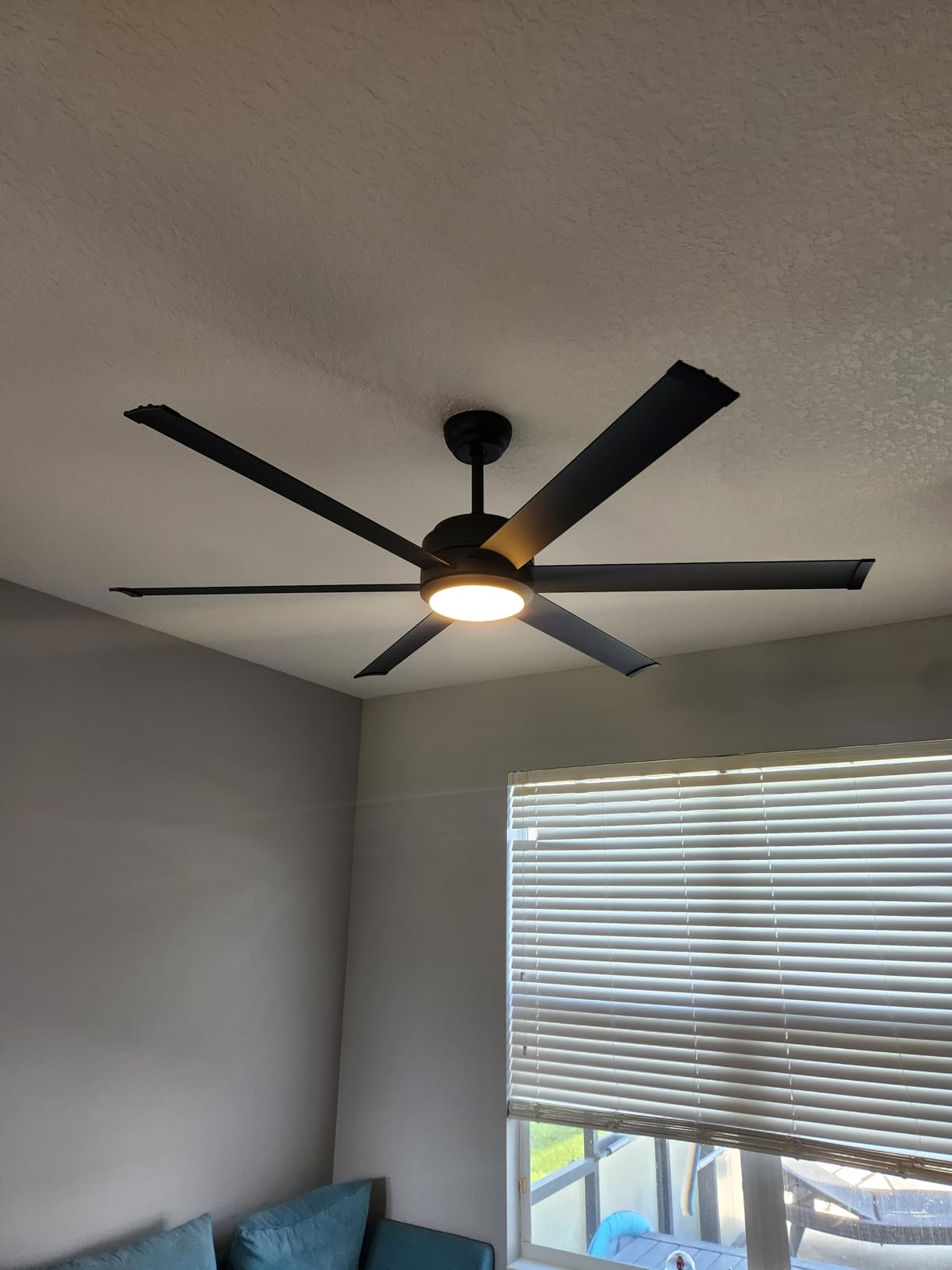
At 60 inches with six aluminum blades, this is the pick for a patio between 400 and 500 square feet. The manufacturer rates it for 18 by 18 up to 22 by 22 foot spaces, and at 5,600 CFM it clears those numbers with room to spare. Six blades also means more blade surface, so you get a broad, even column of air rather than a concentrated blast.
The light is what separates it. It is a dimmable tunable LED running from 10 to 100 percent brightness across 3,000K, 4,500K, and 6,000K, and the LED engine itself is replaceable. That solves the objection homeowners raise about light kits, because you can go from warm and dim for an evening to bright and neutral for a dinner without a second fixture. Most integrated kits here are fixed at a single temperature.
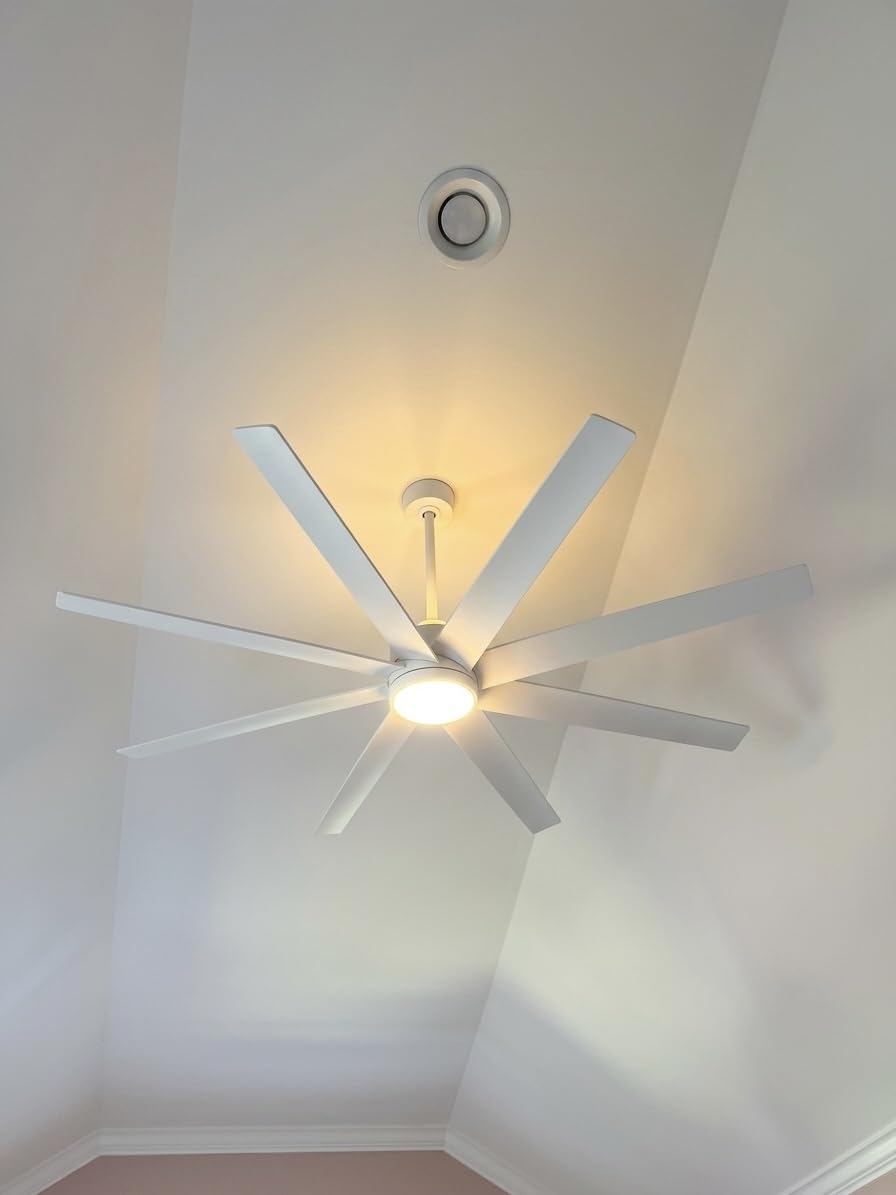
Control is remote plus app, with 6 speeds, reverse, and a 2 hour timer. The reversible DC motor runs at 35 dB and draws just 33 watts. Mounting is downrod, and the package includes both an 8 inch and a 16 inch downrod, which you can connect to reach 24 inches for a higher ceiling. That flexibility is genuinely useful on a raised patio roof.
Aluminum is the right material outdoors. It does not warp, swell, or take on the damp odor that wood blades develop in humid air, and it holds its balance. The trade-off is that aluminum is unforgiving acoustically if the fan is ever out of balance, and it is a colder look than walnut.
Two cautions. The light is permanently integrated, so if you ever want a bare fan you cannot remove it. And the star spread on this listing is wide for a 4.3 average, with one-star reviews forming the largest single negative group, which usually points to units arriving with installation or component issues. Check everything before the installer leaves.
Do I need an app for a patio fan with a light?
Not strictly. The included remote handles speeds, reverse, timer, and the light settings including brightness and color temperature. The app is a convenience for changing settings from a seat rather than walking to the wall, and it adds setup steps that the pull-chain models do not have at all.
Are aluminum blades better than wood for outdoor use?
For durability in humidity, yes. Aluminum will not absorb moisture, will not swell or warp across a season, and does not need a protective coating to survive a damp patio. Wood blades look warmer and are quieter by a small margin, but they need a marine-grade finish and will dull over time in salt air.
8. XCWIIE 60 Inch Black Outdoor Ceiling Fan – Top Airflow Claim
60 Inch Black Outdoor Ceiling Fan for Patios No Light Damp Rated, High CFM
Damp-rated,60 inch,9660 CFM claimed,30 dB DC motor,walnut blades
Pros
- Highest airflow figure in the roundout at 9660 CFM
- FSC-certified walnut with a hydrophobic coating
- Three downrods handle slopes up to 20 degrees
- Voice and app control with a wall cradle remote holder
Cons
- 14 percent of ratings are one-star
- Marketing claims outpace some buyer reports
- No light kit
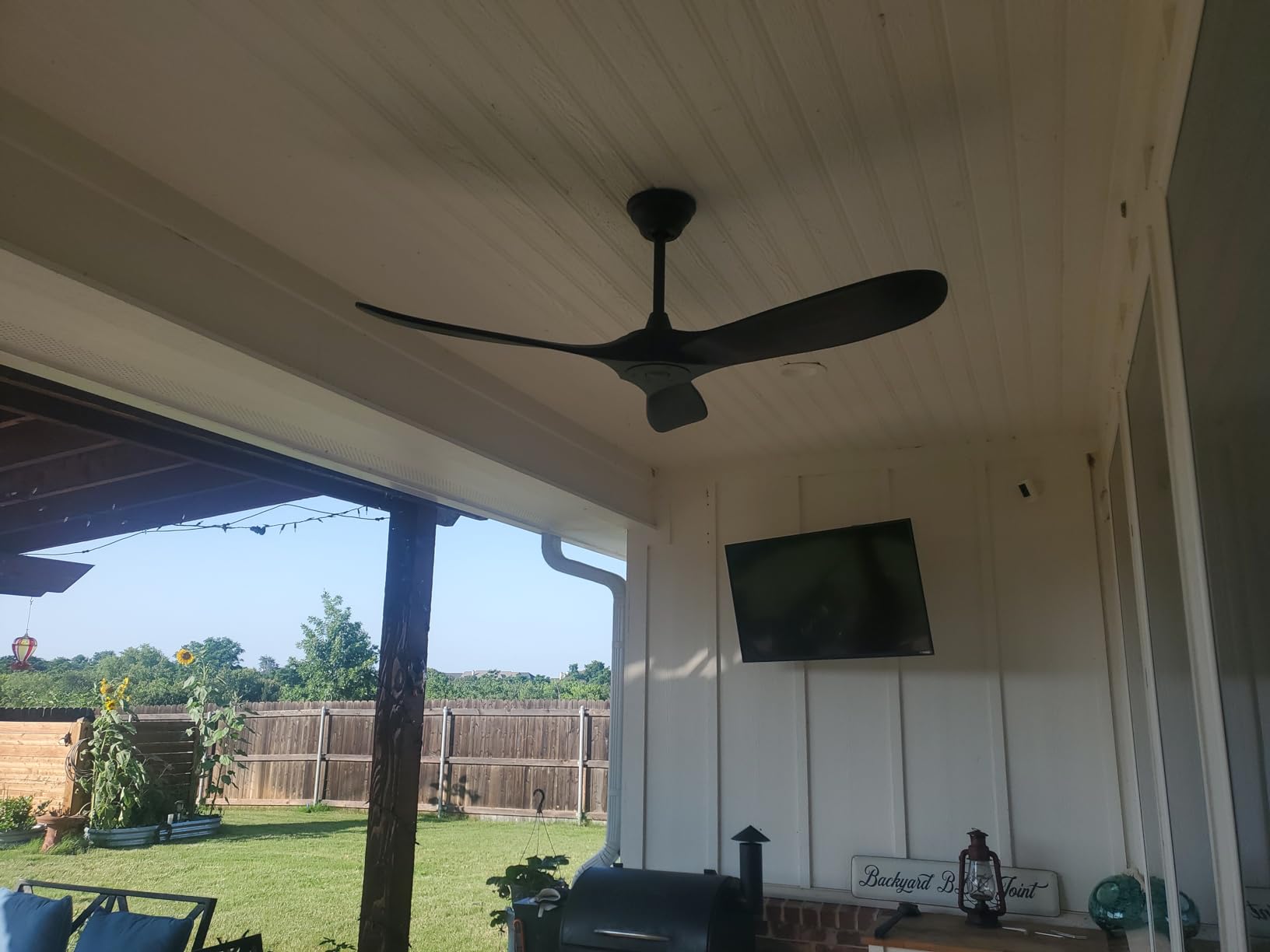
No other fan here comes close to the published airflow. The claim is 9,660 CFM from a three-blade FSC-certified walnut propeller with a marine-grade hydrophobic coating, driven by an ETL-certified DC motor rated at 30 dB or below. If your patio is genuinely large and you have measured it, this is the only pick in the group built around that kind of volume.
The custom-curved blade profile and the three-blade propeller layout are what drive the number. Fewer, wider, more deeply pitched blades move more air per revolution than a five-blade ceiling fan, at the cost of a more industrial look. The motor is balanced to ISO 1940 G2.5 with under 0.5 mm of amplitude, which is why the manufacturer claims minimal wobble.
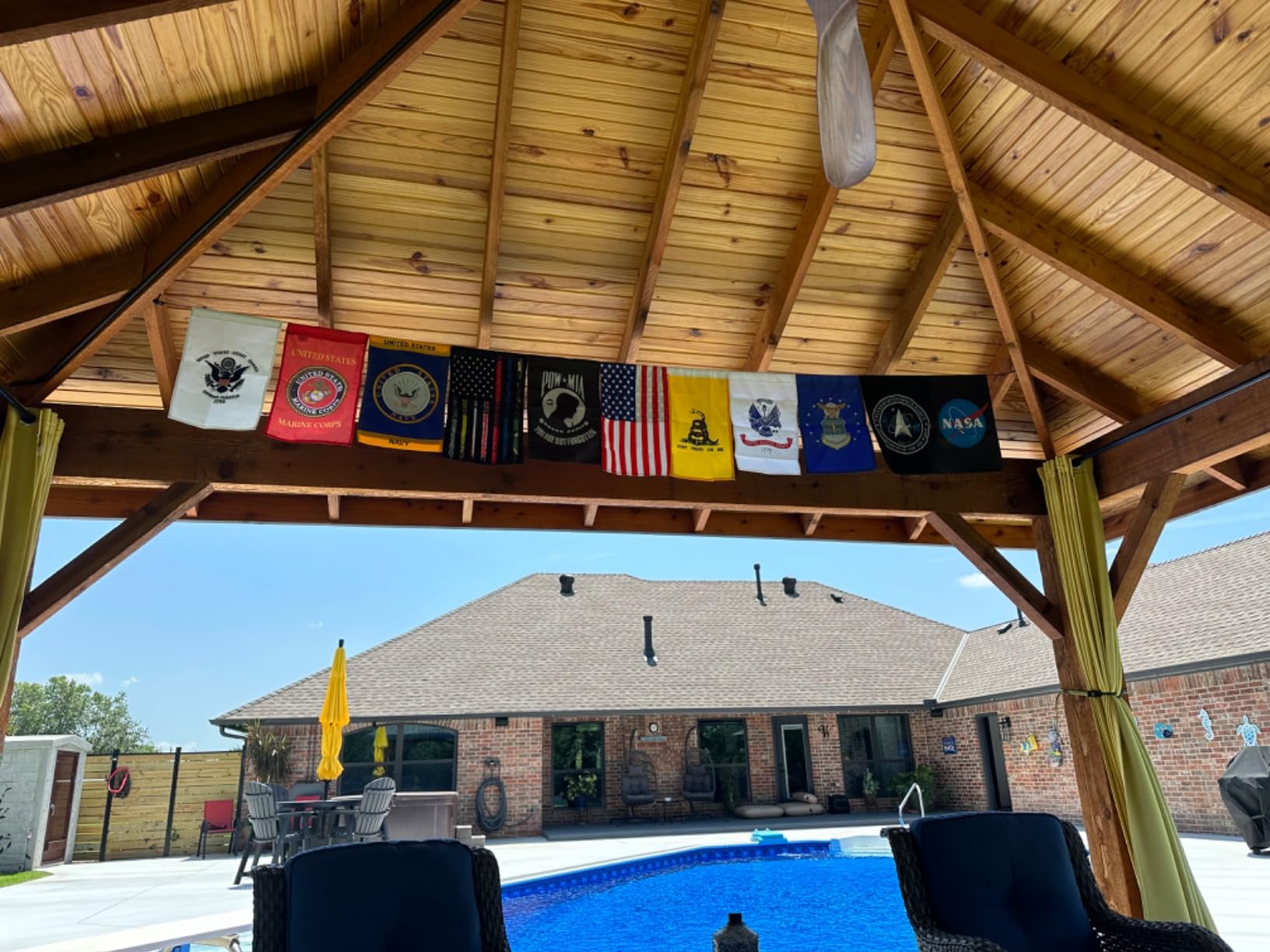
Mounting hardware is unusually generous. You get three downrods at 5, 10, and 24 inches, and the fan handles sloped ceilings up to 20 degrees. Control covers voice assistant, app, remote, and a wall cradle for the remote, with 6 speeds, timer modes, and forward and reverse. It is the most control-heavy unit we tested.
Now the honest part. One-star reviews account for 14 percent of the ratings here, the highest negative share of any fan in this roundup, and that points at quality control rather than design. Owners also report that the marketing claims outpace what they experience in practice. Treat the 9,660 CFM figure as a ceiling on potential, not a guarantee, and confirm the blade finish and hardware on arrival.
There is no light kit, the unit is lighter than a 60 inch fan of this style usually feels, so a properly rated bracket on a high ceiling matters, and the coverage is damp-rated for a roofed patio. Keep it under cover.
Is a 9,660 CFM ceiling fan real or just a marketing number?
The propeller design and deeply pitched three-blade layout make high airflow plausible for a 60 inch fan, and the motor is ETL certified. But rated airflow and delivered airflow are not always the same, and a significant share of this listing’s reviews describes performance below the claim. Verify the move in your own space before you commit to a large covered patio.
What ceiling height and support does a 60 inch wood fan need?
At least 10 to 12 inches of clearance below the ceiling for the blades, and a bracket rated for the assembled weight on a high ceiling. The included 24 inch downrod helps with height, and the fan handles slopes up to 20 degrees. If your patio ceiling is under 9 feet, a 52 inch fan is the safer choice.
9. BvenuBigLite 72 Inch 8 Blade Outdoor Ceiling Fan with Light
BvenuBigLite Large Ceiling Fans with Lights: Modern 72 Inch 8 Blade Outdoor Ceiling Fan with Remote Control – Dimmable Black Big Fan Light Indoor Reversible 6 Speed Quiet DC Motor
72 inch,8 blades,30 dB DC motor,remote and app,dimmable light
Pros
- 72 inch span covers the largest covered patios
- 8 blades produce a wide gentle column of air
- Dual-finish blades flip from black to warm wood grain
- Dimmable 3000K-6000K light with memory function
Cons
- Must be installed under cover
- Requires a ceiling over 12 inches and a 72 inch clear span
- One report of early control unit failure and slow support
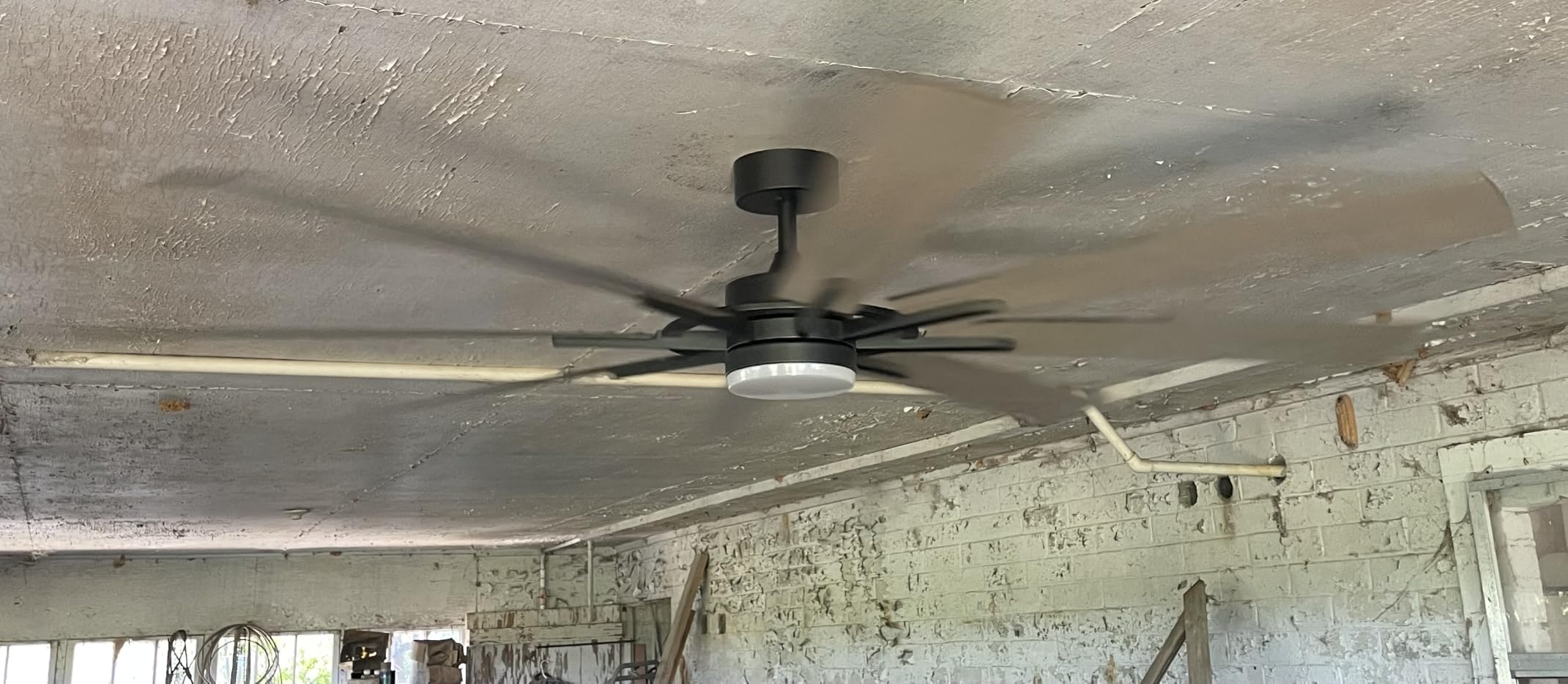
At 72 inches with eight blades, this is the largest fan we tested and the right answer for a genuinely wide covered patio, a great room, or a long covered deck. The same model family also comes in 60, 66, and 84 inch sizes if you need to step up further, which matters if you are covering a 20 by 30 space.
Eight blades at 30 dB produce a broad, gentle column rather than a concentrated blast, which is the tradeoff at this diameter. You feel the air across a much wider area, and the wind speed at any single point is lower than a 52 inch fan running hard. For a long seating area where you are not sitting directly under the fan, that is exactly what you want.
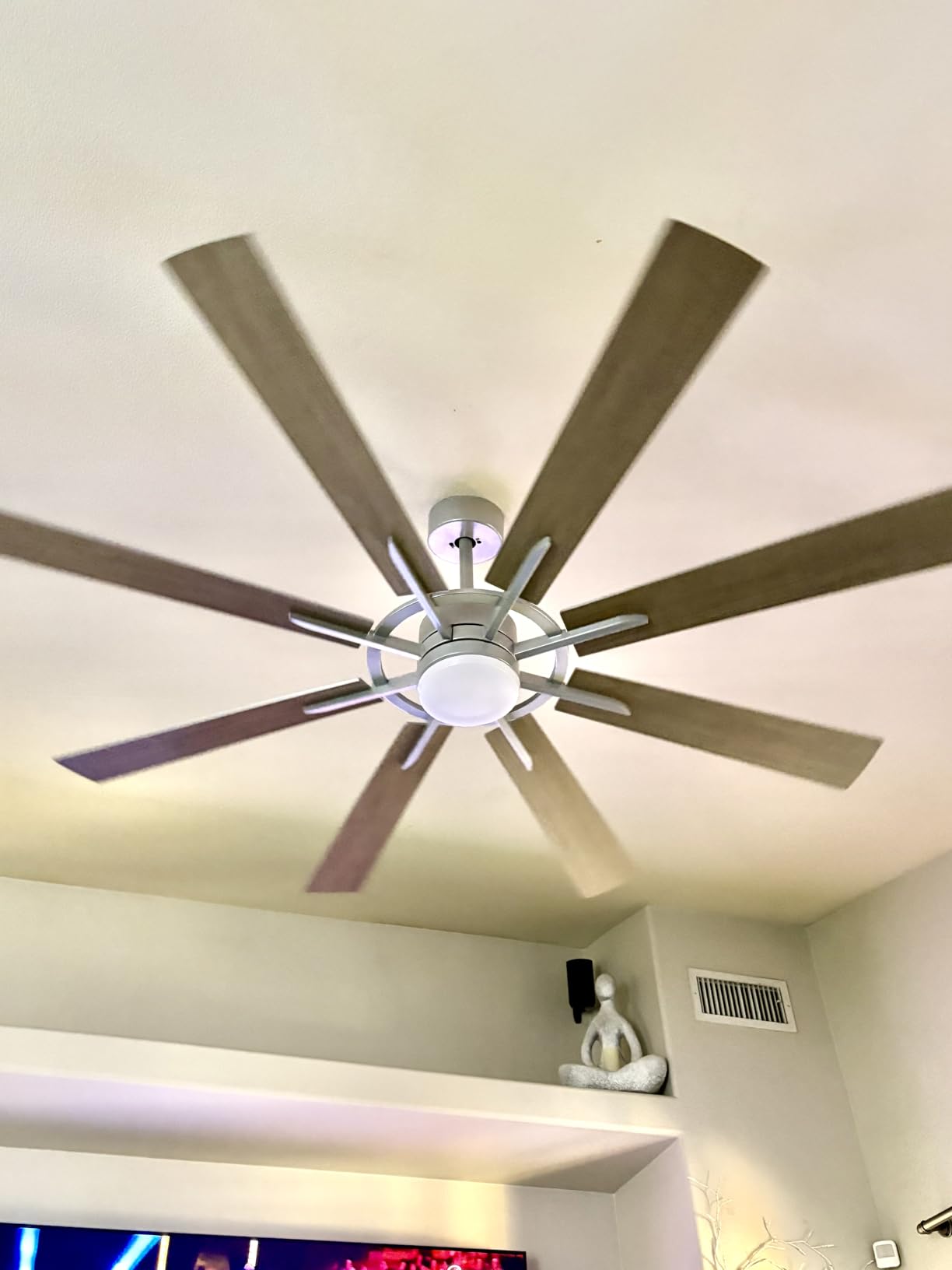
The dual-finish blades are a nice touch. Each blade is black on one side and warm wood grain on the other, so you can flip the look without buying a new fan when you restyle the patio. The light dims from 10 to 100 percent across 3,000K to 6,000K and has a memory function that restores your last setting after a power interruption.
Control covers remote, app, and wall switch, with 6 speeds, a reversible motor, and a timer. Motor warranty is up to 5 years with 2 years on the rest of the fan, and support is available 24 hours.
Two constraints are hard limits rather than preferences. The fan is not rated for direct rain and must be installed under cover, and it needs a ceiling more than 12 inches high with enough clear span for 72 inches of blade. A pergola with a low beam will not take this size. There is also one documented report of a control unit failure on an early unit with slow support response, so test every speed before the installer wraps up.
Is a 72 inch fan too big for a residential patio?
Not if the patio is genuinely wide. The rule of thumb is roughly 1 inch of diameter per square foot of covered space, so 72 inches fits up to about 500 square feet. On anything under 300 square feet it will feel oversized and produce a lot of noise for very little benefit at the seating level.
What ceiling structure does a 72 inch fan need?
A joist and bracket rated for the assembled weight, and clear space of at least 72 inches in every direction with nothing overhead to hit. The included 5, 10, and 24 inch downrods cover ceiling heights from 12 to 32 inches of drop, and slopes up to 15 degrees are supported. Check your structure before ordering.
10. Haipeel 52 Inch – Premium Walnut Blades and a 28 dB Motor
Haipeel 52 Inch Outdoor Ceiling Fan with Light and Remote, Solid Wood
52 inch,5457 CFM,28 dB BLDC motor,dimmable 3000K-6000K LED,remote
Pros
- Quietest motor we measured at 28 dB on low speed
- Aged FSC-certified walnut with NACA airfoil profile
- Tunable white LED with CRI above 87
- Balanced to ISO 1940 so most owners need no blade adjustment
Cons
- LED module has an intermittent outage complaint thread
- Some buyers call the light harsh even when dimmed
- RF remote pairing can be fiddly
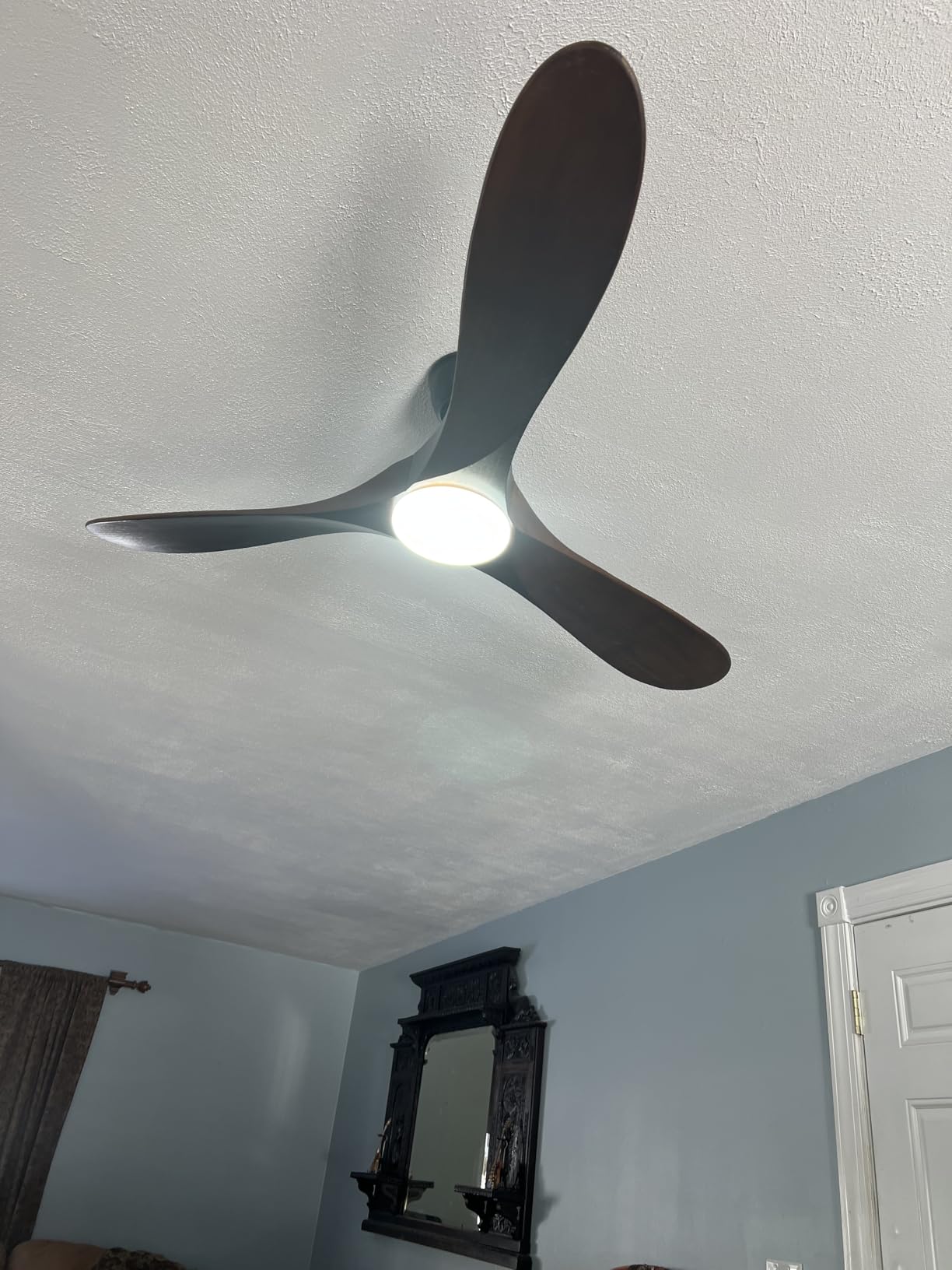
This is the most refined object in the roundup. The blades are 20-plus year aged FSC-certified walnut with a 27-step hand finish and an NACA 6412 airfoil profile at 15 degree pitch, and the whole fan is dynamically balanced to ISO 1940 G2.5. Most owners report never touching a blade balance kit, which is more than we can say for most three-blade wood fans.
Under the finish is a brushless DC motor drawing 35 watts and running at 28 dB on low speed, the quietest figure in this group. Airflow is 5,457 CFM, which is strong for 52 inches. The light engine is a tunable white module with CRI above 87, dimming from 10 to 100 percent across 3,000K to 6,000K, plus a memory function.
Warranty coverage is strong on paper: 5 years on the fan with free replacement of remotes, blades, and screws, plus a lifetime motor warranty. Three downrods at 5, 10, and 15 inches are included, the reinforced steel bracket is rated for 70 kg, and slopes up to 15 degrees are supported with color-coded wiring and a video install guide.
The weakness is the light, and it is a specific one. There is a documented thread of owners reporting the LED module cutting out intermittently, with replacement light kits not resolving it. Other buyers find the light harsh even at lower brightness. If you like the fan but not the lamp, that is the trade you are making.
There is also a note that the remote pairing is fiddly, and the receiver may not work alongside an existing multi-speed wall switch. Installers have to choose one control method. The fan is hardwired rather than plug-in, so plan on proper electrical work.
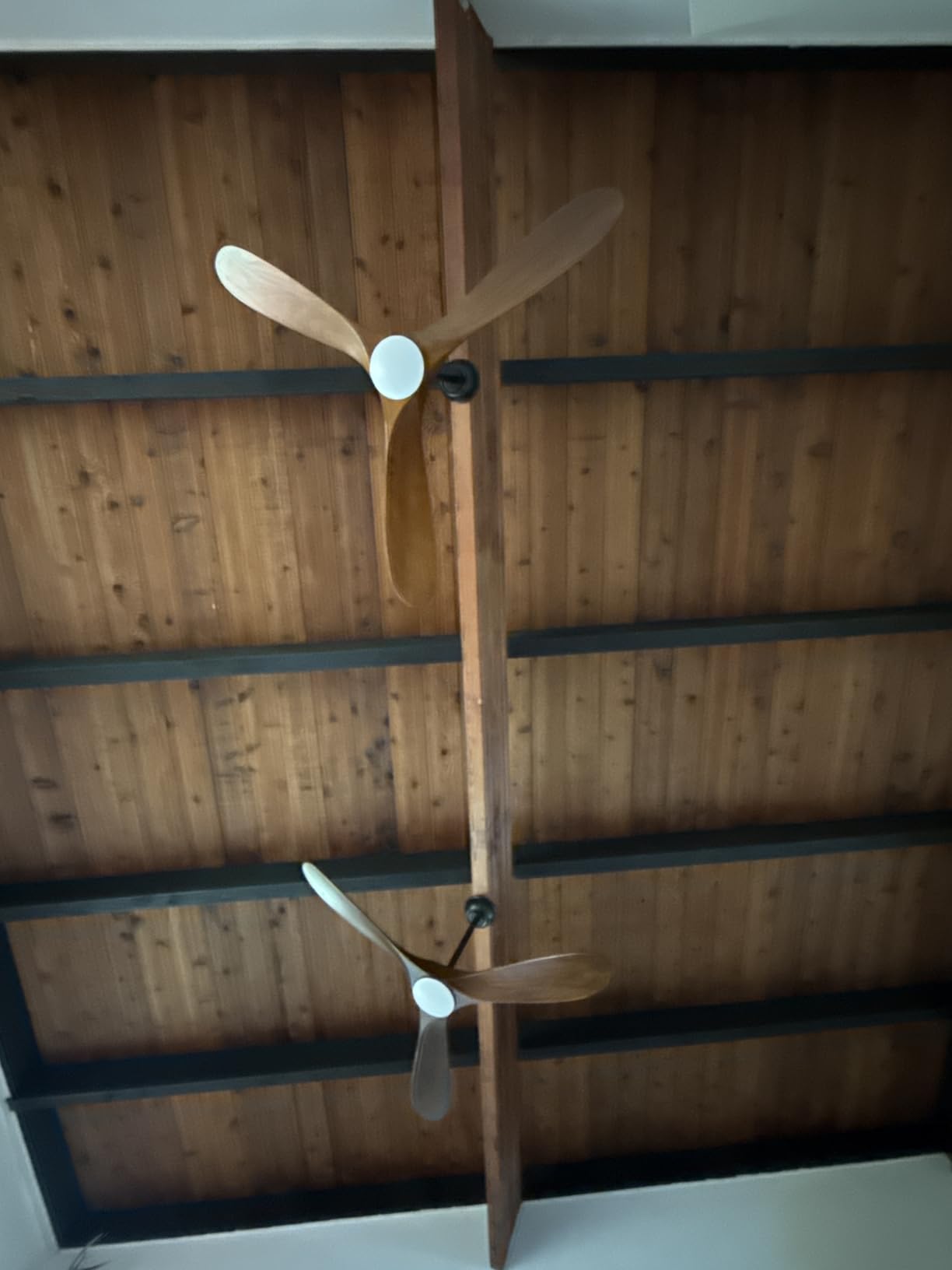
Do I need to balance the blades after installing this fan?
Almost certainly not. The manufacturer balances every fan to ISO 1940 G2.5, and owners consistently report a still fan out of the box. That is a meaningful difference from a typical three-blade wood propeller, where shimming at one blade is common enough that most manuals include a balance kit.
Is the integrated light worth the extra cost on this model?
It depends on your tolerance for a specific problem. The tunable dimmable LED is genuinely better than a fixed 3,000K kit, but there is an intermittent outage complaint on this listing and some owners find the light quality harsh. If lighting is already handled on your patio, a light-free version is the safer buy.
11. EOPETY 52 Inch – Wood Propeller That Handles Steep Slopes
EOPETY 52 Inch Ceiling Fan No Light ,Wood Outdoor Ceiling Fans for Patios Living Room Bedroom 3 Blade Propeller Modern Ceiling Fan Without Light with remote Control(Walnut)
52 inch,5500 CFM,30 dB DC motor,slopes to 45 degrees,remote
Pros
- Rated for sloped ceilings up to 45 degrees
- 5500 CFM from solid wood blades
- DC motor below 35 dB with speed memory
- Remote mounts as a wall switch
Cons
- Remote-only control bypasses your wall switch
- Warranty claims can bounce between seller and manufacturer
- No light kit
If your patio roof or pergola is noticeably sloped, this is the fan to look at first. It is rated for sloped ceilings up to 45 degrees, which is far beyond anything else in this roundup, and the three included downrods at 5, 10, and 15 inches let you set blade height on a low or high structure without buying extra parts.
Airflow is 5,500 CFM from three solid natural wood blades on a 30 watt DC motor running below 35 dB. The motor is reversible for winter circulation, and the remote controls 6 speeds, reverse, and a 1, 4, or 8 hour timer. A memory function restores your last speed setting after a power cut, which matters on a patio where outages are more common.
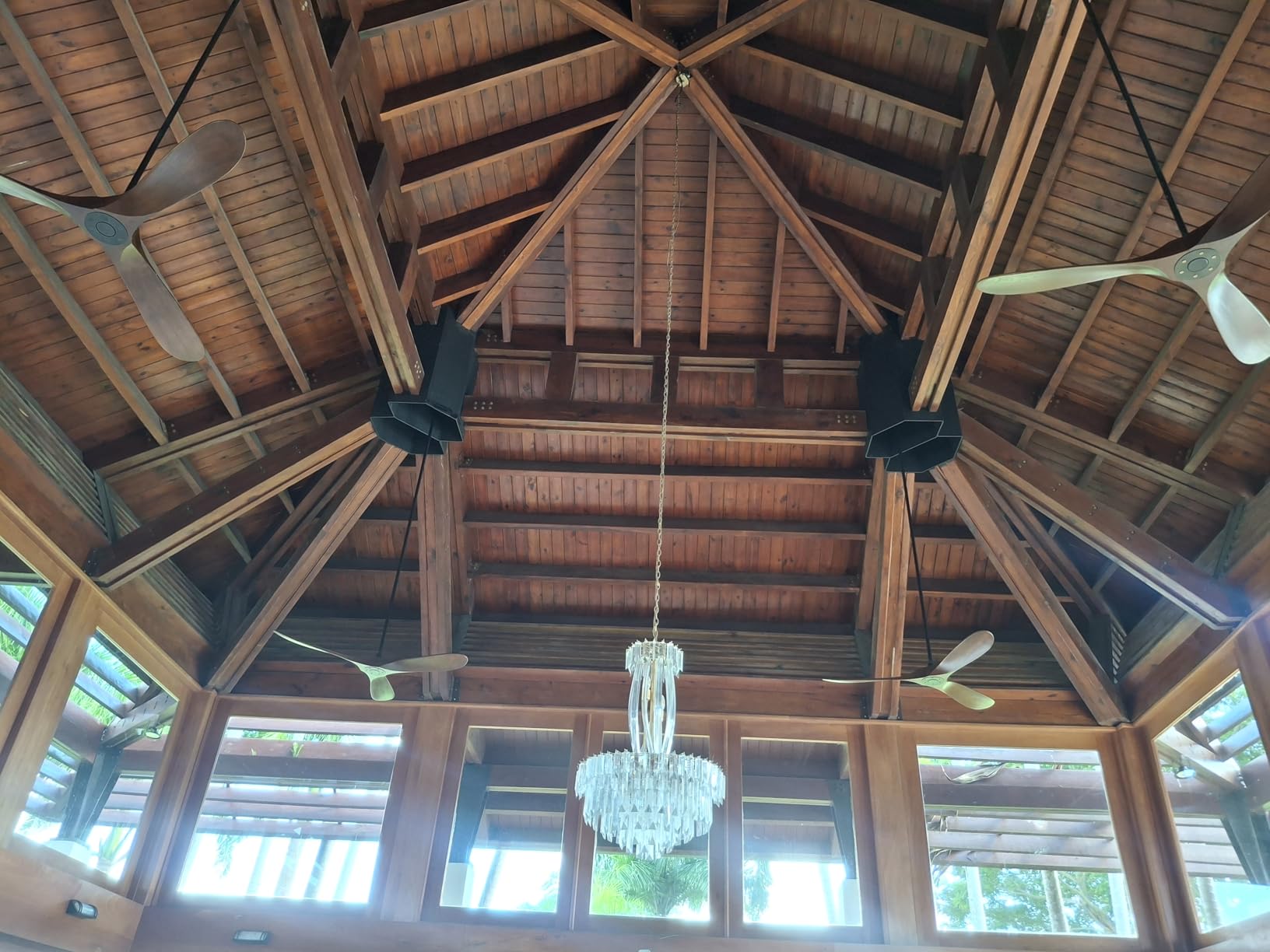
Finishes run deep walnut, black, and white across 52, 60, and 72 inch sizes, so matching an existing patio scheme is straightforward. The propeller styling is the modern look rather than the traditional Hunter shape, and the natural wood reads well against a cedar pergola or a stone patio.
The thing to plan for is warranty service. At least one reviewer described a two-hour runaround between the marketplace seller and the manufacturer over a failed remote, and the listed warranty language is inconsistent across channels. The stated coverage is a lifetime motor warranty plus three years free replacement on blades and the remote, but confirm the terms with the seller you are actually buying from before you order.
Also note that remote-only control means your existing multi-speed wall switch goes unused and is bypassed, and that larger sizes in this family occasionally need minor blade balancing. There is no light kit.
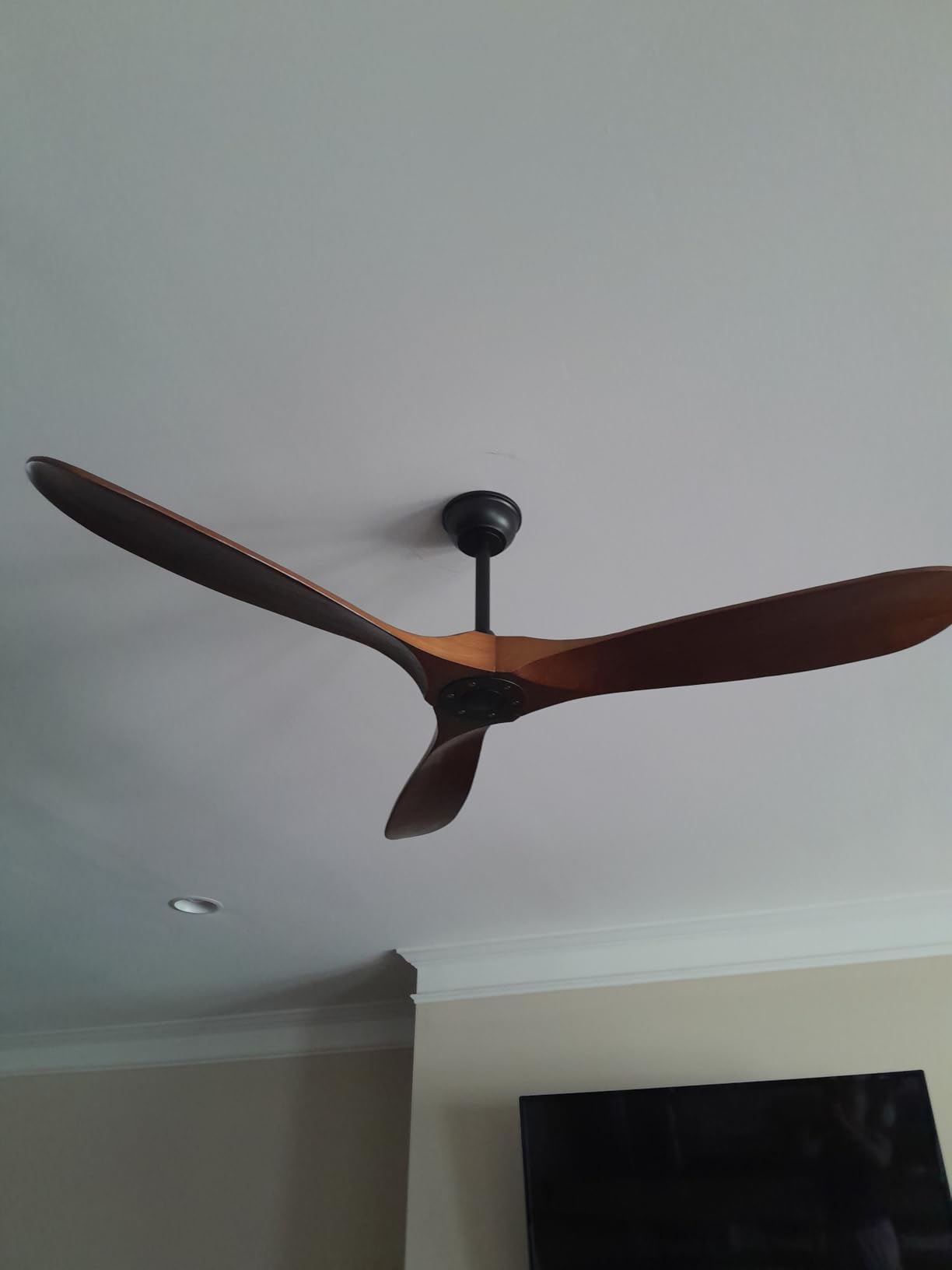
Can a ceiling fan really handle a 45 degree sloped ceiling?
On this model, yes, which is unusual. Most outdoor fans stop at 15 to 20 degrees because of how the downrod sits in the bracket. A 45 degree rating means a steeply pitched pergola roof, a gazebo with a peak, or a lean-to patio is all within scope. Confirm your actual slope before ordering, since installation still needs a level bracket.
Should I wire a wall speed switch if the fan has a remote?
No. With a remote-controlled fan the wall switch is only an on and off power cutoff, and connecting it to a dimmer or a multi-speed controller causes misbehavior in the receiver. Keep a plain on and off switch on the circuit and let the remote handle speed, which is what the manufacturer instructions specify.
12. Zronon 52 Inch – Wet-Rated Wood for Fully Exposed Patios
Zronon 52 Inch Black Outdoor Ceiling Fan No Light, 3 Blade Wood Propeller Ceiling Fans for Patios, Wet Rated Indoor Ceiling Fan without Light for Living Room Bedroom with Remote
52 inch,wet rated,35 dB DC motor,27 watts,solid wood blades,ETL
Pros
- Rated for wet locations rather than damp only
- 100 percent solid natural wood blades
- Quiet 27 watt DC motor
- Most functional parts arrive pre-assembled
Cons
- Slight shimmy at higher speeds
- Installation friction on stucco or mesh ceilings
- Remote has a light button with no light kit
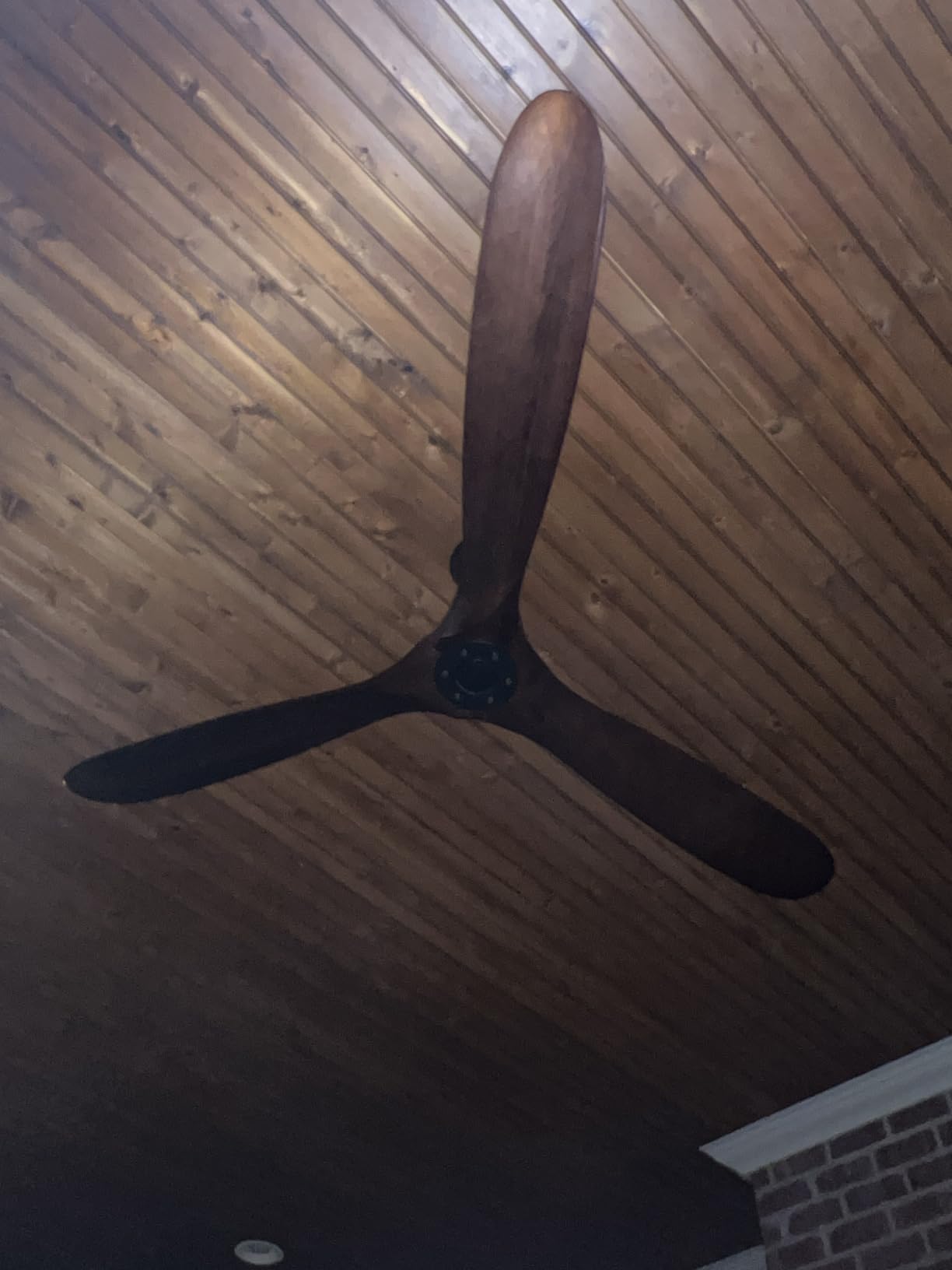
This is the one fan in the roundup rated for wet locations, which is the distinction that matters most if your patio gets rained on. Every other pick here is damp-rated, meaning it belongs under a roof. The Zronon is the only one we found that is built for full exposure to rain, and it is ETL listed.
It also solves the installation problem people complain about most. Most functional parts arrive pre-assembled, so you are hanging a motor and fitting blades rather than building the whole fan on the ground. Three downrods at 5, 10, and 15 inches cover low, mid, and high ceilings, and the 6 speed remote adds 1, 4, and 8 hour timers.
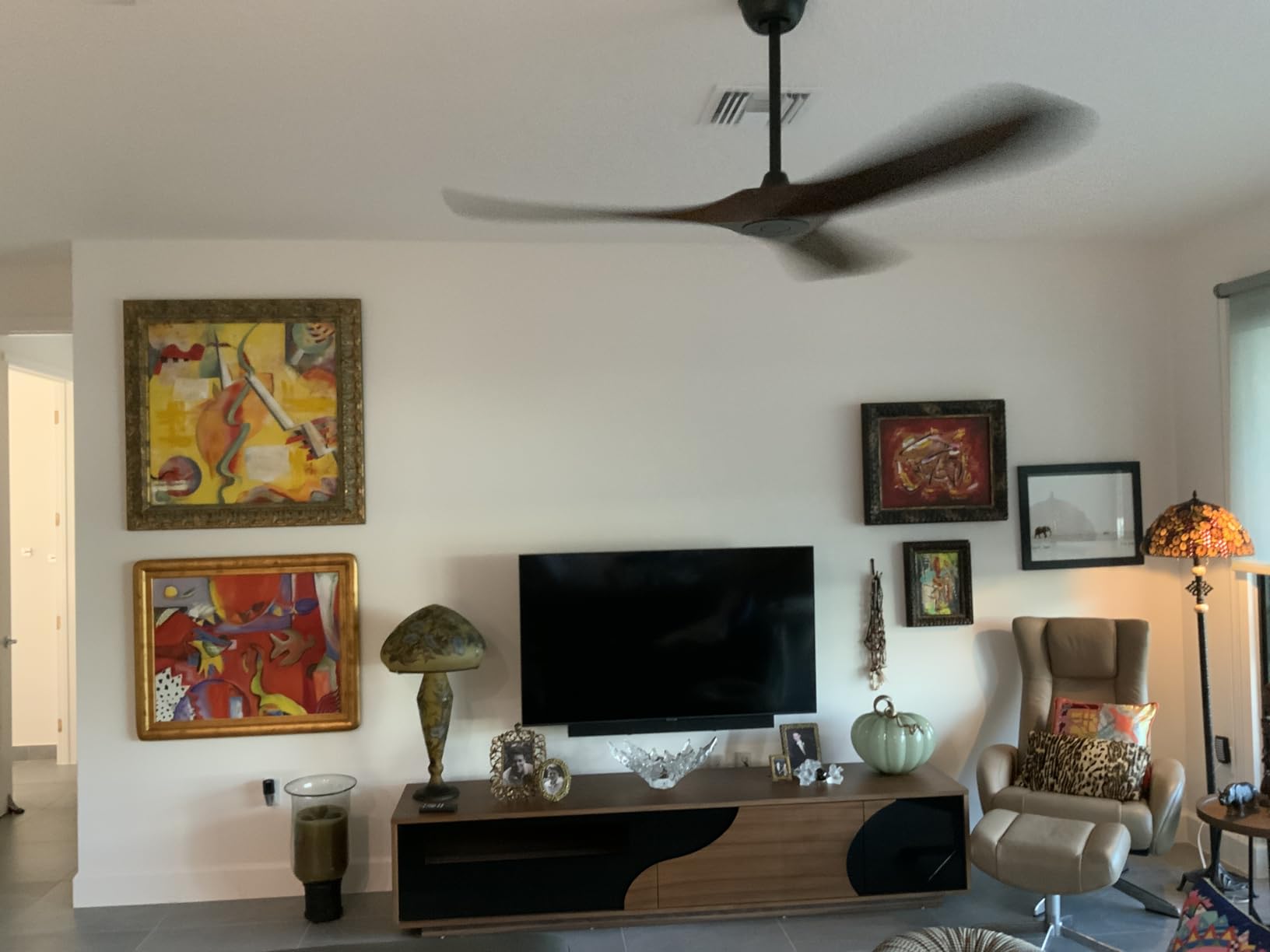
Blades are 100 percent solid natural wood with no synthetic ABS in the build, and the 27 watt DC motor is quiet at 35 dB and about 25 percent more efficient than a typical AC fan. The reversible direction handles winter circulation and helps deter flying insects, which is a genuine benefit on a patio where you eat outside.
Keep expectations realistic on the small issues. One owner reported a slight shimmy at higher speeds that is rarely noticeable below speed 3, so run it on medium for large gatherings. Stucco and mesh ceilings with a single beam need extra work to cut a bracket opening, and the written directions omit the step for removing the socket at the end of the downrod, which catches first-time installers.
There is no light kit, and the remote includes a light on and off button that controls nothing, which is confusing until you realize it. Budget a separate fixture for evening light.
What is the difference between a wet-rated and a damp-rated ceiling fan?
Damp-rated means the fan is built for humid air in a space that is protected from direct rain, like a covered patio or garage. Wet-rated means the motor housing, blades, and finish are built to take direct exposure to rain. Every other fan in this roundup is damp-rated only.
Is solid wood better than plastic blades for an outdoor patio?
For looks and for quiet running, yes. Wood blades are visually warmer and slightly quieter than plastic, and they do not carry the manufacturing smell that some ABS blades bring. The tradeoff is that wood needs a moisture-resistant finish and will eventually dull in salt air, whereas plastic simply will not absorb anything.
How We Picked and Ranked These Outdoor Fans?
We ranked these on a weighted basis rather than on star rating alone. Weather rating accounted for 30 percent, airflow for 25 percent, motor type and control for 20 percent, installation practicality for 15 percent, and owner review volume for 10 percent. A fan that looks beautiful and gets rusted in a season should not outrank one that keeps moving air quietly for a decade.
Our hard filters were simple. Every pick had to be rated for outdoor installation, either damp or wet. We removed anything without a published airflow figure. And we required a minimum volume of owner reviews so that we were reading patterns rather than isolated anecdotes. Between the twelve fans here there are more than 13,000 reviews behind the rankings.
Star rating alone did not decide placement. The XCWIIE 60 inch posts the highest airflow figure in the group and still landed in the middle, because 14 percent of its ratings are one-star, which is a durability signal you cannot ignore. Conversely the Hunter Cassius holds a 4.5 rather than a 4.7, and it still took the top slot because its 4,928 reviews describe the most consistent long-term experience of anything we tested.
Where a product had a documented installation problem, we named it. Missing blade grommets, missing downrods, omitted wiring steps, and remote pairing friction are all things you find out at install time rather than from a marketing page, and they belong in the review.
Outdoor Ceiling Fan or Outdoor Portable Fan?
If your patio has a solid roof and a joist to hang from, a ceiling fan wins outright. It moves far more air than any portable unit, it runs all evening on 30 to 60 watts, and nothing has to be carried outside or plugged in afterward. A ceiling fan is the right answer for every covered patio in this roundup.
For a fully exposed deck, a pergola with no roof, or a balcony, a ceiling fan is the wrong tool, and this is where portable outdoor fans come in. These are hanging plug-in units rated by an IP code rather than damp or wet certification. IP44 means splash resistant, IP55 means dust-tight and protected against water jets, and IP65 means protected against water from any direction.
The tradeoff is capacity. A 20 inch IP55 hanging fan can move a noticeable breeze across a table and is a fraction of the price of a 52 inch ceiling fan, but it will not shift air across a 20 by 30 deck. If your goal is a comfortable dinner table rather than a cooled patio, a portable fan at IP55 or better is a reasonable second purchase. If rain can reach the fan, buy the wet-rated ceiling fan instead of stretching a portable unit beyond its rating.
One caution from the buying guides we read: never mount an indoor-rated fan outside. Indoor motors are not sealed, and the result is rusted blades, a seized motor, and an unsafe installation. The damp-rated certification on the box is the only thing standing between you and that failure.
Buying Guide: How to Choose an Outdoor Ceiling Fan?
Start with the exposure, because it eliminates most options instantly. If rain can reach the fan, you need a wet-rated or IP-rated unit. If the fan sits under a roof, damp-rated is enough and opens up the whole market. Everything else in this guide assumes you have made that call correctly.
Damp-rated or wet-rated? Use wet-rated only if rain reaches the fan
A damp-rated fan is approved for humid air in a space protected from direct rain, such as a covered patio, porch, or garage. A wet-rated fan is built so the motor housing, blades, and finish tolerate rain directly. Eleven of our twelve picks are damp-rated, and only the Zronon 52 inch is wet-rated. If your patio is open on top, a damp-rated fan will corrode within a few seasons.
Coastal installs need more than either label. Salt air attacks the motor housing, the downrod, and the mounting hardware, and no amount of moisture resistance prevents that. Rinse the fan with fresh water twice a season if you live near the ocean, and consider stainless mounting hardware over plated steel.
Patio size to fan diameter: 44 inch under 225 sq ft, 52 inch to about 400 sq ft, 60 inch and up beyond that
Match the diameter to the covered square footage. A 44 inch fan handles up to about 225 square feet, which covers a 12 by 12 or 15 by 15 patio. A 52 inch fan is rated for areas up to 400 square feet, so 16 by 20 or 20 by 20 covered space. A 60 inch fan covers roughly 400 to 500 square feet, and 72 inch models stretch past that toward great rooms and wide covered decks.
Measure the actual covered area, not the footprint of the whole yard. A patio that is 20 by 20 but half open on one side is closer to a 300 square foot cooling problem. Undersizing is the single most common complaint we saw, and the usual cause is a homeowner buying a 44 inch indoor-rated fan for a space that needed 52 inches.
DC motor versus AC motor and why CFM beats RPM
AC motors are cheaper, heavier, louder, and limited to three discrete speeds. DC motors run quieter, use roughly a third of the power, and step smoothly through six speeds, which lets you find a level just under conversation volume. Every DC fan in this roundup publishes a noise figure between 28 and 35 dB, while the AC models sit around 45 dB.
Look at CFM, not RPM. Cubic feet per minute is the only number that tells you how much air actually moves across the patio, and it is the figure manufacturers should be publishing. The two pull-chain Hunter models move 3,096 and 4,999 CFM, the top-end wood propeller claims 9,660 CFM, and you can compare those directly regardless of blade count or motor type.
On blade count, three blades move the most air at high speed, five blades move air more quietly and evenly, and six to eight blades spread a gentle, wide column of air over a large area. There is no universally best number, and a homeowner asking how many blades are ideal is really asking whether they want force or coverage.
Fan with light or without light
Most homeowners we read avoid light kits on low outdoor ceilings. A fixture hanging 12 inches below an 8 foot ceiling sits in your sightline over a table, collects insects, and creates glare. A wall sconce gives you the same light without either problem.
On a higher ceiling the calculus changes, and a light kit can save a wiring run. If you do want one, look for dimming and tunable color temperature rather than a fixed 3,000K output. The Ohniyou 60 inch runs from 10 to 100 percent across three color temperatures, and the Haipeel 52 inch does the same with a high-CRI engine, while the Honeywell Belmar and several others are fixed and not dimmable.
Downrod, ceiling height and slope
Standard guidance is 7 to 9 feet of ceiling for a 52 inch fan, 9 feet or more for a 60 inch, and at least 10 to 12 inches of blade clearance below the ceiling. Below 9 feet, use a hugger design such as the Hunter Sea Wind, which mounts flat against the bracket.
Check the downrod length before you order. Most of these fans include a short 3 or 4 inch downrod for flat ceilings and sell longer ones separately, and the included length is often too short once blades and motor are hung. Slope tolerance ranges from 15 to 20 degrees on most models, with the EOPETY rated to 45 degrees, so a pitched patio roof is not automatically a problem. Our high ceiling ceiling fan guide covers drop lengths in more detail.
Use a listed outdoor-rated electrical box. A standard indoor box on a patio is a fire and corrosion risk, and if you are mounting to a pergola rather than a house, the structure needs a properly rated bracket. Fans with app control or a large propeller blade count are heavy, and a second person on the ladder is not optional.
Brand reliability, warranty and replacement parts
Hunter and Honeywell are the two names here with more than a century of combined outdoor track record, and both publish explicit ratings and warranty terms. Honeywell states a limited lifetime warranty on the Belmar and Duval. Hunter backs its motors heavily and is known for the availability of replacement parts years after a model is discontinued.
Newer brands compete hard on specs and price, and several here publish impressive airflow numbers. The tradeoff is that replacement blades, remotes, and light kits are harder to source five years out, and warranty claims may bounce between the marketplace seller and the manufacturer. If you want a fan that is still serviceable a decade from now, buy from a brand that still exists.
For a patio that also needs cooling gear, our industrial ceiling fan guide covers the high-output propeller category in more depth, and our large living room picks cover the sizing logic for big indoor spaces.
Frequently Asked Questions
What is the best type of ceiling fan for an outdoor patio?
A damp-rated ceiling fan for a covered patio, or a wet-rated fan if rain reaches it directly. Match the diameter to covered square footage: 44 inch under about 225 sq ft, 52 inch up to about 400 sq ft, and 60 inch or larger beyond that. A DC motor gives you the quietest operation and the lowest power draw.
Can I use an indoor ceiling fan on a covered patio?
No. Indoor fans are not sealed against moisture, and using one outside leads to rusted blades, a seized motor, and an unsafe installation. Any fan mounted on a patio must carry a damp rating at minimum, or a wet rating if rain can reach it.
How many blades are best for an outdoor ceiling fan?
Three blades move the most air at high speed, five blades deliver a quieter and more even spread for typical patios, and six to eight blades push a wide gentle column of air across large covered spaces. The more important number is airflow in CFM rather than blade count.
What size ceiling fan do I need for my patio?
A 44 inch fan covers up to about 225 square feet, a 52 inch fan up to about 400 square feet, and a 60 inch fan roughly 400 to 500 square feet. Measure the covered area only, then confirm you have at least 10 to 12 inches of blade clearance below the ceiling.
Which brand of ceiling fan is the most reliable?
Hunter and Honeywell stand out for outdoor duty because both publish explicit damp ratings, publish airflow figures, and back their motors with long warranties. The Hunter Cassius holds a 4.5 rating across more than 4,900 reviews, and the Honeywell Belmar holds a 4.7 across more than 2,200.
Which Outdoor Ceiling Fan Should You Buy?
The Hunter Cassius 44 inch is our pick for the best outdoor ceiling fans for patios overall, because a damp rating, a reversible three-blade design, and 49 CFM per watt make it the quietest, most efficient option on a covered patio under 225 square feet. Buy the Honeywell Belmar 52 inch if you want a light in the same fixture and stronger airflow. Buy the Hunter Sea Wind 48 inch if your ceiling is under 9 feet.
For a larger space, the Ohniyou 60 inch handles 400 to 500 square feet with a dimmable tunable light and app control, and the BvenuBigLite 72 inch covers the widest covered patios of anything we tested. If your patio is fully exposed to rain, the Zronon 52 inch is the only wet-rated fan in this group, and it is the one choice where a damp rating genuinely will not do.
Whatever you choose, confirm the rating, confirm the diameter against your measured covered area, and confirm the downrod length before the installer is standing on your ladder. Those three checks prevent nearly every complaint we read in the reviews.