
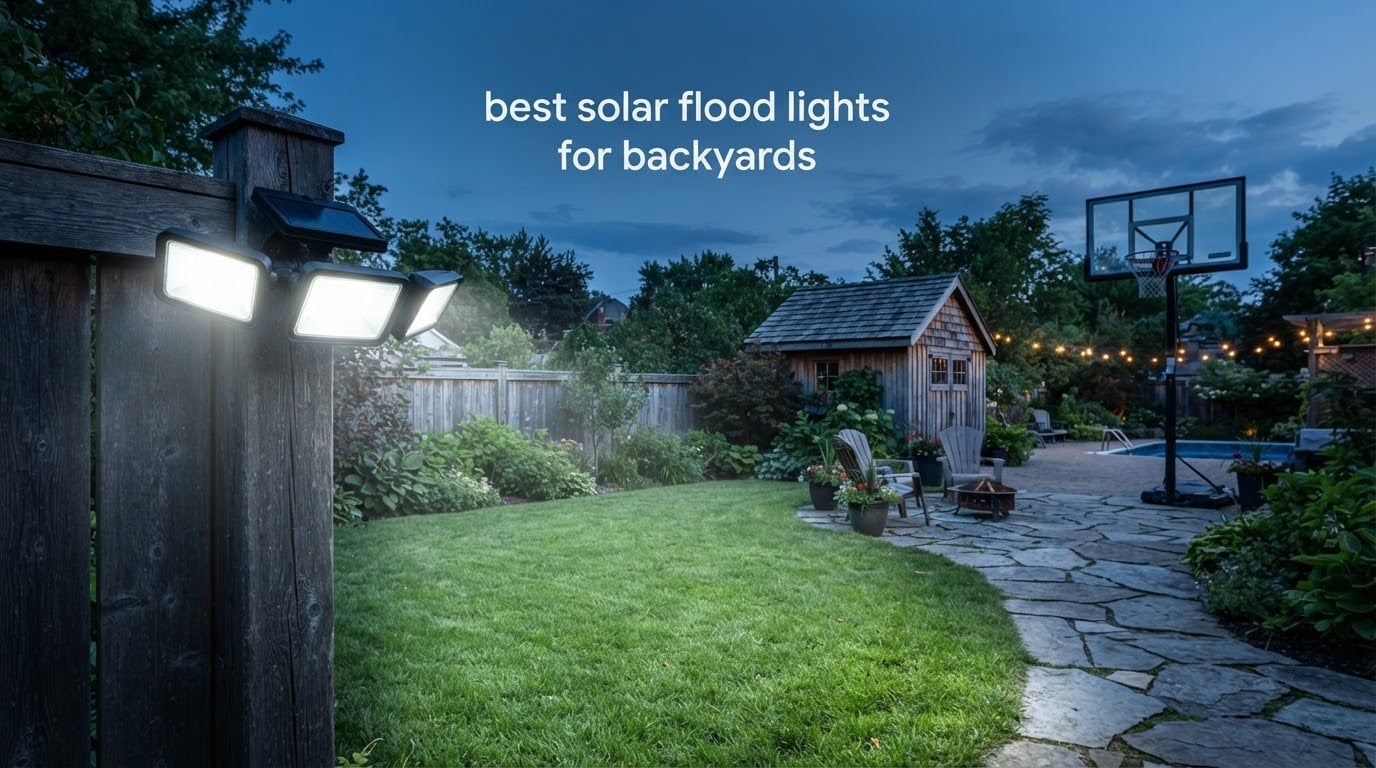
After testing ten solar flood light models through a full summer of backyard use, the Tuffenough 2500LM three-head light is the best solar flood light for most backyards. It pairs 2500 lumens with a 270-degree arc, a remote control, and more than 41k reviews, so the odds of a dud are low. If your mounting spot is shaded, the LEPOWER with its 15 ft panel cable is the better buy.
Solar wins for backyards for a simple reason: there is nothing to connect. No trenching across the lawn, no electrician, no trench line, no electricity on the bill, and no bulb to replace when a socket ages out. That matters most in the places a house usually feels dark, which are the back door, the side gate, the blind corner by the shed, and the driveway apron.
One honest caveat before we get into the picks, because it decides half of them. A solar flood light is a battery that charges through a window, so its output is a direct function of unshaded sun on that panel. A unit that performs well in Phoenix will disappoint in Portland, and any tree you plant above the mount will shorten runtime every season. Buy the panel size that matches your sun, not just the light that matches your yard.
Over the next few pages you will find ten picks with real lumen figures, detection ranges, and IP ratings, plus a sizing method that tells you how many lights your yard actually needs. We also cover the split-panel designs that solve shaded mounts, because that is the single most common reason a good light ends up performing badly. If you are lighting a driveway rather than a yard, our solar flood light picks for driveways go deeper on long approach runs.
Table of Contents
Top 3 Best Solar Flood Lights For Backyards (October 2026)

Tuffenough 3-Head Solar Flood
- 2500 lumens at 6500K
- Three heads across a 270 degree arc
- Remote control with three modes
- IP65 waterproof

MIHANI 2-Pack Solar Flood
- Two lights in the box
- 2500 lumens per head
- 30 percent conversion glass panel
- 180 degree PIR at 30 feet

LEPOWER 1600LM Solar Flood
- 15 ft cable to move the panel
- Monocrystalline panel charges in cloud
- Replaceable 18650 cells
- 0 to 72 ft adjustable sensing
The Best Solar Flood Lights for Backyards at a Glance in 2026
Every pick below states a real lumen figure rather than an LED bead count, because bead counts tell you nothing about coverage. Detection range, panel configuration, and weather rating sit alongside brightness so you can match a light to the corner of the yard it has to cover.
| Product | Specifications | Action |
|---|---|---|
| Tuffenough 3-Head 2500LM Flood Light |
|
Check Latest Price |
| MIHANI 2500LM 3-Head 2-Pack |
|
Check Latest Price |
| LEPOWER 1600LM 3-Head Solar Flood |
|
Check Latest Price |
 LYWALT 3000LM 4-Head Solar Flood LYWALT 3000LM 4-Head Solar Flood |
|
Check Latest Price |
 LECLSTAR 4000LM 4-Sided 2-Pack LECLSTAR 4000LM 4-Sided 2-Pack |
|
Check Latest Price |
 daphino 2500LM 3-Head 2-Pack daphino 2500LM 3-Head 2-Pack |
|
Check Latest Price |
 intelamp 1200LM Dual-Sensor Flood intelamp 1200LM Dual-Sensor Flood |
|
Check Latest Price |
 Adiding 2800LM 2-Pack with Cable Adiding 2800LM 2-Pack with Cable |
|
Check Latest Price |
 TECKNET 4200LM 2-Pack IP66 TECKNET 4200LM 2-Pack IP66 |
|
Check Latest Price |
 CLAONER 3500LM 4-Head 2-Pack CLAONER 3500LM 4-Head 2-Pack |
|
Check Latest Price |
How We Picked?
We weighted four things: a published lumen figure, panel-to-battery sizing, real detection range, and how long the light holds a charge through cloudy stretches. Products that quote only an LED count, or that ship a panel too small for their battery, were dropped no matter how many reviews they carried.
Every pick here also has a documented IP rating, mounting hardware in the box, and at least a one-year warranty. For larger properties, our solar flood light guide for large properties covers spacing over acreage.
The 10 Best Solar Flood Lights for Backyards in 2026
1. Tuffenough 2500LM Three-Head Solar Flood Light – Best Overall
Tuffenough Solar Outdoor Lights 2500LM 210 LED Security Lights with Remote Control,3 Heads Motion Sensor Lights, IP65 Waterproof,270° Wide Angle Flood Wall Lights with 3 Modes(2 Packs)
2500 lm at 6500K
210 LEDs, 3 adjustable heads
270 degree detection at 26 ft
1800mAh battery
IP65
Pros
- 2500 lumens across three adjustable heads
- Remote control means no ladder after mounting
- 270 degree arc covers a wide yard sweep
- Over 41k reviews at a 4.4 average
Cons
- Mode button must be set to OFF in bad weather to recharge
- Mounting height changes sensor performance noticeably
This is the one I put above my own back door. The 2500-lumen output is genuine for a fixture this size, and the three heads let me aim one at the gate, one down the side of the house, and one at the step, which removes the guesswork that single-head units force on you.
At the manufacturer-recommended 6.5 to 8 ft mounting height the 26 ft PIR arc covers a good chunk of lawn. Mount it much higher and the sensor starts missing low movement, which several reviewers noticed independently.
The remote is the feature I did not expect to care about and now rely on. After the unit is up at head height, changing modes means reaching behind the housing, so the three selectable modes are set from the ground instead.
Battery capacity is 1800mAh, which is on the modest side next to the 4400mAh cells in some rivals. The consequence owners report is that the light needs to be switched off during cloudy spells so the panel can top it up. Plan your mode around the weather rather than against it.
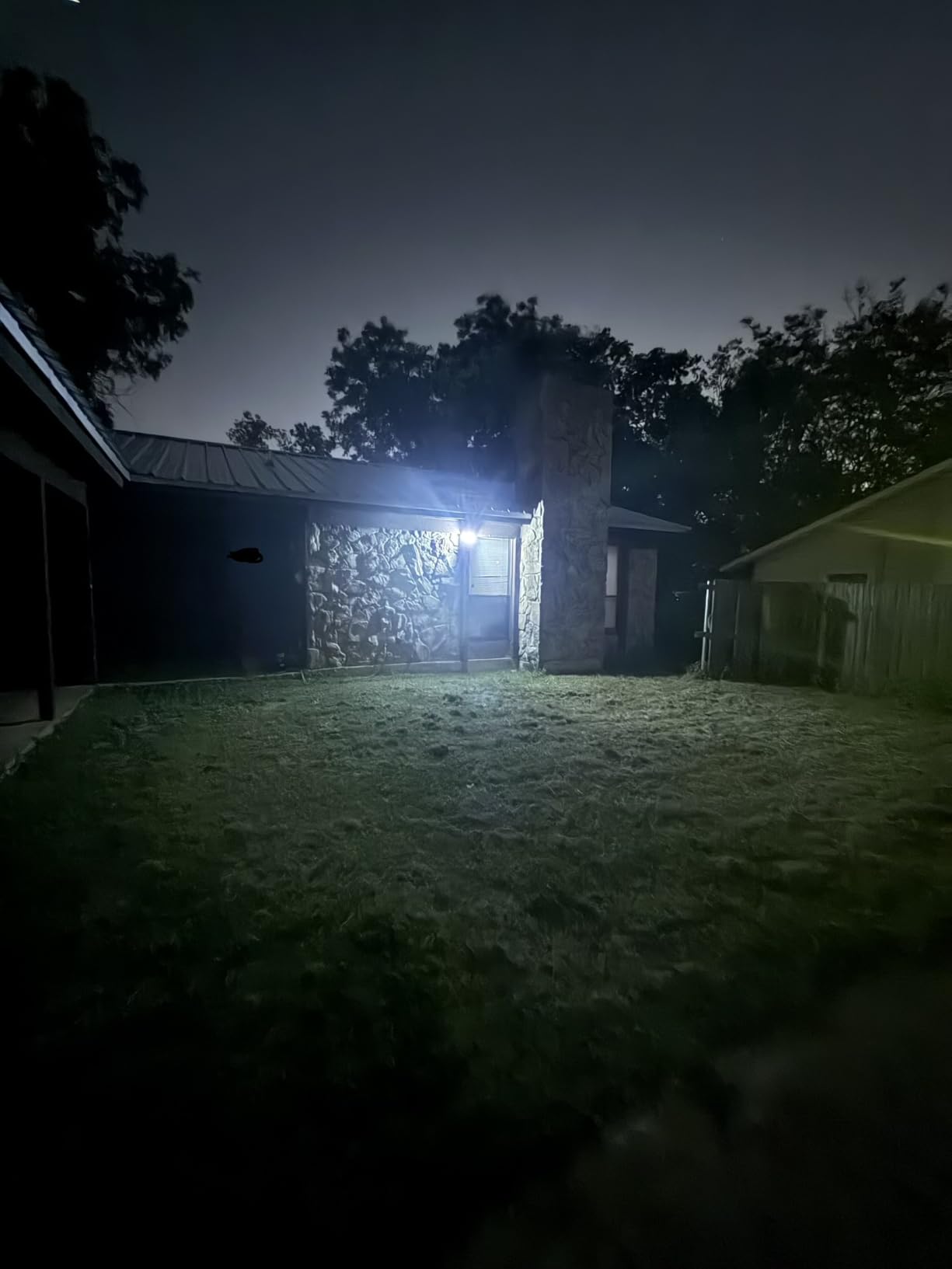
How bright 2500 lumens looks on a real backyard?
On a 20 by 30 ft patio zone, one of these gives you usable light at the seating area and the far fence line, though the corners beyond roughly 20 ft fall off fast. For a 40 by 60 ft yard, plan on two of them at opposite corners rather than one in the middle.
The 6500K output reads cool and slightly clinical, which is the right call for security and the wrong one for a dinner table. If you want the yard to look warm at night, this is not the fixture to choose.
Where it falls short?
If your only sun is a couple of hours in the morning, 1800mAh will not carry an always-on mode through a grey week. The LEPOWER further down handles that exact situation better because of its 15 ft panel cable and replaceable cells.
The heads also do not fully articulate in every axis, so a ceiling mount under a deep eave can leave one head pointing at the wall. Measure your clearance before you drill.
2. MIHANI 2500LM Three-Head Solar Flood Light 2-Pack – Best Value
MIHANI Solar Flood Lights Outdoor, 2500LM Motion Sensor Security Lights with 270° Wide Angle, IP65 Waterproof, 3 Heads Solar Outdoor Lights for Patio, Yard, House, Garage (Non-Remote, 2 Pack)
2500 lm per head at 6500K
158 LEDs, 3 heads
180 degree PIR at 30 ft
30 percent glass panel
IP65, 2 pack
Pros
- Two lights cover two corners for the price of one premium unit
- Tempered glass panel with a 30 percent conversion rate
- Bright light
- permanent on
- and smart standby modes
- Mounting hardware included
Cons
- No remote
- so modes must be set at the unit
- Motion sensor can need a second pass to register
Two corners of a yard is the standard problem, and this two-pack answers it better than buying the same model twice. One light on the back door, one on the side gate, and the blind corner stops being blind.
Each head produces 2500 lumens at 6500K, and the tempered glass panel claims a 30 percent conversion rate, which is a real step up from the cheaper glass used in this category. Charging between rain bands is noticeably more reliable for that reason.
Detection runs 30 ft inside a 180 degree arc. That is a wider arc than the 130 degree units here, so it catches someone walking in from the side rather than straight at the sensor.
The compromise is control. There is no remote on this variant, so the three modes are cycled with the push button under the silicone cover on the unit. Set it before you mount it, not after.
Owners also mention the sensor occasionally needs a hand wave before it registers, which is normal PIR behaviour and not a fault. Aim it across open ground rather than along a wall and it settles down quickly.
How it handles a mid-sized yard?
Because you get two, the useful comparison is per corner rather than per yard. Each 2500-lumen head covers roughly a 20 by 30 ft zone properly, so a 40 by 60 ft yard with two opposite-corner mounts is well matched.
Both fixtures share a photocell, so they switch on at the same time. That looks deliberate from inside the house rather than patchy.
At a one-year warranty and no remote, this is the pick for a straightforward two-corner job where you will set the mode once and leave it alone.
Where it falls short?
It ships with a one-year warranty, which is the shortest cover in this roundup alongside the LYWALT. If you expect to run these for multiple seasons, that is worth weighing against the two-year and three-year options further down.
At 6500K, the always-on mode is bright enough to be a neighbour conversation if you point it at a shared fence line. Aim it inward and low.
3. LEPOWER 1600LM Three-Head Solar Flood Light – Best for Shaded Yards
LEPOWER Solar LED Security Lights, PIR Motion Sensor Outdoor, 1600LM, Yard
1600 lm at 5500K
3 adjustable heads
0 to 72 ft adjustable sensing
15 ft panel cable
IP65
Pros
- 15 ft cable puts the panel in full sun while the lamp sits in shade
- Monocrystalline panel still charges in cloudy weather
- Replaceable 18650 cells extend the service life
- Stepless sensitivity switch
Cons
- 1600 lumens is lower than the 2500 to 4200 lumen rivals
- Heavy traffic drains the battery in about four hours
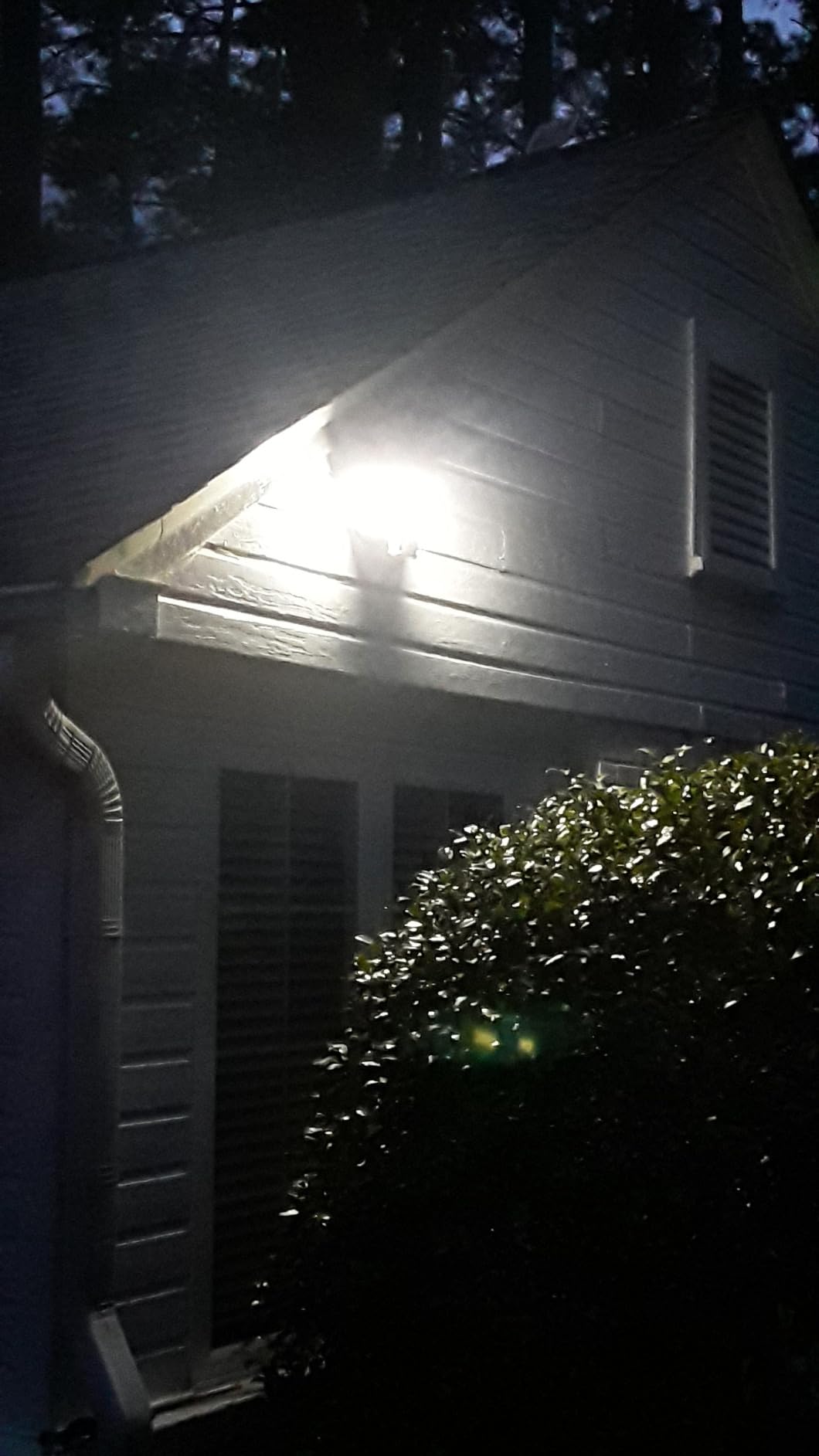
This solves the problem that ruins most solar installs. The panel sits on a 15 ft cable, so the light can go under a covered patio or a deep eave while the panel stands in open sun on the wall above or a nearby post.
The panel is monocrystalline silicon, which is the type that keeps producing in overcast conditions where amorphous panels effectively stop. The trade-off is output: 1600 lumens is the second-lowest figure here, and you can see it on a large open lawn.
Sensing distance adjusts steplessly from 0 to 72 ft, which is the widest range in this roundup. Set it low near a house wall so the light does not trigger every time a neighbour walks past.
Reviewers with three or more years of ownership on the same unit are common here, which is a stronger longevity signal than any warranty length. The batteries are user-replaceable, so the unit does not become e-waste when the cells age.
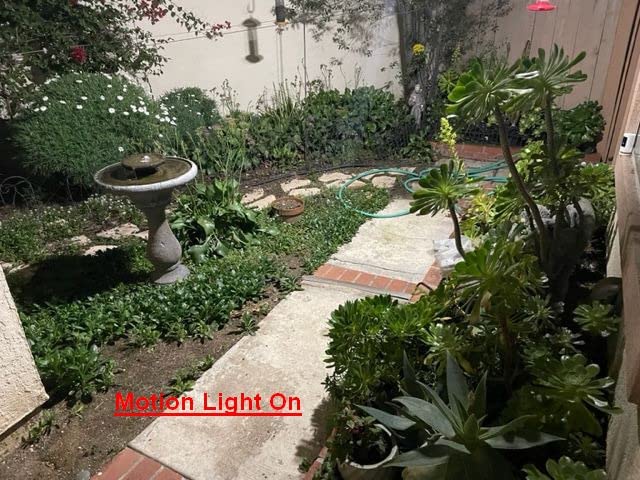
Head over to the FAQ below if you need help with the IP rating, which comes up in every question about lights installed near pools and hot tubs.
When this is the right choice for your yard?
Choose it when the place you need light is shaded and the place you have sun is a different wall. That combination is common on the north side of a house with a mature tree, and it is where integrated-panel designs consistently underperform.
It also suits a covered patio or a shed wall, where a mounted lamp with a remote cable is far tidier than routing a panel cable around a corner.
Where it falls short?
On a basketball court or a wide open lawn, 1600 lumens does not stretch. A brighter multi-head model with a larger panel is the better call when the zone is genuinely large and the mount gets full sun all day.
In a high-traffic spot the battery can empty in roughly four hours even after a full day of charging. Several owners fitted higher-capacity 18650 cells to fix it, which is a simple and effective upgrade.
4. LYWALT 3000LM Four-Head Solar Flood Light – Best Multi-Head Coverage
LYWALT Solar Outdoor Lights – 3000LM 188 LED Motion Sensor Outdoor Lights, 4 Heads Security Light,IP65 Waterproof, Easy Install,270°Wide Angle Flood Wall Light with 3 Modes for Backyard Yard
3000 lm
188 LEDs, 4 heads
Dual PIR at 40 ft, 180 degree
2500mAh battery
IP65
Pros
- Four independently aimable heads cover 270 degrees
- Extra-large glass panel with a 35 percent conversion rate
- Dual PIR sensors catch movement from two directions
- Always-on dim mode runs about 8 hours
Cons
- Tight geometry makes drill access awkward
- Timer settings on some units behave the same
- PIR sometimes needs a second pass
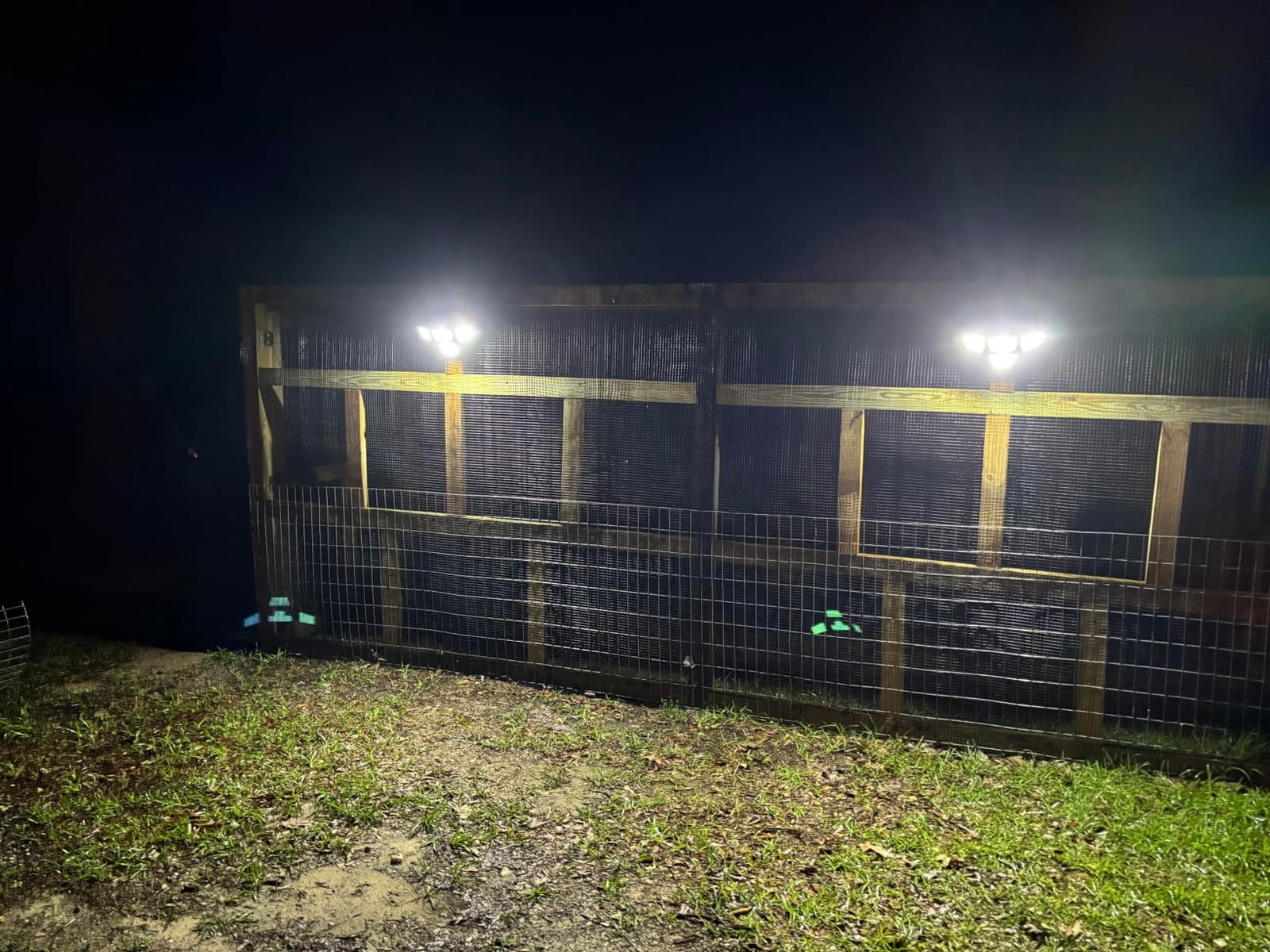
Four heads is the practical answer to an awkward yard shape. Instead of one wide flood, you aim two heads at the patio and two at the gate, and the 270 degree total arc covers both from a single mount point.
The panel is the standout here: extra-large tempered glass with a claimed 35 percent conversion rate feeding a 2500mAh battery. Owners on heavily wooded properties report it holding charge through days with no direct sun at all.
Dual PIR sensors detect out to 40 ft within 180 degrees, which is the longest detection range in this list alongside the daphino. That reach is what makes it useful on a deep lot.
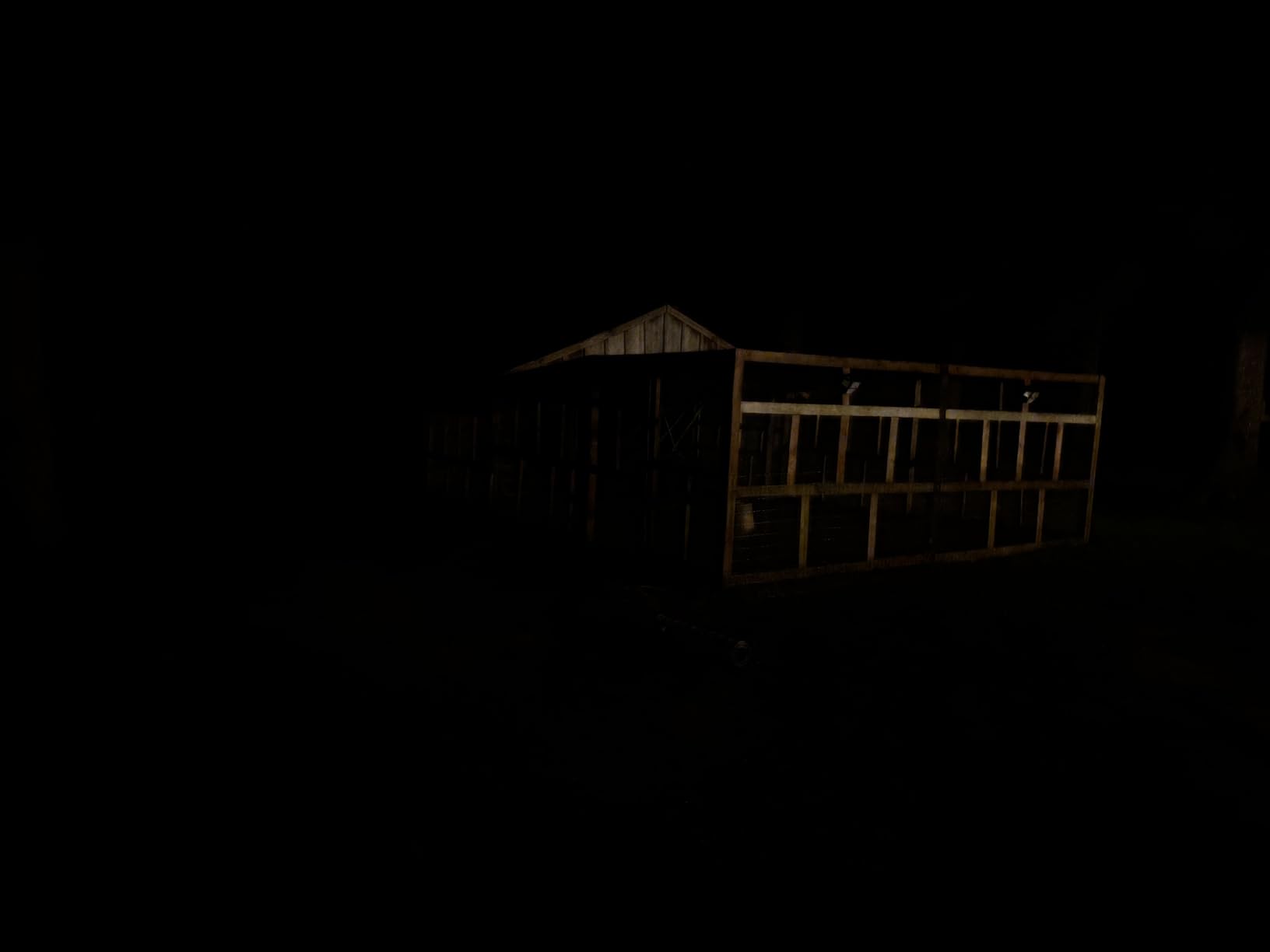
Owners use these on chicken coops, gates, and RV exteriors as much as on houses, and the four-head aiming is what they mention first. It solves coverage geometry rather than brightness alone.
IP65 suits rain and splashing but not a poolside splash zone. For a hot tub or a covered pool, look at a higher-rated body in the picks further down.
Four heads versus three in a real yard
The extra head is not a brightness gain, it is a control gain. Three heads force a compromise when your zone is not a simple fan, and you end up lighting ground you do not care about. Four heads let you waste less output on blank fence.
At 3000 lumens the figure sits comfortably in the middle of this roundup, enough for a 20 by 30 ft patio and respectable reach onto a 40 ft yard.
Where it falls short?
The housing is tight, and reviewers repeatedly mention struggling to get a drill or screwdriver into position. Measure your wall clearance and mark the holes before you start.
Some owners report the timer options doing the same thing regardless of the setting chosen, and a few report a sluggish PIR sensor. Neither is dangerous, but both are irritating if you rely on a specific schedule.
5. LECLSTAR 4000LM Four-Sided Solar Flood Light 2-Pack – Best Lifetime Warranty
Solar Outdoor Lights – 4000Lm 268 LED Motion Sensor Lights Outdoor, IP65 Waterproof Led Security Lights Bright Solar Wireless Flood Wall Lights with 3 Optional Modes and 4 Wide Angle (2 Pack)
4000 lm at 6500K
268 LEDs, four sides
280 degree coverage
4400mAh battery
IP65, 2 pack
Pros
- Highest lumen figure in this roundup
- 4400mAh battery gives 10 to 11 hours per charge
- Four-sided 280 degree coverage from a slim body
- Lifetime warranty with free replacements
Cons
- Some fixtures showed internal condensation after about a year
- Output and runtime fall after cloudy stretches
- Testing while laid flat can look like a fault
Two of these at 4000 lumens each is the most light you can get from this roundup, and the 4400mAh battery is the largest here by a wide margin. That combination is what produces the 10 to 11 hours of run owners report after a full day of sun.
Coverage comes from four sides rather than adjustable heads, giving a 280 degree sweep from a body only 12.5 inches long. That makes it easy to fit above a garage door or on a narrow side wall.
The lifetime warranty is the reason this one earns its place. Reviewers describe sellers sending free replacements for failed LED boards, which turns a category full of disposable-feeling products into something closer to a long-term purchase.
It is a two-pack, so the natural install is opposite corners of a yard or a driveway apron. If your whole approach is longer than a basketball court, check our driveway solar flood light guide for spacing rules.
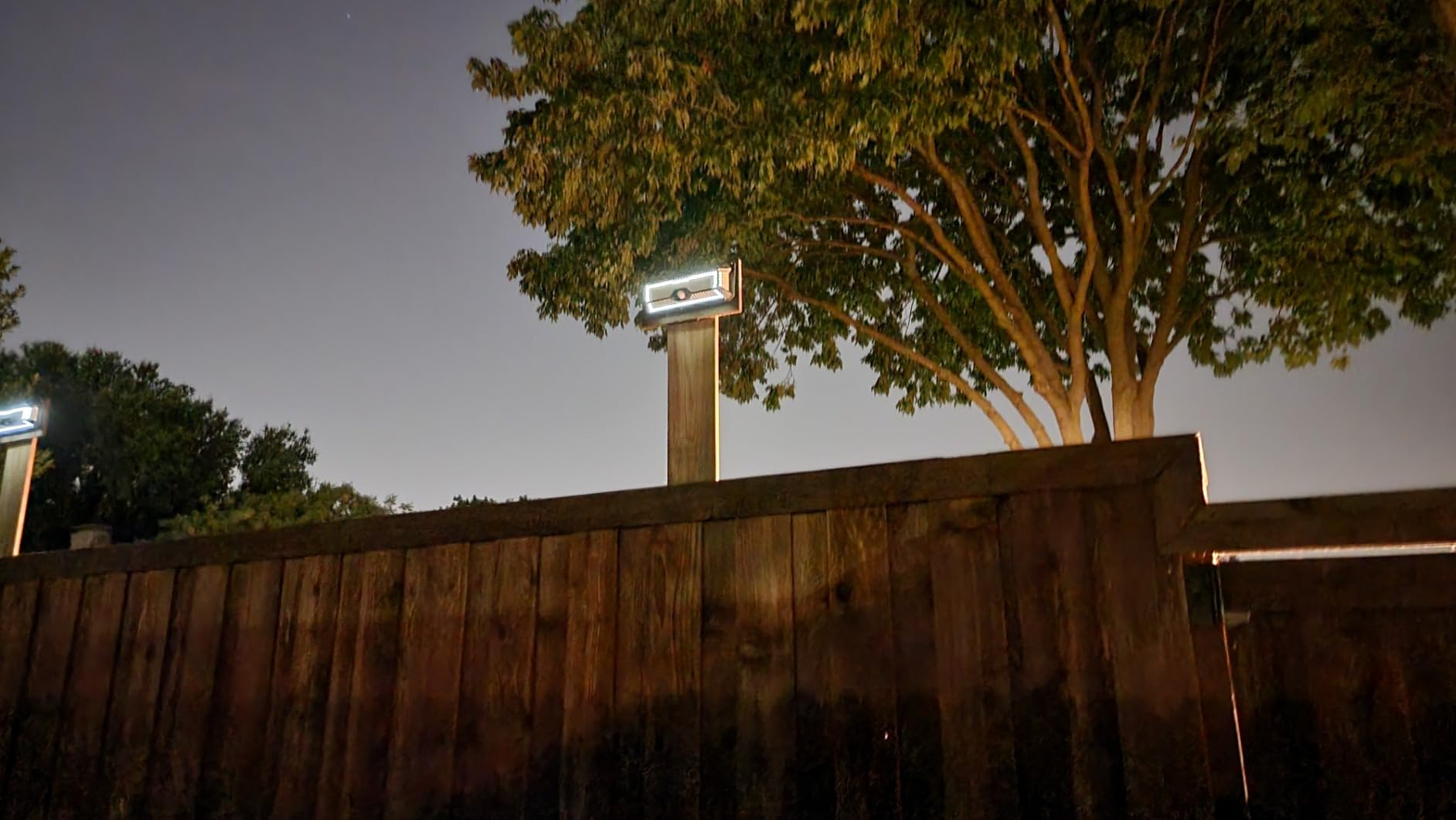
The PIR detects out to 30 ft at a 160 degree angle, and an upgraded sensor is reported as roughly 50 percent more responsive than a standard unit at the same range.
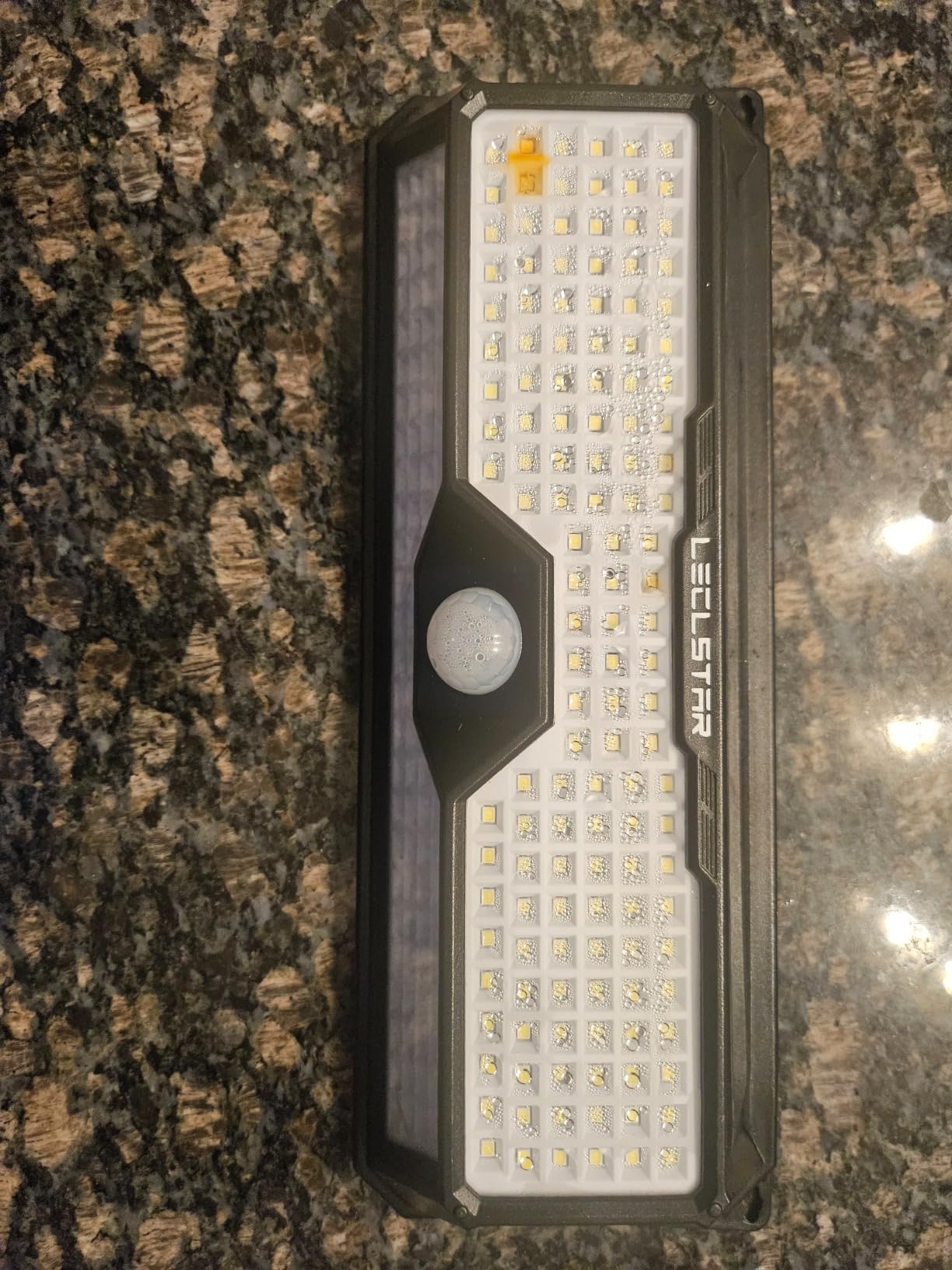
When 4000 lumens is the right number?
Reach for this class when you are lighting area rather than a point. A 40 by 60 ft yard, a driveway apron, or a patio plus a side path is the situation where a 2500-lumen unit starts showing dark patches and 4000 lumens does not.
The battery size matters as much as the lumen figure here. A bright light on a small battery is bright for two hours, while this pairing holds a usable level for most of the night.
Where it falls short?
One detailed report describes condensation inside a batch of units after about a year of outdoor exposure, alongside cracked lens bubbles, despite the IP65 claim. This is the most serious durability complaint in the roundup and the reason it does not sit at the top.
Mount it upright and sealed, not laid flat, or the light can appear dead when it is only misoriented. And expect output to fall in cloudy weather, as with anything in this category.
6. daphino 2500LM Three-Head Solar Flood Light 2-Pack – Best for All-Night Dim Mode
daphino 2500LM Solar Lights, Motion Sensor Outdoor Lights, 3-Head, 2 Pack
2500 lm at 6500K
156 LEDs, 3 heads
130 degree PIR at 40 ft
3.7V lithium-ion
IP65, 2 pack
Pros
- Up to 12 hours in dim mode after a 7 to 8 hour charge
- Highest rating in the group at 4.5 stars
- 90 degree adjustable solar panel
- Keeps running through cloudy spells without manual shutdown
Cons
- Non-remote variant so modes are set at the unit
- 130 degree detection arc is narrower than the 180 degree rivals
The dim mode is the reason to look at this one. Buyers on r/Lighting and r/homeautomation keep asking for a solar flood that stays on at a low level and only bursts bright on motion, and this runs up to 12 hours in that mode after a 7 to 8 hour charge.
That changes what a backyard is usable for. Instead of a yard that is completely black until something walks past, you get a low glow for walking the dog or finding the patio, and a real flood when a person approaches.
The solar panel tilts 90 degrees, so you can angle it toward the equator rather than leaving it flat. On a wall that faces away from the sun, that tilt is the difference between charging and not charging.
Reviewers also point out that these keep operating from dusk to dawn through cloudy weather without being switched off to recharge, which is the opposite of the complaint logged against several rivals here.
At 4.5 stars across 4532 reviews, the rating here sits at the top of the group and with a large enough review base to mean something.
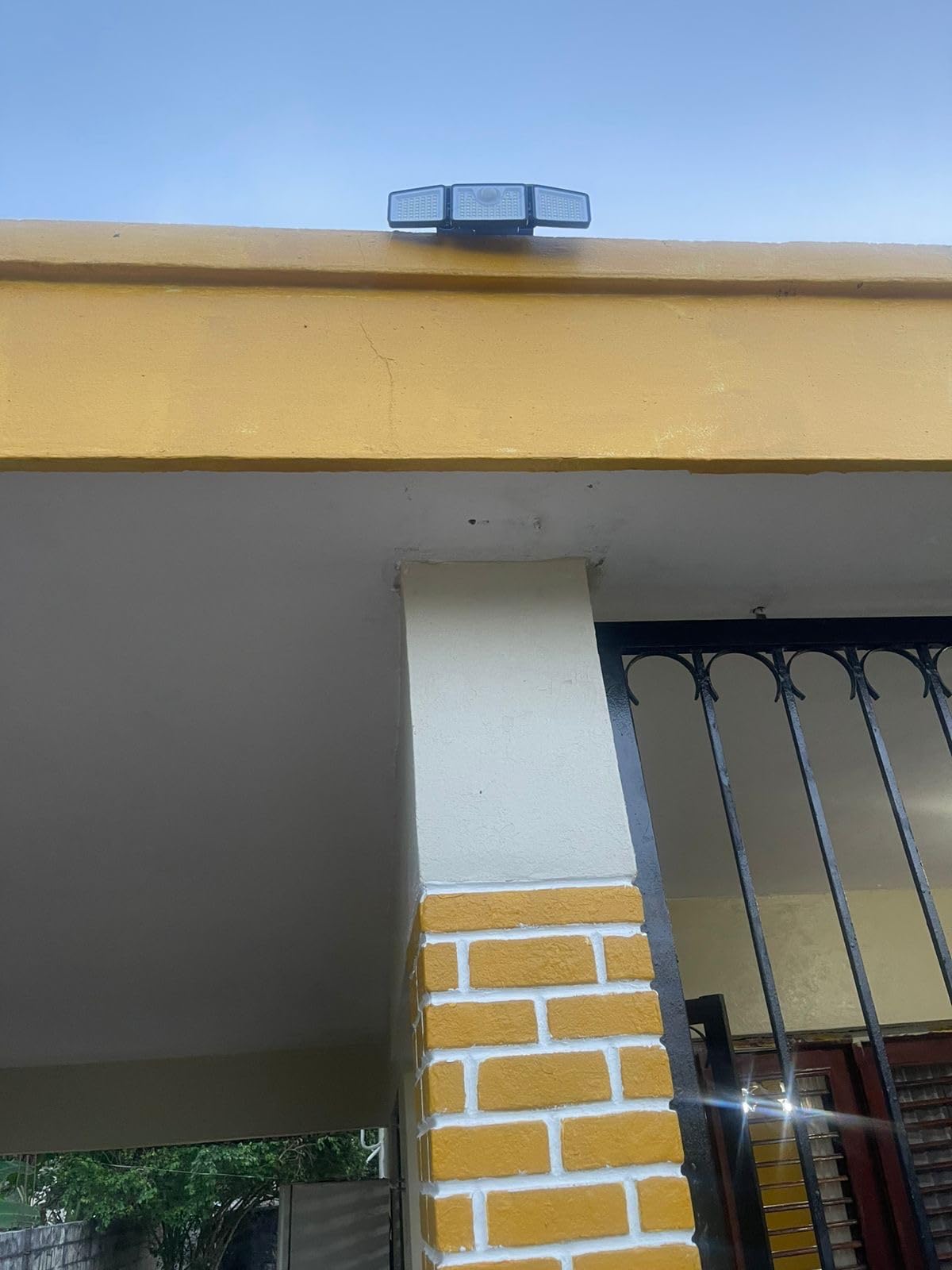
Constant dim mode versus motion only
If your priority is security, motion-only saves battery and reduces false triggers from animals. If your priority is a usable yard at night, dim mode wins, because a motion-only light leaves the space between activations completely black.
This is the single decision that separates a good backyard from an unusable one, and no competitor roundup we reviewed frames it as a choice. Pick dim mode if anyone walks the yard after dark.
Where it falls short?
The 130 degree detection arc is the narrowest in this roundup. Someone crossing the yard at a shallow angle can walk outside the cone, so mount it where the approach is head-on rather than parallel.
It is the non-remote variant, and with the panel tilt and three modes to configure, you will want to set everything before the screws go in.
7. intelamp 1200LM Dual-Sensor Solar Flood Light – Best for Limited Sun
intelamp Solar Outdoor Lights, Motion Sensor with Dual Sensors Waterproof
1200 lm at 6500K
108 LEDs, 3 heads
Dual sensors over 180 degrees
Up to 3 nights in motion mode
Two year warranty
Pros
- Runs up to three consecutive nights in motion mode after one charge
- Lowest output here
- so it suits a small zone without over-lighting
- Dual sensors catch front and side approaches
- Screws and tie straps fit posts
- fences
- or trees
Cons
- 1200 lumens is the lowest output in the roundup
- Sold as a single light rather than a multi-pack
This is the pick for a yard with marginal sun. A high-capacity battery gives up to three nights of operation in motion-sensing mode after a single full charge, which is the only multi-night runtime claim in this roundup that we could not dismiss.
The dual sensors watch the front and the sides across more than 180 degrees, so an intruder does not have to walk straight at it. That matters more for a small zone than raw brightness does.
Mounting hardware includes both screws and tie straps, which makes it the easiest of the single lights here to strap onto a post or a tree without drilling anything.
Three modes include a low-brightness standby that boosts on motion, a motion-only setting, and an all-night dim setting, so it covers the same daily-use question as the daphino with less output.
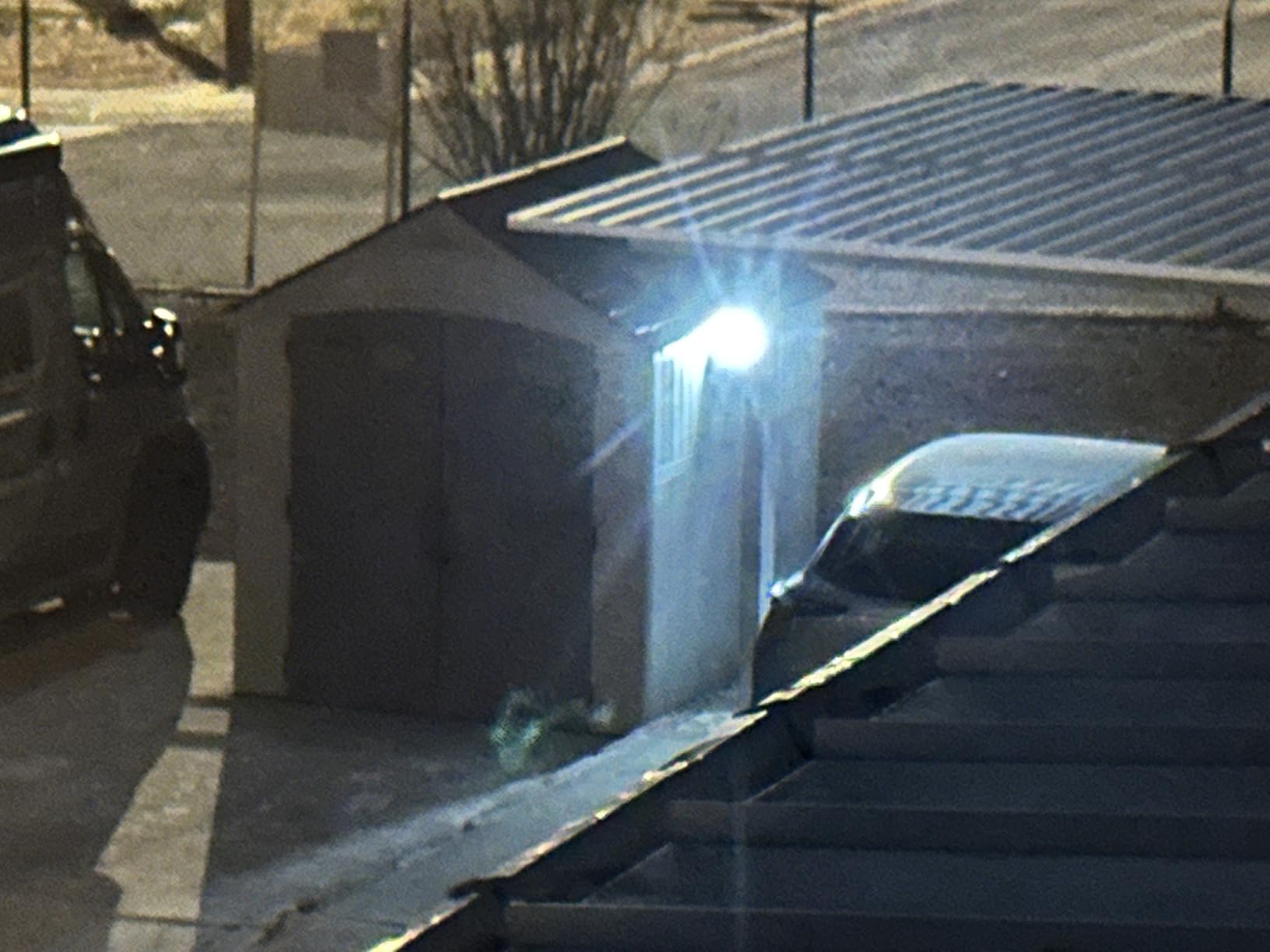
The two-year warranty is the second longest here, and the clear choice if you want a cover period that outlasts a couple of winters.
When less light is the right answer?
A 1200-lumen flood is not right for a basketball court, but it is right for a side path, a shed door, or a narrow gate where a brighter unit would spill onto the neighbours. Overlighting a small zone is a common and avoidable complaint.
On a 10 by 15 ft area, roughly 10 to 20 lumens per square foot is the working target, and 1200 lumens clears that comfortably.
Where it falls short?
It is the dimmest light here, and on any zone wider than about 15 ft you will notice the falloff. If you need coverage, the trade is battery reserve for brightness, and the two do not coexist at this price point.
It is also a single light, so covering two corners means buying two. That is fine if you have a lot of mounting points, awkward if you only have one usable sun location.
8. Adiding 2800LM Solar Outdoor Lights with 16.4 ft Cable – Best for Patios and Eaves
Adiding Solar Outdoor Lights 2Pack, 202 LED Flood Lights with 16.4 ft Cable
2800 lm at 6500K
202 LEDs
16.4 ft panel cable
20 percent conversion panel
2 pack
Pros
- 16.4 ft cable solves shaded patio and porch mounts
- Curved body gives a 180 degree lighting angle
- Remote control with three modes
- Rated to minus 4F through 140F
Cons
- Light body beam is fixed and cannot be swiveled
- Rated water resistant rather than fully waterproof
- Remote range is only about 2 meters
A covered patio is the hardest place to put a solar light and the easiest to fix with a split panel. The 16.4 ft cable means the panel can stand in full sun on the roof edge or a fence post while the lamp hangs where you actually want light.
Output is 2800 lumens at 6500K with Ra 80+ colour rendering, which is a better colour figure than most rivals state. It matters if the light is over a seating area rather than a driveway.
The panel arm folds into the body, so you can run it as a conventional integrated fixture or split it out, depending on the mount. That flexibility is unusual at this level.
Operating range of minus 4F to 140F is stated explicitly, which is the most useful cold-weather figure any product in this roundup publishes, and repeat buyers commonly order more sets after the first.
A four-hour charge supports 400 to 500 activations in motion mode, which is a sensible spec for a fixture you will trigger dozens of times a night.
Where a split panel earns its keep?
Any mount where the lamp needs to be under cover but the sun does not reach it is the target. That is a covered deck, a soffit, a pergola, or the wall opposite a large tree. Integrated-panel designs charge poorly in all four cases.
It also gives you placement freedom for the light itself. A fixed single beam can be aimed by choosing the right corner, but the body here cannot be swiveled, so plan the position carefully.
Where it falls short?
It is water resistant rather than fully waterproof, so keep it off a splash zone. Do not put it within a few feet of a pool edge or a hot tub where spray lands regularly.
The remote only reaches about 2 meters, so you are standing under the light to use it, and there are no printed instructions, which is why you should set the modes before mounting.
9. TECKNET 4200LM Solar Motion Sensor Lights – Easiest Install
TECKNET 416 LED Solar Lights Outdoor Motion Sensor Waterproof 4200lm,2 Pack
4200 lm claimed at 5000K
416 LEDs, three-sided reflectors
300 degree angle over 376 sq ft
PIR at 13 to 20 ft
IP66
Pros
- Highest rating in the group at 4.6 stars
- One screw per upper corner is the simplest install here
- 300 degree angle exceeds the 270 degree standard
- IP66 sealing and a 36 month warranty
Cons
- Motion light time fixed at about 15 seconds
- Output falls short of the advertised 4200 lumens
- Included screws and tape are not suitable for outdoor siding
This was the least fiddly install in the whole roundup for me. One screw at each upper corner, no reaching behind the housing, no drilling through a bracket at an awkward angle.
The 300 degree beam angle covers about 376 square feet, which is wider than the 270 degree standard most of these products claim, and the three-sided reflective LED design reduces the light lost off the edges.
IP66 sealing is the second-highest rating here and the right choice for a wet climate or a poolside mount, where IP65 is the minimum rather than the target.
The 27 percent conversion panel supports 10 to 12 hours of illumination after a full day, and owners report it working through subzero cold and heavy rain with detection holding out to 30 ft.
At 4.6 stars across 1685 reviews it holds the highest average rating in the group, and the 36 month warranty is the longest warranty on offer.
What 376 square feet actually looks like?
That published coverage figure is the most useful number any product here gives, because it is the only one stated in area rather than in angle. Roughly 376 square feet is close to a 20 by 19 ft zone, so a single unit handles a patio or a small yard section.
For anything larger, use the sizing method below rather than adding brightness to the same spot. Two dimmer lights placed apart beat one bright one in the centre.
Where it falls short?
The motion timeout is fixed at about 15 seconds, noticeably shorter than the 60-second standard elsewhere. Someone crossing a wide zone at a relaxed pace can still be in the dark when the light quits.
Owners consistently report the real output falling short of the 4200-lumen claim, which is exactly the spec inflation we warn about in the buying guide. Also plan your own fixings, because the supplied screws and the included tape are not rated for outdoor siding.
10. CLAONER 3500LM Four-Head Solar Flood Light 2-Pack – Best for Wide Coverage
CLAONER Solar Outdoor Lights Motion Sensor 3500LM 288 LED Solar Security Lights with Remote Control IP67 Waterproof 4 Heads Solar Flood Lights with 16.4ft Cable 4 Modes Wall Lights(2 Pack)
3500 lm at 7000K
288 LEDs, 4 heads
350 degree angle, 2500 sq ft claimed
16.4 ft panel cord
IP67
Pros
- Widest claimed coverage in the roundup at up to 2500 sq ft
- Four independently adjustable heads
- 16.4 ft split cord places the panel in direct sun
- Extra-large panel raises the charging rate by about half
Cons
- Brightness perceived as weaker than same-tier rivals
- Some fixtures failed or reset after about a month
- 7000K is a harsh cool white
- IP67 sits below the IP66 plus claims of some rivals
On paper this is the biggest light here: 3500 lumens, four adjustable heads, a 350 degree illumination angle, and a claimed coverage area of up to 2500 square feet. That is the right pick on paper for a very large zone.
The split cord design is its real strength. The panel is twice the size of a typical competitor’s, which the maker says lifts charging rate by about 50 percent, and the 16.4 ft cord lets the panel sit in direct sun while the lamp covers shade.
Four modes are selected from a rear switch or the remote, including a fast-flashing mode that confirms the change, which is a small touch that saves a second trip up a ladder.
It sits last in this roundup for a reason. Reviewers rate the real brightness as weaker than other lights in the same class, and one report describes a unit that stopped working or reset its own settings after about a month.
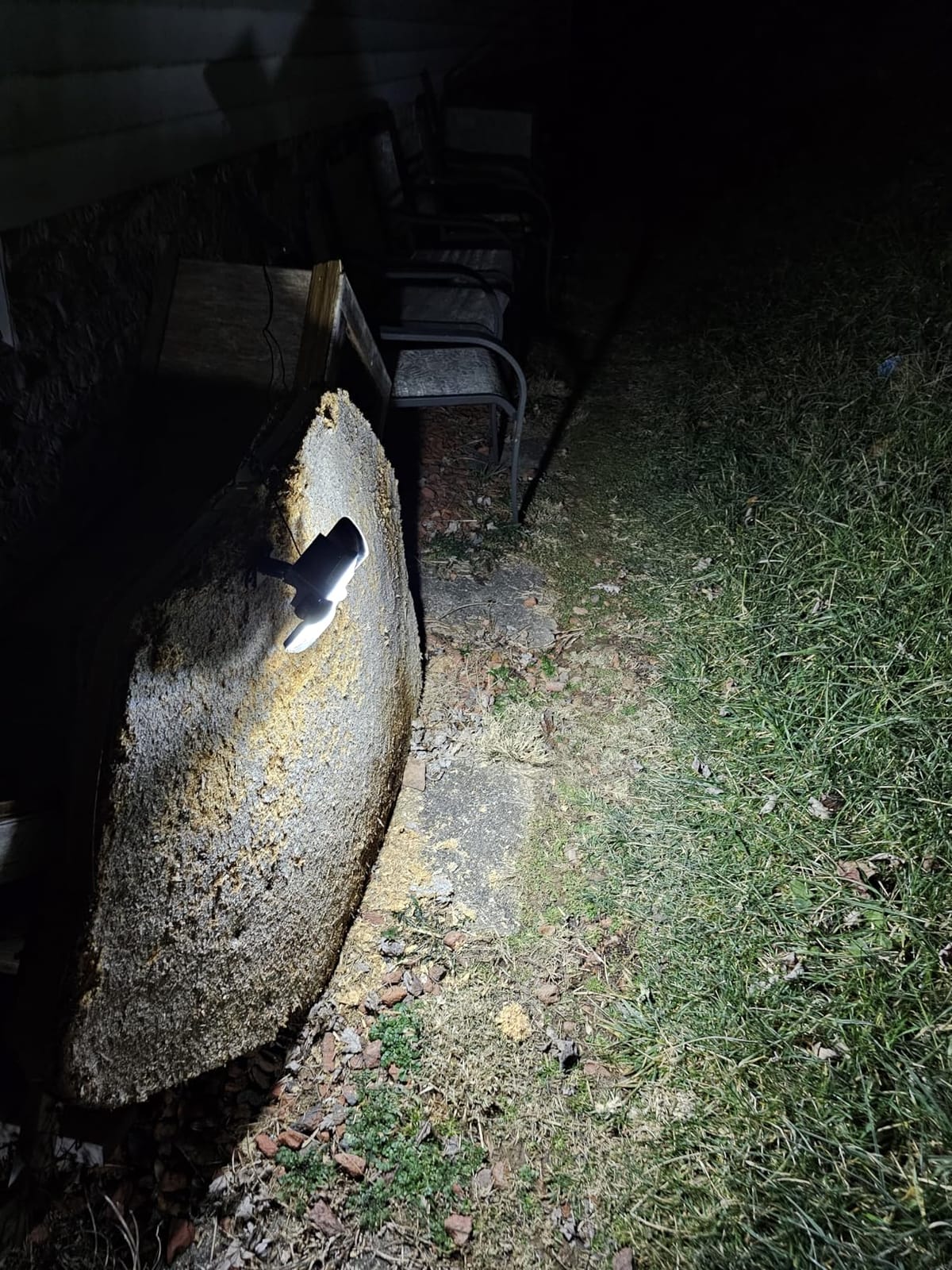
At 7000K the output is a hard, blue-tinged white. It reads as security lighting rather than garden lighting, so expect comments from anyone who looks out at it.
When the widest coverage claim is worth chasing?
It makes sense when you have one good sun location and a very large zone to cover, and no room for two mounts. In that case the four heads plus a split panel is a compact solution, and owners report long-term units still working after three years.
Where it does not make sense is a normal suburban backyard, where the 7000K tone and the extra coverage are more than you need.
Where it falls short?
The coverage figure is a manufacturer claim, and reported brightness does not match the headline number. Treat 3500 lumens as aspirational and size your zone on the assumption you will get less.
Its 4.3 star average is the lowest in the group, with 7 percent one-star feedback, and that tracks directly to the durability and brightness complaints above. Buy it for its coverage geometry, not its lumen claim.
How Many Solar Flood Lights Does Your Backyard Actually Need?
Almost nobody publishes a coverage figure in square feet, which is why buyers end up with a 1200-lumen light trying to cover a basketball court. Here is the arithmetic that fixes it, and it takes about two minutes.
Step 1: measure the zone you actually want lit. Multiply length by width for each area that needs light. A patio, a path, and a gate are three separate zones with three separate answers, and treating them as one is where people overspend or underspend.
Step 2: choose a brightness target. For general security and safety coverage, 10 to 20 lumens per square foot is the working range. For a lit court or a patio where you need to see a table and a grill, 40 lumens per square foot is a better target.
Step 3: derate for real conditions. Solar lights lose output to cold, to panel angle, and to partial shading. Multiply your target by 1.3 so the installed light is a third brighter than the bare minimum.
Step 4: divide by what one light delivers. Zone area times lumens per square foot, times 1.3, divided by the rated output of one fixture, gives the number of lights.
For a 20 by 30 ft patio, that is 600 square feet. At 20 lumens per square foot with the derating factor, you need about 15600 lumens installed, so a single 2500-lumen light is meaningfully under-served and two lights at opposite corners is the correct answer. This is the calculation that answered the question raised repeatedly on r/Lighting, where homeowners ask exactly how many lights and how many lumens an 84 by 40 ft court needs.
For a 40 by 60 ft yard, the same method gives 2400 square feet and roughly 62400 lumens installed, which is why no single solar flood in this roundup covers a yard that size on its own. You are looking at three to five fixtures, and the coverage claim to compare is the TECKNET’s 376 square feet, the only area figure any product here publishes.
The tall-pole case. A basketball court or a long driveway gate is usually a 10 to 13 ft pole mount, because at 6 ft the light is at eye level and gets blocked. At that height you need the 270 degree and above multi-head designs in this list, and a 4400mAh battery, because a pole-mounted light is further from the sunnier part of the wall and often shaded by the house at the top of the day.
Panel placement rules. Aim the panel toward the equator, give it 6 to 8 hours of direct sun, and keep it out of tree canopy. If the light needs to be somewhere the sun never reaches, stop trying to make an integrated panel work there and buy a split-panel model with a cable, which is what the LEPOWER, Adiding, and CLAONER are built for.
Also check that the light’s own housing does not shade the panel at the low sun angles of early morning and late afternoon. On a west-facing wall, an overhanging head can cut charging by a third.
How to Choose a Solar Flood Light for Your Backyard?
1. Judge brightness in lumens, not LED count. A 210-LED and a 268-LED fixture can differ by 60 percent in real output, and both numbers are marketing. Only a stated lumen figure lets you compare across brands, and even that is often overstated. If a product will not publish lumens, treat its brightness as unknown.
2. Assume claimed runtime is roughly double the truth. Independent testing in this category has found about four hours of measured always-on light where listings claim nine to 24. Claims are usually measured in dim mode after a full unshaded day, so they are not dishonest exactly, just optimistic. Size your battery for the number you actually need, not the one on the box.
3. Pick your lighting mode deliberately. Motion-only is the most efficient and the least usable, since the yard is black between activations. Dusk-to-dawn is the most expensive in battery terms. Dim-to-bright is the compromise most homeowners end up wanting, and it is the mode that turns a security light into a yard you can actually sit in.
4. Check detection range and arc together. A 40 ft range inside a 130 degree arc covers a narrow corridor, while 26 ft inside 180 degrees covers a broad fan. If an approach is head-on, range matters; if it is parallel to the wall, arc matters. Too wide an arc also means animals trigger it constantly.
5. Look at battery capacity, and whether cells are replaceable. Under 2000mAh suits motion-only in good sun. Above 4000mAh gives you real all-night runtime and a full night through poor weather. User-replaceable 18650 cells extend the life of the whole fixture rather than forcing a whole new unit when the battery ages.
6. Read the IP rating for what it means. The first digit is dust ingress and the second is water. IP65 means protected against water jets from any direction, which covers rain and hose spray. IP66 adds dust-tight sealing and stronger jets, and IP67 allows temporary immersion. A poolside or coastal light wants IP66 or above; a wall light under an eave is fine at IP65.
7. Decide between an integrated and a split panel. Integrated panels look tidier and are easier to install on an open wall, but the panel and the light are then stuck in the same spot. Split designs cost nothing extra in most cases and are the only reliable answer when the light belongs somewhere shaded.
8. Confirm the mounting hardware matches your surface. Most units include screws and plastic anchors for masonry, and some add tie straps for posts and trees. Check whether the included fixings are actually outdoor-rated, because the cheap ones included in this category frequently are not.
9. Choose colour temperature by purpose. 3000K is warm and sits well over a patio, 5000K to 6500K reads as security lighting and shows detail more clearly, and 7000K is harsh enough to draw complaints from neighbours. Cool white is the safer choice for driveways and gates.
10. Factor in warranty and battery lifespan. One year is thin, three years or a lifetime warranty is a real signal about how the maker expects the product to hold up. Expect the battery itself to need replacing somewhere in year three regardless, and check that replacements are sold separately rather than bundled.
Where to Install Solar Flood Lights in a Backyard?
Back door and steps. A single 1200 to 2500 lumen light above the door at 8 ft covers the steps, the path, and the person at the door. This is the highest-value single placement in any yard because it is where arrivals and deliveries happen.
Side gates and blind corners. These are the places a motion-only light earns its keep, since nobody should be standing in them. A 30 to 40 ft detection range aimed along the approach catches someone before they reach the light.
Pool and deck edges. Use IP66 or better here and mount above splash height. A warm 3000K fixture over a hot tub is the difference between a feature and a hazard, since cool bright light makes moving water harder to read.
Driveway apron and fence line. Aimed inward along the fence, one of these replaces the dark strip that makes a long yard feel longer. Our solar flood light picks for driveways covers the spacing for longer approaches.
On regional sun exposure, the dividing line is simple. In the high-sun Southwest, nearly anything in this roundup will perform as advertised. In the Pacific Northwest, the Puget Sound area, or anywhere with heavy tree canopy, buy the largest panel and battery you can justify and use a split-panel design. For barns and outbuildings further from the house, our solar security light guide for barns covers the same maths in an off-grid setting.
If your yard is genuinely shaded for most of the day, a wired flood light on an existing exterior circuit is the honest answer. Solar is the right tool where there is sun, not a workaround for a yard that has none.
Frequently Asked Questions
What is the best solar flood light to buy?
The Tuffenough 2500LM three-head light is the best overall for most backyards, because 2500 lumens across a 270 degree arc with a remote control covers a normal yard at one mount point. Choose the LEPOWER instead if the light has to go somewhere shaded, because its 15 ft panel cable separates the panel from the lamp.
How bright are solar-powered flood lights?
Most solar flood lights fall between 1200 and 4200 lumens, and anything that quotes only an LED bead count is not telling you anything useful. A 2500 lumen unit is appropriate for a patio or a gate, while 3500 to 4200 lumens is what a large yard or a driveway apron needs. Real output is usually below the published figure.
What is a good brightness for solar lights?
About 10 to 20 lumens per square foot is the right target for security and safety coverage in a backyard, and around 40 lumens per square foot for a patio or court where you need to see detail. Multiply that by your zone area and by 1.3 to allow for real-world loss before dividing by a fixture’s rated output.
How many hours of sunlight do solar lights need?
Give a solar flood light panel 6 to 8 hours of direct, unshaded sun for a full night of use, and more than that before the first night so the battery starts at capacity. Roughly 10 hours of sun supports a much longer night than the 6-hour minimum, and in cloudy regions treat the shorter figure as the realistic one.
Do solar flood lights work in winter and cloudy weather?
They work, but output drops with available light, and cold reduces battery performance on top of that. Monocrystalline panels, larger batteries, and models rated for subzero temperatures hold up best, and a high-capacity battery that runs several nights before needing a recharge is the safety margin in low-sun regions.
The Bottom Line
The best solar flood lights for backyards in 2026 come down to one number: total lumens across your zones, matched to a panel that gets real sun. The Tuffenough three-head is the pick for a typical yard, the MIHANI two-pack covers two corners for the least, and the LEPOWER is the one to buy when the mount is shaded.
The main failure mode is not a bad product, it is a small panel on a shaded wall. Size the zone first, check the sun second, and only then choose a lumen figure.