
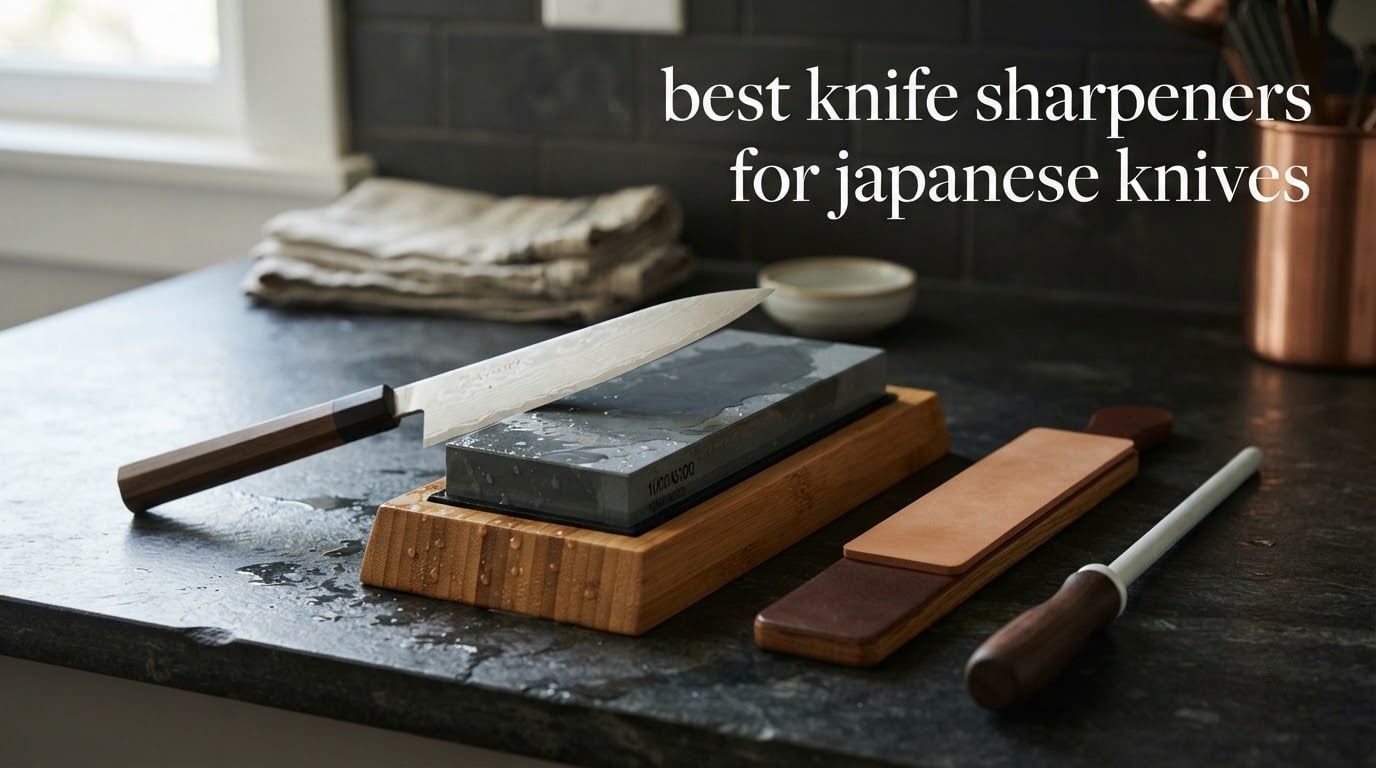
The best sharpener for Japanese knives is a 1000/6000 grit combination whetstone. Japanese blades are hardened to 60+ HRC and ground thin so they take a keener edge than a Western knife, usually at 15 degrees per side. A waterstone removes the least metal at that angle, so the original geometry survives every session.
That is the short answer, and it matters more than any brand preference. The wrong sharpener does not just fail to improve a Japanese edge, it quietly reshapes it. A fixed 20-degree V-slot in a pull-through sharpener, or the heat of an electric wheel, will grind a thin 15-degree bevel down into something duller and tougher to bring back.
We spent weeks putting stones, guided systems and rollers through their paces on a mixed kit of gyuto, santoku and yanagiba blades to build this roundup of the best knife sharpeners for Japanese knives. Everything below is ranked on how little steel it removes, how closely it holds a 15-degree angle, and whether it leaves an edge you would want on a single-bevel blade.
Table of Contents
Why to avoid pull-through and electric sharpeners on Japanese knives?
Fixed 20-degree slots. Most pull-through sharpeners use a V-shaped slot set around 20 degrees per side. Run one over a 15-degree Japanese edge and the leading shoulder grinds away until the slot angle becomes your new edge angle.
Aggressive wheels on hard steel. Electric sharpeners generate heat. Japanese stainless at 60+ HRC loses temper at the edge and can show a dark, brittle band that slices duller than the original.
Coarse abrasive left on the bevel. Many three-stage devices finish on a scratch pattern coarse enough to dull a refined edge visually, even when it cuts.
Reprofiling you did not intend. Guided systems at 20 degrees are useful for old European knives. On a well-kept Japanese blade they quietly shorten the working life of every knife you own.
Serrated and straight-edge confusion. Some devices dull a straight edge while the user thinks they are honing. You can watch it happen in the reflection of the blade.
That does not make those tools useless. They are fine for a beaded chef’s knife you have never sharpened, and for a rolling diamond plate they are a genuinely quick first pass. The rule is simple: keep them away from a 60+ HRC Japanese edge you care about.
If you also spend time making or restoring your own blades, our guides to the best belt grinders for knife making and best belt sanders for knife making cover the grinding stage that comes long before sharpening.
Top 3 Knife Sharpeners For Japanese Knives (October 2026)

Sharp Pebble 1000/6000 Whetstone
- Dual grit 1000 and 6000 corundum
- Angle guide for consistent 15 degree work
- Water based with bamboo base

Work Sharp Precision Adjust Elite
- Adjustable 15 to 30 degree angle range
- 320 and 600 grit diamond plates
- Leather strop and serrated rod included

King KW65 Combination Whetstone
- 1000 grit dark brown side and 6000 grit side
- Harder stone that wears slowly
- Includes molded plastic base
Best Knife Sharpeners for Japanese Knives in 2026
Twelve sharpeners, all of them capable of putting a keen edge on hardened Japanese steel. The table below is the fast read; the individual reviews below carry the detail on angle accuracy, stone behaviour and the blade types each one suits.
| Product | Specifications | Action |
|---|---|---|
| Sharp Pebble Whetstone 1000/6000 Grit |
|
Check Latest Price |
| Work Sharp Precision Adjust Elite |
|
Check Latest Price |
| King KW65 Combination Whetstone |
|
Check Latest Price |
 Wucgea Four Grit Whetstone Kit Wucgea Four Grit Whetstone Kit |
|
Check Latest Price |
 KEENBEST 400/1000 Whetstone Set KEENBEST 400/1000 Whetstone Set |
|
Check Latest Price |
 Shapton K0702 1000 Grit Stone Shapton K0702 1000 Grit Stone |
|
Check Latest Price |
 Sharp Pebble 5 Precision Adjust Sharp Pebble 5 Precision Adjust |
|
Check Latest Price |
 Amazon Basics 400/1000 Whetstone Amazon Basics 400/1000 Whetstone |
|
Check Latest Price |
 Kota Japan 1000/6000 Whetstone Kota Japan 1000/6000 Whetstone |
|
Check Latest Price |
 Work Sharp Benchtop Whetstone Work Sharp Benchtop Whetstone |
|
Check Latest Price |
 SHARPAL 202H Sharpening System SHARPAL 202H Sharpening System |
|
Check Latest Price |
 Naniwa Chosera 400 Grit Whetstone Naniwa Chosera 400 Grit Whetstone |
|
Check Latest Price |
1. Sharp Pebble 1000/6000 Whetstone – Best Overall for Japanese Knives
Sharp Pebble Whetstone Knife Sharpener – 1000/6000 Grit Sharpening Stone
Dual grit 1000/6000 corundum
Angle guide and bamboo base
7.25 by 2.25 inch water stone
Pros
- Angle guide locks blade position for consistent 15 degree passes
- Dual 1000 and 6000 grit covers repair and polishing in one stone
- Large surface handles full length chef knives
- Water based with no oil required
- Stays flat longer than cheap stones
Cons
- Freehand technique still has a real learning curve
- No printed instructions for the angle guide
- Needs soaking and separate flattening over time
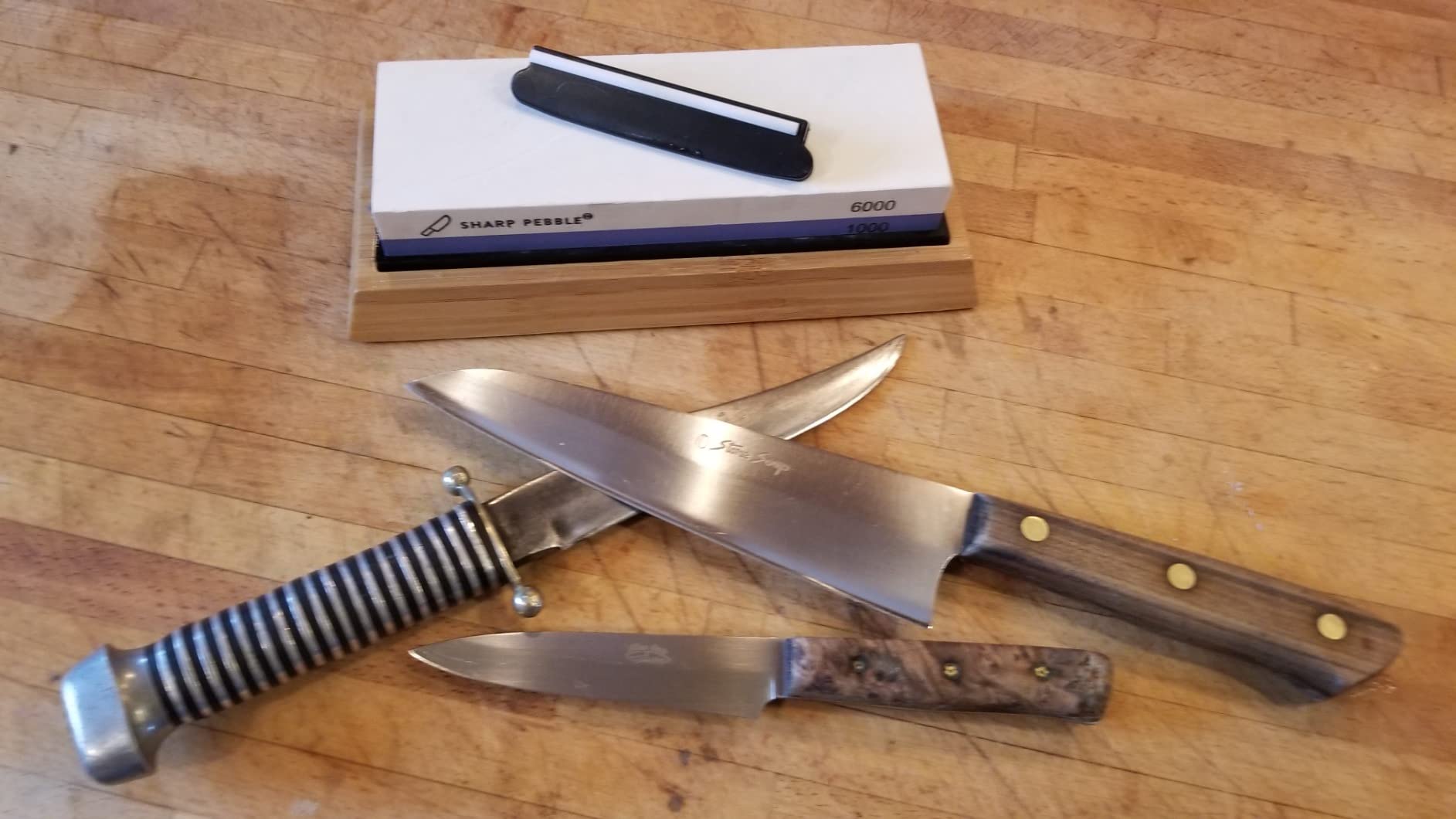
This is the stone I keep within reach of the sink. On a 200mm gyuto that had been cutting tomatoes all week, ten minutes on the 1000 side and five on the 6000 side brought it back to slicing paper, and the stone face never wandered off the existing bevel. The angle guide is the part that matters for a first-timer: you slide the blade against it and the flank sits at a repeatable angle without any wrist gymnastics.
What convinced me was the combination pair rather than the guide. A 1000 grit stage resets an edge that has rolled or picked up micro-chips, and the 6000 grit side refines without needing a separate 3000 stone on the counter. For a thin single-bevel yanagiba I still add a strop afterwards, but for a double-bevel gyuto or santoku this pair does the whole job.
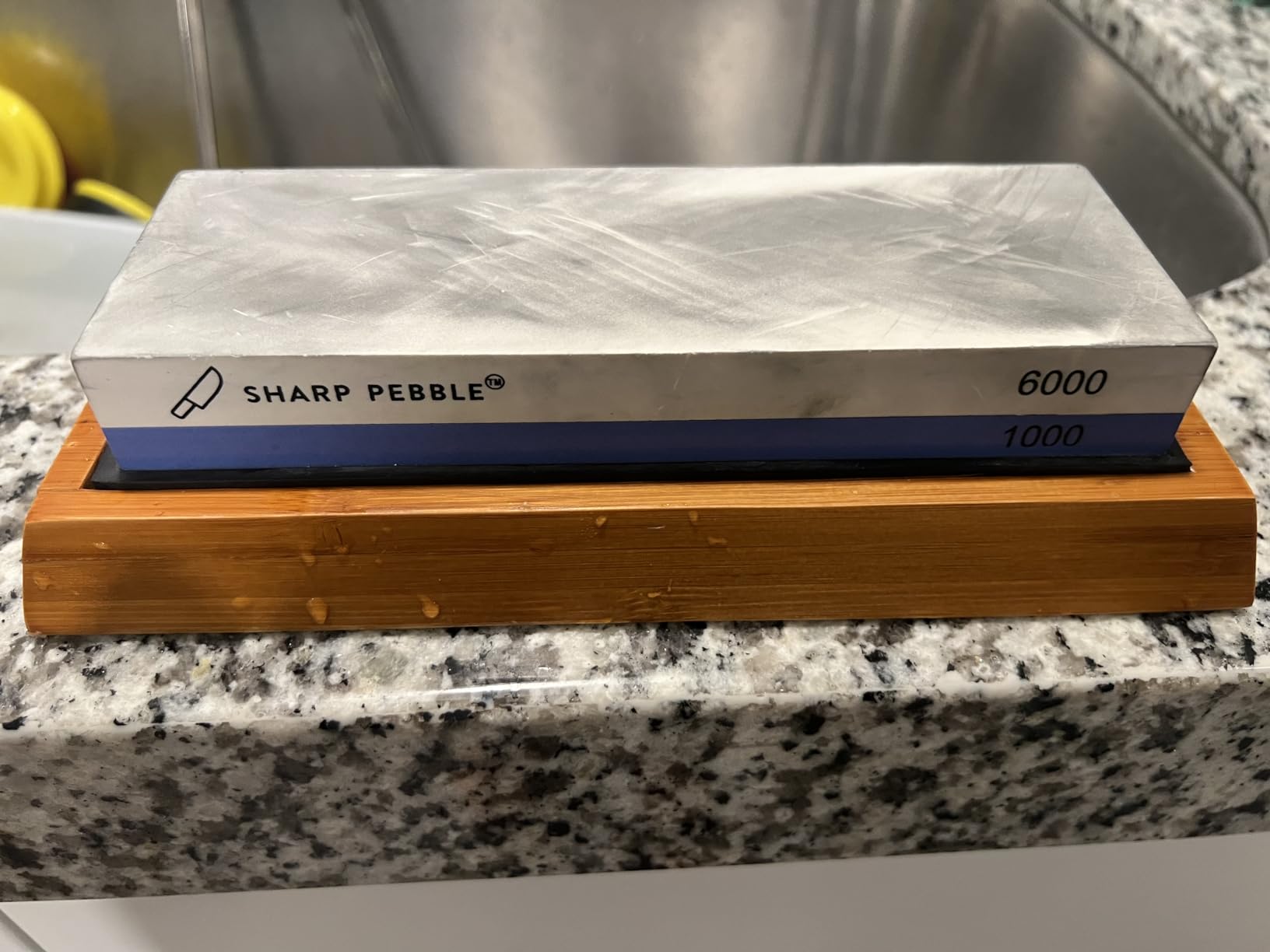
The stone is 7.25 inches long and 2.25 inches wide, which is wide enough to sweep an 8-inch knife across the face in a single pass. The bamboo base is non-slip and wide enough that the stone does not rock, and the whole assembly is 2.1 pounds, so it does not walk across the counter when you push on a stiff edge. Cleanup is a rinse of the metal slurry and an air dry.
Two honest limits. The 1000 grit side does throw a heavy clay-like slurry that needs rinsing more often than a diamond plate would, and over months of use you will eventually want a flattening stone to keep the face true. Neither is a reason to skip it if you are starting from nothing.
Will this hold a 15-degree edge on a VG10 gyuto?
It will, and that is the reason it takes the top slot. Japanese stainless usually arrives from the factory at a secondary bevel of 15 to 17 degrees per side, and the angle guide puts your stroke close to that figure. Because 1000 grit corundum is a moderate abrasive rather than an aggressive one, a few passes remove only what the burr needs and no more.
What it will not do for you?
It will not repair a blade with a real chip in the bevel. That needs a 400 or 320 grit stone first, or a diamond plate, and only then does the 1000 side refine the work. Nor will it produce a mirror finish on its own; the 6000 side leaves a bright but satin edge. Add a leather strop if that matters to you.
2. Work Sharp Precision Adjust Elite – Best Guided Angle Control
Work Sharp Precision Adjust Elite Knife Sharpener – Fixed Angle Sharpening System for Kitchen & Pocket Knives – Professional Guided Knife Sharpening Tool
Adjustable 15 to 30 degrees
320 and 600 grit diamond plates
Leather strop and serrated rod
Pros
- Angle dial includes a 15 degree setting for Japanese knives
- Guided clamp holds full flat grind blades centred
- Broad kit covers serrated and straight edges
- Works fast without freehand skill
Cons
- Angle adjustment has some play so a digital angle cube helps
- Metal clamp can scratch polished finishes
- Light pressure needed or the abrasive pins flex
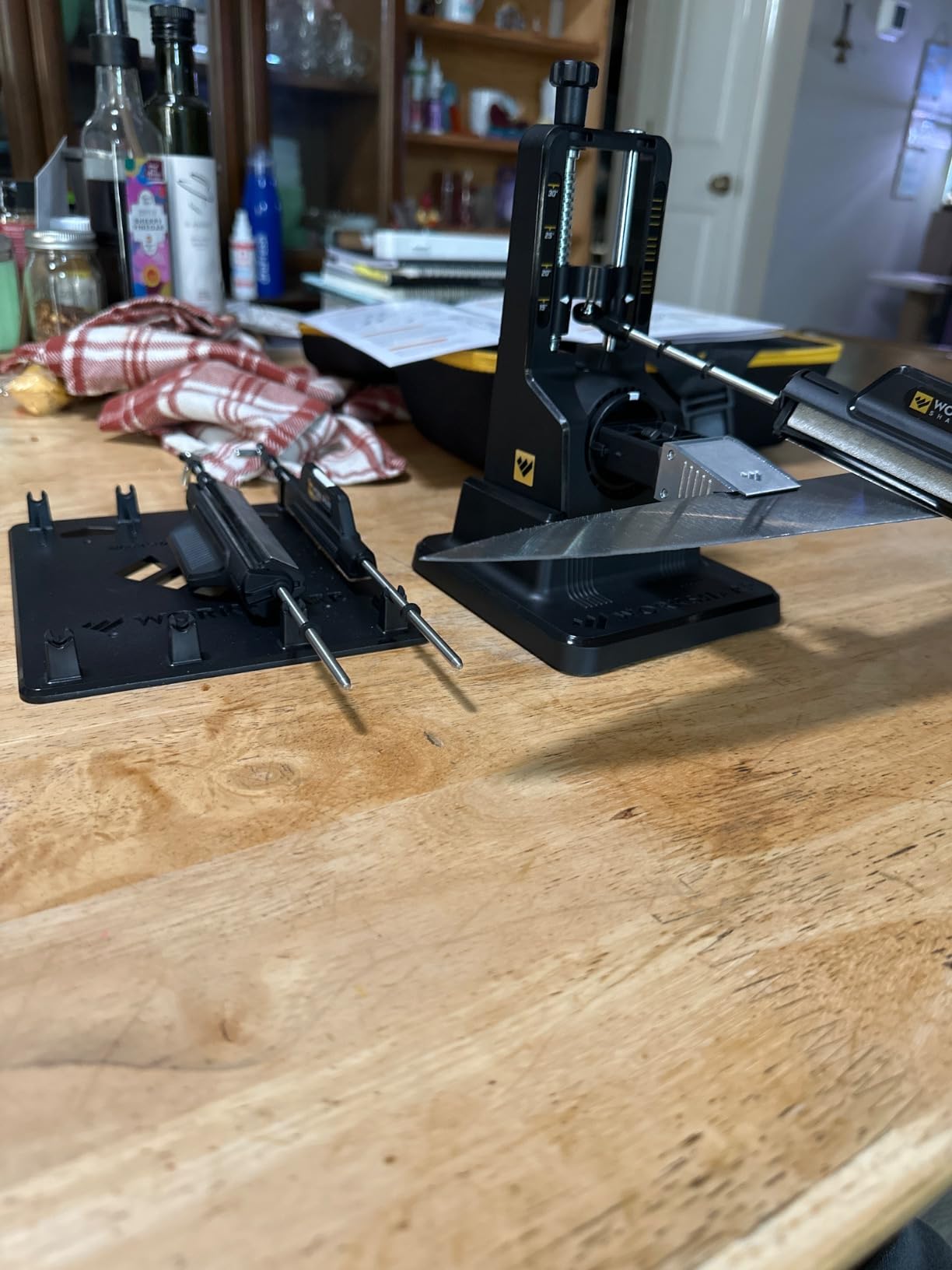
If freehand angle control is what stops you sharpening, this system removes that problem entirely. The dial sets the angle from 15 up to 30 degrees per side, and the 15 degree stop is the one to use on a Japanese knife. You clamp, pull, and the plates do the work with no stone to soak and no slurry to rinse.
On a santoku with a rolled edge from a few months of hard use, the 320 plate took about eight passes per side to expose clean metal and the 600 plate finished it. Then the ceramic rod and the leather strop dealt with the burr. Total time was under four minutes, which is the whole reason guided systems exist.
The kit is unusually complete for the money. You get 320 and 600 grit diamond plates, a conical ceramic rod for serrated blades, a ceramic finishing rod, a tri-brasive attachment for curved blades, a leather strop and a storage case. That is everything a home kitchen needs and then some, and the strop in particular is what keeps a fine edge from feeling blunt between sessions.
The wide rubber-footed base stayed planted on a tablecloth during testing, and the clamp held a 210mm blade dead centre. Large knives are the awkward part: you reposition the whole unit instead of rotating it, so sharpening a full chef’s knife takes a little planning.
Does it reprofile a 15-degree Japanese edge?
Not when you park the dial at 15 degrees. The plates are fixed-angle at that setting and stop as soon as the bevel is clean. The risk comes from leaving the unit on its 20 degree default for a Japanese knife, which is what most people do without reading the dial. Set it deliberately every time and the geometry is safe.
Where the diamond plates fall short?
Diamond abrasive cuts hard steel quickly but leaves a visible scratch pattern that does not have the same refined look as a waterstone finish. It also wears faster under heavy pressure, so pushing hard shortens plate life without speeding up the work. Light, even strokes give a better result and a longer-lived system.
3. King KW65 Combination Whetstone – Best Value Japanese Stone
KING KW65 1000/6000 Grit Combination Whetstone with Plastic Base
1000 and 6000 grit two sided stone
8 by 2.5 by 1 inch face
Includes molded plastic base
Pros
- Long established Japanese water stone maker
- Harder than most water stones so it wears slowly
- One pair handles kitchen and chisel work
- Plastic base keeps the stone secure
Cons
- Grit sides are not labeled on the stone
- Slides unless placed on a damp towel
- Corner damage to the stone is a recurring complaint
King stones have been made in Japan for generations, and this combination pair is the workhorse of that range. The darker brown face is 1000 grit and the lighter face is 6000 grit. Neither face is labeled, which trips up a lot of first-timers, so learn it once and it never matters again.
The cut speed on hardened stainless surprised me. Because the stone is harder than a typical bargain waterstone, it stays flatter over time and produces a finer, more consistent slurry. On a blue paper #2 carbon steel yanagiba with an old dull edge, the 1000 side behaved politely and did not gouge the blade.
Ownership details are where this one separates from cheap stones. The stone is 8 inches by 2.5 inches by 1 inch thick, which is a proper working surface for a chef’s knife, and the injection-molded plastic base grips it securely. Long-time owners in the reviews make one point repeatedly: flatten the stone after each use or a valley forms in the middle and your edge angle drifts.
It is a soak stone, not a splash-and-go stone. Give it water until the surface stops drinking, sharpen with a wet surface, and rinse the slurry away afterwards. There is no honing oil anywhere in the process, which is one fewer thing to buy and store.
Is a two-sided stone enough for a single-bevel yanagiba?
For sharpening, yes. The back bevel on a single-bevel knife is flat, so you are only working one side and 1000 grit handles the bulk removal. Add a strop before you hit the 6000 side to knock the burr off the flat, otherwise the fine side can leave a wire edge that feels sharp and then folds.
What to watch out for?
Waterstones are fragile and corner damage on arrival is the most repeated complaint in the reviews. Inspect the corners before you start; a chipped corner is fine to sharpen with but worth knowing about. Also keep a damp towel under the base, because the stone will drift across a dry counter under real pressure.
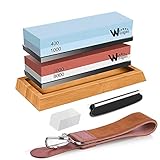
4. Wucgea Four Grit Whetstone Kit – Best All-in-One Set
Wucgea Knife Sharpening Stone Kit – 400/1000 3000/8000 Grit Japanese Whetstone Set with Non-Slip Rubber Base, Angle Guide, Flattening Stone and Leather Strop
400/1000 and 3000/8000 grit pair
Angle guide and flattening stone
Leather strop with compound
Pros
- Four grit levels cover coarse repair through polishing
- Angle guide and flattening stone included as standard
- Non-slip rubber base keeps stones stable
- White corundum suits Japanese and stainless steel
Cons
- Water stones must be soaked and dried fully to avoid mold
- Sides identified by feel since markings are minimal
- Not suitable for serrated blades
Most kits give you a stone and send you off to find everything else. This one includes two stones in 400/1000 and 3000/8000 grit, an angle guide, a flattening stone and a leather strop with polishing compound, all in a bamboo base with rubber holders. For someone starting out, that is the whole shopping list in one box.
The four grit steps mean you are not stuck at one stage of progression. A knife with chips gets the 400 side, an everyday dull edge gets the 1000, and the 3000 and 8000 handle refinement and polishing. That progression is exactly what a full sharpening chain should look like, and it matches how we would set up a station for hard VG10 stainless.
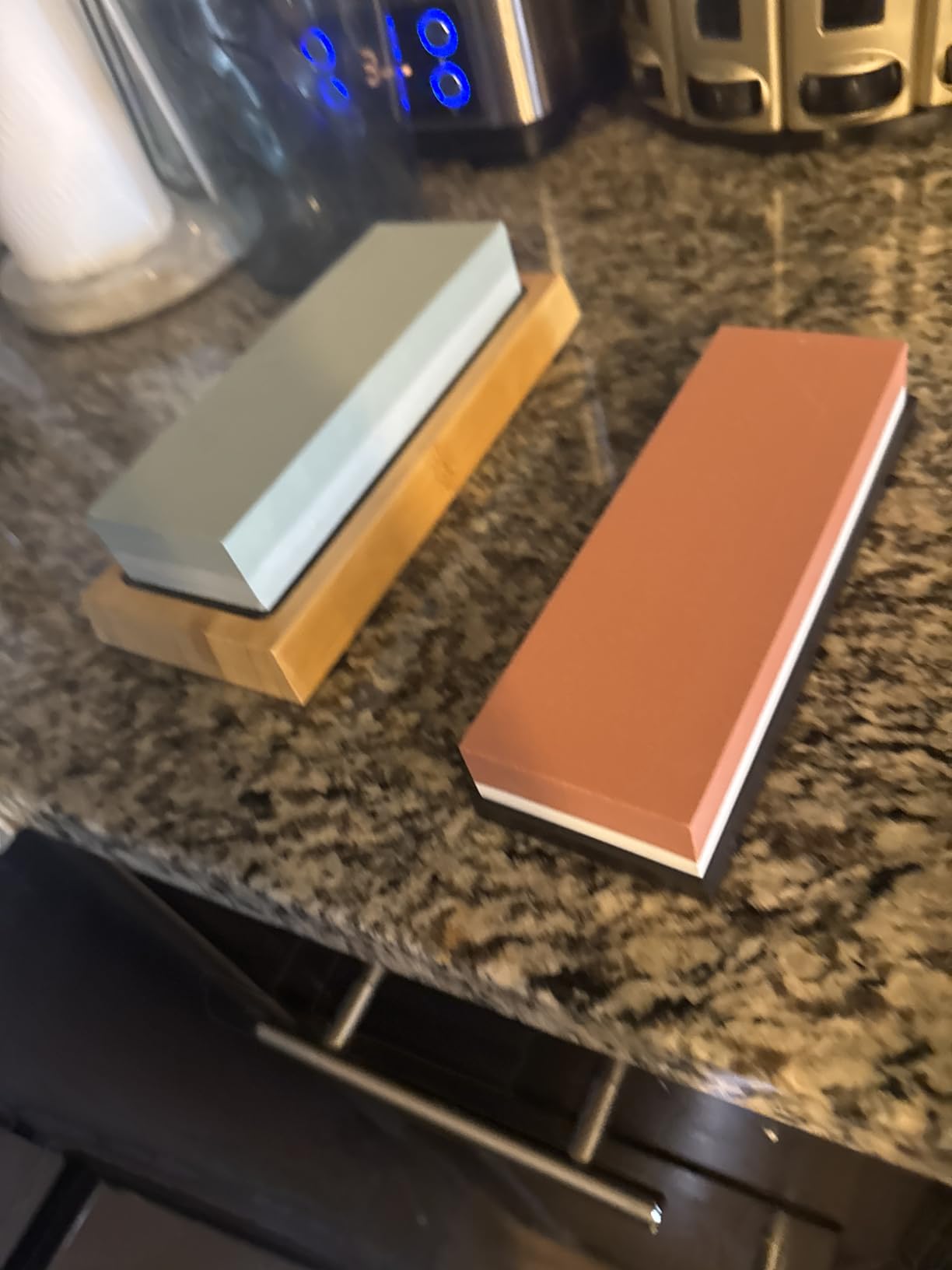
White corundum across both stones gives a balanced cut that works on Japanese stainless and on softer European steel without changing approach mid-session. The strop matters here more than the packaging suggests: stropping on leather with compound pulls the burr off and takes the edge from sharp to alarming.
The kit is not for serrated knives, and the grit markings on the stone sides are minimal, so identify them by feel before you start. Setup takes five minutes of soaking per stone. Budget that in and the kit rewards you with a complete system rather than a starting point.
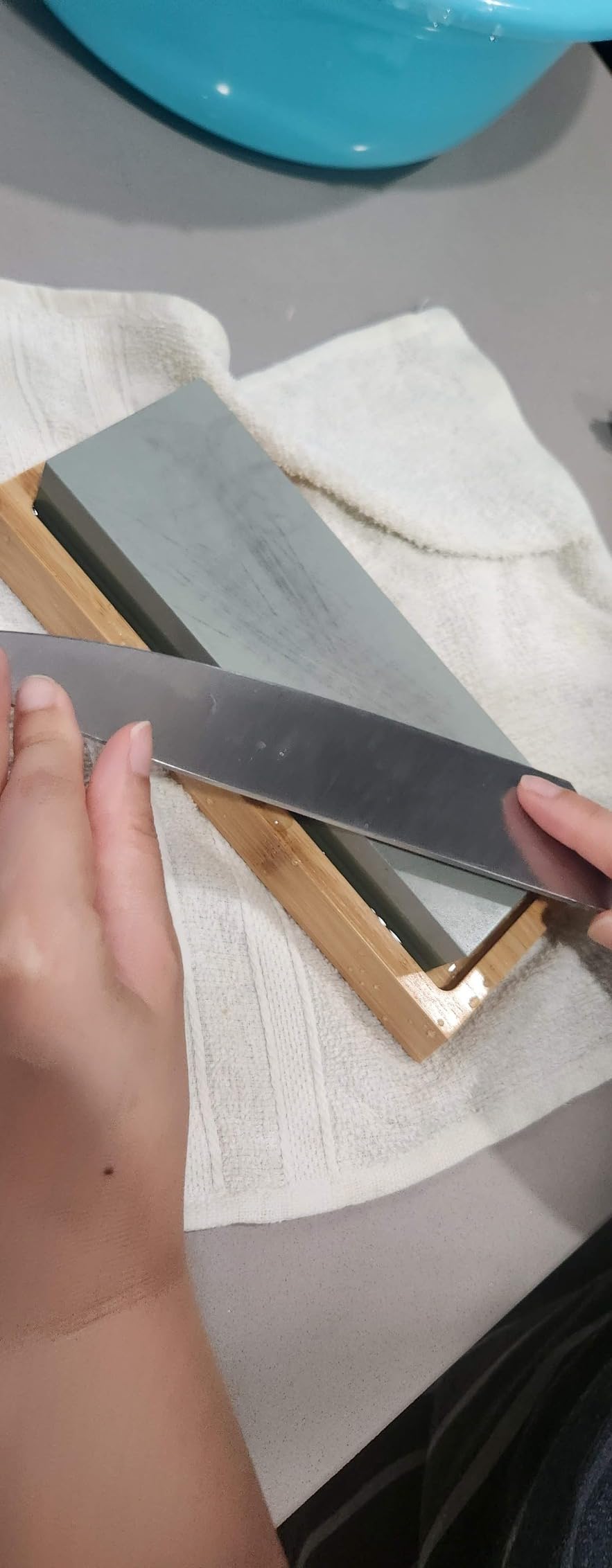
Is a four-grit kit better than one good stone?
For most home cooks, yes, because the 400 and 8000 faces cover the two jobs a single combination stone handles badly: chip repair and true polishing. It is a bit more to learn and more to maintain than one stone. If you already own a 1000/6000 pair, this kit duplicates some of that range.
How do I stop these stones going mouldy?
Dry them flat, out of the base, and give them time. Water stones that go back into a closed base while damp will grow spots you cannot shift. Stand them upright near the sink after use and wipe the surface once the slurry is off. The reviews are unanimous on this point and it is the single most common complaint when people abandon water stones.
5. KEENBEST 400/1000 Whetstone Set – Best Starter Set
KEENBEST 400 1000 Premium Material Whetstone Sharpening Stone Set 2 Side Kitchen Knife Sharpener Stone Wet Stones for Sharping Knives Kit Non-slip Rubber Base
Two stones at 400 and 1000 grit
Each stone 7 by 2.2 by 1.1 inch
Soak 10 to 15 minutes before use
Pros
- Entry cost makes water stone sharpening accessible
- 400 and 1000 grits handle daily maintenance
- White corundum cuts quickly and self sharpens
- Explicitly listed for Japanese knives
- Non-slip rubber base
Cons
- No angle guide so angle control is freehand only
- Fine polishing needs a higher grit stone or strop
- Requires 10 to 15 minutes soaking per session
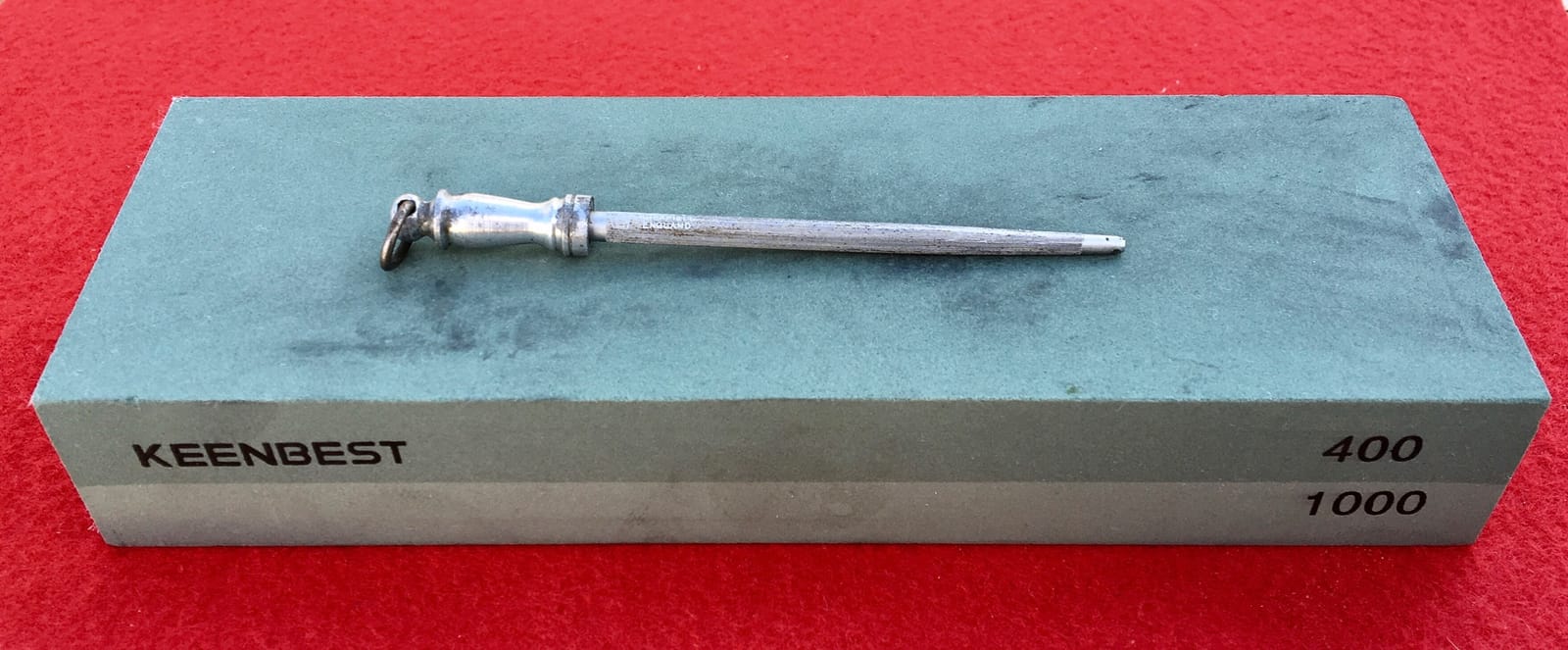
This pair does one job well: keeping an edge in working condition without any frills. The 400 grit stone handles daily sharpening and small edge repair, the 1000 grit side smooths the result. There is no angle guide, so this is the one in the roundup where technique matters most, and where a cheap knife for practising on genuinely helps.
Tested on a thin 180mm petty, the 400 side set the edge quickly and the 1000 side tidied it up without any drama. Because the stones are 7 by 2.2 by 1.1 inches they are long enough for most blades but narrower than the wide stones above, so you make more passes on a long gyuto.
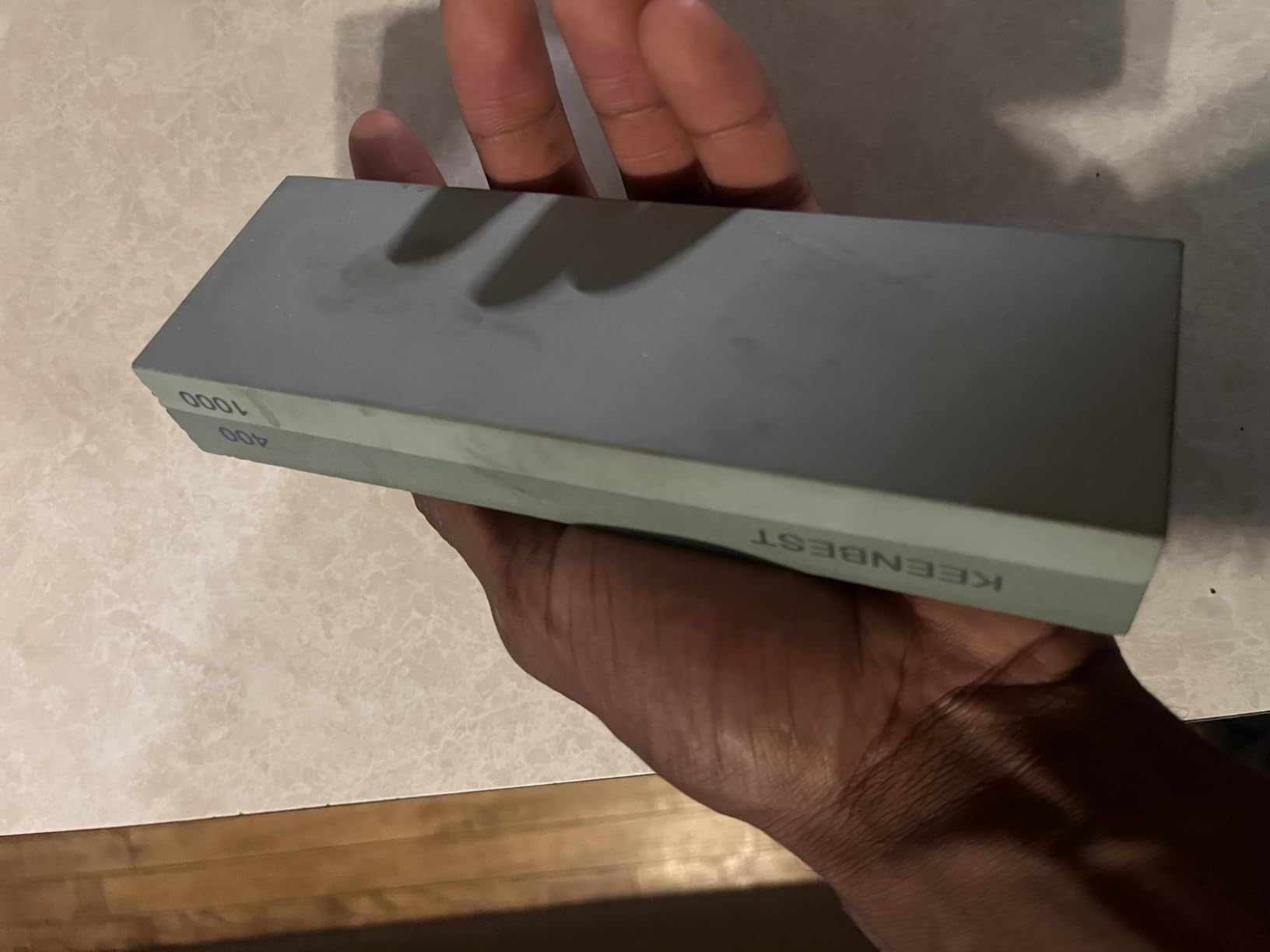
Compatibility is broad: the listing covers chef, hunting, pocket, Japanese, butcher, paring and barbecue knives, plus scissors, chisels, hatchets and axes. White corundum self sharpens as it wears, which keeps the cut consistent over time rather than glazing. The rubber base keeps the stones from moving under pressure.
Results also depend on soak time, pressure and how you maintain the stones, which the manufacturer says openly and we agree with. Ten to fifteen minutes in water, keep the surface wet while you work, and dry both stones afterward. Skip that and performance drops noticeably.
Is this enough to start sharpening Japanese knives?
It is enough to start, yes. Most of the damage Japanese knives suffer comes from careless handling, not from lack of a 6000 grit stone. Maintain the edge on 400 and 1000, then add a strop and a finer stone later when you want a finer polish. Buying the whole chain at once is not necessary.
Where beginners get stuck?
Angle control. With no guide, the natural instinct is to lay the blade too flat and chase the edge, which rounds it off. Rest the spine lightly on the wet stone, keep the pressure on the heel near the bolster, and finish each stroke by lifting away. Two or three sessions on a cheap blade teaches this faster than any explanation.
6. Shapton K0702 1000 Grit Stone – Best Rated Whetstone
Shapton K0702 Blade, #1000, Medium, Orange
1000 grit Japanese water stone
8.3 by 2.8 by 0.6 inch face
Weighs 45 grams
Pros
- Highest average rating of any stone in this roundout
- Very light at 45 grams so it is easy to reposition
- 1000 grit is a versatile stage for Japanese knives
- Sharp and fast cutting surface
Cons
- Sold as a bare stone with no base or guide
- Needs a water bath and careful drying to avoid mold
- No coarser grit included for badly damaged edges
This is the stone enthusiasts recommend by name, and at 45 grams it is the most pleasant to work with. You hold it in one hand or rest it on a damp towel, which makes it easy to make the short alternating passes that stone sharpening wants. The 1000 grit cuts fast and refines quickly rather than grinding away steel.
On a 210mm gyuto with a fresh edge, a light 1000 grit session followed by a strop returned it to slicing thin onion without any reprofiling. The stone weighs almost nothing compared with the multi-stone kits, so repositioning it mid-stroke costs you nothing. That is a small thing that makes a real difference over a full session.
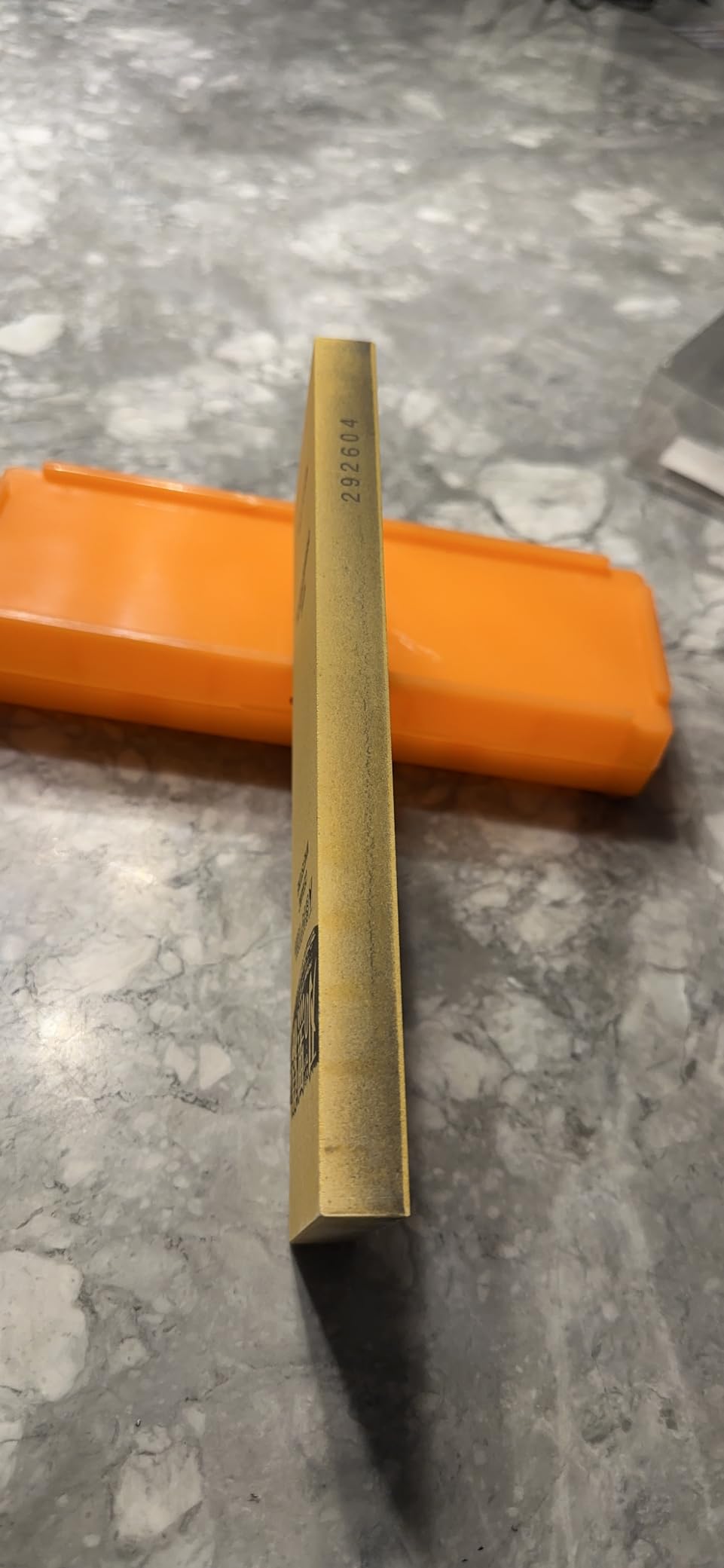
It ships as a stone only. No base, no angle guide, no strop, no instructions. You will want a stone holder or a damp folded towel, plus a strop for burr removal, and that is exactly why we would not call it a first purchase for a total beginner. For anyone sharpening regularly it is a permanent fixture.
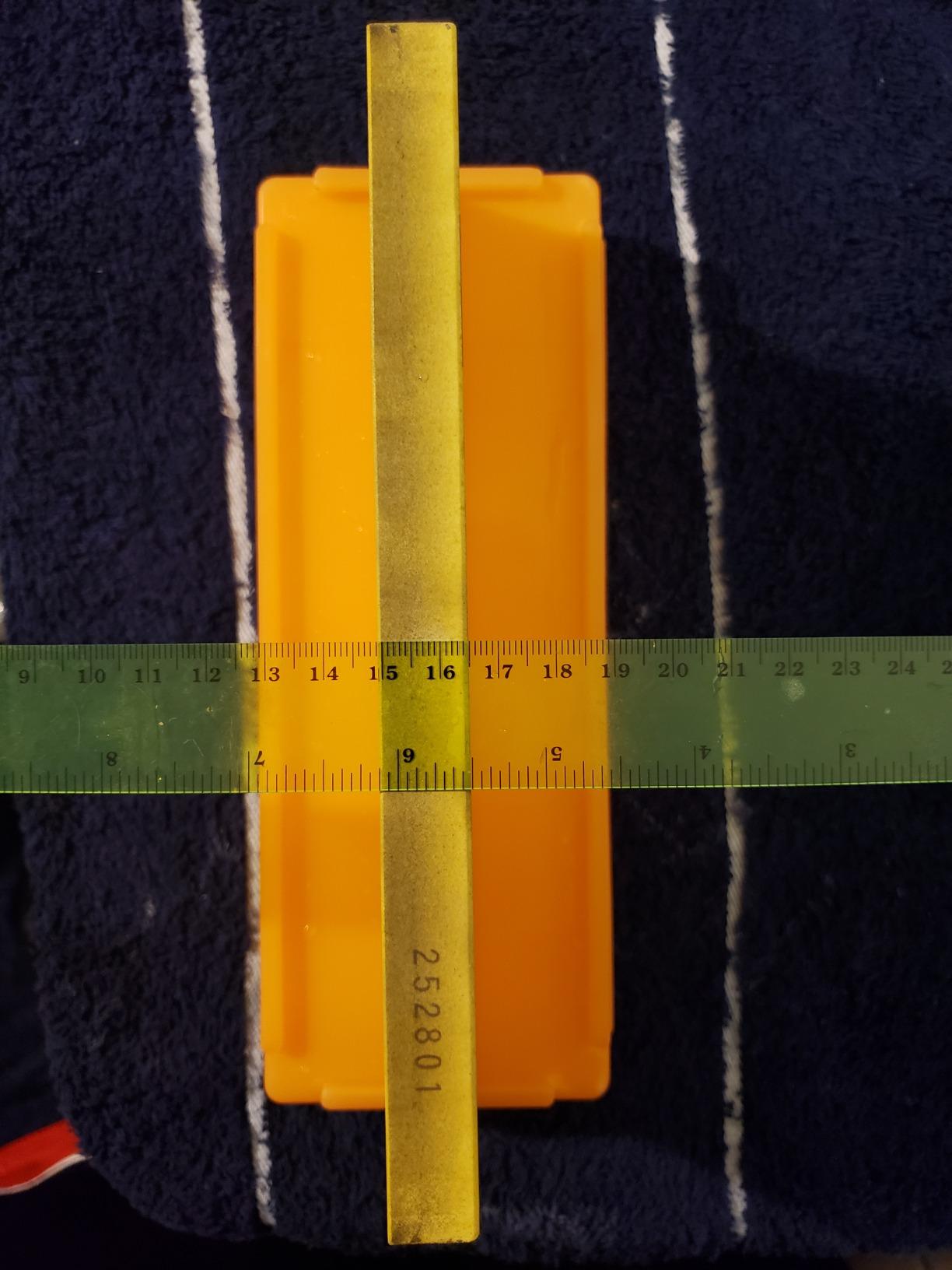
The face measures 8.3 by 2.8 by 0.6 inches, which is a thin profile that is comfortable to hold and easy to make full-length passes with. It is a soak stone. Treat it that way and it will stay flat and clean for years.
Is one 1000 grit stone enough for a full sharpening cycle?
For an edge that is dull but undamaged, yes. 1000 grit is the general-purpose stage: it forms and removes a burr, resets a rolled edge and leaves a finish you can strop to keen. It only falls short when steel is actually missing, which means a chip or a broken tip, or when you want a finer polished finish than stropping gives.
What the bare-stone format costs you?
A base and a strop. Without a strop you are likely to leave a burr that feels sharp and then rolls over on the first fish skin. Without a base the stone walks on a wet counter. Both are inexpensive and both change the result, so factor them into the decision rather than treating this as a complete kit.
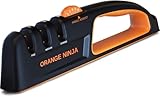
7. Sharp Pebble 5 Precision Adjust – Best for Quick Touch-Ups
5 Precision Adjust Knife Sharpener- 3-Stage Premium Kitchen Knife Sharpener
Adjustable angles 12 to 24 degrees
Three abrasive stages
Weighs 1.5 ounces
Pros
- Angle dial includes a 15 degree setting for Japanese edges
- Compact and light enough for a kitchen drawer
- Three stages cover repair through polish
- Rubberized grip on handle and base
Cons
- Straight edge blades only
- Adjustment wheel can be tight and has locked up for some users
- Does not match a wet stone on high-end Japanese knives
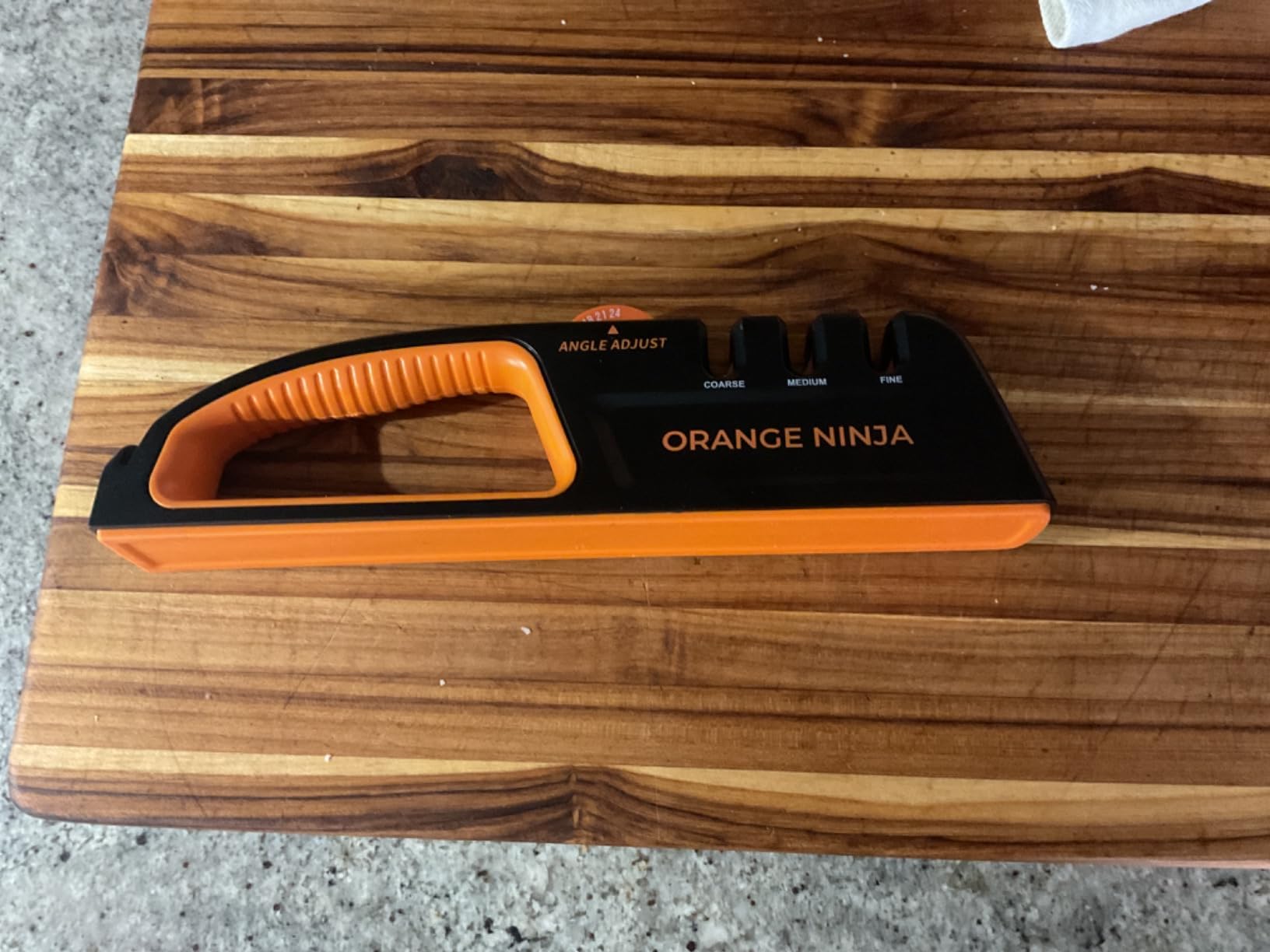
There is a place for a device that finishes in under a minute. This one has an angle dial with stops at 12, 15, 18, 21 and 24 degrees, and the 15 degree stop is the correct setting for a Japanese double-bevel edge. On a knife that went dull over a weekend of meal prep, a handful of pulls brought it back to cutting cleanly.
Being honest about the limit: this is maintenance, not sharpening. Reviewers repeatedly note the results do not match a traditional wet stone on an expensive Japanese knife. It cannot remove chips, it cannot set a bevel, and it will not refine an edge the way a 6000 grit stone followed by a strop does.
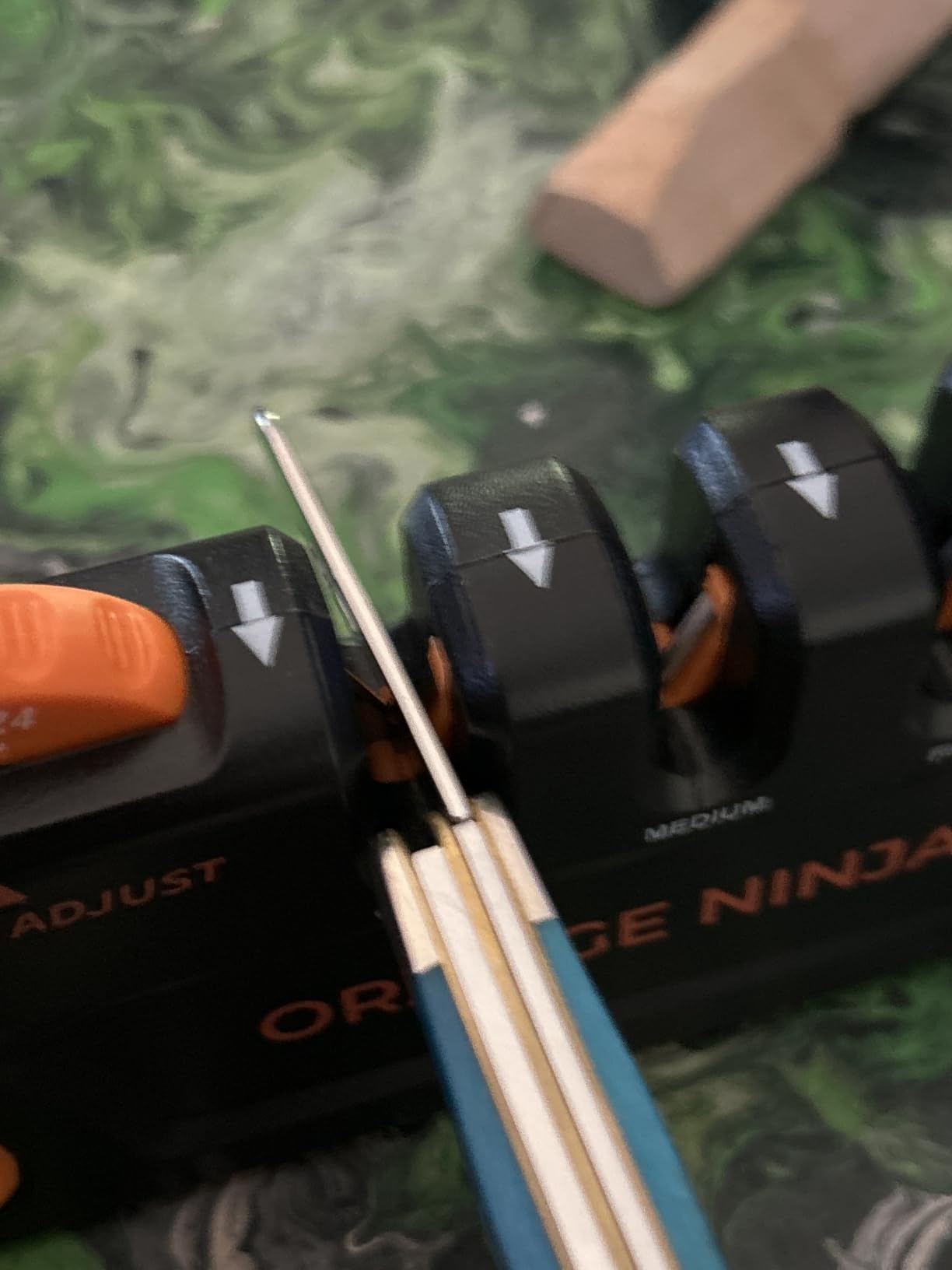
The build is light and pocketable at 1.5 ounces, and the rubberized grip on both handle and base keeps it from sliding on a wet counter. There is a fillet setting and a printed adjustment guide on the body, which helps when you are new to the dial. Three abrasive stages mean you can move from coarse to fine in one pass of the dial.
The two lowest reviews both involve the adjustment wheel locking up or failing to hold a setting, which is the main reliability complaint. Test the dial on a cheap blade before trusting it with a good knife, and if the wheel feels stiff, do not force it.
Can this 15 degree setting actually match a Japanese edge?
It is close enough for routine touch-ups on a double-bevel knife that is already in spec. The fixed slot geometry cannot follow the hollow grind or the thinner spine sections of some blades, so the pressure is not identical along the edge. For a yanagiba with a single chisel bevel, treat the result as approximate and strop afterwards.
Where it should stay in your kit?
Think of it as a steel that you put away after a session at the stone. It is fast, silent, needs no water and no cleanup, which makes it genuinely useful between sharpenings. It should not be your only tool if the knife is worth protecting, and it cannot handle serrated blades or scissors at all.
8. Amazon Basics 400/1000 Whetstone – Best for First-Time Angle Control
Amazon Basics Dual Sided Whetstone Knife Sharpening Stone 400/1000 Grit with Angle Guide, Non-Slip Bamboo Base, Black & Grey
400 grit and 1000 grit dual sided
7.1 by 2.4 by 1.1 inch stone
Bamboo base with silicone holders
Pros
- Angle guide helps beginners hold a consistent angle
- Bamboo base with silicone grip stays put
- Different colours mark the two grit sides
- Water based and easy to rinse clean
Cons
- 400 grit is too fine for repairing real chips
- Guide needs shims for blades under 2 inches wide
- Bamboo base coating slips once wet
The selling point here is the blade holder that comes in the box. New sharpeners struggle most with holding a repeatable angle, and a plastic guide that rests against the spine removes that variable entirely. Colour coding on the two sides is a small touch that saves real confusion at the sink.
Water-based sharpening means no oil anywhere and a rinse is the whole cleanup. The stone is 7.1 by 2.4 by 1.1 inches, which handles standard kitchen knives and pocket knives comfortably. For sharpening scissors and smaller blades the listing claims support, though the guide becomes less useful the narrower the blade gets.
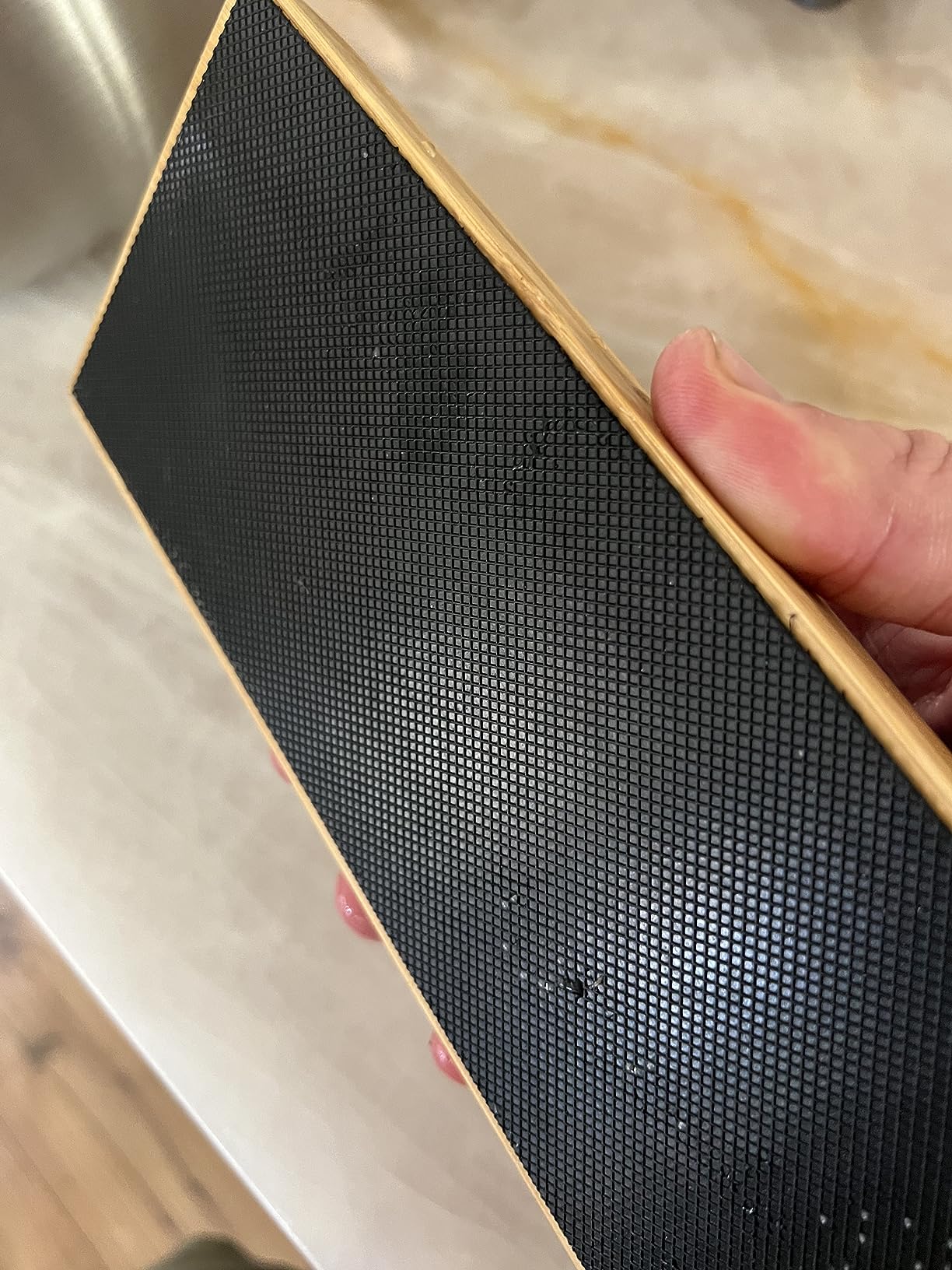
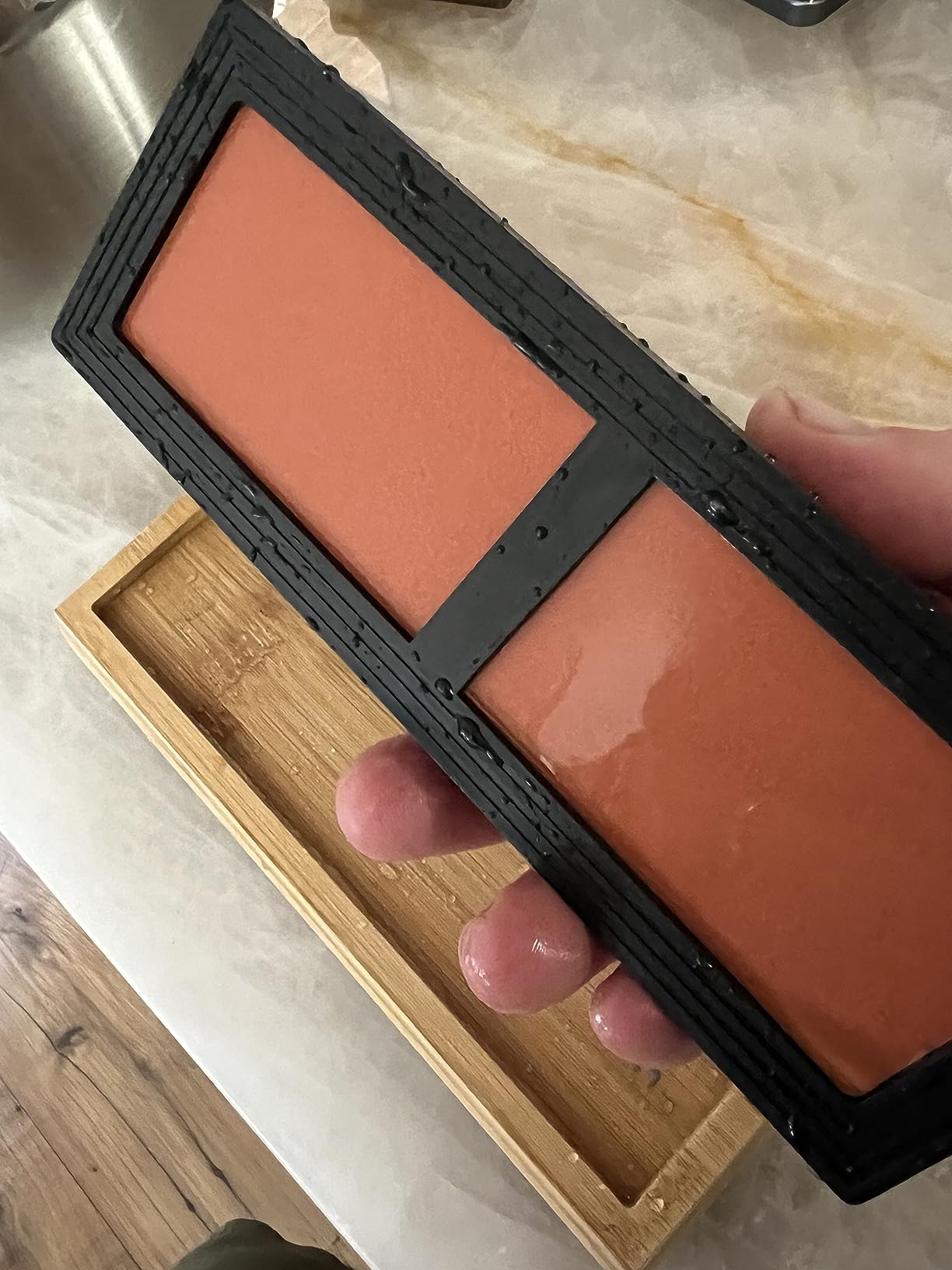
Watch the base once it is wet. The bamboo base coating does not stay put, so put the assembly on a damp towel or a non-slip mat and you will not chase it around the counter. That is a two second fix and it stops the most common frustration for first-time stone users.
It comes with a one year limited warranty, which is more than most stones in this category offer. Silicone holders grip the stone inside the base so it is easy to lift out, rinse and stand up to dry.
Is 400 grit the right starting grit for a Japanese knife?
For an edge that is merely dull, yes. 400 grit is aggressive enough to set a working edge quickly and fine enough not to gouge. For a blade with a genuine chip or a missing corner it is too fine, and you will waste a lot of time. In that case step up to a coarser stone or a diamond plate before you come back down.
What about narrow blades?
The angle guide is sized for blades wider than roughly 2 inches, which covers most kitchen knives. A narrow paring knife or a small petty will not sit flush, and the workaround in the reviews is to improvise shims so the guide contacts the spine. It works, but it is fiddly and not a reason to pick this stone for paring knives.
9. Kota Japan 1000/6000 Whetstone – Best Two-Sided Stone with a Guide
Kota Japan 1000-grit Coarse Side and 6000-grit Polishing Side Knife Sharpening Whetstone with Bamboo Base and Blade Guide
1000 grit and 6000 grit corundum
Bamboo base and blade guide
Soak 10 to 15 minutes
Pros
- Blade guide makes the angle support much less stiff
- 1000 and 6000 pairing suits everyday knives
- Aluminum oxide resists cracking and chipping
- Owners report hair shaving edges
Cons
- Angle guide is stiff so sliding it down scratches the blade
- Stone must be dried for days or it moulds in the box
- Less established brand than the better known Japanese stones
Kota Japan pairs the everyday 1000 and 6000 grits with a bamboo base and a blade guide, which is the combination most beginners actually want. Aluminum oxide construction resists cracking and chipping better than a softer stone, and one of the 3000 and 8000 grit versions exists if you want to finish finer instead of polish.
Users coming from electric sharpeners tend to find this a big step up, and several report hair shaving edges on kitchen knives. On a Japanese santoku with a decently maintained edge, the 1000 side behaved well and the 6000 side polished without drama.
There is one handling habit you have to learn. The angle guide is stiff enough that sliding it down the blade can scratch the surface. Set the guide where you want it and lift the blade away at the end of each pass instead of dragging it. It suits knives, pocket knives, scissors and straight razors, which makes it the most versatile stone here.
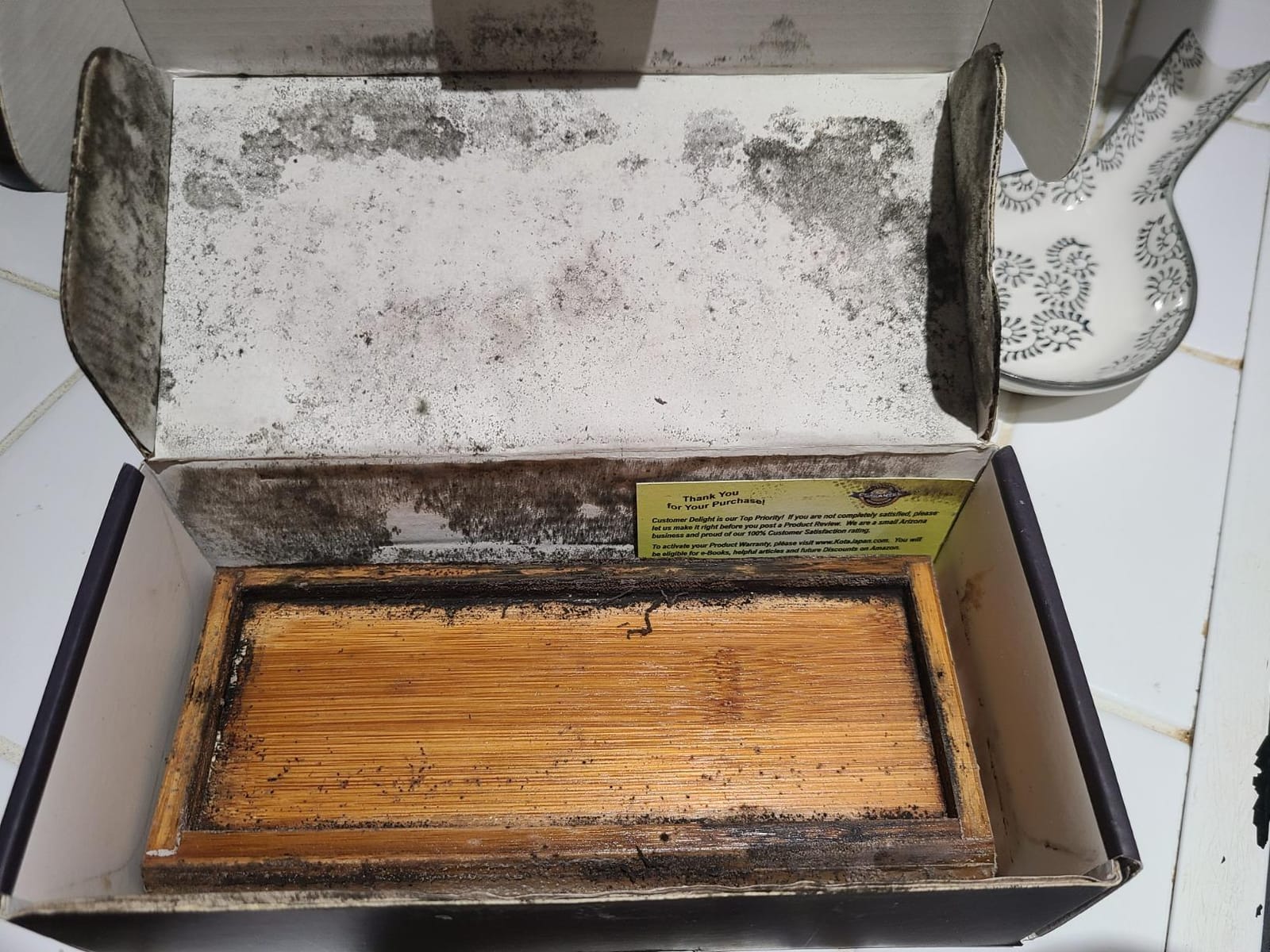
Soak it for 10 to 15 minutes and keep it wet while you work. Then give it days to dry, not minutes, or you will find mould in the box. The brand is less established than Shapton or King, which matters less than it sounds given the corundum build.
How does this compare with a 400 grit starting point?
It starts gentler. A 1000 grit face refines and maintains an edge rather than establishing a new bevel, so if your knife has never been sharpened properly or has picked up chips, you want a coarser stone or a diamond plate before this one. If it is merely dull, this pairing is the right starting point.
What about single-bevel blades?
It works, with the usual single-bevel precautions. Only one side is ground, the flat back carries the knife against the stone, and you must avoid rounding the heel of the edge or thinning the knife too far forward. The blade guide helps here because it holds the relationship between spine and stone face steady.
10. Work Sharp Benchtop Whetstone – Best Benchtop System
Work Sharp Benchtop Whetstone Knife Sharpener – For Knives & Edged Tools – Kitchen, Pocket, & Fillet Knives
1000 and 6000 grit corundum stone
15 and 17 degree guides included
Water control base
Pros
- 15 and 17 degree guides cover most kitchen geometries
- Water control base holds water and cuts down mess
- Face is wide enough for a 10 inch knife in one sweep
- Direct blade to stone feedback that guided systems lack
- Limited lifetime warranty
Cons
- Silicon carbide stone needs frequent rewetting
- 1000 grit side may need light lapping over time
- Magnet held guides can detach if handled roughly
This is the one experienced sharpeners in our roundup rate highest on feel. You get real tactile feedback from the blade touching the stone, which is something belt systems and guided clamps simply cannot give you. The 15 and 17 degree guides are magnet held and removable, so you can learn freehand once the angle is familiar.
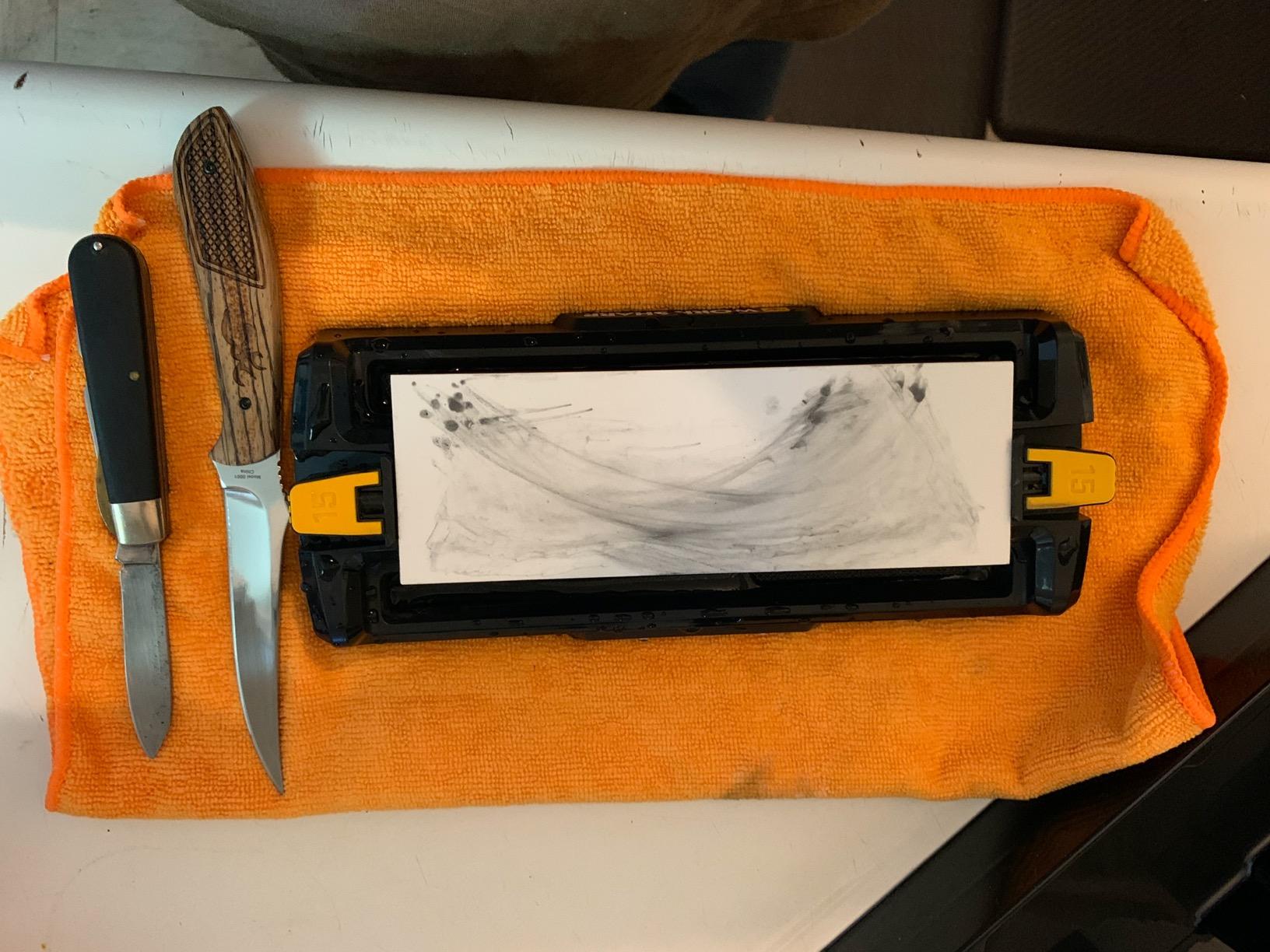
The stone face is wide enough to sweep a 10 inch chef’s knife across in a single pass, which is a practical advantage over the narrower stones in this list. The water control base holds water for a stable, less messy surface and doubles as stone storage between sessions.
It handles both carbon steel and high carbon steels, and the company builds in Ashland, Oregon as a fourth generation family business. That comes with a limited lifetime warranty. Separate 20 and 25 degree guides are available for outdoor knives if you own a thicker blade and want to reprofile it deliberately.
Two things to plan around. The silicon carbide surface soaks slowly and wants rewetting partway through a long session, and the 1000 grit face will need light lapping after a certain number of blades to keep it cutting cleanly. Both are normal for a stone of this type rather than faults.
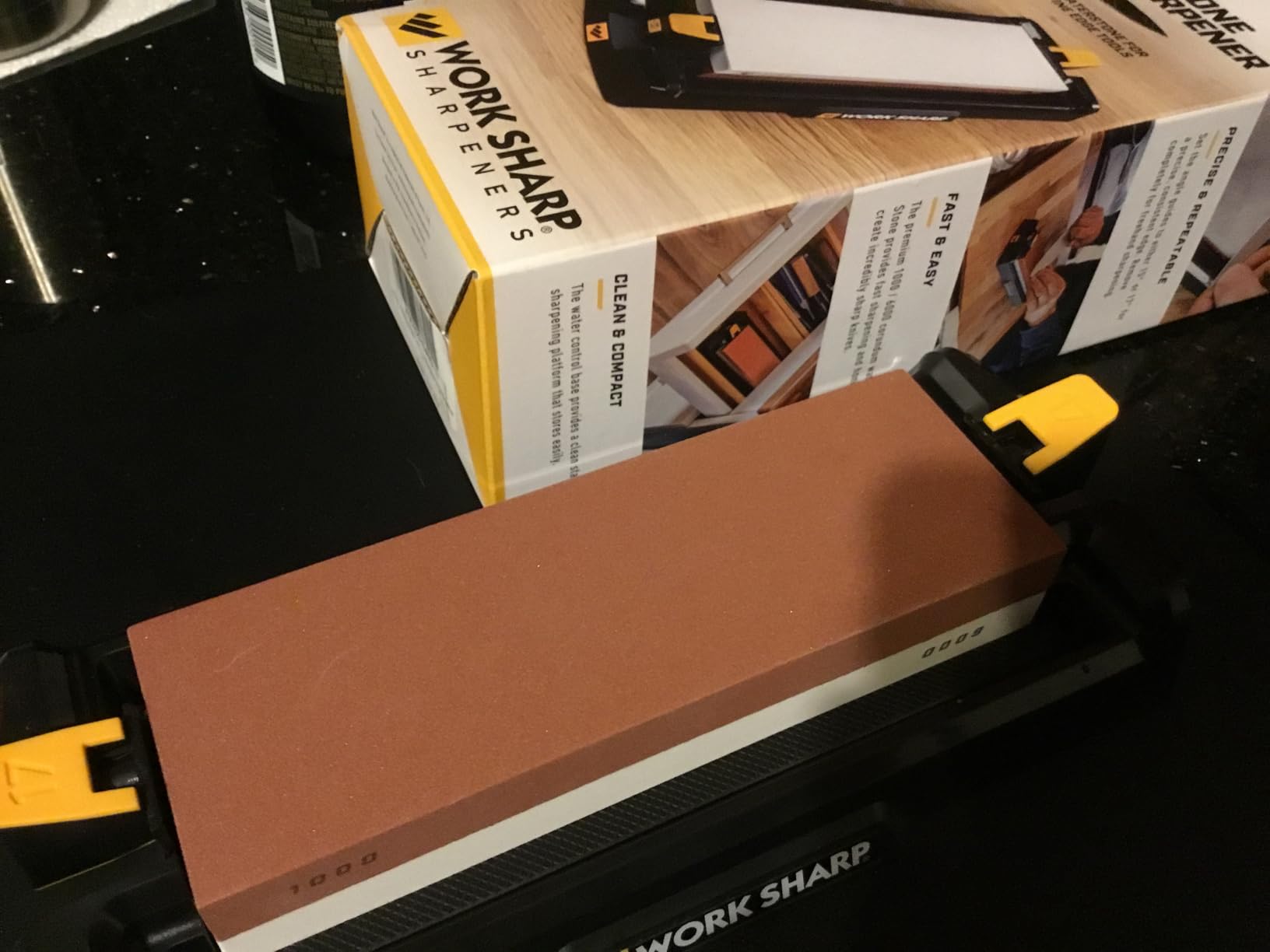
Is the 15 degree guide accurate enough to protect a Japanese edge?
Yes, and it is the reason to prefer this over a fixed-angle system. A guide holds the same relationship to the spine every pass, so the angle stays consistent over a long session rather than drifting as your hand tires. One buyer reported the stone faces labeled medium and fine rather than the advertised grades, so check what you actually received.
Stones or system: what do you give up?
The benchtop base is bulkier than a loose stone and you keep it in one spot, which is a downside in a small kitchen. In return you get a stable wet surface, contained mess, guides you can remove and a warranty that a bare stone does not offer. It is the better fit for someone who sharpens weekly.
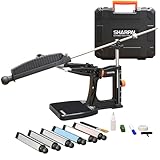
11. SHARPAL 202H Sharpening System – Best Range of Angles
SHARPAL 202H Precision Knife Sharpening System, Adjustable Angle 10–35°
Adjustable angle 10 to 35 degrees
Seven piece abrasive kit
Dual sliding clamps with carry case
Pros
- Wide 10 to 35 degree adjustment covers unusual geometries
- Seven piece kit spans 220 grit diamond to 6000 grit stone
- Heavy duty metal construction with anti-slip base
- Carry case included
- Customer service reported as very responsive
Cons
- Angle accuracy can differ from the printed setting
- Clamp screws have shallow heads that may strip
- No serrated knife attachment included
- Base can move unless clamped to a bench
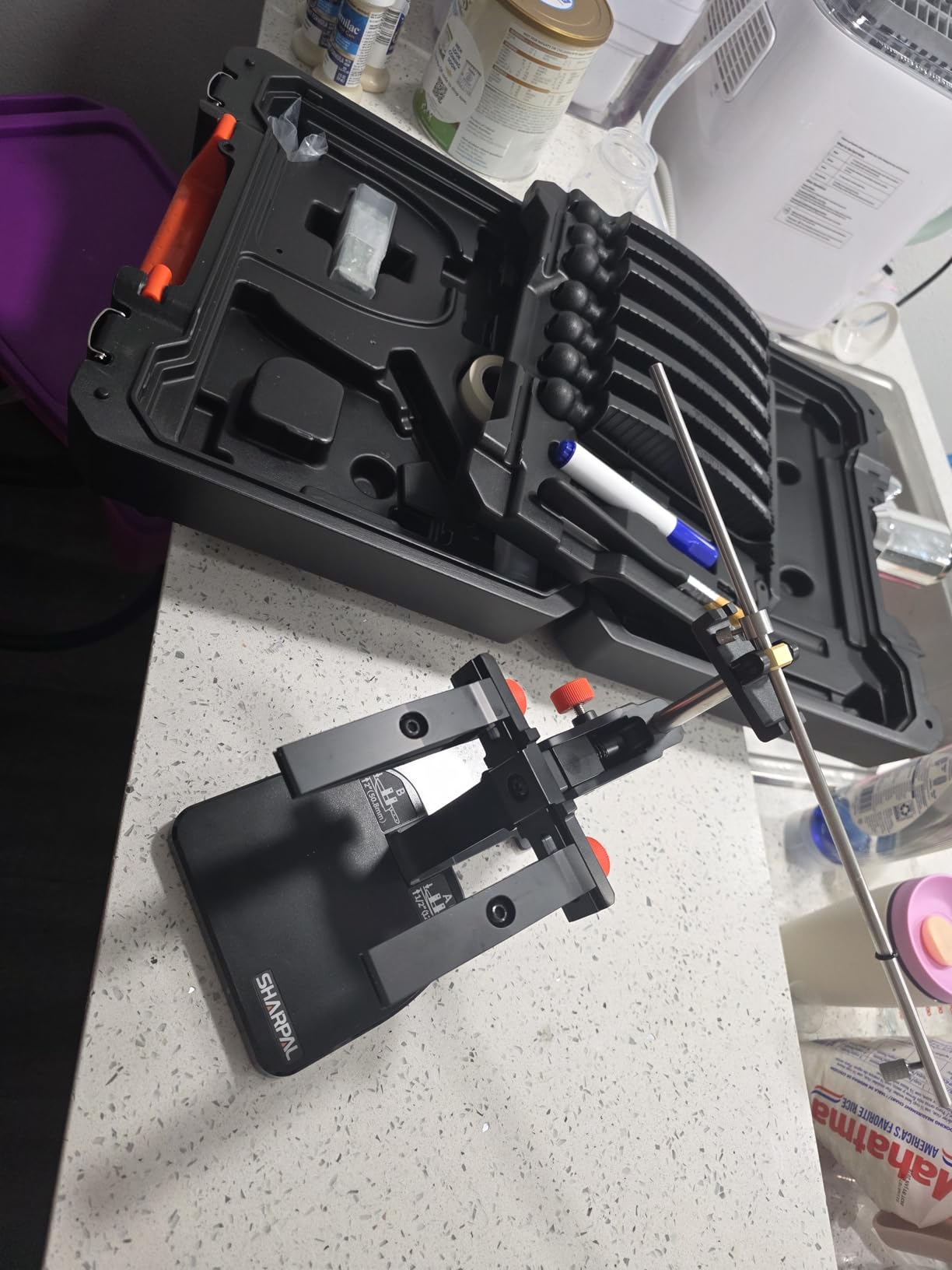
The 202H is the most configurable system in this roundup, adjusting from 10 to 35 degrees per side. That range is its argument on a Japanese knife: you can hold a 15 degree edge on a thin gyuto, and you can deliberately set 20 degrees to reprofile an older knife that came from a factory with a heavier bevel.
The seven piece abrasive kit covers the whole progression. You get 220, 325, 600 and 1000 grit diamond plates for the early stages, 3000 and 6000 grit whetstone plates for refinement, plus a leather strop with green polishing compound. That is a complete chain in one case, and it is compatible with other stone systems.
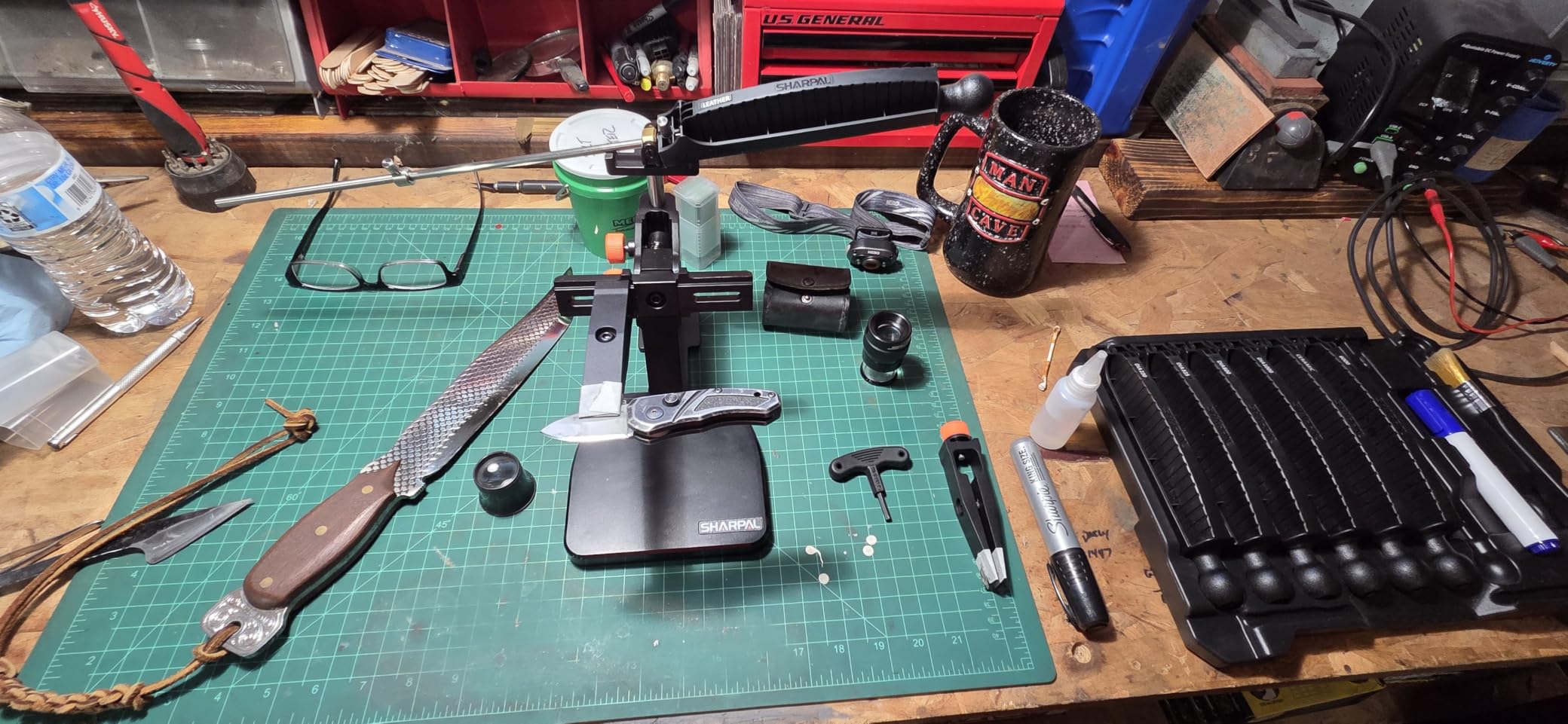
The dual sliding clamps hold blades firmly and the construction is heavy duty metal with an anti-slip base. Beginners report getting professional results because the angle setting is done for them. It handles everything from pocket knives to cleavers, which is more range than any other system here.
The base can move during use on an unclamped bench, and the jaw padding leaves room for improvement on blade stability. Clamp tightening screws have shallow heads, so take the turning force gently. None of that stops it working; it just needs a little care.
How accurate is the angle setting on hard Japanese steel?
Useful but worth verifying. One buyer measured a 15 to 16 degree result where they had set 20, which is a meaningful gap. Check the angle once with a digital angle cube, note where the true figure lands for your blade, and treat the dial as a repeatable starting point rather than a guarantee.
What are the 3000 and 6000 plates missing?
They do not perform like natural stones on super hard steels. On VG10 or AUS-10 at 60 HRC they are fine for the finishing stages, but for the coarsest work on very hard alloys the diamond plates are the faster route. Use the diamond plates to remove metal and the stone plates and strop to finish.
12. Naniwa Chosera 400 Grit Whetstone – Best for Edge Repair
Naniwa Chosera Whetstone SS-400 Grit 400
400 grit splash and go water stone
210 by 70 by 25 mm
Supplied on a sturdy holder
Pros
- Exceptional cutting power with a balanced hardness
- Splash and go so no soaking time is needed
- Very hard and slow wearing stone
- Cuts the hardest steels without clogging
- Needs no separate nagura stone for routine work
Cons
- Glued to a plastic base so it does not dry evenly
- Less aggressive than diamond plates on very dull blades
- Diamond plates are recommended for steels like S90V
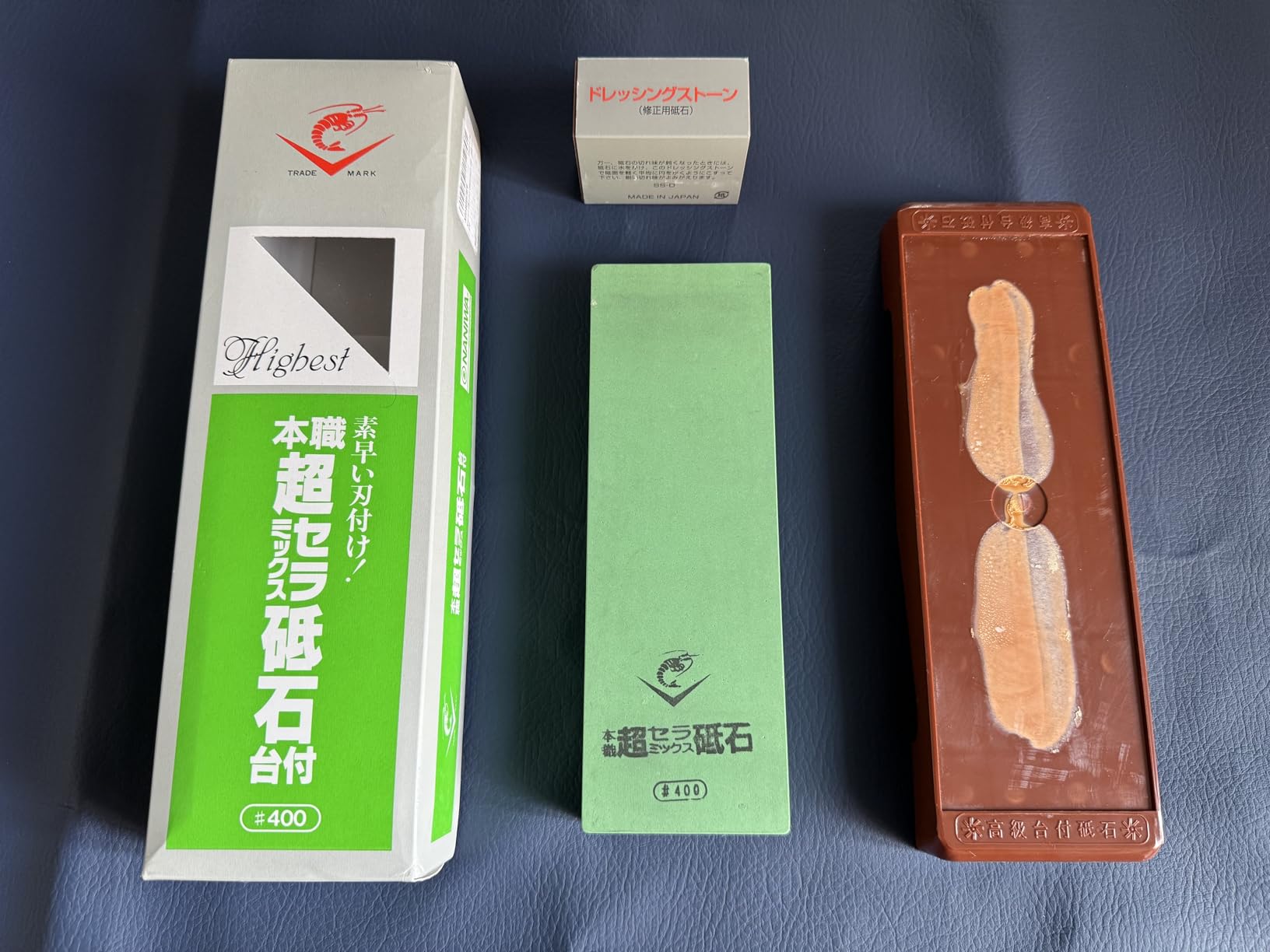
This is the repair stone in the roundup, and professionals pick it deliberately. At 400 grit it removes steel quickly and evenly to establish a new bevel, then steps up to a finer stone to finish. On a knife with a genuine edge chip it set a clean bevel where lighter abrasives would have just smeared the damage.
It is a splash-and-go stone, which is the single biggest practical advantage here. No ten minute soak, no waiting, and it is described as polishing above its grit level while still cutting fast. The stone is hard enough that it does not need a nagura block for routine flattening, which takes one accessory off your shopping list.
Hardness is the headline. The stone is extremely hard and slow wearing, so it stays flat over years of hard work and cuts metal quickly with a smooth tactile feel rather than a gritty one. Users pair it with a Chosera 2000 or an 800 grit stone to complete the progression, which is the normal way to use it.
It arrives on a sturdy holder, and the 210 by 70 by 25 mm face gives plenty of working area. On very dull blades it takes more passes than a diamond plate would, and for super hard steels like S90V the reviews recommend diamond plates instead. For VG10 and white #2 it is excellent.
Does 400 grit belong in a routine sharpening session?
Only when steel is missing. On an edge that is merely rolled or dull, jump to 1000 or 2000 and you will get to a finer result faster with less metal removed. Reserve the 400 for chips, tip repairs and any time you are changing the bevel angle deliberately.
What about the glued base?
The stone is glued to its plastic holder, so it does not dry evenly underneath and can develop hairline cracks if you leave it wet. Do not try to remove it, because the reviews are clear that this is not recommended. Stand it on edge to dry after use and keep the stone from sitting in pooled water overnight.
How to Choose a Sharpener for Japanese Steel?
The system you pick matters less than the angle it holds and the amount of steel it removes. Here is how the main categories stack up against a 15 degree Japanese edge.
15 degrees per side versus 20 degrees per side
A Japanese gyuto or santoku typically arrives at a secondary bevel of 15 to 17 degrees per side, which is what lets it take an edge you can barely feel. A Western chef’s knife or a cleaver more often sits at 20 degrees and trades sharpness for durability. Sharpening a 15 degree edge at 20 degrees does not fail loudly. It quietly adds five degrees per side, the edge becomes chunky, and the knife feels safer but noticeably duller.
The reverse is also worth knowing: taking a 20 degree Western knife down to 15 degrees produces an edge that is keener but far more fragile. If you own both kinds of knife, that is an argument for a sharpener with adjustable angles rather than one fixed setting.
Matching the abrasive to the steel hardness
Japanese stainless such as VG10 sits around 60 to 61 HRC and AUS-10 runs roughly 58 to 61 HRC. Carbon steels including white #2 and blue #2 are softer, often in the high 50s or low 60s for blue #2. Waterstones handle this range well because corundum cuts smoothly without loading up. Diamond plates cut faster and are the better choice when you hit very hard alloys with large carbides.
Ceramic finishing stones are the quiet third option. They stay flat, need no water and are gentle enough for a final polish, but they remove very little metal so they are a finishing step rather than a sharpening tool.
Honing versus sharpening
Sharpening removes metal and establishes the geometry. Honing realigns the existing edge without meaningfully changing it. A honing rod or ceramic honing steel between full sharpenings keeps an edge aligned and extends the time between stone sessions. On Japanese knives keep the pressure light and the angle true; hammering a hard edge with a steel is how chips happen.
If a steel is harder than the knife itself it becomes an abrasive in its own right, which is why the reviews mention diamond rods working on Japanese steel as long as the rod is rated around 65 HRC or softer. Plain high-carbon steels are the traditional choice.
Single bevel blades need different handling
A yanagiba or deba has a chisel bevel on one side and a flat back. You only grind the bevel side, the flat rides against the stone, and the risk is thinning the knife too far forward or rounding the edge at the heel. Guides help, but the real fix is a nagura stone to set a flat reference surface before you start. Beginners should practise single-bevel technique on a cheap knife first.
Choosing by skill level
Complete beginners should start with a stone that includes a guide, such as the Sharp Pebble or Amazon Basics pair, because angle control is the whole learning curve. Intermediate sharpeners usually want a 1000 grit workhorse plus a strop, which is what the King and Kota Japan stones are built for. Experienced users tend to assemble a chain: a coarse repair stone, a 1000 grit, a 3000 or 6000 grit finisher, a nagura and a leather strop.
One more piece of kit worth budgeting for is a stone base or holder. Sharpening with a stone that slides is frustrating and unsafe, and a damp folded towel solves it for nothing at all.
If you are building a full kit rather than sharpening, our guide to chainsaw sharpeners for firewood cutters covers the abrasive and filing side of edge maintenance, and our survival knife picks cover the blades most likely to need edge repair.
Frequently Asked Questions
What is the best sharpener for sharpening Japanese knives?
A 1000/6000 grit combination waterstone is the best general choice, because it resets a dull edge and then refines it while holding the 15 degree angle most Japanese knives are ground to. Add a leather strop for burr removal. Guided systems set to 15 degrees work too, and they remove the guesswork for beginners.
What angle should I sharpen a Japanese knife at?
Fifteen degrees per side is the target, and many Japanese knives arrive with a secondary bevel of 15 to 17 degrees per side. Sharpening at 20 degrees per side adds metal to the bevel and leaves the knife duller than it should be. Check with a digital angle cube while you learn, then trust the guide.
Are electric knife sharpeners bad for Japanese knives?
They are a poor match. Electric wheels generate heat, and Japanese stainless at 60+ HRC can lose temper at the edge and show a dark band that slices duller than before. Their fixed grinding stages also tend to leave a coarse scratch pattern. Use them on beaded chef’s knives rather than on a Japanese edge.
Do I need to soak a whetstone before use?
Most traditional waterstones need soaking until the surface stops drinking, usually 10 to 15 minutes, and they must be dried fully afterwards or they grow mould. Splash-and-go stones such as the Naniwa Chosera need no soaking at all; you just add water as you work.
What is the difference between honing and sharpening?
Sharpening removes metal and sets the bevel angle. Honing realigns an edge that has already folded over, removing very little material. Hone with a steel between full sharpenings and sharpen on a stone when the edge genuinely stops holding. Keep honing pressure light on hard Japanese steel.
The Sharpener I Recommend for Japanese Knives
After putting all twelve through their paces, the Sharp Pebble 1000/6000 combination whetstone is the sharpener I recommend for Japanese knives in 2026. It holds the 15 degree angle that a gyuto or santoku is built around, removes the least metal of anything in this roundup, and ships with the angle guide and base that beginners need. Add a leather strop and you have a complete system.
If freehand angle control is the thing holding you back, the Work Sharp Precision Adjust Elite at its 15 degree setting gets the same result in four minutes with no stone to soak. For enthusiasts who already have a guide, the Shapton K0702 is the stone we would keep on the bench.
Whichever you pick, stay at 15 degrees per side, work light, and keep electric wheels and pull-through sharpeners away from the edge. That habit alone will outlast any gadget you buy.