
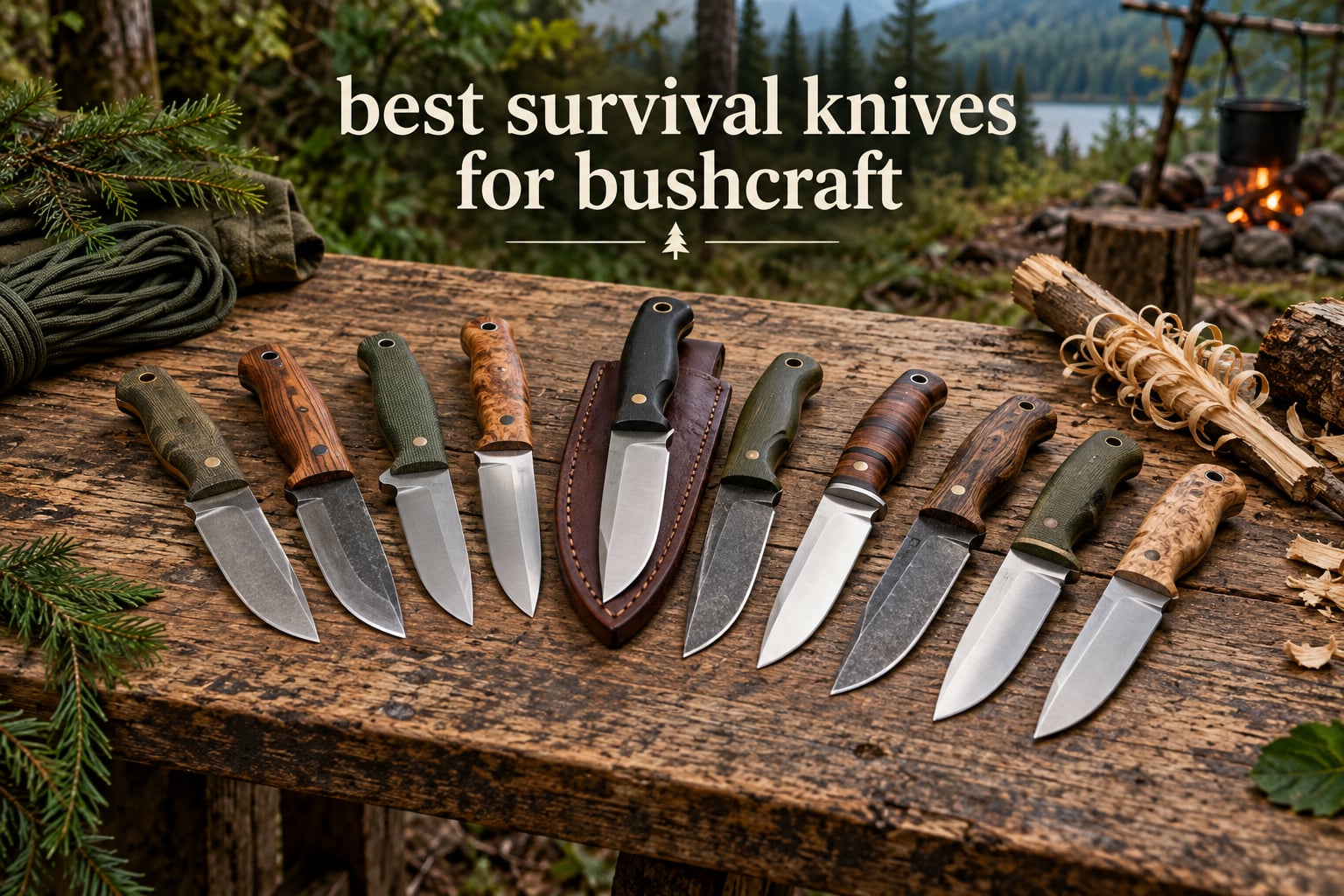
The best survival knives for bushcraft are the Morakniv Companion for general woodcraft, the Gerber Strongarm for heavy abuse, and the KA-BAR BK2 for batoning. The Companion is the one most beginners should buy; the other two earn their place when a task gets hard. All ten picks below are full tang or near it, sharpenable by hand, and legal-carry friendly in most places.
That answer hides a truth the forums keep arguing about. Nobody needs an expensive knife, and most people who think they do end up with a blade they sharpen badly rather than a blade they use well. My friend who taught me bushcraft carried a simple Mora on a cord around his neck for years and out-carved people with folders costing several times more.
So this roundup ignores brand hype and looks at what a knife actually does in the woods: how it takes a stone, whether the spine throws sparks, whether the tang survives a baton, whether the handle stays planted in wet conditions, and whether you can still afford to replace it when the sheath wears out. I compared all ten blades side by side on the same six tasks, from feather sticks to game dressing.
If you also carry emergency kit beyond the knife itself, our picks for the [best emergency survival kits for rural homes](https://www.haynet.net/best-emergency-survival-kits-for-rural-homes/) are worth a look. Everything in this guide assumes you already know how to use the tool you are holding.
Table of Contents
Top 3 Best Survival Knives For Bushcraft (October 2026)
The three below cover the widest spread of real use cases. The Companion handles carving and camp chores, the Mossy Oak handles oversized work with a lot of steel to swing, and the Strongarm handles the abuse most people accidentally inflict on a knife.


Mossy Oak 15-Inch Survival
- 10 inch stainless blade
- saw-back spine
- ferro rod in sheath
- 16.8 oz

All 10 Survival Knives for Bushcraft Compared Side by Side in 2026
This table is the fastest way to narrow the field. It lists every pick with the specification that actually decides which knife suits your work, so you can rule out six options in about a minute.
| Product | Specifications | Action |
|---|---|---|
| Morakniv Companion Fixed Blade |
|
Check Latest Price |
| Mossy Oak 15-Inch Survival Knife |
|
Check Latest Price |
| Gerber Strongarm Fixed Blade |
|
Check Latest Price |
 KA-BAR BK2 Becker Companion KA-BAR BK2 Becker Companion |
|
Check Latest Price |
 Gerber Ultimate Fixed Blade Gerber Ultimate Fixed Blade |
|
Check Latest Price |
 BPSKNIVES Adventurer BPSKNIVES Adventurer |
|
Check Latest Price |
 Morakniv Kansbol Morakniv Kansbol |
|
Check Latest Price |
 SOG Field Knife Full Tang SOG Field Knife Full Tang |
|
Check Latest Price |
 Condor Indigenous Puukko Condor Indigenous Puukko |
|
Check Latest Price |
 Cold Steel Bushman Bowie Cold Steel Bushman Bowie |
|
Check Latest Price |
1. Morakniv Companion Fixed Blade: Best Overall Bushcraft Survival Knife
Morakniv Companion Fixed Blade Outdoor Knife with Stainless Steel Blade, 4.1-Inch, Military Green
4.1 inch Sandvik 12C27 stainless blade, partial tang, 3.9 oz with sheath
Pros
- Factory edge is sharp out of the box
- easy to re-sharpen by hand
- high friction handle grips when wet
- 3.9 oz with sheath
- holds a fine edge for detail carving
Cons
- Partial tang
- so no hard batoning or prying
- plastic sheath is simple and feels cheap
- occasional edge blemishes near the tip
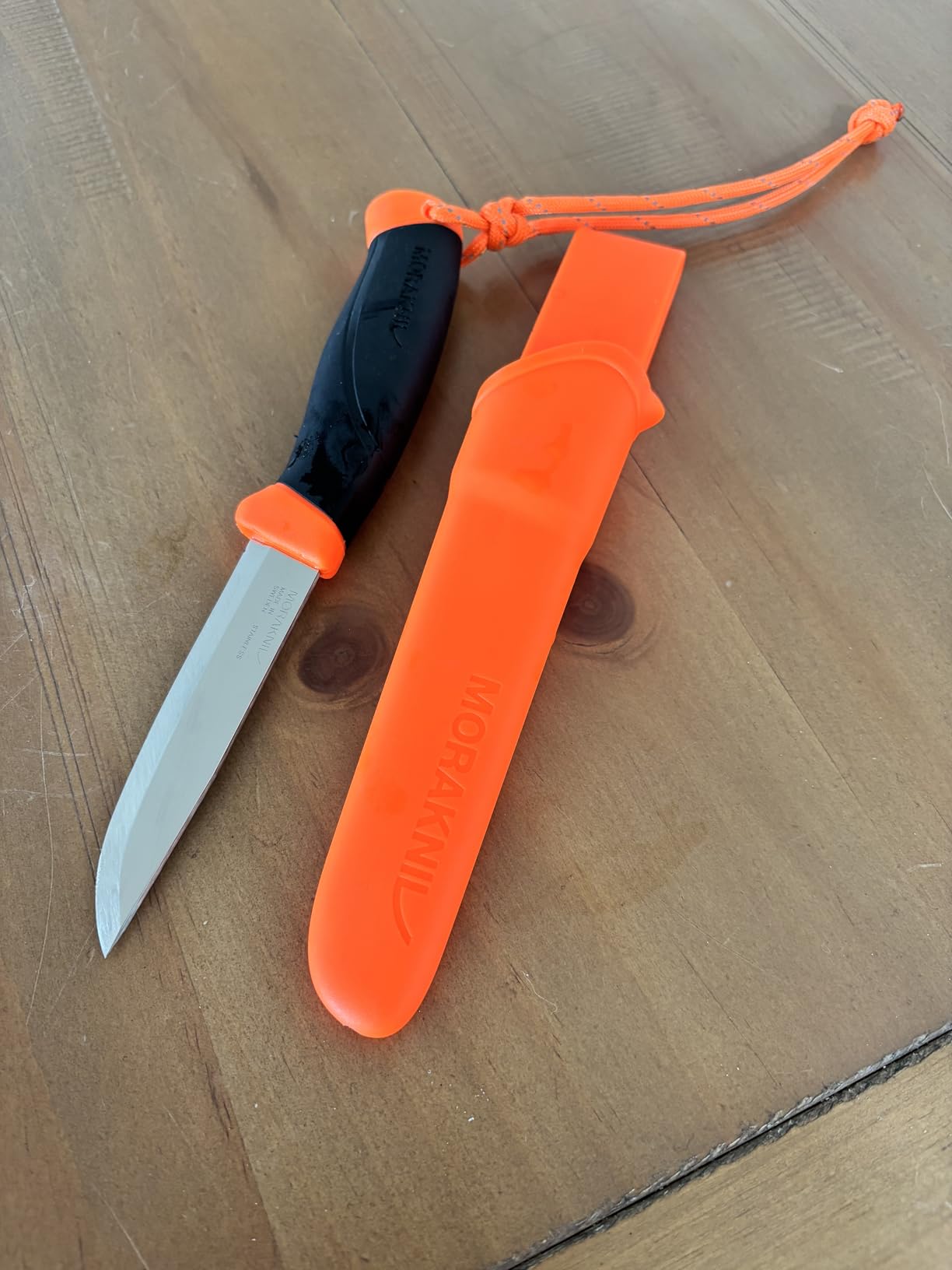
I have carried the Companion for the longest stretch of any knife on this list, and it has never needed anything more than a stone and a strop. The 4.1 inch Sandvik 12C27 blade leaves the box sharper than most knives that have already been sharpened twice, which matters on day one when your technique is worst.
At 3.9 ounces with the sheath, it is the knife I forget I am carrying. That is the highest compliment for a bushcraft blade. A tool you leave at the bottom of the pack is a tool that will not be there when a fire needs building.
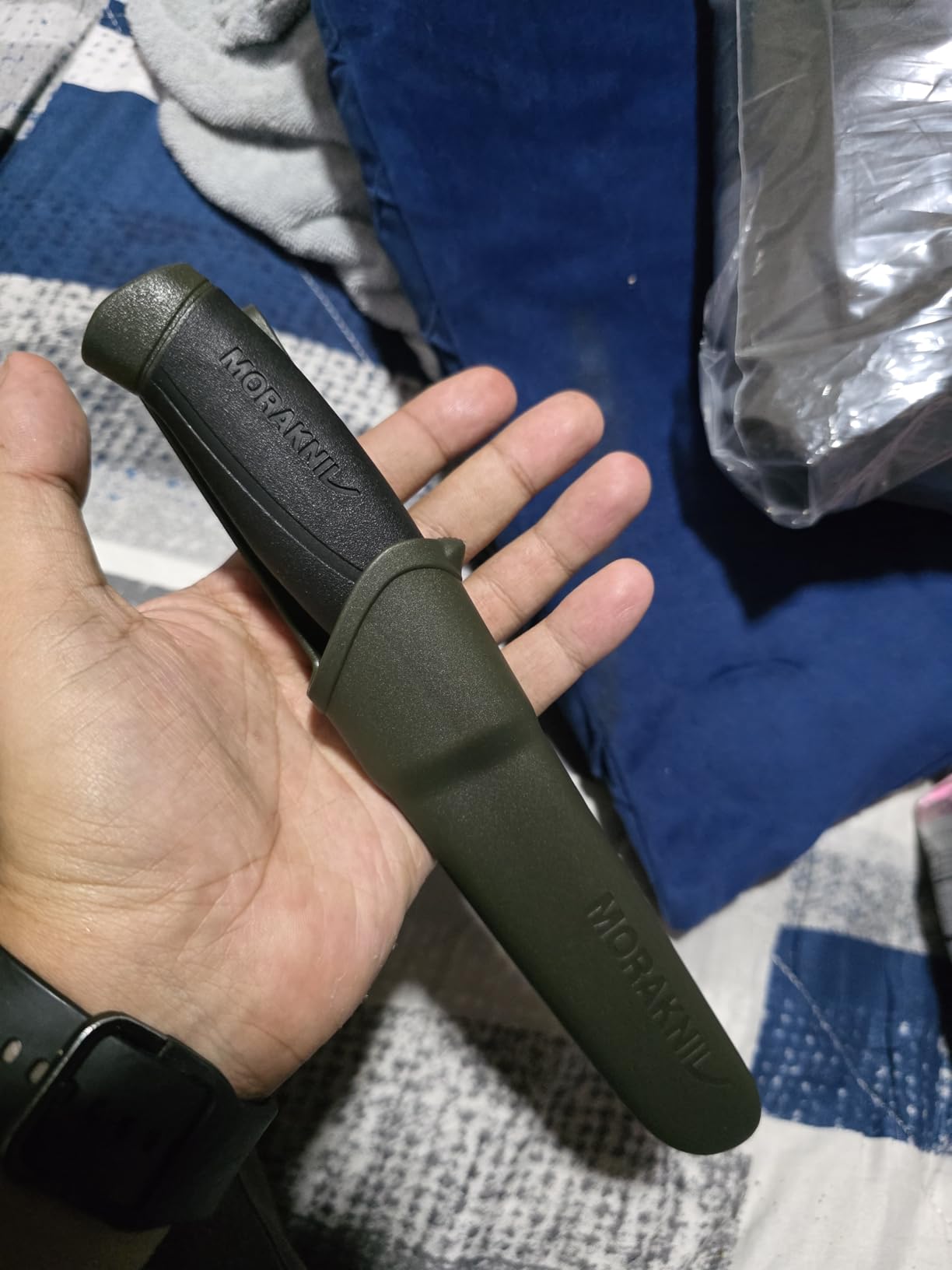
The 0.08 inch blade is thin enough for controlled push cuts and detail work on a try stick, and the handle has a guard that keeps your index finger off the edge when you push forward on a green stick. The high-friction polymer texture has stayed planted in rain, mud, and after handling wet meat for me.
Where it stops is force. The tang runs partway into the handle, not the whole length, so batoning with a branch or prying bark off a log will eventually loosen it. I found the honest limit early: it is a carving and camp-chore knife, not a chopping tool.
Stainless means no rust anxiety, which removes the single biggest reason people hesitate over a first knife. The trade is edge retention. Twelve-twenty-seven is not a super steel, so plan on touching it up every few days of hard use rather than every few weeks.
Who the Morakniv Companion suits?
It suits a beginner, a hiker, and anyone who wants one tool that handles carving, food prep, tinder processing, rope, and camp chores without a learning curve. It was also the blade I reached for most often while working a try stick and a feather stick.
It also suits anyone who lives somewhere humid or coastal. Wipe it and put it away, and rust is a non-issue. If you have ever delayed buying a knife because you did not want to learn edge maintenance, that anxiety disappears here.
Where the Companion falls short?
Skip it if your main job is batoning firewood or driving the blade into a round for splitting, because the partial tang is the limiting factor, not the steel. Skip it if you need to gut a moose, since a 4 inch blade is a camp chore blade and not a game processor.
The plastic sheath is the other weak point. It holds the knife well enough for a belt, but it scratches, cracks, and loses its retention over a few seasons of hard use. Budget for a leather or zippered replacement, or accept replacing the whole kit.
2. Mossy Oak 15-Inch Survival Knife: Best for Big Batons and Camp Chopping
Mossy Oak 15-inch Survival Knife with Sharpener and Fire Starter
15 inch overall with 10 inch stainless blade, saw-back spine, 16.8 oz
Pros
- Carries real momentum for batoning and light chopping
- rubber grip stays grippy in any condition
- ferro starter throws a strong spark shower
- nylon sheath with belt hanging system
- holds an edge well
Cons
- 15 inch overall is awkward on a backpacking belt
- thick stainless takes a long time to bring to a fine edge
- saw-back spine does little cutting work
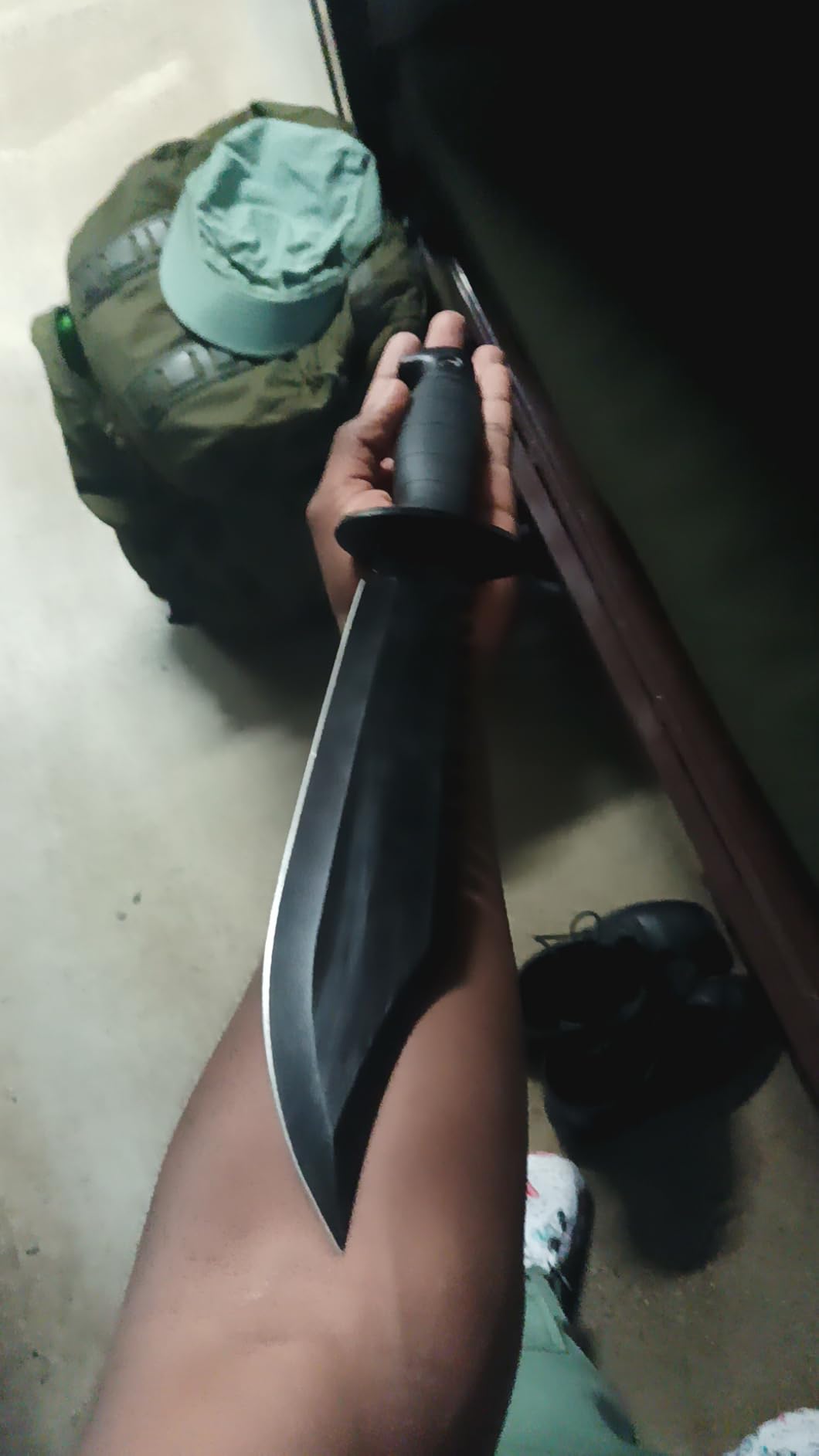
Most knives in this roundup are carving tools that occasionally chop. This one is a chopping tool that also carves. The 10 inch blade and 16.8 ounce weight give it the momentum to drive through a length of firewood, and the balance point sits forward where a hand wants it.
The rubber grip is the most consistently well-praised feature in the reviews. It stayed planted for me in wet gloves and with wet hands, and it is a full handle rather than a small guard, so a hard slip still finds fingers attached to the knife.
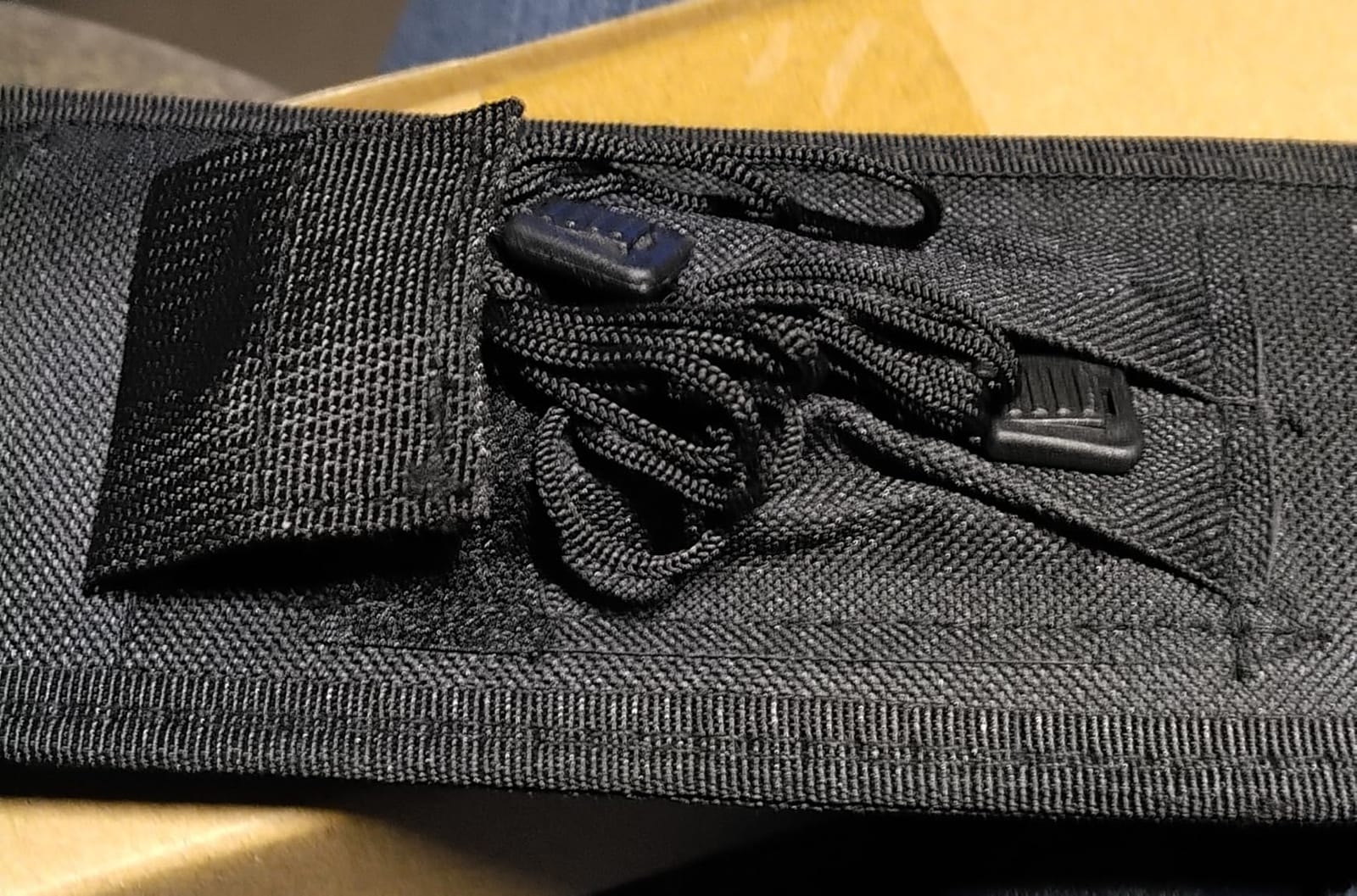
Owners consistently report the included ferrocerium starter throwing a strong shower off the saw-back spine. That makes it a genuine one-knife kit for a beginner: blade, striker, and a sheath that hangs from a belt or a pack. You do not need to buy a separate fire kit to get through your first winter.
The 5/32 inch stainless blade is thick, and that thickness cuts both ways. It survives abuse that would ruin a thin blade, and it takes a long time to bring to a fine edge. On a coarse stone it will not behave like the Companion for detail work, and the 15 inch overall length is a pack-weight problem.
The saw-back spine is functionally decorative. It is not sharp and it does not cut, so treat it as a grip texture and a spark source, not as a saw. Anyone selling you on the sawback doing real work is overselling it.
Who the Mossy Oak suits?
It suits car campers, hunters processing game, and anyone who splits or chops a real volume of wood each season rather than trimming kindling. The ferro starter in the box removes one common excuse for not practicing fire making.
It also suits buyers who want one object rather than a kit. Knife, sheath, striker, and sharpening steel all come in the box, which makes it a common first purchase for someone who does not yet know what else to add.
Where the Mossy Oak falls short?
Skip it for backpacking. Fifteen inches of knife and a nylon sheath will be felt on every step, and no amount of skill fixes that. It is also a poor choice for feather sticks and fine carving, where a thinner blade with a single bevel is much faster.
The plastic insert inside the sheath that holds the sharpener and rod is a recurring complaint because it dislodges on a hard draw. Keep the striker in a pocket instead of trusting the pocket in the sheath, and you will stop losing it.
3. Gerber Strongarm: Best Heavy-Duty Survival Knife for Abuse
Gerber Gear Strongarm – Fixed Blade Tactical Knife for Survival Gear – Coyote Brown, Plain Edge
Full tang 420HC with Cerakote, 4.8 inch blade, 9.8 inch overall
Pros
- Survives abuse tests
- prying
- batoning and striking without failure
- diamond-textured grip stays planted when wet
- 420HC is easy to sharpen
- multi-mount sheath
- made in the USA
Cons
- Sabre grind and thick blade are poor for fine slicing and carving
- 420HC loses its edge sooner than modern steels
- Cerakote coating wears through with hard use
The Strongarm is the reference do-everything tactical fixed blade, and the reviews treat it that way. Owners describe prying, batoning, and striking it against masonry without any failure, which is a stronger durability claim than any other knife here carries.
The full tang is the reason. Steel runs the length of the handle, so torque from a stuck baton or a levering motion has somewhere to go. Add the glass-breaking pommel and the roughly 0.190 inch sabre grind, and this is a knife built to be used roughly.
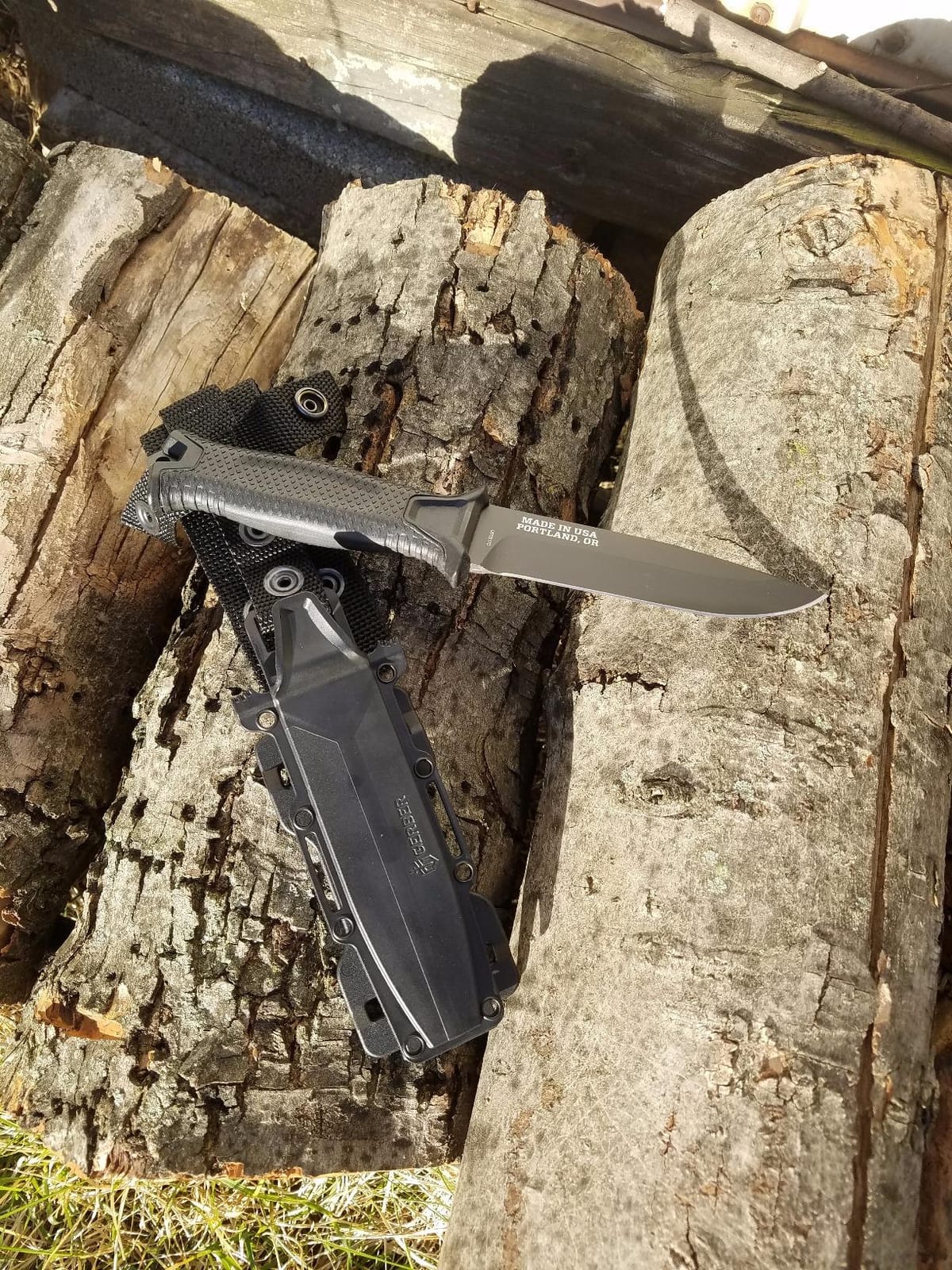
The 90-degree spine is listed as suited to striking ferro rods, though some units report a rounded spine that limits spark throw, so test your own before you rely on it. The multi-mount sheath is genuinely useful, accepting belt, drop-leg, MOLLE, inverted MOLLE, and scout carry without buying a second sheath.
Sharpening is where the design costs you. A 0.190 inch sabre grind with a plain edge takes a stone well and a beginner can maintain it, but it will never produce the thin, precise edge that detail carving needs. Think food prep and utility, not feather sticks.
Two honest caveats from the review data. The Cerakote coating wears through with heavy use, and cosmetic wear is a normal part of this knife’s life. The sheath polymer also stiffens in cold conditions, which matters if you are drawing it with gloves in winter.
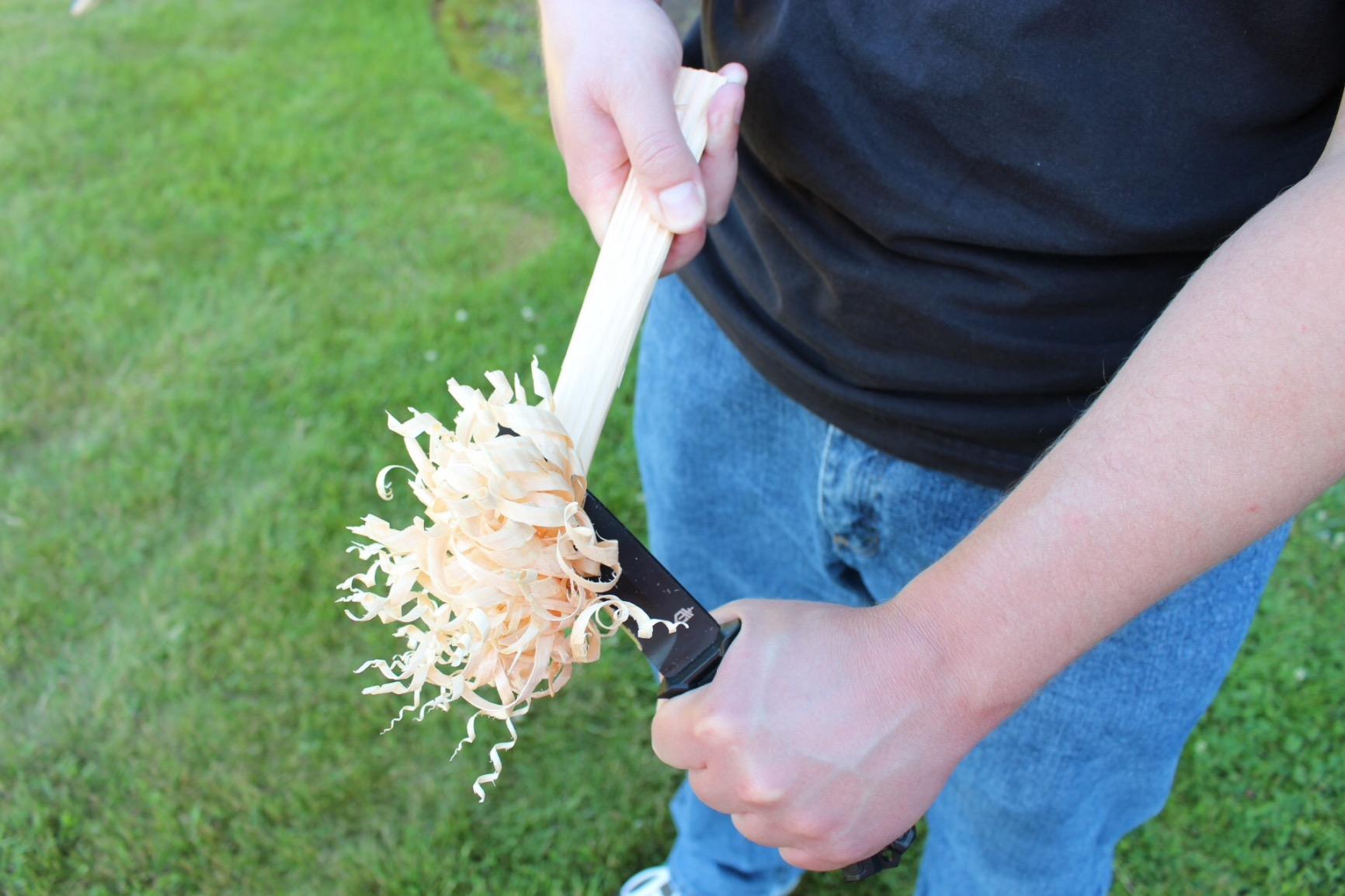
Who the Gerber Strongarm suits?
It suits the person who is hard on tools, works in harsh conditions, or wants one knife that can be left in a vehicle or a go bag without anxiety. It is a natural companion to an emergency kit rather than a replacement for one.
It also suits anyone who resents sharpening. 420HC is soft enough to bring back with a cheap stone and a strop, and a blunt edge on this knife is a fifteen-minute fix rather than a project.
Where the Strongarm falls short?
Skip it if your priority is carving, whittling, or precise food prep. The grind and blade thickness work against you on anything that needs a thin, controlled edge, and no amount of technique fully closes that gap.
Skip it if you plan on this being your only fine woodcutting knife. It is a survivor and a utility tool. If you want one blade to carve and one to survive, the two jobs here are different enough to be worth separating.
4. KA-BAR BK2 Becker Companion: Best Bushcraft Knife for Batoning and Chopping
KA-BAR Becker BK2 Campanion Fixed Blade Knife, Carbon Steel
1095 carbon steel, full tang, 0.25 inch thick blade, 16 oz
Pros
- Beastly thick 1095 blade that chops
- batons
- splits and digs
- forward-weighted balance like a compact camp axe
- extended tang usable as a chisel or pounding surface
- straightforward to sharpen
- secure sheath
Cons
- Smooth handle scales can feel slick when wet
- handle bolts loosen over time
- too wide and thick for fine slicing or food prep
At roughly 0.25 inch thick, the BK2 is by a wide margin the thickest blade in this roundup, and that is the entire point. Reviewers describe it as a bushcraft beast that can replace a hatchet for splitting and batoning, which no other knife on this list can claim.
Full tang 1095 carbon steel with a black Cro-Van powder coat does two things well. The steel is easy to sharpen and takes a working edge quickly, and the powder coat slows surface rust long enough for most people to get into a maintenance habit.
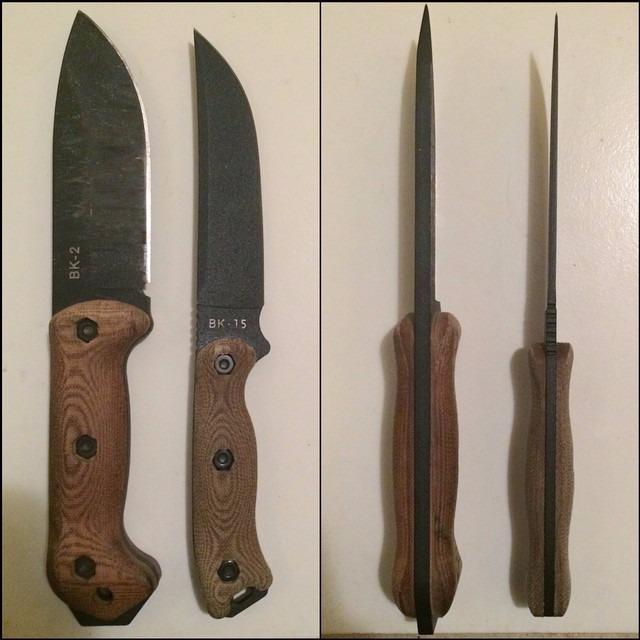
The extended tang is a detail that gets overlooked. Steel continues past the handle scales, so you have a hardened surface to hammer on, use as a chisel, or pry with. Owners mention treating it like a small cold chisel, and it is one of the few features on this list with a real mechanical reason behind it.
The forward weighting is what makes batoning feel safe. The mass sits near the front third of the blade rather than in your hand, so a miscalculated swing travels away from your knuckles instead of into them. That is a safety design choice more than a comfort one.
Two real issues. The handle scales are smooth and can feel slick when wet, and the bolts can loosen with use, so a periodic re-torque is worth it. The factory edge is also only adequate, so expect to sharpen it before the first real cutting task.
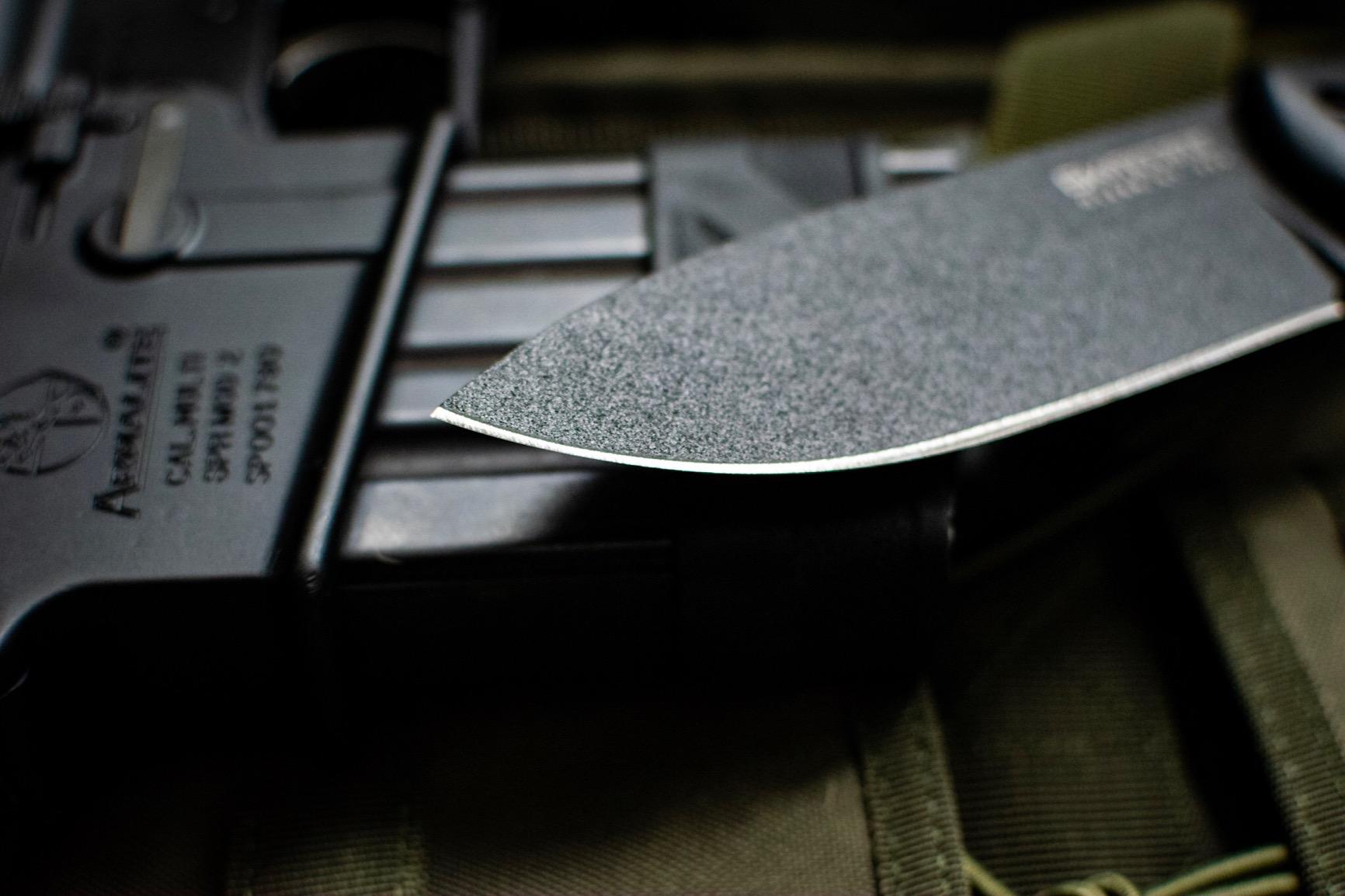
Who the KA-BAR BK2 suits?
It suits anyone who processes a lot of wood, splits kindling, digs, or wants a knife that can stand in for a small axe. It also suits cold and wet climates, where 1095 with a powder coat is far more forgiving than bare high carbon steel.
For a beginner who only wants one tool for years, this is a strong argument. It is a full tang with a thick blade, and those two things together are what allow a bushcraft knife to survive being used as a lever.
Where the BK2 falls short?
Skip it if you cook often, because a wide 0.25 inch blade at 16 ounces is wrong for food prep and awkward for cutting an onion. Skip it if you plan to carve, since the same thick blade that splits oak will roll off a feather stick.
Note the weight for backpacking. Sixteen ounces plus a sheath is a real pack decision, and lighter options like the Companion or the Kansbol exist for a reason. The black coating also has to be filed back on the spine before it throws a good ferro spark.
5. Gerber Ultimate Fixed Blade: Best All-in-One Kit with Sharpener and Ferro Rod
Gerber Ultimate Fixed Blade Knife w/Sheath, Knife Sharpener, Ferro Rod
Full tang half-serrated 4.8 inch blade, 10 inch overall, 11.02 oz
Pros
- Sheath
- sharpener and ferrocerium rod all included
- textured rubber grip holds in wet conditions
- full tang stainless construction
- hammer pommel and emergency whistle add utility
Cons
- Half-serrated section limits fine edge work and is harder to field sharpen
- heavier than typical Mora-class bushcraft knives
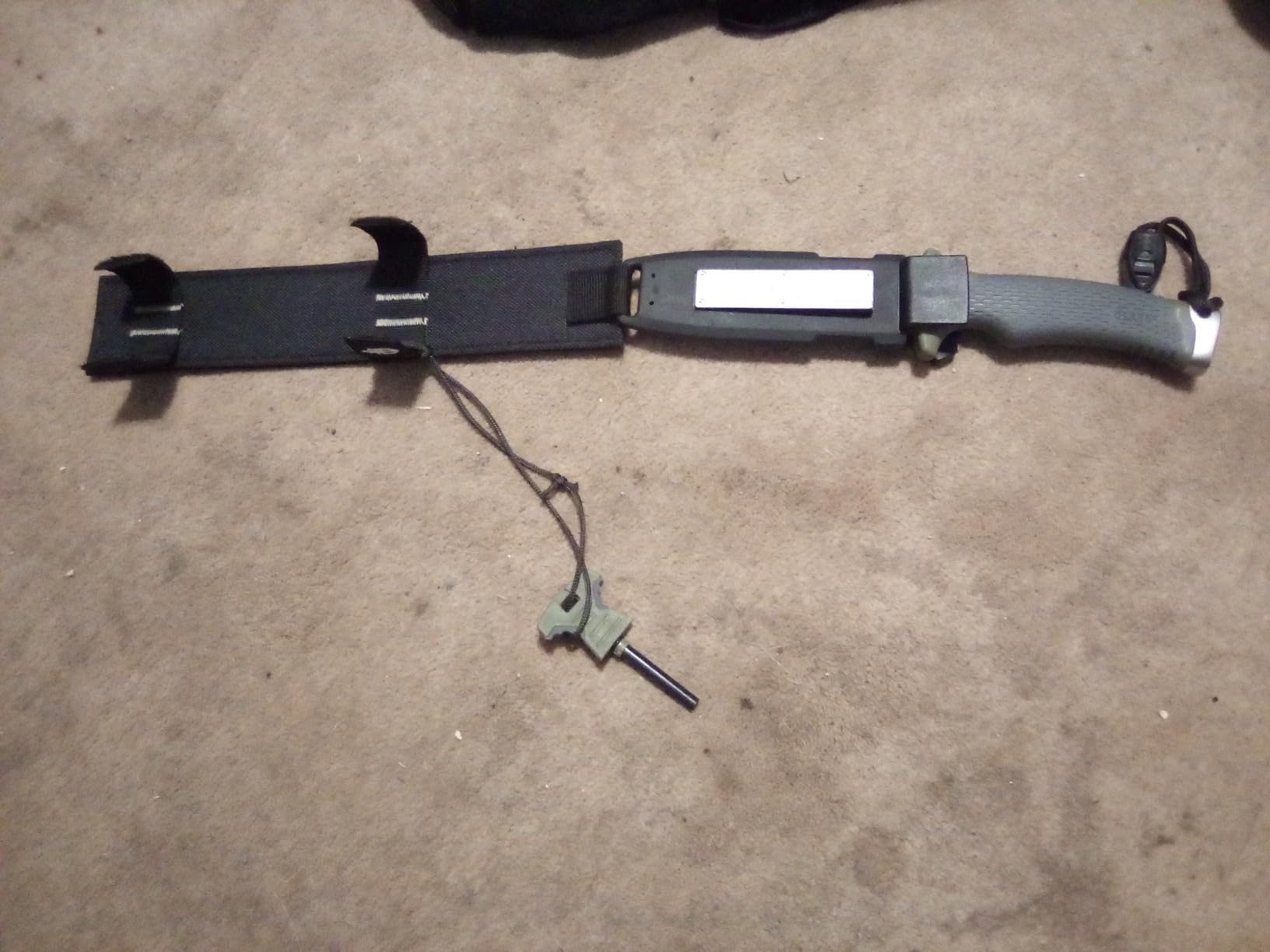
This is the pick for someone who opens a box and wants to be able to start that afternoon. The sheath holds an integrated sharpening stone and a ferrocerium rod, so the maintenance tool lives with the knife instead of at home in a drawer.
The full tang stainless construction and textured rubber grip make it a dependable camp knife, and the reviews are unusually free of serious complaints. At 4.8 inches with a 10 inch overall length, the size sits in the comfortable middle of the range.
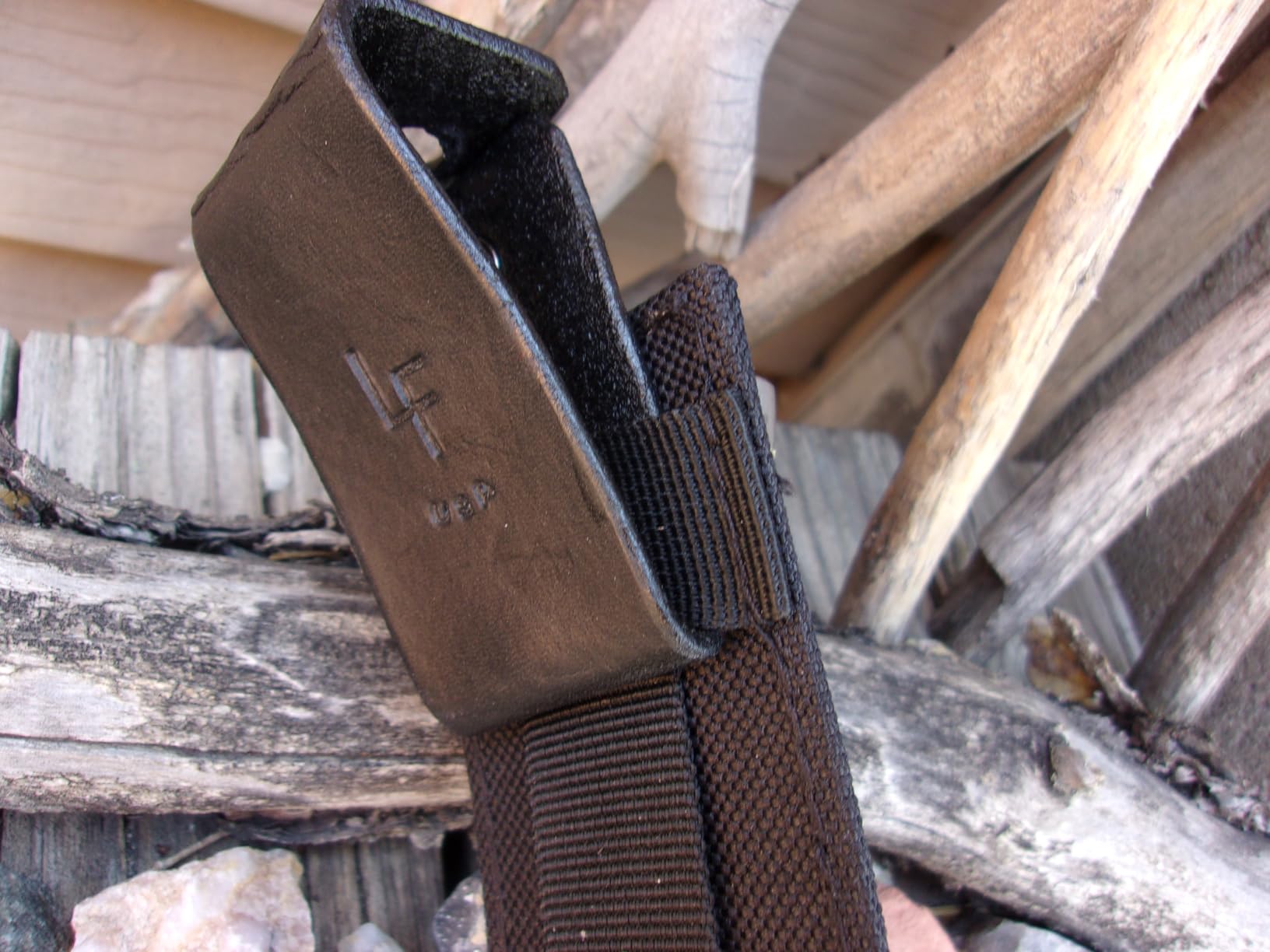
The half-serrated edge is the thing to think about before you buy. It is genuinely useful on rope, webbing, and hide, where a plain edge would roll or dull. It is also difficult to restore in the field, because a serration needs a different motion and often a different tool than a plain edge does.
For a bushcraft buyer specifically, that serration is a compromise rather than a bonus. Most of your wood tasks want a plain edge that can be honed to a fine finish, and the serrated third of this blade is dead weight for a try stick.
At 11.02 ounces it is heavier than Mora-class blades, and on long trips that difference adds up. The hammer pommel and the emergency whistle are real additions, though forum consensus holds that gimmick features are worth little compared to a good edge.
Who the Gerber Ultimate suits?
It suits gift buyers, new campers, and anyone who does not yet own a sharpener or a fire starter. The bundled system removes the two most common reasons beginners stall out, and the brand’s limited lifetime warranty is a reasonable comfort.
It also suits people who work with rope, cord, and webbing regularly. The serrated section earns its place on synthetic material in a way it never will on a piece of basswood.
Where the Gerber Ultimate falls short?
Skip it if carving is a main goal. The factory edge can be sharpened further, but the serration will always limit you on fine work, and that is a design decision you cannot sharpen away.
Skip it for long backpacking trips, where 11 ounces and a fixed blade is more weight than the task requires. This knife does a lot, and it carries the weight of doing a lot.
6. BPSKNIVES Adventurer: Best Carbon Steel Bushcraft Carving Knife
BPSKNIVES Adventurer – Bushcraft Knife – Fixed-Blade Carbon Steel Knife with Leather Sheath and Firestarter – Outdoor Full Tang Knives – Camping Knives – Survival Tactical Camp Knives
1066 carbon steel scandi grind at 18 degrees, walnut handle, 5.7 oz
Pros
- Exceptionally sharp out of the box and holds an edge well
- hand-stitched leather sheath with strong stitching
- full tang carbon steel with a true scandi grind
- well balanced at the finger groove
- firm ferro rod
Cons
- Carbon steel needs wiping dry and regular oiling
- quality control varies between units
- bundled ferro rod feels cheap
This is the most traditional bushcraft knife in the roundup, built around a true single-bevel Scandinavian grind on a 5.3 inch blade. That geometry is the reason it produces clean feather sticks: the flat bevel rides the back of a knife and cuts a straight wall every time.
High 1066 carbon steel hardened to 56 to 57 HRC is the traditional choice. It takes a razor edge on a stone, it throws better sparks than any stainless on this list, and it develops a patina that protects the surface once you learn to wipe it.
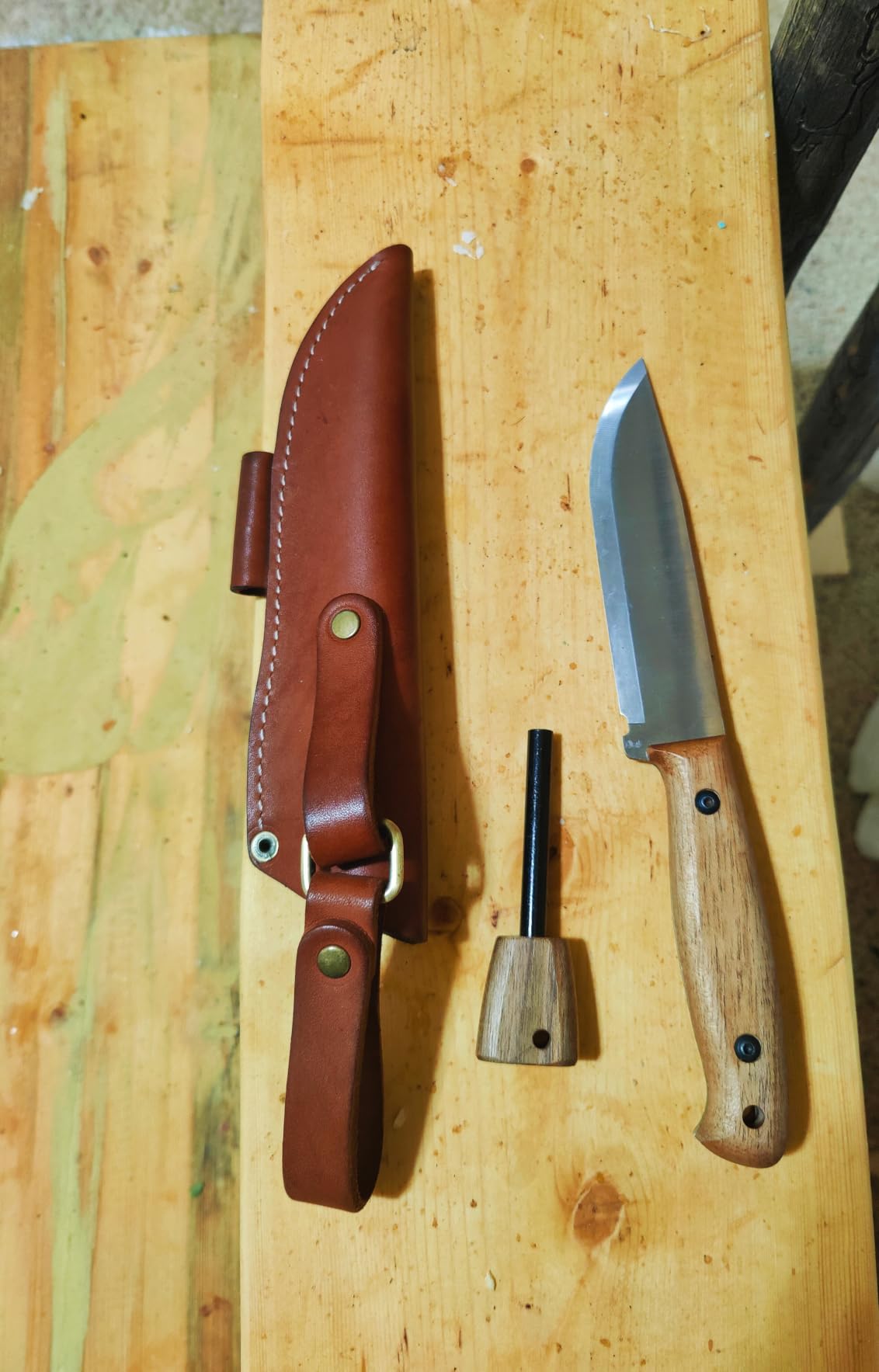
The walnut handle finished with Danish oil and the hand-stitched leather dangler sheath are the most praised details in the reviews. The sheath in particular is called exceptional repeatedly, and it is the part that most affects whether you actually carry a knife rather than leaving it at home.
At 10.2 ounces with the sheath and ferro rod, this is heavier than it looks at 5.7 ounces bare. The 5.3 inch blade is also longer than a beginner needs, and the handle runs long for medium hands, which is worth knowing if you have small hands.
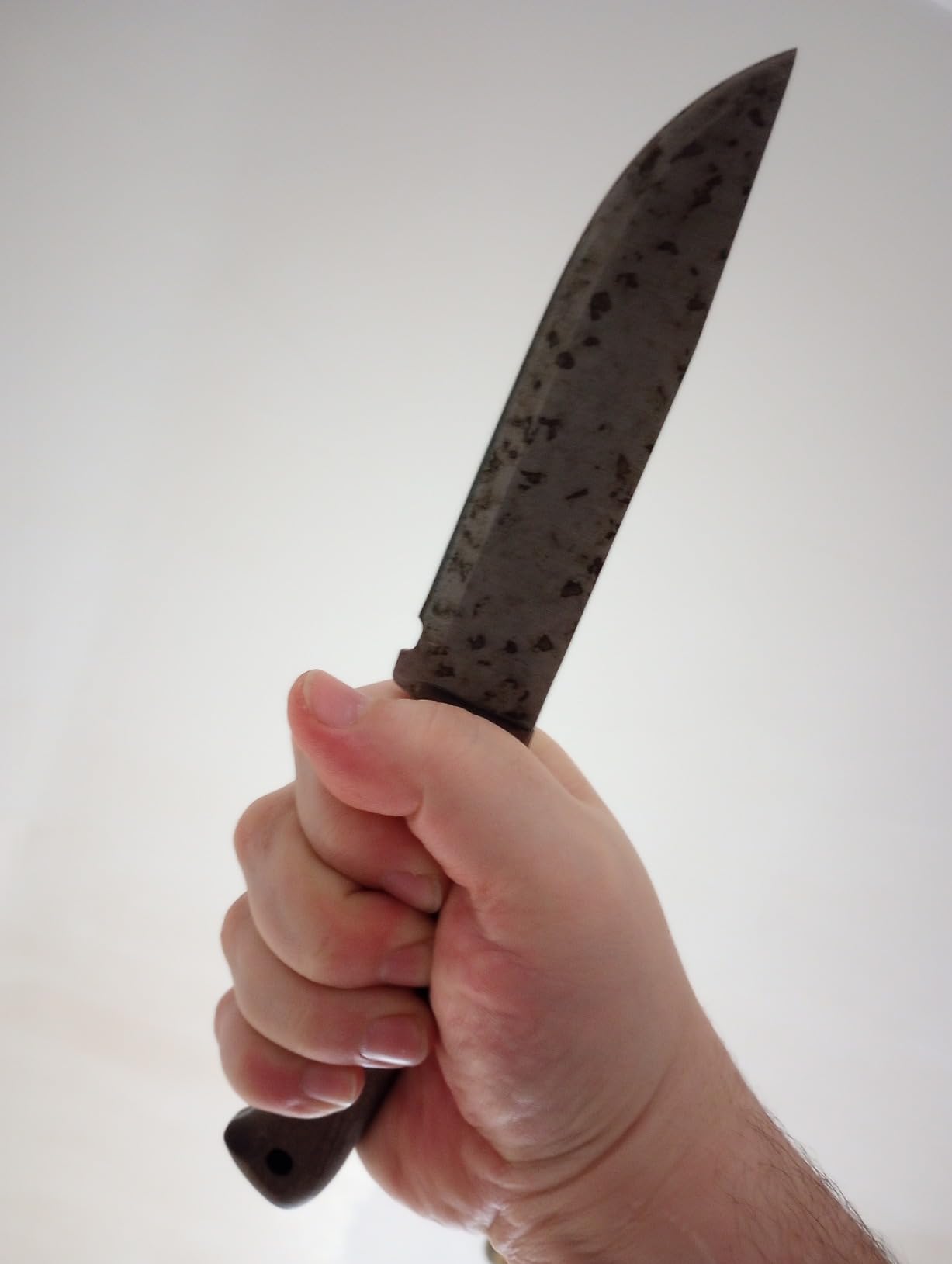
Expect variation between units. The reviews mention uneven edge grind, a dull tip, or misaligned handle scales on some examples, and the handle scales can loosen enough to need a 2.5 mm hex bit. Inspect the blade on arrival rather than trusting the box.
Who the BPSKNIVES Adventurer suits?
It suits anyone who wants to learn bushcraft properly and plans to carve, drill a bow, and work on a hearth board. Of everything here, it is the most natural fit for a friction fire kit, because a single-bevel edge makes accurate, flat work far easier to learn.
It also suits anyone who enjoys maintaining a tool. Owners repeatedly compare it favourably to knives costing several times more, which tells you the value case is being made by people who have owned both.
Where the Adventurer falls short?
Skip it if you live somewhere wet and will not wipe a blade down. Carbon steel plus a humid climate plus no maintenance equals rust, and rust anxiety is what stops many people from buying a bushcraft knife in the first place.
Skip it for heavy batoning and chopping at 5.3 inches, and skip it if you want a factory edge that stays sharp for months. It arrives sharp, but 1066 at this hardness wants regular stropping to stay that way.
7. Morakniv Kansbol: Best Lightweight Knife for Carving and Friction Fire
Morakniv Kansbol Stainless Steel Fixed-Blade Survival Knife With Sheath, Military Green, 4.3 Inch
Dual scandi and flat grind, 4.3 inch blade, 8.9 inch overall, 4.7 oz
Pros
- Dual grind gives carving near the handle and fine slicing at the tip
- extremely light at 4.7 oz
- grippy polymer handle with finger guard
- 90 degree spine works with a ferro rod
- symmetrical sheath
Cons
- Distal taper leaves a very thin tip
- not full tang so less suited to hard abuse
- two-stage grind is fiddlier to maintain
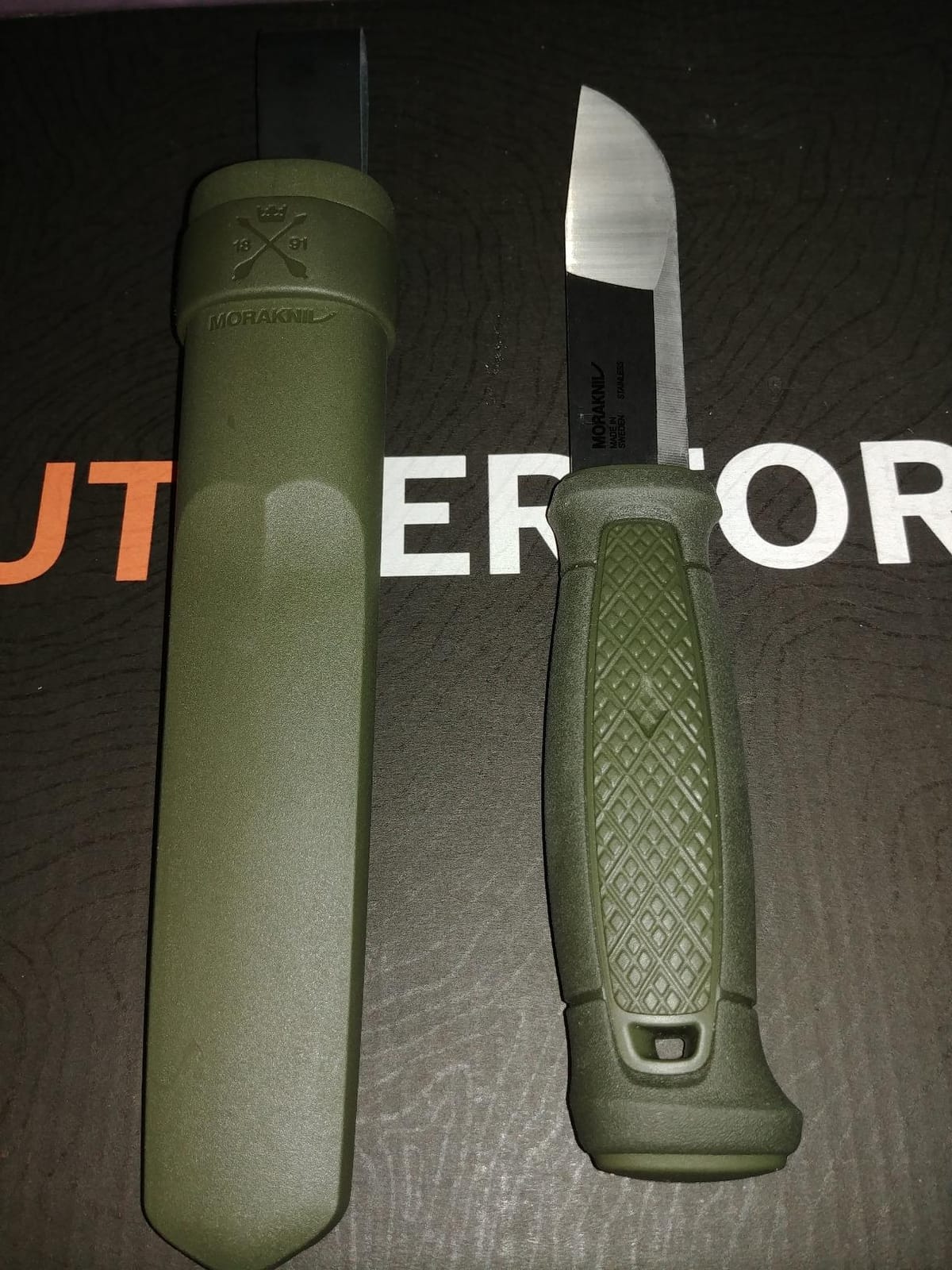
The Kansbol is the bushcraft-specific member of the Morakniv family, and the dual grind is the reason. The section near the handle is scandi for carving, and the section near the tip is flat for fine slicing and food prep, so one knife covers both jobs without a compromise.
At 4.7 ounces it is one of the two lightest full-size blades here, and the balance reduces hand fatigue on long carving sessions. Owners in bushcraft communities single it out as their most-used knife, which is a stronger signal than any rating.
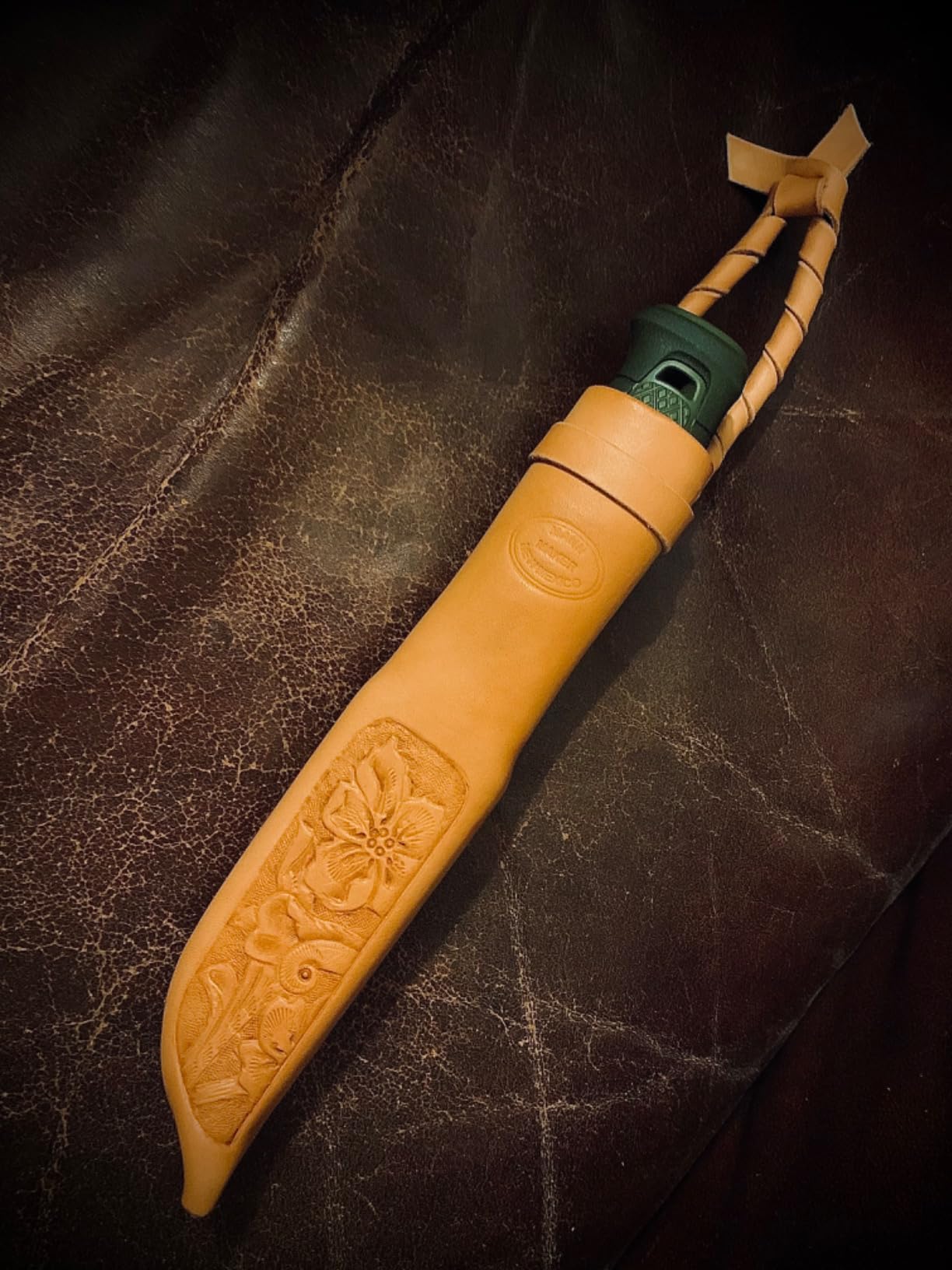
The 0.1 inch Swedish stainless blade has a 90-degree spine that works with a ferro rod, and the symmetrical polymer sheath with a click lock accepts the knife from either side. For left- or right-handed use, that is a small detail that eliminates a whole category of annoyance.
The honest limit is the tip. The blade tapers to something thin and delicate at the point, which feels nimble for carving but leaves you cautious about batoning or driving into a round. Owners regularly mention the tip as the first thing to go if the knife gets abuse.
Sharpening a two-stage grind takes more care than a single bevel. You have to work two different angles and keep them consistent across the transition, and that transition is where a beginner most often puts a wobble into the edge.
Who the Morakniv Kansbol suits?
It suits backpackers and anyone who spends a day carving rather than chopping. The weight is low enough to forget, and the scandi section handles feather sticks and a bow drill hearth board properly rather than approximately.
It also suits people who cook on trips. Most bushcraft knives give you a compromise at the tip, and this one deliberately puts a flat section there so slicing and food prep are a real strength.
Where the Kansbol falls short?
Skip it if you need heavy batoning, since the distal taper and the partial tang are both working against you. Skip it if you are rough with your tools or expect to use it as a pry bar or a mini axe.
The moulded polymer sheath also takes practice for a one-handed draw, and the steel is not a premium alloy, so it wants more frequent touch-ups than the carbon steel picks on this list.
8. SOG Field Knife Full Tang: Best Compact Full Tang for Pouch or Boot Carry
SOG Survival Knife with Sheath – Field Knife Fixed Blade Knives 4 Inch Tactical Knife and Bushcraft Knife w/Full Tang Hunting Knife Blade (FK1001-CP)
4 inch satin stainless blade, full tang, 8.5 inch overall, 3.8 oz
Pros
- Grippy TPR handle works wet or dirty
- full tang stainless with good edge retention
- only 3.8 oz with a compact 4 inch blade
- sheath notch cuts cord or line without drawing
- repair and replacement program
Cons
- Slim 4 inch blade limits heavy batoning or chopping
- thermoplastic rubber grip feels plain next to premium bushcraft handles
- basic sheath retention
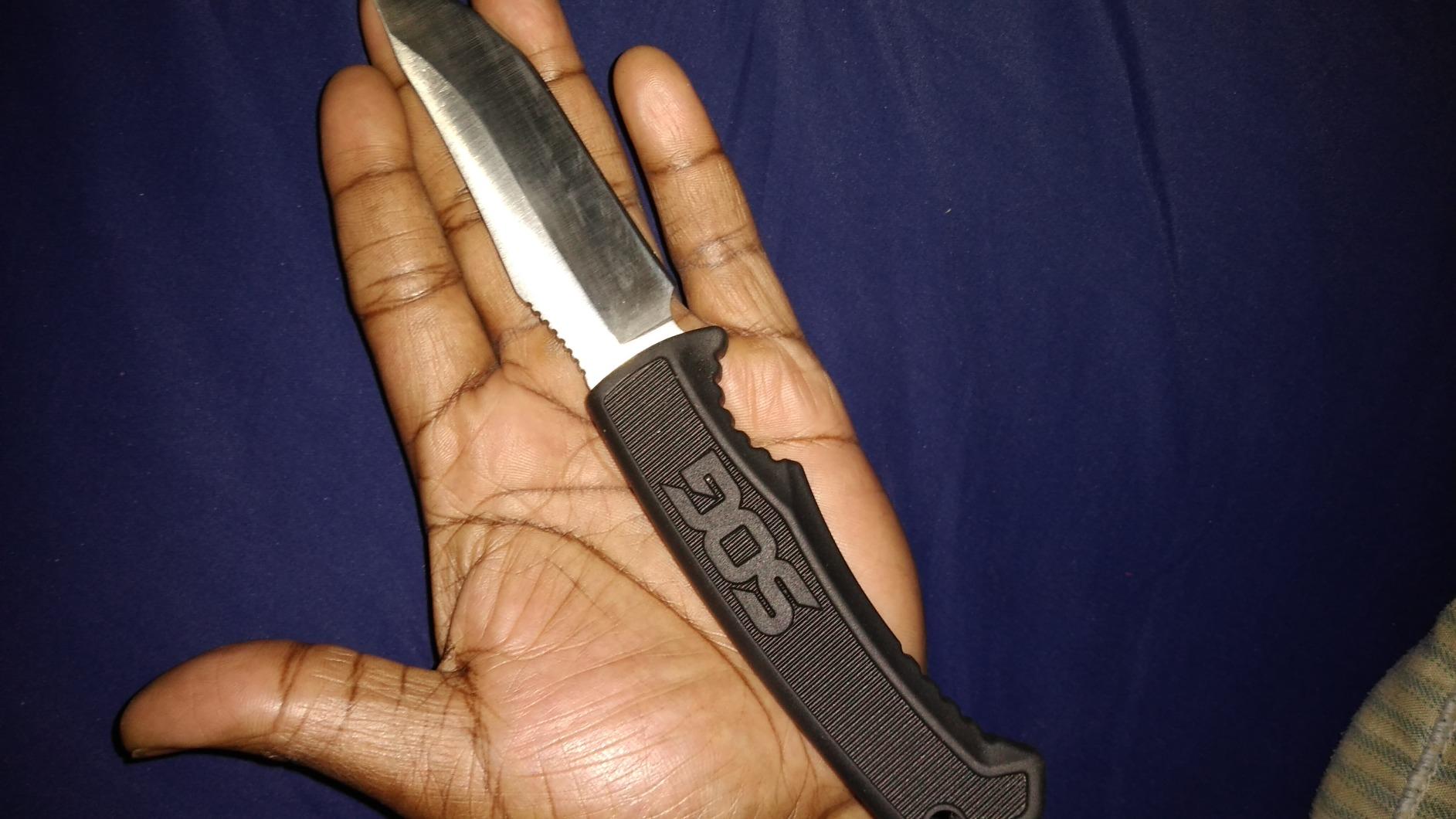
At 3.84 ounces with a full tang, the SOG is the lightest full-tang knife in this roundup, and one of the most compact overall. For a neck carry, a belt pouch, or a bug out bag that must stay light, that combination is hard to find.
Reviewers describe it as a companion to a heavier chopper rather than a replacement for one, and that framing is accurate. A 4 inch blade handles carving, food prep, tinder, cord, and general camp work well, and it will not replace an axe for splitting.
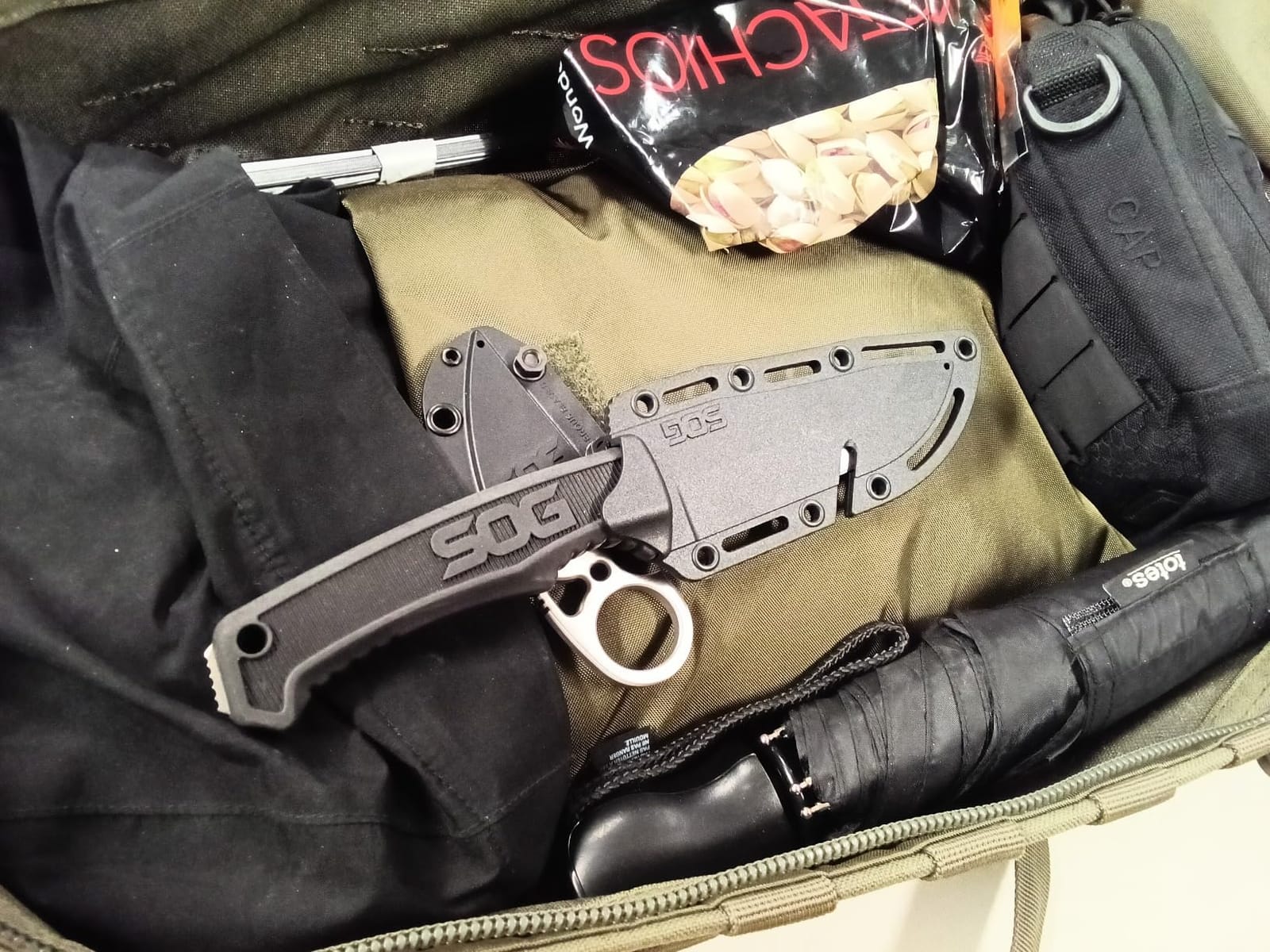
The notch cut into the green sheath is a small, sensible feature. It lets you cut cord or fishing line without drawing the knife, which is the sort of detail that matters in the field where your dominant hand is busy holding something else.
Build quality is straightforward: satin polished stainless steel, a full tang, and a TPR overmoulded grip. There is no carbon steel to maintain, no coating to wear through, and no moving parts to fail. It is the lowest-friction carry option here.
The grip is the honest compromise. It is functional and grippy, but it is a plain moulded surface rather than the contoured scales or shaped hardwood you get on a carving knife, and it tells you so in the hand after an hour of use.
Who the SOG Field Knife suits?
It suits anyone who wants a full tang that disappears in a pocket or hangs under a shirt collar, and it works well as a second knife for camp duties while a heavier blade does the chopping.
It also suits users in coastal or marine settings. Stainless steel and rust resistance mean the blade can live in a damp locker or a salty pack without the daily wipe-down a carbon steel blade needs.
Where the SOG falls short?
Skip it as your only knife if you process game or split wood. A 4 inch blade at this weight is built for chores, and asking it to do heavy work is where the design runs out of steel.
Skip it for fine carving. The edge is a serviceable satin grind with no single bevel to help you, so a stone-based sharpening routine will not get you to the precision a carving task needs.
9. Condor Indigenous Puukko: Best Nordic Puukko-Style Bushcraft Blade
Condor Tool & Knife Indigenous Puukko Knife – 1095 High Carbon Steel – Hand Crafted Welted Leather Sheath – Polynesian and Sami Designed Walnut Handle – 3.9in Blade – 4.6oz (3mm)
1095 high carbon steel, 3.9 inch blade, full tang, 4.6 oz
Pros
- Forged high carbon steel with impressive hardness and edge retention
- handcrafted welted leather sheath is thick and durable
- walnut handle with a recessed wire wrap
- full tang in a compact profile
Cons
- High carbon steel needs regular oiling
- 3.9 inch blade limits chopping and batoning
- slim handle can feel slick when wet
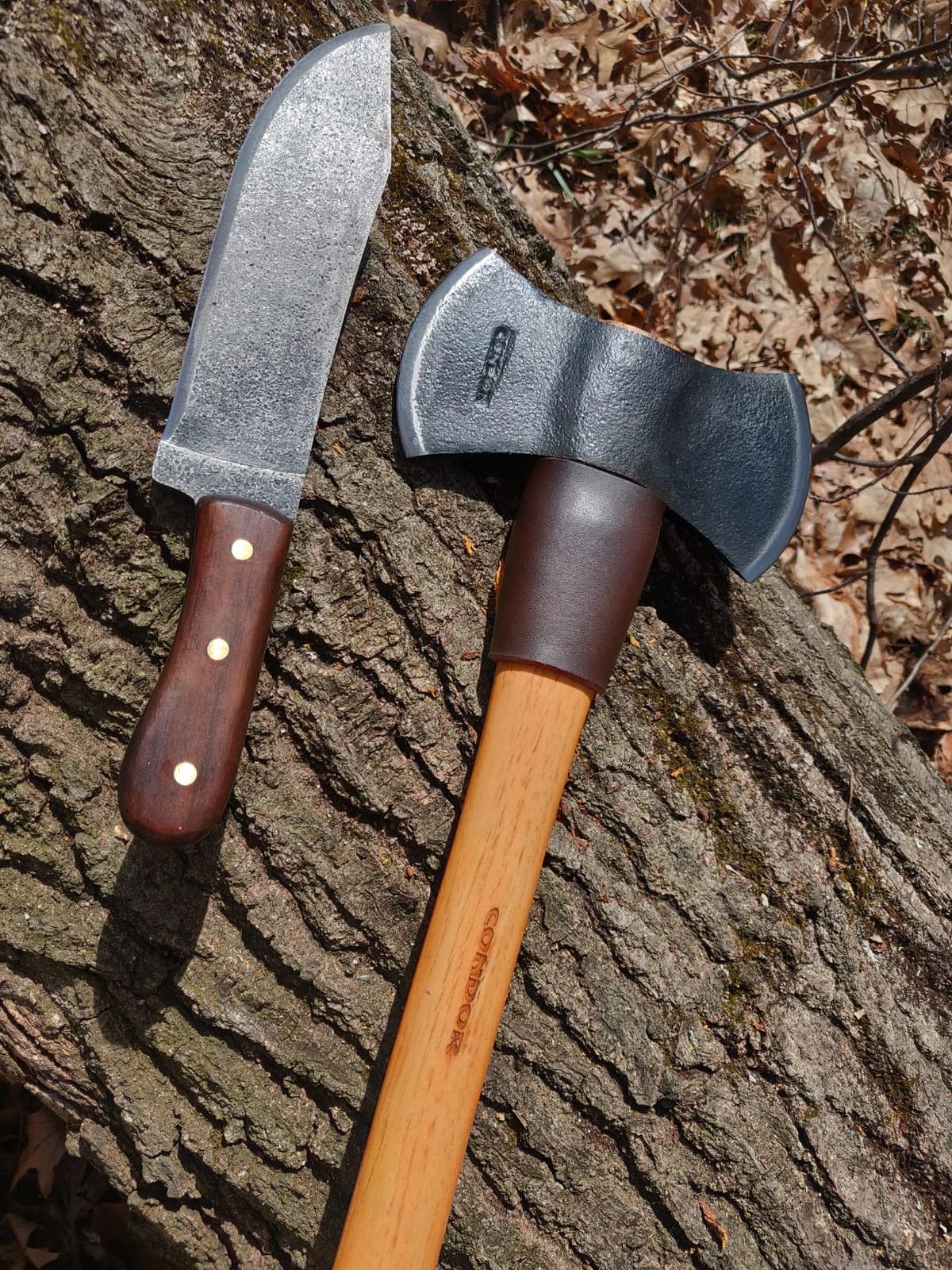
A puukko is a Nordic knife with a single bevel, a shallow handle, and no finger guard, and this one bridges Polynesian and Sami design traditions. The result is a distinct look that no other knife in this roundup shares, and it changes how you hold the tool.
1095 high carbon steel at 3 mm thick with a full tang gives you more strength than the blade length suggests. The reviews praise the forging quality and edge retention, and the handcrafted welted leather sheath is repeatedly singled out as thick and well stitched.
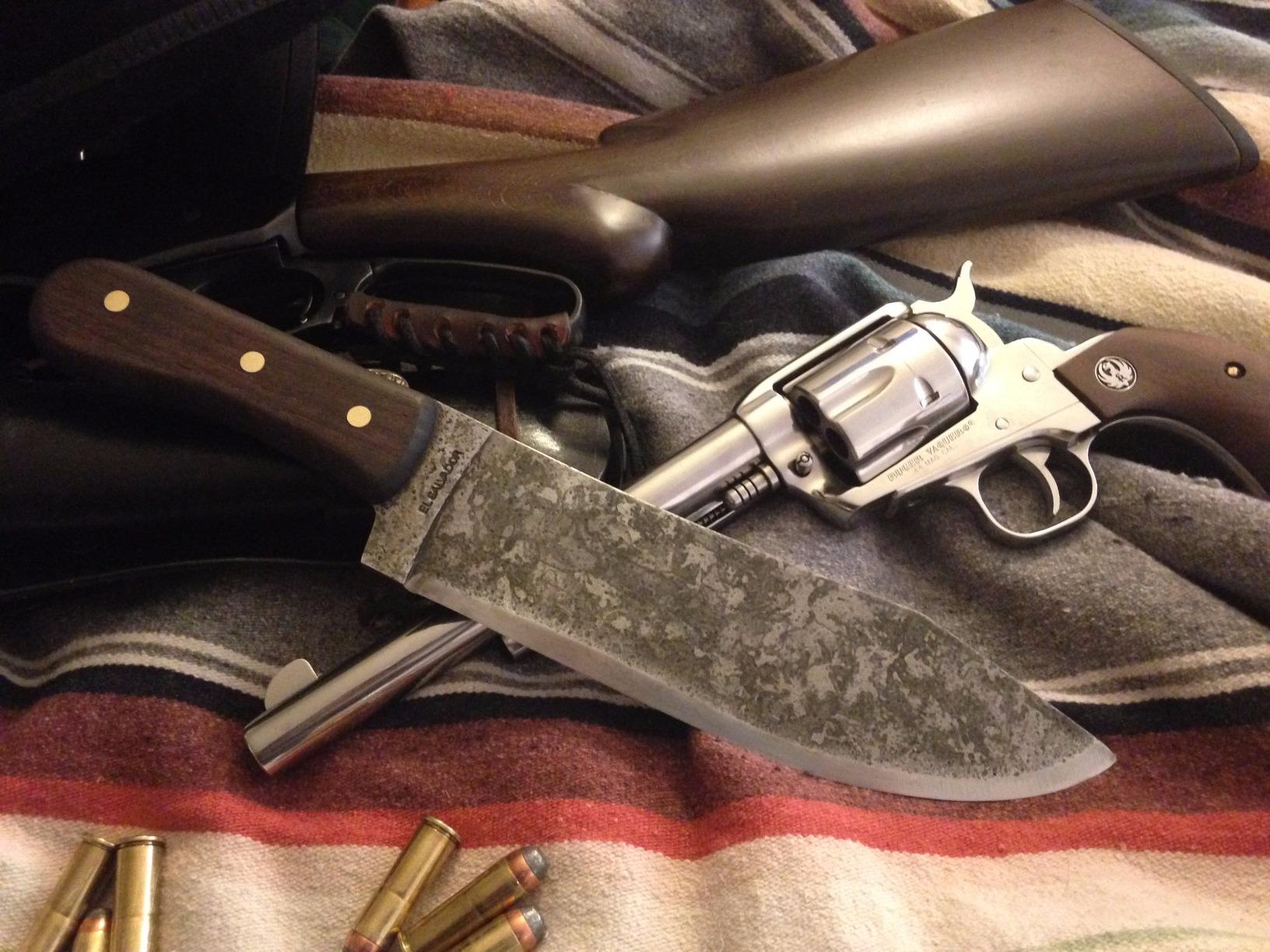
The recessed wire wrap in the walnut handle is a period-correct grip method rather than a modern ergonomic one. It works, and it looks right, but the handle has no guard, so the knife relies on your grip discipline rather than a physical stop.
Carving is where a puukko genuinely excels, because the single bevel and shallow handle give you a very fine line of control. Whittling, small green wood work, and detail tasks are the strengths. Heavy work is the opposite of the strength.
Three honest limits. Carbon steel means regular oiling. At 3.9 inches there is not enough blade to chop or baton. And the slim handle profile can feel slick to some hands in wet conditions, which matters given the no-guard design.
Who the Condor Puukko suits?
It suits carvers and whittlers who want a traditional profile, and it suits anyone who likes a tool that looks like it belongs in a hand rather than in a tactical rig. The leather sheath is the one many owners keep long after they move on.
It also suits buyers who want a full tang under 5 ounces. That combination is unusual and it makes the puukko a good second knife for day hikes where a chopper would be dead weight.
Where the Condor puukko falls short?
Skip it for batoning, chopping, or splitting. The blade is too short and the section too thin for the load, and pushing past that limit is how people chip a puukko edge in a single mistake.
Skip it if you have large hands or grip wet gear. With no guard and a slim handle, a slip is a cut to the holding hand, so the tool demands more care than a guarded design does.
10. Cold Steel Bushman Bowie: Best Survival Blade for Big Game and Skinning
Cold Steel Bowie Blade Bushman Durable Resistant 7″ SK-5 High Carbon Fixed Blade Outdoor Survival Hunting Knife, 5.25″ Hollow Handle, Secure-Ex Sheath with Ferrocerium Fire Steel
One-piece forged SK-5 steel, 7 inch blade, 12.25 inch overall, 10.1 oz
Pros
- One-piece forging with no seams or joints
- heat treated to RC54
- extra-thin hand-honed edge for skinning and slicing
- hollow handle stores survival supplies or accepts extensions
- Secure-Ex sheath includes a ferrocerium fire steel
Cons
- SK-5 high carbon steel needs care and oiling
- 7 inch blade and 10.1 oz weight is bulky for pack carry
- poor for fine carving compared with smaller blades
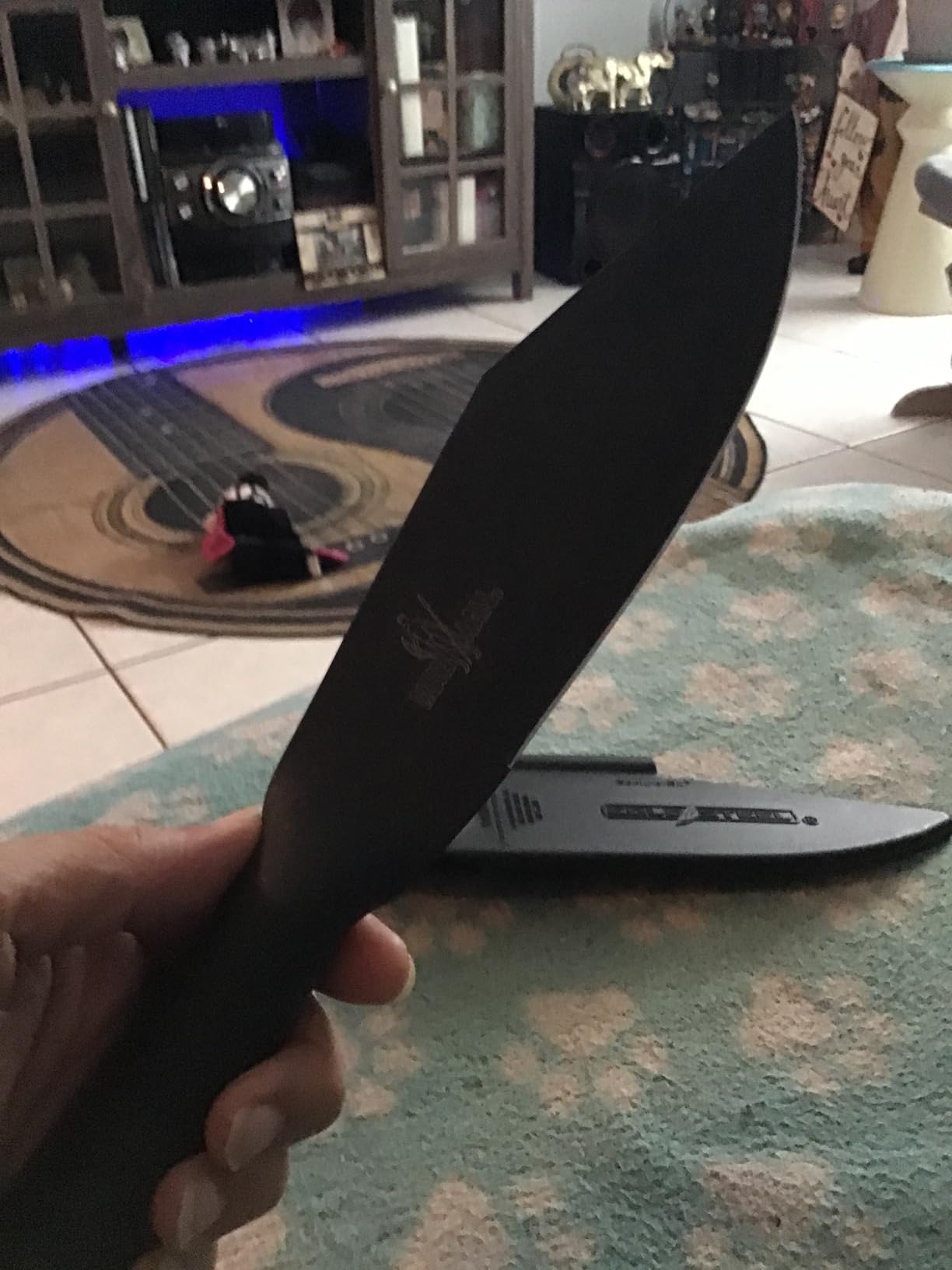
The Bushman is forged from a single piece of SK-5 high carbon steel, heat treated and tempered to RC54. One-piece construction means there is no tang joint and no handle adhesive line to fail, which is the honest reason for the durability claim in the reviews.
At 7 inches with a hollow grind and an extra-thin hand-honed edge, this is the longest blade in the roundup and the one built for skinning. Long thin steel through hide and a hanging carcass is a different job from carving green wood, and this knife is set up for it.
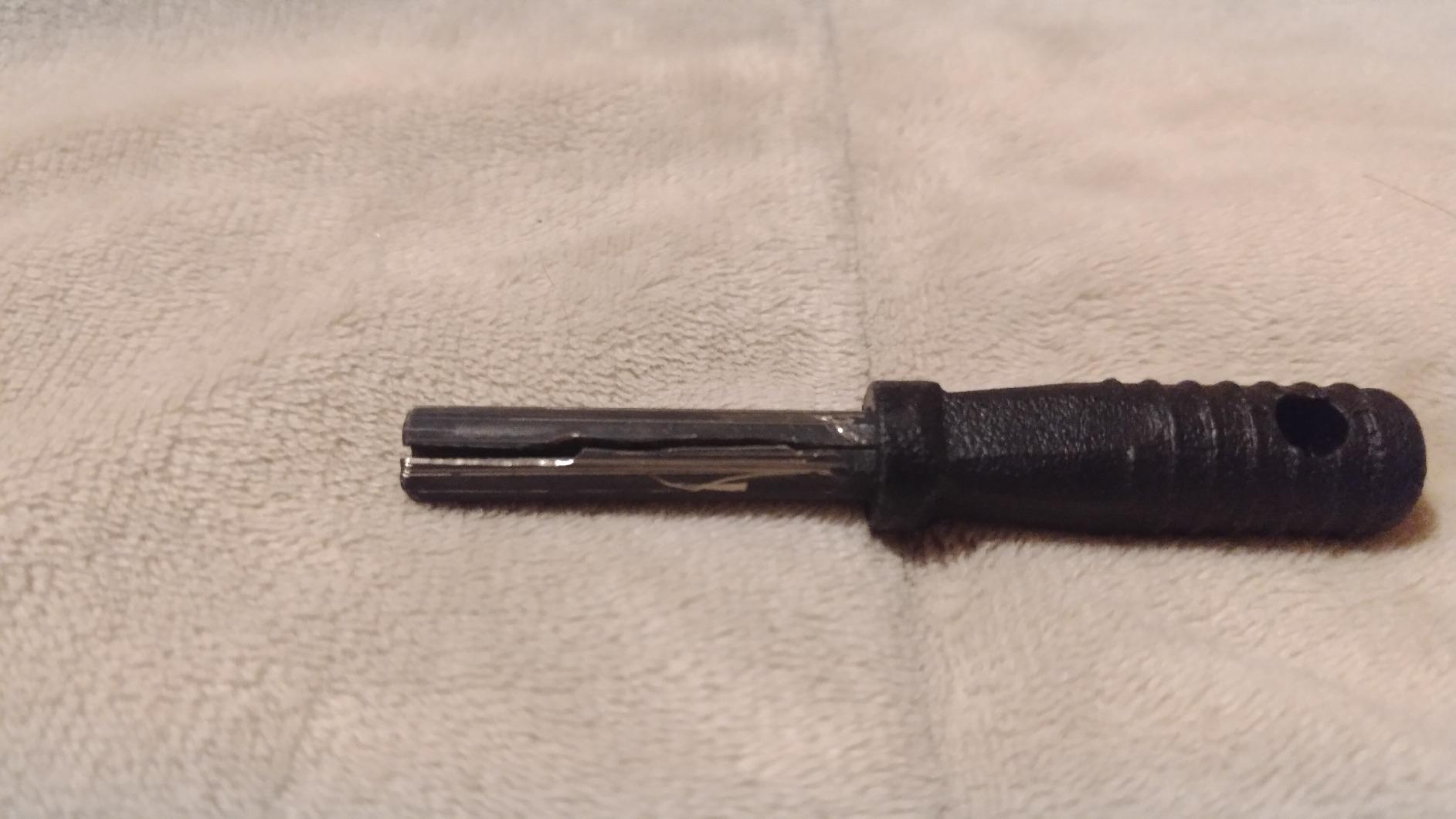
The hollow handle accepts small survival supplies, and it can take handle extensions to add reach and leverage. That extension option is a real feature in a pinch, giving you more authority on a task than the bare handle offers.
The Secure-Ex sheath comes with a ferrocerium fire steel built into it, so the fire-making tool travels with the knife. It is a heavier, larger object than most people want to carry on foot, and the Secure-Ex retention is stiff in cold weather.
Be clear about the limits. A 7 inch blade at 10.1 ounces is a pack-weight decision, the hollow grind makes it a poor choice for fine carving, and SK-5 high carbon steel needs regular oiling like any other carbon blade here.
Who the Cold Steel Bushman suits?
It suits hunters who process game and want a large, tough skinning blade with a fire steel in the sheath, and it suits anyone working around a vehicle or a base camp rather than walking a long trail.
It also suits buyers who like the aesthetics and durability of a single-piece forged blade. The reviews describe it as a rugged, no-nonsense survival Bowie, and that is exactly what it is.
Where the Bushman falls short?
Skip it for backpacking, since 10.1 ounces and 12.25 inches of fixed blade is a lot of pack for a knife that cannot carve. Skip it for feather sticks, where the hollow grind has nothing to offer.
It is also not a substitute for a purpose-built game knife when you are gutting a large animal. Even a 7 inch blade gets inefficient quickly, and forum consensus is clear that hunting knives are the right tool for that job.
How to Choose a Bushcraft Survival Knife?
Every knife above can do most of what a beginner asks of it. The differences matter mainly when you have a specific task in mind, and the five decisions below cover nearly all of the variation between these ten blades.
Blade length: match the blade to your hand
For a beginner, a blade between 3.5 and 4.5 inches is the range that gets used most. It carves feathers, slices food, and fits a sheath without swallowing the whole front of a belt. Blades under 3 inches are pocket tools, and blades past 6 inches start costing you pack weight and control.
Use your hand as the measuring device. A comfortable knife is one you can hold with a relaxed grip and still reach the tip with a fingertip. If you have to re-grip to get to the point, it is too long for the work you are actually doing.
Carbon steel beats stainless for most woods work
For forests, mountains, and desert, carbon steel is the better default. It takes a keener edge, it is easy to sharpen in the field with a stone, it throws better sparks off a fire steel, and it forms a patina that protects the surface once established.
Stainless is the right call when you work around salt water, when you store a knife in a damp vehicle for weeks, or when you refuse to maintain anything. Experienced sharpeners argue that stainless is much harder to sharpen than carbon steel, and that reputation is largely overstated.
The forum consensus that super steels are unnecessary is hard to argue with. What matters in the field is not what a blade is made of on a forum, it is whether you can restore the edge with the tools you carried. A stone and a strop work on everything in this roundup.
Grind decides what the knife is good at
A Scandinavian single-bevel grind has one flat side, so you can see and feel the correct angle on the stone and the flat rides the back of the knife for clean carving. A flat grind has two bevels and cuts more like a saw. A hollow grind is thin and slices fast but loses its edge quickly. A convex grind is durable and rounds at the tip.
For bushcraft, the single bevel wins on carving and bow drill work, which is why the puukko and the Adventurer are built that way. For food prep and general utility, a flat or sabre grind is faster. Notice the one deliberate exception here: the Gerber Ultimate carries a half-serrated section, which is a utility feature rather than a carving one.
Full tang matters, but a partial tang is fine below batoning level
A full tang runs steel the full length of the handle, so torque from a stuck baton or a levering motion has a path into the handle instead of into a thin section. It is the single structural reason to spend more, and the Strongarm and the BK2 earn their extra cost largely because of it.
Here is the part most buying guides skip. A partial tang is genuinely sufficient if you are carving, prepping food, cutting cord, and processing tinder. Forum consensus holds that a quality partial-tang Mora is a correct first knife, and buying above it without a batoning plan is spending money on a feature you will not use.
Handle and sheath decide whether you actually carry it
A knife you leave at the bottom of the pack is a knife that will not be there. Sheath quality, retention, and carry options are not accessories here; they determine whether the tool stays on your belt through a whole season.
Contoured handles and a guard help on long carving sessions. Rubber or moulded grips stay planted when wet. Leather sheaths like the ones on the Adventurer and the puukko look and age well, while polymer sheathers resist weather and cost less to replace. Pick the one that matches your weather and your pack.
Field Sharpening, Patina and Rust Control
The most common reason people buy a second knife is that the first one rusted. That is avoidable, and the routine below is the whole of it. If you are buying winter equipment for livestock rather than a knife, our [winter survival guide for newborn lambs](https://www.haynet.net/newborn-lamb-care/) covers the other half of cold-weather preparation.
Sharpen to 15 to 20 degrees per side
That range is the working sweet spot for a bushcraft knife. Below about 12 degrees the edge rolls quickly on bone, rope, and dirt, and above 22 degrees you lose most of the slicing performance the knife is capable of. A scandi grind is easy to hit because one flat face sets the angle for you.
Two tools cover almost everything. A coarse stone resets a dull edge and a fine stone or a strop refines it. You can carry both, or a single medium stone and a leather strop, and that is genuinely sufficient for a season of use.
A six-step carbon steel maintenance routine
First, wipe the blade clean right after use, every time, before anything else. Second, dry it fully. Third, apply a thin coat of light oil, and wipe off the excess so the blade does not feel slick. Fourth, store it dry, not in a wet sheath or a damp bag.
Fifth, re-oil on a schedule during humid months rather than waiting for a spot to appear. Sixth, keep the edge keen, because a sharp edge sheds moisture better than a dull one. Once a stable patina forms, most owners find the steel stops needing daily attention entirely.
You cannot ruin a knife by sharpening it, unless you use the wrong stone
Sharpening removes steel and nothing else. As long as you use a stone meant for knives and keep the angle consistent, you can resharpen a blade hundreds of times. The way people damage edges is by using a hardware-store file, a ceramic plate, or a grinding wheel on a thin blade.
The other common mistake is a secondary bevel that grows into a secondary cliff. If you grind one tiny section repeatedly instead of the whole edge, the transition between the two angles becomes a notch that snags. Keep the full length of the edge in contact with the stone and the problem does not arise.
Frequently Asked Questions
What is the number one survival knife?
For bushcraft specifically, the Morakniv Companion is the number one pick. It arrives sharp, weighs 3.9 ounces with the sheath, sharpens easily by hand, and handles carving, food prep, tinder and cord. Its limitation is the partial tang, so it is a carving and camp tool rather than a batoning tool. If you need batoning, the KA-BAR BK2 or the Gerber Strongarm are the stronger choices.
What is the best blade length for a bushcraft knife?
For most beginners, a blade between 3.5 and 4.5 inches is the range that gets used most. It carves feather sticks, slices food, and fits a sheath without dominating your belt. Use your hand as the measure: if you have to re-grip to reach the tip, the blade is too long for the work you are doing.
Should a bushcraft knife be carbon or stainless steel?
For forests, mountains and desert, carbon steel such as 1095, 1066 or A2 is the better default. It takes a keener edge, is easy to field sharpen, throws better sparks, and develops a patina that protects it. Choose stainless if you work near salt water, store knives in damp conditions, or want zero maintenance.
What is the recommended edge angle for a bushcraft knife?
Between 15 and 20 degrees per side is the working range for a bushcraft knife. Below about 12 degrees the edge rolls on bone, rope and dirt, and above 22 degrees you lose slicing performance. A Scandinavian single-bevel grind is easy to maintain at that angle because one flat face sets it for you.
Can you ruin a knife by sharpening it wrong?
Not with the right tools. Sharpening only removes steel, so a knife can be resharpened many times. The damage comes from using a hardware-store file, a ceramic plate or a grinding wheel, and from grinding only a small section of the edge until the transition between two angles becomes a notch. A knife stone and a consistent angle avoid both problems.
How do I stop a carbon steel blade from rusting?
Wipe the blade clean and dry after every use, then apply a thin coat of light oil and wipe off the excess. Store it dry rather than in a wet sheath, and re-oil on a schedule during humid months instead of waiting for spots. A stable patina that forms over time actually protects the steel underneath.
Can you baton with a Mora or Morakniv knife?
Light batoning is fine on the Morakniv Kansbol because the scandi section handles it well. Hard batoning, driving a branch, or splitting rounds is not recommended on any partial tang design, including the Companion and the Kansbol, because torque concentrates where the tang narrows. If batoning is a regular part of your work, choose a full tang with thick stock such as the KA-BAR BK2.
The Verdict on the Best Survival Knives for Bushcraft in 2026
The Morakniv Companion is the best survival knife for bushcraft for most people, because it is sharp, light, easy to maintain, and does every camp task well. Buy the KA-BAR BK2 if you baton and chop, the Gerber Strongarm if you are hard on your tools, and the BPSKNIVES Adventurer if you want to carve and are willing to keep carbon steel oiled.
Buy one, learn to sharpen it, and use it. Every other decision on this page is secondary to those three things, and every one of these ten will serve you well if you do them. If you also work outdoors at home and in the field, our [pond de-icer guide](https://www.haynet.net/best-pond-de-icers-for-winter-fish-survival/) covers the cold-weather side of the same routine.