
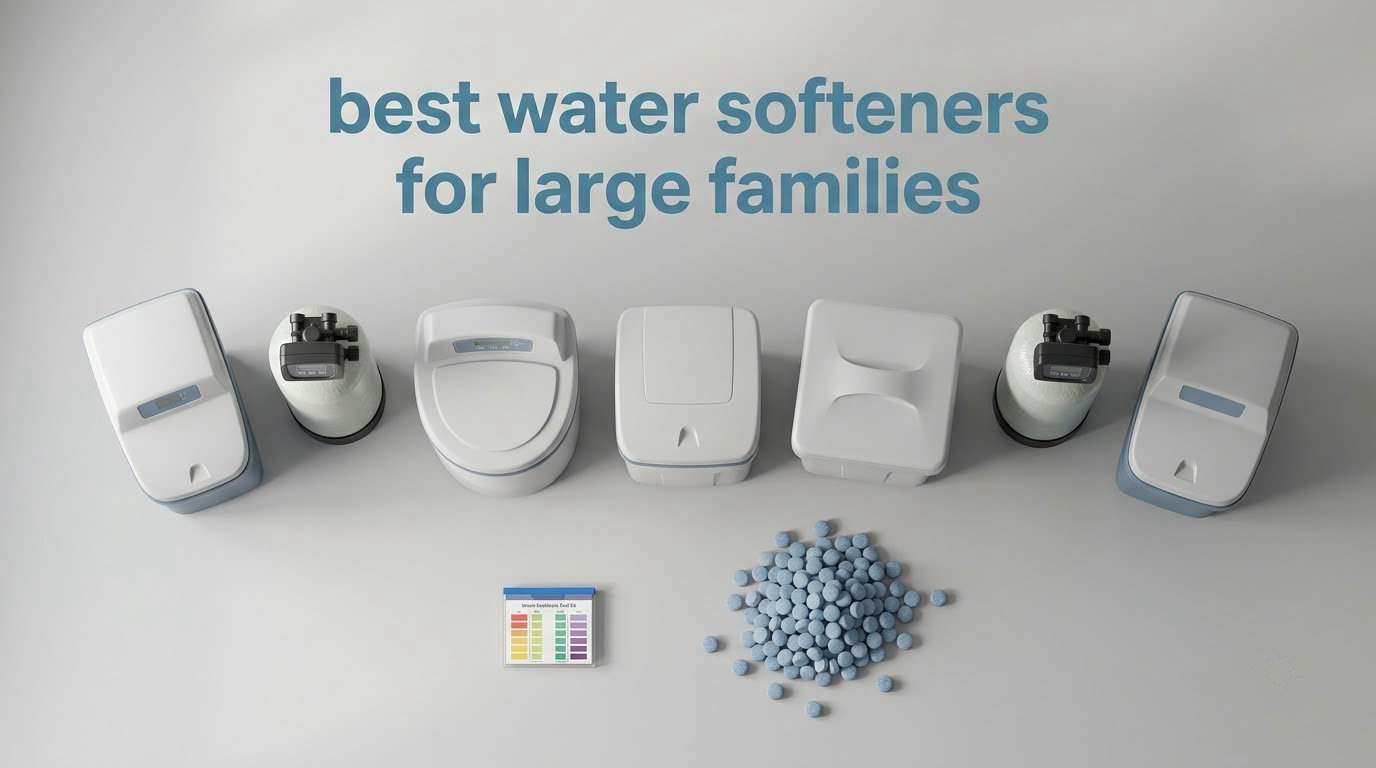
Hard water does not announce itself. It shows up as a dishwasher that will not get dishes clean, a shower head that turns white and crusty, towels that come out of the dryer stiff, and a water heater working harder every month to heat mineral-laden water. In a household of five to eight people, all of that happens several times faster than it does in a small home, because you are moving several times the volume of water through the same pipes every single day.
That is the whole argument for choosing carefully. Pick a system that is too small and it regenerates constantly, burns salt, wears the resin down, and leaves you with a service problem. Pick one that is too large and it wastes 20 to 40 percent more salt than it needs to and takes six to eight years to pay back instead of roughly three and a half. This guide covers the best water softeners for large families, with the sizing arithmetic up front, a full comparison grid, and eight specified systems you can actually choose between.
Last updated in 2026. We compared eight whole-house ion exchange systems in the 45,000 to 80,000 grain range, checked the control valve on each, and worked through the flow rate and running costs that matter once three or more people are sharing three bathrooms. If you are still working out how much treatment you need, start with our whole house water softener guide first, then come back to the sizing section below.
Table of Contents
Top 3 Best Water Softeners For Large Families (October 2026)
These three came out of the eight we compared as the strongest combination of capacity, control valve reputation, review volume and warranty. The Aquasure Harmony 48K leads because it is the most reviewed system in this group by a wide margin and holds a 4.4 star average. The AFWFilters Iron Pro 2 is the pick when the water is from a well and carries iron, since it does softening and iron removal in one tank. The Fleck 5600 SXT 48K is the value choice, carrying the control head that water treatment professionals name more than any other.


Best Water Softeners for Large Families at a Glance
Every system below is whole house, meaning it treats every tap in the house rather than a single sink. The quick grid gives you capacity, the control valve, and the situation each one is built for. The sizing section that follows explains how to turn your own water test into a capacity number.
| Product | Specifications | Action |
|---|---|---|
| Aquasure Harmony 48,000 Grain Whole House Water Softener |
|
Check Latest Price |
| AFWFilters Iron Pro 2 64,000 Grain Combo Unit |
|
Check Latest Price |
 Fleck 5600 SXT 48,000 Grain Whole House Softener Fleck 5600 SXT 48,000 Grain Whole House Softener |
|
Check Latest Price |
 Tier1 48,000 Grain Water Softener for 4-5 Bathroom Homes Tier1 48,000 Grain Water Softener for 4-5 Bathroom Homes |
|
Check Latest Price |
 Aquasana SimplySoft 60K Grain Whole House Softener Aquasana SimplySoft 60K Grain Whole House Softener |
|
Check Latest Price |
 PRO+AQUA 80,000 Grain Heavy Duty Whole House Softener PRO+AQUA 80,000 Grain Heavy Duty Whole House Softener |
|
Check Latest Price |
 iSpring WCSTB45KG 45,000 Grain Whole House Softener iSpring WCSTB45KG 45,000 Grain Whole House Softener |
|
Check Latest Price |
 Fleck 9100 SXT Twin Tank 48,000 Grain Softener Fleck 9100 SXT Twin Tank 48,000 Grain Softener |
|
Check Latest Price |
How Big of a Water Softener Does a Large Family Need?
Multiply your household size by 75 gallons per person per day, multiply that by your water hardness in grains per gallon, multiply by 7 days, then add a 25 percent reserve. That result is your minimum grain capacity, and for most large families it lands somewhere between 48,000 and 80,000 grains. Here is the arithmetic, step by step, so you can plug in your own numbers rather than trusting ours.
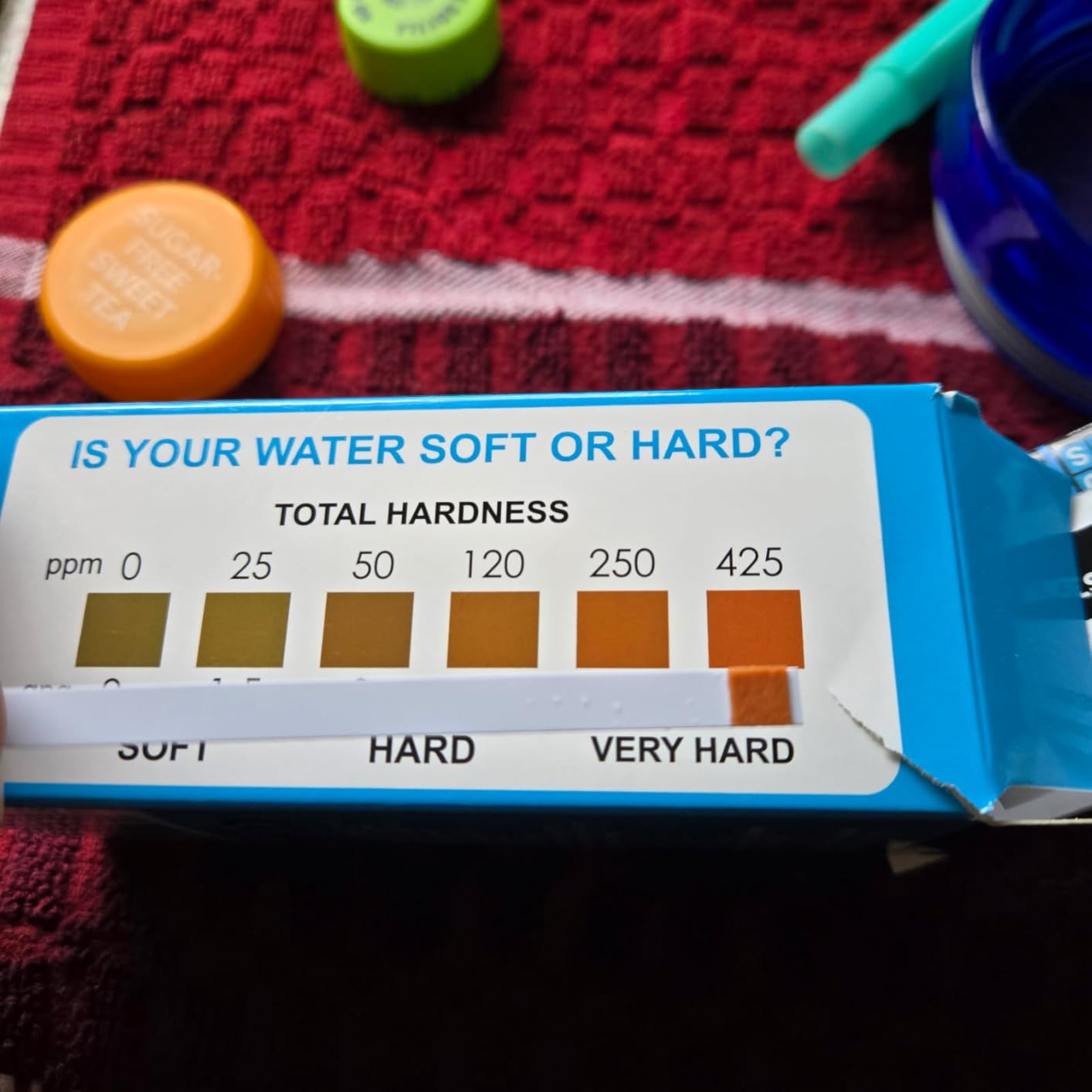
Start with water hardness, because the rest of the formula depends on it. Most municipal water reports publish hardness in grains per gallon or in parts per million. If you only have parts per million, divide by 17.1 to get grains per gallon. A report showing 342 ppm works out to about 20 gpg, which is genuinely hard water. Well water should be tested rather than estimated, and a well test is worth doing anyway because iron changes the sizing.
Next, multiply people by 75 gallons, then by the hardness figure, then by 7. For a family of six at 15 gpg, that is 6 people multiplied by 75 gallons, which is 450 gallons a day, multiplied by 15 gpg, which is 6,750 grains a day, multiplied by 7 days, which is 47,250 grains. Add your 25 percent reserve and you land near 59,000 grains, so a 60,000 grain system is the honest recommendation rather than a 48,000 grain one.
Run the same math for eight people at 20 gpg and the picture changes. That is 8 people times 75 gallons, or 600 gallons a day, times 20 gpg, or 12,000 grains a day, times 7 days, or 84,000 grains, plus 25 percent, which is about 105,000 grains. Households in that band need a twin tank or a commercial-style system rather than a bigger single tank.
The ladder that falls out of the formula looks like this. Five people at 10 to 15 gpg lands near 35,000 to 40,000 grains. Six people at 15 to 20 gpg needs 55,000 to 65,000. Seven to eight people at 15 to 20 gpg needs 75,000 to 105,000. And anything above 20 gpg pushes you into twin tank territory no matter how many people live there.
Two adjustments belong in that math. If your water carries iron, add 5 grains of capacity for every ppm of iron, because the resin is spending capacity on the iron as well as the hardness. If you are on a well, add generously, because well hardness numbers often drift over a few years as the aquifer changes.
One more target worth holding: aim for a system that regenerates every 7 to 10 days. A correctly sized system at that interval is regenerating often enough to keep the resin bed swept clean, but not so often that you are flushing brine down the drain several times a week. If your unit is regenerating every three days, it is undersized. If it is regenerating every three weeks, it is oversized and you are wasting salt to get the same softened water.
One forum data point anchors the upper end of that range. A commenter running 25 gpg water with a two-person household reported regenerating roughly every six days on a 32,000 grain system. Work that backwards and a five to eight person home at moderate hardness lands squarely in the 48,000 grain band, which is exactly where the community consensus sits on r/WaterTreatment.
Aquasure Harmony 48,000 Grain Softener: Best Overall for Large Families
Aquasure Harmony Series 48,000 Grains Whole House Water Softener w/High Efficiency Digital Metered Control Head (48,000 Grains)
48000 grains
Triple purpose pre-filter
Digital metered head
12 gpm max flow
5-year warranty
Pros
- Most reviewed softener in this group at 3199 ratings
- Triple purpose sediment carbon and zinc pre-filter
- Programmable backlit digital metered head
- Fiberglass lined polyethylene tank with bypass
- 5-year extended warranty with online activation
Cons
- 12 gpm maximum flow is modest for three full bathrooms
- About 8 percent of reviewers gave a 1-star rating
- 120 pound preloaded tank needs a dolly and two people
When a category has this much review volume, the pattern stops being anecdotal. The Aquasure Harmony 48K has 3199 ratings and holds a 4.4 star average, and the recurring theme in the reviews is scale reduction that shows up within weeks. Fixtures clean easier, glassware stops clouding, and the water heater stops working as hard. For a family of five or six on moderately hard municipal water, that is the system I would put in first.
What makes it work at this household size is the combination of a 48,000 grain bed and a pre-filter that handles sediment, carbon and zinc in one stage. Chlorine, odors, pesticides and sediment are dealt with before the water ever reaches the softening stage, which helps protect the resin from fouling over a decade of service. The control head is a programmable digital metered unit with a backlit display, so you set the flush interval and the salt dose yourself rather than accepting whatever the factory shipped.
The honest weakness is flow rate. At 12 gallons per minute maximum, this is not the system I would choose for a home where three people shower at the same time in three separate bathrooms. It is a comfortable fit for a family of five with two or three bathrooms, and it becomes marginal in a four-bathroom home. Check how many fixtures can realistically run at once before you settle on it.
What 48,000 grains looks like in a real home?
In practice this capacity supports a family of five at moderate hardness, or a family of six on softer water in the 10 to 12 gpg range. Buy the municipal report before you order and run the formula in the sizing section above. If your number comes out under 48,000 you would be oversizing, and there is a real cost to that in salt waste and slower payback.
Where it falls short?
About 8 percent of reviewers gave it a single star, and the recurring themes in that group are installation confusion and the flow rate ceiling. Several buyers report needing to adjust the control head programming after setup, which is a ten-minute job once you know which setting to change. If you are installing for the first time and want zero decisions, that is a fair reason to look at a unit with more forgiving setup.
It is also a single tank, which means soft water drops to hard water for the duration of each regeneration cycle. In a family of five that is mostly a non-event. In a home with three or more people who shower at once, it is worth pairing with a low-flow shower head or looking at the twin tank option later in this list.
AFWFilters Iron Pro 2 64,000 Grain: Best for Hard Well Water
AFWFilters Iron Pro 2 Combination Water Softener Iron Filter Fleck 5600SXT Digital Metered Valve 64,000 Grain – High Flow for Whole House Use – Removes Hardness, Iron, Manganese, Sediment, Rust
64000 grains
Fleck 5600SXT valve
Handles iron to 6 ppm
5-year warranty
Pros
- Softens and removes iron manganese and rust in one tank
- Fleck 5600SXT valve is widely respected
- Well owners report hardness dropping to 0 ppm
- Red and orange fixture stains stop after install
- Far less than a professional treatment quote
Cons
- Instructions are sparse on valve programming
- Advanced mode requires setting the clock to 12:01 first
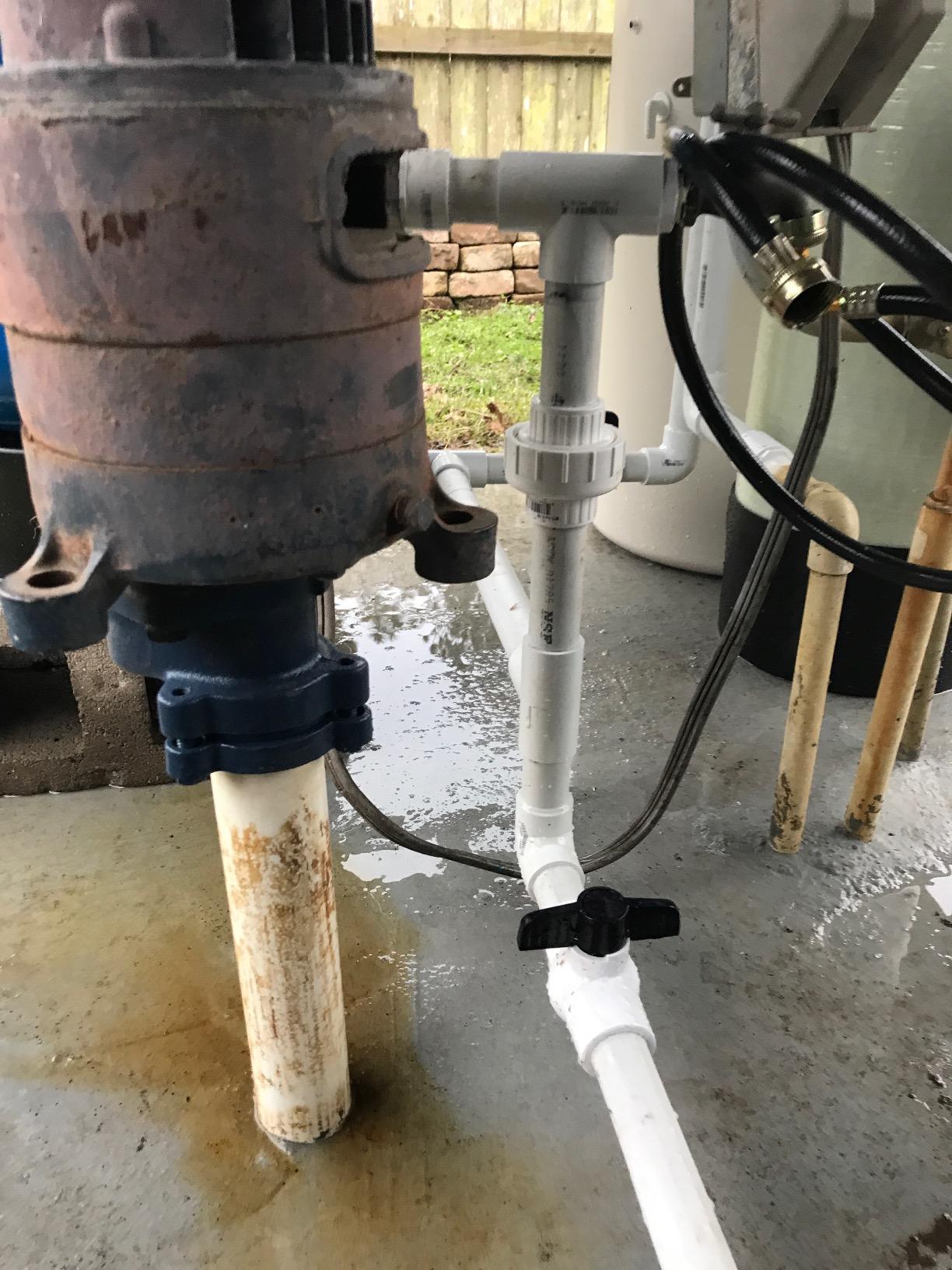
- IN valve can leak on first startup until flow is cycled
Well water changes the whole calculation, and this is the system built for it. Rather than a softener and a separate iron filter, it runs a single tank that handles hardness, iron up to 6 ppm, manganese up to 6 ppm, rust and sediment. Owners on well water report hardness reading zero ppm after install and report that the red and orange staining stops coming back on fixtures, which is usually the reason they bought in the first place.
The control valve is the Fleck 5600SXT digital metered unit, which is the same valve on the Fleck system later in this list. Water treatment professionals on r/WaterTreatment name Fleck and Clack control heads first for ease of service, and this is a Fleck head in a 64,000 grain configuration with an iron-filtration resin mixed in.
At 64,000 grains it is sized for a family of six to seven at moderate hardness, and the extra capacity versus a plain 48,000 grain softener is doing double duty, absorbing hardness and iron at the same time. Buyers regularly describe it as costing a fraction of a professional water treatment quote for the same result. The 5-year warranty is a reasonable middle ground for the category.
Two honest cautions. The paperwork does not fully cover the Fleck valve programming steps, and a number of buyers had to work those out from outside resources, so allow time for that on install day. You may also need to buy a drain line and fittings separately for a clean install, depending on how close your floor drain or standpipe is to the main shutoff.
When a well home needs more than softening?
If your well test comes back with iron above 3 ppm, a standard softener is the wrong tool. Iron fouls standard resin quickly and you will be replacing resin far sooner than the manufacturer suggests. The added 5 grains per ppm of iron rule in the sizing section exists precisely for this case, and this system already accounts for some of it through the blended resin.
Sulfur smell is a separate problem that no softener here solves. If your well has a rotten egg odor, you need a sulfur filter alongside the softener.
Where it falls short?
The advanced programming mode requires setting the internal clock to 12:01 before the menu will let you change settings, which is the kind of undocumented quirk that sends people to forums at midnight. The IN valve can also weep on first startup until you cycle the flow, which alarms buyers who are not expecting it.
It is a single tank, so you still get hard water during regeneration. For a well household that is usually tolerable, because well water is often only mildly hard once iron is removed.
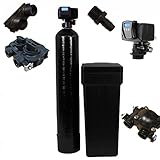
Fleck 5600 SXT 48,000 Grain: Best Value for a Family of Six
DURAWATER Fleck 5600 SXT Whole House Water Softener, 48,000 Grains, Black
48000 grains
1.5 cu ft resin preloaded
Fleck 5600SXT metered valve
Complete system
Pros
- Fleck 5600 SXT valve is the industry standard control head
- Resin preloaded so the tank is ready to install
- Brine tank safety float for overflow protection
- 4.5 star average across 369 ratings
- Complete system includes tank bypass and brine tank
Cons
- 350 ppm maximum TDS rating is modest
- No battery or electronic backup on the valve
- DuraWater and Fleck branding can confuse buyers
This is the system the forums recommend, and the reason is the control valve rather than the tank. Water treatment professionals on r/WaterTreatment repeatedly put the Fleck 5600 SXT at or near the top for ease of service, and a community member noting a well-known 48,000 grain configuration with 1.5 cubic foot resin described it as the default choice in the category years ago. Nothing has changed that assessment.
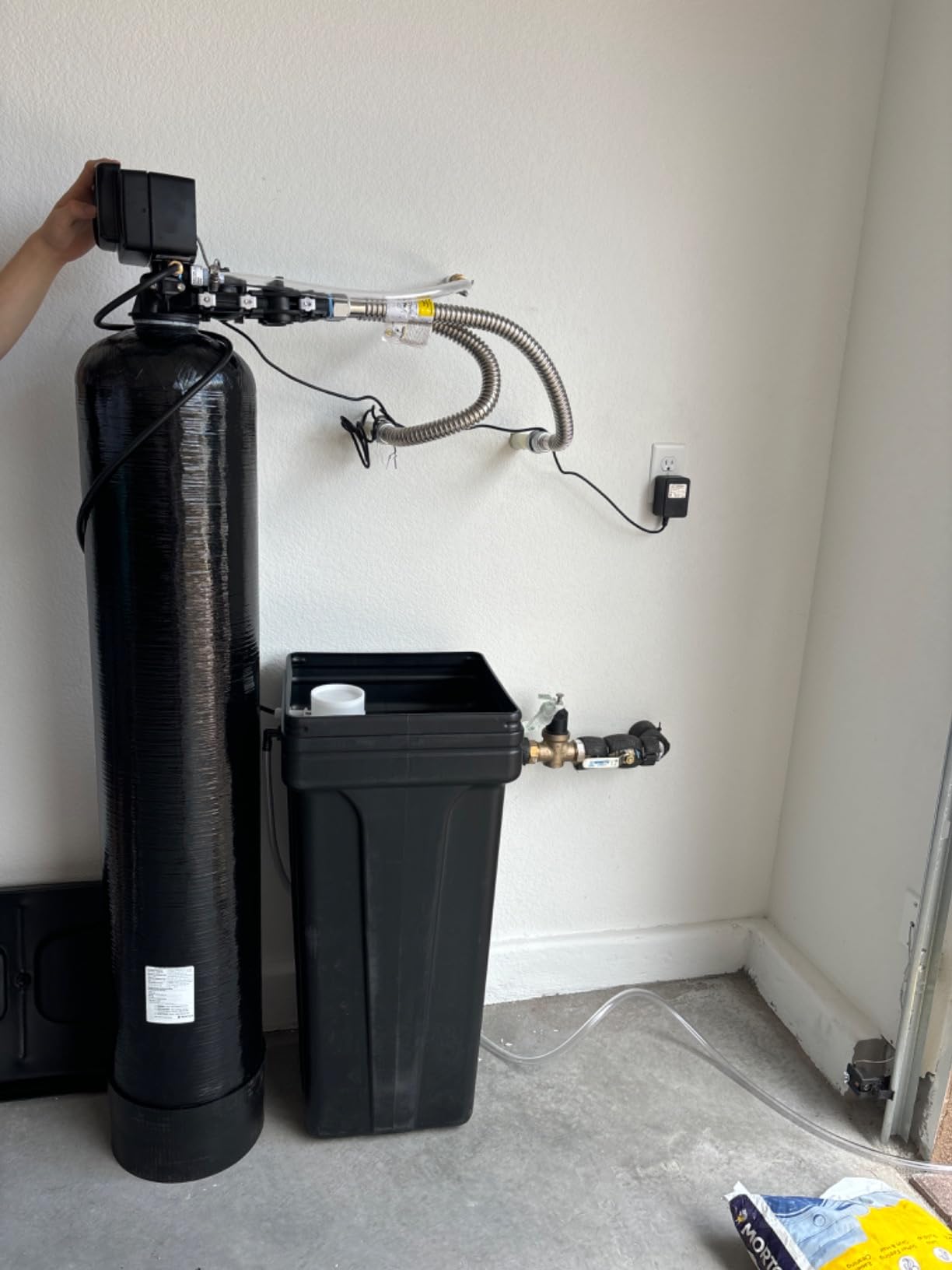
It also holds a 4.5 star average across 369 ratings with 79 percent five-star reviews. The 1.5 cubic foot resin bed comes preloaded in the mineral tank, so you are not pouring resin through a funnel in a basement. The brine tank has a safety float, which matters more than most sellers admit, because it is what stops a salt bridge from silently flooding your utility area.
For a family of six on moderately hard water, this is the arithmetic sweet spot. It is cheaper than the Aquasana 60K, has a far longer service history than the newest units in this group, and carries the most repairable control head. If you want the highest rating in the comparison and a valve any plumber recognizes, this is it.
Keep the real limitations in view. The 350 ppm maximum TDS rating is modest, so it is not the right pick for a well with high dissolved solids. And the power source is manual and gravity fed, meaning no battery backup and no electronic alerts, which is a genuine drawback if you like being told when salt is running low.
Why control valve reputation matters most?
Every part of a softener is replaceable except the habits you build around it. The valve is the part that decides when to regenerate, how much brine to draw, and how to recover from a power outage, and it is the part a technician is most likely to be familiar with. Fleck and Clack heads are the two names that come up most in that context.
Where it falls short?
At 48,000 grains this is a family of five or six system, not a family of eight. If your hardness test comes back above 20 gpg, the math sends you to a larger capacity and this becomes undersized quickly, regenerating far more often than the 7 to 10 day target.
There is no app, no Bluetooth monitoring and no diagnostic alerts, so you are on your own for salt level. Add a salt level monitor to your install and the gap mostly closes.
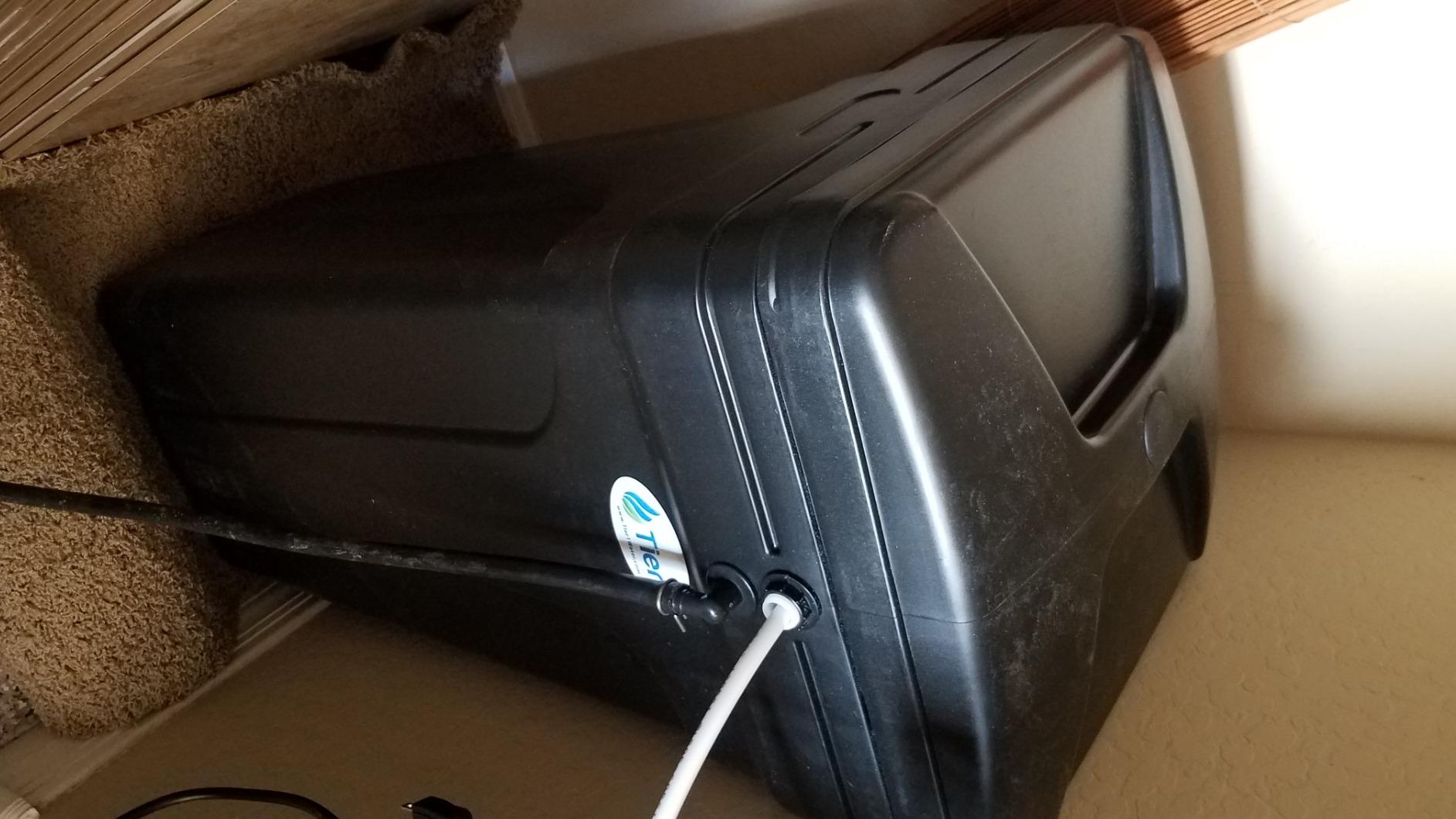
Tier1 48,000 Grain: Best Flow Rate for Four to Five Bathrooms
Tier1 48,000 Grain Water Softener System for 4-5 Bathroom Homes
18 gpm max flow
Ceramic disc valve
1.5 cu ft NSF 44 resin
10-year tank warranty
Pros
- 18 gpm maximum flow is the highest in this group
- Patented ceramic disc valve resists abrasion and corrosion
- 10-year limited tank warranty is among the longest listed coverage here
- Customer service praised for shipping parts and phone support
- Slim tank footprint despite the resin load
Cons
- Some owners report regeneration on a fixed schedule instead of metered demand
- A few installs needed extra assembly beyond the instructions
- 120 ppm maximum TDS ceiling is the lowest here
This one is built around a number that matters more than capacity in a busy house: 18 gallons per minute. That is the highest maximum flow rate in this comparison, and in a home with four or five bathrooms it is the difference between a comfortable morning and a morning where the upstairs shower runs cold because three showers overlap. If your problem is concurrency rather than hardness, flow rate is the spec to shop on.
The control mechanism is a patented ceramic disc valve rather than a rubber-seated piston. The manufacturer states it resists abrasion and corrosion and eliminates the need for seals and rebuild kits, and the 10-year limited warranty on the fiberglass resin and brine tanks is among the longest coverage in this group, extendable to 5 years on the valve and electronics with registration. The 1.5 cubic foot NSF/ANSI 44 certified cation resin arrives preloaded.
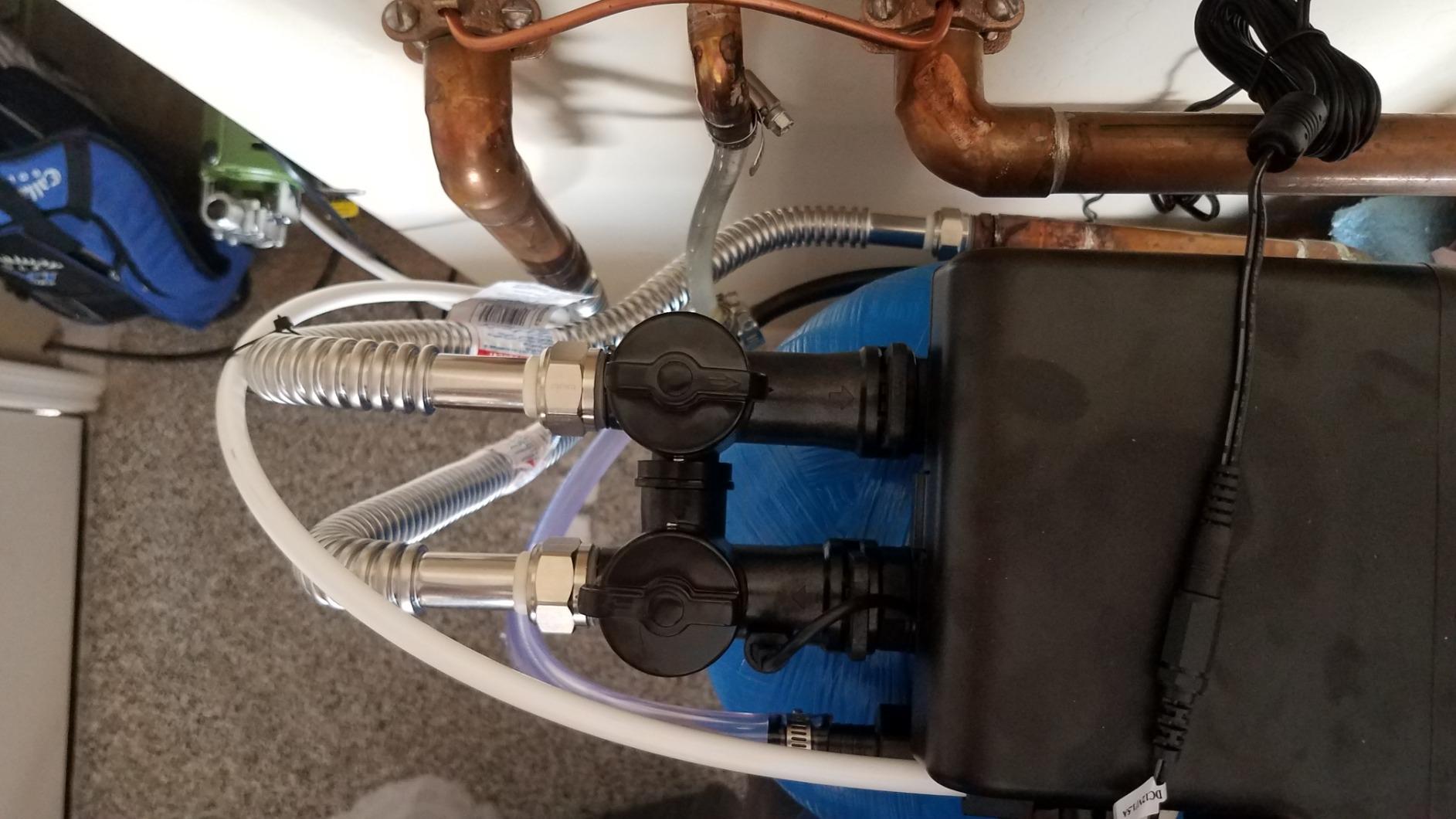
At 48,000 grains it targets four to five bathroom homes, running at 20 to 87 psi with a 40 to 120 degree temperature window, and the tank footprint stays narrow despite the resin load.
There is a real caveat on the regeneration claim, and it is the one to weigh. A number of reviewers report that the unit regenerates on a roughly 30 day fixed schedule rather than purely on measured demand, which is a time clock behaviour on a product described as metered. If your usage swings wildly week to week, that matters for salt cost.
When flow rate beats grain capacity?
Grain capacity decides how long between regenerations. Flow rate decides whether you can run the house at once. A home with three or more full bathrooms and moderate hardness can be well served by a 48,000 grain system with high flow, instead of a much larger system with a smaller valve.
Where it falls short?
The 120 ppm maximum TDS ceiling is the lowest rated in this group, and that is a hard stop for some well water. It also carries a 10 percent one-star share, driven mostly by the regeneration schedule complaints and by some installs needing extra assembly beyond what the instructions described.
One buyer reported the unit is not rated for outdoor installation and that this was not disclosed in the listing. Treat it as an indoor install only, and check the 4.2 star average against the two higher rated systems here, which cost more but carry longer track records.
Aquasana SimplySoft 60K: Best for Big Families in Small Utility Rooms
Aquasana SimplySoft Whole House Water Softener | 60K Grain | WH-SF60-BASE
60000 grains
16.6 gpm max flow
IAPMO certified NSF 44
Cabinet style brine tank
Pros
- 16.6 gpm flow suits large homes with multiple hot water uses
- IAPMO certified to NSF ANSI 44 and CSA B483.1
- Uses about 50 percent less salt and 28 percent less water than time clock
- Cabinet brine tank keeps the footprint tidy
- Marketed for 5 or more people and 4 or more bathrooms
Cons
- Pre-filter is a separately sold installation kit
- 2000 ppm TDS and 20-125 psi range need attention
- Only 128 reviews so the track record is still short
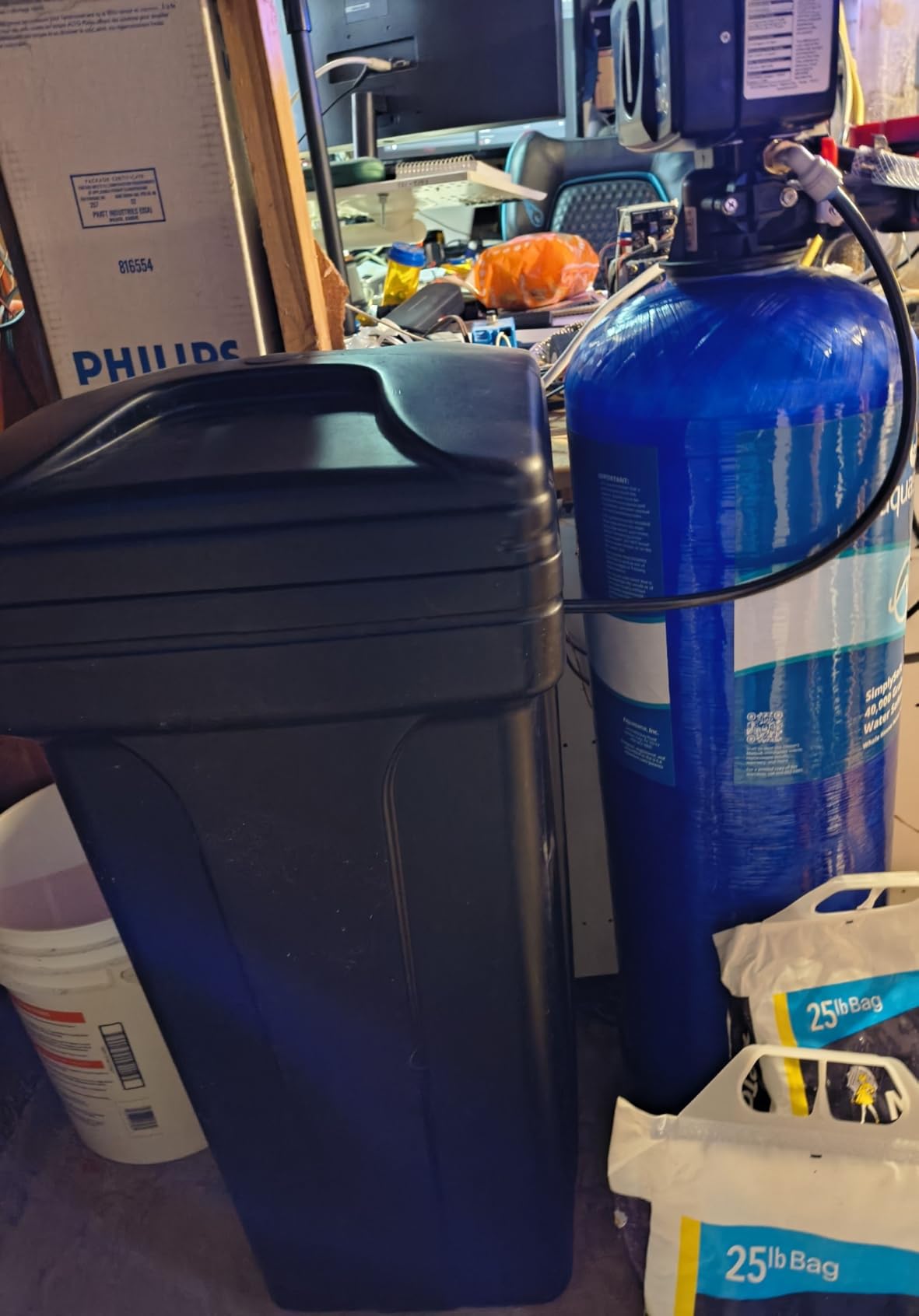
The problem this solves is space. A twin tank or a large single tank plus a full size brine tank needs a wide floor area, and many family homes have a utility room that is already crowded with a water heater. This system is 30 by 16 by 43 inches and the brine tank sits inside a cabinet-style base, which is why it fits where a bare-tank setup would not.
On performance, the numbers are aimed straight at the large-family case. Capacity is 60,000 grains, which is exactly where the sizing math puts a family of six at moderate hardness. Maximum flow is 16.6 gallons per minute, rated by the manufacturer for homes with 5 or more people and 4 or more bathrooms, so it handles concurrency far better than the 12 gpm system earlier in this list.
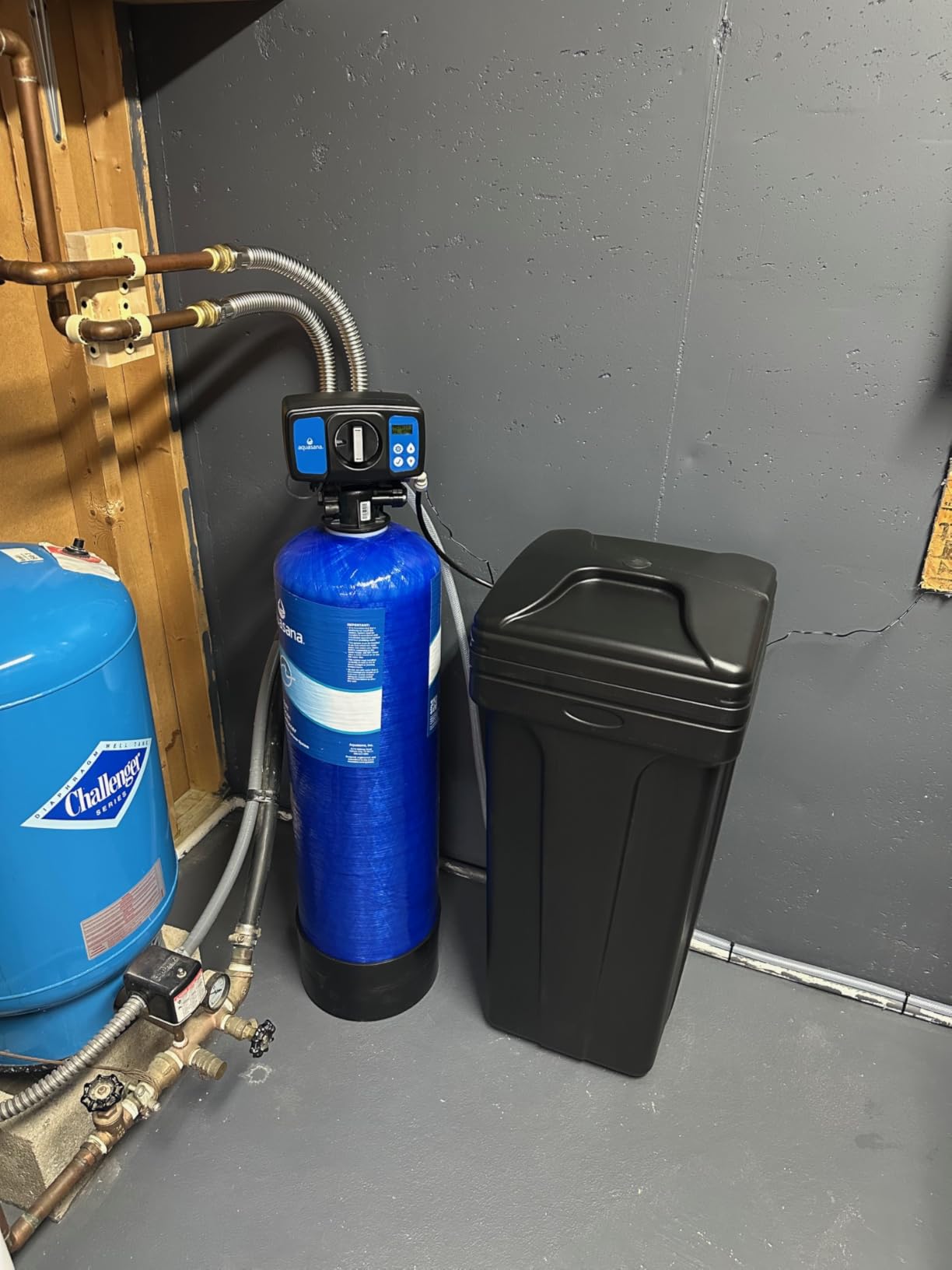
The efficiency claim is the part worth testing against your own meter. Metered operation here is stated to use about 50 percent less salt and 28 percent less water than a standard time clock softener, and the unit is IAPMO certified to NSF/ANSI Standard 44 and CSA B483.1 for hardness reduction. It also works on city or well water, and carries a 5 and 10 year limited warranty.
Be clear-eyed about two limits. The pre-filter is a separately sold installation kit rather than included, so budget for it. And with 128 ratings this is the newest system in the group, so the long term record simply has not been built yet, even though 72 percent of those reviews are five star.
Why certification matters in this category?
NSF/ANSI 44 is the standard that certifies a softener actually reduces hardness to a claimed performance, and CSA B483.1 is the Canadian equivalent. Plenty of units in this category are listed with no third party certification at all, which means nobody has independently verified the claim.
Where it falls short?
The 2,000 ppm TDS figure is a capacity claim, not a guarantee, and it pairs with a 20 to 125 psi operating range. Check your household pressure before ordering, because pressure below 20 psi will cause problems regardless of how well the valve is designed.
At 60,000 grains this is still a single tank, so soft water drops out during regeneration. For most six person households that is fine. If you want continuous soft water and you have the space, the twin tank further down is the better structural answer.
PRO+AQUA 80,000 Grain: Best Capacity for Families of Seven or Eight
PRO+AQUA Heavy Duty Whole House Water Softener System – 80,000 Grain Capacity, Premium Long-Lasting Resin, 1″ Ports
80000 grains
Premium 10 percent resin
Smart digital valve
Handles 2 ppm clear water iron
Pros
- Largest grain capacity in this group at 80000
- Several owners report strong performance after several years
- Smart digital valve automates salt and water dosing
- Good value against Fleck branded systems of similar size
- Reduces up to 2 ppm of clear water iron
Cons
- 15 percent of reviews are 1-star the highest negative share here
- Some owners report failure on well water despite the listing claim
- Documentation is thin for confirming programming
- 1 inch ports often need new flex piping
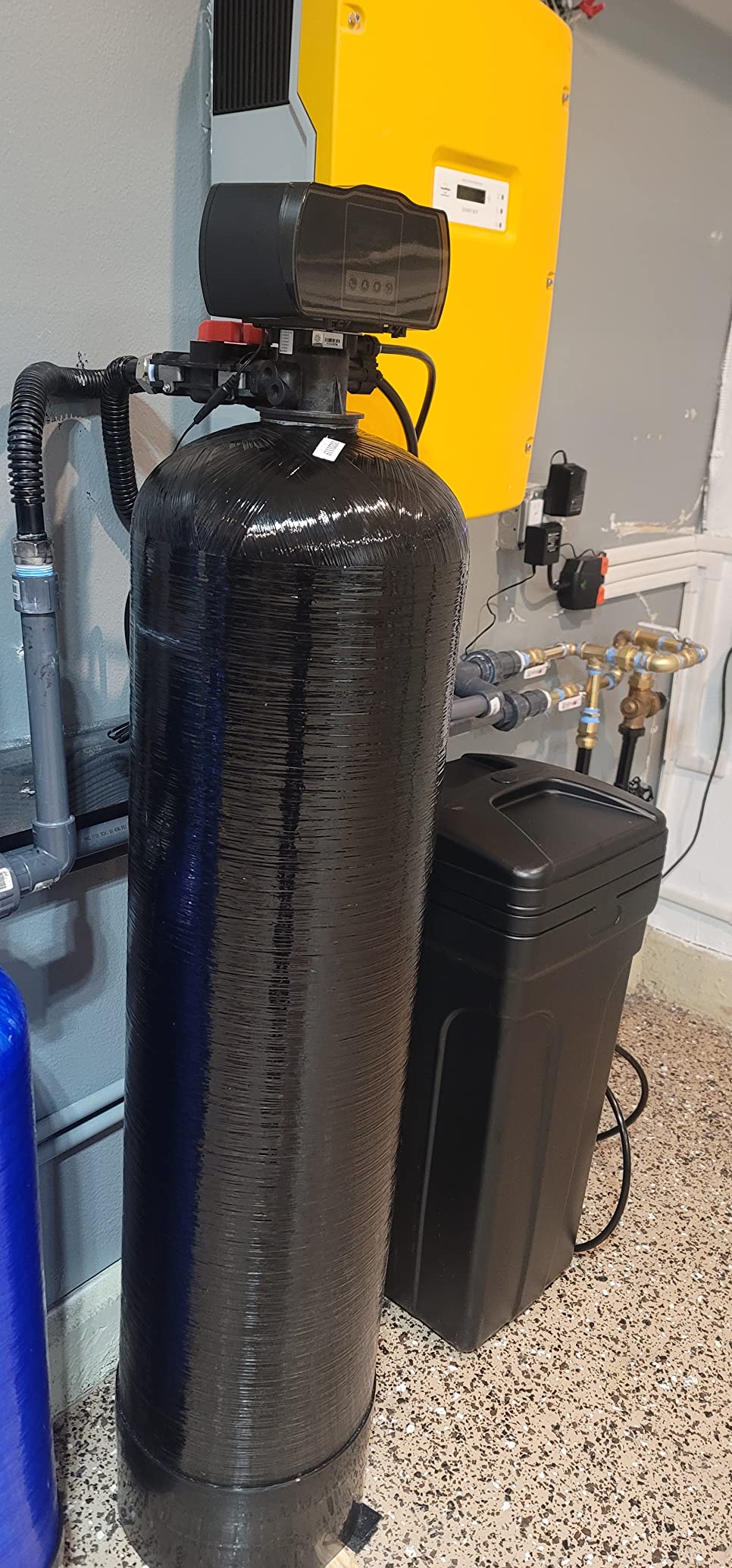
Capacity is the entire argument for this system. At 80,000 grains with premium 10 percent resin, it is the largest single tank here, and the manufacturer rates it for 6 to 8 people and up to 6 bathrooms. Run the sizing formula for a seven or eight person home at 15 to 20 gpg and this is the tank that lands on your number without pushing you all the way to a twin tank setup.
The resin grade is a real differentiator. 10 percent crosslink resin resists degradation under heavier duty cycles than standard 8 percent, and in a system regenerating as often as a large family causes, resin life is where the money is over ten years. The control valve is a smart digital unit that calculates salt and water needs automatically, so there is no fixed schedule to get wrong.
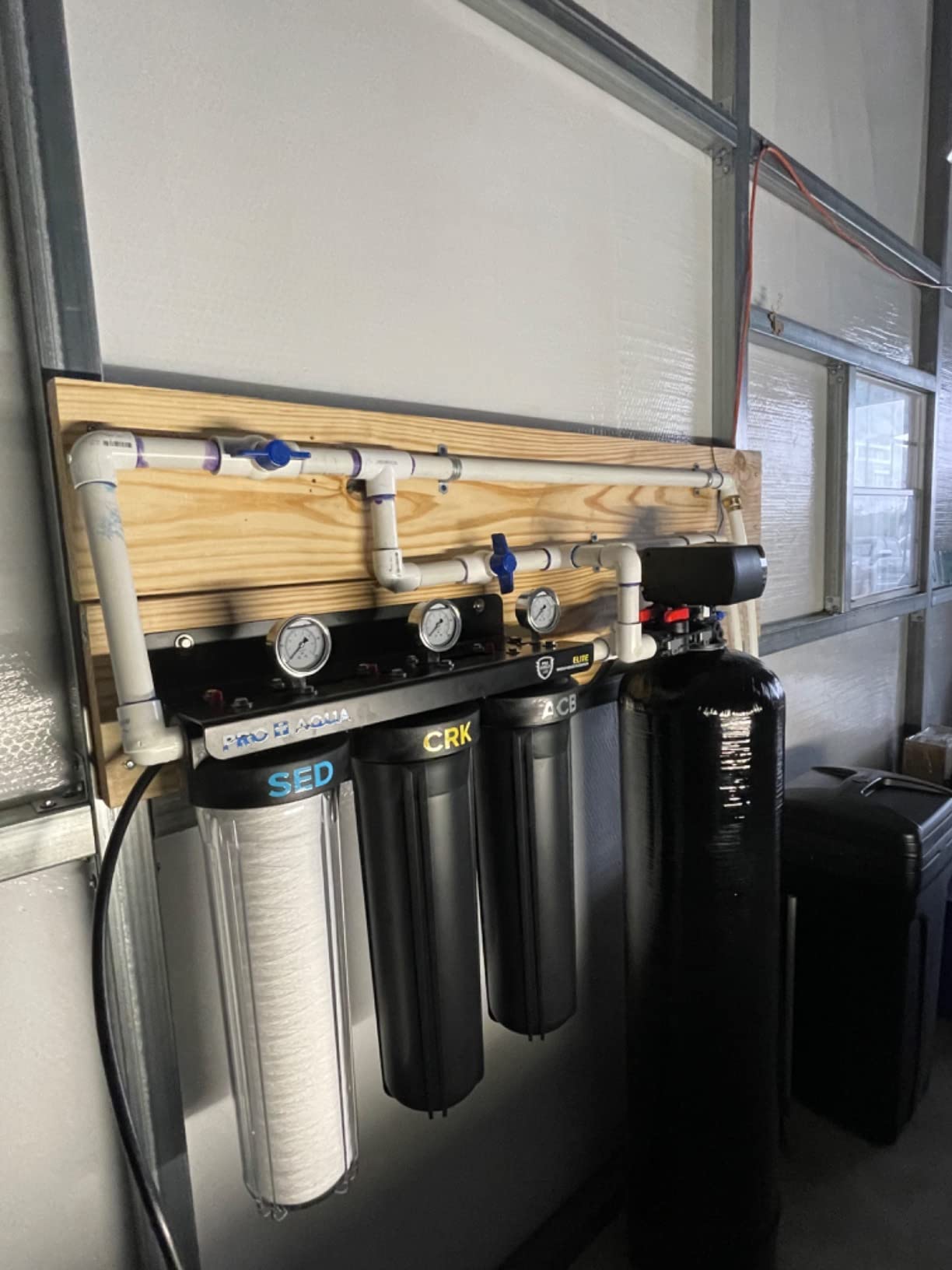
There are also practical details that reward planning. The 1 inch inlet and outlet ports often require new flex piping rather than reusing existing plumbing, and spare parts are available for 5 years, which is longer than most of this group commits to. The system handles up to 2 ppm of clear water iron, which helps some well users and does nothing for the rest.
The warranty is the weak point. It is 1 year standard and extendable to 3 with registration, against 5 years on the Aquasure and the Iron Pro 2 and 10 years on the Tier 1 tanks. Combined with a 15 percent one-star share, the highest negative share in this comparison, this is the one where you accept some risk in exchange for capacity per dollar.
Where 80,000 grains is the right answer?
This capacity band is where a large family with hard water actually needs a bigger system. Seven people at 20 gpg produces roughly 92,000 grains a week before reserve, which no 48,000 grain tank can serve without constant regeneration. Buying 80,000 grains puts you in the correct 7 to 10 day regeneration window instead of fighting a system that is permanently behind.
The 10 percent resin choice also pays off specifically at this size. Higher crosslink resists the mechanical stress of frequent backwash, which is the failure mode that ends resin life in high duty cycle systems.
Where it falls short?
Several owners report failure on well water despite the listing claiming well compatibility, so if you are on a well, this is not the unit. The documentation is thin, which makes it hard to confirm the programming is set correctly, and that combines badly with a shorter warranty than anything else here.
Only 94 ratings means a small sample, and a 4.2 average with a 15 percent one-star share tells you the unhappy customers are more unhappy than the happy customers are delighted. For a family that values the longest warranty and the deepest service record, the Aquasure or the Fleck at the top of this list is the more conservative choice.
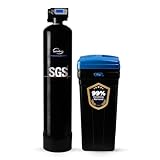
iSpring WCSTB45KG 45,000 Grain: Best Budget Pick for Five People
iSpring WCSTB45KG 45,000 Grains Whole House Water Softener with Brine Tank
45000 grains
Programmable digital valve
Fiberglass tank
300 ppm max TDS
Pros
- Lowest cost in this group at 45000 grains of capacity
- Lightest system at 75.6 pounds so the tank is easy to position
- Digital display allows real time monitoring and hardness adjustment
- Third party tested hardness reduction figure
Cons
- 45000 grains is less suited to homes with 6 or more people
- Only a 1 year warranty and 1 year of spare part availability
- Manufacturer dimensions are not published
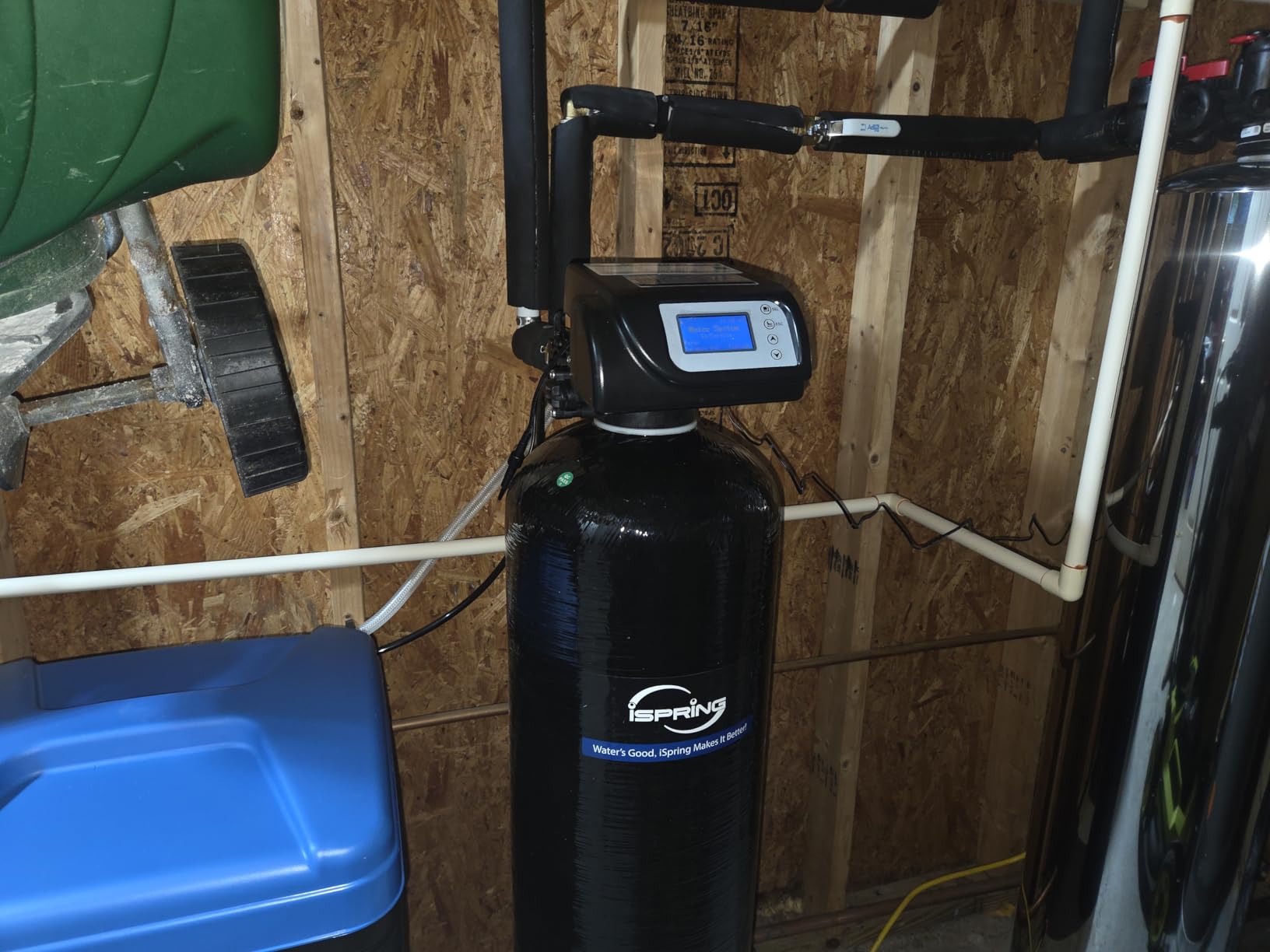
Not every large household needs 80,000 grains. A family of five on moderate municipal water can be served well by a 45,000 grain system, and this is the cheapest way to do that in the comparison. The hard water reduction figure of 99.71 percent is third party tested, and the programmable automatic control valve has a digital display for real time monitoring and hardness adjustment.
Two physical details make it easier to live with than the price suggests. At 75.6 pounds the resin tank can be moved into place without a dolly or a second pair of hands.
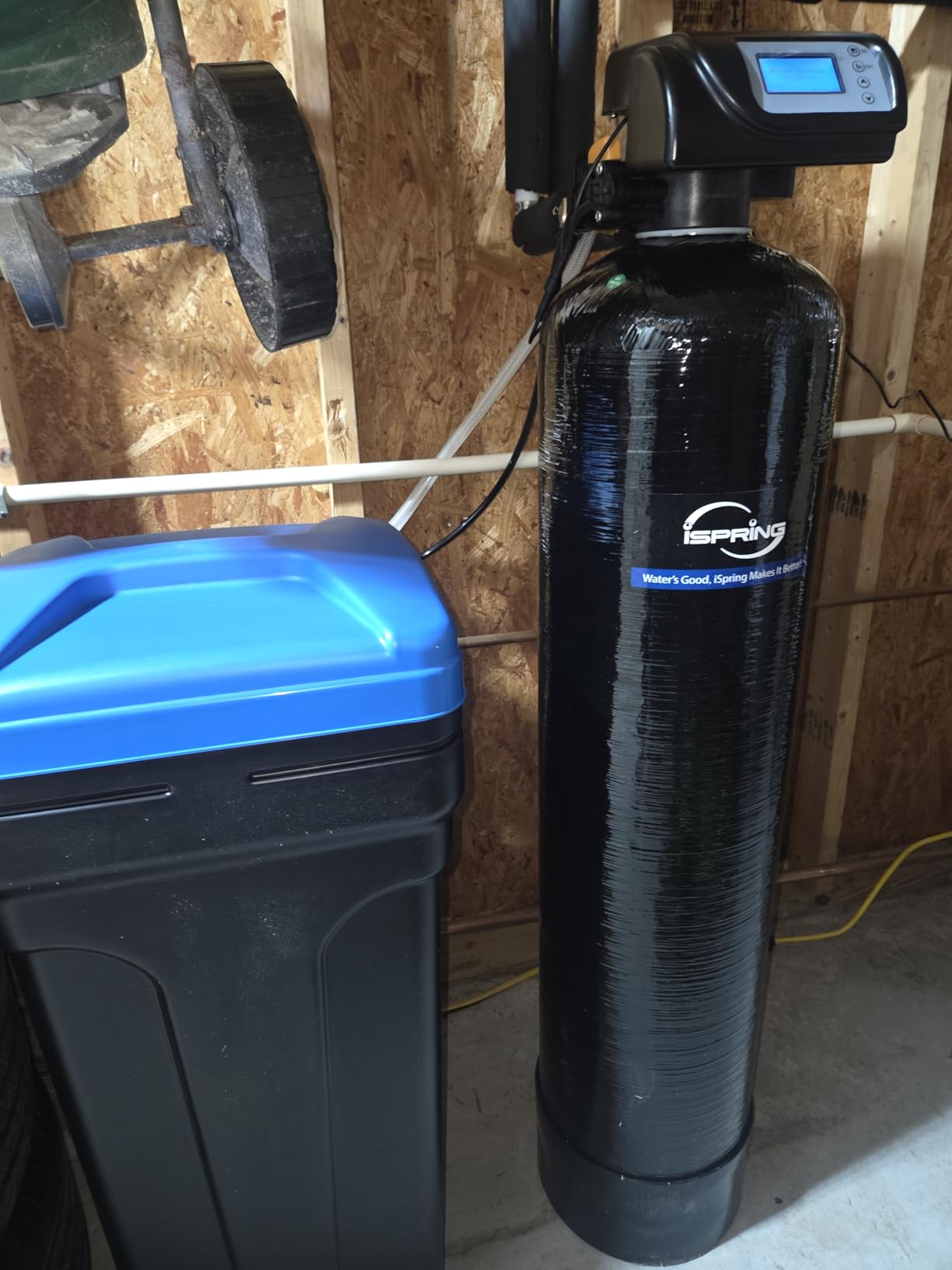
The system runs automatic backwash and regeneration cycles intended to extend resin life, uses premium ion exchange resin in a corrosion resistant fiberglass tank, and is rated for up to 300 ppm TDS. It is compatible with city and well water, comes with the brine tank, lid, power adapter and accessories, and carries a 30 day money back guarantee with lifetime technical support.
Where it falls short is capacity and warranty in equal measure. 45,000 grains is the second lowest here and it is genuinely under-sized for six or more people at anything above moderate hardness. The warranty is 1 year with 1 year of spare part availability, which is the shortest commitment in this comparison on both counts.
When 45,000 grains is genuinely enough?
Run the formula. Five people at 10 to 12 gpg produces roughly 26,000 to 32,000 grains a week, so a 45,000 grain system gives you a comfortable margin and lands in the target regeneration window. Add your 25 percent reserve and the number still works, which is not true of the 45,000 class for six person homes.
If your usage is likely to grow, with an older couple moving in or guests who stay for months, this is the one to skip. Buying up front costs less than replacing in four years.
Where it falls short?
The manufacturer does not publish dimensions, which makes space planning a guessing game. Measure the narrowest path from your delivery door to the install location and add a few inches before you commit, because the resin tank is the awkward part in any installation.
About 8 percent of reviews are 3-star, which reads as competent rather than delighted. For a five person household on moderately hard water that is a reasonable trade for the cost saving. If your household is at the top of the large family range, spend the difference and get a 60,000 or 80,000 grain system instead.
Fleck 9100 SXT Twin Tank 48,000 Grain: Best for Continuous Soft Water
DuraWater Fleck 9100 SXT Twin Tank Water Softener, 48,000 Grains, Black
Twin tank design
48000 grains total
Fleck 9100 SXT metered valve
15 percent water and salt savings
Pros
- Highest average rating here at 4.6 stars with 82 percent five star reviews
- Twin tank keeps soft water available during regeneration
- Fleck 9100 SXT valve is a recognized commercial grade head
- On demand metered regeneration saves about 15 percent water and salt
- Resin preloaded and mineral tanks included
Cons
- Highest cost in this comparison by a wide margin
- Twin tanks plus brine tank need a larger footprint and more plumbing
- Only 50 ratings so the sample size is small
- Two loaded 10 by 54 inch tanks weigh about 95 pounds
This is the structural answer to the problem every single tank has. While one tank regenerates, the other is online, so the house never runs on hard water. In a home where three or more people shower in three bathrooms at the same time, that is the difference between a softener and a softener you never have to think about.
It carries the highest average rating in this comparison at 4.6 stars, with 82 percent five star reviews. The control valve is the Fleck 9100 SXT, a recognized commercial grade metered head, and regeneration is on demand rather than on a clock, saving about 15 percent water and salt. Total capacity is 48,000 grains spread as 1.5 cubic foot of resin per tank, in 10 by 54 inch mineral tanks.
The valve choice matters here more than anywhere else. In a single tank, a failed valve means an unsoftened house. In a twin tank configuration the 9100 is a more capable head, and the 14 by 36 inch brine tank carries a safety float alongside the 1 inch plastic bypass. The system arrives with the resin preloaded and the mineral tanks included, so it is a complete install.
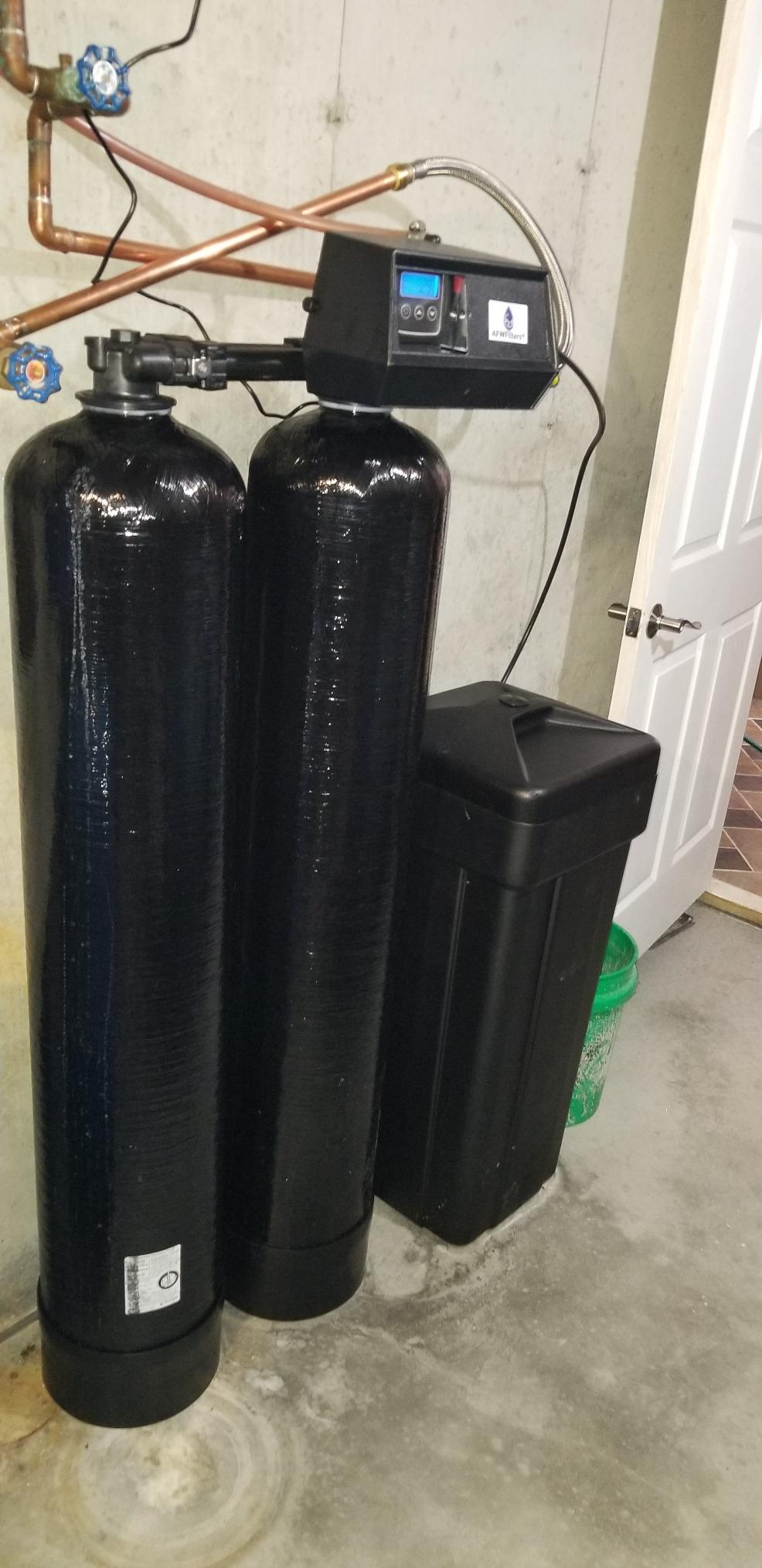
Be honest about the trade. This is the highest cost system in the comparison by a wide margin, and it needs a larger footprint and more plumbing space than anything else here. It also has the smallest review base at 50 ratings, so the 4.6 average is impressive but drawn from a limited sample.
When the regeneration outage actually bothers you?
It is worth being honest that most families of five do not notice single tank regeneration. You notice it when someone showers during a cycle and wonders why the water is different, or when a load of laundry comes out oddly at the wrong moment. Twin tank systems are for the households where that unpredictability has become a real irritation.
It is also the right answer for a family of eight at hard water. Instead of buying one enormous tank, you run two moderate tanks in parallel and each one gets a proper rest between cycles.
Where it falls short?
Space is the practical limit. Two 10 by 54 inch mineral tanks plus a 14 by 36 inch brine tank needs a real footprint, and moving them into place takes help. Measure the wall before you order rather than after.
With 50 ratings there is limited long term evidence, and a replacement part for a 9100 valve costs more than a 5600 valve. If the budget is the deciding factor, the Fleck 5600 SXT earlier in this list delivers most of the same capacity for far less, and you accept hard water during regeneration in exchange.
How to Choose a Water Softener for a Big Family?
Sizing is the part that goes wrong most often, and it goes wrong in both directions. Retailers default to 40,000 to 48,000 grain systems regardless of measured grain load, which is the loudest and most repeated complaint across the water treatment forums. Understanding the penalty for going too large is what stops you from overcorrecting.
Right-sizing and the over-sizing penalty
An oversized system is not a harmless purchase. Oversized softeners consume roughly 20 to 40 percent more regeneration salt, they regenerate on a schedule that is far longer than needed, and they show the symptoms of a system working too hard for too little to do. Salt bridging in the brine tank, channeling in the resin bed, and poor performance at low flow are all classic signs.
The financial maths matters as much as the mechanical. Properly right-sized systems pay back in roughly 3.5 years, while oversized systems can take 6 to 8 years to reach the same point. A 42 percent resin lifespan advantage for the right-sized unit compounds that difference every year after it.
Hidden load drivers are worth checking before you finalise a number. Irrigation systems, pool backwash, steam showers, hot tubs and heavy laundry all add grain load that headcount does not capture. If your family runs any of those, add their water use into the gallons figure before you do the hardness multiplication.
Twin tank versus single tank
A single tank is cheaper, smaller and simpler to service, and for a family of five it is almost always the right call. A twin tank costs more and needs roughly double the footprint, and it removes the regeneration outage entirely. The trade is a straight one: space and budget against never seeing unsoftened water.
The tiebreaker is not family size alone, it is concurrency. Three bathrooms, three people showering in parallel, and a house where a 12 gpm softener is already struggling. That combination, rather than the number of people, is what makes a twin tank the correct answer.
What it really costs to run?
Salt consumption is the running cost people ask about most and quantify least. The useful method is empirical rather than theoretical: count the bags you use over three months, then divide. Regeneration frequency is the driver, and frequency is a direct function of how closely your capacity matches your grain load.
Water is the cost people forget. Each regeneration sends several tens of gallons down the drain, and a system regenerating every three days instead of every eight is running that bill far more often than necessary. The Aquasana’s stated 28 percent water saving against a time clock system, and the Fleck 9100’s stated 15 percent saving against on demand regeneration, are the two efficiency numbers worth benchmarking against your own meter.
Electricity is small but not zero for units with powered valves, and a year of frequent regeneration adds up to a few dollars. It is worth including in any payback calculation but will never change which system you pick.
Control valves and build quality
The control valve is the heart of the system and the part most worth paying for. Water treatment professionals on r/WaterTreatment recommend Clack heads first and the Fleck 5600 SXT a close second, specifically because of how easy they are to service. A community sourcing tip worth knowing: Aquatell sells systems built around the Clack WS1, which is a useful way to get that valve without hunting for it.
Look for NSF/ANSI 44 or IAPMO certification on the listing rather than trusting a capacity claim on its own. A certified system has been independently verified for hardness reduction, and 8 percent versus 10 percent crosslink resin is a real durability difference on high duty cycle systems.
Brands worth approaching carefully
Forum consensus is not uniform, and pretending otherwise is dishonest. Multiple threads explicitly advise staying away from Culligan, Kinetico, RainSoft, EcoWater and Leaf, citing high pressure sales, expensive service contracts and a perceived value gap. Home Depot and Rheem units are discussed in terms of common parts breaking and replacement cycles rather than longevity.
That is community opinion, not laboratory finding, and it points at the service model more than the hardware. Brands with strong local service networks can be excellent value where you have one. The recurring pattern in those threads is not that the equipment is bad, it is that the ownership experience is worse than expected.
Well water and iron
Well water needs its own sizing pass. Add 5 grains of capacity per ppm of iron, and test before you buy rather than assuming, because sizing math handed to well buyers by sellers frequently ignores iron entirely. Well households in this comparison are best served by a blended resin system rated for iron rather than a plain softener.
Sulfur, manganese and high TDS are separate problems that softening does not solve. If your test shows them, you need filtration hardware, and a softener alone will disappoint you. Our well water softener guide covers those cases in more detail.
Installation reality in a large home
Before you buy anything, confirm you have a floor drain or standpipe within roughly 10 feet of the main shutoff, and that the drain line can reach a safe discharge point. Check the vertical clearance above the install location, because most of the systems here stand between 54 and 62 inches tall and need room for service access.
Water pressure is the other common failure. The systems in this comparison are rated across different pressure ranges, from 20 to 87 psi up to 20 to 125 psi, and a home with marginal pressure will cause early valve failure regardless of brand. In a multi bathroom house, pressure drops when several fixtures run at once, so test it under load if you can.
On hiring a plumber, the honest answer is that a first time install in a house with multiple fixtures and older plumbing is worth paying for. A drain line that has to be routed or a pressure issue that needs a regulator can turn a weekend project into a two day job.
Where to buy?
Brand direct purchases often carry the strongest warranty and the best parts support, and they are the only route to the Fleck and Clack valves in many cases. Big box retail gives you a staffed counter and easier returns, at the cost of heavier upselling on capacity. A local installer gives you someone to call, and their pricing normally includes installation.
Frequently Asked Questions
How big of a water softener do I need for a large family?
Multiply your household size by 75 gallons per person per day, multiply by your hardness in grains per gallon, multiply by 7 days, then add a 25 percent reserve. For a family of six at 15 grains per gallon that lands near 59,000 grains, so a 60,000 grain system is the honest recommendation rather than a 48,000 grain one.
How many people is a 40,000 grain water softener good for?
A 40,000 grain system is a good match for a family of four, or a family of five on water at 10 to 12 grains per gallon. It is undersized for six people at moderate hardness and for any household above 20 grains per gallon.
How many people is a 48,000 grain water softener good for?
A 48,000 grain softener suits a family of five on moderately hard water, or a family of six on softer water in the 10 to 12 grain per gallon range. Forum consensus treats 48,000 as the default large family starting point, with 45,000 described as acceptable but unnecessary for smaller households.
How long should a 40 lb bag of salt last in a water softener?
It depends entirely on regeneration frequency, which depends on how closely capacity matches your grain load. The practical method is to count bags over three months and divide. A correctly sized system regenerating every 7 to 10 days uses far less salt than an oversized one regenerating every three weeks.
Do I need a twin tank softener for a large family?
Most families of five do not need one. Twin tanks are for households with three or more bathrooms where several people run hot water at the same time and cannot tolerate hard water during regeneration, or for eight person homes at hard water where you would otherwise need an oversized single tank.
Which brand of water softener is considered the most reliable?
Reliability in this category tracks the control valve more than the brand. Water treatment professionals recommend Clack control heads first and the Fleck 5600 SXT a close second, specifically for ease of service. Fleck 5600 and 9100 systems, and any system built around the Clack WS1, are the choices that come up most.
The Bottom Line for Large Families in 2026
The Aquasure Harmony 48K is our pick for most households, because 3199 ratings at 4.4 stars is a service record nothing else here can match. It is the strongest of the best water softeners for large families on evidence alone. Buy it for a family of five, or a family of six on softer water, and pair it with a low flow shower head if you have three full bathrooms.
Go bigger when the math says so. A family of six at moderate hardness should be looking at the Aquasana SimplySoft 60K, and a household of seven or eight needs the PRO+AQUA 80K or the Fleck 9100 SXT twin tank. If the water comes from a well with iron, the AFWFilters Iron Pro 2 64K handles hardness and iron in one tank instead of two.
Whichever one you choose, run the sizing formula with your own hardness number before you order, and skip a capacity band you do not need. Getting the capacity right matters more than the brand badge on the tank, and it is the difference between a system that pays back in about three and a half years and one that takes the best part of a decade. Related reading: our best tankless water heaters for large families guide covers the other half of what hard water does to your utility room.