
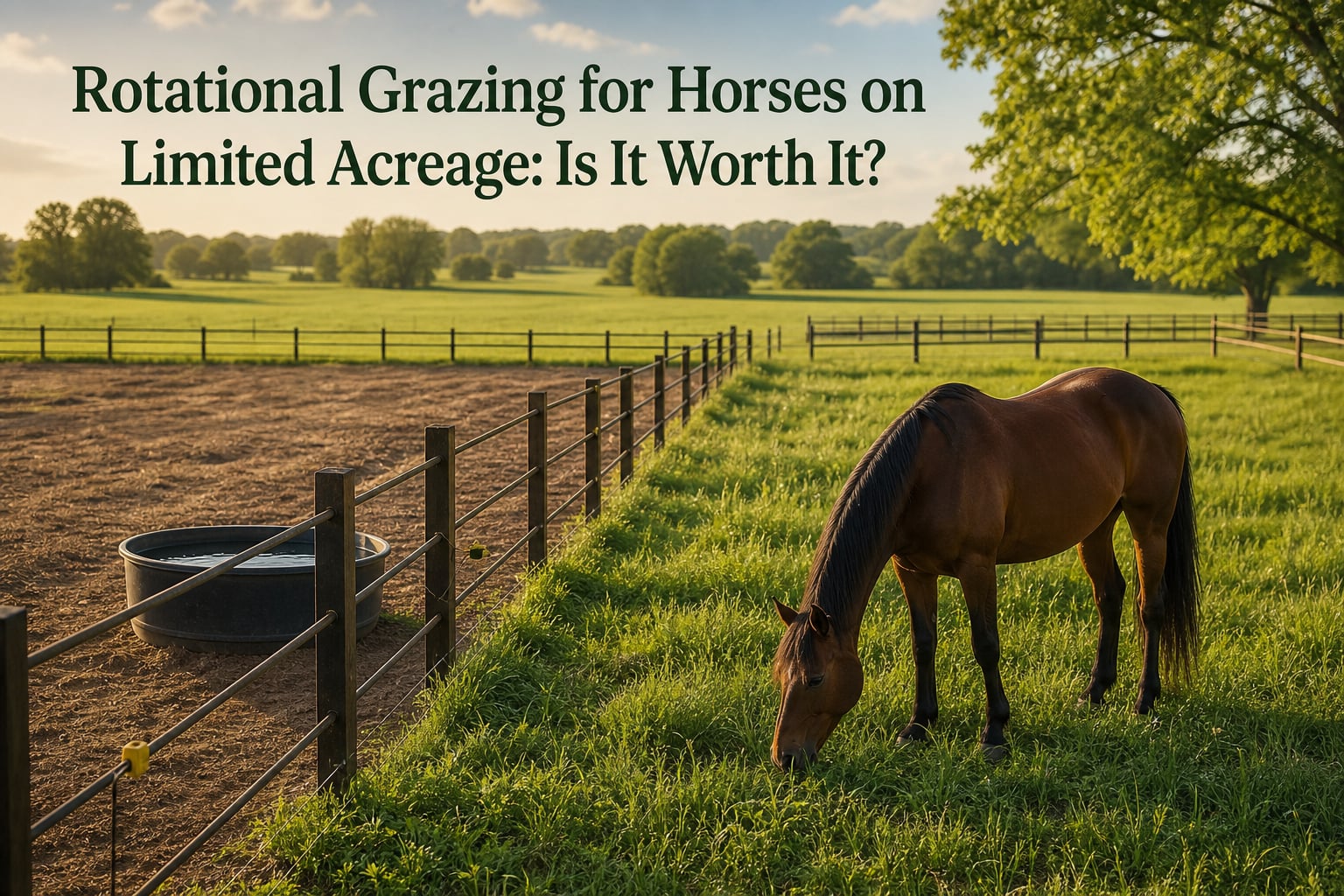
Rotational grazing for horses on limited acreage can be worth the work when it gives grass a real recovery period and keeps horses off wet, short, or stressed ground. It is not a shortcut that makes too little land support unlimited horses, but it can make the acreage you have easier to manage.
The basic idea is simple: horses use one paddock while the others rest. The hard part is matching that idea to your herd, soil, forage growth, water access, and the time you can actually give to moving horses.
I think the most useful way to judge the system is not by asking whether every horse owner needs a perfect multi-paddock layout. Ask whether repeated grazing is leaving your grass thin, weedy, muddy, or slow to recover, and whether a planned rest period would change that pattern.
For a small property, a workable rotation may begin with only two grazing areas plus a dry lot or sacrifice area. That is much more realistic than waiting until you can build a textbook setup with many permanent paddocks.
Table of Contents
Rotational grazing for horses on limited acreage works by moving horses before forage is overgrazed.
Rotational grazing is a pasture management system where horses are moved between multiple paddocks on a regular schedule, allowing grazed areas to rest and recover while other areas are being used. The goal is healthy forage cover, not simply making horses walk through a different gate.
In a continuous system, horses can return to the same tasty plants again and again as soon as new leaves appear. Those plants lose leaf area before they have rebuilt energy reserves, while less-palatable plants and bare spots gain ground.
A rotation interrupts that habit. One paddock is open for grazing, while other paddocks are closed long enough for the forage to put on growth before horses return.
Rotational grazing needs a move trigger and a return trigger.
The research supplied for this article uses about 4 inches of remaining forage as a move trigger. It also uses a return trigger of roughly 6 to 8 inches of growth, with a rest period often lasting 3 weeks or more.
Those numbers are guides, not a promise that every field will recover on the same calendar. Rainfall, temperature, soil fertility, grass species, hoof traffic, and the number of horses all change the pace of regrowth.
I would treat the grass height as the first signal and the calendar as a backup. If a paddock has not rebuilt enough leaf area, it is not ready just because the planned date has arrived.
A sacrifice area protects the rest of the farm when grass cannot be grazed.
A sacrifice area, often called a dry lot, is a deliberately managed space where horses can stay while the pasture rests. It may look less green than the grazing areas by design, because it takes the hoof traffic, manure concentration, and feeding activity that would otherwise spread across recovering forage.
This area matters most on limited acreage during wet weather, winter dormancy, and slow growth. It also gives you somewhere to put horses when a paddock is too short, when reseeding is underway, or when a herd needs to be separated.
A dry lot still needs safe footing, drainage, shade or shelter as appropriate, clean water, and a manure plan. Holding horses there does not mean leaving them without turnout, observation, forage, or company; it means choosing where the unavoidable pressure will land.
Rotational grazing beats continuous grazing when repeated use is weakening the pasture.
Continuous grazing is not automatically neglectful; it is simply a system with little control over which plants horses revisit and when. On a large, lightly stocked pasture, the effects may be less obvious than they are on a small horse property.
On limited acreage, horses often graze favorite spots close to the ground, leave rough patches untouched, and congregate by gates, water, and shade. The result can be a pasture that looks both overused and underused at the same time.
Continuous grazing concentrates pressure where horses already want to be.
- Forage use: Horses can repeatedly bite new growth from preferred plants before recovery is complete.
- Traffic: Gates, troughs, feeders, and shade lines can turn bare or muddy because horses visit them constantly.
- Manure: Droppings and parasite-management needs are spread less predictably, while horses may avoid grazing near manure patches.
- Planning: It is harder to see whether the field is resting because it never truly closes.
The problem is not that horses are making bad choices. They are doing what horses do: selecting forage, traveling familiar routes, and returning to comfort spots.
Rotational grazing creates a planned recovery window for every paddock.
- Forage use: A closed paddock can rebuild leaves and cover before horses return.
- Traffic: The active area changes, while a sacrifice lot can take the heaviest use when conditions are poor.
- Manure: You can observe and clean a smaller active space, then factor manure management into the next move.
- Planning: Grass height, growth rate, and the next available paddock guide decisions instead of habit alone.
The tradeoff is management. More divisions mean more gates, fencing decisions, water planning, and moments when you have to move a horse even though you are busy or the weather is unpleasant.
Forum discussions reflect that tradeoff honestly. Horse owners report that rotation can work well, while also pointing to more fencing, water distribution, and labor depending on how often horses move.
Rotational grazing is a pasture-rest system, not a promise of more feed.
The strongest reason to rotate is to protect the plants that produce forage. If grass is allowed to recover, the property may carry healthier cover and make better use of the growing season.
That does not mean a small field will provide all of a horse’s forage all year. Many owners still feed hay, especially during winter, drought, mud season, or any period when keeping horses on grass would damage the stand.
That distinction keeps expectations realistic. Better timing can reduce waste and protect pasture productivity, but it cannot replace enough acreage, purchased forage, or sound nutrition planning.
Limited acreage benefits most when rotation protects grass, soil, and decision-making.
The clearest benefit is recovery. When horses leave a paddock before forage is grazed too short, the plants have a better chance to regrow rather than surrender ground to bare soil and weeds.
Healthy cover also matters below the leaves. Roots, soil structure, and water movement are all easier to protect when a field is not repeatedly cropped to the ground and churned under hoof traffic.
Rotational grazing can make small acreage easier to read.
When one area is closed, you can see whether it is actually recovering. That makes it easier to spot thin places, weed pressure, drainage problems, or a paddock that is failing to keep pace with your horses.
With continuous access, a pasture can decline slowly because there is no clear before-and-after period. A rotation gives you a visible record: this was the height when horses entered, this is the height when they left, and this is how long the field took to come back.
I would keep those observations in a notebook or phone note rather than rely on memory. After one season, the notes can show which paddocks recover quickly, which gates stay muddy, and when the sacrifice area was most useful.
Rotational grazing can reduce overgrazing pressure but cannot correct overstocking.
The supplied AI research gives a 2-to-4-acre-per-horse baseline, but a baseline is not a stocking-rate guarantee. Productive, well-drained ground in a favorable growing area can behave very differently from shallow soil, drought-prone ground, or a property with long winter dormancy.
Use the baseline as a prompt to look closely at your own forage supply, not as a permit to add horses. If your property has fewer acres per horse, rotation and a sacrifice area become more important because pasture must be protected from constant access.
A pasture that never gets above the return height, has widening bare patches, or needs horses kept on it while it is wet is telling you that the available grazing pressure is too high. The response may be more rest, more purchased forage, fewer horses on the land, or help from a local equine or extension professional.
The take-half, leave-half idea gives a simple forage-use check.
Horse owners often hear “take half, leave half” as a grazing rule. In practical terms, it means avoiding the urge to harvest every available blade and leaving enough leaf area for the plant to recover.
It is useful as a mindset, especially when grass is growing fast and a paddock looks abundant. It does not replace watching actual residual height, because a tall coarse stand and a short leafy stand can look very different while offering different amounts of usable forage.
A basic rotational system starts with a dry lot, two paddocks, and a repeatable routine.
You do not need to create many tiny paddocks on day one. Start by making the next right management decision possible: give horses a place to stay off grass, then make at least one grazing area available while another rests.
Step 1: Map how horses already use the property.
Walk the acreage and mark the existing fence lines, gates, water, shade, high ground, low ground, and places that turn muddy. Also mark areas horses graze close, areas they leave rough, and routes they take to reach water or shelter.
This map is more useful than a generic paddock diagram because it shows where the pressure already is. A new division that puts a gate at the wettest corner or makes water inaccessible will create a daily problem you could have avoided.
Step 2: Choose the sacrifice area before dividing the grazing area.
Pick the place that can handle concentrated use with the least harm to the rest of the property. For many farms, that means an area with practical access for hay delivery, manure removal, water, and observation rather than the prettiest patch of grass.
Plan drainage and footing carefully. A sacrifice area is intended to take pressure, but it should not become a safety hazard or a source of runoff and mud that spreads into the pasture.
Decide in advance when horses will use it: wet periods, winter, reseeding, drought, or whenever every grazing paddock is below its return height. Making that rule before grass is scarce is far easier than making it after a field is bare.
Step 3: Divide the grazing ground into at least two usable areas.
A two-paddock rotation is a valid beginning. Horses can graze one side while the other side rests, then switch when the active side reaches its move trigger and the rested side has enough recovery.
More paddocks can create longer rest periods, but more is not always better if the divisions become too small for safe turnout or too difficult to manage. The right number is the number that gives you useful rest without making gates, water, and daily handling unworkable.
Temporary electric fencing may help you test a layout before you commit to permanent divisions. Any fencing choice still has to be safe, visible, properly installed, and suitable for the horses on the property.
Step 4: Put water and gates where daily use will not damage every paddock.
Water distribution is a recurring concern in owner discussions because a layout that looks good on paper can fail when every horse must travel through one muddy bottleneck. Consider how each group will reach clean water without crossing a closed paddock or wearing a trench along a fence.
Gate placement affects your workload too. A gate that lets you move horses calmly from the active paddock to the dry lot or next field is more valuable than a perfectly symmetrical layout that requires complicated handling.
If several groups cannot mix, plan separate routes and holding areas from the beginning. Rotation is still possible with separate herds, but the setup and labor need to match that reality.
Step 5: Set grazing and rest rules that everyone can follow.
Use the 4-inch move point and 6-to-8-inch return point from the supplied research as your initial visual guidelines. Then adjust based on what your forage, season, and local professional guidance show you.
Write down what happens if the next paddock is not ready. The answer should be the sacrifice area with hay or another appropriate forage plan, not letting horses keep removing new leaves from the current paddock.
A scheduled move can be helpful, but grass growth is the final vote. During rapid growth, horses may move more often; during slow growth, they may spend longer in the dry lot because the pasture needs more time.
Step 6: Monitor forage, footing, and horse condition after every move.
Check grass height in more than one place, since favorite grazing areas may be much shorter than the field average. Look at bare ground, manure accumulation, gate wear, hoof damage, standing water, and the condition of the horses themselves.
Pasture management and feeding management need to agree. If pasture intake is changing, work with your veterinarian or qualified equine nutrition professional when you need help managing body condition, dietary restrictions, or metabolic concerns.
The record does not need to be complicated. Note entry date, exit date, approximate height, weather pattern, and any problem you observed; that is enough to make the next cycle more informed.
Rotational grazing is worth it when the pasture gains recovery time that justifies the added work.
The financial and labor answer is personal because fencing, water access, soil work, purchased forage, and horse numbers are different on every property. The better question is whether the system prevents repeated damage that is already costing you grass cover, time, and future options.
Owners who move horses regularly may spend more time opening gates, checking water, and watching forage. In exchange, they gain a clearer way to decide when grass is ready, when it needs rest, and when the dry lot should take over.
Rotation pays back through avoided pasture damage, not through a guaranteed feed bill.
It is reasonable to hope that healthier, thicker forage will contribute useful nutrition during the growing season. It is not reasonable to promise that rotation will remove the need for hay or other feed, because weather and land quality set limits that a fence cannot change.
Think of the return as risk control. Protecting forage can reduce the chance that a small property slides into chronic bare ground, weeds, erosion, and expensive rehabilitation, even though it requires upfront planning and ongoing chores.
The article research identifies this cost-benefit question as a gap in competing content, and it deserves a plain answer: the benefit is strongest when the alternative is continued overgrazing. If your pasture is already rested, lightly stocked, and healthy under its current management, more divisions may offer less improvement.
Fencing and water are the most common barriers, so plan the minimum workable system.
High initial fencing cost is a real concern, especially on a small property where every new line changes the way people, equipment, and horses move. Before buying materials, sketch the smallest design that creates a genuine rest period and safe access to water.
Water can be the deciding factor. If a new paddock cannot reach a safe source without opening a resting field, a shared access lane, a carefully located trough, or a different division may be necessary.
Do not make a purchase decision based only on the number of paddocks a layout can produce. Make it based on whether you can safely use, check, and maintain the system in bad weather and during your busiest weeks.
Labor is manageable when the routine fits your real day.
Some owners move horses daily, while others use longer grazing periods that still leave meaningful rest. The correct frequency depends on forage growth and paddock size, not on copying someone else’s schedule.
Build the system around calm, repeatable handling. If every move requires catching difficult horses, walking a long route with water buckets, or threading groups past one another, the plan may be too demanding to keep up.
I would choose fewer, easier moves over a complicated plan that only works in ideal conditions. Consistency protects pasture better than an ambitious design that gets abandoned when life becomes busy.
Rotation remains possible when horses cannot share turnout.
Separate herds add gates, water needs, and labor, but they do not rule out rotational grazing. Each group can rotate through its own pair or set of paddocks, or groups can use the same spaces at different times if handling and biosecurity practices fit the property.
The important part is to count every group when you calculate grazing pressure. Dividing horses socially does not reduce the amount of forage they remove from the farm.
Seasonal rotation works best when grass growth, weather, and footing set the schedule.
Pasture is not equally ready all year. The management move that protects grass in a fast-growing period may be the wrong move during drought, heat, cold, or prolonged rain.
Spring rotation should give grass a head start before turnout expands.
A small-farm owner described holding horses off most of the grazing area during early spring so it could get a good head start. That approach matches the core purpose of rotation: wait for enough growth before asking plants to support grazing.
Early growth can look abundant before it is resilient. Watch actual height and ground conditions rather than opening every field just because the first green blades appear.
Spring is also a good time to review gates, fence visibility, water equipment, and the sacrifice area before the first move. Problems are easier to fix while you still have a dry-lot option and unused forage.
Slow-growth periods require longer rest and more dry-lot use.
During dry weather, heat, cold, or dormancy, the 3-plus-week rest guideline may not be enough. A paddock that is not growing cannot replace leaves removed by grazing, so the rest period has to extend until conditions change.
This is where a sacrifice area and a hay plan carry the system. Keeping horses off resting ground may feel like lost pasture time, but it is often what preserves the stand for the next growing window.
Winter grazing is not a universal answer. Assess footing, forage availability, and local weather patterns, and do not assume frozen or dormant ground can take unlimited traffic without consequences.
Pasture warning signs mean horses should leave the area or pressure should drop.
- Preferred grazing spots are close to bare soil or consistently below the move height.
- New growth is being bitten off as soon as it appears.
- Bare patches are expanding near gates, water, feeders, shade, or fence lines.
- Hooves are creating deep prints, mud, or churned soil after rain.
- Weeds are taking space where desirable forage has thinned.
- The next paddock is not reaching its return height before the current one is short.
These signs are not a reason to blame yourself or the horses. They are management information that says the land needs more rest, a different traffic pattern, a better sacrifice area, or less grazing pressure.
Common rotation problems have practical first responses.
If horses graze one area short while ignoring another, review forage quality and consider whether mowing, dragging only when appropriate for your manure and parasite plan, or targeted pasture improvement is needed. If gates stay muddy, change traffic flow or reinforce footing rather than moving the problem from one paddock to another.
If the next field is never ready, do not shorten the rest period to keep the rotation moving. Use the sacrifice area and review stocking pressure, forage growth conditions, and the size of your grazing divisions.
If the system feels like too much labor, simplify it. A dependable two-paddock rotation that preserves grass is a better result than several small paddocks that cannot be checked or used safely.
Rotational grazing answers the most common limited-acreage questions.
What is the 1/2/3 rule for horses?
The phrase is commonly used as a stocking-density guideline: about 1 horse per 2 acres for a pasture-based setup, 2 horses on 3 acres with careful management, and more horses only with stronger dry-lot and purchased-forage planning. It is not a universal carrying-capacity rule. Soil, climate, forage, horse size, and the length of the grazing season can change what a property can support, so use it as a starting point and watch pasture recovery.
How many horses can you graze on 40 acres?
Forty acres may support very different numbers of horses depending on productive acreage, forage quality, rainfall, soil, season length, horse size, and whether hay and a sacrifice area are part of the plan. Using the supplied 2-to-4-acre-per-horse baseline would suggest a broad starting range, not a guarantee. First subtract unusable ground and then base decisions on whether paddocks reliably recover to the return height before horses need them again.
What is the 20% rule with horses?
The 20% rule can refer to different horse-management contexts, so it should not be treated as a single grazing formula. For limited acreage, the more useful pasture rule is to avoid taking forage too short: move horses when the active paddock approaches about 4 inches and wait until a rested paddock reaches roughly 6 to 8 inches, adjusted for local conditions. Ask a local equine or extension professional if you have heard a specific 20% recommendation.
Is rotational grazing necessary for small acreage?
Rotational grazing is not mandatory in every situation, but it is especially helpful when small acreage is showing overgrazing, mud, thin grass, or slow recovery. The system gives horses controlled access while the remaining forage rests. If the property cannot provide enough rest, use a sacrifice area and purchased forage rather than relying on continuous access to short grass.
How long should a horse pasture rest?
A horse pasture often needs 3 weeks or more of rest, but the correct period is set by growth rather than the calendar. The supplied research recommends returning horses when forage has regrown to about 6 to 8 inches after they left near 4 inches. Drought, dormancy, heavy traffic, and slow growth can make the needed rest much longer.
Can rotational grazing work with only one acre?
A one-acre property can still benefit from controlled turnout, a sacrifice area, and keeping horses off grass while it recovers, but it may not produce enough forage for a true pasture-based rotation. Split areas can reduce repeated grazing pressure, yet hay and dry-lot management will usually remain central. Judge success by pasture recovery and safe footing, not by the number of divisions on the map.
How many cows can I have if I have 500 acres for rotational grazing?
That question needs a cattle-specific stocking assessment and is not transferable directly to horses. Animal size, forage demand, climate, soils, pasture productivity, and the length of the growing season all matter. For horses, begin with local forage conditions and a cautious 2-to-4-acre-per-horse baseline, then use paddock recovery and a sacrifice area to guide management.
Rotational grazing for horses on limited acreage is worth it when it gives your pasture a real chance to recover.
Rotational grazing for horses on limited acreage is not about forcing grass to do more than the land can produce. It is about preventing the repeated bites and hoof traffic that make a small pasture decline faster than it has to.
Begin with the smallest system you can maintain: a sacrifice area, two usable grazing sections, safe water, and a written rule for moving horses off short grass. Then let pasture height and ground conditions guide every next move.
If you are unsure whether your acreage can support the herd or whether a paddock is recovering as it should, local extension and equine professionals can help you turn those observations into a plan that fits your soil, forage, and horses.