
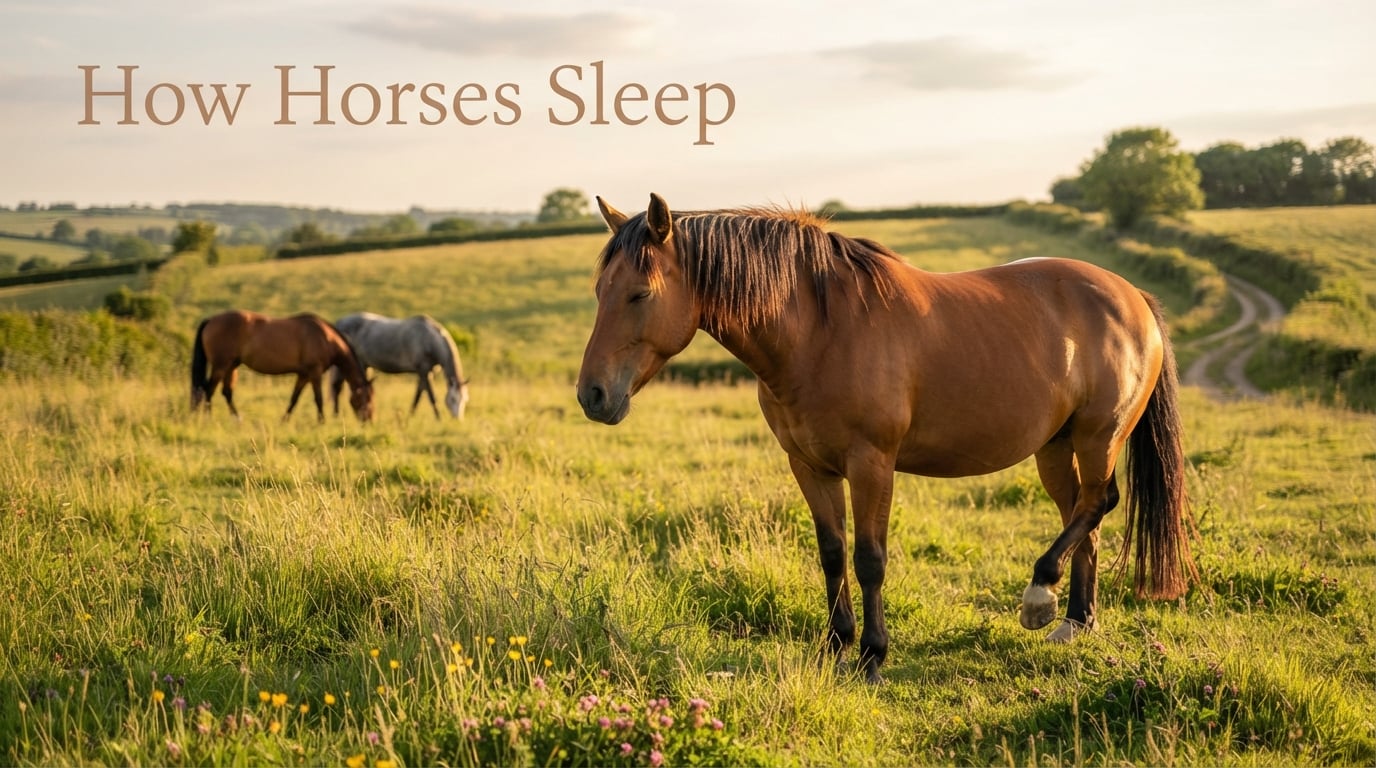
If you have ever spent an evening watching your herd and wondered how horses actually get their rest, you are not alone. The way horses sleep is one of the most fascinating topics in equine care, mixing unique anatomy, survival instincts, and surprising sleep cycles. In this guide, I will walk you through exactly how horses sleep, why they do it the way they do, and what you can do to make sure your horse gets the rest it needs.
Table of Contents
The Four Stages of How Horses Sleep
Horses do not simply drift off for one long stretch like we do. They experience four distinct sleep stages, and understanding them is the foundation of understanding how horses sleep overall.
Wakefulness — the alert state when the horse is aware of surroundings, ears moving, eyes wide open, and ready to react.
Drowsiness — a relaxed state with the head lowered and ears soft, often mistaken for sleep but technically still awake.
Slow Wave Sleep (SWS) — also called NREM sleep, where the horse can stand still, breathing slows, and brain waves deepen.
Rapid Eye Movement (REM) sleep — true deep sleep, where muscles fully relax and the horse must lie down.
Researchers confirm these same four stages appear in EEG studies of equine brain activity. As prey animals, horses spend more time in lighter stages so they can react to danger in seconds.
Most adult horses reach SWS while standing and only drop into REM when they lie down. Foals, on the other hand, drop into REM much faster, even while standing, because their stay apparatus is still developing.
Why Horses Sleep Standing Up: The Stay Apparatus
Horses sleep standing up because of a built-in mechanism called the stay apparatus. This system of tendons and ligaments locks the major joints in the forelimbs and hindlimbs, letting the horse rest its muscles without collapsing.
The stay apparatus works like this:
The patella locks over the femur on the hind leg, creating a passive brace.
The forelimb flexor tendons engage to keep the front legs stable.
The horse shifts its weight onto two legs and one diagonal pair, rotating the resting leg.
This is the evolutionary trade-off that lets a 1,000-pound prey animal rest without becoming vulnerable. As many owners in equestrian forums point out, this is also why you can watch a herd at midnight and see most horses dozing upright, with one standing watch.
The catch is that the stay apparatus keeps muscles partially engaged, so standing sleep is mostly light. It is perfect for dozing and SWS, but it cannot deliver REM sleep, which requires total muscle relaxation.
When Horses Lie Down: Getting REM Sleep
Horses must lie down to get REM sleep, and that is where things get really interesting. For true deep rest, the horse will settle into one of two recumbent positions:
Sternal recumbency — legs tucked under the body, head up or resting. This position can support light SWS but not always full REM.
Lateral recumbency — fully on the side, legs stretched out, head on the ground. This is the position required for genuine REM sleep in horses.
Studies show horses spend only around 30 minutes per day in REM sleep, often broken into a few short naps of 5 to 15 minutes each. Because lying down leaves them vulnerable, horses will only do it when they feel completely safe.
If you have ever wondered why your horse never seems to lie down in a busy barn, that is normal. Horses often wait for a quiet, dark stall or a familiar pasture to stretch out.
How Much Sleep Horses Actually Need
Adult horses generally need between 5 and 7 hours of sleep every day, but the way that sleep is delivered is what makes them different from us. Horses are polyphasic sleepers, which means they take many short naps around the clock rather than one long stretch at night.
Most of those hours are dozing or SWS while standing. The actual deep REM sleep totals roughly 30 to 60 minutes per day, almost always while lying down.
Here is a quick breakdown:
Adult horse total sleep: 5 to 7 hours in 24 hours
Adult horse REM sleep: about 30 minutes per day
Nap length: usually 5 to 15 minutes
Number of naps: often 6 to 10 per day
Newborn foals, in contrast, sleep more than half the day, around 12 to 14 hours, dropping in and out of REM very rapidly. As foals mature, their sleep patterns gradually shift toward the adult polyphasic schedule.
Signs a Horse Is Sleeping
Telling the difference between a relaxed horse and a sleeping horse is easier once you know what to look for. Here are the clear signs that a horse is genuinely asleep versus just resting.
Standing sleep: one hind leg cocked, head lowered, lower lip loose, ears relaxed sideways, and partial or closed eyelids.
Sternal recumbency: legs tucked under, head often resting on the ground or on a companion.
Lateral recumbency: fully stretched out on the side, eyes closed, occasional twitching, soft snoring or snorting sounds.
REM signs: rapid eye movement under closed lids, twitching ears, muzzle quivering, and limb jerks.
If you see the rapid eye and twitch combo, you are watching REM sleep. That is also when most owners report seeing horses appear to dream, although we can only guess what those dreams are about.
Herd Behavior: Why Safety Matters for Sleep
Horses do not sleep deeply unless they feel safe, and herd behavior is their built-in security system. In a healthy herd, one or two horses stay alert while the others lie down, rotating the role through the night.
This is why solitary horses often struggle to get enough REM sleep. Many owners on equestrian forums report that single horses, or those kept alone in stalls, show clear signs of sleep deprivation over time. Without a herd to share watch duty, the horse simply does not feel safe enough to lie down.
If you keep a horse alone, this is something to actively manage. Stable companions, mirrors, or simply extra turnout time can help encourage your horse to settle.
How Foal Sleep Differs From Adult Horses
Foals sleep a lot, often more than half of every day, and their sleep is much more REM-heavy than adult horses. This is one reason foals are so fun to watch: they flop down for naps every couple of hours, often right in the middle of the pasture.
Key differences include:
Foals can enter REM sleep while standing because their stay apparatus is not fully developed.
Foals nap more often in shorter cycles and lie down far more readily than adults.
Foals often pile up together for naps, which adds warmth and a sense of safety.
By around 3 months of age, foal sleep starts to look more like adult sleep. By weaning, they are usually on the same polyphasic pattern as the rest of the herd.
What Affects Your Horse’s Sleep Quality
Several factors can interrupt or reduce sleep quality, and most of them come up in owner forums and equine veterinary research.
Stable environment — bright lights, noise, or constant activity prevent lying down.
Physical discomfort — arthritis, sore hooves, or ill-fitting tack make lying down painful.
Social isolation — alone horses delay REM sleep for days at a time.
Recent travel or stress — transport, competition, or new surroundings delay deep sleep.
Senior horse changes — older horses often avoid lying down due to stiffness, which can lead to REM debt.
Senior horses are an underappreciated group when it comes to sleep. Many older horses quietly suffer from partial sleep deprivation because the effort of getting up and down becomes harder. If you manage a senior horse, pay extra attention to whether they are actually lying down to nap.
How to Help Your Horse Sleep Better
You cannot force a horse to sleep, but you can absolutely set the stage for high-quality rest. Here are the practical steps our team uses and that equine behavior experts recommend.
Provide as much turnout as possible, ideally with compatible companions.
Keep nighttime lighting dim, since horses are sensitive to overhead light.
Use deep, dry bedding in stalls to encourage lying down.
Schedule turnout and feeding around natural rest cycles, with most forage access overnight.
Address pain early, including joint, hoof, and dental discomfort.
Avoid bedding or stall changes right before peak rest hours.
For solitary horses, consider a stable mirror or companion animal to reduce anxiety.
Owners often see a noticeable improvement in demeanor and performance within a week of fixing environmental issues. A horse that actually sleeps deeply is calmer, healthier, and far easier to train.
When Sleep Goes Wrong: Deprivation and Disorders
Sleep deprivation in horses is real and can have serious consequences. Horses can delay REM sleep for several days, but the debt eventually shows up. Symptoms of sleep deprivation include:
Sudden collapse in the stall, often mistaken for a seizure
Excessive drowsiness and slow reactions
Poor performance and dulled responses
Increased irritability or spookiness
Narcolepsy is rare but documented in horses, particularly in certain breeds. It causes sudden loss of muscle tone triggered by excitement. Hypersomnia, where the horse sleeps far more than normal, can also occur and usually signals an underlying issue.
If you suspect your horse is sleep deprived or showing collapse symptoms, call your vet. Most cases resolve once the environment and pain issues are corrected.
Frequently Asked Questions
How long do horses lie down to sleep?
Most horses lie down for short naps of about 5 to 15 minutes at a time, totaling roughly 30 to 60 minutes of REM sleep per day. They only lie down when they feel completely safe.
How can you tell if a horse is asleep?
Look for a lowered head, cocked hind leg, droopy lower lip, soft ears, and closed or half-closed eyes for standing sleep. For REM sleep, the horse lies flat on its side, often twitching, with rapid eye movement under closed lids.
Do horses ever get tired of standing up?
Yes. Horses shift weight regularly and rotate which hind leg they rest on. Standing rest is light sleep, so they still need to lie down for true deep REM sleep every few days.
Do horses sleep standing?
Yes, horses sleep standing up using a mechanism called the stay apparatus, which locks their leg joints. They use this for dozing and slow wave sleep, but they must lie down for REM sleep.
Do horses sleep lying down every night?
Most horses lie down at least once per day to get REM sleep, but some delay it for several days if the environment does not feel safe. Solitary or stressed horses are most likely to skip lying down.
How many hours a day should a horse sleep?
Adult horses need 5 to 7 hours of total sleep per day, including around 30 minutes of REM sleep. Foals sleep 12 to 14 hours per day while they are growing.
Final Thoughts on How Horses Sleep
Understanding how horses sleep helps you spot problems before they become serious. The basics are simple: horses are polyphasic sleepers who rest standing for most of their day and only lie down briefly for REM sleep, relying on their herd to keep watch.
Start by watching your own horse for a few days. Count the naps, watch for lying-down behavior, and check the environment for lighting, bedding, and companions. Small changes usually deliver big improvements in rest quality, and a well-rested horse is one of the best investments you can make for 2026.