
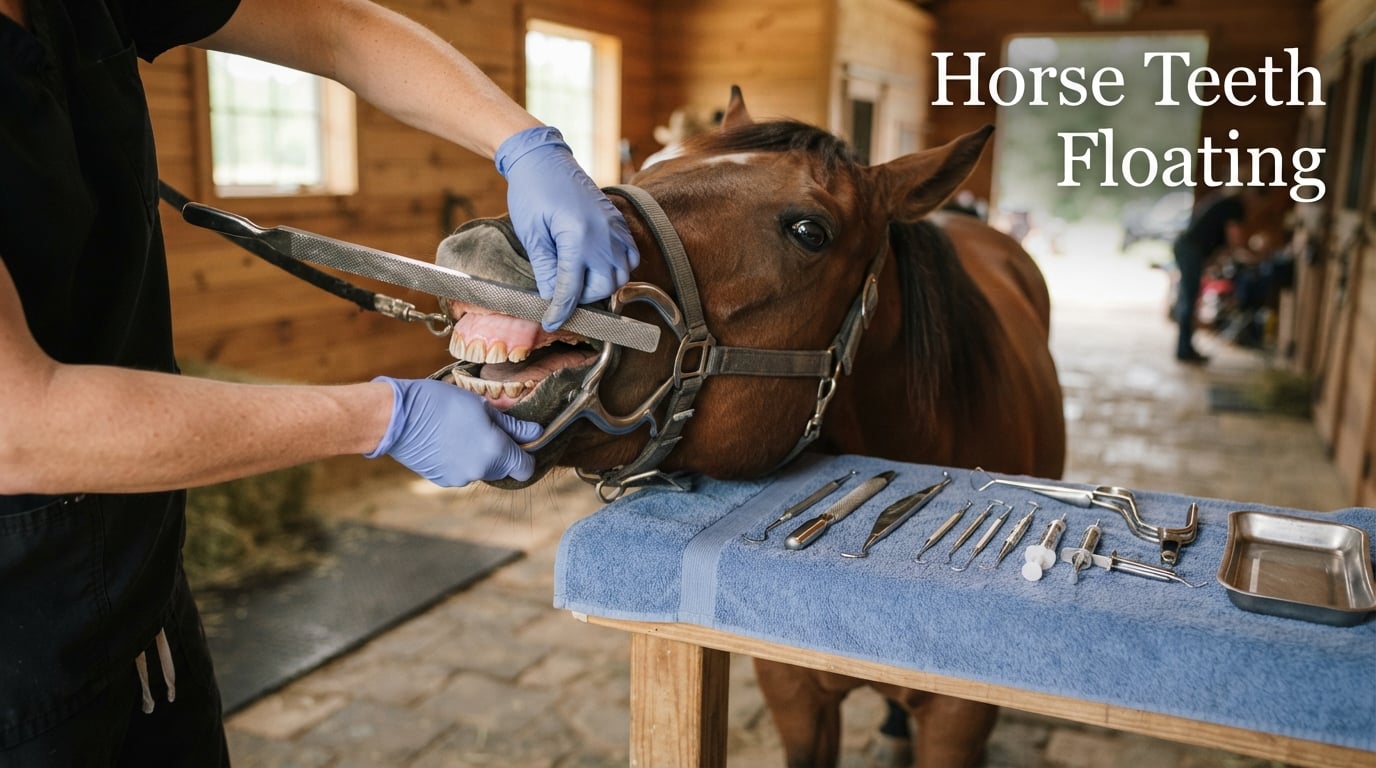
Horse teeth floating is a routine equine dental procedure where a veterinarian or equine dentist files down sharp enamel points and smooths uneven surfaces on a horse’s teeth, typically recommended once or twice a year. I learned this the hard way when my gelding started dropping half-chewed hay all over his stall. After his first float, the change was obvious within a week. This guide covers everything you need to know about horse teeth floating, from what actually happens during the procedure to how often your horse really needs one.
Whether you are a first-time horse owner or have been around barns for decades, understanding floating helps you catch problems early and avoid expensive dental corrections later.
Table of Contents
What Is Horse Teeth Floating and How Does It Work?
Horse teeth floating is a dental procedure that uses specialized rasps or power tools to file down sharp enamel points and correct uneven wear on a horse’s cheek teeth. The term “floating” comes from the name of the tool used, a dental float, which resembles a farrier’s rasp but is designed for oral use.
The procedure targets the premolars and molars at the back of the mouth. These are the grinding surfaces that process forage, grain, and roughage throughout a horse’s life. Over time, normal chewing creates sharp points along the edges of these teeth, points that can cut into the cheeks and tongue, causing ulcers and pain.
A typical horse teeth floating session involves three main actions. First, the practitioner smooths the sharp enamel points that form along the outer edges of the upper molars and inner edges of the lower molars. Second, they correct any minor malocclusions, including hooks, ramps, waves, or steps that have developed. Third, they balance the overall bite so the horse chews evenly on both sides of its mouth.
Most horses tolerate the procedure well with light sedation, and a full float takes between 30 and 60 minutes depending on the horse’s age and the amount of correction needed.
Why Do Domestic Horses Need Their Teeth Floated?
Horses have hypsodont teeth, which means their teeth continue to erupt (grow) throughout most of their lives, pushing out from the jaw at a rate of about 2 to 3 mm per year. This evolutionary trait made sense when wild horses grazed on abrasive grasses for 16 to 18 hours a day. The constant grinding wore teeth down evenly, matching the rate of eruption.
Modern domesticated horses eat a completely different diet. They consume softer hay, pelleted feeds, and limited pasture. Their chewing motion is more lateral and less aggressive than wild grazing. This uneven wear creates sharp points, hooks, and ramps that would rarely develop in a wild herd.
Wild Horses vs Domestic Horses: Why the Difference?
Wild horses almost never need their teeth floated because their natural lifestyle keeps their teeth worn evenly. They spend most of their day walking and grazing on tough, fibrous grasses that contain silica and grit. This constant grinding wears the chewing surfaces uniformly.
Domestic horses live in a different world. They eat twice daily from feeders, munch on softer hays, and rarely travel long distances to graze. Their jaw motion is reduced, and the chewing pattern is different. This combination leads to uneven wear patterns that wild horses simply do not develop.
So when owners ask why wild horses do not need teeth floated, the answer comes down to diet and lifestyle. The teeth themselves are identical. The wear patterns differ entirely.
Common Dental Problems That Floating Corrects
Several abnormal wear patterns develop in domestic horses, and floating addresses each one.
Hooks form at the very front of the first upper cheek tooth or the back of the last lower cheek tooth. They occur when the jaw’s natural motion does not fully contact those edges. Severe hooks can interfere with bit fit and cause pain.
Ramps are similar to hooks but appear as a sloped surface on the front of the first upper cheek tooth. They often develop in horses with overbite or underbite conformation.
Wave mouth describes an uneven chewing surface where some teeth are taller than others, creating a wavy pattern. This condition worsens over time without intervention and can make chewing nearly impossible in advanced cases.
Step mouth occurs when one tooth grows taller than its neighbor, creating a step-like profile. It usually follows a lost or damaged tooth.
Diastema refers to gaps between teeth where food packs in and causes gum disease. Floating alone cannot close a diastema, but it can reduce the gaps and slow food impaction.
Tools Used and the Step-by-Step Floating Procedure
The horse teeth floating procedure uses several specialized tools, and knowing what they are helps you understand what to expect on the day of the appointment.
Dental speculum: A metal frame that holds the horse’s mouth open safely. Modern speculums are adjustable and padded for the horse’s comfort.
Hand float: A manual rasp that the practitioner moves back and forth by hand. Hand floats are quiet, precise, and require more time per tooth. Many experienced equine dentists still prefer them for detailed work.
Power float: A motorized rotary tool that removes enamel more quickly. Power floats speed up the procedure dramatically, especially for horses with significant corrections needed, but they can also remove too much material if used by an inexperienced practitioner.
Head stand: A padded cradle that supports the horse’s head during the procedure. Some practitioners use a hanging head support instead.
Irrigation system: Water spray that keeps the mouth cool and flushes away debris during power floating.
What to Expect on Procedure Day
Most horses should not eat for a few hours before the appointment, although water can usually stay available. Your practitioner will give specific instructions based on whether sedation is being used.
Step 1: Sedation. The vet administers a mild sedative, usually a combination of detomidine or xylazine with butorphanol for pain relief. Sedation keeps the horse calm and still. Most horses stand with their heads lowered and relaxed.
Step 2: Speculum placement. The speculum is fitted to hold the mouth open so the practitioner can see and reach all the cheek teeth.
Step 3: Oral exam. Before any filing begins, the practitioner inspects every tooth, checks the tongue and cheeks for ulcers, and identifies any abnormalities.
Step 4: Floating. Using either a hand float or power float, the practitioner files down sharp points and corrects the bite surface. Each side of the mouth takes 10 to 15 minutes.
Step 5: Final check. The practitioner verifies the bite is balanced and the horse can close its mouth comfortably. The speculum is removed.
Step 6: Recovery. The horse is walked back to its stall or paddock to wake up from sedation. Most horses recover within 2 to 4 hours and are back to eating normally by evening.
How Long Does the Procedure Take?
A routine horse teeth floating appointment takes 30 to 60 minutes from start to finish. Young horses with mild sharp points may be done in 30 minutes, while senior horses with wave mouth or significant hooks may need 90 minutes or longer.
7 Signs Your Horse Needs Its Teeth Floated
Horses cannot tell us when their teeth hurt, but their behavior and eating habits speak volumes. Here are the most common signs I have seen in my own horses and heard about from other owners.
1. Quidding (dropping food): Your horse forms a ball of half-chewed hay or grain and lets it fall from its mouth. Quidding is the single most common sign of dental pain and almost always points to sharp points or hooks.
2. Weight loss despite a normal appetite: If your horse is eating the same amount but losing body condition, poor chewing efficiency is a likely culprit. Undigested grain in the manure is another red flag.
3. Head tossing or tilting under saddle: Dental pain often shows up as resistance to the bit. The horse may toss its head, tilt its nose, or refuse to take one rein.
4. Bad breath or foul smell from the mouth: A sour or rotting odor suggests infected teeth, gum disease, or food packed into a diastema.
5. Excessive salivation or drooling: While some saliva is normal during eating, constant drooling when not eating often signals mouth pain.
6. Difficulty chewing or slow eating: If your horse takes much longer than usual to finish its grain, dental issues may be slowing it down.
7. Behavioral changes: Grumpy horses that suddenly resist grooming, bucking under saddle, or pin their ears when bridled may be reacting to oral pain.
If you notice any of these signs, schedule a dental exam promptly. Waiting can turn a simple float into a more complex correction.
Benefits of Regular Dental Floating for Horses
Routine horse teeth floating delivers benefits that go far beyond a comfortable mouth. I have tracked body condition, manure consistency, and bit acceptance in my own horses before and after floating, and the differences are clear.
Better digestion: Properly ground forage absorbs nutrients more efficiently. Horses with sharp points swallow longer pieces of hay that pass through undigested.
Stable weight maintenance: Senior horses especially benefit. I have watched underweight geriatric horses gain 30 to 50 pounds over six months after starting regular dental care.
Improved bit acceptance: Horses with smooth, balanced mouths work more willingly. Riders often report softer contact within weeks of a float.
Reduced choke risk: Choke (esophageal obstruction) often starts with poorly chewed food. Floating helps horses grind hay and grain into safer sizes.
Lower colic risk: Poor chewing contributes to impaction colic. Smooth teeth plus proper grinding reduce the chance of feed blockages in the gut.
Extended working life: Performance horses with regular dental care stay sound and willing longer than those without.
How Often Should Horses Have Their Teeth Floated?
The answer depends on age, diet, and individual wear patterns. Here is what most equine dentists and veterinarians recommend.
Young horses (2 to 5 years): Every 6 months. Young horses shed baby teeth (caps) and develop adult teeth rapidly. Six-month intervals catch problems early and remove retained caps that can disrupt the bite.
Adult horses (5 to 15 years): Once per year. Annual floating keeps the bite balanced and addresses wear before it becomes severe.
Mature horses (15 to 20 years): Every 9 to 12 months. As teeth wear down and roots shorten, more frequent checks help catch loose or fractured teeth.
Senior horses (20+ years): Every 6 to 9 months. Older horses can outlive their teeth, and the roots eventually push out entirely. Regular care keeps them eating comfortably through their final years.
Miniature horses follow the same schedule as full-size horses. Their teeth are proportionally similar, and they develop the same sharp points despite their smaller mouths.
Vet vs Equine Dentist: Who Should Float Your Horse?
You do not have to be a veterinarian to float horse teeth in most US states, but laws vary by location. Both licensed veterinarians and certified equine dentists can legally perform the procedure in many areas. Some states restrict the practice to veterinarians only.
Veterinarians bring medical training and the ability to sedate, prescribe medication, and handle complications. They are the only legal option in some states.
Equine dentists often have more specialized dental training and may use hand floats exclusively. Many horse owners prefer them for routine maintenance because of their focus.
The best choice depends on your state’s regulations and your horse’s specific needs. Horses with complicated dental problems should always see a veterinarian.
Horse Teeth Floating FAQs
How much does it cost for a horse to get its teeth floated?
The average cost of horse teeth floating ranges from 80 to 250 dollars, depending on your location, whether sedation is used, and how much correction is needed. A simple float on a healthy adult horse typically falls between 100 and 150 dollars. Power floats, full-mouth dental x-rays, and senior horse care usually cost more.
What do floating teeth mean in horses?
Floating teeth in horses means filing down the sharp enamel points and uneven surfaces that develop on a horse’s cheek teeth. The name comes from the dental float, the rasp-like tool used to smooth the teeth. It is a routine, non-surgical procedure that most horses need once or twice a year.
Why do wild horses not need teeth floated?
Wild horses do not need their teeth floated because their natural diet of abrasive grasses grazed over 16 to 18 hours a day wears their teeth evenly as they erupt. Domestic horses eat softer feeds in shorter sessions, which creates the uneven wear and sharp points that floating corrects.
Do you have to be a vet to float horses’ teeth?
You do not always have to be a veterinarian to float horses’ teeth. In many US states, certified equine dentists can legally perform routine floating, but laws vary by state. Veterinarians are required for sedation, extractions, and treatment of dental disease.
How long does it usually take to float a horse’s teeth?
Horse teeth floating usually takes 30 to 60 minutes for a routine float. Young horses with mild sharp points may be done in 30 minutes, while older horses with wave mouth, hooks, or other corrections may need 60 to 90 minutes.
Is teeth floating painful for horses?
Teeth floating is not painful for horses because they are sedated beforehand and the procedure only files dead enamel. Horses may feel mild pressure but no sharp pain, and most return to eating normally the same day.
How long after teeth floating can I ride my horse?
You can usually ride your horse the day after teeth floating, once the sedation has fully worn off. Most horses recover from sedation within 2 to 4 hours and are safe to ride the following morning, though some practitioners recommend waiting 24 hours for full bit acceptance.
Final Thoughts on Horse Teeth Floating
Horse teeth floating is one of the most important routine care tasks you can schedule for your horse. It prevents painful ulcers, supports healthy weight and digestion, and keeps your horse comfortable under saddle. Most horses need a float once or twice a year, with young horses and seniors requiring more frequent checks.
If your horse shows any of the warning signs covered in this guide, book a dental exam with a qualified veterinarian or equine dentist in your area. Catching dental problems early saves money, prevents suffering, and extends the working life of every horse in your care.