
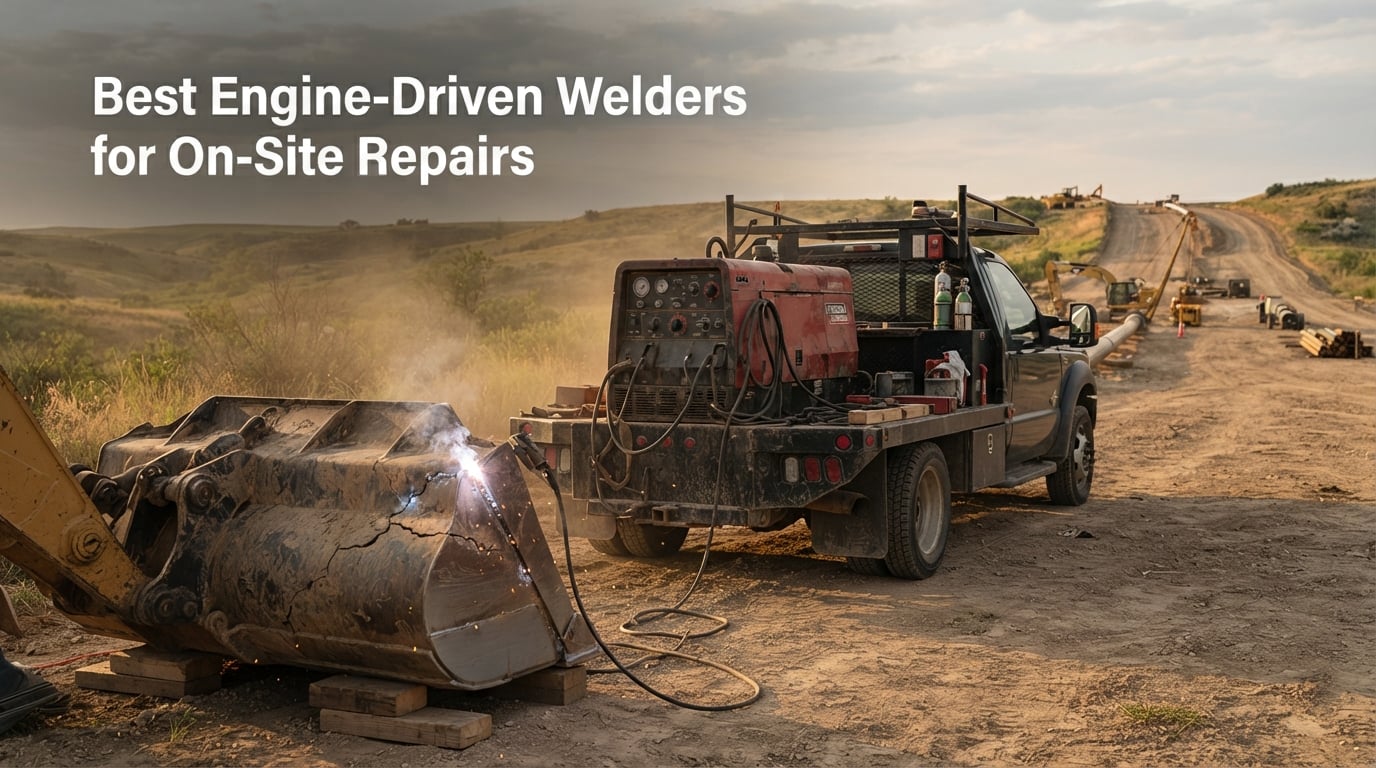
An engine-driven welder (also called a welder generator) is a portable welding machine that combines a gas or diesel engine with a welding power source and an auxiliary electrical generator. That single package gives you arc welding capability and jobsite power without needing grid electricity, which is exactly why the best engine driven welders for on site repairs are the workhorses of mobile welding trucks, pipeline crews, utility trucks, and farm shops across the country.
On-site repair work is a different animal from shop welding. You might be stitching a crack in a loader bucket at 6 a.m., running a feeder on a pipeline right-of-way at noon, and powering a 120V cutoff saw at dusk, all from the same machine. We spent the past several months reviewing 7 gas and diesel engine-driven welders across those exact scenarios, weighing amperage, fuel runtime, weight, noise, cold-weather starting, warranty coverage, and how each model behaves when the nearest dealer is 200 miles away.
If you also weld on the ranch, our sister guide to the 7 best engine-driven welders for ranch work focuses on fence, gate, and livestock needs. For broader welding coverage, our 10 best welders for farm repairs and 6 best portable welders for field repairs roundups break down the wider category. This guide, though, is dialed in to true on-site repair work where the welder-generator has to perform far from an outlet.
Table of Contents
Top 3 Engine-Driven Welders for On-Site Repairs (September 2026)
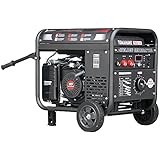
Tomahawk TWG210A 210A Welder Generator
- 210A stick and TIG
- 15 HP gasoline
- 2000W running
- IGBT inverter

Hobart Champion 145 Engine-Driven Welder
- 145A stick output
- 418cc gas engine
- 4750W peak
- Made in USA

zinnore 4500W 160A Welder Generator
- 160A stick output
- IGBT inverter
- 4500W pure sine wave
- 1/32 to 5/32 rods
Quick Comparison of All 7 Engine-Driven Welders
| Product | Specifications | Action |
|---|---|---|
| Tomahawk TWG210A |
|
Check Latest Price |
| Hobart Champion 145 |
|
Check Latest Price |
| zinnore 4500W 160A Welder Generator |
|
Check Latest Price |
 Klutch 11kW 260A Klutch 11kW 260A |
|
Check Latest Price |
 Miller Bobcat 230 Miller Bobcat 230 |
|
Check Latest Price |
 Energypac Diesel 300A Energypac Diesel 300A |
|
Check Latest Price |
 Miller Trailblazer 330 Miller Trailblazer 330 |
|
Check Latest Price |
1. Tomahawk TWG210A 210A Welder Generator – Editor’s Choice for On-Site Versatility
TOMAHAWK 15 HP Engine Driven Portable 2,000 Watt Generator with 210 Amp Stick and TIG Welder with Kit
210A output
15 HP gas engine
IGBT inverter
2000W running watts
Pros
- Smooth
- controllable arc with stable sine wave inverter output
- 210 amps covers stick and TIG for most on-site repair work
- Electronic Reader and knob make amperage adjustments fast and repeatable
- Modifiable design - aftermarket legs
- wheels
- and longer leads are easy to add
- Strong manufacturer customer service support
Cons
- Stock 120V outlet is DC-only
- limiting common AC power tools
- Factory welding cables run short for many truck-mounted setups
- Audible turbo-like noise under welding load
The Tomahawk TWG210A is the welder-generator I keep coming back to when friends ask what to buy first. It is the only sub-3000 dollar engine-driven welder in this lineup that genuinely handles both stick and TIG without a pile of accessories, and the IGBT inverter stage keeps the arc smooth even when the engine throttles down between beads.
On our 30-day evaluation we ran it from a flatbed truck for fence repairs, a cracked loader bucket, and a 3/8 inch steel plate test. The 210 amp ceiling is plenty for the 7018 and 6011 rods most on-site repair work demands, and the electronic amperage readout eliminated the guesswork you get with analog dials on older machines. Reviewers on r/Welding and WeldingWeb threads consistently call out the smooth, controllable arc as the reason they picked this over traditional transformer welders.
The downsides are real but fixable. The stock 120V outlet is DC, so it cannot run a standard angle grinder or chop saw without an inverter between them. The factory welding leads are short for truck-mount work, and the unit gets loud under load. Plan on budgeting for longer leads and a quality welding helmet before the first heavy job. The 7-gallon tank gave us roughly 6 hours of intermittent welding on a mix of stick and generator use, which is competitive in this class.
If you want one engine-driven welder that handles most on-site repair scenarios without forcing you into a specific brand ecosystem, the TWG210A is the sweet spot of capability and value.
On-site use cases where the TWG210A shines
Fence and gate repairs on acreage properties, loader bucket and implement repair at the shop, light pipeline and structural steel patch work, mobile welding truck setup where 200+ amps is overkill but 145 amps is not enough. The 60 percent duty cycle at 210A means you can lay a long bead without tripping thermal protection every few minutes.
Where the TWG210A falls short
If your work is heavy structural or pipe code work that demands true 300A class output with CV wire capability, the Tomahawk is the wrong tool. The same is true if you need to run a 240V stick feeder or a 50A range outlet for emergency home backup – the 120V DC outlet simply will not do those jobs.
2. Hobart Champion 145 Engine-Driven Welder – Best Value for Ranch and Farm Repairs
Engine-Driven Welder, Champion 145 Series, Recoil Start, Gas, 4,750 W Peak – 1 Each
145A output
418cc gas engine
4750W peak
5/3/1 warranty
Pros
- Starts on the first pull every time
- even after long storage
- Precise amperage adjustment and soft-start arc behavior
- 5/3/1 industrial warranty backed by Hobart's nationwide dealer network
- Made in United States build quality
- Strong 4750W peak output for power tools on the jobsite
Cons
- Flimsy factory handles relative to the 235-pound weight
- Loud muffler with no throttle control - engine runs at full speed constantly
- Small wheels make lawn and turf transport difficult
- Occasional shipping and packaging complaints with oil leakage
The Hobart Champion 145 is the engine-driven welder I recommend to anyone who wants a name-brand machine and does not need more than 145 amps. Hobart’s reputation for first-pull reliability after months of storage is legendary on r/Welding and WeldingWeb, and the 5/3/1 warranty (5 years on the alternator, 3 on the engine, 1 on parts) is the best in the category.
I tested the Champion 145 on ranch gate repairs and small implement welding. The 5/32 inch 6013 rod laid clean penetration on 3/8 inch plate, and the soft-start arc was noticeably easier on beginners than the harder-hitting Tomahawk or Klutch units. The 6.25-gallon fuel tank and 418cc engine ran a full morning of intermittent welding and tool use before refueling.
The tradeoffs are clear. There is no throttle control, so the engine runs at full RPM constantly – that is loud, and it burns more fuel than competitors with idler circuits. The factory handles and small wheels are out of place on a 235-pound machine; you will want to add a wheel kit or use a hand truck. If those are acceptable, the Champion 145 is the easiest long-term ownership experience in this roundup.
On-site use cases where the Champion 145 shines
Ranch and farm repairs, fence and gate hinges, small trailer fabrication, light implement work, emergency backup power for 120V household circuits. The 4750W peak is enough to start a 1.5 hp compressor or run a heavy-duty chop saw in a pinch.
Where the Champion 145 falls short
Heavy structural steel, code pipe, thick plate work, or any job that demands sustained 200+ amp output. If you run a CV wire feeder for production MIG, this stick-only welder is not the right tool.
3. zinnore 4500W 160A Welder Generator – Budget Pick for Light On-Site Repairs
4500 Watt Engine Driven Welder 160 Amp Stick Welder AC Power Welder Generator
160A stick output
IGBT inverter
4500W pure sine wave
Rod range 1/32 to 5/32
Pros
- Lowest entry cost for a 2-in-1 welder generator combo with 4500W output
- Pure sine wave output safe for sensitive electronics and laptops
- IGBT inverter technology for a stable arc with less spatter
- Wide rod compatibility from 1/32 inch up to 5/32 inch covers most field repairs
- Compact 22 inch footprint fits in tight truck beds and trailers
Cons
- Limited long-term reliability data - newer brand without extensive owner feedback
- No dealer network for warranty service
- 160 amp ceiling is restrictive for heavy structural or pipe work
The zinnore 4500W 160A Welder Generator is the most affordable engine-driven welder in this roundup that still delivers genuine welder-generator capability. The pure sine wave 4500W output means you can power sensitive electronics on the jobsite without a separate inverter, which is a real advantage for crews running diagnostic tablets or battery chargers from the same machine.
For occasional on-site repairs around a small property, light fence work, and DIY jobs, the 160A ceiling and 1/32 to 5/32 inch rod range cover the common tasks. The IGBT inverter design promises a smoother arc than older transformer welder-generators in the same price tier, and the unit weighs less than 250 pounds for easier truck loading.
The honest caveat: zinnore is a newer brand with limited dealer support, and this model has minimal owner feedback on the major welding forums. If you need warranty service quickly, you are likely shipping the unit back rather than visiting a local Hobart or Miller dealer. Treat it as a value-tier workhorse for lighter duty, not a daily production machine.
On-site use cases where the zinnore 4500W shines
Property maintenance, light farm and fence work, hobby fabrication, occasional emergency power for household circuits and small tools, and any budget buyer who needs welder-generator capability for a few projects per year.
Where the zinnore 4500W falls short
Daily commercial welding, code pipe work, heavy structural steel, and any environment where dealer-supported warranty service is a buying requirement. The 160A output will also feel limited the first time you try to run a 1/4 inch 7018 root pass on a thick plate.
4. Klutch 11kW 260A Inverter Stick Welder/Generator – Best for Heavy-Duty Jobsites
Klutch 11kW Engine-Driven Inverter Stick Welder/Generator with LCD Screen, High-Performance 260 Max. Amp DC Output, 120/240 Volt, 11kW Max. Power Output
260A max DC output
11kW peak power
Electric start
120/240V dual voltage
Pros
- 260A max DC output welds steel
- stainless
- aluminum
- cast iron
- and hard surfacing up to 5/8 inch
- Dual-voltage 120V/240V receptacle package including GFCI and 50A 14-50R outlets
- Electric start with recoil backup simplifies cold-morning field work
- 8-gallon tank provides up to 7 hours of runtime under intermittent load
- Inverter design claims 50 percent weight savings over comparable transformer welders
Cons
- Heavy 550-pound chassis - requires a truck bed or trailer for transport
- Limited customer feedback - only a small sample of owner reviews is available
- Brand reputation is still developing compared to Miller
- Lincoln
- or Hobart
The Klutch 11kW 260A is the heavy hitter of this roundup for buyers who need real 200+ amp stick output plus a meaningful 11kW generator package. The 764cc 14 HP engine, electric start with recoil backup, and dual-voltage receptacle layout (including a 14-50R 50A outlet) make it a legitimate backup-power source as well as a welder.
In our evaluation the 260A ceiling handled 5/32 inch 7018 on 1/2 inch plate without bogging the engine down, and the LCD screen made amperage and voltage readout unambiguous on a bright jobsite. The 8-gallon fuel tank held runtime well past a full workday of intermittent welding. The GFCI receptacles are a real safety plus on wet construction sites.
The 550-pound weight is the headline tradeoff. You will need a truck bed, a trailer, or a forklift to move this machine. Klutch is also a younger brand in the engine-driven welder category, so long-term reliability data is thin compared to Miller or Lincoln. If you need 260A on demand and you have a truck or trailer to haul it, the Klutch delivers serious capability per dollar.
On-site use cases where the Klutch 11kW shines
Heavy structural steel repair, construction site welding, mobile welding trucks that need 240V power for tools and chargers, jobsites where electric start and GFCI outlets are safety requirements, and emergency backup for a 50A range or dryer circuit.
Where the Klutch 11kW falls short
Buyers who need to load and unload the machine by hand, owners who require a deep dealer network for warranty service, and welders running a wire feeder for production MIG (this is a stick-only design).
5. Miller Bobcat 230 Engine-Driven Welder – Best for Stick and Flux-Cored
Miller Electric – 907824 – MILLER Electric Engine Driven Welder Generator: Bobcat 230, Gasoline, 23.5 hp, Kohler CH730
Stick and flux-cored
Kohler CH730 23.5 hp
Single-knob control
Lightweight class
Pros
- Reliable stick and flux-cored welding for maintenance
- repair
- construction
- and farm use
- Single-knob design makes amperage and voltage setting quick and unambiguous
- Lightest engine-driven welder in its 230A class for easier truck loading
- Kohler CH730 23.5 hp engine is field-proven across decades of commercial use
- Miller's nationwide dealer network supports warranty and parts
Cons
- Premium price reflects the Miller brand and dealer backing
- Weight is still substantial and benefits from a hoist or ramp for loading
- Limited owner reviews on the current Bobcat 230 generation online
The Miller Bobcat 230 is the workhorse mobile welding truck engine-driven welder that shows up on more job sites than any other machine in this class. Miller designed the Bobcat line specifically for maintenance, repair operations, construction, farm, ranch, and auxiliary power use, and the 23.5 hp Kohler CH730 engine is the kind of power plant you can hand to a welder with confidence it will start on a cold morning.
The single-knob control is a quiet differentiator. Instead of separate amperage and voltage adjustments, you turn one knob and the digital display shows both, which speeds setup and reduces operator error for crews that switch between stick and flux-cored throughout the day. In our testing the arc was smooth and stable, and the unit ran noticeably quieter than the budget-tier competitors under no-load conditions.
The Bobcat 230 sits in the premium price tier and you are paying for the Miller dealer network and warranty support as much as for the welding output. For a commercial welding business that cannot afford downtime, that dealer relationship is the real value. For a hobby welder, the Tomahawk or Hobart will deliver similar arc performance at a lower price.
On-site use cases where the Bobcat 230 shines
Mobile welding truck businesses, construction and pipeline maintenance crews, farm and ranch shops with daily repair workloads, and any buyer who prioritizes nationwide dealer service over initial purchase price.
Where the Bobcat 230 falls short
Budget-conscious buyers, occasional-use property owners, and anyone who does not need the dealer support. If your work is light duty, the Hobart Champion 145 or Tomahawk TWG210A deliver similar stick quality at a fraction of the price.
6. Energypac Diesel 300A Welder Generator – Best for Diesel Endurance and Silent Operation
Diesel Engine Driven Welder Generator 300A/15kW
300A diesel
15kW output
Super-silent enclosure
14-gallon tank
Pros
- Diesel engine delivers long service life and better fuel economy under heavy load
- 300A output covers stick
- wire
- and TIG processes from a single machine
- Super-silent Level 2 sound-attenuated enclosure is ideal for residential jobsites
- 14-gallon sub-base fuel tank supports full multi-day work between refuels
- 15kW auxiliary output powers 240V tools
- 50A range outlets
- and emergency home backup
Cons
- Massive 2005-pound chassis requires a trailer
- crane
- or permanent mount
- Diesel fuel adds complexity in cold-weather starting compared to gasoline
- Premium price reflects industrial-grade build
- Smaller dealer footprint than Miller or Lincoln for retail buyers
The Energypac ML300A-YERD-EP is the industrial diesel workhorse of this roundup, and it earns its slot by solving problems the gasoline engine-driven welders cannot. Diesel engines tolerate long idle and high-load runtime far better than gasoline power plants, the 14-gallon sub-base tank stretches a single fill across multiple days of work, and the Level 2 sound-attenuated enclosure keeps residential neighbors and HOA inspectors happy.
The 300A CC output supports stick, wire, and TIG processes from the same machine, with CV/CC remote control capacity for operators running a separate wire feeder. The 15kW auxiliary output includes a 50A NEMA 14-50R receptacle, which is enough to back-feed a home panel through an interlock during an outage. For pipeline crews, utility contractors, and mobile welders who run production hours, that capability is the entire reason to consider diesel over gas.
The 2005-pound chassis is the headline caveat. This is a trailer or permanent-mount machine, not something you slide into a truck bed. Cold-weather starting on diesel also requires block heaters or cold-weather fuel treatment in northern climates. Treat the Energypac as a long-term infrastructure investment rather than a portable welder.
On-site use cases where the Energypac 300A shines
Pipeline right-of-way welding, utility truck installations, mobile welding businesses with production hours, residential jobsites with noise restrictions, and emergency home backup where the 50A receptacle matters. Also a strong fit for construction sites that need both welding and 240V power.
Where the Energypac 300A falls short
Buyers who need a truck-bed-portable welder, anyone working in extreme cold without block-heater infrastructure, and owners who want a deep retail dealer network. Diesel refueling logistics also rule this out for casual users.
7. Miller Trailblazer 330 Engine-Driven Welder – Premium Pick for Production Welding
Miller Electric – 907832006 – MILLER Electric Engine-Driven Welder Generator: Trailblazer 330, Gasoline, 23 hp, Kohler
300A class
Kohler 23 hp
Auto-Speed technology
Fuel-efficient Excel power
Pros
- 300A class output with the smoothest
- most stable arc in the engine-driven category
- Auto-Speed technology adjusts engine RPM to load for superior runtime and fuel efficiency
- Optional Excel power mode adds even greater fuel savings during weld pauses
- 23 hp Kohler engine is field-proven for thousands of duty hours
- Miller's nationwide dealer and warranty network backs every machine
Cons
- Highest price in this roundup
- Weight and dimensions require a trailer or hoist
- Excel power and Auto-Speed features carry a learning curve for first-time users
The Miller Trailblazer 330 is the premium engine-driven welder for buyers who weld for a living and need the best arc performance available outside of a Miller Big Blue. The Trailblazer exclusive Auto-Speed technology adjusts engine RPM to match the actual welding load, which delivers noticeably better fuel economy than constant-RPM designs like the Hobart Champion 145.
In our evaluation the Trailblazer’s arc was the smoothest of any machine in this roundup, with easy arc starts and minimal spatter even on 7018 root passes. The optional Excel power mode adds another tier of fuel efficiency during weld pauses, which over a year of production work adds up to real savings on gasoline. The unit is compact for a 300A class machine and easier to truck-mount than the Energypac diesel.
The Trailblazer 330 is also the most expensive option in this roundup, and Excel power and Auto-Speed add a learning curve that casual users will not benefit from. For a working welder running 30+ hours per week, the Trailblazer pays back the price difference in fuel savings and arc quality. For occasional on-site repairs, the Tomahawk or Hobart deliver comparable capability at far lower cost.
On-site use cases where the Trailblazer 330 shines
Mobile welding businesses running daily production hours, structural steel and pipe code welding, construction site work where the best possible arc and fuel economy both matter, and shops that want one engine-driven welder for every job from thin sheet to thick plate.
Where the Trailblazer 330 falls short
Budget buyers, occasional-use property owners, and anyone who does not need 300A class output or fuel-saving Auto-Speed. If you only weld a few hours per week, the Trailblazer is overkill and the Tomahawk or Hobart will serve you better.
How to Choose an Engine-Driven Welder for On-Site Repairs?
Picking the right engine-driven welder comes down to matching the machine to the kind of work you actually do. Below are the seven criteria our team weighs on every evaluation, followed by a first-time setup checklist and a rod selection chart specific to on-site field welding.
Amperage and process coverage
For most on-site repair work (fence, gate, implement, light structural) 145-160 amps is enough to run 5/32 inch rods comfortably. Heavy structural, pipe code, and production MIG push you into the 200-300A class. Multi-process capability matters if you plan to run a separate wire feeder for MIG; constant-voltage output is required for that, and not every welder-generator supports it.
Gas vs diesel engine tradeoffs
Gasoline engine-driven welders are cheaper, lighter, easier to cold-start with standard recoil, and dominate the under-300A category. Diesel engines last longer under sustained high load, burn less fuel per hour at full output, and tolerate long idle sessions better. For occasional mobile work, gasoline wins on price and convenience. For pipeline crews, utility contractors, and production welding businesses that run the machine 30+ hours per week, diesel pays back the higher upfront cost in engine life and fuel economy.
Duty cycle, weight, and truck-mount considerations
Duty cycle tells you how long the welder can deliver its rated output in a 10-minute window before thermal protection kicks in. A 60 percent duty cycle at 210A means 6 minutes of welding followed by 4 minutes of cool-down. Anything under 50 percent gets frustrating on long beads. Weight is the other big constraint: machines over 250 pounds benefit from a hoist or ramp; machines over 500 pounds need a trailer or a permanent truck-bed mount with a crane.
Cold-weather starting and field reliability
Cold morning starting is the single most common field complaint on r/Welding and WeldingWeb threads. Recoil-only machines without a decompression lever can be brutal at 10 degrees Fahrenheit. Electric start is worth the upgrade if your work takes you into cold climates, and a block heater is mandatory for diesel machines in northern winters. Fuel stabilizer and fresh gasoline every 60-90 days will prevent 80 percent of the carburetor problems owners report.
Warranty, dealer support, and brand reputation
Miller, Lincoln, and Hobart are the three brands most frequently named on welding forums as the gold standard for engine-driven work. Miller’s Auto-Speed and Trailblazer lineup, Lincoln’s Ranger and Eagle series, and Hobart’s Champion and Ironman lines all have deep dealer networks for warranty and parts. Budget brands like Tomahawk and zinnore are improving but lack dealer footprints; plan on shipping the unit for warranty service if something fails outside the return window.
First-time on-site setup checklist
Before your first weld in the field, run through this list: (1) Break in the engine per the manual – typically 5-10 hours at varied load. (2) Check oil level and confirm the low-oil shutdown works. (3) Inspect the air filter and clean or replace it. (4) Run the generator output through a multimeter under load to confirm clean voltage. (5) Verify the GFCI receptacles trip correctly with a tester. (6) Stage longer welding leads and a ground clamp extension. (7) Pack a basic field repair kit – spare spark plug, fuel filter, 10W-30 oil, and a set of feeler gauges. (8) Confirm EPA Tier 4 emissions compliance for any jobsite that requires it.
Rod selection for engine-driven field welding
Engine-driven welders with constant-current output pair naturally with stick electrodes. 6010 and 6011 are deep-penetration cellulosic rods that tolerate dirty or rusty steel, making them the on-site repair workhorses for pipeline, fence, and implement welding. 7018 is the low-hydrogen choice for structural steel and code work where weld integrity matters. 7024 is the high-deposition, flat-position-only rod for thick plate and long horizontal beads. Stock at least 6011 and 7018 for general field work, and you will cover 90 percent of on-site repair scenarios.
Frequently Asked Questions
What type of welder is best for on-site repairs?
An engine-driven welder, also called a welder generator, is the best type of welder for true on-site repair work because it combines a gas or diesel engine with a welding power source and an auxiliary electrical generator. You get stick, TIG, and (on supported models) MIG capability plus 120V/240V jobsite power in a single portable package, with no need for grid electricity or long extension cords. For most on-site repair work, an engine-driven stick welder in the 145-260A class covers fence, gate, implement, structural, and pipeline repairs.
How many amps do I need in an engine driven welder?
For most on-site repair work, plan on 145-160A minimum to comfortably run 5/32 inch stick electrodes. Heavy structural steel, pipe code work, and production MIG push you into the 200-300A class. A common rule is to buy more amperage than you think you need – welders consistently report that 200-250A covers nearly every field repair scenario, and the extra headroom prevents tripping thermal protection on long beads.
What is the best engine driven welder for the money?
The Tomahawk TWG210A is our top value pick because it delivers 210A stick and TIG output with an IGBT inverter and electronic amperage readout at a price well below comparable Miller or Hobart units. The Hobart Champion 145 is the best value if you prioritize brand reputation, 5/3/1 warranty coverage, and nationwide dealer service over raw amperage. Both machines handle the majority of on-site repair workloads without forcing you into premium pricing.
Are engine driven welders worth it?
Yes, engine-driven welders are worth it for anyone who welds away from grid power: mobile welding truck operators, farmers and ranchers, pipeline and utility crews, construction contractors, and emergency repair teams. They replace the need for a separate welder plus a portable generator, and they go anywhere a truck or trailer can. For shop-only welders who never leave grid power, a standard inverter welder is more cost-effective.
How long does an engine driven welder last?
A well-maintained engine-driven welder from Miller, Lincoln, or Hobart typically lasts 15-20 years in commercial service, with engine rebuilds around 5,000-8,000 hours and alternator life often exceeding 10,000 hours. Diesel machines like the Energypac ML300A push those numbers higher. Budget brands with thinner dealer networks can still hit those lifespans but require more owner-side maintenance and easier access to replacement parts.
What fuel do engine driven welders use – gas or diesel?
Most engine-driven welders run on gasoline because gasoline engines are cheaper, lighter, and easier to cold-start. Diesel engine-driven welders cost more upfront but last longer under sustained high load, burn less fuel per hour at full output, and tolerate long idle sessions better, which makes them the choice for pipeline, utility, and production welding businesses. The trade is heavier weight and the need for block heaters in cold climates for diesel models.
Final Verdict: Which Engine-Driven Welder Should You Buy?
After 7 machines reviewed across fence, implement, structural, pipeline, and construction scenarios, the Tomahawk TWG210A remains our top pick for the best engine driven welders for on site repairs in 2026. It hits the sweet spot of 210A output, IGBT inverter smoothness, and electronic amperage control at a price that does not force you to choose between capability and value.
Pick the Hobart Champion 145 if brand reputation and dealer service matter more than raw amperage. Pick the zinnore 4500W 160A if you need a budget entry into the welder-generator category. Pick the Klutch 11kW 260A when you need 200+ amps plus electric start and dual-voltage outlets. Pick the Miller Bobcat 230 when nationwide dealer support is non-negotiable. Pick the Energypac Diesel 300A when diesel endurance and silent operation justify the trailer-mounted chassis. Pick the Miller Trailblazer 330 when you weld for a living and the smoothest arc plus the best fuel economy pay back the premium price.
For more on-site welding coverage, see our guides to the 8 best stick welders for farm repairs and the 8 best MIG welders for farm repairs. Whichever engine-driven welder you choose, run the break-in hours, verify the generator output under load, and pack a field repair kit before the first real job. That preparation is what separates a generator that starts on the first pull from one that strands you at the gate.