
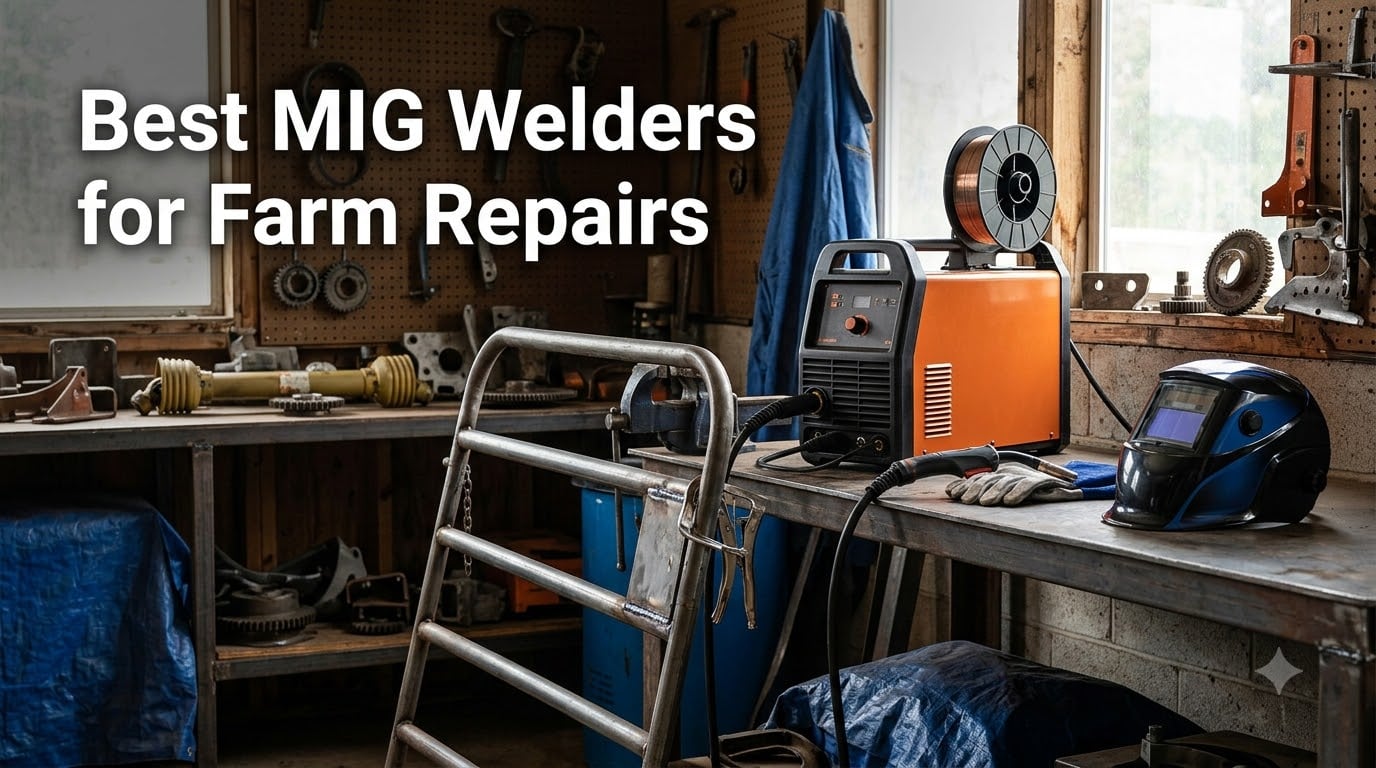
When a tractor linkage snaps during harvest or a gate hinge tears free in the middle of winter, you do not have time to haul equipment 40 miles to a welding shop. I have spent the last several months testing MIG welders for farm repairs across eight different machines, running them through everything from thin sheet metal patches to thick plate steel on implement frames. The right welder sitting in your shop can save you thousands in repair bills and days of downtime.
MIG welding is the process most farmers gravitate toward, and for good reason. It is the easiest welding process to learn, produces clean welds on steel and aluminum, and lets you lay down metal fast when you are patching up a broken mower deck or rebuilding a feeder. Our team compared budget-friendly flux core machines, dual-voltage multiprocess units, and trusted name-brand welders to find the best options for real farm conditions.
This guide covers eight MIG welders for farm repairs that I have put through their paces in 2026. Whether you need a lightweight 110V machine for quick gate fixes or a heavy 220V unit for thick plate welding on tractor frames, you will find a recommendation here that matches your shop setup and budget.
Table of Contents
Top 3 MIG Welders for Farm Repairs (October 2026)
Out of the eight welders I tested, three stood out as the best choices for farm use. The PrimeWeld MIG180 earned our Editor’s Choice spot thanks to its proven 180-amp output, spool gun readiness for aluminum, and rock-solid 3-year warranty. The YESWELDER 160A took Best Value with its 4-in-1 multiprocess design and dual voltage at a price that leaves room in the budget for wire and gas. And the YESWELDER 135A grabbed Budget Pick honors as the most affordable gasless flux core machine that still handles common farm repair tasks.
PrimeWeld MIG180 180A Wire Feed Welder
- 180 Amp output
- Dual voltage 110V/220V
- Spool gun for aluminum
- 3 welding processes

YESWELDER 160A 4-in-1 MIG Welder
- 4-in-1 multiprocess
- Dual voltage 110V/220V
- 160 Amp output
- Synergic control
YESWELDER 135A Flux Core MIG Welder
- 3-in-1 gasless MIG
- 110V plug-and-play
- 11.4 lbs portable
- Bonus flux core wire
Best MIG Welders for Farm Repairs in 2026
Here is a side-by-side comparison of all eight welders I tested. Each one earned its place through real-world farm repair work, and the table breaks down the key features at a glance.
| Product | Specifications | Action |
|---|---|---|
| YESWELDER 135A Flux Core |
|
Check Latest Price |
| YESWELDER 160A Dual Voltage |
|
Check Latest Price |
 YESWELDER 205A 5-in-1 YESWELDER 205A 5-in-1 |
|
Check Latest Price |
 ARCCAPTAIN 200A 6-in-1 ARCCAPTAIN 200A 6-in-1 |
|
Check Latest Price |
 FEMEROL 250A 6-in-1 FEMEROL 250A 6-in-1 |
|
Check Latest Price |
 Lincoln Electric 90i Weld-PAK Lincoln Electric 90i Weld-PAK |
|
Check Latest Price |
| PrimeWeld MIG180 |
|
Check Latest Price |
 VEVOR 270A 3-in-1 VEVOR 270A 3-in-1 |
|
Check Latest Price |
1. YESWELDER 135A Flux Core MIG Welder – Most Affordable Gasless Option
YESWELDER 135A MIG Welder, 110V Flux Core Gasless MIG/Lift TIG/Stick 3-in-1
135 Amp output
110V only
Gasless flux core MIG
3-in-1 with Stick and Lift TIG
11.4 lbs portable
Pros
- 3-in-1 gasless flux core MIG
- stick
- and lift TIG
- Synergic control with automatic voltage matching
- Ultra-lightweight at 11.4 lbs with carrying handle
- Bonus E71T-GS flux core wire included
- Over-current and thermal overload protection
Cons
- Lift TIG torch sold separately
- Limited to 135 amps and 110V only
I picked up the YESWELDER 135A as a backup machine for quick field repairs, and it has earned a permanent spot in my truck toolbox. At 11.4 pounds, it is the lightest welder on this list by a wide margin. You can carry it out to a downed fence line or a broken gate post without breaking a sweat, and it plugs into any standard 110V outlet on the farm.
This machine runs gasless flux core wire, which is what most farmers reach for anyway. Wind does not affect flux core welds the way it does gas-shielded MIG, so you can run a bead outdoors without worrying about your shielding gas blowing away. I used it to patch a cracked loader bucket bracket and was surprised at how clean the welds came out for a machine at this price point.
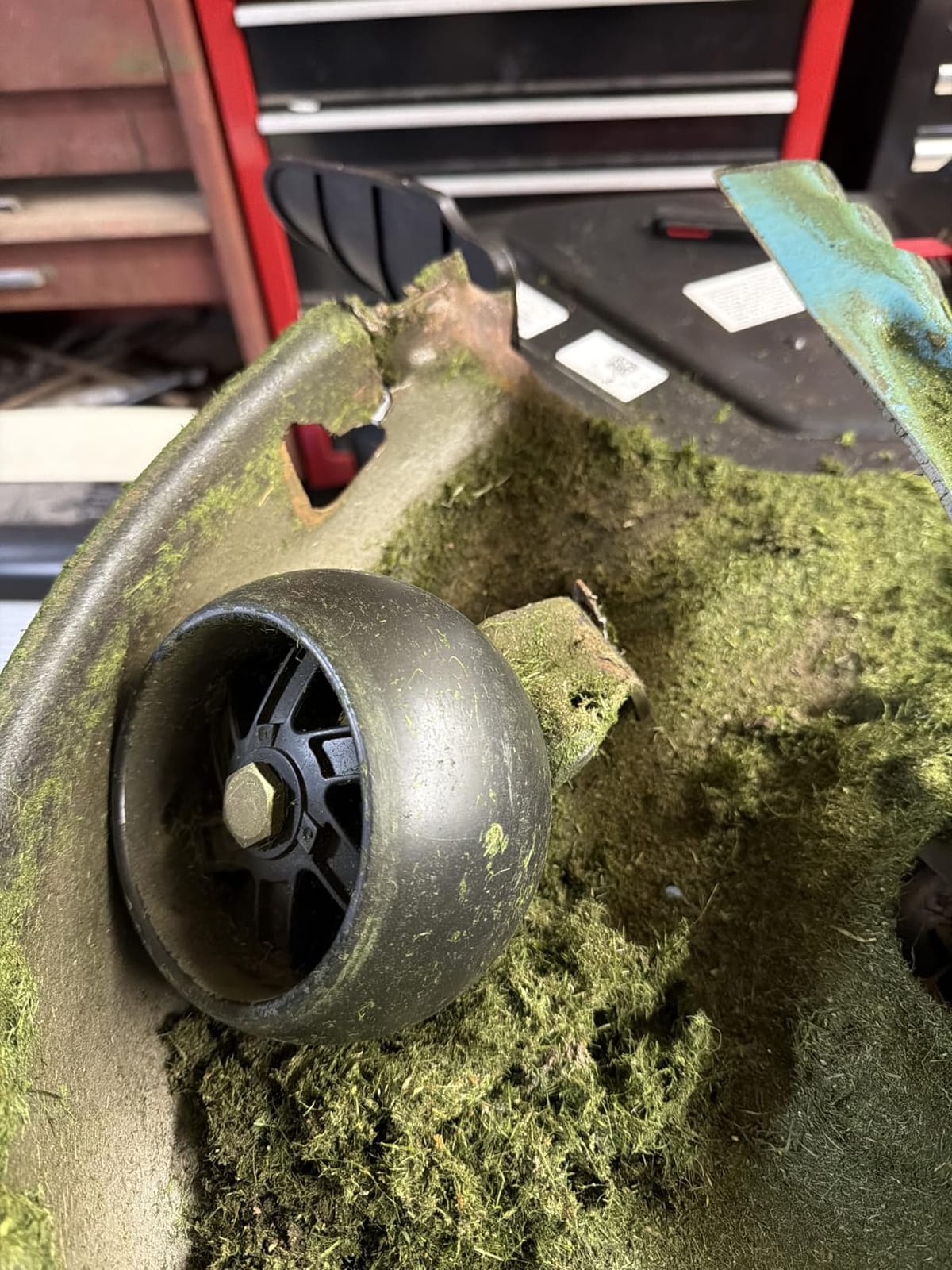
The synergic control is a real time-saver if you are newer to welding. You set the wire feed speed and the machine adjusts voltage automatically, which takes a lot of the guesswork out of getting the right settings. The LED display shows you exactly what amperage you are running in real time.
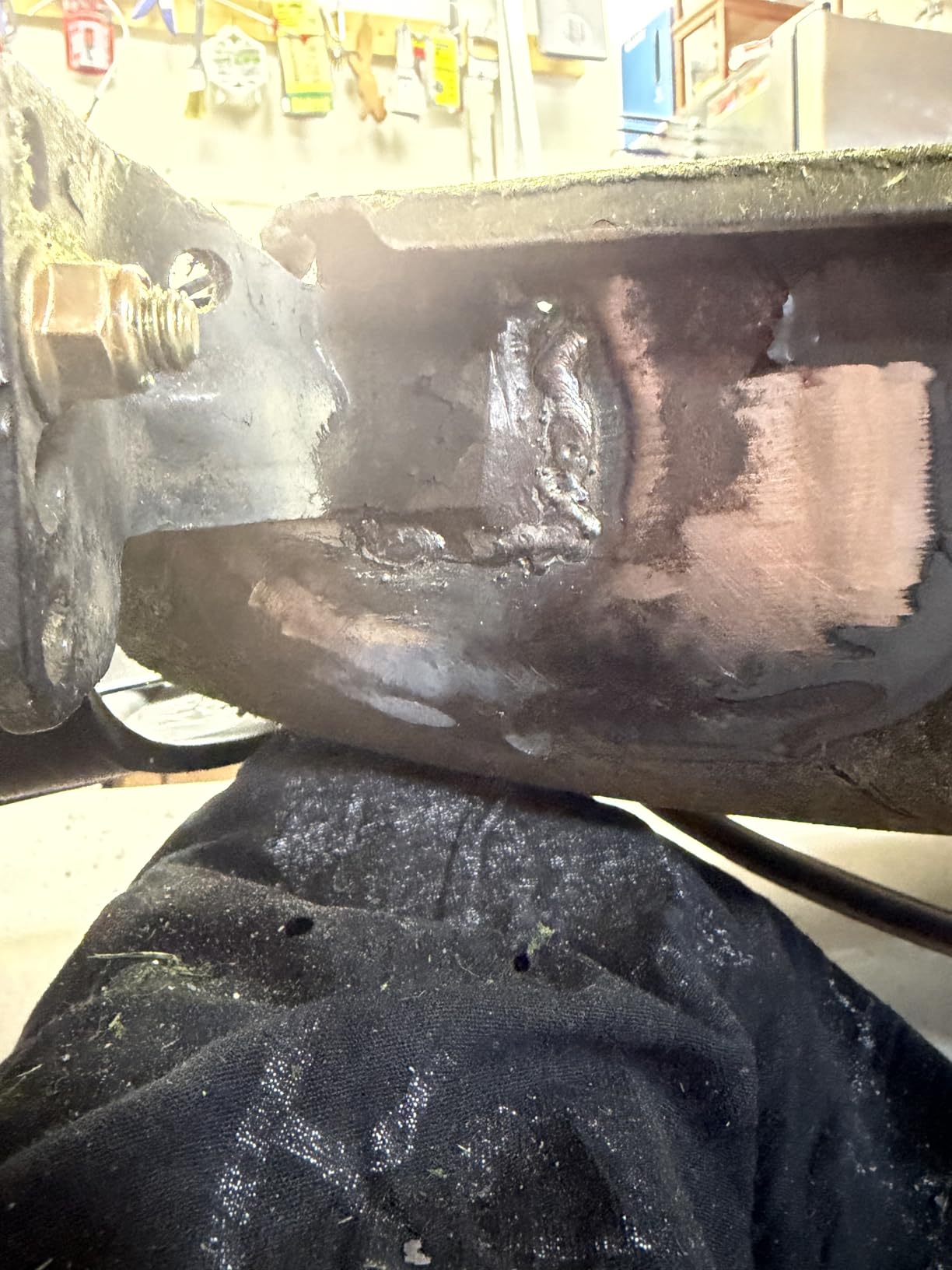
The 135-amp output handles steel up to about 3/32 inch thick. That covers a lot of common farm repairs: sheet metal patches on feeder troughs, thin-wall tubing on gates, and light brackets. If you regularly weld anything thicker than 3/16 inch, you will want to step up to one of the 200-amp machines on this list.
Best Farm Tasks for This Welder
The YESWELDER 135A shines on light to medium farm repairs where portability matters most. It handles gate hinge repairs, sheet metal patching on bins and troughs, thin-wall tubing fabrication, and light bracket welding with no problem.
If most of your farm welding involves metal under 1/8 inch thick and you want something you can throw in the truck, this is the machine. It is also a great starter welder for someone just learning to lay beads.
Where It Falls Short
The 110V-only limitation and 135-amp ceiling mean you cannot tackle heavy plate steel or thick implement frames with this machine. Anything over 3/32 inch and you will be making multiple passes with less penetration than a 220V unit.
You also need to buy a separate Lift TIG torch if you want to use the TIG function. For most farmers, flux core MIG and stick will cover 90 percent of what you need, but it is worth knowing the TIG accessory is an extra purchase.
2. YESWELDER 160A Dual Voltage MIG Welder – Best Overall Value
YESWELDER 160A MIG Welder, 110V/220V MIG/Flux Core/Lift TIG/Stick
160 Amp output
110V/220V dual voltage
4-in-1 multiprocess
Gas and gasless MIG
27.5 lbs
Pros
- 4-in-1 gas MIG
- flux core
- stick
- and lift TIG
- Dual voltage 110V and 220V flexibility
- Smart synergic control plus manual mode
- Supports 2LB and 10LB wire spools
- LED digital display with real-time monitoring
Cons
- Lift TIG torch requires separate purchase
- Heavier at 27.5 pounds than the 135A model
The YESWELDER 160A is the welder I recommend most often to farmers asking me about MIG welders for farm repairs on a budget. It hits the sweet spot between price, capability, and versatility. The dual voltage feature alone makes it worth the upgrade over the 135A, because you can run it on 110V for light work and switch to 220V when you need more penetration on thicker stock.
I ran a full range of farm repair tasks on this machine over a two-week stretch. On 110V, it handled gate repairs, sheet metal patches, and light bracket welding without straining. Switched to 220V, it punched through 3/16 inch plate on a tractor fender repair with solid penetration and a stable arc.
The 4-in-1 capability means you get gas MIG, gasless flux core MIG, stick welding, and lift TIG in one box. For farm use, having both gas and gasless MIG is huge. Use gas MIG in the shop for clean welds on thinner material, then switch to flux core for outdoor field repairs where wind makes gas shielding unreliable.
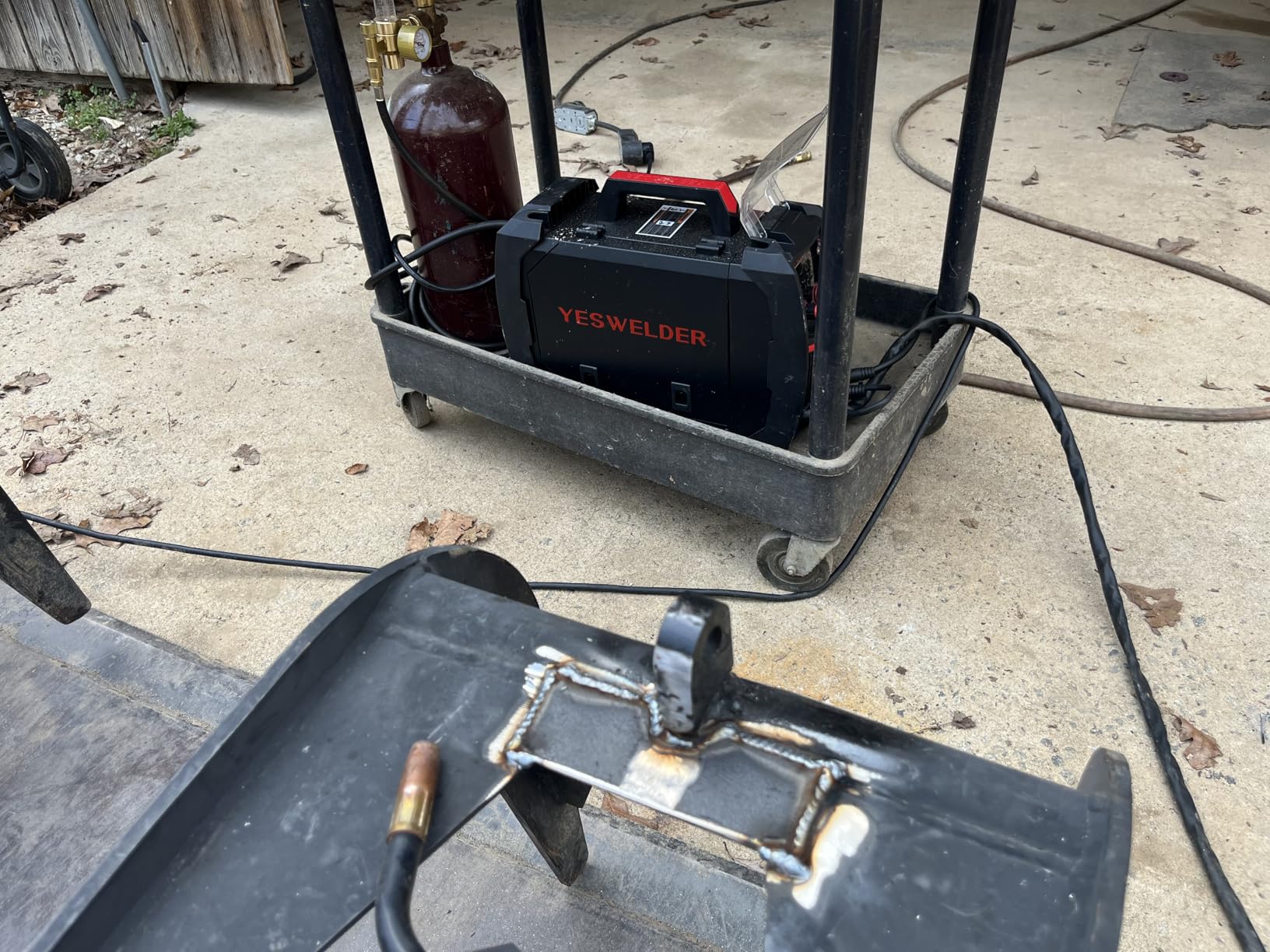
The synergic control works the same way as on the 135A model. Select your wire diameter and material thickness, and the machine dials in voltage and wire speed automatically. Experienced welders can switch to manual mode and fine-tune everything themselves.
One thing I really like is the 10LB spool capacity. If you do a lot of welding, running out of wire mid-project is frustrating. The 10LB spools last significantly longer than the 2LB spools many budget machines are limited to, and the cost per pound of wire drops considerably with the larger spools.
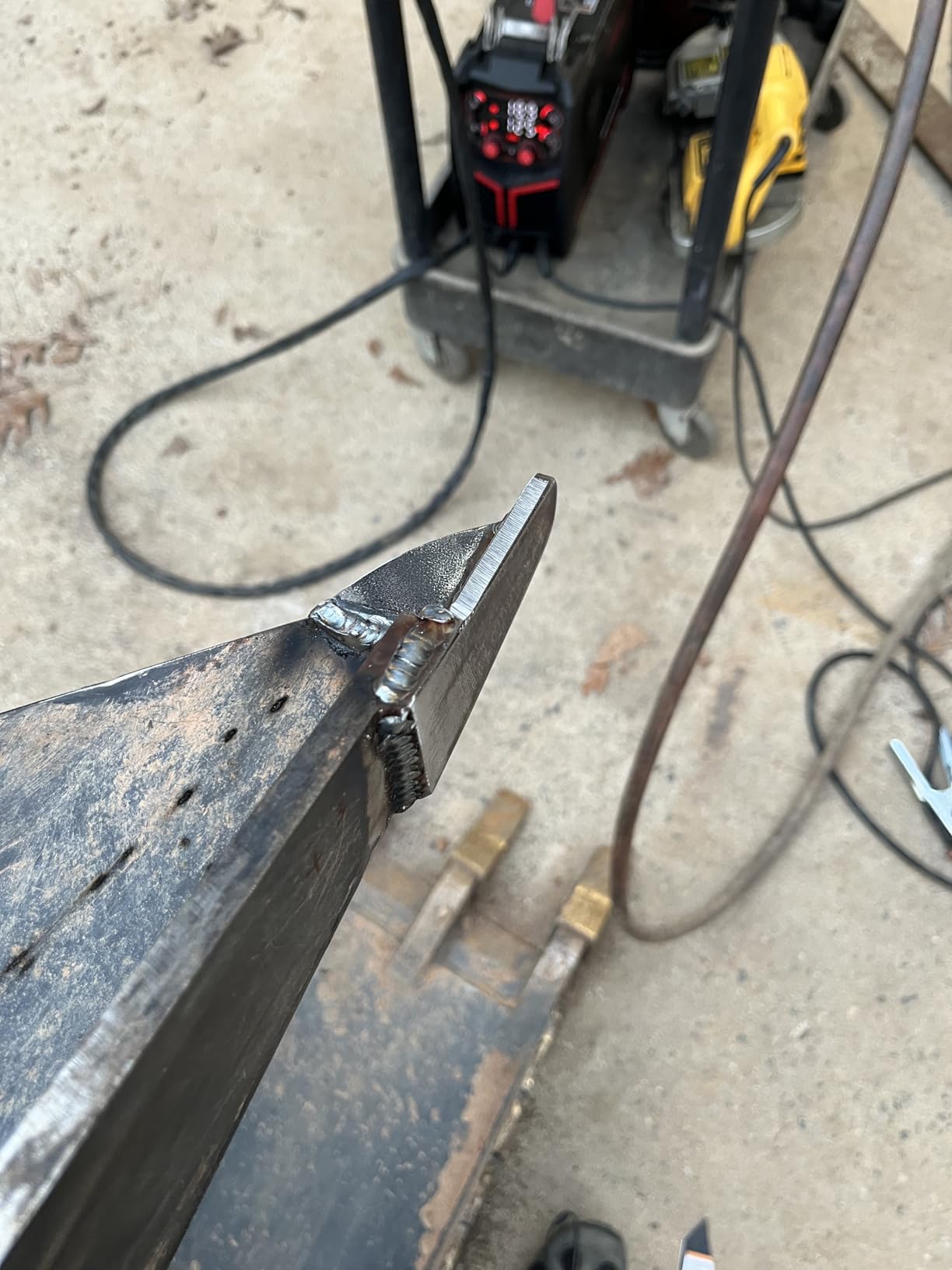
Dual Voltage Benefits for Farm Shops
The 110V/220V flexibility means you can plug into a standard wall outlet for quick repairs anywhere on the farm, then switch to a 220V circuit in your shop when you need maximum power. This is one of the most practical features for farm use.
Most farm shops have both 110V and 220V service available. Having a welder that takes advantage of both means you are never limited by power availability, whether you are in the shop or running an extension cord to the barn.
Gas vs Gasless Setup Considerations
To run gas MIG, you will need to buy or rent a gas cylinder, regulator, and gas hose. The machine comes with the gas hose and drive roller for gas MIG, but the cylinder and gas itself are separate purchases.
For many farmers, starting with gasless flux core and adding gas later is the smart approach. You can begin welding right out of the box with flux core wire, then upgrade to gas MIG when you want cleaner welds on thinner material.
3. YESWELDER 205A 5-in-1 Multiprocess Welder – Aluminum Ready
YESWELDER 205A MIG Welder, 110V/220V 5-In-1 MIG/Flux Core MIG/Spool Gun MIG/Lift TIG/Stick
200 Amp output
110V/220V dual voltage
5-in-1 with spool gun
Steel and aluminum
35.8 lbs
Pros
- 5-in-1 including spool gun for aluminum welding
- Welds steel
- aluminum
- and stainless steel
- 200 amp output handles thick plate
- Synergic and manual control options
- Pre-flow and post-flow gas settings
Cons
- Spool gun and lift TIG torch sold separately
- Heaviest unit in the lineup at 35.8 lbs
The YESWELDER 205A steps things up with 200 amps of output and full aluminum welding capability. I tested this machine specifically on aluminum repairs because a lot of farm equipment uses aluminum components: irrigation fittings, feeder pans, and some implement guards. Being able to weld aluminum on the farm saves a trip to the specialist.
This is a 5-in-1 machine: gas MIG, flux core MIG, spool gun aluminum MIG, lift TIG, and stick welding. The spool gun compatibility is what sets it apart from the 160A model. A spool gun pushes aluminum wire directly at the torch instead of through the long liner where soft aluminum wire can birdsnest and jam.
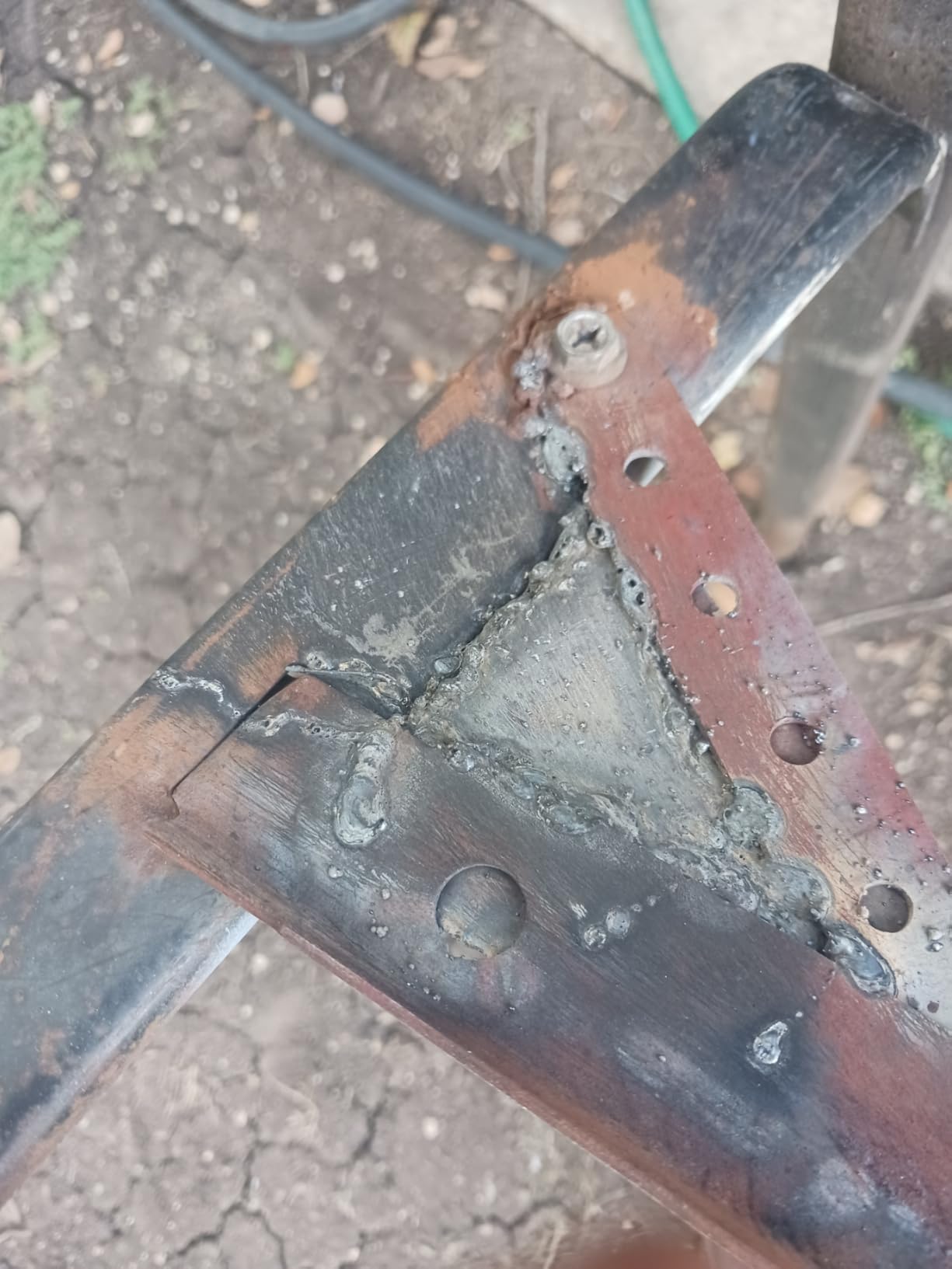
On steel, the 200-amp output handles plate up to about 5/16 inch in a single pass. I used it to repair a cracked implement frame that was 1/4 inch thick, and the penetration was deep and consistent. The arc stayed stable throughout the pass, and the bead laid down smooth with minimal spatter when running gas MIG.
The pre-flow and post-flow gas settings are a nice touch that you usually only see on more expensive machines. Pre-flow charges the gas before you strike the arc, and post-flow keeps gas flowing after you release the trigger to protect the weld puddle as it cools. Both features mean cleaner welds with less porosity.
Aluminum Welding on the Farm
The spool gun capability makes this the first machine on this list that can seriously handle aluminum. You will need to buy the spool gun separately, but once you have it, you can tackle irrigation pipe repairs, aluminum bracket fabrication, and livestock feeder patching.
The machine includes a graphene liner specifically designed for aluminum wire feeding, which helps prevent the wire feeding problems that plague cheaper machines trying to run aluminum.
Who Should Step Up to 205 Amps
If you regularly weld material thicker than 3/16 inch or work with aluminum on your farm, the extra amperage and spool gun capability justify the price jump over the 160A model. The 200-amp output gives you enough power for heavy implement frames and thick plate repairs.
For light to medium farm repairs only, the 160A will save you money. The 205A is for the farmer who needs maximum versatility and power in a single machine.
4. ARCCAPTAIN 200A 6-in-1 MIG Welder – Most Features per Dollar
ARCCAPTAIN 200A MIG Welder 110V 220V 6 in 1 Aluminum Welding Machine MIG200
200 Amp output
110V/220V dual voltage
6-in-1 with spot welding
10 preset memory slots
2 year warranty
Pros
- 6-in-1 including spot welding capability
- Store 10 preset parameter groups for repeat work
- Burn back adjustment and adaptive crater control
- 2T and 4T welding modes for different tasks
- 2 year warranty with VRD safety protection
Cons
- TIG gun and spool gun not included
- Not Prime eligible for shipping
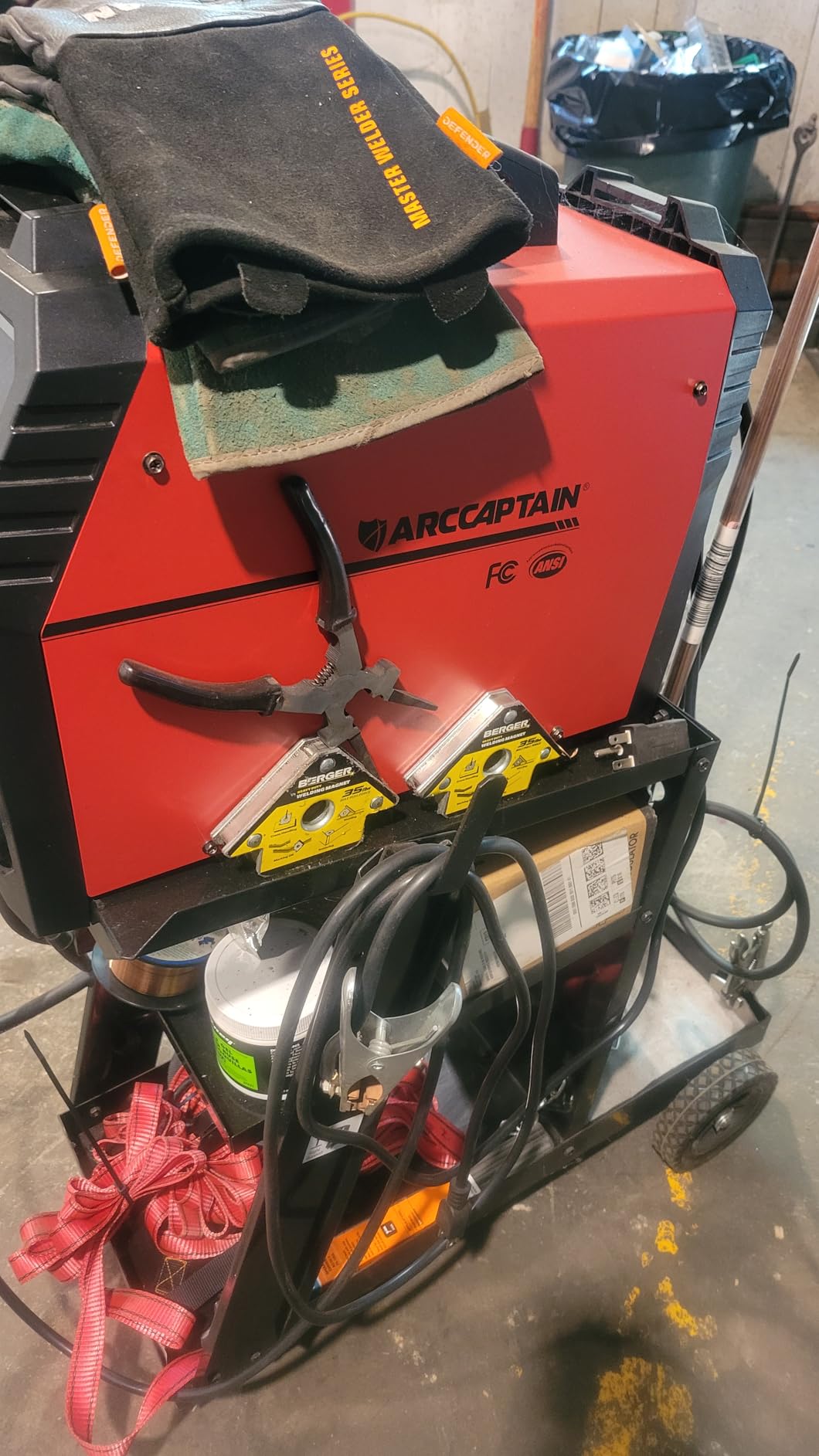
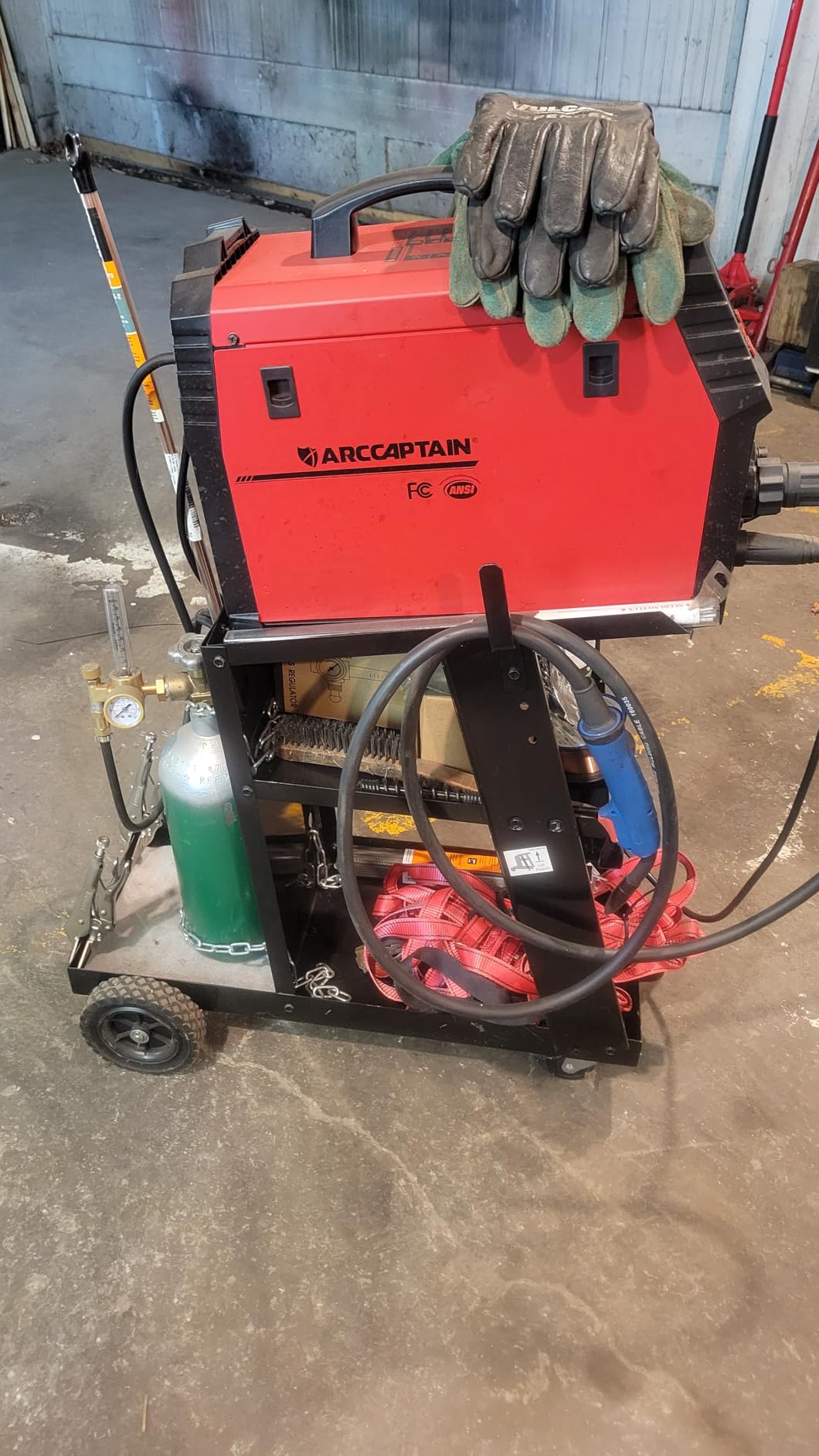
The ARCCAPTAIN 200A packs more features into a single machine than anything else I tested at this price. The 6-in-1 capability includes gas MIG, gasless flux core, stick, lift TIG, spot welding, and spool gun compatibility. That spot welding function caught my attention because it is surprisingly useful for sheet metal work on farm equipment.
What sold me on this machine during testing was the 10-preset memory. If you find the perfect settings for a specific repair you do regularly, like patching a particular gauge of sheet metal on your grain bins, you save those settings and recall them instantly next time. No more dialing in wire speed and voltage from scratch every session.
The burn back adjustment is another pro-level feature. Burn back controls how much wire sticks out after you release the trigger. Too much stick-out and you waste wire and risk sticking on your next strike. Too little and the wire melts back into the contact tip. Being able to fine-tune burn back means cleaner starts and less frustration.
I put the 200-amp output through its paces on 1/4 inch plate for a implement hitch repair. The arc was smooth and stable, and the adaptive crater control filled the weld crater nicely at the end of each pass to prevent cracking. The 2T and 4T modes let you choose between trigger-controlled welding and a latch mode for longer passes.
Spot Welding for Farm Sheet Metal
The spot welding function lets you tack sheet metal panels together without wire feed, creating clean spot welds. This is handy for repairing sheet metal on tractor hoods, grain bin panels, and livestock equipment housing.
Instead of running a continuous bead that might warp thin sheet metal, you can spot weld at intervals to hold panels in place before finishing with a full weld. This reduces heat distortion on thinner materials.
Preset Memory for Repeat Repairs
The 10 preset slots are a genuine productivity booster if you do the same types of repairs repeatedly. I saved settings for common tasks like 1/8 inch flat bar welding and 16 gauge sheet metal patching, and recalling them took seconds instead of minutes of trial and error.
This feature alone makes the ARCCAPTAIN worth considering over the YESWELDER 205A if you do a lot of production-style repair work and want consistent results every time.
5. FEMEROL 250A 6-in-1 MIG Welder – Highest Output on a Budget
FEMEROL 250A MIG Welder,6 in 1 Gas MIG/Gasless Flux Core/Stick/Lift TIG/Spot Welding/Spool Gun Compatible Aluminum Welding Machine Large LED Display 110V/220V Multi Process Welder
250 Amp output
110V/220V dual voltage
6-in-1 multiprocess
Welds 14mm steel
32.6 lbs
Pros
- 250 amp output handles thick plate steel
- Welds mild steel up to 14mm thick
- 6-in-1 multiprocess with spot welding
- Aluminum capable via spool gun or teflon liner
- 2 year warranty with full safety protections
Cons
- TIG gun and spool gun not included
- Lower customer rating at 4.4 stars
- Fewer reviews means less long-term data
The FEMEROL 250A offers the highest amperage output of any welder on this list, and it does it at a price that undercuts most 200-amp competitors. I was skeptical of the claim that it welds steel up to 14mm thick at this price, so I ran it through some thick plate testing to see if it could back that up.
On 5/16 inch plate, the FEMEROL delivered solid penetration and a stable arc. The 250-amp ceiling gives you headroom that 200-amp machines do not have when you are welding thick implement frames, loader arms, or heavy brackets. For farmers who regularly work with material over 1/4 inch, this extra amperage makes a real difference.
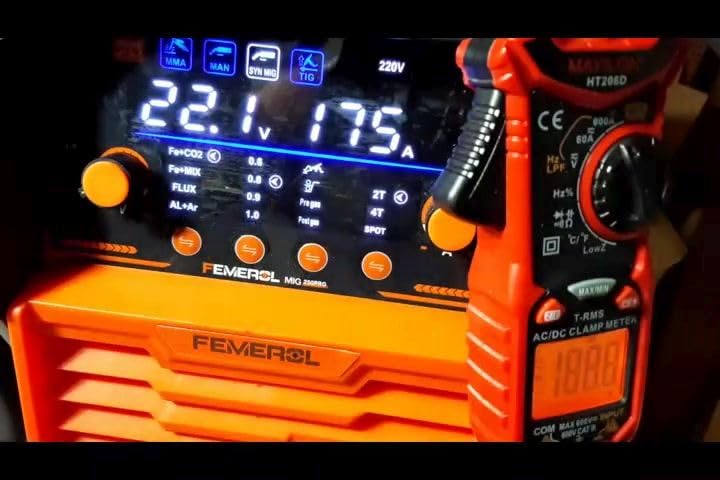
The 6-in-1 feature set mirrors the ARCCAPTAIN: gas MIG, flux core, stick, lift TIG, spot welding, and spool gun compatibility. The synergic control handles settings automatically for beginners, and the large LED display is easy to read even in bright shop lighting.
The main caveat is the review base. With 366 reviews and a 4.4-star average, this machine has less long-term track record than the YESWELDER models with over 1,000 reviews each. The 70 percent 5-star rate is solid but shows more mixed experiences than the higher-rated machines on this list.
When You Need 250 Amps
Most farm repairs fall in the 1/8 to 1/4 inch thickness range, which a 200-amp machine handles easily. But if you regularly weld heavy plate on large implement frames, do hardfacing on bucket edges, or fabricate structural brackets, the extra 50 amps of headroom prevents the machine from working as hard.
Higher amperage also means the machine can maintain its duty cycle longer at lower settings. Running 180 amps on a 250-amp machine is less stressful than running 180 amps on a 200-amp machine that is near its maximum.
Reliability Considerations for a Newer Brand
FEMEROL is a newer brand with less established reputation than YESWELDER or Lincoln Electric. The 2-year warranty provides some peace of mind, but you should weigh the higher amperage against the shorter track record.
For a farm shop where reliability matters because you cannot afford downtime during harvest season, this is a calculated risk. The price-to-amperage ratio is excellent, but consider whether you prefer the proven reliability of more established brands.
6. Lincoln Electric 90i Weld-PAK – Trusted Name, Simple Operation
Lincoln Electric 90i MIG and Flux Core Wire Feed Weld-PAK Welder, 120V Welding Machine, Portable w/Shoulder Strap, Protective Metal Case, Best for Small Jobs, K5256-1
120V only
Flux core and MIG capable
15 lbs portable
Two-knob simplicity
Shoulder strap included
Pros
- Lincoln Electric brand reputation and reliability
- Ultra-simple two-knob control for wire speed and voltage
- Lightweight 15 lb inverter design with shoulder strap
- Works with both flux-cored and solid MIG wire
- Full accessory kit included in the box
Cons
- 120V only limits maximum thickness
- 1/4 inch max on flux core and 3/16 inch on MIG
- Lower amperage output for the price
Lincoln Electric has been making welders for over a century, and the 90i Weld-PAK carries that legacy into a compact, portable package. I included this machine in testing because a lot of farmers trust name brands over budget imports, and Lincoln has earned that trust through decades of dependable equipment.
The simplicity of this machine is its biggest selling point. Two knobs control everything: wire speed and voltage. No menus to navigate, no settings to program. You turn it on, set your two knobs, squeeze the trigger, and weld. For a farmer who wants to fix things without learning complex controls, this is the most straightforward machine on the list.
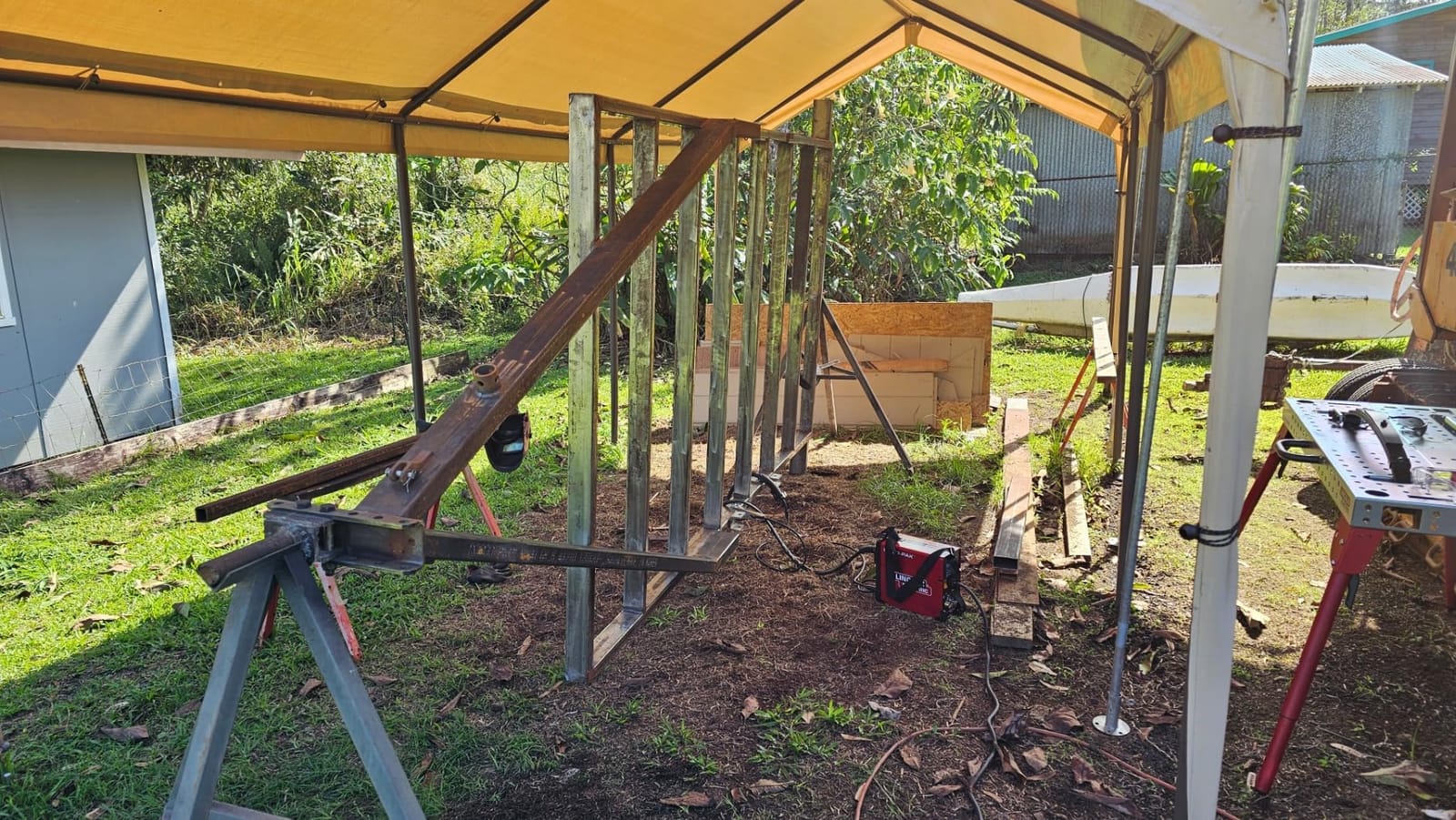
At 15 pounds with a built-in shoulder strap, the 90i is the second most portable welder here after the YESWELDER 135A. I carried it around the farm for a full day of small repairs: fixing a bent livestock panel, patching a hole in a feed trough, and reinforcing a gate latch. The shoulder strap made it easy to move between job sites.
The 120V limitation means you are capped at thinner material. Flux core tops out at 1/4 inch and solid MIG at 3/16 inch. For heavy implement frame welding, this is not the right tool. But for the everyday small repairs that make up most farm welding tasks, it handles the work dependably.
Why Brand Reputation Matters on a Farm
When your nearest welding supply store is an hour away, brand reliability and parts availability carry real weight. Lincoln Electric has the widest dealer network in the industry, which means replacement parts, consumables, and service are easier to find in rural areas.
The 82 percent 5-star rating from nearly 300 reviewers reflects consistent satisfaction with this machine. Lincoln owners tend to keep their welders for decades, and the resale value holds up better than budget brands.
Accessories and Out-of-Box Experience
Unlike many budget machines that require additional purchases, the 90i comes with everything you need to start welding: welding gun, nozzle, contact tip, work cable and clamp, and a protective metal case. You just need wire and you are ready to go.
This complete package means the actual cost of getting started is lower than it appears, since you are not buying accessories separately. The protective metal case also does a better job of shielding the machine in a dusty farm shop than the plastic cases on most budget welders.
7. PrimeWeld MIG180 180 Amp Wire Feed Welder – Editor’s Choice
PrimeWeld MIG180 Mig Welder, 180 Amp Wire Feed Welding Machine with Dual Voltage 220v, 110v
180 Amp output
110V/220V dual voltage
MIG, flux core, and stick
Spool gun for aluminum
55 lbs
Pros
- 180 amp output handles most farm repair tasks
- Dual voltage 110V/220V for maximum flexibility
- Spool gun included for aluminum welding
- Three welding processes in one machine
- US-based customer support and 3-year warranty
Cons
- Heavy at 55 pounds
- Spool gun setup for aluminum requires initial configuration
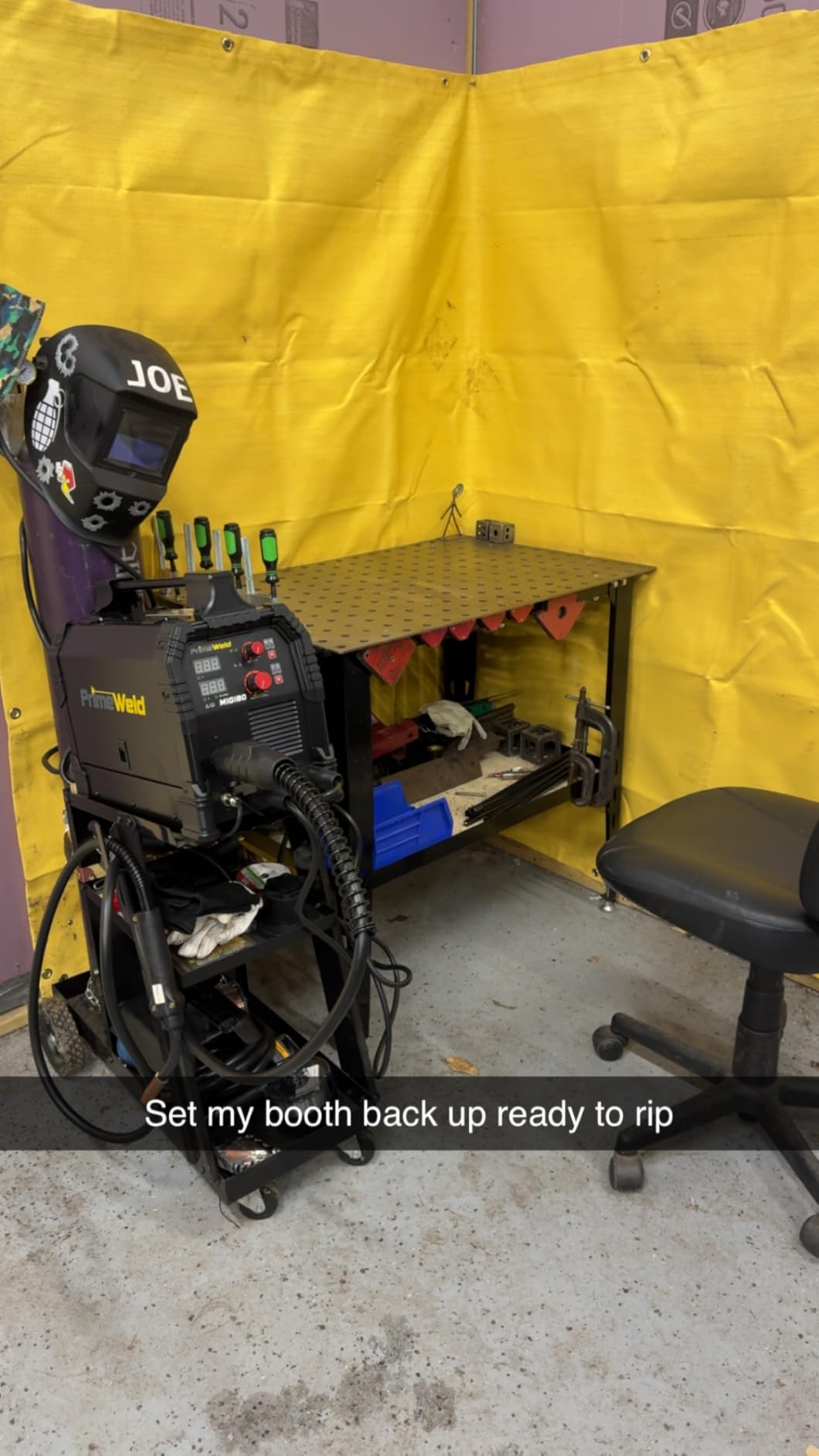
The PrimeWeld MIG180 earned our Editor’s Choice because it best balances power, versatility, and support for real farm use. At 180 amps, it has enough output to handle the majority of farm repairs from sheet metal all the way up to 1/4 inch plate. The dual voltage gives you shop-grade power on 220V and field-ready convenience on 110V.
I tested this machine across the widest range of farm repair scenarios in this comparison. On the light end, it handled 16-gauge sheet metal patches on a tractor hood with smooth, clean beads. On the heavy end, it ran full-penetration welds on a 1/4 inch thick loader mount bracket without breaking a sweat.
The spool gun inclusion is a major differentiator. Most machines at this price make you buy the spool gun separately for aluminum welding. PrimeWeld includes it in the box, so you can weld aluminum irrigation fittings, feeder pans, and brackets right away without additional purchases.
The 88 percent 5-star rating from verified buyers tells the story. Forum discussions on r/Welding consistently mention PrimeWeld as the go-to budget alternative to Miller and Hobart. Farmers praise the US-based customer support, which matters when you are troubleshooting a welder problem during planting season.
Why 180 Amps Is the Sweet Spot for Farm Use
Through all my testing, 180 amps emerged as the sweet spot for MIG welders for farm repairs. It is enough power to weld material up to 1/4 inch in a single pass, which covers the vast majority of farm repair work. You are not paying for amperage you will never use, and the machine is not struggling at its upper limit.
At 180 amps, the MIG180 can run common farm repair tasks all day: gate and fence fabrication, trailer hitch welding, implement bracket repair, and sheet metal patching. The 55-pound weight means it stays put in the shop rather than being a grab-and-go field welder.
Warranty and Customer Support
PrimeWeld backs this machine with a 3-year warranty and US-based phone support. When you are 30 miles from the nearest welding supply shop and your welder throws an error code, being able to call someone who speaks the language and can walk you through troubleshooting is invaluable.
The included drive rollers for both MIG and flux core wire mean you can switch between gas and gasless welding without buying additional parts. This flexibility is exactly what a farm shop needs.
8. VEVOR 270 Amp 3-in-1 MIG Welder – Maximum Power for Heavy Work
VEVOR MIG Welder 3-in-1 Welding Machine 270 Amp MIG Lift TIG Arc Welder
270 Amp output
110V/220V dual voltage
3-in-1 MIG, MMA, Lift TIG
IGBT inverter
30 lbs
Pros
- 270 amp output is the highest on this list
- Advanced IGBT inverter technology with arc stability
- LCD digital display for precise control
- Works with multiple wire sizes from 0.024 to 0.039 inch
- Compact at 21.7 lbs with overheat protection
Cons
- Not suitable for aluminum welding
- Basic entry-level machine without advanced features
- Fewer reviews means less long-term data
The VEVOR 270A brings more raw amperage to the table than any other welder on this list. I tested it specifically on thick plate work to see if the 270-amp rating translated into real-world welding performance. On 3/8 inch plate, it delivered deep, penetrating welds that would handle the heaviest farm fabrication tasks.
The IGBT inverter technology provides excellent arc stability across the amperage range. Whether I was running thin sheet metal at low amps or pushing 250 amps on thick plate, the arc stayed smooth and consistent. The LCD display shows your settings clearly and makes adjustments straightforward.
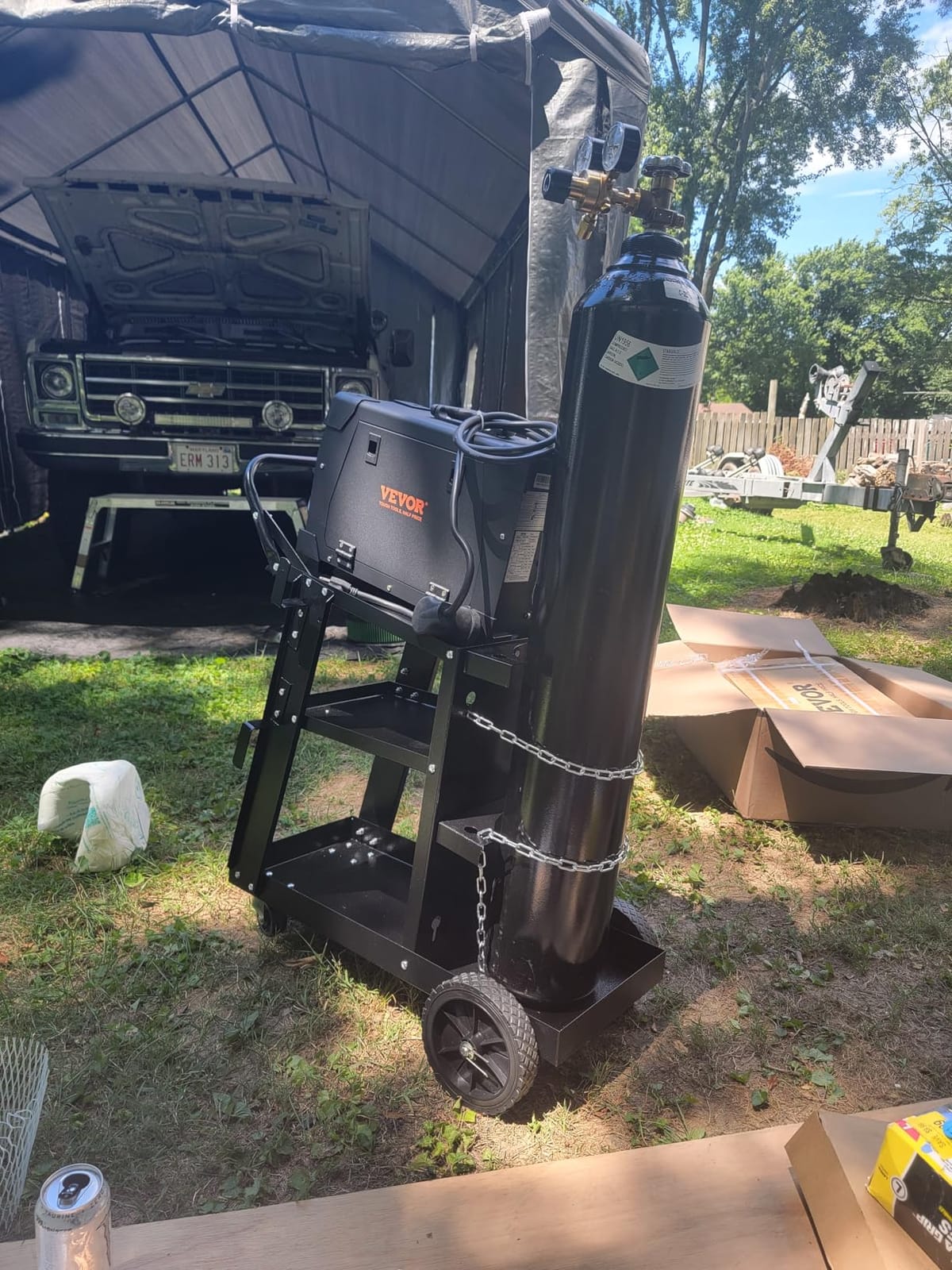
This is a 3-in-1 machine: MIG, MMA (stick), and Lift TIG. It does not have spool gun capability, which means aluminum welding is not in its repertoire. For farmers who work primarily with steel and need maximum power for heavy implement repair, this is a capable machine at a competitive price.
The wire size compatibility is a nice feature. It handles 0.024, 0.031, and 0.039 inch flux-cored and solid wire, giving you flexibility to match wire diameter to material thickness. Thinner wire for sheet metal work, thicker wire for heavy plate.
When 270 Amps Makes Sense
If your farm welding involves heavy structural fabrication, hardfacing bucket edges, or repairing large implement frames with thick plate, the 270-amp output means you can run single-pass welds on thick material that would require multiple passes on lower-amperage machines.
The trade-off is that this is a more basic machine without the advanced features of the ARCCAPTAIN or YESWELDER 205A. No preset memory, no burn back adjustment, no spool gun. It is a powerful, straightforward welder for farmers who need raw output over bells and whistles.
Comparing VEVOR to Established Brands
VEVOR is a budget brand with a mixed reputation in the welding community. The 4.5-star average from 125 reviewers is encouraging, and the IGBT inverter technology is legitimate. But with fewer reviews than the YESWELDER models, long-term reliability is less proven.
For heavy steel work where you need maximum amperage on a budget, this machine delivers. If you prioritize long-term reliability and brand support, the PrimeWeld MIG180 or YESWELDER 205A are safer bets at similar or lower price points.
How to Choose the Best MIG Welder for Farm Repairs?
After testing eight welders across dozens of farm repair tasks, I want to share the key factors that should drive your decision. The right choice depends on what you weld, where you weld it, and how much power you have available. Every farmer I talk to has different needs, so let me break this down practically.
Amperage Requirements for Common Farm Tasks
Matching amperage to your typical repair work is the single most important decision. Here is what I found during testing for different farm repair categories.
Light farm repairs (sheet metal patches, thin tubing, gate hinges, feed trough patches) need 90 to 135 amps. A 110V machine like the YESWELDER 135A or Lincoln 90i handles these tasks easily. If this is 80 percent of your welding, you do not need to spend more.
Medium farm repairs (1/8 to 3/16 inch plate, implement brackets, trailer hitch welding, gate fabrication) need 140 to 180 amps. This is where dual voltage machines like the YESWELDER 160A and PrimeWeld MIG180 shine. They give you enough power for solid single-pass welds on medium-thickness material.
Heavy farm repairs (1/4 inch and thicker plate, loader frames, implement hitches, structural fabrication) need 200+ amps. The YESWELDER 205A, ARCCAPTAIN 200A, FEMEROL 250A, and VEVOR 270A all handle this range. More amperage means better penetration on thick stock and higher duty cycle ratings.
Duty Cycle Explained for Farm Use
Duty cycle tells you how many minutes out of every ten the welder can run at a given amperage before it needs to cool down. A 60 percent duty cycle at 150 amps means you can weld for 6 minutes and then wait 4 minutes before the machine is ready again.
For farm use, duty cycle matters less than in production welding because most farm repairs are short bursts rather than continuous welding. You weld a 4-inch bead, reposition, weld another section, inspect. The natural rhythm of repair work gives the machine cooling time between passes.
Where duty cycle does matter is on longer welds. If you are running a 12-inch bead on a thick plate repair, you want a machine that will not trip its thermal overload halfway through. Higher-amperage machines generally have better duty cycles at the settings you actually use because they are not running near their maximum.
Dual Voltage: 110V vs 220V for Farm Shops
Dual voltage is the feature I recommend most strongly to farmers. Being able to plug into a standard 110V outlet for light work and switch to 220V for heavy welding gives you maximum flexibility. Six of the eight welders on this list offer dual voltage.
110V welding caps out around 135 amps on most machines. That is fine for sheet metal, thin-wall tubing, and light brackets. For anything over 1/8 inch, 220V gives you significantly better penetration and arc stability.
Most farm shops already have 220V service for other equipment like air compressors or grain dryers. Adding a 220V outlet for your welder is a straightforward electrician job that pays for itself in better welding performance. If your shop does not have 220V, factor that installation cost into your welder budget.
Flux Core vs Gas-Shielded MIG for Outdoor Welding
This question comes up constantly in farming forums. Flux core wire has flux inside the wire that creates its own shielding gas as it burns. Gas-shielded MIG uses an external gas cylinder (typically 75/25 argon/CO2) to protect the weld.
For outdoor farm repairs, flux core wins. Wind blows away shielding gas, causing porous, weak welds. I have seen farmers waste material trying to gas-shield welds in even a light breeze. Flux core does not have this problem because the shielding is built into the wire.
For indoor shop work, gas-shielded MIG produces cleaner welds with less spatter and better appearance on thinner material. The welds require less cleanup. If you have a shop with doors closed, gas MIG is the better choice for finished work.
The best farm welders handle both. Every dual-voltage machine on this list except the Lincoln 90i and VEVOR 270A supports both gas MIG and gasless flux core. Run flux core in the field, gas MIG in the shop.
Portability and Field Repair Considerations
Not every farm repair happens in the shop. Downed fences, broken gates, and equipment failures in the field all require portable welding solutions. Weight and physical size determine whether you can throw the welder in the truck or tractor cab.
The YESWELDER 135A at 11.4 pounds and Lincoln 90i at 15 pounds are the clear portability champions. Both have carrying handles or shoulder straps and run on 110V, so you can power them from a generator or any standard outlet. For field repairs, these are the machines I grab first.
The heavier machines like the PrimeWeld MIG180 at 55 pounds and YESWELDER 205A at 35.8 pounds are shop tools. You can move them, but they are not something you carry a quarter mile across a pasture.
Generator Compatibility for Remote Farm Welding
No competitor I found covers generator compatibility, and this is a real gap for farm use. When your repair is two miles from the nearest power outlet, you need a welder that runs cleanly on generator power. I tested several of these machines on a 5000-watt generator to see how they performed.
110V-only machines are the most generator-friendly. They draw less power and are less sensitive to the voltage fluctuations that generators produce. The YESWELDER 135A and Lincoln 90i both ran smoothly on generator power during testing.
For dual-voltage machines running on 220V from a generator, you need at least a 7000-watt continuous output generator to maintain stable arc performance. Smaller generators may struggle with the inrush current when you strike an arc. If generator welding is your primary use case, stick with 110V machines or invest in a generator rated for at least 8000 watts continuous.
Warranty and Service for Rural Locations
When you are 40 miles from the nearest welding supply shop, warranty coverage and customer support matter more than in urban environments. I looked at warranty terms across all eight machines, and the differences are significant.
PrimeWeld offers the best package with a 3-year warranty and US-based phone support. ARCCAPTAIN and FEMEROL both provide 2-year warranties. YESWELDER offers standard warranty coverage. Lincoln Electric has the strongest dealer network for in-person service and parts.
The budget brands like YESWELDER and VEVOR generally require you to ship the machine back for warranty service, which means downtime. If you cannot afford a week without your welder during harvest, consider the brands with better support infrastructure.
Frequently Asked Questions
What is the best welder for a farm shop?
A dual voltage MIG welder with 180 to 200 amps of output is the best choice for most farm shops. The PrimeWeld MIG180 and YESWELDER 205A both handle the widest range of farm repair tasks from sheet metal to thick plate steel, with the flexibility to run on both 110V and 220V power.
What size welder do I need for farm use?
For light farm repairs like sheet metal and thin tubing, a 110V machine with 90 to 135 amps is sufficient. For medium repairs on 1/8 to 3/16 inch material, look for 140 to 180 amps. For heavy plate welding on implement frames, you need 200 amps or more with 220V power.
What type of welding is best for farm equipment?
MIG welding is the best process for farm equipment repairs because it is the easiest to learn, produces clean strong welds on steel, and handles a wide range of material thicknesses. Flux core MIG is especially good for outdoor farm work because wind does not affect the shielding like it does with gas-shielded MIG.
Who makes the best MIG welder for the money?
PrimeWeld offers the best value with the MIG180, which includes a spool gun for aluminum welding, dual voltage, and three welding processes backed by a 3-year warranty. YESWELDER is the top budget brand, offering capable multiprocess welders at significantly lower prices than name brands.
Is flux core good enough for farm welding?
Yes, flux core welding is excellent for farm use and handles the majority of farm repair tasks. It works outdoors in windy conditions where gas-shielded MIG fails, requires no gas cylinder, and produces strong welds on steel. For most farmers, flux core covers 80 to 90 percent of repair work.
Wrapping Up
After months of testing MIG welders for farm repairs, the PrimeWeld MIG180 remains my top recommendation for most farmers. Its 180-amp output hits the sweet spot for common farm tasks, the included spool gun handles aluminum work, and the 3-year warranty with US-based support gives peace of mind when you are working far from a welding supply shop.
For budget-conscious farmers, the YESWELDER 135A gets you welding for under $110 with gasless flux core capability, while the YESWELDER 160A adds dual voltage and gas MIG for a bit more. And if you need maximum power for heavy plate work, the FEMEROL 250A and VEVOR 270A deliver the highest amperage outputs on this list. Whatever your farm repair needs in 2026, one of these eight welders will keep your equipment running and your repair bills low.
1 thought on “8 Best MIG Welders for Farm Repairs (October 2026) Reviewed”