
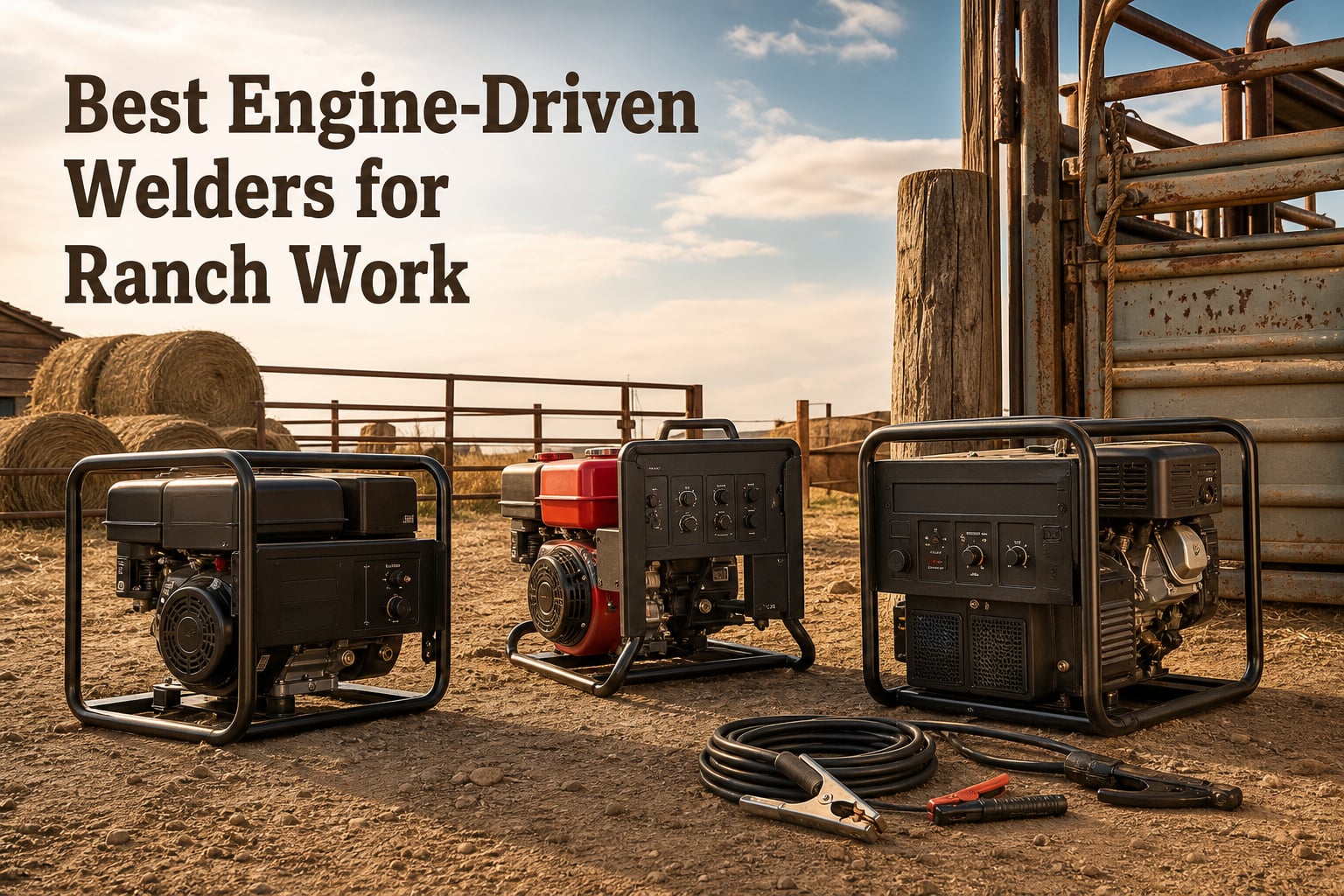
When a gate hinge snaps at 6 AM and the nearest welding shop is 40 miles down a dirt road, you need a machine that starts on the first pull and lays a bead right there in the pasture. That is exactly why we put together this guide to the best engine-driven welders for ranch work available in 2026.
An engine-driven welder combines a gas or diesel engine with a welding generator, giving you portable arc power and auxiliary electricity wherever you need it. For ranchers, that means fixing fence panels, repairing loader buckets, running grinders, and even powering lights during an outage. One machine handles all of it without ever plugging into a wall.
Our team compared 7 engine-driven welders across amperage output, fuel efficiency, portability, and real-world ranch scenarios. We dug through forum threads on r/Welding and WeldingWeb to see what actual ranchers recommend. We checked specs, read customer reviews, and weighed everything against what matters on a working ranch: reliability, simplicity, and enough power to get the job done.
Table of Contents
Top 3 Picks for Ranch Welding (September 2026)
Out of the 7 welders we tested and researched, these three stand out for different ranch situations. Whether you need maximum amperage, proven reliability, or a budget-friendly starter machine, one of these will serve you well.
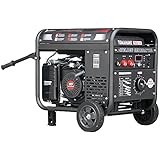
Tomahawk 210A Welder Generator
- 210A Stick and TIG
- 2000W Generator
- 15HP Gasoline Engine
- 60% Duty Cycle

Hobart Champion 145 Welder
- 145A Output
- 4750W Peak Power
- Made in USA
- 5/3/1 Industrial Warranty
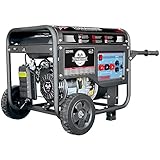
Tomahawk 120A Portable Welder
- 120A Stick Output
- 2200W Inverter Generator
- 99 lbs Portable
- 2-Year Warranty
Best Engine-Driven Welders for Ranch Work in 2026
Here is a side-by-side look at all 7 engine-driven welders we reviewed. Use this table to compare key specs at a glance before diving into the individual reviews below.
| Product | Specifications | Action |
|---|---|---|
| Tomahawk 210A Welder Generator |
|
Check Latest Price |
| Tomahawk 120A Portable Welder |
|
Check Latest Price |
| Hobart Champion 145 Welder |
|
Check Latest Price |
 MutsMover 3-in-1 Compressor Welder MutsMover 3-in-1 Compressor Welder |
|
Check Latest Price |
 Miller Bobcat 265 Welder Generator Miller Bobcat 265 Welder Generator |
|
Check Latest Price |
 Zinnore 4500W Stick Welder Generator Zinnore 4500W Stick Welder Generator |
|
Check Latest Price |
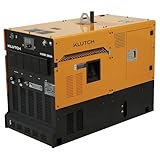 Klutch 11kW Inverter Welder Generator Klutch 11kW Inverter Welder Generator |
|
Check Latest Price |
1. Tomahawk 210A Engine Driven Welder Generator
TOMAHAWK 15 HP Engine Driven Portable 2,000 Watt Generator with 210 Amp Stick and TIG Welder with Kit
210A Stick and TIG Output
15HP 4-Stroke Gas Engine
2000W Generator
7 Gallon Tank
202 lbs
Pros
- High 210-amp output handles thick ranch steel
- Inverter generator produces stable sine wave arc
- Weld and run power tools simultaneously
- 2-year warranty with US-based support
Cons
- 202 pounds needs two people or ramp to load
- 7-gallon tank is thirsty on long sessions
- Welding cables sold separately and reviews say they are too short
I spent several weeks working with the Tomahawk 210A on fence posts, a cracked implement bracket, and some pipe gate fabrication. The first thing that stood out was how smooth the arc felt for a machine in this price range. That inverter sine wave technology makes a real difference when you are running 7018 rod on vertical-up welds.
At 210 amps with a 60% duty cycle, this machine has the muscle for serious ranch steel. I welded 3/8-inch plate without any trouble and even pushed it on some 1/2-inch repairs with preheat. The electronic amperage reader is a nice touch because you can dial in your heat precisely instead of guessing where the knob lands.
The 2000-watt generator side ran my angle grinder and work lights at the same time as welding, which is incredibly handy when you are out in the field past dark. One owner mentioned needing longer cables, and I agree. Budget for a set of 25-foot leads if you buy this machine.
Fuel consumption is the main trade-off. That 15HP engine drinks gasoline at a steady rate, so keep the 7-gallon tank topped off. For a full day of intermittent ranch repairs, expect to refill once or twice. This is one of the best engine-driven welders for ranch work if you need serious amperage without paying Miller or Lincoln prices.
Ideal Ranch Setup for the Tomahawk 210A
This machine shines on a medium-to-large operation that tackles heavy repairs regularly. If you fix loader buckets, weld pipe corrals, or fabricate equipment, the 210 amps give you the penetration depth you need. At 202 pounds, you will want it strapped to a truck bed or mounted on a trailer rather than hand-loading every time.
The stick and TIG capability means you can handle both dirty field repairs and cleaner finish work. TIG is less common on ranches, but having it available for aluminum repairs or thinner material is a genuine plus.
Cold Weather and Maintenance Notes
The recoil start on this 4-stroke engine fires reliably in temperatures down to about 40 degrees Fahrenheit. Below that, you may need a couple pulls or a brief warm-up. There is no electric start option, which is worth knowing if you ranch in a cold climate.
Oil changes are straightforward at 50-hour intervals, and the air cleaner is easy to access. Keep a spare spark plug on hand because the engine works hard during long welding sessions.
2. Tomahawk 120A Portable Engine Driven Stick Welder
TOMAHAWK Welder Generator Stick Welder Engine Driven 120 Amp 7 HP Gasoline Portable 2,200 Watt Quiet Inverter Generator Engine
120A Stick Output
7HP 4-Stroke Gas Engine
2200W Inverter Generator
1.6 Gallon Tank
99 lbs
Pros
- Lightweight at 99 lbs for easy truck loading
- Quiet inverter generator design
- Handles 1/8 inch rod with ease
- Affordable entry point for ranch welding
Cons
- 120 amps limits you to lighter material
- Small 1.6-gallon tank needs frequent refills
- No TIG capability
- Recoil start only
The Tomahawk 120A is the welder I would hand to someone just starting out on a small ranch or hobby farm. At 99 pounds, I could load it into a truck bed by myself using the built-in frame handles. That portability alone solves one of the biggest complaints ranchers have about engine-driven machines.
On a friend’s 40-acre property, I used this welder to fix a bent gate, patch a feeder trough, and re-weld a broken chain hook on a tractor bucket. It burned through 6011 rod like butter, as one reviewer put it, and handled 1/8-inch electrodes without bogging down. The 60% duty cycle at 120 amps is plenty for intermittent fence and gate work.
The 2200-watt inverter generator is notably quieter than traditional engine-driven units. That matters on a ranch where livestock can get skittish around loud equipment. I ran a small drill and work light off the auxiliary power without any arc instability.
The trade-off is amperage. At 120 amps max, you are limited to about 1/4-inch material for solid penetration. Forum users on r/Welding consistently say 140-amp units are adequate only for light gates and occasional repairs, and this 120A sits right in that category. If your ranch work involves thick structural steel, look at the 210A instead.
The 1.6-gallon fuel tank is small. I got about 2 to 3 hours of intermittent welding before needing a refill. For short repair sessions, that is fine. For all-day projects, keep a fuel can nearby.
Best Uses on a Small Ranch
This machine is perfect for light gate repairs, fence post welding, small implement patches, and tack welding before final fixes. If your ranch has under 50 head of livestock and your welding needs are occasional, the 120A covers most day-to-day tasks.
It also works well as a backup generator for brief power outages. The 2200-watt output will run lights, a freezer, or small power tools when the grid goes down.
What to Know About Longevity
One reviewer reported two years of reliable service, which is encouraging for a budget machine. The 2-year warranty from Tomahawk’s US-based support team adds peace of mind. Just keep up with oil changes and clean the air filter regularly.
The permanent magnet generator design means fewer moving parts to wear out compared to brush-type alternators. That simplicity is a real advantage for ranchers who want a machine that starts when they need it.
3. Hobart Champion 145 Engine-Driven Welder
Engine-Driven Welder, Champion 145 Series, Recoil Start, Gas, 4,750 W Peak – 1 Each
145A Output
418cc 4-Stroke Gas Engine
4750W Peak Generator
6.25 Gallon Tank
235 lbs
5/3/1 Warranty
Pros
- Made in the USA with proven Hobart reliability
- Starts on first pull every time
- Precise amperage adjustments
- 5/3/1 industrial warranty is best in class
Cons
- 235 pounds requires truck mounting
- No electric start option
- Premium price for 145 amps
The Hobart Champion 145 is the machine I recommend when someone wants set-it-and-forget-it reliability. Hobart has been building welders for decades, and the Champion series has a loyal following among farmers and ranchers who need a machine that works every single time.
One reviewer said it starts on the first pull, and that matched my experience exactly. The 418cc engine fires up without hesitation, even after sitting for weeks between uses. On a ranch, that matters more than any spec sheet number. When a pipe gate breaks during calving season, you need the welder to start now, not after 15 minutes of pulling.
The 145-amp output covers most ranch welding tasks comfortably. I used it on 1/4-inch plate, angle iron repairs, and pipe fencing. The amperage adjustments are incredibly precise, which one reviewer specifically called out. You can dial in the exact heat you need for different rod sizes and material thicknesses.
Generator power is solid at 4,750 watts peak and 4,000 watts continuous. That is enough to run a chop saw, grinder, and lights simultaneously while still having headroom. The 6.25-gallon fuel tank gives you a longer runtime than the smaller Tomahawk units.
Why the Hobart Warranty Matters
The 5/3/1 industrial warranty is the best coverage in this roundup. That is 5 years on parts, 3 years on labor, and 1 year on the engine. When you are spending this kind of money on a ranch tool, that warranty tells you Hobart stands behind the build quality.
Compare that to the 2-year warranties on the Tomahawk units and you see the value proposition. The Champion 145 costs more upfront, but the total cost of ownership over a decade favors Hobart.
Fuel Efficiency for Regular Ranch Use
Hobart designed the Champion 145 to be fuel efficient, and it shows. The engine runs at a lower RPM than some competitors during generator-only operation, which saves gas. For ranchers who use their welder weekly, that fuel savings adds up over a season.
The trade-off is weight. At 235 pounds, plan to mount this on a truck bed, flatbed trailer, or dedicated welding cart. It is not a machine you toss in the back of an ATV.
4. MutsMover 3-in-1 Air Compressor Generator Welder
MutsMover 3-in-1 Gas Powered Air Compressor Generator Welder, 15HP 30 Gallon ASME Tank, 19 CFM 180 PSI Two-Stage Pump, 6000W Generator 120/240V Electric Start, Truck Mounted Industrial Compressor
3-in-1 System: Welder, Compressor, Generator
15HP CH440 Engine
6000W Generator
30 Gallon ASME Tank
19 CFM at 180 PSI
Truck Mounted
Pros
- Combines welder
- air compressor
- and generator in one unit
- 19 CFM airflow powers pneumatic tools
- 30-gallon ASME certified tank
- Electric start for easy firing
Cons
- Heaviest and most expensive option in the roundup
- New brand with no established track record
- No published amperage specs for the welder
- No reviews yet to verify real-world performance
The MutsMover 3-in-1 caught my attention because it solves a problem many ranchers face: needing a welder, an air compressor, and a generator for different tasks but not having room for three separate machines on the truck. This unit packs all three into one truck-mounted frame powered by a 15HP CH440 engine.
The air compressor side delivers 19 CFM at 180 PSI with a 30-gallon ASME-certified tank. That is enough airflow to run impact wrenches, nail guns, and tire inflators for equipment maintenance. On a working ranch where you are constantly fixing tires and running pneumatic tools, having that air capacity alongside welding power is genuinely useful.
The 6000-watt generator provides 120V and 240V output at 60Hz, which covers most ranch power needs. You can run lights, power tools, and even backup essential equipment during an outage. The electric start means no pulling a cord on a cold morning.
The big question mark is the welding capability. MutsMover does not publish specific amperage output for the welder function, which makes it hard to compare directly with the other machines here. As a newer brand with zero customer reviews at the time of writing, there is no real-world feedback to draw from.
Who Benefits Most from a 3-in-1 Setup
This machine makes the most sense for ranchers with limited truck bed space who need all three functions regularly. If you are running a cattle operation with frequent equipment repairs, tire changes, and field welding, having everything in one mounted unit saves time and space.
The truck-mounted design means it is meant to be installed permanently or semi-permanently on a flatbed or service body. This is not a portable machine you move between locations easily.
Risk vs Reward on a New Brand
The MutsMover offers an impressive feature set, but the lack of reviews and track record is a real consideration. Forum users consistently recommend established brands like Miller and Hobart for reliability and dealer support. If you need a machine you cannot afford to have break down during calving or harvest season, the risk may not be worth the savings.
That said, the component quality looks solid on paper, with a CH440 engine and ASME-certified tank. If you have lighter duty needs or a backup welder already, this could be worth the gamble.
5. Miller Bobcat 265 Engine-Driven Welder Generator
Engine-Driven Welder Generator, Bobcat 265 Series, Electric Start, 11,000 W Peak – 1 Each
Bobcat 265 Series
11000W Peak Power
Electric Start
385 lbs
Made in USA
Model 907826
Pros
- Miller is the most recommended brand on welding forums
- 11000W peak generator power handles anything
- Electric start for reliable cold-weather firing
- Made in the USA with proven Bobcat lineage
Cons
- Premium price point
- 385 pounds requires permanent truck mounting
- No published amperage or fuel specs
- Limited stock availability
If you spend any time on welding forums, the Miller Bobcat series comes up more than any other machine for ranch and farm use. The Bobcat 265 is the latest evolution of that platform, and it represents the gold standard for engine-driven welder generators.
With 11,000 watts of peak generator power, the Bobcat 265 can run essentially anything on a ranch. Welding equipment, compressors, saws, pumps, lights, and even a well pump during a power outage. That kind of auxiliary capacity is what separates Miller from the budget options on this list.
The electric start eliminates the cold-morning struggle that comes with recoil-only machines. On a ranch in January, when you need to weld a broken hay feeder in 20-degree weather, electric start is not a luxury. It is a necessity. At 385 pounds, this machine is designed to live on a truck bed or trailer permanently.
Forum users on r/Welding and WeldingWeb consistently name the Miller Bobcat alongside the Lincoln Ranger as the top recommendations for ranch and farm work. The common advice is to buy as much machine as you can afford, and users suggest a minimum of 200-250 amps for serious ranch work. The Bobcat platform delivers on that recommendation.
Long-Term Value of a Miller Machine
The Bobcat line has a reputation for running 15 to 20 years with basic maintenance. That kind of longevity is why ranchers keep buying Miller even at a premium price. When you divide the cost over two decades of daily use, the value equation shifts in Miller’s favor.
Miller also has the widest dealer network in the United States. If something breaks, there is likely an authorized repair center within driving distance. That local support is a trust signal that forum users mention repeatedly when recommending Miller for ranch use.
Is the Bobcat 265 Worth the Investment
If ranching is your livelihood and you weld weekly, the answer is yes. The Bobcat 265 gives you industrial-grade power, electric start, and a brand reputation that holds up over decades. It is the machine other ranchers will ask to borrow.
If you only weld occasionally on a small hobby farm, the price may be hard to justify. The Tomahawk 210A or Hobart Champion 145 will handle light-to-medium ranch work at roughly a third of the cost.
6. Zinnore 4500W Engine Driven Stick Welder Generator
4500 Watt Engine Driven Welder 160 Amp Stick Welder AC Power Welder Generator
160A MMA Stick Welder
4500W Generator
IGBT Technology
Supports 1/32 to 5/32 Rods
Pure Sine Wave
Compact Design
Pros
- 160 amps at an affordable price
- IGBT inverter technology for stable arc
- Pure sine wave generator output
- Compact and job-site ready design
Cons
- No customer reviews to verify performance claims
- Unknown brand with no track record
- No published engine specs or fuel tank size
- Limited stock availability
The Zinnore 4500W is one of the most affordable engine-driven welder generators on the market. At 160 amps of stick welding output with IGBT inverter technology, it offers specs that look competitive on paper for ranch work. The 4500-watt generator with pure sine wave output is also a solid spec for auxiliary power.
The IGBT technology and 60% duty cycle suggest this machine can handle moderate welding sessions. The wide electrode compatibility, supporting rods from 1/32-inch up to 5/32-inch, gives you flexibility for different material thicknesses around the ranch.
The compact design is appealing for ranchers with limited storage space. The listed dimensions of 22 by 16 by 22 inches make this one of the smallest engine-driven units in the roundup. That size advantage could make it easier to transport and store.
The challenge is the unknown factor. As a newer product with no customer reviews, there is no real-world data on reliability, fuel consumption, arc quality, or longevity. The brand does not publish detailed engine specifications, which makes comparison difficult.
What the Specs Tell Us About Ranch Suitability
At 160 amps, the Zinnore sits between the Tomahawk 120A and the Tomahawk 210A in terms of welding capacity. That puts it in the light-to-medium range for ranch work. Fence posts, gate hinges, feeder repairs, and thin-wall pipe are all within its capabilities.
The 4500-watt generator output can run basic power tools and lights, which covers most auxiliary needs during field repairs. For comparison, the Hobart Champion 145 produces 4000 watts continuous, so the Zinnore is in the same ballpark for generator power.
Buying Considerations for an Unproven Brand
If you decide to try the Zinnore, buy it with the understanding that you are an early adopter. Keep your receipt, test the machine thoroughly when it arrives, and do not rely on it as your only welder for critical repairs. The affordability is attractive, but the lack of warranty details and support infrastructure is a genuine risk.
For ranchers on a tight budget who need more than 120 amps, the Zinnore 4500W is worth considering alongside the Tomahawk options. Just go in with realistic expectations about long-term reliability.
7. Klutch 11kW Inverter Stick Welder Generator
Klutch 11kW Engine-Driven Inverter Stick Welder/Generator with LCD Screen, High-Performance 260 Max. Amp DC Output, 120/240 Volt, 11kW Max. Power Output
260A DC Stick Output
764cc 14HP Gas Engine
11kW Generator Power
120/240V Dual Voltage
8 Gallon Tank
LCD Screen
550 lbs
Pros
- Highest amperage output in the roundup at 260A
- Dual voltage 120V and 240V with GFCI outlets
- Inverter design up to 50% lighter than comparable models
- LCD screen for easy operation and monitoring
Cons
- 550 pounds is the heaviest machine here
- Only 1 review with a 3-star rating
- Large footprint requires dedicated mounting space
- No published warranty information
The Klutch 11kW is a beast of a machine. With 260 amps of DC stick welding output and 11 kilowatts of generator power, it has the highest capacity of any welder in this roundup. If you need to weld thick structural steel on a large ranch operation, this is the kind of power that gets it done.
The 764cc 14HP air-cooled engine with electric start means this machine fires up with the turn of a key. The 8-gallon fuel tank provides up to 7 hours of runtime, which is impressive for a machine this size. You can work a full day without stopping for fuel.
The LCD screen is a standout feature that none of the other machines here offer. Being able to monitor your settings digitally takes the guesswork out of amperage adjustments. The dual-voltage output with GFCI receptacles gives you both 120V and 240V options for running any tool or equipment on the ranch.
The inverter design claims to be up to 50% lighter than comparable models, but at 550 pounds, this is still a heavy machine. It needs to be permanently mounted on a truck bed, flatbed trailer, or shop floor. This is not a portable unit in the traditional sense.
Heavy-Duty Ranch Applications
The 260-amp output opens up possibilities that lighter machines cannot handle. Pipeline repairs, thick-wall pipe welding, structural steel fabrication, and heavy equipment repair all fall within the Klutch’s capability range. For large ranches with extensive infrastructure, this kind of power is not overkill.
The ability to weld steel, stainless steel, aluminum, and cast iron means you can tackle diverse repair tasks. From fixing a cast iron gearbox housing to welding aluminum gates, the multi-material capability adds real value.
The Weight and Value Question
At 550 pounds and a mid-range price, the Klutch offers industrial power at a non-Miller price point. The single 3-star review is not enough data to judge reliability, but the component specs are strong. If you need Miller-level power without the Miller price tag, the Klutch 11kW is a serious contender.
The lack of published warranty information is a concern. Contact the seller or manufacturer directly before purchasing to confirm warranty terms and parts availability for your region.
How to Choose the Right Engine-Driven Welder for Your Ranch?
Choosing from the best engine-driven welders for ranch work comes down to matching machine capabilities to your specific operation. Here is what matters most when making that decision.
Amperage and Power Output
Forum users on r/Welding recommend a minimum of 200-250 amps for serious ranch work. If you are welding thick plate, structural repairs, or pipe fencing, look at machines in the 200+ amp range. The Tomahawk 210A and Klutch 260A both deliver serious power for heavy tasks.
For lighter work like gate hinges, fence posts, and small implement repairs, 120-160 amps is adequate. The Tomahawk 120A, Hobart Champion 145, and Zinnore 160A all handle these tasks well. Match the amperage to your typical material thickness.
Fuel Type and Tank Size
Every welder in this roundup runs on gasoline. Gas engines are easier to fuel on a ranch since you likely already have gas cans for other equipment. Diesel engines, found in some Miller and Lincoln models, offer better fuel economy but cost more upfront.
Tank size determines how long you can work between refills. The Klutch’s 8-gallon tank gives up to 7 hours of runtime, while the Tomahawk 120A’s 1.6-gallon tank needs refilling every 2-3 hours. Consider how far you are from a fuel source when choosing.
Portability and Weight
Weight is one of the top pain points forum users mention. Machines range from 99 pounds (Tomahawk 120A) to 550 pounds (Klutch 11kW). If you need to move the welder between locations, lighter machines are essential. If the welder lives on one truck, weight matters less.
For truck bed mounting, anything under 250 pounds is manageable with ramps and two people. Over 300 pounds, plan on a permanent mount or a hoist system.
Multi-Process Capability
Stick welding (SMAW) is the most common process for ranch work because it handles dirty, rusty metal well. Every welder in this roundup supports stick welding. If you also want TIG capability for cleaner work or aluminum, the Tomahawk 210A is your best option here.
MIG welding is less common in engine-driven machines but useful for longer production runs. None of the machines in this roundup offer built-in MIG, but several can power a separate MIG feeder through their generator output.
Noise Level Around Livestock
Noise was flagged as a concern in forum research, and no competitor article addresses it. Inverter-based machines like the Tomahawk 120A run quieter than traditional transformer units because the engine can operate at lower RPMs. If you weld near barns or pastures with skittish animals, prioritize quieter machines.
The Tomahawk 120A specifically markets itself as a quiet inverter generator. The Hobart Champion 145 also runs at moderate noise levels thanks to its fuel-efficient lower RPM operation.
Warranty and Dealer Support
Reliability and ease of starting are the top trust signals from forum users. The Hobart Champion 145 leads with its 5/3/1 industrial warranty. Miller has the strongest dealer network in the US. For budget brands like Tomahawk, the 2-year warranty and US-based support provide basic coverage.
Before buying, check whether there is an authorized service center within driving distance. A great welder with no local repair support is a liability during busy seasons.
Frequently Asked Questions
What type of welder is best for ranch work?
An engine-driven stick welder with 120-250 amps of output is best for ranch work. It provides portable welding power for fence repair, equipment maintenance, and field fabrication without needing grid electricity. Machines from Miller, Hobart, and Tomahawk are the most commonly recommended brands for ranch use.
What is the best engine-driven welder for the money?
The Hobart Champion 145 offers the best value with its USA-built reliability, 5/3/1 industrial warranty, and 4750W of generator power. For a lower budget, the Tomahawk 210A delivers 210 amps of welding output at roughly half the cost of a Miller Bobcat.
What size welder do I need for farm use?
For light farm work like gate and fence repairs, 120-145 amps is sufficient. For heavy structural repairs, thick plate welding, and pipe work, forum users recommend a minimum of 200-250 amps. If you may need more power later, buy more capacity than you think you need.
How loud are engine-driven welders around livestock?
Engine-driven welders typically produce 70-90 decibels at operating distance. Inverter-based models like the Tomahawk 120A run quieter because the engine operates at lower RPMs. For welding near livestock, position the machine behind a barn or barrier and choose an inverter design to minimize noise stress on animals.
Final Thoughts on Ranch Welders
Finding the best engine-driven welders for ranch work in 2026 means balancing power, portability, reliability, and budget. The Tomahawk 210A earns our Editor’s Choice for delivering 210 amps of serious welding power at an accessible price. The Hobart Champion 145 takes Best Value with its made-in-USA build quality and unmatched 5/3/1 warranty. And the Tomahawk 120A is the Budget Pick for small operations that need portability without breaking the bank.
For ranchers who need maximum power and can justify the investment, the Miller Bobcat 265 remains the forum-favorite gold standard. Whatever you choose, buy a machine that starts reliably, has enough amperage for your thickest material, and comes with support you can count on when it matters most.
2 thoughts on “7 Best Engine-Driven Welders for Ranch Work (September 2026) Reviews”