
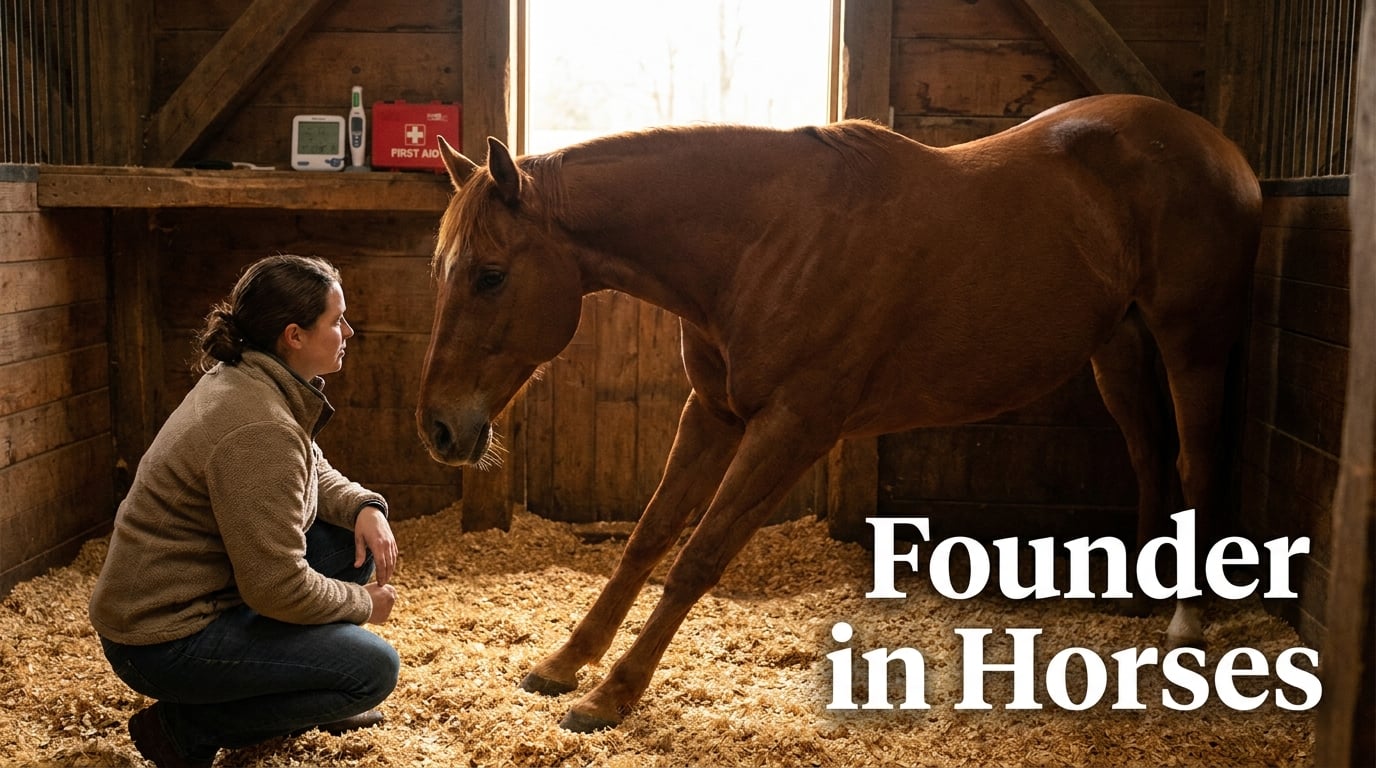
I’ve raised horses for over a decade, and nothing strikes fear into a barn quite like the word founder. Founder in horses isn’t just a fancy term for sore feet. It’s a painful, sometimes deadly condition that can wreck a promising horse in a matter of days.
This guide walks you through everything I’ve learned from veterinarians, farriers, and fellow owners. We’ll cover what founder actually is, why it happens, the early warning signs most people miss, and the exact steps to take during an emergency. You’ll also get a clear-eyed look at treatment costs, recovery timelines, and the prevention habits that keep my own horses safe year-round.
Whether you’re a first-time horse owner or a seasoned rider, this is the article I wish someone had handed me the day my gelding took his first bad step.
Table of Contents
What Is Founder in Horses? (Founder vs Laminitis Explained)
Founder in horses is the common name for laminitis, a painful condition in which the sensitive tissues (called laminae) inside the hoof become inflamed and start to fail. The laminae are the tiny, interlocking structures that hold the hoof wall to the coffin bone (also called the pedal bone). When those structures break down, the coffin bone can rotate downward or sink within the hoof capsule.
Technically, laminitis refers to the inflammation itself, while founder refers to the mechanical failure that follows when the bone shifts. In everyday barn talk, owners use both words interchangeably, and most vets do the same. When you hear someone say their horse has foundered, they mean the hoof has already started to fail mechanically, not just feel a little sore.
The condition can affect one foot or all four, though the front feet are most commonly involved because they carry roughly 60% of a horse’s body weight. The pain comes from swelling, pressure, and the tearing of soft tissue inside a rigid, weight-bearing structure.
Left untreated, founder in horses leads to permanent hoof damage, chronic lameness, and in severe cases, euthanasia. That’s why understanding the early signs is so important. The first 48 to 72 hours are when your actions matter most.
The Anatomy Behind the Pain
Picture a horse’s hoof as a glove of tough keratin wrapped around soft, sensitive tissue. Inside that glove sit the coffin bone, the digital cushion, and thousands of finger-like laminae that lock everything together. Healthy laminae act like Velcro. When they fail, the bond loosens, and the bone starts to move.
Two main mechanical changes can happen:
Rotation: The coffin bone tilts downward, pressing the tip into the sole.
Sinking (or descent): The entire bone drops deeper into the hoof capsule. This form is rarer and far more dangerous.
Both scenarios cause intense pain because the hoof cannot expand to accommodate the swelling. The result is the classic founder stance: front legs stretched forward, hind legs tucked under the belly, as the horse tries to shift weight off its toes.
What Causes Founder in Horses?
Anything that disrupts blood flow to the hoof or damages the laminae can trigger founder. In my experience, most cases fall into one of four buckets: metabolic, dietary, mechanical, or toxic.
1. Metabolic and Endocrine Causes
This is the leading cause of founder in horses today, especially in easy keepers and older horses. Two conditions drive most metabolic founder:
Equine Metabolic Syndrome (EMS): A cluster of problems including obesity, insulin resistance, and abnormal fat deposits. EMS horses founder easily on lush spring grass.
Pituitary Pars Intermedia Dysfunction (PPID), also called Cushing’s disease: Common in horses over 15, this hormonal disorder raises cortisol and increases laminitis risk.
Both conditions cause insulin dysregulation, which directly damages the laminae. Even seemingly small spikes in blood sugar can trigger an episode in a susceptible horse.
2. Dietary and Pasture-Related Causes
This is what most people picture when they think of founder. The classic scenarios include:
Grass founder: Consumption of lush, fast-growing pasture rich in sugars and fructans, especially in spring and fall.
Grain overload: A horse breaking into the feed room and devouring 20 to 50 pounds of grain at once.
Sudden diet changes: Switching hay or feed without a gradual transition can disrupt the gut microbiome and trigger inflammation.
Obesity: Overweight horses carry extra inflammation and are far more likely to founder.
3. Mechanical and Weight-Bearing Causes
Sometimes founder in horses has nothing to do with diet. Mechanical triggers include:
Supporting limb laminitis: When a horse severely injures one leg, the opposite leg bears extra weight for weeks, and that overload can founder the good leg.
Road founder: Repeated concussion on hard surfaces, often seen in working carriage or police horses.
Unbalanced trimming or shoeing: A farrier who removes too much toe or leaves one side too high can create harmful stress.
4. Toxic and Systemic Causes
Anything that triggers a massive inflammatory response can founder a horse:
Endotoxemia: From retained placenta after foaling, severe colic, or pneumonia.
Black walnut shavings: Even small amounts of bedding from black walnut wood can cause acute laminitis.
Excessive steroid use: Long courses of corticosteroids in susceptible horses.
Severe illness: Potomac horse fever, salmonella, and other systemic infections.
Signs and Symptoms of Founder in Horses
The symptoms of founder range from subtle to obvious. Catching the subtle ones is what saves horses.
Early Warning Signs (Easy to Miss)
These are the quiet signals I now watch for every single day:
Reluctance to pick up a front foot, or shifting weight from one front foot to the other when standing still.
A short, choppy stride on hard ground that looks like the horse is walking on eggshells.
Heat in the hoof wall or coronet band.
A bounding digital pulse, which you can feel by pressing two fingers against the artery at the back of the fetlock.
Stiffness in the shoulders or back that disappears with a few minutes of walking.
Subtle rings on the hoof wall that grow out wider at the heel than at the toe.
Acute Symptoms (Veterinary Emergency)
If you see any of these, call your vet immediately. Founder is always time-sensitive:
The classic founder stance: front legs out in front, hind legs tucked under the body, leaning back to take weight off the toes.
Reluctance or refusal to move, even with encouragement.
Visible trembling, sweating, and an elevated heart rate.
A strong, pounding digital pulse in one or both front feet.
Lameness that worsens on hard or uneven surfaces.
Chronic Founder Symptoms
When founder has been ongoing for weeks or months, the hoof itself starts to change shape. You may notice:
Divergent hoof rings (wider at the heel than the toe).
A flattened or dropped sole.
A bulge at the coronary band.
A “foundered hoof” with a dished dorsal wall and long, slipped heels.
Persistent lameness that improves on soft ground but never fully resolves.
Emergency Warning Signs Checklist
Save this checklist on your phone. If you answer yes to two or more of these, call your vet right now:
Is the horse leaning back or shifting weight constantly?
Are the front hooves noticeably hotter than normal?
Can you feel a strong digital pulse at the fetock?
Did the horse get into grain or a lush pasture recently?
Is the horse reluctant to turn in a tight circle?
Is the horse sweating, trembling, or showing a high heart rate?
How Veterinarians Diagnose Founder in Horses?
A vet diagnoses founder through a combination of physical exam, history, and imaging. Here’s what to expect during the call.
Physical Examination
Your vet will watch the horse walk and turn, feel the hooves for heat, and palpate the digital pulses. They’ll use hoof testers, a pincer-like tool that applies pressure to specific spots on the sole, to localize pain. Horses with founder typically react strongly when pressure is applied at the toe.
Radiographs (X-rays)
X-rays are the gold standard for confirming founder and measuring how much rotation or sinking has occurred. The vet will take lateral views of the affected feet to compare the position of the coffin bone to the hoof wall. This also helps farriers trim and shoe the horse correctly during recovery.
Blood Work
If your vet suspects metabolic causes, they’ll draw blood to check insulin, glucose, ACTH, and sometimes leptin levels. Baseline insulin values above 20 to 30 µIU/mL (depending on lab) raise red flags for EMS-related founder. ACTH testing helps diagnose PPID in older horses.
Other Tests
In certain cases, your vet may also test for underlying infections, run a complete blood count, or analyze the diet. The goal is to find the root cause, not just treat the symptoms.
How to Treat Founder in Horses?
Treatment for founder in horses has three goals: stop the damage, control the pain, and address the root cause. Here’s the step-by-step approach most vets follow.
Step 1: Emergency Response (First 24 to 72 Hours)
If you suspect founder, act fast. Here’s exactly what to do:
Move the horse to a stall with deep, soft bedding (shavings or sand). Deep bedding supports the sole and encourages the horse to lie down.
Remove all grain, treats, and access to grass immediately.
Offer only hay soaked for 30 to 60 minutes to leach out sugars.
Apply cold therapy to the affected feet. Ice boots or standing the horse in ice water for 20 to 30 minutes several times a day reduces inflammation.
Call your vet and describe what you’re seeing. Don’t wait to see if it gets better on its own.
Step 2: Veterinary Medical Treatment
Once your vet arrives, they will likely start or recommend:
NSAIDs: Phenylbutazone (“bute”) or flunixin meglumine (Banamine) to control pain and inflammation. Higher doses may be used early on.
Cryotherapy: Continued icing of the feet, especially in acute cases.
Anti-rotation support: Styrofoam pads or deep sand bedding to take pressure off the toe.
Gut support: Psyllium or activated charcoal if grain overload is suspected.
Insulin-lowering medication: If EMS is involved, your vet may prescribe metformin or other therapies.
Step 3: Hoof Support and Therapeutic Shoeing
Your farrier is part of the treatment team from day one. Common therapeutic options include:
Styrofoam pads or impression material: Placed under the frog to support the sole and reduce pull on the laminae.
Heart-bar shoes: Distribute weight across the frog instead of the hoof wall.
Glue-on shoes or clogs: Useful for horses with thin or damaged walls.
Reverse shoes or wedge pads: Help rotate the coffin bone back toward a healthier angle over time.
Farrier and vet should communicate regularly. Repeat X-rays every 4 to 8 weeks help track progress and adjust the shoeing plan.
Step 4: Diet and Lifestyle Changes
Medication alone won’t fix a foundered horse. Diet is half the battle:
Switch to a low-sugar, low-starch diet (hay soaked if needed).
Eliminate grain, sweet feeds, and molasses-based products.
Use a grazing muzzle if the horse must have pasture access.
Consider a ration balancer instead of a full grain ration.
Test your hay for sugar content if EMS is suspected.
Recovery and Long-Term Management of Founder
Honest answer here: there is no quick fix. Recovery from founder takes weeks to years, and many horses need lifelong management.
Realistic Recovery Timelines
Mild, acute founder caught early: 2 to 4 weeks of stall rest, then a slow return to turnout over 2 to 3 months.
Moderate founder with mild rotation: 3 to 6 months of careful management before light work resumes.
Severe founder with significant rotation or sinking: 6 to 18 months of rehabilitation. Some horses never return to full work.
The first six weeks are the hardest. Once new hoof growth starts to appear at the coronet band, you’ll have a better idea of long-term prognosis.
Quality of Life Considerations
This is something most articles don’t talk about, and it should be. A horse that has foundered once is at higher risk of foundering again. Owners must decide whether the horse can live a comfortable life given:
The level of chronic pain the horse experiences.
The horse’s ability to move freely in a pasture or paddock.
The financial commitment for ongoing farrier, vet, and medication costs.
The horse’s temperament and ability to tolerate long-term stall rest.
Some foundered horses do wonderfully as pasture pets and light hacks. Others struggle with chronic pain despite the best care. Work closely with your vet to make decisions based on the individual horse.
Long-Term Management Habits
Once a horse has foundered, lifelong management is essential:
Keep body condition at a 4 to 5 out of 9 on the Henneke scale.
Restrict or eliminate pasture access with a dry lot or grazing muzzle.
Soak hay to keep sugar intake under 10 to 12% NSC.
Maintain a strict farrier schedule (every 4 to 6 weeks).
Test insulin and ACTH levels at least once or twice a year.
Avoid high-dose steroid medications unless absolutely necessary.
How to Prevent Founder in Horses?
Preventing founder is far easier than treating it. The habits that work for me come straight from my vet and farrier.
Diet and Pasture Management
Feed a diet based on forage, not grain.
Introduce spring pasture slowly, 15 minutes a day increasing over 2 to 3 weeks.
Keep easy keepers on a dry lot or use grazing muzzles from March through June.
Test hay for NSC content. Anything over 12% should be soaked.
Avoid sudden feed changes. Transition over 7 to 10 days minimum.
Weight and Body Condition
Use a weight tape monthly and track trends.
Address weight gain early, before it becomes obesity.
Exercise regularly. Movement improves insulin sensitivity.
Seasonal and Metabolic Awareness
Spring and fall are peak grass founder seasons. Be extra vigilant during these transitions.
Older horses (15+) should be tested annually for PPID.
Easy keepers and horses with prior founder episodes should have baseline insulin testing.
Keep a record of any “off” days, even if the horse seems fine the next morning.
Build Your Team Early
The best prevention is having a vet and farrier who know your horse before there’s a crisis. Schedule annual wellness checks and a spring laminitis risk assessment if your horse is in a high-risk category.
Frequently Asked Questions
How do you fix a foundered horse?
Fixing a foundered horse requires immediate veterinary care. Your vet will likely administer NSAIDs such as phenylbutazone or flunixin meglumine for pain and inflammation, recommend cold therapy or ice boots on the affected feet, place the horse on deep soft bedding, and coordinate with your farrier for therapeutic shoeing. Diet changes to remove grain and restrict sugar are essential, and underlying causes like EMS or Cushing’s disease must be diagnosed and managed.
Can a horse survive foundering?
Yes, many horses survive foundering, especially when the condition is caught early and treated aggressively. Mild to moderate cases often return to light work within 3 to 6 months. Severe cases with significant coffin bone rotation or sinking may not return to full soundness, but many horses live comfortably as pasture pets or light trail horses with proper management.
What are the signs of founder in a horse?
The signs of founder in a horse include a bounding digital pulse at the fetlock, heat in the hoof wall, reluctance to move or turn, a foundered stance with front legs stretched forward, sensitivity to pressure on the toe with hoof testers, and the horse shifting weight from foot to foot. Early subtle signs include a short choppy stride, stiffness that warms out, and visible rings on the hoof wall that grow wider at the heel than the toe.
What is the difference between founder and laminitis?
Laminitis is the medical term for inflammation of the sensitive laminae inside the hoof. Founder is the common barn term that refers to the mechanical failure of those tissues, when the coffin bone rotates or sinks within the hoof capsule. In practice, both words are used interchangeably, and most horse owners and veterinarians mean the same overall condition when they say founder.
Final Thoughts on Founder in Horses
Founder in horses is one of those conditions that rewards owners who pay attention. The horses I’ve seen come through founder best are the ones whose owners caught the early signs, called the vet quickly, and stuck to the management plan for months after the crisis passed.
If you take one thing from this guide, let it be this: founder is always an emergency, but it’s also a manageable condition when you understand the causes and act decisively. Watch your horse’s weight, control the diet, know your horse’s digital pulses, and have a vet and farrier you trust on speed dial.
For 2026 and beyond, the best protection against founder in horses is still the basics done consistently. Slow grass introductions, soaked hay for easy keepers, and a watchful eye every time you walk into the barn.