
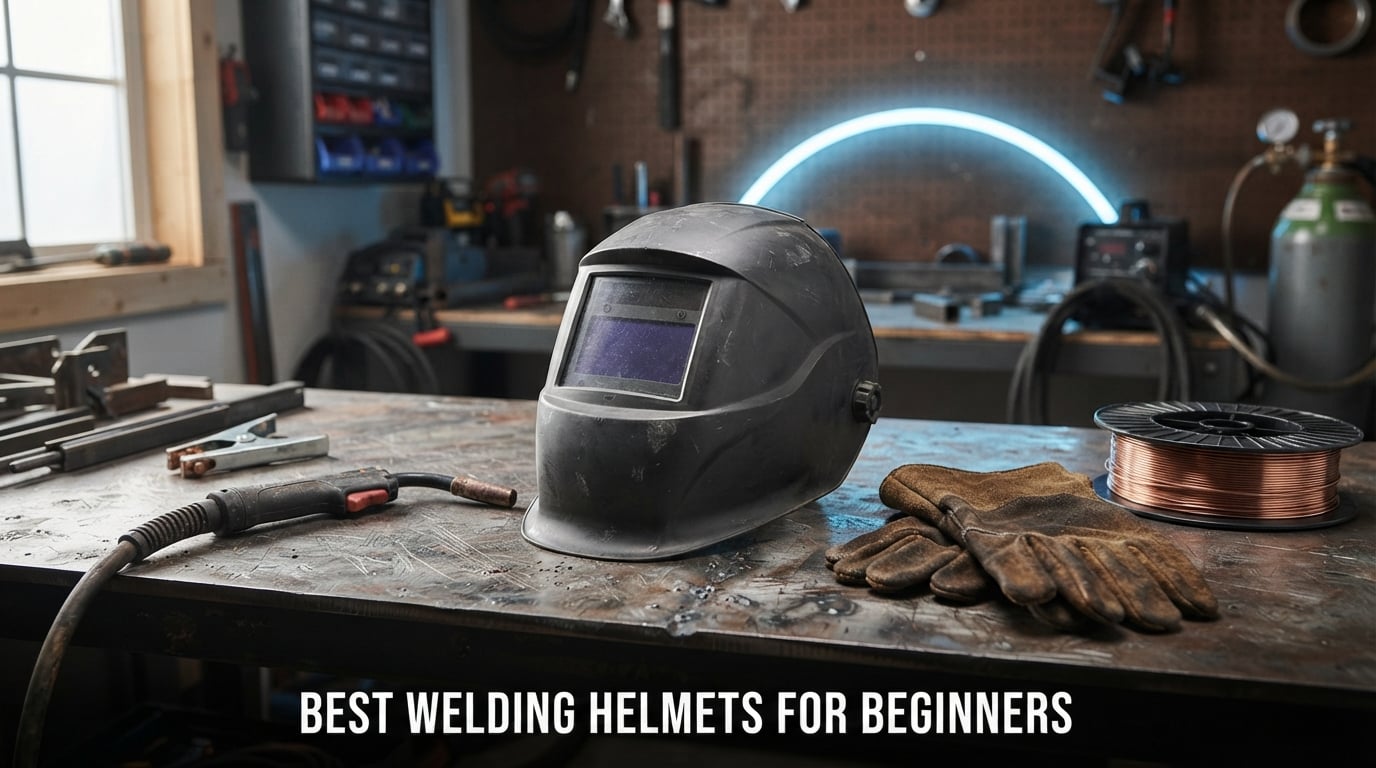
A welding helmet is a face and eye shield that blocks arc flash, ultraviolet and infrared radiation, sparks and molten spatter while you weld. Modern auto-darkening helmets use arc sensors to darken the lens the instant the arc strikes, then fade back to a light shade when you stop. For a first-time welder, that auto-darkening feature matters more than brand prestige, because it removes the guesswork of flipping a hood by hand while your hands are busy.
We compared 12 of the most-reviewed auto-darkening and fixed-shade helmets on the market to find the best welding helmets for beginners in 2026. The short answer: if you are learning MIG in a home garage, a true-color helmet with a shade 9-13 range, two to four arc sensors and a light weight matters far more to your first year than a premium badge does.
Table of Contents
What to Look For in a Welding Helmet?
Auto-darkening filter (ADF) so the lens darkens on arc strike instead of you flipping the hood by hand.
Variable shade 9-13 to cover stick, MIG and flux core work in one helmet.
Two to four arc sensors so the lens detects the arc reliably in a bright garage or a dark shop.
Fast switching speed, in the 1/20,000 to 1/30,000 second range, so no arc flash reaches your eyes.
True color optics and a decent viewing area, because a green-tinted small window makes it hard to read the puddle.
Top 3 Best Welding Helmets For Beginners (October 2026)

YESWELDER LYG-L600A
- True color 1/1/1/1 lens
- 2 arc sensors at 1/30000s
- Shade 3/7-13
- 16 oz shell
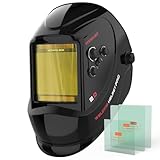
YESWELDER LYG-M800H
- Large 3.93 inch by 3.66 inch view
- 4 arc sensors
- Shade 5-9 and 9-13
- True color

All 12 Welding Helmets for Beginners at a Glance
| Product | Specifications | Action |
|---|---|---|
| YESWELDER LYG-L600A |
|
Check Latest Price |
| YESWELDER LYG-M800H |
|
Check Latest Price |
| ARCCAPTAIN Auto Darkening Helmet |
|
Check Latest Price |
 YESWELDER LYG-Q800D YESWELDER LYG-Q800D |
|
Check Latest Price |
 TOOLIOM Solar Auto Darkening Helmet TOOLIOM Solar Auto Darkening Helmet |
|
Check Latest Price |
 TRQWH True Color Helmet TRQWH True Color Helmet |
|
Check Latest Price |
 Sunstac Auto Darkening Helmet Sunstac Auto Darkening Helmet |
|
Check Latest Price |
 NDUUN True Color Helmet NDUUN True Color Helmet |
|
Check Latest Price |
 TOPDC Flip Front Shade 11 Helmet TOPDC Flip Front Shade 11 Helmet |
|
Check Latest Price |
 Lincoln Electric K4134-1 Lincoln Electric K4134-1 |
|
Check Latest Price |
 Hobart 770890 Hobart 770890 |
|
Check Latest Price |
 Miller Classic Series ClearLight Miller Classic Series ClearLight |
|
Check Latest Price |
1. YESWELDER LYG-L600A – Best welding helmet for beginners overall
YESWELDER Auto Darkening Welding Helmet 1/1/1/1 True Color, LYG-L600A
1/1/1/1 true color lens
2 arc sensors
Switching in 1/30000s
Shade 3/7-13
16 oz
Pros
- True color 1/1/1/1 lens shows a natural view of the puddle
- Fast 1/30000s darkening with external shade and sensitivity controls
- Comfortable adjustable headgear that works with a respirator
- Box includes spare lenses
- a spare battery and a storage bag
Cons
- Viewing area is small compared with full-face or panoramic styles
- Shell and headgear feel thin and flex under pressure
With more than thirteen thousand reviews behind it, the LYG-L600A is the helmet most beginners end up buying, and the reason is simple. The 1/1/1/1 true color lens is the highest optical clarity grade used across this group, so the puddle looks like metal rather than a green smear.
That matters more than any spec sheet suggests. A first welder spends most of the first month learning to read the puddle, and a clearer lens shortens that learning curve noticeably.
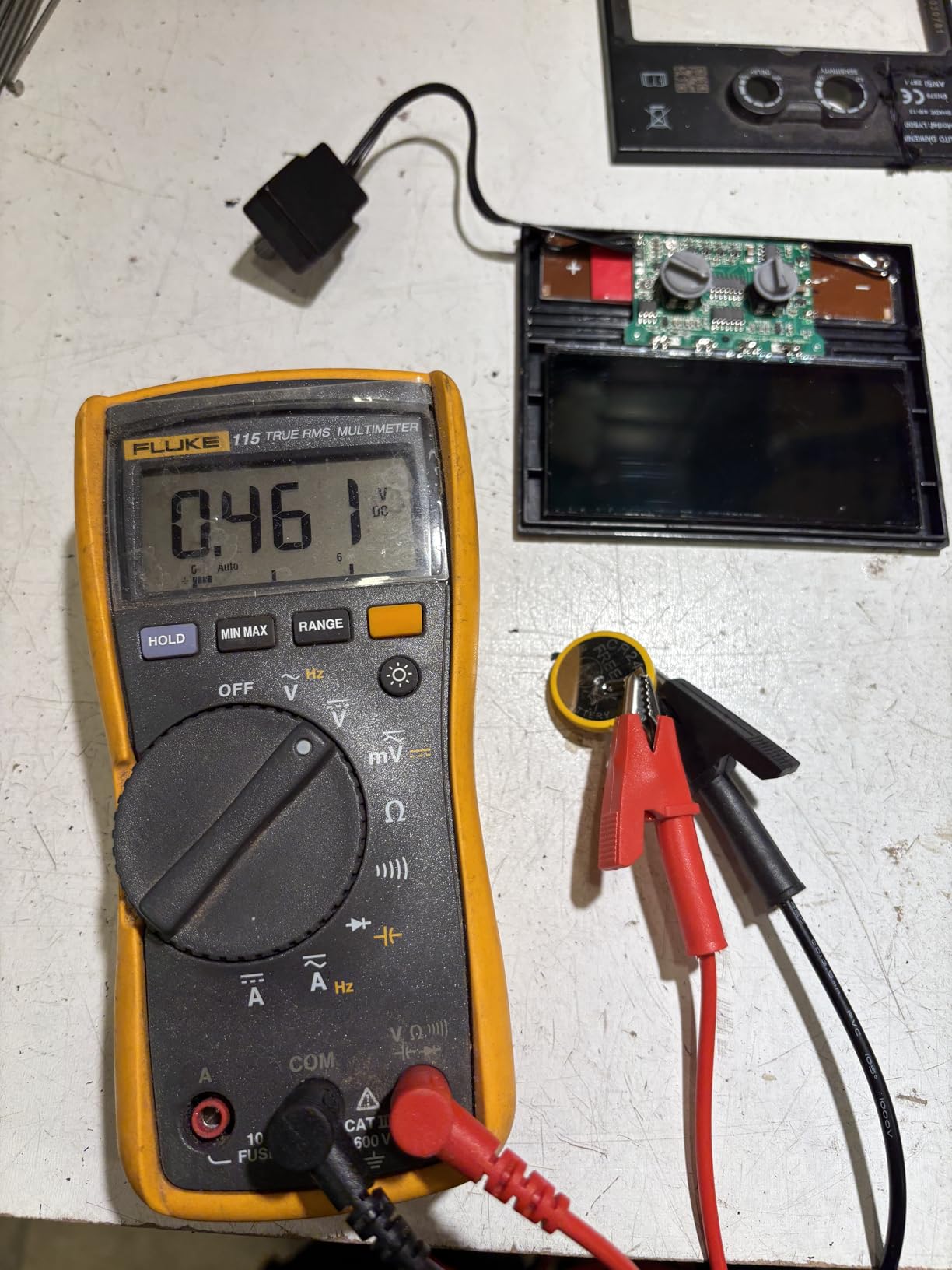
The electronics do their job. Two arc sensors trigger the darkening in 1/30000 second, and both shade and sensitivity sit on external controls you can reach with a gloved hand. Shade 3/7-13 covers TIG, MIG, stick and grinding without a swap.
Power comes from a solar panel backed by a replaceable CR2450 coin cell, so there is no charging routine to remember. Owners report the auto-darkening working as intended for years, and the fit is reported as comfortable alongside a half-face respirator.
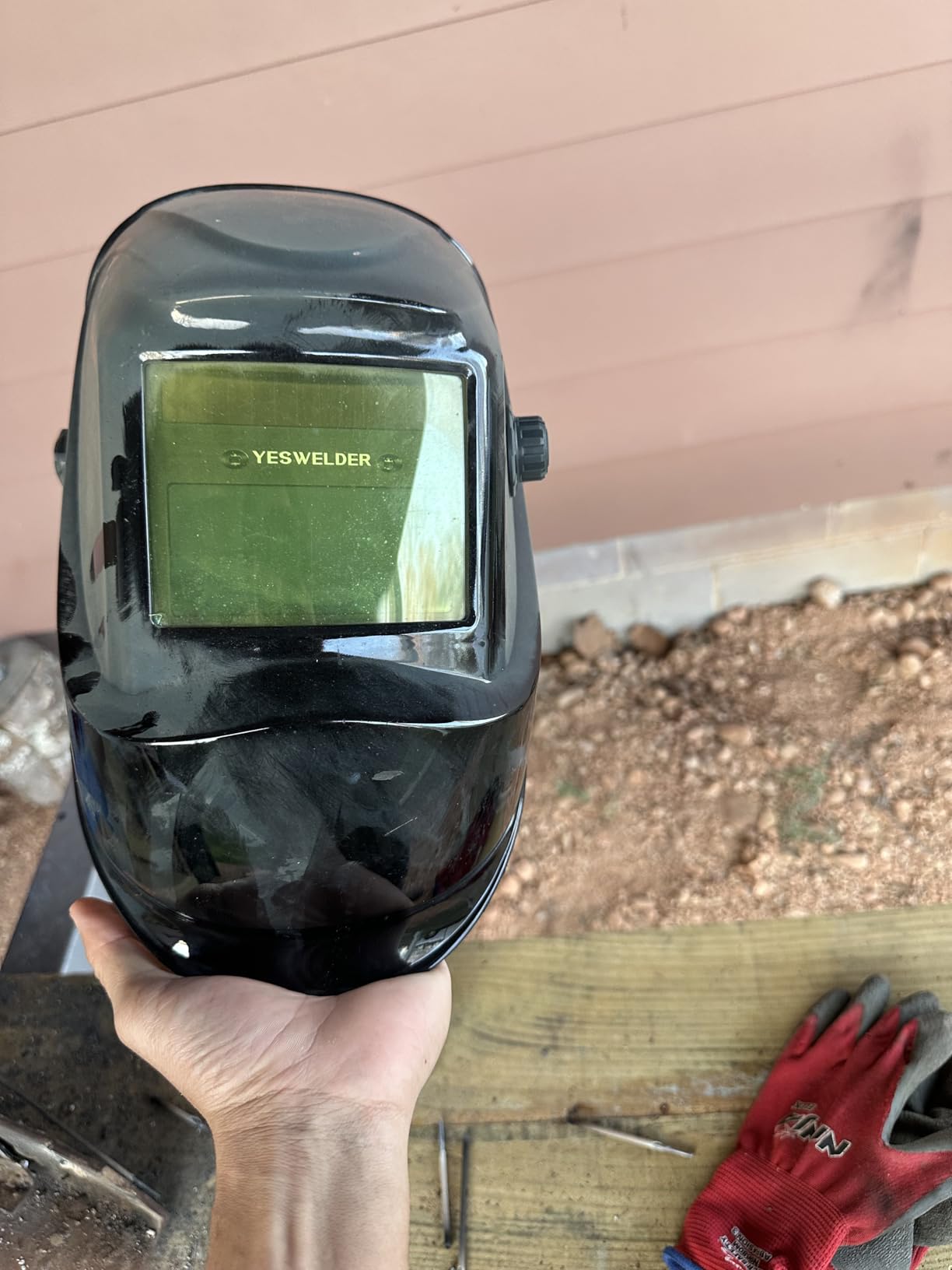
The build is where the compromises live. The shell and headgear are described as thin, and the viewing area is small next to a panoramic model. Buy it if you want the simplest first step up from a cheap hood.
Who this helmet suits?
A student in a welding class doing MIG and stick work on thin mild steel. The light 16-ounce shell is easy to keep on for a full session, and the spare lenses and spare battery in the box mean you are not hunting for parts after your first scuff.
Who should skip it?
Anyone welding overhead in a confined space who needs side coverage, or a TIG welder working at very low amperage who needs an electromagnetic sensing mode. Both of those point to a larger-view or four-sensor model instead.
2. YESWELDER LYG-M800H – Best value for a large viewing area
YESWELDER Auto Darkening Welding Helmet, Large View, LYG-M800H
3.93 inch by 3.66 inch view
1/1/1/1 true color
4 arc sensors
1/30000s
Solar plus CR2450
Pros
- Extra large viewing area makes the joint easy to see
- True color optics are described as a night-and-day upgrade
- External controls for shade and grind changes with gloves on
- Light enough to wear for hours
Cons
- Side tension knobs feel fragile and need tightening hard
- Inner lens and battery are hard to remove and the lens frame feels flimsy
- Headgear can slip forward when you nod the mask down
The M800H solves the main complaint about small-window entry helmets by making the viewing area dramatically larger at 3.93 inches by 3.66 inches. For a beginner learning where to put the torch, seeing the whole joint at once changes how fast the skill sticks.
Beginners report a measurable improvement in bead quality once they switch to a true-color view, largely because the joint edges become visible for the first time. Four arc sensors and a 1/30000 second switch also make it steadier than the two-sensor models at the same level.
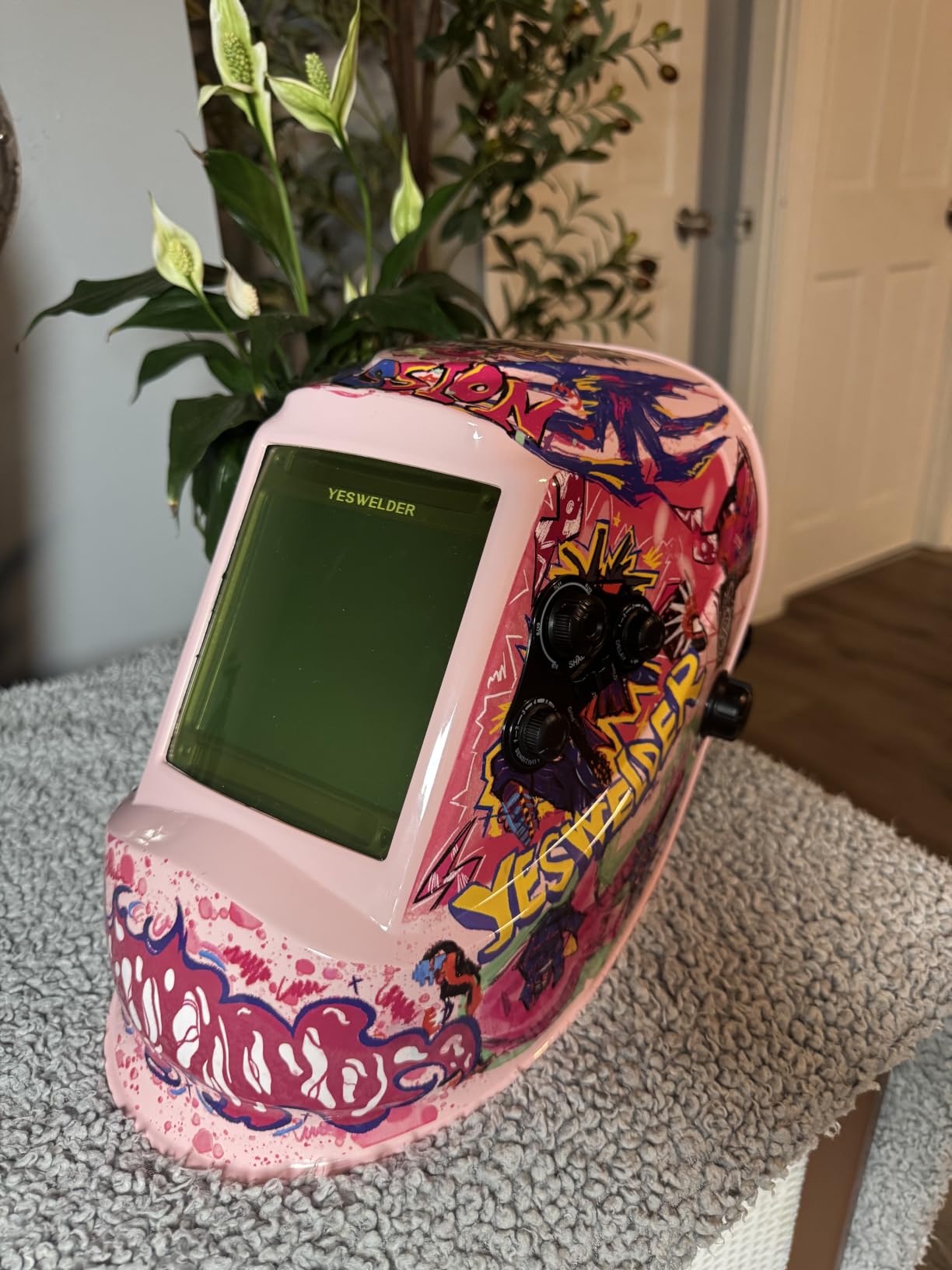
Shade control covers the 5-9 and 9-13 ranges with adjustable settings, so you can drop to a lighter shade for thin material without changing helmets. The cheater lens mount opens up spot welding and close inspection work.
Weight is listed at roughly 1.32 lb, which keeps it comfortable through long practice sessions. The blue light blocking outer lens adds a layer of protection against the high-energy light modern arcs produce.
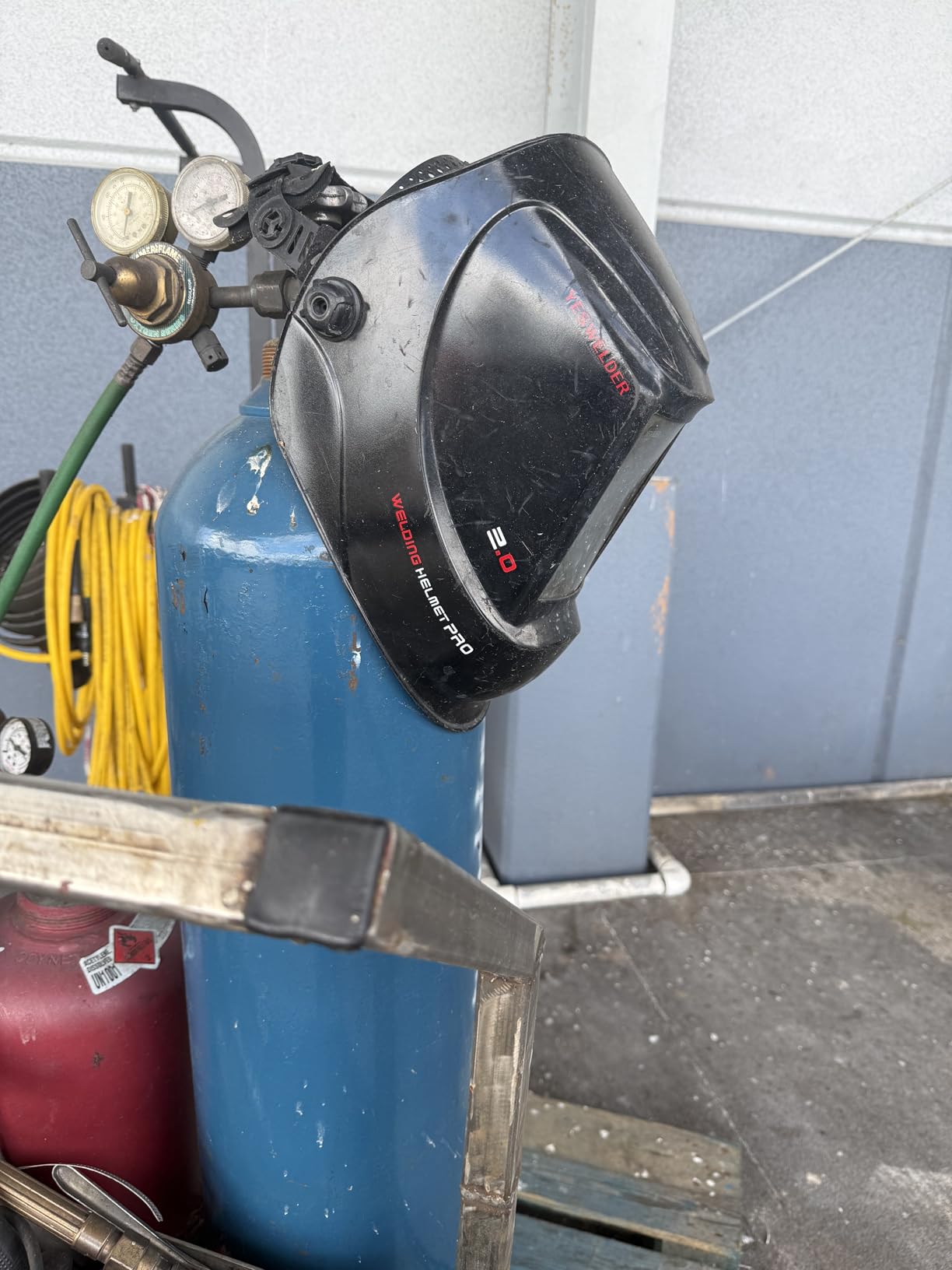
The weak points are mechanical rather than optical. The side tension knobs are the most criticized part, and several owners mention the headgear creeping forward when the mask is tipped down for overhead work.
Who this helmet suits?
A hobbyist working in a garage where lighting is poor and the work is close-up. The wide view plus true color optics is the combination beginners benefit from most, and the 1/1/1/1 rating confirms the clarity is real rather than marketing.
Who should skip it?
Welders who constantly tip the helmet up and down, or who need a headgear you can dial in precisely. The forward slip and the fragile side knobs are the two complaints that come up again and again.
3. ARCCAPTAIN Auto Darkening Helmet – Best for low-current TIG work
ARCCAPTAIN Welding Helmet Auto Darkening, 1/25000s Response, Shade 4/9-13
Shade 4/9-13
4 arc sensors
1/25000s
1/1/1/1 true color
DIN 16 UV/IR
Pros
- Blue-tinted 1/1/1/1 lens reported as among the clearest in use
- Fast and reliable auto-darkening with easy darkness controls
- Lightweight at about 1 lb with a padded adjustable headband
- Includes three replacement lenses
Cons
- Shell and graphics can feel cheap on first touch
- A minority of owners report slow response or flicker in long sessions
- Cheaper lens glass wears faster than premium brands
Most entry helmets jump straight to shade 9, which is wrong for TIG work at low amperage. This one starts at shade 4, so a beginner can do thin-gauge TIG and then dial up for steel without a second helmet.
It is also one of the few affordable models here with four arc sensors and a 1/25000 second switch, which is exactly the combination that keeps detection reliable when the arc is small and the workshop is bright.
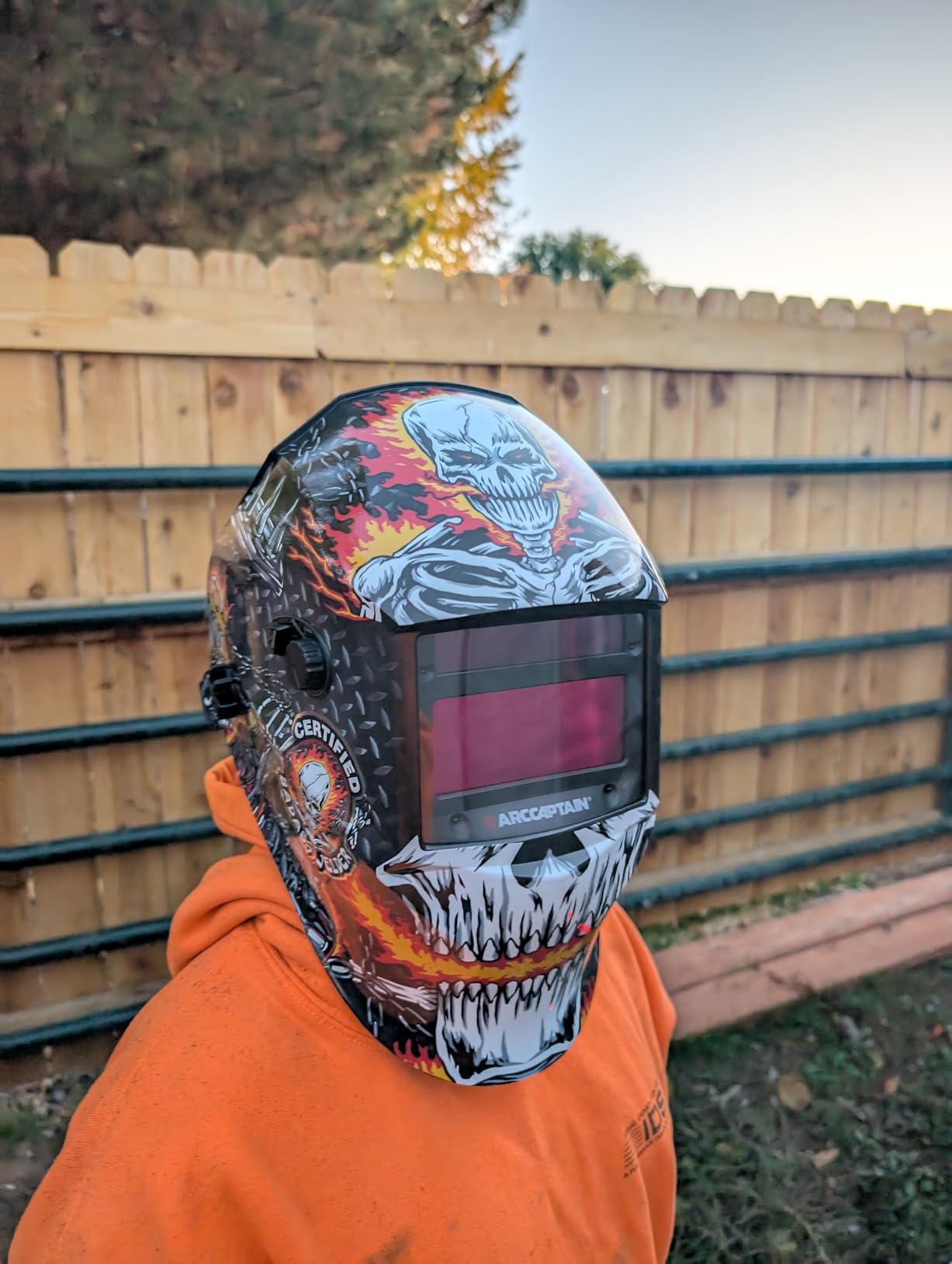
Owners repeatedly single out the blue-tinted lens. The 1/1/1/1 optical class is the highest grade in this group, and reviewers say it holds up against helmets costing several times more.
The 12-in-1 filter provides automatic DIN 16 UV and IR protection, and the certification list includes ANSI/ISEA Z87.1-2010, CSA Z94.3, DIN EN 175 and DIN EN 379. The cheater lens mount is a small addition that pays off on stainless work.
A small minority of reviews describe units that slowed, flickered or stopped darkening during long sessions, which reads as a quality-control variance rather than a design fault. Solar cells with a replaceable CR2450 battery handle power.
Who this helmet suits?
Someone who plans to do TIG on thin stainless or aluminum as well as MIG and stick. The low shade 4 setting is the deciding factor, and the four sensors help when the arc is faint.
Who should skip it?
Anyone who needs a hard shell that survives daily shop abuse, or who cannot tolerate a small viewing area. The build is light and the plastic gives a little, which is fine for weekend work but not for constant grinding duty.
4. YESWELDER LYG-Q800D – Best for a panoramic view and LED work light
YESWELDER Auto Darkening Welding Helmet with LED, 180° View, LYG-Q800D
180 degree view
3.94 inch main window
Side window at DIN5
LED work light
4 arc sensors
Pros
- Panoramic view with side window widens the field for lining up work
- Integrated LED work light helps in dim shops and garages
- True color 1/1/1/1 optics reduce the green tint
- Four arc sensors and 1/30000s switching suit multiple processes
Cons
- Heavier shell than entry-level true color models
- Headgear and shell construction are less robust than professional hoods
The Q800D is the pick if your biggest problem is not seeing enough of the workpiece. The 3.94 inch by 3.23 inch main window is joined by a side window that stays at DIN 5, so you can look sideways at the joint without flipping anything.
Owners choose this model mainly for two reasons, the wide field and the built-in LED. In a dark garage, the light is what stops you from guessing where the torch is before the arc strikes.
The shade range runs 3/5-9/9-13 across TIG, MIG, stick, cutting and grinding, and both sensitivity and delay are adjustable internally. Four arc sensors with a 1/30000 second switch keep up with a fast start.
Power is handled by a solar panel with a replaceable CR2450 battery, and the box includes a spare battery plus three replacement lenses. A magnifying lens mount is available for close work.
It is heavier than the smaller true color models, and the shell and headgear are described as entry-level rather than professional. For a student who will wear it for a few hours a week, that trade works out.

Who this helmet suits?
Fabricators who weld in tight spots or work out of position, and anyone whose garage needs a light source. The side window is the feature you will notice on day one and appreciate every session after that.
Who should skip it?
Anyone with neck or back issues who is sensitive to helmet weight, or welders who drop their helmets frequently. It is the heaviest shell in this roundup at a listed 2.2 pounds.
5. TOOLIOM Solar Auto Darkening Helmet – Best lightweight helmet for long sessions
TOOLIOM Auto Darkening Solar Powered Welding Helmet for TIG MIG ARC
1.14 lb
solar powered with replaceable battery
external grind knob
1/25000s
breathable sweatband
Pros
- Very light at 1.14 lb which owners with neck issues specifically praise
- Reliable auto-darkening reported after five years of shop use
- Solar panel plus replaceable battery means no charging routine
- Includes three replacement lenses and a storage bag
Cons
- A few owners report a slightly slow reaction to the arc
- If the solar cell is shadowed the lens can clear while welding
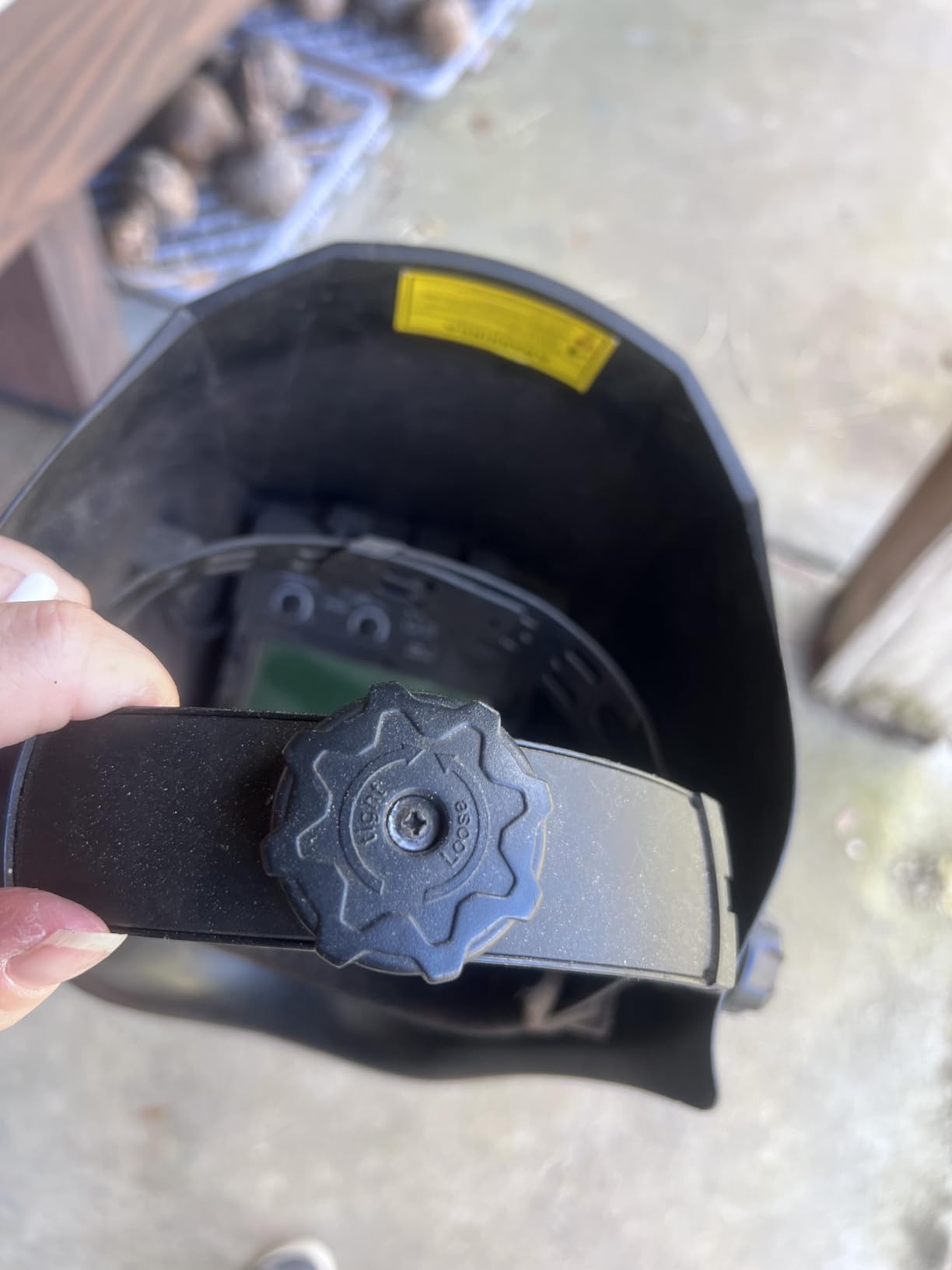
- Plastic shell feels thin at first touch
At 1.14 lb, this is one of the lightest helmets here, and weight turns out to matter more than most buyers expect. Welder after welder on the forums says a light helmet is the reason they keep it on instead of lifting it to rest their neck.
Long-term owners report the auto-darkening still working after five years of home shop use, which is the strongest durability signal in this group for a solar-powered design.
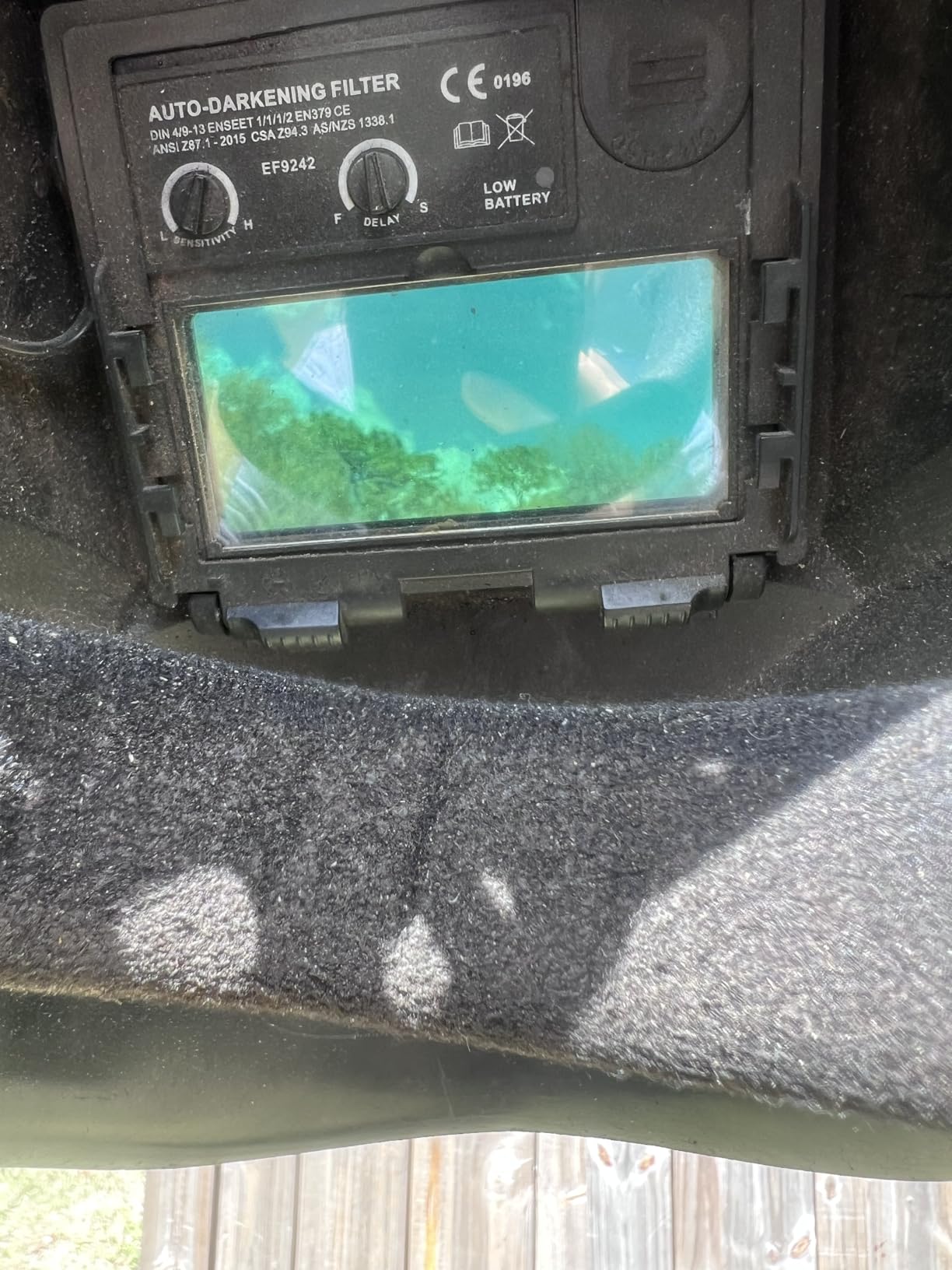
The external grind knob is a genuinely useful feature for beginners, because it lets you switch between welding and grinding without taking the helmet off or reaching inside. Sensitivity and delay knobs are internal.
Shade range is DIN 3.5/9-13, covering TIG, MIG, stick and plasma cutting. A low-battery indicator and a user-replaceable battery compartment take the guesswork out of maintenance.
Two cautions show up repeatedly: a slightly slow arc reaction on some units, and the fact that a shadowed solar cell can let the lens clear while welding. Keep the panel exposed and both go away.
Who this helmet suits?
Body-shop and out-of-position welders, or anyone welding overhead for long stretches. The breathable sweatband and the low weight make it a favorite for full days in a hot shop.
Who should skip it?
TIG welders who need reliable low-amp detection in bright conditions, and anyone who expects a rigid shell. The plastic gives noticeably, and a few owners report slower reaction than the spec sheet suggests.
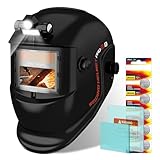
6. TRQWH True Color Helmet – Most versatile with a rechargeable work light
TRQWH Welding Helmet with Light True Color Auto Darkening Welding Helmets for Men Solar Powered Welding Hood with 2 Arc Sensor Wide Shade 4/9-13 for TIG MIG ARC Cool Welder Mask
1/1/1/2 true color
2 arc sensors at 1/20000s
DIN4 light state
rechargeable USB LED light
Pros
- True color lens with a built-in rechargeable USB work light
- Clear lens view and quick auto-darkening reported by owners
- Adjustable side and rear knobs with sponge padding at forehead and ears
- Spare replaceable batteries included
Cons
- Lenses and shell are thin and wear quickly in shop use
- Flipp-up state is not well locked so the hood can fall when the head moves
- One owner reported a first unit that would not darken reliably
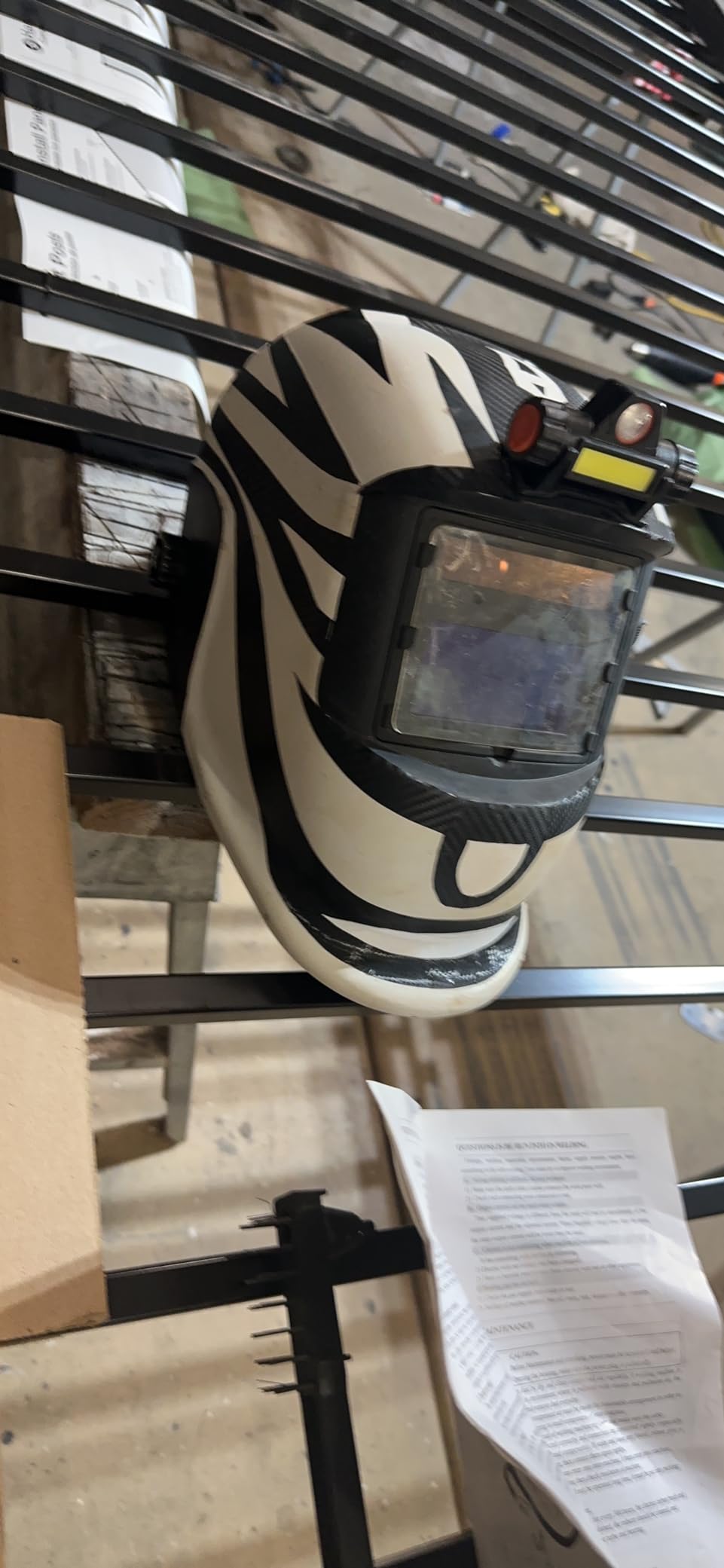
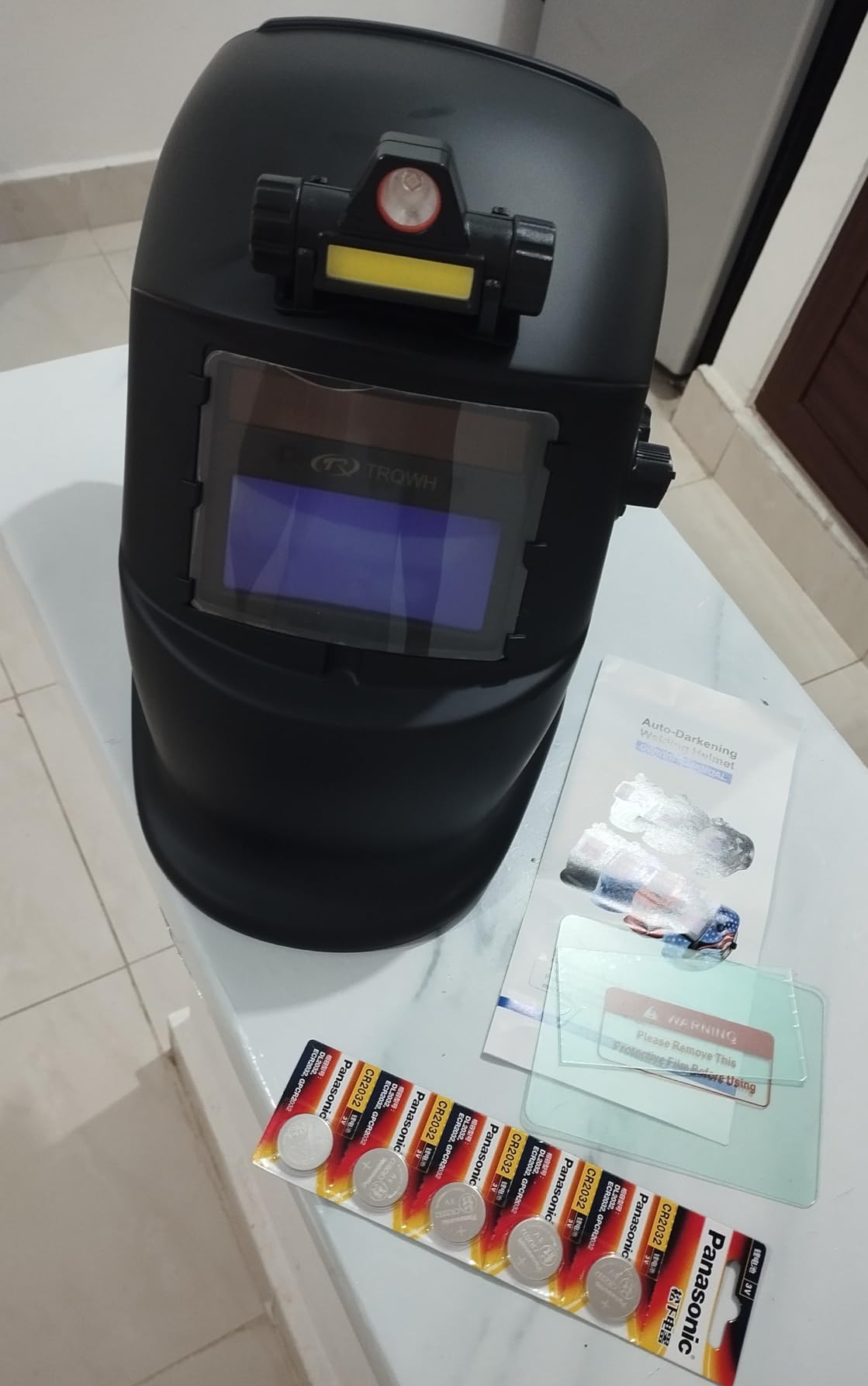
The TRQWH is a low-cost true color helmet, and for a first month of learning the trade-offs are acceptable. Owners describe it as a capable first helmet rather than a shop tool.
Two arc sensors switch in 1/20000 second across shade 9-13, with a DIN 4 light state so you can still see the room between passes. Compliance covers ANSI Z87.1, EN 379 CE and CSA Z94.3.
The optical class here is 1/1/1/2 rather than 1/1/1/1, so there is a small drop in side-angle perception. In practice buyers rarely mention it, but it is worth knowing if you will do a lot of out-of-position work.
The rechargeable LED work light has a USB port and a sponge-padded headband, and spare CR2032 cells are included. Solar cells handle the main power, which is convenient.
The recurring criticisms are durability and the flipp-up mechanism, which is not well locked and can let the hood fall when you move your head. Keep spares on hand and expect to replace lenses more often.
Who this helmet suits?
A first-week student who wants true color optics and a work light at the lowest outlay. If you are not sure whether welding will stick, this is a reasonable way to find out.
Who should skip it?
Anyone planning a full welding program or working in a shop full time. Thin lenses, a loose flip-up hood and a weak bundled lamp are all consumable-grade issues, not design flaws.
7. Sunstac Auto Darkening Helmet – Best for a rechargeable swiveling work light
Sunstac Auto-Darkening Welding Helmet, Shade 4/9-13 with Light
3.94 inch screen
1/1/1/1 true color
1/25000s
shade 4/9-13
dual power
Pros
- True color 1/1/1/1 lens with no darkening lag
- Rechargeable auxiliary work light with two brightness modes and adjustable angle
- Comfortable fully adjustable padded headband
- Dual power via solar panel and replaceable lithium battery
Cons
- Battery compartment is awkward to access
- Side tension buttons feel delicate and the hood can flop down when raised
- Headpiece is deep and can hit glasses on smaller heads
The Sunstac is a mid-entry true color helmet with a 3.94 inch wide screen and the full 1/1/1/1 optical class. Owners often compare the upgrade from an older green-tinted hood as dramatic, which is exactly the jump a first welder feels.
Its standout is the rechargeable work light with two brightness modes and a swivel angle, so you can aim it at the joint instead of holding a flashlight in your mouth.
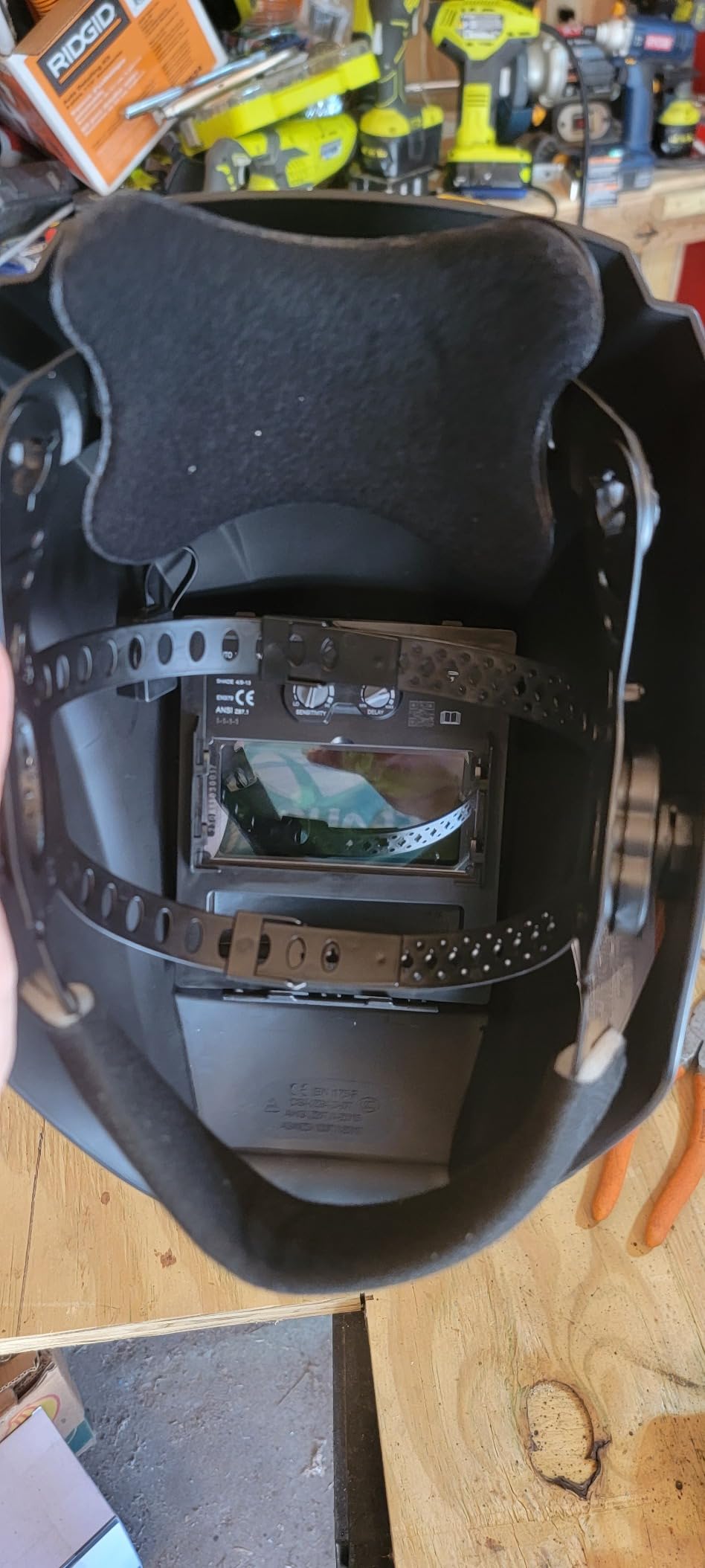
Two arc sensors darken in 1/25000 second across shade 4-13, covering stick, TIG, MIG and plasma work. The low shade 4 setting again matters for thin TIG, and a cheater lens mount is sold separately.
Power is dual, a solar panel with a replaceable lithium battery as backup. Multiple fit adjustments and internal padding let you dial in the headband rather than relying on a single strap.
Fit hardware is the weak point. The battery compartment is awkward to reach, the side tension buttons feel delicate, and the deeper headpiece can press against glasses on a smaller head.
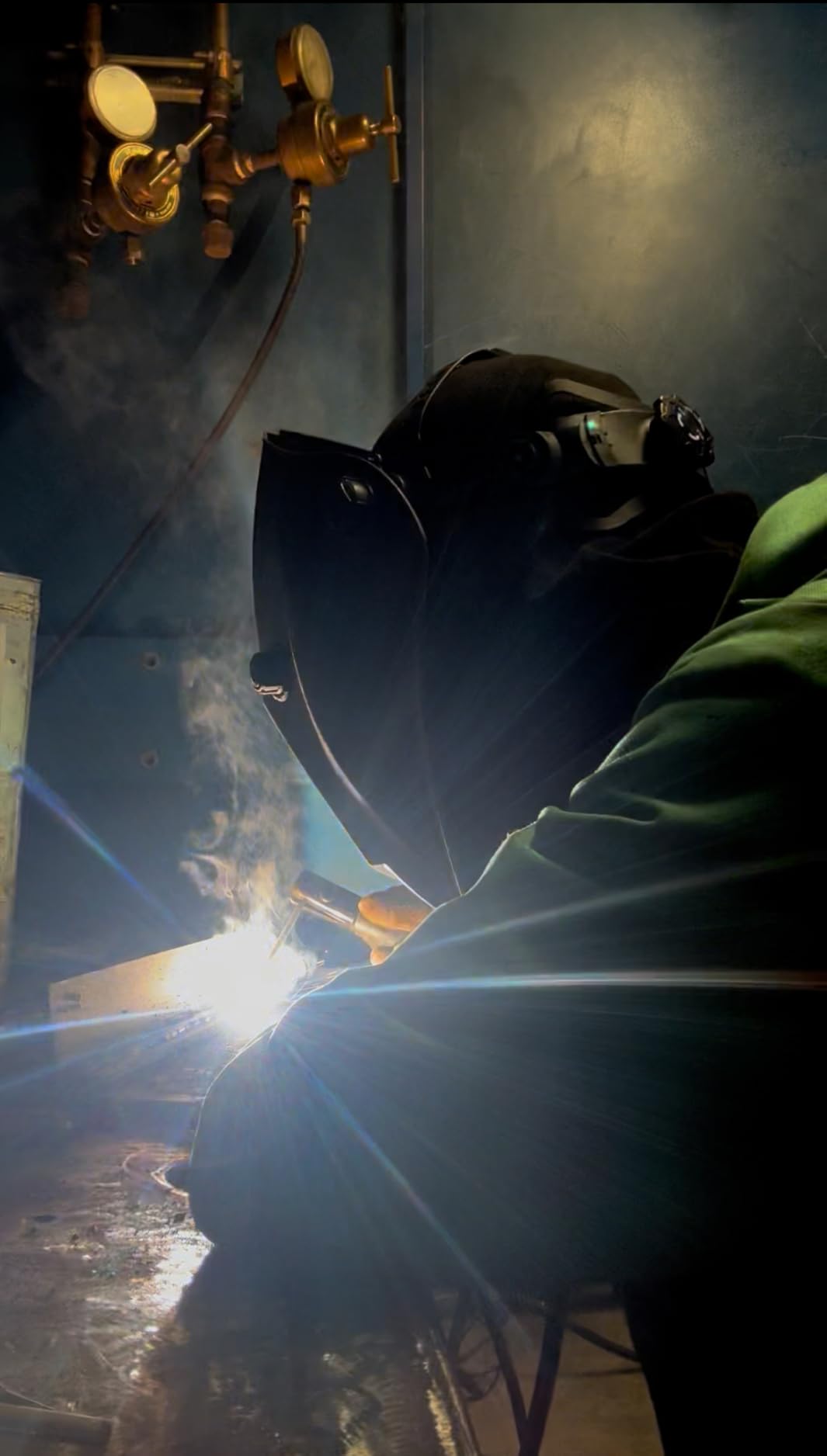
Who this helmet suits?
Shop welders who need to see both sides of a joint and light their own setup. The swiveling lamp and the wide screen cover the two tasks that frustrate beginners most in a dark workspace.
Who should skip it?
Anyone who wears glasses under the helmet, or who needs a smooth flip-up action. Check the depth of the headpiece against your face before committing.
8. NDUUN True Color Helmet – Best for working in a bright room
NDUUN Welding True Color Helmet Auto Darkening Mask with Adjustable Shade Range 4/9-13 for TIG MIG ARC Welder Hood…
DIN4 light state
2 arc sensors
3/10000s switch
0.1s to 0.8s fade back
solar charging
Pros
- True color view with a DIN4 light state that stays comfortable in bright rooms
- Simple assembly and straightforward on and off control
- Lightweight headgear and adjustable headband for longer work periods
- Offered in several graphic and color variants
Cons
- Thin plastic shell feels flimsy
- Viewing area is smaller than larger-format helmets
- Inner lens glass wears relatively quickly with regular use
Most beginners set the light state too dark and then complain the helmet is awkward. This one sits at DIN 4 in the light state, which is bright enough to see the torch, the wire and the layout of the joint before the arc starts.
The dark-to-bright transition is adjustable from 0.1 to 0.8 seconds. Short is better for stick and flux core where you want the pool to stay protected, long is better for TIG work where you want to watch the torch tip.
Two arc sensors handle the light-to-dark switch in 3/10000 second, and both sensitivity and delay are adjustable for different environments. The solar panel charges the battery in natural light, so there is no outlet routine.
Owners rate it as strong value and note that assembly is simple with no learning curve. The headgear is light and the headband adjusts well for longer work periods.
The shell is thin plastic and the 3.62 inch by 1.65 inch viewing area is the smallest here. The inner lens glass is the consumable that wears fastest, and owners of this line report replacing it several times a year.
Who this helmet suits?
Anyone welding in a well-lit room or a home workshop with a window nearby. A bright light state makes torch positioning far easier before the arc is lit.
Who should skip it?
Welders who need a large viewing window or a rugged shell for daily shop work. The smallest window and the fastest-wearing inner lens are both real limits for full-time use.
9. TOPDC Flip Front Shade 11 Helmet – Best fixed-shade helmet for learning on the side
TOPDC Welding Helmet 3.86″x1.61″, Flip Front Welding Mask, Shade 11
Fixed shade 11 passive lens
3.86 inch by 1.62 inch view
flip front
no electronics
0.66 kg
Pros
- Simple no-power flip front design that works for tacking and occasional work
- Very light all-plastic shell with a partly padded adjustable headband
- Standard viewing area and a head drop that can be tuned to preference
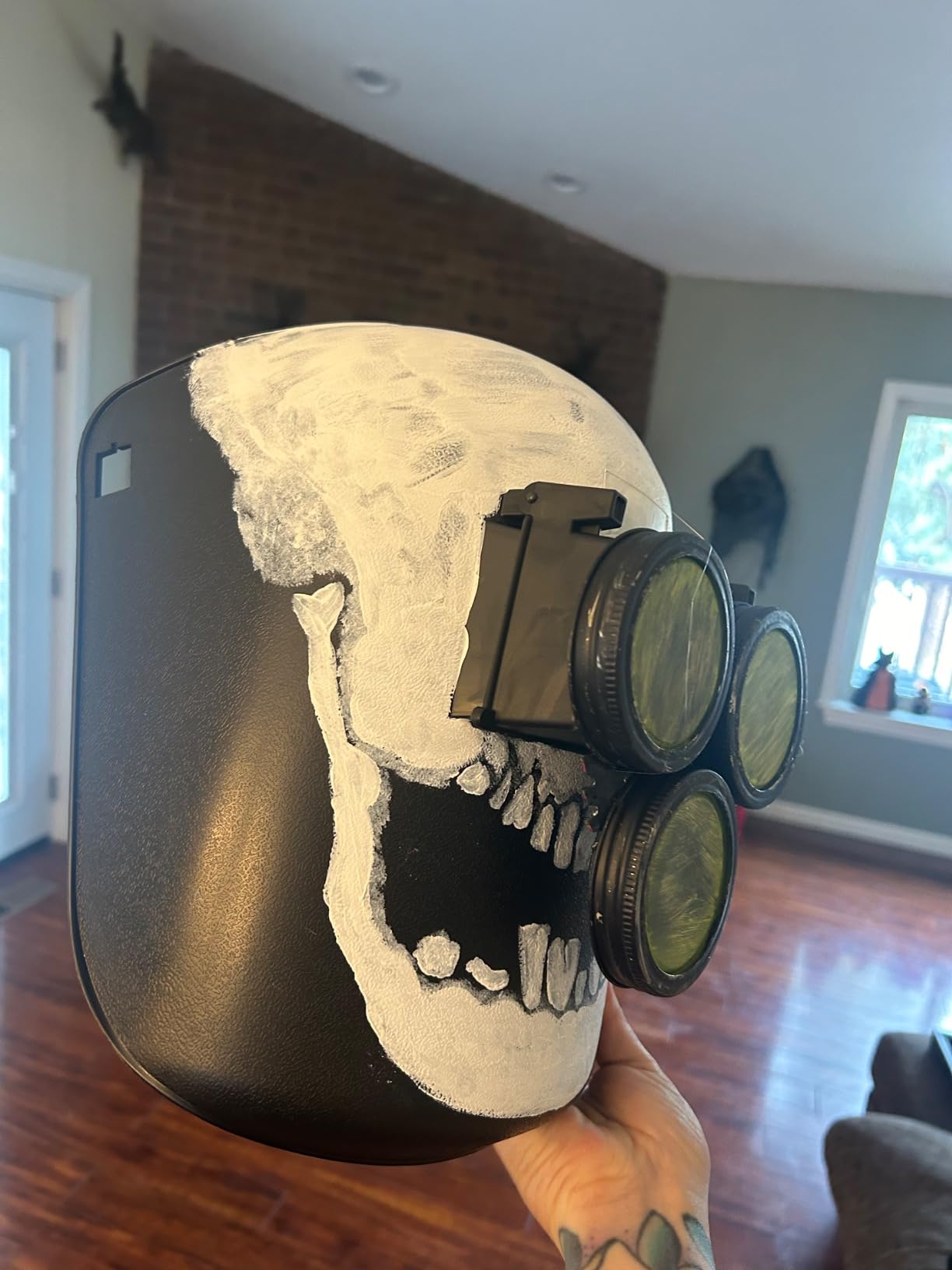
- Doubles as a base for DIY and costume projects
Cons
- Shade 11 glass is very dark so you must flip the lens up to see your work
- Comfortable only for short spells and hard to keep stable when flipping
- Build feels flimsy and a few units broke within weeks of light use
Not every beginner needs an auto-darkening helmet. If you are tacking occasionally, doing a one-off garage job, or watching a welding class for a few hours, a passive fixed-shade flip-front is the simplest way to start.
There is no electronics at all here, which means no sensors to fail and no battery to forget. The 3.86 inch by 1.62 inch filter lens sits at shade 11, a genuinely dark tint.
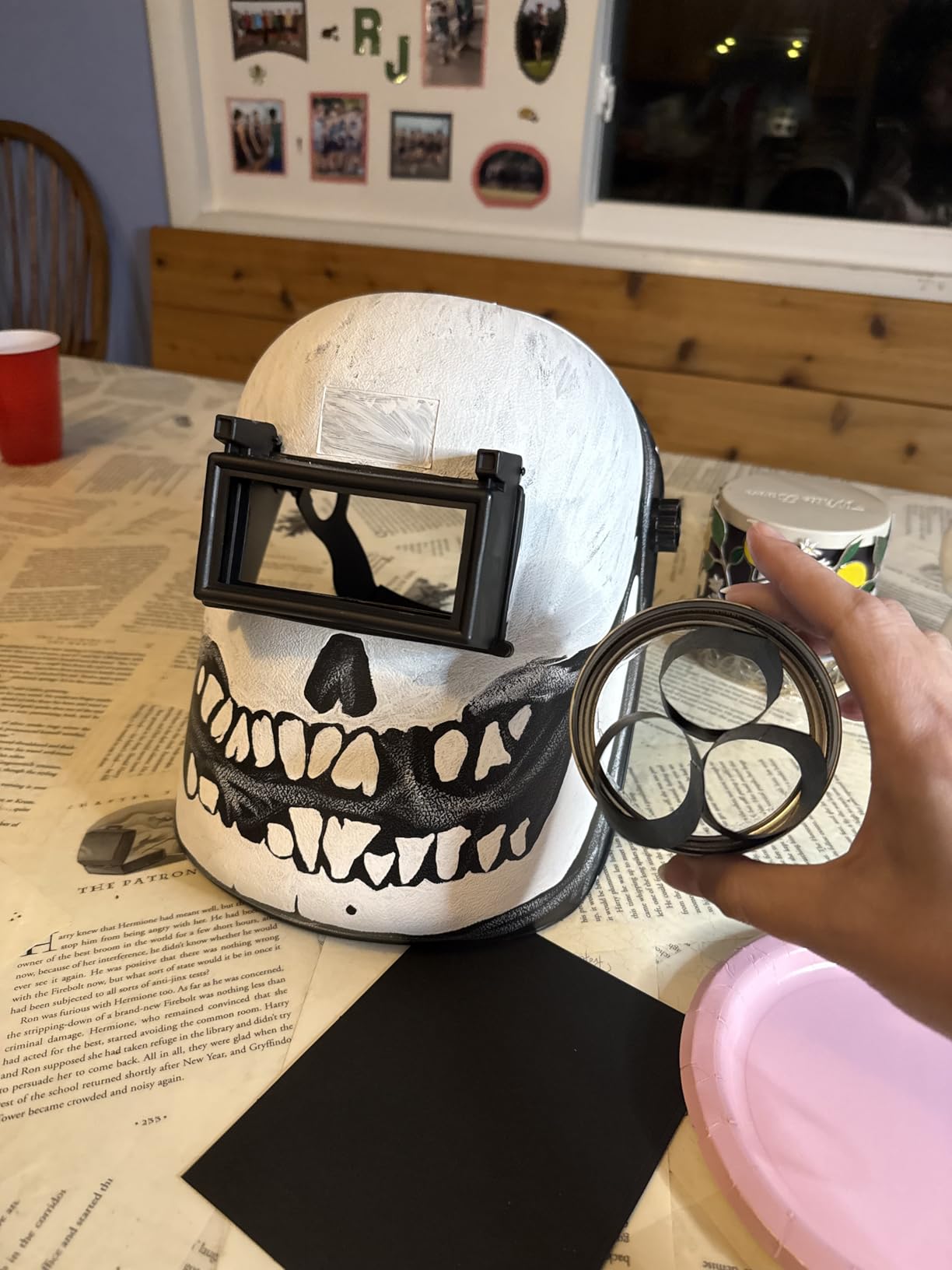
That darkness is the whole trade-off. Because you cannot vary the shade, you have to flip the lens up to see your work and flip it down to weld, and that is awkward once the arc is running.
It suits TIG, MIG, stick and plasma cutting, and the lenses are removable for cleaning. Fit is handled with a partly padded adjustable headband and a head drop you can tune.
Replacement filter lenses are not included, and the build is light duty. A few buyers report units breaking within weeks, so treat this as a consumable learning tool rather than a primary helmet.
Who this helmet suits?
Hobbyists who weld a few times a year, students watching demos before buying an auto-darkening model, and anyone who wants protection for a single garage project.
Who should skip it?
Anyone who welds regularly. A fixed shade 11 lens means constant flipping, no adjustable shade for different materials, and comfort that only holds for short spells.
10. Lincoln Electric K4134-1 – Best for a full welding program
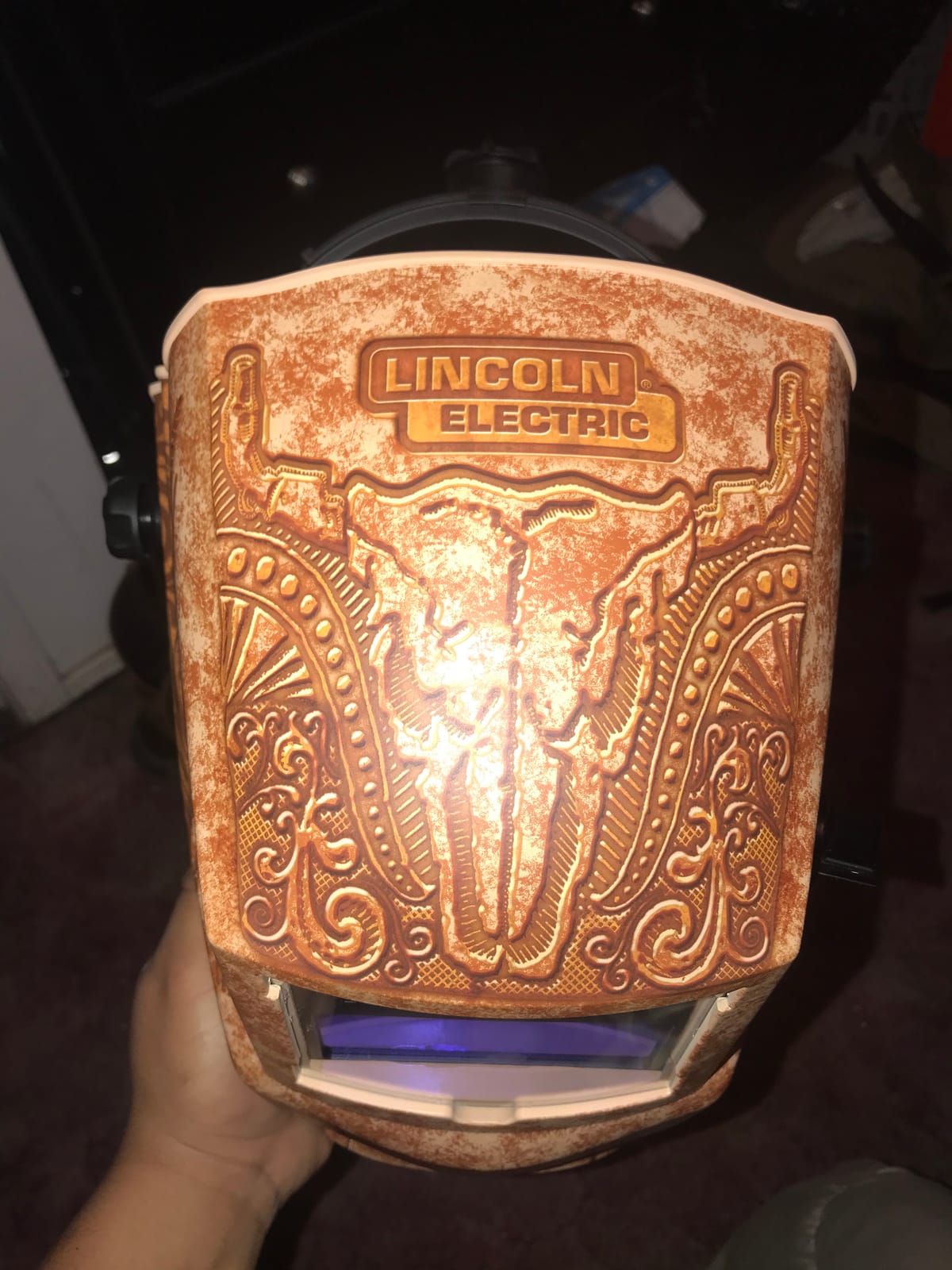
Lincoln Electric-K4134-1 Welding Helmet, Brown, Ratchet, Plastic
Auto-darkening lens
Ratchet headgear
External shade knob
spare lenses included
Pros
- Auto-darkening lens has kept working after years of daily shop use
- Lightweight and comfortable enough to forget you are wearing it
- Easy to adjust for tightness and resting angle with simple battery changes
- Distinctive Lone Star graphics with spare inner and outer lenses included
Cons
- Thin plastic flexes at the front and may crack over time
- External shade knob can be bumped to a wrong shade during handling
- Viewing area is smaller than expected and the ratchet action is not smooth
The Lincoln K4134-1 is the pick when a student is going to wear one helmet for an entire welding program. Lincoln owners report the auto-darkening lens still performing after three years of daily work, which is the kind of track record schools and shops care about.
The ratchet headgear is the quiet advantage. It holds position far better than a simple strap, so the helmet stops drifting forward during long sessions or overhead work.
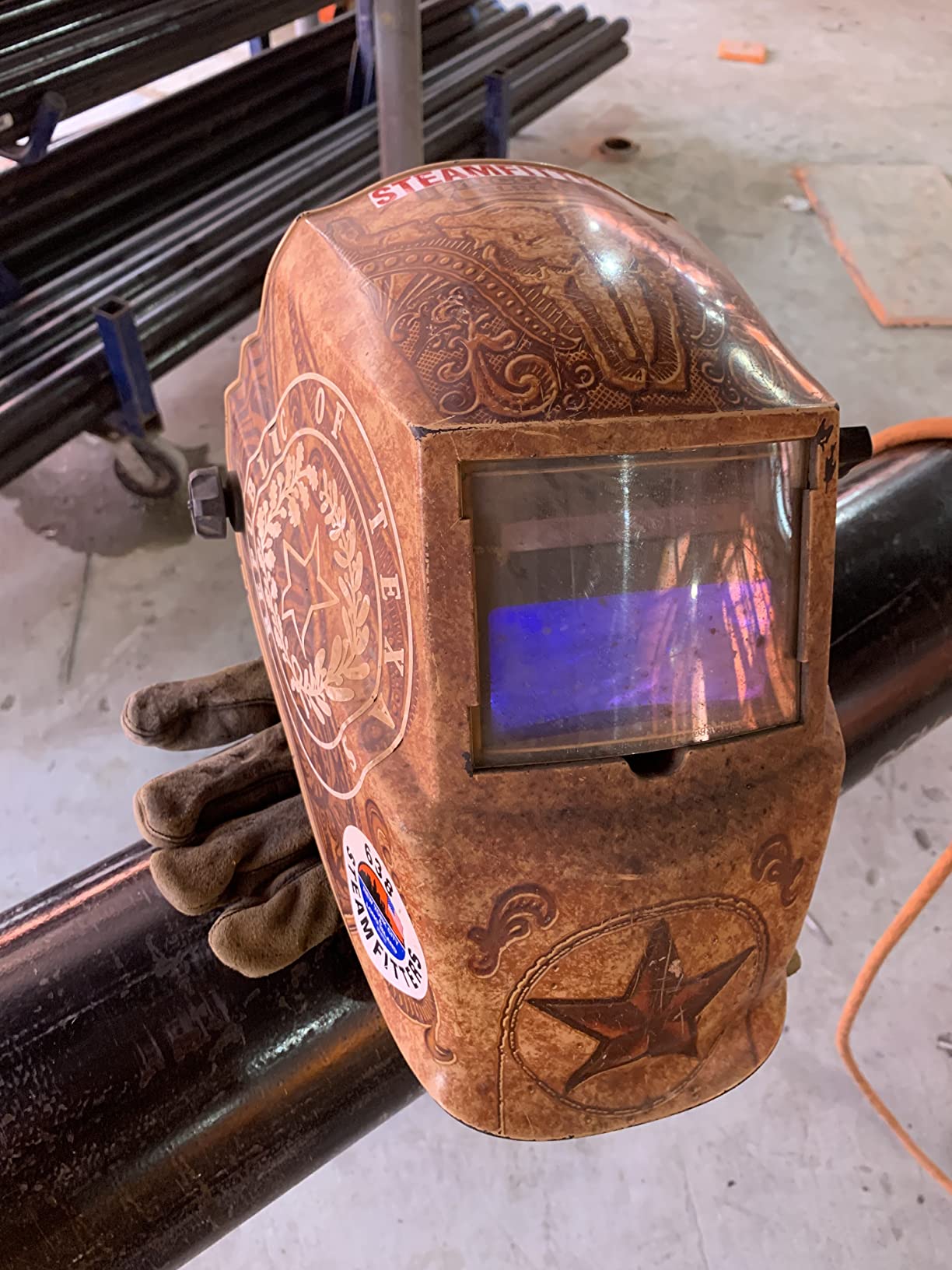
The external shade knob is a genuine plus for beginners, because you can move between weld and grind modes with a gloved hand instead of feeling around inside the shell. Batteries are simple to change.
Owners consistently describe the shell as lightweight and comfortable enough to forget. Spare inner and outer lenses are included, which removes a first-week errand.
Two caveats. The front plastic flexes at the flex point and some owners expect cracking over years, and the external knob is easy to bump while handling, which can leave the helmet on the wrong shade.
Who this helmet suits?
Welding school students and anyone who will weld most weeks. A ratcheting headband and a long-lived cartridge are worth more here than a panoramic view or a work light.
Who should skip it?
Welders who need a large viewing window or a low shade for TIG. The viewing area is smaller than expected, and this model is built for shop work rather than thin-gauge TIG.
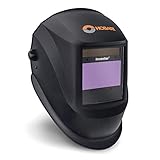
11. Hobart 770890 – Best for analog controls and a widescreen view
Hobart 770890 Auto-Darkening Welding Helmet, Large, Black
PureColor 9.3 inch widescreen view
4 independent sensors
auto-on power
two year warranty
Pros
- Large widescreen PureColor viewing area gives an accurate view of the puddle
- Four independent arc sensors and auto-on power make detection dependable
- Simple analog knob controls for shade sensitivity and delay are easy to learn
- Backed by a limited two year manufacturer warranty
Cons
- The listing for this model carries an inconsistent model number so confirm the exact model before buying
- Widescreen hood suits MIG and heavy work more than fine TIG
The Hobart stands out for its widescreen PureColor viewing area and for a reason that beginners rarely think about: the controls are analog. Turn a knob, feel it click into place, and you know what setting you are in without looking.
Four independent arc sensors and auto-on power control mean the lens activates at the strike of an arc. That removes the constant on and off cycle that eats batteries on cheaper models.
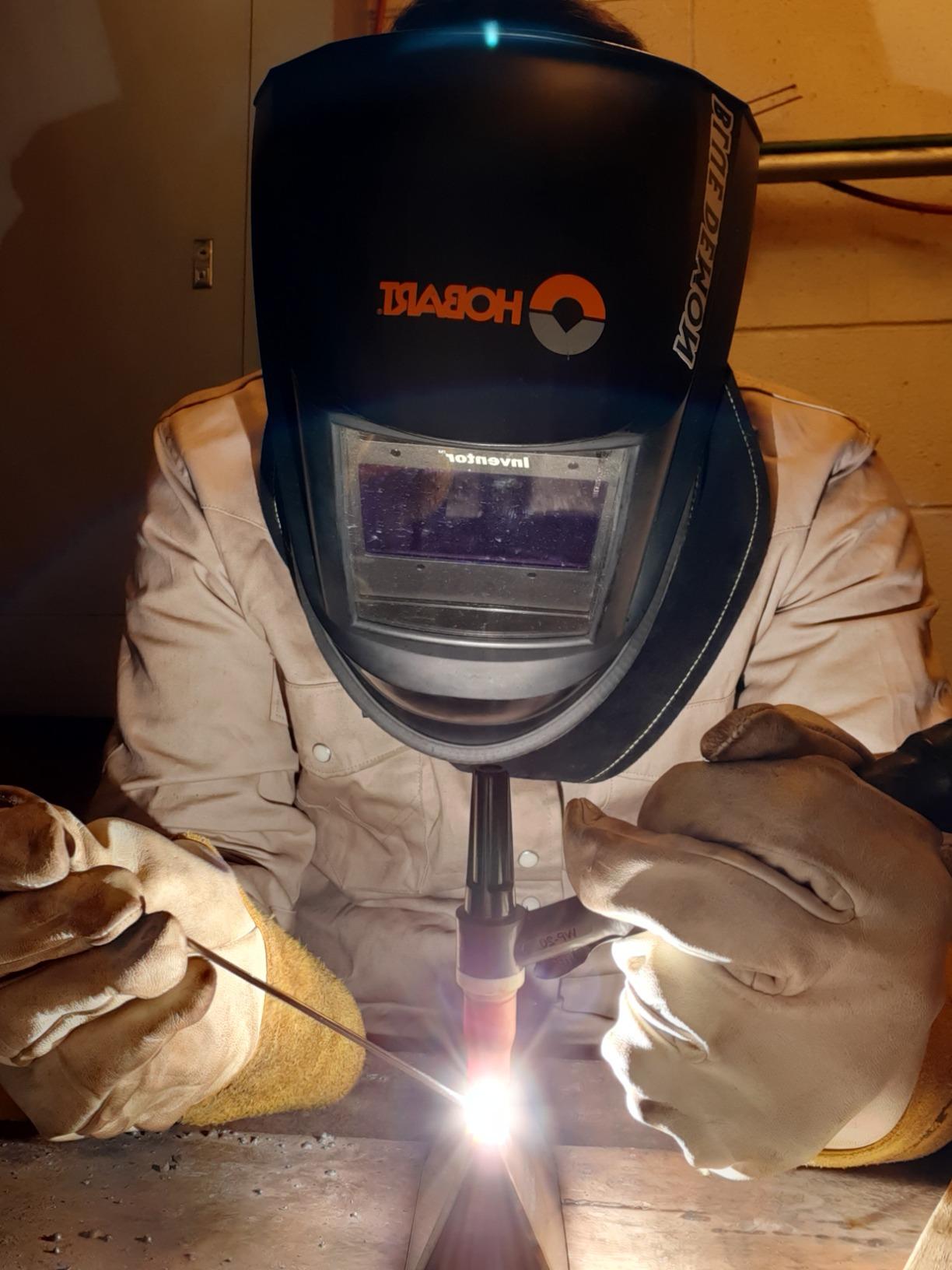
Mode switching between weld and grind is seamless, and shade, sensitivity and delay are all set from the same style of knob. Owners report the detection as dependable and the view of the puddle as accurate.
It is listed at 1.25 lb, so it is light for its size, and the polyamide nylon shell carries continuous UV and IR protection. A limited two year manufacturer warranty is included.
One practical warning: the product listing for this model includes an inconsistent model number, so confirm the exact model before ordering. The controls themselves are the reason to buy, and nothing else here changes your settings faster.
Who this helmet suits?
Beginners who dislike digital menus and want settings they can change without removing the helmet, plus anyone who wants a wide field for large plate and structural work.
Who should skip it?
Shoppers who need precise low-amp TIG detection or cheater lens work. Confirm the model number first, and expect a widescreen hood that suits MIG and heavy work better than fine TIG.
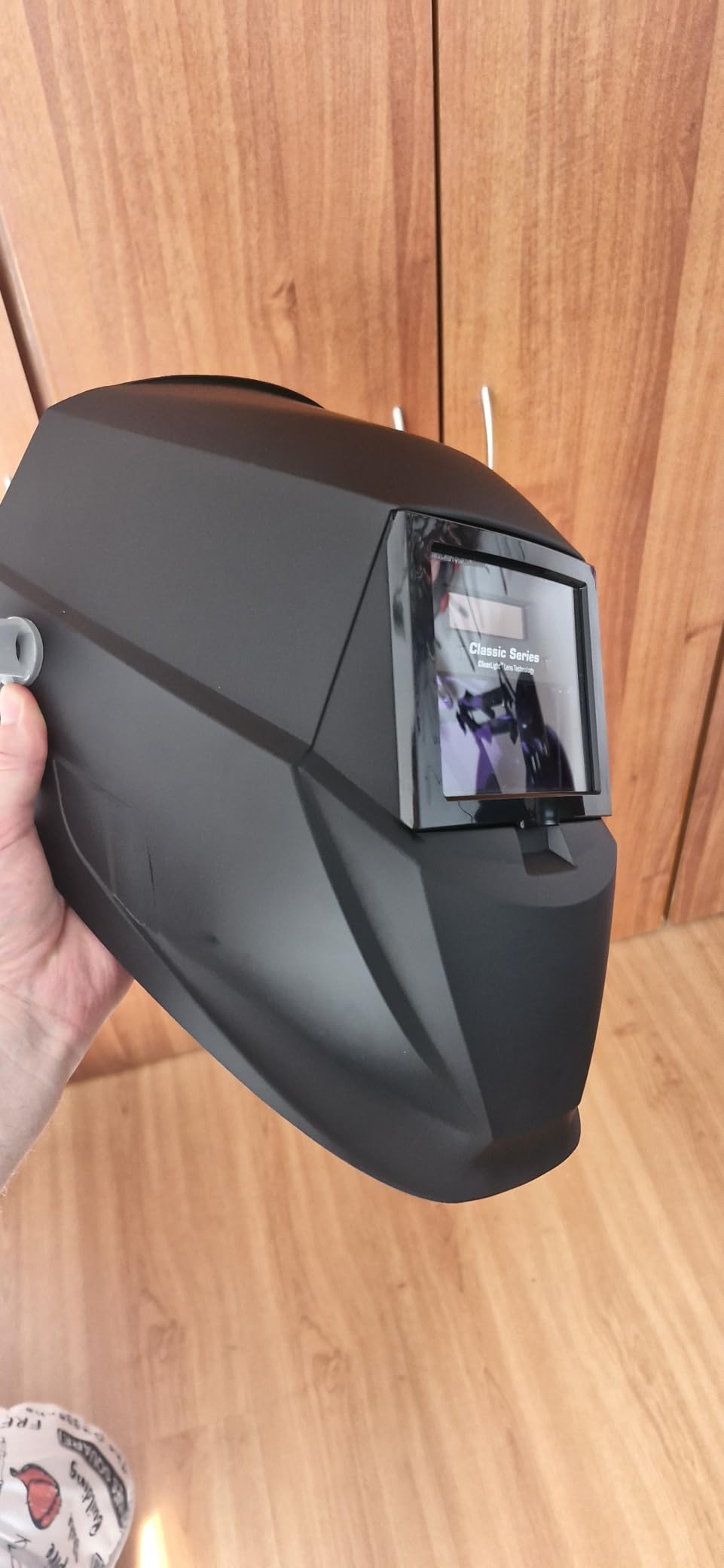
12. Miller Classic Series ClearLight – Best warranty coverage
Miller Classic Series Welding Helmet, ClearLight™, Shade 8-13, Black
ClearLight optics
6 square inch view
Shade 8-13
2 sensors at 1/23000s
3 year warranty
Pros
- ClearLight lens with a 3.0 light state for working between welds
- Digital controls make shade delay and sensitivity adjustments straightforward
- Ratchet headgear gives a secure comfortable fit for longer sessions
- Backed by a three year warranty and meets ANSI Z87.1 plus CSA and CE standards
Cons
- 6 square inch viewing area is smaller than panoramic premium options
- Best suited to five amps or below rather than heavy fabrication
The Miller Classic holds the highest rating band in this group alongside the Lincoln and Hobart, and the reason is the ClearLight lens. It is specified for welding at five amps or below, which is exactly where most beginners start.
A 3.0 light state means you can keep the hood down between welds and still see the joint, which reduces the repeated flip-up that gives beginners neck and forehead fatigue.
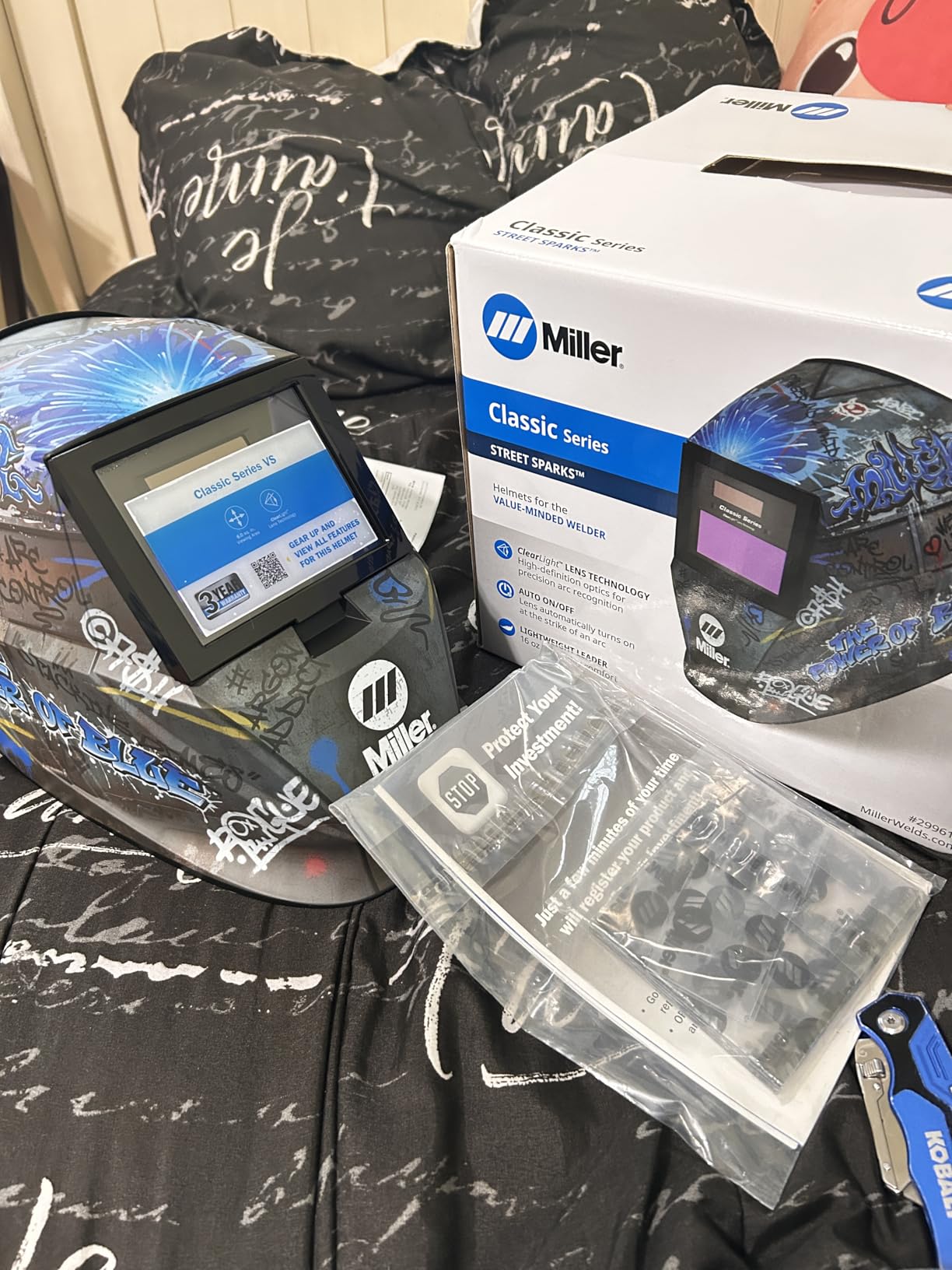
Digital controls for shade, delay and sensitivity sit on the shell, and auto-on power activates the lens at arc strike. Two arc sensors switch in 1/23000 second across weld shades 8-13, cut shades 5-8 and grind shade 3.
The ratchet headgear is the most refined here and holds a secure fit through long sessions. Standards coverage includes ANSI Z87.1+, CSA and CE, and the warranty runs three years.
The trade-off is a 6 square inch viewing area, the most compact window here. That is a real limit for anyone who wants to see the whole joint, and heavy plate work pushes past the five amp guidance.
Who this helmet suits?
First-time TIG and thin-gauge welders who will stay at low amperage, and anyone who values a three year warranty over a big window. Miller is also the brand experienced users name most often for headgear reliability.
Who should skip it?
Structural and heavy fabrication welders who need a large viewing area and the low shade 3 grind range for extended grinding sessions.
How to Choose a Welding Helmet as a Beginner?
Start with the process, not the price. If you will mostly run MIG and stick, a shade 9-13 helmet with two to four sensors covers you. If TIG is on the plan, look for a low shade 4 or 5 setting or an electromagnetic sensing mode, because a shade 9 lens on low-amp TIG is nearly black and beginners regularly learn this the hard way.
Arc sensors are the next filter. Two sensors are fine for a beginner working in ordinary light. Four sensors matter in bright rooms, outdoors, or on small low-current arcs, and they are also what stops a lens from staying light when an arc is faint.
Optical class is worth understanding once. The EN 379 code reads 1/1/1/1, where each digit grades pass, light transmission, angle dependence and color perception from 1 to 3, and 1 is best. A 1/1/1/1 lens is measurably clearer than a 1/1/1/2, and the difference is most obvious in a large view.
Switching speed is the safety number. Anything at 1/20,000 second or faster is modern and adequate; the differences between 1/20,000 and 1/30,000 are marginal compared with buying a model whose sensors fail outright.
Comfort is not a luxury. A helmet you find heavy comes off after twenty minutes, and a helmet that is off is not protecting you. Weight, headgear type and padding matter more over a year than any single spec.
If you also need a jacket, gloves or a respirator, we have covered welding jackets for metal fabrication and auto-darkening helmets for fabrication work in separate guides.
Which Budget Tier Should You Buy First?
The cheapest tier covers learning on the side and tacking, and the TOPDC fixed shade 11 flip-front sits there with no electronics to fail. It is a sensible first purchase if you are not yet sure you will weld regularly.
The middle tier is where most beginners should land. The YESWELDER LYG-L600A, the ARCCAPTAIN auto darkening helmet, the TOOLIOM solar model and the TRQWH all deliver true color optics, solar power with a replaceable battery, and ANSI Z87.1 or EN 379 certification for very little money.
The upper tier is for a welding program or full-time shop work, where ratcheting headgear, a longer warranty and a wide view start to pay back. The Lincoln K4134-1, Hobart 770890 and Miller Classic Series all carry multi-year warranties and proven long-lived electronics. The welding tables for fabrication shops guide covers what else you will need once you commit to that tier.
Helmet Care and Troubleshooting: Why a Lens Stops Darkening?
Most reported problems are not a dead cartridge. Work through these steps in order before you replace anything.
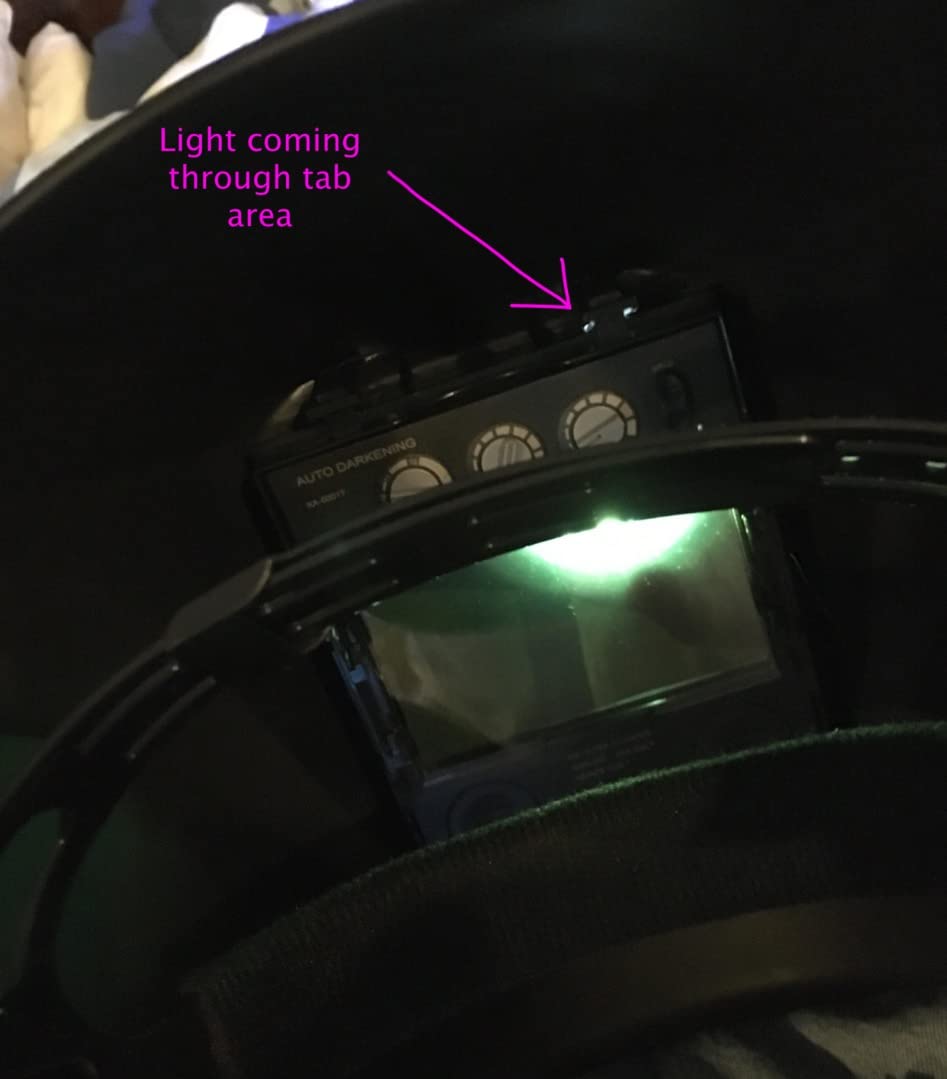
Clean the sensors. Dust, spatter and grinding residue on the arc sensor windows will block or weaken detection. Wipe them with a dry cloth and check the two or four small windows on the front of the shell.
Replace or charge the battery. Solar helmets still rely on a coin cell for cold starts and for a dark first weld. A dead CR2032 or CR2450 is the single most common cause of a lens that never darkens.
Test the dark state in a dark room. Cover the sensors with your hand and check that the lens darkens on its own. If it will not, the cartridge has failed rather than the sensor being blocked.
Test with a bright lamp or phone screen. Holding a bright light to the front should trigger the lens. Most shops keep this as a five-second pre-weld check.
Check the delay and sensitivity knobs. On a helmet that flashes bright during TIG, turning sensitivity down and delay up is usually the fix.
Inspect the cover lens. A heavily pitted or spattered outer lens scatters light and can trigger false readings. Replace it and retest.
Cover lenses are the running cost nobody mentions. The inner lens is a consumable that fogs and scratches; the outer lens takes spatter. Both are cheap and easy to swap, and keeping spares means you are never tempted to keep welding with a damaged window.
On fume, a helmet protects your eyes and face but does nothing for your lungs. Pair it with the correct respiratory protection for the material you are welding, and check that your headgear still fits once the respirator is on.
Frequently Asked Questions
What is the best welding helmet for a beginner?
The YESWELDER LYG-L600A is the strongest starting point for most beginners. It uses a 1/1/1/1 true color lens so you can actually see the puddle, two arc sensors with a 1/30000 second switch, and a shade 3/7-13 range that covers MIG, stick, TIG and grinding. It weighs 16 ounces, so it is easy to keep on. For thin-gauge TIG, pick a model that starts at a lower shade such as the ARCCAPTAIN.
What should I look for in a welding helmet?
Look for four things: an auto-darkening filter so you never flip the hood by hand, a variable shade 9-13 range for multi-process work, two to four arc sensors for reliable detection, and a fast switching speed around 1/20,000 to 1/30,000 second. Add true color optics, a comfortable weight, and certification to ANSI Z87.1 or EN 379.
What is the best welding helmet on a tight budget?
In the entry tier, the YESWELDER LYG-L600A and the ARCCAPTAIN are the two strongest options. Both give you 1/1/1/1 true color lenses, solar power with a replaceable CR2450 battery, and ANSI Z87.1 or EN 379 certification. The ARCCAPTAIN adds four arc sensors and a low shade 4 setting, which helps on thin TIG.
What is the best welding helmet for value for money?
The YESWELDER LYG-M800H offers the most usable viewing area at 3.93 by 3.66 inches with a 1/1/1/1 true color lens, four arc sensors and a 1/30000 second switch. For simple tacking and occasional work, the TOPDC fixed shade 11 flip-front costs the least and has no electronics to fail.
Is a Harbor Freight welding helmet any good?
Reviewers report mixed results with the lowest-cost Harbor Freight and Vulcan class helmets. The auto-darkening versions are reported to be durable enough once owned, but false triggering or staying in a light state during TIG and plasma work is a recurring warning. If you buy one, set sensitivity low, set delay high, and test it in a dark room before you rely on it.
Is shade 10 or 11 better for welding?
Both work, and the higher number is darker. Shade 10 suits thin mild steel and light MIG work where you still need to see the puddle, while shade 11 is a good general choice for thicker material and stick welding. Neither is correct for TIG, where you often need shade 8 or lower. A variable 9-13 auto-darkening range avoids choosing.
Why isn’t my auto-darkening welding helmet darkening?
Clean the arc sensor windows first, since dust and spatter block detection. Then check the coin cell battery, which is the most common cause. Next, cover the sensors with your hand in a dark room to see whether the lens still darkens. If it does not, the cartridge has failed. Finally, inspect the outer cover lens, because heavy pitting can trigger false readings.
Do I need a respirator with a welding helmet?
Yes. A welding helmet protects your eyes and face from arc flash, ultraviolet and infrared radiation, sparks and spatter, but it does nothing for fume. Galvanized, stainless and painted metal all produce fumes that need respiratory protection. Choose your respirator first, then confirm the helmet headgear still fits comfortably over it.
The Best Welding Helmet for Beginners in 2026
After comparing 12 helmets, the YESWELDER LYG-L600A is our pick for the best welding helmets for beginners, because true color optics, a shade 3/7-13 range and a 16-ounce shell cover everything a first welder needs without a premium outlay. If you weld thin-gauge TIG, take the ARCCAPTAIN auto darkening helmet for its low shade 4 setting and four sensors. If you want the widest view, go with the YESWELDER LYG-M800H, and if you are starting a full welding program, the Lincoln K4134-1, Hobart 770890 and Miller Classic Series carry the headgear and warranties that survive daily use.