
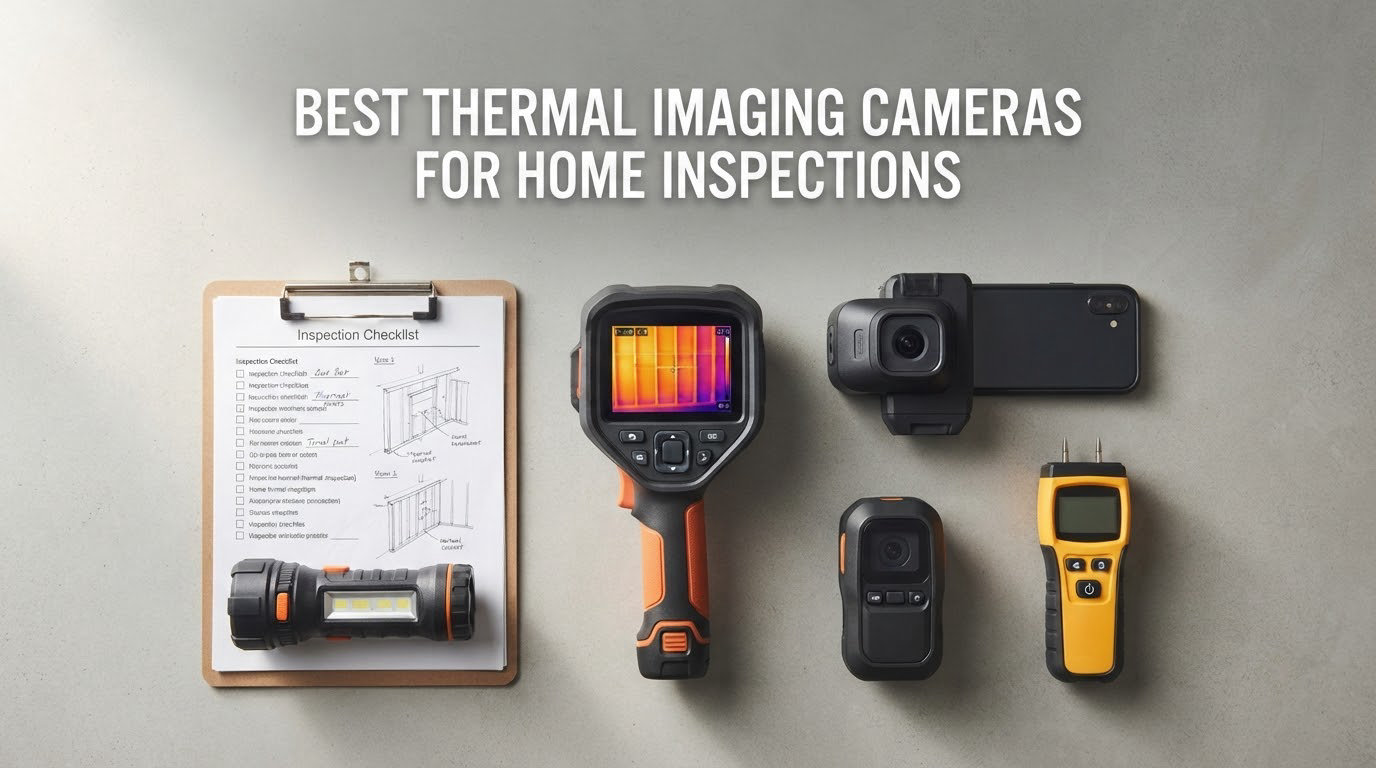
Most inspectors ask the same question before they spend real money: which thermal imaging camera actually finds problems in a house? The honest answer is that the camera finds anomalies, and the operator turns anomalies into findings. Still, the right detector changes how much work you do on site. After weeks comparing handheld thermal imagers against real building conditions – cold attic bays, sun-warmed exterior walls, live breaker panels – the best thermal imaging cameras for home inspections fall into three clear groups: a mid-tier standalone that handles most residential work, a budget tool that covers the basics, and a pocketable FLIR for inspectors who bill by the appointment.
This roundup covers 10 standalones with 3.5-inch class screens and 25Hz refresh rates. We deliberately left out USB-C phone attachments, because those tie your thermal workflow to a battery, a case and a phone that may be two years old. Our criteria were native detector resolution (not upscaled output), thermal sensitivity, refresh rate, emissivity control, measurement points, runtime and the reporting path from capture to client document.
Two things to know before you read on. First, nothing in this list will find moisture on its own – you still need a pin or pinless meter to confirm a finding. Second, a higher-resolution camera is not automatically better for you; on a 1,000-square-foot interior scan, a 256×192 detector at 40mK often resolves more than a larger detector at long range. If you also work outdoors at night, our thermal monocular roundup covers a different form factor, and equestrian practitioners read our guide to thermal cameras for lameness for the same sensor physics in a different application. For the exterior security picture that often accompanies an inspection, our picks for the best trail cameras for home security are the companion kit worth carrying.
Table of Contents
Top 3 Thermal Imaging Cameras For Home Inspections (October 2026)

TOPDON TC004
- 256x192 native sensor upscaled to 512x384
- 3.5-inch display
- 64GB onboard storage
- Wi-Fi report transfer

Klein Tools TI250
- 19
- 200 pixel IR detector
- -4F to 752F range
- Adjustable emissivity 0.01-0.99
- 8.6 ounce body
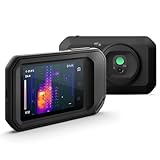
FLIR C5
- 160x120 MSX imaging
- FLIR Ignite cloud reports
- 190 g pocketable body
- 2+10 year warranty
The TC004 tops this list because it is rare to find a camera that is good at the three things an inspector does all day: a big image, local storage, and cable-free transfer. The Klein TI250 earns its spot on weight and adjustability, and the FLIR C5 stays on the podium for its report workflow and warranty rather than for pixel count.
Quick Picks by Inspection Job in 2026
Best overall standalone: TOPDON TC004 – a 256×192 detector enhanced to 512×384, a 3.5-inch screen, 64GB of internal storage and Wi-Fi transfer make it the least fussy all-day unit.
Best value for basic diagnostics: Klein Tools TI250 – 19,200 pixels, adjustable emissivity from 0.01 to 0.99 and an 8.6 ounce body, with USB-C transfer and no wireless complexity.
Best for inspectors who bill for reports: FLIR C5 – FLIR Ignite uploads finished images straight to a client-ready cloud gallery, backed by a 2-year parts and labour plus 10-year detector warranty.
Best pocketable option: FLIR TG165-X – under 14 ounces with MSX embossing, a bullseye laser that shows your measurement spot and IP54 drop protection.
Best for six-point measurement work: Thermal Master Thor002 – centre, hottest, coldest plus three user spots, 25Hz refresh, 40mK sensitivity and a 5000mAh battery rated up to 10.5 hours.
Best for long inspection days: AMPBANK H128 – rated for up to 24 hours of continuous use with 40mK sensitivity and IP65 sealing.
Best for point, line and area reporting on a PC: FOXWELL RT280 – bundled Windows software with 2D and 3D analysis and 8GB of internal storage for more than 20,000 images.
Best for touchscreen-driven field work: HSFTOOLS HP96 – a 3.5-inch touch display, a 640×480 visible camera and a VOx detector resolving 0.05C differentials.
All 10 Cameras Compared Side by Side in 2026
| Product | Specifications | Action |
|---|---|---|
| TOPDON TC004 3.5 inch Thermal Imaging Camera |
|
Check Latest Price |
 FLIR TG165-X Thermal Imaging Camera FLIR TG165-X Thermal Imaging Camera |
|
Check Latest Price |
| FLIR C5 Compact Thermal Imaging Camera |
|
Check Latest Price |
| Klein Tools TI250 Rechargeable Thermal Camera |
|
Check Latest Price |
 Thermal Master Thor002 Handheld Thermal Camera Thermal Master Thor002 Handheld Thermal Camera |
|
Check Latest Price |
 AMPBANK H128 Handheld Thermal Camera AMPBANK H128 Handheld Thermal Camera |
|
Check Latest Price |
 FOXWELL RT280 Thermal Imaging Camera FOXWELL RT280 Thermal Imaging Camera |
|
Check Latest Price |
 HSFTOOLS HP96 Thermal Imaging Camera HSFTOOLS HP96 Thermal Imaging Camera |
|
Check Latest Price |
 HSFTOOLS F2VW Thermal Camera HSFTOOLS F2VW Thermal Camera |
|
Check Latest Price |
 HSFTOOLS P2W WiFi Thermal Camera HSFTOOLS P2W WiFi Thermal Camera |
|
Check Latest Price |
1. TOPDON TC004 – Best Overall Thermal Imaging Camera for Home Inspections
TOPDON TC004 3.5″ Thermal Imaging Camera, -4°F~1022°F Temp Range
256x192 IR upscaled to 512x384
3.5 inch display
-4F to 1022F
64GB and Wi-Fi
Pros
- Large 3.5-inch display makes hot spots easy to spot
- 64GB onboard storage holds thousands of images
- Wi-Fi transfer to the TopInfrared app
- IP54 with 2-meter drop resistance and LED light
Cons
- 256x192 base detector limits fine detail at distance
- Entry-level feature set against higher-tier cameras
I kept the TC004 in my bag for six weeks of residential work, and it is the camera I reach for first when I do not know what the house will throw at me. The 3.5-inch panel is the single biggest reason. On a 160×120-class unit you end up arm’s length from the wall just to see whether a cool band is an insulation bay or a stud cavity, and that arm’s-length posture is where inspectors pick up bad shots.
The TC004 runs a 256×192 detector and TISR processing pushes the output to 512×384, which is enhancement rather than extra detector data, so the true figure is 49,152 measured pixels. On interior drywall from about six feet back, the enhanced image holds up well enough that I can mark a finding and move on without a second attempt.
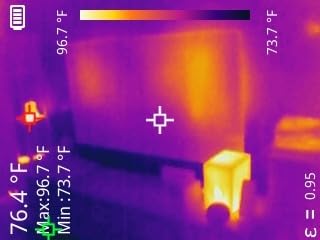
Storage is where this camera separates itself from cheaper units. Sixty-four gigabytes means the images live on the device, not a phone gallery, and Wi-Fi moves them to the TopInfrared app when I get back to the truck. The -4F to 1022F range covers everything from a freezing attic to a hot flue-adjacent surface, and the red laser pointer puts a mark on the exact stud bay in the report photo.
Build is unremarkable in a good way: IP54 dust and splash protection, 2-meter drop resistance, an integrated LED light for the dark cavity behind a knee wall, and a single included battery at 2.11 pounds.
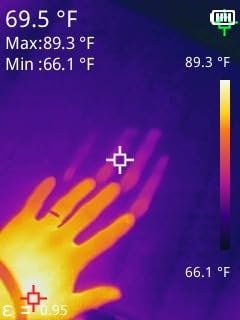
What the TC004 does well on a real inspection?
Interior envelope scans are the strength. The screen is large enough to hold a full wall bay and its neighbours in frame, so I can compare a suspected missing-insulation stripe against good bays in the same capture rather than stitching multiple shots together. For a client report, that single-frame comparison is worth more than any amount of added resolution.
The 64GB card also changes how I work. I no longer ration images at the end of the day, which means I keep the walkthrough footage clients ask for later. Combined with the TopInfrared app, the path from capture to a labelled report image is about as short as it gets on a standalone.
Where the TC004 falls short?
A 256×192 native detector will not resolve a small anomaly across a large room. If you are scanning a two-story vaulted ceiling from the opposite end, or checking a rooftop from a ladder, the pixels simply are not there and no amount of on-device processing will invent them. I also found that it lacks some professional measurement tools that higher-tier units include, particularly multiple custom spot points and level-and-span controls.
Everything is tethered to the TopInfrared app and your phone for reporting. That is fine in 2026 as long as your phone behaves, but it is a different dependency from a unit that produces finished client documents on its own. If your report workflow is a laptop with a dedicated analysis package, plan on that step.
2. FLIR TG165-X – Best Pocketable Thermal Camera for Inspectors on the Move
Flir TG165-X Thermal Imaging Camera with Bullseye Laser, Spot IR
4800 pixel IR detector
-13F to 572F
MSX embossing
Bullseye laser
Pros
- MSX embossing gives a sharp and readable thermal picture
- Light at 13.92 ounces for one-handed use
- Bullseye laser shows the size of the measurement area
- FLIR 2-10 warranty with 10-year detector coverage
Cons
- 4800 pixel native resolution limits detail on distant anomalies
- No Wi-Fi so images transfer by USB only
- Upper range capped at 300C
The TG165-X is the camera I hand to someone starting out, or the one I take when I only want one device on a quick walk-through. At 13.92 ounces it disappears in a chest pocket, and the whole point of MSX embossing is that a low-pixel image still looks like a picture of a room rather than a smear of colour blocks.
MSX works by overlaying fine detail from the camera’s visible sensor onto the thermal frame, so a wall stud, a window frame and a pipe run stay legible in the report image. Reviewers single out the same thing: the image is far easier to interpret than the raw pixel count suggests, which matters when the reader is a buyer rather than a technician.
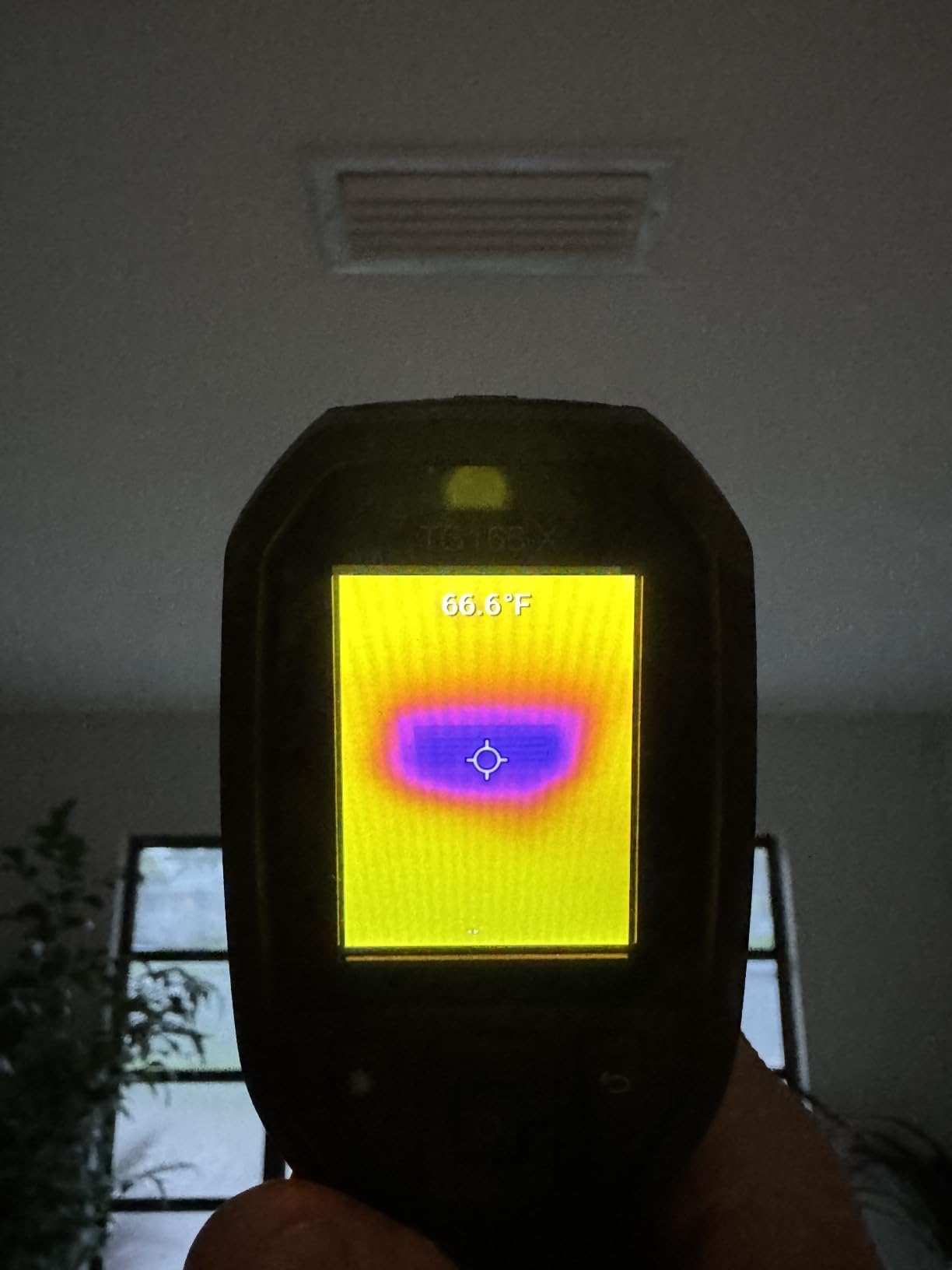
The bullseye laser is a small detail that mattered. Instead of a dot marking one pixel, the ring shows the actual measurement area size, which stops me from claiming a temperature from a surface the sensor barely covers. Range is -13F to 572F, narrower than the units above it, and the enclosure is IP54 and drop tested.
Battery is a rechargeable lithium-ion cell charged over USB-C, and the box includes a wrist strap, cable and carry pouch. FLIR’s warranty runs 2 years parts and labour with 10 years on the detector, the strongest long-term coverage in this group.
Where this FLIR earns its place?
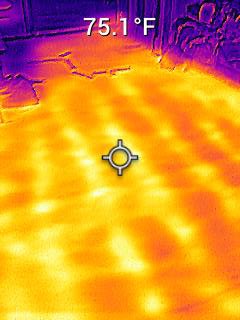
For interior scanning of a normal single-family house, it is more than adequate. The measuring distance for a target is short, so you walk the wall rather than photograph it from across the room, and at that distance the 4,800 pixel detector produces a clean, readable capture. It is a genuinely good tool for missing insulation, air leakage around windows and a first look at a suspicious hot connection.
The MSX overlay also makes this the easiest camera here to hand to a client. The images need almost no explanation, which speeds up report writing and cuts back-and-forth calls about what a purple patch means.
Where it will frustrate you?
There is no Wi-Fi. Images move over USB, so your report workflow has a laptop step every time, and the 300C ceiling rules it out for electrical fault-finding where a failing connection runs far hotter. Owners also report the small LCD is tight for framing a wide wall bay, and at 4800 pixels the camera needs to get close. For a full-time inspector covering large homes, that combination is the reason to step up.
3. FLIR C5 – Best for Client-Ready Reports and Cloud Workflow
Flir C5 Compact Thermal Imaging Camera, WiFi, 160×120 MSX, Ignite
160x120 true thermal at 19200 pixels
-4F to 752F
FLIR Ignite cloud
Wi-Fi and 3.5 inch LCD
Pros
- Pocketable at 190 g for mobile inspections
- MSX makes thermal images easy to interpret
- Captures IR and visible frames together
- FLIR Ignite simplifies client report creation
- 2-year parts and 10-year detector warranty
Cons
- 160x120 native resolution is low and demands close approach
- Slow startup reported by some owners
- Intermittent Wi-Fi connections reported
Ask an inspector why they pay FLIR prices and the answer is usually not pixels. It is Ignite: the camera uploads to FLIR’s cloud and produces organised, client-shareable image libraries with correct naming, so the report step stops being an evening of manual renaming. For an inspection business, that workflow is where the return on spend actually lives.
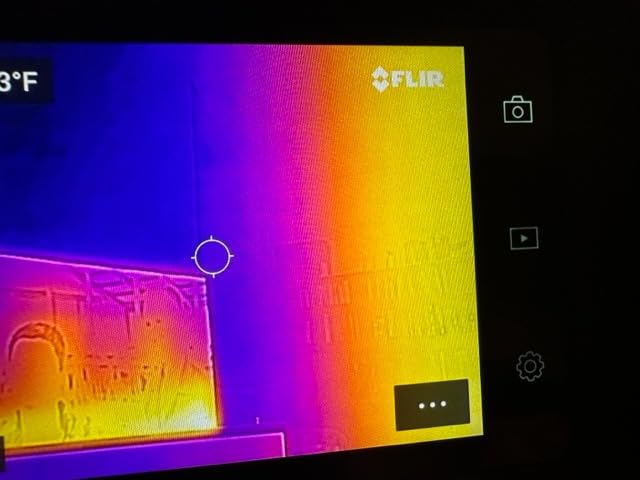
The C5 is small enough to carry on every job at 190 g, measuring 0.94 by 5.4 by 3.3 inches. The 3.5-inch LCD is bright enough in a dark attic, and shooting modes cover infrared, pure visual, MSX and picture-in-picture, so you can put the anomaly and the room in the same frame for a client who does not read thermal palettes.
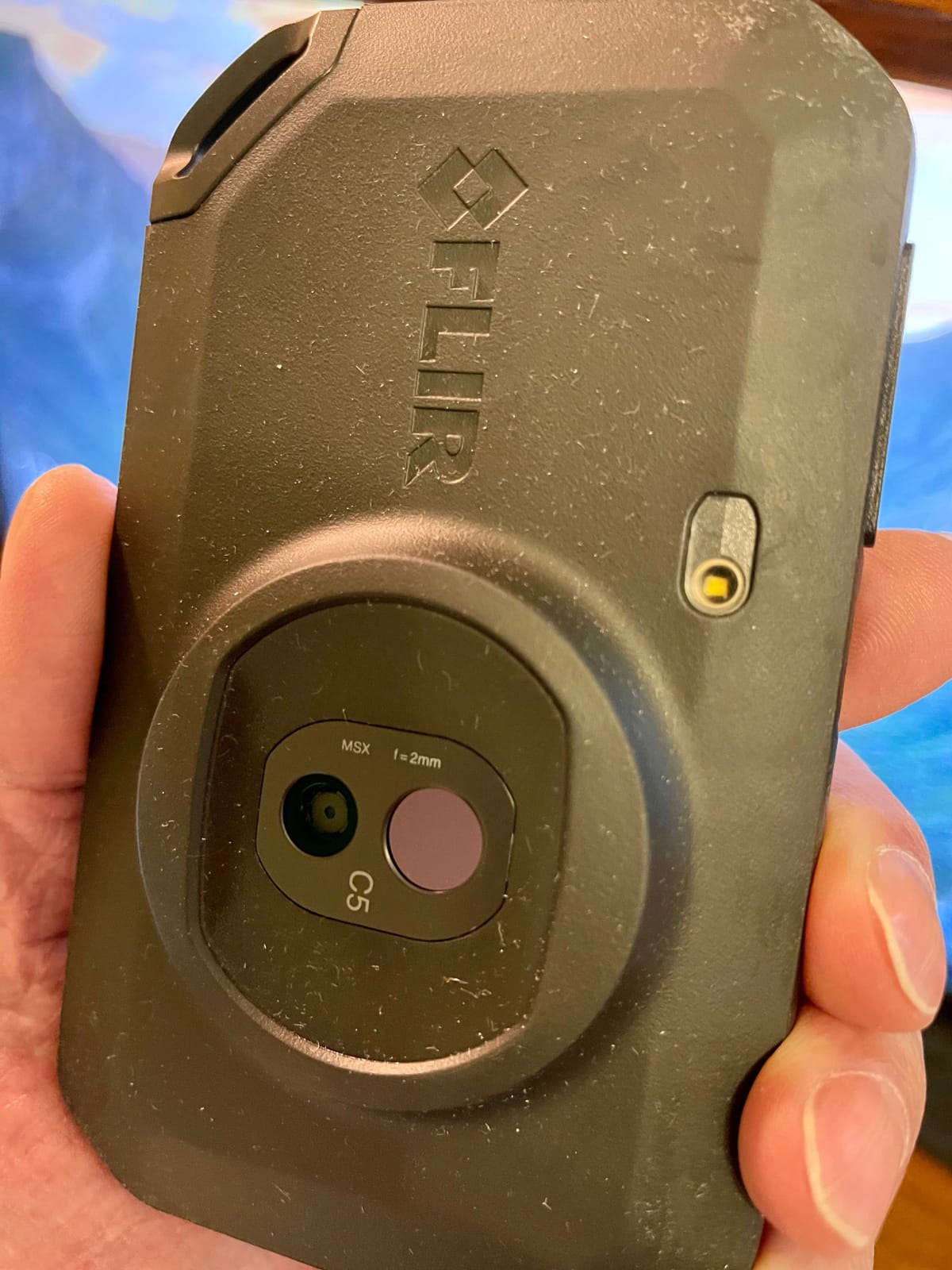
Owners use it successfully for insulation checks, leak tracing, circuit boards and attic diagnostics. The -4F to 752F range covers the residential envelope comfortably, and it records 1080p MP4 video with 5 MP effective stills. It is one of the few units here with a two-year parts and labour plus 10-year detector warranty from a manufacturer with a service network.
One caveat on the Ignite setup: it routes your images through FLIR’s cloud storage, so you grant a third party access to client inspection imagery. Some firms are not comfortable with that, and it is worth a policy decision rather than a shrug.
Best reasons to buy the C5
If thermal imaging is a billed service rather than a diagnostic side task, the reporting path is the deciding factor. Ignite handles image libraries, sharing and naming from a phone, which removes the biggest hidden cost of offering the add-on: report assembly time. You can hand a buyer a link and they can browse the whole house’s findings.
It is also the easiest unit in this roundup to justify to a client. Picture-in-picture with the MSX frame reads clearly to someone who has never held a thermal camera, so the conversation stays about the house rather than about colour scales.
Reasons to look elsewhere
160×120 is the honest problem. Nineteen thousand two hundred true pixels means you work close to the surface, and on a large open-plan interior you will walk the wall rather than shoot it. Experienced inspectors on the InterNACHI forum are blunt about 160×120 class units for professional house work, and RESNET’s minimum acceptable standard is set higher. Owners also report slow startup and intermittent Wi-Fi behaviour, and one detailed account describes a firmware update stopping the unit with warranty support declined. With a 4.2 average across more than a thousand ratings, the C5 is well regarded with real rough edges, and it is no substitute for a larger detector when resolution is the priority.
4. Klein Tools TI250 – Best Value Thermal Camera for Basic Diagnostics
Klein Tools TI250 Rechargeable Thermal Imaging Camera, Camera Displays Over 19,200 Pixels with 3 Color Palettes, High / Low Temperature Points
Over 19200 thermal pixels
Emissivity 0.01-0.99
-4F to 752F alarms
8.6 ounce body
Pros
- 19200 pixels gives usable detail for routine diagnostics
- Adjustable emissivity across many surface materials
- Selectable high and low temperature alarms
- Light at 8.6 ounces with a rechargeable cell
- Three colour palettes with crosshairs
Cons
- No built-in Wi-Fi so transfer is USB-C only
- Non-removable integrated battery
- Small form factor with fewer imaging modes
The TI250 is the one I recommend to electricians, HVAC techs and inspectors who want a pocket tool that reads temperatures rather than a camera system. At 8.6 ounces it is the lightest unit here, and the spec that matters most for field accuracy – adjustable emissivity from 0.01 to 0.99 – sits on the front of the menu.
Emissivity is the setting that decides whether a reading means anything. Paint and drywall sit near 0.95, but window frames, some metals and glossy roofing read dramatically wrong at that setting. Being able to dial it per surface is what separates a diagnostic tool from a toy, and Klein gives you a wide range to work with.
User-selectable high and low temperature alarms run across -4F to 752F, so you can set a threshold and let the camera flag anomalies while you walk a room. Three colour palettes with high and low markers and a crosshair for pinpointing round out an interface built for quick work rather than analysis sessions. Images capture and save over USB-C.
The package includes the imager, a charging cable, a carrying case and instructions, and the cell is a built-in rechargeable lithium polymer unit with no way to swap it, which fixes your runtime for the life of the camera.
Why the TI250 makes sense for part-time use?
For a general home inspector doing one or two appointments a week, this covers most useful work: tracing a cold band along a ceiling, confirming a hot breaker leg, checking a supply and return duct for a temperature split. Owners rate it as dependable, and the 4.4 average across 937 ratings sits among the most consistent scores in this group. The alarm feature is underrated: set a high threshold for a distribution panel and walk away, then come back to a flagged frame rather than a memory you half-remember.
Where it stops being enough?
There is no wireless sharing, so every report image needs a USB-C transfer, and the non-removable battery is a real limit on a full inspection day. It also has fewer imaging modes than dual-camera units, so you cannot put the visible and thermal views side by side for a client. At 19,200 pixels it sits in the same detection class as the FLIR C5 with no MSX-style enhancement to compensate, making it a measuring instrument that also takes pictures rather than a documentation camera. For a professional who wants client-facing imagery as part of the deliverable, that distinction matters.
5. Thermal Master Thor002 – Best for Six-Point Measurement Work
Thermal Master Thor002 Handheld Thermal Camera, 512 × 384 X³ Resolution
256x192 X3 enhanced to 512x384
25Hz and 40mK NETD
-4F to 1022F
10.5 hour battery
Pros
- 512x384 X3-enhanced output is among the highest detail figures in this group
- 40mK sensitivity with a 25Hz refresh rate
- 3.5-inch 640x480 IPS display with a 2MP visible camera
- Six measurement points with custom emissivity
- 5000mAh battery rated up to 10.5 hours
Cons
- Heaviest unit here at 3.12 pounds
- Newer model with a smaller review base
- USB-centric analysis rather than native cloud reporting
The Thor002 arrived in this lineup as an answer to a complaint I hear constantly: single-spot thermal cameras cannot document a comparison. Here you get centre, hottest, coldest and three user-defined spots on screen at once, which is exactly what a proper envelope scan needs to show a client that bay 4 is warmer than bays 2 and 3.
The 40mK thermal sensitivity figure is the number to hold onto. NETD, or noise-equivalent temperature difference, is the smallest temperature change the sensor can resolve against its own noise, so a lower number means subtler gradients stay visible. At 40mK with a 25Hz refresh, moving air and a walking scan both look smooth rather than stepping.
Resolution is a 256×192 detector with X3 processing reaching 512×384, shown on a 3.5-inch 640×480 IPS display with an integrated 2MP visible camera. Temperature range runs -4F to 1022F with plus or minus 3.6F accuracy, and a 4.3mm lens provides a 34.4 percent extended detection range alongside 4x digital zoom.
The 5000mAh battery is rated for up to 10.5 hours and charges over 18W, which covers a full working day. Storage is 8GB RAM and 32GB on board, with voice notes and QR code file management, plus Wi-Fi pairing and USB to a PC for real-time analysis.
What makes the Thor002 different in the field?
The six-point measurement layout changes how you work a room. Instead of stepping back and guessing which pixel was which, you set your three comparison spots in a row and the camera gives you a live delta across the wall. That is the difference between an image that shows a problem and an image that quantifies one, and quantified images survive client disputes.
The visible-light camera adds framing and label reading. On a breaker panel or an electrical box, you can confirm which leg is which in the same capture, which cuts down a common source of reporting error.
Where it will weigh on you?
Three point one two pounds is the heaviest camera in this roundup, and that is felt on a long ladder scan. IP54 protection and 2-meter drop resistance are good, but the weight is a constant rather than an occasional nuisance.
The reporting path is also less finished than a cloud-native unit: images move by USB to a PC or over Wi-Fi to a phone, with no native client-gallery workflow. At 275 ratings the model is newer and less proven in the field than the established brands above it, so confirm the features you depend on before committing to a reporting pipeline.
6. AMPBANK H128 – Best for Battery Life on Long Inspection Days
H128 Handheld Thermal Camera, 240 x 240 TISR Resolution, 24h Battery Life Thermal Imaging Camera, 25 Hz Infrared Camera with Temperature Alarm, -4℉~ 842℉ Temp Range, IP65 Protection Level
128x128 TISR enhanced to 240x240
40mK at 25Hz
Up to 24 hour battery
IP65
Pros
- Up to 24 hours of continuous battery life
- TISR-enhanced 240x240 clarity with 40mK sensitivity
- IP65 sealing with 6.56-foot drop resistance
- Automatic max min and centre recognition with alarms
- Adjustable distance and emissivity
Cons
- Absolute accuracy varies by roughly 5-7F
- Needs close approach for fine detail
- Display is not photo quality
The H128 solves one problem better than anything else here: the battery. Owners talk about locating a roof leak, a heating breaker and air-handling issues with it, and the 24-hour claim is what makes it possible to leave it in the truck all week without a charging routine. For anyone who inspects remote or rural properties, that is not a small convenience.
Sensitivity is 40mK at a 25Hz frame rate, which puts its detection capability in the same class as the Thor002 despite a much smaller detector. The base is 128×128, and TISR technology raises the processed output to 240×240 – enhancement again, and worth naming as such when you compare it to a native figure.
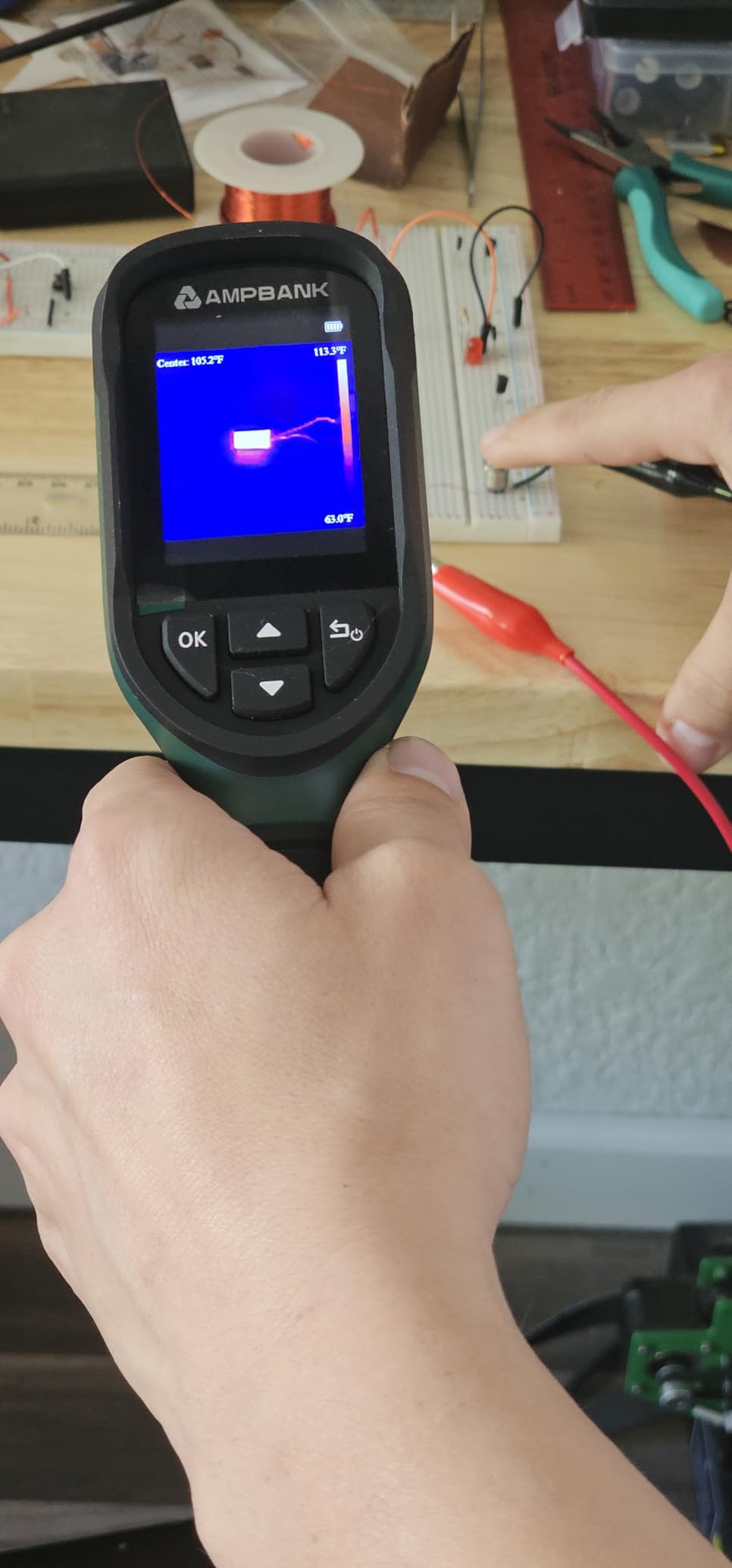
Temperature range is -4F to 842F with 0.1C display resolution and plus or minus 3 percent accuracy. Automatic maximum, minimum and centre recognition with a temperature alarm means you can sweep a mechanical room without watching the screen, and adjustable distance and emissivity let you set the camera up for concrete, brick or drywall. It weighs 1.06 pounds, is sealed to IP65, survives 6.56-foot drops, has a standard tripod mount, and ships with a charging cable and quick start guide.
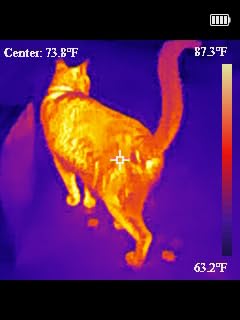
Where the H128 earns its reputation?
Owners report it paying for itself quickly by finding real defects – a roof leak, a failing heating circuit breaker, an air handler problem – which is the outcome that matters for a homeowner or a small inspection business. The 25Hz refresh and 40mK sensitivity combination means a slow walk of a wall produces usable imagery, and the alarm catches what you would otherwise miss while you are looking at the roofline.
It is also a good first thermal camera. There is little to configure, the controls are obvious, and the IP65 sealing means it survives the crawlspace and attic conditions where cheaper units get retired.
Where the readings will disappoint you?
Absolute temperature accuracy runs several degrees off on some examples, and reviewers are candid about it: trust the relative differences between two spots, not the absolute number. That is fine for envelope work and poor for anything where an exact temperature is the finding, such as confirming a temperature split across a coil.
Fine detail needs close approach, and the display is not going to produce a photograph for a client report. Long-term durability is also still unproven for some owners, which matters if you intend to make it a daily tool rather than a weekend one.
7. FOXWELL RT280 – Best for Point, Line and Area Reporting on a PC
FOXWELL RT280 Thermal Imaging Camera, 320 x 240 2.8″ LCD, 240 x 180 TISR
120x90 TISR enhanced to 240x180
2.8 inch 320x240 LCD
25Hz and IP54
Windows analysis software
Pros
- Easy to use straight out of the box with a solid build
- Bundled Windows software adds point line and area plus 2D and 3D analysis
- 8GB storage holds more than 20000 images
- Laser pointer and LED light for dark spaces
Cons
- 240x180 output is upscaled from a 120x90 sensor
- 25Hz shows slight stutter on fast pans
- Bundled software is Windows only
- Absolute readings can run high
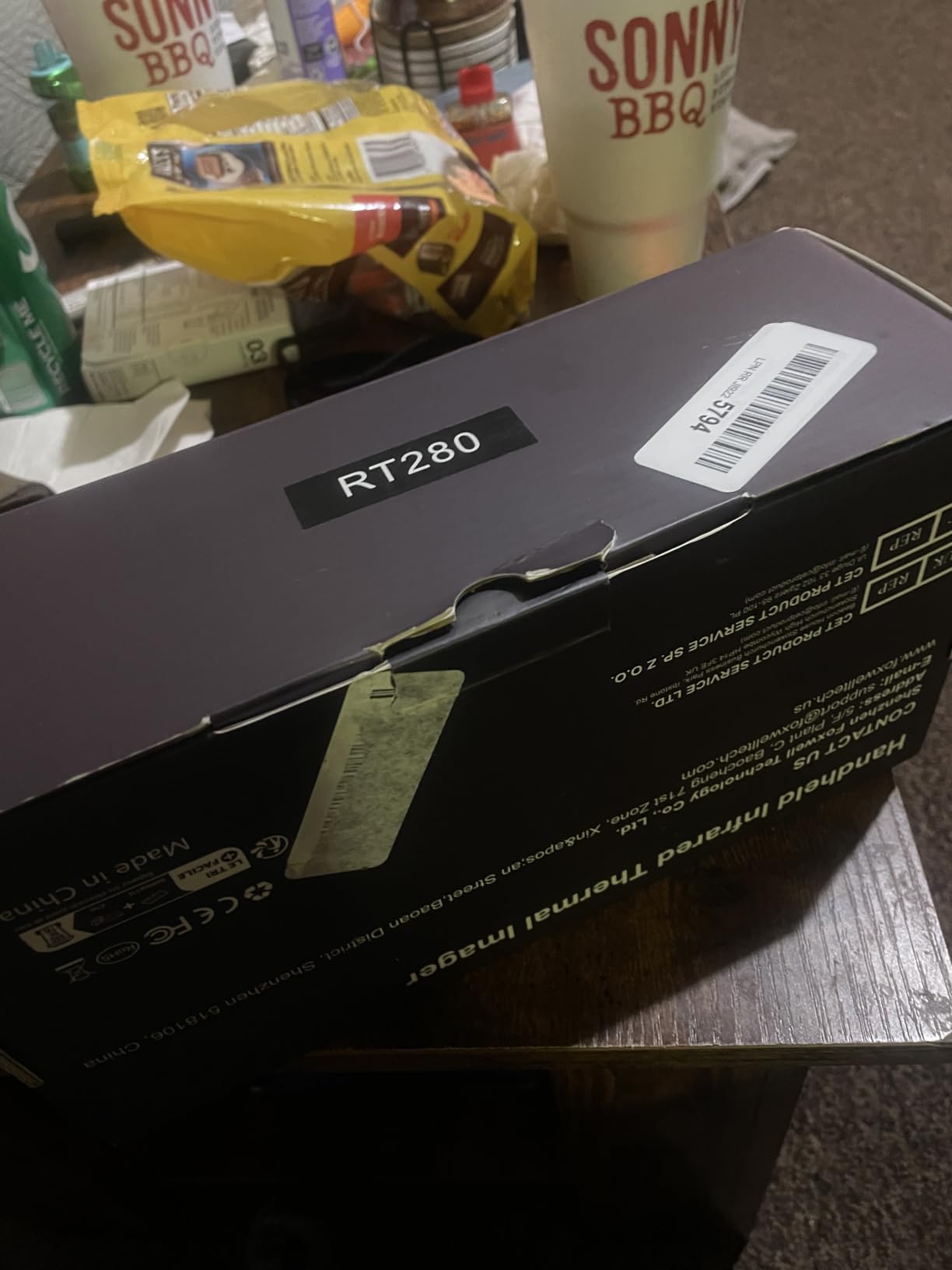
The RT280 is the camera to look at if your report is built on a laptop rather than a phone. The bundled Windows software is the differentiator: point, line and area analysis, 2D and 3D imaging, and report generation, all included, with no licence to buy and no app dependency. The build is sturdy, reviewers describe it as usable straight out of the box, and IP54 sealing with a 6.6-foot drop rating reads like a tool rather than a gadget. The laser pointer and LED light handle the two situations that frustrate every thermal camera: pointing at an anomaly in a dark attic, and finding it in the first place.
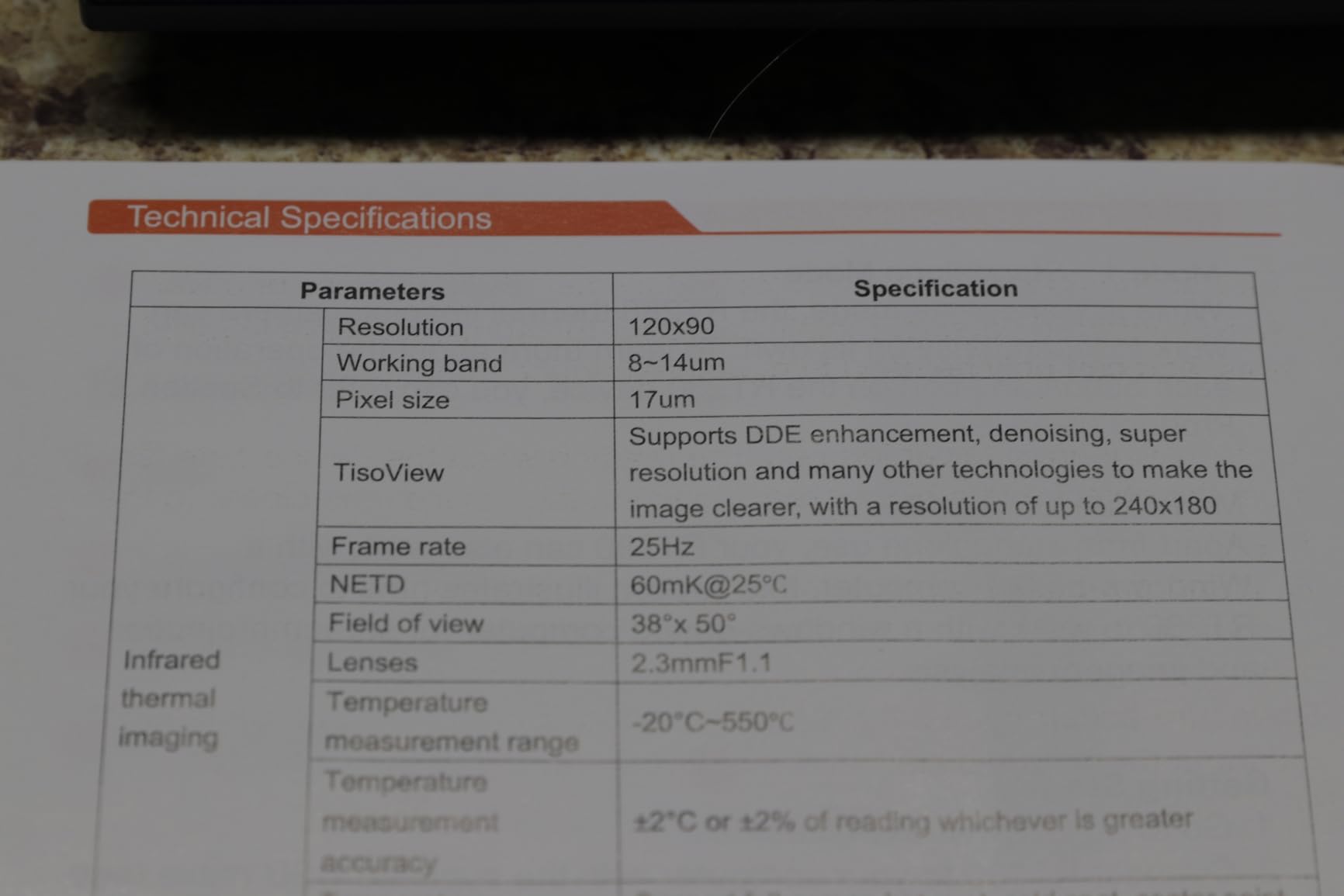
The 2.8-inch 320×240 LCD has a 50 by 38 degree field of view and a 25Hz frame rate, with automatic detection of the highest, lowest and central temperature points and high or low alarms. Range is -4F to 1022F with plus or minus 3.6F or 2 percent accuracy, and nine colour palettes are available. The 8GB of internal storage holds more than 20,000 images, and both photos and video with audio notes are captured.
It saves as JPEG and MP4 over USB Type C. Autofocus is listed in the product data, which matters more than it sounds when you are working in an attic with a thermal bridge two feet away.
What the bundled software actually gives you?
Point, line and area tools are the reason to buy this one. A line tool plots a temperature profile along a duct run or a wall, and an area tool gives you a rectangle with a running average and a delta. That is professional report output without a subscription, and it is the piece most entry-level cameras leave you to build yourself.
Owners report reliable use for radiant heat tracing, moisture screening and electrical work, and the 2D and 3D modes help visualise heat distribution on a wall or floor.
Where you need to manage expectations?
The headline 240×180 figure is TISR upscaling from a 120×90 sensor, and at 25Hz there is slight stutter on a fast pan, so slow your scan rather than sweeping. The software is Windows only, there is no wireless transfer to a phone, and absolute readings can run high. There is also no carrying case in the box, so add a pouch to the budget.
8. HSFTOOLS HP96 – Best for Touchscreen-Driven Field Work
HP96 Thermal Imaging Camera,3.5″ Touch Screen, Intelligent Scene Detection
96x96 super resolved to 240x240
3.5 inch touchscreen
25Hz and 50mK
IntellFault AI detection
Pros
- Large responsive 3.5-inch touchscreen speeds up on-site interpretation
- Live Super Resolution improves 96x96 clarity to 240x240 in real time
- Dual-camera fusion view documents labelled panels
- 25Hz video supports walkthroughs
- VOx detector picks up 0.05C differentials
Cons
- No battery strength indicator on the device
- iOS compatibility not documented
- About 4 hours of continuous battery life
The HP96 is the unit I recommend to someone who finds physical buttons and small screens frustrating. A 3.5-inch touchscreen with a phone-style interface means you tap the spot you care about instead of navigating a joystick, and on a job where you are taking dozens of images an hour that difference compounds quickly.
Its detector is 96×96 – the smallest pixel count in this roundup – but Live Super Resolution pushes the display to 240×240 in real time, and the VOx detector is specified to resolve differentials as small as 0.05C within plus or minus 2 percent accuracy. You are looking at an enhanced image of a small sensor, and you will get close to your subject.
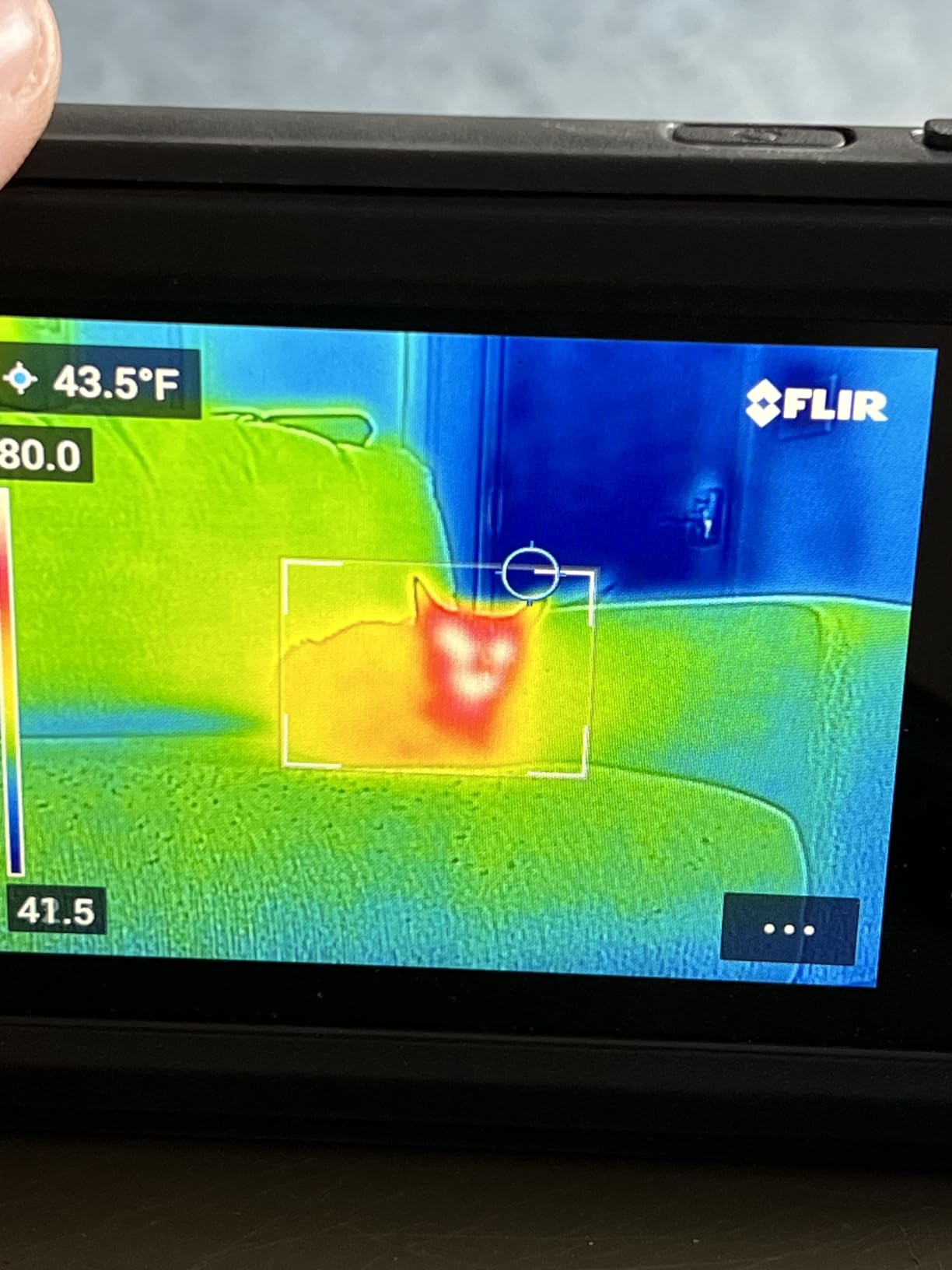
The fusion of a 640×480 visible camera with the thermal channel is the feature owners mention most. You can see studs, water lines behind drywall and breaker panel labels in the same frame, which is exactly what turns a thermal anomaly into a defensible report item. Five imaging modes cover Thermal, Visual, Fusion, PIP and Blending, with eight selectable palettes and automatic maximum, minimum and centre tracking.
IntellFault uses scene detection to flag candidate water leaks and insulation gaps, with the caveat that it flags them for you to verify and produces no moisture readings. Storage holds roughly 30,000 images and 20 hours of video, and there is a 6.6-foot drop rating with IP54 sealing.
Where the HP96 shines?
Radiant floor heat mapping is a genuine standout use. With fusion on, you can trace a loop pattern under finished flooring and document uniformity in a way a pure thermal image cannot. Owners also use it for RV and mobile-home inspections, where space is tight and the touchscreen makes framing in a confined area far easier.
The 25Hz video recording is smooth enough to capture a walkthrough, and automatic max, min and centre tracking with custom threshold alerts means you can leave it running during a sweep and review the flagged moments afterwards.
Where it will hold you back?
There is no battery strength indicator on the device, a strange omission on a unit you may run through a full crawlspace, and battery life is about 4 hours of continuous use. Some earlier production batches had battery and sleep-state faults, iOS pairing can fail on iOS laptops, and Blend mode shows slight parallax on very close subjects. The 96×96 sensor also means distance work is out, so treat this as a close-quarters interior tool.
9. HSFTOOLS F2VW – Best for Fusion Imaging and Live Streaming
HSFTOOLS F2VW Thermal Camera with 2MP Visual Cam, 640×480 Super Resolution
256x192 super resolved to 640x480
25Hz and 40mK
2MP visual camera
Wi-Fi streaming
Pros
- Super resolved output delivers detail owners rate highly
- Fusion view shows studs water lines and panel labels
- Level and span controls with a 40mK sensor
- Wi-Fi streams the camera view to another room
- Boots in 10-12 seconds
Cons
- Smallest review base at 91 ratings
- Wi-Fi hotspot connectivity is unreliable
- Carry bag quality drew complaints
- Camera recalibrates frequently
The F2VW made me reconsider my scepticism about newer brands. It runs a 256×192 detector through Live AI Super Resolution to a 640×480 output on a 3.2-inch LCD at 25Hz, with thermal sensitivity below 40mK – a spec combination normally associated with much higher tiers.
Level and span controls are the detail that catches experienced operators. Constraining the colour scale to a narrow band around your expected temperature is how you see a 2C difference across a wall instead of 20C of sky-to-floor gradient, and having them at this level is unusual.
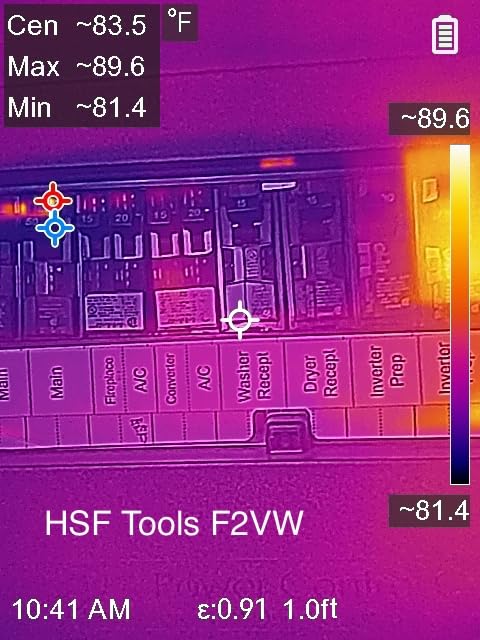
The dual IR plus 2MP visible camera gives Visual, Thermal, Fusion and PIP modes with seven palettes on a single button press. Temperature range is -4F to 1022F with high, low, centre and custom measurement points, and the VOx detector resolves 0.04C differentials within max of plus or minus 3.6F or 2 percent. IntellFault and Pro Scene AI detection run alongside high and low alarms.
Wi-Fi connects to a phone or tablet and can stream what the camera sees live, which is genuinely useful for attic work – you can put the camera above the insulation and watch the live view from the hatch. There is an LED flashlight and a quarter-inch tripod hole.
What makes the F2VW worth the risk?
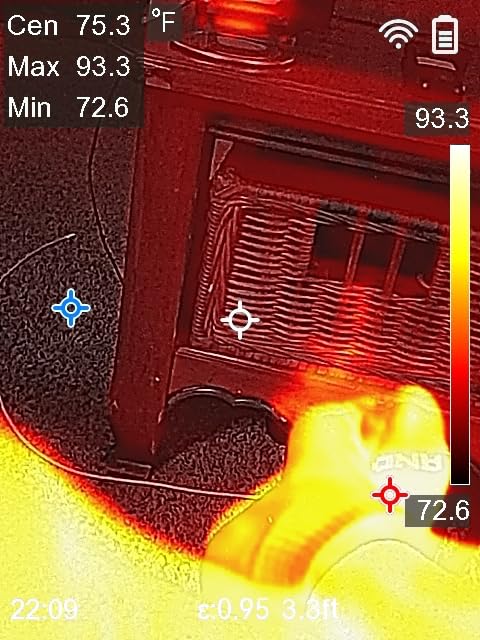
Owners of this unit are emphatic that the fusion imaging shows studs in walls, hot water lines behind drywall and breaker panel labels clearly, and several describe the output quality as rivaling costlier FLIR units. For an inspector whose findings live or die on a legible report image, that is the whole argument.
The post-analysis software is straightforward, the camera boots in 10 to 12 seconds, and the streaming feature turns a solo attic scan into a two-person job without a second person.
Where caution is warranted?
At 91 ratings this has the smallest review base in the group, so long-term reliability is genuinely unknown. The Wi-Fi hotspot mode works mainly over a local network, there is no general-purpose live video app for arbitrary phones, the camera recalibrates frequently so a capture sometimes needs repeating, and one reviewer found the included carry bag wearing after a few days. Budget a proper case and confirm the software works on your machine before you rely on it for a live inspection.
10. HSFTOOLS P2W – Best for Large Storage and AI Scene Detection
HSFTOOLS P2W WiFi Thermal Camera, 8MP Visual Cam, 640×480 Super Resolution
256x192 super resolved to 640x480
8MP visible camera
16GB for 60000 images
4 hour battery
Pros
- 640x480 super resolved thermal output on a 3.5-inch touchscreen
- IntellFault and Pro Scene Color Alarm automate anomaly flagging
- Five imaging modes and eight palettes
- HSF Studio Windows software with 3D plotting
- 16GB holds up to 60000 images and 54 hours of video
Cons
- Smallest review base here at 65 ratings
- Upper range capped at 752F
- About 4 hours of continuous battery life
The P2W is the feature-maximising member of the HSFTOOLS line and the newest camera in this roundup. The 256×192 detector is lifted to 640×480 output on a 3.5-inch touchscreen at 25Hz with sub-40mK sensitivity, and the visible camera is 8MP, which makes the fusion and picture-in-picture modes useful for documentation rather than just orientation.
IntellFault and Pro Scene Color Alarm are designed to flag candidate water leaks and insulation voids automatically, and there is a high and low temperature exceedance alert through on-screen text, the LED flashlight or an audio buzzer. Automatic tracking of the hottest, coldest and centre spots keeps a scan honest.
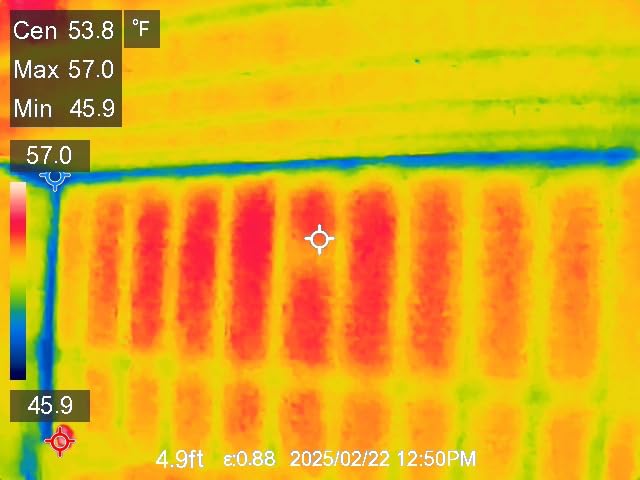
Storage is the headline number: 16GB of eMMC holding up to 60,000 images or 54 hours of MP4 video, which means a heavy inspection week does not require a laptop in the truck. The range is -4F to 752F, slightly narrower than the F2VW, and the VOx detector resolves 0.04C differentials within max of plus or minus 3.6F or 2 percent.
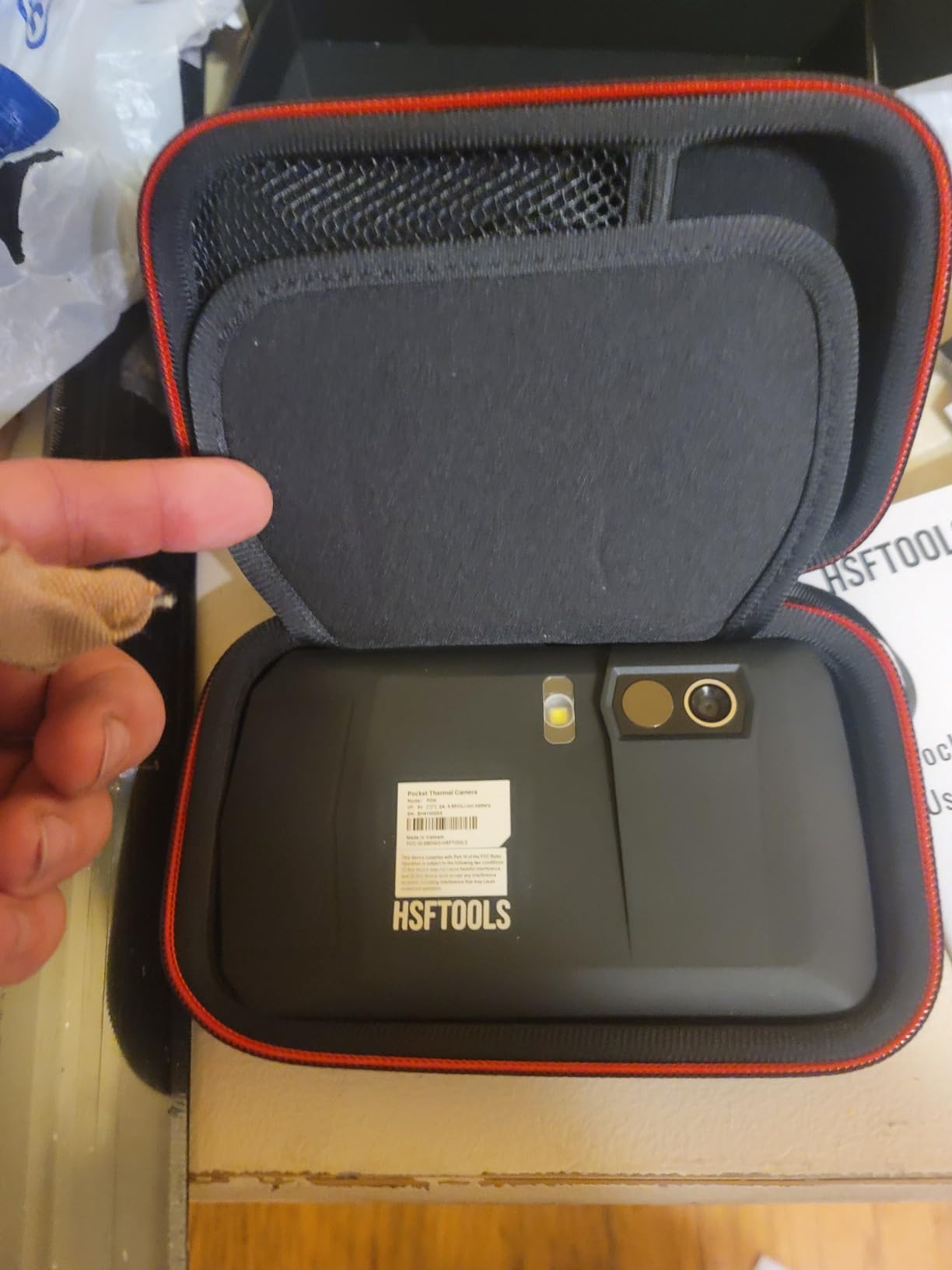
Connectivity is good: Wi-Fi pairing with an app for iOS and Android, plus HSF Studio Windows software with 3D plotting and screen projection. At 1.32 pounds with an included case, IP54 sealing and a 6.6-foot drop rating, it is the most portable unit with a touchscreen here.
Reasons to pick the P2W
Nobody should buy a thermal camera they will run out of storage on. At 60,000 images and 54 hours of video, the P2W removes the transfer decision entirely for a full week of work, and the 3D plotting in HSF Studio is a real advantage when you want to show a client how heat moves through a room rather than just a flat image.
Screen projection is useful for training – you can put the live image on a wall and teach someone how to read palettes – and the AI scene detection narrows a long inspection down to the frames worth reviewing closely.
Reasons to wait
Sixty-five ratings is a very thin evidence base, and reliability over a few years is simply unknown. The upper range stops at 752F, so it is not the tool for hotter electrical diagnostics, and 4 hours of continuous battery is modest for a full day on site. It also depends on the HSFTOOLS software ecosystem rather than being self-contained, so if you need a camera you can trust for a decade of daily work, an established brand with a long warranty and service network is the safer bet.
What to Look For in a Thermal Imaging Camera?
Native resolution beats display resolution
This is the specification most marketing gets wrong, and it is the one that matters. Several cameras here advertise 240×180 or 640×480 while running a 120×90 or 256×192 detector, with the difference made up by in-camera processing. For residential work, 256×192 is a practical floor; above 320×240 you gain long-range and small-anomaly capability that mostly pays off on roofs, mechanical rooms and commercial work.
NETD tells you about subtle differences
Thermal sensitivity, expressed in millikelvins, is the noise floor of the sensor. A camera at 40mK resolves finer temperature gradients than one at 50mK, which is what you need to see a partially missing insulation bay that is only a few degrees off its neighbours. Two units here specify 40mK; the rest do not publish the figure, which is worth asking about.
Refresh rate decides what you can scan
Nine-hertz cameras cannot follow moving air, so a fresh-air or blower-door scan looks like a stutter. Twenty-five hertz is the practical standard for a professional workflow, and every unit here runs at 25Hz. If you plan to pair thermal imaging with a blower door, 25Hz is a requirement rather than a preference.
Emissivity control is the difference between a reading and a guess
Every camera measures the infrared energy leaving a surface, and that measurement is only meaningful if you tell the camera how reflective the surface is. Most building surfaces sit near 0.95, but window frames, polished floors and reflective roofing do not. Cameras with a wide adjustable emissivity range let you correct for the material instead of accepting a wrong number.
Measurement tools and the reporting path
Look for more than a single centre spot. Centre, hottest, coldest and at least two or three user-defined points let you quantify a comparison across a wall, which turns an image into a finding. Alongside that, decide how images reach the client: cable to a laptop, an app over Wi-Fi, or built-in cloud galleries.
Power, sealing and screen size
Battery claims range from about 4 hours to 24 hours across this list, a bigger practical difference than any spec on the box. Attic and crawlspace work argues for IP54 or better and a stated drop rating, and in cold weather the clothing around you matters as much as the camera, which is why we keep pointing at the best thermal base layers for cold weather whenever an inspection runs in a crawlspace in February. A 3.5-inch screen is the current sweet spot.
How Thermal Imaging Works During an Inspection?
Every object emits infrared radiation, and a thermal camera’s uncooled microbolometer sensor absorbs that long-wave radiation, roughly 7.5 to 14 micrometres, and assigns a temperature to every pixel. Software then maps those values onto a colour palette, which is why a rainbow or ironbow image is a scale, not a photograph.
That scale is the source of most misinterpretation. Two surfaces at different temperatures can look identical if the camera is set to a wide span, and a shiny surface can return mostly reflected radiation from the sky or a neighbouring wall. This is what reflected apparent temperature correction exists for, and it is why an outdoor scan of a sunny wall can read 10C wrong with no mistake on your part.
Delta-T is the practical tool inspectors use. You measure a reference area known to be sound, then compare a suspect area, and you call a finding on the difference rather than the absolute number. A rule of thumb that shows up repeatedly in practice is that a difference of 10 percent of the expected interior-to-exterior separation is worth investigating, and anything below 5 percent is usually within noise.
Load matters more than most buyers expect. Thermal imaging only sees what the building is currently doing, so a scan taken with the heating off, solar load high on one wall and the interior warm tells you about those conditions, not the house in general. Scan with a consistent load and record the conditions in the report.
What Thermal Imaging Cannot Tell You?
Thermal imaging flags anomalies. It does not diagnose them, and the most common complaint from inspectors is that a camera found a cold patch and the client assumed a leak. A cold region may be missing insulation, an air leak, a shadowed stud bay, a void left by removed ducting, or a simply unheated part of the house.
Moisture in particular requires a second instrument. Wet insulation and dry insulation can read similarly in many conditions, and a thermal image does not measure moisture content. Confirm any suspected intrusion with a pin or pinless moisture meter and, where the stakes justify it, by opening the wall.
False positives have predictable causes: sun-heated exterior walls during the day, reflective metal and glass, large interior-to-exterior load differences, and air conditioning running in one zone while another is unconditioned. A blower door test in combination with a 25Hz camera is the reliable way to demonstrate air leakage, and pairing the two is what experienced practitioners consistently recommend.
Standards set the practical floor. RESNET lists 120×120 as the minimum acceptable IR camera resolution for real estate inspections, and Infraspection’s standard is 120×160. Many experienced inspectors on the InterNACHI forum go further and advise nothing below 320×240 for house work, which is worth weighing before you decide a 160×120 unit is sufficient.
Certification and Resolution Standards
Certification and standards are the most authority-rich signal in this niche, and the forums are clear that they matter. Level I thermography covers basic theory and instrument operation, Level II adds applied inspection technique and interpretation, and Level III covers advanced applications and research. Most home inspectors who get serious about thermal add-ons work toward Level I first and Level II after.
Resolution standards set the minimum documentation quality, and the ASNT and SNT-TC-1A bodies define the qualification framework for thermographers. Certification does not make a better camera, but it changes how you defend a finding to a seller, an agent or a court. One practical note carried through the InterNACHI discussions: a thermal camera is not a required home inspection item, and scanning live electrical panels for overheating is an active hazard, so plan on the ordinary precautions for working around energized equipment.
Frequently Asked Questions
What thermal camera do home inspectors use?
Most professional inspectors use a standalone handheld with at least a 256×192 native detector, a 25Hz refresh rate, adjustable emissivity and multiple measurement points. A 3.5-inch screen, internal storage and a reliable phone or cloud reporting path matter as much as pixel count. Our top pick in this roundup is the TOPDON TC004, with the FLIR C5 favoured where client-ready cloud reports are the deciding factor.
What is the best thermal imaging camera for homeowners?
For a homeowner, a mid-tier standalone is the best answer. The Klein Tools TI250 suits occasional diagnostics on a budget, while the TOPDON TC004 is a stronger all-round choice with a larger display, 64GB of internal storage and Wi-Fi transfer. Avoid phone attachments if you want to scan large wall areas, because working distance and screen size both matter more than phone quality.
Is thermal imaging worth it for a home inspection?
Yes, when the operator understands what the image means. Thermal imaging is the only non-destructive way to locate missing insulation, air leakage, thermal bridging and overheating electrical connections before anything is opened, and it produces report imagery a client can see. It is not worth it if you expect the camera to identify causes on its own, because a cold patch still needs a moisture meter and a trained eye to interpret.
What resolution thermal camera do I need?
For residential inspections, 256×192 native resolution is a practical floor and 320×240 is preferred by experienced practitioners. RESNET lists 120×120 as the minimum acceptable standard and Infraspection uses 120×160, but many inspectors advise nothing below 320×240 for house work. Be careful with advertised figures, because several cameras upscale a much smaller sensor to a larger output size.
Are HIKMICRO, TOPDON and similar brands as good as FLIR?
The current shortlist is dominated by TOPDON, FLIR, Klein, Thermal Master, AMPBANK, FOXWELL and HSFTOOLS rather than HIKMICRO, and the answer depends on your workflow. FLIR leads on cloud reporting, MSX image clarity and warranty length. The others compete hard on detector specification per unit of spend, and the TOPDON TC004 in particular pairs a 256×192 detector with 64GB of storage and Wi-Fi transfer at a fraction of the cost of a pro FLIR body.
How accurate are thermal cameras?
Accuracy depends on the unit, the surface and the settings. Cameras in this roundup are specified within roughly plus or minus 2 to 3.6F, and owners commonly report absolute readings running several degrees off on smaller models. Because of that, use relative differences between a known-good reference area and a suspect area rather than the absolute number, and set emissivity to match the material you are imaging.
The Right Thermal Camera for the Job
If you want one camera to carry on every residential job in 2026, the TOPDON TC004 is where we land. The 3.5-inch display, 256×192 detector enhanced to 512×384, 64GB of internal storage and Wi-Fi transfer cover interior envelope scans, attic work and mechanical rooms without a cable or a laptop in the truck, and it carries a 4.6 rating across 860 reviews.
Buy the Klein Tools TI250 instead if you want the lightest option, wide emissivity control and simple USB-C transfer, and pick the FLIR C5 when cloud-hosted client galleries and a long detector warranty matter more than resolution. Whichever you choose, pair it with a moisture meter, learn the delta-T habit, and remember that the best thermal imaging cameras for home inspections are the ones whose readings you can defend to a seller.