
The mount decides whether your astrophotography works. You can put a mediocre telescope and a second-hand camera on a solid head and get sharp, well-guided data all night, but a wobbly mount will spoil every frame no matter how good the glass is.
We spent weeks comparing the ten best telescope mounts for astrophotography currently shipping, checking payload ratings, drive type, polar alignment options and the small parts that decide whether a rig is pleasant or a chore. Quick picks first, then the full write-ups.
Here is the short version, and every product below sits inside the format the search results reward: label, name, one-line reason.
Choosing a mount means matching a rated load to a real imaging train, and the same matching logic shows up in every other field where weight, clamping and vibration decide whether a job gets done. We cover the rest of that thinking in our guides to rifle scope mounts and ATV winch mounts, but a telescope mount has one extra constraint: it has to hold a target still for minutes at a time.
Best overall: Sky-Watcher Star Adventurer 2i Pro Pack – the most-reviewed tracker here, with a deluxe equatorial base, an illuminated polar scope and a two-minute-sub workflow that works for lenses up to roughly 400mm.
Best value: iOptron SkyGuider Pro – an 11lb payload, an illuminated polar scope and around 20 hours of internal battery in a head that weighs 2.2lb.
Budget pick: Omegon MiniTrack LX3 bundle – the simplest tracker on the list, bundled with a solid ball head, accurate enough for sub-pixel registration on wide-field stacks.
Best for heavy payloads: Sky-Watcher EQ6-R – 44lb of rated capacity, belt-driven steppers and encoders, and the tracking head most deep-sky imagers end up on.
Table of Contents
Top 3 Telescope Mounts for Astrophotography (October 2026)
Three mounts cover most buyers: one for portability, one for value, one for load capacity. The table below puts their strengths in plain terms before the full comparison.

Sky-Watcher Star Adventurer 2i
- Deluxe equatorial base
- Illuminated polar scope
- Wi-Fi SAM Console app
- Tracks lenses to about 400mm

iOptron SkyGuider Pro
- 11lb payload
- 2.2lb all-metal head
- AccuAlign illuminated polar scope
- 20 hour internal battery
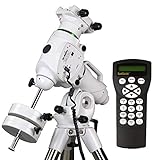
Sky-Watcher EQ6-R
- 44lb payload capacity
- Belt-driven steppers with encoders
- Illuminated polar finderscope
- ST-4 autoguide port
All 10 Mounts Compared Side by Side
Payload figures below exclude counterweights, which is how the manufacturers quote them. Plan to load no more than two-thirds of rated capacity for imaging work.
| Product | Specifications | Action |
|---|---|---|
| Sky-Watcher Star Adventurer 2i Pro Pack |
|
Check Latest Price |
| iOptron SkyGuider Pro Camera Mount |
|
Check Latest Price |
 Celestron Advanced VX GoTo GEM Celestron Advanced VX GoTo GEM |
|
Check Latest Price |
 Sky-Watcher Star Adventurer GTi Kit Sky-Watcher Star Adventurer GTi Kit |
|
Check Latest Price |
 Explore Scientific iEXOS-100-2 Explore Scientific iEXOS-100-2 |
|
Check Latest Price |
| Sky-Watcher EQ6-R |
|
Check Latest Price |
 Omegon MiniTrack LX3 Bundle Omegon MiniTrack LX3 Bundle |
|
Check Latest Price |
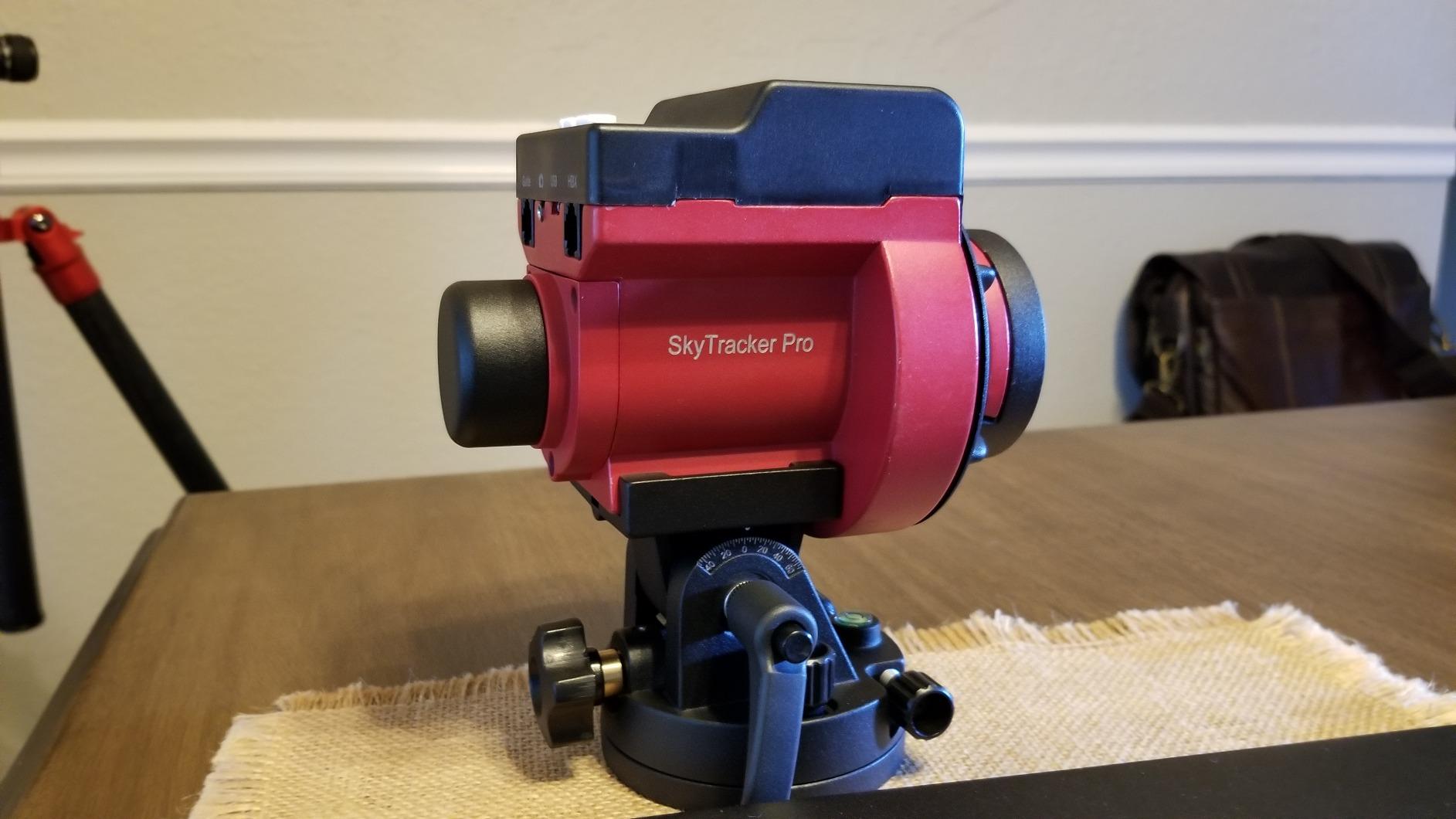
 iOptron SkyTracker Pro iOptron SkyTracker Pro |
|
Check Latest Price |
 Vixen POLARIE U Vixen POLARIE U |
|
Check Latest Price |
 Celestron CGX 55lb Payload Celestron CGX 55lb Payload |
|
Check Latest Price |
1. Sky-Watcher Star Adventurer 2i Pro Pack – The Most Reviewed Tracker Here
Sky-Watcher Star Adventurer 2i Pro Pack (S20512)
7 lb kit
13.9 x 9.6 x 6.3 inch
Wi-Fi SAM Console app
Lenses to about 400mm
Pros
- Compact and easy to travel with
- Tracks cleanly at 2 minute subs
- Reliable Wi-Fi app control
- Runs roughly 40 hours on a set of AA batteries
- Illuminated polar scope speeds up alignment
Cons
- Polar alignment has a steep learning curve
- Factory app is basic
- A sturdy tripod is essentially required
This is the tracker most people in our search data own, and the reason is simple: it does the one job well without asking you to learn a new control ecosystem. The deluxe equatorial base has enough mass and adjustment range to hold a DSLR on a 100-300mm lens dead still for two minutes.
Owner reports are consistent about what works and what does not. The illuminated polar scope gets you aligned quickly, the app connection holds through a full night, and a set of AA batteries carries you through roughly 40 hours of tracking. Frames stack cleanly once alignment is dialled in.
The failures are all about the supporting cast rather than the tracker. The red plastic base plate is described as flimsy, the factory app is called basic, and the little ancillary parts – the polar illuminator adapter and the SNAP connector ring – are repeatedly described as easy to lose and awkward to replace.
Reviewers also recommend a second counterweight for heavy telephoto glass, and caution about occasional erratic motor behaviour. None of that is fatal, but it is the kind of thing that shows up at 2am in a field when you are trying to stack a 250mm lens.
One more practical note before you commit: this is a head, not a system. It clamps onto a photographic tripod you already own, and a light camera tripod will flex enough to show up in your guiding graphs. The rating reflects 610 owner reviews, the largest sample on this list by a wide margin.
Is it good for beginners learning polar alignment?
It is workable, but the alignment process is the part reviewers mention most as a hurdle. The illuminated polar scope helps, though the base still needs careful levelling before the scope means anything. Budget an evening for your first setup and expect the second one to take minutes.
For the learning-curve-sensitive, the iEXOS-100-2 below has a different personality, and the MiniTrack LX3 has none at all because it needs no fine adjustment.
Is it a good first mount for long lenses?
Up to about 400mm, yes, with balanced counterweights. Beyond that, you are asking a 7lb kit to do a job the EQ6-R exists for. Treat the 400mm figure as the ceiling, not the target, and keep a 20-30% payload margin so wind does not turn a marginal rig into a ruined one.
2. iOptron SkyGuider Pro – The Tracker With Real Payload Headroom
iOptron SkyGuider Pro Camera Mount Full Package
11lb payload
2.2lb all-metal head
20 hour internal battery
AccuAlign polar scope
Pros
- Packs into a camera bag
- All-metal body for low vibration
- Clean 2-3 minute subs to 300-500mm
- Integrated illuminated polar scope
- Counterweight shaft and weights in the box
Cons
- No GoTo
- Polar scope often arrives out of collimation
- Sturdy tripod not included
This is the most capable small tracker in the group and the one we would hand someone who has already done a few sessions and wants a step up. Eleven pounds of rated payload is roughly double what most bare trackers in this class carry, and the all-metal body keeps vibration low enough for longer focal lengths.
Owner reviews keep coming back to the same result: clean 2-3 minute subs at up to 300-500mm after a careful alignment. The internal rechargeable battery runs around 15-20 hours, which comfortably covers a full night without a power brick, and the counterweight shaft means you can carry a heavier telephoto than a plate-only tracker allows.
The most-cited gripes are practical rather than fundamental. There is no GoTo, so you find targets yourself. The AccuAlign polar scope frequently arrives out of collimation and needs adjusting with a hex key you are not given – the supplied 2mm key is the wrong size. The counterweight bar is short, and the camera chuck is plastic that some owners report cracking over time.
Forum threads also flag the classic SkyGuider failure mode: the RA clutch gets over-tightened during setup and becomes genuinely hard to release years later. Treat the clutch as a light-touch adjustment rather than a mounting bolt, and this is a long-lived mount.
A sturdy tripod is not in the box. That is the single most common real-world complaint about this class of mount, and it pairs neatly with what we saw in the field: people succeed with mediocre telescopes and cameras, but not with a bad or flexing support.
The latitude range of minus 30 to 65 degrees and plus or minus 5 degrees of azimuth adjustment are both generous, so most observing sites are covered without a wedge.
Can it handle a telephoto lens and a guide camera?
Yes, within reason. The 11lb rating comfortably covers a DSLR, a 200-300mm lens, a small guide scope and a guide camera, which is the standard deep-sky bundle. Heavy 400mm-plus glass plus a cooled camera pushes you toward the edge, and you will want the counterweight bar extension that owners end up buying separately.
Is the missing GoTo a real problem?
For imaging, not really – you plate solve to the target either way, and most people run a sequence that re-centres automatically. GoTo matters more if you also want to point the camera at visual targets. If that is part of your plan, the Star Adventurer GTi kit below has it built in.
3. Omegon MiniTrack LX3 Bundle – The Simplest Tracker That Still Stacks Well
Omegon Mount Mini Track LX3 Bundle with Tripod Ball-Head Pro OM8
950g head
3kg recommended payload
60 second max shutter
OM8 Pro ball head included
Pros
- Extremely simple to set up
- Very portable at 950g
- Sub-pixel registration across 25 second frames
- Optical polar finder aligns in under a minute
- Solid OM8 ball head in the bundle
Cons
- Suggested focal length ceiling around 100mm
- Camera mounting screw is too short
- Needs a solid tripod bought separately
There is no motorised GoTo, no app, and no second axis. The MiniTrack LX3 does one thing – it turns a camera at sidereal rate – and reviewer reports describe the accuracy as sub-pixel registration across stacked 25-second frames at typical wide-field focal lengths.
The optical polar finder is the standout. Owners report aligning in under a minute, which makes this the fastest setup in the group by a wide margin. At 950g the whole bundle is the kind of thing you can carry up a hill in one hand, and the included OM8 Pro ball head is a real ball head rather than the flimsy folding head bundled with cheaper trackers.
The limits are equally clear. The suggested maximum focal length is around 100mm, and the maximum shutter speed is 60 seconds. That makes it a wide-field Milky Way and nightscape tool, not a deep-sky machine for a refractor or imaging Newtonian.
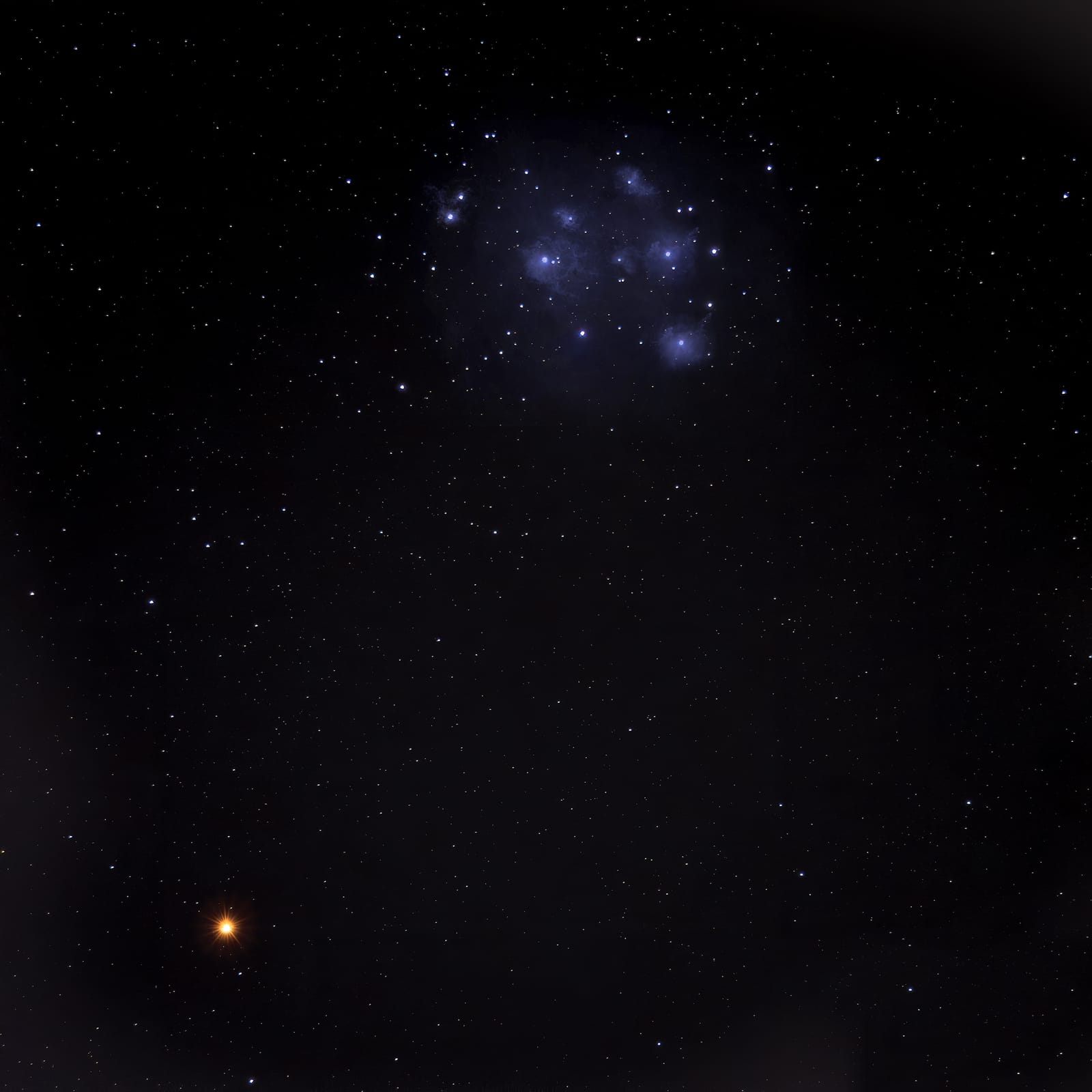
Two mechanical details catch people out. The camera mounting screw is too short, which makes a tight, wobble-free fit fiddly to achieve, and the ball head alignment can shift by roughly 15 degrees as the clockwork is wound – so re-check it before a long run rather than trusting a fresh setup.
Documentation for the optical polar finder is thin, and the manual is not detailed enough on its own. Budget some time reading community write-ups if you have never aligned a tracker before.
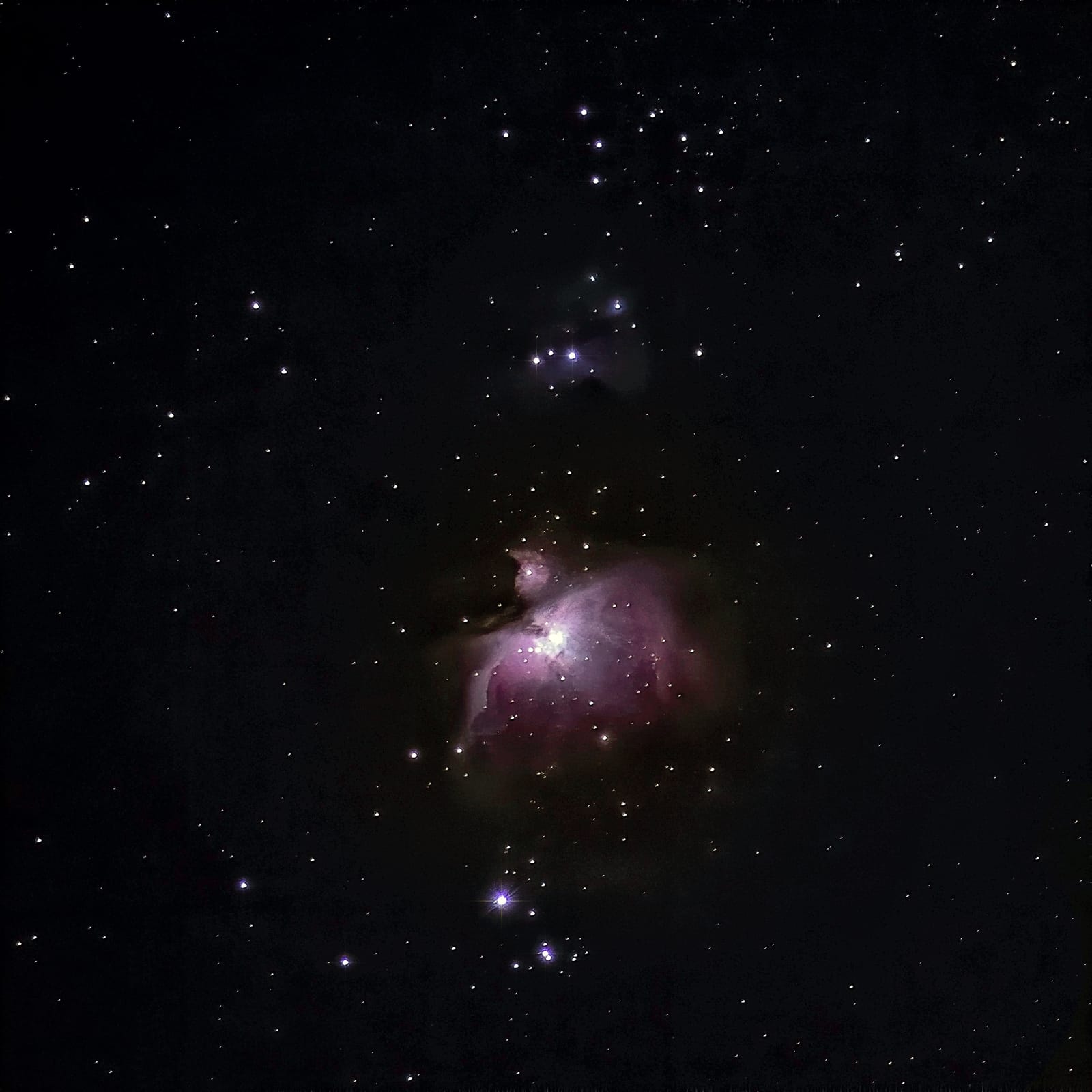
If you fly to a dark site, this is the mount that changes your mind about what is possible. Reviewers also note it is a genuinely good beginner instrument for learning where things are in the sky.
Is 60 seconds enough for star field photos?
For wide-field work at short focal lengths, yes. Owner reports of clean sub-pixel stacking on 25-second frames mean a 60-second exposure is comfortable headroom, not a limit. Push past that on this head and the fixed gear and short screw start to show, which is why the guidance stops there.
Who should skip it?
Anyone planning to grow into a refractor, a cooled camera or long focal lengths. The jump from this to the SkyGuider Pro or the EQ6-R is a large one, and the MiniTrack will need replacing rather than upgrading. Buy it for what it does well: small, light, wide-field, and cheap to carry.
4. Vixen POLARIE U – Smallest and Most Rigid of the Trackers
Vixen POLARIE U Star Tracker
0.58kg head
4.53 x 2.83 x 3.48 inch
Five tracking speeds
ST-4 autoguide on RA
Pros
- Very small and rigid for its size
- Point stars at short focal lengths with rough alignment
- Five tracking speeds plus ST-4 port
- Smartphone shutter release for time-lapse
- Works with existing POLARIE accessories
Cons
- Top tracking speed of 10x judged too slow
- Accessory parts priced above competing brands
- External power needed for long sessions
At 0.58kg this is the lightest mount we tested, and the thing that stands out in owner reviews is not its weight but its rigidity – several people describe it as approaching equatorial-mount rigidity in a tiny body.
The POLARIE U delivers point stars at short and moderate focal lengths even when polar alignment is only roughly judged. That forgiving quality matters on a travel setup where you are aligning by headtorch in a car park rather than next to a laptop screen.
It also has more electrical options than most of its size class: five tracking speeds, an ST-4 autoguiding port on the right ascension axis, smartphone shutter release for time-lapse, and USB-C external power alongside four AA batteries.
The criticism is mostly about the accessory ecosystem. The maximum 10x tracking speed is judged too slow by some users, only one 3/8 to 1/4 inch adapter screw is included and it can be insufficient, and the optional Vixen accessories – the DX fine-adjust head, the PF-L II polar scope – cost more than comparable parts from other brands.
Long sessions want external power despite AA support. That is a small criticism given how little the whole unit weighs, and it is the one adjustment that turns this from a nightscape tool into something you can run for a whole night without babysitting a power bank.
If you already own POLARIE accessories, this is the easy upgrade. If you are starting fresh, the accessory pricing is worth comparing against the alternatives before you commit, because the tracker itself is only part of what a first setup needs.
Why does rigidity matter more than payload?
Because payload ratings assume a rigid support underneath. A head that flexes under load will show that flex in your guiding graph as error that no amount of autoguiding correction can remove cleanly. Owners repeatedly single out how little this unit moves as its headline strength, and that is the same thing said a different way.
Is it a deep-sky mount or a nightscape mount?
Mostly nightscape. Its strength is wide-field to moderate telephoto lens support, and the ST-4 port guides on the right ascension axis only. For long deep-sky integrations on a long refractor, step up to a dual-axis mount such as the iEXOS-100-2 or the EQ6-R.
5. iOptron SkyTracker Pro – The Quiet, Battery-Powered Middle Step
iOptron SkyTracker Pro Camera Mount with Polar Scope, Only
6.6lb payload
3.3lb folded unit
600 second worm period
Rechargeable internal battery
Pros
- Near-silent tracking on an internal battery
- 60 second and multi-minute subframes with pinpoint stars
- Many fine adjustment knobs for alignment
- Dimmable polar scope LED and four tracking speeds
- Compact 3.3lb form factor
Cons
- Rubber cushion around swivel head slips under load
- Flat base will not fit tripods with a fixed index mark
- Dovetail base is not Arca-Swiss compatible
The SkyTracker Pro is the sensible middle step between a bare plate tracker and a full equatorial head. It weighs 3.3lb, folds to 115 x 115 x 95mm, and runs on an integrated rechargeable battery that charges over Micro USB to 80% in about five hours.
Owner reports describe it as a clear step up from the original SkyTracker: quieter, more stable, and fitted with the fine adjustment knobs that make polar alignment far less painful. Several people are getting 60-second subframes, and some are stacking 4-5 minute frames with pinpoint stars once the alignment is right.
Underneath the polish is a straightforward design. A DC servo motor drives a worm with a 600-second period across four bearings, and there are 1X sidereal, half-celestial, solar and lunar rates plus north and south variants.

The complaints are mechanical and specific. The rubber cushion around the swivel head slips, which makes heavy loads hard to tighten securely. The flat base will not fit tripods that carry a fixed polar-north index mark, so check your tripod before you buy. The supplied dovetail base is not Arca-Swiss compatible and reviewers call it not very stable.
Long focal lengths from 200-500mm exceed the 3kg limit unless you add the optional counterweight, and the ball head and polar alignment app are both sold separately – a point that catches first-time buyers out.
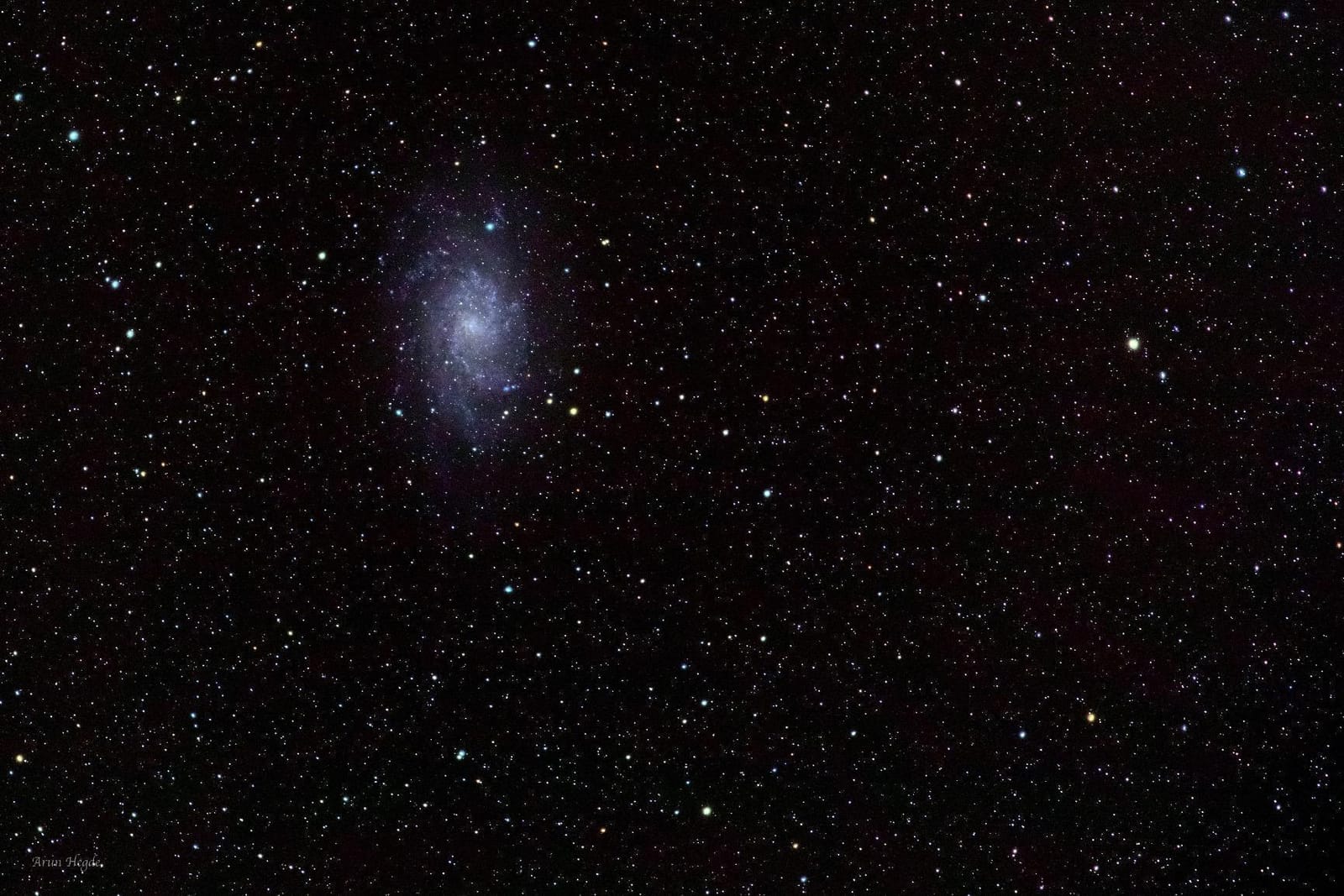
One nice touch reviewers mention: the padded bag and polar scope are included in the package, so unlike several bare trackers there is nothing else to buy before the first session.
Can it beat a plain tracker on long lenses?
It can go further, yes. The fine adjustment knobs and the polar scope LED give you a much cleaner alignment than a plate-only tracker, which is why some owners reach multi-minute frames. Past 200mm you are into the optional counterweight territory, and past 500mm you should be looking at a different class of mount entirely.
Is the internal battery enough for a full night?
For a nightscape session, easily. Owners run long evening sequences on a single charge without a power brick, which is the main reason to choose this over a bare tracker. For a deep-sky run that starts at dusk and finishes at dawn, carry a USB power bank as backup and stop thinking about it.
6. Explore Scientific iEXOS-100-2 – The Entry German Equatorial With Real Drive Gears
iEXOS-100-2 PMC-Eight Equatorial Tracker System Tripod and Mount for Astrophotography with WiFi and Bluetooth Compatible
Clutched dual-axis worm gears
Eight CPU PMC-Eight board
ExploreStars app
Wi-Fi and Bluetooth
Pros
- Quiet during tracking
- Guides well with PHD2 and ASIAIR
- Handles a RedCat 51 plus guide rig at about 1.5 arcsec variation
- Responsive motor control
- Connects easily to a PC or ASIAIR unit
Cons
- ExploreStars app criticised for stability and alignment routines
- No hand controller at this tier
- Azimuth adjuster is a paid accessory
This is an entry-level true German equatorial, and that changes what the mount can do. You get two driven axes with clutches, so you can balance a real imaging train and guide on both, rather than bolting a camera to a one-axis plate.
Reviews split sharply along one line: the hardware or the software. Owners who drive it with PHD2, Ekos or an ASIAIR unit report excellent guiding, 3-5 minute subs with no tracking issues, and a RedCat 51 plus guide scope and guide camera running at about 1.5 arcsec variation. Owners who trust the bundled ExploreStars app report crashes, broken star-alignment routines and a steep learning curve.
Ignore the app. That is the single most useful thing we can tell someone buying this mount.
Alignment is the other friction point. The mount uses a sight hole through the right ascension axis, which is workable but awkward, and the azimuth adjuster is a paid accessory. The polar scope is also optional at this tier, so budget for it if you want fast repeat alignment.
The PMC-Eight microcontroller with eight independently operating CPUs is a genuine advantage. Reviewers credit it with fast timing and responsive motor control, and that shows up in guiding results more than any spec sheet number.
Two things to plan around: the supplied counterweights are described as slightly too light for heavier rigs, and the unit demands eight C batteries with a real appetite for supply voltage. Several reviewers also report unresponsive Explore Scientific customer support, so check what warranty service actually looks like where you live.
Is a 3.9 rating a warning sign?
It is a signal about the bundle, not the mechanics. The lowest rating on this list sits on the mount with the most drive capability per unit of money, and the split between PHD2 users and app users is the whole story. Drive it from a laptop or a smart controller and the complaints disappear; live inside the vendor app and they do not.
Is it heavy enough for a small refractor?
For a short refractor, a DSLR and a guide scope, yes. Clutched axes let you balance the train properly, which is the step most cheap mounts ask you to skip. For an 8-inch class telescope, step up to the EQ6-R – you want that capacity in reserve for wind and cables.
7. Sky-Watcher Star Adventurer GTi Kit – The Complete Portable GoTo Package
Sky Watcher Sky-Watcher Star Adventurer GTI Mount Kit with Counterweight, CW bar, Tripod, and Pier Extension – Full GoTo EQ Tracking Mount for Portable and Lightweight Astrophotography
26lb full kit
44.5 inch max height
Counterweight bar with 5lb weight
Tripod with pier extension
Pros
- GoTo in a genuinely portable form factor
- Built-in illuminated polar scope
- Counterweight bar and 5lb weight allow longer lenses
- Built-in Wi-Fi for app control
- Tripod and pier extension included
Cons
- GoTo adds setup and app learning complexity
- Longer lenses still need careful balancing with the supplied weight
- At 26lb the kit is bulkier than bare trackers
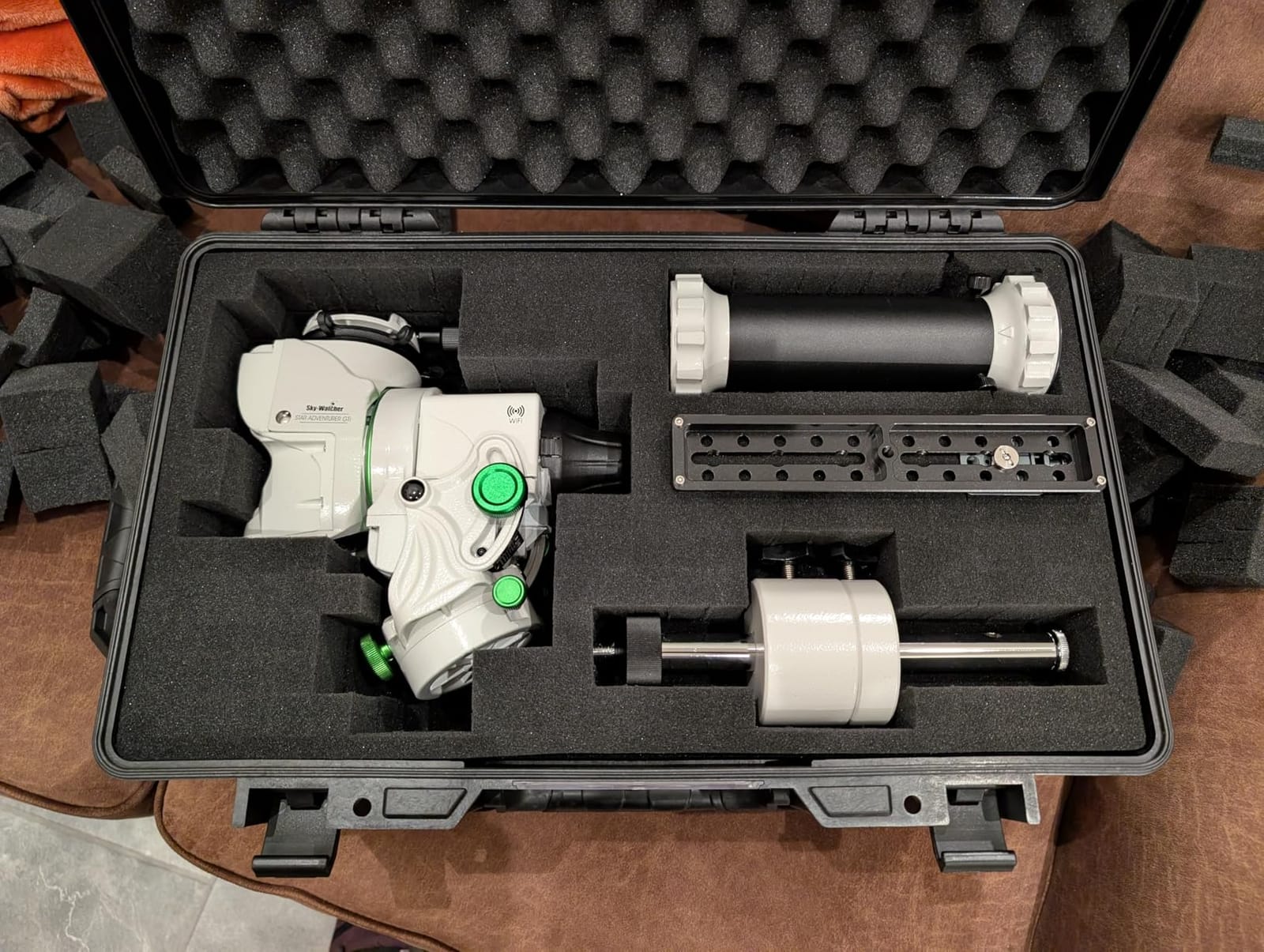
This is the kit that answers the most common forum complaint about portable mounts, which is that the advertised price covers a head you still have to build a support system around. Here the tripod, the pier extension, the counterweight bar and a 5lb counterweight all come in one box.
With 72% five-star ratings, buyers treat it as the modern replacement for the earlier Star Adventurer line. You get GoTo over built-in Wi-Fi, an illuminated polar scope, and enough counterweight mass to carry longer and heavier lenses than the 2i manages.
That balance capability is the real upgrade. The 2i is a plate tracker; the GTi can take an off-axis guider, a heavier camera body or a longer lens without the balance anxiety that comes with a single mounting screw.
The trade-offs are weight and complexity. At 26lb for the full kit it is bulkier than a bare tracker, and the pier extension, while useful, adds another joint that can develop play if you overtighten it.
GoTo also adds an app-based workflow that a plain tracker does not have. If you are comfortable with a phone app you will use the database every session; if you are not, you will ignore it and still get excellent results.
Longer lenses still need careful balancing with the supplied weight – the 5lb counterweight is a starting point, not a solution. The two-year warranty is longer than the one-year cover on most of the smaller trackers here.
Is the included tripod good enough for imaging?
It is a real tripod rather than a folding camera tripod, and the pier extension raises the head to a height that reduces the chance of a tripod leg fouling a long lens during a meridian flip. Many owners use it as-is for nightscapes and upgrade later if they move to long focal lengths.
Star Adventurer 2i or GTi?
The 2i is lighter, simpler and the most-reviewed tracker here. The GTi adds GoTo, a counterweight bar and a proper tripod in one package, and it is the one to pick if you want to grow into longer lenses without replacing the mount. For a fixed camera and a wide lens, the 2i is the better buy.
8. Celestron Advanced VX – The Mount That Works as Well by Day as by Night
Celestron Advanced VX Computerized German Equatorial Mount – 30lb Payload
30lb payload
47lb kit weight
2 inch stainless steel legs
NexStar+ 40000 object database
Pros
- Rigid stainless steel tripod legs cut vibration
- 30lb payload covers mid-size imaging telescopes
- Celestron PWI with pointing models and PPEC
- NexStar+ controller with multiple alignment procedures
- Widely supported by third-party control software
Cons
- Heavy at roughly 47-50lb
- GoTo and hand controller setup is fiddly for visual use
- Serious imaging needs ASCOM drivers and EQMOD
Most deep-sky mounts are unpleasant to use visually because the polar axis locks you into an awkward viewing position. The Advanced VX is the counterexample, and that dual-purpose quality is why it has held onto owners for years.
The mechanical case is strong. Thirty pounds of rated payload, 2-inch stainless steel tripod legs that meaningfully reduce vibration, and a dual saddle plate that accepts CG-5, CGE-style and Vixen format dovetails – so it is not locked into one brand of accessory ecosystem.
On the control side, the NexStar+ hand controller carries more than 40,000 objects and supports several alignment procedures, and Celestron PWI adds pointing models and PPEC periodic error correction. Reviewers also note the sheer volume of third-party tutorials and control software support.
The weight is the honest drawback. Between 47 and 50lb for the kit, this is a two-person carry for anything beyond a backyard setup, and the constraints that follow from being heavy are real: it is awkward in the field, and reviewing the listed figures against the imaging weight, your effective capacity is closer to 20lb in practice.
Serious imaging work also means going beyond the hand controller. You will download ASCOM drivers and work with EQMOD for pointing models, and your guiding results will depend heavily on how carefully you polar align. Reviewers call that dependence honest rather than negative – it is simply a mount that rewards a methodical setup.
Latitude adjustment spans 7 to 77 degrees, and the tracking modes cover sidereal, solar and lunar rates plus EQ North and EQ South. That makes it usable from most latitudes on Earth.
Can I use the same mount for visual observing?
Yes, and that is its standout quality. The NexStar+ database and multiple alignment routines let you slew to planetary and deep-sky targets without hunting manually. Most equatorial mounts make you reposition yourself every twenty minutes; this one does not.
Is it too heavy for a beginner?
It is heavy, but it is not fragile and it is not complicated in the way the price suggests. If your observing site is a driveway or a garden, the weight is a non-issue and you gain a mount that outlasts most upgrades. If you plan to drive to dark sites regularly, look at the GTi kit or the EQ6-R weighing options first.
9. Sky-Watcher EQ6-R – The Heavy Payload Benchmark
Sky-Watcher EQ6-R – Fully Computerized GoTo German Equatorial Telescope Mount – Belt-driven, Motorized, Computerized Hand Controller with 42,900+ Celestial Object Database
44lb payload
44lb head,75lb assembled
Belt-driven steppers with encoders
PPEC and ST-4 autoguide
Pros
- Rock-solid build that stays stable with heavy imaging loads
- Sub-arcsecond guiding once polar aligned
- Whisper-quiet slewing with no backlash reported
- Encoders plus PPEC allow permanent PE correction
- Built-in carry handle
Cons
- Around 75lb assembled
- and counterweights add 22lb more
- Alt-az adjustment screws at the base feel awkward
- Hand controller LCD can fail in very cold conditions
Reddit consensus calls the Sky-Watcher EQ6 the gold standard, and the EQ6-R is the version most of those owners now run. It is the deepest recommendation on this list from people who have used it for years, not weeks.
The drive system is why. Belt-driven stepper motors with encoders give whisper-quiet slewing and reduced periodic error, and the encoders combined with PPEC allow permanent periodic error correction. Owners report sub-arcsecond guiding, and in several cases sub-0.5 arcsecond, with heavy payloads once the mount is polar aligned.
Forty-four pounds of rated capacity is the other half of the story. Set against the practical two-thirds rule, that leaves comfortable room for an 8-inch-class telescope, a cooled camera, filters, a guide scope and a guide camera – a rig that no smaller mount on this list handles properly.
Now the honest part. This is a 44lb head, over 75lb assembled, and the two 11lb counterweights add another 22lb to that. It arrives in two boxes, and some buyers report receiving only one. The built-in handle helps with the head, not the assembled kit.
Reviews also flag the shallow 2-inch tripod spreader as a legacy weakness, the alt-az adjustment screws at the base as feeling awkward rather than smooth, and the hand controller LCD failing in very cold conditions – a real concern for winter imagers. The most common and most fixable complaint is factory grease: expect noticeable stiction until you work the axes and tune the mount.
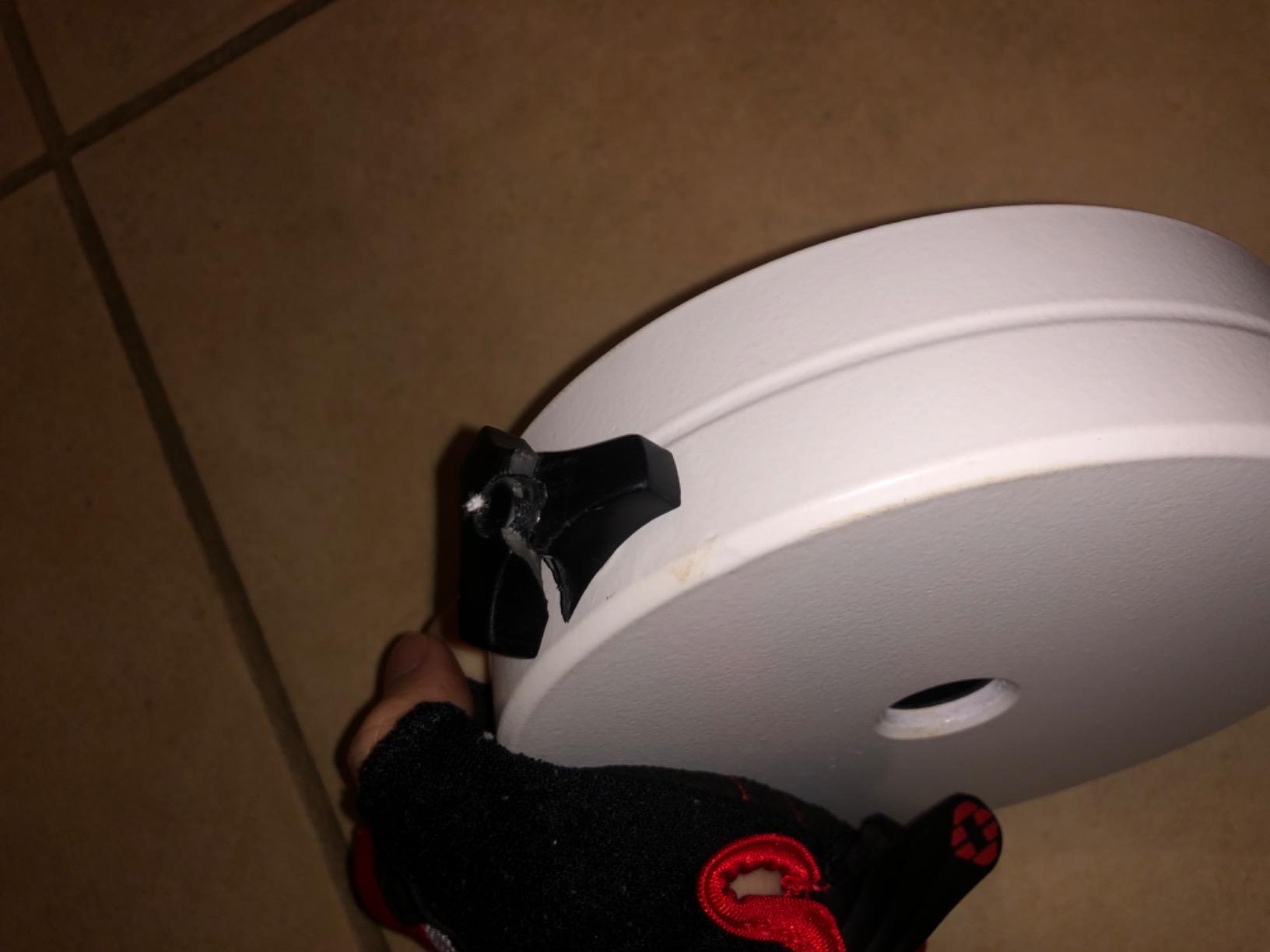
Setup friction worth knowing before you buy: the altitude adjustment is fiddly enough that owners warn against rushing it, and the SynScan GPS module is a separate purchase if you want automatic time and location.
Is the EQ6-R overkill for a small refractor?
Functionally, yes – a small refractor and a DSLR will guide beautifully on something a third of the weight. The case for it is headroom and longevity: you can grow into longer focal lengths, a bigger camera and a heavier guider without replacing the mount, and the drive system rewards careful setup with the tightest guiding numbers in this group.
What breaks first?
Nothing dramatic, in most reports. The realistic list is factory stiction that needs tuning, cold-weather hand controller behaviour, and the tripod spreader. The genuine long-term risks are mechanical and self-inflicted – over-tightening clutches and unbalanced loads are the two errors that most often damage mounts in this class.
10. Celestron CGX – For the Big Scope and the Permanent Pier
Celestron CGX Computerized German Equatorial Mount & Tripod, 55lb Payload
55lb payload
108lb total weight
Belt-drive high-torque servos
Internal cable routing
Pros
- Solid construction for heavy rigs such as a 10-inch Newtonian
- Smooth alt-az controls even when fully loaded
- Quiet slewing and an easy hand controller
- Owners report 30-minute subframes with flat guiding graphs
- Internal wiring keeps the cable bundle manageable
Cons
- Extremely heavy at 108lb
- Optional polar scope can limit declination range and cause collisions
- Hand controller has hung on initialising for some units
The CGX exists for people who have outgrown everything else. Fifty-five pounds of rated capacity covers a large imaging Newtonian with multiple accessories, and long-term owners describe exactly the result that justifies the weight: 30-minute subframes with flat graphs in PHD2 and Prism, as long as the rig stays under roughly 42lb in practice.
The build is substantial. High-torque servo motors drive through belts, the alt-az controls stay smooth even fully loaded, and slewing is quiet. The internal cable management is a real feature for anyone running long imaging sessions – the cable bundle stays manageable instead of drooping across the mount.
It also supports pointing models and All Star Polar Align, and the NexStar+ controller carries a 40,000-object database with guided tours and custom object filters for the visual side.
What you accept for that capability is 108lb. This is a permanent installation, not a field mount – a two-person move at minimum, realistically a pier.
Several mechanical issues are worth weighing. The optional CGX polar scope can physically interfere with the declination range and cause collisions, which is a design complaint rather than a defect. The bundled tripod is less rigid than the L-series version, and for a 108lb mount that is the wrong place to economise.
Long-term durability has mixed reports. Belts and gears wear over several years and eventually affect tracking and guiding, hand controllers have hung on an initialising screen for some owners, and a small number of units have needed factory repair for right ascension drive faults. At a 20-review count, the sample is thinner than the rest of this list, so treat these as reported patterns rather than a defect rate.
Do I need this much capacity?
Only if you are running a large Newtonian or Schmidt-Cassegrain with a cooled camera, a filter wheel and a guide train. For most people the EQ6-R leaves more usable capacity than they will ever fill. Choose the CGX when you are past that point, not when you are close to it.
Is a pier worth it here?
Yes. Forum users running observatory-grade setups pair a permanent pier with a mount this size, and the reason is vibration, not weight. A fixed pier stops tripod flex from showing up in your guiding data, which is exactly the error that autoguiding cannot correct away.
How to Choose a Telescope Mount That Lasts?
There are two types of telescope mount, and the distinction decides almost everything else. An alt-azimuth mount moves in altitude and azimuth only, which makes it intuitive and stable but useless for long exposures. An equatorial mount is tilted so one axis points at the celestial pole, and the motors turn that single axis at exactly the rate the Earth spins.
That single-axis tracking is the whole game for deep-sky imaging. Stars stay on the same pixel, so you can expose for minutes. On an alt-az mount, the field rotates as the mount steps on two axes to follow a star, which limits you to a few seconds per frame – fine for planetary and lunar video, wrong for nebulae.
Within the equatorial family there are three practical designs. A German equatorial mount (GEM) uses a counterweight shaft to balance the load off-axis, and it is the traditional choice. A centre-balanced equatorial mount (CEM) sits the payload over the polar axis and needs no counterweight, which is lighter and faster to set up but has less payload headroom. A harmonic or strain wave drive mount has no gears to mesh and no backlash, but typically carries a higher inherent periodic error that autoguiding fixes.
A star tracker is the fourth category and sits below the others: a single-axis device for a camera and lens, no second driven axis, no guiding on declination. Our first four picks on this list are all star trackers, and that is a deliberate choice, not a ranking by quality.
The rule that prevents most disappointment is short enough to quote: load a mount to no more than two-thirds of its rated capacity for imaging. Payload ratings exclude counterweights, and the remaining margin absorbs wind, cables and the balance error you will not notice until the data says so.
Work backwards from your imaging train. Add the telescope, camera, guide scope, guide camera, filter wheel and cables, then find a mount rated at roughly 1.5 times that combined weight. A small refractor with a DSLR and a guide rig is a few kilograms; an 8-inch telescope with a cooled camera is a completely different category.
Focal length matters as much as weight. Longer focal lengths magnify every mount error, so a 400mm refractor and a 1000mm imaging Newtonian on the same head will not produce the same results. Working out your image scale is the quickest way to know how accurate your mount has to be: divide pixel size in microns by focal length in millimeters, multiply by 206.265, and you have arcseconds per pixel. Your tracking accuracy needs to be better than that number or stars will visibly trail between exposures.
For most rigs, an RMS guiding error under 1.0 arcsecond is good, and anything under 0.7 arcsec is comfortable. A tracker with a rough alignment can fail those numbers at long focal length even when the hardware is fine, which is why autoguiding exists. Owner reports on the SkyGuider Pro cite clean 2-3 minute subs at up to 500mm, and the iEXOS-100-2 is reported at about 1.5 arcsec variation with a small refractor and guide train – both comfortably inside the useful range.
Polar alignment is the other half of the equation, and the methods differ more in convenience than in accuracy. An illuminated polar scope like the one on the Star Adventurer 2i, the GTi and the SkyGuider Pro is fast and needs no power. An electronic scope such as the iOptron iPolar does the same job through a camera. Plate-solved alignment needs no extra hardware at all – you shoot a wide field, the software solves it, and the mount computes the correction from there.
Wedge quality matters less than buyers expect, but only to a point. A cheap wedge on a light tripod limits how finely you can adjust altitude, so you spend ten minutes chasing a quarter-degree error. Owner communities consistently report that swapping an imprecise stock wedge for a proper one is the single highest-value upgrade for a portable tracker setup.
Then there is the cost nobody puts in the headline. A head-only mount still needs a tripod or wedge, a counterweight bar and weights, a reliable 12V supply and probably a hard case. This is the most common real-world complaint in owner threads, and it is why the GTi kit and the Advanced VX, which ship with their support systems, are easier totals to plan for than a bare head.
Long-term reliability varies more by care than by brand. The two most common self-inflicted faults are an over-tightened right ascension clutch and an unbalanced load. Using fastest slew settings accelerates worm gear wear on older designs. And any mount left outdoors under a cover still benefits from an annual check of belts, gear mesh and backlash.
If you are buying used, inspect the same things: motor noise on both axes, backlash felt in declination, belt slack, whether the counterweight kit is complete, and which firmware version the controller is running. A mount with a missing counterweight or a stripped altitude bolt is a worse deal than a slightly higher-priced complete one.
One last note for anyone splitting their ambitions. A deep-sky imaging mount is usually unpleasant for visual observing because the polar axis dictates where you stand. If you want both, the Celestron Advanced VX is the clearest answer in this list, or keep a small alt-az or tabletop Dobsonian for the eyepiece and let the tracker do the imaging – the reasoning is the same one behind the difference between the types of telescope mounts, applied to how you actually use your evenings.
It is the same problem you meet when a cheap mount under-rates the load and a good one does not, which is why we spend so much time on rated capacity rather than headline features. The comparison is familiar from our UTV plow mount guide: the specification that matters is the one you can rely on when the working conditions get worse, not the one on the box.
Frequently Asked Questions
What mount do I need for astrophotography?
You need a computerized equatorial mount rated at roughly 1.5 times the combined weight of your telescope, camera, guide scope and accessories. Load it to no more than two-thirds of rated capacity. A small refractor with a DSLR and guide rig suits the ZWO and Sky-Watcher portable trackers, while an 8-inch telescope with a cooled camera needs a German equatorial head in the 44lb payload class.
Do you need an equatorial mount for astrophotography?
For long-exposure deep-sky imaging, yes. An equatorial mount tracks on one polar-aligned axis, so stars stay on the same pixel for minutes at a time. An alt-azimuth mount steps on two axes and rotates the field, which limits you to a few seconds per frame. Planetary and lunar imaging uses short video frames and works on either type.
What are the two types of telescope mounts?
1. Equatorial mounts (EQ), which include German equatorial (GEM) and centre-balanced (CEM) designs. These rotate around a polar-aligned axis and are the standard for deep-sky imaging. 2. Alt-azimuth mounts (alt-az), which move only in altitude and azimuth. These are more intuitive for visual observing but rotate the field during long exposures.
How much payload capacity do I need?
Add up the weight of your telescope, camera, guide scope, guide camera and cables, then find a mount rated at about 1.5 times that total. Payload ratings exclude counterweights. Staying at or below two-thirds of rated capacity leaves the margin that wind, cabling and minor balance error demand.
Is a harmonic drive mount better than a German equatorial mount?
A harmonic or strain wave drive mount has no meshing gears, so backlash is effectively eliminated and the mount is lighter and faster to set up with no counterweight shaft. Its inherent periodic error is usually higher than a belt-driven worm mount, which autoguiding corrects. A German equatorial mount costs more to carry but gives more payload capacity and a steadier platform for long focal lengths.
Can I do astrophotography with a camera lens?
Yes, and it is the easiest way in. A star tracker such as the Omegon MiniTrack LX3, the Vixen POLARIE U or the iOptron SkyTracker Pro will track a DSLR with a 24-135mm lens for two-minute exposures, which is enough for Milky Way panoramas and large nebulae. Keep total focal length near or under 200mm for the smallest trackers.
Verdict: The Best Telescope Mounts for Astrophotography in 2026
The best telescope mounts for astrophotography in 2026 come down to what you are photographing. For a camera and lens at wide field, the Sky-Watcher Star Adventurer 2i Pro Pack is the pick – it has the largest owner base on this list and the alignment tools to match. For real payload headroom in a small package, the iOptron SkyGuider Pro is hard to argue with.
For a true two-axis mount on a budget, drive the Explore Scientific iEXOS-100-2 from PHD2 or an ASIAIR unit rather than its bundled app. For a rig that will grow for years, the Sky-Watcher EQ6-R remains the benchmark, and the Celestron Advanced VX is the pick if you also want to observe visually.
Whichever you choose, budget for the tripod, the counterweights and the power supply. The mount in the box is never the whole system.