
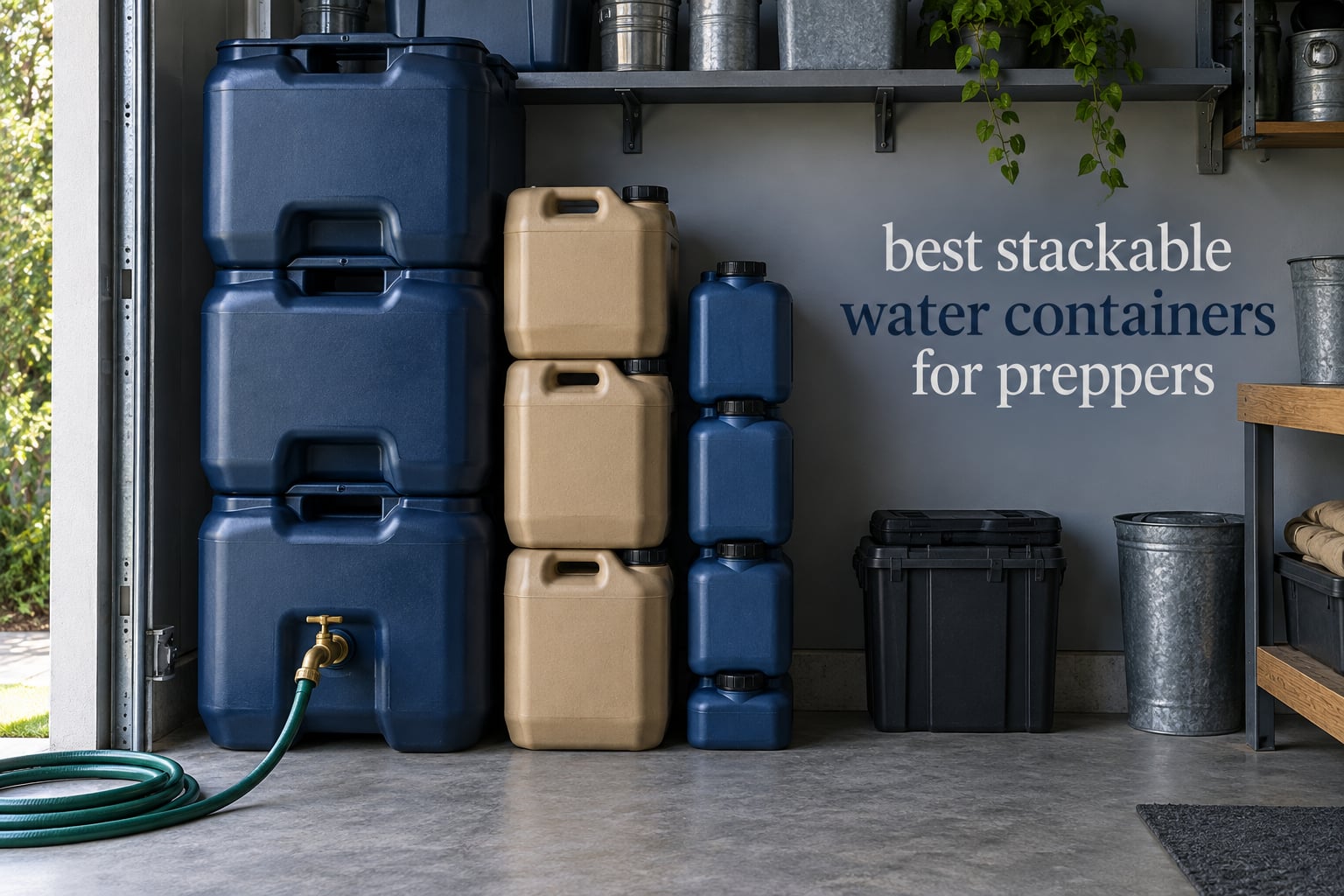
Storage capacity is the easy part of prepping. The hard part is getting 100 gallons of water to live in a closet, a garage bay, or the back of a truck without the weight, cost, or handling ruining the whole plan. That is where stackable containers earn their place. A stackable water container is a rigid, food-grade polyethylene vessel shaped so identical units interlock, letting you build a vertical column of storage in the footprint of one. This guide covers the best stackable water containers for preppers we could find, from 2.5 gallon carboys to 55 gallon rotomolded tanks.
Our whole team has been comparing these for weeks, and the pattern was consistent: geometry decides everything. Purpose-built stackable units transfer load down through the stack rather than resting it on a lid rim, which is why they can be stacked filled. Ordinary jugs from the grocery aisle can only be stacked empty. We also found a second pattern worth stating up front. Nearly every complaint in owner reviews came down to one of two things: a missing spigot, or a weight that made the container a permanent fixture rather than a portable one.
For sizing, start with the FEMA baseline of one gallon per person per day, then raise it. Real households consume between 1.5 and 2 gallons per person daily once cooking, hygiene, pets, laundry, and medical needs are counted. If you are also storing bulk reserve alongside your grab-and-go supply, our picks on water storage barrels for preppers cover the drum end of the range, and the containers below cover the modular end. Either way, plastic has to be the right kind of plastic, and we explain that in the buying guide.
We rated all twelve on the same five things: filled weight, stack geometry, dispensing hardware, material documentation, and how much usable space each unit wastes. No product number in this guide is estimated. If a tank weighs 125 pounds full, that is the number its manufacturer publishes, and we tell you what that means for your floor and your back.
Table of Contents
Top 3 Stackable Water Container Picks (September 2026)
The three below cover the widest range of needs. The Legacy kit is the all-rounder, Saratoga is the value pick for anyone starting out, and the WaterPrepared tank is the bulk option for a garage or basement.

Legacy 30-Gallon Stackable Tank Kit
- Six 5-gallon tanks
- Stackable rib locks
- Water treatment drops included
Saratoga Farms 4-Pack 5-Gallon
- Flat nesting tops and bottoms
- Twist breathing ports
- BPA-free HDPE
WaterPrepared 55-Gallon Stackable Tank
- 55 gallon capacity
- Integrated hose spigot
- UV-resistant polyethylene
How the Best Stackable Water Containers Compare in 2026?
All twelve containers appear below with the specs that actually change the buying decision. Capacity and footprint come first because they set the space budget, and the dispensing column matters more than most shoppers expect. Check the current listing for each before you commit.
| Product | Specifications | Action |
|---|---|---|
| Legacy 30-Gallon Stackable Tank Kit |
|
Check Latest Price |
| Saratoga Farms 4-Pack 5-Gallon |
|
Check Latest Price |
| WaterPrepared 55-Gallon Stackable Tank |
|
Check Latest Price |
 Saratoga Farms 20-Gallon Kit with Spigots Saratoga Farms 20-Gallon Kit with Spigots |
|
Check Latest Price |
 WaterBrick 3.5-Gallon 4-Pack WaterBrick 3.5-Gallon 4-Pack |
|
Check Latest Price |
 Legacy 15-Gallon Stackable Tank Legacy 15-Gallon Stackable Tank |
|
Check Latest Price |
 Aguaprep 4-Pack 5-Gallon with Spigot Aguaprep 4-Pack 5-Gallon with Spigot |
|
Check Latest Price |
 Wurx Space-Saving 20-Gallon Wurx Space-Saving 20-Gallon |
|
Check Latest Price |
 Consolidated Plastics 2.5-Gallon Carboy Consolidated Plastics 2.5-Gallon Carboy |
|
Check Latest Price |
 Emergency Water Tanks 55-Gallon Rotomolded Emergency Water Tanks 55-Gallon Rotomolded |
|
Check Latest Price |
 Rockwell Exodus 35-Gallon Rockwell Exodus 35-Gallon |
|
Check Latest Price |
 Emergency Water Tanks 30-Gallon Cube Emergency Water Tanks 30-Gallon Cube |
|
Check Latest Price |
1. Legacy 30-Gallon Stackable Tank Kit – Best Overall
5-Gallon Stackable Water Storage Containers, 6-Pack
30 gal across six 5-gal tanks
12 x 10 x 15 inch each
40 lb filled
Stackable ribs
Pros
- Ribbed tops lock units together vertically
- Dark blue shell blocks light
- Water treatment drops included
- Spigots and threaded cap sets included
- Built-in handle plus strap wrench
Cons
- About 40 lb per filled tank
- Moving filled units once stacked takes planning
This is the container we kept coming back to. It carries a 4.7 rating across 1390 reviews, and the reason is not a single clever feature. It is that the kit already contains everything a household needs: six 5-gallon tanks, threaded sealed cap sets, spigots, a strap wrench, and water treatment drops. Nothing has to be bought separately before the first fill.
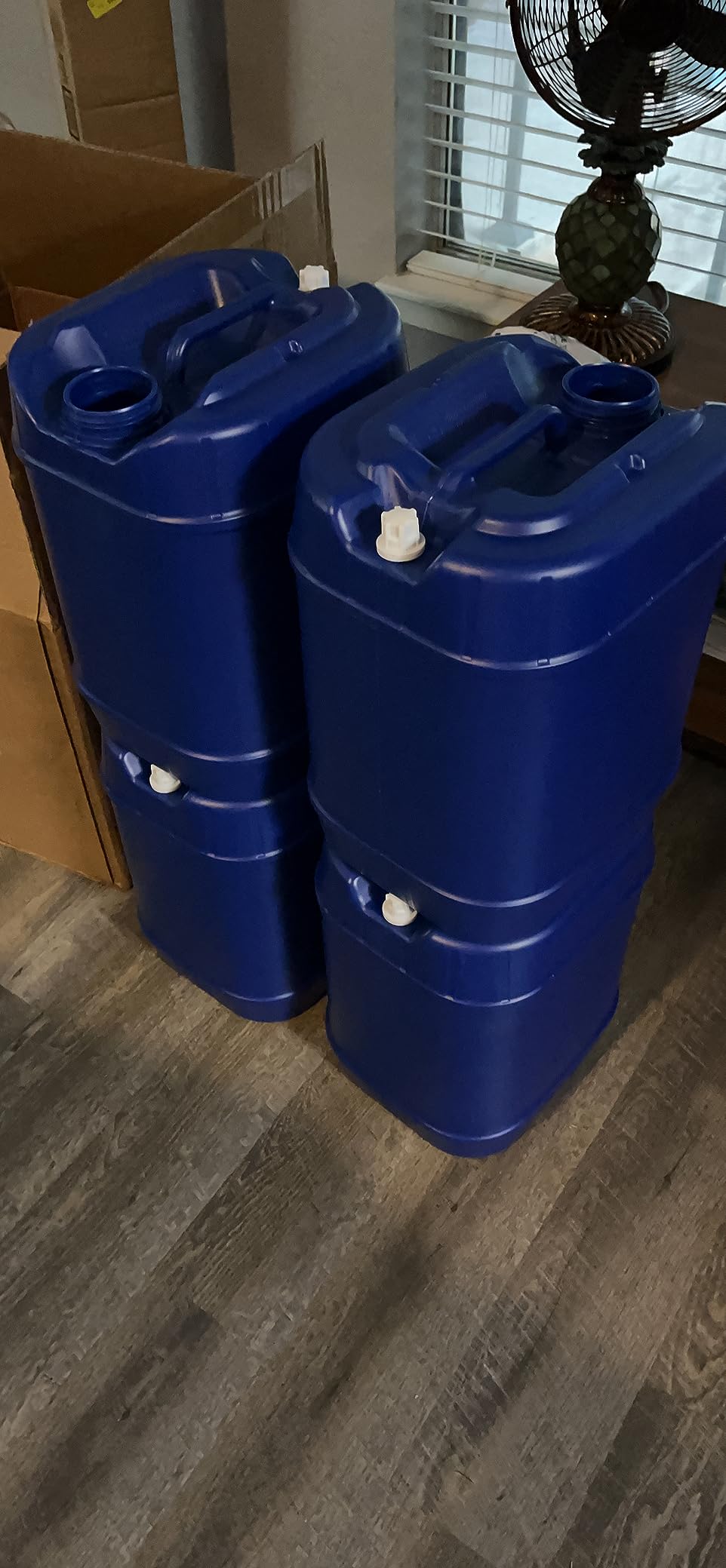
The ribbed top is the part that matters. Those ribs are what let a filled tank sit on the one below it and transfer weight down the column instead of resting on a lid rim. Each tank measures about 12 inches long, 10 inches wide, and 15 inches tall, so a two-high stack of six units gives you 30 gallons in roughly the footprint of a single tote and two feet of vertical space.

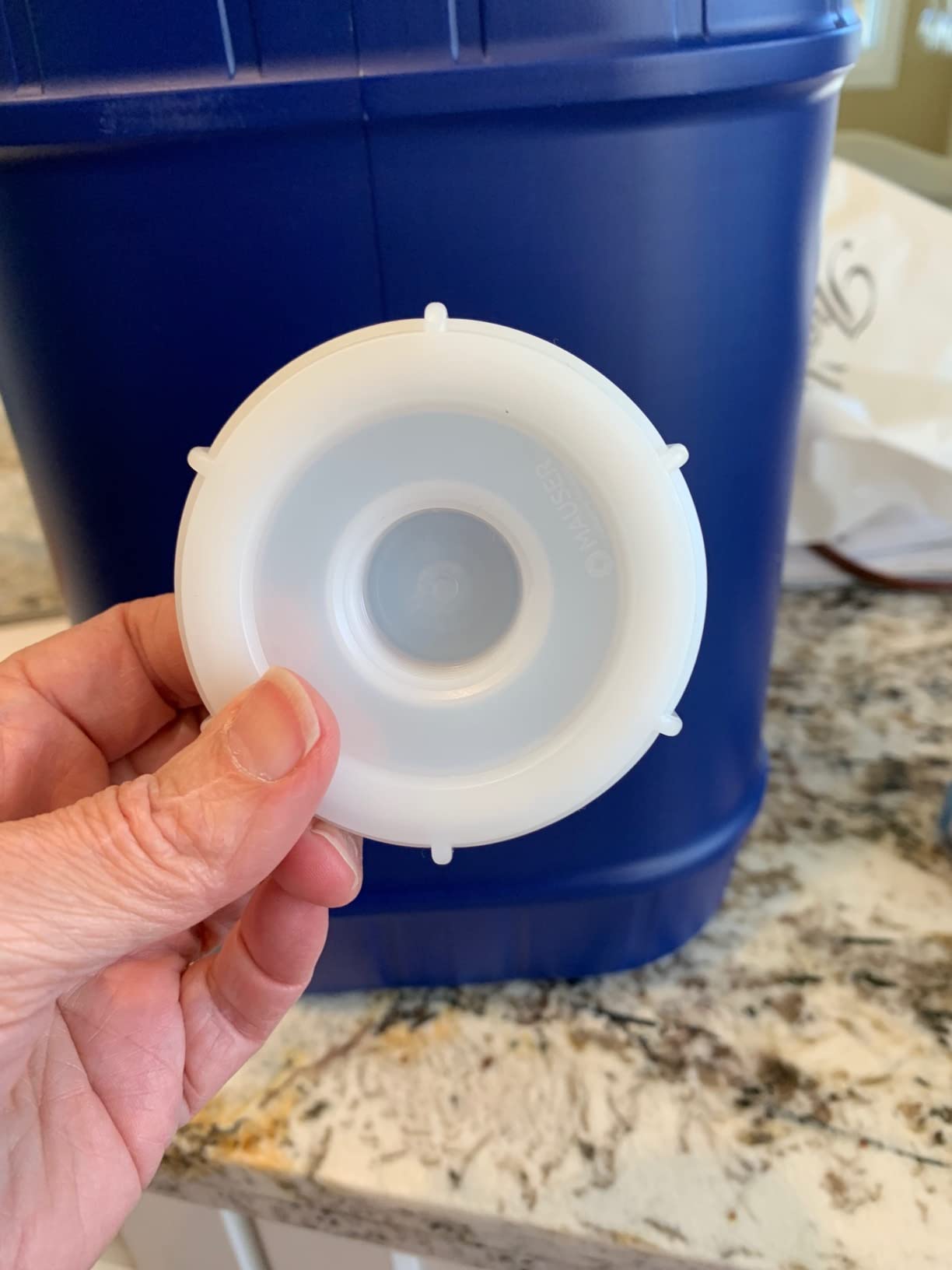
The 2.25 inch opening is wider than most competitors in this class, which means an actual sponge or bottle brush reaches the bottom. That detail saves you on every rotation you do for the next decade, because the only way to refresh water in a container is to get a cleaning tool through the mouth and dry the interior properly.
Dark blue plastic is not a marketing flourish. Light drives algae and biofilm, and a dark shell slows that growth noticeably compared with a clear or translucent jug. The treatment drops included with the kit are sized to protect stored water for up to five years, which matches the long-horizon use most people buy this kit for.
The honest drawback is weight. Filled, each tank is about 40 pounds, and once you have a column assembled the realistic way to move it is empty it first. Plan your fill location as close as possible to the final position, and you will never have to lift a full one.
Does it earn a spot in a small home?
It can, but not where you might expect. Two columns of three occupy a closet corner roughly 20 inches square, and the low slats under a bed frame clear the 15 inch height of a single unit. Just verify your floor joists can carry the concentrated load before you build a tall column upstairs, which we cover further down.
What this kit is less suited for is a go bag or vehicle kit. At 40 pounds filled, a full tank is not something you carry down stairs quickly. Pair it with something lighter for mobility, and use the Legacy column as your fixed household reserve.
What you should know before buying four of them?
Order the six-tank configuration rather than singles if you are building a reserve, because the whole value of the ribbed stacking disappears with one lonely tank in a closet. The included strap wrench is not optional either. Those threaded caps tighten properly with it and are frustrating by hand.
Give the tanks a rinse and a bleach soak before the first fill if any manufacturing smell shows up, and date every tank you fill with a permanent marker. Rotating six tanks on a schedule is far easier when the fill date is written on the side rather than remembered.
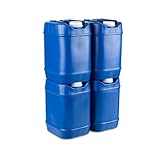
2. Saratoga Farms 4-Pack 5-Gallon Containers – Best Value
Saratoga Farms 5-Gallon Stackable Water Storage Containers, Emergency Water Storage for Camping and Disaster Preparedness, 20 Gallons
Four 5-gallon containers
20 gallon total
11 x 10 x 14 inch each
40 lb filled
Pros
- Genuinely flat nesting tops and bottoms
- Twist breathing ports stop air lock
- Food-grade BPA-free HDPE
- Integrated handles
- Easy to move in multiples
Cons
- About 40 lb per filled container
- Pouring needs attention to the breathing port
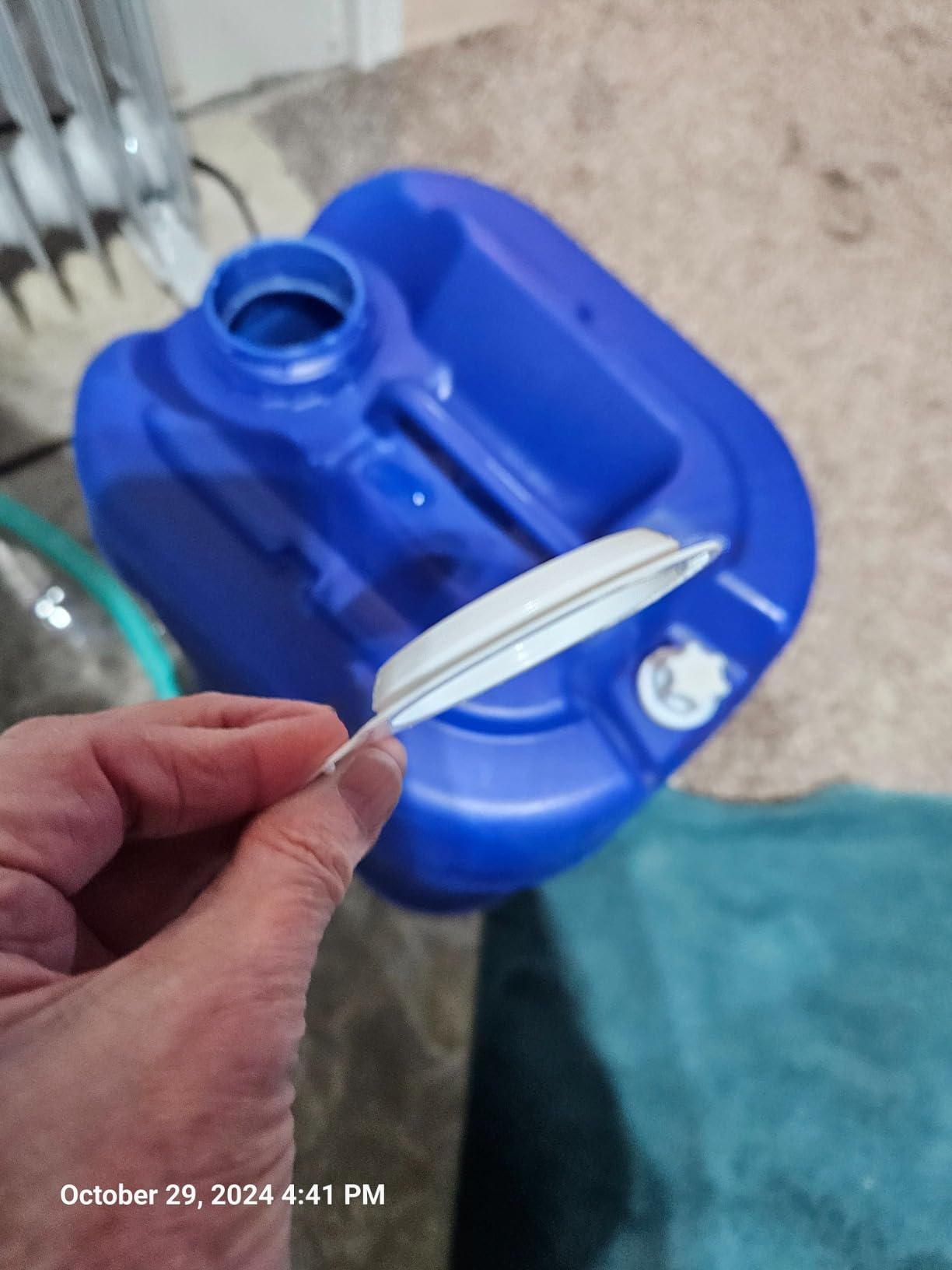
This is the set we recommend to people building a first water cache. It carries 4.5 stars from 987 reviews, and the design detail that separates it from generic blue jugs is the flat nesting geometry. Most stackable claims really mean the lid nests into a rim. These have genuinely flat tops and bottoms, so a stack does not wobble.
The second thing worth knowing is the breathing port. Every container traps air as you pour, and that trapped air is what causes the glugging, the sudden surge, and the spill down your leg. These have a twist vent you open before pouring and close afterward, which converts a messy pour into a controlled one. For a family of four drawing water several times a day, that difference compounds fast.
Each container holds 5 gallons and measures about 11 inches long, 10 inches wide, and 14 inches tall. Four of them give you 20 gallons, which the manufacturer frames as roughly 40 days of household drinking, cooking, and washing water for a couple of people. That framing assumes only drinking and cooking, so treat it as a floor rather than a plan.
Integrated handles are molded into the shell rather than bolted on, and that distinction shows up over years. Bolted handles are the first thing to loosen on a heavy jug. These have no mount to fail, which is exactly the failure mode owners of brick-style containers complain about most often.
Weight is the trade-off you accept for the value. A filled unit runs about 40 pounds, so these work best as a stationary cache near where you will use them rather than as grab-and-go stock. Moving a full one takes two hands and a clear path.
Is a four-pack enough to start with?
For a two-person household covering a 72-hour emergency, yes. Twenty gallons covers two people for five days at 2 gallons per person per day, and it stacks into a single tight column that fits beside a washer or in a utility closet. If your household is larger, this is a format to repeat in multiples rather than a one-time purchase.
One thing to plan for: the breathing ports seal the containers for storage, so check them during your annual rotation. A port left in the open invites insects and dust, and a port left closed makes the next pour messy. Mark it on your rotation checklist.
How this compares to a brick-style container?
Bricks win on space efficiency because a flat rectangular shape wastes almost no space when cross-stacked two per row. Round 5-gallon jugs like these leave air pockets. If your constraint is a shallow under-bed space where vertical room is scarce, a brick format will hold more. If your constraint is weight and portability, a jug is easier to carry one at a time.
Spigots are not included with this particular set, so budget for them separately or plan on pouring through the top. For daily household use during an outage, a spigot is the difference between a workable system and a frustrating one.
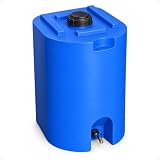
3. WaterPrepared 55-Gallon Stackable Tank – Best for Bulk Storage
WaterPrepared 55 Gallon Unique Stackable Utility Water Tank, Blue
55 gallon capacity
28 x 22 x 29.5 inch
Integrated spigot
UV-resistant polyethylene
Pros
- Stackable oval shape uses far less floor area
- Integrated spigot accepts a garden hose
- Large cap and narrow profile pass a doorway
- Pre-tested for leaks
- UV-resistant blend
Cons
- Small plastic shavings can need cleaning before filling
- Two-person job to fill or move
- Low spigot usually needs a stand
When people picture a 55 gallon water store, they picture a horizontal drum that eats a quarter of a garage. This tank exists to break that expectation. Its oval shape stacks vertically and measures about 28 inches long, 22 inches wide, and 29.5 inches tall, so it holds 55 gallons in a footprint comparable to a large upright trash bin.
That vertical geometry is the whole argument. A horizontal drum holds 55 gallons across a wide footprint. This holds 55 gallons upward, and the design is engineered so a second unit can sit on top of the first. If your ceiling height allows three units, you are looking at 165 gallons in roughly 30 inches of floor depth.
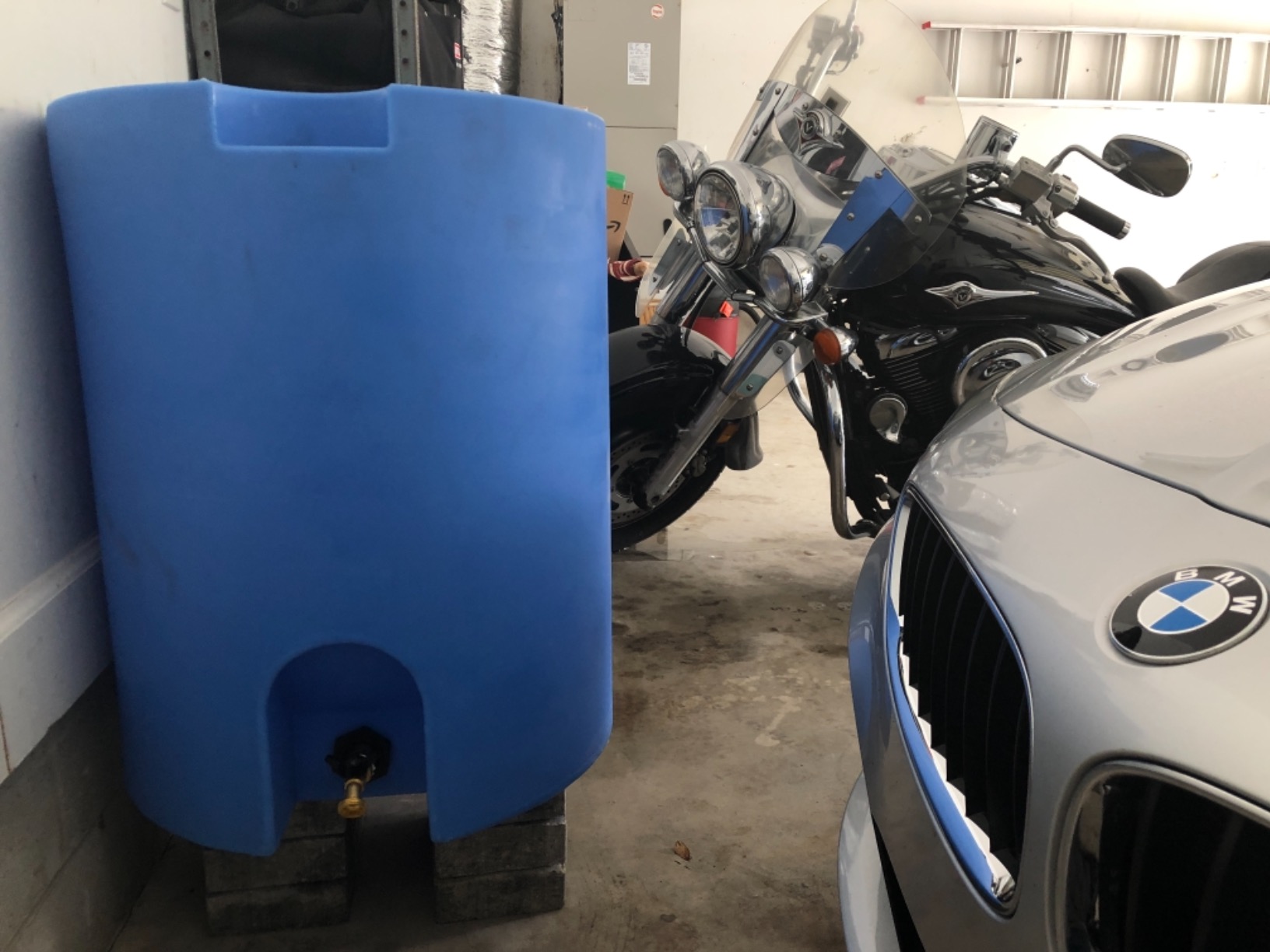
The integrated spigot is another real advantage over the 5-gallon class. It sits low on the tank, and because the manufacturer builds it to accept a standard garden hose, you can fill from a spigot, a hose bib, or a rain barrel without carrying jugs around. That single feature removes most of the labor from a 55 gallon fill.
The material is a UV-resistant high-density polyethylene blend, chosen specifically to slow the biological growth that degrades stored water. Owners report arriving with the tank pre-tested for leaks, and several mention that it replaced a roomier horizontal drum in the same garage with space to spare.
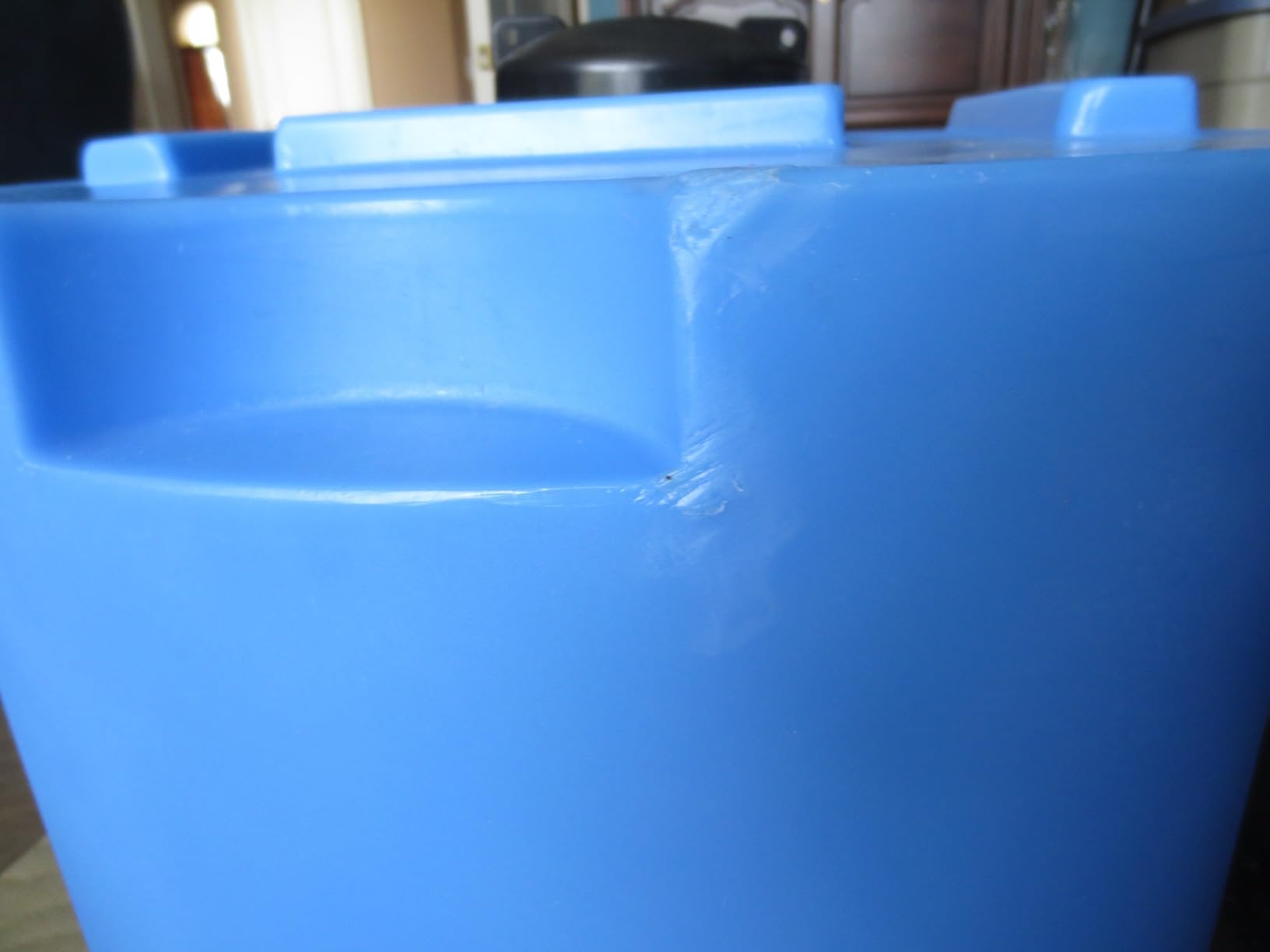
Two honest notes. Some owners find small plastic shavings or chips inside a new tank, so flush and wipe it before the first fill. And because the spigot sits low, most people end up building a simple stand, which also solves the problem of a slight floor slope sending the tank toward one corner.
Will it fit through your door and down your stairs?
The narrow profile is the reason this tank works for people who have never considered a 55 gallon drum at all. The manufacturer lists it as fitting through a standard doorway, and at 22 inches wide it clears most interior doors. Getting it to the storage location is the harder test, so measure your narrowest stairwell and turn before you commit.
Fill it where it will live. A full 55 gallon tank is over 460 pounds of water, and the practical advice from owners is consistent: place it empty, fill it in place, and never plan to reposition it full.
Should you pair it with smaller containers?
Yes. A large tank answers the long-horizon question, and it answers it badly for evacuation. If your household needs water on the move, pair this with something in the 2.5 to 3.5 gallon range so you have a portable tier. Our gravity-fed water distillers for preppers guide covers the other half of treating stored water once you run reserves down.
One caution on stacking: two full 55 gallon tanks is over 900 pounds in one column. Put them on a concrete pad rather than a raised wooden platform, and confirm the load if they sit above a basement or on an upper floor.
4. Saratoga Farms 20-Gallon Kit with Spigots – Best Kit for First-Time Preppers
Saratoga Farms 5-Gallon Stackable Water Storage Containers with Lids, Emergency Water Storage Kit Including Spigots, Wrench, and Water Preserver, 20 Gallons
20 gallon total capacity
4 containers, 4 lids
Two no-drip spigots
Cap wrench included
Pros
- Stable stacking with no teetering
- Full accessory bundle in the box
- Water preserver treats up to 110 gallons
- Breathing ports for clean pouring
- Food-grade BPA-free HDPE
Cons
- Tamper rings make lids hard to open
- Cap wrench is effectively required
- Occasional missing caps or spigots
If a friend asked us to build their first water cache, this is the box we would hand them. The 20 gallon kit includes four containers, four lids, two no-drip spigot spouts, a 70mm cap wrench, and a water preserver concentrate rated to treat up to 110 gallons. That is a working system out of the box rather than a container and a shopping list.
The spigots are the reason this kit sits above the plainer four-pack. Gravity-fed dispensing turns 20 gallons from a lifting problem into a faucet. During an outage, when you are drawing water multiple times a day with wet hands, that is not a minor convenience.
Stacking is stable here. Flat bottoms and flat tops mean the four containers form a clean column without the teetering you get from containers with raised rims. The breathing ports keep pouring clean, and the built-in handles make each container easy to move between rooms, cars, and boats individually.
The water preserver is sized well beyond the kit’s own capacity, which tells you the manufacturer expects you to scale up. That is a reasonable assumption, and it means one purchase covers treatment for the next set of containers too.
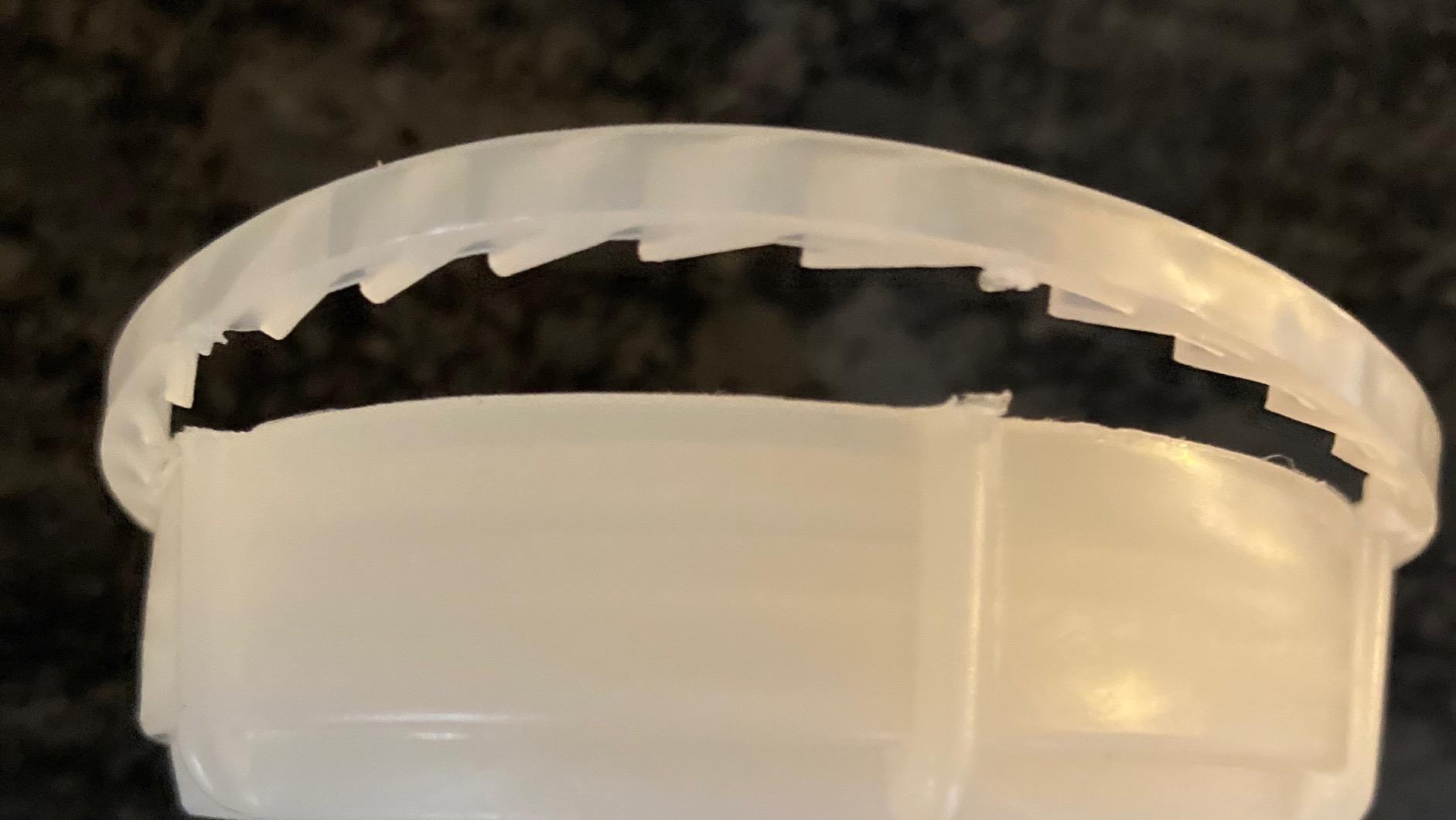
The most repeated complaint across reviews is the tamper-proof ring on the caps. Several owners describe it as needlessly difficult to operate. The cap wrench solves the tightening side, but plan on a little friction when opening lids for the first year or so.
Is the water preserver concentrate actually necessary?
For water going into long-term storage, yes. Tap water is usually fine untreated for a year or two, but once you are targeting a five-year shelf life in a closed container, a preservative stabilizes the chlorine residual that keeps bacteria and biofilm in check. The concentrate included here treats more than this kit holds, so it carries you to the next purchase.
Do not rely on the drops alone if your source water is chlorinated municipal supply and you plan to drink the water without further treatment after years. For drinking, pair your storage with a filter or a distiller you can actually run.
What about the missing hardware reports?
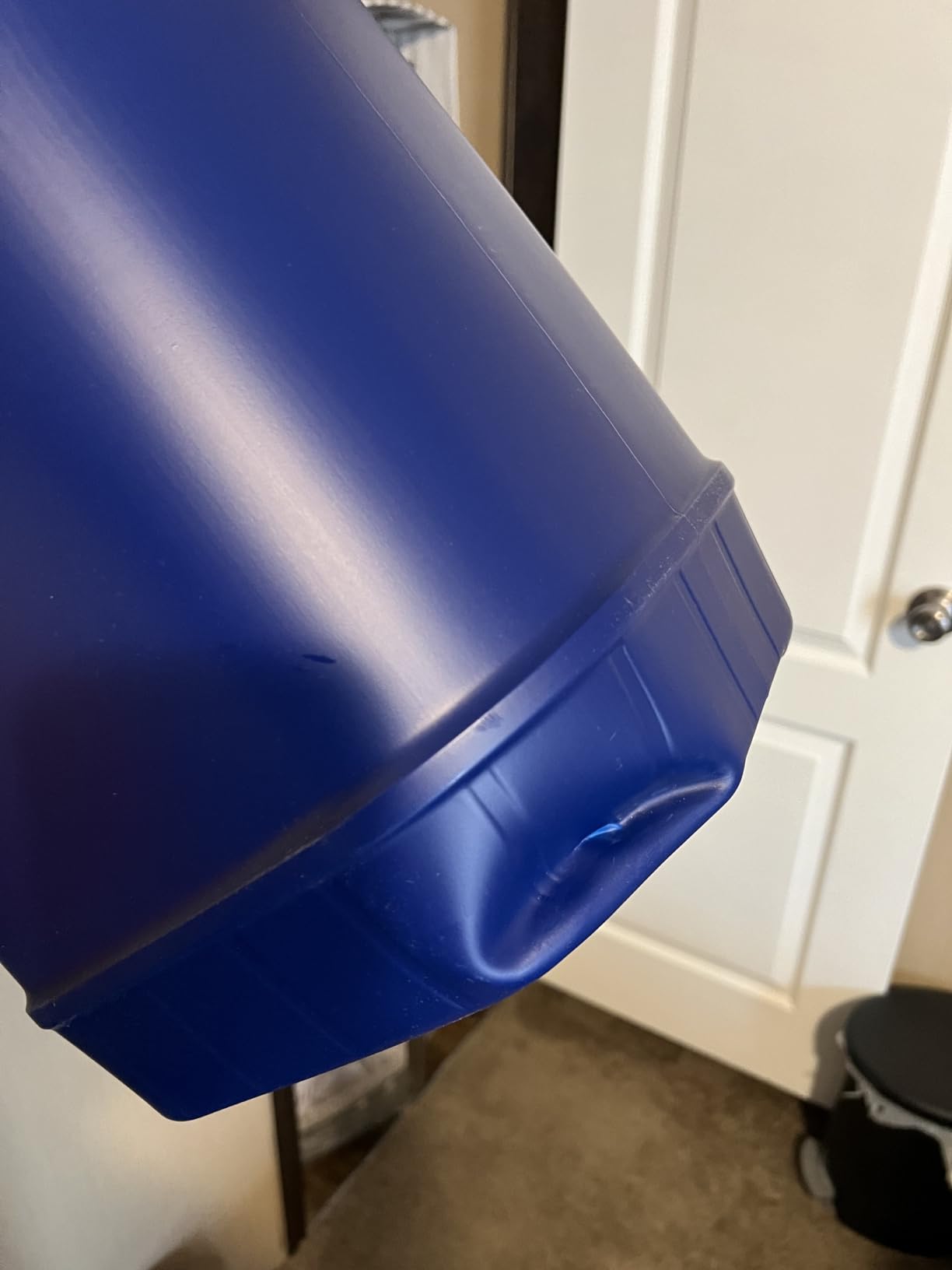
A small number of owners received units with defects or absent caps and spigots. Customer service replaced them quickly, so this is a packing issue rather than a design flaw. Inspect the box the day it arrives, before you start filling, so a replacement takes minutes instead of weeks.
Check the spigot threading against your caps before filling anything. Owners of this kit and several competing kits mention confusion over exactly how the spigot threads into the cap, and two minutes of fitting it dry will prevent a wet floor later.
5. WaterBrick 3.5-Gallon 4-Pack – Best for Apartments
WaterBrick International Water Storage Containers for Emergency Water Storage | 4-Pack of Stackable 3.5 Gallon Water Container Bricks | Food-Grade HDPE Plastic | BPA-Free | STD Tan
3.5 gallon per brick
18 x 9 x 6 inch each
14 gallon total
Food-grade HDPE
Pros
- Cross-stacks two per row up to eight rows
- Compact 9 by 18 inch footprint
- About 30 lb when full
- Also stores rice and pet food
- Thick gasketed lids seal well
Cons
- Handles can pop loose
- Recessed mouth will not fully drain
- Gasket installs backwards easily
If you have ever wondered why apartment preppers keep recommending the same shape, this is the answer. A 3.5 gallon brick measures 18 inches long, 9 inches wide, and 6 inches tall. Two sit side by side in a 18 by 9 inch footprint and cross-stack up to eight rows, roughly four feet high. That is 14 gallons per pair of rows in about 18 inches of floor space.
Compare that to four 5-gallon jugs on a shelf: 20 gallons spread across a 22 by 10 inch base with wasted air pockets. The brick format wins on usable volume per unit of floor area, and that is the entire reason it became the recurring top recommendation in apartment threads on preparedness forums.

Weight is the second win. A filled brick runs about 30 pounds, which is a genuine two-handed carry rather than a lift-and-hope. Users moving between a car and an upstairs unit can manage one without a dolly, and that changes how often they rotate the water.
These are made in the USA from food-grade, BPA-free HDPE with a wide diameter opening and thick gasketed lids. The multi-purpose angle is real too. The same brick holds rice, beans, sugar, pet food, sand, or ammunition, which is why pairing them with a long-term food storage kit doubles your storage density in a small apartment.
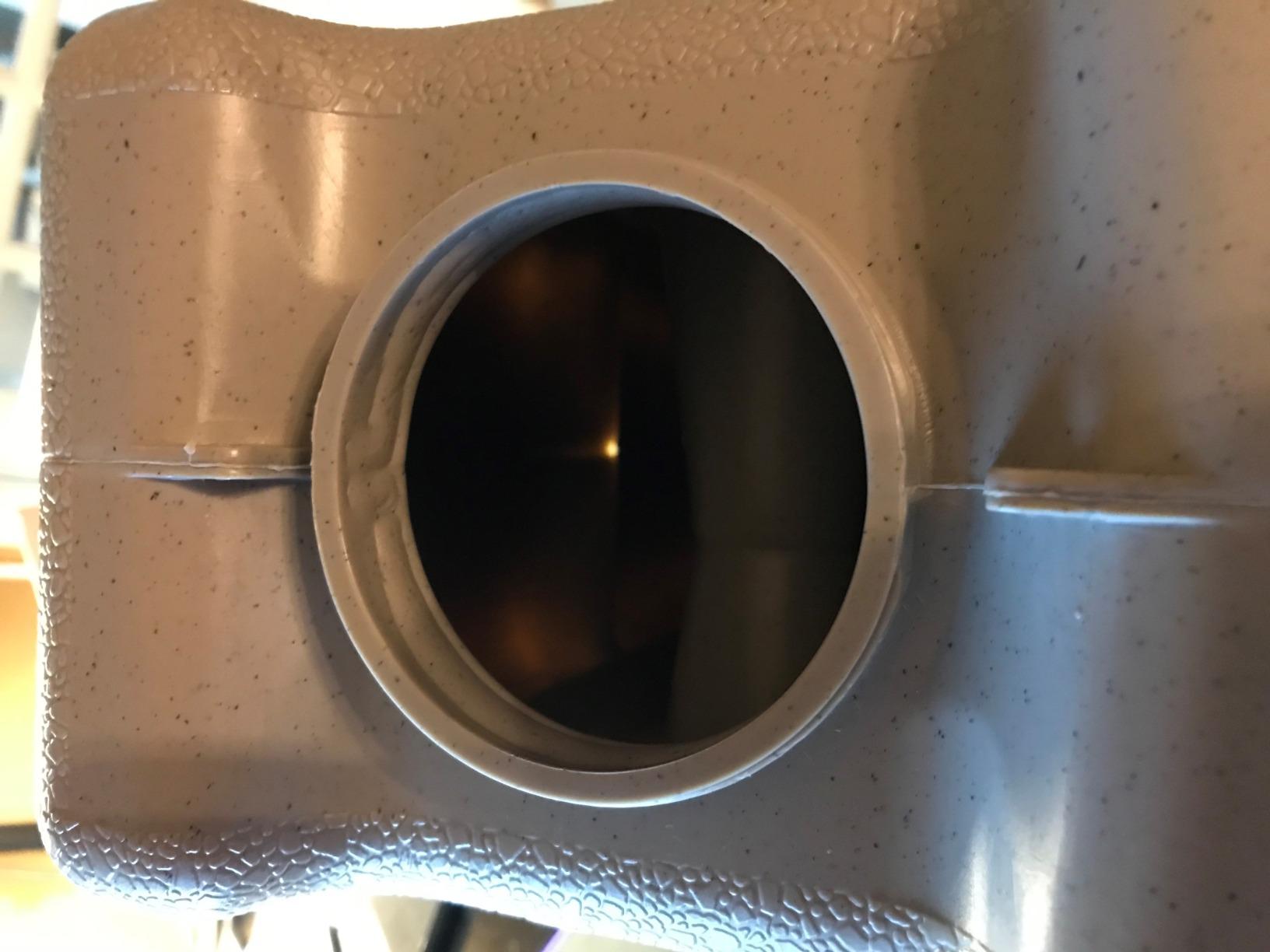
Now the defects, because every container in this category has them and nobody mentions them. The removable handles are the most reported issue. Owners report handles popping loose, particularly when bricks are stored on their sides, and the common fix is a pair of pliers tightening the mount. The recessed mouth is the second issue. Water will not fully drain from it, which matters on rotation day.
A third detail catches people: the gasket installs backwards easily, and a backward gasket produces a slow leak that does not show until you find a damp shelf. Check the gasket orientation on every lid, every time.
How high can you actually stack these?
The manufacturer states cross-stacking up to eight rows, roughly four feet. We would treat that as a tested ceiling rather than a daily habit. Two or three rows is a stable column most people are comfortable filling, and it still gives 21 to 28 gallons in a 18 by 9 inch footprint. Taller columns are fine on a ground-floor garage slab and worth avoiding on an upper floor.
Plan the layout before you fill. A six-inch brick in a low-ceiling crawlspace is useless, and the same brick in a closet beside a washer is a permanent home. Measure the height you have, not the height you wish you had.
Do you need a spigot with bricks?
Yes, and this is where people get caught. The recessed mouth means pouring a 3.5 gallon brick out by hand is awkward and messy. A low-cost spigot kit designed for this format turns the stack into a usable system. Do not assume a spigot from a different brick brand will thread into these caps. Buyers who assumed that ended up ordering the correct one anyway.
New bricks can arrive with a faint plastic odor. A dilute bleach soak followed by a thorough rinse clears it, and doing that on day one is easier than doing it after a fill.
6. Legacy 15-Gallon Stackable Tank with Siphon Hose
15-Gallon Stackable Water Storage Container with Siphon Hose
15 gallon capacity
15.7 x 15.7 x 21.5 inch
125 lb filled
6.5 foot siphon hose
Pros
- Middle ground between jug and drum
- Dark blue blocks light
- Two 2-inch bung fittings
- Siphon hose included
- Cap wrench included
Cons
- About 125 lb when full
- Two bung openings mean two lids to seal
This is the container we would call the middle of the range, and the middle is exactly its job. At 15 gallons it is far more portable than a 55 gallon tank and far more efficient per pour than a 3.5 gallon brick. A 4.7 rating across 264 reviews reflects a design that simply does not have the awkward edge cases the small and large formats struggle with.
The included siphon hose is the standout. It is a 6.5 foot food-safe self-priming hose with a copper head, and it is the difference between having a tank and having a usable tank. You set it in the tank, prime it, and you can draw water from the bottom of a container you cannot lift.
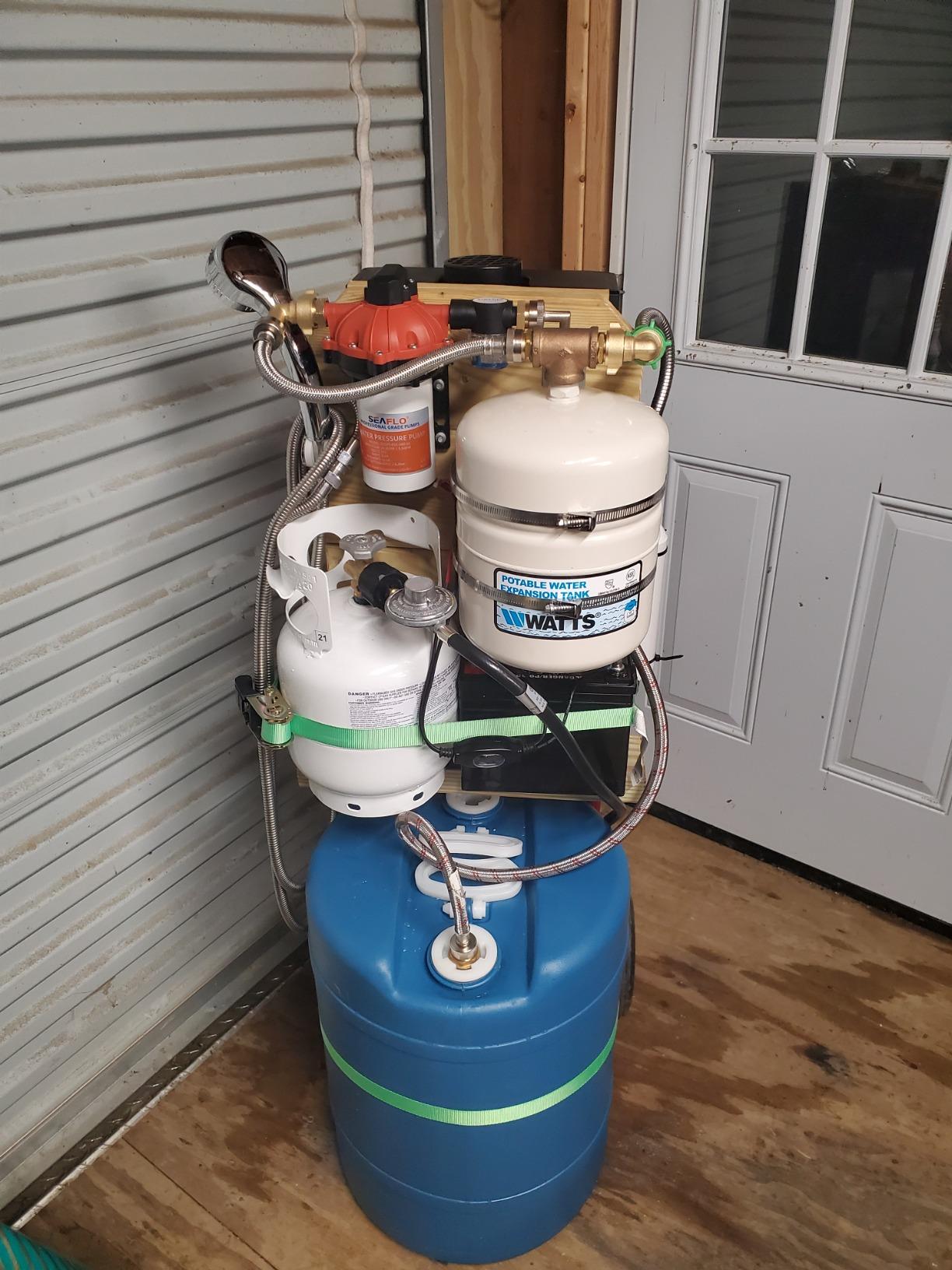
Two 2-inch bung fittings with rubber gasket seals give you separate fill and dispensing openings, and they let you run two hoses if you want. A cap wrench for tightening the lids is also in the box, which matters because sealed lids on a 15 gallon vessel are a real torque job by hand.
The dark blue, light-blocking body is consistent across the Legacy range and serves the same purpose: slowing light-driven biological growth in water you intend to keep for years. Two integrated heavy-duty carry handles make positioning an empty tank straightforward.
Being honest about the number: filled, this tank is about 125 pounds. Owners describe it plainly as a fixed installation rather than a portable container. That is fine if you treat it correctly, because the siphon hose means you never need to move it. It is a problem if you imagined carrying it to a neighbor during a flood.
Where does 15 gallons sit between the tiers?
Right in the middle of a household reserve. For a family of two, two of these give 30 gallons, which covers a full week at 2 gallons per person per day. For a family of four, four tanks give 60 gallons, close to a two-week reserve at 1.5 gallons per person per day.
Stacking two high gives you 30 gallons at about 43 inches tall, which clears a typical 8-foot garage wall and most closets with a raised shelf. That makes this a strong candidate for a utility room or a half-height basement.
Why the siphon hose matters more than the tank?
Because a container you cannot empty is a container you cannot rotate. Every long-term storage recommendation, from FEMA guidance to prepper forums, comes back to the same point: water has to come out completely so the interior can be cleaned and dried. The self-priming siphon gets the last of it out of a vessel that is too heavy to tip.
It also unlocks high-tank dispensing. With the hose, you can fill a pitcher or a smaller container at waist height instead of crouching to a 125 pound tank. If you pair it with the smaller containers in this guide, you end up with a proper two-tier system.
7. Aguaprep 4-Pack 5-Gallon with Spigot – Best for RVs and Boats
Aguaprep 5-Gallon Stackable Water Storage Containers, 5 Lids + 1 Spigot, Easy Fill, Survial Supply Emergency Water Storage for Camping and Disaster Preparedness, RV, 20 Gallon (4 Tanks)
20 gallon total
15 x 12 x 15 inch each
Five lids included
Spigot supplied
Pros
- Stacks two high
- rated up to five
- Screw-on lids resist leaking
- Flat sides for stable pouring
- Includes a pour-through filling lid
- Made in the USA
Cons
- About 40 lb per filled tank
- Spigot threading instructions unclear
- Five-high limit deserves caution
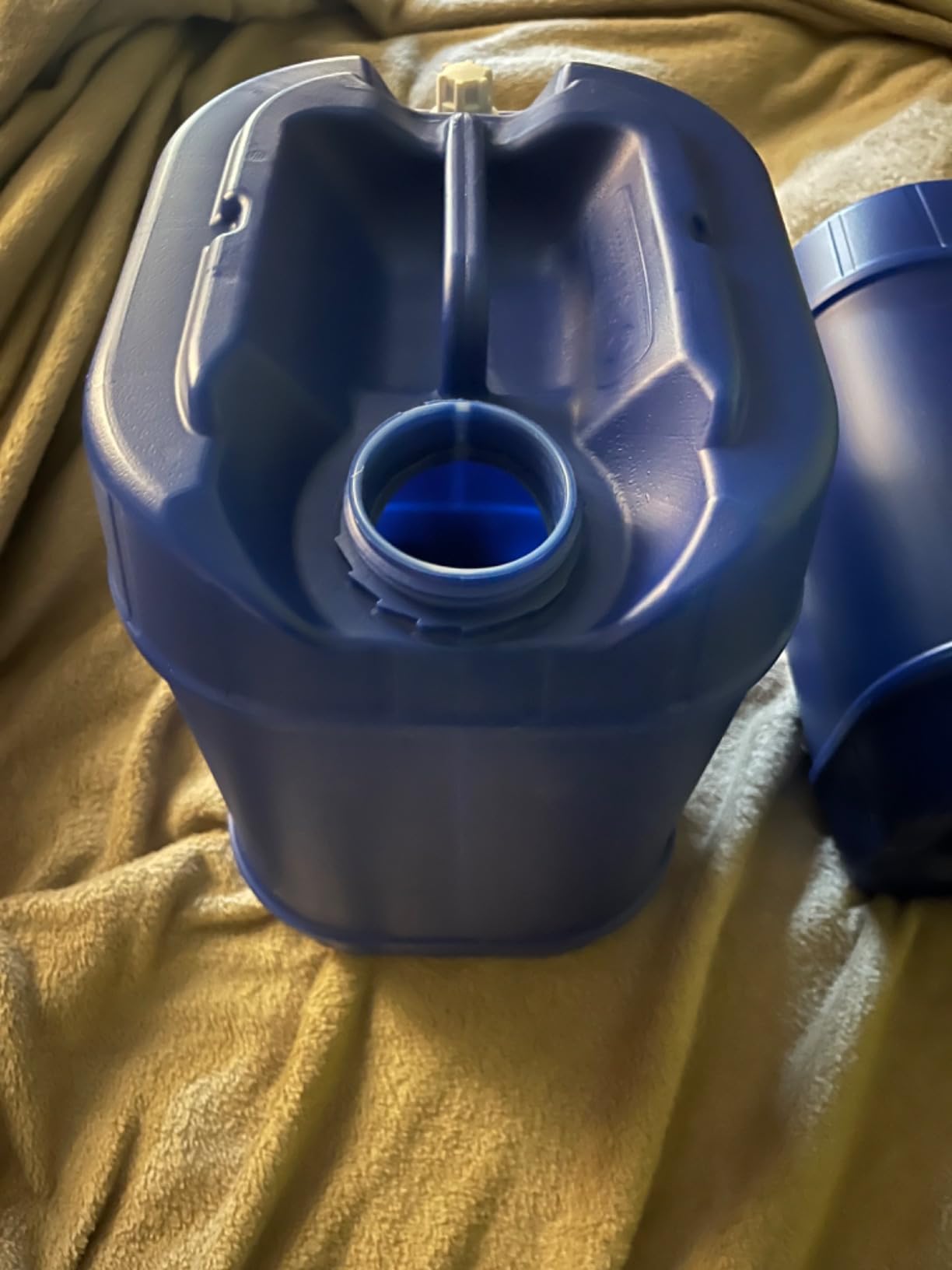
The Aguaprep set is the one we would put in an RV or a boat, and the reasoning is the lid count. This kit includes five lids for four tanks: screw-on transport lids plus a dedicated pour-through filling lid. That sounds like a small detail until you are trying to fill a tank in a campground shower stall or a washdown hose situation.
Each container measures about 15 inches long, 12 inches wide, and 15 inches tall and holds 5 gallons, for 20 gallons across the set. The flat sides give you a stable surface when you are pouring into a smaller jug, and the walls are noticeably thick for a plastic tank in this class.
The manufacturer states the containers stack two high and rates them up to five high. Owner reviews are more cautious than the listing, and we agree with the owners. Two high is a sensible working limit. If you intend to go higher, do it on a level slab and load it empty, then fill from the bottom up.
Made in the USA from food-grade plastic, these are sized for the tight geometry of mobile storage where you cannot spread containers across a floor. A closet, a bay, or a slide-out in an RV all benefit from containers that stack without wobble and dispense from a spigot.
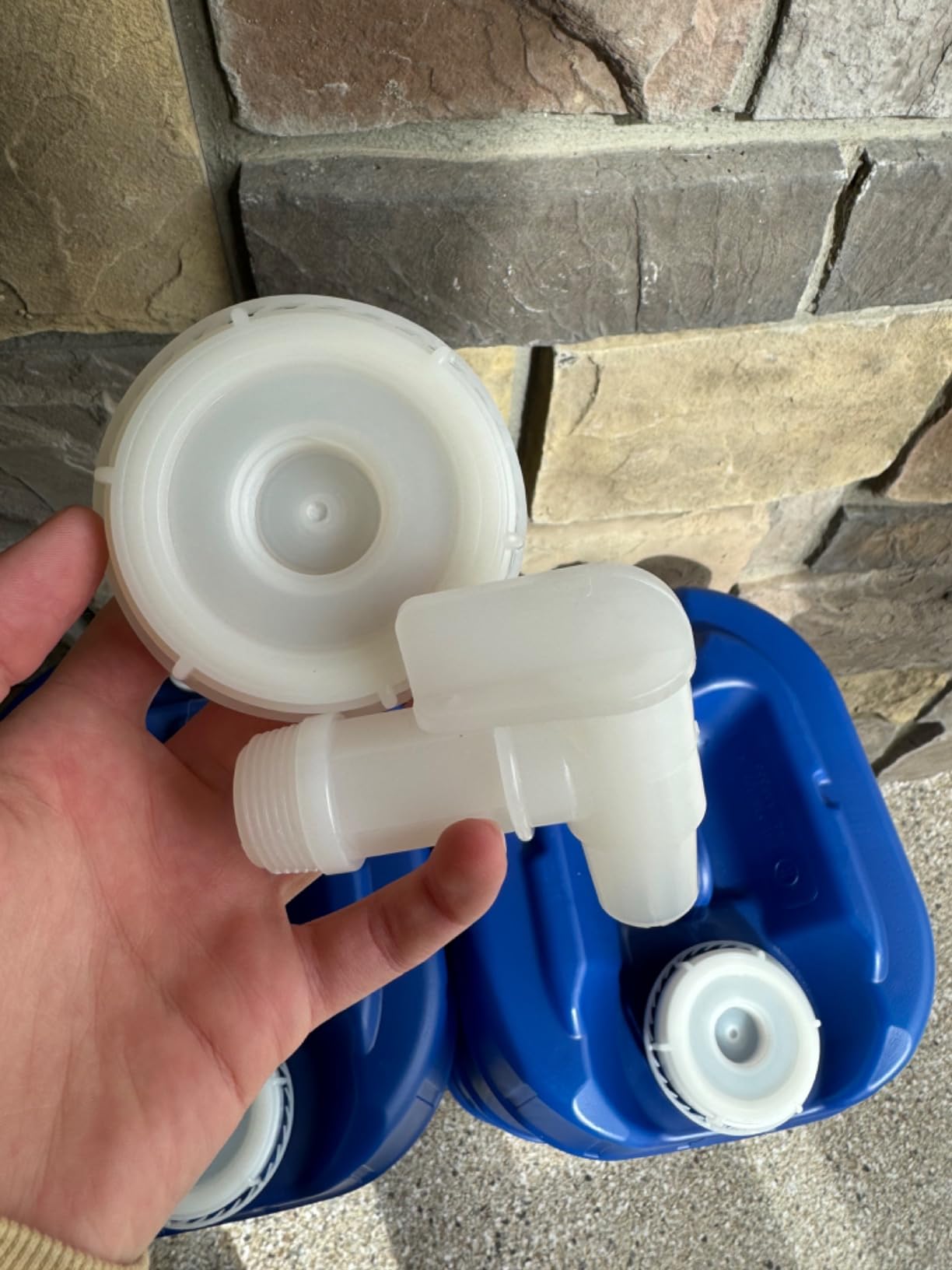
One recurring point of confusion: the instructions do not make it obvious how the faucet threads into the caps. Fit it dry before the first fill, and mark the orientation with a pen once you have it right. Owners who did this reported no further issues.
Is a 20 gallon set enough for a family of four?
For a 72-hour emergency, yes. Twenty gallons covers four people for roughly two and a half days at 2 gallons per person per day. For anything longer you are combining tiers: a bulk tank in a garage for the long horizon and a set like this for the accessible portion.
Because the containers are individually portable at about 40 pounds filled, this set is a good candidate for a shed or garage you can reach quickly during flooding. That is usually the deciding factor in a real outage.
What should you check when the box arrives?
Count the lids. Five lids for four tanks is the correct configuration, and a short count means a lid is missing. Also fit the spigot to a cap before filling anything, and confirm the gasket sits flat rather than cocked, which is the usual source of slow leaks in this style of kit.
Give the interior a rinse before the first fill. There is no wide opening brush in the box, and a long-neck bottle brush with a bend reaches the corners of a rectangular tank better than a sponge that cannot turn a corner.
8. Wurx Space-Saving 20-Gallon Container – Best for Low-Profile Stacking
Wurx Containers Spring Creek Space-Saving 20 Gallon Water Container
20 gallon capacity
24 x 24 x 14 inch
Low square profile
Stackable
Pros
- Low 14 inch profile saves vertical space
- Designed for small-space living
- BPA-free for drinking water
- Portable for camping and travel
- Made in the USA
Cons
- Low shape is less stable when partly filled
- Narrow opening is harder to clean
This container answers a constraint the taller tanks ignore. At 24 inches long, 24 inches wide, and only 14 inches tall, it holds 20 gallons while staying under the height of most furniture. That makes it the natural pick under a bed frame, inside a low storage bench, or behind a sofa in a studio apartment.
Stack two high and you have 40 gallons in roughly 28 inches of vertical space, which clears most under-bed clearances. For households with no garage and no basement, the ability to use horizontal space that already exists is worth more than any other feature on this list.
The square footprint is generous for 20 gallons, and that is deliberate. The same volume in a tall narrow tank would be harder to stack and easier to tip. This one trades footprint for stability and reach.
It is BPA-free and made in the USA, and owners highlight that the design supports water rotation. That matters more than it sounds. A container built to be emptied and refilled on a schedule is a completely different object from a container you fill once and hope for the best.
Is a low profile container less stable?
Partly filled, yes, and owners say so directly. A wide, low tank with half its volume in it has a higher center of gravity relative to its base than a tall cylindrical one. Fill it completely or empty it completely, and put it against a wall rather than in a hallway.
Stacking is where the low profile pays off, and it is the reason to choose this over a taller 20 gallon alternative. Each unit is 14 inches, so a two-high stack fits under a bed that a single 21 inch tank would not.
What about the narrow opening?
Cleaning is the trade-off. A narrow opening is harder to reach with a brush, and corners in a square tank hold more residue than the smooth curve of a round one. Budget a bottle brush with a flexible neck and treat the interior with a dilute bleach solution before every refill.
There is no spigot listed for this container, so plan on top-pouring or add a dispensing solution that fits the opening. For a bulk reserve you touch a few times a week, that is workable. For daily use, pair it with a smaller container that has a spigot.
9. Consolidated Plastics 2.5-Gallon Carboy 4-Pack – Best for Easy Carrying
Consolidated Plastics 2.5 Gallon Stackable Carboy with Leakproof Cap and Handle, HDPE Food Grade, BPA Free, Made in USA (Natural, 4 Pack)
2.5 gallon per carboy
9.75 x 11 x 9 inch each
14 lb package weight
FDA compliant HDPE
Pros
- About 21 lb when full
- Stacks up to four high filled
- Thick heavy-duty HDPE walls
- 60mm gasketed leakproof cap
- Meets FDA and UN specs
Cons
- Mouth placement prevents full draining
- Do not stack more than four high
- Wide body misses narrow shelves
This is the portability play. A 2.5 gallon carboy measures about 9.75 inches wide, 11 inches deep, and 9 inches tall, and filled it comes in around 21 pounds. That is the difference between carrying water with one hand over a shoulder and carrying a 40 pound jug with both hands in front of you.
That weight is why off-grid and prepper users reach for this format. It fits in a hand truck easily, it fits in a cabinet, and it works with a standard water dispenser. For a vehicle kit, a bug-out bag, or carrying water up to a cabin, nothing else in this list is easier to move.
The construction is serious. Consolidated Plastics uses high-density polyethylene that meets UN specifications as applicable and FDA requirements, in a 4-pack of 2.5 gallon carboys with integrated handles and 60mm red gasketed leakproof caps. Owners consistently describe the walls as thick and built to last for years.
The stacking limit is stated clearly by the manufacturer: do not stack more than four full containers high. That is a real ceiling rather than a marketing number, and we would keep to three in everyday use.
What is 2.5 gallons good for?
Mobility and small-space storage. Four carboys give 10 gallons in a footprint small enough for a cabinet, and you can carry one to a neighbor, up a flight of stairs, or to a vehicle without assistance. That is the use case no other container on this list serves as cleanly.
Four-high stacking gives 10 gallons in about 36 inches of vertical space, which makes a closet or the gap beside a washer a viable home. The wide body means it will not fit under a sink or on a narrow shelf, so measure the cabinet before you commit.
Why the mouth position is the one complaint to know?
Owners report the mouth placement makes the carboy difficult to drain completely, leaving a small amount of residual liquid. On a long-term storage cycle that residue is exactly what you do not want, because it is the starting point for biofilm growth inside a closed container.
Pouring the last of it out takes a deliberate tip and swirl, and we would add a small squeeze bottle or a pipette for the final ounce. If a container that empties completely is important to you, look for a wide-mouth design with a flat interior base instead.
10. Emergency Water Tanks 55-Gallon Rotomolded Tank
55 Gallon Stackable Emergency Water Storage Tank – Food Grade BPA-Free Water Container for Long-Term Home Preparedness
55 gallon capacity
27.75 x 21.75 x 29.5 inch
22 lb empty
5-inch twist lid
Pros
- Stacks without expanding the footprint
- Rotationally molded polyethylene
- 5-inch lid for fast filling
- Built-in brass spigot
- Long manufacturing track record
Cons
- Nearly impossible to move once full
- Needs a level base or stand to dispense
This tank takes a different approach to the same problem the WaterPrepared solves. It is rotationally molded polyethylene, a process where a rotating heated form forms the body as one continuous piece, so there are no welded seams to fail. It holds 55 gallons in about 27.75 by 21.75 by 29.5 inches and stacks vertically by design.
The 5-inch twist lid is the feature most owners raise first. A wide opening fills fast and, more importantly, lets you get a cleaning tool inside. A tank you cannot properly clean is a tank you will eventually have to drain and start over with.
The built-in brass spigot serves double duty. It dispenses, and it lets you rotate old water out without lifting the tank, which is the only realistic way to change 55 gallons. That function is often overlooked in product descriptions and it is the single most useful feature for anyone holding water for years.
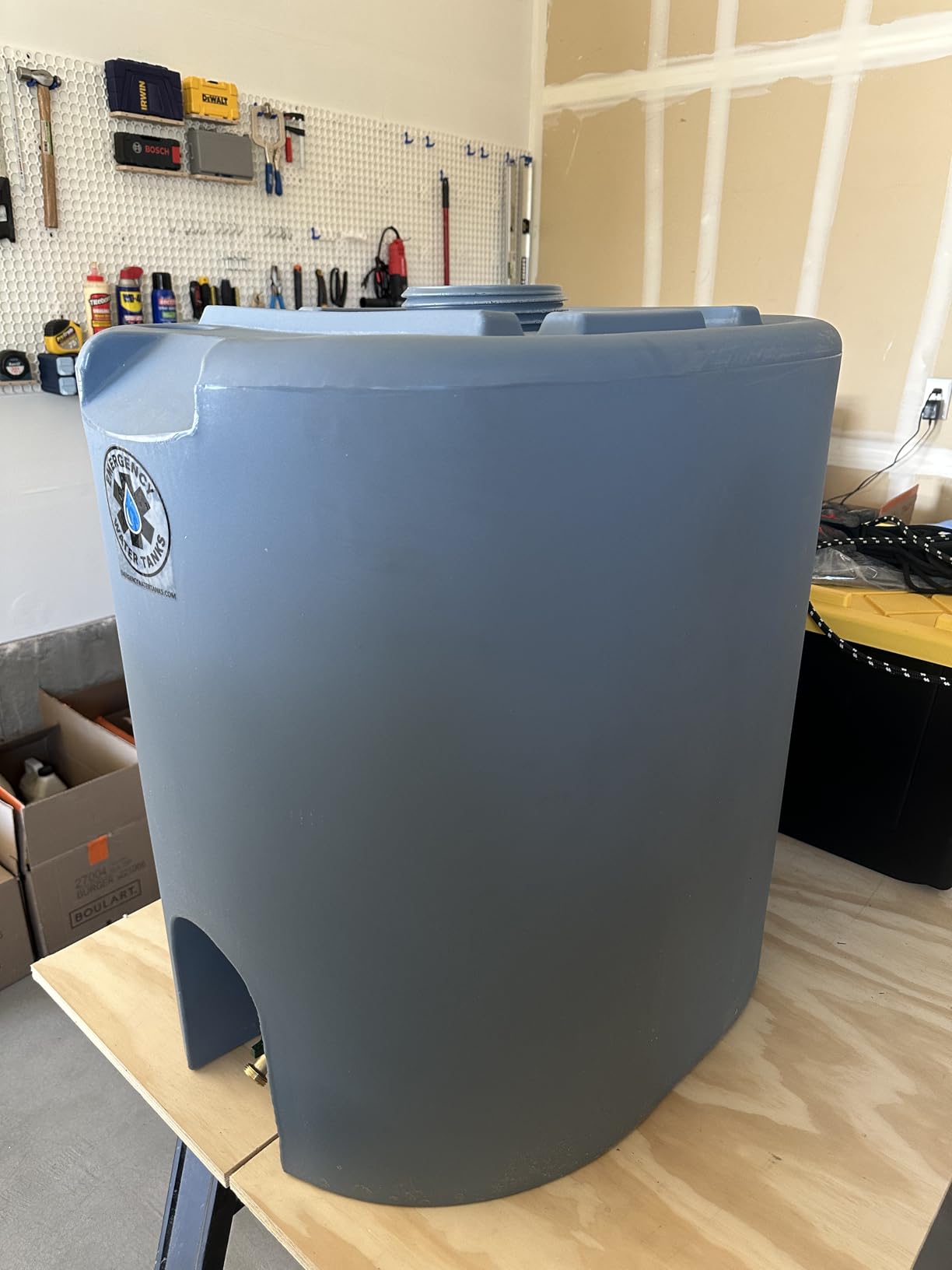
The manufacturer has more than 70 years of tank manufacturing experience and tests for strength, leak integrity, and safety. The 4.2 rating across 63 reviews sits below the leaders, and the reviews explain exactly why: handling, not construction.
That is the honest trade. A full 55 gallon tank is over 460 pounds and is effectively a permanent installation. Owners also note that dispensing from ground level means you need a level base or a stand, otherwise the tank settles and the last of the water refuses to come out.
How do you get 55 gallons into it?
Run a hose. The 5-inch lid accepts a standard fill line, and at that volume, filling by jug is not a project. Set the tank in position, run a hose from a spigot or a well pump, and check the level at the top. Budget an afternoon the first time.
Because it is designed to stack, place the first unit on the ground floor of your stack rather than planning to build upward later. Nobody should be carrying 460 pounds onto an existing unit.
Is one 55 gallon tank worth it?
For a household of four drinking only, 55 gallons is about two weeks at 1.5 gallons per person per day. It becomes a short reserve the moment you count cooking, hygiene, and washing, which is why most people who buy one tank end up wanting a second.
Its lower rating does not reflect a quality problem. It reflects that a 55 gallon tank asks you to commit to a permanent spot in the house, and buyers rate convenience heavily. If you have a garage bay and a plan for where it lives, that is exactly the right container.
11. Rockwell Exodus 35-Gallon Tank – Best for Thick-Wall Durability
Rockwell Exodus 35 Gallon Stackable Emergency Water Storage Tank, BPA-Free Water Container for Home Backup, Camping and RVs, Made in USA, Blue
35 gallon capacity
29.5 x 20 x 18.25 inch
NSF 61 compliant
3-year warranty
Pros
- Thicker than standard rotomolded walls
- Anti-airlock 5-inch lid
- Corner drain plug empties the last drop
- Lead-free brass quick-turn valve
- Truck bed tie-down points
Cons
- Vent hole in the lid area
- Stacking limited to two tanks high
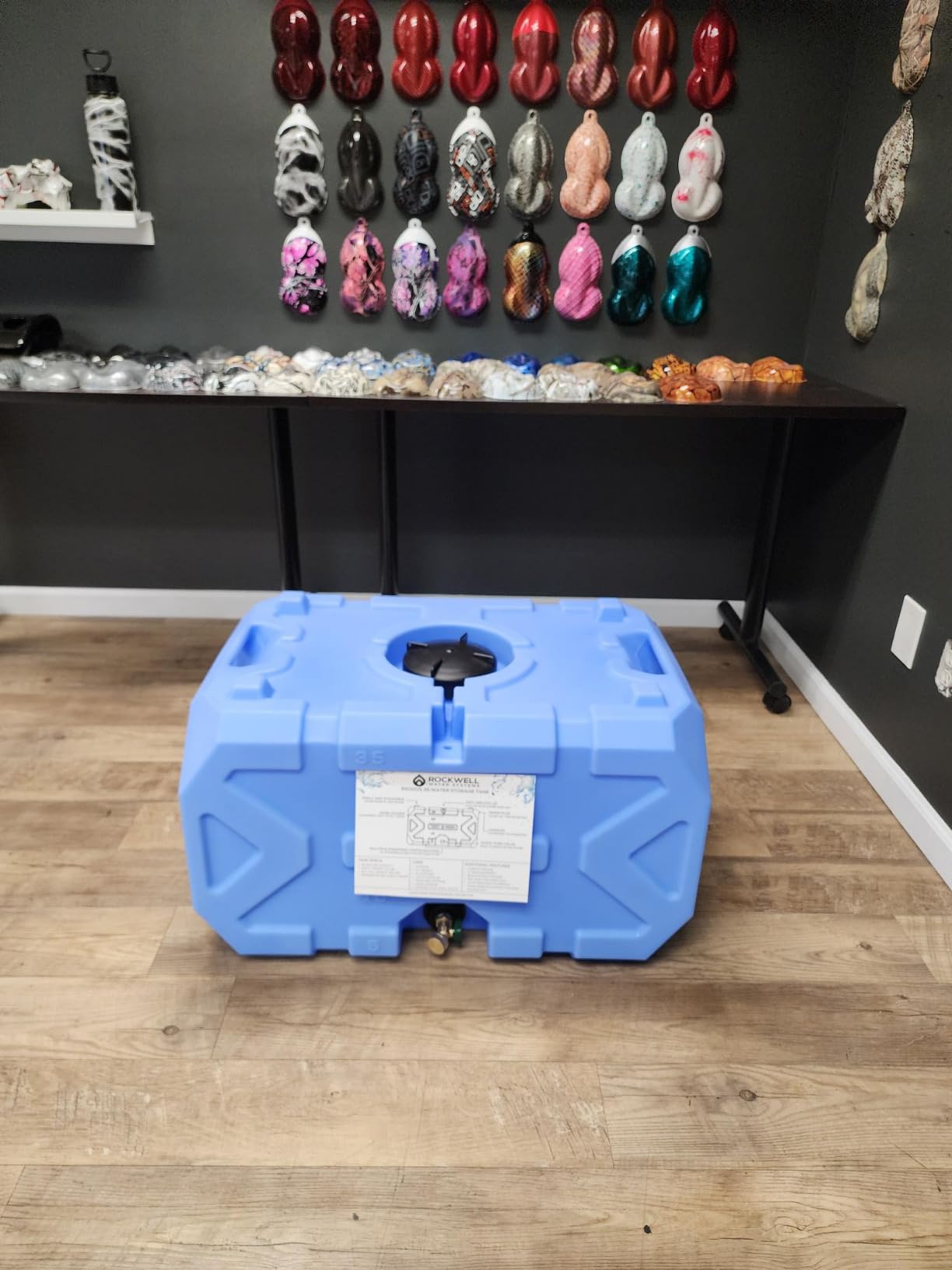
The Rockwell Exodus 35 is the one in this group built for abuse. It uses a custom thicker-wall rotational molding process, and owners consistently describe the walls as rock solid. It also meets the National Sanitation Foundation 61 standard for potable water components, which is a more rigorous food-contact certification than most containers in this price and size class carry.
It is also BPA-free, phthalate-free, and UV-resistant. Every tank passes a five-point quality inspection and carries a limited three-year warranty, which is the longest warranty on this list and the only one backed by a written term.
The kit contents are unusually complete. You get the tank, water preserver treating up to 55 gallons, a 5-inch anti-airlock lid, a lead-free brass quick-turn valve, a brass faucet cap, a drain plug, and a printed rotation schedule. The rotation schedule in the box is a nice touch for anyone who has bought containers and never actually changed the water.
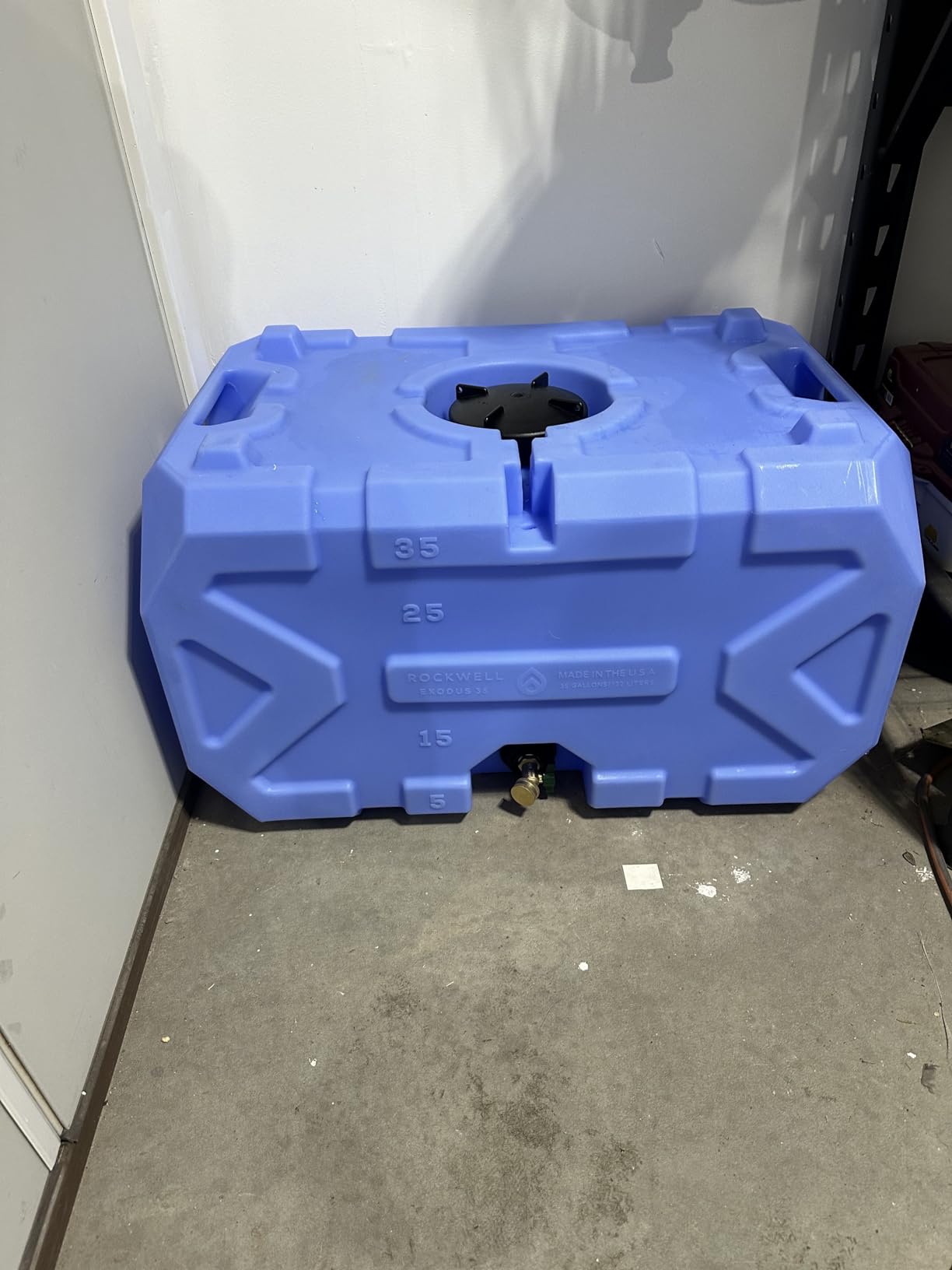
Two details set it apart. The anti-airlock lid solves the glugging problem that makes wide-mouth tanks frustrating to fill. And the corner drain plug lets you empty the last of the water, which is the difference between a clean interior on rotation day and a tank you have to tip.
At 29.5 by 20 by 18.25 inches, the 35 gallon capacity is sized for a two-high vertical stack that fits garages, closets, RVs, cabins, apartments, and truck beds. Molded tie-down points and handles make truck bed transport straightforward.
Two negatives worth stating. There is a vent hole in the top of the tank, and some buyers dislike having any exposed opening in a container of stored water. Stacking is designed for two high, which is lower than a brick stack but far stronger per unit.
Is 35 gallons the right amount for a family of four?
It is close to a two-week reserve for four people drinking and cooking at about 1.5 gallons per person per day, and about ten days if you count hygiene and washing. Most households that buy one of these end up adding a second, and the two-high stacking design is built for exactly that.
Two tanks gives 70 gallons, which comfortably covers two weeks for a family of four at 2 gallons per person per day. That is a realistic planning figure rather than a drinking-only number.
What does NSF 61 actually tell you?
It certifies that the material does not leach contaminants into drinking water at specified levels, tested by an independent organization rather than asserted by the manufacturer. For water you intend to drink in an emergency years from now, an independent certification is worth paying attention to.
For scale, compare it with our bulk grain storage bins for preppers guide, where the certification question is even more important. Grain sits in a container for years, and so does water.
12. Emergency Water Tanks 30-Gallon Cube
30 Gallon Stackable Emergency Water Storage Tank – Heavy-Duty Water Barrel for Long-Term Drinking Water or Preparedness
30 gallon capacity
21 x 21 x 21 inch cube
17 lb empty
5-inch twist lid
Pros
- 30 gallons suits apartments and RVs
- Cube shape stacks vertically
- Food-grade BPA-free lead-free plastic
- 5-inch lid for easy cleaning
- Durable spigot connection
Cons
- Too heavy to reposition when full
- Square shape uses more floor area than oblong
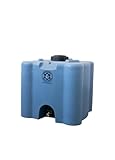
The 30 gallon cube sits at 21 inches on a side, which makes it the most geometrically flexible tank in this group. Squares of any size tile together, so a 30 gallon cube fits neatly into a corner, against a wall, or inside a vehicle cargo bay without the awkward gaps an oblong or round tank leaves behind.
30 gallons is also a well-chosen capacity. The manufacturer frames it as about one week of drinking water for a family of four, and it genuinely works for a couple covering a full week at 1.5 gallons per person per day with room to spare.
The construction follows the same approach as the 55 gallon tank from this line: rotationally molded polyethylene rated for long-term potable water storage, in food-grade, BPA-free, lead-free material. The 5-inch twist lid makes filling fast and interior cleaning possible, which is the feature that determines whether a tank survives a decade.
The spigot connection is described as durable and spill-free, which matters more in a cube shape than in a tall tank, because the spigot sits close to the base and a slight tilt sends water out of the cap instead of through the spigot.
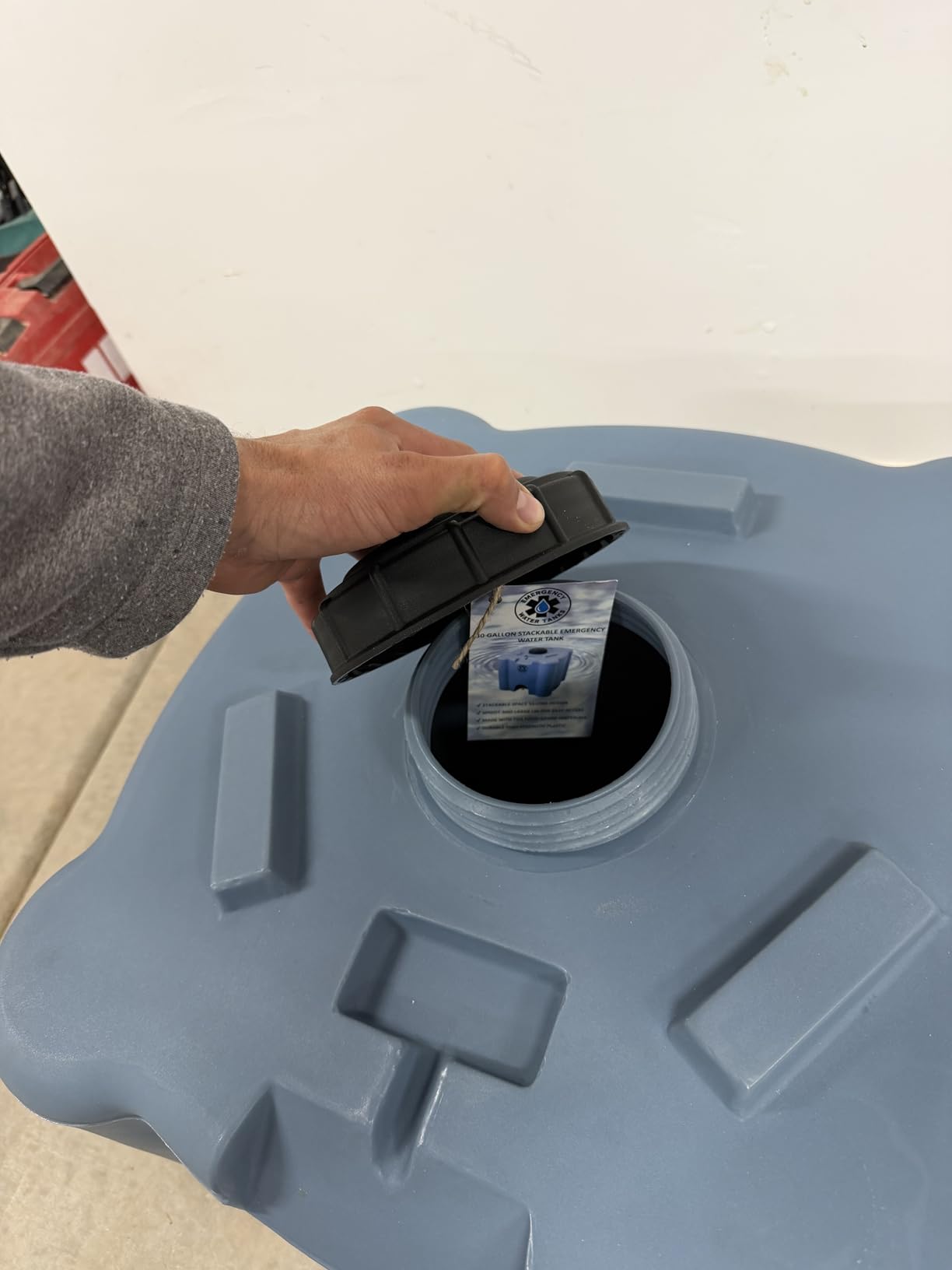
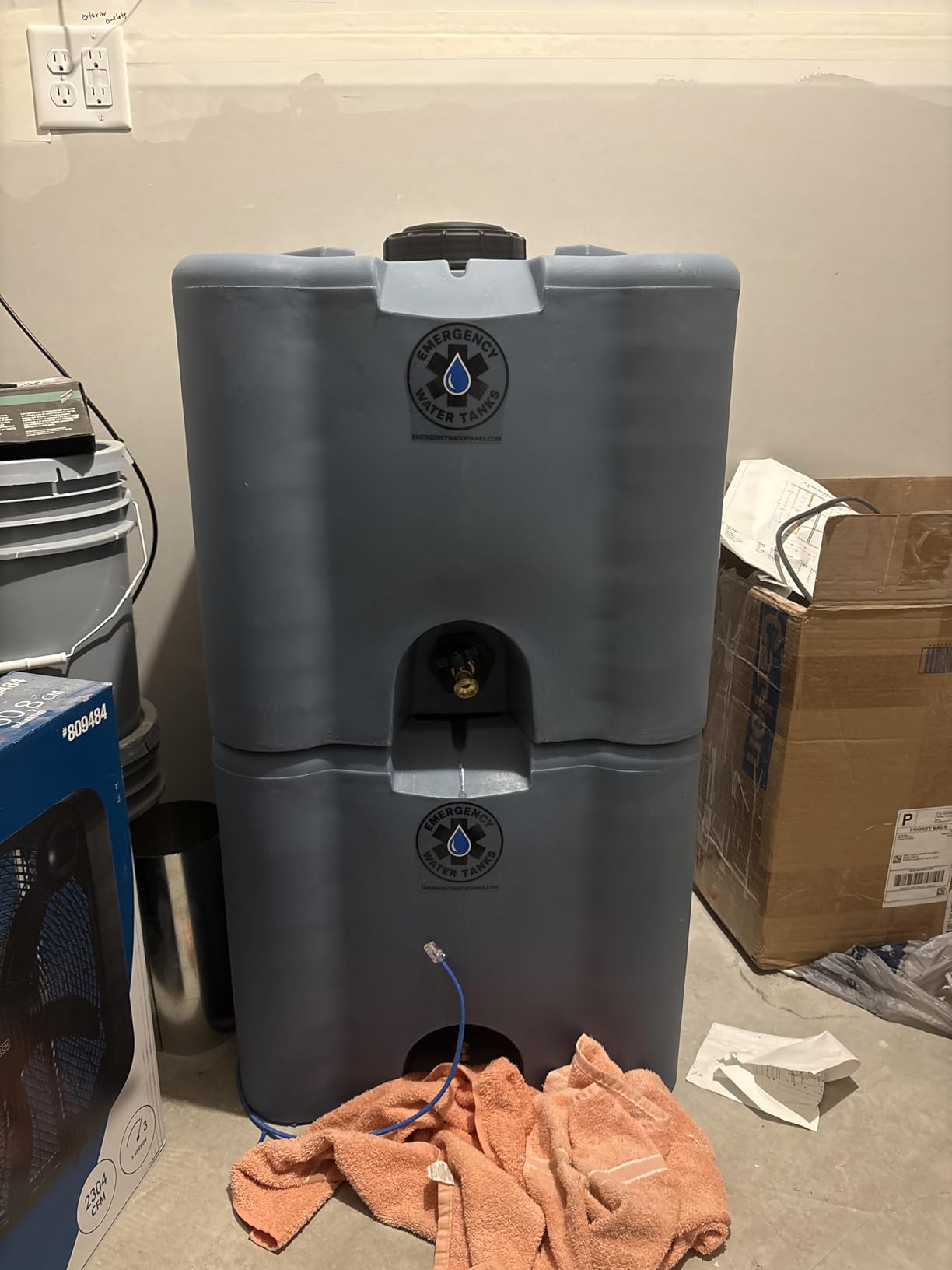
The 4.2 rating across 31 reviews is the second lowest here, and the reviews explain it plainly. Buyers value the capacity and the right-sized fit, then hit the same wall: a full 30 gallon tank is over 250 pounds and nobody is moving it across a room. The other recurring note is that the square shape claims more floor area than an oblong tank of equal capacity.
That is a real trade, and it is a geometry trade. You give up floor efficiency to gain a perfect square footprint, perfect vertical stacking, and no wasted corner space. If your available area is a clean rectangle, that is a good bargain. If it is an awkward L-shaped closet, an oblong tank wastes less.
Should you go with a cube or an oblong tank?
Choose the cube when your space is rectangular and you want to build upward. Choose the oblong when your space is irregular and floor area is the scarce resource. The capacity is the same, so the decision is entirely about the shape of the room.
Two cubes high give 60 gallons at 42 inches tall, which clears a typical garage door header with room to spare. Put them on a concrete or tiled pad rather than a raised wooden platform, since the load at the bottom unit is roughly 500 pounds.
Is 30 gallons enough on its own?
As a starting point for a family of four, it covers a short emergency. As a long-horizon reserve, it is a starting point for a larger system. Most households we would advise toward one cube plus four or five 5 gallon containers, which keeps the bulk where you need less of it and the accessible portion where you can reach it quickly.
Plan dispensing before you fill it. Build a low stand so the spigot clears the floor, and set the tank on a level surface. A slightly out-of-level tank will not drain from the bottom, and you will find out on the day you try to change the water.
How Much Water Do You Actually Need?
Start with the federal baseline of one gallon per person per day, then adjust upward. That figure covers drinking and basic cooking only. Once you add hygiene, washing, food preparation, pets, and medical needs, realistic household consumption lands between 1.5 and 2 gallons per person per day. Prepper forums converge on the same adjustment, and it is the number we use for every calculation here.
So how long will 500 gallons last one person? At 1 gallon per day, a little over sixteen months. At 1.5 gallons, about eleven months. At 2 gallons, roughly eight and a half. For a single person preparing for a year, 500 gallons is adequate but not generous, and most people who plan for a full year target closer to 750.
For a household, multiply people by days by 1.5 to 2. A family of four planning a two-week reserve needs between 120 and 224 gallons. A family of four planning 30 days needs between 180 and 240 gallons. Those are the numbers that decide how many containers you buy.
Then split the total into two tiers. Keep 20 to 25 percent in containers small enough to carry, ideally 2.5 to 3.5 gallons each, so you have water on hand for the first hours. Hold the rest in bulk tanks that never need to move. This split is the single most common pattern in preparedness discussions and it exists for a practical reason: a 40 pound jug is no use to you during a flood.
One last variable most guides overlook. Households with pets, small children, or anyone with medical needs add meaningfully to daily consumption. A family of four with a dog and a baby is closer to 3 gallons per person per day than 2, and sizing for 2 will leave you short in exactly the situation where running short hurts most.
What to Look for in a Stackable Water Container?
The single most important specification is material, and there is really only one acceptable answer. Look for food-grade high-density polyethylene, the plastic marked with recycling symbol number 2. HDPE resists the chemical interaction that degrades water, it does not leach noticeably at normal temperatures, and it is what commercial water and food packaging is made from. An independent food-contact certification such as NSF 61 is a stronger signal still, because a manufacturer cannot self-declare its way through an outside test.
Never store emergency water in milk jugs, juice bottles, or soft drink bottles. Those are typically PET or polycarbonate, they are designed for a single use, and their plasticizers migrate under warm conditions over time. This is not a marginal preference. Guidance from FEMA, the CDC, and every serious preparedness source treats it as a hard rule, and plastic-averse readers on forums ask about stainless steel and other non-plastic options for the same reason.
Stackable when filled beats stackable when empty
Almost every container in this category stacks empty. Only purpose-built units with interlocking ribs or cross-stack geometry transfer load down through the column instead of resting it on a lid rim. That distinction is the difference between a 4 foot stack of 28 gallons and a pile of jugs that has to be taken apart to refill.
Check the stated limit before you build tall. Bricks commonly rate eight rows, cubes commonly rate two to four, and 5 gallon jugs are the least robust of all. Do not treat a marketing rating as a target.
Where the weight lands matters more than the weight?
A filled 55 gallon tank puts roughly 460 pounds in one spot, and a filled 5 gallon jug puts 40 pounds in one spot. Distributed weight across many joists is structurally unremarkable. Concentrated weight sitting on a single upper-floor joist, a closet subfloor, or a raised wooden platform is a different conversation entirely.
Practical guidance: put bulk tanks on a ground-floor slab or a poured pad, spread bricks across as many joists as possible, and if you must stack high upstairs, keep the heaviest units on the bottom. We would not build a four foot brick column on an upper floor with full containers in it, and we would double check with a professional if the load is anywhere near 500 pounds.
Spigot ecosystems do not mix
This is the most common mistake in the category. Spigots thread into specific cap geometry, and a spigot designed for one brick format will not necessarily fit another. Buyers assume compatibility, order the cheap one, and discover the mismatch when they try to fit it.
Buy the spigot that the container’s manufacturer specifies, and fit it dry before the first fill. Also decide whether you need one at all. For a 2.5 gallon carboy you can lift and tip, a spigot is optional. For a 3.5 gallon brick with a recessed mouth, or a 15 gallon tank weighing 125 pounds, it is close to mandatory. Skipping it is the number one complaint in owner reviews across this whole list.
Look at cost per stored gallon, not per container
A 20 gallon kit of four 5 gallon containers and a 55 gallon rotomolded tank are not comparable purchases, and treating them as such is how people end up with the wrong amount of water. Divide what you spend by the gallons you actually store, then add the hardware a complete system needs: spigots, a cap wrench, treatment concentrate, and a stand for a low-sitting tank.
Two more criteria separate a container that lasts from one that gets replaced. A wide opening that accepts a bottle brush determines whether you can properly clean the interior at rotation. Light-blocking colored plastic slows the growth that flat water develops. Both are cheap to buy and hard to add later.
Filling, Treating, and Rotating Stored Water
Fill with potable tap water where available, and treat it if you are targeting a shelf life beyond a year. The sequence matters more than the product. Sanitize the container first, fill it, add the preservative at the labeled ratio for the volume, seal it, and date the side with a permanent marker.
Water preserver concentrate is formulated for long-term storage and treats far more water than household bleach for the same container. Household bleach works as an emergency measure, dosed by volume, but the dosage has to be right and the smell persists. For a container you expect to open in three years, we use the concentrate.
Rotate on a schedule and stick to it. Every few months is easier to defend than twice a year, because the containers are smaller and each change is quick. A six-month cycle means half your supply is always in service and half is resting, which lets you treat a batch and let it sit before the next swap.
Rotation logistics at volume are the part nobody explains. Changing 50 gallons or more without losing your reserve means filling first and draining second. Never empty a container and then go looking for water. Fill the replacement containers, seal them, confirm they are treated, and only then open the spigot on the old tank. A tank with a drain plug or a low-position spigot exists to make that order possible.
Between swaps, wash the empty container with a dilute bleach solution, scrub the corners with a narrow-necked brush, and let it dry completely with the lid off. Residual moisture trapped in a closed container is what turns a clean tank into a biofilm problem within months.
Watch the temperature. Freezing expands water by about 12 percent, and a rigid full container in a garage with an unheated wall can crack or push its lid open. Leave expansion room, keep containers off concrete in winter, and set them on pallets or dunnage. In summer heat, keep them in shade and out of direct sun, and follow a tank with a light-blocking color over one that does not.
Frequently Asked Questions
What are the best stackable water storage containers for emergency preparedness?
The best stackable water containers for emergency preparedness are the ones built from food-grade HDPE, with interlocking geometry that allows stacking when filled, and a spigot-compatible lid. Our top overall pick is the Legacy 30-gallon stackable tank kit, which combines six 5-gallon ribbed tanks, threaded caps, spigots, and treatment drops. For small spaces the WaterBrick 3.5-gallon cross-stack format holds more usable gallons per square foot than any jug, and for bulk storage the WaterPrepared 55-gallon oval tank stacks vertically in a garage bay.
What is the best water storage container for a prepper?
It depends on where the water will live. A prepper with a garage should start with a 30 or 55 gallon rotomolded tank for the long-horizon reserve. A prepper in an apartment should start with 3.5 gallon WaterBrick-style containers cross-stacked two per row, because they use floor area far more efficiently and a filled brick carries about 30 pounds. Most households do best with both tiers plus a few 2.5 gallon carboys for mobility.
How long will 500 gallons of water last for one person?
At the FEMA baseline of one gallon per person per day, 500 gallons lasts a little over sixteen months for one person. Raise the figure to 1.5 gallons per day for realistic household use and it drops to about eleven months, and at 2 gallons per day you are looking at roughly eight and a half. If you are preparing for a full year for one adult, target 550 to 750 gallons depending on how much cooking and hygiene water you plan to store.
Can you stack water jugs when they are full?
Only if they are purpose-built stackable containers. Interlocking ribs or cross-stack geometry transfer the load down the column instead of resting it on a lid rim, which is why those units can be stacked filled. Ordinary jugs and most grocery containers should only be stacked when empty, and even purpose-built units have published limits that should be treated as ceilings. Keep the heaviest units at the bottom of any column.
Do I need a spigot for water storage containers?
For anything over about 5 gallons, yes. Pouring 40 pounds of water by hand is awkward and spills, and a container with a recessed mouth such as the WaterBrick will not drain fully without one. A spigot also lets you rotate old water out without lifting the tank, which is the only realistic way to change 50 gallons. Buy the spigot the manufacturer specifies, because spigots are not interchangeable between brick formats.
Our Verdict on the Best Stackable Water Containers for 2026
After comparing all twelve, the Legacy 30-gallon stackable tank kit takes our Editor’s Choice. It has the highest rating on the list at 4.7 across 1390 reviews, and more importantly it arrives complete: six ribbed 5-gallon tanks, threaded cap sets, spigots, a strap wrench, and treatment drops. There is no second purchase, no accessory guesswork, and no waiting to find out whether the parts fit.
For tight spaces, the WaterBrick 3.5-gallon bricks are the smarter buy. They hold the most usable gallons per square foot of anything we tested, and a filled brick carries about 30 pounds, which means you will actually rotate the water instead of avoiding it. For a garage, the WaterPrepared 55-gallon oval tank gives you 55 gallons in a footprint that a horizontal drum would have taken three times over.
The most important takeaway is not a product at all. Match the container to the space you actually have, check that the spigot is included or buy the correct one before you fill, and write the fill date on the side of every container. People buy water storage and never change the water. A schedule on the side of the tank is what turns a purchase into a supply.
Use the 2026 buying guides on this site to build out the rest of the cache, and start with the container tier that fits your floor space today rather than the one you might need in five years.