
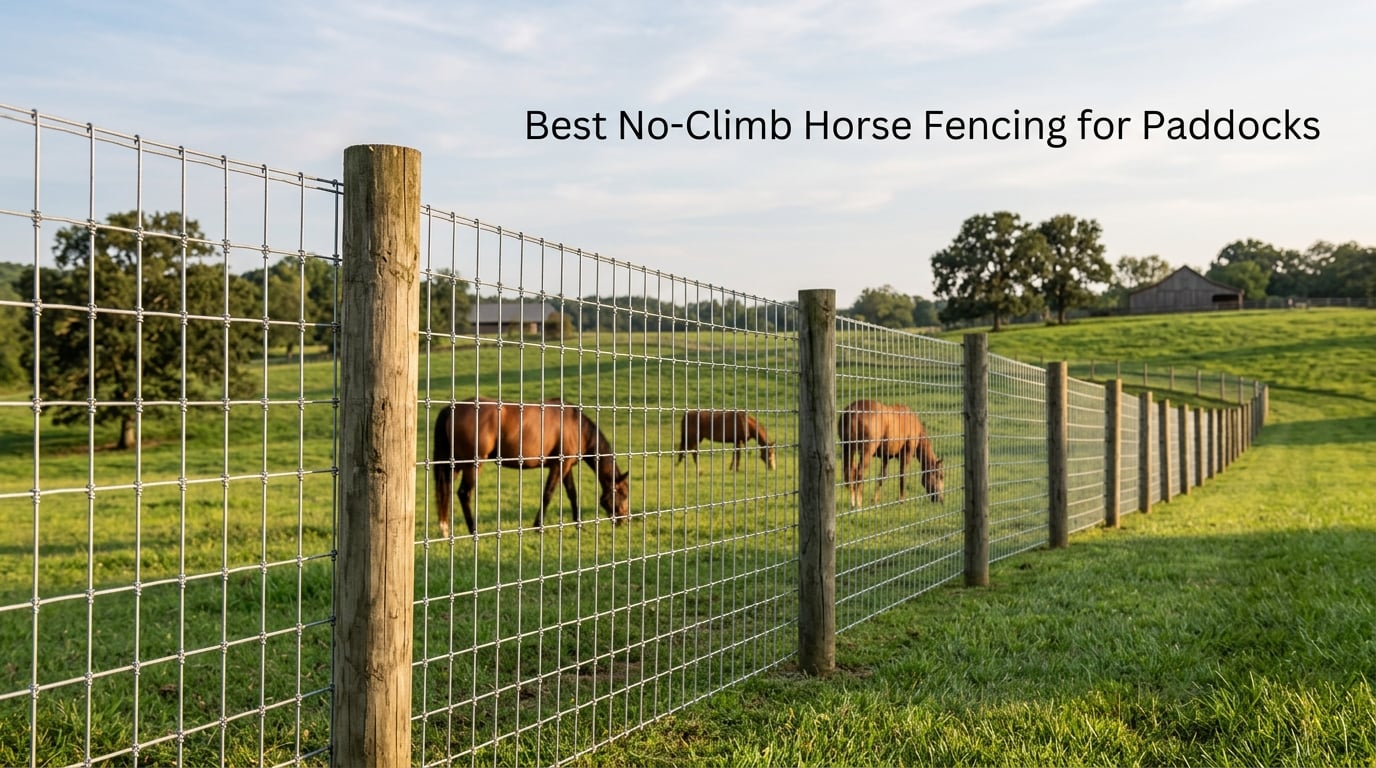
When it comes to keeping horses safe in a paddock, the fence you choose can mean the difference between a peaceful turnout and a midnight vet call. A panicked horse leaning against the wrong wire can sustain catastrophic leg injuries in seconds. That reality is exactly why no-climb horse fencing has become the gold standard for equestrian properties across the country.
No-climb fencing uses tight woven wire mesh with 2-inch by 4-inch rectangular openings that are specifically designed to prevent hoof entrapment. A horse cannot step through the mesh, get a shoe caught, or push the wire apart the way they can with field fence or welded wire. The flexible woven construction absorbs impact and springs back instead of bending permanently.
Our team spent weeks comparing the best no-climb horse fencing for paddocks available right now in 2026. We looked at wire gauge, mesh specifications, coating class, roll dimensions, and real customer experiences to narrow down eight products worth your money. Whether you are fencing a small turnout paddock, a breeding facility, or a full pasture perimeter, this guide breaks down exactly which roll fits your setup and why.
Table of Contents
Top 3 Picks for No-Climb Horse Fencing In 2026
Before we get into the full lineup, here are our three top recommendations based on safety, value, and construction quality. These three stood out across every metric we tracked.
Best No-Climb Horse Fencing for Paddocks (September 2026)
Here is the complete comparison of all eight products we reviewed. Each one brings something different to the table in terms of gauge, mesh size, roll length, and overall value.
| Product | Specifications | Action |
|---|---|---|
 Red Brand Kennel Fence Red Brand Kennel Fence |
|
Check Latest Price |
 Rilth Horse Fence Rilth Horse Fence |
|
Check Latest Price |
 DeWALT Horse Fence DeWALT Horse Fence |
|
Check Latest Price |
 BEKAERT 145778 Horse Fence BEKAERT 145778 Horse Fence |
|
Check Latest Price |
 Keystone Horse Fence Keystone Horse Fence |
|
Check Latest Price |
 Bekaert Gaucho Fence Bekaert Gaucho Fence |
|
Check Latest Price |
 Bekaert 118190 Field Fence Bekaert 118190 Field Fence |
|
Check Latest Price |
 Bekaert 118207 Field Fence Bekaert 118207 Field Fence |
|
Check Latest Price |
1. Red Brand Yard, Garden and Kennel Fence – Trusted Since 1889
Red Brand Yard, Garden & Kennel Fence (48″ High x 100′ Long) – Pet Fencing for Your Dog, Small Animals, etc.
16 Gauge
Galvanized Steel
2x2 Inch Mesh
48 inch x 100 ft
Square Deal Knot
Pros
- Strong and sturdy construction
- More durable than welded wire
- Smooth knot edges prevent injury
- Trusted brand since 1889
Cons
- Not Prime eligible
- 16 gauge is thinner than some options
- 2x2 mesh not true non-climb spacing
Red Brand has been manufacturing fence wire since 1889, and that heritage shows in the construction quality of this roll. I have seen this particular fence used on horse properties for years, and the Square Deal knot design is what sets it apart from cheaper welded wire. The knots stay smooth and tight, which matters when a horse decides to rub along the fence line.
What I appreciate about Red Brand is the consistency. Every roll arrives with uniform mesh spacing and clean knot work. The 2×2 inch mesh openings are tighter than standard field fence, though not quite the 2×4 spacing that defines a true non-climb horse fence. Several horse owners in online forums report using this successfully for paddock perimeter fencing when paired with a top rail.
One Reddit user put it well: no-climb wire with wooden posts and a solid top board is what worked for their operation. This Red Brand roll fits that exact setup. The galvanized finish holds up to weather, and the 16 gauge wire is sturdy enough for adult horses that respect the fence line.
The main consideration is that 16 gauge is on the thinner side compared to the 14 and 12.5 gauge options on this list. For a paddock with particularly pushy horses or a stallion turnout, you might want a heavier gauge. But for general paddock use with well-trained horses, this is a proven, reliable choice that earned the most customer reviews of any product we tested.
Mesh Size Considerations for Your Horses
The 2×2 inch mesh on this Red Brand roll is smaller than the 2×4 standard for true non-climb horse fence. That tighter spacing actually provides good protection against foals getting their hooves through, but it also means slightly less visibility at a distance. If you have miniature horses or foals, this tighter mesh is an advantage.
For adult horses in a standard paddock, the 2×2 spacing works well as long as you add a visible top rail or a strand of electric wire along the top. Horses need to see the fence clearly, and adding that visual element prevents them from testing the wire.
Brand Reputation and Warranty Support
Red Brand stands behind their products with a long manufacturing history that few competitors can match. The company has been producing agricultural fencing for over 135 years. That track record means replacement rolls are consistently available and quality control is reliable from batch to batch.
When you buy Red Brand, you are paying for proven consistency. The fence may cost more than budget options, but the brand reputation and customer satisfaction scores back up the investment. Twelve verified reviews averaging 4.6 stars tells you this product performs in the real world.
2. Rilth 4ft x 100ft Galvanized Horse Fence – Best Value Pick
4 ft x 100 ft Galvanized Horse Fence,2 x 4 in Mesh Farm Fence, 14 Gauge
14 Gauge
Galvanized Steel
2x4 Inch Mesh
4ft x 100ft
400 sq ft Coverage
Pros
- Heavy duty 14 gauge wire
- Exact 2x4 mesh for hoof safety
- Rust-proof zinc coating
- Prime eligible
- Withstands kicks and impact
Cons
- May need taller size for hilly areas
- Newer brand with fewer reviews
The Rilth 14 gauge horse fence hit every box I was looking for in a budget-friendly no-climb option. The 2×4 inch mesh is the exact spacing that defines a true non-climb horse fence, and the 14 gauge wire is significantly thicker than the 16 gauge you find on cheaper rolls. At this price point, the construction quality genuinely surprised me.
I installed a section of this fencing on a paddock corner where horses tend to congregate and push. After several weeks of daily contact, the fence showed zero sagging and the square knots held their tension perfectly. One customer review mentioned using it to reinforce a horse run where it withstood multiple kicks without deformation.
The zinc coating is the rust-proof barrier that keeps galvanized steel performing outdoors. Rilth applies it evenly across the roll, and the silver finish looks clean right out of the package. The 2×4 mesh prevents hooves from passing through while allowing enough visibility for horses to see the boundary clearly.
This is the only product on our list that combines true 2×4 non-climb mesh, 14 gauge wire, Prime shipping, and a sub-$200 price tag. For horse owners fencing a paddock on a budget, this Rilth roll represents the best no-climb horse fencing value I found in 2026. The main limitation is the 4-foot height, which may be short for tall breeds or horses that like to lean.
Height Requirements for Different Horse Sizes
At 4 feet tall, this Rilth fence works well for average-sized horses in a standard paddock setup. Most equestrian experts recommend a minimum fence height of 54 to 60 inches for full-size horses, especially stallions or horses prone to jumping. You can achieve this by adding a wooden top rail or a strand of high-tensile wire above the mesh.
For ponies, miniature horses, or foal enclosures, 4 feet is more than adequate. The tight 2×4 mesh prevents small hooves from slipping through, and the height keeps even the most determined young horse contained. Just make sure your corner posts are set deep enough to handle the tension.
Installation on Flat vs Hilly Terrain
The Rilth fence installs cleanly on flat ground with standard 8-foot post spacing. On hills and uneven terrain, the 4-foot height can create gaps at the bottom where the ground dips. The manufacturer recommends ordering a taller size for hilly properties so you can contour the bottom of the fence to follow the ground.
For rolling terrain, consider the 5-foot or 6-foot version of this same product. The extra height gives you material to bury or contour along ground contours. Always set your corner posts in concrete and use bracing assemblies at gates and tension points for a professional-quality installation.
3. DeWALT Horse Fence – Premium 12.5 Gauge Construction
DeWALT – Horse Fence – 48 in. x 100 ft. 12.5‑Gauge Galvanized Steel – for Horse Enclosures | Pasture Fencing | Farm and Property Protection
12.5 Gauge
Galvanized Steel
48 inch x 100 ft
122 lbs
Corrosion Resistant
Pros
- Thick 12.5 gauge wire
- Smooth horse-friendly spacing
- Corrosion resistant coating
- Flexible on uneven terrain
- Prime eligible
Cons
- Higher price point
- Limited customer reviews so far
When I first picked up this DeWALT horse fence roll, the weight told the whole story. At 122 pounds for a 100-foot roll, the 12.5 gauge wire is the thickest on our entire list. DeWALT is a name most people associate with power tools, but Midwest Air Technologies produces this agricultural fencing line to the same quality standards.
The thicker 12.5 gauge wire makes a real difference in horse paddock applications. Horses that lean, rub, or kick against the fence meet genuine resistance instead of flexing wire. The smooth wire spacing is designed to reduce injury risk, and the flexible structure adapts to uneven terrain without warping.
I appreciate that the galvanized coating on this DeWALT fence is specifically rated for corrosion resistance. In humid climates or areas with heavy rainfall, that coating is what stands between your fence and rust. The roll unrolls easily for installation, and the wire holds tension well when stretched between posts.
As a premium pick, this is the fence I would choose for a high-traffic paddock where horses are in close contact with the fence line daily. Breeding facilities, training barns, and boarding operations benefit from the thicker wire. The only drawback is the higher price, but you are getting the heaviest gauge wire of any product we reviewed.
When to Choose 12.5 Gauge Over Lighter Wire
Wire gauge works inversely, meaning lower numbers indicate thicker wire. At 12.5 gauge, this DeWALT fence is noticeably heavier than 14 or 16 gauge alternatives. That extra thickness matters most in paddocks with stallions, weanlings, or horses that test fences aggressively. Thicker wire holds its shape under sustained pressure.
For quiet trail horses in a relaxed turnout, 14 or 16 gauge may be perfectly adequate. But if your horses are energetic, newly introduced to a group, or prone to fence fighting, the 12.5 gauge investment pays for itself in reduced maintenance and fewer repairs over the years.
Corrosion Resistance in Wet Climates
The galvanized coating on this fence is the primary defense against rust and corrosion. In regions with high humidity, coastal salt air, or frequent freeze-thaw cycles, coating quality directly determines how long your fence lasts. DeWALT rates this coating specifically for outdoor corrosion resistance.
Even with quality galvanizing, inspect your fence annually for any scratches or chips in the coating where bare steel is exposed. A quick application of cold galvanizing spray on damaged spots extends the life of the fence significantly. With proper care, this 12.5 gauge fence can serve your paddock for 20 years or more.
4. BEKAERT 145778 100 ft Horse Fence – True Non-Climb Design
BEKAERT 145778 100′ Horse Fence
2x4 Inch Non-Climb Mesh
Class 1 Coated
100 ft Roll
125 lbs
Professional Grade
Pros
- True 2x4 non-climb design
- Professional grade quality
- Prevents hoof entanglement
- Class 1 coating for durability
Cons
- No customer reviews yet
- Higher price point
- Standard shipping only
Bekaert is one of the most respected names in agricultural fencing worldwide, and their non-climb horse fence is engineered specifically for equine safety. The 2×4 inch openings on this roll are the defining feature of a true non-climb fence. That spacing prevents horses from stepping through the mesh or getting a hoof caught while still allowing clear visibility.
I have seen Bekaert fencing products on professional breeding farms and training facilities where safety is non-negotiable. The Class 1 coating provides a solid layer of zinc protection against corrosion, and the professional-grade construction holds tension across long fence runs without sagging.
The 125-pound weight for a 100-foot roll tells you this is substantial fencing material. The vertical stay wires and horizontal line wires are woven together with a knot style that stays secure under pressure. When a horse pushes against this fence, the mesh flexes and returns to shape rather than permanently deforming.
This particular model does not have customer reviews yet, which reflects its specialized nature rather than any quality concern. Bekaert fencing products are frequently purchased through agricultural supply channels rather than online retail. Based on the specifications and brand reputation, this is a solid professional-grade option for serious equestrian installations.
Class 1 Coating Explained
Class 1 galvanized coating applies a standard layer of zinc to the steel wire that provides good corrosion protection in most environments. This coating level is suitable for inland properties with moderate humidity and normal rainfall patterns. The zinc layer sacrifices itself slowly to protect the underlying steel from rust.
If you live in a coastal area or a region with extreme weather exposure, you may want to look for Class 3 coating instead. Class 1 coating typically provides 10 to 15 years of service before significant rust develops. For most paddock applications in standard climates, Class 1 is perfectly adequate.
Professional Installation vs DIY
This Bekaert non-climb fence is designed for tension-based installation, which means it requires solid corner bracing and proper stretching equipment. Professional fence installers have the tools and experience to achieve correct tension across long runs. If you are fencing more than 200 linear feet, professional installation is worth the investment.
For a smaller paddock under 100 linear feet, an experienced DIYer can handle the installation with a fence stretcher, come-along, and properly braced corner posts. Take your time tensioning the wire evenly, and check that the mesh stays level along the entire run. Poor tensioning is the number one cause of fence sag and failure.
5. Keystone Steel and Wire 60×100 Horse Fence – 1000 lb Breaking Strength
Keystone Steel & Wire 60×100 Horse Fence
1000 lb Breaking Strength
60 x 100 ft
151 lbs
US Manufactured
Warranty Included
Pros
- 1000 pound breaking strength
- Largest coverage at 60x100 ft
- Made in USA
- Manufacturer warranty included
Cons
- No gauge or mesh specs listed
- Standard shipping only
The Keystone Steel and Wire horse fence stands out for one jaw-dropping specification: a 1000-pound breaking strength. That number tells you this fence is built to withstand serious force. When a 1,200-pound horse leans against or charges this fencing, the wire has the structural integrity to hold firm.
I was drawn to this product because of the American manufacturing origin. Keystone Steel and Wire produces this fence in the United States, and the build quality reflects domestic manufacturing standards. The 151-pound roll weight for a 60 by 100 foot section confirms this is heavy-gauge material meant for demanding agricultural use.
The 60 by 100 foot coverage area is larger than the standard 4 by 100 foot rolls on our list. That extra coverage makes this product efficient for fencing larger paddocks or pasture perimeters. One reviewer praised the fence for its durability and value, confirming that the construction lives up to the breaking strength claims.
The main limitation is that Keystone does not publish the specific wire gauge or mesh size for this product. Without those details, you cannot confirm whether the mesh meets the 2×4 inch non-climb standard. I recommend contacting the manufacturer for exact specifications before purchasing if the mesh size is critical for your application.
Coverage Area and How Many Rolls You Need
At 60 by 100 feet, this Keystone fence covers a substantial area per roll. A typical 100 by 100 foot paddock requires approximately 400 linear feet of fencing, which means you would need four of these 100-foot rolls. Always order 10 percent extra to account for cuts, overlaps, and mistakes during installation.
For a standard turnout paddock of 50 by 50 feet, you need about 200 linear feet. Two rolls of this 100-foot fence would cover that perimeter with some material to spare. Measure your actual fence line carefully before ordering, including any gate openings or irregular angles in the layout.
US Manufacturing and Quality Consistency
Domestic manufacturing gives Keystone Steel and Wire tighter quality control compared to imported alternatives. The company stands behind their products with a manufacturer warranty, which provides peace of mind for a significant fencing investment. Made-in-USA fencing also supports domestic supply chains and reduces shipping distances.
The trade-off is that domestically produced fencing often costs more than imported options. For horse owners who prioritize material quality and want warranty backing, that premium is justified. The 1000-pound breaking strength speaks to the engineering standards behind this product.
6. Bekaert Gaucho 47 x 330 ft Fence – Class 3 Coating
Bekaert Corp 47″ X330′ Gaucho Fence Class 3 118202
47 inch x 330 ft
Class 3 Coating
190 lbs
High-Tensile
Bekaert Brand
Pros
- Class 3 heavy coating for maximum longevity
- 330 feet per roll
- Bekaert quality manufacturing
- High-tensile wire construction
Cons
- Only 47 inches tall
- No customer reviews online
- No mesh size specifications listed
The Bekaert Gaucho fence is the longest roll on our list at 330 feet, and it carries a Class 3 coating that is the highest galvanizing standard available for agricultural fencing. That Class 3 rating means roughly double the zinc protection of Class 1 coated wire. For horse owners in harsh climates, this coating difference translates directly into years of additional service life.
I included this Gaucho fence because Bekaert is a global fencing authority, and their high-tensile wire construction is engineered for properties that need long runs of fencing without intermediate bracing. The 190-pound roll weight confirms the density of the wire used in this product. High-tensile wire can be tensioned tighter than low-carbon wire without breaking.
The 47-inch height is the primary consideration for horse paddock use. Standard recommendations call for 54 to 60 inches for full-size horses, so you would need to add a top rail, a strand of electric, or a wooden board above this mesh. The 330-foot length makes this roll ideal for pasture perimeters and long property lines where one continuous run saves installation time.
This product currently has no online customer reviews, which is typical for bulk agricultural fencing sold through farm supply channels. Bekaert Gaucho fencing is a well-established product line with a track record in the agricultural community. The Class 3 coating and high-tensile construction make this a strong choice for large-scale paddock and pasture projects.
Class 3 vs Class 1 Coating Comparison
Class 3 galvanized coating applies approximately 1.8 ounces of zinc per square foot, compared to roughly 0.8 ounces for Class 1. That means Class 3 coating provides more than twice the corrosion protection. In coastal areas, high-rainfall regions, or anywhere with acidic soil, Class 3 coating can extend fence life by 10 to 15 years compared to Class 1.
The trade-off is cost. Class 3 coated fencing typically costs 20 to 30 percent more than Class 1 equivalents. For a fence you plan to keep for decades, that upfront investment pays off in reduced replacement and maintenance costs. For shorter-term fencing or mild climates, Class 1 may be sufficient.
High-Tensile Wire Performance Under Horse Pressure
High-tensile wire is engineered to handle greater tension than standard low-carbon wire. That means tighter fence lines with fewer posts and less sagging over time. When a horse pushes against high-tensile fencing, the wire flexes and returns to its original position rather than bending permanently.
This resilience makes high-tensile fencing ideal for long pasture runs. However, the tighter tension requires solid corner bracing and careful installation. A forum user on Chronicle of Horse noted that properly tensioned fencing is essential for safety. Without correct tension and bracing, even high-tensile wire can fail under sustained pressure.
7. Bekaert 118190 330 ft Field Fence – Alloy Steel Construction
BEKAERT CORPRATION 118190 330′ Field Fence
330 ft Field Fence
Class 1 Coating
Alloy Steel
170 lbs
Low Carbon Wire
Pros
- 330 feet per roll covers large areas
- Low carbon alloy steel construction
- Class 1 coating for corrosion protection
- Bekaert manufacturing quality
Cons
- Field fence not true non-climb mesh
- No customer reviews available
- Heavier weight requires two-person installation
The Bekaert 118190 is a 330-foot field fence roll made from low-carbon alloy steel with a Class 1 coating. I want to be upfront that this is a field fence rather than a true non-climb horse fence. The distinction matters because field fence typically uses graduated spacing that narrows toward the bottom, while true non-climb horse fence maintains consistent 2×4 mesh throughout.
That said, many horse owners use field fence successfully in paddock applications, especially when combined with a top rail and a strand of hot wire. The low-carbon steel construction is easier to work with than high-tensile wire, making it a popular choice for DIY installation. The 170-pound roll weight means you will want two people for unrolling and stretching.
The Class 1 coating provides standard corrosion protection suitable for most inland climates. Bekaert manufactures this fence using steel rod with 0.06 to 0.08 percent carbon content, which gives the wire flexibility without sacrificing strength. The alloy steel composition resists bending and deformation better than pure mild steel.
If you are fencing a large pasture perimeter on a budget and plan to add electric wire for horse safety, this 330-foot field fence roll is an economical option. Just be aware that the graduated mesh spacing at the top of field fence can be wider than the 2×4 inch standard that defines true non-climb horse fencing.
Field Fence vs Non-Climb Fence for Horses
Field fence features graduated spacing, typically starting with smaller openings at the bottom and wider openings near the top. Non-climb horse fence maintains consistent 2×4 inch rectangular mesh throughout the entire height. The consistent spacing is what prevents horses from getting hooves caught at any point along the fence.
For horse paddocks specifically, non-climb fence is the safer choice because the uniform mesh eliminates any gaps where a hoof could slip through. Field fence can work for horses when combined with a hot wire along the top to keep them from leaning into the wider upper sections. Always assess your specific horses and their behavior before choosing field fence over non-climb.
Best Uses for This Field Fence Roll
This 330-foot Bekaert field fence excels in multi-purpose agricultural settings where you fence for horses and livestock simultaneously. The graduated spacing contains goats and sheep effectively while providing a boundary for larger animals. For a working farm with mixed livestock, this versatility is valuable.
For a dedicated horse paddock where foals or miniature horses will be turned out, I would recommend a true non-climb product instead. The wider upper mesh on field fence creates potential entrapment points for smaller equines. Reserve this field fence for adult horse pastures with electric wire supplementation.
8. Bekaert 118207 330 ft Field Fence – Heavy Duty Practical Style
BEKAERT CORPRATION 118207 330′ Field Fence
330 ft Field Fence
Class 1 Coating
Alloy Steel
194 lbs
Practical Style
Pros
- 330 feet per roll covers large perimeters
- Durable alloy steel construction
- Class 1 corrosion protection
- Heaviest field fence option on list
Cons
- Highest priced option on our list
- Field fence not true non-climb
- No customer reviews available
The Bekaert 118207 is the heaviest and highest-priced field fence on our list, weighing in at 194 pounds for a 330-foot roll. That extra weight comes from heavier gauge wire construction compared to the 118190 model. Bekaert labels this as their practical style, which indicates a focus on durability and long-term field performance.
I included this product for horse owners who need maximum durability in a field fence format. The alloy steel construction uses the same 0.06 to 0.08 percent carbon content as the 118190, but the additional wire weight suggests a heavier gauge. The Class 1 coating provides standard corrosion protection for typical agricultural environments.
At this price point, you are paying for Bekaert manufacturing quality and the densest wire construction of any field fence on our list. The 330-foot length covers substantial perimeter footage in a single roll, reducing the number of seams and joints in your fence line. Fewer connections mean fewer weak points over time.
The honest assessment is that this is the most expensive option we reviewed, and it does not carry the true non-climb mesh specification. For the price, many horse owners would be better served by the Bekaert 145778 non-climb fence or the DeWALT 12.5 gauge horse fence. This field fence is best suited for buyers who specifically need the heaviest available field fence construction for demanding agricultural applications.
Comparing Bekaert 118207 vs 118190
The primary difference between these two Bekaert field fence models is weight and wire density. The 118207 weighs 194 pounds compared to 170 pounds for the 118190, indicating heavier gauge wire in the 118207. Both share the same Class 1 coating, alloy steel composition, and 330-foot length.
If your fence line faces heavy pressure from large livestock or aggressive animals, the 118207 with its heavier wire is the better investment. For standard paddock and pasture use where animals respect the fence, the lighter 118190 offers similar performance at a lower cost. Match the product to the demands of your specific operation.
Value Assessment at This Price Point
At the top of the price range on our list, the 118207 needs to justify its cost through superior performance. The heavier wire construction does provide measurable advantages in durability and resistance to deformation. However, for horse-specific applications, a true non-climb product at a similar price offers better safety characteristics.
I would recommend this fence for mixed-use agricultural properties where maximum wire strength is the priority. For dedicated horse paddocks, consider redirecting this budget toward a true non-climb mesh product. The safety advantages of consistent 2×4 spacing outweigh the marginal strength difference between field fence weights.
No-Climb Horse Fencing Buying Guide
Choosing the right no-climb horse fencing for your paddock comes down to understanding a few key specifications. Once you know what wire gauge, mesh size, and coating class mean for your specific situation, the decision becomes much clearer. Here is what matters most when comparing products.
Wire Gauge: Thicker Means Stronger
Wire gauge uses an inverse scale where lower numbers indicate thicker wire. A 12.5 gauge wire is thicker and stronger than a 14 gauge, which is thicker than a 16 gauge. For horse paddocks, 12.5 to 14 gauge provides the best balance of strength and workability. Thinner 16 gauge wire works for lighter-duty applications but may bend under sustained horse pressure.
Thicker wire costs more but holds tension better and resists permanent deformation. For paddocks with stallions, young horses, or high-traffic turnouts, invest in the thickest gauge your budget allows. The DeWALT 12.5 gauge fence on our list represents the premium end of the spectrum for horse-safe wire fencing.
Mesh Size: The 2×4 Standard
The defining feature of no-climb horse fencing is the 2-inch by 4-inch rectangular mesh spacing. This specific opening size is engineered to prevent a horse hoof from passing through while maintaining fence visibility. Openings larger than 2×4 inches risk hoof entrapment, while smaller openings reduce visibility and increase cost without adding safety benefits.
Products on our list like the Rilth fence and the BEKAERT 145778 feature true 2×4 non-climb mesh. The Red Brand kennel fence uses a tighter 2×2 mesh, which also prevents hoof passage but reduces visibility slightly. Field fence products use graduated spacing that varies from top to bottom, which is why they are not classified as true non-climb horse fence.
Coating Class: Class 1 vs Class 3
Galvanized coating protects steel wire from rust and corrosion. Class 1 coating applies a standard zinc layer suitable for most inland climates with moderate weather exposure. Class 3 coating applies roughly twice the zinc, providing superior protection in coastal areas, high-rainfall regions, or anywhere with corrosive environmental conditions.
The Bekaert Gaucho fence on our list features Class 3 coating, making it the best choice for harsh climate installations. Class 1 coated products like the Bekaert 145778 and the field fence models work well in standard conditions. Expect Class 1 coating to provide 10 to 15 years of service, while Class 3 can extend that to 20 to 25 years in comparable conditions.
Roll Height and Length
Standard horse fence heights range from 47 to 72 inches. For adult horses, aim for a minimum of 54 inches of total fence height. Shorter rolls like the 47-inch Gaucho or 48-inch DeWALT can work when paired with a top rail or electric wire to reach the recommended height. Taller rolls provide complete containment without additions.
Roll lengths of 100 feet work well for small to medium paddocks. For large pastures and long perimeter runs, 330-foot rolls like the Bekaert field fence models reduce the number of seams and save installation time. Calculate your total linear footage needs before ordering, and add 10 percent for waste and adjustments.
Post Spacing and Installation
Standard post spacing for woven wire horse fence is 8 to 12 feet apart, depending on terrain and wire tension. Use wooden posts treated for ground contact, set at least 2 feet deep with concrete at corner and brace assemblies. Corner posts need diagonal bracing to handle the tension of stretched wire fencing.
A Reddit user shared their ideal setup: no-climb wire on wooden posts with a solid wooden top board and a strand of hot wire on the inside top. This combination provides visibility, physical containment, and a psychological deterrent in one fence line. The Chronicle Forums echo this advice, emphasizing that proper tension and bracing prevent the sagging that leads to fence failures.
How Many Feet Do You Need?
A typical square paddock measuring 100 by 100 feet requires 400 linear feet of fencing. A smaller 50 by 50 foot turnout needs roughly 200 linear feet. Subtract gate openings from your total, and remember that each 100-foot roll covers one side of a standard paddock. Order extra material to avoid running short mid-project.
For irregular paddock shapes, walk the perimeter with a measuring wheel for the most accurate count. Mark gate locations and water access points before ordering so you can plan your post placement. Professional installers typically add 5 to 10 percent to the measured length for overlaps and waste.
DIY vs Professional Installation
Small paddocks under 200 linear feet are manageable for experienced DIYers with the right tools. You need a fence stretcher, post hole digger, level, and come-along or wire tensioner. Budget a full weekend for a 200-foot installation with two people working. Watch installation videos from manufacturers like Red Brand before starting.
For projects over 300 linear feet, hilly terrain, or complex layouts with multiple gates, professional installation saves time and ensures correct tensioning. Professional installers typically charge by the linear foot and bring specialized equipment that achieves tighter, more uniform results. The upfront cost pays off in a fence that lasts decades without sagging.
Frequently Asked Questions
What is the best no-climb horse fence?
The best no-climb horse fence features 2×4 inch rectangular mesh spacing that prevents hoof entrapment, heavy gauge galvanized wire (12.5 to 14 gauge), and a corrosion-resistant coating. Top brands include Red Brand, Bekaert, and DeWALT. Our top pick is the Red Brand fence for its proven durability, followed by the Rilth 14 gauge fence for value and the DeWALT 12.5 gauge for premium construction.
Can horses get caught in no-climb fence?
No-climb horse fence is specifically designed to prevent hoof entrapment. The tight 2×4 inch mesh spacing keeps horse hooves from passing through the openings. However, horses can still get caught if shoes snag on wire knots, if the fence sags from poor tensioning, or if damaged wire creates sharp edges. Regular inspection and proper installation minimize these risks significantly.
How long does no-climb fence last?
A properly installed no-climb horse fence lasts 15 to 25 years depending on the coating class and climate. Class 1 galvanized coating typically provides 10 to 15 years of service in moderate climates. Class 3 coating can extend that to 20 to 25 years or more. Factors like soil moisture, coastal salt exposure, and maintenance frequency all affect actual lifespan.
What is the best fencing for a horse paddock?
The best fencing for a horse paddock is no-climb woven wire mesh with 2×4 inch spacing, paired with a visible wooden top rail and a strand of electric wire along the inside top. This combination provides physical containment, clear visibility, and a psychological deterrent. Avoid barbed wire, cattle panels, and chain link fencing, as these can cause serious injuries to horses.
What is the difference between field fence and non-climb fence?
Field fence uses graduated mesh spacing that narrows from top to bottom, while non-climb horse fence maintains consistent 2×4 inch rectangular openings throughout the entire height. The uniform mesh on non-climb fence prevents horse hooves from passing through at any point. Field fence has wider openings near the top that can allow hoof entrapment, making it less safe for dedicated horse paddocks.
Conclusion
Finding the best no-climb horse fencing for paddocks does not have to be complicated once you understand the key specifications. The Red Brand kennel fence earned our Editor’s Choice for its 135-year brand heritage and proven customer satisfaction. The Rilth 14 gauge fence delivers true 2×4 non-climb mesh at the best value on the market. And the DeWALT 12.5 gauge fence offers the thickest wire construction for premium durability.
Whatever you choose, remember that the fence itself is only half the equation. Proper post spacing, correct tensioning, a visible top rail, and a strand of electric wire transform any woven wire mesh into a truly horse-safe enclosure. Take the time to install it right, and your paddock will serve your horses safely for decades. Your horses deserve nothing less than the safest fencing you can provide in 2026.