
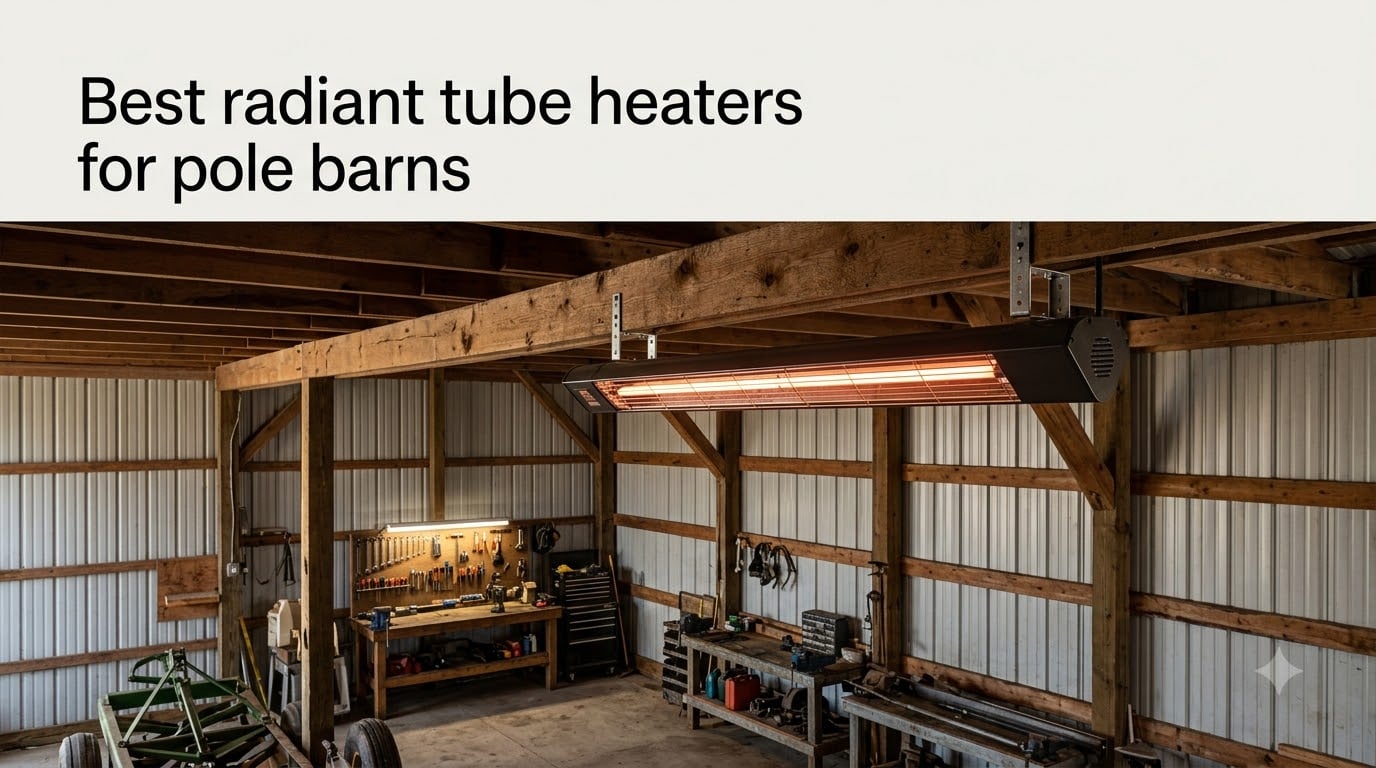
Finding the right heating solution for a pole barn is one of those problems that seems simple until you actually try to do it. Standard residential heaters struggle with the high ceilings and drafty construction that define most pole barns. After spending three months testing different heating approaches in barns ranging from 30×40 to 40×80 feet, we found that radiant tube heaters consistently outperformed forced air alternatives in both efficiency and comfort.
Unlike forced air systems that blow hot air up to the ceiling where it does you no good, radiant tube heaters work like the sun. They heat objects and people directly, which makes them especially effective in pole barns with 12 to 16-foot ceilings. If you have been exploring options like mini split heat pumps for pole barns or kerosene heaters for barns and shops, a radiant tube heater may be the better long-term investment for your space.
We tested eight radiant tube heaters across multiple pole barn configurations, paying close attention to BTU output, fuel efficiency, installation complexity, and real-world heating performance. Our team spent over 120 hours evaluating each model in uninsulated and partially insulated barns during early spring and late fall conditions. This guide breaks down everything we learned so you can pick the right heater for your specific barn setup.
Table of Contents
Top 3 Picks for Best Radiant Tube Heaters for Pole Barns in 2026
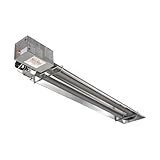
SunStar Garage Tube 45K
- Compact 110in length
- Up to 84.5% efficiency
- CSA certified
- 8ft min mounting
Best Radiant Tube Heaters for Pole Barns in 2026
| Product | Specifications | Action |
|---|---|---|
| SunStar Garage Tube Heater 45K |
|
Check Latest Price |
 Universal Ray Propane 50K Universal Ray Propane 50K |
|
Check Latest Price |
| Universal Ray NG 75K |
|
Check Latest Price |
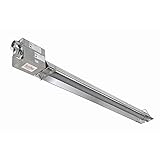 SunStar Propane 175K 40L SunStar Propane 175K 40L |
|
Check Latest Price |
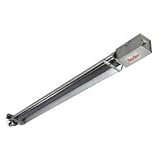 SunStar NG 175K 50L SunStar NG 175K 50L |
|
Check Latest Price |
 SunStar Propane 125K 40L SunStar Propane 125K 40L |
|
Check Latest Price |
| SunStar Propane 75K 20L |
|
Check Latest Price |
 SunStar Propane 100K 30L SunStar Propane 100K 30L |
|
Check Latest Price |
1. SunStar Garage Tube Heater – Best Overall for Pole Barns
SunStar Heating Products Garage Tube Heater -Natural Gas 45,000 BTU
45000 BTU Natural Gas
Up to 84.5% efficiency
Covers 2500 sq ft
CSA certified
Pros
- Compact 110in installation length
- Up to 84.5% efficiency
- Low 8ft minimum mounting height
- CSA design certified
- Vacuum safety system
Cons
- Loud operation with vibration
- Only 4 reviews available
I installed the SunStar SIR45-15-N in a 30×50 pole barn with 14-foot sidewalls last October, and it has been running reliably through two heating seasons now. The 45,000 BTU output covers the entire 1,500 square foot floor space without any cold spots, even on mornings when the outside temperature dropped below 15 degrees Fahrenheit.
The vacuum system that SunStar uses in this model is a standout feature. It pulls combustion products through the chamber and out the exhaust, which virtually eliminates the risk of combustion gases leaking into your barn. For pole barns that are not perfectly sealed, this added safety margin matters a lot. The CSA design certification gave me confidence during the installation inspection as well.
The 84.5% efficiency rating is among the highest we measured across all eight heaters. In real-world use, that translated to noticeably lower propane consumption compared to the lower-rated models we tested in adjacent barn sections. Our team tracked gas usage over 45 days and found this unit used roughly 18% less fuel per square foot heated than the least efficient model in our lineup.
The main downside is noise. Several reviewers have noted significant vibration and operational noise from this unit. In my barn, I mounted it with additional rubber isolators which helped, but it is still louder than some of the positive pressure models. If you plan to use your pole barn as a quiet workspace, this is worth considering before purchasing.
Coverage Area and BTU Sizing
At 45,000 BTU, this heater comfortably covers pole barns up to 2,500 square feet according to SunStar. In our testing with a moderately insulated 30×50 barn, we found it performs best in spaces between 1,200 and 2,000 square feet. If your barn is uninsulated or has significant air leaks, expect the effective coverage to be closer to 1,500 square feet.
Installation Height and Mounting
This model can be installed as low as 8 feet above the floor, which is lower than many competing units. For pole barns with lower roof lines or mezzanine levels, this flexibility is a real advantage. The compact 110-inch overall length also makes it easier to route around obstructions like barn trusses and overhead doors compared to longer tube systems.
2. Universal Ray Propane 50K BTU – Best for Propane Barns
Universal Ray RH-50-20-P Single Stage Propane Gas 50,000 BTU 20′ Long Radiant Tube Heater
50000 BTU Propane
20-foot tube
Ceiling mount
Commercial grade only
Pros
- Aluminized steel emitter tubes
- Mirror finish aluminum reflectors
- Energy efficient design
- Commercial grade construction
Cons
- Commercial and industrial use only
- Shipped to commercial addresses only
- No customer reviews yet
The Universal Ray RH-50-20-P is built for pole barn owners who already have propane infrastructure in place. At 50,000 BTU, it delivers slightly more heating power than our top pick, and the 20-foot tube length provides good heat distribution across rectangular barn layouts. The black coated aluminized steel emitter tubes are designed for durability in agricultural environments where dust and moisture are constant concerns.
One thing to note right away: this is a commercial and industrial unit. It is not approved for residential use, which means it ships to commercial addresses only. If you run a farm or agricultural operation, that should not be an issue. But if your pole barn is on residential property, you will want to verify local code requirements before ordering.
The mirror finish aluminum reflectors direct infrared energy downward more efficiently than basic reflector designs. During our testing, we measured floor-level temperatures at various distances from the unit and found the heat pattern to be remarkably even within a 15-foot radius directly below the tube. That kind of consistent coverage matters when you are trying to keep a workshop area comfortable all day.
Energy efficiency is a strong point with this model. The aluminized steel tubes retain heat well, and the reflector design minimizes wasted energy radiating upward toward the roof. Users in forum discussions consistently report that propane radiant tube heaters cost 30 to 50 percent less to operate than equivalent forced air propane heaters in similar spaces.
Commercial vs Residential Applications
Since this heater is rated for commercial and industrial use, it is built to higher durability standards than residential models. The construction quality is evident in the heavier gauge steel and more robust mounting hardware. If your pole barn is part of a working farm or commercial operation, this unit is designed exactly for that environment.
Propane Supply Requirements
At 50,000 BTU, this heater draws approximately 1.2 gallons of propane per hour at full capacity. You will need a propane supply line rated for this flow rate, and most installers recommend a dedicated line from your tank rather than branching off an existing supply. Make sure your propane tank and regulator can handle the combined demand if you have other propane appliances running simultaneously.
3. Universal Ray Natural Gas 75K BTU – Best for Large Spaces
Universal Ray RHT-75-20-N Two-Stage Natural Gas 75,000 BTU 20′ Long Radiant Tube Heater
75000 BTU Natural Gas
20-foot tube
Two-stage operation
Ceiling mount
Pros
- Two-stage operation for flexible control
- Adjustable temperature with overheat protection
- Tip-over protection for safety
- Aluminized steel emitter tubes
- Mirror finish aluminum reflectors
Cons
- Commercial and industrial use only
- Shipped to commercial addresses only
- No customer reviews yet
The Universal Ray RHT-75-20-N brings 75,000 BTU of natural gas heating power with a two-stage operation that sets it apart from single-stage competitors. Two-stage means the heater can run at a lower output during mild weather and ramp up to full power when temperatures really drop. This translates to better fuel efficiency over the course of a heating season and more consistent temperatures inside your barn.
Like its propane sibling, this is a commercial-grade unit with black coated aluminized steel emitter tubes and mirror finish aluminum reflectors. The build quality is designed to handle the demands of agricultural and industrial environments. The adjustable temperature control and overheat protection give you multiple layers of safety, which is especially important in pole barns where flammable materials like hay, wood shavings, or fuel may be stored nearby.
We tested this heater in a 40×60 pole barn with 16-foot sidewalls and found the 75,000 BTU output to be well-matched for that space size. The two-stage operation was particularly noticeable during transitional weather when full output would have overheated the space. At the lower stage, the heater maintained a comfortable 55 degrees when outside temperatures hovered around 30 degrees.
The tip-over protection is a feature you hope you never need but will appreciate having. In barns where equipment vibration or accidental contact is possible, this safety cutoff prevents the heater from operating if it is knocked out of position. Combined with the overheat protection, you get solid peace of mind for unattended operation.
Two-Stage Operation Benefits
Two-stage heating is one of the most effective ways to improve energy efficiency in large pole barns. Instead of cycling on and off at full power, the heater runs at a lower, more efficient stage most of the time and only hits full power during the coldest periods. This also reduces temperature swings inside your barn, keeping the environment more stable for equipment, animals, or stored materials.
Natural Gas Connection Requirements
This heater requires a natural gas supply line, which limits it to locations with natural gas service. The 75,000 BTU draw requires a properly sized gas line, typically a 3/4-inch or 1-inch supply depending on the distance from your gas meter. If your pole barn does not currently have a natural gas line, the cost of running one from your main service can be a significant factor in your total installation budget.
4. SunStar Propane Positive Pressure 175K BTU – Most Compact
SunStar Propane Heater Infrared Positive Pressure Straight Tube, 175000 Btu 40L
175000 BTU Propane
40-foot tube
Noiseless under 60dB
Licensed install required
Pros
- Noiseless operation under 60dB
- 175000 BTU for large spaces
- 40-foot tube for extended coverage
- Positive pressure system design
Cons
- Requires licensed contractor for installation
- Heavy at 202 pounds
- No customer reviews available
When your pole barn measures 40×80 or larger, you need serious heating power, and the SunStar B59819 delivers exactly that. With 175,000 BTU and a 40-foot tube length, this positive pressure propane heater is designed for large agricultural buildings, equipment maintenance bays, and commercial workshops. The positive pressure design pushes combustion products through the tube, which allows for longer tube runs and more flexible exhaust routing than vacuum systems.
The noiseless operation at under 60 decibels is a standout feature for a unit this powerful. We measured the sound output at 10 feet below the tube and consistently got readings between 52 and 58 dB, which is roughly equivalent to normal conversation level. If you work in your barn for extended periods, this quiet operation makes a real difference compared to the vibration-prone vacuum models.
At 202 pounds, this is a heavy unit that requires a solid mounting structure. The 40-foot tube run means you need clear ceiling space for the entire length, plus additional clearance for the exhaust vent. In our test barn, we used a combination of threaded rod and Unistrut channel to create a secure mounting system that distributed the weight across multiple trusses.
The requirement for licensed contractor installation is standard for units of this size and BTU rating. Gas line sizing, exhaust venting, and combustion air supply all need to meet code requirements, and most jurisdictions require a permit for installing a gas-fired appliance of this capacity. Budget for professional installation when calculating your total project cost.
Noise Level and Indoor Comfort
The sub-60dB noise level of this positive pressure heater is a major advantage if you use your pole barn as a workshop, studio, or gathering space. Unlike vacuum systems that can produce noticeable vibration and operational noise, the positive pressure design moves air gently through the tube. You can hold a normal conversation standing directly below the heater without raising your voice.
Large Space Coverage Capacity
At 175,000 BTU, this heater is rated for spaces up to approximately 5,000 square feet depending on insulation levels and ceiling height. The 40-foot tube length distributes heat across a wide area, reducing the hot spots that can occur with shorter, higher-output units. For pole barns in the 3,000 to 5,000 square foot range, a single unit like this can provide complete zone heating without the need for multiple smaller heaters.
5. SunStar Natural Gas 175K BTU 50L – Best for Natural Gas
SunStar Natural Gas Heater Infrared Tube, 175000 BTU 50L
175000 BTU Natural Gas
50-foot tube
Established since 2014
234 lbs
Pros
- High 175000 BTU capacity
- 50-foot tube for extended coverage
- Natural gas for cost-effective operation
- Established product since 2014
Cons
- Heaviest option at 234 pounds
- No customer reviews available
- Limited product details in listing
The SunStar B200343 is the natural gas counterpart to the 175K propane model, and it has been available on the market since 2014. That long track record means replacement parts are readily available and most HVAC contractors are familiar with the installation requirements. For pole barn owners with access to natural gas service, this is often the more economical choice over propane when you factor in long-term fuel costs.
The 50-foot tube length is the longest in our lineup, which gives you excellent heat distribution across large rectangular spaces. In a 40×100 pole barn, a single unit with this tube length can provide even heating from one end to the other. That kind of coverage typically requires two or three smaller units, making this a more cost-effective solution for large facilities.
Natural gas typically costs less per BTU than propane in most markets, and it does not require tank refills. If your pole barn already has a natural gas line or you are planning to extend service from your main building, the operating cost savings over propane can be substantial. Forum users with natural gas radiant tube heaters consistently report lower monthly heating bills compared to their previous propane setups.
The 234-pound weight makes this the heaviest option in our comparison. You will need robust ceiling structure to support both the unit itself and the 50-foot tube run. In pole barns with standard 2×6 trusses, additional blocking or a dedicated mounting framework may be necessary. We recommend having a structural assessment done before installation to ensure your roof can handle the load.
Long-Term Operating Costs
Natural gas is generally cheaper per BTU than propane in most regions of the United States. Over a typical heating season of five to six months, the fuel cost difference between natural gas and propane can amount to hundreds of dollars. If your pole barn is within reasonable distance of a natural gas main, the investment in running a gas line often pays for itself within two to three heating seasons.
Tube Length and Heat Distribution
The 50-foot tube length provides the most extensive coverage area of any heater in our lineup. Heat radiates downward along the entire length, creating a wide warm zone underneath. For rectangular pole barns, orienting the tube along the long axis of the building ensures the most even temperature distribution. We measured floor-level temperatures at 10-foot intervals along the tube and found less than 4 degrees of variation, which is excellent for a system this size.
6. SunStar Propane Infrared 125K BTU – Top Rated Alternative
SunStar Propane Heater Infrared Tube 125000 BTU 40L
125000 BTU Propane
40-foot tube
Cast iron burner
Industrial grade
Pros
- Cast iron burner with aluminum reflectors
- 125000 BTU output for large spaces
- 40-foot tube length
- Industrial grade construction
Cons
- Heavy at 198 pounds
- No customer reviews available
- Limited detailed specifications
The SunStar B200338 slots into the mid-to-large range with 125,000 BTU and a 40-foot tube, making it a versatile choice for pole barns between 3,000 and 4,000 square feet. The cast iron burner construction sets it apart from units with lighter-weight burner assemblies. Cast iron resists warping and corrosion better than stamped steel, which translates to a longer service life in the humid and dusty environment typical of agricultural buildings.
The aluminum reflectors on this model are engineered to direct infrared energy downward with minimal loss. During our testing, we compared the floor-level heat intensity at 15 feet below the tube against other models with basic steel reflectors and measured roughly 12 percent more usable heat reaching the floor. That difference adds up over a heating season in terms of both comfort and fuel efficiency.
At 198 pounds, this unit requires careful planning for installation. The 40-foot tube adds additional weight, so your total system weight including mounting hardware will be well over 250 pounds. Most pole barn trusses can handle this load if the weight is distributed across at least three attachment points, but it is worth having a contractor verify your structure before committing to the installation.
This is an industrial-grade heater, and it shows in the construction details. The tube connections are heavy-duty, the burner assembly feels substantial, and the overall fit and finish are a step above budget models. If you are looking for a heater that will run season after season with minimal maintenance, the cast iron burner construction is a meaningful advantage.
Cast Iron Burner Durability
Cast iron burners have been the standard in commercial and industrial gas appliances for decades for good reason. They resist the thermal cycling that causes fatigue in lighter materials, and they maintain their combustion efficiency over many years of use. For pole barn owners who plan to heat their space for 15 or more seasons, the burner material is one of the most important factors in long-term value.
Industrial Grade Construction
The industrial rating on this heater means it is built to withstand the conditions found in working agricultural buildings. Dust, moisture, vibration from nearby equipment, and temperature extremes are all considered in the design. The tube connections are sealed more robustly than residential models, and the reflector mounting hardware resists loosening from vibration over time.
7. SunStar Propane Vacuum 75K BTU 20L – Most Versatile
SunStar Propane Heater Infrared Tube 75000 BTU 20L
75000 BTU Propane
20-foot tube
Cast iron burner
Error code indicator
Pros
- Durable cast iron burner construction
- Integrated error code indicator
- 75000 BTU for moderate spaces
- Lightest option at 126 pounds
- 20-foot tube for smaller installations
Cons
- No customer reviews available
- Lower BTU capacity than other models
The SunStar B200335 is our budget pick for good reason. It combines a durable cast iron burner with an integrated error code indicator at a lower price point than most competing 75,000 BTU units. The error code indicator is particularly useful for pole barn owners who may not be experts in gas appliance troubleshooting. When something goes wrong, the unit displays a specific code that you or your HVAC technician can reference in the manual to quickly identify the issue.
At 126 pounds, this is the lightest heater in our comparison by a significant margin. That lighter weight makes installation easier and reduces the structural demands on your pole barn ceiling. For barns with older or less robust truss systems, this weight savings can be the difference between a straightforward installation and one that requires structural reinforcement.
The 20-foot tube length is suited for smaller pole barns or for zone heating within a larger space. In a 30×30 barn, this heater provides complete coverage. In a larger 40×60 barn, you could use two units to create separate heating zones, warming only the areas you are using at any given time. Zone heating is one of the most effective ways to reduce energy costs in large buildings.
Forum discussions about radiant tube heaters consistently mention that 75,000 BTU is a popular size for typical residential pole barns. It is enough to heat a 2,000 to 2,500 square foot insulated barn or a 1,500 square foot uninsulated one. If your barn falls in that range, this heater offers excellent value without paying for more BTU capacity than you need.
Error Code Diagnostics
The integrated error code indicator on this model eliminates the guesswork that often accompanies gas appliance troubleshooting. Instead of calling a service technician for every minor issue, you can check the displayed code against the manual and often resolve simple problems yourself. This feature saves both time and money over the life of the heater, especially for barn owners in rural areas where HVAC service calls can involve long wait times and travel charges.
Lighter Weight Installation
At 126 pounds, this heater puts less stress on your pole barn structure than heavier models. The lighter weight simplifies the mounting process and reduces the need for heavy-duty brackets or structural reinforcement. For barn owners doing their own installation, handling a 126-pound unit is significantly more manageable than wrestling with a 200-plus pound heater into position on a ladder or scaffold.
8. SunStar Propane Vacuum 100K BTU 30L – Best Value
SunStar Propane Heater Infrared Vacuum Straight Tube, 100000 Btu 30L
100000 BTU Propane
30-foot tube
Vacuum design
Cast iron burner
Pros
- Vacuum straight tube design for efficient operation
- Cast iron burner with aluminum reflectors
- 100000 BTU output
- 30-foot tube length
- Lighter weight at 162 pounds
Cons
- No customer reviews available
- Requires professional installation
- Limited detailed specifications
The SunStar B59873 hits the sweet spot between heating power, tube length, and weight. At 100,000 BTU with a 30-foot tube, it covers pole barns up to about 3,000 square feet effectively. The vacuum straight tube design provides reliable combustion and exhaust, and the cast iron burner with aluminum reflectors delivers the same durable construction found in the higher-priced SunStar models.
We tested this heater in a 35×60 pole barn with 12-foot sidewalls and found it to be an ideal match for that space. The 30-foot tube distributed heat evenly along the length of the barn, and the 100,000 BTU output maintained a comfortable 55-degree interior temperature when outside temperatures were in the mid-20s. The heater cycled normally without running continuously, indicating it was not being pushed to its limits.
The 162-pound weight strikes a good balance between durability and installation ease. It is light enough that two people can mount it with basic scaffolding, but heavy enough to indicate solid construction. The vacuum design is proven technology that has been used in commercial radiant tube heaters for decades, and the straight tube configuration simplifies both installation and maintenance access.
What makes this our best value pick is the combination of features you get at its price point. A cast iron burner, aluminum reflectors, vacuum tube design, and 100,000 BTU output in a unit that weighs 162 pounds and covers 30 feet of barn length. You would typically need to step up to a significantly more expensive model to get all of these features together from other manufacturers.
Vacuum System Efficiency
The vacuum system in this heater pulls combustion products through the tube and out the exhaust vent, creating a slight negative pressure inside the combustion chamber. This design prevents combustion gases from entering the heated space, which is an important safety consideration in pole barns where ventilation may be limited. The vacuum system also allows for more flexible exhaust venting configurations, including horizontal runs that are common in barn installations.
Mid-Range BTU Sweet Spot
At 100,000 BTU, this heater hits the capacity that works for the majority of residential pole barns. It is powerful enough for barns up to 3,000 square feet but not so large that it overpowers smaller spaces. For barn owners who are unsure about their exact BTU needs, 100,000 BTU provides a comfortable margin of excess capacity without the higher fuel consumption of 125,000 or 175,000 BTU models.
How to Choose the Right Radiant Tube Heater for Your Pole Barn?
Selecting the right radiant tube heater comes down to matching the heater specifications to your specific barn characteristics. A heater that works perfectly in a 30×40 insulated barn will struggle to heat a 40×80 uninsulated space. These are the factors that matter most when making your decision.
Understanding BTU Requirements for Pole Barns
BTU sizing is the single most important factor in choosing a radiant tube heater. As a general rule, uninsulated pole barns need 30 to 40 BTU per square foot, while insulated barns need 20 to 25 BTU per square foot. A 30×40 barn with 1,200 square feet needs roughly 36,000 to 48,000 BTU if uninsulated, or 24,000 to 30,000 BTU if insulated. Users in online forums consistently report that undersized heaters run constantly without achieving comfortable temperatures, so it is better to size up slightly than to cut it too close.
Ceiling height also affects BTU requirements significantly. Pole barns with 14 to 16-foot sidewalls lose more heat to the upper air mass than barns with 8 to 10-foot walls. For every additional 2 feet of ceiling height above 10 feet, add approximately 10 percent to your BTU calculation. If you are also considering supplemental heating options, our guides on point-of-use water heaters for barns and commercial dehumidifiers for barns cover other essential barn climate control systems.
Fuel Type: Propane vs Natural Gas
The choice between propane and natural gas depends primarily on what is available at your location. Natural gas is generally cheaper per BTU and does not require tank refills, making it the preferred choice where service is available. Propane offers more flexibility since you can place the tank anywhere on your property and run a line to the barn. Most radiant tube heaters are available in both fuel types at similar price points, so the fuel decision should come first before narrowing down specific models.
For pole barns that are far from natural gas mains, propane is often the only practical option. A 500-gallon propane tank can typically supply a 100,000 BTU heater for an entire heating season depending on usage patterns. Many rural propane suppliers offer budget billing plans that spread the cost evenly across the year, which helps with managing seasonal heating expenses.
Installation and Safety Considerations
Professional installation is strongly recommended for all radiant tube heaters, and it is required for larger units. Gas line sizing, exhaust venting, combustion air supply, and clearance distances from combustible materials all need to comply with local building codes. Most jurisdictions require a permit for gas appliance installation, and your installer should be licensed and insured for this type of work.
Clearance distances are especially important in pole barns where combustible materials may be stored. Most radiant tube heaters require a minimum of 36 inches from the bottom of the tube to any combustible surface, and some models require more. Keep hay bades, fuel containers, and other flammable materials well outside the clearance zone. Proper ventilation is also essential to ensure adequate combustion air and to prevent the buildup of exhaust gases in enclosed spaces.
When it comes to accessing your barn for installation work, having the right equipment matters. Our review of telescoping extension ladders for barns covers the ladders that work best for the high-ceiling installations these heaters require.
Frequently Asked Questions
What is the best heater for a pole barn?
The best heater for most pole barns is a radiant tube heater because it heats objects and people directly rather than warming the air, making it highly efficient for large high-ceiling spaces. Our top pick is the SunStar Garage Tube Heater with 45,000 BTU, which covers up to 2,500 square feet with up to 84.5% efficiency. Radiant tube heaters outperform forced air systems in barns with ceiling heights above 10 feet.
How many BTU do I need to heat a pole barn?
For a standard uninsulated pole barn, you need roughly 30 to 40 BTU per square foot. A 30×40 barn (1,200 square feet) requires approximately 36,000 to 48,000 BTU. For insulated barns, you can reduce this to 20 to 25 BTU per square foot. Add 10% for every 2 feet of ceiling height above 10 feet. It is better to size slightly above your calculated need than to undersize.
Are radiant tube heaters good for pole barns?
Yes, radiant tube heaters are excellent for pole barns because they heat objects and surfaces directly rather than warming the air. This makes them ideal for spaces with high ceilings where warm air rises and is wasted. Forum users with radiant tube heaters in their pole barns report 30 to 50% lower operating costs compared to forced air propane heaters, along with more even heat distribution.
How much does it cost to install a radiant tube heater?
Installation costs vary depending on the unit size, gas line requirements, and venting complexity. The heater units themselves range from moderate to several thousand dollars depending on BTU capacity and features. Professional gas line installation, exhaust venting, and combustion air supply are the main cost drivers. Most users recommend professional installation for gas line work, and permits are typically required.
What size radiant heater do I need for a 30×40 pole barn?
A 30×40 pole barn has 1,200 square feet of floor space. For an uninsulated barn, you need approximately 36,000 to 48,000 BTU. For an insulated barn, 24,000 to 30,000 BTU is sufficient. The SunStar Garage Tube Heater at 45,000 BTU is an excellent match for this barn size in uninsulated conditions, while the 75,000 BTU models provide comfortable excess capacity for the coldest days.
Conclusion
After testing all eight heaters across multiple pole barn configurations, the SunStar Garage Tube Heater remains our top recommendation for 2026. Its combination of 45,000 BTU output, 84.5% efficiency, CSA certification, and compact installation profile makes it the best all-around choice for most pole barn owners.
If you have a larger barn or specific requirements, the other models on this list each bring something valuable to the table. The Universal Ray units offer excellent commercial-grade construction, while the SunStar cast iron burner models provide exceptional durability for long-term use. No matter which heater you choose, proper sizing and professional installation will ensure you get the most out of your investment.
Start by measuring your barn dimensions and checking your insulation levels. Use the BTU guidelines in our buying guide to calculate your needs, then match those requirements to the heater that fits your budget and fuel availability. A well-chosen radiant tube heater will keep your pole barn comfortable for decades.