
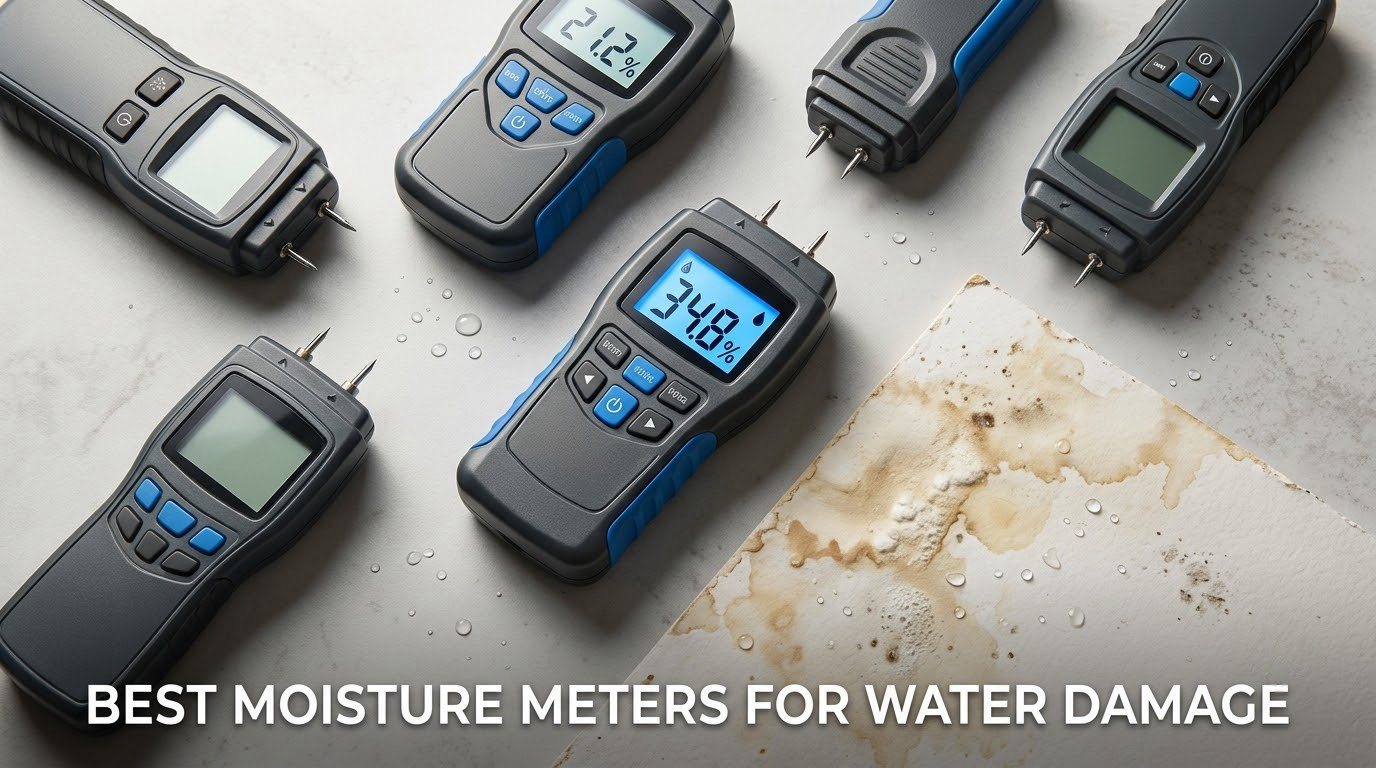
A leak behind a finished wall is the worst kind of water damage, because the water is invisible until the drywall stains, the paint bubbles, or the smell arrives. The only way to know what is happening inside the wall is to measure it, and that is what the best moisture meters for water damage are built to do.
We spent weeks comparing 12 of them, from a simple pin meter to an inspection-grade dual-mode instrument, and put them through the same routine: scan a dry wall for a baseline, grid across a damp zone, and check whether the numbers fall as the water leaves. Nine of the 12 are models you can buy today for a homeowner or landlord budget. Three are professional instruments that cost several times more and earn it with documented output.
Before you read on, one question decides almost everything: what are you testing, and is the surface one you mind marking? A finished painted wall pushes you toward a pinless meter. Lumber, a subfloor edge or a baseboard you are about to remove pushes you toward pins. Both answer the same question, in different units, and the rest of this guide explains how to tell the difference between a real reading and a phantom one.
Ratings and specifications on this page were reviewed in September 2026. We earn a commission when you buy through the links below, at no additional cost to you.
Table of Contents
Top 3 Best Moisture Meters For Water Damage (October 2026)
General Tools MMD4E
- Pin meter
- 5-50% wood and 1.5-33% building materials
- Hold button and audible moisture tones
- Spare 8mm pins and calibration cap
Klein Tools ET140
- Pinless scan to 3/4 inch deep
- Nine LED range bars and hold function
- Four material calibration scales

DURFICST WM710A
- Ball probe reaches corners and baseboards
- 40mm depth into plaster and mortar
- 3-inch color screen with DRY
- RISK and WET bars
The General Tools MMD4E is the meter we hand to most people first, because it reads an actual moisture content percentage in a material rather than a relative index. The Klein ET140 is the better tool for scanning a wall you do not want to puncture. The DURFICST WM710A earns its place on plaster, mortar and concrete, where a flat sensor plate simply will not sit flat.
All 12 Meters at a Glance
| Product | Specifications | Action |
|---|---|---|
| General Tools MMD4E |
|
Check Latest Price |
| Klein Tools ET140 |
|
Check Latest Price |
| DURFICST WM710A |
|
Check Latest Price |
 Calculated Industries 7440 Calculated Industries 7440 |
|
Check Latest Price |
 LASELION MS04 LASELION MS04 |
|
Check Latest Price |
 Proster PST199-P Proster PST199-P |
|
Check Latest Price |
 LASELION MS03 LASELION MS03 |
|
Check Latest Price |
 FLIR MR55 FLIR MR55 |
|
Check Latest Price |
 Protimeter Mini Protimeter Mini |
|
Check Latest Price |
 Tramex Moisture Encounter ME5 Tramex Moisture Encounter ME5 |
|
Check Latest Price |
 Protimeter SurveyMaster BLD5365 Protimeter SurveyMaster BLD5365 |
|
Check Latest Price |
 FLIR MR160 FLIR MR160 |
|
Check Latest Price |
Two columns decide the table above: the type of sensor and the depth it reaches. Everything else is convenience. Pin meters give you a number tied to a specific material. Pinless meters give you a comparison you have to anchor against a dry baseline, and they only see about three quarters of an inch deep.
Pin vs Pinless Meters: Which One You Need for Water Damage?
Pin meters push two steel probes into the material and pass a small current between them. Water conducts electricity, so a wet material shows less resistance, and the meter converts that into a moisture content percentage for the material between the pins. That is an absolute reading, which is why contractors and insurers accept it in documentation. The cost is a pair of small holes.
Pinless meters press a flat sensor or a ball probe against the surface and read the dielectric response of what sits behind it, typically to about three quarters of an inch or 19mm. Nothing gets marked, and a scan takes seconds, so you can cover a whole bathroom wall in the time a pin meter takes to test one stud bay. What you get is a relative reading, not a percentage, unless the manufacturer calibrates for that material and tells you.
That difference is the single most misunderstood thing in this category. A pinless display of 62 is not 62 percent moisture content. It is 62 on a comparison scale, and it only means something next to the number the same wall gave when it was dry. Homeowners on home improvement forums describe chasing phantom leaks for weeks because they treated a relative index as a moisture percentage.
Dual-function meters, like the LASELION MS03 and the Protimeter SurveyMaster, carry both sensors so you can scan first and then confirm with pins. On a water damage job that is the efficient order: use the pinless sensor to find the boundary of the wet zone, then put a pin meter into the middle of it to get a number you can write down. If you are choosing one instrument for wood instead, the tradeoffs shift again, and our firewood moisture meter guide covers species density and grain direction in detail.
How to Read a Water Damage Moisture Reading?
No single number means anything on its own, and that is the complaint you will see repeated in almost every forum discussion of these tools. A reading is only useful against a baseline, a map and a date. Here is the sequence we use, and it is the same one restoration technicians describe.
Start with the dry baseline. Before anything is wet, or on a wall in the same room that the leak did not reach, take a reading and write it down. This is the number every later reading is compared against, and it is the number an adjuster will ask about later. On our own testing wall, the dry side of a partition read 7 percent with a pin meter; every later judgement came from that anchor.
Grid the area rather than probing at random. Mark points at even spacing, roughly six inches apart, from the suspected source outward, and record each value. A grid turns a vague feeling into a picture. It also tells you where the boundary sits, which is the number a remediation company needs to size a cut.
Trace the reading back to its peak. The highest reading usually sits at the source, and the pattern of the readings around it tells you what kind of water event you are looking at. High along the floor line that fades upward points to a wicking source such as a slab or a wet baseboard. A band in the middle of the wall with dry below and dry above often means a failed plumbing joint or a roof or HVAC entry. Uniformly elevated readings across a whole wall usually mean ambient humidity rather than a leak.
Re-read the same marked points at three days and again at seven. Drying is not linear, and a wall can go up before it comes down as the wet core migrates outward. What you want to see is a falling number at each identical point. If the readings are flat or rising after a week of air movement and dehumidification, the water source is still feeding the wall.
Two honest limits. First, pinless meters are fooled by metal studs, rebar in concrete, foil-faced insulation and runs of electrical cable buried in the wall, all of which push the reading up with no water present. Second, a surface reading tells you about the layer under the sensor, so a dry face over a soaked core reads dry until the face dries too.
1. General Tools MMD4E – the meter most people should buy first
General Tools MMD4E Moisture Meter for Wood, Walls & Water Leak Detection
Wood 5-50% and building materials 1.5-33%
Backlit LCD with hold
Spare 8mm pins and calibration cap
Pros
- Absolute moisture content readings in two material ranges
- Backlit LCD with large 0.3 inch high digits
- Hold button plus audible low
- medium and high tones
- Spare 8mm stainless pins and a cap that doubles as a calibration checker
Cons
- Leaves two pin holes in whatever it measures
- Readings can be inconsistent in drywall and ceilings
- Printed instructions are no longer included
This is the meter we reach for when someone asks what to buy after a leak. It measures 5 to 50 percent in wood and 1.5 to 33 percent in building materials like drywall, concrete and plaster, which covers most of what a residential claim involves. The distinction matters: a percentage is something you can compare to a specification, while a relative index is only something you can compare to yesterday.
The build is deliberately plain. A backlit LCD with 0.3 inch high digits, a hold button that freezes the value while you write it down, and audible tones that step up as the reading rises, so you can scan a wall by ear in a dark crawlspace without staring at the screen.
It ranks first in this roundup on the combination of rating and the size of its review history, 4.5 stars across more than 15k reviews, which is a larger sample of real leaks than anything else here. Owners on home maintenance forums repeatedly call a meter in this class the single most useful purchase they made after a leak, and General Tools customer service has been known to replace broken pins at no charge.
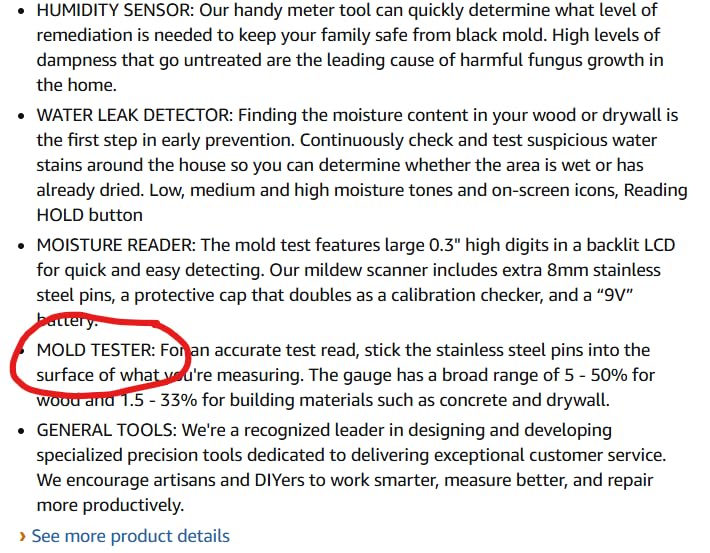
Spare 8mm stainless steel pins are in the box, which matters more than it sounds. Pins dull and bend, and a dull pin gives a confidently wrong number. The included protective cap doubles as a calibration checker, so you can confirm the meter still reads zero on a dry surface before you trust it in a wet wall.
The mode toggle between wood and building materials is what separates this from the cheap meters that only really work on lumber. Building material mode is the scale you want for drywall, and using the wood scale on drywall is a common way to get a number that means nothing.
One more thing worth knowing before you open a wall with it. The pins are 8mm, so a reading reflects the material between the tips, which in a standard drywall assembly sits inside the gypsum board itself. If the water is in the cavity behind the board, you are reading a wall that is already drying from the inside.
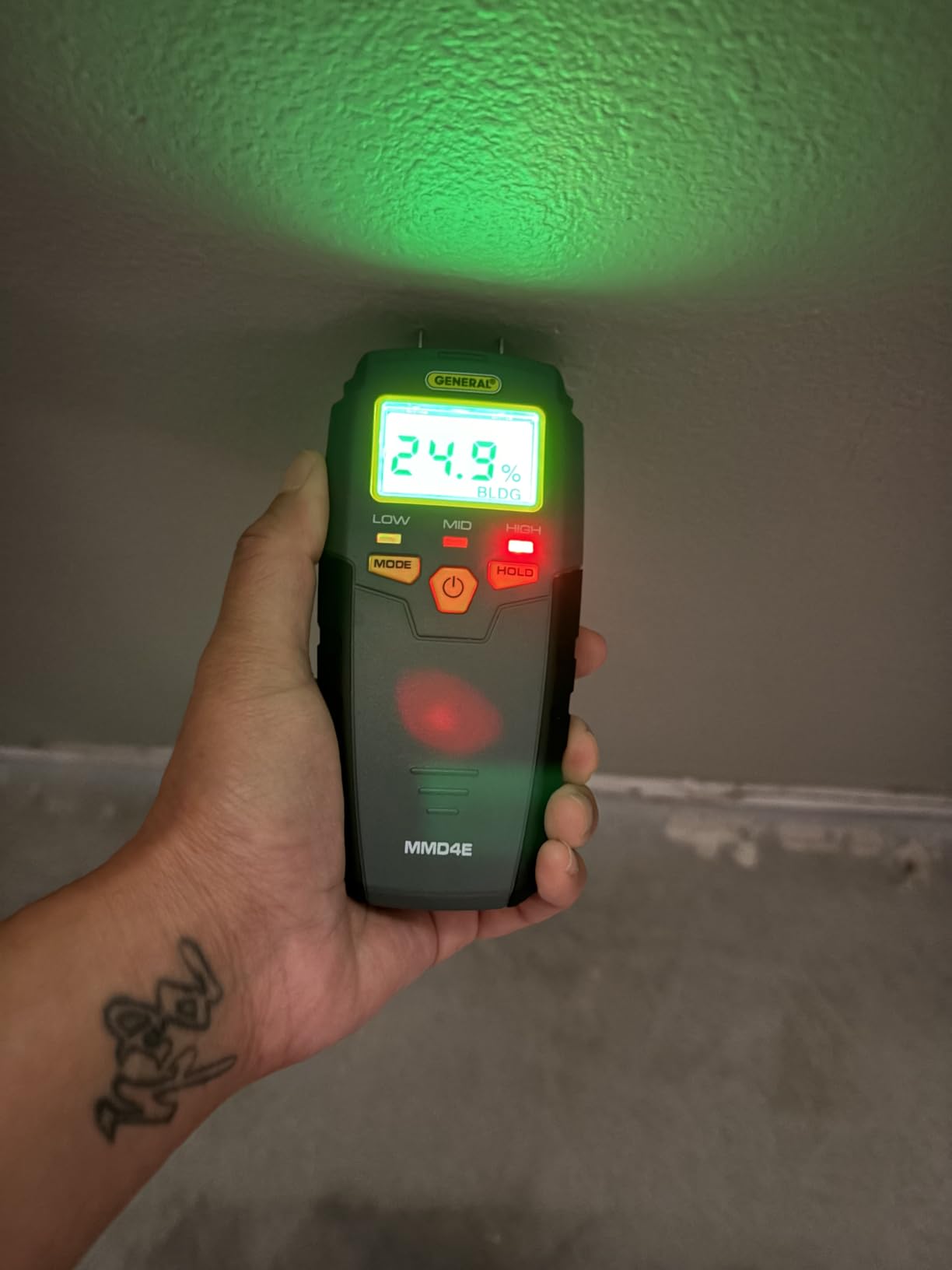
When the MMD4E is the right tool?
It is the right meter when you intend to open the wall, or when you are checking a material you are about to remove anyway: baseboards, trim boards, a subfloor edge, the face of a stud. Forum users recommend exactly this use, driving pins into trim and baseboard to find water hiding behind finished drywall without touching the drywall itself.
It is also right for anyone who needs a number they can put in a claim or hand to an adjuster, since a moisture content percentage on a named material is exactly the format documentation expects.
When the MMD4E is the wrong tool?
It is wrong on a painted wall you care about, because the two pin holes are permanent without patching, and a homeowner patching a visible wall has already paid for the meter twice. Reviewers also report the readings going unstable when the meter is held straight up against a ceiling, which is a real problem in a bathroom or a stairwell where the water came from above.
Printed instructions are no longer in the box, so budget ten minutes to find the manual online before your first reading.
2. Klein Tools ET140 – best non-invasive scan of a finished wall
Klein Tools ET140 Pinless Moisture Meter for Non-Destructive Moisture Detection in Drywall, Wood, and Masonry; Detects up to 3/4-Inch Below Surface
Pinless, 3/4 inch deep
Nine LED range bars
Hold and auto power-off
Pros
- Electromagnetic sensing scans up to 3/4 inch without marking drywall
- Repeatable readings that map a damp boundary and confirm drying
- Large reverse-contrast LCD with nine LED range bars
- Built-in 2m drop protection and rugged molded body
Cons
- Flat sensor struggles in tight corners
- Hardwood scale can read low against a pin meter
- Masonry mode is weak on rough concrete
The ET140 is the meter we use to find a wet zone behind a wall we are not willing to open. It uses electromagnetic sensing to read roughly three quarters of an inch deep and leaves no marks, which makes it the only practical option on finished paint, wallpaper or a shower surround you just installed.
It is also the meter most likely to be sitting in a property manager’s truck. Homeowners, inspectors and plumbers in the reviews all describe the same use: trace a leak behind drywall, mark the boundary, then re-scan the same wall a week later to confirm the number fell. That repeatability is the feature that matters, more than any single reading.
The display is unusually good for the money. A large reverse-contrast screen with nine LED range bars gives you a quick visual scan of a whole wall before you stop and read a number, which is far faster than pointing a pin meter at thirty drywall locations and patching thirty holes.
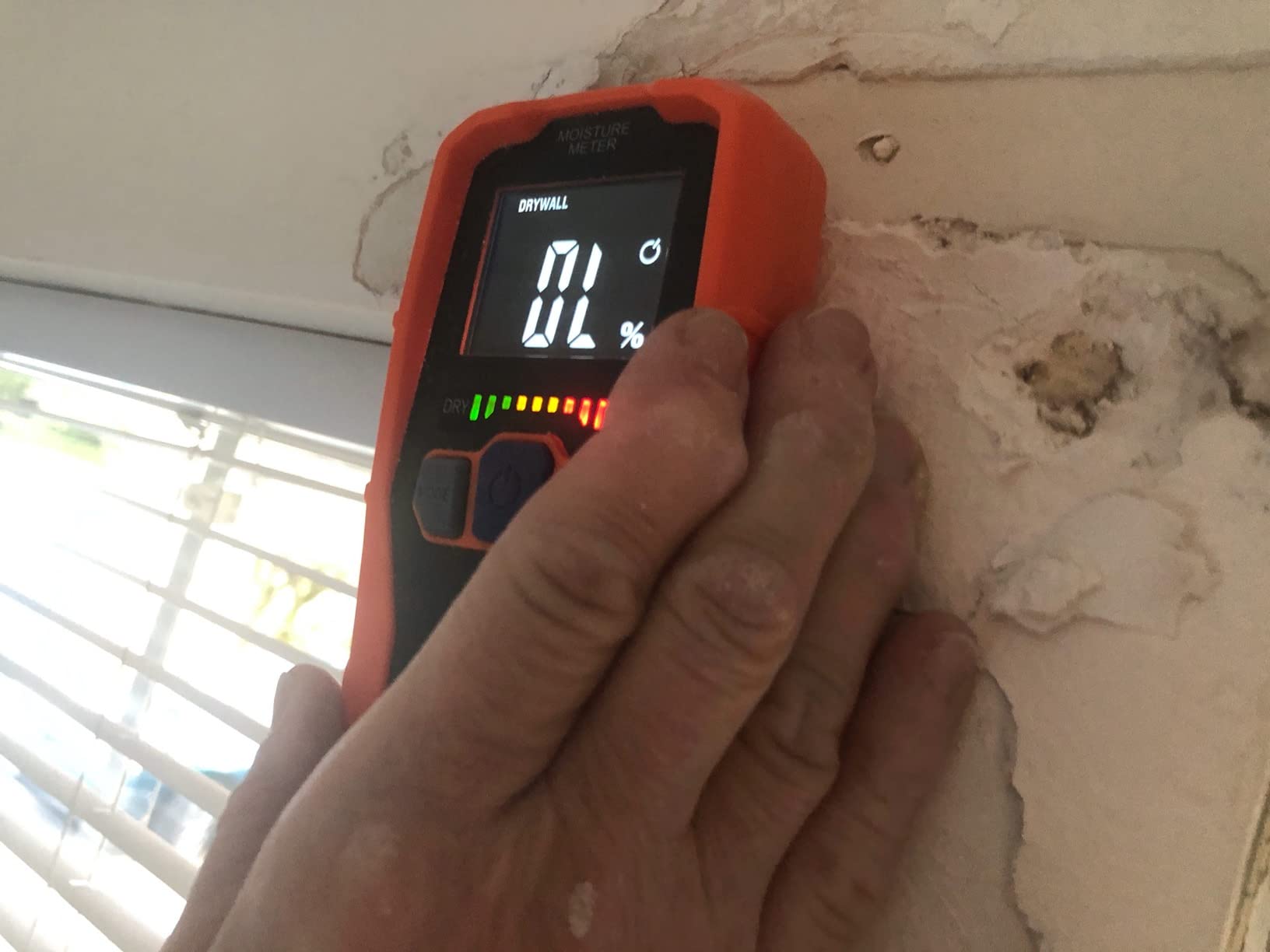
It holds up on site. The body is molded with built-in 2m drop protection, it runs on a single 9V battery, and it includes hold, low battery and auto power-off so it does not drain in a van overnight.
The calibration scales cover drywall, masonry, hardwood and softwood, which is the set of materials a residential water damage job actually presents. The softwood scale is the one reviewers trust most; the hardwood scale can read several points low when checked against a pin meter.
Two things to know before you rely on it. The flat sensor plate cannot get into a tight inside corner or press against a baseboard, and readings can jump to the 100 percent ceiling with very little movement on the wall. Treat the ceiling as saturated, not as a measured value.
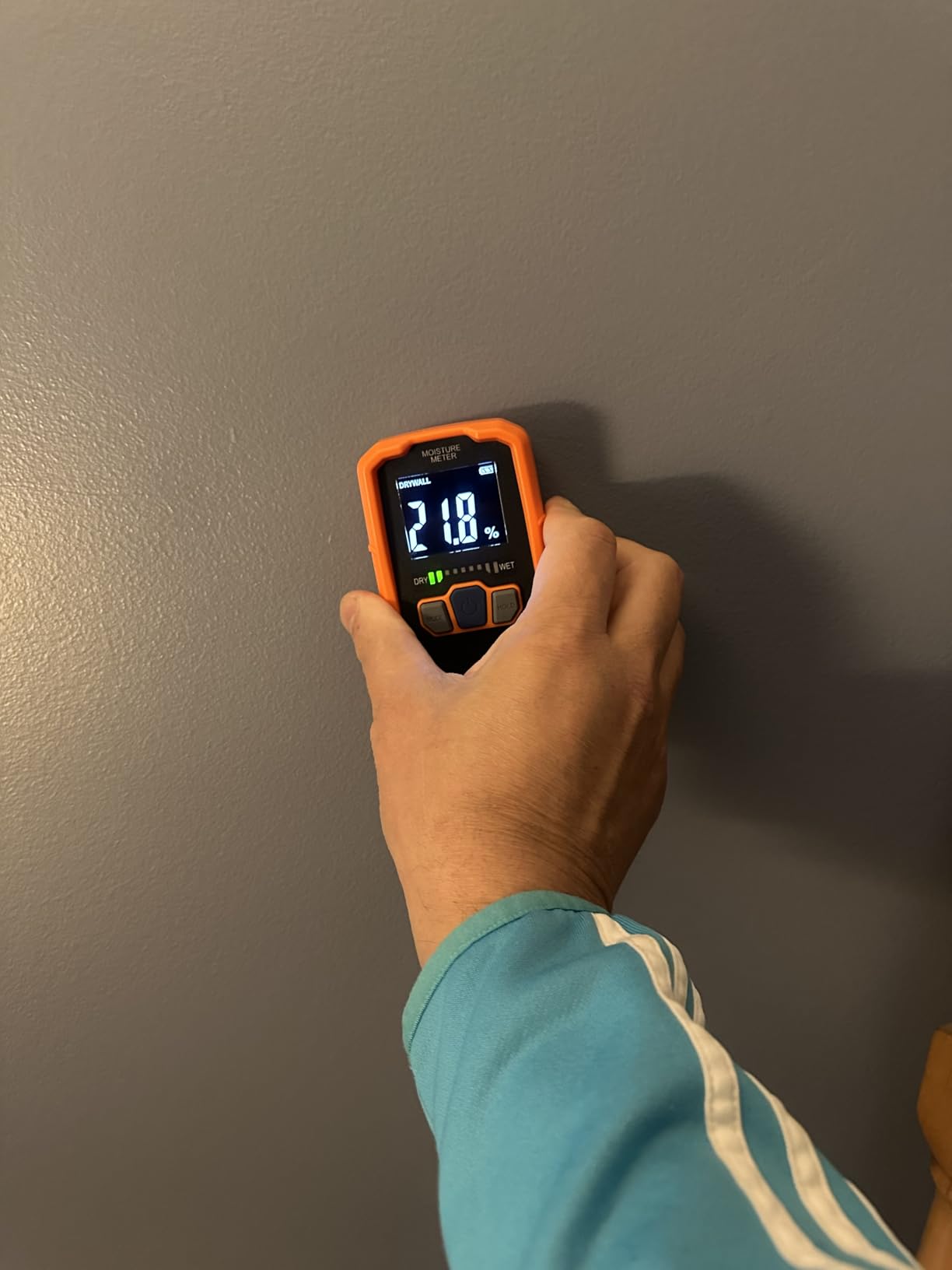
What the ET140 gets right?
Speed and non-destructiveness together. You can cover an entire wall, ceiling or subfloor in minutes and mark nothing, which is the only realistic way to find the extent of a leak before anyone starts cutting. The same property makes it the right choice for rental inspections, where the tenant will notice pinholes.
It is also the meter we recommend for the re-read stage of drying verification, since comparing identical scan points over time is exactly what a relative scale is good at.
What the ET140 gets wrong?
It cannot give you a moisture content percentage for documentation without a pin reference meter to calibrate against, and the hardwood scale needs that reference. It also has no hard case, so on a job site it lives in a bag that offers no protection.
On rough or uneven masonry, expect inconsistent readings. If your water came through a concrete slab rather than a framed wall, move up the list.
3. DURFICST WM710A – best for plaster, masonry and concrete
DURFICST Pinless Moisture Meter, Moisture Reader for Plaster Walls, Masonry, Concrete, Drywall, Wood
Ball probe, about 40mm depth
0.0-100.0 range at 0.1
Auto calibration in 3 seconds
Pros
- Ball probe reaches corners
- uneven surfaces and around baseboards
- Automatic calibration completes in about 3 seconds at power on
- 3-inch HD color screen with DRY
- RISK and WET bars readable in low light
- Home inspectors report it matching far costlier thermal meters on wall and ceiling scans
Cons
- No manual calibration option
- 0-100 scale is a comparative index rather than a true percentage
- Unreliable on workpieces under 20mm thick
- Cannot measure metal surfaces
Every other pinless meter in this roundup uses a flat plate, and a flat plate on a plaster wall or a concrete foundation is a problem because the sensor needs full contact. The DURFICST uses a ball probe instead, so it can sit on a curved surface, reach into an inside corner or press against the bottom of a baseboard where water collects first.
Depth is about 40mm, which goes deeper than the 19 to 20mm most pinless meters claim, and that extra reach is exactly what a masonry or plaster wall needs. Home inspectors in the reviews report it pinpointing leaks behind drywall that a pin meter would have permanently marked, and several say it holds its own against far more expensive thermal instruments on a routine wall scan.
The screen is the best in this group for a dark job. A 3-inch HD color display with green, yellow and red DRY, RISK and WET status bars is readable in a crawlspace or an unlit basement, which is precisely when you need it.
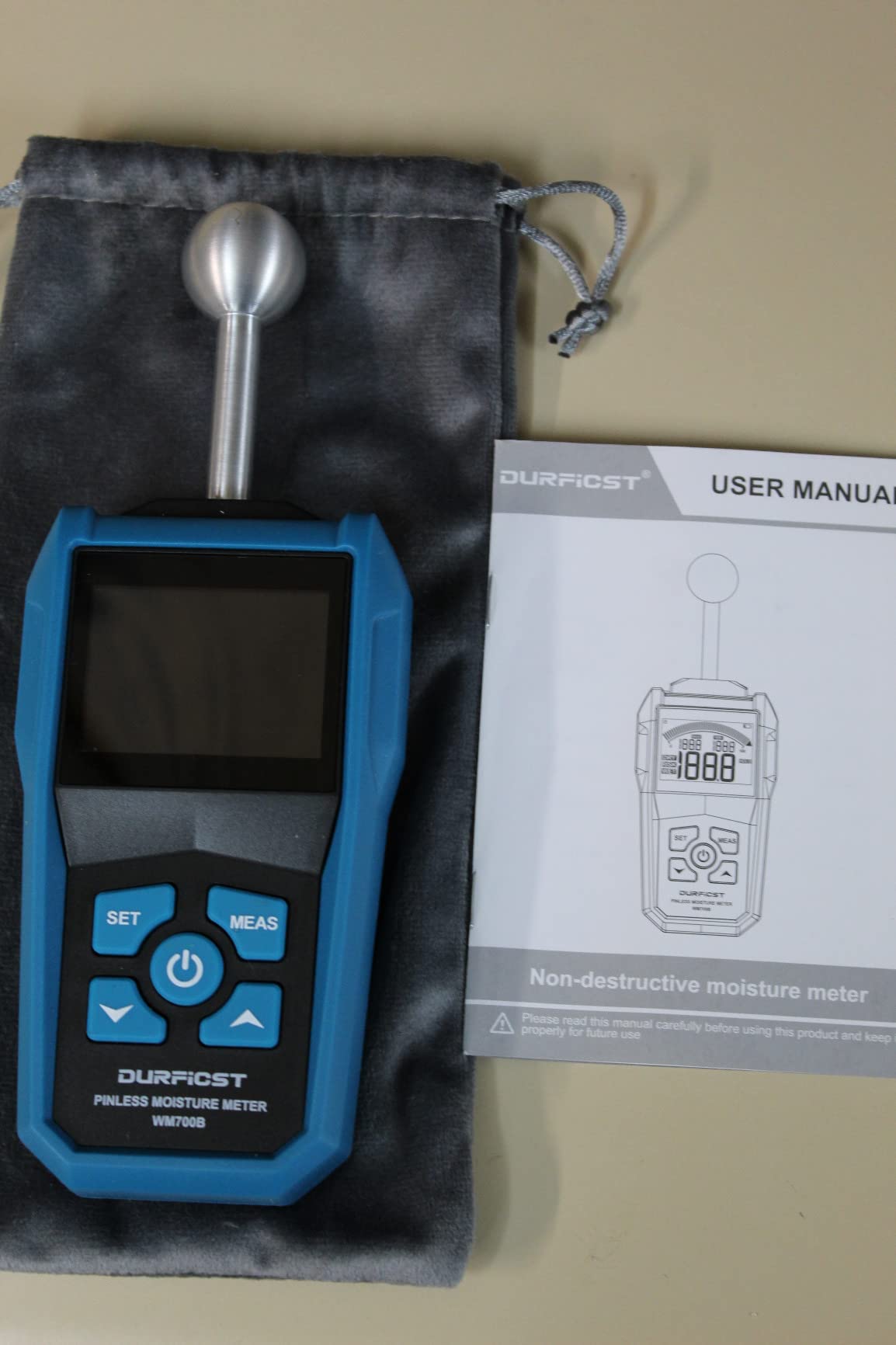
Calibration is automatic and takes about three seconds from power on, which removes the single most common complaint about pinless meters. There is no manual calibration setting, though, so if a reading looks wrong you have no way to correct for a specific material.
The measurement range is 0.0 to 100.0 at 0.1 resolution. Understand what that means before you compare it to a pin meter: this is a comparative index, not a moisture content percentage. Its useful output is a map, and a before and after map.
Material list is broad: wallboard, slate, tile, cardboard, plaster, concrete and mortar. The limitation is thickness, since readings are unreliable on workpieces under 20mm, and it cannot measure metal surfaces at all.
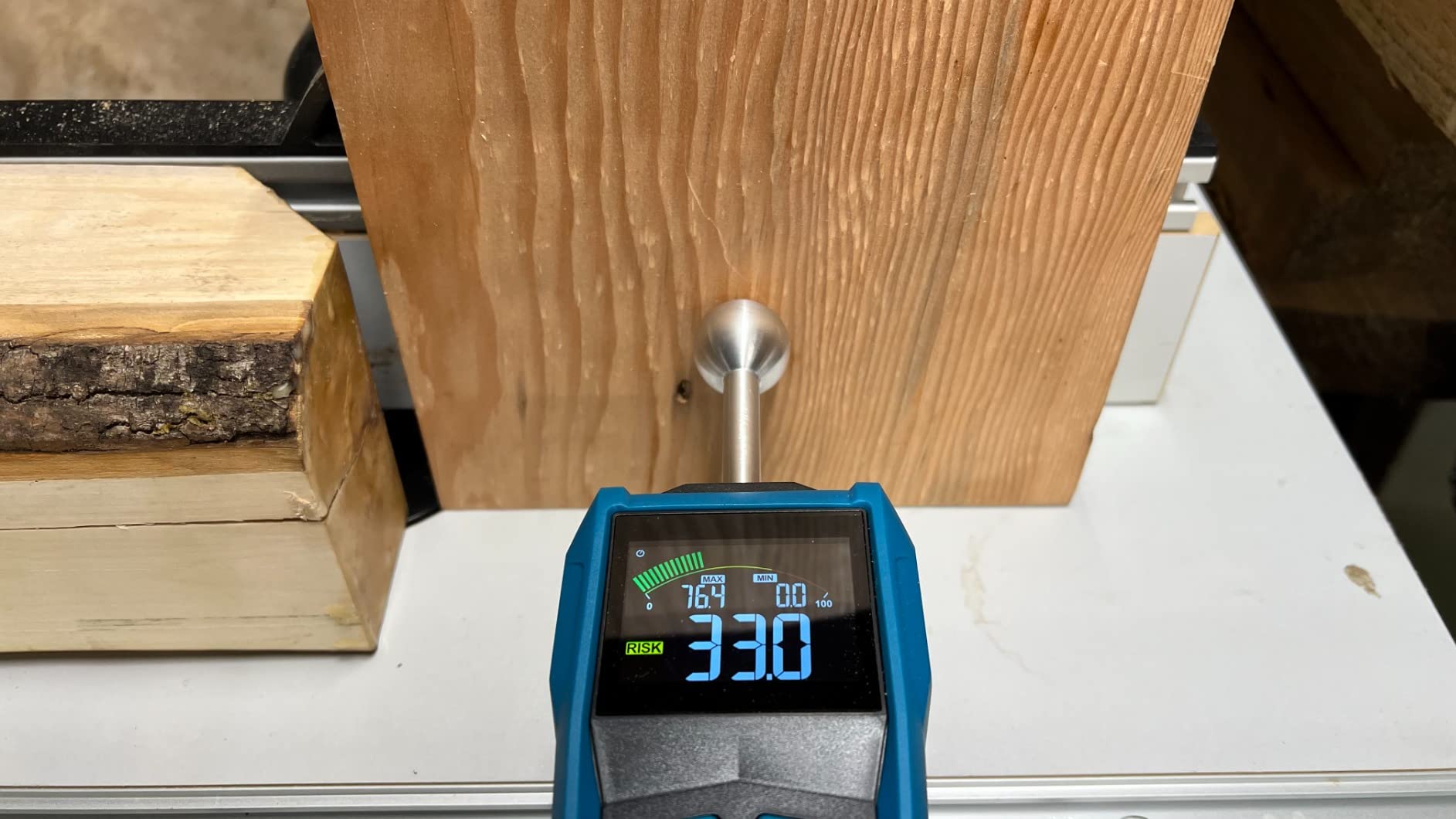
Where the WM710A earns its place?
Plaster, lath, mortar, tile backer, concrete foundation walls and any surface too uneven for a flat plate. If your water damage came through a slab, a masonry wall or a bathroom tiled over backer board, the ball probe is the reason this meter works where others give inconsistent results.
It is also a strong choice as a second meter for anyone who already owns a pin meter, giving you scan-then-verify without marking a single surface.
Where it falls down?
There is no manual calibration, and reviewers report readings running somewhat high against a pin meter. If you need a defensible number for an insurance document, this is not the instrument, even though it is an excellent finder.
It is also the bulkiest pinless option here at 210g, and the storage is a drawstring felt bag rather than a hard case. At 210g in a tool bag across a job site, expect it to take more abuse than the smaller scanners.
4. Calculated Industries 7440 AccuMASTER XT – best pin meter with replaceable pins
Calculated Industries 7440 AccuMASTER XT Digital Moisture Meter | Handheld |Pin Type | Backlit LCD Display | Detects Leaks, Damp and Moisture in Wood, Walls, Ceilings, Carpet and Firewood
Pin type with replaceable stainless steel pins
Backlit LCD with hold key
Built-in calibration test pins, 9V included
Pros
- Replaceable super-sharp stainless steel pins extend instrument life
- Large backlit LCD in a sturdy hand-friendly body
- Hold key freezes readings for note taking
- Moisture icons
- audio alerts and auto shut-off
- Built-in calibration test pins
- Works on drywall
- plaster
- concrete
- brick
- floors and carpet
Cons
- Pin probes leave puncture marks in finished surfaces
- Audio alerts need cross-checking against a pin reference
- No pinless mode for fast scanning
The AccuMASTER XT is the pin meter we recommend for anyone whose pins will be used hard. The probes are replaceable, which is the detail that decides instrument life: forum users consistently report that pins dull and bend fast, and a meter with no spare or replacement option is a meter that starts returning wrong numbers within a season.
Everything else here is a solid residential pin meter. A large backlit LCD, a body heavy enough to press pins into a dense material without wobbling, a hold key that freezes the value while you record it, and moisture icons with audio alerts for scanning without looking.
Calibration test pins are built into the body, so you can verify the instrument reads correctly in the field rather than trusting a value that appeared once a year in a workshop. A 9V battery and a user guide are included.
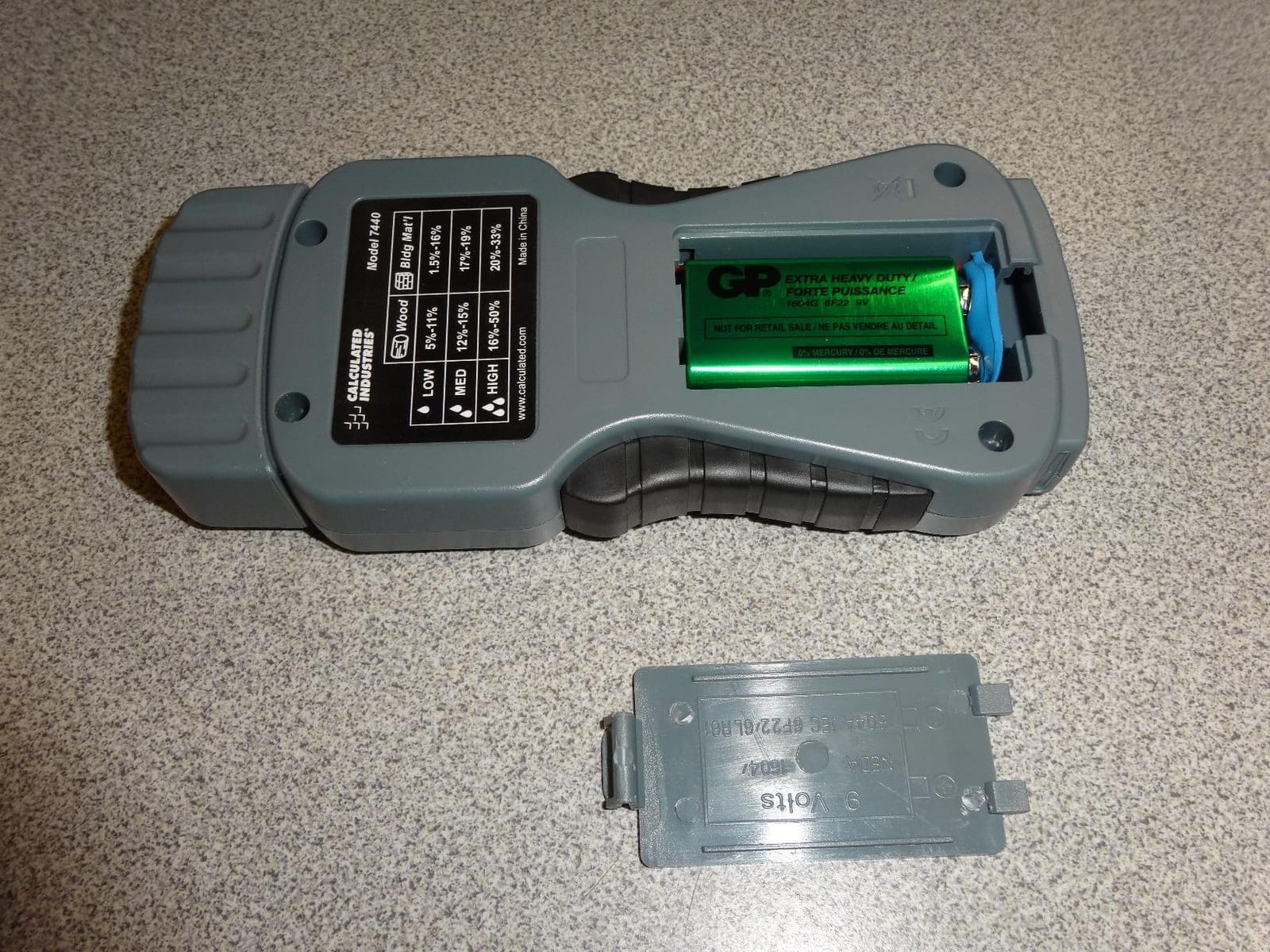
Material coverage is broad for a pin meter: firewood, lumber, brick, concrete, drywall, plaster, floors, walls and carpet. That carpet capability is worth noting, because a soaked carpet pad under a dishwasher or a roof leak is one of the most common residential claims and a pin meter is the only way to check it.
It also carries named moisture bands for wood, with low at 5 to 11 percent, medium at 12 to 15 percent and high at 16 to 50 percent, which makes quick readiness checks simple.
It is a pin meter and only a pin meter. There is no pinless sensor, so you cannot scan a wall quickly, which means it pairs naturally with one of the scanners in this list rather than replacing one.
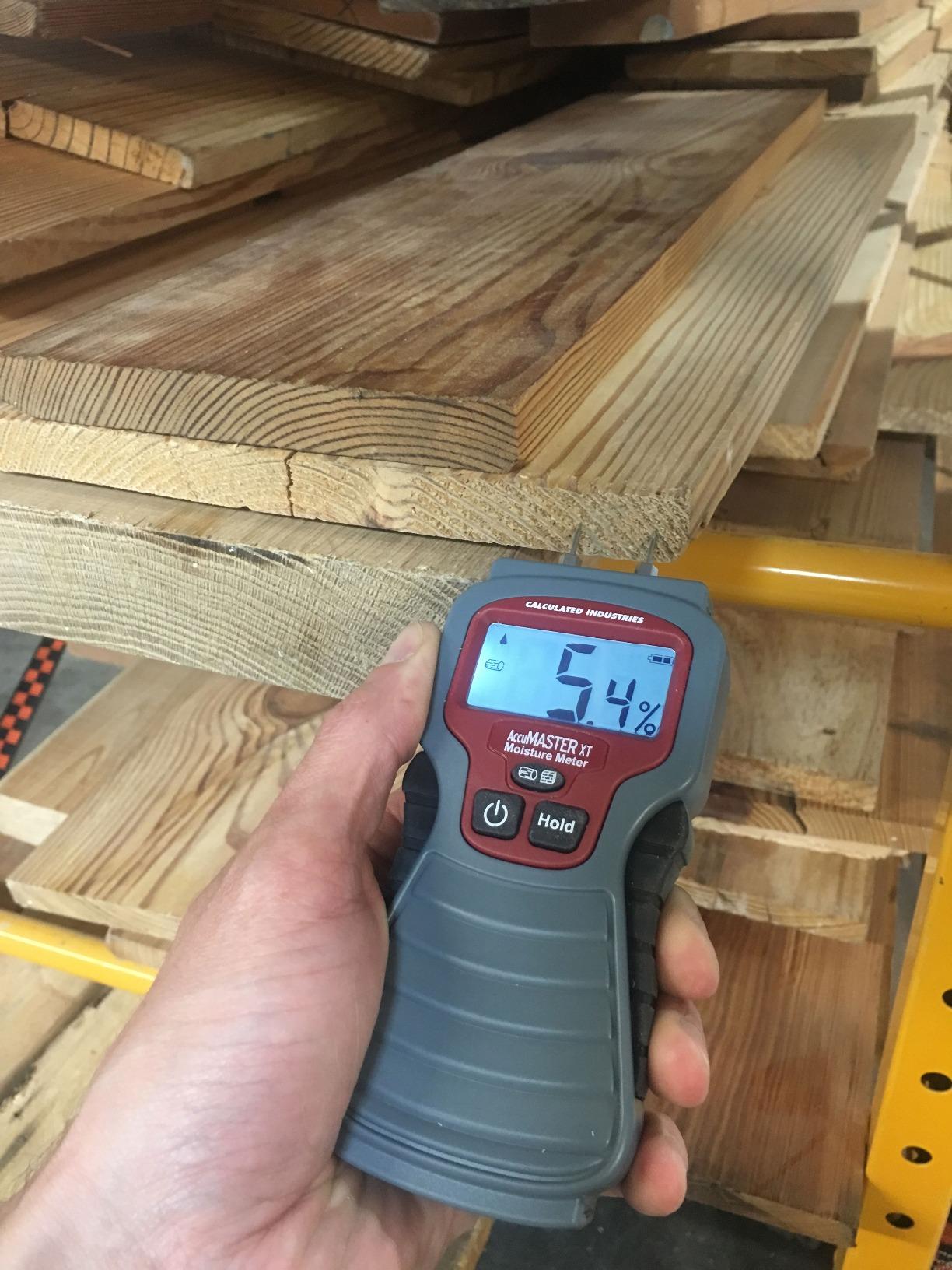
Who should buy the 7440?
Anyone who will be pressing it into materials repeatedly: a landlord doing move-out inspections, a property manager checking units, or a restoration contractor who wants a spare instrument in the truck. The replaceable pins and the built-in calibration check are what justify choosing it over a generic pin meter.
It is also the right choice for insurance documentation, because a pin reading on a named material in a named range is the format an adjuster recognises.
Who should skip it?
Do not use it on a wall you have just painted, or on any finished surface you are not prepared to patch. Two pin holes in a living room wall is a repair bill that outweighs the meter.
Reviewers also caution against trusting the audio alerts alone for precision work. Use the tone to locate a suspect area, then confirm with a number on the display before you write anything into a report.
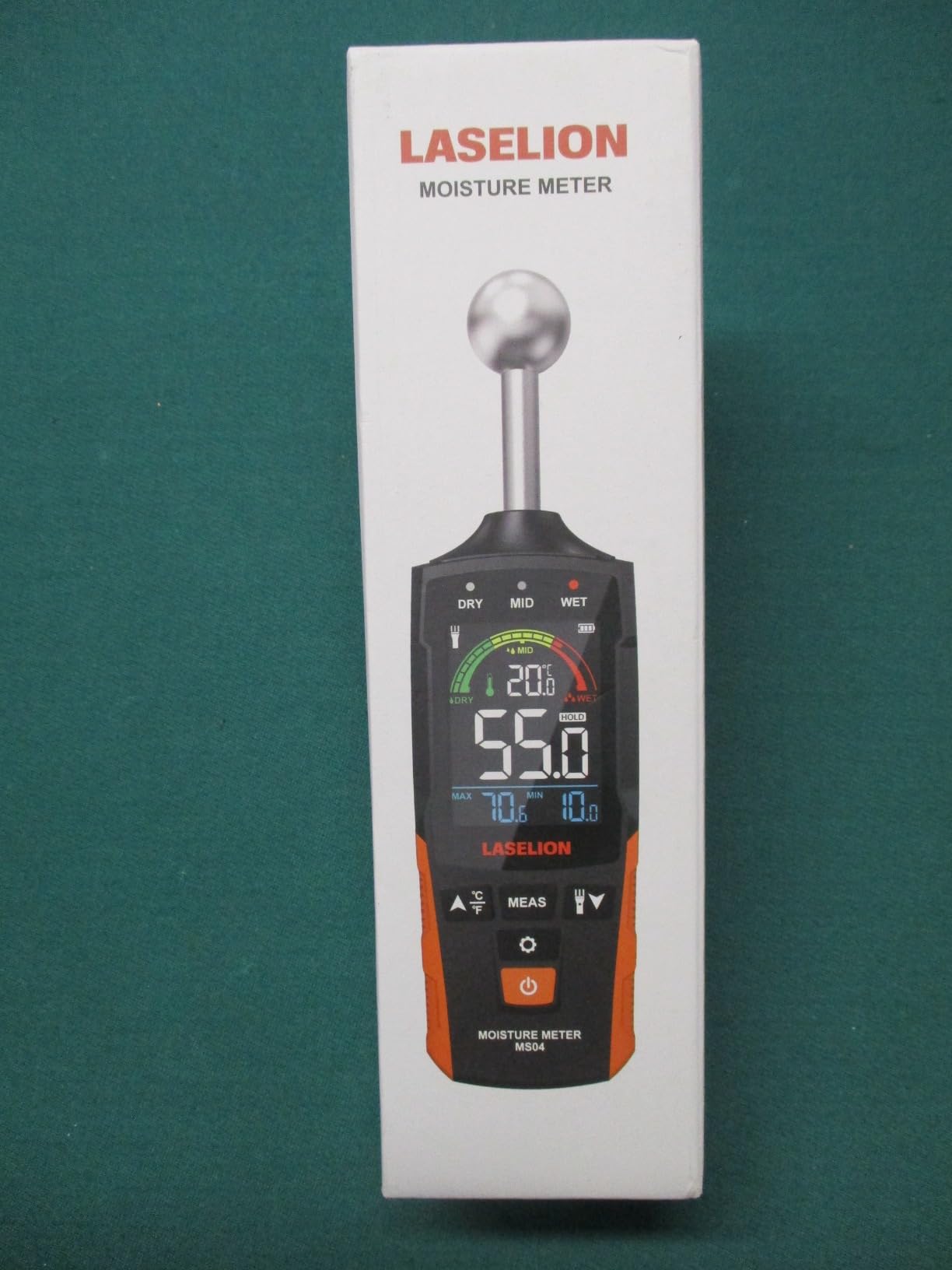
5. LASELION MS04 – best for crawlspaces and dark cabinets
LASELION MS04 Pinless Moisture Meter with Ball Probe for Non-Destructive Area Scans Ideal for Wood Walls and Construction Materials Customizable Humidity Alarms Built-in Flashlight
Pinless ball probe, 5-40mm depth
Customizable MID and WET alarms
Flashlight, carry case, 3 AAA batteries
Pros
- Ball probe scans wider areas and reaches tight corners
- Customizable MID and WET alarm thresholds flag problem levels automatically
- 5-40mm depth covers surface and subsurface moisture
- Readable display in direct sunlight and comfortable in the hand
- Carrying case and three AAA batteries included
Cons
- Requires recalibration after every power on
- Can overshoot to very high readings when passed close to a surface or a warm body
- 0-100 scale needs practice to interpret
The MS04 is the meter that solves a specific problem: dark, tight spaces. It has a built-in flashlight and a ball probe, so you can check inside a cabinet, under a sink, in a crawlspace beam or behind an appliance without a headlamp and without marking anything. Three AAA batteries and a carry case are in the box.
The adjustable alarms are the sleeper feature. Rather than learning a fixed scale, you set your own MID and WET thresholds, so the meter tells you when a reading crosses into the range that means action on your specific wall. For a contractor mapping dozens of readings, that removes a layer of interpretation from every single reading.
One owner described the decisive test: during a teardown, the wet zone stopped exactly where the MS04 had indicated it would, before the drywall came off. That is the standard you want from any of these meters.
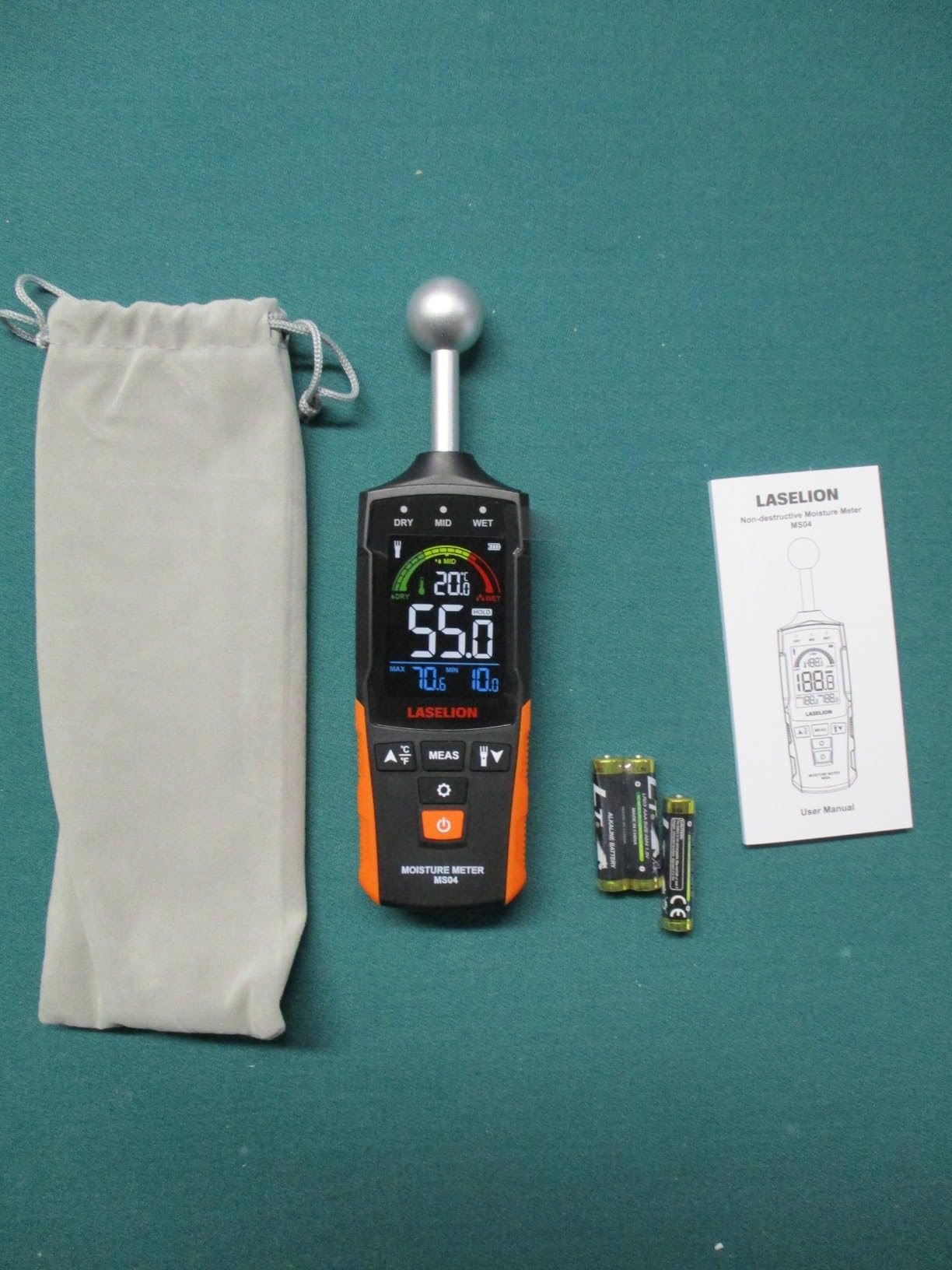
Depth is 5 to 40mm, which covers the surface layer and a good part of the substrate below it. That range is broader than the 19 to 20mm typical of flat-plate scanners, which matters when water has soaked through drywall into the framing cavity.
It is entirely non-destructive, so it suits finished wood, painted drywall and delicate surfaces that a pin meter would scar. The display stays readable in direct sunlight as well as in low light, which is useful when you are working between a lit kitchen and an unlit void.
There is a habit to build. Recalibrate after every power on, and hold the probe still and square to the surface rather than sweeping it, because moving close to a wall or near a warm body spikes the reading.
Best uses for the MS04
Crawlspace and attic surveys, under-sink and behind-appliance checks, and any quick first pass during a property inspection where you want a yes or no before you bring out the more precise instrument. The flashlight and the adjustable alarms are made for exactly that.
It is also a good companion to a pin meter for the scan-then-verify workflow, since it leaves the surface untouched while you narrow the area down.
Limits worth planning around
The 0 to 100 scale is comparative, and users note it takes practice to interpret against a material chart. Treat it as a map, not a measurement.
Like every other pinless meter here, it will read high near metal, and the reviews specifically mention overshoot when the probe passes close to a surface. Slow, deliberate placements produce numbers you can trust.
6. Proster PST199-P – fastest way to find the wet zone
Proster Pinless Moisture Meter 3/4″ Depth Color Alarm Non-Destructive
Pinless, detection up to 3/4 inch (19mm)
Three-color LED bar graph and audible tones
Out-of-range and low battery alarms
Pros
- Non-invasive scanning leaves finished surfaces unmarked
- Three-color LED bar graph plus audible high-pitch tones find the wet zone fast
- Large backlit LCD with reverse contrast
- hold button and auto power-off
- Out-of-range and low battery alarms built in
- Mode ranges cover wall
- masonry
- softwood and hardwood
Cons
- Only a soft storage bag for protection
- Rough or uneven masonry and concrete reduce reading consistency
The Proster is built around one idea: find the source quickly. The three-color LED bar graph and the high-pitch audible alert mean you can move across a wall in a pattern and let the meter tell you where the concentration is, without stopping to read a number at every point. Users describe it as the fastest route to the origin of a leak behind a finished surface.
Depth is up to 3/4 inch or 19mm below the surface, the same class as the other flat-plate scanners, and the mode ranges are unusually complete: 5 to 70 percent for wall and masonry, and 5 to 75 percent for softwood and hardwood.
It runs on a 9V battery, includes a storage bag, and has out-of-range and low battery alarms so a saturated zone or a dying battery never gets mistaken for a dry reading.
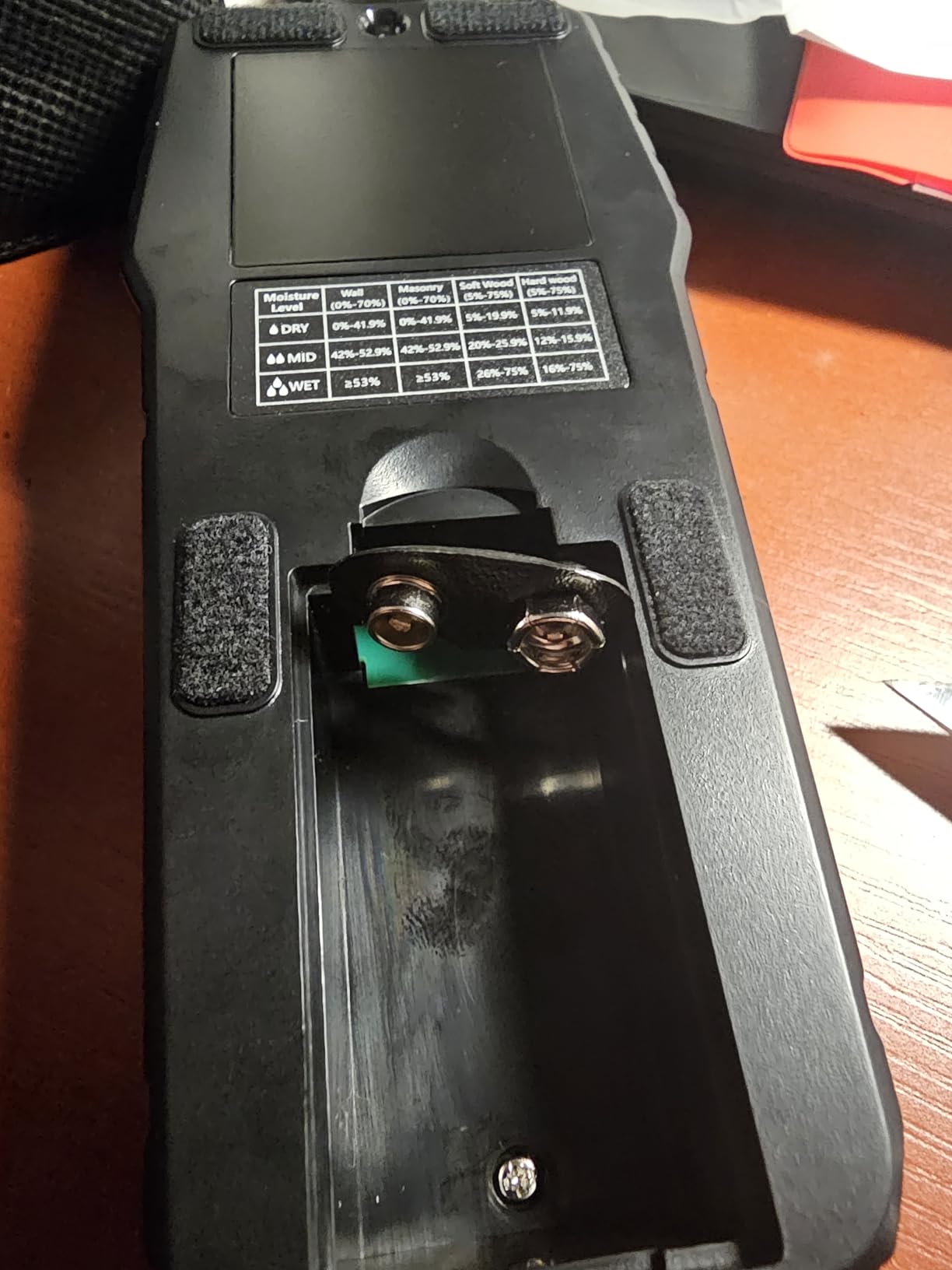
The backlit reverse-contrast LCD and the hold button make it usable in a dark basement or a laundry room after a supply line has failed, which is where most of these scans actually happen.
Non-destructive scanning is the whole point. Nothing gets marked, so it works on painted drywall, finished trim and a wall you are about to show an adjuster, and it is safe to use in a rental unit before you decide whether to replace drywall at all.
Because it is relative, the discipline of the baseline still applies. Scan a known dry wall in the same room first, write that number down, and every later reading is measured against it.
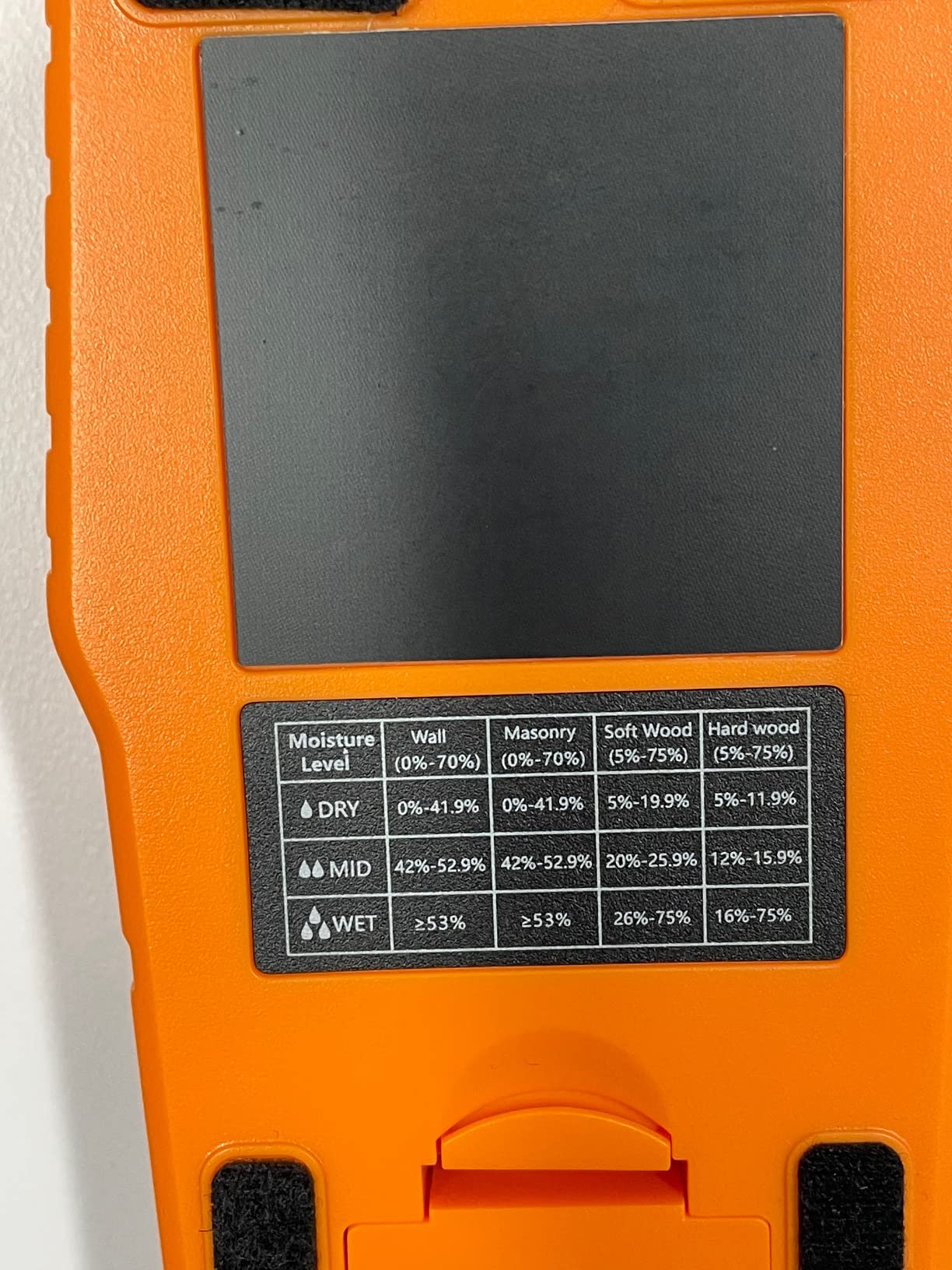
Where the Proster works best?
First-pass leak location on drywall, plaster board, masonry and wood trim, in a house where the water came from a supply line, a drain, a roof or a window. It is fast enough to grid a bathroom wall in a couple of minutes and mark the boundary with a pencil.
It is also a genuinely good low-cost option for landlords, because scanning a unit before a repaint decision costs nothing in repairs and nothing in tenant relations.
Where it disappoints?
Rough, uneven masonry and bare concrete floors give inconsistent readings, because the flat sensor needs full surface contact. If the water is coming through a slab, use a ball-probe model instead.
Storage is a soft bag only, so on an active job site it is the meter most likely to come back with a cracked housing.
7. LASELION MS03 – dual-function meter on a tight budget
LASELION 2-in-1 Pin & Pinless Moisture Meter MS03 – Accurate Moisture Detection for Wood, Concrete, Drywall, and More – LCD Display with Hold Function, Flashlight, and Auto Power Off
Pin and pinless modes in one body
0-75% wood and 0-25% building materials
Built-in flashlight, hold and auto power-off
Pros
- Pinless for finished surfaces plus pins for lumber and panels in one unit
- 0-75% wood and 0-25% building material ranges
- Manual calibration for pinless mode plus ambient temperature display
- Built-in flashlight for dark crawl spaces and cabinets
- Auto power-off after two minutes and hold function
Cons
- Pinless mode can drift out of calibration and show phantom readings
- Tight sensor cover is hard to remove
- Some units are not rugged
- Weak technical support for calibration problems
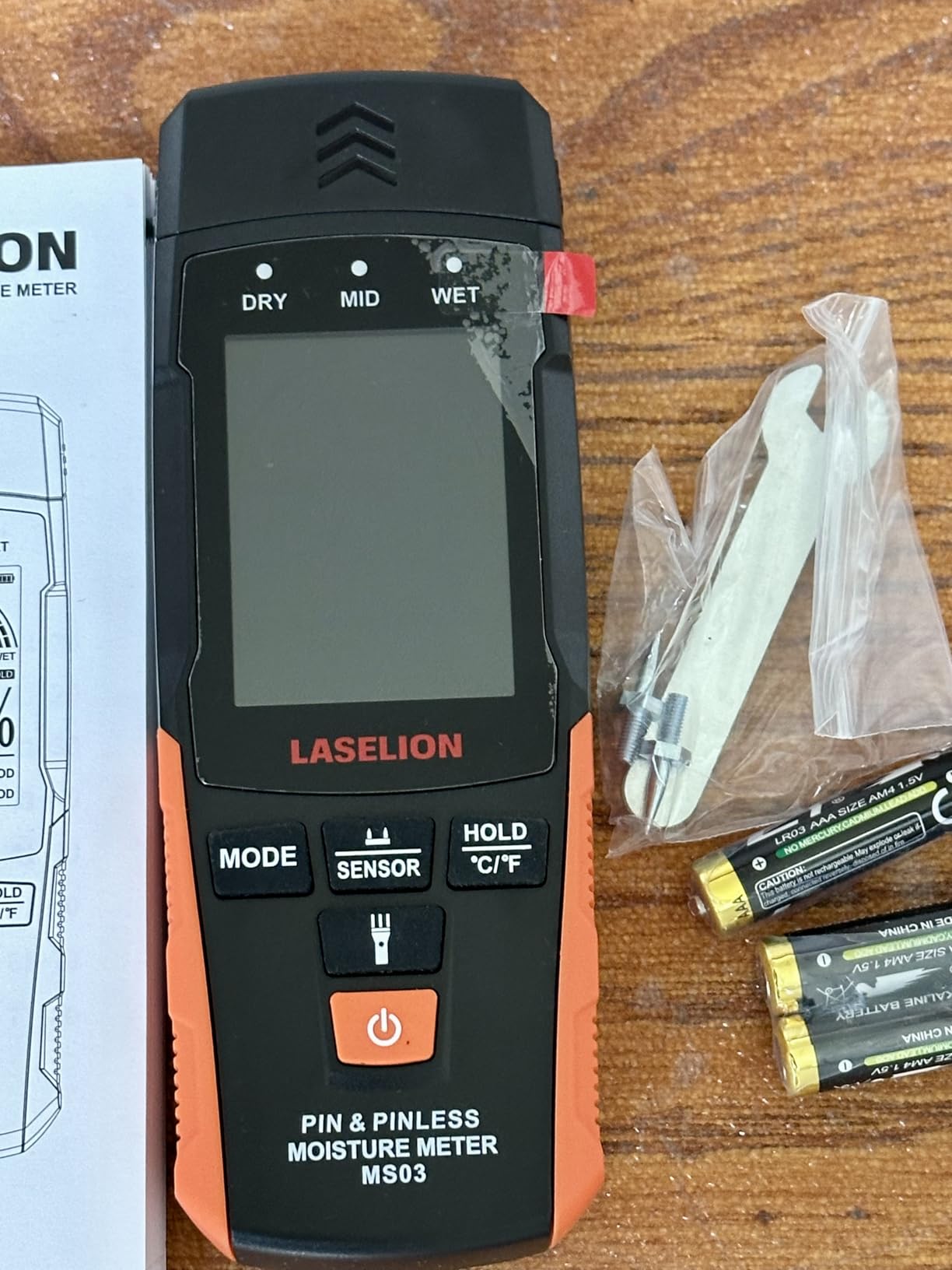
Carrying both sensors in one body is a sensible answer to the pin versus pinless argument, and the MS03 is the cheapest way to do it. You scan a finished wall pinless to find the wet zone, then switch to pins to get an actual moisture content reading in the middle of it, without owning two instruments.
The ranges are stated as real values rather than a bare index: 0 to 75 percent for wood and 0 to 25 percent for building materials, with an accuracy of plus or minus 4 percent relative humidity. The pin mode is the part to trust for a number, since it is measuring the material between the probes.
It also has a built-in flashlight, a hold function, an ambient temperature display and auto power-off after two minutes. The flashlight matters more than it looks in a crawlspace or behind a washing machine.
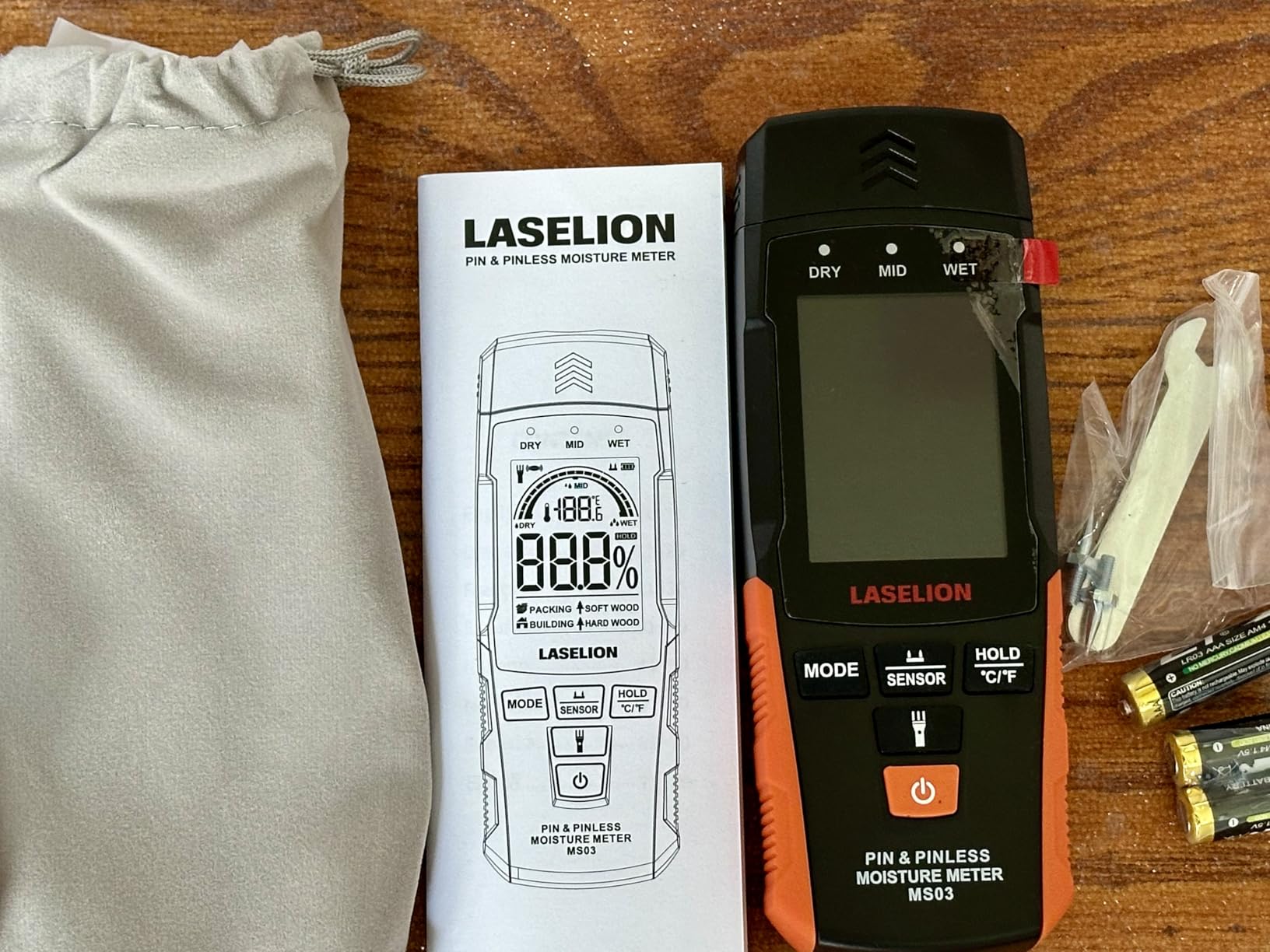
Manual calibration for the pinless mode is a genuine feature at this level, because most competing scanners give you no way to correct a drifting sensor. Ambient temperature display is useful context, since cold surfaces skew readings and knowing the wall temperature helps you interpret them.
The dual architecture suits a mixed job. Finished drywall on one side of a basement, bare lumber or a subfloor edge on the other, and you are not switching tools between them.
Our honest caveat is the durability and the sensor cover. The cover is a tight fit and awkward to remove, and a number of owners report units that broke after a single drop or bent pinless sensor behaviour after a few months.
Best fit for the MS03
A homeowner handling a single leak who wants both a finder and a measuring tool without carrying two devices, and who will treat the pinless mode as a rough map rather than a number. In that role it does the job well for a small claim or a pre-paint drywall check.
It is also a sensible backup instrument for a restoration contractor who wants a cheap unit in every truck for quick screening.
Where it falls short?
Do not build a documentation workflow on the pinless mode. Owners report the sensor drifting out of calibration and returning high readings in open air that manual calibration could not resolve, and there have been complaints about a lack of reachable technical support when that happens.
For a claim that will be contested, use one of the professional instruments below and keep this as a screening tool.
8. FLIR MR55 – best for phone-based documentation
Flir MR55 Pin Moisture Meter with Bluetooth
Pin type with Bluetooth
FLIR Tools Mobile app reporting
Rugged housing with 3-year warranty
Pros
- Bluetooth syncs readings to the FLIR Tools Mobile app for instant sharing
- Pin detection suits remediation
- pest control and inspection workflows
- Rugged housing with a limited 3-year warranty
- Compact 1.3 by 7.4 inch body runs on two AA batteries
Cons
- Pin probes require puncturing the material
- App-dependent documentation adds friction to quick field notes
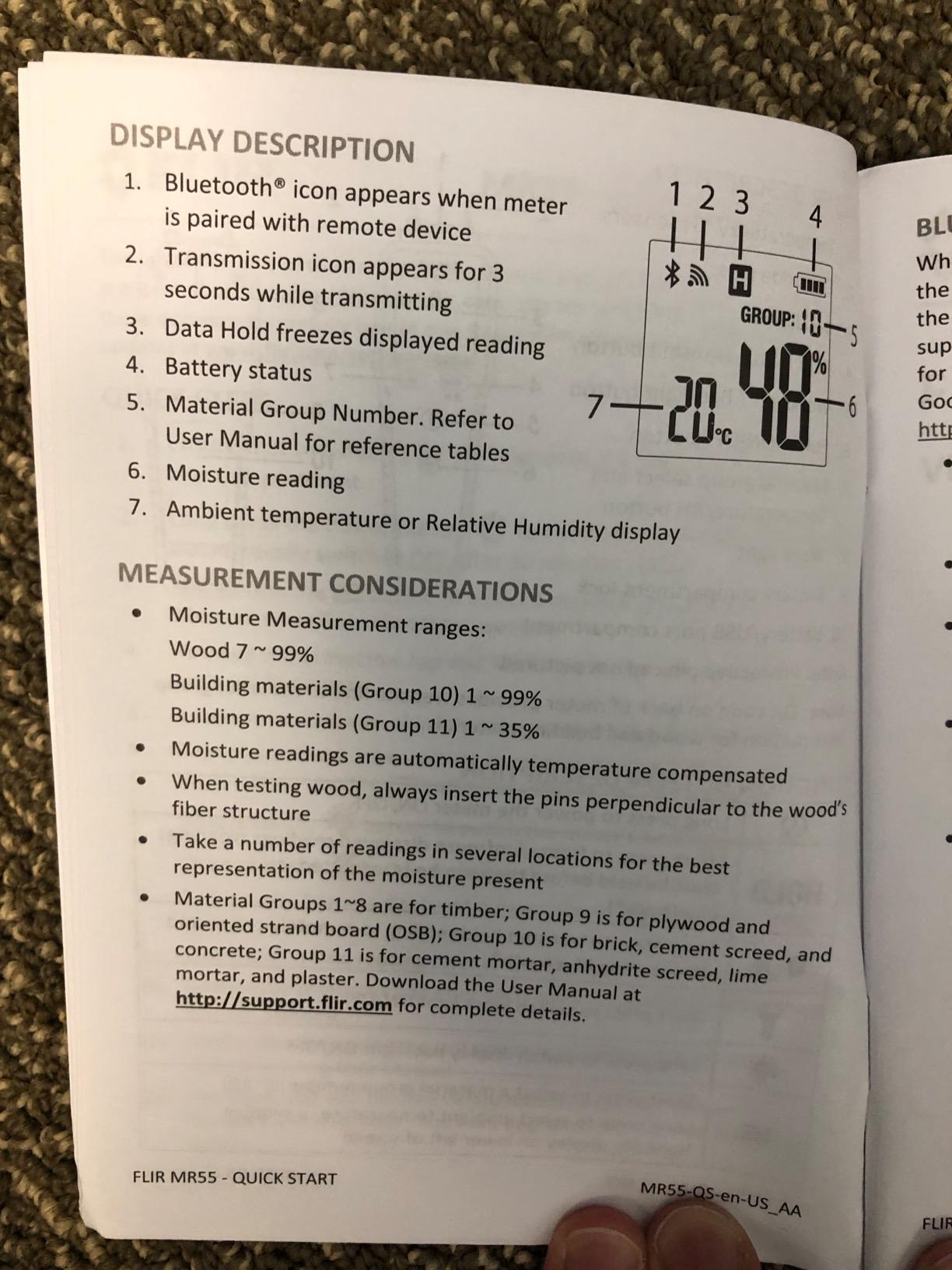
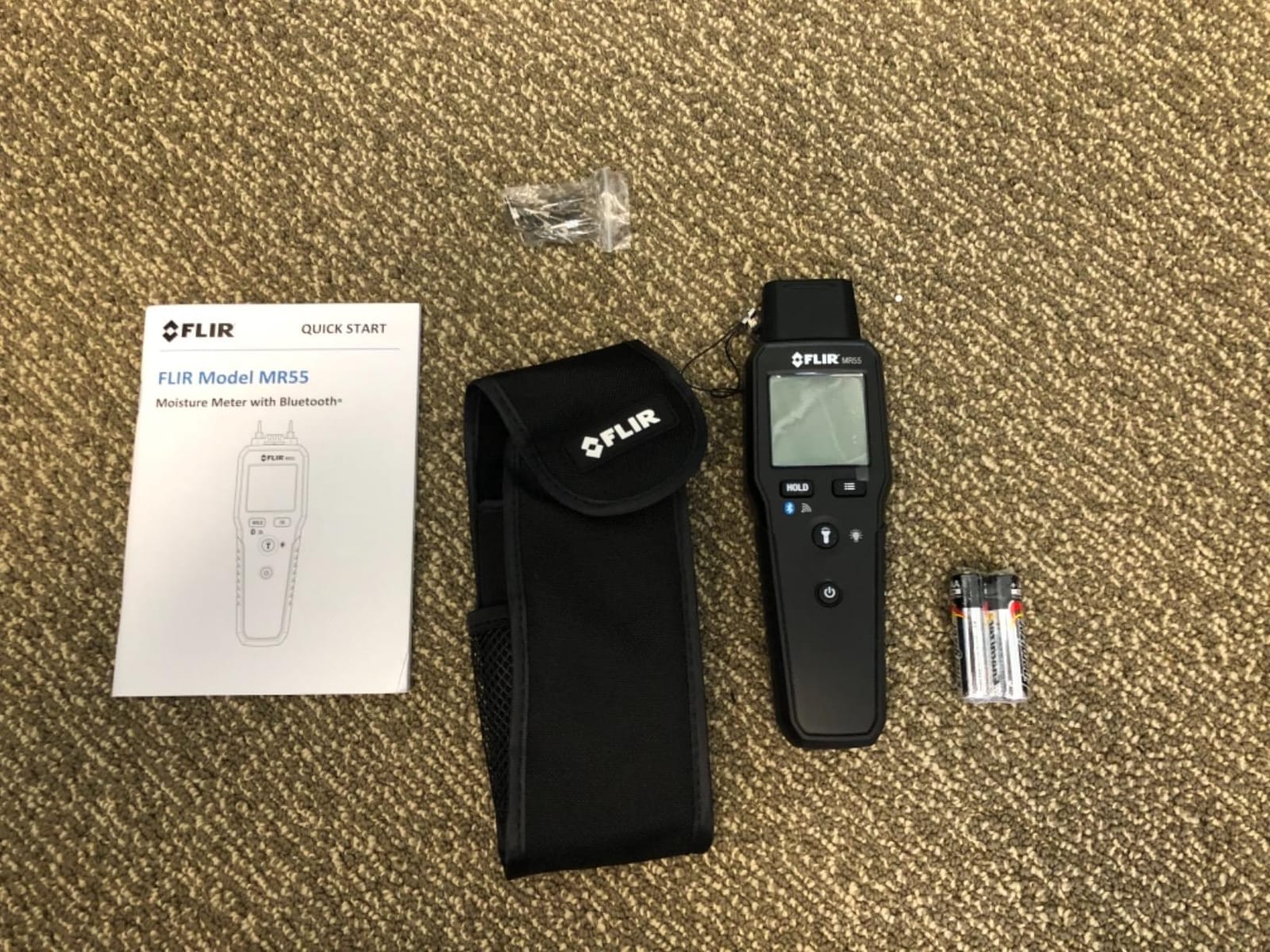
The MR55 is the instrument for anyone whose findings have to leave the building. Readings sync over Bluetooth to the FLIR Tools Mobile app, so a technician can capture a number, attach it to a location and send it to an office or a client before leaving the site. For documentation-heavy inspection work, that is the difference between a note and a report.
Measurement is by pin, which is the right technology for accuracy and for materials that are about to be removed. The body is 1.3 by 7.4 inches and runs on two AA batteries, so it is small enough to carry on a belt and light enough to use all day.
Build quality is above what the rating suggests. The housing is rugged and it carries a limited three-year warranty, which is longer than anything else in this roundup apart from the Protimeter SurveyMaster.
It is aimed squarely at remediation, pest control and inspection workflows, which tells you how the manufacturer expects it to be used: as a professional tool that reports as it works rather than a hobbyist accessory.
Temperature accuracy is one degree Celsius and the upper operating range is 51 degrees Celsius, so you can pair a reading with a surface temperature check when you are assessing whether drying equipment is actually moving air across the wet zone.
Because it is a pin meter, it belongs at the verification stage of the workflow rather than the discovery stage. Scan first with a pinless unit, then confirm here.
Who the MR55 suits?
Home inspectors, remediation companies and anyone who sends findings to a client or an insurer. The app workflow is the reason to choose it, and inspectors reviewing it call the sharing capability the standout feature.
It also makes sense as a second instrument for a contractor who wants a permanent, branded record attached to each reading rather than a handwritten number on a tape.
Where it will frustrate you?
It punctures the material, so it is the wrong tool for scanning a wall you are keeping. And the app dependency cuts both ways: documentation is excellent once the phone cooperates, but reviewers note it adds friction to fast field notes when you simply want to record a number and move on.
At 4.2 stars across a much smaller review history than the consumer meters here, treat the reported experiences as a smaller sample.
9. Protimeter Mini – a reference instrument for absolute readings
Protimeter Mini General Purpose Moisture Meter
Built-in pin probes
Color-coded dry, borderline, damp display
Includes calibration device and extension probe
Pros
- Colour-coded display reads dry
- borderline and damp instantly
- Built-in pin probes for general purpose measurement
- Includes a calibration device to verify instrument function
- Extension pin probe for awkward positions
- Highest star rating among the mid-tier professional meters here
Cons
- Pin-based measurement punctures the material
- Heavier and bulkier than pinless scanners for the same task
Protimeter has been a reference name in restoration for decades, and the Mini is the compact version of that instrument. It carries built-in pin probes and shows a colour-coded display: green for dry, yellow for borderline, red for damp. That three-colour system is the fastest way to communicate a finding to someone who does not read meters.
It shows moisture content and the classification together, so you get a number and an interpretation on one screen. That is a meaningful difference from a consumer pin meter that only tells you a percentage and leaves you to decide what it means.
A calibration device is included for verifying the instrument is functioning correctly in the field. That matters more than it sounds, because a meter that has drifted will still return a confident number, and nobody will know the baseline has moved.
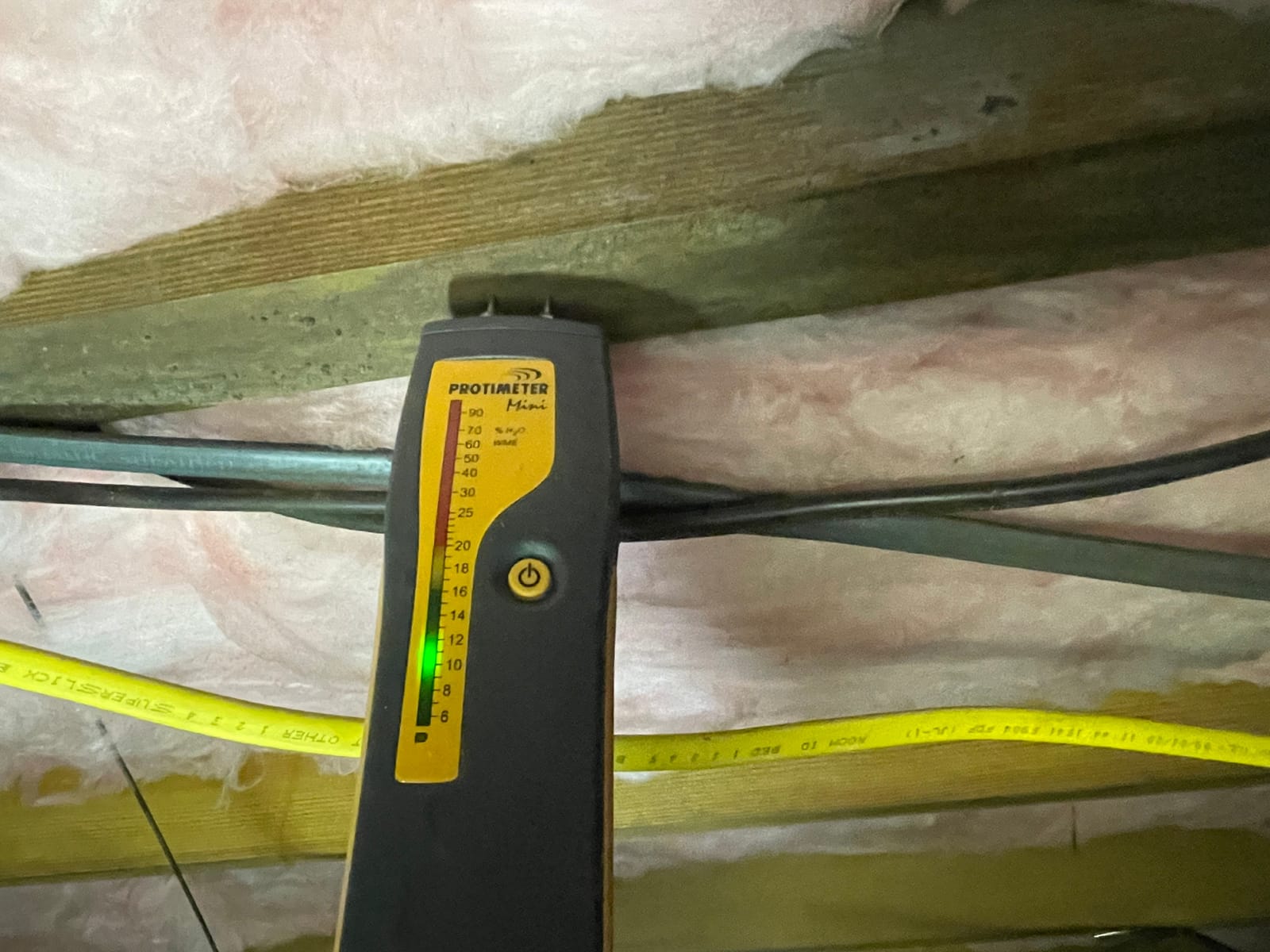
The extension pin probe is for the places you cannot get to comfortably, such as a deep cavity, the back of a built-in unit, or a soffit above a window. The unit operates in a 0 to 90 percent relative humidity range and has temperature accuracy of plus or minus 0.1 degrees Celsius.
It is the instrument to reach for when a disputed reading matters. If two parties disagree about whether a wall is dry, the useful move is to check with an instrument that verifies its own calibration, and to record the result in a format both can trust.
It runs on a 9V alkaline battery and weighs about 0.41kg, so it is a genuine job-site tool rather than a pocket instrument.
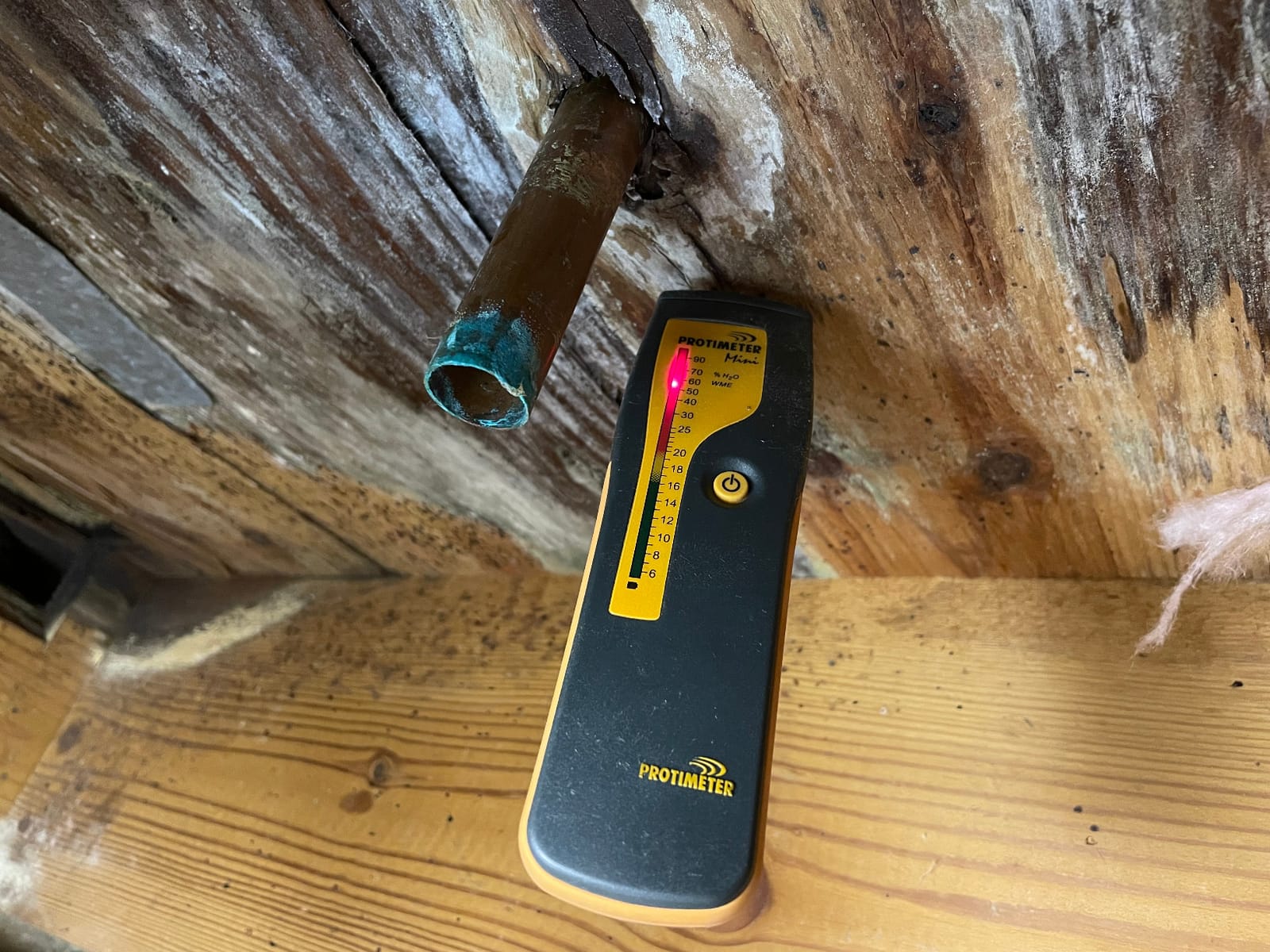
Best reasons to own the Protimeter Mini
It is a reference meter, which means you can use it to sanity-check the cheap ones. Take a reading with your everyday pin meter, then take one here on the same spot. If the two disagree by a few points every time, your everyday meter has drifted and needs calibrating.
It is also a strong choice for anyone whose readings end up in front of an adjuster, a tenant or a lawyer, because the colour classification and the included calibration device are easy to demonstrate.
Where it is the wrong buy?
It pins the material, so it cannot be used on a finished wall you are preserving, and there is no pinless mode for fast scanning. It is also heavier and bulkier than a pinless scanner doing the same discovery job.
For a single leak in a home you own, that weight and puncturing are real costs for a capability you may never need.
10. Tramex Moisture Encounter ME5 – best dual-depth scan
Tramex Moisture Encounter ME5
Dual depth: 0.4 in shallow, 1.25 in deep
Wood 5-30% with density tables
Bluetooth moisture maps and reports
Pros
- Dual-depth measurement separates surface from core moisture
- Pre-calibrated to wood
- drywall
- plaster
- roofing
- tile
- masonry
- walls
- floors and ceilings
- Bluetooth app generates visual moisture maps with time-stamped reports and photos
- Large analogue display with optional high-moisture audio warning
- Non-destructive and pinless
- so finished surfaces are never marked
Cons
- Wood density adjustment tables must be referenced for true content readings
- Comparative 0-100 scale for non-wood materials still needs a chart
The ME5 solves a problem that flatters cheaper meters: a surface reading can look dry while the material behind it is soaked. Taking a shallow reading to 0.4 inch and a deep reading to 1.25 inch, then subtracting one from the other, separates the surface contribution from the core. That subtraction is how you tell a wall that is drying from a wall that is still wet inside.
It is entirely non-destructive, so it can be used on finished surfaces without marking them, and it is pre-calibrated across the materials a water damage job presents: wood, drywall, plaster, roofing, tile, masonry, walls, floors and ceilings.
The reporting is what separates it from every other scanner in this list. The Bluetooth app produces visual moisture maps with geo-tagged, time-stamped reports and photographs, which is documentation you can hand to a client or attach to a claim without retyping anything.
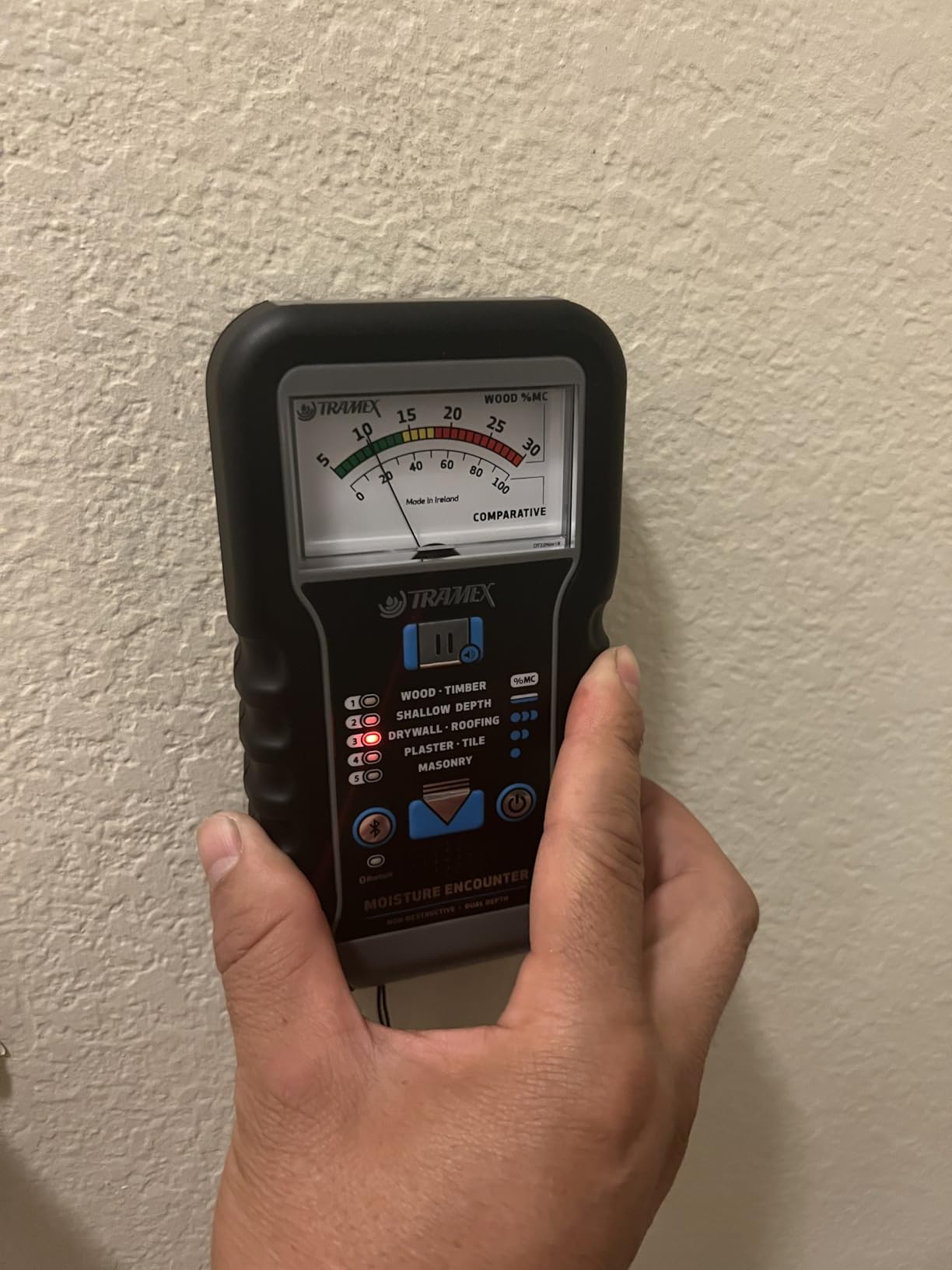
Wood reads 5 to 30 percent with adjustment tables for wood type density. Other materials use a comparative 0 to 100 scale. Neither is difficult, but both require you to actually use the reference material rather than reading the number and moving on.
The large analogue display is unusual in a digital category and it has one practical advantage: it can be read in a glance from a crouching position in a crawlspace, without focusing on digits. An optional high-moisture audio warning tone is available for hands-busy scanning.
Power is two AA batteries, included, and the body is 6.3 by 3.5 by 1.5 inches at 10.6 ounces, so it is genuinely portable between rooms and between properties.
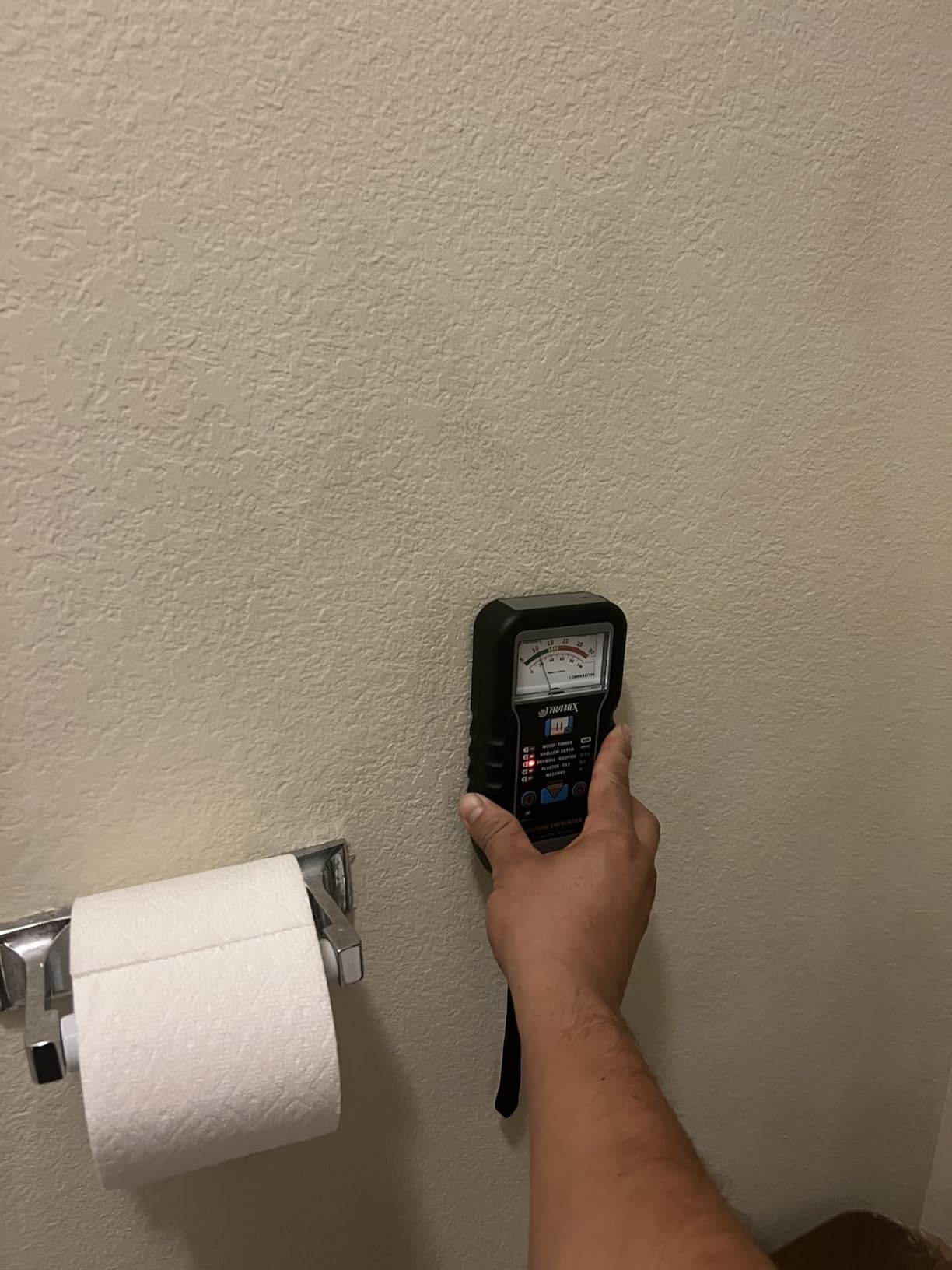
Where the ME5 is worth the money?
Large-area mapping. If you are surveying a whole property after a flood, or tracking a big drying project across multiple rooms, the app-generated maps turn a stack of readings into something a client, a tenant or an adjuster can read at a glance. That is the single biggest gap in consumer meters.
The dual-depth measurement also earns its place in the drying verification stage, where you need to know whether a wall that reads acceptable on the face still has water inside it.
Where it does not help?
Interpretation still depends on the density tables and the comparative chart, so it rewards someone who will spend ten minutes reading the manual. A user who only wants a yes or no answer will find a simpler scanner faster.
It is also a big step up in cost for a single-room leak, and the deep 1.25 inch reading can pick up substrate influence in some assemblies.
11. Protimeter SurveyMaster BLD5365 – inspection-grade dual mode
Protimeter BLD5365 Surveymaster Moisture Meter
Pinless search and pin measure modes
3/4 inch (20mm) non-invasive depth
Large backlit display, 2-year warranty
Pros
- Two modes in one unit: pinless search then pin measurement for precise content values
- Non-invasive scanning up to 3/4 inch (20mm) below the surface
- Rugged construction with a large backlit display for dark job sites
- Industry-leading 2-year warranty
- Highest average rating of the 12 meters tested here
Cons
- High outlay for a residential job and accessories add further expense
- Pin mode still requires puncturing finished surfaces
This is the instrument a restoration company buys when the readings are going to be argued over. It has two modes, pinless search for fast non-invasive scanning and pin-type measurement for precise content values, which is the complete workflow in one housing rather than two boxes.
It carries the highest average rating of the twelve meters we tested, at 4.8, and the warranty is two years, the longest in this roundup. Buyers describe it as an inspection-grade instrument and single out the backlit rugged build for working in dark job sites.
Non-invasive depth is up to 3/4 inch, which the manufacturer states as 20mm, and the accessory plug-in ecosystem extends what the unit can do beyond moisture alone.
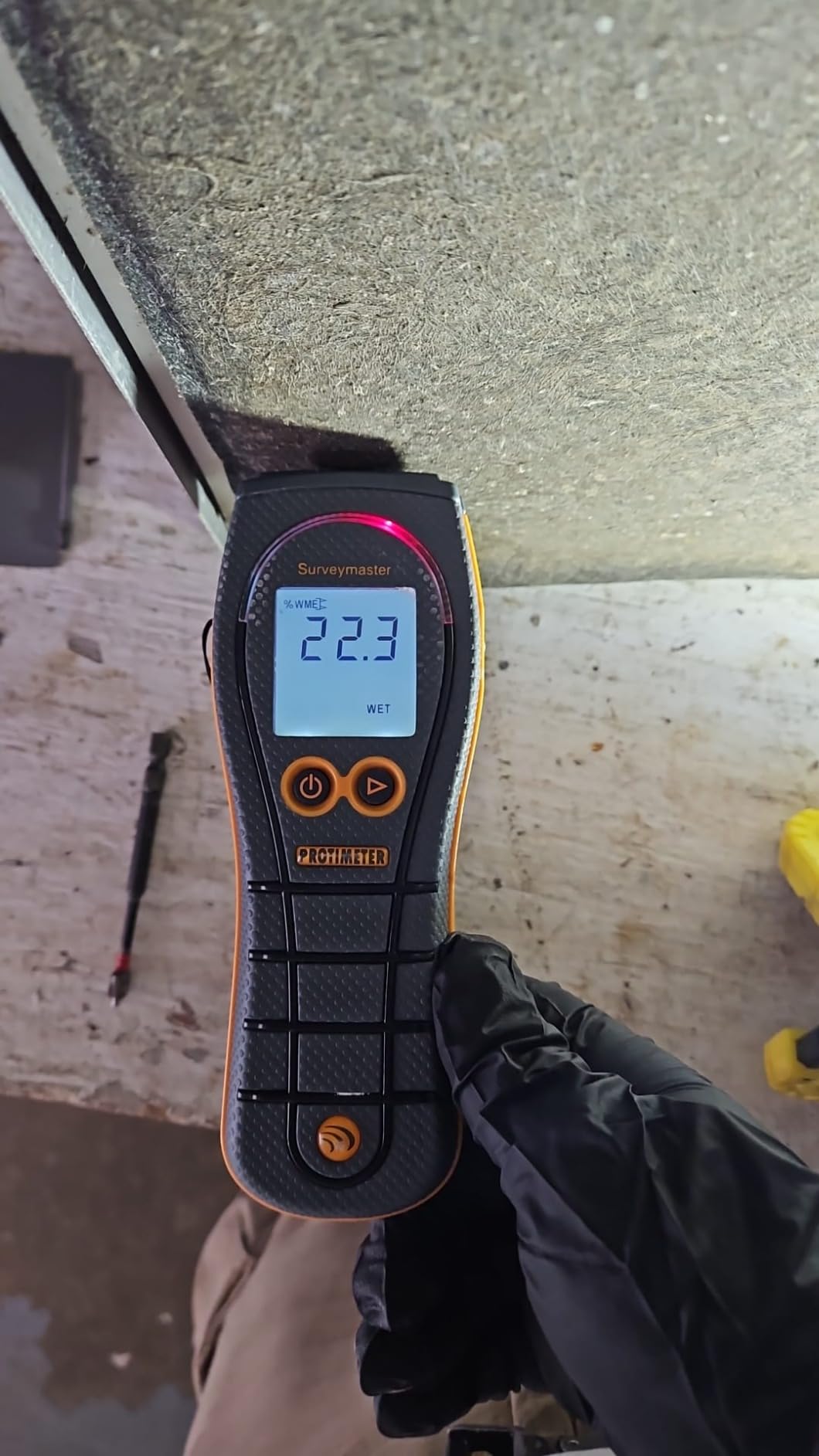
The two-mode design is the practical argument. Scan a wall in pinless mode, find the boundary of the wet zone in minutes with no marks, then switch to pin mode and take documented content readings at the boundary and at the centre. You get the speed of a scanner and the defensibility of a pin meter, from one device.
That workflow is why it shows up on professional specification sheets rather than on a garage shelf. The reading you take in the field is the same instrument and the same calibration you will be held to later.
It weighs about 225g and measures 2.75 by 1.9 inches, so it is a handheld field instrument rather than something you carry in a pocket.
Who should buy the SurveyMaster?
A restoration or remediation company doing repeat work, and an insurance-adjuster-facing inspector whose findings need to survive scrutiny. The pinless-then-pin workflow removes the guesswork from sizing a cut, and the accessory ecosystem means the investment extends as the work does.
It also makes sense as a single reference instrument for an organisation that currently owns a shelf of consumer meters that all disagree with each other.
Where it is overkill?
This is one of the two most costly meters in the group, and accessories add further cost on top. For one leak in one room, that outlay is not recoverable.
Pin mode still punctures the material, so the dual-mode advantage covers discovery and verification, not non-destructive measurement of a wall you intend to keep. Check how you plan to use it before committing.
12. FLIR MR160 – thermal imaging plus a moisture sensor
FLIR MR160 Imaging Moisture Meter with IGM Technology: Thermal Imaging, Pin & Pinless Detection, 80×60 Resolution, METERLiNK App, Rechargeable Battery – for Home Inspection & Mold Remediation
80x60 Lepton thermal imager
Pinless scanner plus external pin probe
METERLiNK app with moisture overlay
Pros
- Thermal view visually guides you to hidden moisture before probing
- Dual sensor: pinless for fast scanning plus an external pin probe for verification
- METERLiNK app overlays moisture data on thermal images and generates client reports
- Stores up to 9999 images with moisture readings
- transferable by USB
- Rechargeable internal battery and drop-resistant housing
Cons
- 80x60 thermal resolution produces grainy images
- Some units delivered inaccurate pin probe readings that support acknowledged as defective
- Firmware update requires a Windows PC and the software is not intuitive
- On-board documentation is sparse
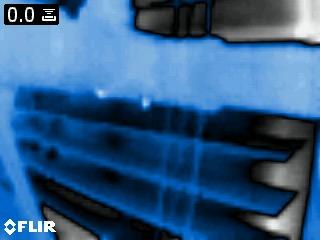
The MR160 is the only instrument here that shows you the wall before it shows you a number. The 80×60 Lepton thermal imager renders the surface, and evaporative cooling makes wet material read visibly different from dry material, so you walk the thermal image, find the cool anomaly, and then go confirm it with the built-in sensors.
It carries both sensor types. The pinless scanner handles fast non-destructive sweeps, and an external pin probe gives you a precise content reading at the exact point the thermal image flagged. That combination is the argument for it over buying a thermal camera and a meter separately.
Documentation is app-driven through METERLiNK, which syncs readings wirelessly, overlays moisture data on the thermal images and produces client reports. Image storage holds up to 9999 frames with integrated moisture readings, transferable by USB into free FLIR Tools software.
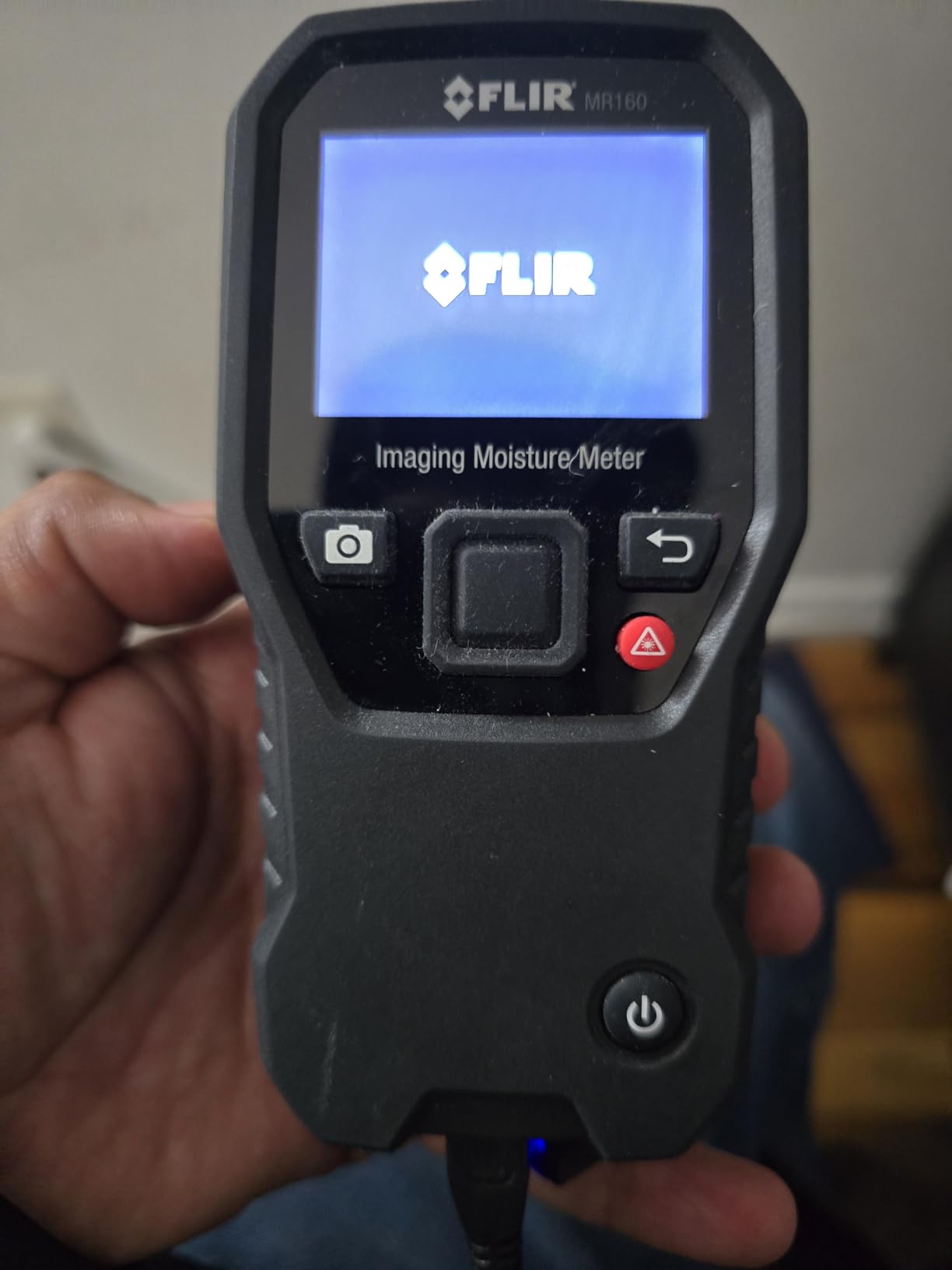
Power is an internal rechargeable lithium-ion battery at 3.7V, and the housing is described as rugged and shock-resistant. Several owners report it paying for itself on a first leak detection job, which is the argument you can make when a client asks why thermal imaging is necessary.
Temperature accuracy is plus or minus 0.5 degrees Celsius, and spare part availability is stated at ten years in the EU, which matters if you plan to keep it for the life of your business.
Understand the resolution. An 80×60 image is coarse, and owners report the pictures are grainy and hard to read without a reference photo to compare against. It is a pointer to where to measure, not a photograph you would put in a report without annotation.
Where the MR160 earns its cost?
Large or ambiguous water events. A stain on a ceiling where the source could be the roof, a plumbing riser or a condensation issue is exactly the case where a thermal overview shortens the diagnostic path, and inspectors and remediation firms say the thermal view makes hidden moisture obvious.
It is also strong for documenting the extent of a claim. Images with moisture readings integrated, exported to a report, give a claim a picture that a list of numbers cannot.
Where it will frustrate you?
It carries the lowest rating in this roundup at 4.0, and the complaints are consistent: coarse thermal images, some units delivered with inaccurate pin probe readings that support acknowledged as defective units, and a firmware update that requires a Windows PC rather than a Mac, with software reviewers describe as non-intuitive. On-board documentation is sparse, so the operating instructions live inside the PC software.
There are also reports of the pinless sensor ceasing to work after about a year. If you buy it, test the sensor early and keep the packaging for the warranty conversation.
Buying Guide: How to Choose a Moisture Meter for Water Damage?
Start with the surface, not the specification. If the wall is finished and you want to keep it, a pinless meter is the only option that answers the question without a repair bill. If the material is going to be opened, removed or replaced anyway, a pin meter gives you a number tied to that material and is worth the two holes.
Depth is the next filter. Most pinless meters read to about 19 or 20mm, which covers drywall and the near face of the substrate but not a soaked cavity. Two instruments here go deeper: the DURFICST to about 40mm and the Tramex ME5 to 1.25 inch, and both earn their place on thick plaster and masonry.
Absolute or relative is the third question, and it decides whether your readings can be documented. A pin meter gives moisture content percent for a material, which is what a specification and an adjuster expect. A pinless meter gives a relative index that is only meaningful against a dry baseline you recorded yourself. If you are filing a claim, you need the first, or you need to calibrate the second against the first.
Calibration is where cheap meters quietly fail. A pinless meter with no manual calibration, or one that drifts so it reads high in open air, will send you chasing a leak that is not there. Reviewers of the LASELION MS03 describe exactly that failure, and reviewers of the Protimeter Mini and the Calculated Industries both single out a supplied calibration device or test pins as a reason to trust the reading.
Know what produces false positives, because this is the number one complaint from homeowners on home maintenance and improvement forums. Metal studs, rebar inside concrete, foil-faced insulation and buried cable runs all push a pinless reading up with no water present. One commenter with a metal-framed building simply states that pinless will not work in their assembly, and another notes that a floor over a crawlspace or a rebar-filled slab interferes with the reading. If your building has metal framing, a pin meter is not optional.
Readability matters more than specifications suggest. A large backlit LCD with a reverse-contrast display, a hold function so you can record without losing the value, and audible alerts for scanning in the dark are what separate a meter you will actually use at 9pm in a basement from one that stays in the drawer.
Finally, weigh build and consumables. Spare or replaceable pins extend the life of a pin meter, because dull pins return wrong numbers. Hard cases protect scanners on a job site, and several models here include only a soft bag. And for materials like hay and firewood, where the measurement problem is different again, our hay moisture tester guide covers the density corrections those crops need.
When a Wet Reading Means Call a Professional?
Some situations are not a meter question. These are the ones where a reading is a reason to stop and get help, not a reason to keep investigating.
Call a professional when the wet area is larger than about 10 square feet. At that scale, hidden water usually extends behind baseboards, into wall cavities or under a floor, and the drying equipment needed is a rental rather than a hardware store fan. The EPA advises drying water-damaged areas and items within 24 to 48 hours to prevent mold growth, and that clock starts when the water stops, not when you find it.
Call immediately if sewage or floodwater was involved, rather than clean water from a supply line. Contaminated water carries a health risk that a moisture reading cannot address.
Call if anyone in the home is immune-compromised, has asthma or severe allergies. The tolerance for damp in a house changes completely when the occupants cannot tolerate mold spores, and testing is a job for someone who can identify what they are looking at.
Call if readings are flat or rising after a week of active drying, which means the source is still feeding the structure. And call if the claim is contested, because a single meter reading presented at an insurance desk is not a diagnosis, and a documented survey from a technician is.
What a Moisture Meter Cannot Do?
It cannot identify mold, or name a species, or tell you whether what you are looking at is a spore count that matters. A meter finds the water that mold needs, which is the useful and honest claim, and that is the line the ranking content in this category keeps.
It cannot certify a number. There is no universally accepted pass mark that a meter prints, and specifications for drying generally reference a material threshold that has to be interpreted against a dry baseline, a material and a time.
It cannot see past its own depth, and it cannot see through metal. It cannot tell a leak from ambient humidity on its own, which is why the baseline reading matters so much.
It also cannot replace opening the wall when the question is what is happening in the cavity. For a recurring or unexplained leak behind finished drywall, a meter narrows the search; a borescope and an opening wall answer it.
Frequently Asked Questions
Which is better, pin or pinless moisture meter?
For water damage, a pinless meter is better for finding the wet zone on a finished wall, because it scans to about 3/4 inch deep without marking the surface. A pin meter is better for confirmation and documentation, because it returns a real moisture content percentage for the material between the probes. The strongest approach is to scan with pinless first, then verify with pins in the middle of the wet zone.
What is the best moisture meter for detecting water damage?
The General Tools MMD4E is the one we recommend most often, because it gives absolute readings of 5-50% in wood and 1.5-33% in building materials rather than a relative index, and it has the largest review history of anything we tested. If your wall is finished and must stay unmarked, the Klein Tools ET140 is the better first tool.
How do I know if moisture is behind drywall?
Take a dry baseline reading on an unaffected wall in the same room, then grid the suspect wall at roughly six inch spacing and compare every point to that baseline. Scan first with a pinless meter, then press a pin meter into the middle of any zone that reads high. Re-read the same marked points at three days and again at seven days to confirm the numbers are falling.
What moisture reading is too high?
It depends on the material and the meter. Restoration specifications commonly reference a threshold in the low teens for gypsum and for concrete, and mold risk rises as readings move into the high teens and above. A pinless reading is a relative index rather than a percentage, so judge it against your dry baseline and re-read the same points over several days rather than trusting one number.
How far do pinless moisture meters read?
Most pinless meters read to about 3/4 inch, or 19 to 20mm, which covers drywall and the near face of the substrate beneath it. A few reach further: the DURFICST WM710A measures to about 40mm and the Tramex ME5 offers shallow and deep modes to 0.4 inch and 1.25 inch. Anything deeper than that needs a pin probe or an opening wall.
Why does my moisture meter read high on drywall with nothing visible?
The usual causes are not water at all. Metal studs, rebar inside concrete, foil-faced insulation and runs of electrical cable buried in the wall all push a pinless reading up. A surface that is still drying can also read high while the cavity behind it is soaked, and sweeping the sensor close to a wall or a warm body spikes the reading on several models. Re-read with a pin meter to separate a real wet zone from a false one.
Will mold show up on a moisture meter?
No. A moisture meter finds the water that mold needs in order to grow, not the mold itself. It cannot identify a species or measure a spore count. What it does give you is the early warning that matters, because the EPA advises drying water-damaged areas and items within 24 to 48 hours to prevent growth.
How often should I re-check a wet spot?
Mark and record the reading on day one, then re-read the same points at three days and again at seven days while drying equipment is running. Drying is not linear, so a wall can rise before it falls as water migrates outward. What you want to see is a falling number at each identical point, and flat or rising readings after a week mean the source is still feeding the wall.
Our Verdict
For most people dealing with a leak, the General Tools MMD4E is the meter to start with, because an absolute reading on a named material is worth more than any relative index and its 4.5 star rating across more than 15k reviews is the largest real sample in the category. Add a pinless scanner if you need to look at a wall you are keeping, and the Klein Tools ET140 is the fastest, most repeatable way to do that.
If your water came through plaster, mortar or concrete rather than framed drywall, choose the ball-probe meters instead: the DURFICST WM710A for reach and depth, the LASELION MS04 for dark crawlspaces with its flashlight and adjustable alarms. If the claim is going to be contested, the Protimeter Mini and the Protimeter SurveyMaster give you calibration verification and a documented workflow, and the FLIR MR160 adds a thermal view when the source is not obvious.
Whichever you choose, take the dry baseline before you take anything else, grid the area, and re-read the same points at three and seven days. That habit is worth more than any feature on the list. You can compare these picks against our other moisture coverage in the guide to keeping trapped moisture out of a structure once the reading is in hand.