
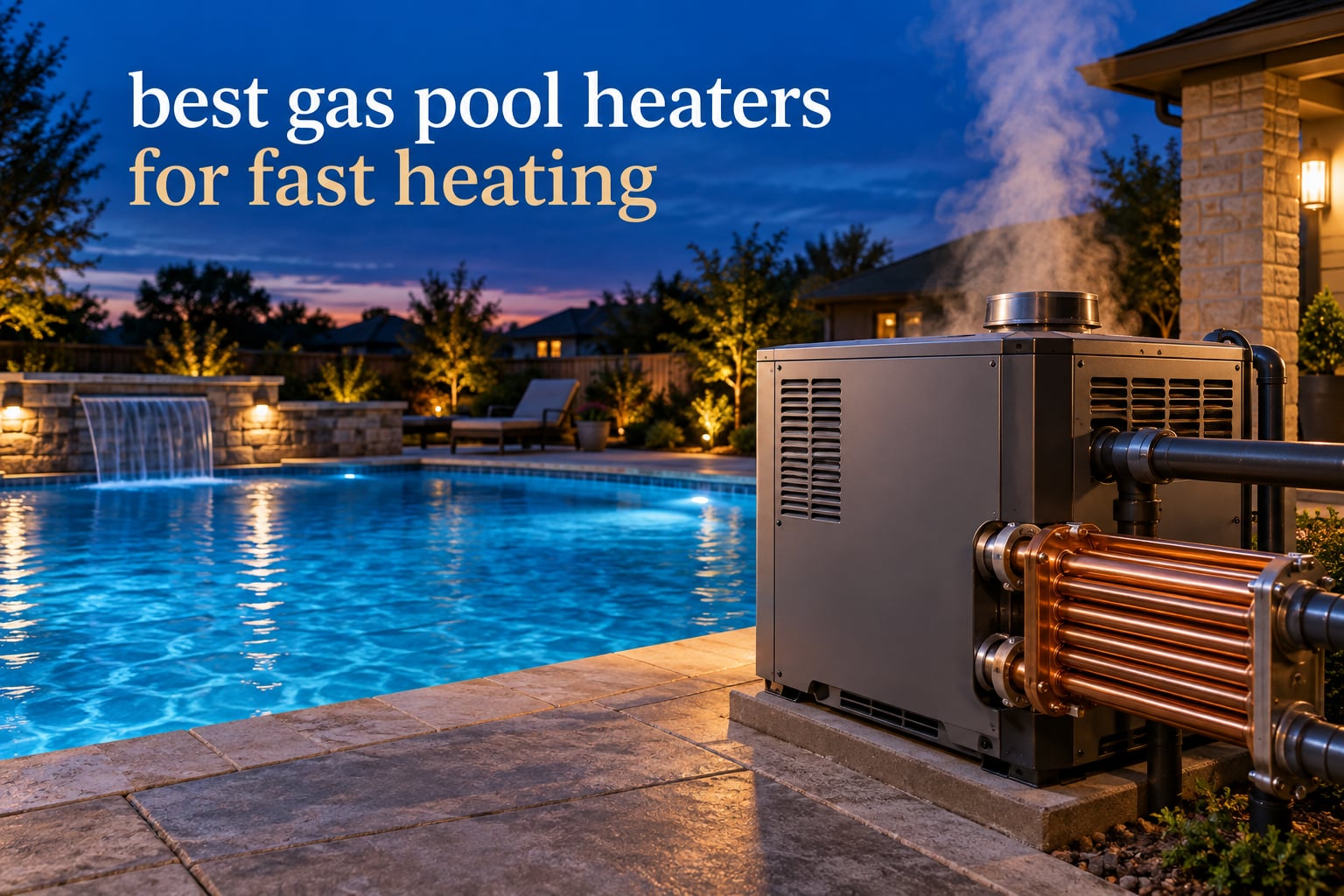
If your pool water sits at 68F when you get home and you want it swimmable by dinner, the heater’s job is not comfort, it is speed. A gas pool heater is the only residential heater that can move 20,000 gallons of water up a dozen degrees in an afternoon, and the gap between a 250,000 BTU unit and a 400,000 BTU unit is the gap between a long evening and a short one. We spent weeks reading the review data, spec sheets and owner reports behind every mainstream gas pool heater on the market to work out which ones actually deliver the fast heating this keyword promises.
This roundup covers six natural gas and propane pool heaters, all sized for in-ground pools, all of them built around forced-draft burners and copper-family heat exchangers. We picked them because they are the models showing up in owner conversations and service forums right now, and because they span the real use cases: a mid-size family pool, a large deep-end pool, a pool and spa combo, and a tight equipment pad.
Two things shaped our ranking. The first is heat-up rate per BTU tier, which is the number that actually decides how fast your water moves. The second is what owners say happens three years later, because a heater that heats fast and then fails is a bad investment no matter how good its spec sheet looks. One more note before we start: if your pool is above-ground and you have no gas line, the sizing math here still applies, but you will want our above-ground pool heater guide first, since those setups work within tighter constraints.
Table of Contents
Top 3 Picks: The Hayward H-Series 250K Takes the Top Spot (September 2026)
Three heaters stood out once we sorted the owner data by heat rise, serviceability and how well the unit held up after the first year. The Hayward H-Series 250,000 BTU won on the sheer weight of satisfied owners, the Raypak 406,000 BTU cupro-nickel model took the highest-rated slot, and the Raypak 266,000 BTU came out as the value pick for mid-size pools.

Hayward H-Series 250K Natural Gas
- 250000 BTU natural gas
- Digital LED panel with self-diagnostics
- Low-NOx certified
- Left or right side gas and electrical connections

Raypak 406K Cupro-Nickel Natural Gas
- 406000 BTU natural gas
- Cupro-nickel heat exchanger
- Microprocessor controlled thermostat
- Pagoda design for harsh weather

Raypak 266K Digital Natural Gas
- 266000 BTU natural gas
- Intermittent spark ignition
- No heat sink required cabinet
- Weather resistant construction
All Six Gas Pool Heaters at a Glance in 2026
Every heater below is a forced-draft gas unit rated for in-ground pools. Read the BTU column against your pool volume first, because that single number predicts heat-up speed better than any other spec.
| Product | Specifications | Action |
|---|---|---|
| Hayward H-Series 250000 BTU Natural Gas |
|
Check Latest Price |
| Raypak 406000 BTU Cupro-Nickel Natural Gas |
|
Check Latest Price |
| Raypak 266000 BTU Digital Natural Gas |
|
Check Latest Price |
| Raypak 406000 BTU Digital Propane |
|
Check Latest Price |
 Pentair MasterTemp 400 High Performance Natural Gas Pentair MasterTemp 400 High Performance Natural Gas |
|
Check Latest Price |
 Pentair MasterTemp 250000 BTU Propane Pentair MasterTemp 250000 BTU Propane |
|
Check Latest Price |
How Fast Is Fast: Gas Pool Heater Heat-Up Rate Math?
A gas pool heater raises pool water roughly 1 degree Fahrenheit per hour for every 3,000 BTU of input, on a pool of about 10,000 gallons. That is the rule of thumb that lets you predict a heat-up before you ever turn the burner on, and it is why BTU rating matters more than any other number in this guide.
Scale it from there. Raw burner math says a 150,000 BTU unit would move a 10,000-gallon pool about 5 degrees an hour, but in a real installation that lands closer to 1.5 to 2 degrees an hour once you account for heat lost to the air, the plumbing and the ground. A 400,000 BTU unit on the same pool realistically delivers 4 to 6 degrees an hour. On a 20,000-gallon pool, expect to halve those figures, so a 400,000 BTU heater lands closer to 3 degrees an hour, or about 8 hours to go from 70F to 82F.
Real owner reports line up with the math. One Hayward H-Series owner took a 22,500-gallon pool from 65F to 80F overnight, and pushed the same heater from a 78F setting to 94F-plus in under two hours in the evening when the starting point was already warm. A Raypak 406,000 BTU owner raised a 30,000 to 35,000-gallon pool from 80F to 84F in under two hours, which is a big pool and a small temperature climb landing in exactly the time the formula predicts.
Two things distort the numbers. A solar cover can cut heat loss dramatically, so a covered pool warms considerably faster than the same pool uncovered. And a variable-speed pump running at low flow pulls the rated efficiency down, which means the burner is making heat but the water is not carrying it away fast enough. If you want the fast heating this roundup is about, keep the cover on and keep the flow rate calibrated.
For spa and combo work the picture is different again. One owner heated an 8 by 16 foot spa from 60F to 100F in about three hours with a 406,000 BTU propane Raypak. Small bodies of water heat far faster per hour than pools, so if your demand is hot tub water rather than swim water, BTU headroom pays off quickly.
1. Hayward H-Series 250,000 BTU Natural Gas Pool Heater: Best Overall for Fast Heating
Hayward H-Series Natural Gas Pool Heater for Inground Pools 250,000 BTU
250,000 BTU natural gas
Digital LED panel with self-diagnostics
Low-NOx certified
171 pounds
Pros
- Proven heat rise on very large pools
- Quiet running
- Self-diagnostic LED panel is genuinely easy to read
- Side-mounted gas and electrical connections simplify replacement
- Low-NOx certified
Cons
- Heat exchanger elbow leaks reported within months on some units
- Warranty claims often disputed
- Needs adequate pressure from a clean filter to ignite
This is the heater we kept coming back to, because it has the largest body of real-world feedback in the group. With 195 ratings averaging 4.0 stars, the H-Series 250K has more owners reporting on its long-term behavior than anything else we reviewed, and that is a genuine advantage when you are buying a device that sits outside year after year.
The heat-up performance is where the fast-heating promise gets cashed. Owners report running a 22,500-gallon pool from 65F to 80F overnight, and the same unit jumping from a 78F setting past 94F within two hours when the water was already warm. The digital LED control panel with self-diagnostic capability is the piece owners mention most often as easy to live with, and the side-mounted gas and electrical connections on either the left or right mean it drops into a replacement pad far more easily than most.
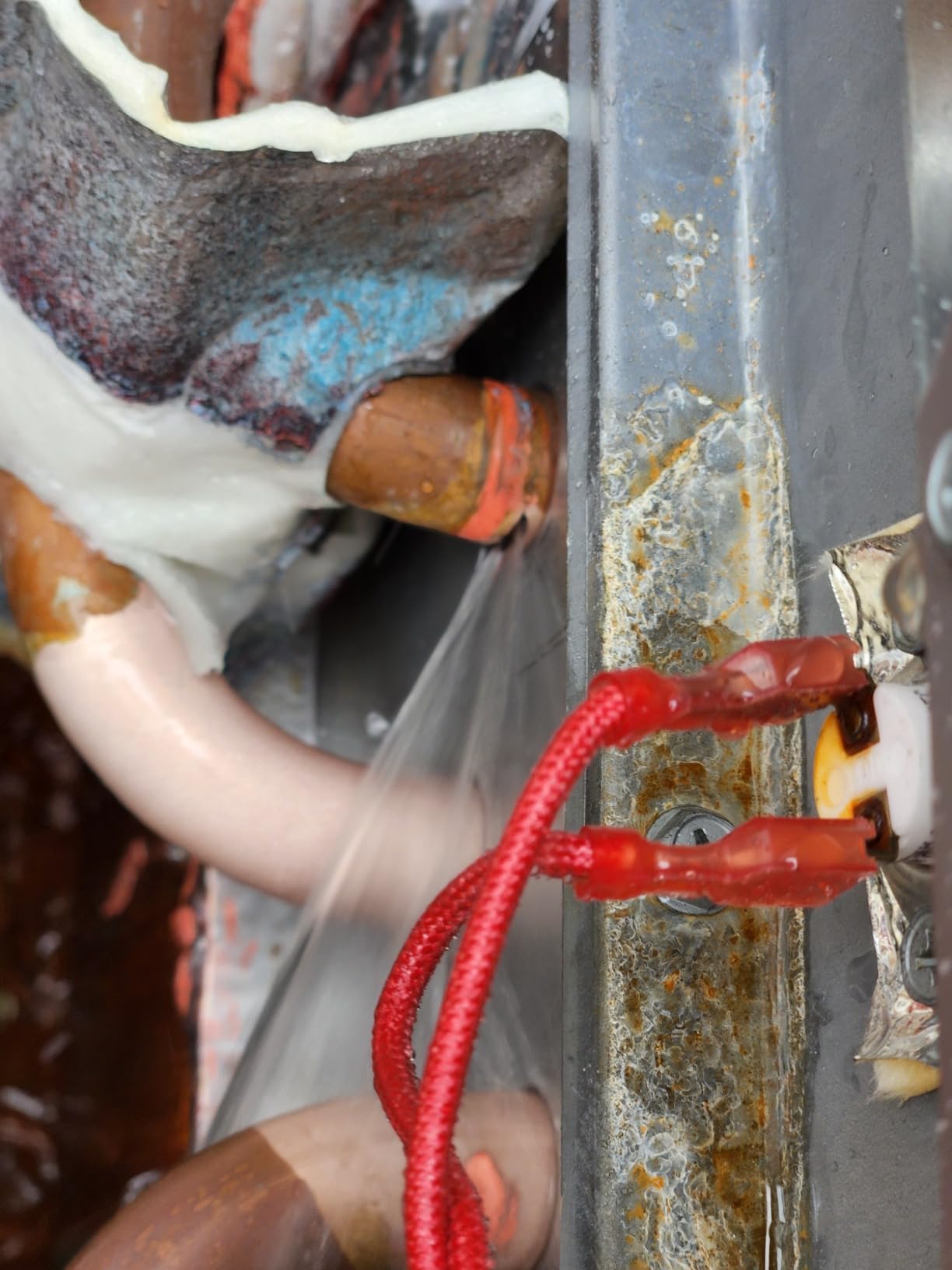
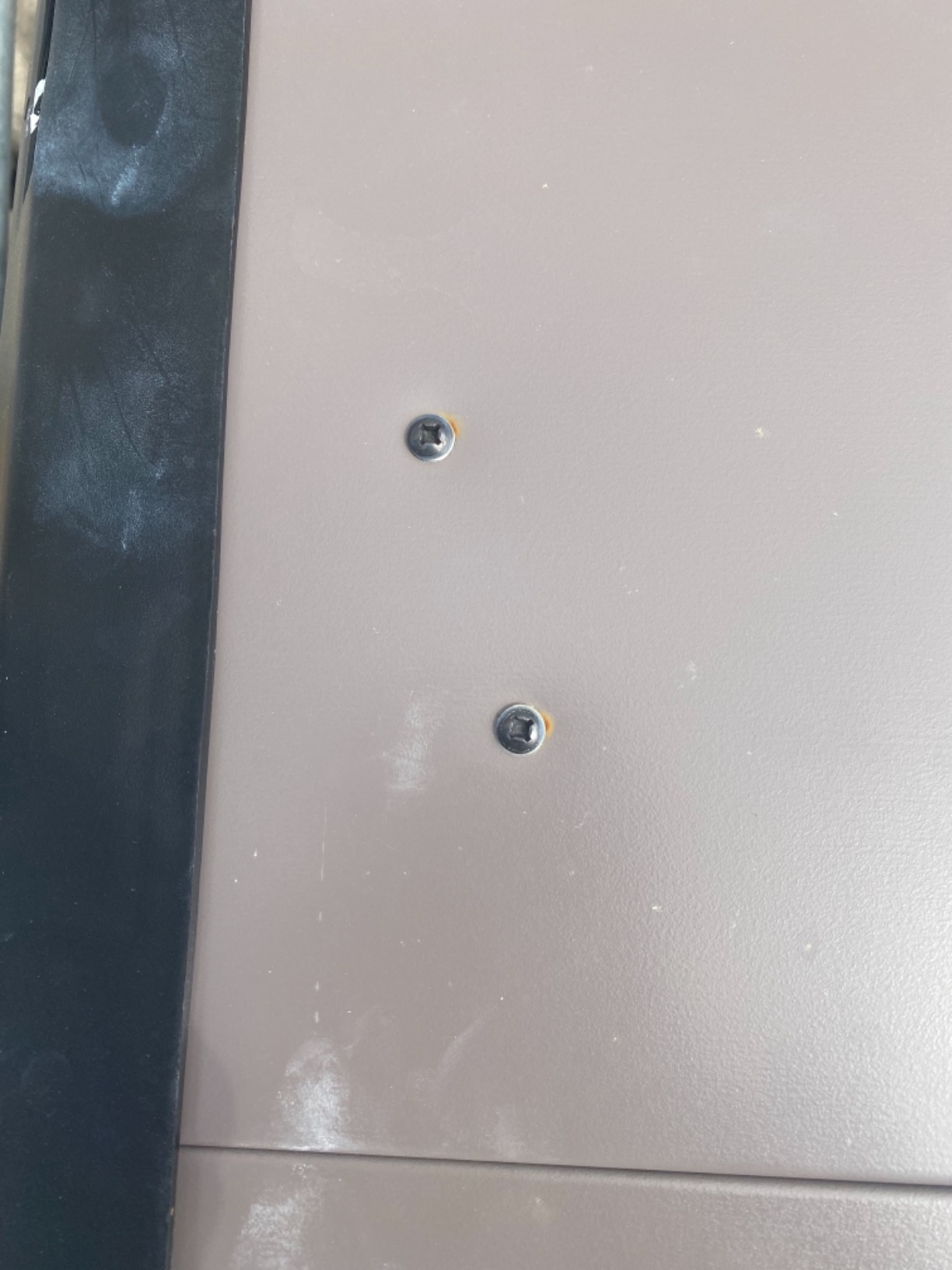
What gives us pause is durability, not output. A meaningful share of owners report heat exchanger leaks at the elbow joints, sometimes within months, and customer stories about disputed warranty claims come up often enough that we would not skip reading them. The unit also refuses to ignite reliably with a dirty filter or low pressure, throwing an LO code and dropping into protection mode rather than firing.
Roughly 66 percent of ratings sit at five stars and 20 percent at one star, which tells you plainly that this is a durability split rather than a performance split. Owners with a working unit love it. The fix for the ignition complaints is unglamorous and cheap: clean the filter, keep the pressure switch satisfied, and service the unit on schedule.
What you should check before buying this model?
Ask your installer to confirm the gas line can deliver the full 250,000 BTU at the unit, because an undersized line or a meter that cannot carry the load is the single most common installation blocker. Also confirm the electrical supply matches the unit’s requirements, since the H-Series needs a proper connection rather than a simple plug.
Then plan for the elbow joint failure mode. If your pool chemistry runs aggressive, budget for a heat exchanger inspection in year two, and consider a zoned heater bypass so the unit can be isolated when sanitizer levels spike.
Who will regret buying it?
Owners shopping purely on price and skipping the install quote. Beyond the unit itself, new gas line runs, fittings and electrical work can add significantly to the total, and that is where the sticker price stops reflecting what you pay. Buyers in saltwater systems should also look at cupro-nickel options instead, since the standard heat exchanger material here is not built for salt.
If your pool is over 20,000 gallons and you want the shortest possible heat-up window rather than the lowest purchase cost, step up to the 400,000 BTU class and accept a longer install conversation.
2. Raypak 406,000 BTU Natural Gas with Cupro-Nickel: Best for Large Pools and Saltwater
Raypak 406,000 Btu Digital Natural Gas Pool Heater with Cupro Nickel
406,000 BTU natural gas
Cupro-nickel heat exchanger
Microprocessor thermostat
44 x 34 x 31 inches
Pros
- Highest rated unit in the group
- Rapid heat rise on very large pools
- Quiet operation
- Digital thermometer removes the need for an external gauge
- Cupro-nickel handles aggressive chemistry
Cons
- High fuel consumption when heating large volumes
- Self-installation needs solid plumbing and gas knowledge
- One owner reported a blank LCD panel until reset
This heater has more raw output than anything else in the roundup except the propane twin below, and the reasons for choosing it are straightforward: 406,000 BTU of natural gas through a cupro-nickel heat exchanger with a microprocessor controlled thermostat. At 4.4 stars across 46 ratings it also holds the highest average rating of anything we reviewed, with 72 percent five-star ratings and only 6 percent one-star.
The heat-up story is the headline. One owner raised a 30,000 to 35,000-gallon pool from 80F to 84F in under two hours, which is an enormous volume of water moving quickly. Owners also mention that the digital thermometer on the unit means you stop needing a separate pool thermometer, and that the Pagoda design keeps the burner working in harsh weather rather than shutting down when conditions turn.
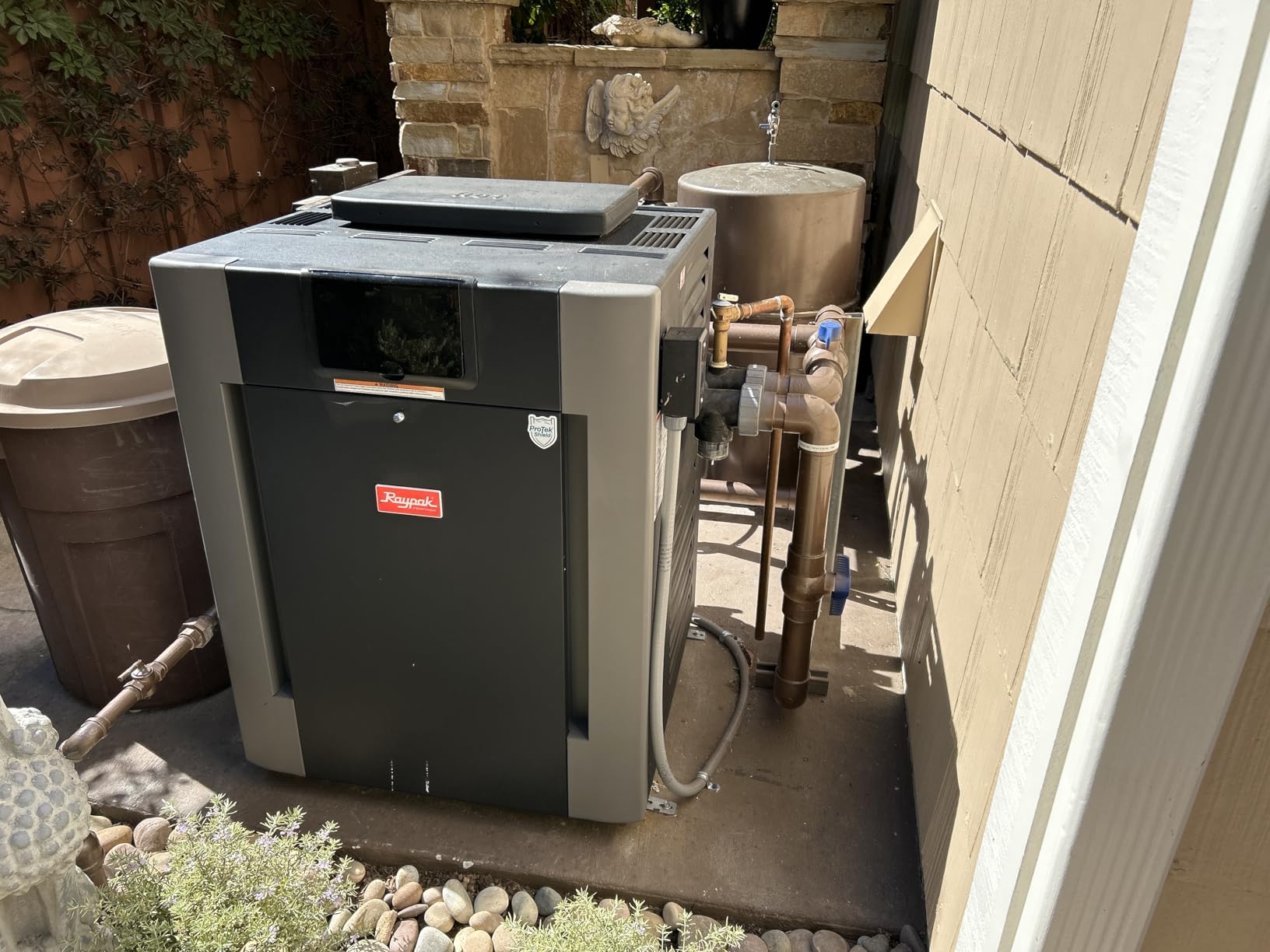
The cupro-nickel heat exchanger is the reason this unit earns its place for saltwater and chemically aggressive pools. Cupro-nickel resists the corrosion that eats through plain copper exchangers when a salt water chlorinator is running, and it tolerates wider chemistry swings. If your pool has a chlorinator, this is the construction you want and the copper fin-tube designs elsewhere on this list are not equivalent.
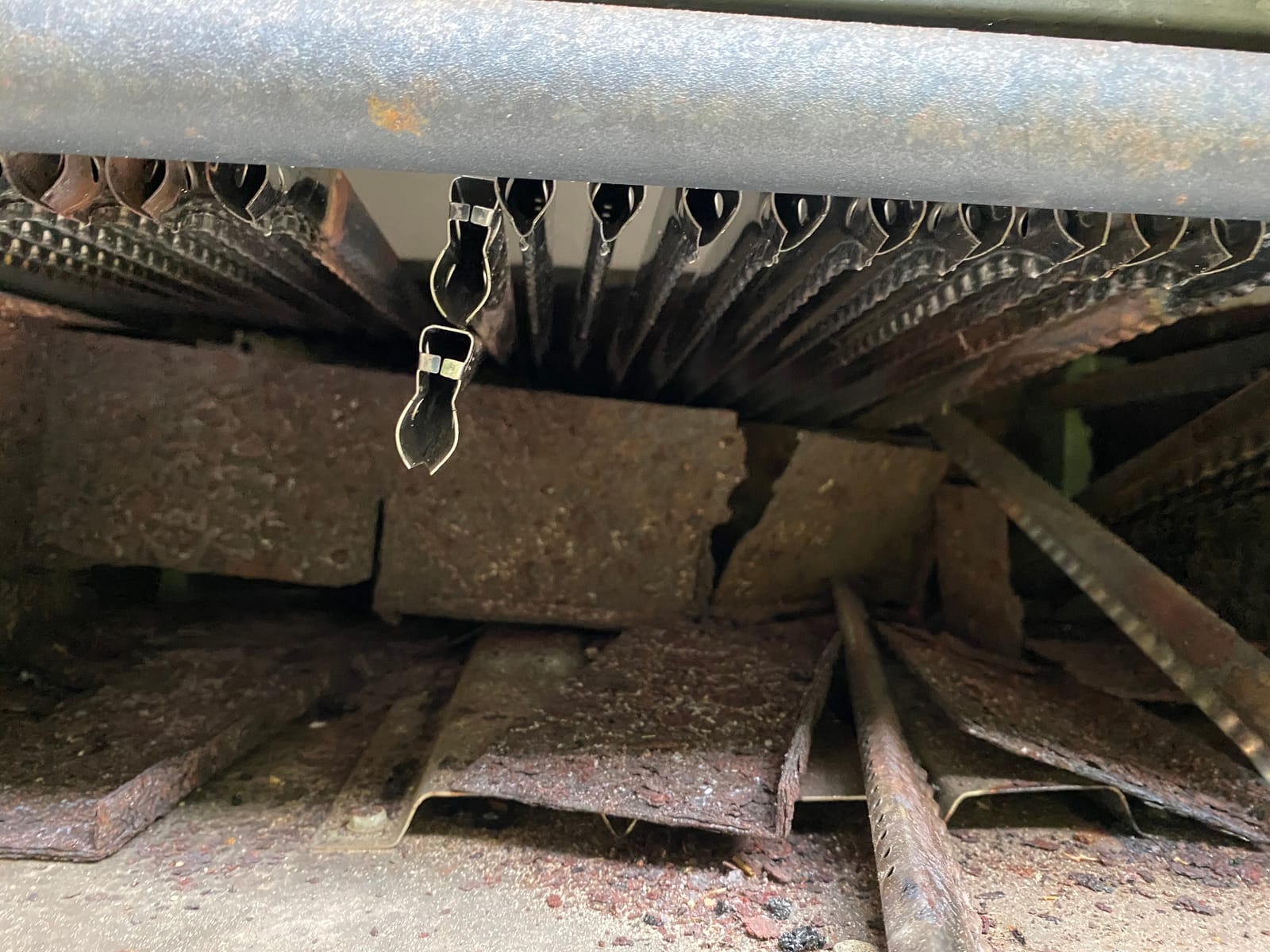
Reviewers do raise real concerns. Fuel consumption climbs sharply when you are pushing 406,000 BTU through a large body of water, and one owner reported the LCD control panel going blank after installation until it was reset. The pool plumbing and gas hookups also have to be right for a unit this size, and installers report it fitting existing gas and plumbing for straightforward replacement, which is a real advantage if you are swapping an older heater.
What you should check before buying this model?
Check your gas meter and line capacity first. A 406,000 BTU load is substantial, and homeowners who convert another gas appliance can find the existing meter too small once the heater goes in. Confirm the service can deliver that load at the unit, not just at the meter.
Second, decide on the heat exchanger material deliberately rather than by default. Cupro-nickel costs more up front and pays for itself in longevity on a salt system. If you are on chlorine-only chemistry, a cheaper copper exchanger in the same BTU class may be the more sensible spend.
Who will regret buying it?
Owners with modest pools and modest fuel budgets. Running a 400,000 BTU burner to warm 12,000 gallons is buying speed you will not notice and burning money you will. This unit is at its best on a large pool, a pool and spa combination, or a cold-climate installation where season extension is the goal.
It is also the wrong pick for anyone unwilling to hire a licensed gas fitter. The self-installation warnings in the reviews are not boilerplate.
3. Raypak 266,000 BTU Digital Natural Gas: Best Value for Mid-Size Pools
Raypak 266,000 BTU Digital Electronic Ignition Natural Gas Pool Heater
266,000 BTU natural gas
Intermittent spark ignition
44 x 31 x 29 inches, 210 pounds
Pros
- Pilot only lights on a call for heat
- Cabinet needs no metal heat sink
- Weather-resistant construction
- Widely serviceable and familiar to local technicians
Cons
- Mixed long-term reliability reports for electronics and ignition
- Installation needs plumbing gas and electrical knowledge
- 19 percent of ratings are one star
The Raypak 266K is the sensible middle of this list, and the reasons are more technical than price. Intermittent spark ignition means the pilot only comes on when there is a call for heat, so you are not paying to keep a standing flame lit through the shoulder season. That single design choice is where a large part of the operating economy in a gas pool heater comes from.
The cabinet is the other quiet win. It is made from a material that does not retain residual heat after shutdown, which means the unit can be installed without the metal heat sink some models require. That simplifies a retrofit, and it matters if you are working in a tight equipment pad where a heat sink is a nuisance.
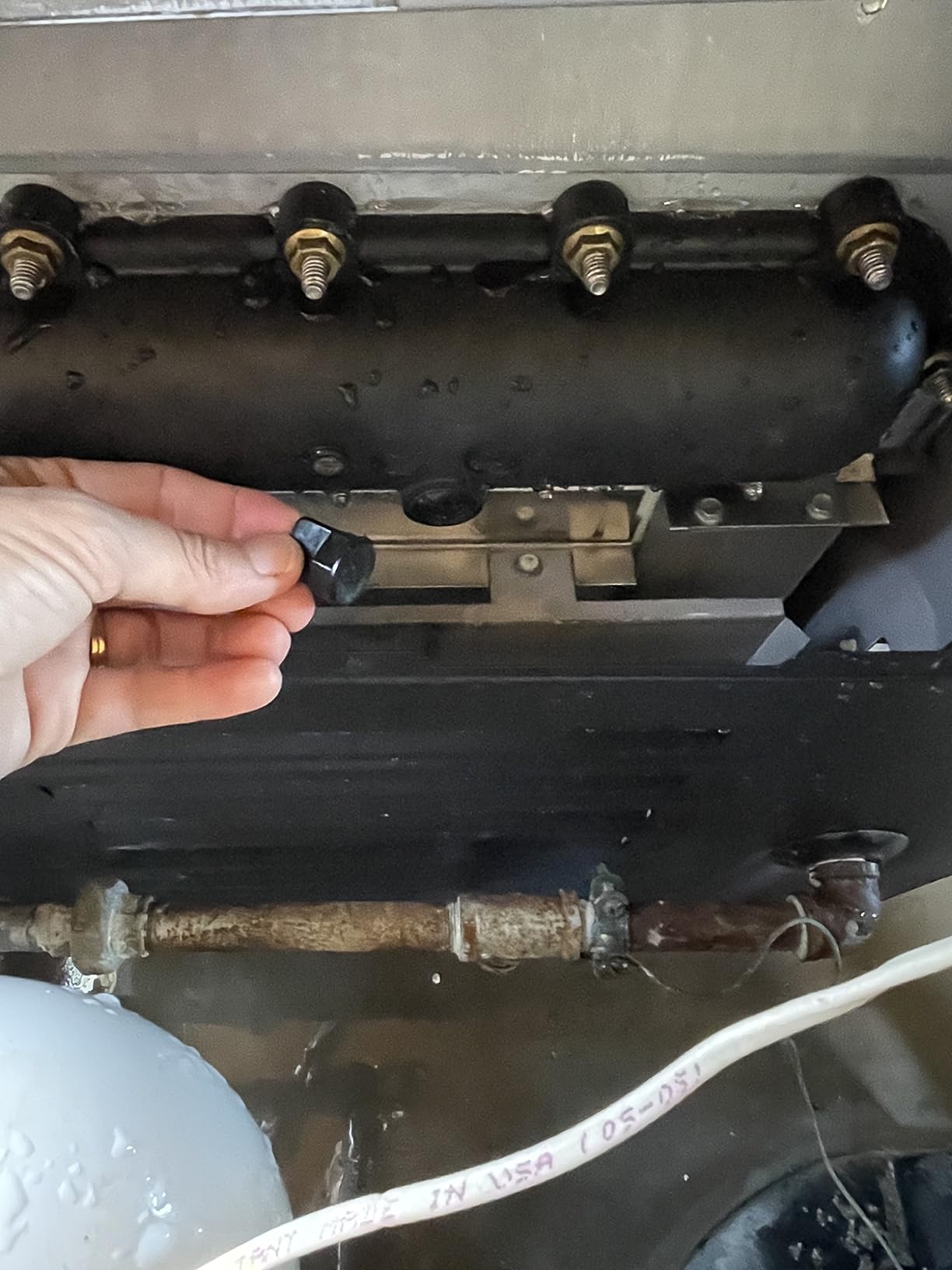
At 3.9 stars across 169 ratings, the split here is about durability rather than capability. Sixty-five percent of ratings are five star, and the 4-star bulk suggests most buyers are satisfied rather than thrilled. The 19 percent one-star share points at electronics and ignition reliability over time, and that is the pattern to watch on an aging unit.
Serviceability is the underrated strength. Raypak units are extremely common in residential installations, so parts are easy for local technicians to source and diagnose routinely. For an owner who cares about getting a unit repaired without ordering exotic components, that familiarity is worth more than a slightly better spec sheet.
What you should check before buying this model?
Match the BTU to your volume rather than to your ambition. Two hundred sixty-six thousand BTU is a good fit for a mid-size in-ground pool, and pairing it with a much larger body of water will leave you waiting. If your pool is in the twenty thousand gallon range and fast heat-up is the goal, the 400,000 BTU class is the better buy.
Confirm the ignition and control module is a current-production part in your region, since electronics longevity is the main complaint pattern in the reviews. Ask the installer what they would replace at year five and roughly what that costs.
Who will regret buying it?
Owners who want maximum speed. This heater is a steady performer, not a sprint unit, and if your priority is heating the water in the fewest hours you will notice the gap against a 406,000 BTU machine. It is also a poor match for saltwater pools, because the heat exchanger here is not cupro-nickel.
It is equally a poor match for anyone planning to install it without a professional. The reviews are clear that plumbing, gas and electrical knowledge all matter on this unit.
4. Raypak 406,000 BTU Propane: Best for Homes Without a Gas Line
Raypak 406,000 BTU Digital Electronic Ignition Propane Pool Heater
406,000 BTU propane
Microprocessor controlled thermostat
All copper fin-tube heat exchanger
2 inch CPVC connections
Pros
- Strong measured temperature rise on replacement installs
- Heated an 8 by 16 spa from 60F to 100F in about three hours
- Quiet operation
- Drop-in fit for older Raypak units
Cons
- One owner reported water leaking from the unit after two months
- Warranty routed through a dealer that may not cover your area
- Propane hookup must be fitted by the gas company
This is the propane answer to the same fast-heating question, and it is the right unit when there is no natural gas line at the property. It carries the same 406,000 BTU output as the natural gas Raypak above, so the heat-up math in this guide applies directly, with the difference that fuel arrives in a tank rather than through a pipe.
The performance reports are concrete. One owner measured outflow water nine degrees above inflow on a matched replacement install, and another heated an 8 by 16 foot spa from 60F to 100F in about three hours. The unit also runs surprisingly quietly, which matters if the heater pad sits near a bedroom wall.
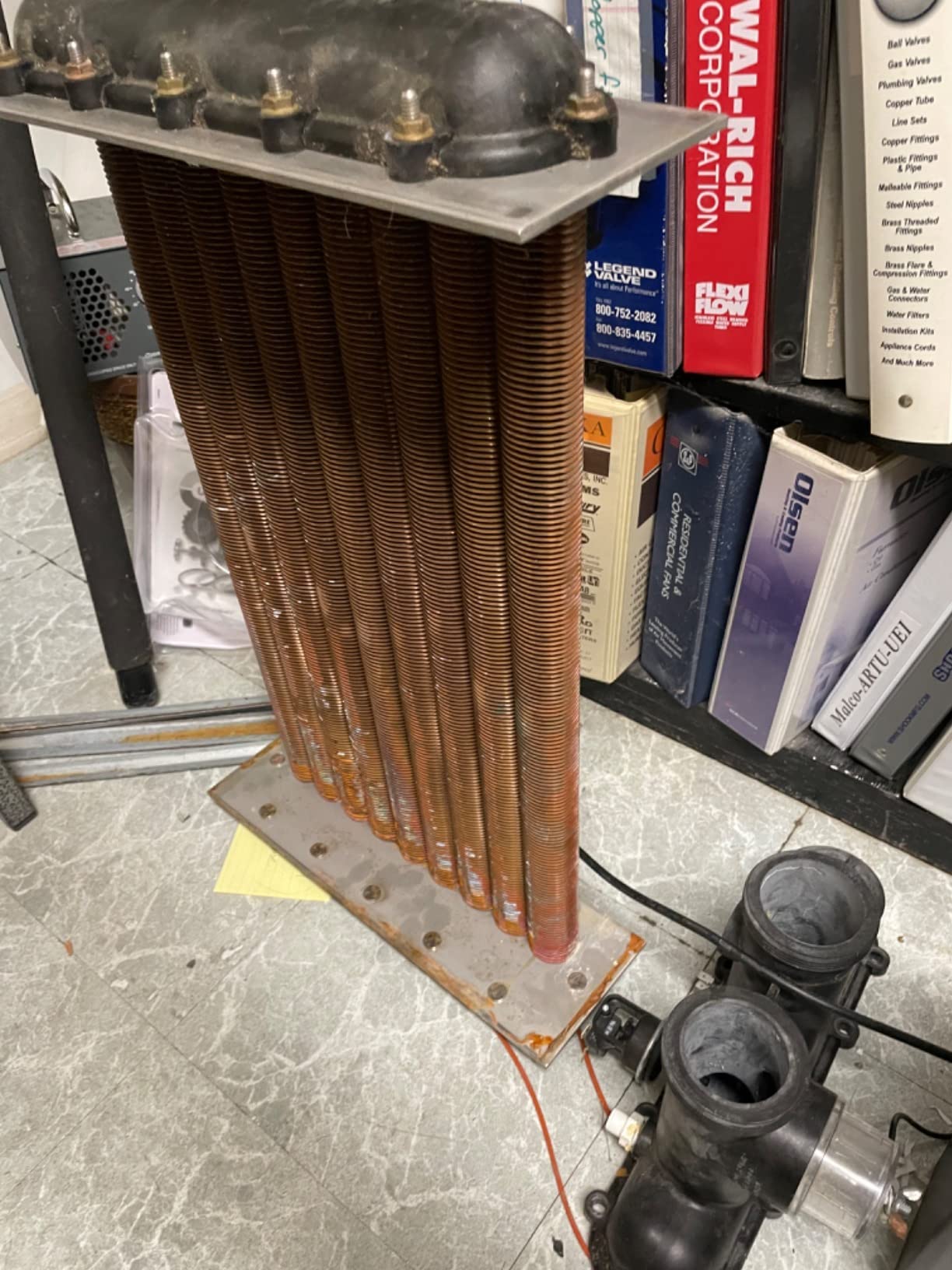
Replacement installs are where this heater genuinely shines. A lot of owners matched it to an older Raypak and reported a drop-in fit, along with the copper fin-tube heat exchanger, stainless steel tube sheet, two inch CPVC water connections, burner tray and fire tile all arriving as a complete package. The PolyTuf powder coating and polymer headers keep the cabinet and internals non-corrosive and rust resistant.
The negatives are narrow but real. One owner reported water leaking out of the unit after roughly two months of light use, and warranty support runs through a dealer who may not service your area, which is a recurring frustration. Have the propane hookup fitted by the gas company so the correct regulator goes on.
What you should check before buying this model?
Confirm your tank size and refill arrangement before you commit. A 406,000 BTU burner drinks propane quickly, and owners who rely on a single small tank report anxiety about running out mid-season. A larger tank or a scheduled refill plan removes the problem entirely.
Then check the drop-in claim against your existing plumbing. The unit uses two inch CPVC water connections, and older installs with different union sizing will need adapters that cost time and money.
Who will regret buying it?
Owners with a natural gas line already available. Gas is simply cheaper per BTU over the long run, and a propane setup carries both the tank hardware and the refill cost forever. If the trench to run a gas line is short, propane is the pragmatic answer, but it is a compromise rather than the fast-heating optimum.
It is also the wrong unit for a saltwater pool, since the exchanger is copper fin-tube rather than cupro-nickel.
5. Pentair MasterTemp 400 High Performance Natural Gas: Best for Tight Equipment Pads
MasterTemp 400 High Performance Pool and Spa Heater – Natural Gas
Natural gas
Premix combustion
Rust-proof exterior
36 x 30 x 22.5 inches, 65 pounds
Pros
- Premix combustion for fast and efficient warm-ups
- Rotatable controls work regardless of plumbing orientation
- Rust-proof exterior
- Certified for both indoor and outdoor installation
Cons
- Listed weight of 65 pounds is far below comparable capacity heaters
- One-quarter of ratings are one star
- Small review base limits long-term reliability evidence
The MasterTemp 400 is the compact one, and compactness is genuinely the feature here. At 36 by 30 by 22.5 inches and a listed 65 pounds, it weighs less than half what the other heaters on this list are rated at, which means it fits equipment pads where a full-size unit will not go.
Premix combustion technology is what drives the fast warm-ups owners report. The fuel and air are mixed before entering the burner rather than being combined in the firebox, which improves ignition reliability and cut-off response. The rotatable control panel is another quietly excellent detail, since it means the unit can be plumbed in whichever orientation the pad allows and still be operated without contortion.
Read the reviews with care though. With 17 ratings and a 4.0 average, the feedback is almost entirely five star or one star, with nothing in between. Seventy-six percent five star, twenty-four percent one star. That polarization is what a small sample produces, and it is a signal to slow down and ask questions rather than to draw a firm conclusion.
That listed 65 pound figure is worth pressing on. It sits far below what heaters of comparable capacity weigh on this list, so verify shipping and handling arrangements with the seller before you commit, and confirm the spec sheet matches what physically arrives.
What you should check before buying this model?
Ask for the real installed footprint and shipping weight, because the listing figure is an outlier in this capacity class. Measure your pad and your access route before ordering, since the whole point of this unit is that it fits where larger heaters do not.
Confirm the venting arrangement with your installer. The unit is certified for both indoor and outdoor installation, which is unusual and useful, but the clearance requirements still have to be met on the site you actually have.
Who will regret buying it?
Buyers who want a deep pool of owner history. Seventeen ratings is not enough evidence to make a confident long-term reliability call, and you are making a purchase you expect to last a decade. If the pad fits, a heater with a larger review base is the safer bet.
Saltwater pool owners should also look elsewhere, since premix combustion does nothing for exchanger corrosion resistance and the cupro-nickel route is the one that matters with a chlorinator.
6. Pentair MasterTemp 250,000 BTU Propane: Best Propane Value for Mid-Size Pools
MasterTemp Pentair EC-462027 250,000 BTU Propane Gas Pool Heater
250,000 BTU propane
Premix combustion
Rust-proof exterior
147 pounds
Pros
- Premix combustion gives quick warm-ups
- Rotatable controls simplify setup
- Rust-proof exterior
- Built-in safety features
- Certified for indoor and outdoor installation
Cons
- Lowest rated unit in the group at 3.7 stars
- One-third of ratings are one star with nothing in between
- Very small review base of 15 ratings
The MasterTemp 250 propane is the value entry point for a mid-size pool without a gas line. It carries the same premix combustion platform and rotatable control panel as the larger MasterTemp 400, at 250,000 BTU, and those two features are what make it worth a look despite the rating.
Premix combustion is the reason the warm-ups are fast, and the rotatable panel means the unit can be piped in from whichever side the pad allows. The rust-proof exterior is built for long service life outdoors, the built-in safety features cover system protection, and the unit is certified for both indoor and outdoor installation.
Now the honest part. At 3.7 stars this is the lowest rated heater in the group, and the fifteen ratings behind that number split entirely between five star and one star with nothing in between. Sixty-seven percent five star, thirty-three percent one star. With a sample that small, the average tells you the customer base is genuinely divided rather than broadly dissatisfied, but it also tells you very little.
We would consider this unit when the budget is the deciding factor and the pool is comfortably in the mid-size range. We would not consider it for a saltwater pool or for anyone who wants a large body of owner feedback to lean on.
What you should check before buying this model?
Have the propane connection and regulator fitted by the gas company, and confirm the tank size supports a 250,000 BTU load. Verify the electrical connection requirements with your installer, since the MasterTemp line does not run on a simple household plug in every configuration.
Ask the installer to walk you through the safety shutdown behavior, including what happens on a low-flow or freeze condition, so you know what codes mean before you need to read them.
Who will regret buying it?
Owners with large pools who will push it past its sizing. Two hundred fifty thousand BTU on a twenty thousand gallon pool will work eventually, but it is not fast heating, and it is the wrong tool if speed is the goal. Buyers who want a long warranty-supported track record will also find fifteen ratings thin.
If the pool is over twenty thousand gallons or you are installing a salt water chlorinator, move up a class rather than down in price.
Raypak vs Hayward: Which Brand Wins Head to Head?
Raypak wins on breadth and cupro-nickel availability, Hayward wins on the weight of owner feedback and service familiarity. In the pool owner forum r/pools, one user described the Hayward FDN models as tried, true, and easy to diagnose and repair, and that sentiment about parts availability and diagnosability is exactly what the review data on the H-Series confirms. Technicians tend to recommend the brand they know best, which produces wildly contradictory advice in both directions.
Raypak’s advantage is that the cupro-nickel construction is available at the top of the range, and its 406,000 BTU natural gas unit carries the highest rating in this group. Hayward’s advantage is the 250K H-Series, where 195 owners have left ratings and the performance reports are consistently strong on large pools. Hayward also uses flexible gas and electrical connections that mount on either the service side of the pad, which is a real installation benefit on a retrofit.
One practical note that trips up buyers: identical heaters appear under Raypak, Rheem and Ruud names in different markets, so confirm the model number and the heat exchanger material before you assume two listings are different products. And if you want to see how fuel type changes the ownership picture, our solar pool heater comparison covers the lower-cost route to the same goal.
How to Size a Gas Pool Heater for Your Pool?
Ten thousand gallons needs roughly 100,000 to 150,000 BTU, fifteen to twenty-five thousand gallons needs 200,000 to 300,000 BTU, and twenty-five thousand gallons and up needs 300,000 BTU or more. Those are the working tiers, and they are the fastest way to answer the sizing question without overcomplicating it.
Work backward from volume instead. Measure the pool’s length, width and average depth, multiply for surface area, then multiply by the gallons-per-square-foot factor for your average depth. Round up when you land between tiers, since an undersized heater will simply take longer rather than saving meaningful fuel.
Oversizing has a real cost that surprises people. A heater far larger than the pool needs will short-cycle, cycling the burner on and off to satisfy the thermostat, and short cycling costs efficiency and wears the heat exchanger faster. Size for the fastest heat-up you actually want on a cold morning, not for the largest pool you might ever own.
Finally, check the gas infrastructure before you finalize a size. A 400,000 BTU load can exceed what an older home’s meter and line can carry, and one owner in the forums found their meter too small once a stove and a heater were both converted. This is a conversation to have with your gas utility early, not on install day.
Natural Gas vs Propane: Which Fuel Heats a Pool Faster?
Natural gas heats a pool slightly faster per hour and costs less per BTU, while propane is the practical choice where no gas line exists. Heat output in BTU per hour is what sets the ceiling on speed, and both fuels can deliver it. The real difference is the infrastructure and the running cost, not the burner.
Natural gas arrives through a pipe, so the cost per BTU is lower and there is no tank to maintain. That makes it the better long-run economics whenever the trench to run a line is reasonable. Propane arrives in a tank, which means tank hardware, refill scheduling and a higher cost per BTU, and it also means your supply depends on deliveries rather than a fixed line.
Both fuels carry a hidden constraint that is worth taking seriously. Propane users worry about running out mid-season, and gas users hit the meter capacity ceiling. Neither problem is solvable by choosing a bigger heater, so decide your fuel based on the infrastructure your property can support rather than on the heater you wish you could buy.
If heat loss is your bigger concern rather than raw speed, pairing any of these heaters with a solar cover is worth more than a small BTU upgrade. Our guide to solar pool heating panels covers that side of the equation.
Copper vs Cupro-Nickel: Choosing the Right Heat Exchanger
Choose cupro-nickel if you run a salt water chlorinator, and copper is acceptable on a chlorine-only pool kept in balance. The heat exchanger is the part of a gas pool heater that touches your water, so its material determines how long the unit lasts and whether it fails early through corrosion.
Copper is cheaper, lighter and an efficient conductor, and it works well in a chlorine-only system with normal chemistry. Cupro-nickel is a copper-nickel alloy that resists corrosion from salt and aggressive chemistry, which is why it appears on the Raypak 406,000 BTU natural gas unit in this roundup. If your sanitizer is a salt water chlorinator, the extra cost of cupro-nickel is the difference between a ten-year heater and a three-year one.
Water chemistry is the single largest driver of early heater failure, more than age. High total alkalinity, low calcium hardness and unbalanced pH all attack the exchanger from the water side. A zoned heater bypass that isolates the unit during chemistry swings or heavy sanitizer treatment is a modest addition that pays for itself in exchanger life.
Installation Realities, Warranty Traps and Heater Lifespan
A licensed gas fitter is required in every case, and a self-installed heater can void most of its warranty. This is not advice we are borrowing from a manual, it is the recurring theme across the reviews and the forums. Nobody on any of these units rates a heater highly for a job done without a permit.
Expect the install to cost meaningfully more than the unit in some cases. New gas line runs, fittings, electrical work and pad modifications all add up, and owners with older Raypak units got the smoothest replacements because the existing plumbing and gas hookups already matched. The side-mounted connections on the Hayward H-Series help here too, since the unit can be oriented either way on the pad.
On lifespan, owner reports and industry experience cluster around five to seven years to the first repair and eight to twelve years of total service life for a gas pool heater. That range assumes reasonable chemistry. Units run with aggressive water or without a bypass tend to fail at the exchanger elbow joints earlier, which is precisely the failure pattern Hayward owners report.
Winterizing matters more than most buyers expect. Rodent damage is a real and common cause of early failure, so clear debris away from the unit before closing the pool and check the enclosure when you reopen it. Calibrating flow rate protects rated efficiency, and an efficiency loss over time is a counterweight to the headline numbers on the spec sheet.
Gas Heater or Heat Pump: Making the Final Call
A heat pump is the right choice for constant temperature maintenance, and a gas heater is the right choice for fast on-demand heating. They are not competing answers to the same question, and buying the wrong one is the most expensive mistake in this whole category.
Heat pumps move ambient heat into the water slowly and cheaply, which makes them excellent for holding a pool at temperature week after week. They are a poor answer for the scenario this roundup covers, where you want a cold pool warm today. Gas burns fuel and delivers heat at a rate no heat pump can approach, and on a feature pool with a waterfall and a spa, gas is often the only realistic option at all.
A hybrid setup is worth considering in cold climates: let the heat pump hold temperature and fire the gas heater for the days you want the pool genuinely warm. If you are still comparing, our guide to above-ground pool heaters covers the sizing limits that matter most for smaller pools.
Frequently Asked Questions
What is the most efficient gas pool heater?
Efficiency in a gas pool heater is thermal efficiency: the share of fuel energy that actually reaches your pool water, and heaters in this class run around 80 to 85 percent. Intermittent spark ignition, where the pilot only lights on a call for heat, is the feature that moves the number most in daily use. In this roundup the Raypak 266,000 BTU model is the clearest example, and the cupro-nickel 406,000 BTU Raypak pairs high output with a durable exchanger.
How fast does a gas heater heat a pool?
Roughly 1 degree Fahrenheit per hour for every 3,000 BTU of input on a 10,000-gallon pool, so about 5 degrees an hour at 150,000 BTU and 4 to 6 degrees an hour at 400,000 BTU in real installations. Owner reports match: a 22,500-gallon pool went from 65F to 80F overnight on a 250,000 BTU Hayward, and a 30,000 to 35,000-gallon pool climbed 4 degrees in under two hours on a 406,000 BTU Raypak.
How many BTUs do I need to heat a 10,000 gallon pool?
A 10,000-gallon pool generally needs 100,000 to 150,000 BTU. Fifteen to twenty-five thousand gallons calls for 200,000 to 300,000 BTU, and anything at or above 25,000 gallons wants 300,000 BTU or more. Size for the fastest heat-up you actually want on a cold morning, because an oversized heater short-cycles, wastes fuel and wears the heat exchanger faster than a correctly matched one.
Which pool heater is better, Raypak or Hayward?
Raypak offers the broader range, including cupro-nickel construction and the 406,000 BTU class that leads this roundup on rating and heat rise. Hayward wins on owner feedback volume and service familiarity, with the H-Series 250K carrying 195 ratings and flexible gas and electrical connections that mount on either side. Owners in pool forums describe Hayward FDN models as tried, true, and easy to diagnose and repair.
What is the average lifespan of a gas pool heater?
Most gas pool heaters last five to seven years before the first repair and eight to twelve years in total, assuming the water chemistry is kept under control. Aggressive alkalinity, low calcium hardness and unbalanced pH attack the heat exchanger, and rodent damage in winter is a common early failure. A zoned heater bypass that isolates the unit during chemistry spikes is the cheapest life extension available.
The Best Gas Pool Heater for Fast Heating in 2026
The Hayward H-Series 250,000 BTU natural gas heater is our pick for the best gas pool heater for fast heating, because it pairs real measured heat rise on large pools with the deepest owner feedback base in the category at 195 ratings. If your pool runs 20,000 gallons or more and you want the shortest possible window, the Raypak 406,000 BTU cupro-nickel model is faster and holds the highest rating, and it is the right build for saltwater.
Whatever you choose, size the unit to your gallons rather than to your wish list, hire a licensed gas fitter, and keep the chemistry balanced so the heat exchanger survives. Do that and the fast heating this category promises is genuinely there when you get home from work.