
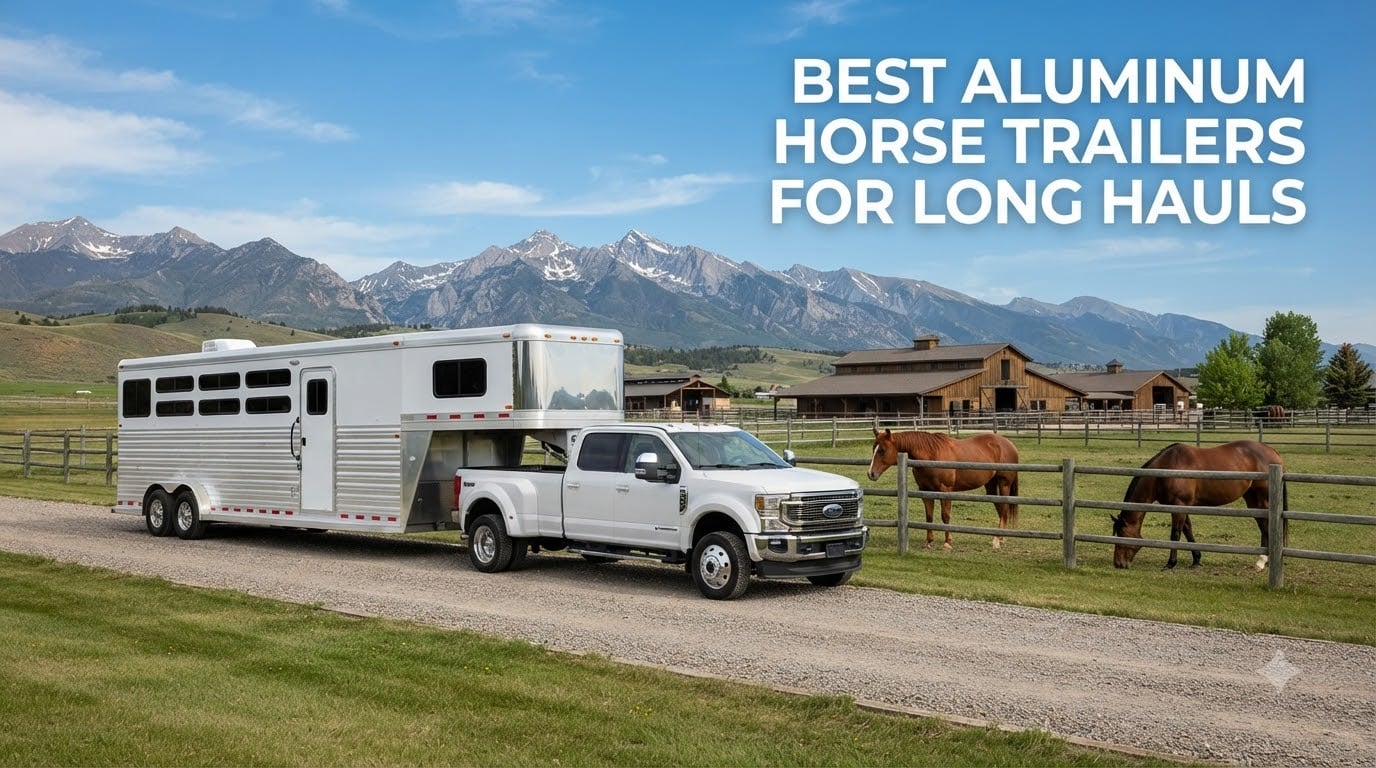
If you have ever driven ten hours with a horse stamping behind you, you know that the trailer matters as much as the truck pulling it. The best aluminum horse trailers for long hauls are not just lighter versions of steel models. They are engineered specifically to keep horses calm, cool, and balanced over hundreds of miles of interstate.
Our team has spent years around the equestrian circuit, talking to owners who have logged cross-country trips with everything from two-horse bumper pulls to full living-quarters goosenecks. What we learned is that the right aluminum trailer can make the difference between a horse that arrives fresh and one that arrives stressed, dehydrated, or injured.
This guide covers everything you need to know before you write a check for an aluminum horse trailer built for long-distance travel. We compare the top five brands, break down gooseneck versus bumper pull decisions, explain which features actually matter on a twelve-hour drive, and give you a maintenance schedule that will save your floor from the corrosion problems nobody likes to talk about.
Table of Contents
Why Aluminum Makes Sense for Long Hauls (October 2026)
Aluminum became the dominant material in premium horse trailers for one simple reason: it does not rust. Steel trailers, even galvanized ones, eventually develop rust at weld points, seams, and anywhere the protective coating gets chipped by road debris. An aluminum trailer that is twenty years old can still look nearly new underneath, provided the owner took basic care of it.
The weight savings are significant. A comparable all-aluminum trailer typically weighs 1,500 to 2,500 pounds less than a steel equivalent. That weight reduction translates directly into payload capacity you can use for gear, feed, and water instead of trailer structure. It also means less strain on your tow vehicle, better fuel economy, and often a truck that does not need to be in the heavy-duty class to handle the load.
For long hauls specifically, lighter weight means your truck’s engine, transmission, and brakes all work less hard. That matters when you are climbing the Rockies in August or descending into the Mojave with two warmbloods behind you. A cooler-running tow vehicle is a more reliable tow vehicle.
However, aluminum is not perfect, and anyone who tells you otherwise is selling something. The biggest issue long-term owners report is floor corrosion. Aluminum reacts with the urea and ammonia in horse urine, and over years of exposure, untreated aluminum floors can develop pitting and structural weakness. This is a manageable problem, but only if you know about it and commit to regular cleaning and inspection. We cover the full maintenance protocol later in this guide.
Aluminum is also more expensive upfront than steel. You can expect to pay 20 to 35 percent more for an all-aluminum trailer versus a comparable steel model. Most owners we have spoken with consider that premium worth it for the longevity, fuel savings, and resale value. Featherlite trailers in particular are known in the equestrian community for holding their value exceptionally well over time.
Top 5 Aluminum Horse Trailer Brands Compared
Not all aluminum trailers are built to the same standard. The five brands below are the ones that consistently come up in forum discussions, dealer recommendations, and long-term owner reviews as the top choices for long-distance hauling. Each has distinct strengths that make it better suited for certain buyers.
1. Featherlite Trailers
Featherlite is arguably the most recognized name in all-aluminum horse trailers, and for good reason. Founded in 1973, the Iowa-based manufacturer has been building all-aluminum trailers longer than most competitors. Their construction uses .050 and .063 aluminum sheeting on the exterior, with a Pierce and Roll roof system that mechanically fastens the roof panel rather than relying on caulk or adhesive alone. That translates to fewer leaks over decades of use.
Featherlite backs their trailers with a 10-year structural warranty, one of the longest in the industry. Their models range from basic two-horse bumper pulls starting around $6,280 to fully loaded living-quarters goosenecks that can exceed $60,000. For long hauls, the Featherlite 854 and 8541 series are popular choices, offering insulated roofs, screened drop-down windows, and slam-latch dividers.
What sets Featherlite apart is dealer network density. With over 200 dealers across North America, you are rarely far from someone who can service one. That matters when you are on a cross-country trip and something needs attention. Their NATM compliance and E-Z Lube axles are standard across the line.
2. Sundowner Trailers
Sundowner, based in Oklahoma, has built a reputation for premium build quality and attention to interior detail. Their trailers consistently rank at the top of owner satisfaction surveys for fit and finish. Sundowner uses an all-aluminum frame and skin construction with a focus on structural rigidity that reduces flex and noise on the highway.
For long-haul buyers, Sundowner’s living-quarters trailers are where they shine. Their Valor and Genesis lines offer factory-installed living quarters built to RVIA standards, meaning the interior components meet the same quality benchmarks as recreational vehicles. Expect prices ranging from $25,000 for a well-equipped three-horse gooseneck to over $90,000 for a premium living-quarters model.
Owners consistently praise Sundowner for the smooth tow and quiet interior. The reduced noise level matters more than people realize. Horses that travel in a quiet trailer arrive less stressed, which is the entire point of investing in a quality long-haul rig.
3. 4-Star Trailers
If you ask experienced haulers on horse forums which brand they trust most for structural integrity, 4-Star comes up again and again. Based in Oklahoma, 4-Star builds what many consider the most over-engineered aluminum trailers on the market. Their frames are heavily braced, their welds are meticulous, and their exteriors use thicker aluminum sheeting than most competitors.
4-Star is the brand most often recommended for owners hauling expensive show horses, warmbloods, and breeding stock over long distances. The trade-off is weight. A 4-Star trailer tends to be heavier than a comparable Featherlite or Exiss, which means you may need a larger tow vehicle. Prices typically start around $30,000 and can reach $100,000-plus for custom configurations.
Forum users on HorseTrailerWorld and HorseForum consistently place 4-Star alongside Elite, Platinum, and Eby as the top tier of construction quality. If your priority is maximum structural protection for your horses and you do not mind the extra weight, 4-Star is hard to beat.
4. Lakota Trailers
Lakota, an Indiana-based manufacturer, has carved out a strong position in the mid-to-premium market by offering generous feature lists at competitive prices. Their Charger and Bighorn lines are particularly popular with the horse-show crowd who need living quarters without spending $80,000.
Lakota trailers feature all-aluminum construction with full-length running boards, insulated roofs, and a modular living-quarters system that allows buyers to customize the layout. Prices typically range from $20,000 for a three-horse gooseneck to $65,000 for a fully equipped living-quarters trailer with slide-outs.
Where Lakota stands out is value. You generally get more standard features for the price than with Sundowner or 4-Star. The trade-off, according to some long-term owners, is that fit-and-finish details are not always at the same level as the more expensive brands. For buyers who want a well-equipped long-haul trailer without a premium price, Lakota is worth serious consideration.
5. Exiss Trailers
Exiss, also based in Oklahoma, rounds out the top five with a reputation for solid all-aluminum construction at accessible price points. Now part of the Universal Trailer family (which also owns Sooner and Miley), Exiss offers a wide range of configurations from two-horse bumper pulls to large living-quarters goosenecks.
Exiss trailers feature aluminum frame construction, LED lighting, rubber-cushioned floors, and screened windows as standard equipment. Their Sport and Eventer lines are popular with first-time buyers stepping up to their first aluminum trailer. Prices typically start around $12,000 for a basic two-horse and reach $50,000-plus for living-quarters models.
Exiss is often recommended as the entry point into quality all-aluminum construction. While they may not have the same prestige as 4-Star or the same interior refinement as Sundowner, they deliver reliable, functional transportation that holds up well when properly maintained. For owners who are new to long-distance hauling and want a dependable trailer without overpaying, Exiss is a smart choice.
Gooseneck vs Bumper Pull for Long-Distance Travel
The gooseneck versus bumper pull decision is one of the most consequential choices you will make, and for long hauls, the answer leans strongly toward gooseneck. A gooseneck trailer attaches to a hitch mounted in the bed of a pickup truck, placing 15 to 25 percent of the trailer’s loaded weight directly over the truck’s rear axle. This creates a dramatically more stable towing experience, especially at highway speeds and in crosswinds.
Bumper pull trailers attach to a ball mount on the rear of the tow vehicle. They are simpler, less expensive, and work with SUVs and half-ton trucks that do not have a gooseneck hitch. For short trips and single-horse transport, a bumper pull is perfectly adequate. But once you are hauling two or more horses more than a few hours, the stability advantage of a gooseneck becomes significant.
Gooseneck trailers also tend to have higher payload capacities, more room for tack and gear storage, and the option for living quarters built into the neck area. The trade-offs are cost (gooseneck hitches and larger trailers are more expensive), the need for a truck with sufficient payload to handle the pin weight, and reduced maneuverability in tight spaces. You also cannot use a gooseneck with an SUV or crossover.
For long-haul use, our recommendation is straightforward. If you are hauling two or more horses regularly over distances of more than four hours, get a gooseneck. The stability, capacity, and storage advantages are worth it. If you are hauling one horse on occasional longer trips and want to keep costs down, a quality aluminum bumper pull will serve you well.
Key Features That Actually Matter on Long Hauls
Dealers will try to sell you on dozens of features. After talking to owners who have logged tens of thousands of miles, these are the ones that genuinely make a difference on long-distance trips.
Ventilation is non-negotiable. Horses generate significant body heat and respiratory moisture during transport. Without proper airflow, that heat and moisture build up into a humid, unhealthy environment. Look for screened drop-down windows on the head side, bus windows on the butt side, and roof vents or a roof-mounted exhaust fan. The goal is air moving from front to back continuously. On a long haul in summer, inadequate ventilation can cause heat stress and respiratory issues that may not show up until days later.
An insulated roof makes a bigger difference than you think. An uninsulated aluminum roof turns the trailer into an oven in direct sun. Insulated composite roofs keep the interior 15 to 20 degrees cooler in summer and reduce condensation in winter. Every premium brand offers this, and it is worth every dollar for long-distance hauling.
Flooring choices affect safety and maintenance. Rumber flooring, made from compressed recycled rubber and plastic, is increasingly popular because it provides cushioning for horses’ legs, does not absorb urine, and will not corrode. It is more expensive than aluminum plank flooring but dramatically reduces long-term maintenance concerns. If your trailer has aluminum plank floors, thick rubber mats on top are essential to protect the aluminum from direct urine exposure.
Suspension quality determines how much your horse gets beat up. Standard leaf-spring suspension is fine for short trips. For long hauls, rubber-torsion suspension or air-ride suspension makes a measurable difference. Air-ride systems, which use air bags instead of steel springs, absorb road impacts that would otherwise be transmitted directly to your horses’ legs. Multiple forum users report that switching to air-ride suspension was the single biggest improvement they made to their long-haul setup.
Reverse-slant stall orientation helps horses balance. In a reverse-slant configuration, horses face the rear of the trailer at an angle. This allows them to brace against braking forces more naturally, since horses balance better when they can push against a surface with their hindquarters. Several owners report calmer horses and less fatigue after switching to reverse-slant layouts.
Noise reduction keeps horses calm. Insulated walls, sealed construction, and rivet-free bonded panels all reduce road noise. A quiet trailer is a less stressful trailer. Horses that arrive calm eat better, drink better, and recover faster. This is an area where premium brands like Sundowner and 4-Star genuinely outperform budget options.
Tow Vehicle Matching Guide
The best aluminum horse trailer in the world is useless if your truck cannot safely pull it. Mismatched tow vehicles are one of the most common and dangerous mistakes we see new trailer owners make. Here is how to get it right.
Start with the trailer’s GVWR, or Gross Vehicle Weight Rating. This is the maximum loaded weight the trailer is designed to carry, including the horses, gear, water, and feed. Your tow vehicle must have a towing capacity that exceeds the trailer’s fully loaded GVWR with a safety margin of at least 10 to 15 percent. Never match your truck’s max tow rating to the trailer’s GVWR exactly. That leaves no room for error, hills, wind, or emergency maneuvers.
Next, understand the 60/40 rule. This rule states that for safe trailer stability, approximately 60 percent of the trailer’s loaded weight should be distributed ahead of the axle centerline and 40 percent behind it. This nose-heavy distribution creates the tongue weight that keeps the trailer tracking straight. Too little tongue weight causes sway. Too much overloads the hitch and lifts the front of the tow vehicle, reducing steering and braking. For a gooseneck, aim for 15 to 25 percent of the loaded trailer weight on the pin. For a bumper pull, aim for 10 to 15 percent on the tongue.
For a two-horse aluminum bumper pull with a GVWR around 7,000 pounds, a properly equipped half-ton truck (Ford F-150, Chevy Silverado 1500, Ram 1500) with a towing package is generally sufficient. For a three-horse aluminum gooseneck with living quarters, you are looking at a GVWR of 12,000 to 16,000 pounds, which requires a three-quarter-ton (F-250, Silverado 2500, Ram 2500) or one-ton truck (F-350, Silverado 3500, Ram 3500) with a diesel engine for best performance on long hauls.
Pay attention to payload capacity, not just towing capacity. Payload is the total weight the truck can carry in the bed and cab, including passengers, fuel, gear, and tongue or pin weight. A truck with a high tow rating but low payload rating will be overloaded once you add the gooseneck pin weight, your family, and your tack. Check the payload sticker on the driver’s door jamb. If the pin weight plus your cargo exceeds payload, you need a bigger truck.
Aluminum Trailer Maintenance: Preventing Floor Corrosion
This is the section most buying guides skip, and it is the one that will save you thousands of dollars. Aluminum trailer floors corrode. It is not a question of if, but how fast, and that depends entirely on how well you maintain them.
The enemy is urine. Horse urine contains urea and ammonia, both of which react with aluminum to cause pitting corrosion. Over years of repeated exposure, this pitting can weaken floor planks to the point of structural failure. The solution is straightforward but requires discipline.
After every trip, remove the rubber mats and wash the floor with a hose or pressure washer. Use a mild dish soap or a dedicated aluminum-safe cleaner. Avoid acidic cleaners or bleach, which can accelerate corrosion. Let the floor dry completely before replacing the mats. Moisture trapped under rubber mats is the fastest path to corrosion.
Every three to four months, perform a thorough floor inspection. Clean the underside of the trailer where the floor planks are visible. Look for white powdery deposits, which are the first sign of aluminum oxidation, and for pitting or flaking. Tap suspect areas with a screwdriver handle. Solid aluminum produces a sharp ping. Corroded aluminum sounds dull and thuds. Any area that sounds hollow or shows visible pitting needs professional evaluation.
Some owners apply protective coatings to aluminum floors, such as spray-on bed liner material or marine-grade aluminum protectant. These can extend floor life, but they are not a substitute for regular cleaning. If your trailer has reached the point where floors are significantly pitted, replacement is the only safe option. Aluminum floor plank replacement typically costs $1,500 to $3,000 depending on trailer size, which is far cheaper than the alternative of a floor failure on the highway.
Buying Guide: How to Choose Your Long-Haul Trailer?
Now that you understand the brands, features, and maintenance requirements, here is a practical framework for making your purchase decision.
First, define your hauling profile honestly. How many horses will you typically carry? How far, how often, and in what conditions? A weekend warrior hauling one horse to local shows has very different needs from someone hauling three warmbloods to Florida every winter. Write down your answers before you start shopping. It will keep you from overspending on features you do not need.
Set your budget, and remember to include the tow vehicle in that calculation. If your current truck cannot handle the trailer you want, the real cost includes a truck upgrade. A $40,000 trailer is actually a $70,000-plus investment if you also need to move from a half-ton to a one-ton diesel.
Decide on gooseneck versus bumper pull based on your hauling profile and tow vehicle situation. If you already own a suitable truck with a gooseneck hitch or plan to install one, go gooseneck for any multi-horse long-haul application. If you are committed to an SUV or half-ton truck, a quality aluminum bumper pull is your best option.
Choose your brand based on your priorities. For maximum resale value and dealer support, Featherlite is the safe bet. For premium interior quality and living quarters, Sundowner leads the pack. For over-built structural protection, 4-Star is the gold standard. For value-oriented buyers who still want full-featured construction, Lakota delivers. For first-time aluminum trailer buyers, Exiss offers a solid entry point.
When inspecting a trailer, whether new or used, check these critical items. Open and close every door, window, and latch. Look underneath for signs of corrosion, especially on floor planks and cross members. Check tire age (the DOT code on the sidewall tells you the manufacturing date; tires older than six years should be replaced regardless of tread). Test all lights. Inspect the hitch and safety chains. On used trailers, look for signs of uneven tire wear, which can indicate axle or suspension problems.
Finally, evaluate the dealer. A good dealer will be there for warranty work, parts, and advice long after the sale. Ask about their service department, typical turnaround times, and whether they stock common parts. A trailer is a long-term investment, and dealer support is worth its weight in gold when something breaks three states from home.
Frequently Asked Questions
What are the best brands of horse trailers with living quarters?
The top brands for horse trailers with living quarters are Sundowner, Lakota, 4-Star, and Featherlite. Sundowner is known for RVIA-certified interior quality in their Valor and Genesis lines. Lakota offers the best value with modular living-quarters layouts in their Charger and Bighorn models. 4-Star provides premium structural quality for high-end buyers, and Featherlite offers strong dealer support nationwide.
What are the drawbacks of aluminum trailers?
The main drawbacks of aluminum trailers are higher upfront cost (20-35% more than steel), susceptibility to floor corrosion from horse urine, and potential for fatigue cracking at weld points over decades of use. Aluminum floors require regular cleaning and inspection to prevent pitting corrosion caused by ammonia and urea in horse waste. Despite these issues, most owners find the rust resistance, weight savings, and longevity worth the trade-offs.
What are the top 5 horse trailer brands?
The top 5 aluminum horse trailer brands are 1) Featherlite, known for longevity and dealer support; 2) Sundowner, recognized for premium interior quality; 3) 4-Star, praised for structural over-engineering; 4) Lakota, offering strong value and feature-rich configurations; and 5) Exiss, providing solid entry-level all-aluminum construction. Forum communities also frequently recommend Elite, Platinum, Eby, and Cu0026amp;C as top-tier options.
What is the 60/40 rule for trailers?
The 60/40 rule states that approximately 60% of a trailer’s loaded weight should be distributed ahead of the axle centerline and 40% behind it. This nose-heavy weight distribution creates proper tongue weight that keeps the trailer stable and prevents sway. For gooseneck trailers, aim for 15-25% of loaded weight on the pin. For bumper pull trailers, aim for 10-15% on the tongue. Improper weight distribution is a leading cause of trailer sway accidents.
How much does a quality aluminum horse trailer cost?
Quality aluminum horse trailers range from approximately $6,280 for a basic two-horse bumper pull to over $157,400 for fully custom living-quarters goosenecks. Most buyers spend between $20,000 and $60,000 for a well-equipped three-horse gooseneck or a living-quarters model. Brand, size, features (air ride suspension, insulated roofs, Rumber flooring), and living-quarters finishes all affect the final price significantly.
Conclusion
Finding the best aluminum horse trailers for long hauls in 2026 comes down to matching the right brand to your specific needs. Featherlite offers the best dealer network and resale value. Sundowner delivers premium living quarters for cross-country comfort. 4-Star provides unmatched structural integrity for protecting valuable horses. Lakota balances features and value, while Exiss gives first-time buyers a reliable entry into all-aluminum construction.
Whatever you choose, commit to the maintenance routine. Clean those floors after every trip, inspect them quarterly, and never ignore the warning signs of corrosion. A well-maintained aluminum trailer will serve you for decades of safe, comfortable long-distance hauling. Your horses deserve to arrive fresh, and the right trailer makes that possible.