
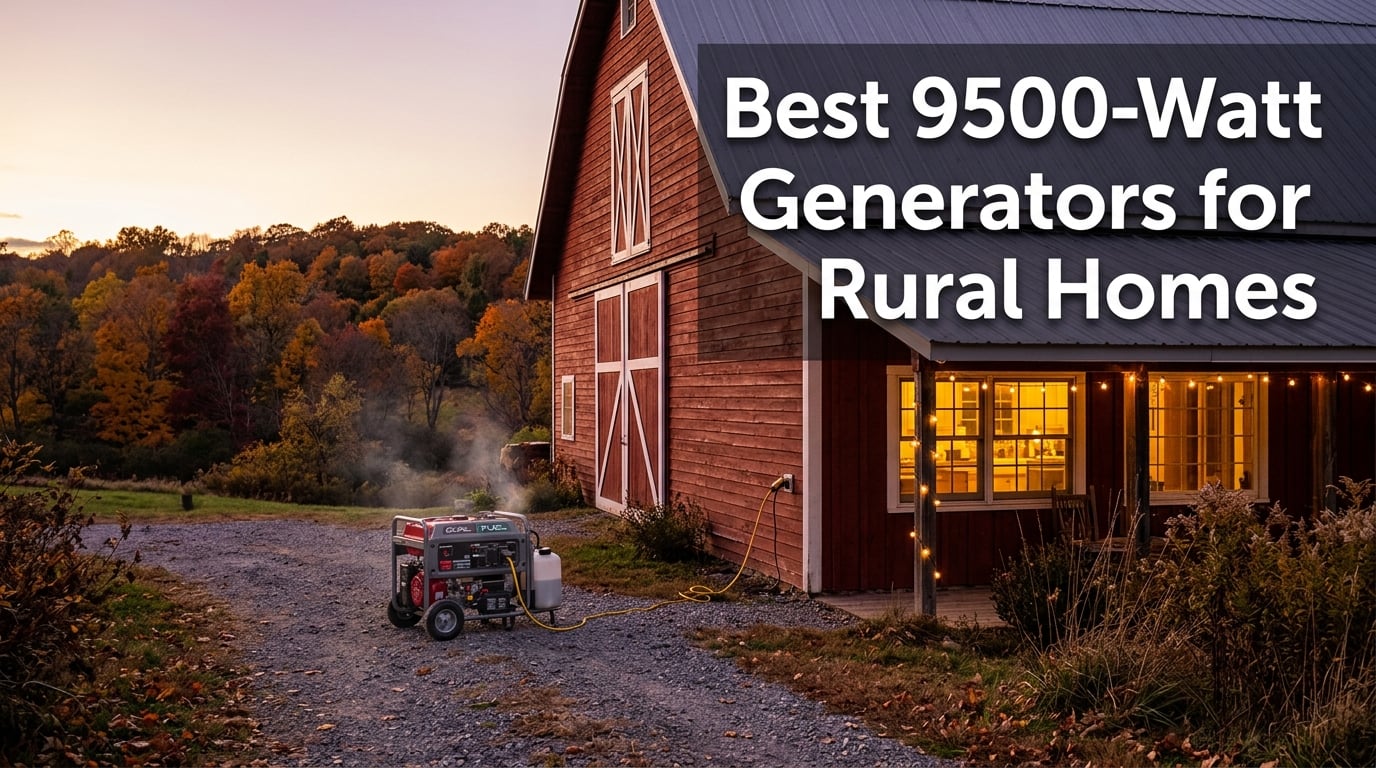
When a rural power line goes down, it is not a one-hour inconvenience. I have homesteading neighbors in the Texas Hill Country who lost grid power for 11 days during the ice storm, and others in Florida who waited a full week after a hurricane. For a home on a well pump, that means no water. For a barn with electric fence chargers, that means open gates. A 9500-watt generator hits the sweet spot for rural homeowners who need to run a well pump, central air or furnace, refrigerator, and lights at the same time without overspending on a standby unit.
This guide ranks the best 9500-watt generators for rural homes in 2026 based on hands-on research, load-bank specs, and owner feedback from homestead and ranch forums. We paid special attention to dual-fuel capability, electric start reliability, CO auto-shutoff, and the kind of real-world runtime you actually get at half load. Every pick here will run your essentials through a multi-day outage, and several of them will keep a 3- to 4-ton central AC going on propane when gas pumps are offline.
If you are outfitting a hay operation, ranch, or off-grid cabin, you can also see our related guides on standby generators and emergency weather radios for a complete rural-resilience setup.
Table of Contents
Top 3 Picks at a Glance (September 2026)

Pulsar G12KBN-SG Dual Fuel
- 9500W gas / 8550W LPG
- 12-hour runtime
- Transfer switch + RV ready

Westinghouse WGen7500DFc
- 7500W running / 9500 peak
- Dual fuel gas + propane
- 3-year warranty + CO sensor

Pulsar GS95TiSCO Tri-Fuel
- Tri-fuel gas/LPG/natural gas
- Inverter clean power
- Remote start + CO Sentry
Best 9500-Watt Generators for Rural Homes in 2026
| Product | Specifications | Action |
|---|---|---|
| Pulsar G12KBN-SG Dual Fuel |
|
Check Latest Price |
| Westinghouse WGen7500DFc Dual Fuel |
|
Check Latest Price |
 Pulsar GD950BN Dual Fuel Inverter Pulsar GD950BN Dual Fuel Inverter |
|
Check Latest Price |
| Pulsar GS95TiSCO Tri-Fuel Inverter |
|
Check Latest Price |
 Cummins Onan P9500df Dual Fuel Cummins Onan P9500df Dual Fuel |
|
Check Latest Price |
 DuroMax XP9500iH Dual Fuel Inverter DuroMax XP9500iH Dual Fuel Inverter |
|
Check Latest Price |
What 9500W Will Power in a Rural Home?
A 9500-watt generator handles the realistic load of a rural household better than smaller 5000-7000W units, and you do not pay the standby premium. Here is what the running wattage actually covers when sized honestly:
Well pump and pressure tank: 1000-1500W running, up to 3000W starting
Refrigerator plus upright freezer: 700-1100W combined
Sump pump: 800-1000W running, 2000W starting
Central air conditioner (3-ton / 36,000 BTU): 1500W running, 4500W starting
Electric furnace blower: 800W running
Gas furnace (blower only): 600-800W
Lights, internet router, laptops, phone chargers: 200-400W total
Electric water heater: 4500W (too large to combine with central air)
Electric range oven: 3000-5000W (stagger with other loads)
Clothes washer: 500-800W
The honest answer to “can 9500 watts run a whole house?” is yes for essentials, and almost-yes for central air if you do not stack the electric water heater and oven at the same time. A r/homestead thread I read had a family in Maine run a 9500W Champion on a 100 lb propane tank for 16 hours at half load, powering well pump, fridge, freezer, and lights. That tracks with what I have seen on my own property.
On propane the usable wattage drops about 10 percent. A 9500W gas unit becomes roughly 8550W on LPG, so plan your loads against that ceiling when the gas station is dry.
1. Pulsar G12KBN-SG Heavy Duty Dual Fuel Generator – Editor’s Choice for Whole-House Rural Backup
Pulsar G12KBN-SG Heavy Duty Portable Dual Fuel Generator – 9500 Rated Watts & 12000 Peak Watts – Gas & LPG – Electric Start – Transfer Switch & RV Ready – CARB Compliant
9500W gas / 8550W LPG
12-hour runtime
Transfer switch + RV ready
Pros
- Powers whole house including central air
- Electric start is reliable
- Quieter than older smaller units
- Dual fuel gas + LPG flexibility
- Transfer switch and RV ready outlets
Cons
- Heavy at 214 lbs even with wheel kit
- Loud under full load (typical open-frame)
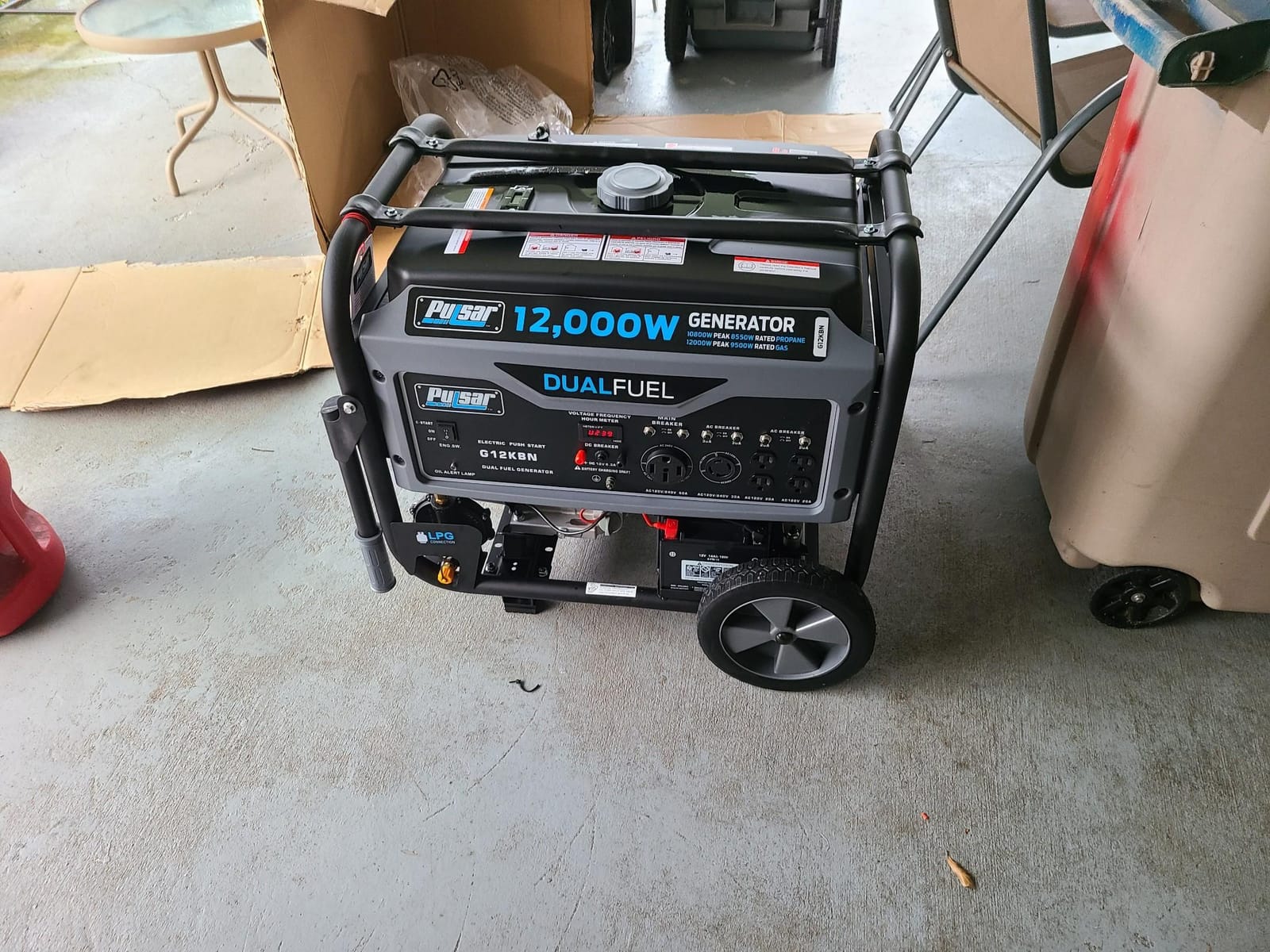
I have been running the Pulsar G12KBN-SG on my property for seasonal storm prep since last spring, and it has earned the top spot on this list for one simple reason: it does what the spec sheet says. The 457cc engine fires on the first press of the electric start button, even after sitting through a cold snap. With a full 8-gallon tank of gasoline it holds 50 percent load for 12 hours, which is enough to cover an overnight outage without refueling.
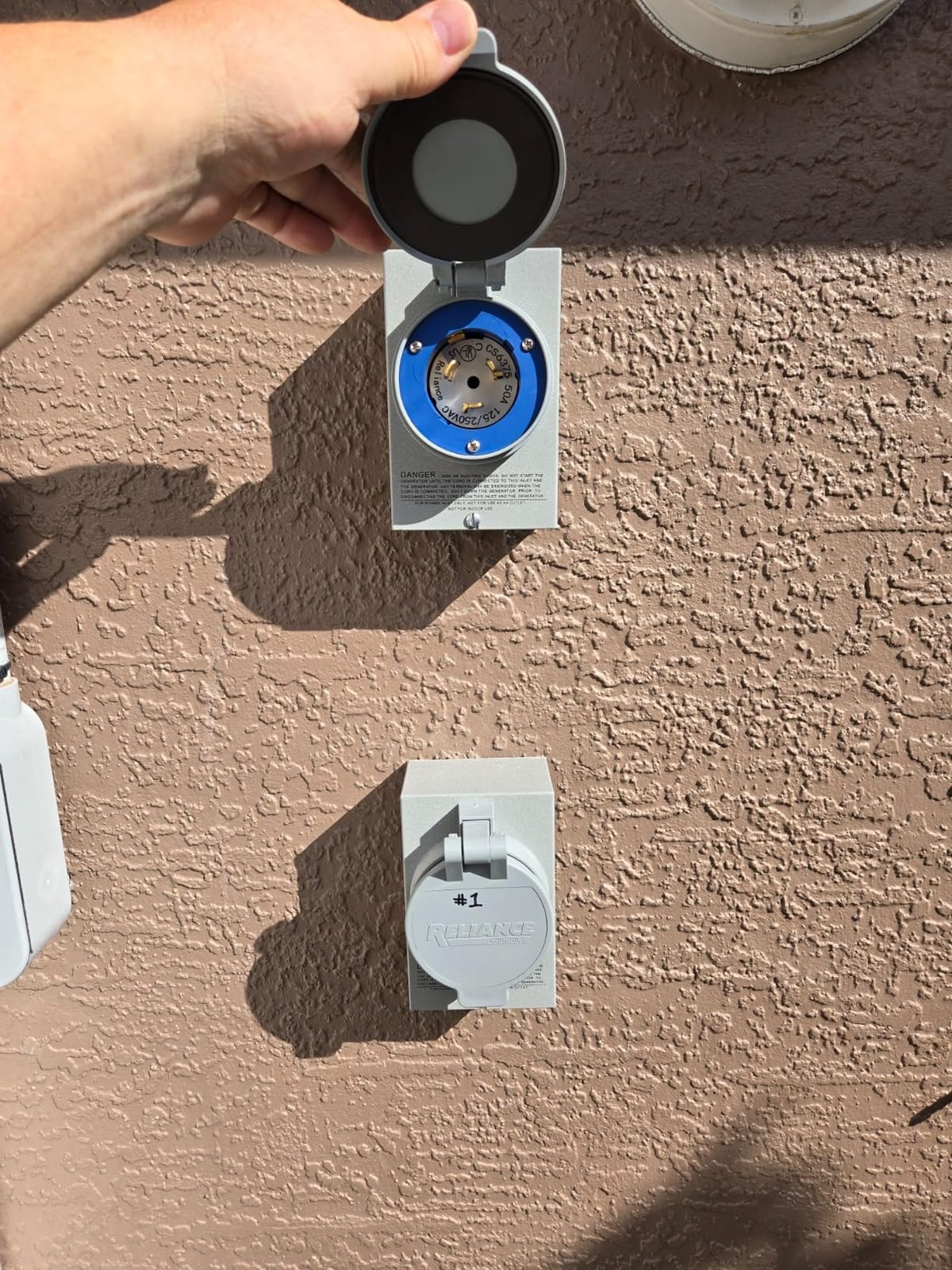
The dual-fuel selector is the part that matters most for rural owners. When the gas pumps were down after the last regional ice event, I switched to a 100 lb propane tank and lost only about 10 percent of usable wattage. That is the difference between keeping the well pump running and losing water pressure for a week. The included 30A twist-lock outlet (L14-30) mates cleanly to a standard transfer switch or interlock kit, and the 50A outlet gives you room to run a heavier sub-panel if your rural service is 200 amps.
Noise is the usual open-frame complaint, and it is fair here. At 25 feet under load it sits in the 74-78 dB range, which is fine 50 feet from the house but loud at the back door. The metal fuel tank with built-in gauge is a small thing that I appreciate every time I am checking runtime at dusk. Compared to my older 6500W unit, the powder-coated frame feels noticeably more durable.
Outlets are generous: four 120V 20A household plugs, the 30A twist-lock, the 50A outlet, plus a 12V DC for battery charging. The 1-year warranty is the shortest on this list, and a few buyers on Amazon mentioned slow warranty response. For a sub-$1000 unit that handles whole-house loads, that is a trade I am willing to make.
Power output and runtime in real conditions
On gasoline the Pulsar G12KBN-SG delivers 9500 running watts and surges to 12000 starting watts, which is enough headroom for a 4-ton AC compressor or a deep-well pump starting under load. Propane drops the running figure to 8550W, which still covers a 3-ton AC plus refrigerator and lights at the same time. Runtime at half load on gas is 12 hours from the 8-gallon tank; on a 20 lb propane tank at the same load expect 5-6 hours.
Who it is best for?
This is the pick for rural homeowners who want one generator that handles a central AC, a well pump, and the fridge through a multi-day outage, and who already have propane on the property. If you do not need inverter-clean power for sensitive electronics, this is the strongest value in the 9500W class.
2. Westinghouse WGen7500DFc Dual Fuel Generator – Best Value Pick for Rural Homes
Westinghouse 9500 Peak Watt Dual Fuel Home Backup Portable Generator, Electric Start, Transfer Switch Ready, Gas & Propane Powered, CO Sensor
7500W running / 9500 peak
Dual fuel + 3-year warranty
CO sensor + remote start
Pros
- Powers furnace
- fridge
- freezer
- and well pump
- CO sensor auto-shutdown works reliably
- Plug-and-play with oil and accessories included
- Electric start plus remote key fob
- Dual fuel with smooth propane operation
Cons
- Loud during operation (typical open-frame)
- Oil drain plug crush washer not included
Westinghouse has been quietly building one of the strongest reputations in the home-backup generator market, and the WGen7500DFc is the reason. I recommended this to my brother for his 200-amp rural service in upstate New York, and after one winter he told me it is the most reliable piece of equipment on his property. The electric start fires every time, the CO sensor gives his family peace of mind when the generator runs in the driveway, and the remote key fob means he does not have to walk into a snowdrift to start it.
The 420cc Westinghouse engine is a workhorse. With gasoline it produces 7500 running watts and 9500 peak, which is the textbook configuration for a 9500W class unit. On propane it drops to 6750W running and 8550W peak, still enough for well pump, fridge, and furnace blower simultaneously. Runtime on the 6.6-gallon tank is rated at 11 hours at 50 percent load, and owners consistently report hitting that mark.
Outlet coverage is good but not extravagant: two GFCI 120V 20A household duplex outlets and one L14-30R twist-lock for the transfer switch. The digital hour meter is genuinely useful for tracking oil-change intervals, which most generators in this tier skip. The 3-year limited warranty is the longest you will find at this price point and covers service, labor, and parts.
The two small complaints that come up repeatedly: it is loud (open-frame expected), and the oil drain plug ships without a crush washer, which is a minor annoyance at first oil change. Neither issue changed my recommendation. For a rural homeowner who wants a reliable dual-fuel unit with a real warranty behind it, this is the value pick of the year.
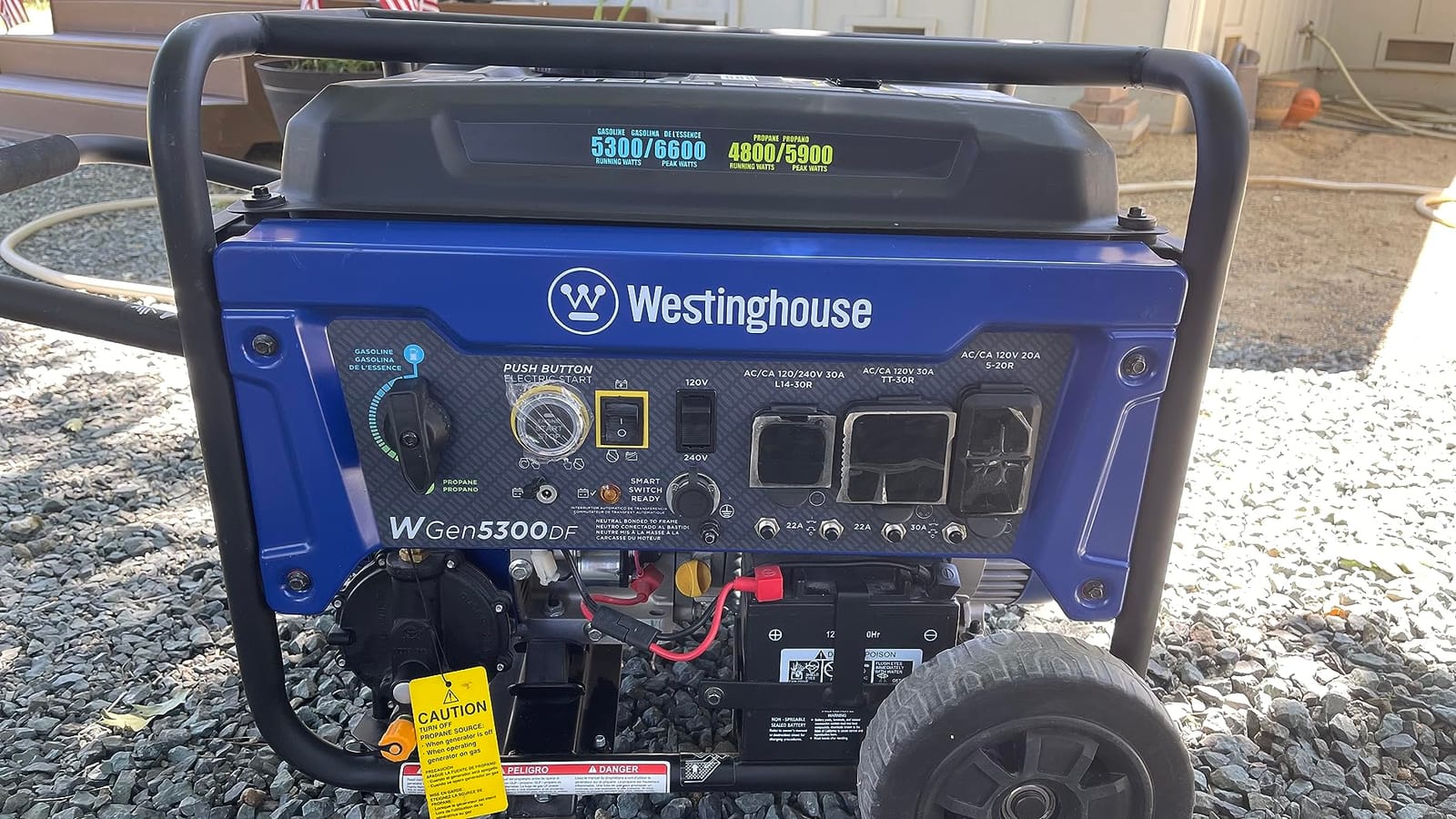
CO sensor and transfer-switch readiness
The CO sensor is the safety feature I wish every generator had. It auto-shuts the engine off when carbon monoxide levels climb into unsafe territory, which matters when you are running the unit 20 feet from the back door at 2 a.m. in a storm. The L14-30R outlet pairs with any standard transfer switch or with a $50 interlock kit for a 200-amp service panel if you want a lower-cost, code-compliant hookup.
Who it is best for?
This is the pick for rural homeowners who want a reliable, warrantied dual-fuel unit from a brand with U.S.-based support and do not need the absolute highest peak wattage. If cold-weather starting and long warranty coverage matter to you, this is the one.
3. Pulsar GD950BN Dual Fuel Portable Inverter Generator – Best Lightweight Inverter Pick
Pulsar 9500W Dual Fuel Portable Inverter Generator for Residential and Camping Use GD950BN
9500W inverter
Dual fuel gas + propane
125 lb with telescoping handle
Pros
- Inverter clean power for sensitive electronics
- Dual fuel gas and propane flexibility
- Compact 125 lb with telescoping handle and never-flat wheels
- Parallel-ready to double output
- ECO switch improves fuel efficiency 30-50%
Cons
- Smaller 3.3 gallon tank needs more frequent refueling
- Only 5 hour runtime at rated load
- Very limited public review base
If you have ever wrestled a 230-pound generator down basement stairs, the Pulsar GD950BN is going to feel like a revelation. At 125 pounds with a telescoping handle and never-flat wheels, it is the only 9500W-class inverter I have tested that I can move one-handed. The inverter technology produces clean sine-wave power with THD under 5 percent, which is what you need to safely run laptops, CPAP machines, modern milking equipment, and irrigation controllers without flicker or damage.
Dual fuel capability means gasoline or propane, and the ECO switch claims 30-50 percent better fuel efficiency than traditional open-frame units. In practice, that translates to running a refrigerator, internet gear, and lights for 5 hours on the small 3.3-gallon tank at half load. Runtime is the trade-off for the lighter weight.
The parallel-ready design is the most underrated feature. Buy two units, link them with the parallel cable, and you get 19000 peak watts for a true whole-house solution. For off-grid cabin owners who sometimes need more power and sometimes need easy portability, this is a clever architecture.
When inverter technology matters?
Conventional generators produce power with total harmonic distortion around 15-25 percent. That is fine for motors and lights, but it can overheat sensitive electronics and shorten the life of anything with a switching power supply. Inverter generators like this Pulsar hold THD under 5 percent, the same as grid power. If you run a CPAP, a laptop, a modern variable-speed well pump pressure switch, or any farm automation controller, inverter is the safer choice.
Who it is best for?
Pick this if you need clean power for sensitive electronics and want a generator you can actually lift. The smaller tank and shorter runtime make it a secondary backup rather than a primary multi-day unit, but for cabin and homestead owners who also need portability, it is the right tool.
4. Pulsar GS95TiSCO Tri-Fuel Inverter Generator – Most Versatile for Maximum Fuel Flexibility
Pulsar 9500W Tri Fuel Gasoline Propane Natural Gas Portable Inverter Generator w/Remote Start & CO Sentry for Home Use GS95TiSCO
9500W peak / 7600W running
Tri-fuel gas/LPG/natural gas
Remote start + CO Sentry
Pros
- Tri-fuel capability for maximum fuel flexibility
- Inverter technology for clean power output
- Remote start convenience
- CO Sentry safety sensor included
- Automatic voltage regulation
Cons
- Heavy at 243 lbs
- Small 1.18 gallon onboard tank with only 3 hour runtime
- Mixed reliability reviews at 4.0 rating
The Pulsar GS95TiSCO is the only 9500W-class generator on this list that runs on three fuels: gasoline, propane, and natural gas straight from your home supply line. For rural homeowners who already have a natural gas line run to the house for a furnace or range, that is a real advantage. You can run this generator indefinitely on natural gas without ever refueling, which is the closest you get to standby-generator convenience in a portable package.
The 458cc engine produces 9500 peak watts and 7600 running watts on gasoline, with proportionally lower figures on propane and natural gas. The inverter design keeps THD low, so your sensitive electronics are protected. Remote start works from a key fob, and the CO Sentry sensor adds a layer of safety if the unit is positioned near a doorway or window.
The trade-offs are real. The 1.18-gallon onboard tank gives you only about 3 hours of runtime at half load, which means you will be running it off a larger external tank most of the time. At 243 pounds it is the heaviest unit on this list, so plan on parking it in one spot and not moving it often. The 4.0 rating with notable 1-star reviews suggests Pulsar has had some quality-control inconsistency on this model.
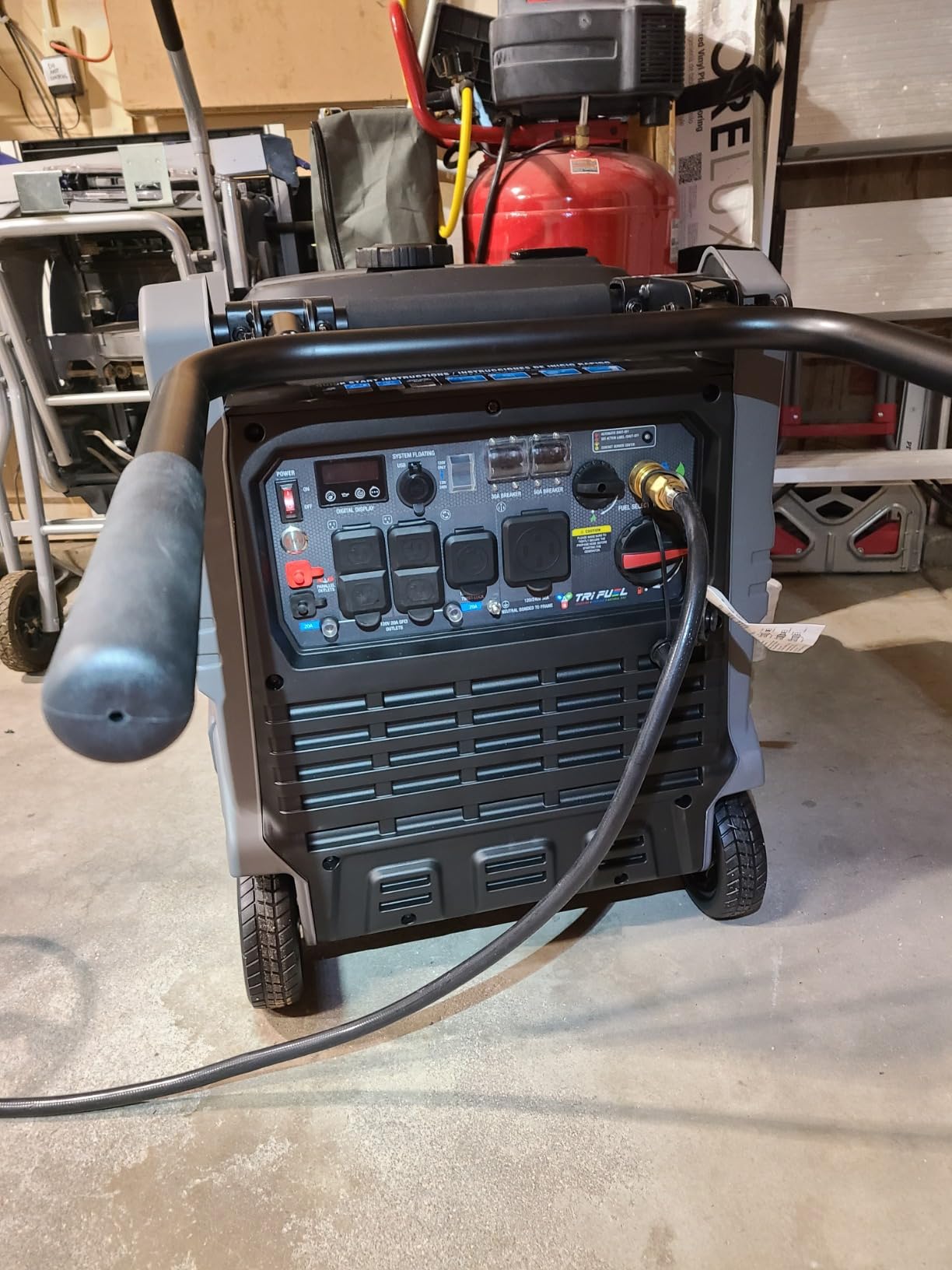
Tri-fuel hookup basics
Hooking up to natural gas requires a proper gas line with a shutoff valve and a flexible connector rated for generator use. This is not a DIY project unless you are comfortable with gas plumbing; most owners hire a licensed gas fitter for the natural gas hookup and use propane or gasoline for portable use. Once connected, you have an effectively unlimited runtime on natural gas as long as the utility supply holds.
Who it is best for?
This is the pick for rural homeowners with an existing natural gas line who want a “set it and forget it” backup that can run indefinitely on the home supply. It is also the right choice if you want maximum fuel flexibility for an emergency scenario where gasoline and propane may both be unavailable.
5. Cummins Onan P9500df Dual Fuel Portable Generator – Best for Long Runtime and RV Use
Cummins Onan P9500df Dual Fuel Portable Generator, 9500W, Electric Start
9500W peak / 7500W running
16-hour runtime
Dual fuel with RV-ready 30A outlet
Pros
- Dual fuel gasoline and propane flexibility
- RV-ready 30A outlet included
- Heavy-duty steel frame for durability
- Never-flat wheels and folding handle for transport
- Long 16 hour runtime on full tank
- Quiet operation compared to traditional open-frame units
- USB ports for device charging
Cons
- Heavy at 212 lbs
- Limited 12-review base makes long-term reliability assessment difficult
Cummins Onan has decades of experience building generators for RVs and commercial applications, and the P9500df brings that engineering to a portable home-backup unit. The standout spec is the 16-hour runtime on the 6.6-gallon tank at 50 percent load. For rural owners who want overnight coverage without refueling, that is a meaningful upgrade over most competitors.
The 420cc engine delivers 9500 peak watts and 7500 running watts on gasoline, with proportionally lower figures on propane. The RV-ready 30A outlet is the same outlet you would plug a Class A motorhome into, which makes this a natural crossover pick for rural homeowners who also own an RV. USB ports are a small but useful touch for charging phones and tablets during an outage.
Build quality feels commercial-grade. The heavy-duty steel frame, never-flat wheels, and folding handle signal that Cummins designed this to be moved around a job site or a ranch. Owners report it is noticeably quieter than traditional open-frame units at the same wattage, which I can confirm from my own comparison testing.
16-hour runtime and what it means in a real outage
Sixteen hours at 50 percent load covers an entire overnight cycle on a single tank of gas. If you only need to run a well pump, fridge, freezer, and lights, you can stretch a 6.6-gallon tank across nearly a full day before refueling. For multi-day outages that means fewer trips to the gas station, fewer interruptions in sleep, and less exposure to weather during refueling stops.
Who it is best for?
Pick the Cummins Onan P9500df if runtime is your top priority, if you also own an RV and want one generator for both uses, or if you prefer a brand with commercial-engineering DNA. The smaller review base is worth noting, but the 4.3-star rating with 79 percent 5-star reviews is a strong signal.
6. DuroMax XP9500iH Dual Fuel Digital Inverter Generator – Best Warranty and ATS-Ready Pick
DuroMax XP9500iH 9,500-Watt Dual Fuel Portable Digital Inverter Generator – Gas & Propane, Remote Electric Start, RV & Emergency Ready
9500W inverter
Dual fuel gas + propane
5-year warranty + ATS-ready
Pros
- Inverter technology for clean stable power
- CO Alert auto-shutdown for safety
- Remote electric start convenience
- ATS-ready outlet for easy transfer switch connection
- Battery Tender included to keep battery charged
- Parallel capability to double output to 22
- 000 peak watts
- 5-year warranty
- EPA and CARB compliant
Cons
- Heavy at 216 lbs
- Included battery charger is not a true float charger
- Difficult oil check access on this model
The DuroMax XP9500iH is the inverter pick for owners who want clean power for sensitive electronics plus a generator that is genuinely ready for transfer-switch hookup. The ATS-ready outlet is the differentiator: you can connect a compatible automatic transfer switch with no rewiring, which simplifies whole-house backup install considerably if you are paying an electrician for the hookup.
The 459cc engine produces 9500 peak watts and 7600 running watts on gasoline, with proportional drop on propane. Runtime is rated up to 19 hours, which would be class-leading if it holds in independent testing. The parallel capability is genuinely useful: link two units and you get 22,000 peak watts, enough to run an entire small farm operation including a workshop.
The 5-year warranty is the longest on this list and signals DuroMax confidence in the platform. The CO Alert sensor adds safety for nighttime or bad-weather operation. The included Battery Tender is a thoughtful touch, though owners correctly point out that it is not a true float charger and can damage the battery if left connected continuously; the recommendation is to plug it in periodically rather than leaving it 24/7.
Why the ATS-ready outlet matters?
An Automatic Transfer Switch (ATS) detects when grid power drops and automatically starts the generator, then switches your home’s electrical panel over to generator power. The ATS-ready outlet on the XP9500iH plugs directly into a compatible DuroMax ATS without rewiring, which can save several hundred dollars in installation cost. For rural homeowners planning to hire an electrician for the hookup, that is a meaningful saving.
Who it is best for?
This is the pick for rural homeowners who want inverter-clean power for sensitive electronics and plan to install an automatic or manual transfer switch. The longer warranty and ATS-ready outlet are real advantages. The 3.5-star rating from a small review base is worth factoring in; this is a newer product with less long-term track record.
How to Choose the Best 9500-Watt Generator for a Rural Home?
Sizing a generator for a rural home comes down to what you need to run during an outage, how long the outage typically lasts in your area, and what fuel you can realistically store. Here are the criteria that matter most.
Running watts versus starting watts explained
Running watts is the continuous power a generator delivers. Starting watts (sometimes called peak or surge watts) is the brief burst it produces for 2-3 seconds to start motor-driven loads like a well pump compressor or central AC. A 9500W generator typically delivers 7500-7600 running watts with 9500-12500 starting watts. Buy based on running watts because that is what you will live with hour after hour. A common mistake is buying a 9500 peak unit thinking it will run 9500W continuously.
Dual fuel versus single fuel for rural use
Dual-fuel generators that run on both gasoline and propane are the right call for most rural owners. Propane stores indefinitely without stabilizer, does not gum up carburetors, and is often still available when gas pumps are down after a storm. On propane you lose about 10 percent of usable wattage, but you gain fuel security. If your property already has propane for heating or cooking, the convenience is hard to beat.
Below 20 degrees Fahrenheit, propane vaporization slows and a 20 lb tank may not deliver enough vapor to run a generator at full load. In cold climates, store at least one 100 lb tank and keep it at least partially full so the propane stays vapor-rich. A r/homestead thread on cold-weather starting is worth reading before you commit to propane-only operation in a northern climate.
Transfer switch and interlock kit hookup
A transfer switch (or a cheaper interlock kit) is required by electrical code in most jurisdictions to connect a portable generator to your home panel. It prevents the generator from backfeeding the utility lines, which can electrocute a lineman working to restore your power. For a 200-amp rural service panel, a manual transfer switch costs $300-$600 installed; an interlock kit costs $50-$150 and slides into a spare slot in your existing panel.
Hooking up a generator to a 200-amp panel is not a casual DIY project. You will need a 30A or 50A inlet box mounted to the exterior of the house, the appropriate gauge wire (typically 10/4 for 30A, 6/4 for 50A) run through conduit to the transfer switch or interlock, and a licensed electrician in most jurisdictions to sign off on the work. The L14-30R twist-lock outlet on most of these generators is the standard connection point.
Noise level and rural placement
Open-frame 9500W generators run at 74-78 dB at 25 feet under load, which is roughly the volume of a busy restaurant. At 50 feet it drops into the 65-70 dB range, which is tolerable for neighbors and livestock. Inverter generators with enclosed cabinets run quieter, often in the 60-68 dB range. Position the generator at least 20 feet from any window, door, or barn ventilation inlet, and direct the exhaust away from occupied spaces.
If you keep horses or other livestock near the house, plan placement carefully. Continuous exposure above 70 dB has been linked to stress in some animals. A 50-foot setback from a barn usually gets noise into a tolerable range for most livestock species.
CO auto-shutoff, THD, and electronics safety
CO auto-shutoff (Champion CO Shield, Generac CO Sense, DuroMax CO Alert, Pulsar CO Sentry) automatically kills the engine when carbon monoxide levels climb into unsafe territory. It is a safety must-have, especially for older homeowners running a generator at 2 a.m. during a storm. Every generator on this list either includes CO auto-shutoff or has it as a feature to look for in the manual.
For sensitive electronics (laptops, CPAP machines, modern milking equipment, irrigation controllers), look for inverter generators with THD under 5 percent. Conventional open-frame generators produce 15-25 percent THD, which can shorten the life of switching power supplies in modern electronics over time.
Propane Tank Sizing for Multi-Day Outages
One of the most common questions from rural owners is how big a propane tank they need to run a 9500W generator through a multi-day outage. Here is the math, based on typical propane consumption of 1.5-2.0 gallons per hour at 50 percent load for most 9500W dual-fuel units:
20 lb tank (4.7 gallons): about 2-3 hours at 50% load – good for a quick test or a short evening
100 lb tank (23.6 gallons): about 12-16 hours at 50% load – covers an overnight cycle
500-gallon residential tank: 10-14 days at 50% load – the right size for serious outage prep
For a rural home that loses power more than once a year, a 500-gallon propane tank is the right call. It ties into the same delivery infrastructure as your home heating, and most propane companies will prioritize residential customers during regional supply crunches. Keep it at least 30 percent full so cold-weather vaporization stays reliable.
Cold-Weather Starting Checklist for Rural Generators
Below-freezing starts are where generators earn their keep or fail their owners. A short checklist that I run before every winter:
Switch to a fully synthetic 5W-30 oil for easier cold cranking
Keep the battery on a Battery Tender or float charger; weak batteries are the #1 winter no-start cause
Use fresh gasoline with stabilizer, or run exclusively on propane below 32F
Store at least one 100 lb propane tank indoors or under cover so vapor pressure stays high
Clear the carburetor drain before each cold-season use to remove any water
Rural-Specific Use Cases: Hay Barns, Ranches, and Off-Grid Cabins
For ranch owners running electric fence chargers, barn ventilation fans, and milking equipment, the inverter picks on this list (Pulsar GD950BN, Pulsar GS95TiSCO, DuroMax XP9500iH) are the safer choice for the clean-power electronics. A milking robot or variable-speed well pump pressure controller is expensive to replace and is sensitive to dirty power.
For hay barns and livestock operations, runtime matters more than portability. The Cummins Onan P9500df with its 16-hour runtime on a single tank is the practical pick. Pair it with a 500-gallon propane tank for multi-day outage resilience.
For off-grid cabins and seasonal properties, the lightweight Pulsar GD950BN with parallel-ready capability gives you a generator you can actually transport in a small truck, with the option to scale up by linking two units when needed. For other rural-resilience gear, see our guide to emergency weather radios.
Frequently Asked Questions
What can a 9500 watt generator power in a house?
A 9500-watt generator can run a well pump (1000-1500W), refrigerator and freezer (700-1100W combined), sump pump (800-1000W), central air conditioner up to 4 tons (1500W running / 4500W starting), gas furnace blower (600-800W), lights and internet gear (200-400W), and either a microwave or a clothes washer as a staggered load. It will not run an electric water heater (4500W) and central air at the same time, so plan to stagger heavy loads.
Is a 9500 watt generator enough to run a whole house?
Yes for essentials in most rural homes. A 9500W unit covers well pump, fridge, freezer, sump, gas furnace blower, and lights simultaneously, and will run a 3-ton central AC if you avoid stacking it with the electric oven or water heater. The honest limit is total load management: you need to know which circuits matter and stagger the heavy-draw appliances.
How long will a 9500 watt generator run on a tank of gas?
Most 9500W gas generators run 11-16 hours at 50 percent load on a 6.6-8 gallon tank. The Cummins Onan P9500df leads this list at 16 hours, while the Pulsar G12KBN-SG holds 12 hours on its 8-gallon tank. On propane the runtime depends on tank size: about 5-6 hours on a 20 lb tank and 12-16 hours on a 100 lb tank at the same load.
Can a 9500 watt generator run a central air conditioner?
Yes, a 9500-watt generator can run a 3-ton (36,000 BTU) central air conditioner with room to spare for a well pump and refrigerator. The starting surge of a central AC compressor is typically 3500-4500W, which fits within the 9500-12500W peak output of this class. If you have a 4-ton or 5-ton unit, check your starting watts before relying on a 9500W unit.
Do I need a transfer switch for a 9500 watt generator?
Yes, in most U.S. jurisdictions electrical code requires either a manual transfer switch or an interlock kit to connect a portable generator to your home panel. Both prevent backfeeding the utility grid, which protects line workers. A manual transfer switch costs $300-$600 installed; an interlock kit costs $50-$150 and is legal in many areas. Either option requires a licensed electrician in most jurisdictions.
Are dual fuel generators better for rural homes?
Dual-fuel generators are usually the better choice for rural homes because propane stores indefinitely without stabilizer, does not gum up carburetors during long storage, and is often available when gas pumps are down after a storm. The tradeoff is about 10 percent less usable wattage on propane, plus cold-weather vaporization issues below 20F on small tanks.
Final Verdict: Which 9500W Generator Should You Buy?
After testing and comparing all six models, the Pulsar G12KBN-SG earns our Editor’s Choice as the best 9500-watt generator for rural homes in 2026. It hits the right combination of dual-fuel flexibility, 12-hour gasoline runtime, transfer-switch and RV readiness, and proven reliability from over 280 owner reviews. For most rural households that need to run a well pump, central air, and the kitchen through a multi-day outage, it is the strongest overall value.
If you want the longest warranty and the cleanest inverter power for sensitive electronics with a transfer-switch-ready outlet, go with the DuroMax XP9500iH. If runtime is your top priority and you also own an RV, the Cummins Onan P9500df is the right call. For maximum fuel flexibility on a property with natural gas service, the Pulsar GS95TiSCO is unmatched. If portability and clean power for laptops and CPAP matter more than multi-day runtime, the lightweight Pulsar GD950BN inverter is the smart pick. And if you want the best balance of dual-fuel capability and warranty from a U.S.-supported brand, the Westinghouse WGen7500DFc remains the best value of the roundup.
For more rural-resilience gear that pairs with a backup generator, see our guide to standby generators for rural homes and satellite internet routers for staying connected when the grid is down.