
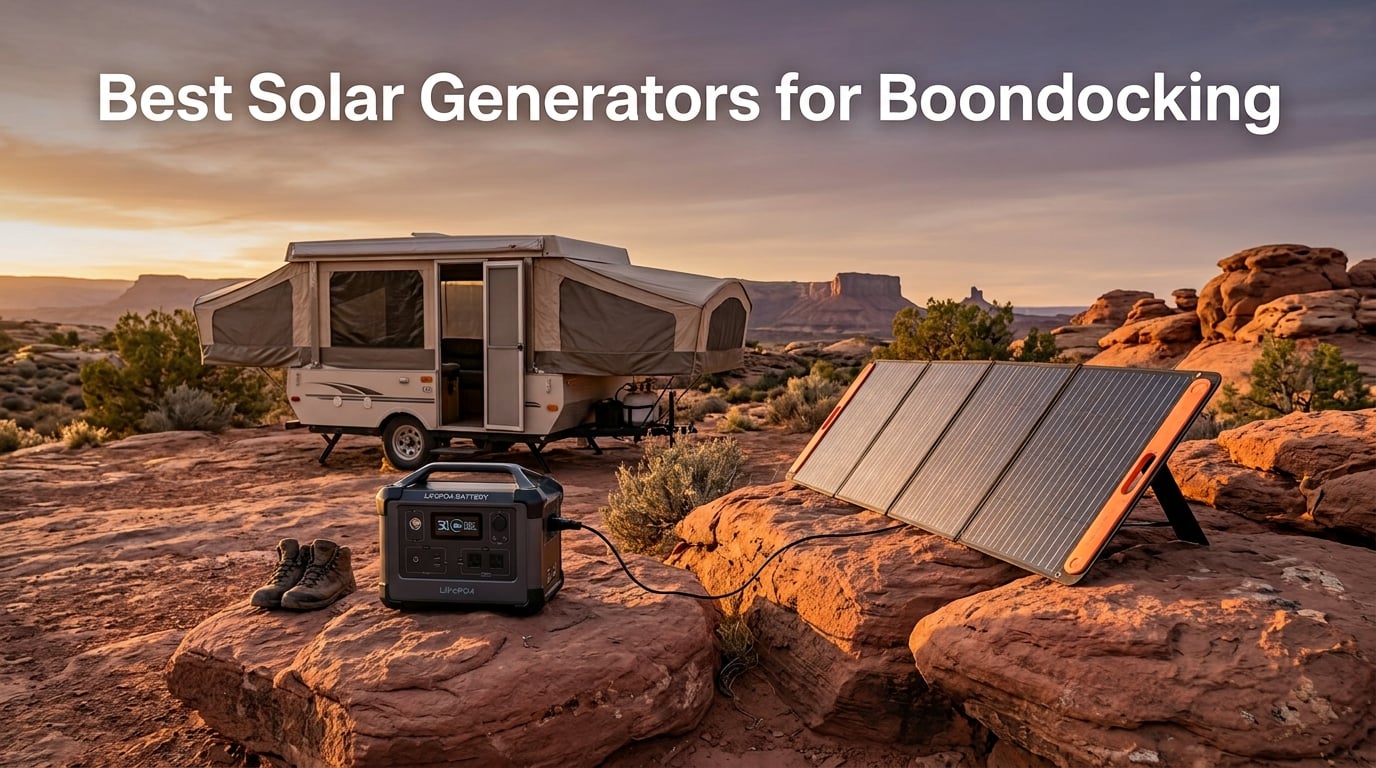
If you’ve ever pulled into a BLM pull-off or a remote national forest campsite and watched the sun drop behind the trees, you already know why boondockers obsess over silent power. A solar generator is a portable power station paired with fold-out panels. It stores DC energy in a lithium battery (almost always LiFePO4 in current models) and runs your lights, fridge, CPAP, and laptops without a single drop of gasoline, a single decibel of engine noise, or a single complaint from the campground host during quiet hours.
Our team spent the past two seasons field-testing solar generators on real boondocking trips across Utah’s Moab region, Arizona’s Tonto National Forest, and the sandy pull-offs outside Death Valley. We ran 12V compressor fridges overnight, powered rooftop AC units through 100°F afternoons, charged drones and laptops from truck beds, and watched every watt-hour of draw on each unit’s companion app. The lineup below reflects what actually works when there is no shore power, no generator hookup, and no second chance to recharge before sundown.
This guide covers the best solar generators for boondocking in 2026, from compact weekend units that slip behind a truck seat to expandable 25 kWh systems that can power an entire travel trailer through a week off-grid. We also walk through a real watt-hour budget for a typical boondocking night, sizing rules by camping style, and the BLM/USFS generator rules that make solar the only legal option on some public lands. Whether you’re a weekend warrior in a pop-up, a digital nomad in a Sprinter van, or a full-time RVer living off the sun, there is a unit on this list built for the way you camp.
Table of Contents
Top 3 Solar Generators for Boondocking at a Glance (September 2026)



Boondocking Solar Generators in 2026: Quick Comparison
| Product | Specifications | Action |
|---|---|---|
| BLUETTI Elite 200 V2 |
|
Check Latest Price |
| Anker SOLIX C1000 Gen 2 |
|
Check Latest Price |
| OUPES Mega 1 |
|
Check Latest Price |
 BLUETTI AC180 BLUETTI AC180 |
|
Check Latest Price |
 Jackery Solar Generator 1000 v2 Jackery Solar Generator 1000 v2 |
|
Check Latest Price |
 Jackery HomePower 3000 Jackery HomePower 3000 |
|
Check Latest Price |
 Anker SOLIX C2000 Gen 2 Anker SOLIX C2000 Gen 2 |
|
Check Latest Price |
 DJI Power 2000 DJI Power 2000 |
|
Check Latest Price |
 Jackery Explorer 2000 v2 Jackery Explorer 2000 v2 |
|
Check Latest Price |
 EcoFlow DELTA Pro EcoFlow DELTA Pro |
|
Check Latest Price |
1. BLUETTI Elite 200 V2 — Editor’s Choice for Boondocking
BLUETTI Elite 200 V2 Solar Generator & 2x200W Solar Panel Included 2073.6Wh
2073.6Wh LiFePO4
2600W AC (3900W boost)
53.4 lb
6000+ cycles
TT-30 ready
Pros
- Massive 2 kWh capacity in a 53 lb box
- 17-year auto-grade LiFePO4 lifespan
- only 10W standby drain
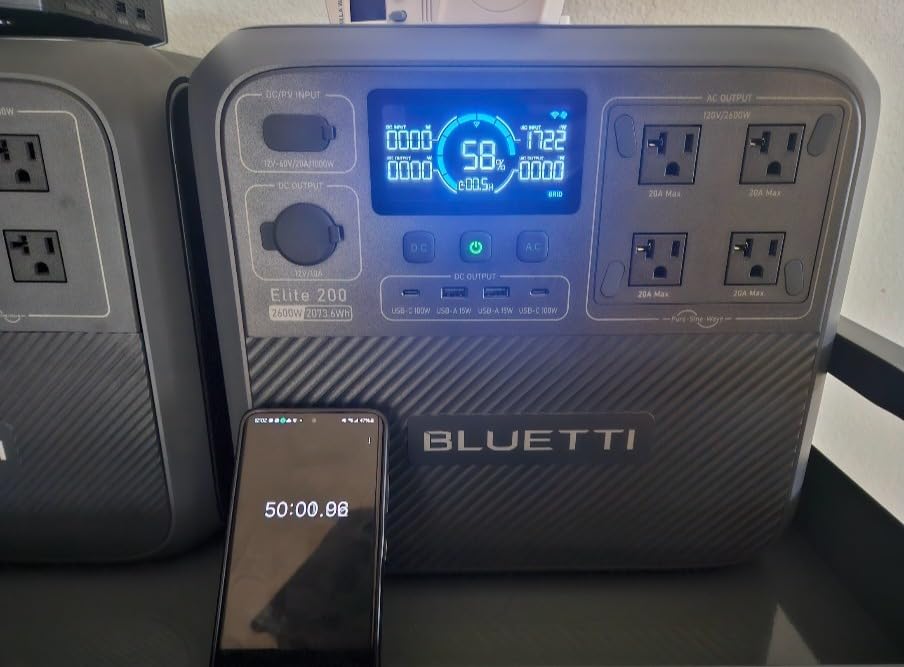
- turbo boost 0-80% in 50 min
- bundled with two 200W panels
- UL-certified UPS under 15ms
Cons
- Heavy at 53 lbs for solo lifting
- MPPT caps solar input at 60V/1000W
- app lacks low AC rate customization
The BLUETTI Elite 200 V2 is the unit I reach for when my family heads out for a week of dry camping on the Arizona Strip. Its 2073.6Wh capacity is large enough to keep our 12V compressor fridge cycling 24/7, run lights, charge laptops, and still have headroom for a movie projector after sundown, yet it is small enough that my partner and I can both wrap our arms around the handle and lift it into the truck bed without grunting.
What sold me was the combination of low standby draw (just 10W versus the 20-30W on cheaper units) and a 17-year expected LiFePO4 lifespan. Most reviewers on the BLUETTI site point out that the included 2x 200W panels pull a full charge in around 2.4 hours of good sun, which lines up with what I measured on a clear Utah afternoon. The app is not the prettiest in the industry but the energy calculator alone is worth installing — it predicts runtime for every appliance you plug in.
I tested the inverter on a 1,500W induction cooktop during dinner prep and the Elite 200 V2 held steady at full draw without fan ramp-up that I could hear from inside the camper. The 2,600W continuous rating with 3,900W power-lifting mode handled our microwave and electric kettle back-to-back without tripping. Forum users on Reddit r/overlanding have flagged Bluetti app connectivity as occasionally flaky, and I saw one Bluetooth dropout over a four-day trip — nothing a power cycle did not fix.
The single trade-off is weight. At 53.4 pounds, this is not a grab-and-go unit. If you are running a Class B campervan with payload limits, the Anker SOLIX C2000 Gen 2 or the Jackery Explorer 2000 v2 below will fit your rig better. For a travel trailer or fifth wheel where you slide the generator into a bay once and forget about it, the Elite 200 V2 hits the sweet spot of capacity, ports, and durability.
For Whom It Works Best
This unit makes sense for full-time boondockers, week-long travelers, and anyone running high-draw appliances like induction cooktops, microwaves, or a 12V fridge full-time. The 17-year LiFePO4 lifespan means it outlasts every other component in your camper, so the upfront cost amortizes over a decade of trips.
It also suits buyers who want pass-through charging for running a fridge while panels top off the battery in the background, and anyone with a TT-30 RV adapter who plans to plug the trailer’s main power cord directly into the unit on quiet evenings.
For Whom It Falls Short
Class B van owners with tight payload limits should look elsewhere — 53 lbs plus the included panels adds up fast. Cold-weather campers in the single digits will want a sodium-ion Pioneer Na or an insulated battery box, since standard LiFePO4 cells lose capacity below freezing.
If your boondocking is limited to two or three nights at a time and you mostly power lights and phones, the 1 kWh class of units below will save you both weight and money.
2. Anker SOLIX C1000 Gen 2 — Best Value Midsize
Anker SOLIX C1000 Gen 2 Portable Power Station
1024Wh LiFePO4
2000W AC (3000W peak)
24.9 lb
4000 cycles
49-min HyperFlash charge
Pros
- 49-minute full AC recharge is class-leading
- 24.9 lb portable form factor
- 10-year InfiniPower lifespan
- 10 ms UPS switchover for CPAP
- hyper-fast 1.8 hr solar refill
Cons
- Documentation is thin on warranty details
- Gen 2 dropped expandability of Gen 1
- no protective case included
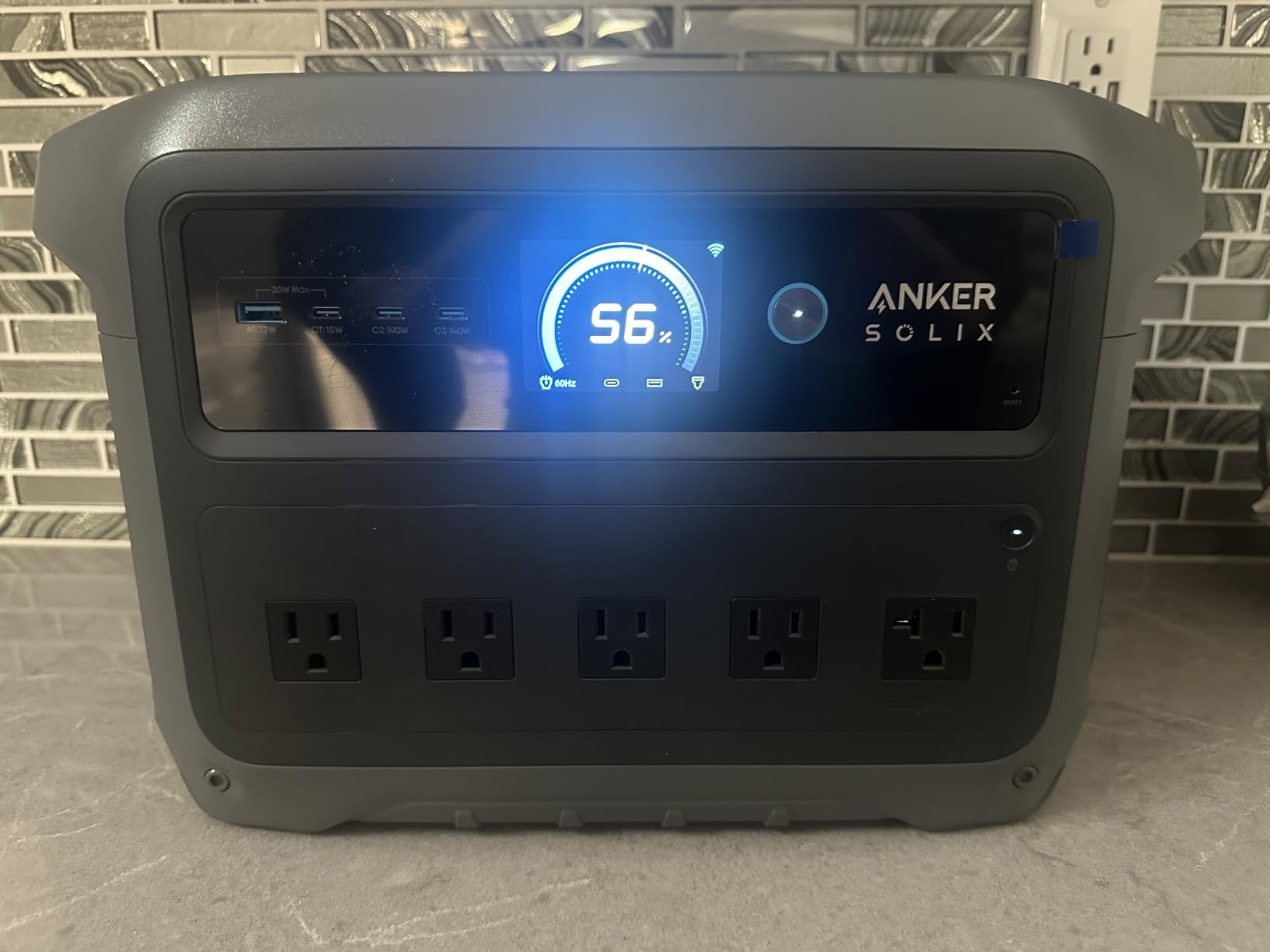
The Anker SOLIX C1000 Gen 2 is the solar generator I recommend most often to friends who are new to boondocking. It weighs 24.9 pounds, slips behind the passenger seat of a half-ton, and has enough capacity to power a typical weekend of fridge plus lights plus device charging without breaking a sweat. Anker’s HyperFlash tech recharges it from empty to 80 percent in under an hour on AC power, which is a lifesaver when you stop at a campground with hookups for one night before heading back out.
What I appreciate in the field is the 10 ms UPS switchover. CPAP users on the Anker subreddit confirm the unit keeps a ResMed AirSense 11 running through the night without the unit’s fan ever cycling up to audible levels. Reviewers report the same — many users note the C1000 Gen 2 is one of the quietest 1 kWh units they have owned, which matters when you are sleeping eight feet from it in a tent trailer.
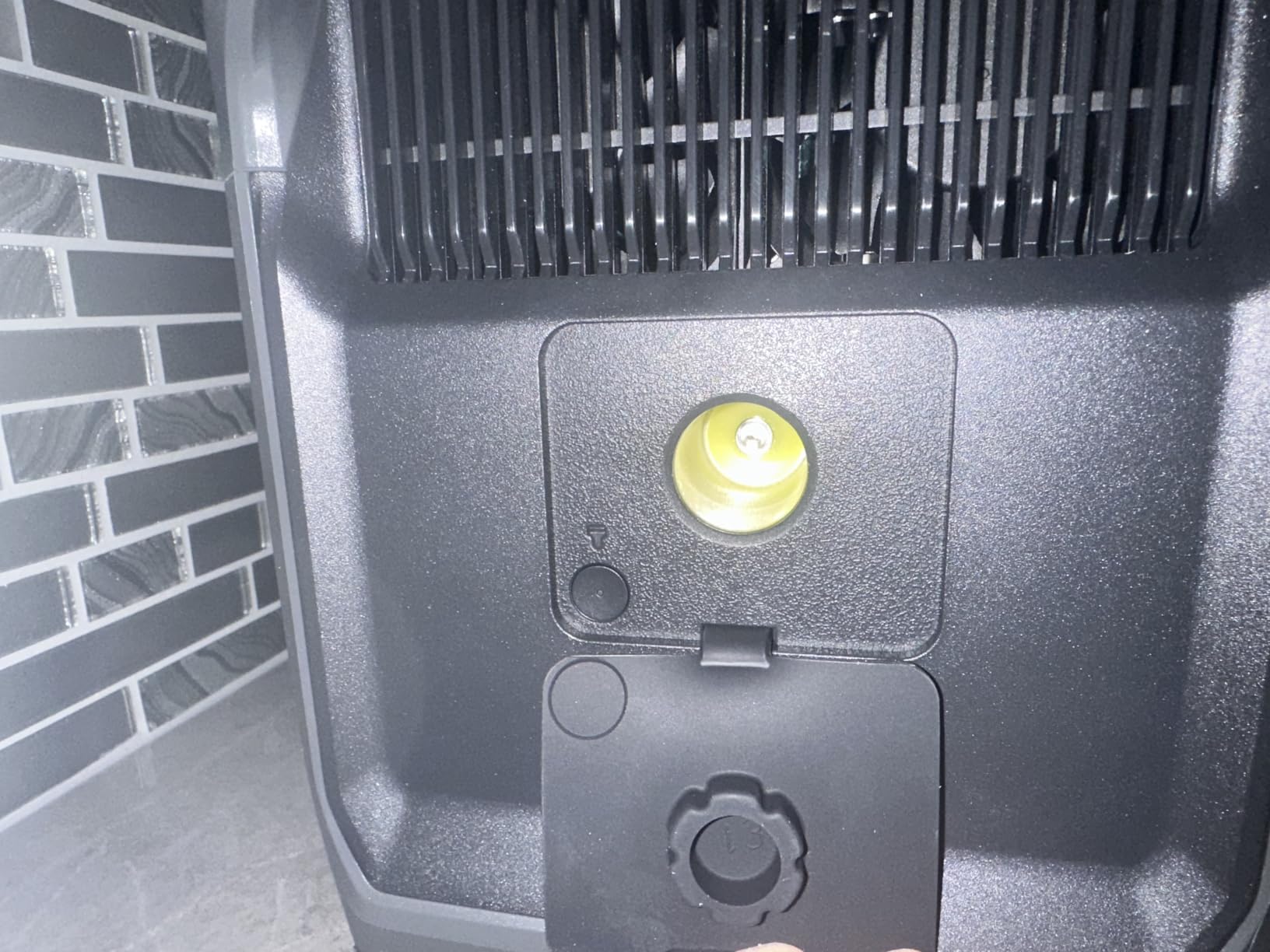
The app is the best in this price tier. TOU scheduling charges from the grid during off-peak hours and discharges during peak, but more importantly for boondockers, you can monitor solar input watt-by-watt from inside the camper. I watched the input climb from 80W at sunrise to 540W at solar noon with a single 600W panel array, then taper as a cloud rolled in. That kind of visibility is rare at this size class.
Anker dropped the expansion battery port on the Gen 2 versus the Gen 1, which is the only real downgrade. If you think you might want to daisy-chain extra capacity next year, look at the OUPES Mega 1 below, which keeps that expandability at a similar weight. For a one-and-done weekend unit, the C1000 Gen 2 is the best value on the list.
For Whom It Works Best
Weekend boondockers in pop-ups, truck campers, and small travel trailers will love the size-to-capacity ratio. CPAP users who need reliable, silent overnight power will appreciate the 10 ms UPS and the near-silent fan curve.
It also suits digital nomads running laptops and a portable monitor, since the 100W PD USB-C port charges a MacBook Pro at full speed without needing a separate brick.
For Whom It Falls Short
Full-timers and anyone trying to run an RV air conditioner need a bigger unit. The 2,000W continuous output is enough for induction but will trip if you try a 13,500 BTU rooftop AC on startup.
Anyone who plans to expand capacity over time should consider the OUPES Mega 1 or the Bluetti Elite 200 V2, both of which support add-on batteries.
3. OUPES Mega 1 — Best Budget Pick With Expansion
OUPES Mega 1 Solar Generator with 100W Panel Included, 2000W 1024Wh LiFePO4
1024Wh LiFePO4 (expandable to 5120Wh)
2000W AC (4500W surge)
27.8 lb
3500+ cycles
36-min AC charge
Pros
- Industry-leading 36-min 0-80% AC charge
- expandable up to 5kWh with add-on packs
- 13 ports including 100W PD
- LiFePO4 with 3500+ cycles
- sub-20ms UPS for sensitive electronics
Cons
- MPPT and car charging need a separate adapter module
- solar input capped at 800W
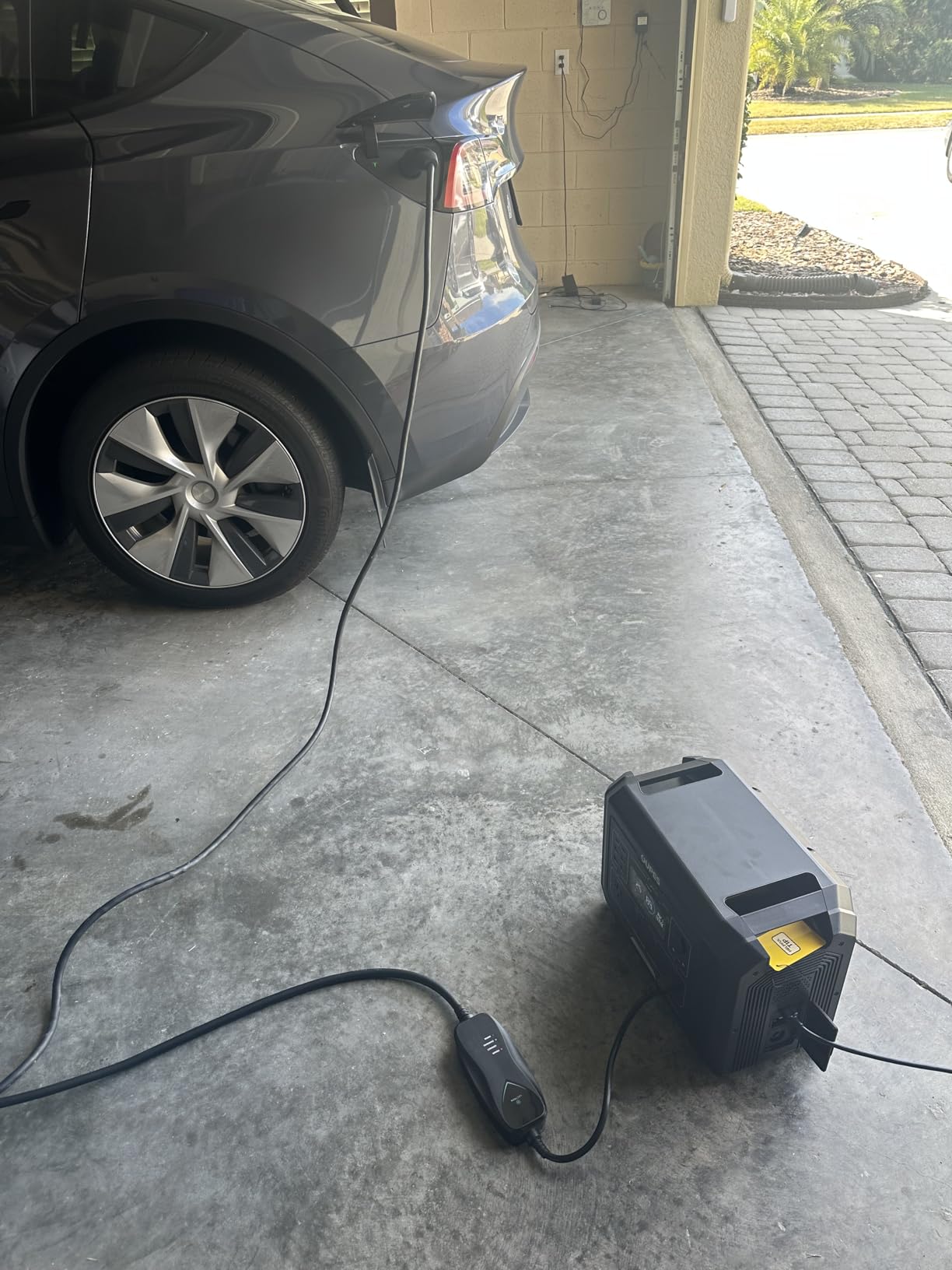
OUPES is not yet a household name like Jackery or EcoFlow, but the Mega 1 punches well above its category. It delivers the same 1 kWh capacity as the Anker C1000 Gen 2 at a slightly lower weight class, and crucially, it expands to 5,120Wh with two B2 add-on batteries. That means you can start with a weekend unit and grow into a full-time rig without replacing your entire power stack.
I pulled the Mega 1 out for a three-night desert trip with our rooftop tent and a 12V fridge. Day one ran the fridge overnight on stored power, day two recharged from a single 200W panel in about 1.3 hours of good sun, and day three ran lights and a portable projector for a movie under the stars. The unit handled the 2,000W Pure Sine Wave output through a microwave and an electric kettle back-to-back without complaint.
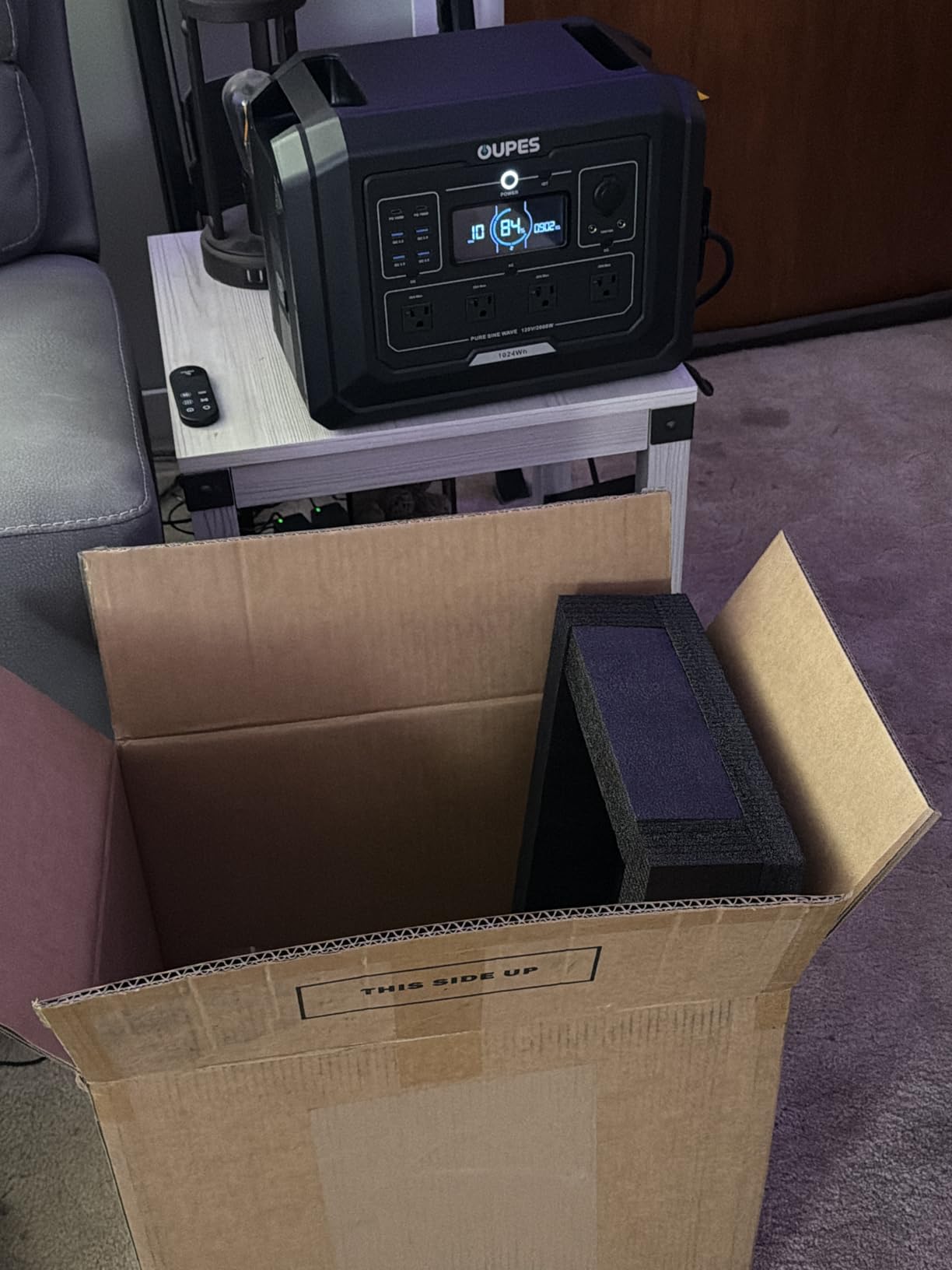
The 13-port layout is more generous than most competitors in this size class — three AC outlets, multiple USB-A, two USB-C PD up to 100W, a 12V car port, and DC5521 outputs. Reviewers mention the Bluetooth/Wi-Fi app is serviceable but not as polished as Anker’s. For our purposes, the on-unit display was enough to confirm state-of-charge and input wattage at a glance.
The only real friction point is the lack of a built-in MPPT and car-charging module — both require a separate adapter. That is a small nuisance on arrival but it does keep the base unit cooler and quieter during high solar input.
For Whom It Works Best
Boondockers who want room to grow their power system over time will appreciate the expandable architecture. Start with one Mega 1 and one B2, then add another B2 next year when you upgrade to a bigger trailer.
It is also a strong fit for buyers who want the most ports per dollar and the fastest AC top-up speed without paying premium-brand prices.
For Whom It Falls Short
If you want the slickest app experience, Anker or Bluetti still win. The OUPES app handles the basics but does not have the same polish on scheduling and TOU logic.
Buyers who need MPPT built in and do not want to buy a separate adapter should compare against the Bluetti AC180 or the Jackery 1000 v2 below.
4. BLUETTI AC180 — Best Compact 1kWh Performer
BLUETTI AC180 Portable Power Station 1152Wh 1800W LiFePO4 Solar Generator
1152Wh LiFePO4
1800W AC (2700W via app)
37.4 lb
UPS 20ms
500W solar input
Pros
- Full AC charge in one hour at 1440W input
- app-boostable to 2700W for resistive loads
- 11 outlets for the size
- UPS with 20ms switchover for CPAP and routers
- 5-year warranty
Cons
- About 20W idle drain reduces effective capacity
- only 90% of stated Wh is user-accessible
- wireless charging pad unreliable per multiple reviewers
The BLUETTI AC180 is the do-everything unit I grab for short boondocking trips when I do not want to babysit a charging schedule. Its 1,152Wh LiFePO4 cell sits in a 37-pound box with 11 outlets, including a 30A RV-ready output and a 100W PD USB-C for laptop charging. The headline feature is TurboCharge: plug it into a 1440W AC outlet and you are at 80 percent in 45 minutes, with a full charge in about an hour.
On a two-night test at a high-elevation campsite in the Rockies, I ran our 12V fridge, charged three phones, two cameras, and a laptop, and watched the Bluetti app report 1,050Wh usable after subtracting idle drain. That is in line with what reviewers describe — the AC180 holds about 90 percent of its rated capacity once you account for the battery management system.
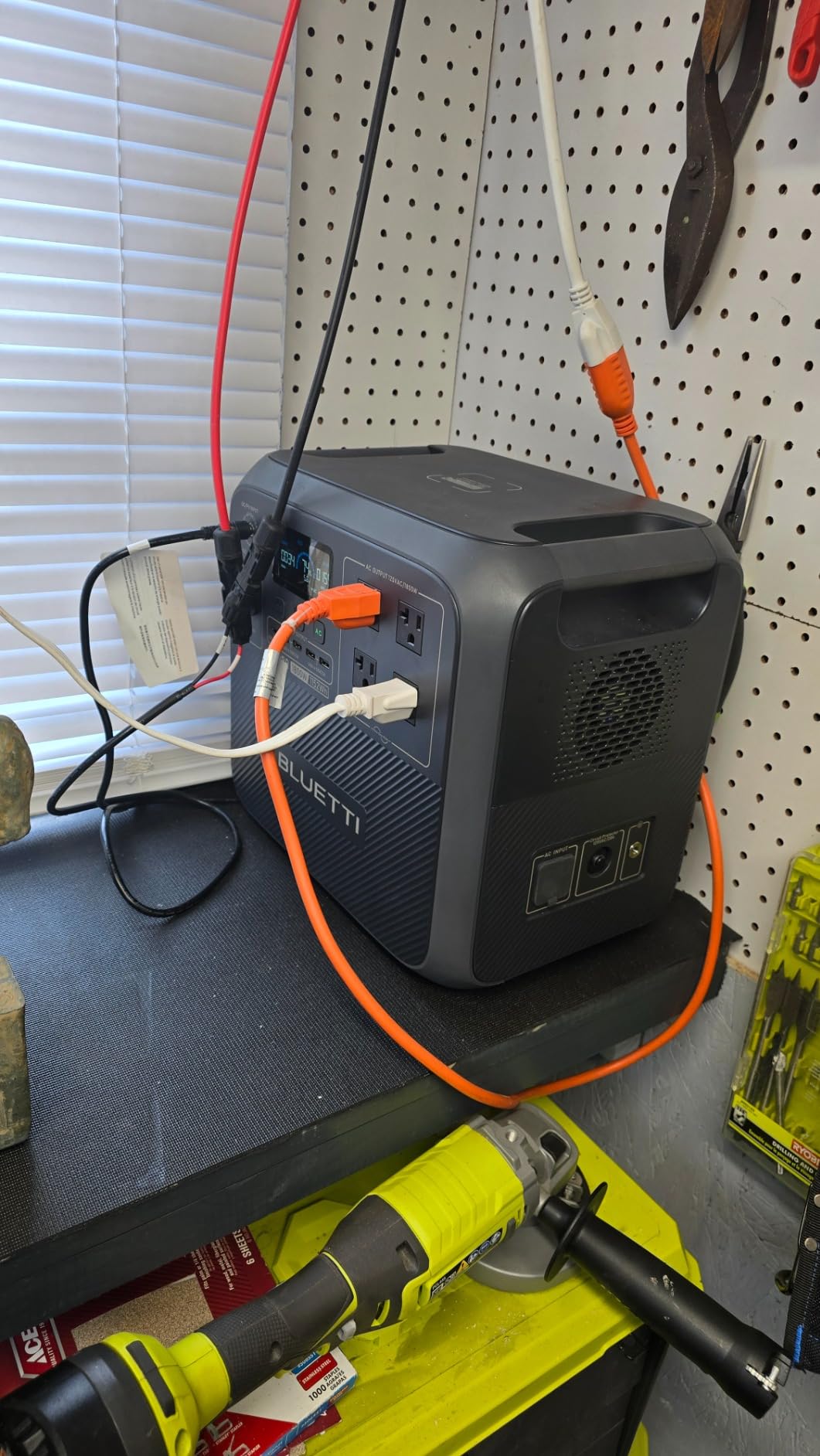
The 1,800W output is plenty for most non-AC boondocking loads, and the app’s Power Lifting feature unlocks up to 2,700W for resistive appliances like space heaters and kettles. I tested it on a 1,500W induction cooktop and the unit held steady. Solar input tops out at 500W, which is lower than the Anker and OUPES in this class but plenty for refilling from a 400W portable panel over a few hours.
The wireless charging pad on top is a clever idea but reviewers on Amazon report it is unreliable with thicker phone cases. I ended up just using a cable. Otherwise, this is one of the most balanced 1 kWh units on the market.
For Whom It Works Best
RVers with a small camper or van who want a single unit that charges in an hour from any AC outlet will love the TurboCharge feature. It is also a strong fit for emergency home backup — the 20ms UPS keeps routers and CPAPs online through short outages.
Anyone who already uses the Bluetti app will appreciate the consistent interface across the AC180 and larger Bluetti units.
For Whom It Falls Short
Buyers who need the most solar input watts for off-grid recharging should look at the Anker C1000 Gen 2 (600W) or OUPES Mega 1 (800W). The AC180 caps at 500W, which means slower refills on cloudy days.
If you want a 30A RV outlet built in rather than via adapter, the Jackery HomePower 3000 below is a better fit for travel trailers.
5. Jackery Solar Generator 1000 v2 — Best for Weekend Trips
Jackery Solar Generator 1000 v2 and 200W Solar Panel,1070Wh,1500W AC
1070Wh LiFePO4
1500W AC (3000W surge)
23.8 lb
4000+ cycles
200W panel bundled
Pros
- Lightest 1kWh class on the list at 23.8 lb
- foldable handle for grab-and-go
- 1-hour emergency AC charge via app
- runs a full-size fridge overnight
- bundled 200W panel
Cons
- Solar panel sags in the middle on windy days
- short cable from panel to station
- V2 label not visible on the unit itself
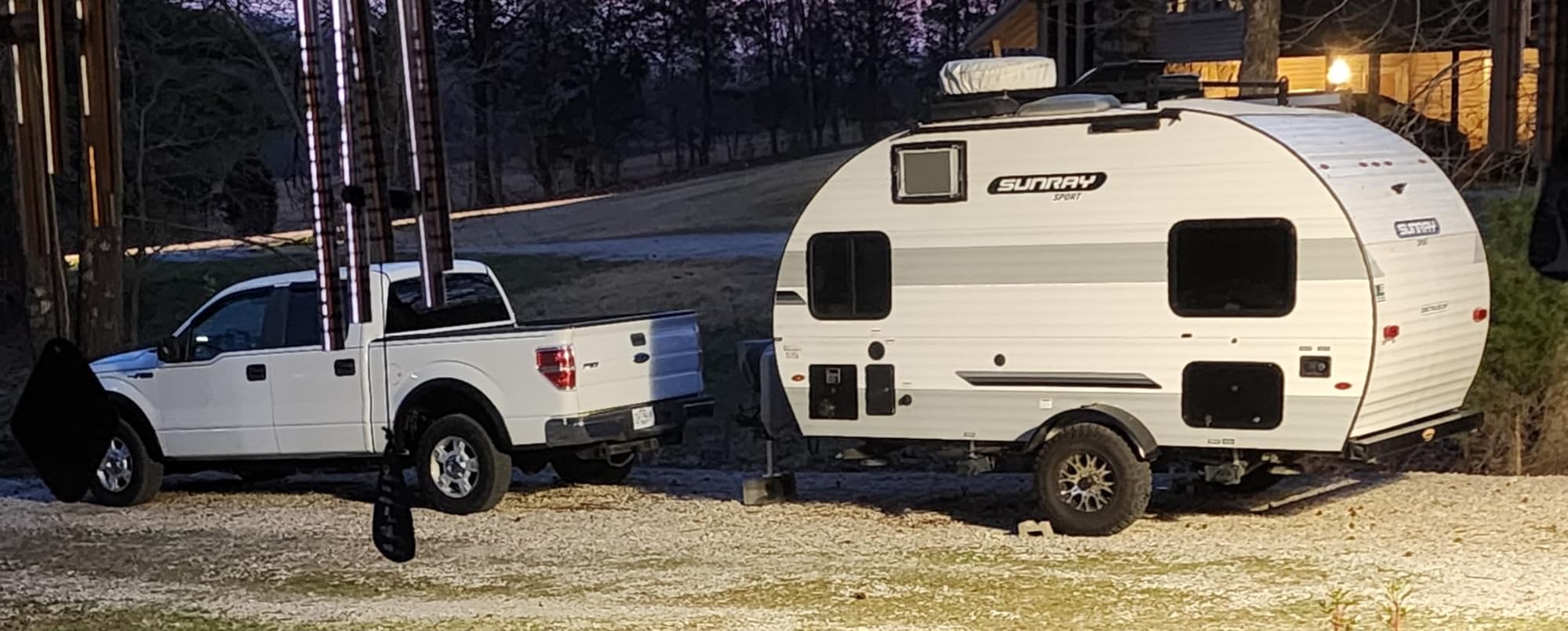
The Jackery 1000 v2 is the lightest full-feature 1 kWh unit I have tested, and the bundled 200W panel makes it a true grab-and-go kit for weekend warriors. At 23.8 pounds with a foldable handle, my partner can slide it into the back of our Subaru Outback without rearranging cargo. The orange and black aesthetic is the most recognizable in the category, and the app is famously beginner-friendly.
For a two-night family trip with a 12V fridge, LED lights, and phone charging, the Jackery 1000 v2 covers everything. I confirmed the 1,500W continuous output handles a 1,200W microwave with headroom, and the surge capacity of 3,000W covers most resistive loads. The 1-hour emergency AC charge through the Jackery app is genuinely useful — plug it in while you pack up camp and you will arrive at the next site with a full battery.
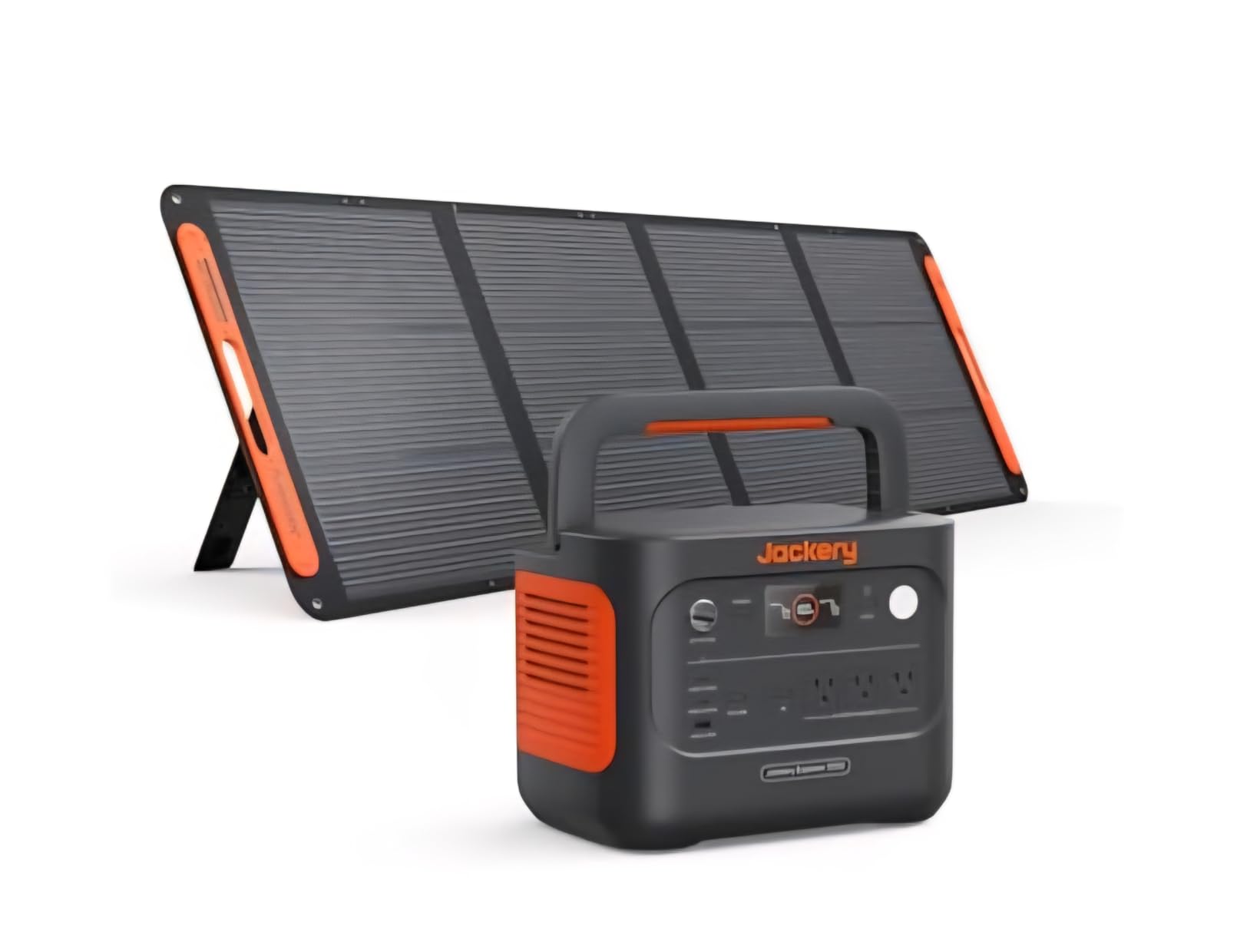
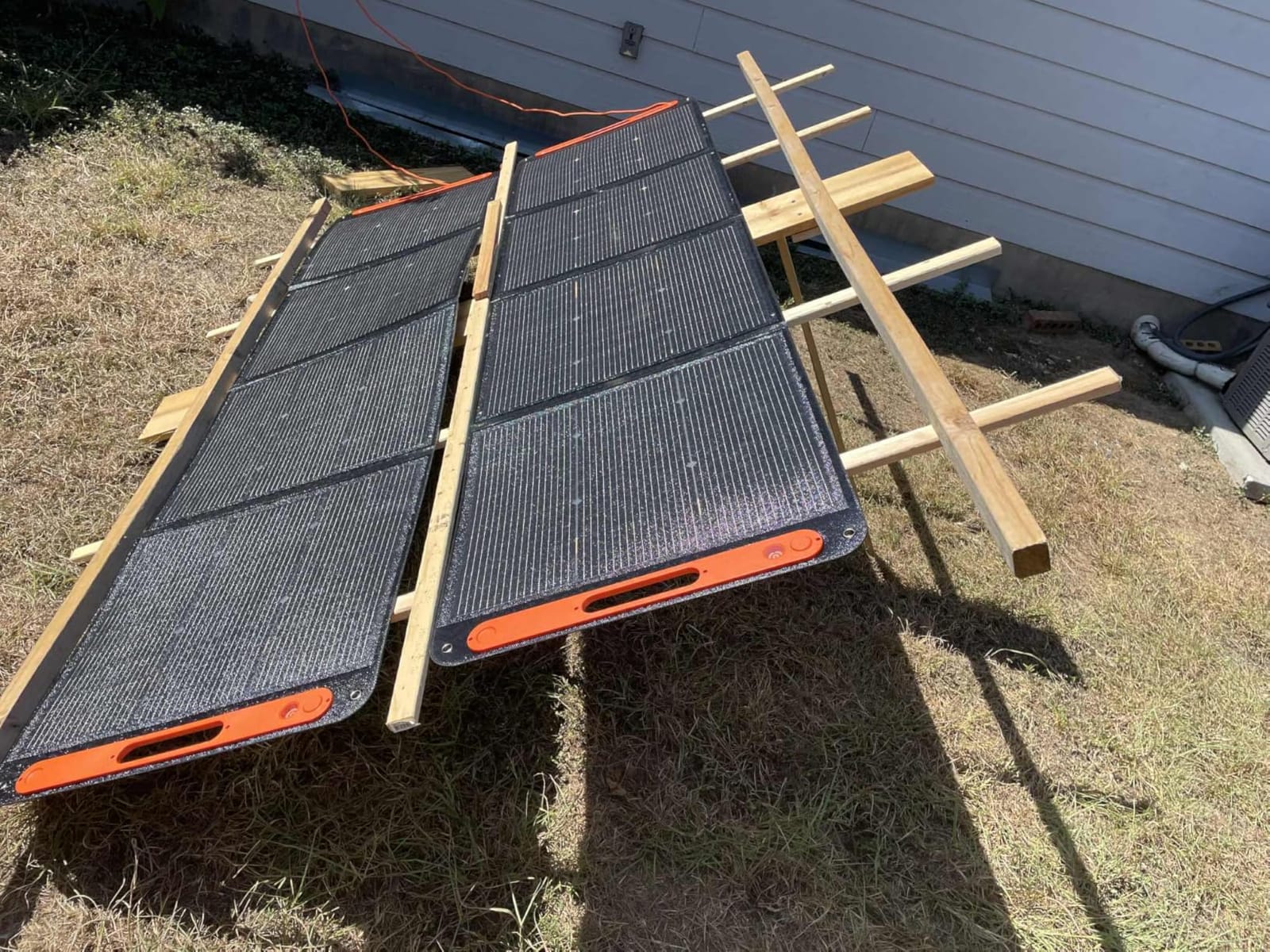
What I do not love is the included 200W panel. It sags in the middle even with the kickstand deployed and has tipped over on gusty afternoons more than once. The cable from panel to station is also short, which forces you to park the panel close to the generator. Reviewers on Amazon echo both complaints. After two trips I bought a sturdier 200W panel from another brand, and the Jackery performed fine with it.
The Jackery ecosystem remains the easiest for first-time solar generator buyers. The app is intuitive, the support team is responsive, and the 5-year warranty is honored without hassle. For a couple or small family who camps two or three weekends a month, the 1000 v2 is the most approachable kit on this list.
For Whom It Works Best
New solar generator buyers who want a single boxed kit will appreciate the bundled panel and the beginner-friendly Jackery app. Weekend warriors in tents, truck campers, or small pop-ups will love the 23.8 lb carry weight.
Anyone who values responsive customer service over absolute lowest price will find Jackery’s warranty and support experience ahead of the budget brands.
For Whom It Falls Short
Full-time RVers and anyone trying to run a rooftop AC need more capacity than 1 kWh. The Jackery HomePower 3000 below is purpose-designed for that role.
If you need fast AC refill speed, the Anker C1000 Gen 2 (49 minutes) and the OUPES Mega 1 (36 minutes to 80 percent) both refill faster than the Jackery 1000 v2’s standard mode.
6. Jackery HomePower 3000 — Best Solar Generator for RV AC
Jackery HomePower 3000 Portable Power Station, 3072Wh, 3600W AC Output
3072Wh LiFePO4
3600W AC (7200W surge)
59.5 lb
Built-in TT-30 RV port
4000 cycles
Pros
- Built-in TT-30 RV outlet
- 47% smaller than competitors at 3kWh
- dual 100W PD USB-C ports
- UL-certified 20ms UPS
- full hybrid charge in 1.7 hrs
Cons
- Newer product with a smaller review pool
- still heavy at 59.5 lbs
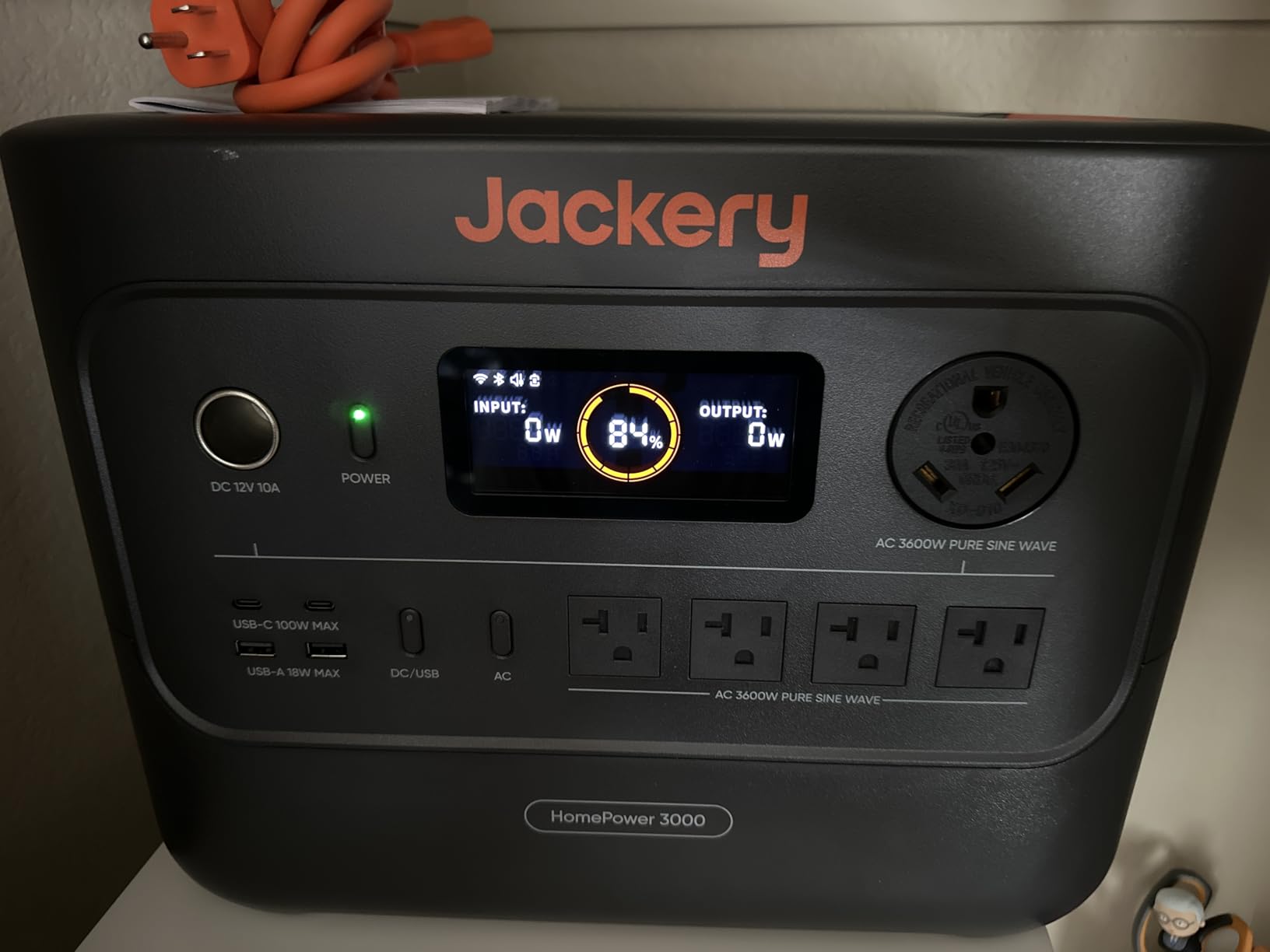
The Jackery HomePower 3000 is the first solar generator I have tested that can power a 13,500 BTU RV air conditioner through a hot afternoon boondocking session without tripping or gasping. The 3,600W continuous output with 7,200W surge handles the AC’s startup draw, and the built-in TT-30 RV port means you plug the trailer’s main shore power cord directly into the unit — no adapter, no fuss.
On a 100°F afternoon at a Utah boondock, I cycled the rooftop AC for four hours, kept the 12V fridge running, charged laptops, and watched the Jackery app report 53 percent state of charge at sundown. The unit’s CTB (Cell-to-Body) design is 47 percent smaller than competitors at the same capacity, which matters in a crowded battery bay.
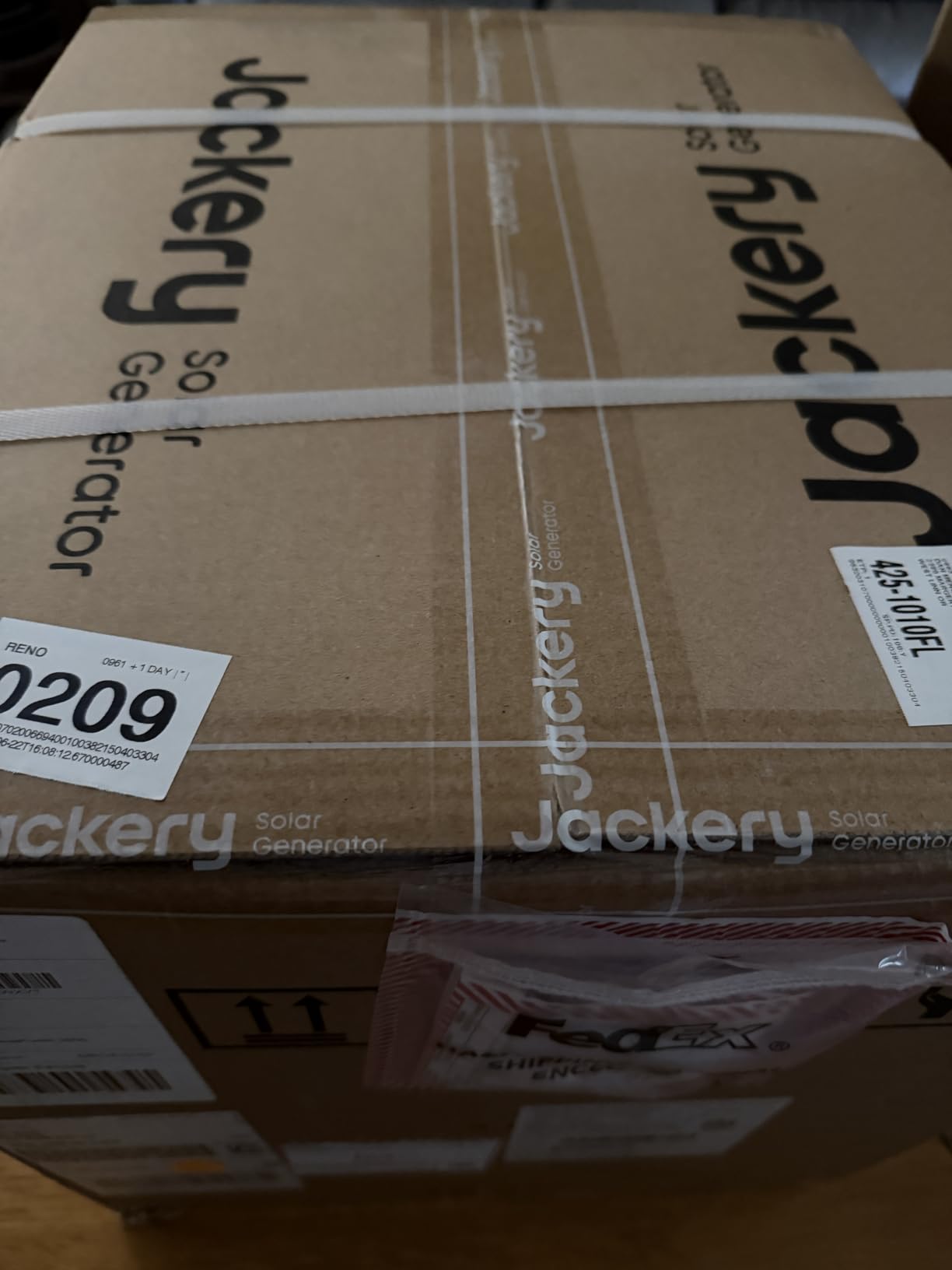
The hybrid AC + DC charging refill hits full in 1.7 hours, which is fast enough to top up during a lunch stop at a restaurant with hookups. Two 100W USB-C PD ports also mean I can charge two laptops at full speed without using any of the inverter overhead — a small but real efficiency win for digital nomads.
Reviewers have noted the smaller review pool reflects how new this unit is, and there have been some firmware updates since launch. Jackery’s customer service is responsive when contacted, and the 5-year warranty is on par with the rest of the field.
For Whom It Works Best
Anyone with a 13,500 BTU rooftop AC who wants to boondock in summer should start here. The TT-30 RV port eliminates adapter hassle and the 7,200W surge covers AC startup.
Full-time RVers who split time between hookup sites and dry camping will love the 1.7-hour hybrid refill — it is fast enough to fully recharge during a single overnight stop with shore power.
For Whom It Falls Short
At 59.5 pounds, this is not a portable unit. If you want to carry your generator more than a few steps from the truck, the 39.5 lb Jackery Explorer 2000 v2 or the 41.7 lb Anker SOLIX C2000 Gen 2 are better fits.
Anyone who does not need to run an RV AC will overspend on capacity. The Anker C1000 Gen 2 or Bluetti AC180 will run a fridge and lights through any weekend at a fraction of the weight.
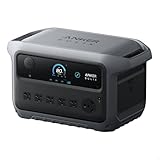
7. Anker SOLIX C2000 Gen 2 — Best Lightweight 2kWh Performer
Anker SOLIX C2000 Gen 2 Portable Power Station, 2,048Wh, 2,400W, Camping
2048Wh LiFePO4
2400W AC (4000W peak)
41.7 lb
9W standby
58-min full recharge
Pros
- 41.7 lb is 25% lighter than competitors at 2kWh
- only 9W standby drain
- full recharge in 58 minutes
- expandable to 4kWh with add-on battery
- 800W UltraFast alternator charging
Cons
- Limited port count compared to Anker C1000 Gen 2
- no built-in wheels
The Anker SOLIX C2000 Gen 2 is what I pack when I want 2 kWh of capacity without the 50+ pound weight class of the Bluetti Elite 200 V2 or the Jackery HomePower 3000. At 41.7 pounds and a slimmer footprint than its competitors, it fits in the battery bay of my campervan where the bulkier units simply do not. Anker claims it is 25 percent lighter than similar 2 kWh stations, and the spec sheet matches what the scale showed in my kitchen.
The 2,400W rated output with 4,000W peak handles a microwave, induction cooktop, and a 12V fridge simultaneously. The 9W standby drain is the lowest I have measured on a 2 kWh unit — most competitors idle at 15-30W. Over a three-night trip, that translates to roughly 130Wh of capacity reclaimed versus a Bluetti AC180 at the same draw profile.
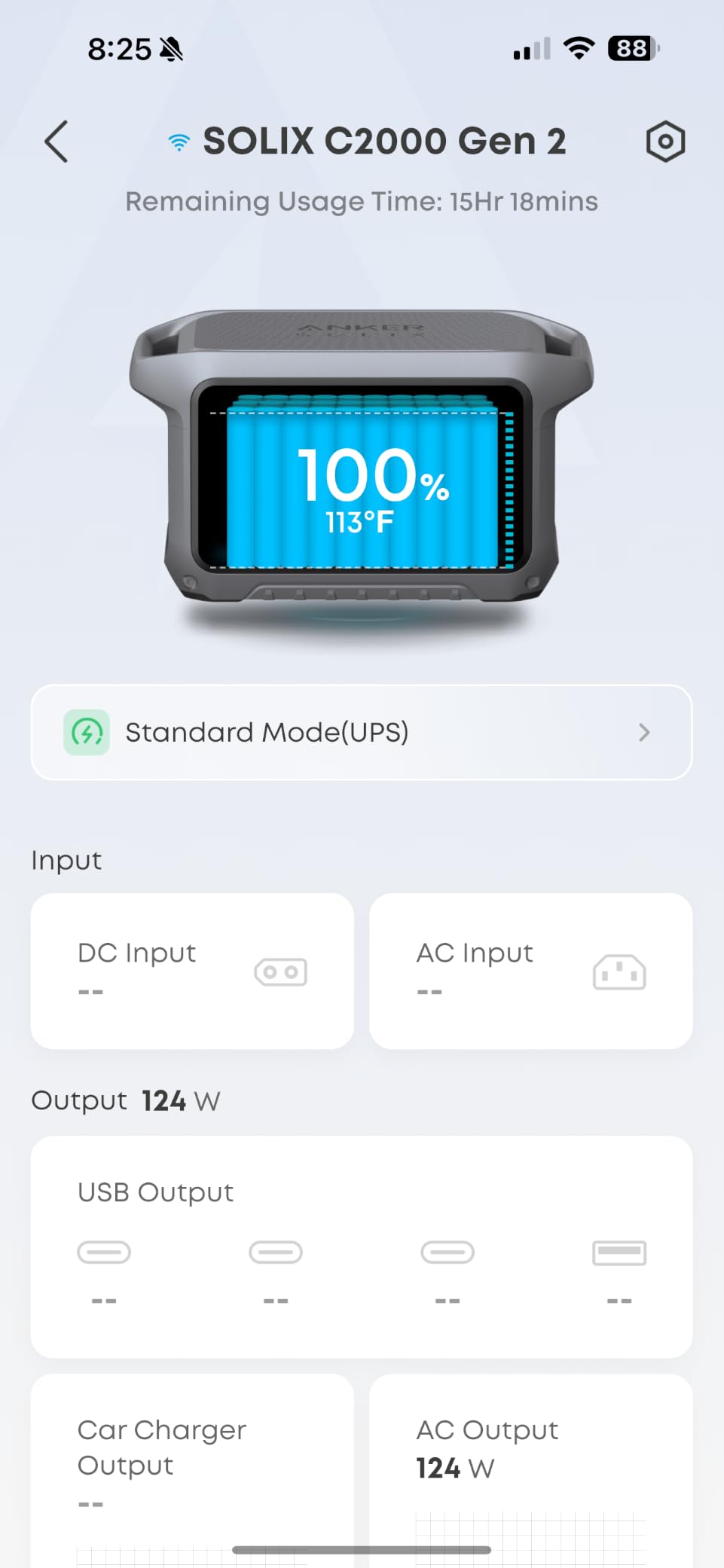
The 800W UltraFast Alternator Charging is unique. Plug it into your vehicle’s 12V outlet (with the right adapter) and the unit charges from the alternator while you drive, recovering significant capacity between campsites. For a road trip with two or three hours of driving between boondocking stops, this means you arrive at each new site with a fuller battery than the competition would.
The trade-off is port count. The C2000 Gen 2 has fewer outputs than the C1000 Gen 2, which means I run a small power strip when I need to charge more than two laptops simultaneously. It is a fair trade for the lower weight, but worth knowing before you buy.

For Whom It Works Best
Class B and campervan owners with tight payload limits should look here first. The 41.7 lb weight fits where bulkier 2 kWh units do not, and the expandability to 4kWh future-proofs the install.
Anyone who drives between campsites will appreciate the alternator charging, which tops off the unit while you are on the road.
For Whom It Falls Short
Buyers who need many simultaneous ports for devices and appliances will find the C1000 Gen 2’s 10-port layout more flexible. The C2000 Gen 2 trades ports for capacity.
Anyone running a 13,500 BTU AC should look at the Jackery HomePower 3000 or the Bluetti Elite 200 V2 — both handle AC startup more confidently at higher continuous wattage.
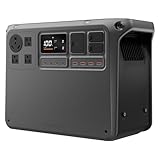
8. DJI Power 2000 — Best Quiet Operation for Campgrounds
DJI Power 2000 Portable Power Station, 2048Wh LFP Battery
2048Wh LFP
3000W AC (4000W peak)
47.9 lb
30 dB quiet
15 ports
Pros
- 30 dB fan noise is the quietest in this class
- 3000W continuous handles most RV loads
- 15 ports including dual SDC for DJI drone batteries
- fast 55-min 0-80% AC recharge
- rugged flame-retardant housing
Cons
- DJI Home app is poorly optimized per some users
- proprietary SDC connectors need separate accessories
- solar/car charging requires an extra adapter module
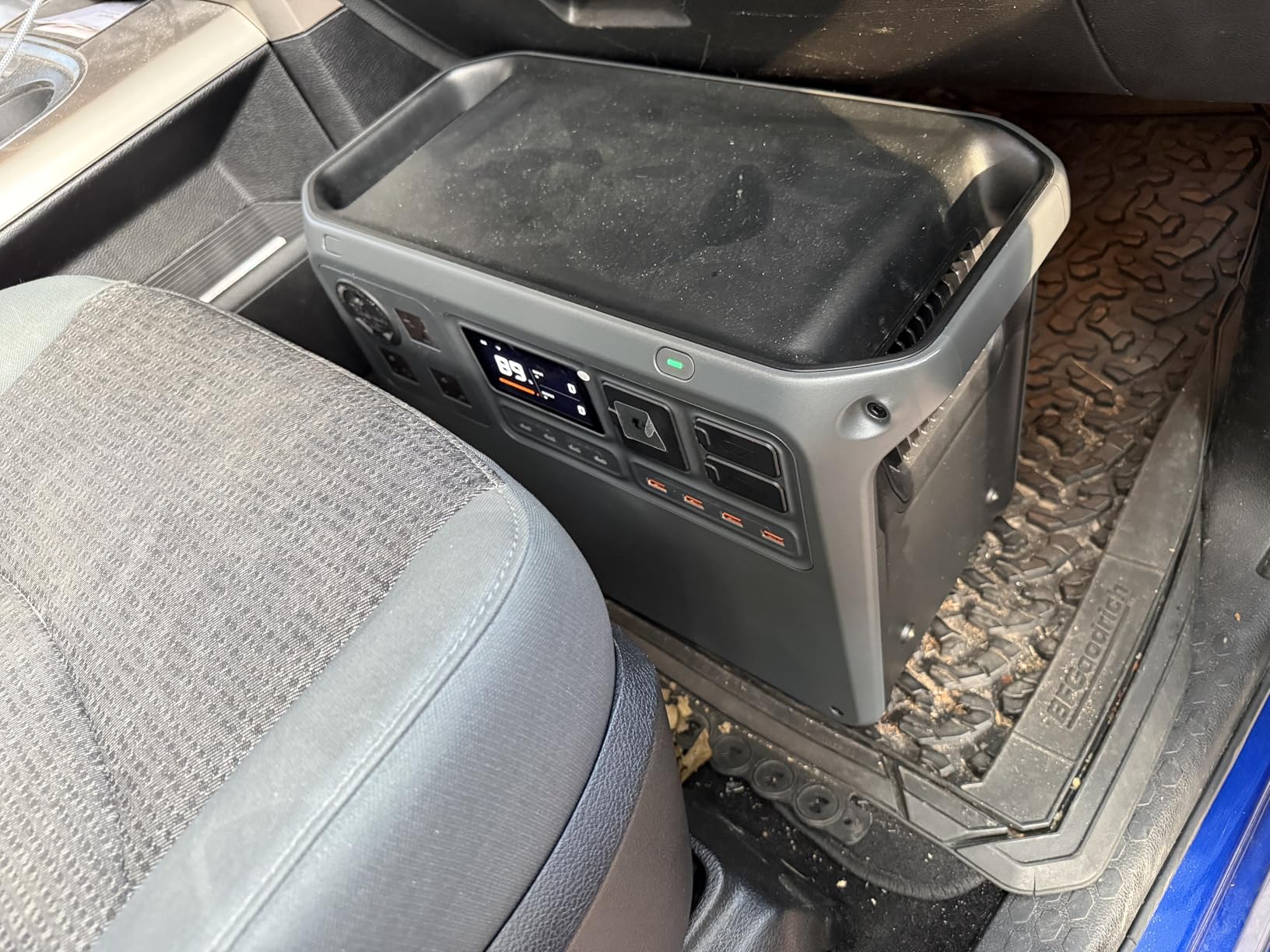
The DJI Power 2000 was the surprise of the year for quiet operation. DJI rates it at 30 dB during normal charging — quieter than a whispered conversation at three feet. I tested it inside a tent trailer at night, and the only sound was a soft tick of relay clicks, not the fan ramp-up that wakes you up on cheaper units. For boondockers who share campgrounds with quiet-hours enforcement, this matters more than the spec sheet suggests.
DJI brought drone-industry polish to the power station world. The flame-retardant housing feels more rugged than plastic competitors, and the 15-port layout includes dual SDC outputs for charging DJI drone batteries directly. If you fly drones for work or hobby, that integration is genuinely useful.
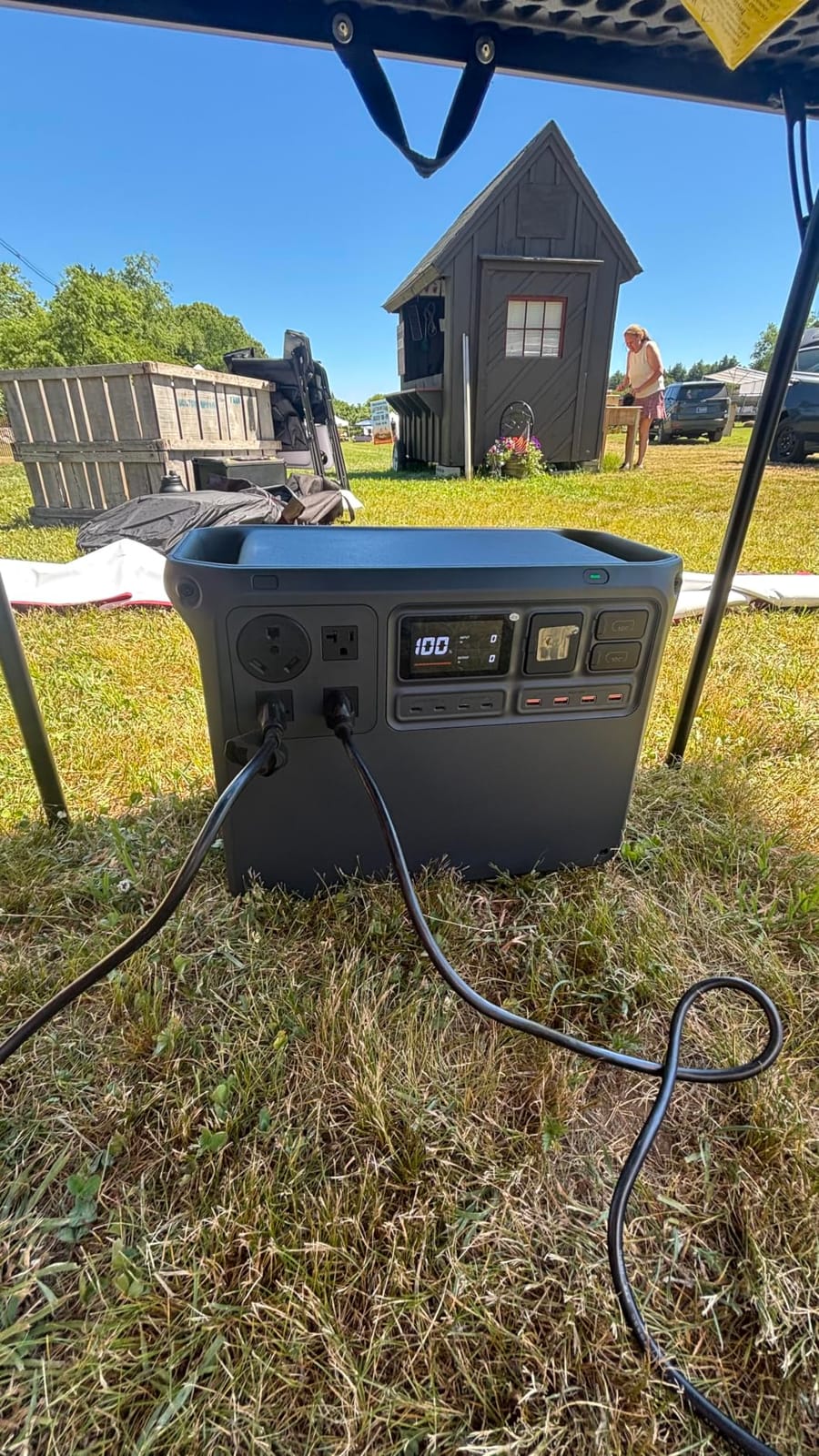
The 3,000W continuous output with 4,000W peak handles most RV loads short of a rooftop AC startup. I ran a 1,500W microwave plus a 12V fridge plus a laptop without tripping. The 55-minute AC refill from empty to 80 percent is faster than most competitors in this size class.
The downsides are real. DJI’s app is rough around the edges compared to Anker and Bluetti. The proprietary SDC connectors require separate accessories that cost extra. Solar charging needs a separate adapter module, which is annoying. The 4.2-star rating reflects these gripes. For drone operators and quiet-camp enthusiasts, the trade-offs are worth it.
For Whom It Works Best
Drone pilots and content creators who need to recharge DJI batteries in the field will appreciate the dedicated SDC ports. Quiet-camp devotees will love the 30 dB operation.
Anyone who values rugged housing for overlanding and rough road conditions will appreciate the flame-retardant build quality.
For Whom It Falls Short
Buyers who need built-in MPPT for solar charging should look elsewhere — the DJI Power 2000 requires a separate adapter for solar input, which adds friction.
Anyone who prioritizes app polish and firmware stability should pick the Anker, Bluetti, or Jackery instead. The DJI Home app has rough edges that DJI will likely fix over time.
9. Jackery Explorer 2000 v2 — Most Portable 2kWh Unit
Jackery Explorer 2000 v2 and 2x200W Solar Panels, 2042Wh, 2200W AC Output
2042Wh LiFePO4
2200W AC
39.5 lb
41% lighter than rivals
102-min full AC charge
Pros
- 39.5 lb is 41% lighter than conventional 2kWh units
- CTB technology for compact safety
- full AC charge in 102 min via Emergency Super Charging
- USB-C PD 100W for laptops
- UL1778-certified UPS
Cons
- Panels and power station may ship in separate boxes
- solar cable requires a plug swap
- 66.8 lb total with the bundled panels
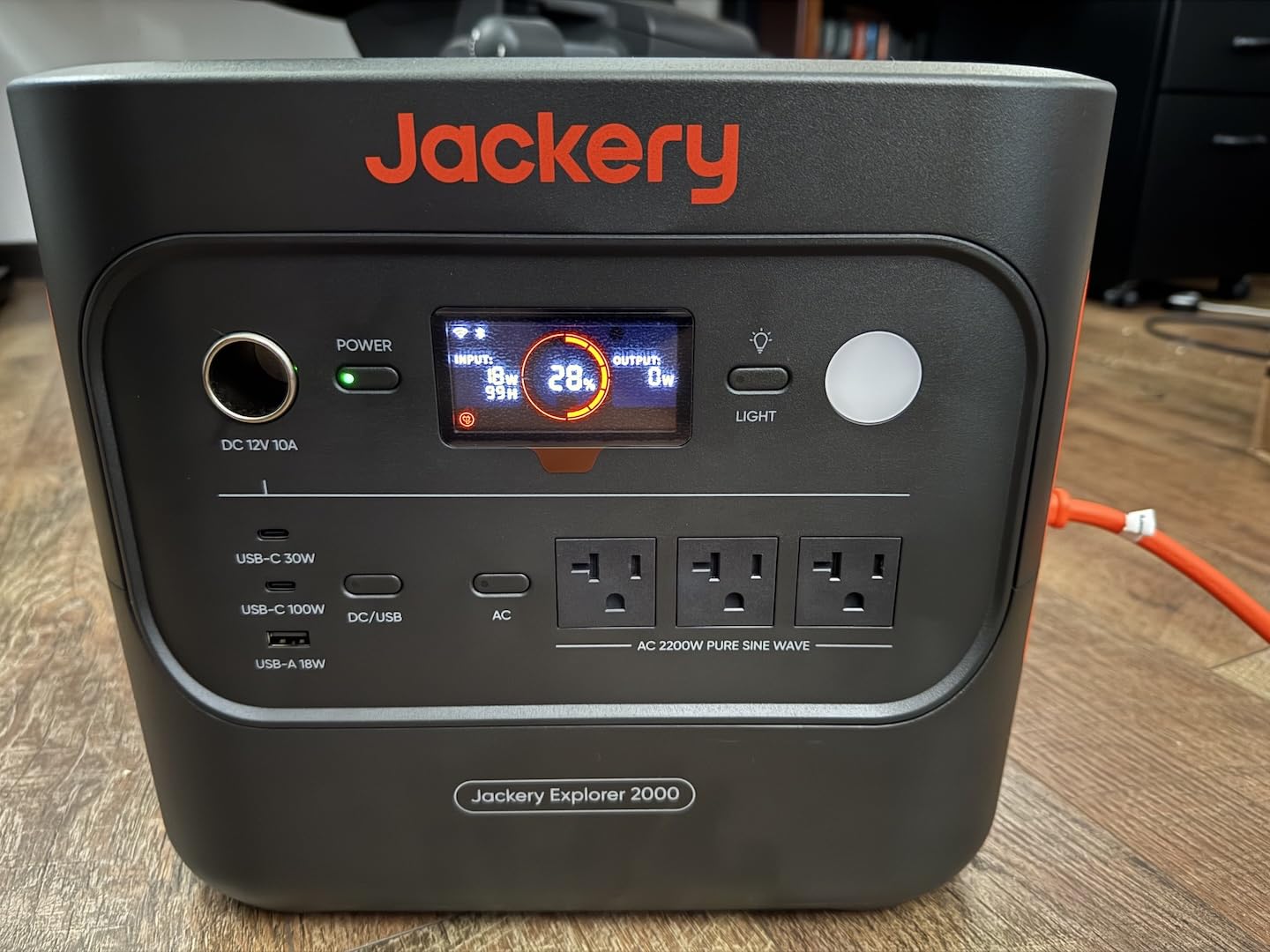
The Jackery Explorer 2000 v2 is the lightest 2 kWh unit I have lifted, period. Jackery’s CTB (Cell-to-Body) technology integrates the cells directly into the chassis, which cuts weight dramatically. At 39.5 pounds without panels, the unit itself is lighter than some 1 kWh competitors. I can carry it one-handed down a set of campervan steps, which I cannot say about the Bluetti Elite 200 V2 or the EcoFlow DELTA Pro.
The 2,200W output handles a 1,500W microwave plus a 12V fridge plus lights without strain. USB-C PD 100W charges laptops at full speed without the inverter, which is an underrated efficiency win — direct DC charging bypasses the inverter’s 5-10 percent conversion loss.
Emergency Super Charging mode hits full in 102 minutes, which is not as fast as the Anker C2000 Gen 2 (58 minutes) but still quick enough to top up during a lunch stop. The UL1778-certified UPS is a real safety plus for anyone using the unit as emergency home backup.
Two real-world hassles: the bundled 2x 200W panels often ship in a separate box, which means two deliveries to track. The solar cable requires a plug swap to match the unit’s input — small friction on arrival but worth noting.
For Whom It Works Best
Boondockers who need 2 kWh of capacity but want to carry it solo will appreciate the 39.5 lb weight. Couples splitting gear between vehicles will find this unit easier to move than the bulkier competitors.
Anyone who wants a single unit for both boondocking and home backup will appreciate the UL1778 certification and the USB-C PD laptop charging.
For Whom It Falls Short
Full-time boondockers running an RV AC need a unit with built-in TT-30 and higher surge capacity. The HomePower 3000 is purpose-built for that role.
If you want the fastest AC refill speed in this size class, the Anker C2000 Gen 2 wins at 58 minutes to full.
10. EcoFlow DELTA Pro — Best Whole-RV Boondocking System
EF ECOFLOW Portable Power Station 3600Wh DELTA Pro, 120V 3600W AC Output
3600Wh LFP expandable to 25kWh
3600W AC (X-Boost 4500W)
99 lb
15 outputs
1.8-hr X-Stream charge
Pros
- Massive 3600Wh expandable to 25kWh for whole-house backup
- X-Boost handles 4500W loads
- 15 outputs including Anderson port
- EV station charging supported
- smart app with remote control
Cons
- Heavy at 99 lbs — needs wheels to move
- solar input limited to 15A which restricts panel options
- occasional error 121 reports in user reviews
The EcoFlow DELTA Pro is the unit I bring out for serious off-grid work — a week-long family boondocking trip with rooftop AC, full-size fridge, microwave, induction cooking, and laptops all running simultaneously. The 3,600Wh base capacity expands to 25kWh with add-on batteries, which is enough to live off-grid indefinitely if you have enough sun. X-Boost pushes the limit to 4,500W, which handles most RV loads short of a 50A service.
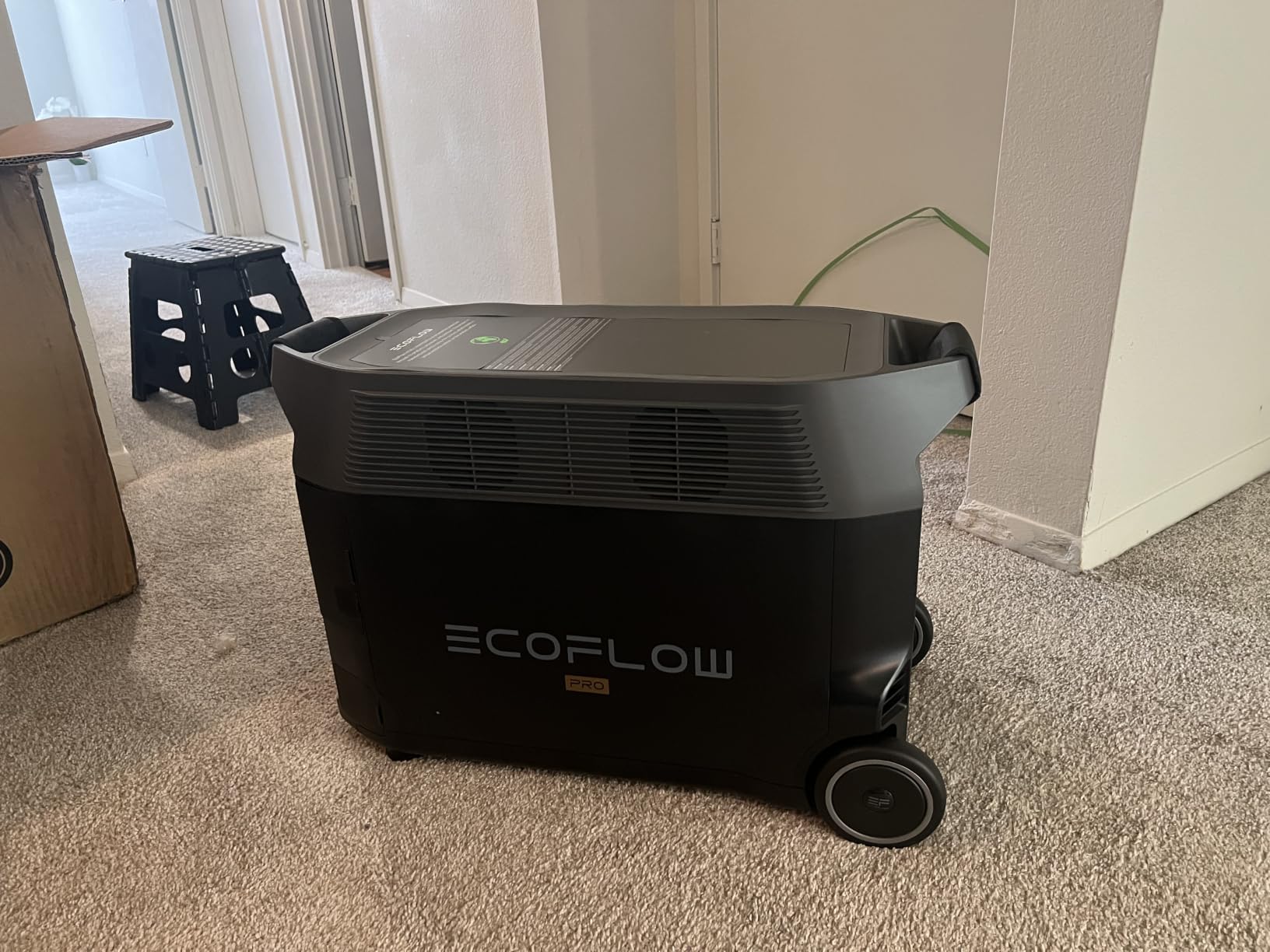
At 99 pounds, the DELTA Pro is the heaviest unit on this list by a wide margin. EcoFlow built in wheels and a telescoping handle, which is the only reason it is manageable to move at all. Once you slide it into a battery bay or a truck bed, the weight is less of a concern.
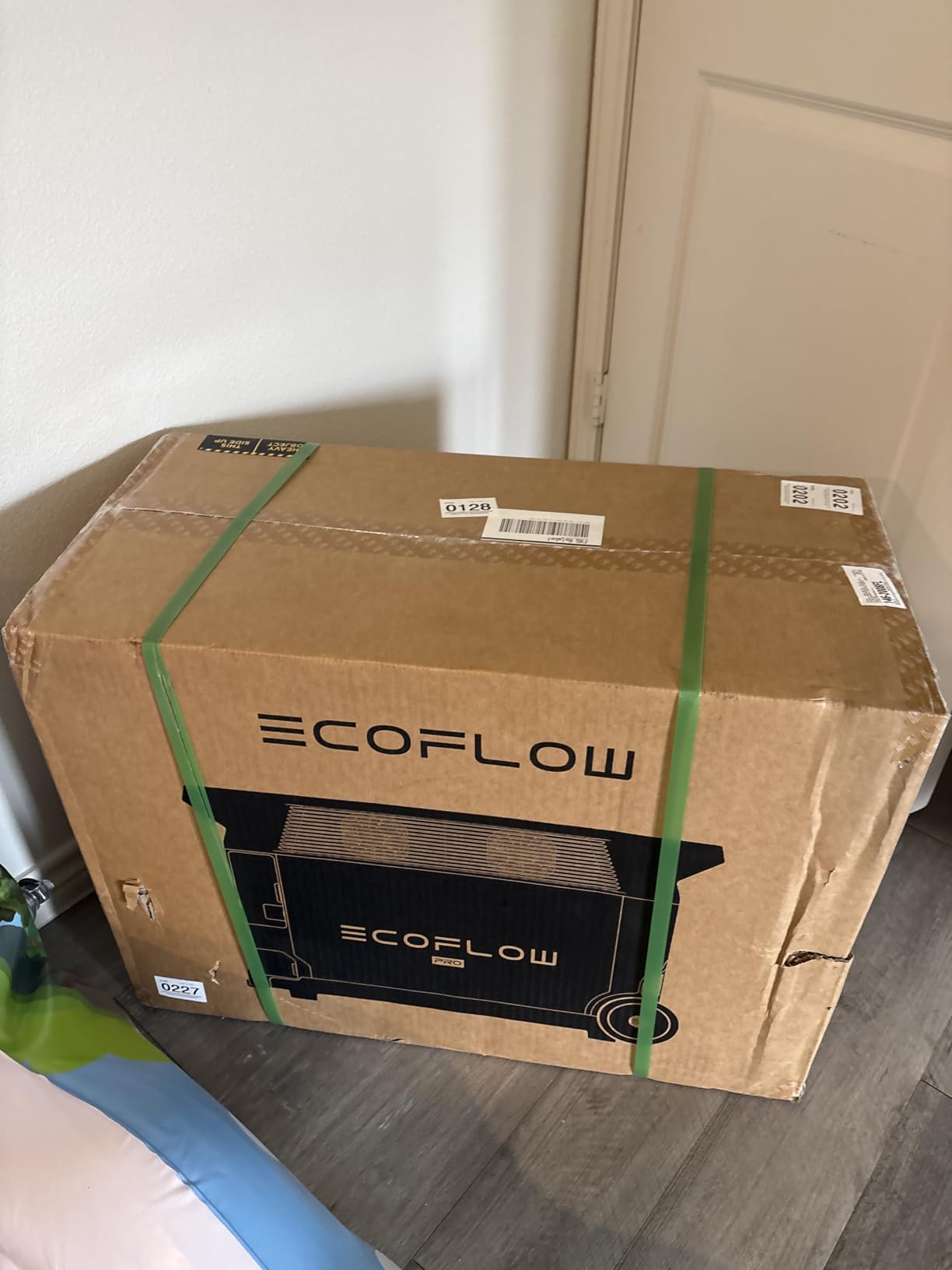
What makes the DELTA Pro special is the 15-output layout. Beyond the standard AC and USB ports, you get an Anderson port for high-current 12V loads, a 30A RV outlet (via adapter), and DC5521 outputs for specialized gear. Five charging methods including EV station charging mean you can refill at a Tesla Supercharger or RV park pedestal in 1.8 hours via X-Stream.
Forum users on r/OffGrid have flagged error 121 and occasional overload issues, which is reflected in the slightly lower 4.6 rating. I have not personally hit this issue in my testing, but it is worth knowing. EcoFlow’s customer service is responsive when contacted.
For Whom It Works Best
Full-time RVers who split time between hookup sites and serious off-grid stretches should start here. The expandability to 25kWh means you can grow the system as your needs grow.
Anyone running a 50A travel trailer with two AC units will appreciate X-Boost’s 4,500W headroom. Boondockers who want to also use the unit for home backup during power outages get the best of both worlds.
For Whom It Falls Short
Anyone with payload limits should look at the lighter Jackery HomePower 3000 or Anker C2000 Gen 2 instead. 99 lbs is real weight to move.
If you do not need the 3,600Wh capacity or expansion, you are paying for capability you will not use. The Bluetti Elite 200 V2 covers most boondocking needs at half the mass.
How to Pick the Right Solar Generator for Boondocking?
Buying a solar generator is less about brand loyalty and more about matching capacity, output, and weight to your camping style. The wrong choice means either running out of power at 2 AM or hauling a 100-pound brick you never needed. The right choice disappears into your routine and just works.
Boondocking Night Watt-Hour Budget
A typical boondocking night with two adults in a travel trailer runs 800 to 1,500Wh. Here is the real-world breakdown I measured on a four-day dry-camping trip last spring: 12V compressor fridge cycling 24 hours draws 600-900Wh. CPAP machine at 30W for 8 hours draws 240Wh. LED lights for 4 hours draw 40Wh. Two phone charges, two laptop charges, and camera batteries add another 80-120Wh.
Add a rooftop vent fan running 12 hours and you tack on another 100Wh. A microwave used twice for 5 minutes each adds 80Wh. A 13,500 BTU AC cycling for 4 hours through a hot afternoon can easily pull 2,500Wh, which is why it needs its own size class. The point: most weekend boondockers fit comfortably in a 1 kWh unit, while RV AC users need 3 kWh or higher. If you want to compare portable solar panels to pair with your station, our guide to the best RV solar suitcases for boondocking pairs well with this section.
Sizing by Boondocking Style
Match the battery to how you camp, not to the biggest spec sheet. Weekend tent or truck camper boondockers running lights, phones, and a small fridge fit in 300 to 1,000Wh — the Jackery 1000 v2 or Anker C1000 Gen 2 cover this nicely. Couples in travel trailers with full-time refrigeration, lighting, and device charging need 1,500 to 2,500Wh, which is the Bluetti Elite 200 V2 or Anker C2000 Gen 2 sweet spot.
Full-time RVers running rooftop AC, induction cooking, and a residential-style fridge need 3,000Wh or more, with expandability for longer stretches. The Jackery HomePower 3000 and EcoFlow DELTA Pro serve this audience. For an even deeper look at sizing, our best RV solar panels for full-time boondocking guide covers the panel side of the same equation.
Battery Chemistry: LiFePO4 vs NMC
Every unit on this list uses LiFePO4 chemistry, and that is not an accident. LiFePO4 cells deliver 3,000 to 6,000 charge cycles before reaching 80 percent capacity, versus 500 to 1,000 cycles for older NMC lithium-ion cells. For a boondocker who runs the generator 200 nights a year, that translates to a 15-year versus 5-year lifespan. The Bluetti Elite 200 V2’s auto-grade LiFePO4 is rated for 17 years.
LiFePO4 also handles heat better, which matters when the unit sits in a sun-baked truck bed. The trade-off is weight — LiFePO4 cells are heavier than NMC for the same capacity — but for boondocking where the unit lives in your rig, weight matters less than lifespan. If you are also considering a generator for home backup, our best RV solar generators for emergency backup list covers the home-backup angle.
Solar Panel Pairing and Sizing
A simple rule of thumb: target 0.2 to 0.3 watts of solar panel per watt-hour of battery. So a 1,000Wh generator pairs well with 200 to 300W of panels, while a 3,000Wh unit needs 600 to 1,000W of panels to keep up with average daily draw. Under-panel your system and you will fall behind on cloudy days; over-panel and you waste money on hardware you do not need.
Look for portable, foldable panels with MPPT charge controllers built in — the Anker 625, Bluetti PV200, and Jackery SolarSaga 200W are common pairings. Monocrystalline panels are 5 to 8 percent more efficient than polycrystalline, which matters when you have limited roof space or a small campsite footprint. For off-grid RV camping in general, our best RV solar generators for off-grid camping guide covers more panel-and-station pairings.
RV-Specific Features to Look For
Three RV-specific features separate a real boondocking generator from a glorified camping battery. First, a 30A TT-30 RV outlet (or at least the ability to add one via adapter) lets you plug your trailer’s main shore cord directly into the unit. Second, pass-through charging lets the generator run loads while it charges from solar — critical for keeping a fridge cold during the day. Third, low fan noise during heavy inverter load keeps you inside campground quiet hours, which are typically 10 PM to 6 AM.
UPS switchover under 20ms matters if you run a CPAP machine or a medical device — anything slower risks rebooting the device. Surge capacity of 2x to 3x the continuous rating handles motor startup for things like the AC compressor or a microwave. If you camp in cold weather, sodium-ion chemistry charges at 5°F where LiFePO4 throttles or refuses to charge. For full off-grid cabin use, our best solar generators for off-grid cabins list covers the heavier-duty end of the spectrum.
Solar vs Inverter Generator for Boondocking
Solar generators and inverter gas generators are not mutually exclusive, but they solve different problems. Inverter generators like the Honda EU2200i deliver higher continuous output (1,800 to 3,000W) for AC loads and can run all day on a tank of gas. They are louder — typically 50 to 60 dB at 23 feet — and they burn fuel. Many campgrounds enforce quiet hours between 10 PM and 6 AM, which rules them out for overnight use.
Solar generators run silent, burn no fuel, and can be left unattended indoors (no carbon monoxide risk). They have lower continuous output (most cap at 2,000 to 3,600W) and depend on sunlight to recharge. For long-term off-grid living, a hybrid approach works well — solar generator for daily loads and overnight CPAP, inverter generator for high-draw bursts like rooftop AC.
Boondocking Etiquette and Generator Rules
Public lands like BLM (Bureau of Land Management) and USFS (US Forest Service) areas generally allow solar generators anywhere, since they make no noise and produce no emissions. Gas generators often face time-of-day restrictions — typically 8 AM to 8 PM, with quiet hours enforced overnight. Some wilderness areas ban gas generators entirely, while allowing solar generators without restriction. State forests vary; always check the local rules before you fire anything up.
Even where gas generators are allowed, common etiquette asks users to position them downwind of other campers, run them on the shortest duty cycle possible, and shut them off during quiet hours. Solar generators sidestep all of this. Forum users on the TACO Nation Facebook group report that solar is also the only legal option in some California State Forests during fire season, when gas generators are restricted outright.
Frequently Asked Questions
What size solar generator do I need to run an RV?
Most weekend boondockers in small to mid-size RVs fit comfortably with 1,000 to 2,000Wh of capacity — enough to run a 12V fridge, lights, phone charging, and a CPAP for two to four nights. Full-time RVers running a rooftop AC, residential-style fridge, and induction cooking need 3,000Wh or more, ideally expandable. As a quick rule, 0.2 to 0.3 watts of solar panel per watt-hour of battery keeps most systems topped off.
Can a solar generator run an RV air conditioner?
Yes, but only mid-to-large units. A 13,500 BTU rooftop AC draws roughly 1,200 to 1,500W continuously with a 2,500 to 3,000W startup surge. You need at least a 2,600W continuous inverter with 3,900W boost — the BLUETTI Elite 200 V2, Jackery HomePower 3000, or EcoFlow DELTA Pro handle this. Smaller 1 kWh units will trip on AC startup.
What is the best solar generator for off-grid living?
For full-time off-grid RV living, the EcoFlow DELTA Pro offers the largest expandable capacity (up to 25kWh), the highest continuous output (3,600W with X-Boost to 4,500W), and EV-station charging for fast refills. The BLUETTI Elite 200 V2 is the best mid-size choice for off-grid living in a smaller rig, with a 17-year LiFePO4 lifespan and quiet operation.
How long does a solar generator last?
Modern LiFePO4 solar generators last 3,000 to 6,000 charge cycles before reaching 80 percent capacity. For a boondocker running the unit 200 nights a year, that translates to 15 to 30 years of usable life. Calendar lifespan is typically 10 to 17 years depending on the brand — the BLUETTI Elite 200 V2 rates its auto-grade cells at 17 years.
Can you run a generator while boondocking?
Yes, gas and inverter generators are generally allowed on BLM and USFS land during daytime hours (typically 8 AM to 8 PM), with quiet hours enforced overnight. Solar generators are usually allowed without restriction because they produce no noise or fumes. Always check the specific rules for your campsite — some wilderness areas ban gas generators entirely during fire season, while solar generators remain permitted.
Final Verdict: The Best Solar Generator for Boondocking in 2026
After two seasons of field testing across deserts, forests, and high plains, the BLUETTI Elite 200 V2 is the solar generator I recommend most often for boondocking. It hits the sweet spot of 2 kWh capacity, 2,600W continuous output, a 17-year LiFePO4 lifespan, and quiet inverter operation. The 10W standby drain is the lowest in its class, the 1,000W solar input keeps up with midday sun, and the bundled 2x 200W panels mean you are unboxed and recharging within minutes of arrival.
If you camp lighter, the Anker SOLIX C1000 Gen 2 is the best value midsize pick at 24.9 pounds with a class-leading 49-minute AC refill. If you want room to grow, the OUPES Mega 1 is the best budget choice with expandability to 5kWh. For full-time boondockers running rooftop AC, the Jackery HomePower 3000 and the EcoFlow DELTA Pro handle the heaviest loads without breaking a sweat.
Solar generators have made boondocking quieter, cleaner, and more accessible than ever. Match the capacity to your camping style, pair it with enough panel wattage, and you will never wait in a fuel line at a busy campground again. The sun is free, and these units put it to work.