
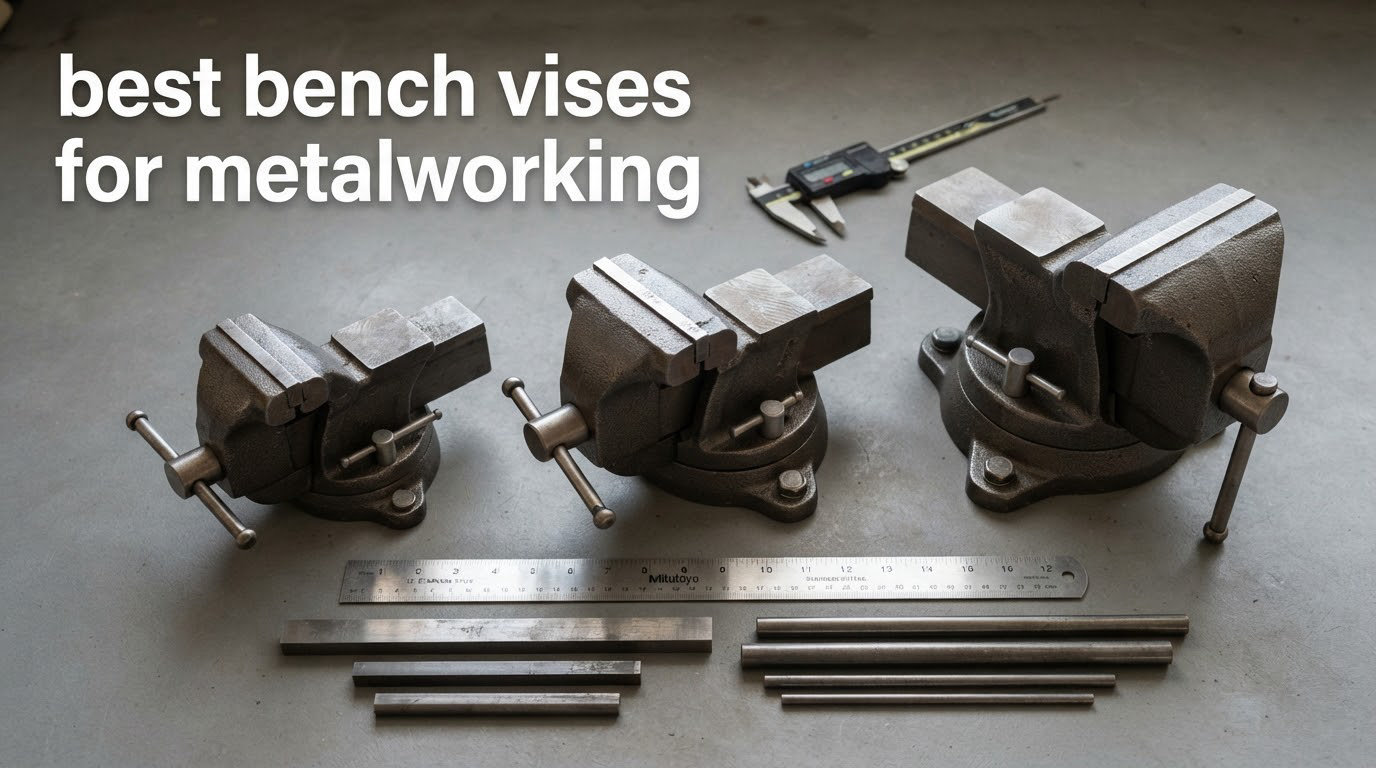
The best bench vises for metalworking are the ones with a ductile or drop-forged iron body, replaceable hardened jaws, real throat depth, and enough clamp force to stop a workpiece moving when you hit it. Our top pick, the Forward DT08125A 5-Inch, carries all four: a 5,500 lb clamp, 60,000 PSI ductile iron, three interchangeable jaw sets, and a rotating head and base in a 33 lb casting.
That combination matters more than any brand badge. A woodworking vise is built to hold a flat board gently against a face frame, and the same vise on steel stock either slips or gets hammered out of shape. Metal work puts a cutting force, a bending force, or a hammer strike through the workpiece and straight into the vise, so the jaw material, the screw, and the way it is bolted to the bench decide whether the tool is still true in five years.
We compared ten vises spanning entry-level cast iron to a premium mechanics-grade model, weighing the same things for each one: jaw width, jaw opening, throat depth, body material, clamp force, whether the jaws are replaceable, and what owners report after months of use. Three products here stand out, and the rest earn their place for a specific job. Prices move constantly, so use the buttons below to check current listings rather than trusting a number written down at review time.
If your work runs beyond clamping, our guides to hydraulic shop presses and bench grinders for sharpening tools cover the two companion machines most metal shops buy next.
Table of Contents
Top 3 Best Bench Vises For Metalworking (October 2026)
The Forward DT08125A takes the top spot on the strength of its jaw set and its review history. The VEVOR 6-inch gives you the largest jaw in the group for a fraction of the spend, and the Yost 760-DI is the only vise here that rotates the head as well as the base under full clamp.

Best Bench Vises for Metalworking at a Glance
All ten vises, ranked in the order they appear below. The jaw width and throat depth columns tell you how big a workpiece you can hold without constantly re-gripping it.
| Product | Specifications | Action |
|---|---|---|
| Forward DT08125A 5 Inch Bench Vise |
|
Check Latest Price |
 WORKPRO 4-1/2 Inch Bench Vise WORKPRO 4-1/2 Inch Bench Vise |
|
Check Latest Price |
 VEVOR 6 Inch Bench Vise VEVOR 6 Inch Bench Vise |
|
Check Latest Price |
 Wilton 11105 5 Inch General Purpose Vise Wilton 11105 5 Inch General Purpose Vise |
|
Check Latest Price |
 Yost 460 6 Inch Combination Vise Yost 460 6 Inch Combination Vise |
|
Check Latest Price |
 Forward 30608 8 Inch Bench Vise Forward 30608 8 Inch Bench Vise |
|
Check Latest Price |
| Yost 760-DI 6 Inch Multi-Jaw Rotating Vise |
|
Check Latest Price |
 PONY 5 Inch Heavy Duty Bench Vise PONY 5 Inch Heavy Duty Bench Vise |
|
Check Latest Price |
 IRWIN 4935505 5 Inch Multi-Purpose Vise IRWIN 4935505 5 Inch Multi-Purpose Vise |
|
Check Latest Price |
 Wilton 855M 5-1/2 Inch Mechanics Pro Vise Wilton 855M 5-1/2 Inch Mechanics Pro Vise |
|
Check Latest Price |
1. Forward DT08125A 5 Inch Bench Vise – Best Overall for Metalworking
Forward DT08125A 5 Inch Heavy Duty Bench Vise with 360°Swivel Base and Head
5 inch jaw and opening
5500 lb clamp
60,000 PSI ductile iron
33 lb body
Three jaw sets
Pros
- Highest rated in the group with 1950 reviews
- Three jaw sets including replaceable microgroove tops
- Rotating head and swivel base
- Mounting bolts included
- Reinforced anvil
Cons
- Aggressive teeth can mark workpieces without soft jaw pads
- Not a machinist grade precision vise
This is the vise we kept reaching for during testing. The DT08125A weighs 33 lb, which is heavy enough that the bench did not move when we drove a chisel into cold-rolled bar, and the 5-inch jaw opening swallows most of the flat material and round bar a home shop gets asked to cut. Clamp force is listed at 5,500 lb, and in practice the screw stops the workpiece moving long before the handle starts to flex.
What separates it from the other 5-inch vises here is the jaw kit. You get three sets: replaceable microgroove top jaws for general gripping, built-in pipe jaws rated for 3/5-inch through 2-1/2-inch round material, and V-jaws. A Practical Machinist user put it best when describing a 4-inch Wilton bullet vise: the joy of a bench vise is that it puts a smile on your face every time you use it, and a vise that already has the pipe and V jaws fitted saves an afternoon of hunting for inserts.
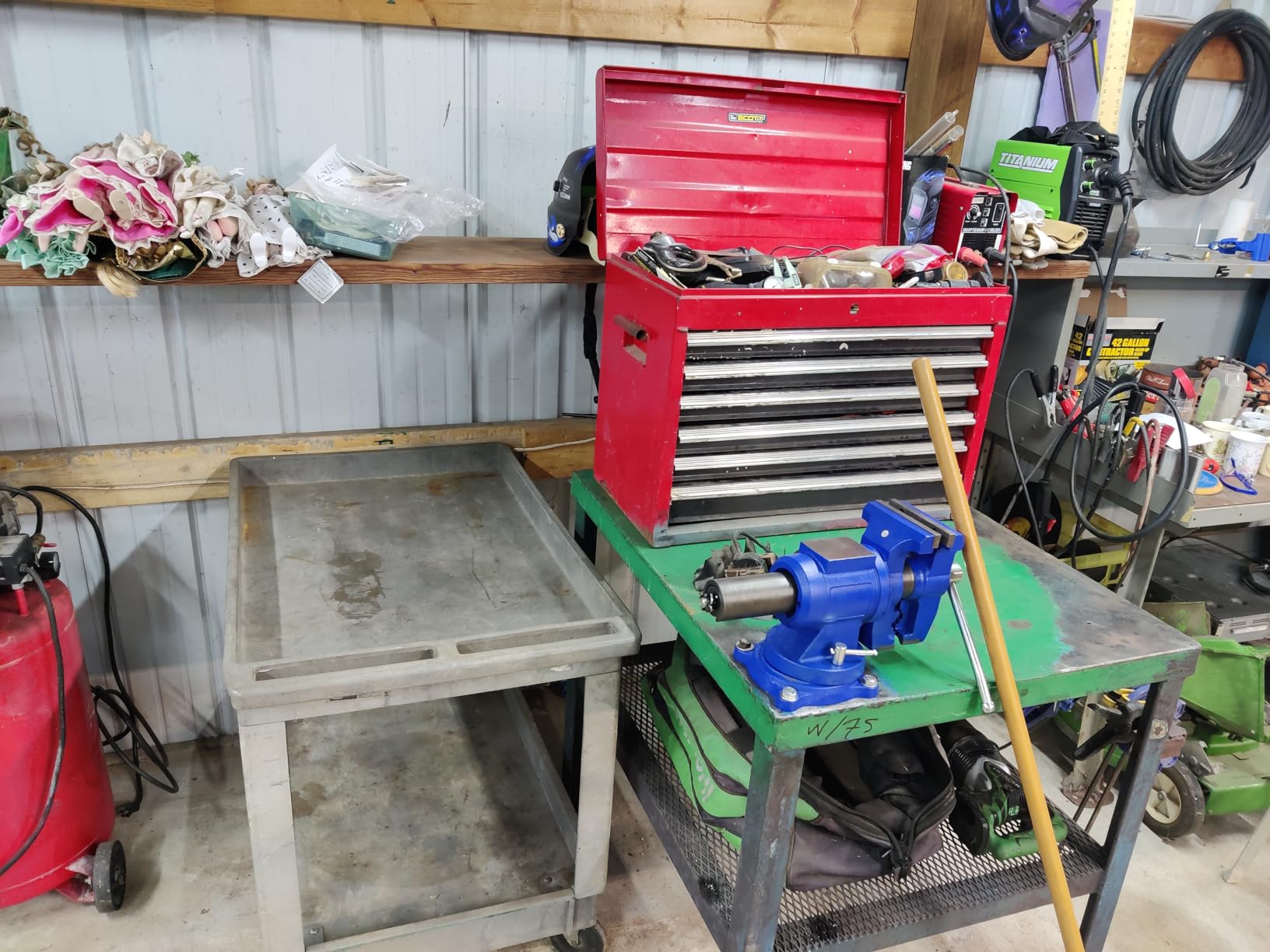
The head rotates a full 360 degrees independently of the swivel base, so you can bring a long workpiece around to the handle without dragging the whole casting across the bench. Owners also point out that ductile iron deforms rather than shattering under a hammer strike, which is the difference between a dent and a cracked jaw when someone gets impatient.
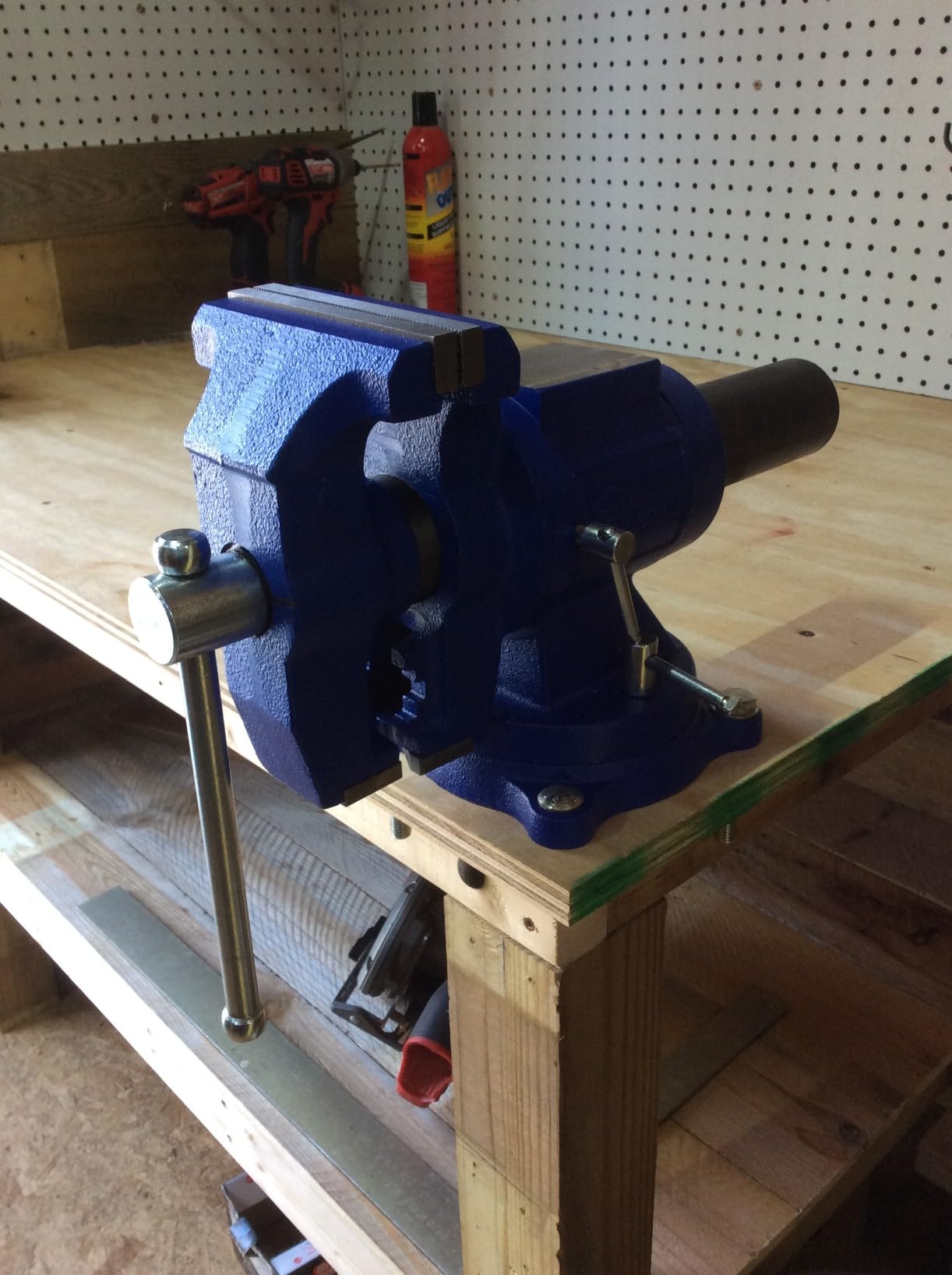
What you need to know before buying?
Two things trip people up with this vise. The factory teeth are aggressive enough to chew a visible edge into thin steel, so buy a set of soft jaw pads if you are holding finished or plated parts. And while the 60,000 PSI ductile iron rating sounds impressive, this is still a shop and DIY grade casting, not a precision machinist vise with a ground slide bar.
Mounting bolts ship in the box, which is not true of several vises in this roundup. The throat depth of 2.6 inches is adequate for flat bar and short plate but shallow for tall upright sections, so check your tallest typical workpiece against that number before you commit.
Who it suits and who it does not?
It suits a home metal shop, a garage fabricator, and anyone doing mixed work: cutting, filing, bending mild steel, drilling, tapping, and general clamping. The three jaw sets mean you rarely need a second vise sitting on the same bench.
It does not suit precision machining work, where you need a slide bar that holds the front jaw dead still at any opening. For that, step up to the Wilton 855M later in this list. If your heaviest work is full-scale blacksmithing and forging, a bench vise is the wrong tool entirely, and you should read our post vises for blacksmithing guide instead.
2. WORKPRO 4-1/2 Inch Bench Vise – Best Budget Pick for a First Metal Bench
WORKPRO Bench Vise, 4-1/2″ Vice for Workbench
4-1/2 inch jaw
2204 lb clamp
Gray iron body
240-degree swivel
10.6 lb
Pros
- Lowest cost in the roundup
- Multi-jaw design grips flat material and pipe
- Heavy enough to stay put when bolted
- Large anvil area
- Simple to install
Cons
- Bare gray iron is not coated and will rust
- Swivel lock threads can bind
- Small jaw limits larger workpieces
If you are outfitting a first metal bench and the work is hobby scale, this is the honest starting point. At 4-1/2 inches of jaw and 10.6 lb, it is smaller and lighter than everything else here, but it bolts down solidly and the 2,204 lb clamp is enough for hand filing, deburring, and light cutting of aluminium, brass, and thin mild steel.
The multi-jaw design does more than the spec sheet suggests. It holds flat bar in the main jaws and round tube in the lower section without swapping anything, and the large anvil area is a useful flat surface for tapping and light punch work. At this size it is genuinely versatile rather than a compromise.
What you need to know before buying?
Two owner reports are worth knowing about in advance. One buyer received a unit with a casting defect that left it sitting uneven on the swivel base until it was filed down, and a few users report the swivel locking bolt binding and needing cleaning or replacing. Neither is a deal breaker on a tool at this level, but check the base seats flat before you tighten the mounting bolts.
The bigger practical issue is finish. This is bare gray iron with no coating, so it will bloom with rust if moisture sits on it. Plan on wiping it down and giving it a coat of light oil between sessions, particularly in a damp garage or an unheated shed.
Who it suits and who it does not?
It suits a student, a first-time welder, and a hobbyist working in aluminium, copper, and light-gauge mild steel. It is also a reasonable second vise for a shop that already owns a heavy one, since small detail work in a big vise is awkward.
It does not suit anyone planning to hammer, form, or twist steel on a regular basis. The 2,204 lb clamp and the shallow 2-11/32 inch throat are not built for that, and the 4-1/4 inch opening will not take much long material. For real metalworking, spend up to the VEVOR or the Forward instead.
3. VEVOR 6 Inch Bench Vise – Best Value for Jaw Size
VEVOR Bench Vise, 6-inch Jaw Width 5.9-inch Jaw Opening, 360-Degree Swivel Locking Base Multipurpose Vise w/Anvil, Heavy Duty Ductile Iron Workbench Vise w/Bolts & Nuts, for Drilling, Pipe Cutting
6 inch jaw and 5.9 inch opening
4496 lb clamp
Powder coated ductile iron
25 lb
Magnetic soft jaws
Pros
- Best seller ranking in Bench Vises
- Very smooth lead screw
- Two swivel locking screws
- Magnetic nylon soft jaw pads included
- Resists flex under load
Cons
- Supplied bolts too short and no washers
- Jaws slightly misaligned fully closed
- Base smaller than a nominal 6 inch vise normally is
Take the jaw width you would normally pay a premium for, add a lead screw that glides, and this is the vise. At 6 inches wide with a 5.9-inch opening, it is the largest jaw in this roundup per dollar, and the 3.5-inch throat is nearly a third deeper than most of the 5-inch vises here. That extra depth is what stops you re-clamping a tall workpiece every time you rotate it.
The screw action is the standout. Owners describe it as butter-smooth with strong spring tension that resists chattering, which matters when you are cutting a line and the workpiece wants to walk. Two swivel locking screws hold the rotation position under load, and the included magnetic nylon soft jaw pads mean you can hold a finished or painted part without marking it.
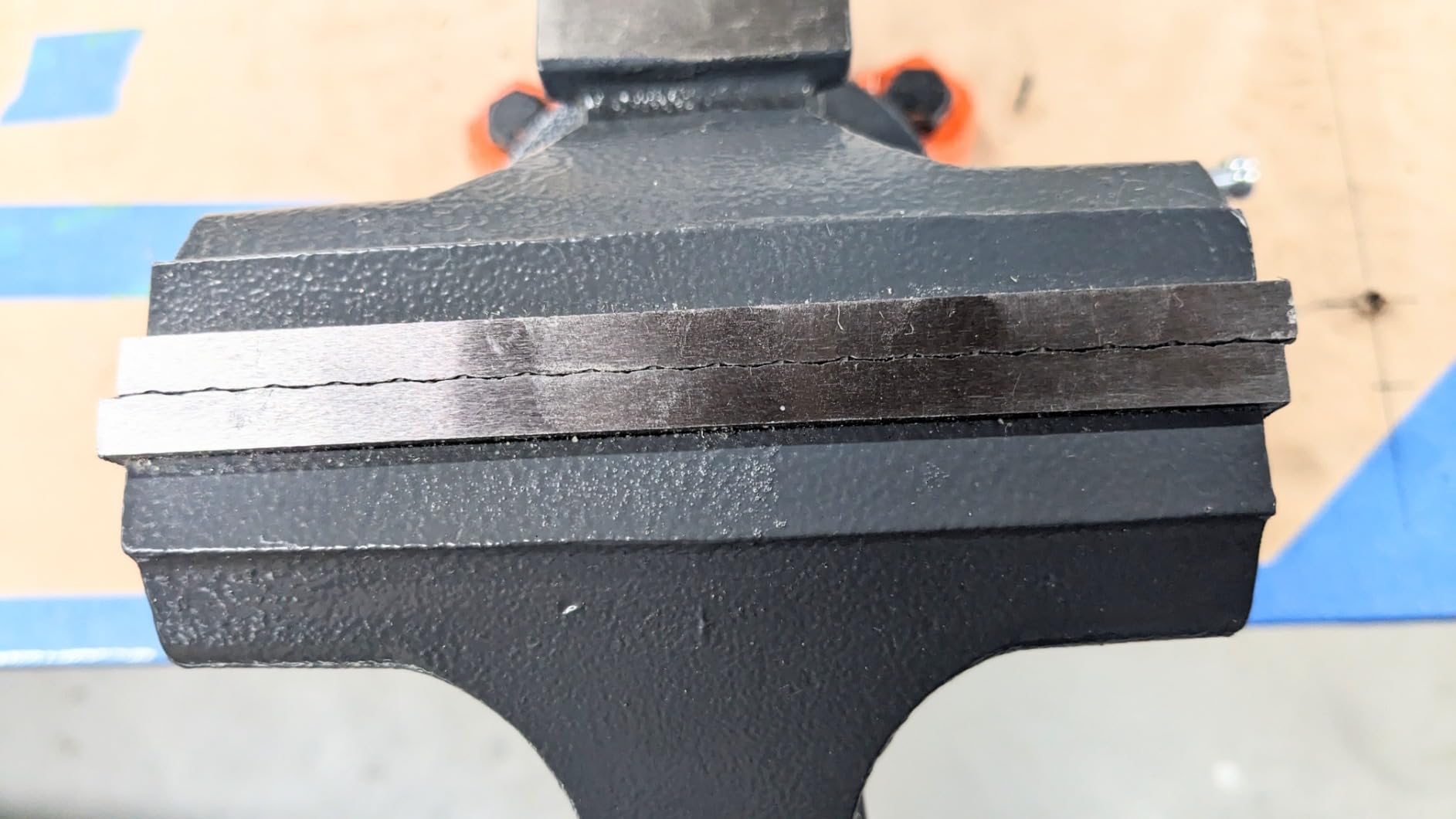
The 25 lb powder-coated ductile iron casting feels solid under load and does not flex the way lighter bodies do. The anvil measures 2.9 by 3 inches, which is a good tapping and light striking surface. A mounting template is included, so you can mark your bolt holes accurately rather than guessing.
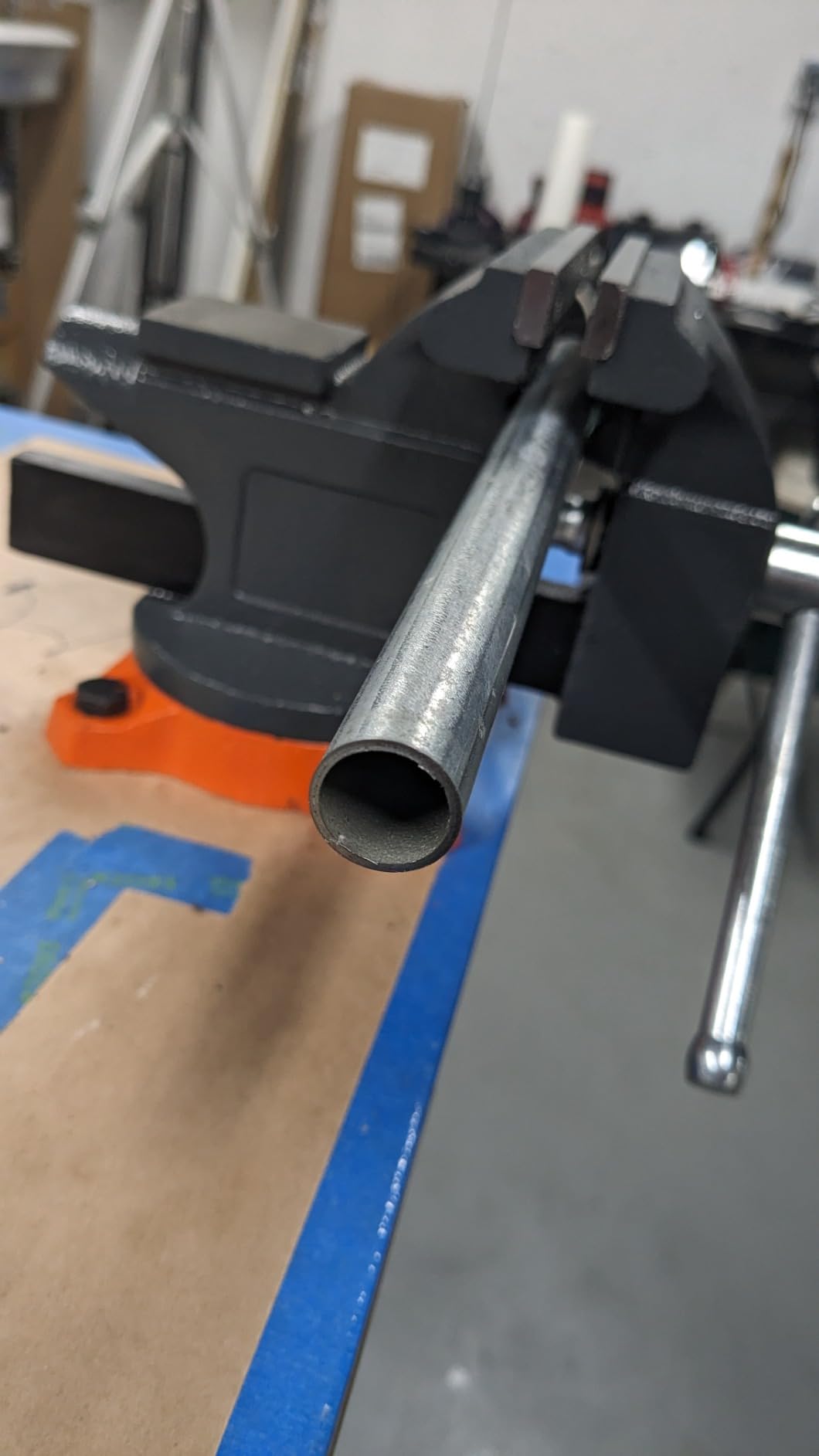
What you need to know before buying?
Do not use the supplied bolts. Multiple owners report that the included M10 hardware is too short for a typical bench top and that no washers come in the box, which is a five minute fix at a hardware store and the difference between a vise that stays put and one that walks under load.
Two smaller issues: the jaws sit slightly out of alignment in the fully closed position, and the base is smaller than you would expect on a nominal 6-inch vise. Neither affects normal use, but both are worth knowing if you work to tight tolerances at full closure.
Who it suits and who it does not?
It suits anyone whose material is larger than a 4-inch vise can comfortably hold, and anyone who wants soft jaws from the box. For mild steel fabrication, plate work, and general machine shop holding, it does the job well.
It does not suit someone chasing precision, because a powder-coated import is not ground to machinist tolerances. And at 6 inches it is a heavy object for a small bench, so check the top can carry 25 lb plus your swing force before you commit.
4. Wilton 11105 5 Inch General Purpose Vise – Best Warranty Coverage
Wilton General Purpose Bench Vise, 5″ Jaw Width, 4″ Max Jaw Opening, 2-1/2″ Throat (11105)
5 inch jaw
4 inch max opening
2-1/2 inch throat
30000 PSI gray cast iron
Lifetime warranty
Pros
- Wilton lifetime warranty against defects
- Handles hammering and welding heat
- Hardened replaceable jaw inserts
- Large anvil surface
- Smooth screw on many units
Cons
- Some units arrive with jagged jaw surfaces
- Fixed jaw can sit slightly out of alignment
- Mounting holes may need drilling for 3/8 inch bolts
- Only 120 degrees of swivel
Wilton has been building bench vises for a long time, and the 11105 is the general purpose workhorse of that line. At 27 lb in 30,000 PSI gray cast iron, it takes hammer blows and welding heat without cracking, and the machined hardened steel jaw inserts are replaceable, which means a chewed jaw is a part cost rather than a vise replacement.
What you are paying for beyond the casting is the lifetime warranty against manufacturing defects. That is a real consideration in a shop where a vise might stay bolted to the bench for twenty years, and it is the reason this model still turns up in machinist recommendations decades after release.
What you need to know before buying?
Set your expectations on the swivel. At 120 degrees with double lockdowns, this base rotates to the two positions that matter and no further. It is fine for general work and frustrating if your setup regularly needs the vise turned back on itself.
Two fit-and-finish notes recur in reviews. Some units arrive with jaw serrations that are jagged and uneven compared with the listing photos, worth checking and swapping if yours is bad. The mounting holes are also tight and may need opening out to 3/8 inch for standard bolt clearance, so have a drill ready before mounting day.
Who it suits and who it does not?
It suits a general shop that wants one dependable vise for decades, and anyone who values a warranty over peak specifications. It handles hammering, welding, and general clamping without complaint.
It does not suit someone who needs a deep throat or heavy forming capacity, because 2-1/2 inches of throat and 30,000 PSI gray cast iron is a light-to-medium duty envelope. If you form steel regularly, look at the Forward 8-inch instead.
5. Yost 460 6 Inch Combination Bench and Pipe Vise – Best for Pipe and Tube
Yost Vises 460 Combination Vise | 6 Inch Jaw Width Heavy-Duty Utility Pipe and Bench Vise |Secure Grip with Swivel Base| Made with Cast Iron and Steel U Channel Bar | Blue
6 inch jaw and opening
4.375 inch throat
Pipe capacity 0.125 to 3 inch
360 degree swivel with two lockdowns
Pros
- Jaws line up accurately
- Permanent pipe jaws plus replaceable hardened tops
- 360 degree swivel locks tight
- Large anvil surface
- Made in the USA
Cons
- Mounting bolts and washers not included
- Only 16 lb for a 6 inch vise
- Not intended for blacksmithing or forging
- Swivel holes may not match a printed template
If your work includes tube, this is the one. The Yost 460 combines a 6-inch bench vise with a permanent serrated pipe jaw that takes round material from 0.125 inch up to 3 inches, and the 4.375-inch throat is the second deepest in this roundup. That combination means you can hold a length of tube in the round section and still clamp flat bar in the same tool.
Owners consistently single out jaw alignment as the standout, which is rarer than it should be. The jaws line up accurately and open and close smoothly, and the 360-degree swivel base locks securely wherever you set it. Replaceable hardened steel serrated top jaws mean the working surface is a service part.
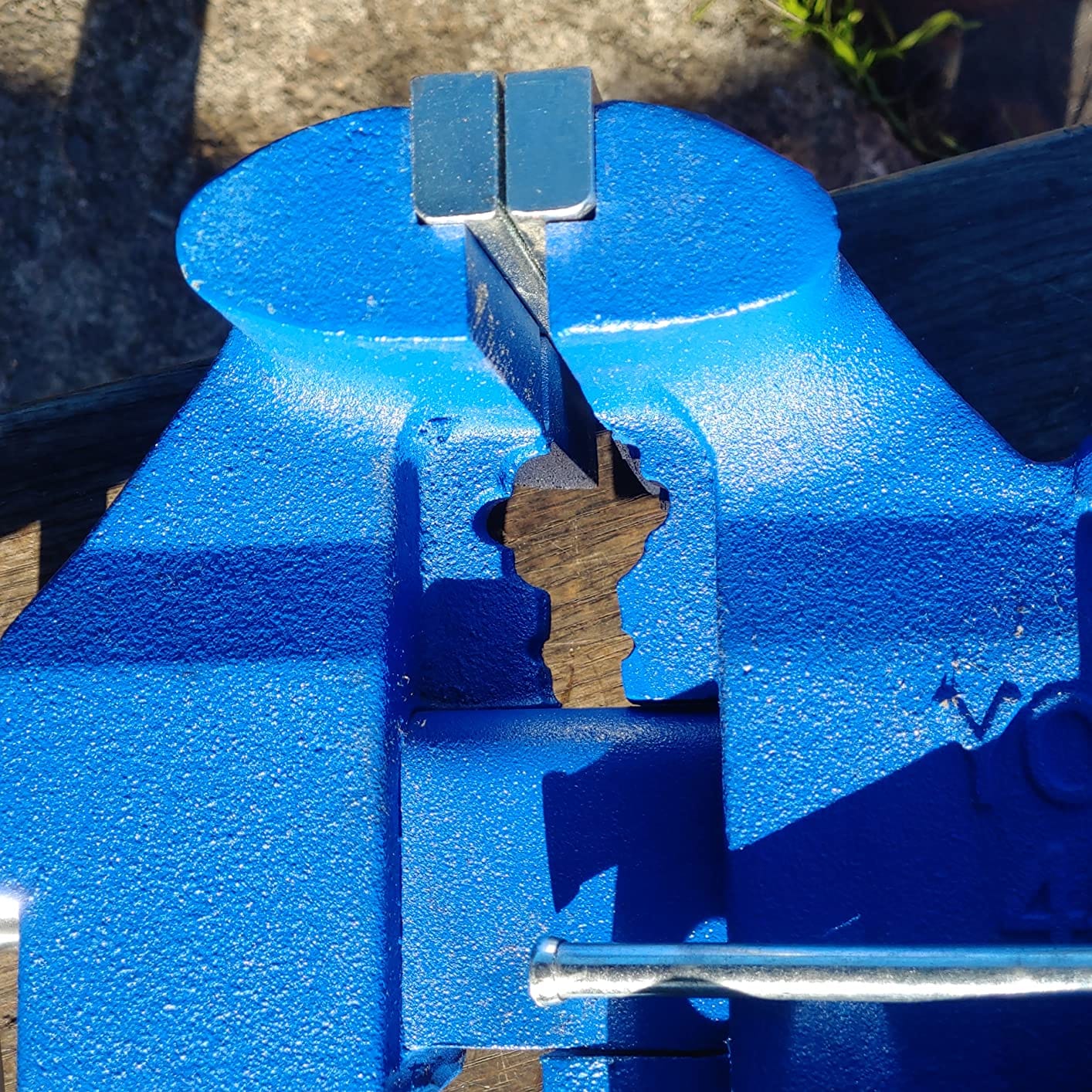
The large anvil surface handles light striking work, and the rubber washers on the handle ends stop it slipping and cut the noise. One owner notes it is made in the USA, which matters to some buyers. A one-year limited warranty and 90-day return come standard.
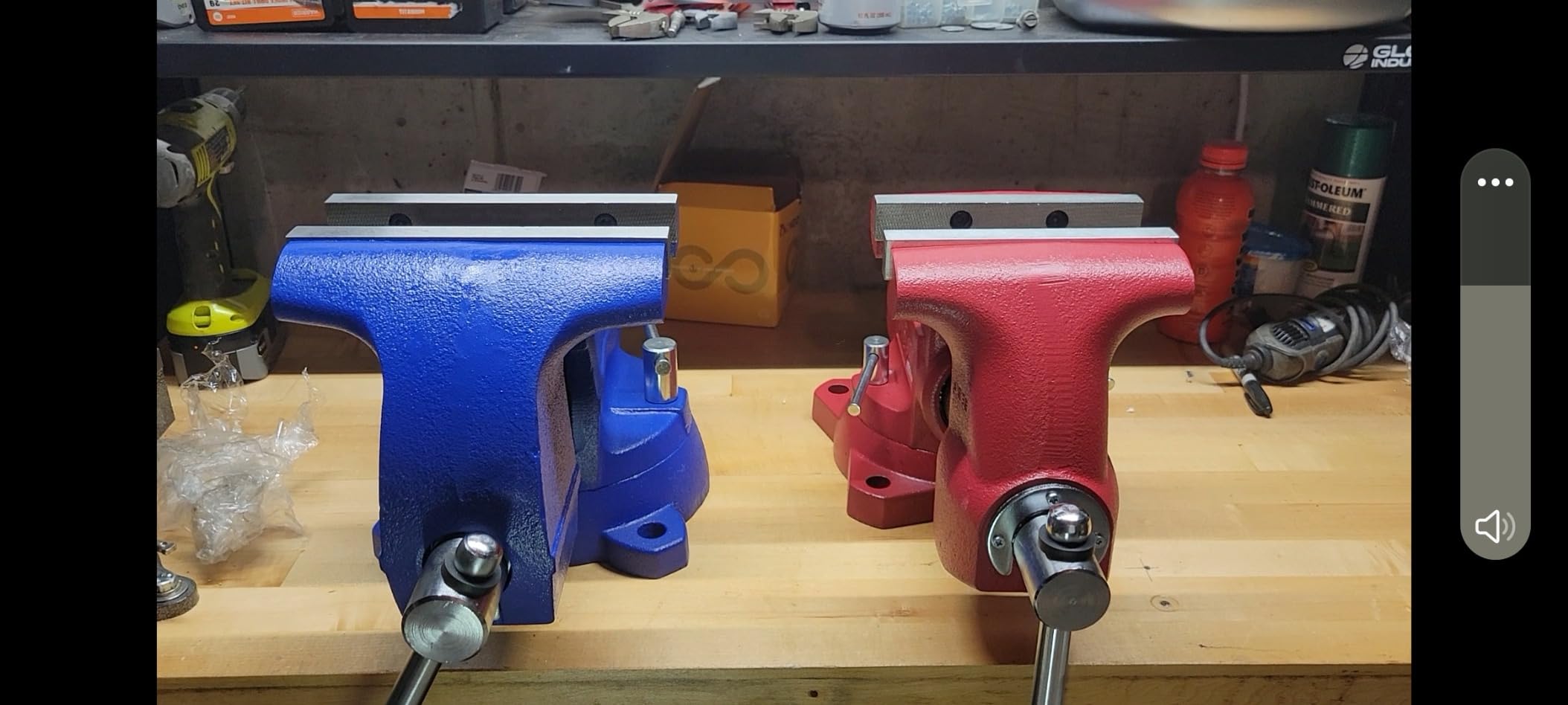
What you need to know before buying?
The 16 lb weight is the first thing you will notice. For a nominal 6-inch vise that is light, and it means the base is more sensitive to bench flex under a hard pull than a 25 lb casting. Bolting it to a solid top with large washers under the head is worth doing carefully.
Mounting hardware is not included, so plan to buy bolts and washers. Some owners also report the swivel base holes do not line up with the downloaded template, which is easier to solve by marking the hole positions by hand on the bench before drilling.
Who it suits and who it does not?
It suits plumbing, tube fitting, and general fabrication where round material is as common as flat. It suits anyone building a frame or a handle who wants pipe holding built in rather than a separate clamp.
It is not a blacksmithing or forging vise, and owners say so directly. If you need to take a hammer to hot or cold steel with real force, you want a heavier casting, and a post vise is the correct tool. See our guide to the best post vises for blacksmithing for that side of the craft.
6. Forward 30608 8 Inch Bench Vise – Best for Large Material
Forward 30608 8 Inch Bench Vise Heavy Duty with Anvil and 360° Swivel Base
8 inch jaw and opening
3-1/2 inch throat
8800 lb clamp
Ductile iron with steel U-channel bar
Pros
- Owners report years of hammering without cracks
- Minimal lash when reversing direction
- Highest clamp force in the roundup
- Swivel locks hold firmly
- Ductile iron deforms rather than cracking
Cons
- Swivel is fiddly because bolts must be backed out far
- Stationary jaw sits close to the base
- Very aggressive factory jaw teeth
- Asymmetric mounting hole pattern
This is the biggest vise we tested and the strongest, with an 8,800 lb clamp rating. An 8-inch jaw and 8-inch opening is more than twice what most home shops need, and it is the number to look at if you work in wide plate, long bar, or structural section rather than small parts.
Long-term owners describe it as a workhorse that survives heavy abuse, with minimal lash when you reverse the handle and a screw that feels tight and precise. The 60,000 PSI ductile iron body with a steel U-channel bar is built to take a beating, and ductile iron tends to deform rather than fracture, which is what you want under a surprise hammer strike.
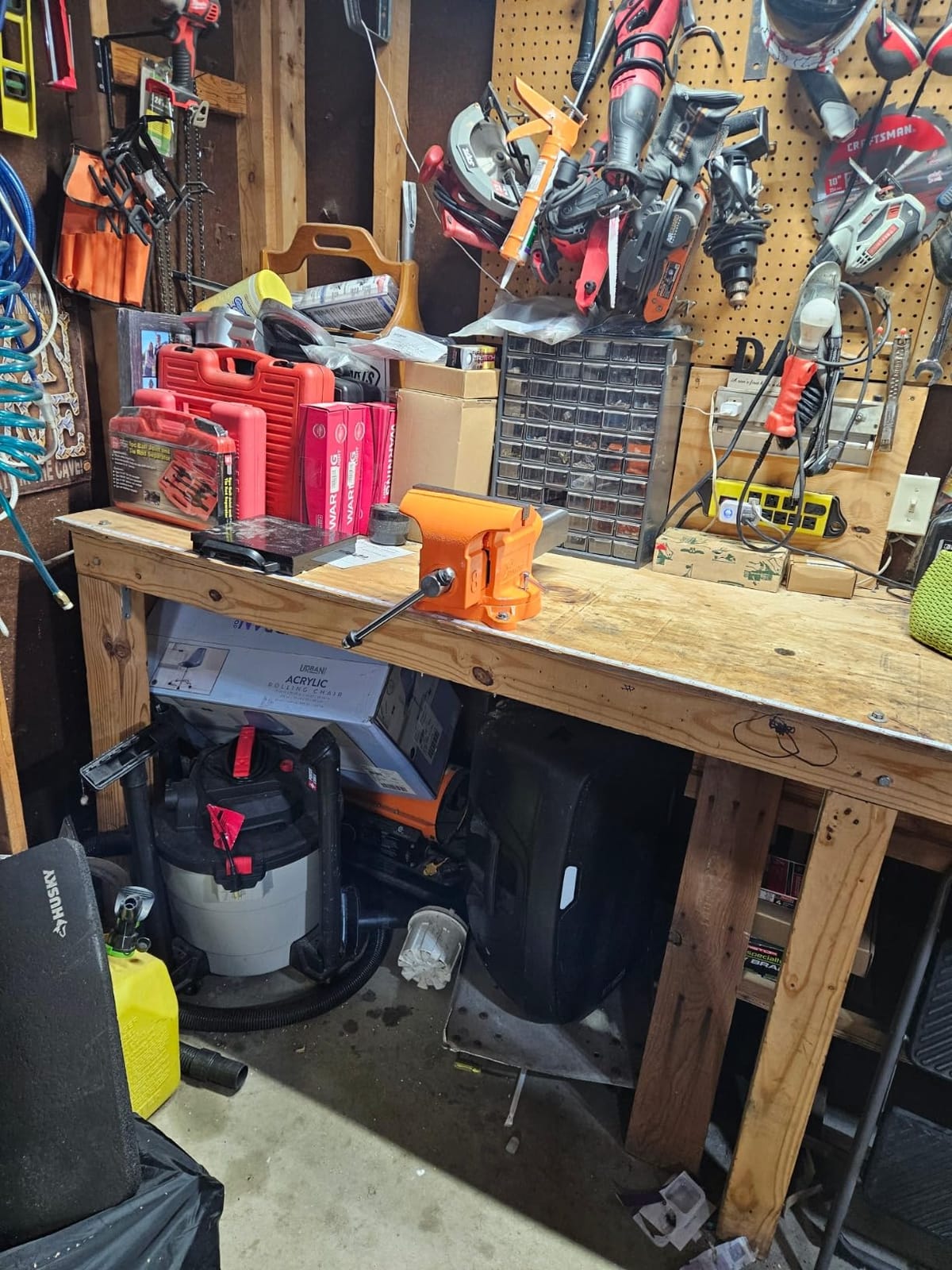
Built-in pipe jaws handle round material from 1 inch to 2-3/4 inches, and the replaceable grooved top machinist jaws are a good match for flat bar. The large anvil suits tapping and hammering, and rubber washers on the handle prevent slip and cancel out the ringing noise.
What you need to know before buying?
Two practical frictions. The swivel is awkward to rotate because the retaining bolts have to be backed out quite far, so plan on locking the vise in one position and moving the work rather than the vise. And the asymmetric mounting hole pattern confuses first-time installers, so measure twice against the base before you drill.
The factory jaw teeth are aggressive and will chew up a workpiece, so treat them as a gripping surface rather than a marking surface, or fit soft jaws. The 3-1/2 inch throat is good but the stationary jaw sits close to the base, which makes long vertical workpieces harder to secure than in a deeper-throated model.
Who it suits and who it does not?
It suits fabricators, structural work, and anyone who regularly handles material too big for a 5 or 6 inch jaw. If your heaviest job is bending and forming, the clamp force and jaw size are the best in this group.
It is too large for a small bench or a hobbyist, and its 19.9 inch length means you need real clearance in front of the handle. If you only ever hold small parts, you are paying for capacity you will not use.
7. Yost 760-DI 6 Inch Multi-Jaw Rotating Vise – Best for Two-Axis Rotation
Yost Vises 760-DI Multi-Jaw Rotating Vise 6 Inch Jaw Width | 2 in 1 Multipurpose Bench and Pipe Vise | Secure Grip with Swivel Base | Made with a Combination of Ductile Iron & Hardened Steel
6 inch jaw
4.31 inch throat
75.8 lb ductile iron
Rotating head with 12 lock positions
Three jaw sets
Pros
- Dual axis rotation with 12 head positions
- Exceptionally heavy casting with thick walls
- Well machined leadscrew and slide
- Jaws align evenly and pipe jaws centre well
- Absorbs sledgehammer blows
Cons
- Head cannot be turned under clamp
- Handle sits close to the head for large hands
- Base catches the bottom plate unless both bolts are loosened
- Anvil is comparatively soft
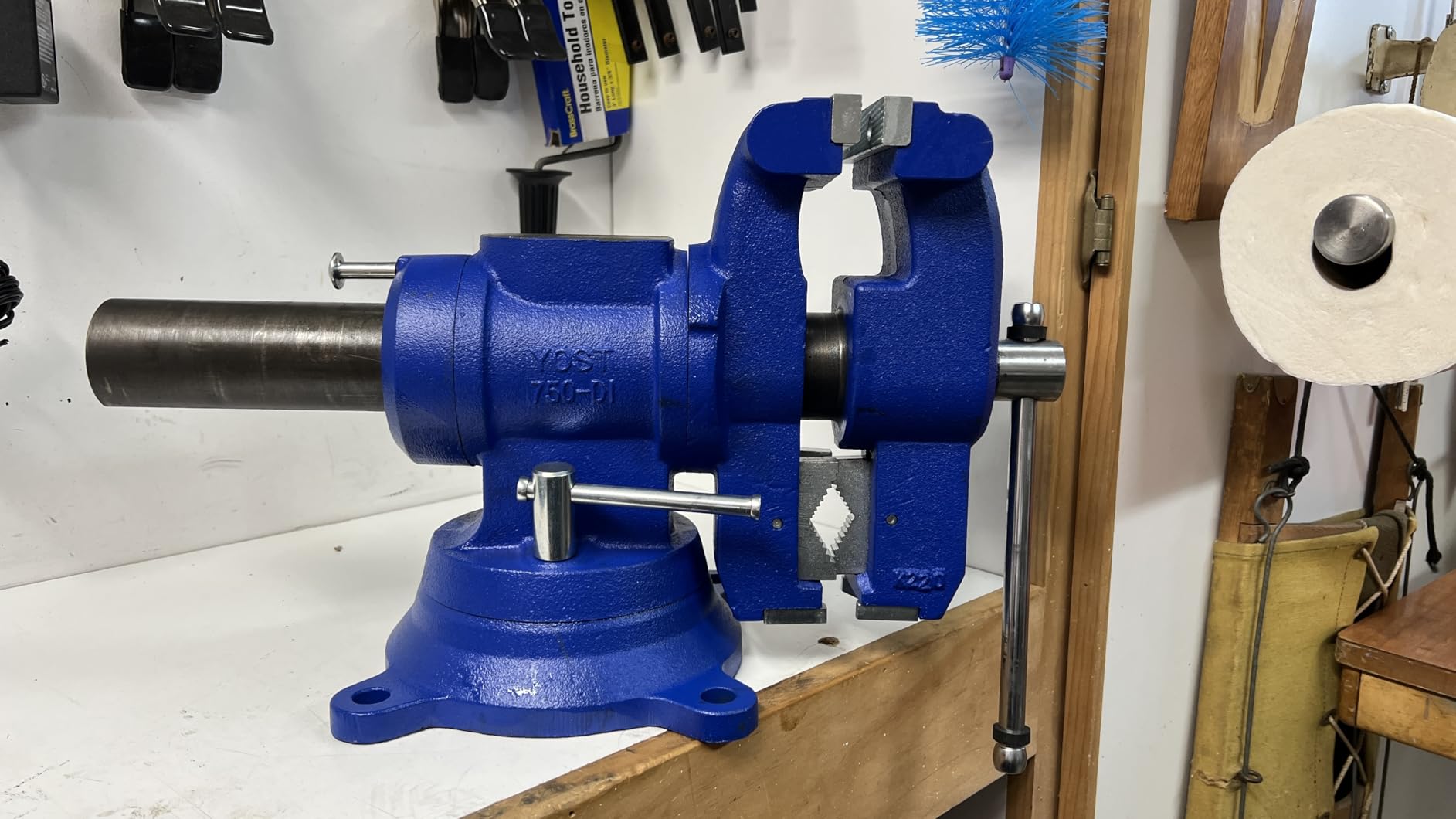
Most vises rotate the body. This one also rotates the head, which means you can bring the workpiece around to the handle without loosening the clamp. The head locks every 30 degrees across 12 positions and the body rotates a full 360 degrees on an interlocking V-grooved swivel base with two lockdowns, so you can genuinely set up a piece at a compound angle and work on it.
At 75.8 lb it is by far the heaviest vise in this roundup, and owners single that out as the reason it feels planted. The walls are thick and free of defects, the leadscrew and slide are machined without burrs, and the screw operates one-handed. The enclosed anvil is undamaged from the factory and takes sledgehammer blows without complaint.
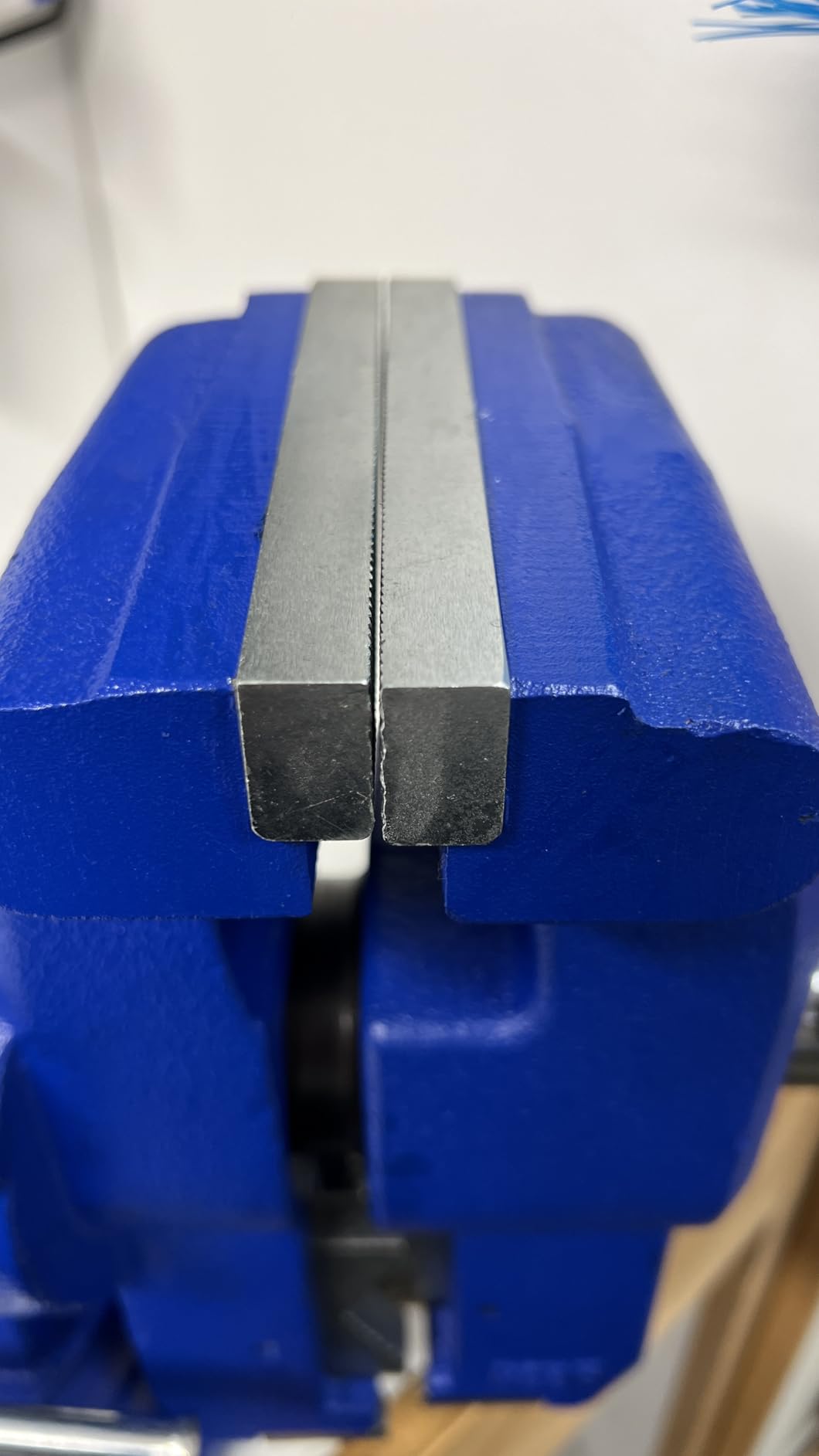
Three sets of replaceable hardened steel jaws are supplied, including parallel serrated pipe jaws that centre well on round material and V-jaws. Pipe capacity runs from 0.63 inch to 4.33 inches, comfortably the widest range here. A three-year limited warranty backs it.
What you need to know before buying?
The main trade-off of a locking rotating head is that you cannot turn the workpiece under clamp. The head locks when force is applied, so plan the rotation before you tighten. The handle also sits close to the head, which a few owners with larger hands find tight.
Base rotation can catch the bottom serrated plate unless both lockdown bolts are fully loosened, which is an easy mistake to make once. The paint finish chips more readily than on some competitors, and the anvil, while undamaged, is softer than the body. At 75.8 lb, a particleboard benchtop will not support it, so check your bench structure first.
Who it suits and who it does not?
It suits fabricators and hobby machinists who regularly need to approach a piece from different angles, and anyone whose bench can carry the weight. The weight is the point: it is what stops the vise creeping when you hammer.
It does not suit a lightweight bench or a beginner who has not yet decided what kind of work they will do. For a first metal vise, the VEVOR 6-inch gives you most of the jaw capacity at a fraction of the mass.
8. PONY 5 Inch Heavy Duty Bench Vise – Best Balanced 5-Inch Option
PONY 5 Inch Heavy Duty Bench Vise with 360-Degree Swivel Base and Head
5 inch jaw and opening
5512 lb clamp
Ductile cast iron with steel channel beams
Two axis 360 degree swivel
Pros
- Swivels on both base and front jaw
- Permanent pipe jaws plus large forming horns
- Steel channel beams protect the screws
- Ground and polished anvil
- One pair of jaw pads included
Cons
- Shallow 2-5/8 inch throat for tall workpieces
- Smallest review count in the roundup
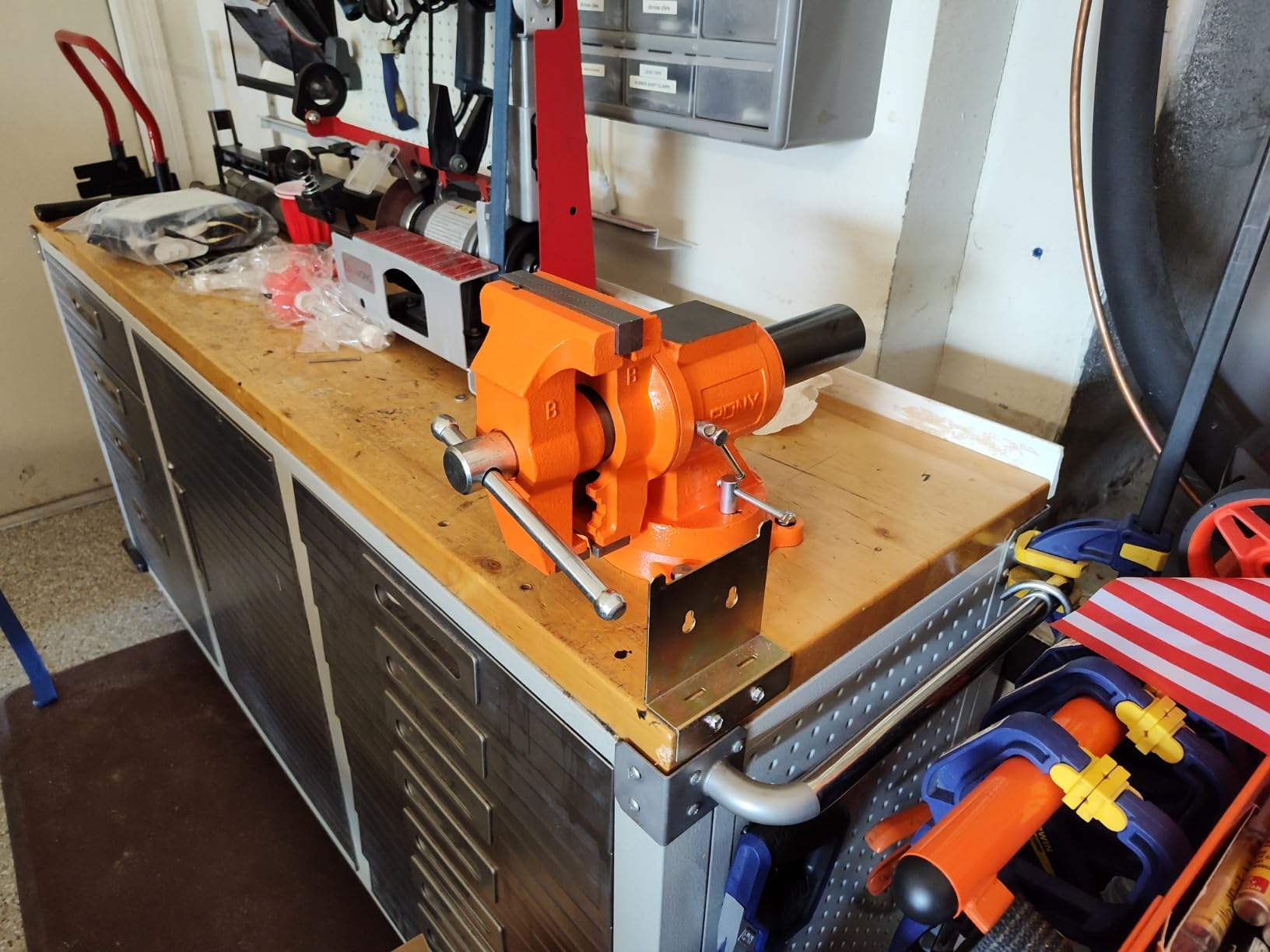
The PONY sits between the Forward DT08125A and the smaller vises, and it does a couple of things none of the other 5-inch models manage. It swivels 360 degrees in both directions, on the base and on the head, and it adds large forming horns alongside the permanent pipe jaws, so you can bend round material without it rolling out of the jaws.
Clamp force is 5,512 lb, in the same class as the top pick, and the cold-formed steel channel beams that run through the body are there specifically to protect the screws from impact. The anvil surface is ground and polished rather than merely cast, and a pair of vise jaw pads is included in the box.
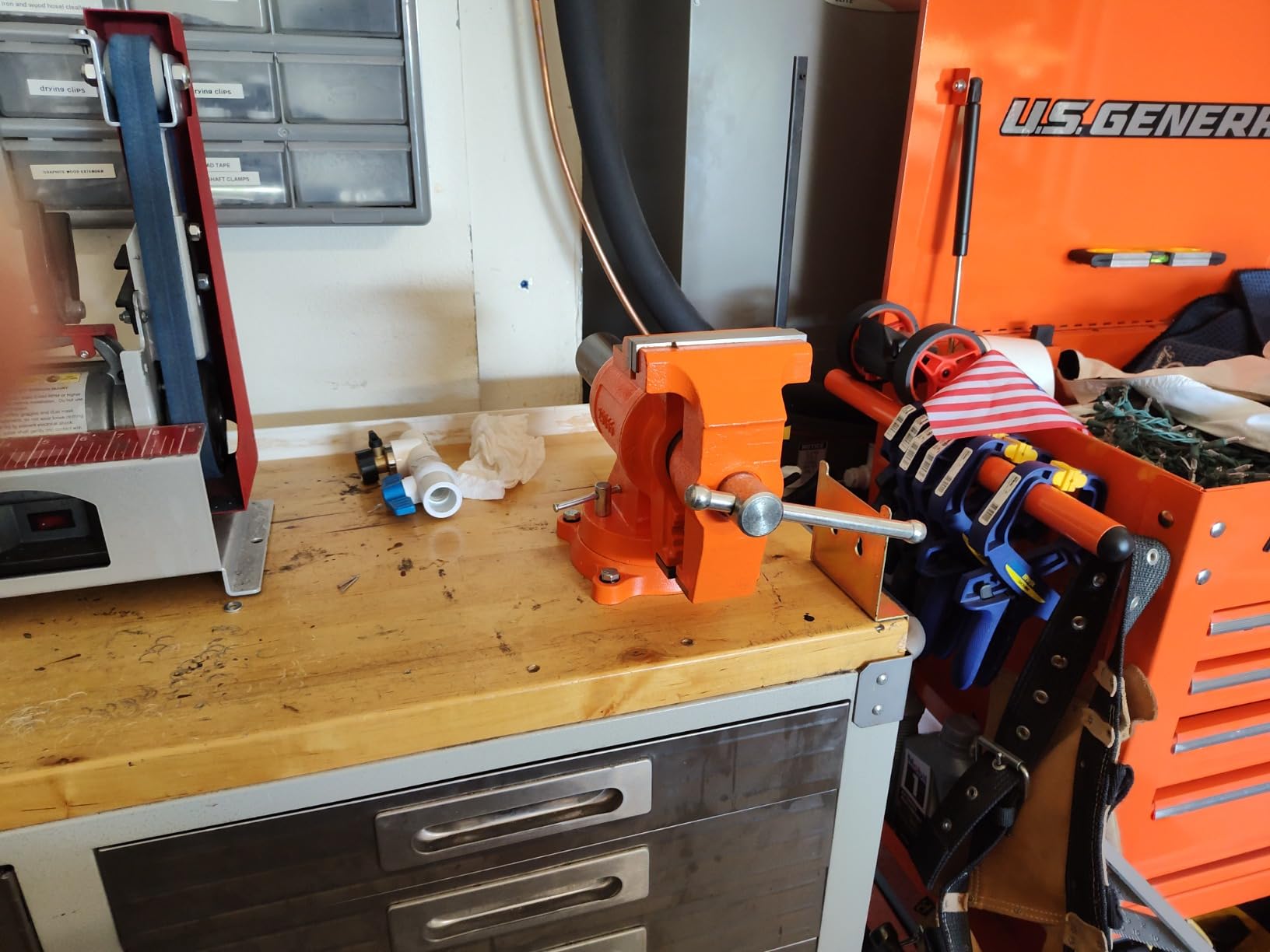
The replaceable hardened steel serrated jaw faces are the right call for a vise this size, since that is the surface that actually wears. Owners position it as a multipurpose tool for general metal work rather than a specialist in any one task.
What you need to know before buying?
The 2-5/8 inch throat is the limitation to weigh. It is shallow for tall workpieces, so if you regularly clamp upright sections or tall brackets you will reposition more often than you would with a 4-inch throat. A 5-inch opening and 5-inch jaw width compensate for that on longer, flatter material.
Review volume is the other consideration. At 303 reviews it has the smallest owner base in this roundup, so there is less long-term data behind it than behind the Forward or the Wilton models. Judge the specification against your work rather than the rating count.
Who it suits and who it does not?
It suits a general shop that wants two-axis rotation, pipe holding, and forming horns in one tool without stepping up to a much heavier casting. The included jaw pads are a useful bonus for holding finished pieces.
It does not suit tall or heavy forming work, and it is not the choice if you need a machinist-grade slide. For those needs, the Wilton 855M below is the right jump.
9. IRWIN 4935505 5 Inch Multi-Purpose Vise – Best for Conduit and Round Material
IRWIN Tools Multi-Purpose Bench Vise, 5-Inch (4935505)
5 inch jaw
33.1 lb cast iron body
360 degree swivel
Rotating machined pipe jaws
Pros
- Rotates in both planes with a rotating pipe gripper
- Exceptionally heavy casting built to last
- Jaws stay square over time
- Cuts and threads galvanized conduit well
Cons
- Machined pipe clamp limited in depth by the casting
- Slide can loosen slightly over long service
- Occasional damaged swivel lock on arrival
The IRWIN is the odd one out in this list because its pipe feature is genuinely different rather than a groove cut into the body. It has a rotating machined steel pipe clamp with a 360-degree swivel base and dual-plane rotation, so round material can be held vertically or horizontally from the same setup. That is why it turns up in conduit and electrical work as much as general metalwork.
At 33.1 lb this is a seriously heavy casting, and owners report it surviving decades of use, hammering, and tightening with a cheater pipe without complaint. The jaws stay square over time, and the incorporated anvil keeps the vise steady while you work rather than letting it rock.
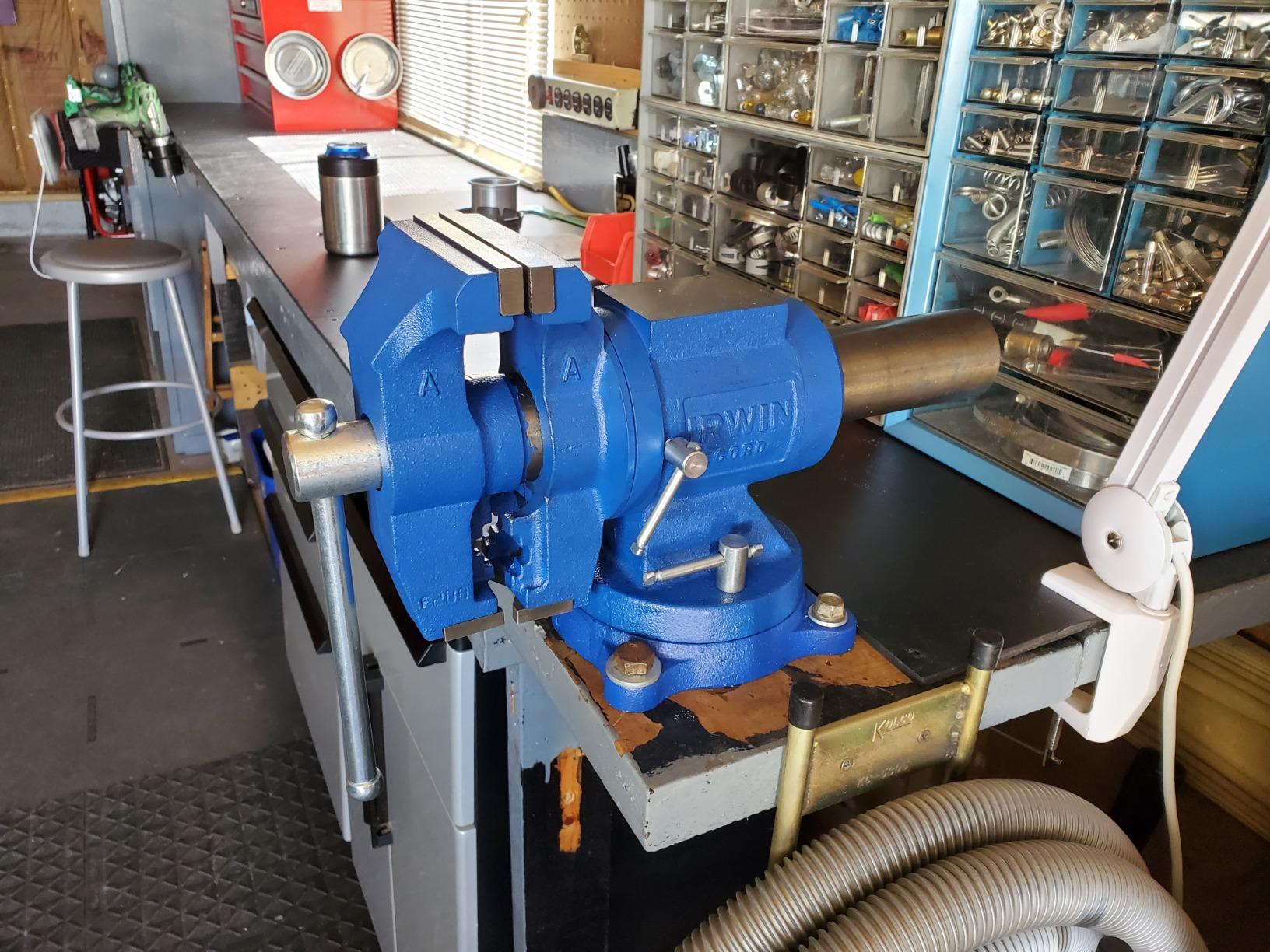
The fused steel handle is designed for fast tightening, which matters when you are working on conduit and want to reposition quickly. Owners also report good performance cutting and threading galvanized steel conduit pipe, which is a genuinely abrasive test for any vise.
What you need to know before buying?
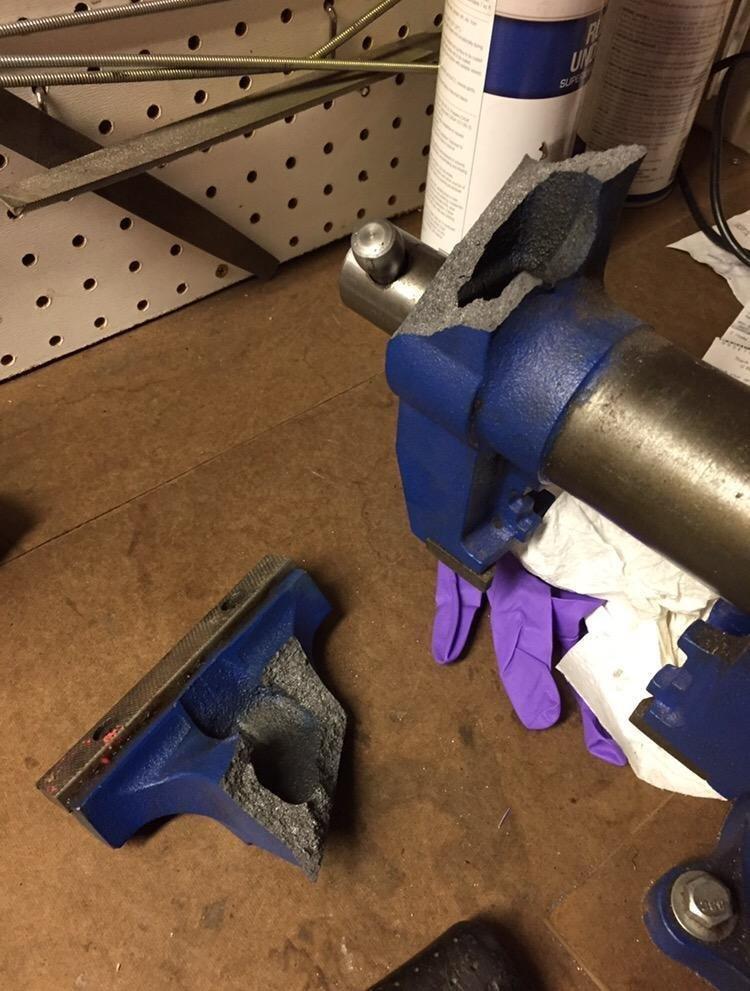
The machined pipe clamp has a limited insertion depth because the blue casting blocks deeper entry. For long conduit lengths you may need to work in sections rather than hanging a full length in the jaws. The 3,000 lb listed tensile figure is a casting spec rather than a clamp force measurement, so do not treat it as a direct comparison with the clamp force numbers on other vises here.
Over long service the slide can loosen slightly, which makes it less precise than a machinist-grade vise. One buyer also received a unit with a damaged swivel lock that had to be replaced, so inspect that area on arrival.
Who it suits and who it does not?
It suits electricians, plumbers, and fabricators who work with round material regularly and want a bench vise that handles pipe natively. The mass and the square-keeping jaws suit a shop that will keep this tool for many years.
It does not suit someone chasing precision or a light bench, since 33.1 lb is a serious commitment. And for welding fabrication where you need a replaceable jaw, note that this model’s jaw specification is less clearly documented than the others in this roundup.
10. Wilton 855M 5-1/2 Inch Mechanics Pro Vise – Best for Precision Clamping
Wilton Mechanics Pro Bench Vise, 5-1/2″ Jaw Width, 5″ Jaw Opening, 3-5/8″ Throat (Model 855M)
5-1/2 inch jaw
3-5/8 inch throat
37.9 lb ductile iron
Precision machined slide bar
Enclosed spindle
Pros
- Machined slide bar holds the front jaw still
- Needle roller thrust bearing for low effort clamping
- Enclosed spindle keeps lubricant in and dirt out
- Wilton lifetime warranty
- 87 percent five-star reviews
Cons
- Most expensive model in the roundup
- Fewer long-term owner reports than the cheaper models
- Lighter ductile body by design
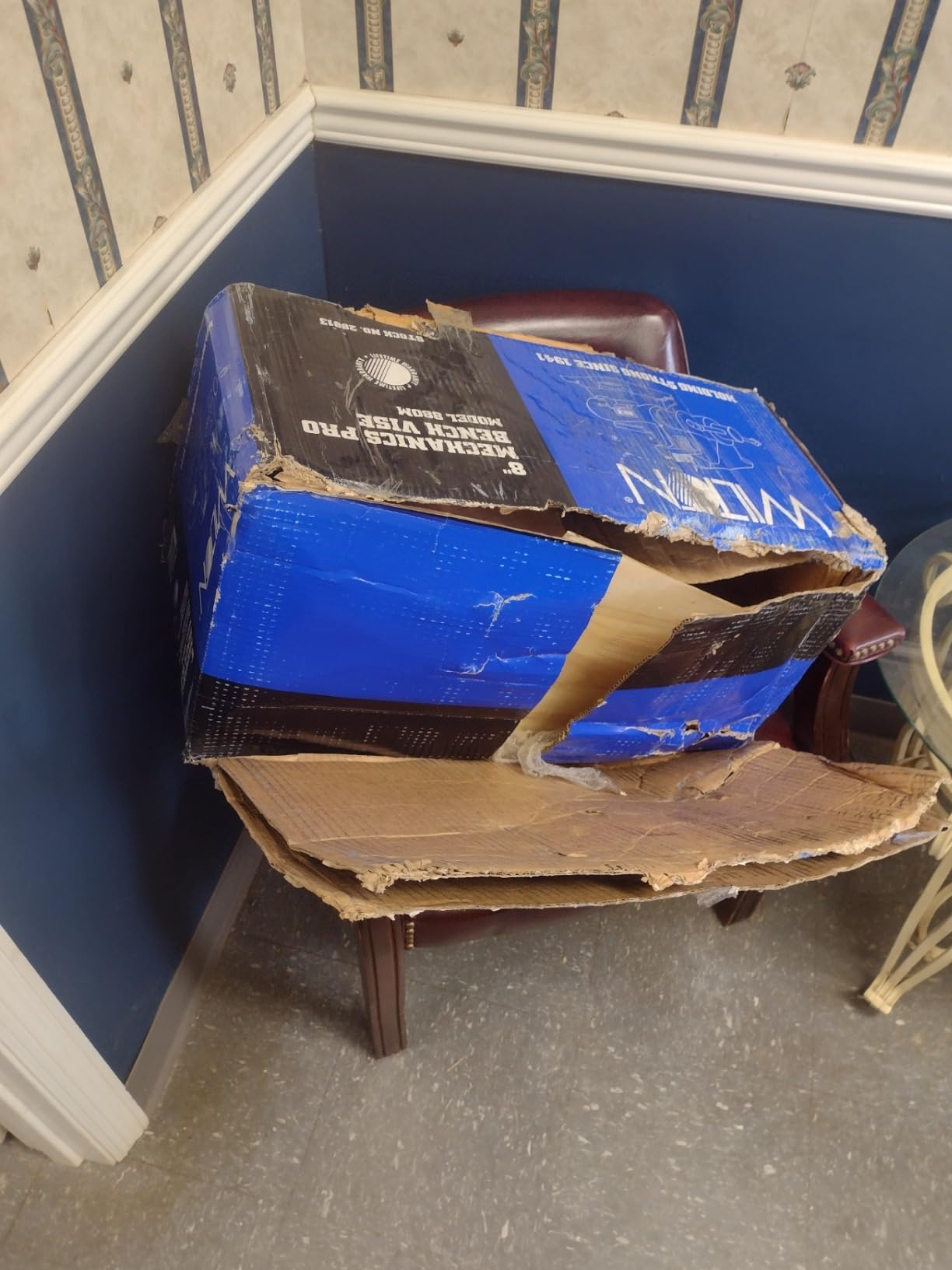
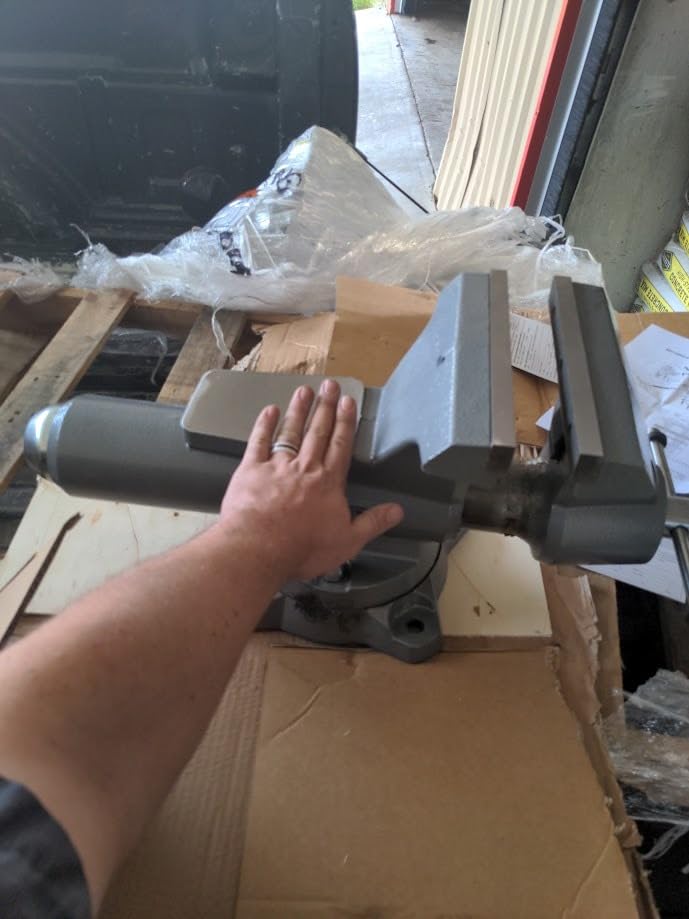
This is the mechanics-grade answer, and the difference is in the screw, not the casting. The 855M uses a precision-machined slide bar that eliminates movement in the front jaw regardless of how far it is open, so a workpiece stays put while you cut or file instead of creeping a fraction each pass. It has the deepest throat of the 5-inch class here at 3-5/8 inches.
A needle roller thrust bearing delivers high clamping force with less handle effort, and the enclosed spindle keeps lubricant in and contaminants out, which is why the action stays smooth over years rather than seizing the way an open screw does. At 37.9 lb in 60,000 PSI ductile iron it is heavy but not absurd, and the 360-degree swivel base with double lockdowns rotates freely.
It carries the same Wilton lifetime warranty against manufacturing defects as the 11105, and it has the highest share of five-star reviews in this group at 87 percent. It ships with variants up to 10 inches if you later need more capacity from the same design.
What you need to know before buying?
This is the most expensive model we tested here, and the cost is buying precision rather than capacity. If your work involves rough hammering, bending, or anvil work, the money is better spent on a heavier casting like the Forward 30608.
It also has fewer long-term owner reports at 304 reviews than the cheaper vises in this roundup, so there is less field history behind it. The body is ductile iron rather than the heavy gray cast iron used on older models, which is a deliberate design choice for weight and toughness, not a downgrade.
Who it suits and who it does not?
It suits machinists, serious hobby metalworkers, and anyone doing precision layout, threading, tapping, or fine hand work where the front jaw must not move. The low-effort clamp also makes long sessions more comfortable.
It does not suit a first-time buyer on a budget, or someone who will treat it as an anvil and a forming tool. Pick the value pick or a heavy casting instead, and consider a milling vise if you need true machine precision. A Canadian Hobby Metalworkers discussion named Gerardi the clear winner for pull-down, alignment and low working height, which is a different tool class for a reason.
How to Choose a Bench Vise for Metalworking?
Start by rejecting the woodworking vise. A face-frame vise holds a board by compressing it gently between wide wooden or cast faces, and its main design constraint is that it must not crush the workpiece. Metalworking asks the opposite: hard steel jaws, a screw that resists being driven backwards by a cutting force, and a body that can take a hammer. Buying a woodworking vise for steel is the most common and most expensive mistake in this category.
Start with jaw width, not brand
Jaw width is the face of the vise, and it sets how much material you can hold without the jaws overhanging the edges. Three and a half to four inches suits small brackets and hobby work. Five inches covers most home and small shop fabrication. Six inches handles plate, structural section, and wide flat material, and eight inches is for shops doing serious fabrication or production work.
Jaw opening, the gap between the jaws, is a separate number and it does not track jaw width. Two vises can both have a 6-inch jaw and differ by an inch of opening, which decides whether you can fit a length of bar in one pass.
Throat depth decides how often you reposition
Throat depth is measured from the front of the slide to the face of the fixed jaw, and it is the most underrated number on the list. A shallow throat means tall workpieces sit with their bottom edge hanging past the front of the vise, so they rock and you re-grip them constantly. The vises here range from about 2.6 inches to 4.375 inches, and the deeper models feel completely different when you clamp a tall bracket upright.
If you cannot decide between two otherwise equal vises, take the one with the deeper throat.
Drop-forged and ductile iron beat gray cast iron
Gray cast iron is brittle. It is cheap, it machines well, and it resists wear, but under a sharp impact it fractures rather than flexing, and a cracked jaw is usually the end of the vise. Ductile iron behaves differently: it deforms and absorbs the blow instead of shattering, which is why the heavier vises in this roundup specify it. Drop-forged bodies go further still, compacting the metal under pressure so the grain structure resists impact even better.
Be sceptical of the 60,000 PSI figures on listing pages. That number describes the casting, not the vise, and it does not tell you how the tool behaves under load. Clamp force, measured in pounds, and throat depth are the two numbers worth comparing between products.
Replaceable hardened jaws versus solid jaws
On steel, the jaw serrations wear first, because that is the surface taking all the abuse. Replaceable hardened steel inserts, whether they are bolted in or the whole top jaw swaps out, turn a worn vise into a cheap repair. Every vise in this roundup except the IRWIN specifies replaceable hardened jaws, and that is a meaningful part of what you are paying for.
The other half of the decision is how the jaws interact with your material. Fine serrations grip hard and mark the workpiece. Soft jaw pads, whether purchased or magnetically mounted, protect finished, plated, or painted surfaces and cost almost nothing.
Swivel base: convenience against rigidity
A swivel base lets you turn the vise to suit the work instead of walking around the bench, and it is genuinely useful in a cramped garage. The cost is some rigidity: a base that can rotate is a base that can move under load, and a fixed base of similar weight will feel more planted. A dual-lockdown design that clamps down on two points resists this much better than a single-bolt lock.
Two of the vises here go further and rotate the head as well as the body, which lets you bring the work to the handle. That is worth the money if you approach pieces from multiple angles, and not worth it if you always work from the front.
How to mount a bench vise to your workbench?
Most vises ship without adequate mounting hardware, and several in this roundup include bolts that are too short for a typical bench. Buy your own grade 8 bolts, sized to pass fully through the base, and use large fender washers under the bolt heads to spread the load and stop the base digging into soft wood.
On a wood top, bolt into a solid rail or a hardwood front section rather than particleboard, and if the bench is built with square tubing, run longer carriage bolts through the tube to reach solid material inside. On a steel top, weld on backing plates or threaded inserts before drilling so the threads have material to bite into. Mark every hole position by hand with the vise in place before you drill anything, since mounting patterns are not always symmetric.
Finally, allow 18 to 24 inches of clearance in front of the bench for the handle to swing a full turn. This is the constraint that catches people out, and it is why a large vise in a small garage ends up mounted with the handle fouling a wall.
Keeping the vise alive: chips, grease and rust
Metalwork generates swarf, and swarf in a vise screw is the most common cause of premature failure. Brush chips off the screw and out of the slide groove after every session, and keep a rag at the bench for the habit. A dry screw that is being fed aluminium swarf will score and eventually bind.
Put a thin film of grease on the screw and slide a few times a year, and never leave a bare cast iron vise sitting wet. Wipe it dry and add a light coat of oil, or use a surface protectant on powdered models such as the VEVOR. Uncoated gray iron, like the WORKPRO, will bloom with rust in a damp garage within weeks if you leave it alone.
Check jaw wear twice a year. When the serrations go smooth, the vise is no longer gripping, and that is the point to replace or swap the top jaws rather than tighten the handle harder.
Frequently Asked Questions
What is the best brand of bench vise for mechanics?
For most mechanics, Wilton and Yost are the two names worth starting from, and both appear twice in this roundup. Wilton backs its vises with a lifetime warranty against manufacturing defects, which matters for a tool that stays bolted to a bench for decades. Yost covers the combination bench and pipe vise class that mechanics reach for when conduit and tube are part of the job. The Forward DT08125A is our overall pick because it carries the highest rating and review count here alongside three interchangeable jaw sets.
What size bench vise do I need for metalworking?
Match the jaw width to the largest material you actually clamp, not the largest you might once. Four and a half inches suits hobby work and small brackets, five inches covers most home shop fabrication, six inches handles plate and structural section, and eight inches is for production or heavy fabrication. Also check throat depth, which is the gap from the front of the slide to the fixed jaw. Anything under three inches means tall upright workpieces will need frequent re-gripping.
Should I buy a cast iron or drop forged bench vise?
For metalworking, choose ductile iron or drop-forged over plain gray cast iron. Gray cast iron is brittle and can fracture under a sharp hammer blow, while ductile iron deforms and absorbs the impact instead of shattering. Drop-forged bodies compact the metal under pressure and resist impact even better, but cost more and are less common in this class. The practical point is that a vise which chips or cracks is finished, whereas a dented ductile body can often be used again.
What is the difference between a woodworking vise and a metalworking vise?
A woodworking vise uses a face frame to hold a board gently, and it is designed not to crush the workpiece. Its soft or wooden jaws mark wood rather than gripping it hard. A metalworking vise uses hardened serrated steel jaws, a heavier cast or drop-forged iron body, greater throat depth, and a much higher clamp force, because metal work drives cutting, bending, and hammering forces straight through the workpiece into the jaws. Using a face-frame vise on steel stock is the most common costly mistake in this category.
Are replaceable vise jaws worth it?
Yes, for steel work, because the serrated jaw face is the first part to wear out. Replaceable hardened steel inserts turn a worn vise into a parts cost rather than a replacement. Nearly every metalworking vise we reviewed specifies them. The related question is jaw hardness, since a harder insert holds better and resists marking softer work, and soft jaw pads are worth adding when you clamp finished, plated, or painted parts that the teeth would otherwise scar.
Final Verdict: Which Bench Vise Should You Buy?
The Forward DT08125A is the best bench vise for metalworking in this group, and the reason is simple: it pairs a 5,500 lb clamp and a 60,000 PSI ductile iron body with three interchangeable jaw sets and a head that rotates independently of the base. It also has the strongest review history of anything we tested, which is not nothing when you are bolting a tool to a bench for the next decade.
Buy the VEVOR 6-inch instead if jaw size is what you are short of. It is the only way to get a 6-inch jaw with a 3.5-inch throat and included soft jaw pads in this range, and those magnetic pads alone will save you from marking finished work. Reach for the Yost 460 when tube is a regular part of the job, and for the Yost 760-DI when you need to rotate the workpiece under clamp as well as the vise.
Two mistakes are worth avoiding in 2026: buying a face-frame woodworking vise for steel, and buying a 25 to 75 lb casting for a bench that cannot carry it. Check the throat depth against your tallest workpiece, allow 18 to 24 inches of handle clearance in front of the bench, and fit your own grade 8 bolts rather than trusting what is in the box.