
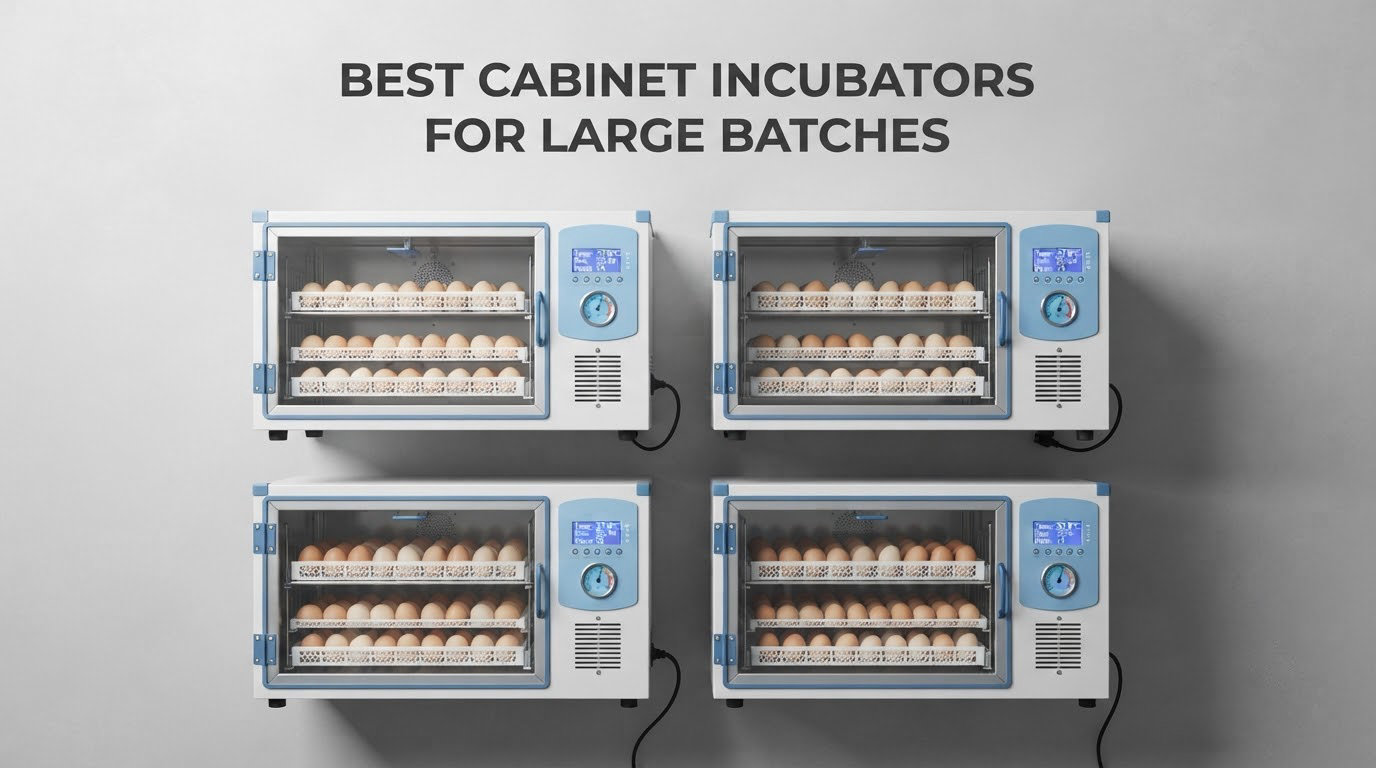
If you are hatching 100 eggs or more at a time, the difference between a good cabinet egg incubator and a bad one is measured in whole clutches, not percentages on a spec sheet. A tabletop unit with a domed lid loses heat every time you lift it, needs manual turning three or more times a day, and drifts when the room temperature swings. A cabinet runs a forced-air cycle for 21 days without you touching it.
That is the roundup. We pulled 12 cabinet incubators built for large batches, from a 180-egg all-in-one setter and hatcher to a 1000-egg commercial cabinet, and compared capacity, turning systems, humidity control, alarms, weight, footprint and owner review history.
Every claim below comes from manufacturer specifications and aggregated owner reviews, not from marketing copy alone. Where the owner data is thin, we say so, because a 5.0 average from one review tells you nothing about a machine you plan to run for a decade. We also lean on long-running BackYard Chickens threads where keepers describe the same units, and we flag the failure points those threads keep returning to. Last updated October 2026.
Table of Contents
What Is a Cabinet Egg Incubator?
A cabinet egg incubator is a full-height, insulated, forced-air machine that holds roughly 100 to 1000 eggs and manages temperature, humidity and egg turning automatically. A fan circulates heated air past the trays while a digital thermostat holds the set point, water pans raise humidity during days 1 to 17, and motorized racks rotate the trays on a timer until you stop them at day 18 for lockdown. The result is a batch that runs for 21 days without daily hands-on work, which is the entire reason large-batch hatchers move from tabletop to cabinet.
Capacity is not the interesting part of a cabinet. Any box can claim a number. What separates them is airflow, thermal mass and whether the turning system is built to survive a full rack of eggs rather than a single tray.
Almost all of them run on an ordinary 110V household circuit, which is one of the reasons the cabinet tier became practical for home operators rather than commercial hatcheries only. The running cost of a 21-day cycle depends on the thermostat’s duty cycle and how hard it is fighting the room, so we work through the electricity numbers further down.
Top 3 Best Cabinet Incubators For Large Batches (October 2026)

GQF 1502 288-Egg Cabinet
- 288 chicken eggs
- Three auto-turning racks
- 5-gallon water reserve
- Digital thermostat with on-board computer

Hatching Time CT180SH
- 180 chicken eggs
- Set and hatch in one cabinet
- Conturn turners with alarms
- IP55 ventilation
- 70W average
Sailret 1000-Egg Commercial Cabinet
- 1000-egg capacity
- Motor-driven tray turning
- Dual digital sensors
- Float-ball water protection
The GQF 1502 configuration takes the top slot because it does the three things a large-batch machine must do without excuses: three independently turning racks, a genuine water reserve system, and a factory-calibrated digital readout you can verify against your own thermometer. The Hatching Time CT180SH earns the value slot on the strength of 195 owner reviews at 4.2 stars, the largest proven base here, plus an all-in-one set-and-hatch design. The Sailret 1000-egg unit is the only true commercial-scale cabinet in the group, but it carries one review, so treat its specifications as unproven.
All 12 Cabinet Incubators Side by Side in 2026
| Product | Specifications | Action |
|---|---|---|
| GQF 1502 288-Egg Cabinet Incubator and Hatcher |
|
Check Latest Price |
| Hatching Time CT180SH Setter and Hatcher |
|
Check Latest Price |
 GQF 1550 Digital Cabinet Hatcher GQF 1550 Digital Cabinet Hatcher |
|
Check Latest Price |
 GQF 1500CI Digital 288-Egg Incubator GQF 1500CI Digital 288-Egg Incubator |
|
Check Latest Price |
| Sailret 1000-Egg Commercial Cabinet Incubator |
|
Check Latest Price |
 AboveMoon 352-Egg Digital Cabinet Incubator AboveMoon 352-Egg Digital Cabinet Incubator |
|
Check Latest Price |
 VEVOR CR400 400-Egg Cabinet Incubator VEVOR CR400 400-Egg Cabinet Incubator |
|
Check Latest Price |
 Criebeo 400-Egg Smart Cabinet Incubator Criebeo 400-Egg Smart Cabinet Incubator |
|
Check Latest Price |
 Montary 400-Egg Cabinet Hatcher Montary 400-Egg Cabinet Hatcher |
|
Check Latest Price |
 TAMUBAKS 400-Egg Digital Poultry Incubator TAMUBAKS 400-Egg Digital Poultry Incubator |
|
Check Latest Price |
 HKDQ 288-Egg Incubator HKDQ 288-Egg Incubator |
|
Check Latest Price |
 ENWEGEY 400-Egg Automatic Cabinet Incubator ENWEGEY 400-Egg Automatic Cabinet Incubator |
|
Check Latest Price |
Two numbers deserve attention before anything else in the table. The VEVOR CR400 has 239 reviews, far more than any other unit here, which makes its 3.6-star average the most statistically meaningful score in the group. Six of the twelve cabinets in the table have two or fewer reviews in total, and we treat their ratings as marketing signals rather than performance evidence.
1. GQF 1502 288-Egg Cabinet Incubator – Best Overall for Large Batches
Pinnon Hatch Farms Incubator GQF 1502 Cabinet Incubator Hatcher Holds Up to 288 Chicken Eggs Includes + 6pk Hatching Egg Trays & 3030 Water Reserve System (with 6 Universal Trays)
288 chicken eggs
162 duck eggs
1368 quail eggs
30.25 x 15.75 x 31.75 inches
Pros
- Three independently turning racks plus a dedicated hatching tray
- Digital thermostat with on-board computer monitoring
- 3030 water reserve system with 5-gallon tank
- Insulated plastic board construction is quiet and easy to sanitize
Cons
- Only 23 reviews so long-term data is thin
- Large footprint for a 288-egg cabinet
- Still requires candling and manual checks on a full batch
The 1502 is the unit most serious keepers in the BackYard Chickens threads describe as the upgrade destination once a tabletop incubator stops being enough. That reputation matters, but the specification sheet is what convinced us. Three automatically turned racks with a separate hatching tray means you can pull a full setting forward on day 18 without gutting the machine.
Capacity is genuinely multi-species: up to 288 chicken eggs, 162 duck eggs or 1368 quail eggs depending on which trays you load. Owners report that the digital thermostat and humidity readouts are factory-calibrated and hold their set points closely, which cuts down on the external-controller habit that many cabinet owners otherwise fall into.
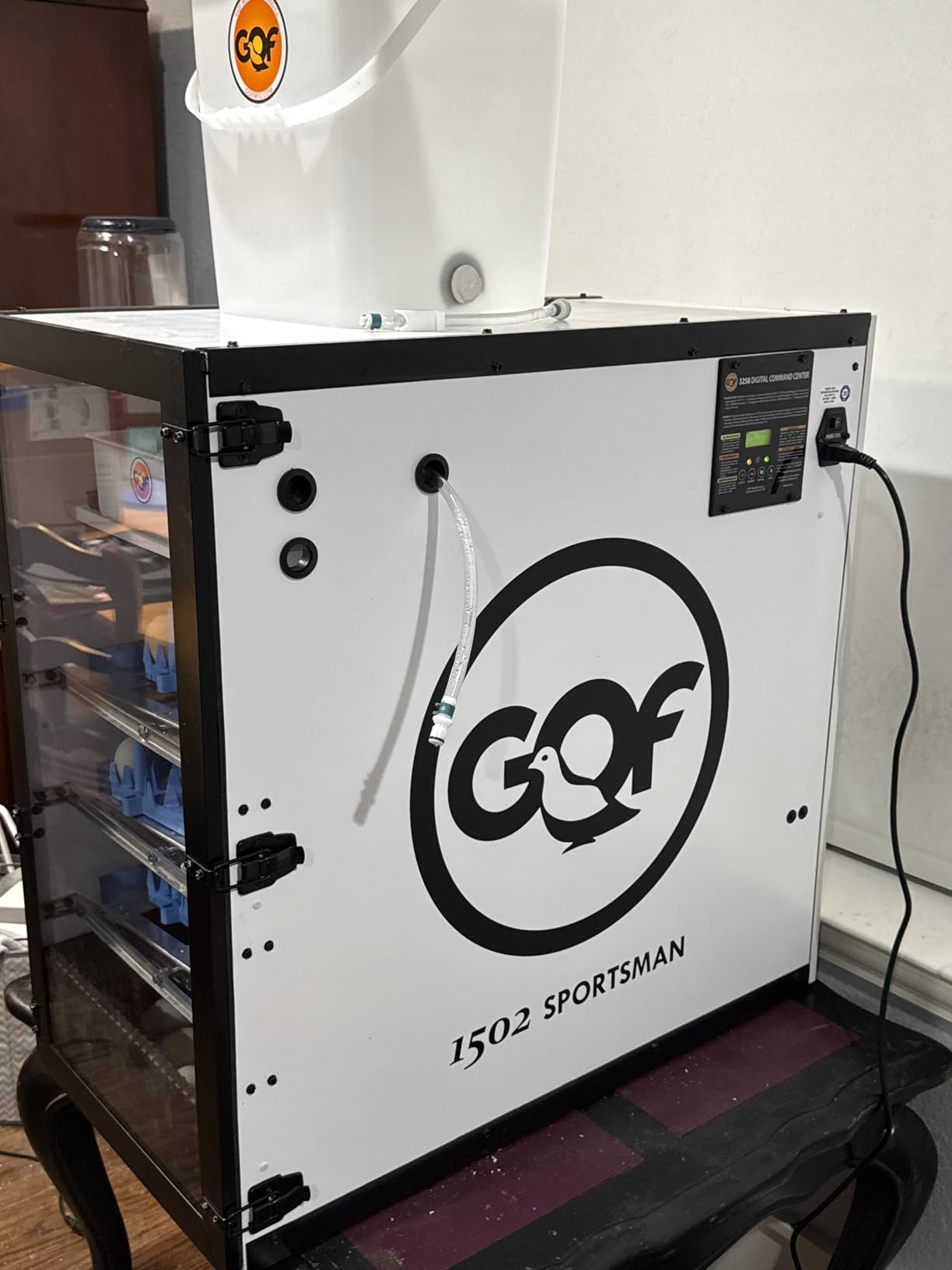
The 3030 water reserve system is the piece most people miss when comparing cabinets. A 5-gallon reserve tank feeding a constant-level pan means you are not walking over to refill a tray every morning, and a large water mass damps humidity swings that a small pan cannot. On a 21-day run, that is the difference between checking twice a week and checking every day.
Construction is insulated high-strength plastic board rather than sheet metal or foam. It is quiet, it wipes clean between batches, and it resists the mold problem that shows up in moisture channels on cheaper steel cabinets. The 4.6-star average comes with 79% five-star ratings, which is a good signal, though 23 reviews is a thin base for a machine people buy for a decade.
What You Get With Three Turning Racks?
Three racks means you can stagger species. Quail on one rack, chicken eggs on another, and the third kept free for a late addition or a second hatch. On BackYard Chickens, multi-species breeders specifically seek out this configuration with quail racks because it is the only way to run a large mixed batch without separating eggs into a second machine.
Egg turning stops independently of the hatching tray, so lockdown is a clean switch rather than a reconfiguration. For large batches, that is a real time saver on day 18 when you have 288 eggs to move.
Where the 1502 Falls Short?
The footprint is 30.25 by 15.75 by 31.75 inches, and you need clearance in front for the door and around the back for airflow. In a small garage corner with a shared wall, plan that out before you buy.
It does not solve humidity or turning for you at the level of the fully integrated hatcher-only units. It is also an incubator and hatcher combined, so during lockdown the turning racks sit idle while the hatching tray does its work. If you want continuous throughput, you need a second unit.
2. Hatching Time CT180SH Setter and Hatcher – Best Value with the Largest Review Base
Hatching Time Incubators for Hatching Eggs, CT180SH Egg Setter & Hatcher
180 chicken eggs
324 quail eggs
17 x 23.5 x 42 inches
110V, 70W average, 200W max
Pros
- 195 owner reviews at 4.2 stars give the most proven base in the group
- Set and hatch in one cabinet with no second unit needed
- Conturn turners plus Humisonic humidity control with high and low alarms
- IP55 AirRoute ventilation with Active Periodic Cooling
Cons
- 12 percent of reviews are one-star
- Goose
- peacock and quail upgrade racks sell separately
- Indoor use in a temperature-controlled room
Several of the cabinets in this roundup share shells and feature lists, which is normal in this category. The CT180SH is a distinct design with a 195-review history, and that is why it lands second and takes the value slot. When keepers compare Brinsea, GQF and the imported cabinets on large-batch threads, this is the one that keeps showing up with a documented service record.
The design premise is the part we like most: Conturn turners run the setter phase, then the same cabinet switches to hatching baskets. You are not buying a second machine or a separate hatcher unit, which for a 180-egg operation is a meaningful saving in both floor space and capital.
Species capacity is broad for a machine in this class: 180 chicken eggs, 252 partridge, 216 pheasant, 120 turkey or duck, 72 goose or peacock, and 324 quail eggs with the standard setup. The 49-pound weight and 17 by 23.5 by 42-inch footprint make it the easiest of the full-size cabinets to reposition when you need floor space for brooders.
Active Periodic Cooling is unusual at this capacity. The fan cycle pauses and cools the chamber periodically, which helps when you are loading a full cabinet of warm eggs and the internal temperature spikes in the first 24 hours.
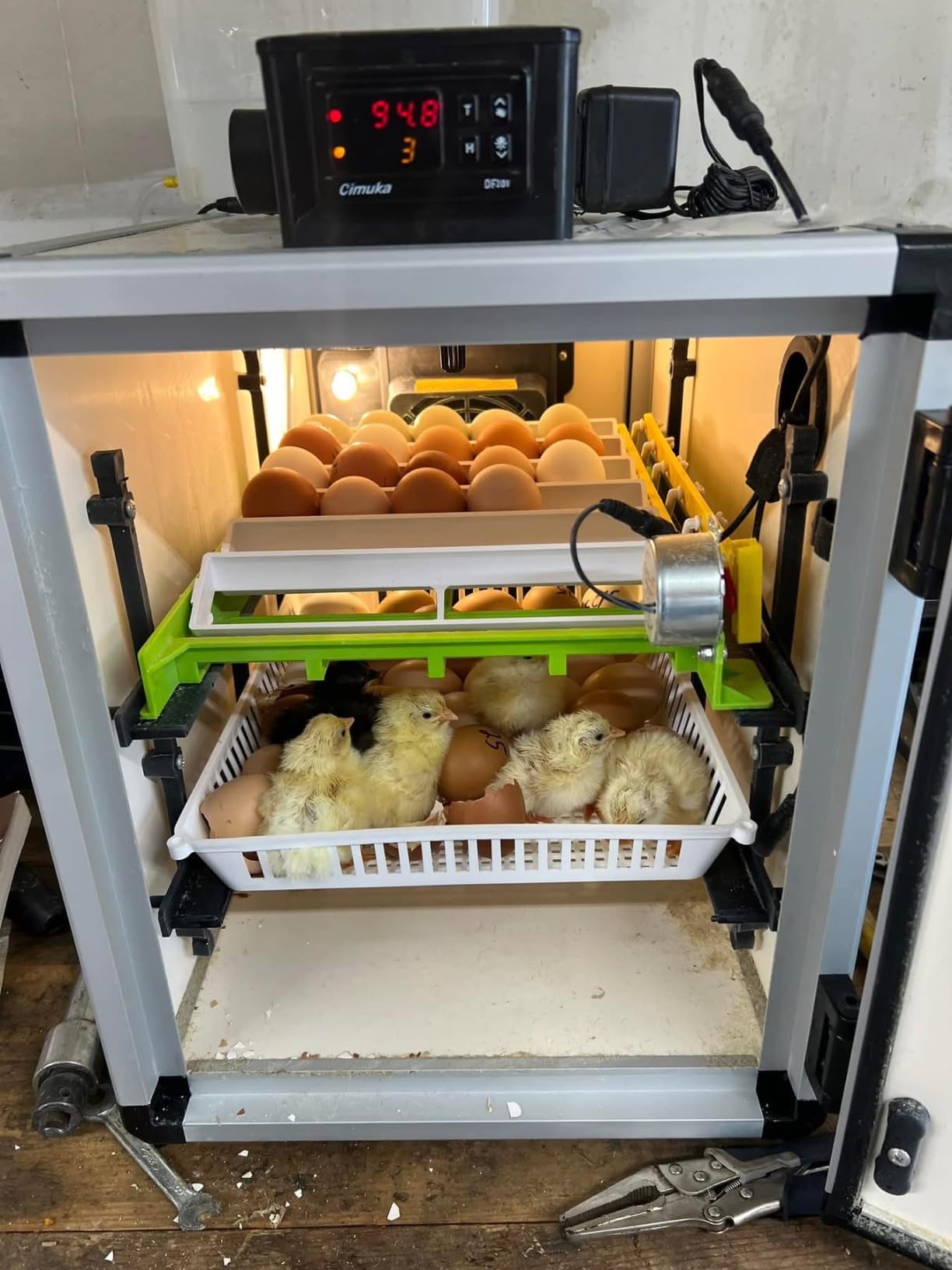
The published draw is 70W average with a 200W maximum on 110V, the only documented figure in this roundup. At 110V it runs on an ordinary household circuit. The honest caveat is the 12% one-star share, which points to hardware and control problems on a minority of machines rather than a systemic design flaw.
When Set-and-Hatch Design Pays Off?
If you are running one 180-egg batch a month, the integrated design is the efficient answer. Loading once and collecting once means you touch the machine at the start and the end of the cycle rather than scheduling a mid-cycle teardown.
It also means the machine is idle during the hatch window. Anyone running more than one batch per month is better served by a dedicated setter plus hatcher pairing, which is a workflow several experienced keepers describe in the forums.
Where Owners Report Problems?
The one-star reviews cluster on electronics and control boards, not on hatch results. When a fan or a turner motor fails on day nine, there is no partial credit, so the failure timing is what makes those complaints feel severe.
The largest species need racks that are not included. Goose, peacock and the quail upgrade all require separately sold trays, so budget for accessories before you set eggs. It is also an indoor machine, and a garage in winter is outside its design envelope.
3. GQF 1550 Digital Cabinet Hatcher – Best for Staggered Batch Workflows
Pinnon Hatch Farms 1550 Cabinet Hatcher GQF Chicken Quail Duck Pheasants Geese Hatching Egg
Holds a complete 1500 setting
Hatcher only cabinet
On-board computer checks every second
USA made
Pros
- Purpose-built hatcher holds a full 1500 setting at once
- On-board computer updates systems and environment readings every second
- USA manufactured
- Pair it with a setter cabinet for continuous throughput
Cons
- Only 2 reviews
- so there is very little owner feedback
- Does nothing without a separate 1500 setter cabinet
- One capacity only
- no smaller variant
This is the only hatcher-only unit in the group, and that is exactly why it is here. Serious operators do not run one machine through 21 days and wait. They run a setter for three weeks, then transfer a full setting into a dedicated hatcher so the setter is free again on day one of the next batch.
The 1550 is sized to hold the complete setting of a 1500 incubator. If you already own a 1500-series setter, this cabinet means your throughput roughly doubles without touching the machine that is doing your temperature control.
The on-board computer checks systems and environment readings every second, which is a genuinely useful figure when you are running unattended in a room at the far end of a building. It is made in the United States, and that matters for parts availability a decade from now.
Why a Dedicated Hatcher Changes the Math?
With a single cabinet, your realistic annual output is capacity multiplied by cycles per year, with a gap between batches. With a setter and a hatcher, the setter never stops except for cleaning, and the hatcher absorbs the last three days when space is at its tightest.
That is the workflow multiple experienced keepers describe in large-batch threads, and the 1550 is the piece that makes it work at full 1500-series scale.
Before You Buy This One
It is useless without a setter. If you do not already run a 1500-series incubator, this is the second machine you buy, not the first.
With two reviews, both five-star, there is no real evidence base. The specification is credible and the brand is long-established, but you are buying on engineering sense rather than demonstrated outcomes.
4. GQF 1500CI Digital Professional Incubator – Best Multi-Species Setter
1500 Digital Professional Incubator – Holds Up to 288 Chicken Eggs
288 chicken eggs
180 duck eggs
1368 quail eggs
Hand-assembled in the USA
Pros
- Factory-calibrated high precision temperature and humidity readouts
- Three auto-turning racks with LCD touch controls
- 288 chicken
- 180 duck or 1368 quail capacity
- Hand-assembled and tested in the USA
Cons
- Only 2 reviews
- giving very little real-world history
- Hatch mode requires manually disabling the turner and setting the hatching tray
- No published footprint or weight figures
The 1500CI is the digital sibling of the 1502, and it is the more attractive buy if all-in-one hatching is not on your list. Three automatically turned racks with LCD display and touch controls, factory-calibrated readouts, and hand assembly in the United States.
Capacity matches the 1502 closely: up to 288 chicken eggs, 180 duck eggs or 1368 quail eggs. The turner and hatching tray are managed separately, which is a cleaner design for a dedicated setter role.
The calibration claim is the part worth trusting. A factory-calibrated high-precision sensor is the single most valuable specification on any large cabinet, because a thermostat that reads two degrees high will quietly cost you hatch rate no matter how good the airflow is.
Setting Up a Multi-Species Batch
Loading 288 chicken eggs and 1368 quail eggs is a tray problem, not an incubator problem. The machine handles both; you decide which racks go in which species, and you keep quail and larger eggs on separate racks so turning geometry works for each.
At 180 duck eggs the spacing tightens, so plan for less headroom per tray than you would with chicken eggs at the same count.
What Two Reviews Cannot Tell You?
Two reviews, both five-star. Nobody has documented a full multi-year service history on this listing yet, so treat the rating as an early signal rather than a track record.
Hatch mode is manual here: you turn off the auto-turner and place the hatching tray yourself. That is a ten-minute job on 18-day-old eggs, and it is the one step you should never rush.
5. Sailret 1000-Egg Commercial Cabinet Incubator – Best for True Commercial Scale
1000-Egg Commercial Cabinet Incubator for Hatching Eggs, Digital Large-Capacity Hatcher with Auto Temperature & Humidity Control & Intelligent Humidification System
1000-egg capacity
Motor-driven tray turning
Dual digital sensors
Built-in water tank
Pros
- Largest capacity in the roundup by a wide margin
- Motor-driven automatic turning of full trays
- Dual digital sensors adjust temperature and humidity in real time
- Float-ball water-shortage protection on the built-in tank
- Glass observation door with internal air ducts
Cons
- Only 1 review
- so there is no meaningful owner feedback
- Main unit only
- so trays and accessories may need separate purchase
- No published dimensions or weight
The other eleven cabinets in this roundup are sized for a corner of a garage or a utility room. The Sailret 1000-egg unit is the exception, and it is the only one whose capacity makes 1000-egg batches possible in a single load.
The mechanical specification is the right one for the scale. Motor-driven tray turning at set intervals means full trays rotate rather than a small carousel, dual digital sensors give the controller two independent readings to reconcile, and the built-in water tank with float-ball water-shortage protection means the humidifier shuts down cleanly if the supply runs dry instead of cooking the batch.
The float-ball protection is the detail that separates a commercial machine from a consumer one. A 1000-egg batch represents three weeks of work from a full flock, and an unattended dry tank in that scenario is a total loss.
What Commercial Scale Actually Requires?
A machine this size needs a stable room, a dedicated 110V circuit, and a water source you can plumb or refill on a schedule. Forced air and dual sensors handle the microclimate; the room handles the macroclimate.
You also need a brooder with real capacity behind it. Hatching 1000 chicks into a setup rated for 200 is the most common way operators at this scale lose the batch on day 21.
Why We Cannot Recommend It Blindly?
One review. There is no owner history, no documented hatch rate, and no published dimension or weight figure, which makes planning the room genuinely difficult.
It is also main unit only. Trays, spare parts and accessories are a separate purchase, and at this capacity you want spares on hand before the first cycle rather than after a fan fails.
6. AboveMoon 352-Egg Digital Cabinet Incubator – Best for Flexible Sizing
352 Egg Digital Cabinet Incubator,Poultry Hatching Breeding Cabinet Incubator for Auto Egg Turning, Temp/Humidity Control, Thermostatic for Chicken/Duck/Goose/Quail Bird.
352 eggs
230L volume
28.35 x 22 x 43.51 inches
99 pounds
Pros
- Capacity family runs 88
- 176
- 264
- 352 and 440 eggs
- Stage-based one-touch control stops turning and boosts warmth before hatch
- Illuminated observation window with real-time displays
- Out-of-range alarms and partial replacement parts included
Cons
- Only 1 review
- so there is no owner feedback to validate claims
- 99 pounds makes it hard to reposition
- Some features need DIY modification by experienced breeders
The AboveMoon is the only cabinet in this roundup sold as a capacity family: 88, 176, 264, 352 and 440 eggs, all sharing the same platform. If you are unsure how many eggs your flock will support in two years, buying into the middle of that range is a genuinely useful hedge.
The one-touch hatching system runs stage-based automatic temperature and humidity control. It stops turning and adds warmth ahead of hatch day without you setting a timer, which removes the single most commonly missed step in large-batch incubation.
The illuminated observation window with a built-in light lets you check embryo development without opening the door. On a 352-egg cabinet, not opening the door is worth real hatch rate, and we appreciate that the manufacturer thought about it.
What the Stage-Based Control Actually Does?
Auto-stop turning plus a pre-hatch warming boost are the two functions that independent hatching baskets do manually. The turner halts and the temperature rises slightly to support pipping, which is what a hatching tray arrangement is meant to achieve.
Automated staging is helpful, but it does not remove the humidity increase at lockdown. That still needs to be set deliberately, and no machine in this roundup does that part for you without instruction.
Weight and Handling
At 99 pounds, this is the heaviest cabinet in the roundup. That is a stability feature rather than a flaw, since a loaded cabinet that walks across the floor is a real problem.
It also means you choose the room before delivery, not after. Some features reportedly require DIY modification by experienced breeders, which tells you the level of support behind the product.
7. VEVOR CR400 400-Egg Cabinet Incubator – Most Reviewed, and What That Reveals
VEVOR 400 Egg Incubator, Poultry Incubator Cabinet with Automatic Eggs Turning, Temperature & Humidity Control, Heating & Cooling Egg Hatcher, Commercial Incubators for Hatching Chicks Ducks Goose
400-egg capacity
24.02 x 19.49 x 37.6 inches
55.1 pounds
110V with 12V switchover
Pros
- 239 reviews
- by far the largest owner base in the group
- 360-degree air circulation for even conditions
- Integrated sensor with real-time monitoring
- Transparent shell with built-in lighting
- Manual switchover to a 12V battery during outages
Cons
- Averages 3.6 stars with 26 percent of reviews at one star
- 26 percent one-star feedback points to control and assembly problems
- Documented temperature fluctuation around 0.9F
- Styrofoam packing needed for extra insulation in cold rooms
This is the most statistically meaningful result in the roundup, and it is not flattering. The CR400 has 239 owner reviews averaging 3.6 stars, with 26% one-star. Every other cabinet here has a fraction of that data, which means a 3.6 is a real signal rather than noise.
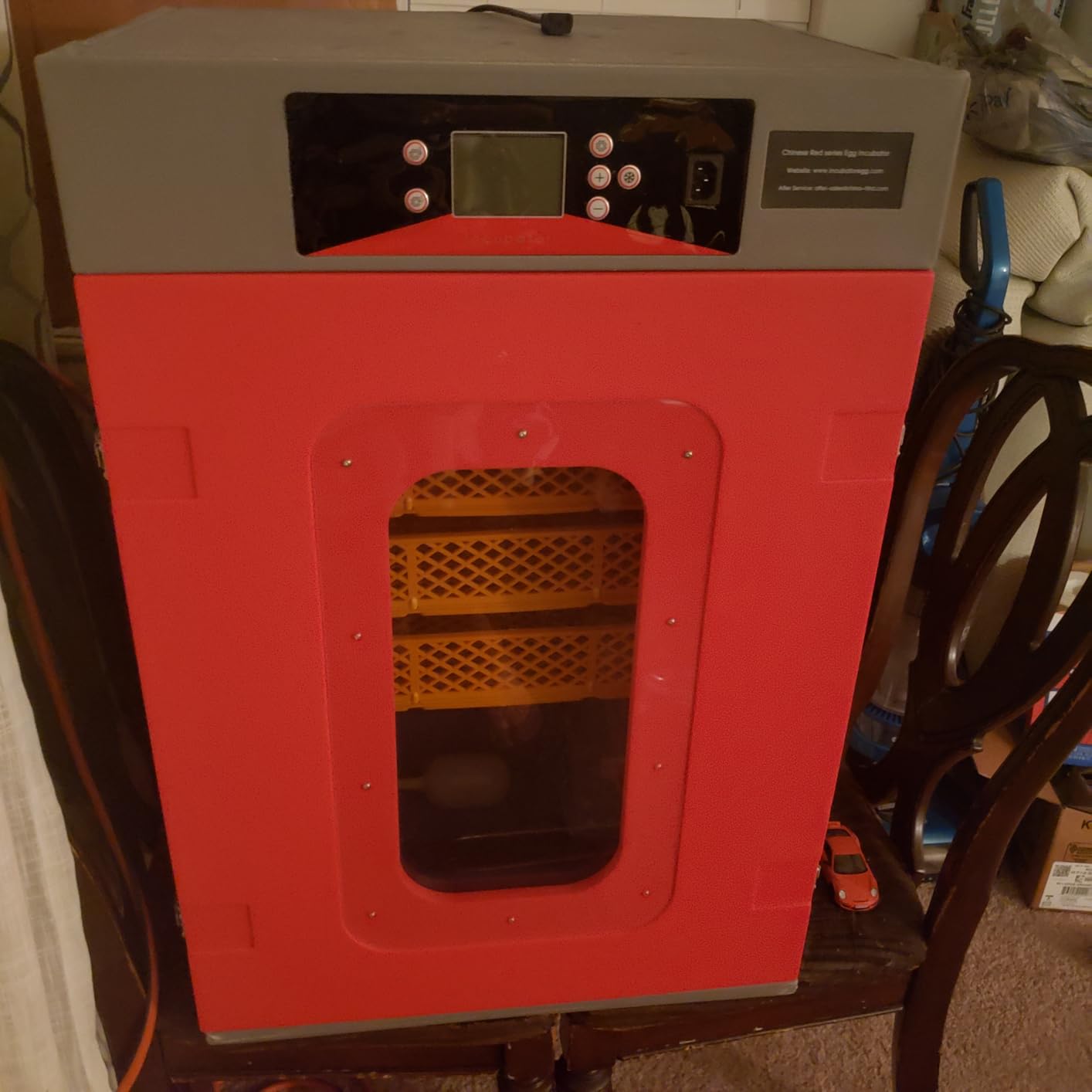
The feature set is competitive. 360-degree air circulation, an integrated temperature and humidity sensor with real-time monitoring, 360-degree automatic egg turning, and a transparent PP shell with built-in lighting for observation. Manual switchover to a 12V battery during a power outage is a thoughtful touch that almost nobody else in this class includes.
Documented temperature fluctuation of about 0.9F is the number that explains the rating. In a still-air machine that is trivial. In a large 400-egg cabinet running continuous 21-day cycles, half a degree of swing at the wrong point in incubation is a measurable hatch rate cost.
Twenty-six percent one-star also tends to cluster around assembly and durability rather than hatch outcomes, which is a category problem rather than an incubation problem. Buyers report styrofoam packing being added for insulation in cold rooms, which points at how the machine handles ambient temperature.
The good news for buyers is that at 239 reviews you can see exactly which failure modes exist before you commit, and the machine is 55.1 pounds, which is manageable for repositioning.
What 239 Reviews Actually Tell You?
At this sample size you can read the rating distribution directly: 52% five-star, 12% four-star, 6% three-star, 4% two-star, 26% one-star. That is a bimodal distribution, meaning buyers either get a machine that works well or one that does not.
Buying a VEVOR CR400 is a bet on landing in the 64% whose unit performs. If you have a second machine to cover a failed cycle, the price point makes that gamble rational. If a single failed batch ends your program, choose elsewhere.
The Outage Feature Is Real and Underrated
Manual switchover to a 12V battery during power cuts is the standout spec here. A 21-day cycle is three weeks of exposure to your electrical service, and most outages are short enough that a battery bridge will carry you through.
It is a manual switch, not automatic, which means somebody has to notice the outage and flip it. For an unattended batch overnight, that limitation is worth planning around.
8. Criebeo 400-Egg Smart Cabinet Incubator – Best for Two-Hour Turning
Cabinet Incubator for Hatching Eggs,400 Eggs Incubator with Automatic Egg Turning and Humidity Control,Commercial Large Cabinet Hatcher for Chicken, Duck, Quail,Birds Eggs (Red,400-Egg)
400-egg capacity
Turns every 2 hours
PE construction
Panoramic observation window
Pros
- Automatic 360-degree turning on a fixed 2-hour interval
- Digital monitoring with smart alarms for temperature and humidity deviation
- Panoramic observation window in corrosion-resistant PE
- 1000-egg variant available in the same family
Cons
- Only 1 review
- so there is essentially no owner feedback
- Listed weight of 8.38 lb seems implausible for a 400-egg cabinet
- Very new listing with no durability record
The above spec sheet is the fullest capability list in the group, though the listings for the two cabinets in the 400-egg import tier are close behind. One detail separates the others: 360-degree automatic turning on a fixed two-hour interval.
Two-hour turning is a genuinely good interval for large batches. It keeps the embryo sacs moving and prevents the eggs from settling into a fixed position, which matters most in a full 400-egg cabinet where a single manual pass takes real time.
Corrosion-resistant PE construction is worth noting for maintenance. It will not rust at the water line the way a steel cabinet eventually does, and it wipes down fast between batches.
The Turning Interval Matters More Than Buyers Think
Every two hours, automatically, works out to 204 turns across a 17-day setting phase. Doing that by hand means opening the cabinet or working the trays several times a day, and every opening on a large cabinet costs you temperature and humidity you then have to recover.
That is the real argument for a cabinet over a tabletop unit, and it is why turning interval is a better differentiator than raw capacity.
Verify the Physical Specs on Delivery
The listed weight of 8.38 pounds is not credible for a 400-egg cabinet holding water pans and turning racks. Expect to check the actual unit and its panels carefully when it arrives.
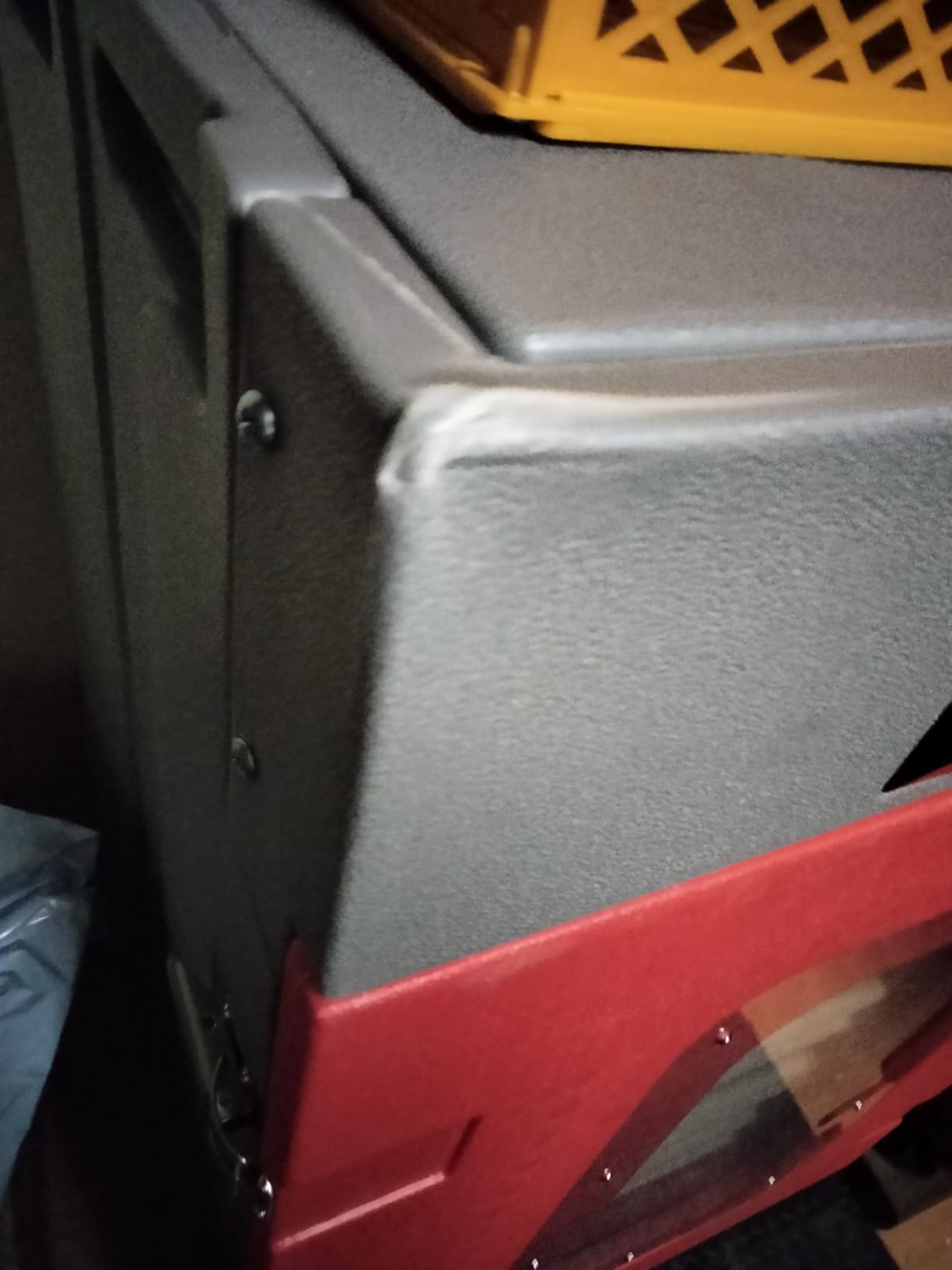
Transit damage on large cabinets is a recurring complaint across the category, and a listing with one review and implausible specifications is exactly the combination where you inspect every panel before your first cycle. If you want a comparison point for what a properly documented cabinet listing looks like, our cabinet incubator roundup for large hatches covers the specs worth insisting on.
9. Montary 400-Egg Cabinet Hatcher – Straightforward Mixed-Species Loading
400 Eggs Incubator Cabinet, Automatic Incubator for Hatching Egg, with Automatic Egg Turning and Temperature Humidity Control, Poultry Hatcher for Chicken, Duck, Goose, Quail Eggs
400-egg capacity
Turns every 2 hours
Auto-humidification with air ducts
1000-egg version available
Pros
- Automatic 360-degree turning every 2 hours
- Digital displays with smart fluctuation alarms
- Panoramic observation window and easy-clean PE body
- 1000-egg version in the same line for scaling up later
Cons
- Only 2 reviews
- both 4-star
- with no 5-star reports
- Listed 50 x 50 x 50 inch dimensions look like packaging data
- Very new listing with no long-term record
The Montary does the standard job cleanly: 400-egg capacity, 360-degree automatic turning on a two-hour cycle, digital temperature and humidity displays with fluctuation alarms, and circulating air ducts with auto-humidification.
What makes it worth a place is the family structure. A 1000-egg version exists in the same line, so if you outgrow 400 eggs you are not replacing a machine from a different manufacturer with an incompatible tray and rack system.
Mixed chicken and duck batches are where it fits best. Duck eggs are larger and need more spacing than chicken eggs, and a 400-egg cabinet that holds ducks and chickens together on separate racks is more useful than a smaller single-species machine.
Alarms Matter More Than Displays
Digital temperature and humidity displays are table stakes. Smart fluctuation alarms are not, because on a 21-day unattended cycle you want to be told about drift rather than discover it at the end.
Pair the alarm with an independent thermometer and hygrometer inside the cabinet, since an alarm that reports only the controller’s own sensor reading cannot tell you that the sensor has drifted.

Check the Published Dimensions
The 50 by 50 by 50 inch figure listed for this machine looks like carton dimensions rather than the cabinet itself. Measure or confirm before you plan a shelf.
With two reviews, both at four stars, there is no performance history. The 1000-egg sibling is a better long-term bet if your volume justifies the jump.
10. TAMUBAKS 400-Egg Digital Poultry Incubator – Best for Size-Adaptive Turning
Poultry Breeding Incubator, Automatic Digital Egg Incubator with Temperature Control, 400 Eggs Capacity, 360° Roller Flipping, for Hatching Chicken Duck Goose Quail Birds (400 Pieces)
Around 400 eggs
360-degree roller flipping
LED readouts
23.8 x 18.7 x 34.8 inches
Pros
- 360-degree roller flipping adapts to varying egg sizes
- LED display with real-time temperature and humidity readings
- Intelligent alert system for deviation from programmed conditions
- Automatic temperature control
- 49.6 pounds
Cons
- Only 1 review
- providing no real-world performance evidence
- Single 400-piece capacity variant with no smaller or larger sizes
- No documented detail on hatch-day turning stop or alarm thresholds
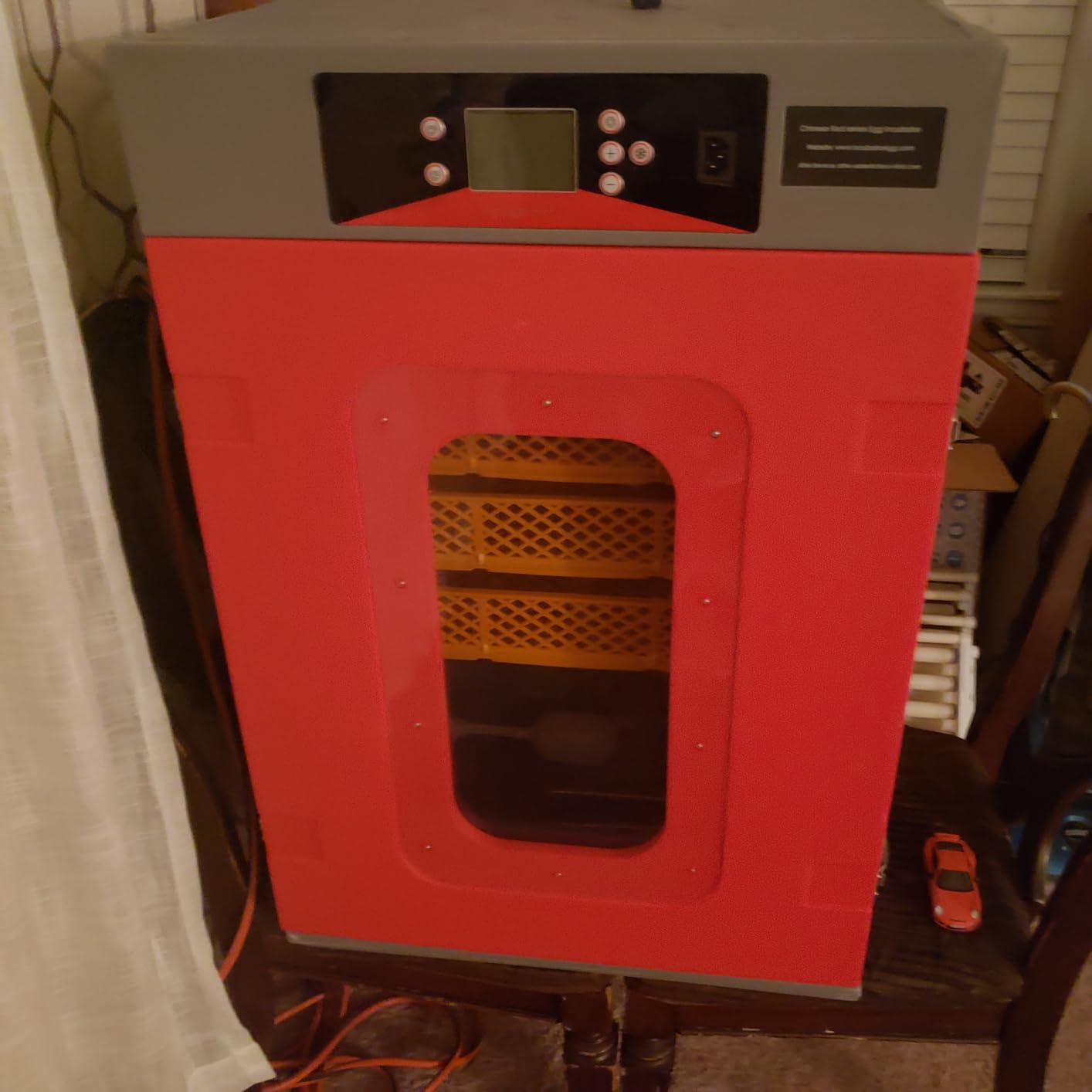
Only two cabinets in this roundup describe turning that adapts to different egg sizes, and this is the one that explains the mechanism: 360-degree roller flipping that adjusts to varying egg sizes. Most turners are fixed-geometry, so the same rack that holds chicken eggs will not hold quail or goose eggs well.
For a mixed batch of chicken, duck and quail eggs on one machine, that flexibility is worth more than raw capacity. The listed species support runs to chicken, duck, goose, quail, pheasant, turkey, swan, parrot, lovebird and macaw.
Automatic temperature control with humidity monitoring and an intelligent alert system for deviation from programmed conditions gives you the monitoring basics, and the LED display shows both readings in real time.
Why Fixed Geometry Limits Mixed Batches?
A turner with fixed slots sized for standard chicken eggs either leaves gaps with quail eggs, which lets them roll and shift, or has no clearance at all for goose eggs. Neither failure is visible until you open the cabinet on day 10 and find the damage.
Adjustment is what lets one rack serve several species across a 21-day cycle, and it is the reason this machine earns a place despite having a single review.
What the Documentation Does Not Cover?
There is no detail on the hatch-day turning stop or on the alarm thresholds. Those are the two questions to get answered before a full batch, because a turner that keeps running on day 19 is a lost cycle.
One capacity variant, at 400 pieces, means no way to scale gradually. Plan for that before ordering.
11. HKDQ 288-Egg Incubator – Budget Pick with the Widest Rating Spread
HKDQ Egg Incubator – 2026 New Egg Incubator with Automatic Egg Turning and Humidity Control,Large Poultry Hatcher for Chickens Birds Ducks (288 Eggs)
288 chicken eggs
228 duck eggs
150 goose eggs
31 x 9.5 x 21 inches
Pros
- Entry point of the roundup while still holding 288 chicken eggs
- Fully automatic and DIY modes with free-setting temperature and humidity
- 360-degree rotation with adjustable spacing for different egg sizes
- Double-fan constant temperature system with built-in water channels
- Includes an egg candling lamp and automatic day counter
Cons
- Averages 3.6 stars with 26 percent of reviews at one star
- 26 percent one-star feedback points to temperature and build quality issues
- Tall 31-inch tabletop form factor rather than a full upright cabinet
The HKDQ holds 288 chicken eggs, 228 duck eggs, 150 goose eggs or 420 bird eggs, and it is the entry point of this roundup. If your budget is the binding constraint, this is the unit that gives you the largest batch you can justify.
The feature set is more complete than the price suggests: fully automatic and DIY modes, 360-degree rotation with adjustable spacing, a double-fan constant temperature system, built-in water channels for humidity, an automatic day counter, and an included LED candling lamp.
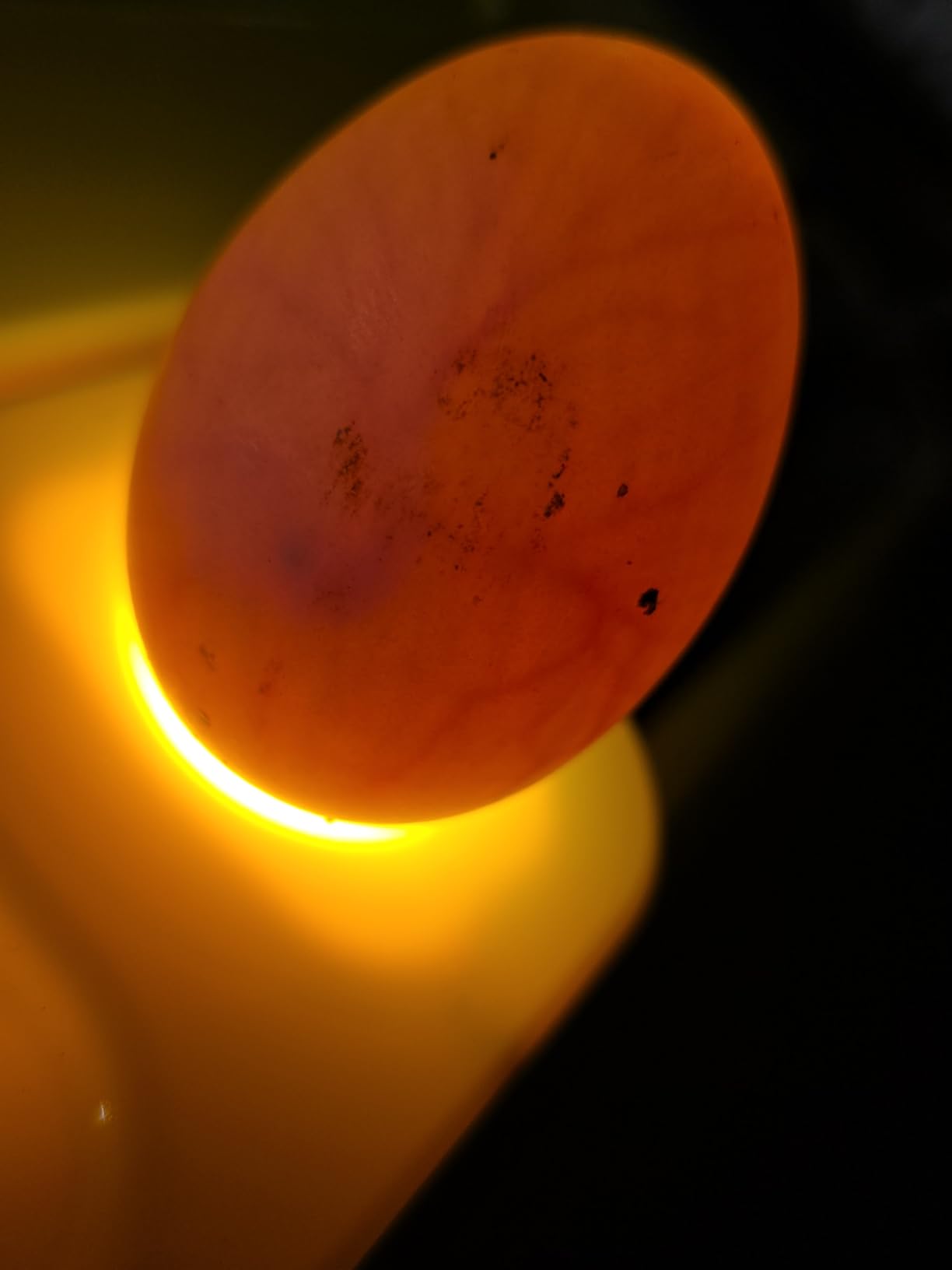
It also has the widest rating spread of anything we looked at. Of 13 reviews, 42% are five-star and 11% are one-star, with a 20% three-star cluster. That is a machine that works very well for some people and not at all for others.
DIY mode is the underrated feature. When the automatic program is not what your breed needs, being able to set temperature and humidity manually and run your own curve is worth more than it sounds.
The Form Factor Is the Catch
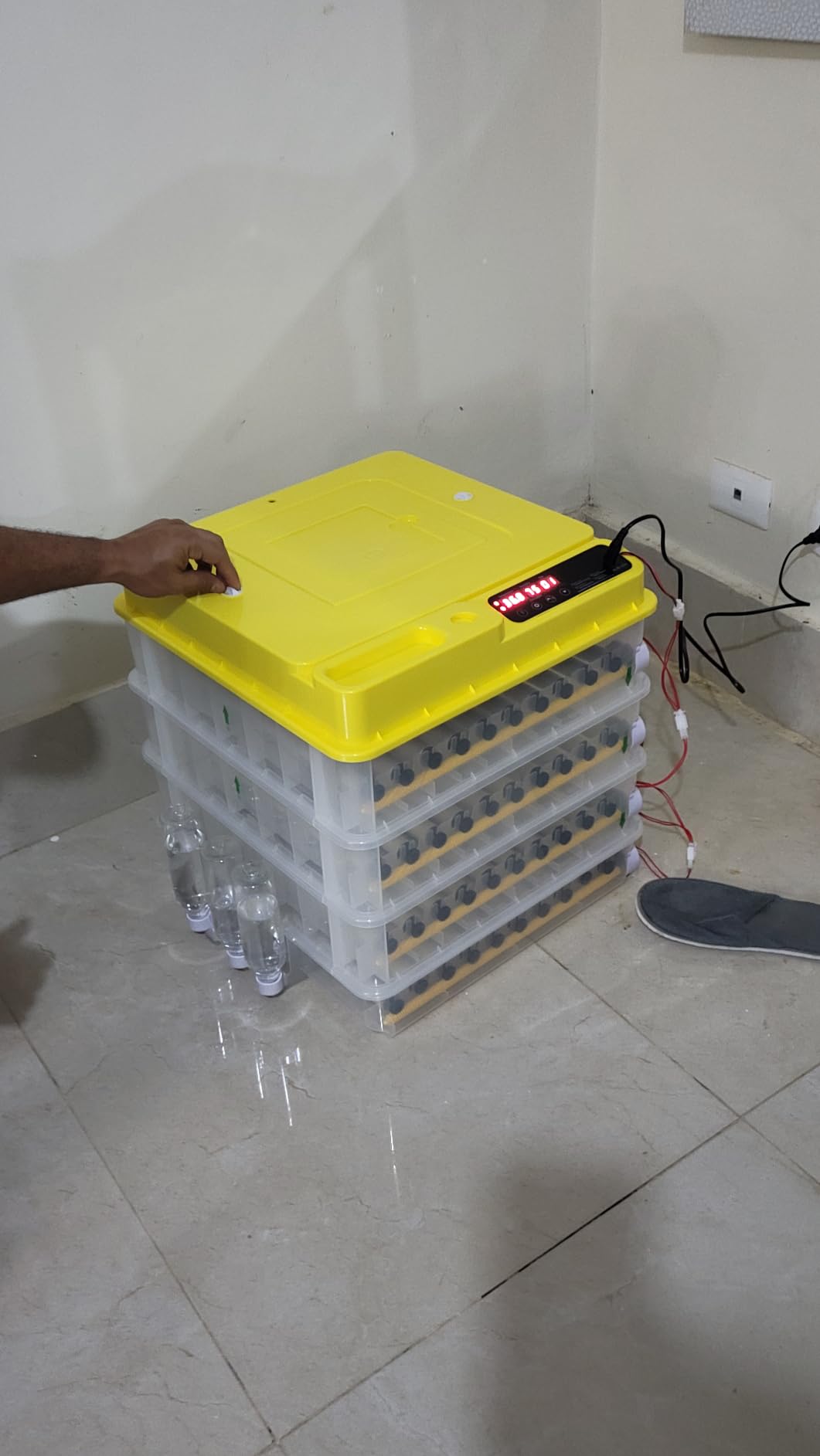
At 31 by 9.5 by 21 inches, this is a tall tabletop unit, not a full upright cabinet. The turning racks and the incubator body are the same object, so on day 18 you still move eggs to a hatching tray the same way you would with a smaller machine.
The double-fan system is the right architecture for a 288-egg load, but a tall narrow body is harder to insulate than a wide cabinet and less forgiving of a cold room.
Where the Complaints Concentrate?
Owners report temperature consistency issues and build quality complaints specifically at the higher capacity settings, which is the pattern you would expect from a machine pushed toward its limits.
If you buy this, verify temperature with an independent thermometer in the first week, and run a small test batch before committing 288 eggs to it. More on that calibration step below.
12. ENWEGEY 400-Egg Automatic Cabinet Incubator – Best for Observation and Monitoring
400-Egg Automatic Cabinet Incubator for Chicken Duck Goose Quail Eggs, Digital Temperature & Humidity Control, Large Capacity Hatching Machine with Automatic Egg Turning System
400-egg capacity
Turns every 2 hours
PE body
18.7 x 23.8 x 34.8 inches, 50 pounds
Pros
- Transparent observation window for checking progress without opening the cabinet
- Automatic 360-degree turning every 2 hours
- Digital displays with real-time readings and an intelligent alert system
- Circulating air ducts with automatic moisture control
- Durable corrosion-resistant PE body that is easy to clean
Cons
- Only 1 review
- and it is 4 stars rather than a top rating
- Low sales rank suggests limited market traction
- No documented hatch-rate data from owners
The ENWEGEY covers the same 400-egg, two-hour-turning, alarmed-digital-controls baseline as three other cabinets in this roundup, and its differentiator is the transparent observation window. On a large batch, checking progress without opening the door is worth more than it sounds like.
Every door opening on a 400-egg cabinet is a temperature and humidity event you have to recover from, and in cold weather the recovery takes longer. A window lets you satisfy the urge to look without paying for the look.
Circulating air ducts with automatic moisture control handle the humidity, and the corrosion-resistant PE body is a sensible material choice for a machine that lives next to water for 21 days at a time.
Observation Windows Versus Opening the Door
Embryo movement is visible by candling around day 7 and day 14, and a lit window on a 400-egg cabinet lets you scan trays for obvious problems without breaking the environment.
It is not a substitute for candling. A window tells you that eggs are in the cabinet; a candler tells you whether they are developing.
Why This One Sits Last?
One review, and it is four stars. Low sales rank suggests limited traction, which in this category usually means a newer listing with less field history than its feature list implies.
The feature set is competitive and there is an owner rating on record, so it is a reasonable first cabinet. For a primary machine running your whole program, we would put a larger review base ahead of this.
How to Size a Cabinet Incubator for Large Batches?
Sizing a cabinet comes down to one number: eggs per cycle multiplied by cycles per year. Everything else, footprint, power and tray count, follows from that figure, and getting it wrong is the most expensive mistake in this category because you cannot incubate 200 eggs in a 100-egg cabinet no matter what the listing says.
The broader sizing framework in our incubator guide for hatching eggs covers small units, but the cabinet tier behaves differently and needs its own math.
Step One: Turn Annual Volume Into Cycles
Take your target chick output for the year, apply a realistic hatch rate, and divide by 21 days plus two days for cleaning and turnaround. Most large-batch operations run 12 to 16 cycles a year, so a 200-egg cabinet delivering an 85% hatch rate supports roughly 2000 to 2700 chicks annually.
Below about 1000 eggs a year, a cabinet is over-serviced. Above 10000 eggs a year, you are in multi-unit territory and should read the staggered-hatch section in this guide before buying the first machine.
Step Two: Add Headroom for Empty Racks
Never load a cabinet to 100% of rated capacity on your first cycle. Rated capacity assumes a specific tray configuration, and a full load leaves nowhere to put eggs that arrive late, a second species, or a batch you need to add after a candling rejection.
We would run 80% of rated capacity as a working maximum. On a 288-egg cabinet that is about 230 eggs per cycle, and it costs you one cycle a year while removing a whole category of mid-cycle scrambling.
Step Three: Match Trays to the Birds You Actually Hatch
Chicken, duck, goose, quail and pheasant eggs all need different trays, and the trays are a consumable you will replace. Check that the cabinet you are buying has racks available for the species you actually run, not just the species on the box.
Quail capacity figures look spectacular, 1368 eggs on the GQF 1502, but they assume quail racks that are frequently sold separately. Price the racks before you commit.
Forced Air, Turning Racks and Humidity Control
Forced-air circulation is the defining engineering choice in every cabinet worth owning. The fan moves air continuously past the trays instead of relying on convection, which is what makes a large batch develop evenly from the top rack to the bottom.
Forced-Air Cabinets Are Not a Marketing Gimmick
Still-air incubation works by trapped air in a dome, which holds heat well in a small box and fails badly in a large one. In a 300-egg cabinet, the top racks run warmer than the bottom ones and the outer eggs run cooler than the center, and no amount of thermostat accuracy fixes a gradient.
Forced air removes the gradient, and it also makes the incubator tolerant of an unheated room because moving air equalises faster. If you are hatching in a garage or basement, forced air is not optional.
Three Turning Racks Beat One Big Tray
A single 400-egg turning tray looks efficient and behaves badly. When one tray rotates, every egg in it moves at once, and any small motor fault stops the entire batch. Three or more racks mean a problem affects a third of your eggs instead of all of them.
Rack count also buys you operational flexibility: separate species on separate racks, room to add a late batch, and a clean separation between setting eggs and hatching eggs during lockdown.
Humidity Is the Hardest Variable to Hold
Humidity is what keepers complain about most in large cabinets, and the failure mode is specific: too high during days 1 to 17 produces oversized chicks with problems that only show at pipping, when it is too late to fix anything.
The standard target is around 45% through day 17, rising to roughly 65% at lockdown. A water reserve system with a larger tank damps swings better than a small fill-up tray, and the 3030 system on the GQF 1502 is built specifically around that idea.
Buy a separate hygrometer. The controller reading tells you what the sensor says, and in many cabinets those two numbers differ.
Reliability, Parts and Power Draw
Long-term reliability is rarely a specification. It is a pattern in owner reports, a parts catalogue that still exists, and a first-week calibration step that most buyers skip.
OEM Thermostats Commonly Read One to Three Degrees Off
Across large-cabinet discussion threads, the most repeated complaint is that the factory thermostat reads one to three degrees away from actual cabinet temperature. That is not a defect, it is uncalibrated equipment, and it is the single most common cause of a disappointing first batch.
Run an independent thermometer at egg height in the centre of a loaded cabinet for the first week before you trust the display. Owners who fix this in week one generally never have a problem again; owners who skip it usually discover it at day 19.
Parts Availability Decides Long-Term Ownership
Fans, heater elements, turner motors and egg trays all fail eventually, and a machine with no parts in five years is a very expensive shelf. This is where USA-manufactured and long-established brands earn their premium, and it is also where forum reputation matters most.
Owners report running the same GQF Sportsman 1502 for 10 to 15 years with basic maintenance, which is the strongest longevity signal in this category. A used cabinet from that same family has an active buyer market, so if you want a proven machine without new-unit cost, that route exists.
Know your failure points before they happen. Thermostat drift shows up gradually, fan motors fail suddenly, heater elements burn out at end of season, and mold in moisture channels is the one you can prevent entirely by cleaning between batches.
Power Draw Matters More Than Buyers Expect
The Hatching Time CT180SH is the only unit in this roundup with a published draw: 70W average with a 200W maximum on 110V. Over a 21-day cycle running continuously, that is roughly 35 kilowatt-hours. Other cabinets in similar insulated shells will land in the same order of magnitude.
That is real money per cycle, and at 15 cycles a year it is a line item worth tracking. The practical implication is that a heavily insulated cabinet in a moderate room will draw less than the same cabinet in a cold garage, because the thermostat is fighting the room rather than holding a stable set point.
Check your circuit capacity too. Two 400-egg cabinets on one household circuit is a question for an electrician, not for the manual.
When a Cabinet Incubator Is the Wrong Purchase?
A cabinet is the wrong tool in several honest situations, and buying one anyway is how people end up with an expensive machine running three batches a year.
If you are hatching under 60 eggs a year, a well-run tabletop unit with manual turning will match a cabinet’s results and take up a fraction of the space. The cabinet’s advantage is throughput, and without volume there is no throughput advantage to capture.
If your batches are one-off and small, the 21-day commitment does not matter. It only matters when you want to load on a schedule and walk away.
If your only available room is an unheated garage in winter, you are fighting ambient temperature rather than running an incubator. A few degrees of extra insulation helps tabletop units and does comparatively little for a large cabinet, because the volume of air to heat is the problem. Use a tabletop unit for winter batches, or solve the room first.
And if you are not willing to candle at day 7 and day 14, no automation will save the batch. Failed eggs and mistuned humidity are the leading causes of a poor hatch, and both are caught by looking.
What a Full Hatch Cycle Costs in Electricity?
Energy is the operating cost almost nobody calculates before buying a cabinet, and at large volume it is easy to calculate once you have one published wattage figure. Take the CT180SH as the reference point: 70W average, 21 days of continuous running, and a thermostat duty cycle that is well below 100% in a stable room.
Run at full duty for the worst case and one cycle consumes roughly 35 kilowatt-hours. Run it at a realistic 60% duty cycle in a moderate room and that drops to about 21 kilowatt-hours per cycle. At 16 cycles a year, that lands somewhere between 340 and 560 kilowatt-hours per machine per year, and a two-cabinet operation doubles it.
That number is worth having in writing, because it changes how you think about machine choice. A heavily insulated cabinet in a stable room cycles less often than a thin-walled one in a cold garage, so the same egg count costs less to run in a well-sited machine. Insulation and room choice are cheaper interventions than buying a smaller machine, and they apply to the cabinet you already have.
How This Scales With Annual Volume?
At 3000 eggs a year, electricity is a rounding error next to feed, bedding and the cost of a failed batch. At 10000 eggs a year, running two cabinets in a conditioned room instead of an unheated one is a decision worth making before you add the second unit.
At 50000 eggs a year, you are operating a hatchery, and the numbers change character entirely. Duty cycle, room climate and maintenance scheduling become line items you track the way a feed mill tracks input cost.
The Cost That Actually Dominates
At every volume, the largest cost is the failed batch. Losing 288 eggs on day 19 because a humidity target was wrong for a week costs far more than a year of electricity, which is the argument for spending your first hour on calibration rather than hunting for the cheapest machine.
Egg quality and keeper consistency outrank incubator brand in most large-batch outcome discussions, and no amount of automation reverses an infertile batch. Buy the cabinet that makes your process repeatable, then protect that process with candling and a written humidity schedule.
Frequently Asked Questions
What is the best cabinet incubator?
The best cabinet egg incubator depends on batch size and how much you trust automation. For most large-batch operations, the GQF 1502 configuration is the strongest overall pick because it combines three independently turning racks, a 5-gallon water reserve system and factory-calibrated digital readouts. The Hatching Time CT180SH is the best value choice thanks to 195 owner reviews at 4.2 stars and an all-in-one set-and-hatch design. For true commercial scale, the Sailret 1000-egg cabinet is the only unit in our roundup that handles 1000 eggs in one load.
Is there an egg incubator that can hold 100 eggs?
Yes, and most cabinet incubators hold far more than 100 eggs. The cabinets in our roundup range from 180 chicken eggs on the Hatching Time CT180SH up to 1000 eggs on the Sailret commercial unit. Several hold 288 to 400 chicken eggs, including the GQF 1502, the GQF 1500CI, the VEVOR CR400 and the TAMUBAKS 400. If you need exactly 100-egg capacity, any of these will exceed that, and you should size for your annual volume rather than your largest single batch.
How many eggs does a GQF incubator hold?
The GQF 1502 and 1500CI cabinets in our roundup hold up to 288 chicken eggs, 162 to 180 duck eggs, or up to 1368 quail eggs depending on the trays loaded. The GQF 1550 is a hatcher-only cabinet sized to hold the complete setting of a 1500 incubator. The companion GQF 1550 is the piece you would add to run staggered batches without idle time between cycles.
Which fully automatic egg incubator is the best?
For fully automatic large-batch operation, the Hatching Time CT180SH leads on evidence: 180 chicken eggs, 324 quail eggs, automatic Conturn turners, Humisonic humidity control with high and low alarms, and IP55 AirRoute ventilation with Active Periodic Cooling, backed by 195 owner reviews at 4.2 stars. It sets and hatches in a single cabinet, so you load once and collect once. Among the higher-capacity machines, the GQF 1502 offers three turning racks and the 3030 water reserve system.
Are Brinsea incubators good?
Brinsea is a long-established brand and forum buyers consistently describe its cabinets as the highest quality available, while also calling them expensive. That split in opinion is the honest summary. Buyers praise build quality, temperature accuracy and app connectivity on the Connect series. Buyers who push back on price point out that trays and accessories for large-capacity models add significant cost. Our roundup does not include a Brinsea unit, so we have no first-hand measurement of their cabinets and cannot rate them against the machines above.
What is the average hatching rate for chickens in an incubator?
A realistic range on fertile eggs is 75 to 85% for a well-run batch and 85 to 95% for excellent egg quality and consistent keeper management. Forum consensus in this category is clear that egg quality and consistency matter more than the incubator brand for final outcomes. Cabinet machines remove the temperature swings and missed turning sessions that cap tabletop results, but they cannot rescue infertile or poorly stored eggs. Set your expectations against hatch rate on fertile eggs, not on total eggs loaded.
The Cabinet Egg Incubator Worth Your Floor Space
The GQF 1502 configuration is the best cabinet egg incubator in this roundup, and the reason is structural rather than cosmetic. Three independently turning racks, a genuine 5-gallon water reserve system, factory-calibrated digital readouts and multi-species capacity up to 288 chicken eggs cover every function a large batch needs, and the 4.6-star owner rating with 79% five-star reviews supports the specification sheet rather than contradicting it.
The Hatching Time CT180SH is the pick if you want the strongest evidence base and the simplest workflow, since 195 reviews at 4.2 stars and an integrated set-and-hatch cabinet mean one machine handles the whole cycle. The Sailret 1000-egg cabinet is the only true commercial-scale option here, and it is worth watching rather than buying on spec alone until more owners report on it.
Before any of them, do the first-week calibration. Run an independent thermometer at egg height in a loaded cabinet, confirm the reading against the display, and fix the gap before you trust the machine with a full batch. That one hour is the difference between a cabinet that runs for a decade and one that disappoints you in the first cycle.
We update this roundup as new owner feedback accumulates, so check back before you commit.