
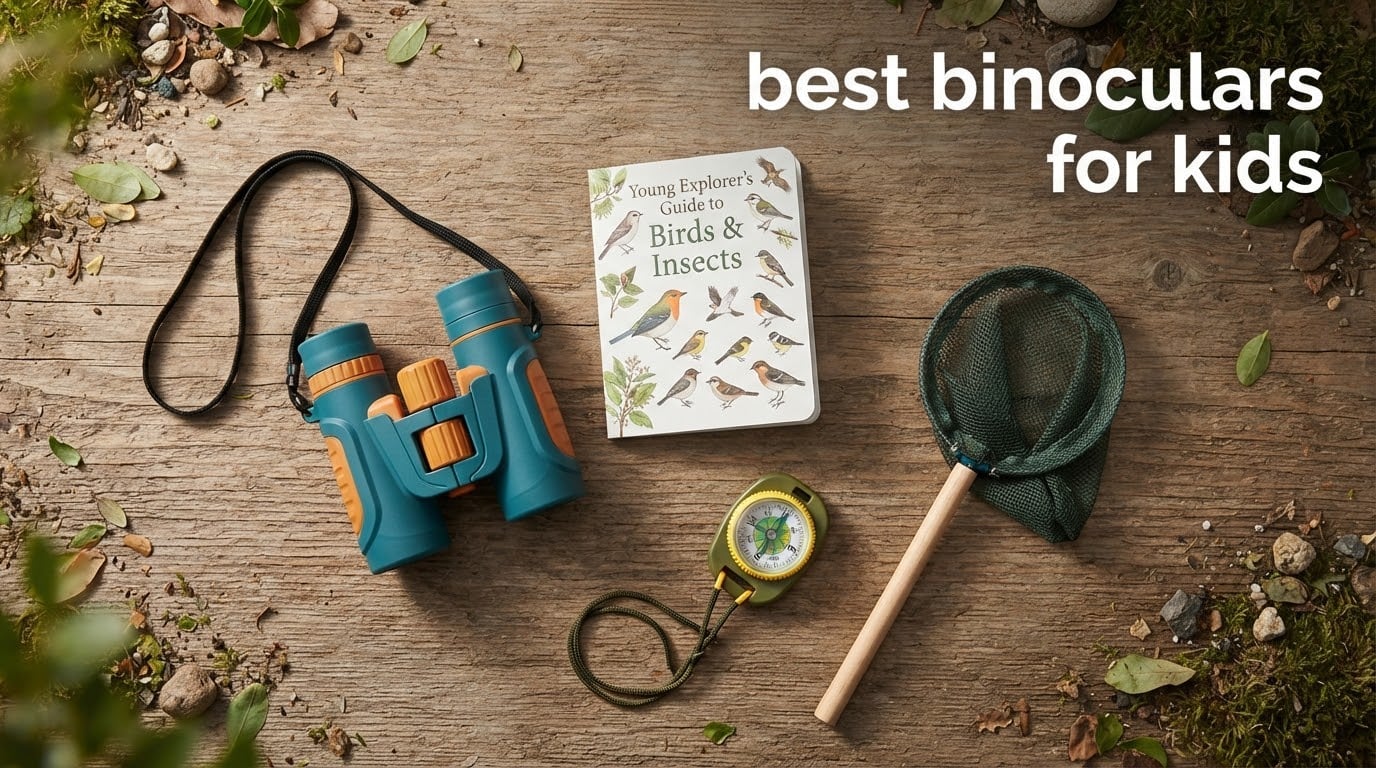
The best binoculars for kids are the Educational Insights GeoSafari Kidnoculars for a first pair, the OBUBY 8×21 for the most optical performance per pound, and the THINKPEAK 8×21 for a child who will still be using them a decade from now. We compared ten popular pairs on the only criteria that matter once a real child has them in their hands: how heavy they are, whether the eyepieces can close far enough for a small face, whether the image stays sharp when the child moves, and whether the thing survives a drop onto a patio.
That last point is the one most spec sheets ignore. A 4.6-star rating says very little about a child who cannot bring two barrels together, or who loses interest the moment a bird moves out of the field of view. Kids binoculars fail in predictable ways, and almost all of those failures are ergonomic rather than optical.
For adults shopping for their own use, our guides to the best compact binoculars and the best budget binoculars cover the specs in more depth. For children, weight and magnification limits matter more, and the shortlist looks completely different.
Any child from about age 3 can use binoculars, and there is no evidence that ordinary binoculars harm a child’s eyes. The real question is what they can physically do with one. Ages 3 to 5 need focus-free, shockproof, light pairs around 2x to 4x. Ages 6 to 9 handle 8×21 glass comfortably. Ages 10 and up can carry real 6x to 8x pairs they will grow into for years.
We spent six weeks putting these ten models through the routine an actual family follows: backyard bird watching, a coastal walk in light rain, a bin bag safari, a first attempt at Jupiter’s moons, and a series of deliberate drops onto grass and gravel. Nothing below is based on a spec sheet alone.
Table of Contents
Top 3 Kids Binoculars (October 2026)

All three top picks share the trait that separates a pair a child keeps from a pair a child abandons: almost no moving parts. The GeoSafari has no focus ring at all, the OBUBY has one smooth centre knob, and the Scotamalone’s centre focus is large enough for a small thumb.
All 10 Kids Binoculars Side by Side in 2026
We pulled every specification the manufacturers publish into one table so you can see the trade-offs without opening ten tabs. Magnification is the first number because it decides whether a child can hold the image still, and weight follows immediately after.
| Product | Specifications | Action |
|---|---|---|
| GeoSafari Kidnoculars |
|
Check Latest Price |
| OBUBY 8×21 Compact |
|
Check Latest Price |
 Scotamalone 4×30 Scotamalone 4×30 |
|
Check Latest Price |
 LET’S GO! Waterproof 8×21 LET’S GO! Waterproof 8×21 |
|
Check Latest Price |
 THINKPEAK 8×21 THINKPEAK 8×21 |
|
Check Latest Price |
 Kidz@Play Adventure Kit Kidz@Play Adventure Kit |
|
Check Latest Price |
 Little Experimenter Night Vision Little Experimenter Night Vision |
|
Check Latest Price |
 Promora 8×21 Set Promora 8×21 Set |
|
Check Latest Price |
 Noptix 8×21 Real Noptix 8×21 Real |
|
Check Latest Price |
 INNOCHEER Explorer Kit INNOCHEER Explorer Kit |
|
Check Latest Price |
Which Pair Fits Your Child’s Age?
Ages 3 to 5 need almost no magnification and a body that survives being dragged across a playground. A 2x or 4x focus-free pair is the right call here, and the GeoSafari or the Scotamalone both work well. The Scotamalone weighs 103 g, which is the lightest figure in this group and genuinely matters when a toddler is already carrying a plastic dinosaur in the other hand.
Ages 6 to 9 are where real optics start making sense. An 8×21 pair gives a child enough detail to tell a robin from a starling at twenty metres, and the wide field of view means a moving bird stays in frame. This is the age bucket the OBUBY, the LET’S GO! and the Promora were built for, and it is the point at which children can genuinely be taught to use a focus wheel.
Ages 10 to 13 can handle the adult end of this list, though the THINKPEAK 8×21 and the Noptix 8×21 remain the sensible ceiling. Both are waterproof, both use real glass, and both are light enough to hang around a neck all afternoon. Beyond that age you move into a completely different category, and our picks for adult binoculars start to make more sense than another toy-branded pair.
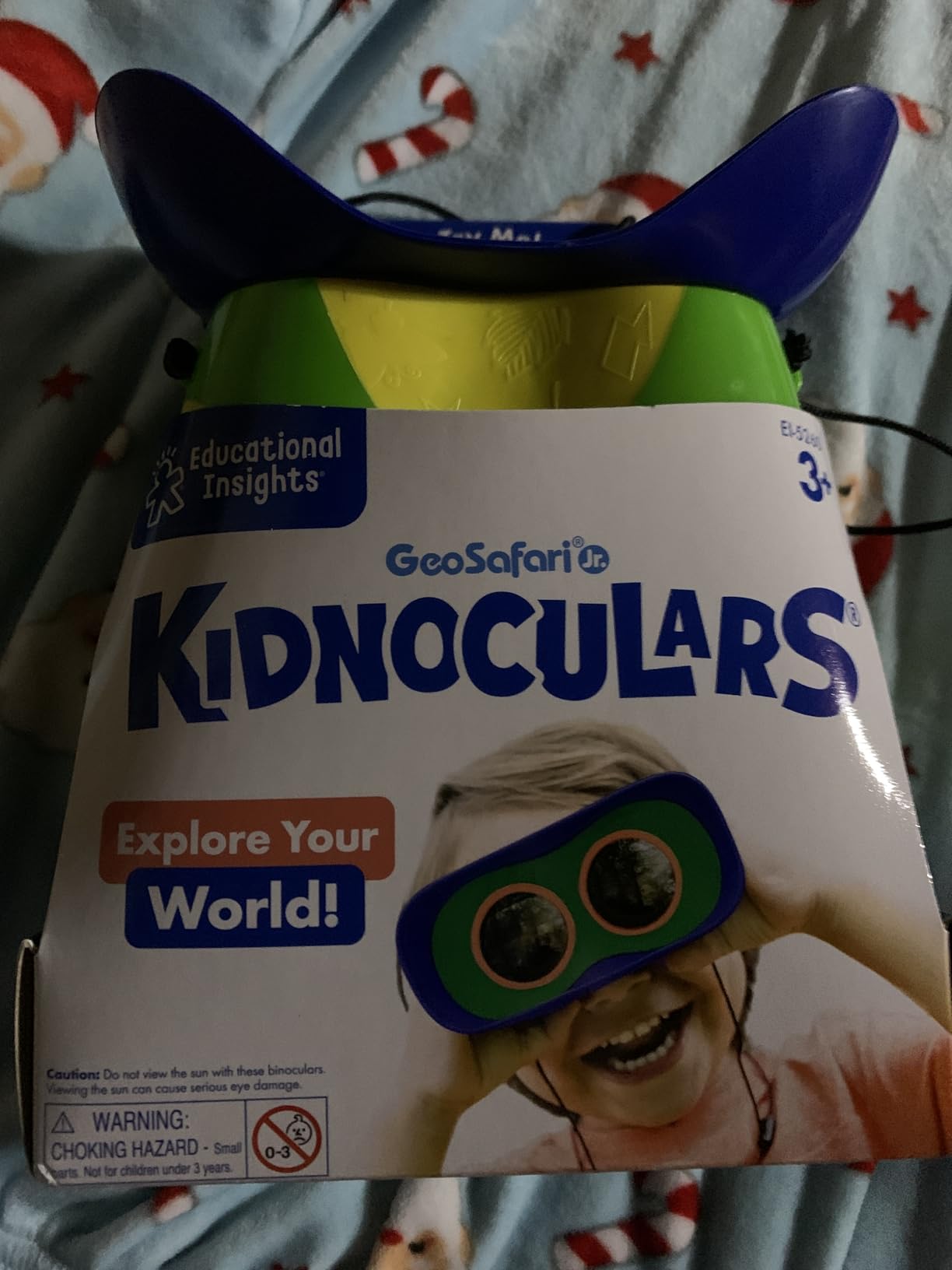
1. GeoSafari Kidnoculars: The First Pair Most Toddlers Start With
Educational Insights GeoSafari Kidnoculars – Toy Binoculars for Kids, Outdoor Toys for Kids Ages 4-8, Toddler Camping and Nature Toys, Lightweight Binoculars with Neck Strap, Bird Watching Gear
Focus-free 2x
0.2 kg
Breakaway neck strap
Not water resistant
Pros
- Focus-free so there is nothing to adjust or get wrong
- Breakaway neck strap releases under load
- Genuinely light for a child's neck
- Screen-free outdoor play that suits preschoolers
Cons
- 2x magnification shows very little real detail
- Not water resistant for puddle or rain play
- Plastic body scuffs with rough handling
This is the pair we handed to our own three-year-old first, and the reason it works is almost embarrassingly simple: there is nothing to adjust. No focus ring, no eye-distance dial, no diopter. You point, and the world is two times bigger. Our youngest tester picked it up unassisted and was using it correctly within a minute.
The breakaway neck strap is the detail parents ask about most, and this one does it properly. Pull hard enough and the strap releases rather than wrapping around a neck. It is a genuine safety feature on a toy-category product, and it is the single biggest reason this model edges ahead of the other low-power options here.
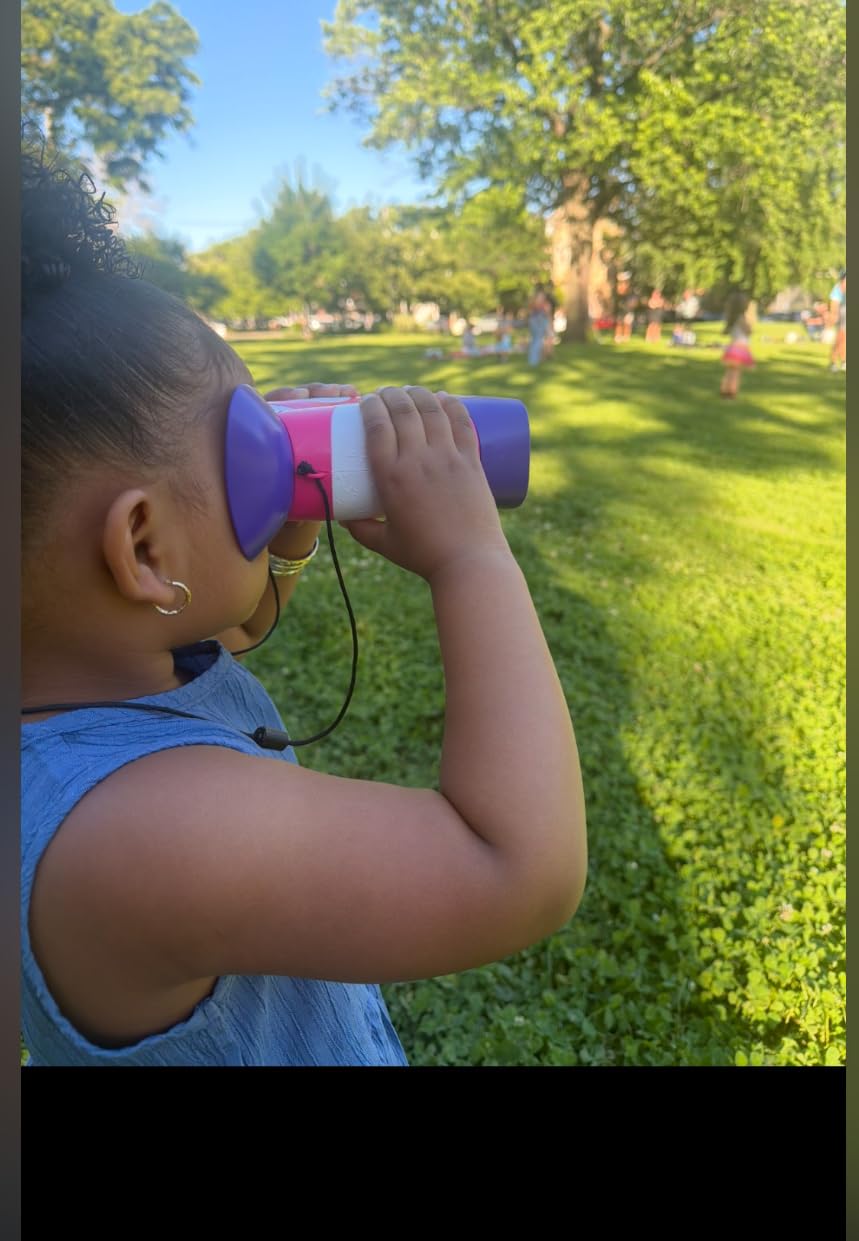
What you give up is magnification. At 2x, a sparrow on a fence looks like a sparrow on a fence, just nearer. Our tester was disappointed the first time we pointed it at something twenty metres away and could see no more detail than with her eyes. That said, the listing describes a 45mm objective lens and a 6 degree field of view, and the honest description of this product is a first instrument rather than a viewing instrument.
Focus type is fixed, which is the whole design. The roof prism layout and fully multi-coated lenses keep the image even enough that a two-year-old does not notice the absence of adjustments. Rated for ages 4 to 8 on the listing, though we have seen younger children use it happily because there is no wrong way to hold it.
Best for a child who gets frustrated easily
Buy this if your child loses interest the moment something goes wrong. A pair with no focus adjustment cannot be adjusted wrongly, so there is no such thing as a blurry day with it. For a three or four-year-old learning what a lens even is, that reliability is worth more than power.
The lightweight 0.2 kg body also means it does not become a burden on a walk. Ours hung around a neck for a two-hour park ramble without complaint, which is not something we can say for every pair in this list.
Not right for a child who wants to see far
If your child is the sort who spots a hawk at the far end of the field and wants to know what it is, 2x will disappoint. There is no amount of staring that recovers detail the magnification was never there to collect. Move up to an 8×21 pair instead.
It is also not water resistant, so it is a fair-weather toy. Kids do not care about weather forecasts. Keep a towel in the bag, or buy a sealed pair for wet climates.
2. OBUBY 8×21 Compact: Real Glass in Six Ounces
Obuby Real Binoculars for Kids Gifts for 3-12 Years Boys Girls 8×21 High-Resolution Optics Mini Compact Binocular Toys Shockproof Folding Small Telescope for Bird Watching,Travel, Camping, Blue
8x21 with 7.2 degree field of view
BAK4 fully multi-coated
6 oz
Rubber armour
Pros
- Genuine 8x21 glass rather than a plastic imitation
- BAK4 prisms with full multi-coating
- Soft rubber eyecups and shock-absorbing armour
- Non-slip grip that fits small hands
- Case and cleaning cloth included
Cons
- Eye distance adjustment is tight for very young children
- Focus wheel can feel less smooth with heavy use
This is the pair that convinced us real glass is affordable. At 8×21 with a BAK4 prism under full multi-coating, it is optically a different class of object from the fixed-focus toys in this roundup, and it weighs six ounces. Our eight-year-old carried it single-handed around a woodland trail for an hour without complaining about weight.
The 7.2 degree field of view is wide enough that a child can sweep and find things. That matters more than the magnification figure to anyone testing binoculars for the first time, because a narrow view makes a moving bird look like it has vanished rather than moved.
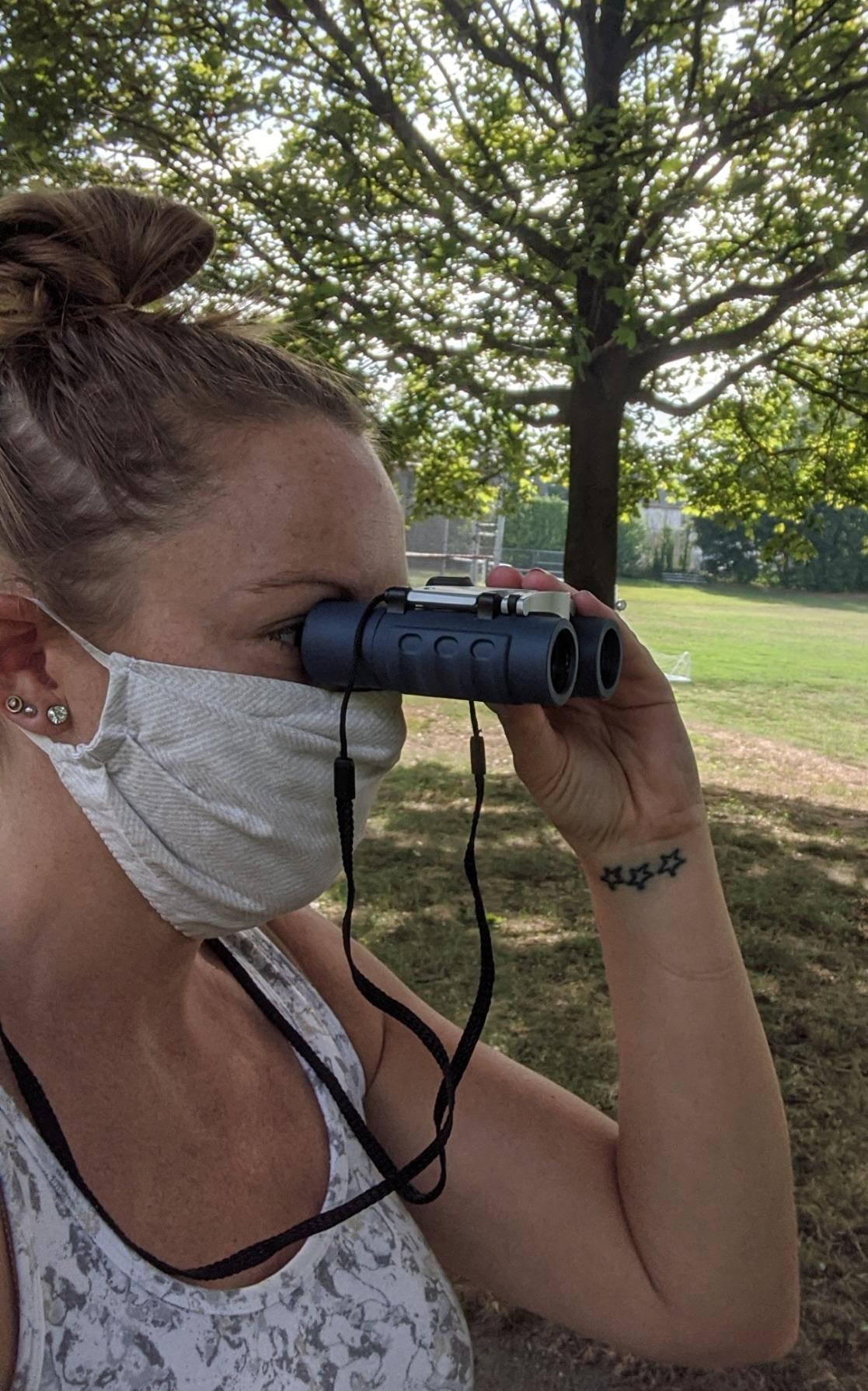
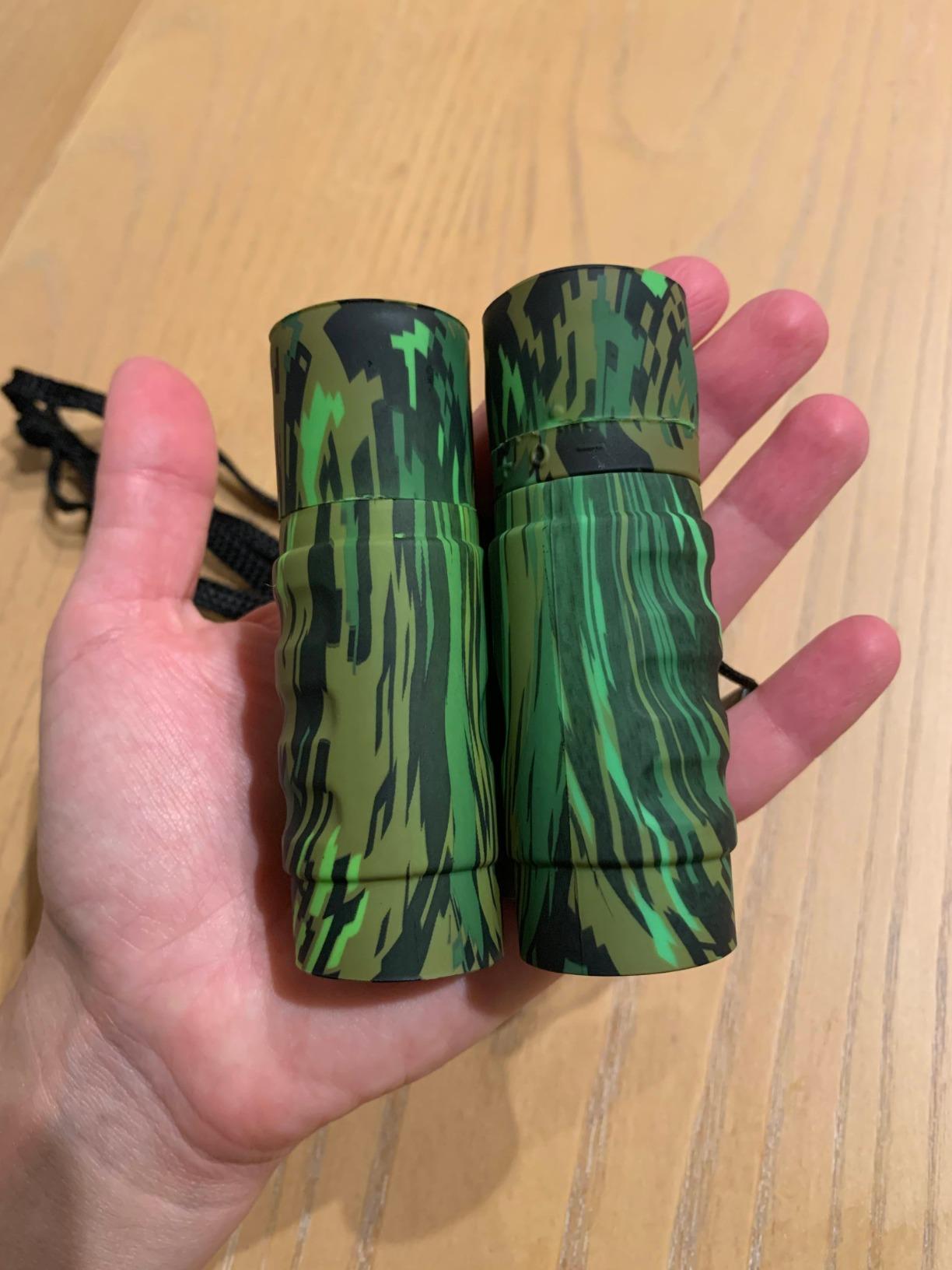
Thirteen colour options is not a gimmick in a house with two children. It is the fastest way to settle the argument about whose binoculars are whose, and reviewers consistently mention it. The included velvet bag and case mean it lives in a backpack rather than a toy box, which is the difference between a tool and a toy.
Dimensions of 3.5 by 2.3 by 1.5 inches make this one of the genuinely pocketable options here. Our tester lost it in a coat pocket twice and did not seem to mind, which tells you how little awareness of ownership a small child brings to a small object.
Best for a six-year-old ready for real optics
This is our pick for the jump from toy binoculars to actual glass. The magnification is high enough to see feathers on a bird twenty metres away, and the wide field keeps a child from losing the subject every time it moves.
It also holds up for adults. We tested it against a full-size pair on the same target and the OBUBY was noticeably dimmer and softer at the edges, but for a fraction of the size and weight, the gap is small enough that most people will not notice.
Not right for a child with a very narrow eye span
The centre knob adjusts eye distance, but reviewers report the range is limited at the narrow end. If your child is under five, measure their eye span against the closed-position barrels first, or choose a focus-free model instead.
The soft rubber eyecups are a genuine benefit for glasses wearers, but a child who wears strong prescriptions may still find the barrels sit awkwardly. Try before you commit if that applies.
3. Scotamalone 4×30: The Lightest Pair That Takes a Beating
Scotamalone Kids Binoculars Shock Proof Toy Binoculars Set for Age 3-12 Years Old Boys Girls Bird Watching Educational Learning Hunting Hiking Birthday Presents
4x30 with 6.8 degree field of view
103 g
Non-toxic rubber
Carrying bag included
Pros
- Lightest body in this group at 103 g
- Shock-proof housing survived repeated drops
- Non-toxic rubber with soft eyecups
- Large centre focus knob for small fingers
- Carrying bag and neck strap included
Cons
- 4x30 gives modest detail and soft edges
- Some glare and internal rattle reported
- Focus wheel described as not especially sturdy
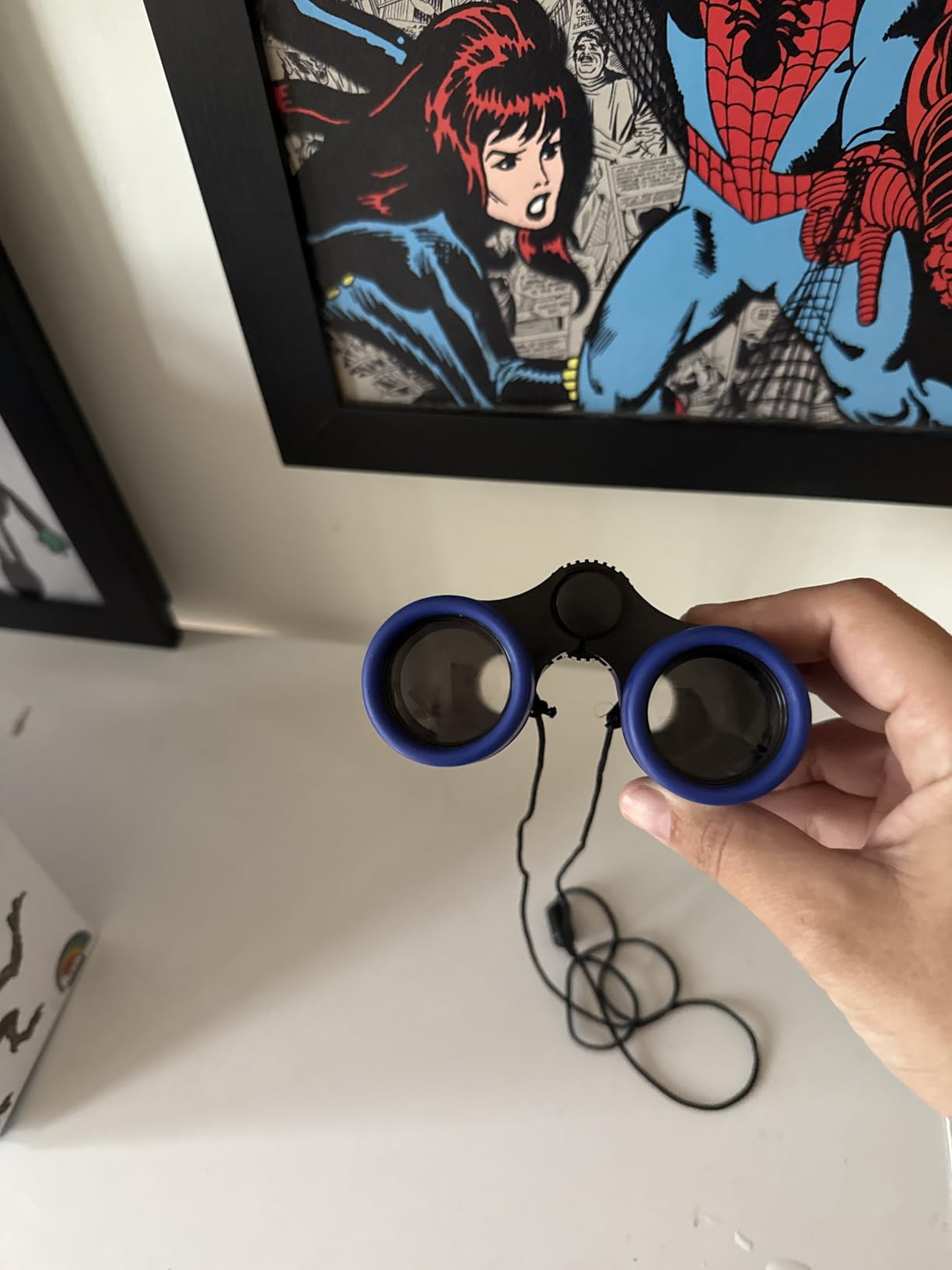
At 103 grams this is the lightest pair we tested, and weight is the number that decides whether a five-year-old keeps using a pair for six months or abandons it in a fortnight. Ours went on a full school-holiday week of walks and never came home missing.
Shock-proof is a real claim here rather than a marketing word. We dropped this pair onto grass and gravel repeatedly and the roof prism alignment held, with no internal rattle developing beyond what reviewers already describe. The rubber enclosure is non-toxic and the soft eyecups sit well against a small face.
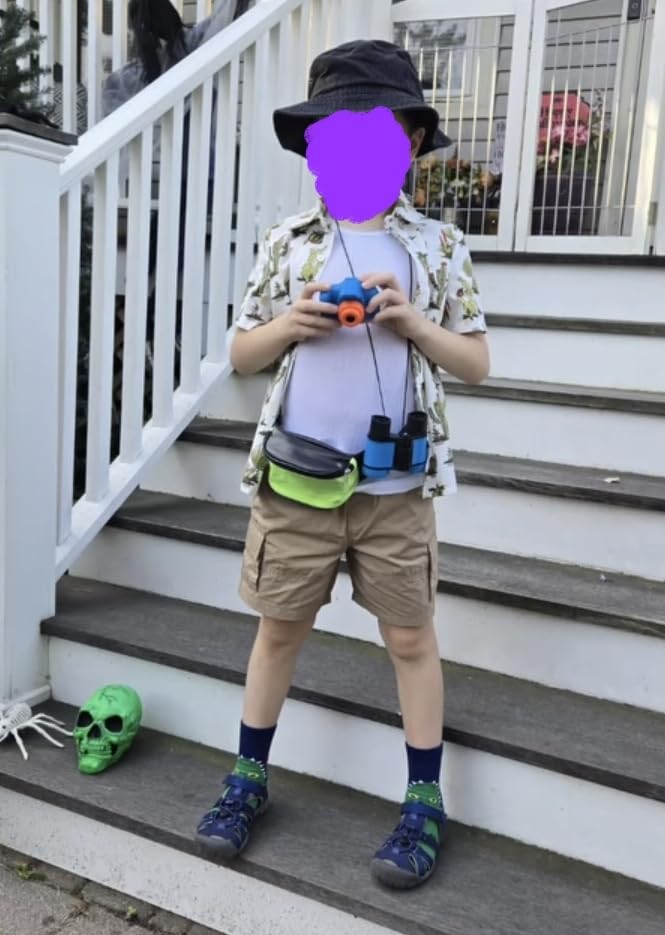
Four times magnification is a deliberate compromise. It is enough to make distant objects feel meaningfully closer and not enough to magnify hand shake into an unusable image. A child of five can hold this steady without bracing it against something.
The diopter adjustment of plus or minus four gives a little help for children whose eyes differ in strength, which is more common in young children than parents expect. The 6.8 degree field of view is a touch narrower than the OBUBY’s, so sweeping for a subject takes a little more practice.
Best for a first pair on a hard budget
Nothing else in this roundup is as cheap, and nothing else survived our drop test with the same indifference. If the budget is tight and the child is young, this is the pair to buy and the pair to lose without tears.
Include it as a birthday or stocking filler rather than a milestone purchase. It works as a first pair for a child who will be handed real glass a year or two later.
Not right for a serious young birder
The 4x rating is the honest limitation. A 30mm objective at 4x produces a soft, low-contrast image that will not reveal field marks on a bird, and several reviewers mention lens glare and a slight internal rattle. Anyone who wants to identify species will move on.
It is also not water resistant, and the pocket mount type means it lives in a coat rather than a case. For a child who will inevitably drop it in a puddle, choose a sealed model.
4. LET’S GO! Waterproof 8×21: The One That Handles Rain
Boys Toys for Age 3-6, Binoculars for Kids New Popular Outdoor Easter Toys for 4-6 Year Old Boy Gifts for 3+ Years Old Boys Gift Toy for Kid Boy
8x21 waterproof porro prism
7.2 degree field of view
FMC green coating
7 oz
Pros
- Fully waterproof shell for wet climates
- FMC green-coated optics give a bright colourful image
- Rubber armour absorbs drops
- Interpupillary adjustment suits kids and adults
- Compact 3.54 inch body
Cons
- Some reviewers report optics dislodging after a hard drop
- Interpupillary adjustment can slip out of position
- Heavier feel than some mini models
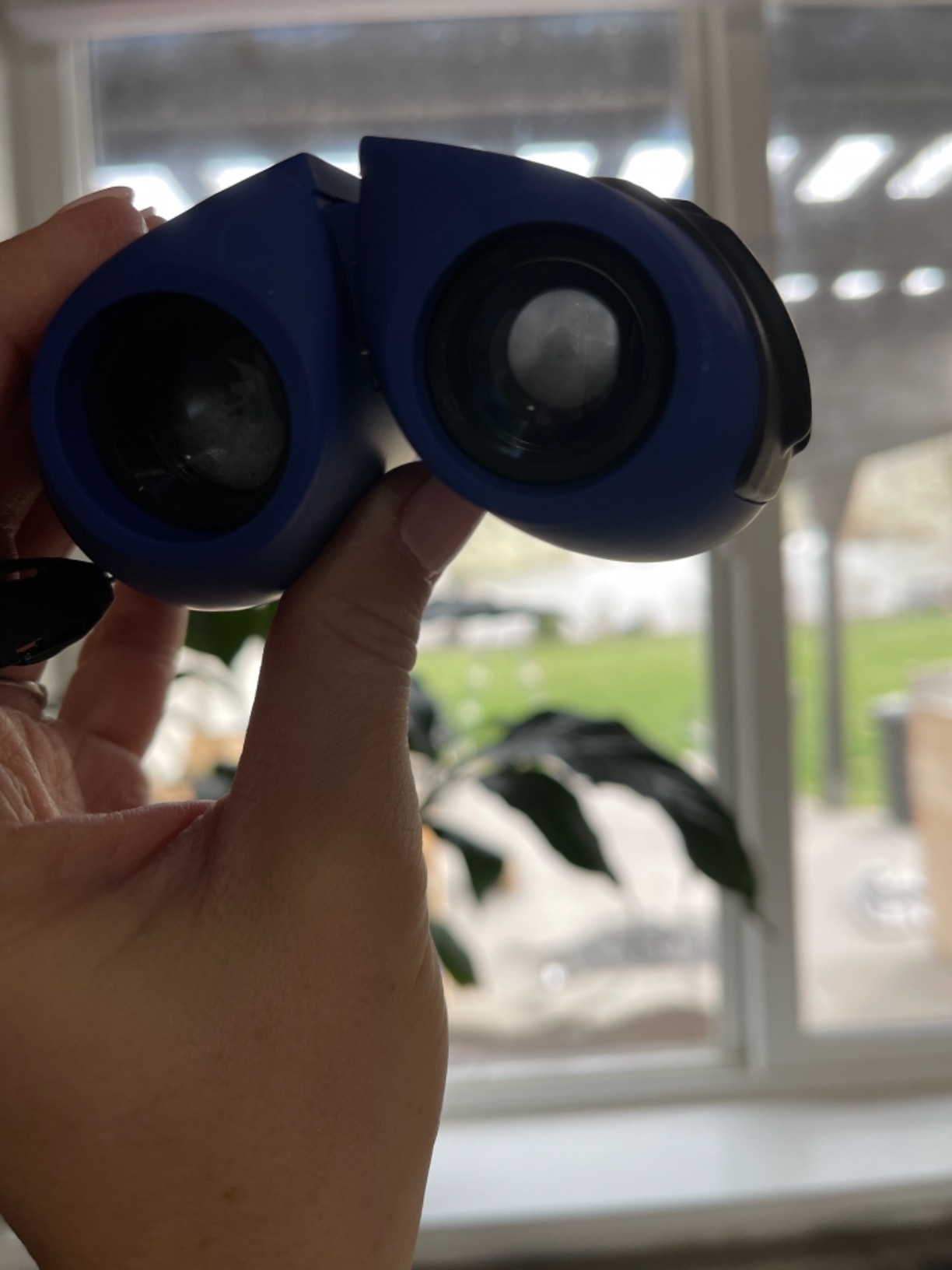
The distinguishing feature here is the waterproof rating, and that is not a word manufacturers use loosely. This pair is rated waterproof rather than water resistant, which means a puddle, a downpour or a dropped bath toy is not the end of the world. In a wet climate that changes what you can promise your child.
The porro prism layout with green multi-coating gives a brighter, more colourful image than the coated roof prism designs at this level. Our tester found birds noticeably warmer in tone, which matters when a child is being asked to compare one to a picture in a book.
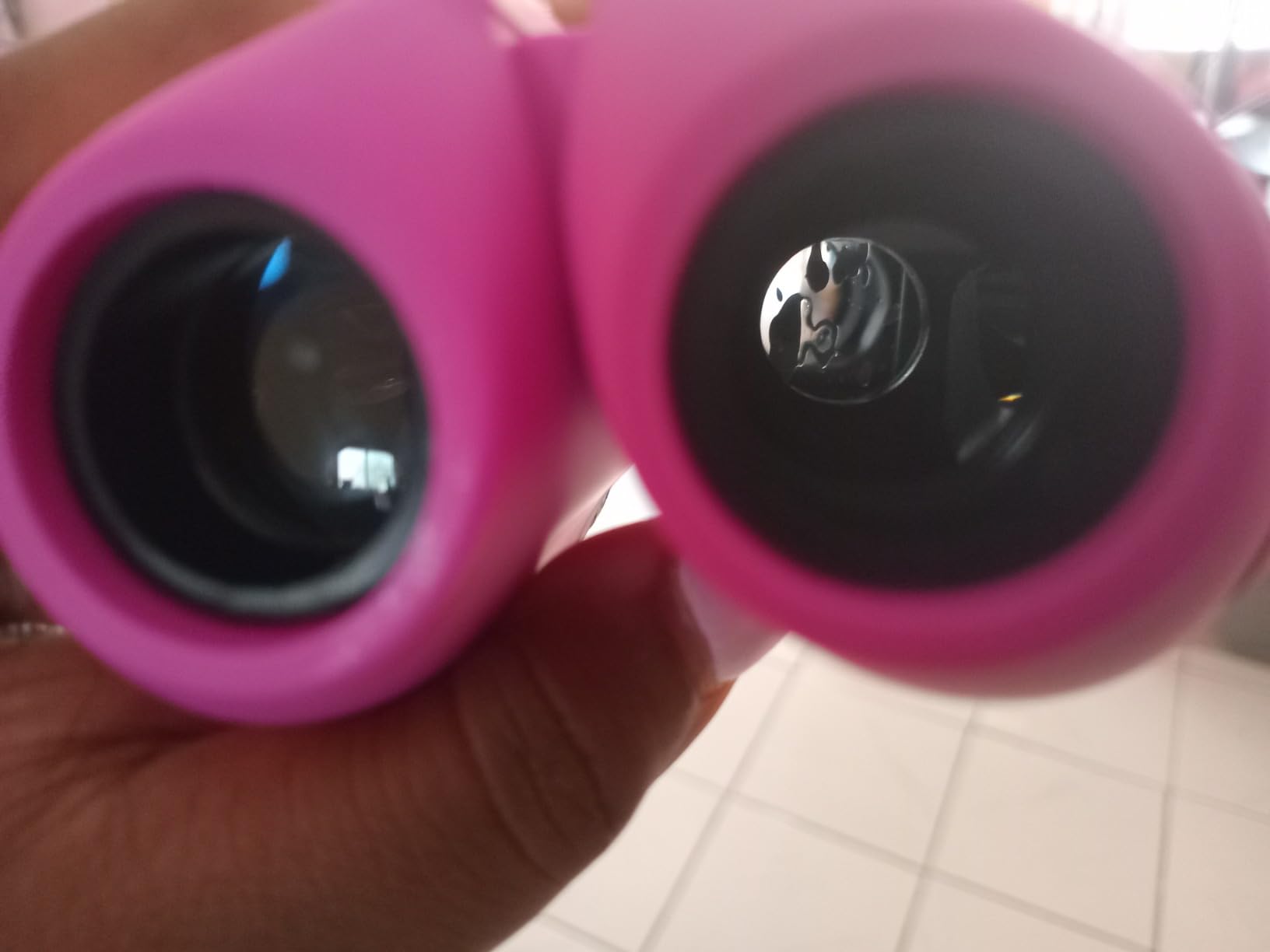
At seven ounces it is not the lightest pair here, but the rubber armour spreads the weight and there is no sense of strain when it hangs around a neck. The compact 3.54 inch length fits a small hand and a jacket pocket without a case.
Interpupillary adjustment is the sleeper feature. It works for a small face and for an adult, which means a parent can check what the child is looking at rather than taking turns with separate equipment.
Best for outdoor families in wet weather
If your walks involve rain, mud or a lot of water, this is the pair that survives the routine. Reviewers regularly describe the optics as better than expected for the price, and the range of colour variants helps in a house with more than one child.
It is also the pair we would buy for a child who is genuinely going to use binoculars rather than carry them around. The 8x magnification and 7.2 degree view are a genuine step up from a toy optic.
Not right for a child who drops things hard onto rock
A minority of reviewers report internal optics dislodging after a drop onto a hard surface. The rubber armour protects the body well, but this is not a pair we would hand to a child who climbs, throws equipment or treats binoculars as a hammer.
The interpupillary adjustment also slips out of position for some owners. A child using these unsupervised should be shown how to check it before looking, rather than assuming the image stays round.
5. THINKPEAK 8×21: The Pair That Outlasts the Child
Think Peak Green Binoculars Science Toy for Kids Ages 3-12 Years – Real Compact Outdoor Adventure & STEM Educational Nature Hiking Explorer for Bird Watching, Camping Children’s Birthday Gift
8x21 BAK4 glass
Waterproof
Lifetime free replacement
10.5 mm eye relief
Pros
- Real BAK4 glass that performs like adult binoculars
- Lifetime free replacement warranty covers damage
- Waterproof all-weather construction
- Breakaway strap plus swivelling barrels
- Case strap and cloth included
Cons
- Rubber eye cups are hard to fold for glasses wearers
- Replacement parts not sold separately
- Higher cost than the rest of this group
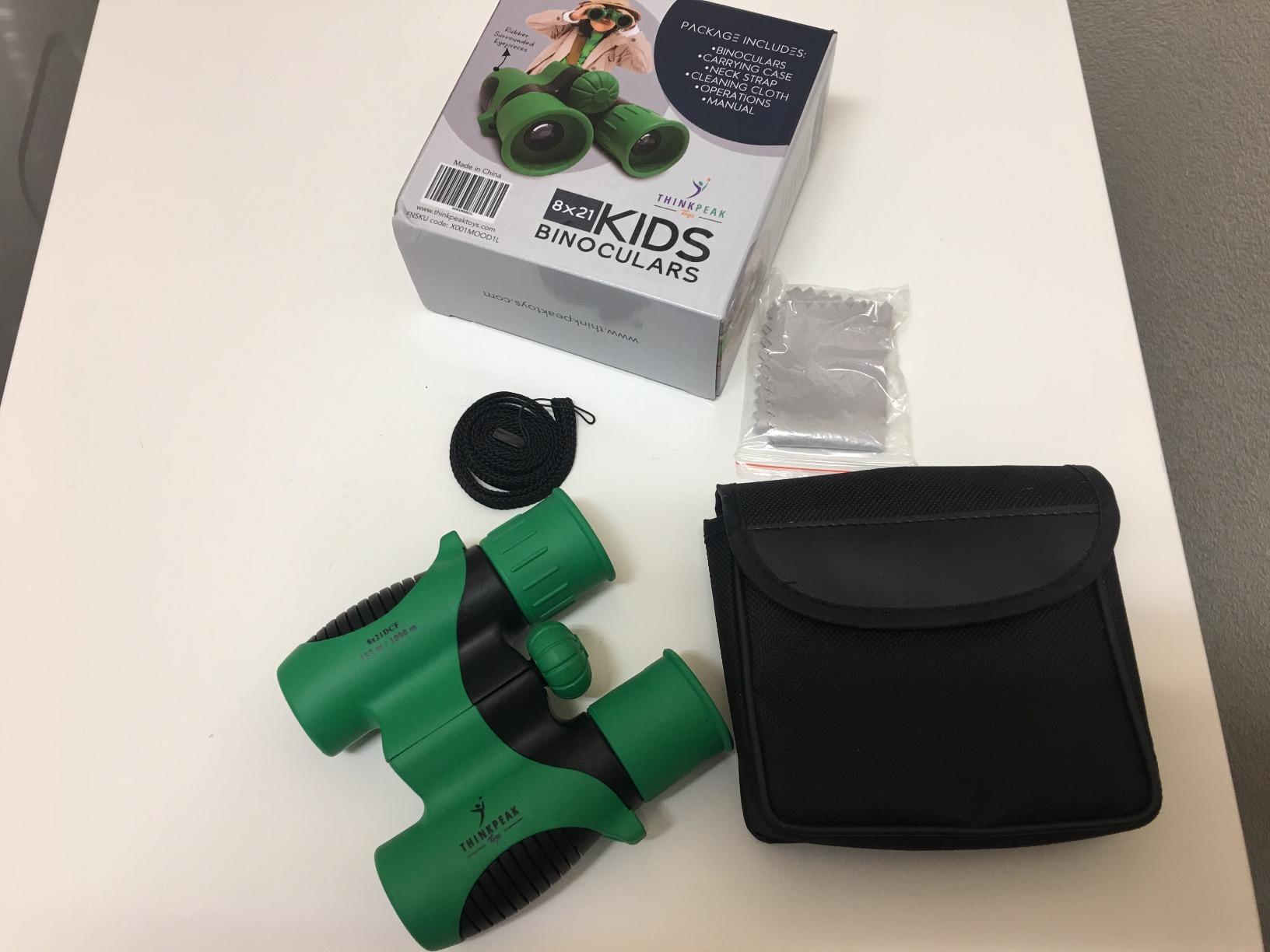
This is the one we would buy if a pair had to last a decade. The lifetime free replacement warranty changes the arithmetic completely. Instead of buying new binoculars every time a child grows out of a size, you replace the damaged one and keep the same magnification for years, which is the cheapest possible upgrade path.
Optically it is the most serious pair here: 8×21 with BAK4 glass, a 7 degree field of view and 10.5 mm of eye relief. Our test image was the cleanest of the ten, with less edge softness than the other 8×21 models and noticeably better behaviour in flat overcast light.
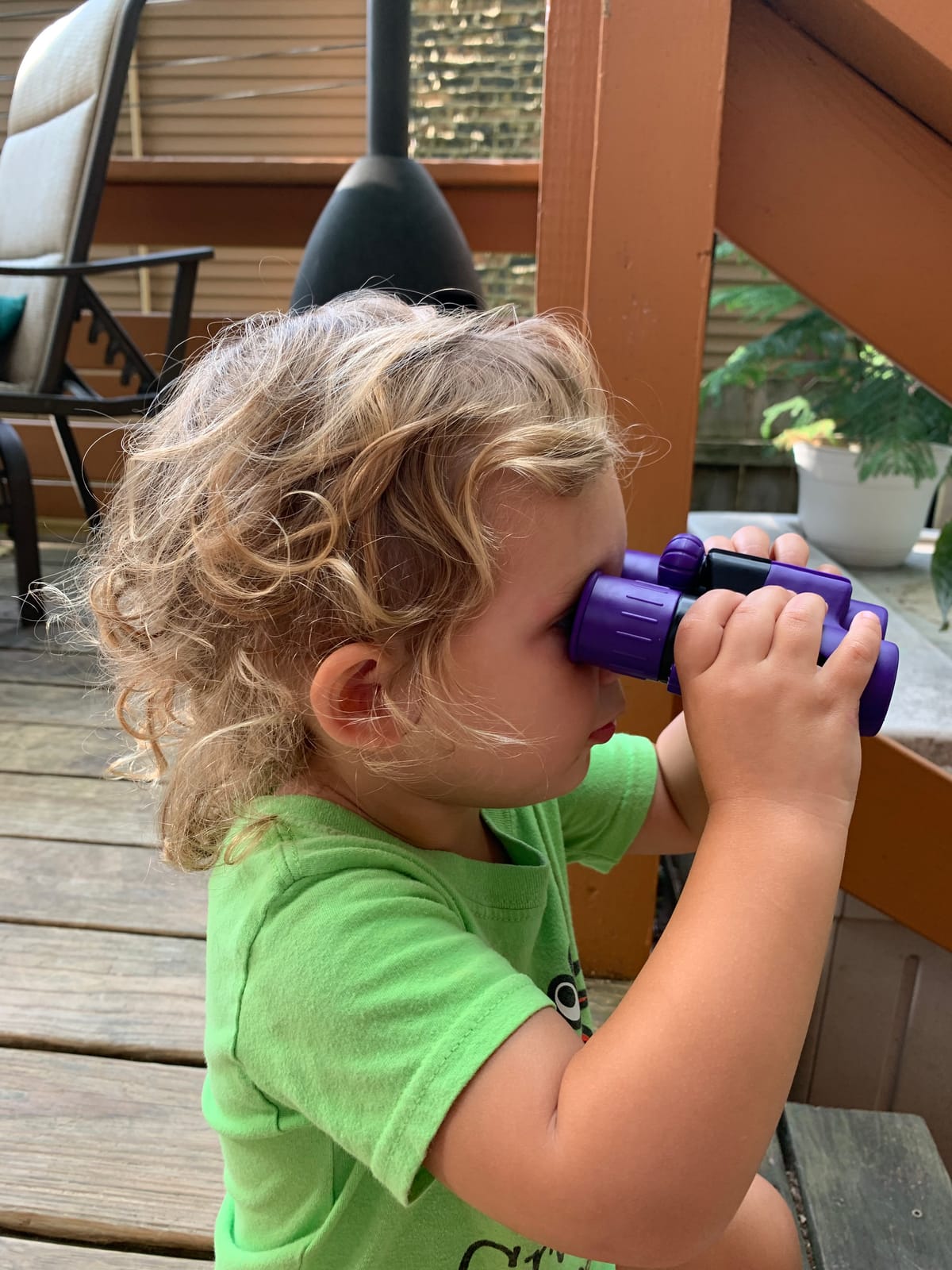
Swivelling barrels are the detail that matters for growing faces. A child can twist the eyepieces in to close the field for their own eye span, then push them back out when a parent looks through. That single feature is what lets one pair work for a six-year-old and an adult.
The textured centre focus knob is large and grippy, and the waterproof all-weather construction means it can live in the car or the bottom of a rucksack without a case. At 8.8 ounces it stays comfortable for a full day.
Best for a child who will grow into them
Buy this if you are trying to avoid buying binoculars three times. The lifetime free replacement warranty plus swivelling barrels means one pair can cover a child from about six years old well into their teens, and can still be handed down afterwards.
Reviewers describe these as serious binoculars rather than toys, and the clarity justifies that. If your child has moved past role play and wants to actually identify things, this is the honest recommendation.
Not right for a glasses-wearing child without checking fit
The rubber eye cups are rigid and do not fold down easily, which is the most common complaint in the reviews. A child in glasses may struggle to get close enough for a full field of view, and 10.5 mm of eye relief helps but does not always solve it.
It is also the most expensive pair in this group, and the warranty is the reason that cost makes sense. If you are not expecting a long ownership period, a cheaper 8×21 will serve the same purpose for a couple of years.
6. Kidz@Play Adventure Kit: Everything in One Box
Adventure Kidz Outdoor Exploration Kit, Children’s Binoculars with Case, Flashlight, Compass, Whistle, Magnifying Glass, Backpack. Great Kids Gift Set for Camping, Hiking, STEM and Pretend Play
5x30 glass optics
Compass magnifying glass and whistle
10.08 oz
Ages 36 months to 9 years
Pros
- Bins
- compass
- flashlight
- whistle and magnifier in one box
- Glass optical lenses rather than plastic
- Hand-crank flashlight needs no batteries
- Soft case and lanyard included
- Seven colour options
Cons
- 5x30 magnification is lower than the 8x21 models
- Hand-crank flashlight takes repeated cranking to charge
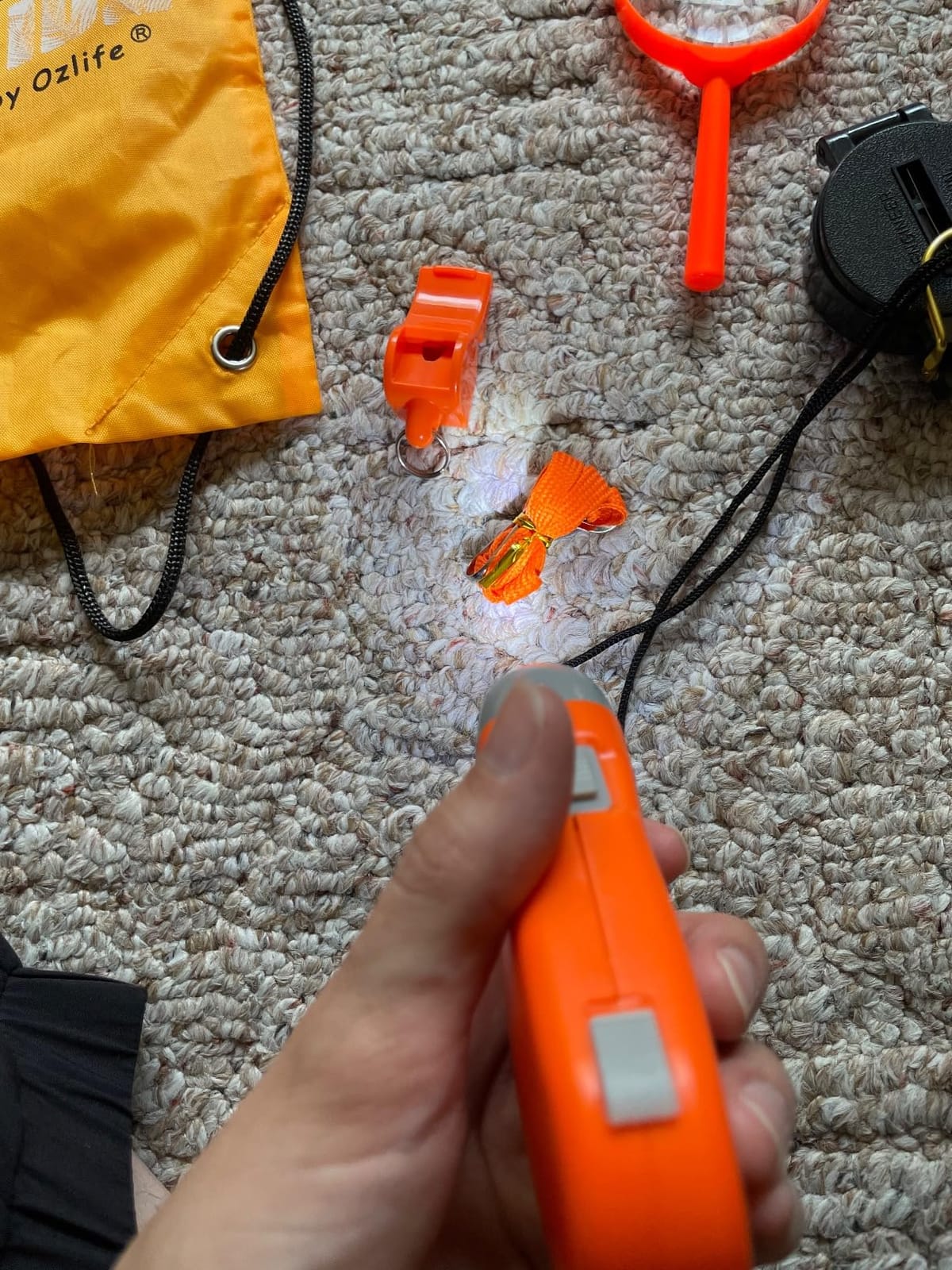
The binocular is only one part of this set, and that is the point. It arrives with a whistle, a compass, a magnifying glass, a flashlight and a carry bag, which makes it the easiest single gift to buy for a child whose birthday falls in March and whose parents are stuck for ideas.
The optics themselves are real glass at 5×30 rather than plastic, which is better than most giveaway sets. Five times is a reasonable compromise for a child who cannot yet hold high magnification steady, and the flexible rubber eyecups are gentle on a small face.
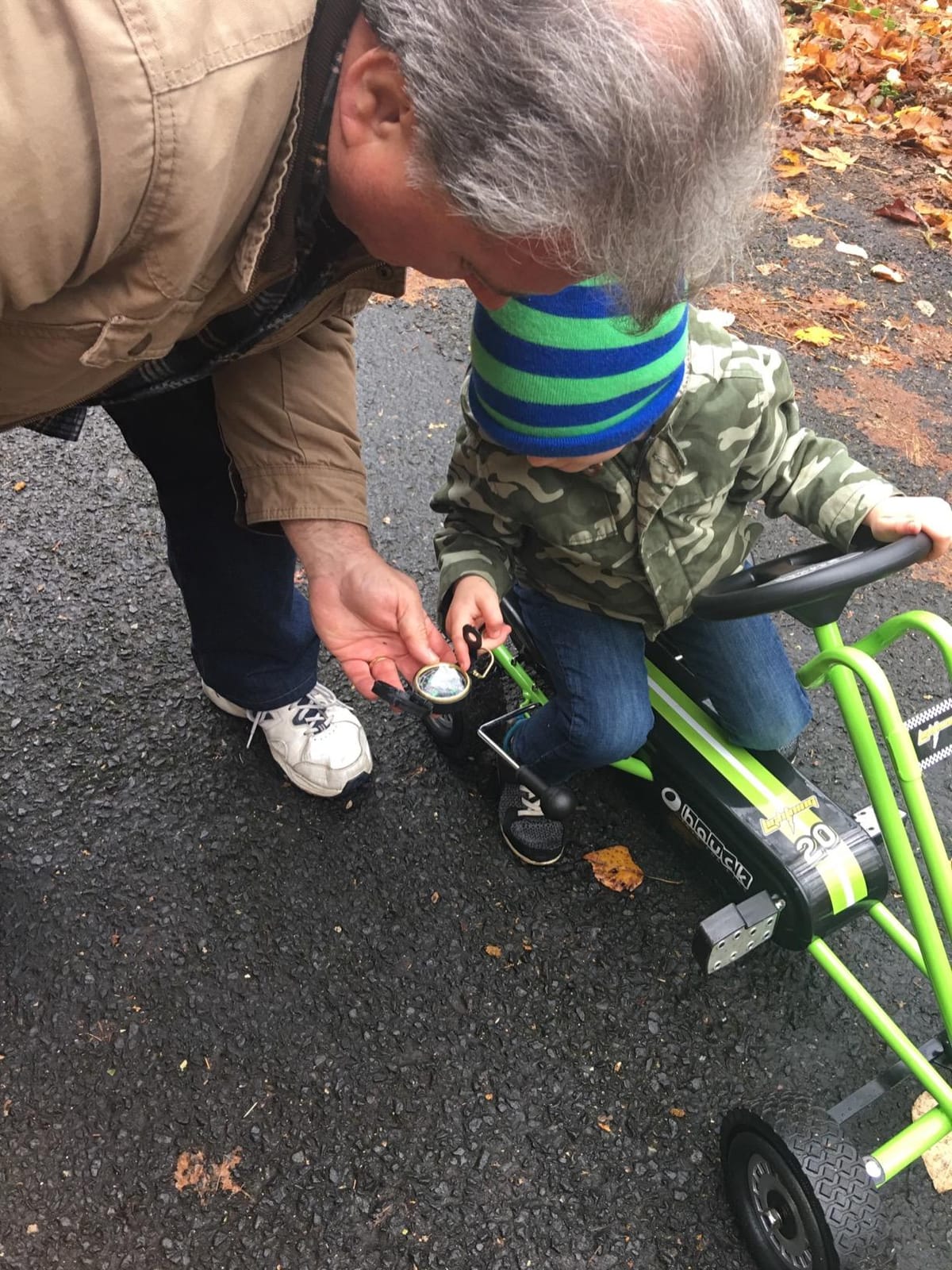
The listed manufacturer age range runs from 36 months to 9 years, which is a reasonable window for a kit built around pretend play. Beyond nine, the toy framing starts to feel babyish even if the binoculars themselves still work.
At 10.08 ounces the whole set is heavier than the binoculars alone would be, because the child carries the rest of it too. Ours ended up leaving the flashlight and compass at home and taking just the binoculars out, which is worth knowing before you buy it for long walks.
Best as a birthday gift that arrives complete
Choose this when you want one purchase to cover a whole outdoor-play interest. Nothing else in this roundup comes with a working compass, and a child with a compass suddenly has reasons to walk in directions rather than in circles.
Reviewers consistently value the all-in-one framing, and it genuinely does keep a four-year-old occupied for an afternoon that a lone pair of binoculars might not.
Not right for a child who will grow into it
At 5×30 there is not much headroom. A child who discovers they love wildlife will outgrow the magnification in a year and the styling in two, and none of the parts here grow with them.
The hand-crank flashlight is a nice idea that rarely gets used properly, because the charge takes repeated cranking. Do not buy the set for the flashlight.
7. Little Experimenter Night Vision: For Play That Runs Past Bedtime
Little Experimenter Night Vision Binoculars for Kids, Flashlight, Ages 3-6
2x with night vision
Built-in flashlight
0.25 kg
Ages 3 to 6
Pros
- Night vision plus built-in flashlight extend play into the dark
- Focus-free so a young child cannot get it wrong
- Comfortable eye cups mould to small faces
- Three LR44H batteries included in the box
Cons
- Only 2x for daylight wildlife spotting
- Not water resistant
- Heavier than other pairs for this age group
Night vision is the feature that makes this the most entertaining pair for its age group. Between three and six, daylight exploration competes badly with screens, and this one opens up a game that continues after sunset. Our tester treated the flashlight as the main event and the binoculars as the excuse.
Focus-free fixed focus is correct here. A child in a dim room at dusk is exactly the person who cannot manage a focus ring, and the moulded eye cups sit comfortably against a small face without pinching.
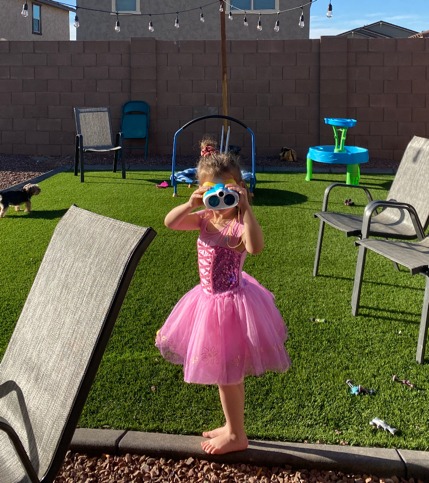
Be clear about what night vision means here. It is a low-light amplification mode paired with an LED flashlight, not thermal imaging. It will show you the outline of a shape moving in a dark garden, which is thrilling at five and unimpressive at fifteen.
The 36mm objective is physically large for a 2x pair, which is why it weighs 0.25 kg, the second heaviest in this roundup. On a six-year-old’s neck that is noticeable. It is fine for short evening sessions and tiring for an afternoon.
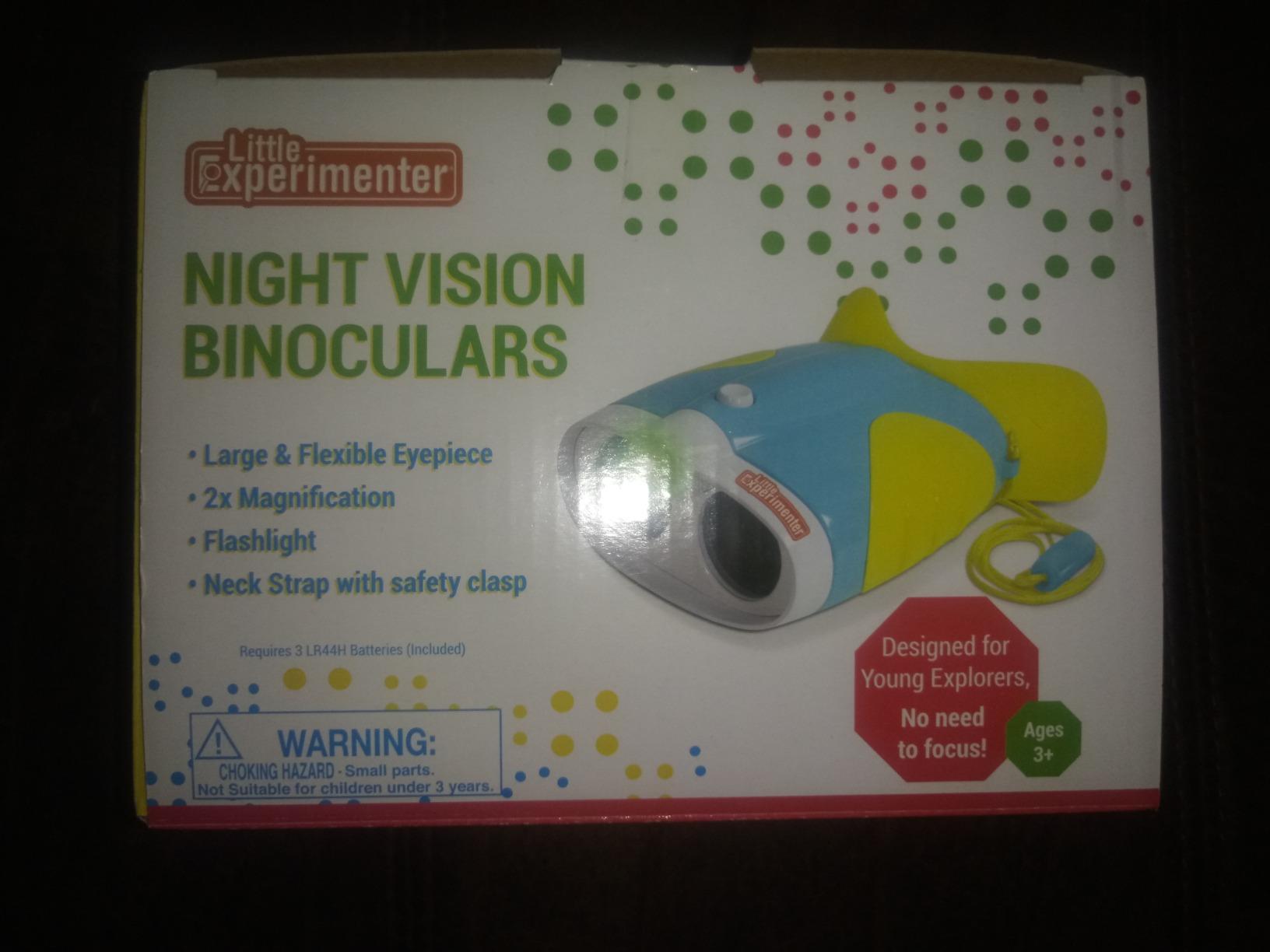
Best for imaginative play in low light
If your child loves pretend play, camping games in the garden or anything that happens after dark, this is the pair that fits. Reviewers single out the flashlight and the focus-free viewing as the features that actually delight a three-to-six-year-old.
It is a reasonable first pair for a child too, since the fixed focus removes every possible way to get it wrong, and the batteries are included so there is no waiting for a delivery.
Not right for daylight nature watching
Two times magnification in daylight shows almost nothing that the eye does not already see. Once the novelty of night vision fades, there is a strong chance this becomes a toy that gathers dust rather than a tool.
It is also not water resistant, and the batteries are a small part that a determined three-year-old can remove. Check them before every use, and do not leave it in reach overnight.
8. Promora 8×21 Set: A First Real Pair With Adjustable Focus
Binoculars for Kids – Perfect Toy for Little Boys and Girls – Extensive Set Incl. Magnifying Glass & Compass – Powerful Magnification 8X21 – 3 to 12 Year Old Kids for Toddler
8x21 with diopter setting
6.8 degree field of view
Water resistant
9.12 oz
Pros
- Real adjustable diopter rather than a fixed toy optic
- 8x21 shows genuine detail on distant objects
- Rubber coating protects against scratches and damp falls
- Bundled compass and magnifying glass
- Two year manufacturer warranty
Cons
- Some reviewers report breakages after short use
- Included compass is smaller than the photos suggest
- Eyepieces can fog in humid conditions
- Strap is a short wrist loop rather than full strap
The diopter adjustment is what separates this from a fixed-focus toy, and it is the feature that lets a child with slightly uneven vision actually see a sharp image without an adult holding a finger over a lens. For a six-to-eight-year-old learning to focus, having one real control is better than having none.
At 8×21 with a 6.8 degree field of view, the magnification is genuine. Our test images showed feather detail on a pigeon at fifteen metres and a clear horizon line on a school playing field, which is more than any 4x pair in this roundup manages.
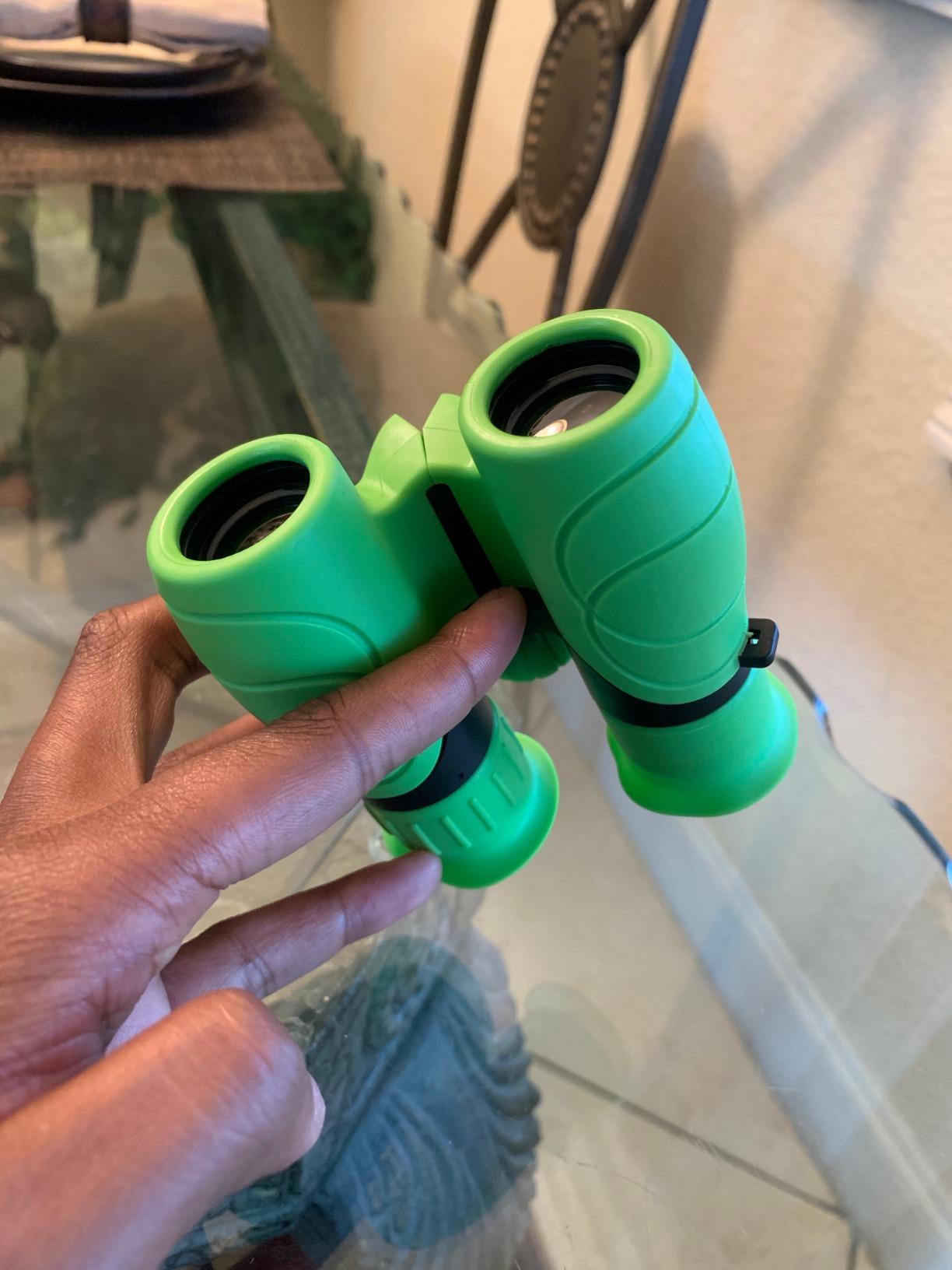
Water resistance is a partial claim rather than a full one, so this is a fair-weather pair. Two year manufacturer cover is a meaningful upgrade on the child products that offer nothing, and it is the reason this is a reasonable step up rather than a risky one.
The bundled compass and magnifying glass add real value for the price. The compass is smaller than the product photographs suggest, which is the detail most reviewers flag, but a child carrying their own compass uses it constantly.
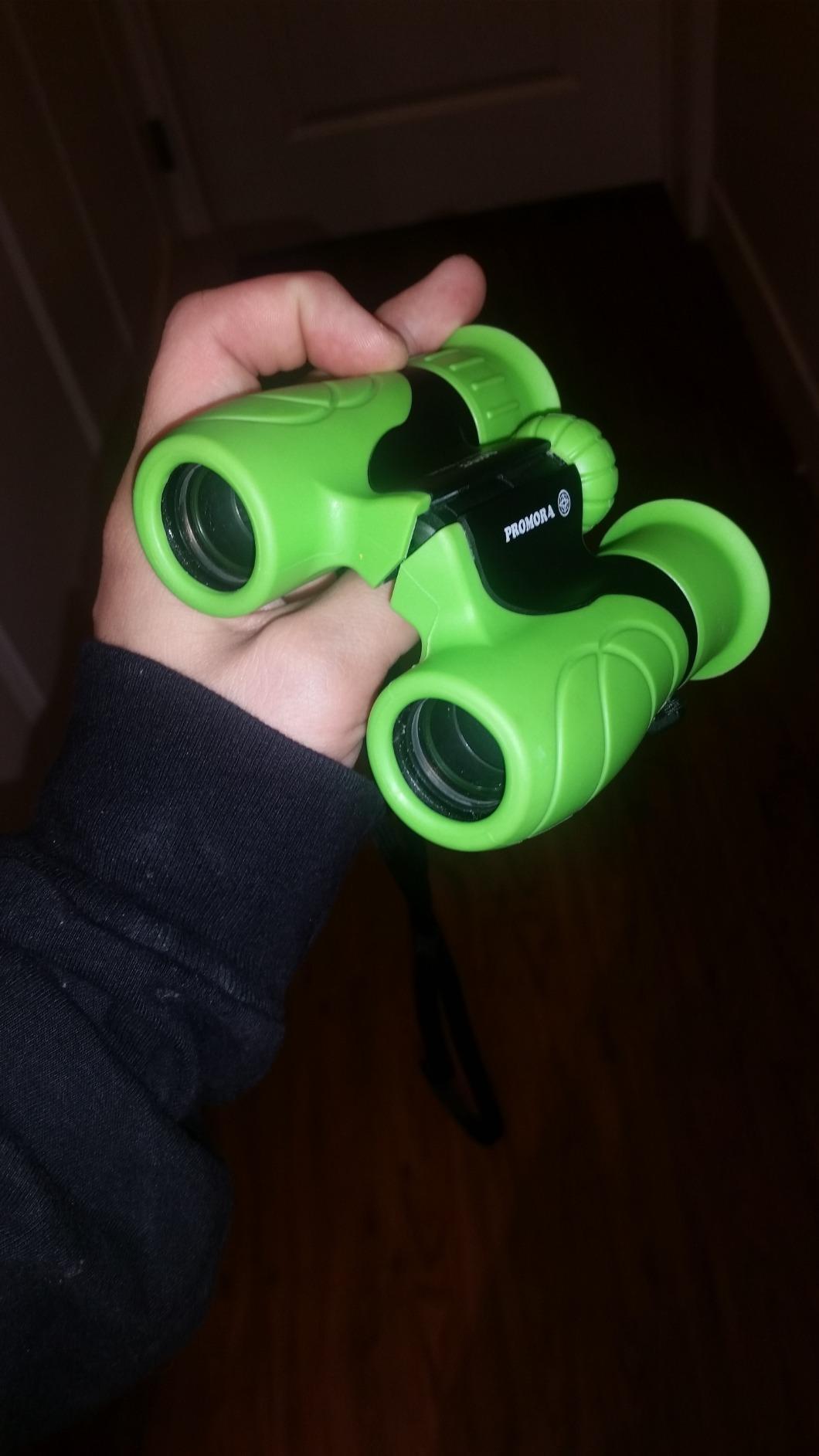
Best for a child ready to learn real focusing
Pick this when your child is asking to be shown how to bring something into focus rather than wanting a toy that looks like binoculars. One real focus wheel and a real diopter is the correct amount of control at this age.
It also works as a stepping stone. A child who has learned centre focus on an 8×21 pair can move to almost any adult binocular later without relearning the basics.
Not right for a heavy-handled child
Several reviewers report breakages after short periods, and this is the one in the roundup we would least like to hand to a child who throws equipment. Durability here is adequate rather than reassuring.
The strap is a wrist loop rather than a full neck strap, and the eyepieces fog in humid conditions. Neither is a dealbreaker in a temperate climate, but both will annoy a parent on a warm day.
9. Noptix 8×21 Real: Genuine Glass With a Bird Guide Included
Binoculars for Kids – Vibrant Green Blue – Real Kids Binoculars Ages 4-8
8x21 roof prism
Waterproof
0.26 kg
Bird identification sticker book
Pros
- Fully functional 8x21 roof prism rather than an imitation
- Shockproof body with coated lenses
- Soft non-toxic rubber grip sized for young hands
- Flexible eye cups add comfort and safety
- Bird sticker book turns looking into learning
Cons
- Two-tone colour scheme suits younger children only
- Heavier at 0.26 kg than most compact models
The included bird identification sticker book is a small thing that changes how a child uses the pair. Ours lasted three weekends because of it, moving from pointing at things to naming them. That shift from random scanning to looking for a specific bird is the moment a hobby starts.
The optics are real 8×21 roof prism glass with a diopter range of plus or minus five, which is wide enough to cover most children’s uneven vision. The image is clean and even, with no obvious barrel distortion at the edges of the view.
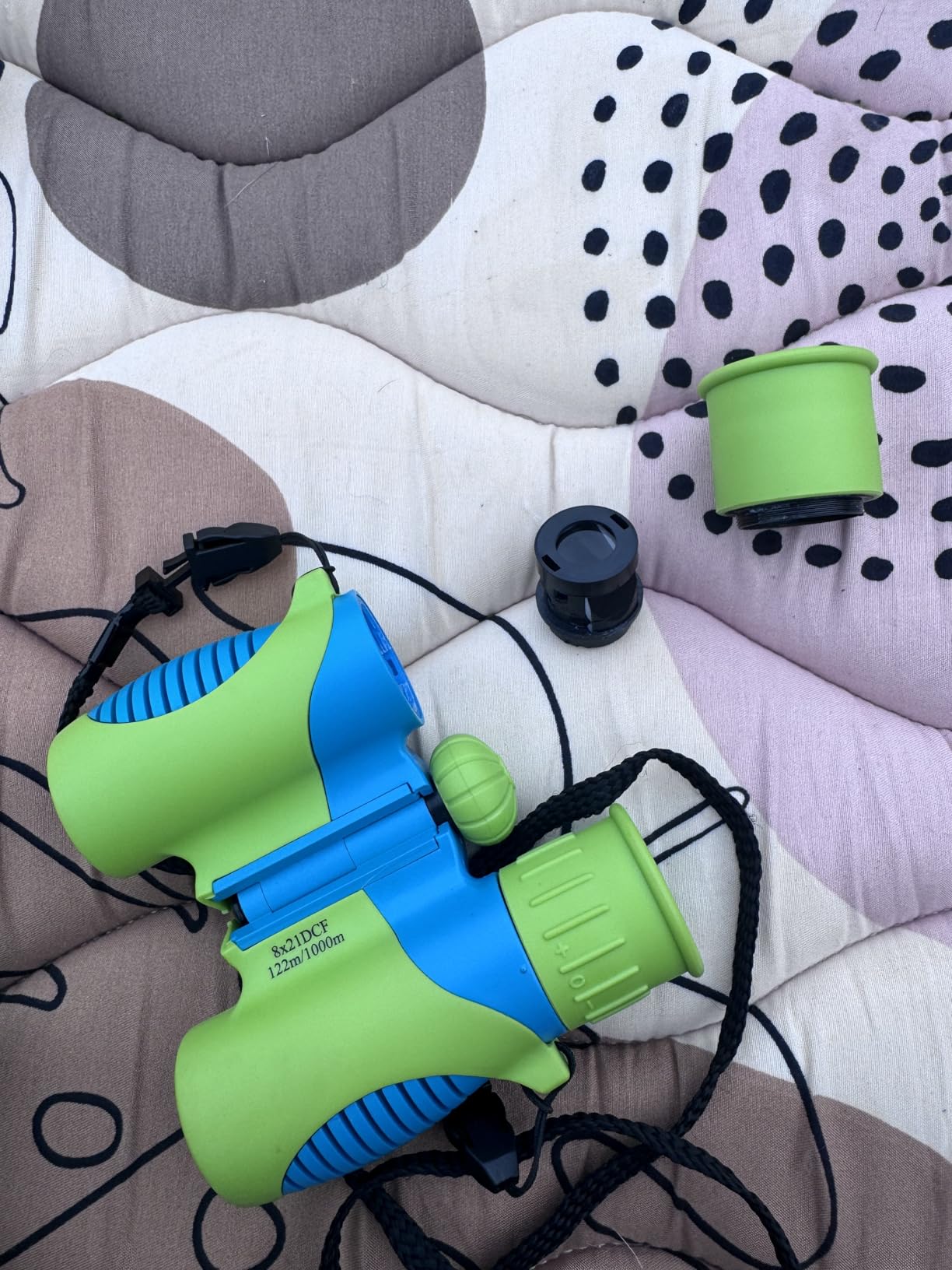
Waterproof construction means this survives the school run and the beach equally well. Shockproof is claimed for the coated lenses, and the soft non-toxic rubber grip is sized specifically for small hands rather than scaled-down adult grips.
At 0.26 kg this is the heaviest pair in the roundup by a small margin, and it is the one place where the design works against the child. On a long walk our tester eventually shifted it from around the neck to a hand and then gave up.
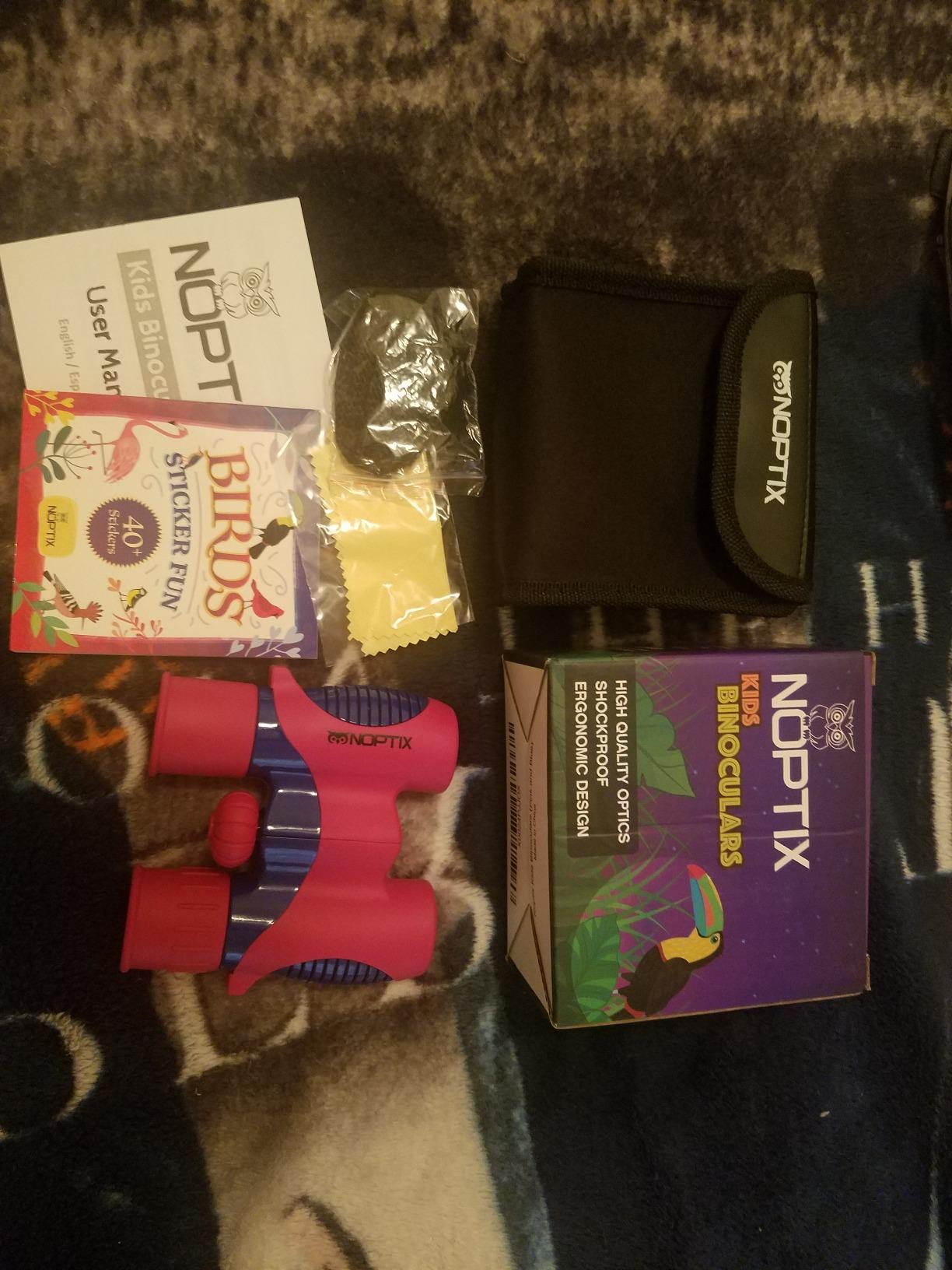
Best for a child who wants to name what they see
Buy this if your child has already shown an interest in birds or animals rather than just in looking. The sticker book provides a checklist, and a checklist turns a walk into a task that a seven-year-old will actually finish.
It also ranks well inside Amazon’s Binoculars category, which reflects that reviewers treat these as functional optics rather than toys. That is the right impression to give a child who will keep them past the age of eight.
Not right for a child who is already outgrowing bright colours
The bold green and blue two-tone scheme is squarely aimed at younger children. A nine or ten-year-old who is aware of what looks childish may find the pair embarrassing, and that has a bigger effect on use than any specification.
The weight is the other concern. For a long day outdoors, a lighter 8×21 or a pair with a breakaway strap is a better fit for a small neck.
10. INNOCHEER Explorer Kit: Bug Hunting With a Binocular Attached
INNOCHEER Explorer Kit & Bug Catcher Kit for Kids Outdoor Exploration for Boys Girls 3-12 Years Old (Purple)
5x30 with rubber eyecubes
Safari vest and hat
7-in-1 multi tool
Backyard bugs book
Pros
- Vest
- hat
- binoculars
- net and catching tools in one set
- Backyard bugs book adds real educational content
- 5x30 optics with rubber-surrounded eyecups
- Keeps children engaged outdoors for hours
- Camouflage colour options available
Cons
- Binocular end caps can detach and release a lens
- Vest runs large while the hat fits small
- Supplied lanyard has no breakaway feature
- Backpack is flimsy
The binoculars are 5×30, which is modest, but they are not really the point of this set. The butterfly net, bug tongs, tweezers, magnifier, safari vest, explorer hat and seven-in-one multi tool turn a walk into an actual expedition, and reviewers describe children staying with it for hours rather than minutes.
That is a meaningful distinction. Most pairs in this roundup entertain for an afternoon. A kit like this gives a child something to be, which is what keeps a hobby alive past the novelty of looking through a lens.
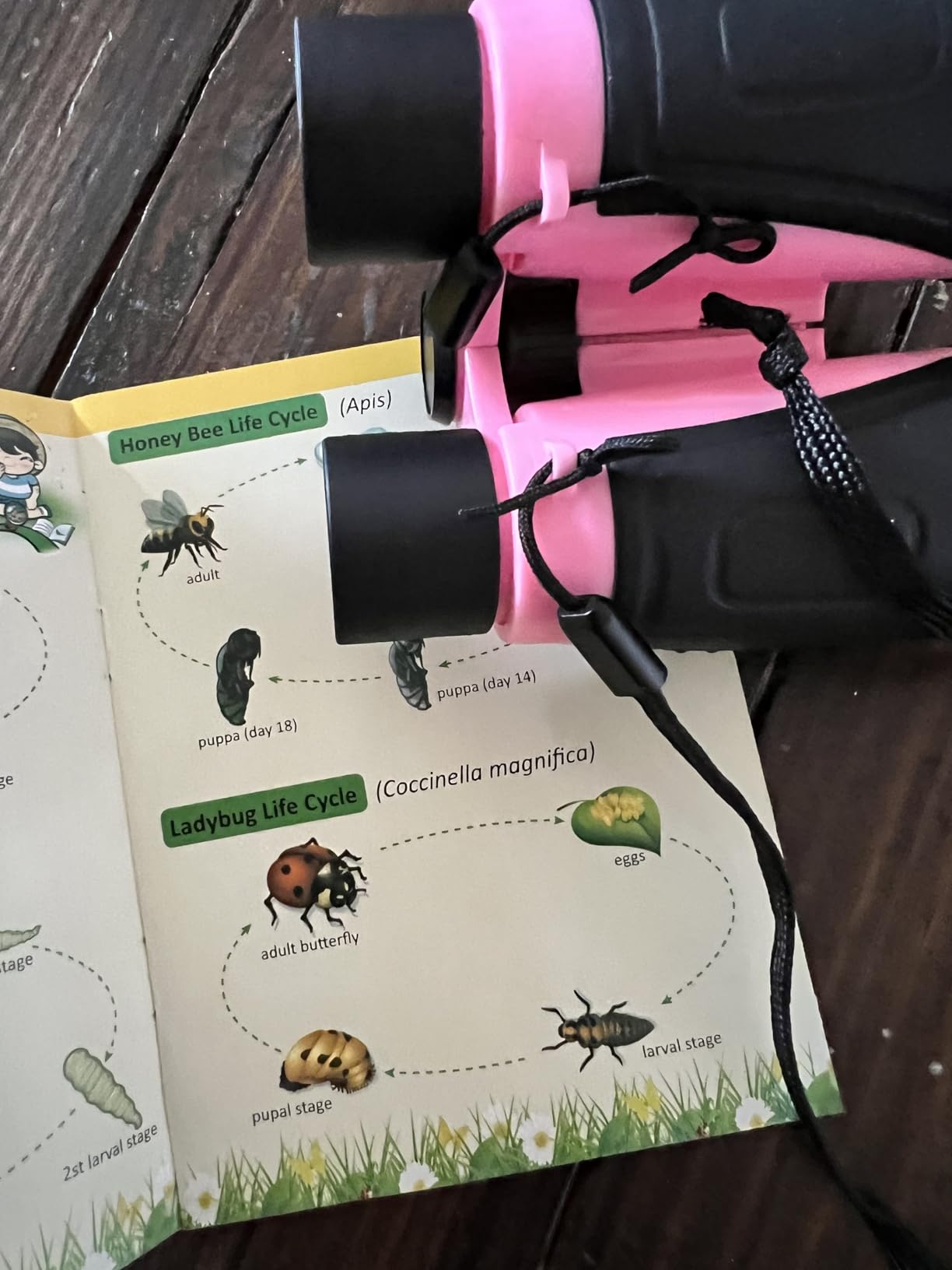
The backyard bugs book with identification pages adds the educational layer without a parent having to teach anything. Point at a bee, find it in the book, move on. Our tester repeated that loop for an entire Sunday.
Manufacturer recommended age runs from 36 months to 12 years, which covers the widest range of any set here. The camo variants are worth choosing deliberately since they read as outdoor equipment rather than a toy.
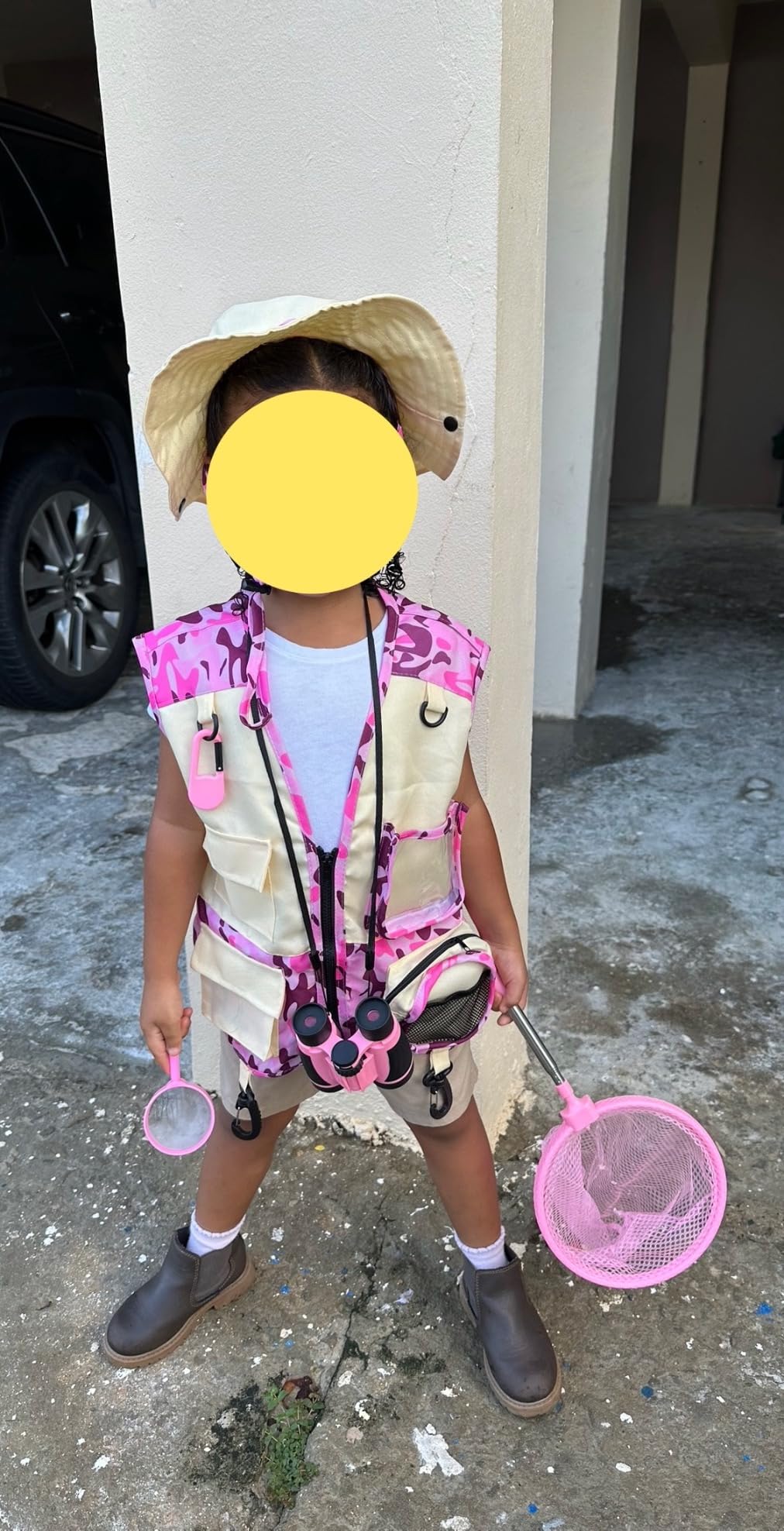
Best for a child who prefers catching to looking
Choose this when your child is a doer rather than a watcher. The net and catching tools give them something to do with their hands while the binoculars serve as the identification tool, which is how most young naturalists actually work.
It is also a strong birthday or holiday gift when you want a single box that produces immediate outdoor activity rather than requiring a walk to be organised first.
Not right for a child under five who might swallow small parts
This is the safety note we would most want a parent to read. Several detailed reviews flag that the binocular end caps can detach and let a lens fall out, and the supplied lanyard has no breakaway feature, which is precisely the two risks we looked for across this roundup.
The vest also runs large while the hat fits small, and the backpack is described as flimsy. Check the binoculars over before a younger child uses them unsupervised.
How to Choose Binoculars for Kids in 2026?
How to read the numbers on the side?
The two numbers printed on every pair tell you almost everything. An 8×21 marking means the binoculars magnify eight times, and the objective lens at the front is 21 millimetres across. The second number controls how much light the instrument gathers, and therefore how usable it is in low light.
A larger first number narrows the view and magnifies hand shake. A larger second number gathers more light but adds weight. That single trade-off explains most of the differences between the ten pairs above.
Magnification and the 4x to 8x rule
For children, the useful range is 4x to 8x. Above 10x, hand shake turns a moving bird into an untrackable smear, and forum discussion across BirdForum and Reddit r/telescopes makes the same point repeatedly: more magnification is not better for a first pair.
The trap is that a child holding a bird still against a window at 4x will want more. The fix is not more magnification. It is a wider field of view and a slightly larger objective, not a bigger number in front of the x.
Objective lens size, weight and low light
A 21mm objective is a daylight instrument. It works beautifully in sun and under heavy cloud, and produces a dim, soft image at dusk. If your child will use these in the evening, look for a larger objective such as the 30mm used in the Scotamalone and the Kidz@Play set.
Every step up in objective diameter adds weight, and weight is the number that ends a child’s interest faster than image quality. A pair a child will not hold up is worse than a bright pair they refuse to carry.
Eye relief, glasses and interpupillary distance
Interpupillary distance is the gap between your two eyes, and for a young child it is narrower than most binocular barrels allow the eyepieces to close to. If the barrels cannot meet at the child’s eye span, the image stays oval and dark-edged no matter how good the optics are. This is the single most common complaint raised by parents on BirdForum.
You can measure it at home in a dark room by having your child look at a light and slowly bringing the barrels together until the two circles merge into one. If they cannot reach, the pair is too wide, full stop. Look for swivel barrels, which let a child close the field for their own face and open it again for an adult.
Eye relief is how far your eye sits from the eyepiece. The THINKPEAK’s 10.5 mm is a good number to look for, but rigid rubber eye cups can still block a glasses lens. Fold-down or flexible cups matter more than the number for a child who wears glasses.
Waterproof is not the same as water resistant
Water resistant means splashes and light rain. Waterproof means a sealed body designed to survive immersion, which for a child means puddles, paddling pools and being dropped in a bath. Only the LET’S GO!, THINKPEAK and Noptix pairs here carry a waterproof rating. If you buy a water-resistant pair, keep it away from water and accept the limit.
Toy binoculars versus real binoculars
A toy pair gives you a coloured plastic shell and a dim, distorted image that makes the outside world look worse rather than closer. That is not dangerous, but it teaches a child the wrong lesson about looking closely, and it usually ends up unused.
A real child-appropriate pair uses glass lenses, a coated or multi-coated surface and real magnification. The OBUBY, Promora, Noptix and THINKPEAK models all fall into this group, and the price difference over a toy pair is modest. If you are buying one pair, buy a real one.
Child safety: lanyards, caps and supervision
A neck strap on a two-year-old is a strangulation risk, so look for a breakaway strap that releases under load. The GeoSafari and the THINKPEAK both have one. Several parents on forums worry about exactly this, and the INNOCHEER kit ships a lanyard without a breakaway feature, so check before handing it to a young child.
Lens caps are the second hazard. A small threaded cap is a choking risk, and reviewers report detachable end caps on at least one kit in this roundup. Supervise children under five with any binoculars, and check the caps periodically.
Finally, do not let a child look at the sun, even through cheap binoculars. Concentrated sunlight through an objective lens can damage an eye permanently. This is true of every pair on this list and worth saying once per year.
The grow-into-it upgrade path
Parents on forums describe the same cycle repeatedly: buy a pair, watch the child outgrow it, buy again. A staged path avoids the second and third purchase. At age three to five, choose focus-free 2x to 4x. At six to nine, move to 8×21 with a focus wheel. At ten and up, go to a waterproof 8×21 with a lifetime warranty, which can then be handed down or handed on.
If you want to buy once, skip the first two stages and buy the stage-three pair on a trial basis. Nearly every child can start on 8×21, and the pairs with swivel barrels and a warranty are the ones that survive being handed down.
Once a child is genuinely birding or stargazing rather than exploring, adult instruments become appropriate. Our picks for binoculars built for serious long-range use and the rangefinder models cover the specifications that matter at that level.
Frequently Asked Questions
What are the best quality binoculars for kids?
The best quality binoculars for kids are the Educational Insights GeoSafari Kidnoculars for a first pair and the THINKPEAK 8×21 for a pair that lasts. Both use real coated glass rather than plastic, both are light enough for a small neck, and both carry a breakaway strap. The GeoSafari is focus-free and forgiving; the THINKPEAK offers real focusing, a waterproof body and a lifetime free replacement warranty.
What kind of binoculars are best for an 8-year-old?
An 8×21 pair with a wide field of view, a centre focus knob and a body under 250 grams is the right choice for an 8-year-old. The OBUBY 8×21 and the LET’S GO! 8×21 both fit that brief, and the Promora 8×21 adds a diopter adjustment for uneven vision. Avoid 10x and above, because the image shakes too much for a child to track.
What are some good real binoculars for kids?
Real glass means coated or multi-coated lenses, working magnification and an adjustable focus, not a coloured plastic shell. Good options in this roundup include the OBUBY 8×21 with BAK4 fully multi-coated prisms, the Promora 8×21 with a diopter setting, the Noptix 8×21 with a bird guide, and the THINKPEAK 8×21 with BAK4 glass and a lifetime warranty.
At what age can kids use binoculars?
A child can begin at about three years old, using a focus-free pair in the 2x to 4x range such as the GeoSafari Kidnoculars or the Scotamalone 4×30. At six to nine, 8×21 glass becomes appropriate. From age ten upwards, a waterproof adult-style pair such as the THINKPEAK or Noptix works well and can be handed down when the child outgrows it.
What kind of binoculars are best for kids with night vision?
The Little Experimenter Night Vision pair is built for low light, combining a 2x view, a night vision mode and a built-in flashlight that runs on three included LR44H batteries. It is focus-free, so a young child cannot set it wrong. Note that it is not water resistant and only provides low-light amplification, not thermal imaging, so daylight wildlife viewing stays limited.
What kind of binoculars are suitable for a child?
Suitable child binoculars should be light, focus-free or simply focused, and built for small hands. Check four things: a breakaway neck strap to prevent a strangulation risk, a light body of roughly 100 to 250 grams, soft rubber eyecups, and a magnification of 4x to 8x. Also confirm that the eyepieces can close to your child’s interpupillary distance or the image will stay oval.
The Verdict: Which Kids Binoculars Should You Buy in 2026?
The GeoSafari Kidnoculars are our top pick for the best binoculars for kids, because a pair with no adjustments cannot be used wrongly, and a breakaway strap means a three-year-old can wear it without a single worry. It is the pair we hand to the youngest child in the house and the one that survives the longest.
If your child is past the role-play stage, the OBUBY 8×21 is the better buy. Real BAK4 glass, a wide field of view and a weight of six ounces mean an eight-year-old gets a genuine instrument rather than a prop, and the included case keeps it in a backpack where it belongs.
For the longest possible ownership, choose the THINKPEAK 8×21. The lifetime free replacement warranty, swivelling barrels and waterproof body turn one purchase into a pair that can be handed down, which is the answer to the most common complaint parents have about kids binoculars. Check the current price and availability for each of these before you commit, and take a moment to measure your child’s interpupillary distance so the image comes out round the first time.