
Saturn is the planet that convinces people to buy a telescope. You point a 70mm refractor at it on a clear night and the rings are suddenly there, an ellipse of pale light hanging around a yellow ball, and no photograph prepares you for that. The catch is that almost any telescope will show a Saturn. Showing the good Saturn takes aperture, a long focal length, and a mount that does not shake when you touch the focuser.
So the honest answer to the best telescopes for viewing Saturn question: you need at least a 70mm aperture to resolve the rings at all, a 90mm to 130mm instrument puts Titan and the main ring gaps in reach, and 8 inches of aperture is where the Cassini Division and real ring banding start to appear. Focal length of 1000mm or more gives you the magnification you need without stacking glass you cannot afford. Everything below those numbers is marketing.
We spent weeks comparing the seven scopes below, checking each aperture against focal length, mount rigidity, included eyepieces, and what owners actually report seeing at the eyepiece. One freshness note before we start: Saturn’s ring plane has been tilted close to edge-on through the mid-2020s, so the wide, open ring view from earlier astronomy books is not what you will see right now. Expect a thinner, sharper ring, and judge your scope on how cleanly it holds that thin line, not on how much ring is showing.
Table of Contents
Top 3 Telescopes for Viewing Saturn (September 2026)

Celestron NexStar 8SE
- 8-inch Schmidt-Cassegrain
- 2032mm focal length
- GoTo fork mount with 40000 object database

Sky-Watcher Classic 200
- 8-inch parabolic mirror
- 1200mm focal length
- Solid-tube Dobsonian base
- 2-inch Crayford focuser

Celestron NexStar 127SLT
- 127mm Maksutov-Cassegrain
- 1500mm focal length
- Closed 27 inch tube
- GoTo alt-azimuth mount
All 7 Telescopes for Saturn Compared in 2026
| Product | Specifications | Action |
|---|---|---|
| Celestron NexStar 8SE |
|
Check Latest Price |
| Sky-Watcher Classic 200 Dobsonian |
|
Check Latest Price |
| Celestron NexStar 127SLT |
|
Check Latest Price |
 Celestron StarSense Explorer 8 Dobsonian Celestron StarSense Explorer 8 Dobsonian |
|
Check Latest Price |
 MEEZAA 150EQ Newtonian MEEZAA 150EQ Newtonian |
|
Check Latest Price |
 Sky-Watcher Classic 150 Dobsonian Sky-Watcher Classic 150 Dobsonian |
|
Check Latest Price |
 Sky-Watcher Flextube 200 Dobsonian Sky-Watcher Flextube 200 Dobsonian |
|
Check Latest Price |
1. Celestron NexStar 8SE – Best Overall Saturn View in an 8-Inch Catadioptric
Celestron NexStar 8SE Computerized Telescope – Schmidt-Cassegrain
8-inch aperture
2032mm focal length
f/10 Schmidt-Cassegrain
Computerized alt-az fork mount
24 lbs
Pros
- 8-inch aperture resolves ring structure
- Cassini Division and Titan
- 2032mm focal length gives long
- flat planetary views
- GoTo mount with 40000 plus object database points and tracks Saturn automatically
- Compact 17-inch tube is far easier to transport than an 8-inch Dobsonian
Cons
- Included 25mm eyepiece is basic
- Single fork arm and tripod can transmit vibration at high power
- Celestron eyepieces and accessories cost extra
This is the scope we keep coming back to. The NexStar 8SE packs 8 inches of aperture into a 17-inch optical tube on a single fork arm, and that combination is unusual: an 8-inch Dobsonian is the same aperture for a fraction of the money, but it is a 50-pound object with a long tube. The 8SE weighs about 24 pounds assembled and stores in a closet, which matters if your observing site is not your driveway.
At the eyepiece, owners report the ring system resolving into distinct structure rather than a flat oval, with the planet’s globe showing a subtle banded look at high power. The 2032mm focal length means the included 25mm eyepiece gives 81x, which is already a serious look at the rings, and stepping to a 10mm Plossl pushes you to 203x. The published Dawes limit of 0.57 arc seconds gives you a real resolving ceiling to work against.
What seals it for Saturn specifically is the mount. The NexStar+ hand control carries a database of more than 40,000 objects, so Saturn is four button presses away, and the single fork arm alt-azimuth mount tracks on both axes once it is aligned. SkyAlign gets you aligned by centering any three bright objects, no star charts, no polar alignment. For a target as small and as far from a convenient star hop as Saturn can be, that is worth real money.
Two things to plan for. The included 25mm eyepiece is the bare minimum; a 10mm or 8mm Plossl and a 2x Barlow are where the real detail lives. And reviewers repeatedly mention the fork arm and tripod passing vibration into the image at high magnification, so let the scope settle after a nudge and avoid touching the tripod legs while observing.
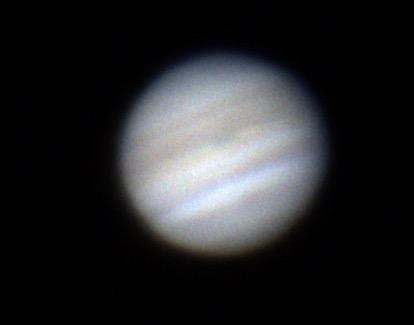
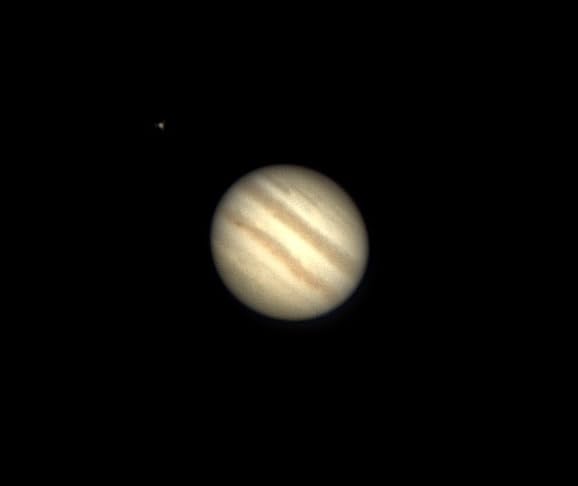
What Saturn looks like through the 8SE?
Start at 81x with the supplied 25mm eyepiece. Saturn will sit comfortably in the field with the rings clearly separated from the globe and Titan visible as a bright point near it. Step to a 10mm for 203x and the globe fills more of the view, the ring shadow becomes visible on the planet, and the division between the bright inner ring and the dimmer outer ring starts to separate.
There is a catch inherent to Schmidt-Cassegrains: the secondary mirror blocks roughly a third of the light, which costs contrast on fine planetary detail. You are trading raw aperture and no-collimation convenience against a little contrast. In practice the 8-inch objective outruns that penalty for most observers, which is why this scope is where we land for someone who wants one telescope to do Saturn, Jupiter, the Moon, and galaxies.
Who should skip the 8SE?
If your budget is fixed and you are purely aperture-driven, the same eight inches of mirror in a Dobsonian gives you a bigger image and a lot more light for the money, and you can always add GoTo hardware later. Choose the NexStar 8SE instead when storage, weight, or the number of people who can help you move your gear is the actual constraint.
It is also worth being honest about what you still need to buy. A bare 25mm eyepiece will not let you use what this scope can do. Budget for a small Plossl set and a 2x Barlow before your first Saturn night rather than after.
2. Sky-Watcher Classic 200 8-Inch Dobsonian – Best Value for Ring Detail
Sky-Watcher Classic 200 Dobsonian 8-inch Telescope – Solid-Tube – Simple, Traditional Design – Easy to Use, Perfect for Beginners, White (S11610)
8-inch parabolic mirror
1200mm focal length
f/6 solid tube
45 lbs assembled
94% reflectivity
Pros
- 8-inch aperture at the lowest cost per inch of aperture on this list
- Solid tube is rigid and holds collimation far better than a truss design
- Parabolic primary with Radian Aluminum Quartz coating gives sharp high-contrast views
- Teflon bearings and tension control handles make fine movement smooth
Cons
- 45 pounds assembled is a two-person lift and the base is bulky
- Included 25mm and 10mm eyepieces are entry-level
- No GoTo
- so finding targets depends on star-hopping or charts
If you strip away the brand names and the marketing, this is the most aperture you can buy, and for Saturn that is the whole game. An 8-inch parabolic primary gathers 78 percent more light than a 6-inch model, and the difference between a 6-inch and an 8-inch view of Saturn’s ring system is the difference between seeing a ring and seeing rings. The 1200mm focal length gives a usable magnification ceiling of about 16 times per inch of aperture, so there is real power here on a steady night.
Owners describe steady, high-contrast images once the mirror is collimated, with Saturn’s rings, Jupiter’s belts and the Galilean moons, and the craters along the lunar terminator all coming through. Several owners specifically call out the solid tube as the reason to pick this over a collapsible Dob: a one-piece tube does not flex, so collimation holds between sessions and you are not re-aligning mirrors every time you carry it outside.

The focal ratio works out near f/6, which is a bit fast for planetary work, and that shows in one way: the 2-inch Crayford-style focuser is good, but the included 25mm and 10mm super wide-angle eyepieces have wide fields and soft edges at high power. At 120x with the 10mm, the view is good. At 200x, you will be looking through the weakest glass in the chain.
That is the fix, and it is cheap: a 6mm or 8mm Plossl plus a 2x Barlow on the 10mm gets you to 240x with glass that holds up. A laser collimator is also worth adding, because the review data shows collimation is the recurring theme in both good and bad experiences with this instrument.
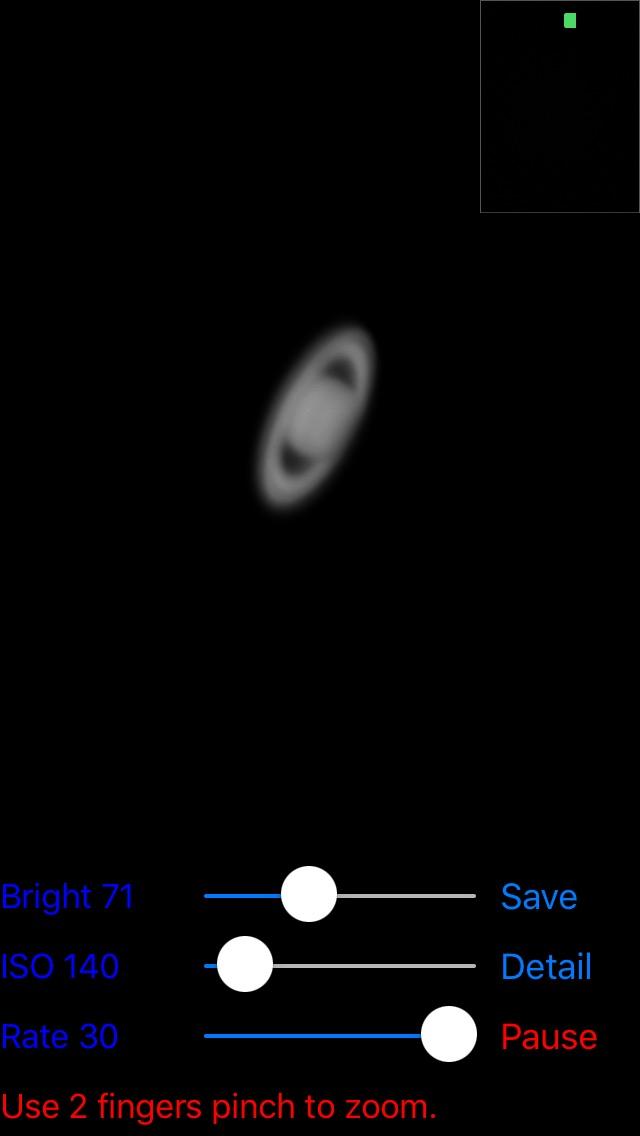
What Saturn looks like through the Classic 200?
At 48x with the 25mm eyepiece, Saturn is a small but unmistakably ringed object. At 120x with the 10mm, the rings separate into the bright inner band and the darker outer band, the ring shadow crosses the planet’s disc, and Titan moves visibly during a session. Push to 240x with a 2x Barlow and a 6mm and you are in Cassini Division territory on a good night, though the atmosphere will start making the decision for you before the aperture runs out.
Remember that 8 inches of aperture does not promise 8 inches of usable magnification. Turbulence caps what you can hold, not the mirror. Treat 120x to 200x as the realistic working range and anything above as a bonus when the air is steady.
Who should skip the Classic 200?
Skip it if you plan to observe away from home. At 45 pounds assembled with a 20-pound tube on a 25-pound base, moving this to a dark site is a two-person job and the base is awkward in a car. Skip it if you have never used a star chart and do not want to, since there is no GoTo here at all.
Also weigh the sheer simplicity. There is nothing to break, nothing to charge, and nothing to align electronically. For many first-time owners that reliability is the point, and the manual focuser means the image never changes unless you move the scope.
3. Celestron NexStar 127SLT – Best for GoTo and Closed-Tube Portability
Celestron NexStar 127SLT Maksutov-Cassegrain Computerized GoTo Telescope
127mm aperture
1500mm focal length
f/11.8 Maksutov-Cassegrain
18 lbs
Closed 27-inch tube
Pros
- 1500mm focal length suits planetary work
- 127mm aperture shows the rings clearly
- Closed tube needs no collimation and avoids tube currents
- GoTo mount with 40000 plus object database points and tracks after SkyAlign
Cons
- Tripod and fork arm transmit vibration at high power
- Red dot finder is awkward to use near the zenith
- Included 20mm and 9mm eyepieces are entry-level
- AA battery life is short
A Maksutov-Cassegrain does three things a Dobsonian cannot: it never needs collimation, its closed tube does not go out of alignment or fill with dust in the garage, and it is short enough to actually put in a car. The NexStar 127SLT pairs that with a computerized alt-azimuth fork mount, which makes it the most complete ready-to-go planetary package here for anyone who does not want to learn star-hopping.
At 1500mm focal length, the supplied 20mm eyepiece gives 75x and the 9mm gives 167x. That 167x is a genuinely good Saturn magnification on a decent night, and because the optical design has no Newtonian coma, the planet tends to look clean and round in the center of the field rather than smeared at the edges. Owners report crisp views of the rings, Jupiter’s bands, and the four Galilean moons.
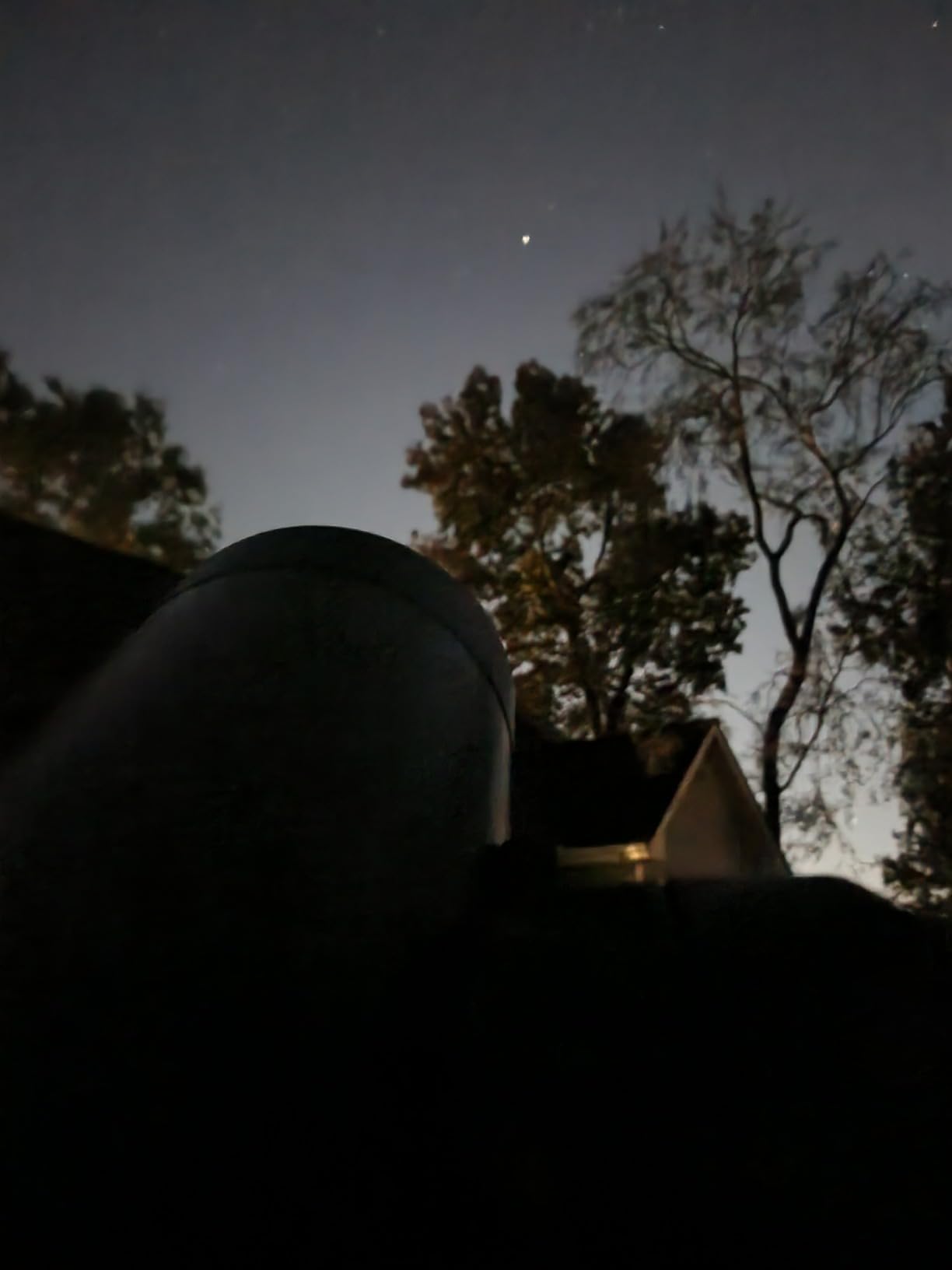
Two real limitations, both named repeatedly in owner feedback. First, vibration: the fork arm and tripod can pass shakes into the image, especially with the legs fully extended or in any wind, and 167x is exactly where that becomes visible. Tighten the legs, avoid touching them, and let the mirror settle after you center the planet. Second, the StarPointer red dot finder is unilluminated and non-magnifying, and it is genuinely awkward when Saturn is near the zenith and the eyepiece is at an uncomfortable angle.
Battery life is another planning point. The mount runs on AA batteries and reviewers report that draining them quickly, so treat an external 12V power pack as standard equipment rather than an accessory.
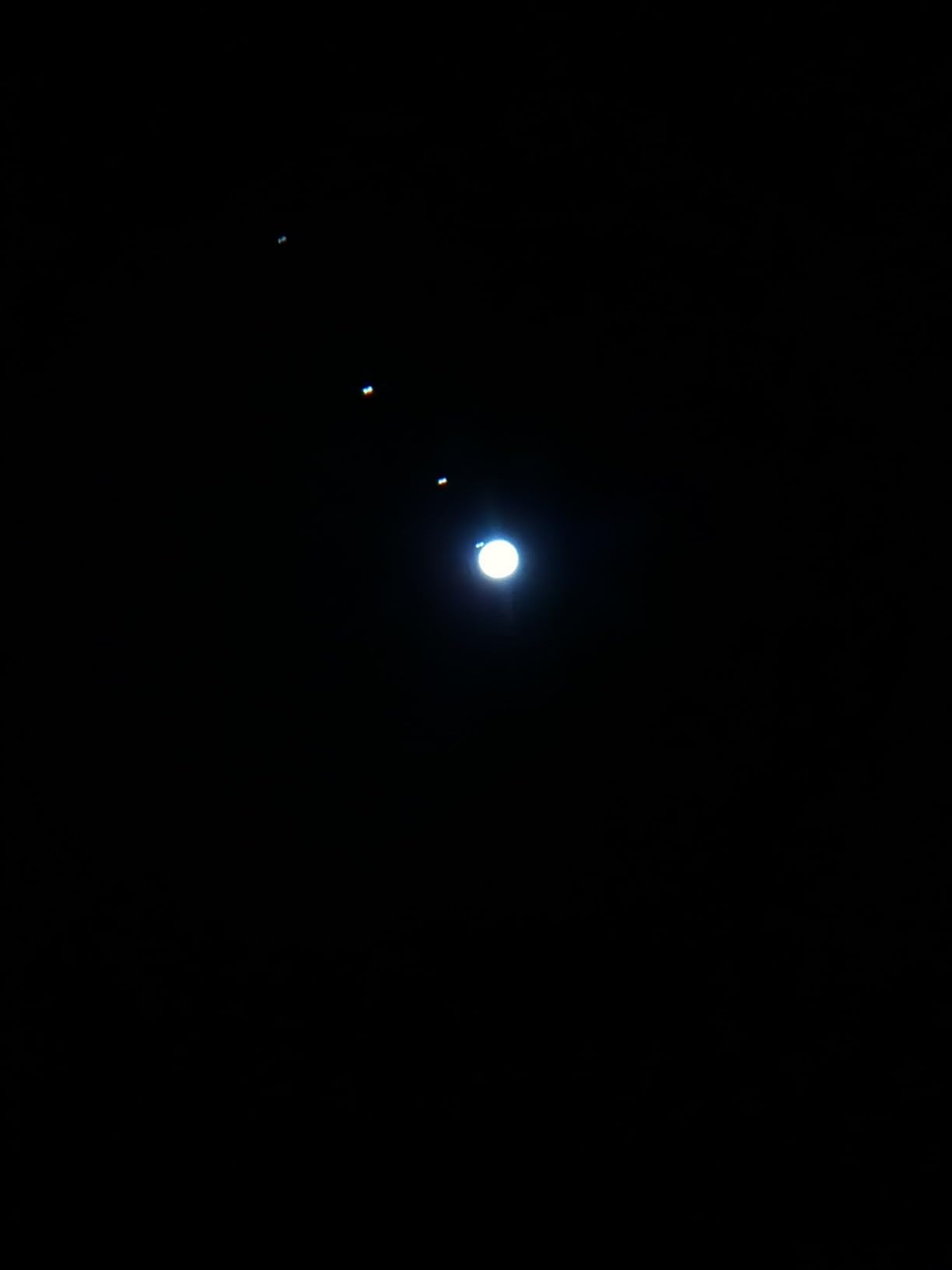
What Saturn looks like through the 127SLT?
At 75x with the 20mm, Saturn shows a clear ring system with a hint of structure in the ring plane, and Titan is an easy point of light to find. At 167x with the 9mm, the rings resolve into the main bright and dark bands, the ring shadow on the globe is visible, and the Cassini Division is near the limit of what a 127mm aperture will show in average seeing.
This is the aperture tier where most people decide whether they are satisfied. If you look through this and want more, the step up is an 8-inch aperture, not a bigger magnification. Forum consensus is consistent on that point: aperture is what reveals more, magnification alone just enlarges what you already have.
Who should skip the 127SLT?
Skip it if deep-sky observing is a serious goal. 127mm with a 1500mm focal length is a planetary instrument, and faint galaxies will disappoint compared with what an 8-inch Dob gathers. It is also the oldest design in the lineup with the smallest aperture, so if buying once for everything, an 8-inch scope buys more headroom.
Do not skip it if you travel, live in a city, or have a genuine allergy to star charts. A 27-inch closed tube, no collimation, and a hand control that puts Saturn on the screen in under a minute is a specific kind of freedom that an 8-inch Dobsonian never offers.
4. Celestron StarSense Explorer 8-Inch Dobsonian – Best for First-Time Dob Owners
Celestron StarSense Explorer 8″ Dobsonian Telescope with Smartphone App
8-inch Newtonian
1200mm focal length
XLT coatings
StarSense app finder
2-inch Crayford focuser
Pros
- 8-inch aperture gives sharp vivid views of Saturn and Jupiter
- StarSense app turns a phone into a sky-recognition finder
- App generates a curated target list for your time and location
- Stable manual base with smooth tracking once centered
Cons
- Collimation is still required after transport or temperature changes
- Large heavy base means changing sites takes two people
- App guidance is visual arrow-following with no motorized tracking
Everything great about an 8-inch Dobsonian, with the hardest beginner problem removed. The StarSense system uses the phone camera to recognise the pattern of stars above you, works out where the telescope is pointing, and gives you arrows to follow until the target is centered. You dock the phone, open the app, and it tells you where to look. For someone who has never found Saturn and has no idea where to start, that is the difference between a first successful night and a frustrated one.
Optically it is the standard 8-inch recipe: a 203mm Newtonian at 1200mm with XLT multi-layer reflective coatings on a manual altazimuth Dobsonian base, a 2-inch Crayford focuser, and a 25mm eyepiece. The 25mm gives 48x, and owners consistently report sharp, vivid images of Saturn’s rings, Jupiter’s bands, the Moon, and deep-sky favorites like the Orion Nebula and Andromeda.
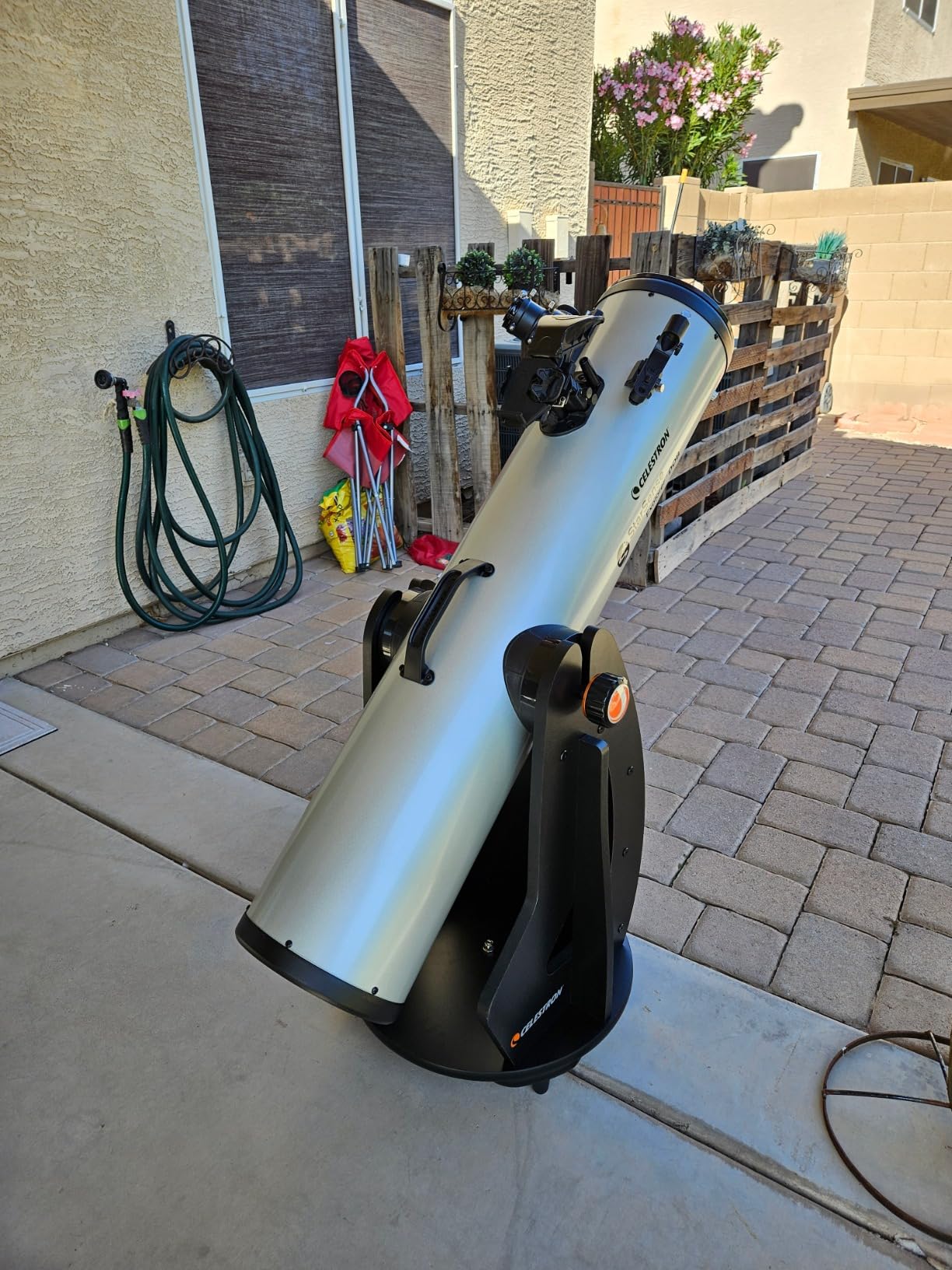
The important thing to understand is what the app does and does not do. It is a finder, not a mount. There is no motor, so once Saturn is centered you track it manually with the base, and the longer you spend at high power the more you will be adjusting. The curated target list is generated from your time and location, which is a nice touch for planning but does not point the tube for you.
Collimation is the other real task. A Newtonian arriving in a new environment usually needs its mirror aligned, and owners note this returns after transport or big temperature swings. Budget ten minutes with a collimation cap or laser collimator the first few times.
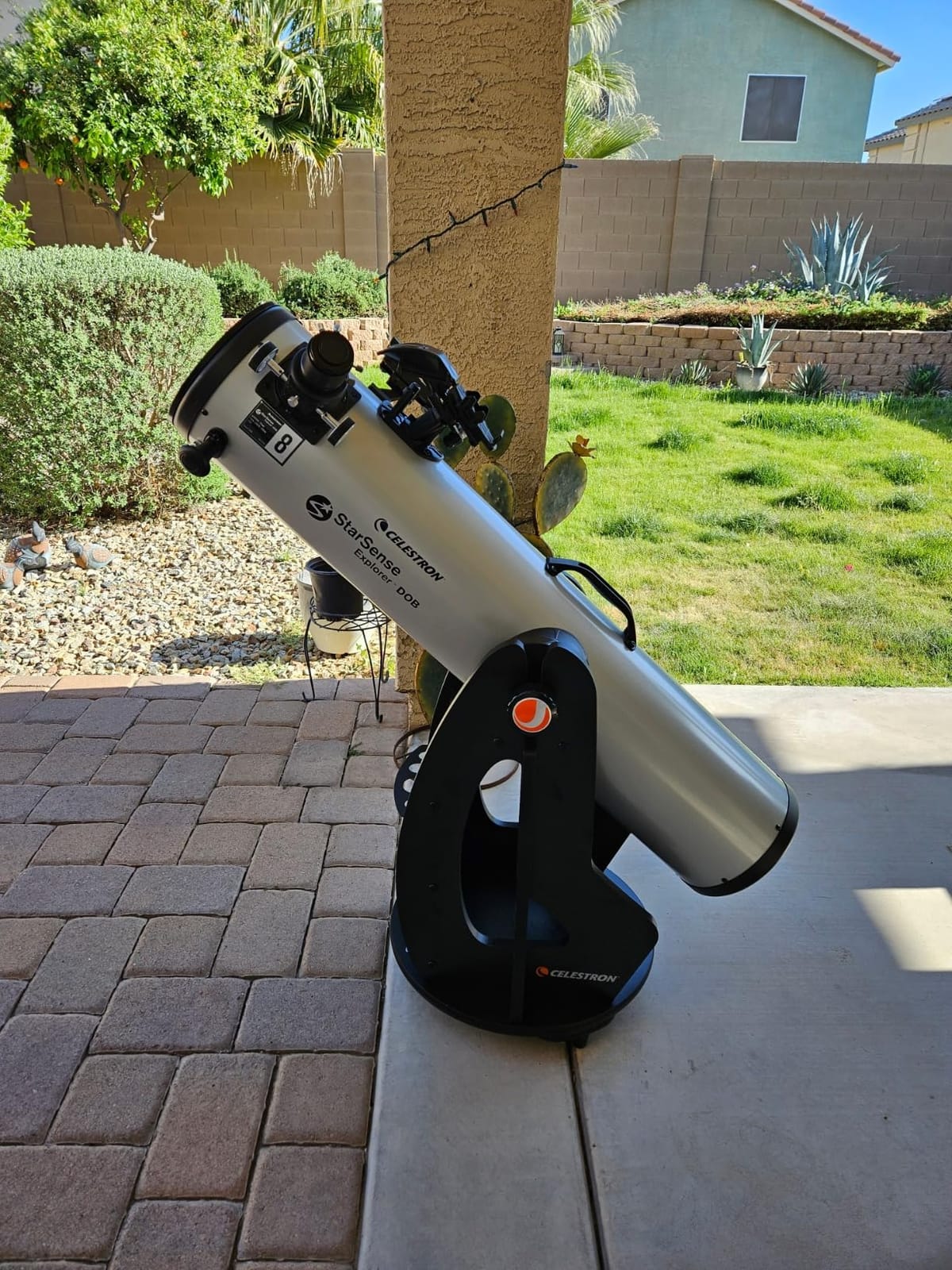
What Saturn looks like through the StarSense 8?
Same optical result as any other 8-inch Dobsonian at 1200mm: 48x with the 25mm to identify it, 120x with a 10mm for ring structure, and beyond that with a Barlow and a shorter eyepiece. The app just gets you to the starting point faster, which means more of your session is spent actually looking at the planet instead of sweeping the sky with a finder.
There is a genuine usability bonus here. Because the app knows your date, time and location, it can hand you a short list of targets that are actually up. On a first night that turns one lucky sighting into several.
Who should skip the StarSense 8?
Skip it if you want a scope that lives in a car. At 43 pounds the base alone is a two-person carry, and the app does not reduce the weight. Skip it if you dislike depending on a phone, since the feature that makes it special is the thing that fails when the battery dies.
It is also a bigger instrument than most people buying a first telescope expect. Measure your storage space before ordering, and think about whether the observing site is close enough that the weight will not matter.
5. MEEZAA 150EQ Newtonian – Best Rated Complete Kit with an Equatorial Mount
MEEZAA Telescope, 150EQ Newtonian Reflector Telescope for Adults Astronomy Beginners, Professional Astronomical Telescopes with Equatorial Mount, Tripod, Phone Adapter, Moon Filter and Large Carry Bag
150mm aperture
650mm focal length
German equatorial mount
26x to 130x with Barlow
Steel tripod
Pros
- Equatorial mount with slow-motion dials tracks a planet once polar aligned
- Unusually complete kit with two eyepieces a 2X Barlow red dot finder moon filter and carry bag
- Bright 150mm aperture shows Jupiter with bands and moons plus Saturn and a crisp Moon
- Stainless steel tripod and metal components feel far more durable than plastic kits
Cons
- Kellner eyepieces are entry-level
- 650mm focal length limits maximum useful magnification
- Polar alignment has a real learning curve
- Focuser and phone holder are plastic
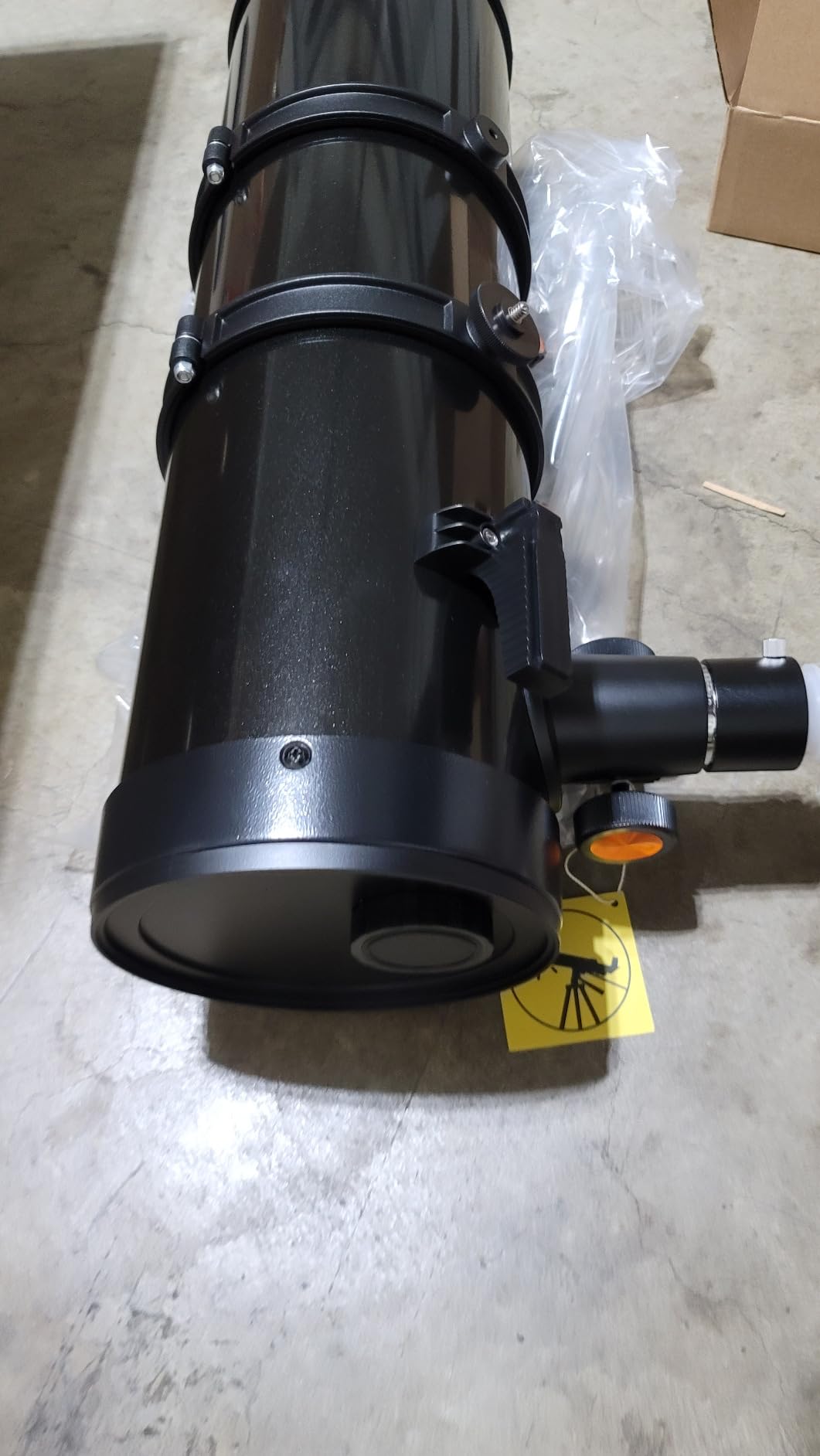
This is the only instrument here with a German equatorial mount, and that changes how you observe. Set it polar aligned, find a planet, and the slow-motion dials let you nudge it without touching the tube. On a long planetary session an altazimuth base needs constant adjusting because the planet drifts diagonally across the field; an equatorial mount near the meridian tracks much more smoothly, which is why planetary imagers have used them for a century.
The 150mm aperture is a genuinely capable size. Owners report Jupiter with its bands and moons, Saturn, and a crisp cratered Moon. The kit is also the most complete in the lineup: 25mm and 10mm eyepieces, a 2x Barlow, a red dot finder, a moon filter, a phone adapter, and a carry bag, with tool-free assembly.
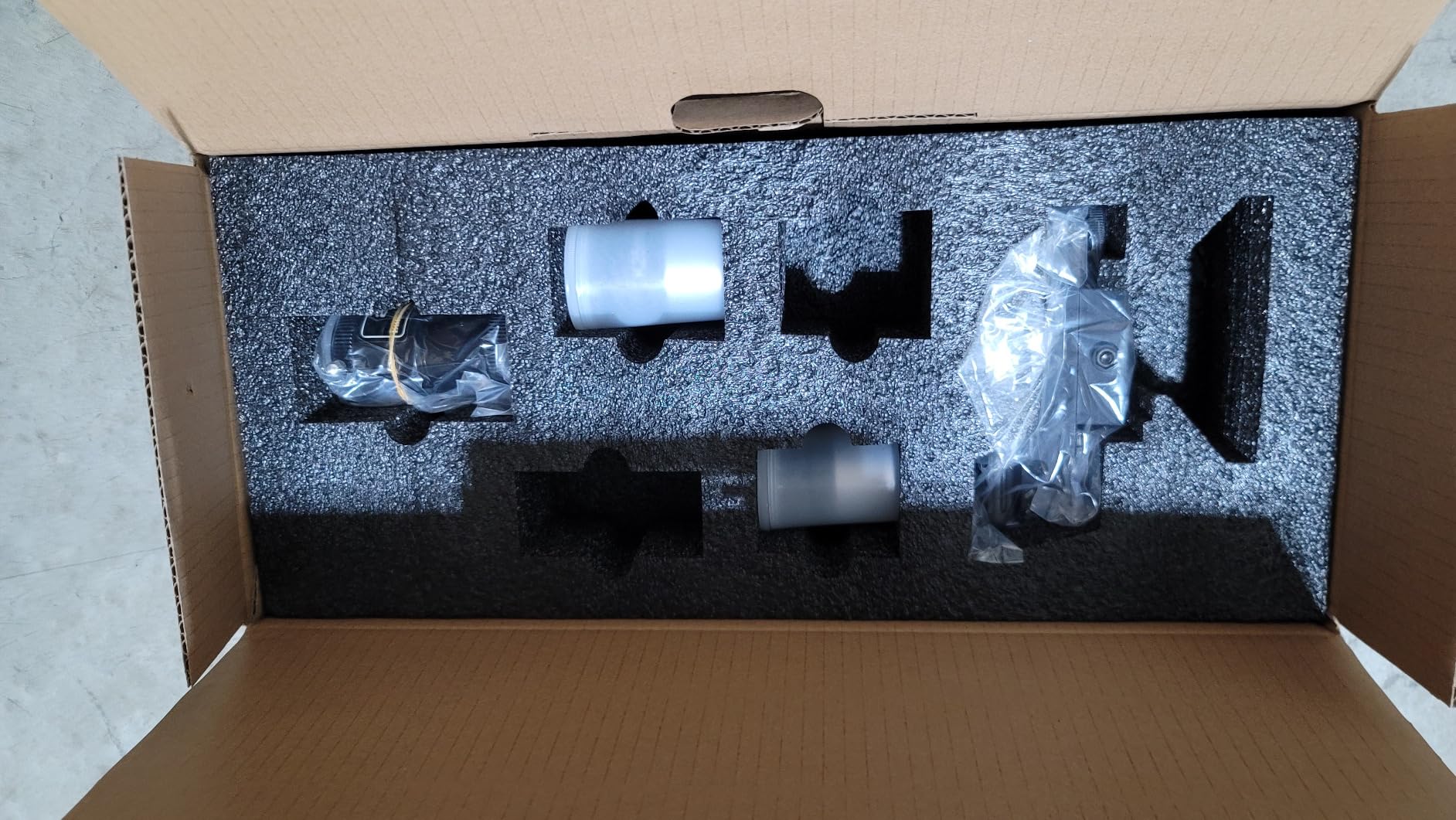
The limitation is focal length, and it is worth understanding before you buy. At 650mm, the 25mm eyepiece gives 26x and the 10mm gives 65x, with the 2x Barlow taking that to 130x. Reviewers report images softening past the stated 130x, because a short focal length runs out of magnification before a 6-inch aperture runs out of light. A 6-inch at 1200mm reaches 240x; this one does not get there.
So the smart move is to think of this as a wide-field and moderate-power instrument that happens to be great for Jupiter and the Moon and perfectly respectable for Saturn’s rings. If Saturn’s ring detail at 200x is the specific goal, the 650mm focal length works against you.
What Saturn looks like through the 150EQ?
At 65x with the 10mm, the rings are clearly separated from the globe and Titan is visible. At 130x with the Barlow, you get ring structure and the ring shadow. That is a satisfying Saturn view for most people, and on a night of steady seeing the equatorial mount’s tracking lets you stay on target far longer than a Dobsonian would.
One caution from the review data: at least one owner reports the primary measuring smaller than the advertised aperture. Check the mirror yourself when it arrives. It does not change the fact that this is a lot of complete, well-regarded instrument, but you should know what you received.
Who should skip the 150EQ?
Skip it if you have never used an equatorial mount and want a night of planetary observing this weekend. Polar alignment is not complicated, but it is a new skill, and it is a real barrier when you just want to look at a planet.
Also skip it if your plan is deep-sky imaging on a budget, or if you are buying for a child who will be handled roughly. The metal construction and steel tripod are genuinely more durable than plastic kits at this level, which is a real advantage for longevity.
6. Sky-Watcher Classic 150 6-Inch Dobsonian – Best Budget Scope for Saturn
Sky Watcher Sky-Watcher Classic 150 Dobsonian 6-inch Telescope – Solid-Tube – Simple, Traditional Design – Easy to Use, Perfect for Beginners, White (S11600)
6-inch aperture
1200mm focal length
Solid-tube traditional design
40 lbs assembled
2-inch focuser
Pros
- 6-inch aperture shows Saturn's rings plus Jupiter's bands and the Galilean moons
- 40 pounds assembled is light for a Dobsonian and manageable to move
- Arrives close to collimated
- so alignment is quick
- Super wide 25mm and 10mm eyepieces give a wide find field
Cons
- No GoTo
- so finding targets relies on star-hopping
- Included eyepieces are entry-level and soften at high power
- 2-inch to 1.25-inch adapter is easy to leave in place by mistake
- Instructions are thin on the focuser adapters
This is the entry point most people land on, and for a first Saturn view it is enough. A 6-inch aperture at 1200mm puts the ring system clearly on display, and at 120x with the supplied 10mm eyepiece owners report ring structure, Jupiter’s bands with the Galilean moons, and bright images of the Moon. Community recommendations on astronomy forums consistently single out 6-inch Dobs as a step-change in planetary detail over smaller scopes.
What makes this one better than a truss-tube 6-inch at the same aperture is the solid tube and the weight. Forty pounds assembled, split roughly fifteen pounds of tube and twenty-five pounds of base, is a genuinely two-person job but not a moving job. The 1200mm focal length is the same as the 8-inch models, so the magnification math is nearly identical: 48x on the 25mm, 120x on the 10mm, and a useful ceiling near 12 times per inch of aperture.
The one-star reviews cluster around documentation, not optics. The 2-inch rack-and-pinion focuser comes with a 1.25-inch adapter, and owners report leaving the adapter in place by mistake and getting an image that will not focus. That is a five-second fix once you know, and it accounts for a startling share of the complaints. A straight-through 6×30 finder is also hard to use when Saturn is high in the sky.
Newtonian mirrors go out of collimation when the tube is carried, so if you move this outside regularly, plan on a quick collimation check. A laser collimator makes the job a couple of minutes.
What Saturn looks like through the Classic 150?
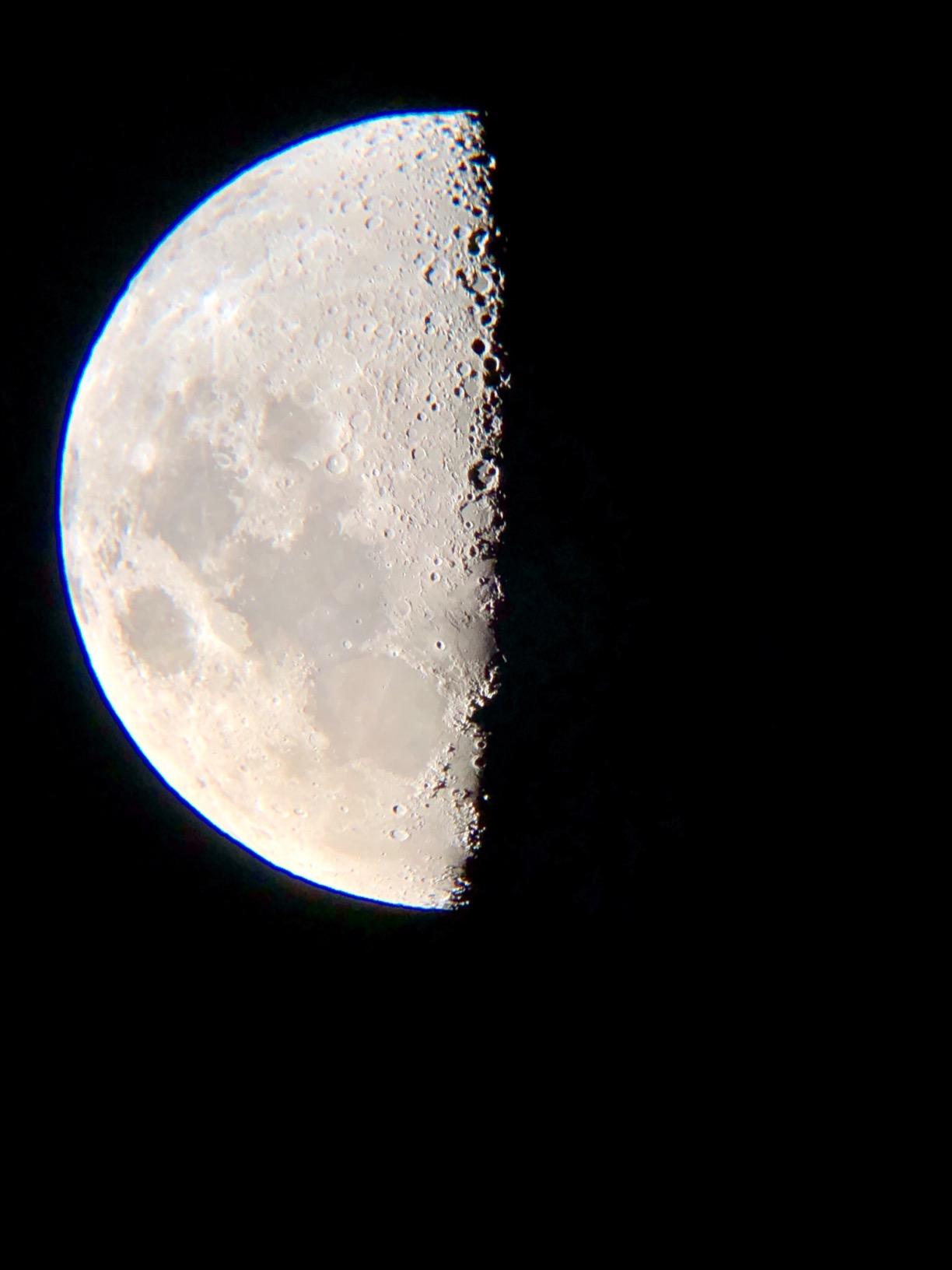
At 48x the rings are there and unmistakable, which is the moment most people describe as the reason they kept the telescope. At 120x with the 10mm the rings break into the main inner and outer bands and Titan is obvious. The Cassini Division is beyond what 6 inches reliably shows in average seeing, so if that specific detail is your goal, plan to move up in aperture eventually.
The upgrade path from here is straightforward and worth knowing: the eyepieces first, then the aperture. A 6mm or 8mm Plossl plus a 2x Barlow will use the aperture you already own far better than any change to the base or the finder.
Who should skip the Classic 150?
Skip it if seeing the Cassini Division is a stated goal, because that is an 8-inch job. Skip it if you will be observing from a light-polluted city and want to hunt faint galaxies, since 6 inches is modest for deep sky.
For a first telescope aimed squarely at Saturn, though, the gap between this and the 8-inch models is real but not as wide as the price difference suggests. You are buying the rings and the first band of ring structure, not the finest detail.
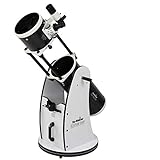
7. Sky-Watcher Flextube 200 8-Inch Dobsonian – Best Collapsible Scope for Travel
Sky-Watcher Flextube 200 Dobsonian 8-inch Collapsible Large Aperture Telescope – Portable, Easy to Use, Perfect for Beginners (S11700)
8-inch aperture
1200mm focal length
Collapsible Flextube design
8x50 right-angle finder
Pros
- 8-inch aperture gives strong Saturn and Jupiter views even under suburban light pollution
- Collapsible tube stores compactly and separates the two mirrors into different tubes
- 2-inch Crayford-style focuser is smooth and accepts 1.25-inch accessories
- 90-degree right-angle finder is far more usable at the zenith
Cons
- Tube needs re-collimation after collapsing or carrying
- Azimuth movement is sticky out of the box
- No GoTo and no Barlow supplied
- Some units arrive with a broken finder ring set screw
This is the 8-inch Dobsonian for people who do not observe from home. The Flextube collapses on a strut design that lets the two mirror tubes slide into each other, so an 8-inch instrument packs into something a much smaller telescope would occupy. The two mirrors end up in separate tubes, which also protects them from bumping each other in the car. Owners who get past the learning curve on collimation describe views of Saturn, Jupiter, and the Moon as excellent.
Otherwise it is the familiar 8-inch, 1200mm Dobsonian recipe: fully multi-coated borosilicate primary and secondary, a 2-inch Crayford-style focuser, 25mm and 10mm super wide-angle Plossl eyepieces, and a 2-year warranty. The 8×50 right-angle finder is a small upgrade over the straight-through finders on the budget models, because it stays usable when Saturn is high and your neck is not.
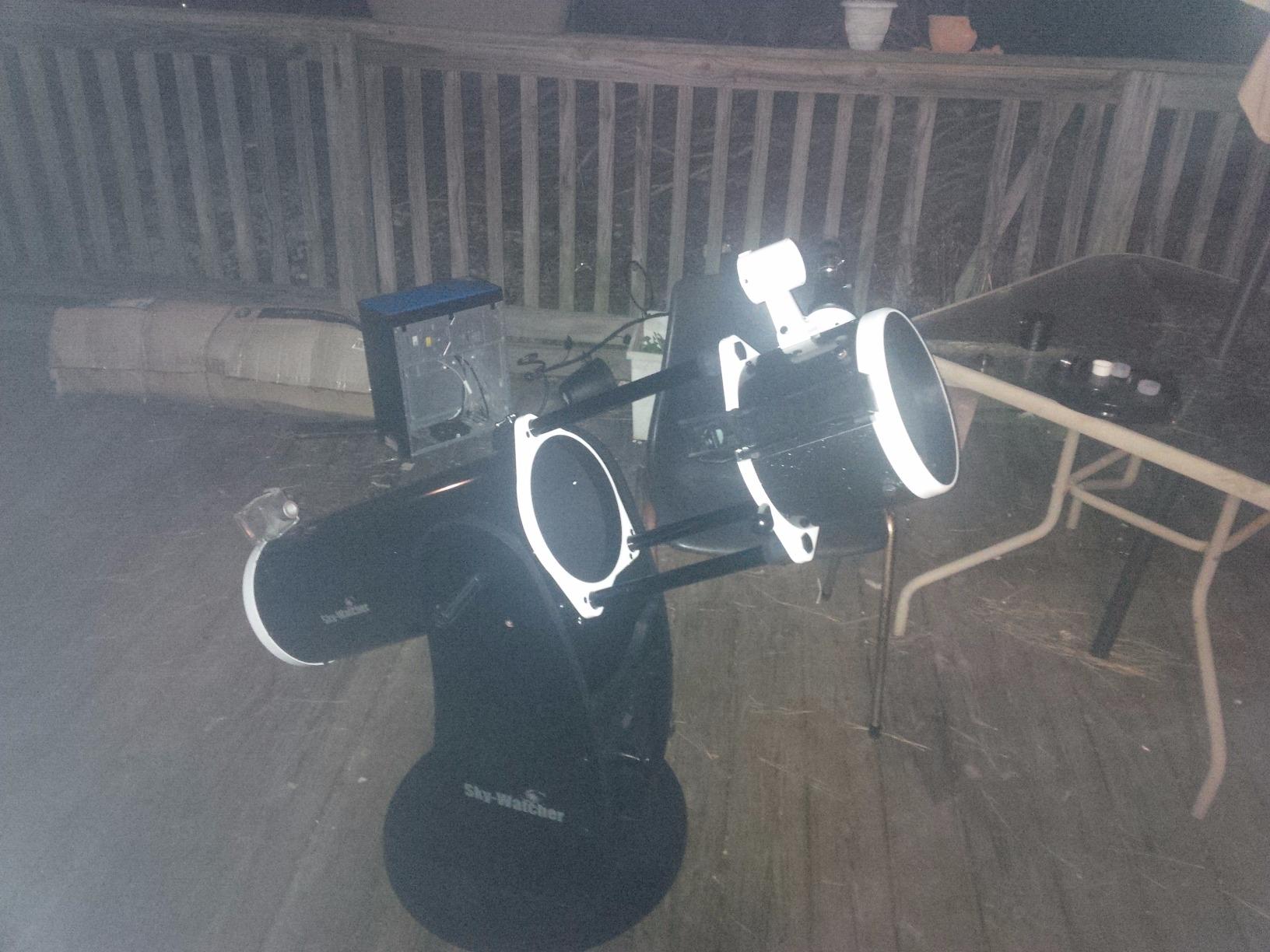
Collimation is the honest downside. The negative reviews focus almost entirely on the difficulty of aligning the collapsible tube, and one reviewer reports never achieving a clear image. If the idea of a collimation learning curve sounds like friction, a solid-tube Dob removes it entirely at the cost of packed size. This is a trade, not a defect.
Two smaller fixes. The azimuth bearing can be sticky out of the box, and owners report that swapping in a 12-inch lazy Susan bearing makes the movement smooth. And there is no GoTo and no Barlow, so you will be star-hopping and buying a 2x Barlow separately.
What Saturn looks like through the Flextube 200?
Optical performance matches the other 8-inch, 1200mm Dobsonians here: 48x to identify it, 120x for ring structure and Titan, and beyond 200x when the seeing cooperates. The open aperture gives bright, high-contrast planetary images, and owners note it holds up well under suburban light pollution for the Moon and planets.
Because a Dobsonian has no secondary mirror in the light path, contrast on a planet is excellent compared with a Schmidt-Cassegrain of the same aperture. That is a real advantage for seeing fine ring detail, and it is why a lot of experienced planetary observers choose a Dob over a catadioptric of identical size.
Who should skip the Flextube 200?
Skip it if you are a complete beginner and collimation sounds intimidating, and skip it if the scope will live on a patio and never travels, because you would be paying a small amount for portability you will not use. An 8-inch solid-tube Dob is simpler for the same aperture.
Buy it if you drive to dark sites, fly with a telescope, or have a small car. The portability is the whole point, and for someone who observes away from city lights, being able to bring the telescope is what makes the observing happen at all.
How to Choose a Telescope That Actually Shows Saturn’s Rings?
Aperture is the number that decides whether you see rings, ring structure, or ring detail. Everything else on the spec sheet is secondary. A telescope is rated by the diameter of its main lens or mirror, and that diameter determines how much light you gather, how much detail you can resolve, and how much magnification you can use before the atmosphere takes over. Ignore the marketing magnification on the box entirely; a 675x claim is meaningless, and reviewers in the astronomy forums complain about it constantly.
What Saturn actually shows at each aperture?
Seven inches is a good Saturn scope. Six inches shows the rings with structure in them. Four inches and below, you are limited. A 70mm refractor is the true minimum for seeing Saturn’s rings at all, and even then only on a steady night with the planet reasonably high.
70mm achromatic refractor: The rings appear as a flattened oval around a bright dot. Titan is usually visible with patience. This is the entry point, not the destination.
90mm to 102mm refractor or Maksutov-Cassegrain: The ring system separates into a bright inner band and a dimmer outer band, and Titan is an easy target. Long focal length scopes in this range are the best value for pure Saturn.
127mm to 130mm Maksutov or short-tube reflector: The Cassini Division starts to appear intermittently in good seeing, and the ring shadow on the globe becomes visible.
6-inch Dobsonian or Newtonian: Rings resolve into multiple distinct bands, the planet shows subtle cloud structure, and the Galilean moons are obvious. This is where most first-time observers decide they are satisfied.
8-inch Dobsonian: The Cassini Division is reliably visible, ring banding shows across the whole ring system, and Titan, Rhea and Dione become straightforward finds. This is the tier we recommend as the target.
8-inch Schmidt-Cassegrain: Same aperture, same theoretical detail, in a compact tube with GoTo, at the cost of some contrast from the secondary mirror obstruction.
Focal length and focal ratio: why longer suits planets?
Magnification comes from your telescope’s focal length divided by your eyepiece’s focal length. A 1200mm scope with a 10mm eyepiece gives 120x. A 650mm scope with the same eyepiece gives 65x. That is why long focal length telescopes dominate the planetary end of this list: they buy magnification without adding a third lens element that costs light and sharpness.
Focal ratio is focal length divided by aperture, and it matters less for planets than the forums suggest. Traditional advice favours f/10 and longer because a slower focal ratio produces a smaller, more concentrated exit pupil, which suits a single dark-adapted eye on a planet. It is a reasonable preference, not a rule, and plenty of observers get excellent planetary images from f/6 and even f/5 instruments. What is a rule is the practical one: whatever your focal length, the useful magnification ceiling is about twice the aperture in inches.
Magnification for Saturn: where the image dies?
Most people asking what magnification they need for Saturn are actually asking what magnification will not make it worse. Saturn is roughly 15 to 20 arcseconds across, and it needs 25x or so to look like anything at all. Past about 60x, additional magnification adds no light, so the image just gets bigger and dimmer, and atmospheric turbulence turns the planet into a boiling blur.
30x to 50x: Saturn is a ringed object. Good for finding it and for showing children what they are looking at.
60x to 100x: The ring system separates into inner and outer bands, the ring shadow appears on the globe, and Titan is an obvious moving point.
120x to 150x: The most useful range for most amateur telescopes. Cassini Division and ring banding are at your mercy here, depending on aperture and seeing.
200x and above: Only meaningful on 8 inches of aperture with steady air. If the image shimmers, step back down. More magnification is not more detail.
The real ceiling is not your mirror, it is your sky. Rule of thumb: about 2x per inch of aperture, then cut that back whenever the image is boiling.
Telescope type: which design suits Saturn?
For Saturn specifically, aperture wins and simplicity wins. Dobsonians are the value choice because an 8-inch mirror on a manual base is the cheapest way to buy light. Maksutov-Cassegrains are the compact choice, needing no collimation and no maintenance. Schmidt-Cassegrains are the travel and GoTo choice, packing a long focal length into a short tube. Achromatic refractors are the simple grab-and-go choice, but at 70mm to 90mm they are aperture-limited and show more colour fringing at high power than the alternatives.
A note on focal ratio inside that: shorter refractors, especially anything at or below f/5, suffer visible chromatic aberration at high magnification because a single lens cannot focus all colours together. If you want maximum sharpness on a small refractor, pick a longer model around f/8 to f/10, or accept that the aberration shows up as a colour fringe on the bright limb of the planet.
Mount steadiness: the quiet killer of planetary detail
More planetary detail is lost to shaking mounts than to weak optics, and this is the single most repeated complaint across owner reviews of every scope in this list. The issue is atmospheric turbulence plus mechanical vibration. Turbulence you wait out. Mechanical vibration you design out: tighten tripod legs fully, avoid touching the legs or the mount while observing, and let a Dobsonian or fork-arm scope settle for a minute after you center a planet.
For long focal lengths and high magnification, damping matters even more. Dobsonian tension control handles and Teflon bearings exist for a reason, and a fork-arm mount on a sturdy tripod can be perfectly adequate if you are disciplined about not touching it. Budget for a vibration-damping pad if you observe from a wooden deck, since decking transmits footsteps remarkably well.
Why Saturn still looks blurry, and how to fix it?
Blurry Saturn is almost never an optics problem. In order of likelihood it is magnification beyond what the aperture supports, atmospheric turbulence, an unstable tripod, a reflector that has drifted out of collimation, or tube currents from a scope that has not acclimated to outdoor temperature. A sixth, less common cause is a cheap achromatic refractor showing its chromatic aberration as blur at high power.
Work down that list before blaming the telescope. The cheapest fix in the hobby is almost always stepping down one magnification step and waiting two minutes for the air to settle.
First-night routine: find, focus, step up, step back
Align and center Saturn at its lowest power, roughly 30x to 40x, using a red dot finder or finderscope. Focus carefully at low power; focus is much easier to judge when the field is wide. Let the telescope sit for 10 to 15 minutes so the tube reaches outdoor temperature and the mirror stops shimmering. Then step up one eyepiece at a time, pausing a minute at each to judge whether the image is sharper or softer.
When it starts getting worse, step back down one and stay there. Let your eyes dark-adapt fully before you start, and observe when Saturn is high in the sky, where you look through less atmosphere. The whole session takes about 30 minutes to do properly, and doing it the same way every time is what separates people who get sharp planetary images from people who wonder why theirs looks like porridge.
When and where to observe Saturn?
Saturn is best observed when it is high in the sky, because you are then looking through less atmosphere. Altitude beats darkness for planets, which is the opposite of the deep-sky rule. A steady, slightly hazy evening over a city can beat a turbulent clear night in the country. Avoid rooftops, asphalt and hot pavement after sunset, since rising heat shimmer ruins a planetary image faster than any other factor.
Planetary seeing also changes through the night. The lowest hours are usually the most turbulent; the hour or two after dark, when the ground has stopped radiating heat, is often the calmest. Saturn reaches opposition roughly every 29.5 months, when it is closest to Earth, brightest, and visible all night, but it is well worth the view at any point in its yearly cycle.
Frequently Asked Questions
How strong of a telescope do I need to see Saturn’s rings?
You need at least a 70mm aperture to resolve Saturn’s rings at all. A 90mm to 130mm instrument puts Titan and the main ring gaps in reach, and 8 inches of aperture is where the Cassini Division and real ring banding become reliable. Add a focal length around 1000mm or more and a mount steady enough to hold 100x without shaking.
What magnification do you need for Saturn?
Start at 30x to 50x to see Saturn as a ringed planet, then move to 60x to 100x where the rings separate into inner and outer bands and the ring shadow appears on the globe. 120x to 150x is the most useful range for most amateur scopes. Beyond 200x the atmosphere usually stops you before the mirror does.
What is the cheapest telescope that can see Saturn’s rings?
A 70mm achromatic refractor is the cheapest instrument that reliably shows Saturn’s rings, though only as a flattened oval. The best value step up is a 6-inch Dobsonian reflector, which shows ring structure and Titan for a modest jump in cost. Marketing magnification claims are meaningless; compare apertures in inches instead.
Can you view Saturn through a telescope?
Yes, and it is one of the easiest targets to find because it is bright and does not twinkle like a star. Point any telescope with a 70mm or larger aperture at it, using a star chart or finder scope to locate it, and the rings will be visible in any decent optical tube from 40x magnification upward.
Why does Saturn look blurry in my telescope?
The most likely causes are magnifying past what the aperture supports, atmospheric turbulence, a shaking tripod, or a reflector that has drifted out of collimation. Step down one eyepiece and wait two minutes before changing anything else. If the image stays soft, collimate the mirror and let the tube reach outdoor temperature before you observe again.
Final Verdict: Which Telescope for Saturn Should You Buy?
Buy the Celestron NexStar 8SE if you want one telescope and you want it to do everything well. Eight inches of aperture at 2032mm gives you the ring detail, a 40,000-object GoTo database removes the hardest beginner task, and at 24 pounds it is the only 8-inch scope here you can carry up stairs alone.
Buy the Sky-Watcher Classic 200 if your money is best spent on aperture and nothing else. The same eight inches, roughly a fraction of the cost, in a rigid solid tube that holds collimation. Add a 6mm or 8mm Plossl and a 2x Barlow and you will use every bit of it. If carrying matters, the Flextube 200 gives you the same aperture in a packable tube.
Buy the NexStar 127SLT if Saturn is one target among many and you travel or observe from a city. It is compact, needs no collimation, and points itself at the planet in under a minute. The Sky-Watcher Classic 150 covers the case where a first Saturn view is the whole goal, and the StarSense 8 covers the case where the biggest barrier is not optics but finding the planet at all.
Whatever you choose, judge it on aperture in inches, not the magnification printed on the box, and give it a full 30-minute session on a steady night before deciding. Saturn is at its ring-plane angle through the mid-2026s, so a thinner ring is normal and not a fault in your telescope. It will widen again in the years ahead, and the scope you buy now will still be pointed at it.