
The best telescope cases for travel solve a problem most owners discover the hard way: a reflector or catadioptric tube is a collimated assembly, and a single knock against a hard fitting can put it out of collimation or crack a focuser. Whether you are hauling an 8 inch Dobsonian to a dark site two hours away or flying a small refractor across an ocean, the case decides whether the instrument arrives aligned and intact.
We spent weeks comparing twelve telescope travel cases across soft padded bags, EVA hard shells and compact multipurpose models, checking stated internal dimensions against real telescope classes, carry modes, weight and fabric ratings. The pattern that stood out: the “universal” bags on the market are rarely universal, and the number printed on the outside tells you very little about the inside length that actually matters.
So this guide is organised the way travel actually works. Padded soft bags win for car travel to observing sites, hard shells earn their bulk when a case goes through baggage handling, and the smallest cases only work if your optical tube is genuinely small. If you also carry long guns or bows to remote country, our guides to the best rifle cases for traveling hunters and the best bow cases for compound bows apply the same fit-first logic to a different kind of fragile cargo.
Table of Contents
Quick Picks: the best telescope cases for travel at a glance
Celestron Telescope Carrying Case for NexStar SE, Evolution, SCT and EdgeHD — the only pick here with a molded EVA shell and thick dense foam, and the one to buy if your tube ever flies.
Celestron 40 inch Protective Carrying Bag — the best all-round value: 900 denier polyester, 16mm foam, a reinforced PVC base, and room for tube, mount and tripod together.
YOREPEK 40.5 inch Tripod Carrying Case — best when the whole rig has to go in one bag, with buckle straps that stop the tube sliding.
Celestron 8 inch Optical Tube Carrying Bag — the dedicated choice for 8 inch Schmidt-Cassegrain and EdgeHD tubes, with two ways in.
bagmate 39 inch Multipurpose Telescope Bag — the lightest sensible soft bag for repeated car runs to dark sites.
SVBONY SV212 Multipurpose Telescope Bag — compact, waterproof-feeling and highly rated, sized for small Maksutovs and refractors rather than big tubes.
Top 3 telescope travel cases (October 2026)

Celestron EVA Hard Shell Case
- Molded EVA shell with dense foam walls
- Fits 4 to 8 inch SCT and EdgeHD tubes
- Compression strap plus foam spacers

Celestron 40 inch Soft Carrying Bag
- 900 denier polyester with 16mm EPE foam
- PVC-reinforced hard bottom
- Two zipper access points

YOREPEK 40.5 inch Tripod Case
- 40.5 inch main compartment
- Retractable buckle fixing straps
- Detachable shoulder strap and padded handles
Our top three cover the three real travel scenarios. The Celestron hard shell is the pick for anything that gets checked or handed off. The 40 inch Celestron soft bag is the value winner for car-based observing. The YOREPEK bag is the one-solution option when the tripod, the tube and the accessories all need to travel together.
All 12 telescope travel cases compared in 2026
Internal dimensions matter more than the size on the box, so the table below lists the measurements and material each manufacturer actually publishes, alongside the telescope sizes the case is realistically built for.
| Product | Specifications | Action |
|---|---|---|
| Celestron Carrying Case for NexStar SE and SCT |
|
Check Latest Price |
| YOREPEK 40.5 inch Tripod Case |
|
Check Latest Price |
 Comecase Monocular Telescope Case Comecase Monocular Telescope Case |
|
Check Latest Price |
 bagmate 39 inch Multipurpose Telescope Bag bagmate 39 inch Multipurpose Telescope Bag |
|
Check Latest Price |
| Celestron 40 inch Protective Carrying Bag |
|
Check Latest Price |
 Celestron 8 inch Optical Tube Bag Celestron 8 inch Optical Tube Bag |
|
Check Latest Price |
 samdew 40.8 inch Telescope Case samdew 40.8 inch Telescope Case |
|
Check Latest Price |
 samdew Double-layer Telescope Bag samdew Double-layer Telescope Bag |
|
Check Latest Price |
 samdew Tube Bag for 4 to 9.25 inch Tubes samdew Tube Bag for 4 to 9.25 inch Tubes |
|
Check Latest Price |
 HODRANT Large Telescope Carrying Case HODRANT Large Telescope Carrying Case |
|
Check Latest Price |
 Astromania Deluxe Accessory Case Astromania Deluxe Accessory Case |
|
Check Latest Price |
 SVBONY SV212 Multipurpose Telescope Bag SVBONY SV212 Multipurpose Telescope Bag |
|
Check Latest Price |
Two entries are not tube cases at all. The Astromania and Comecase models are accessory and monocular cases, and they earn their place because a telescope that flies with its eyepieces loose in a pocket is exactly the scenario most owners regret.
1. Celestron Telescope Carrying Case for NexStar SE, Evolution, SCT and EdgeHD — hard shell protection for checked trips
Celestron Telescope Carrying Case for NexStar SE, Evolution, SCT & EdgeHD
EVA molded hard shell
23 x 15 x 14 in
10 lb
Fits 4, 5, 6 and 8 inch tubes
Pros
- Dense foam padding on all walls
- Semi-rigid shell survives baggage handling
- Compression strap plus foam spacers for a tight fit
- Zippered accessory pocket
Cons
- Does not hold the tripod or tripod base
- Bulky footprint with a deeper lid section
- Very snug fit can press on the focuser
This is the case we trust when a telescope is not going to travel gently. It is a molded EVA shell rather than sewn fabric, so a dropped case or a heavy stack in a baggage hold does not transmit straight into the optics.
Inside, thick dense foam runs along every wall, and two foam spacers plus a built-in compression strap let you tune the fit for a NexStar 4SE, 5SE, 6SE, Evolution 6, or an 8 inch Schmidt-Cassegrain or EdgeHD tube. The 23 by 15 by 14 inch body is not small, and at 10 pounds it is a genuine two-hand carry.
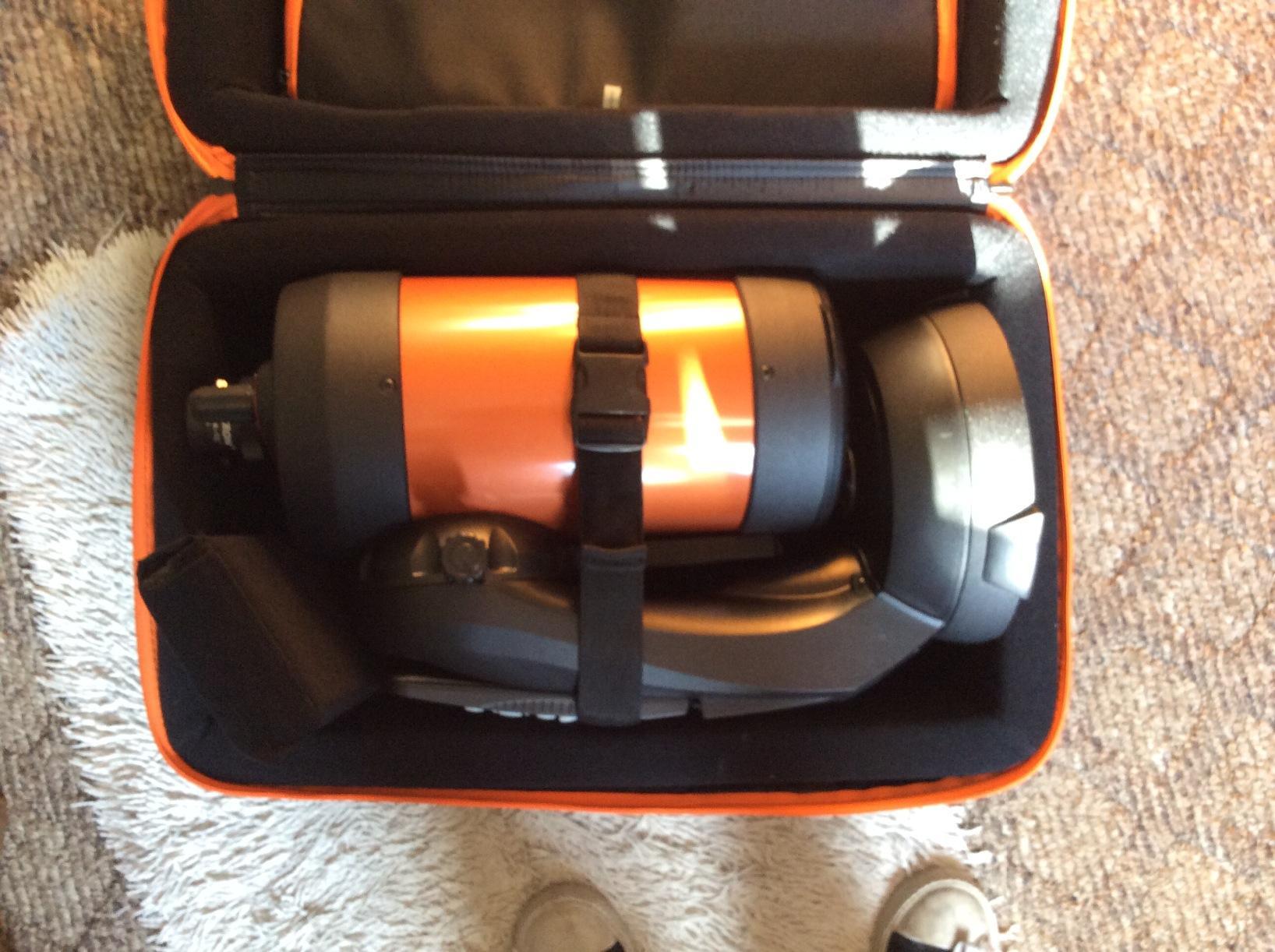
Owners consistently report that the foam and semi-rigid shell do their job, and that the accessory pocket swallows eyepieces and cables that would otherwise rattle loose. One 8 inch Schmidt-Cassegrain owner even fits a Meade ACF tube in it. The tube sits very tightly, so measure your focuser and visual back clearance before you commit to a shorter variant.
What fits inside it?
Optical tubes from 4 inch to 8 inch are the stated range, and that covers most NexStar SE and Evolution tubes plus 8 inch SCT and EdgeHD optical tubes. Mounts and accessories fit alongside, and there is a separate zippered pocket for the loose items.
What it does not take is a tripod or a tripod base. Plan on a second bag for those, which is why the 40 inch soft cases later in this list score well for anyone who wants one bag per trip.
Who should skip it?
Anyone backpacking or moving through airports on a tight budget connection will feel the 10 pound weight and the deep lid section, which adds bulk beyond the dimensions suggest. If your only travel is a two-hour drive to a dark site, this protection is more than you need.
It is also the least convenient option for anyone moving a full rig solo, because a tube plus this case plus a tripod bag is a two-trip load. Budget owners doing car-only transport can get similar everyday protection for far less.
2. YOREPEK 40.5 inch Tripod Carrying Case — one bag for the whole rig
YOREPEK 40.5″ Heavy Tripod Carrying Case Bag with 2 Padding Protective Pads
40.5 x 9.5 x 9.5 in
Water-resistant nylon
3.5 lb
Buckle straps included
Pros
- Long main compartment fits full-size tripods and stands
- Retractable buckle straps hold gear in place
- Water-resistant heavy-duty nylon
- Detachable shoulder strap and padded handles
Cons
- Soft cylindrical shape gives less crush protection than a hard case
- Padding is thin in spots versus dedicated telescope cases
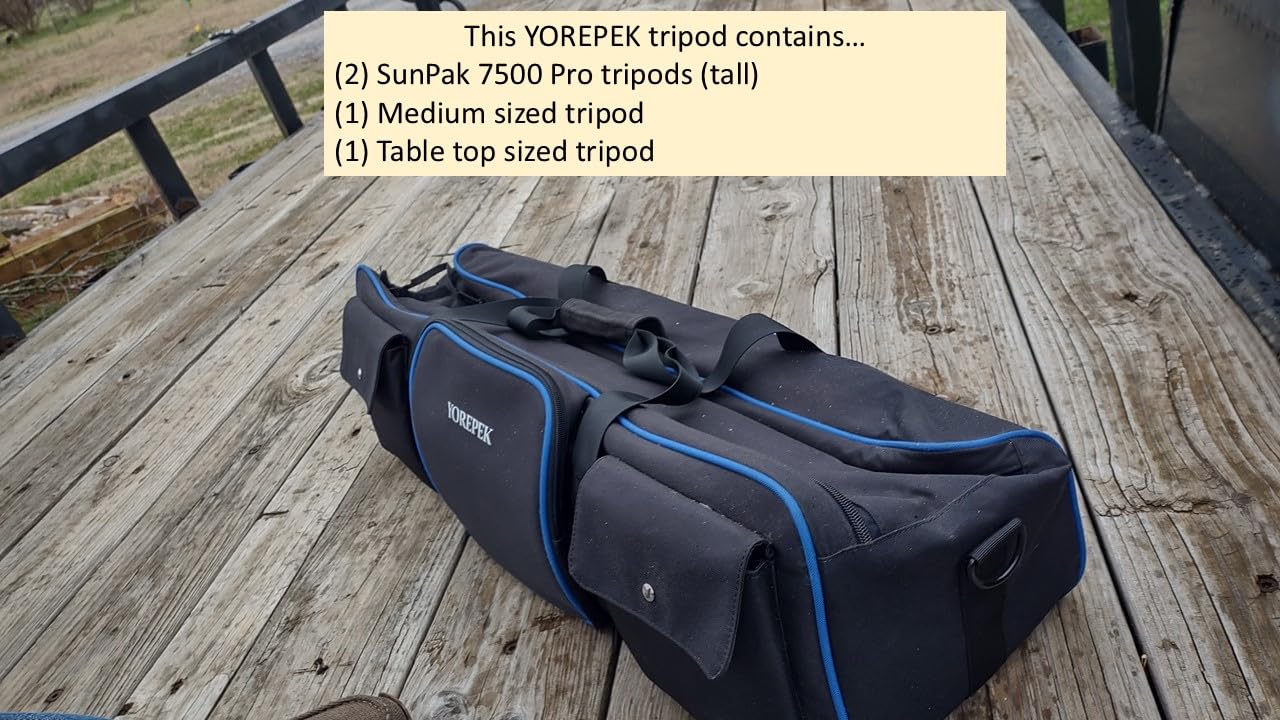
This is the pick for anyone whose problem is not protecting a tube from a drop but simply getting a complete telescope and tripod through a doorway, into a rental car, or onto a train. At 40.5 inches long, the main compartment swallows a full-size tripod with the legs collapsed.
Two things set it apart from a generic camera bag. The retractable buckle fixing straps actually hold gear against the inside wall rather than letting it slide to one end, and the double linked zippers make loading a long tripod in a narrow opening far less awkward.
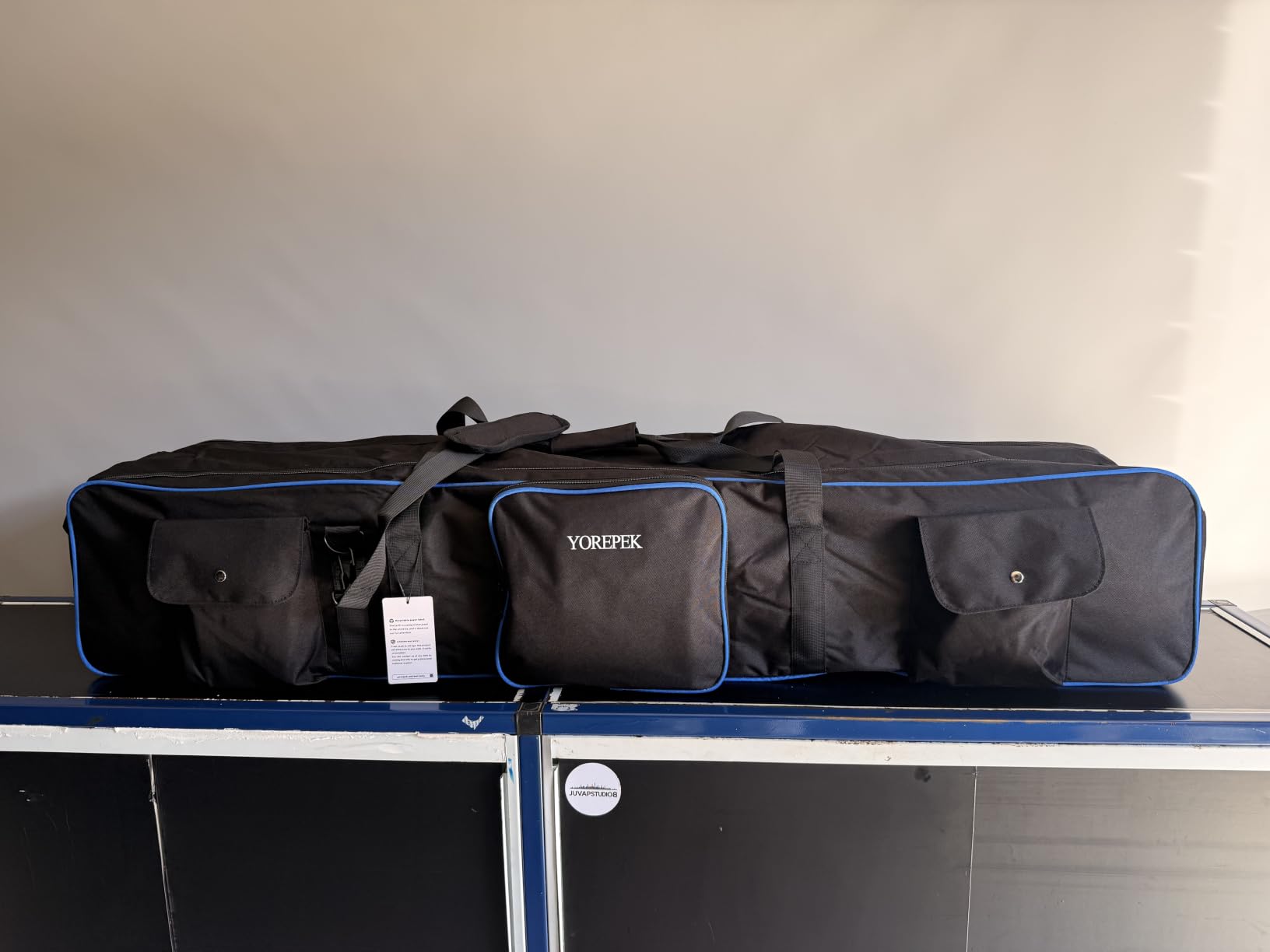
At 3.5 pounds it is also one of the lighter options here, and the detachable adjustable shoulder strap plus padded hand handles mean you can choose how to carry it once. Reviewers commonly pair it with a separate tube case when travelling with astronomy gear, which is a sensible split for car travel.
What fits inside it?
Long tripods, monopods, light stands and similar upright gear are the design brief, and the 40.5 by 9.5 by 9.5 inch body has the diameter for a collapsed tripod plus small accessories. Three front pockets add room for bags, straps and cables.
A short refractor or an 8 inch Dobsonian base will also fit lengthwise, but a long optical tube with a diagonal will not sit comfortably beside a tripod. For tube-plus-tripod, choose a case in the 39 to 40.8 inch soft range instead.
Who should skip it?
If your only travel is checked baggage, skip it. A soft cylindrical case has no crush resistance, and a tube sliding inside a flexible shell through a baggage conveyor is exactly the scenario the molded cases are built for.
Backpackers should also weigh it carefully: 3.5 pounds of empty case plus a tripod plus a mount plus a tube adds up fast, and this shape does not sit well against a rucksack frame.
3. Comecase Monocular Telescope Case — protection for genuinely small optics
Comecase Monocular Telescope Case for Gosky 12×55 with Accessory Storage
Hard EVA shell
9 x 6.5 x 3 in
Two compartments
Divider and mesh pocket
Pros
- Snug well-padded EVA shell
- Detachable divider and mesh pocket
- Light enough to sit inside a backpack
- Firm hand strap and perimeter zipper
Cons
- Shell is thin and dents on a hard impact
- One reviewer reported a strong initial chemical odor
- Outer surface shows fingerprints easily
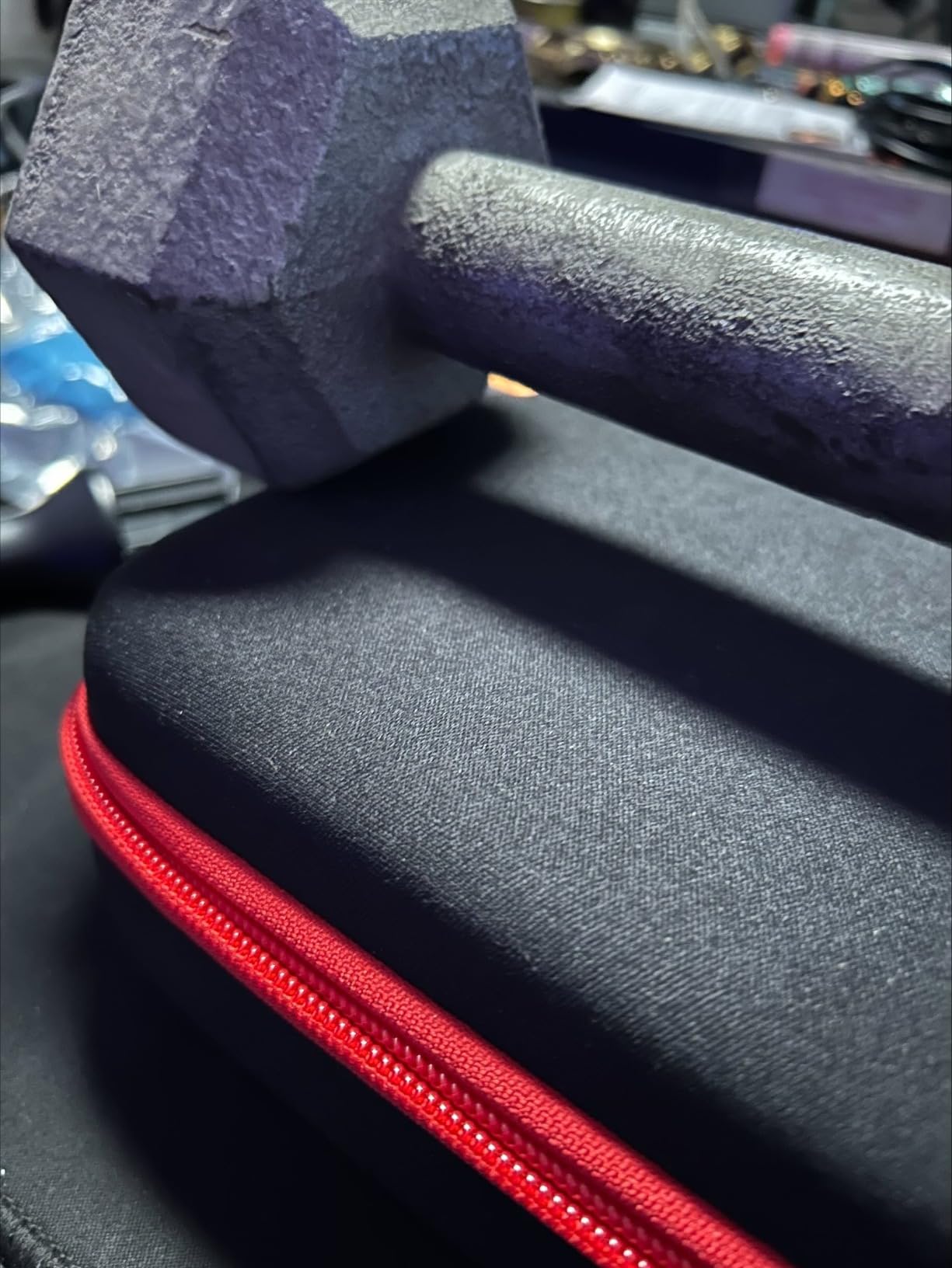
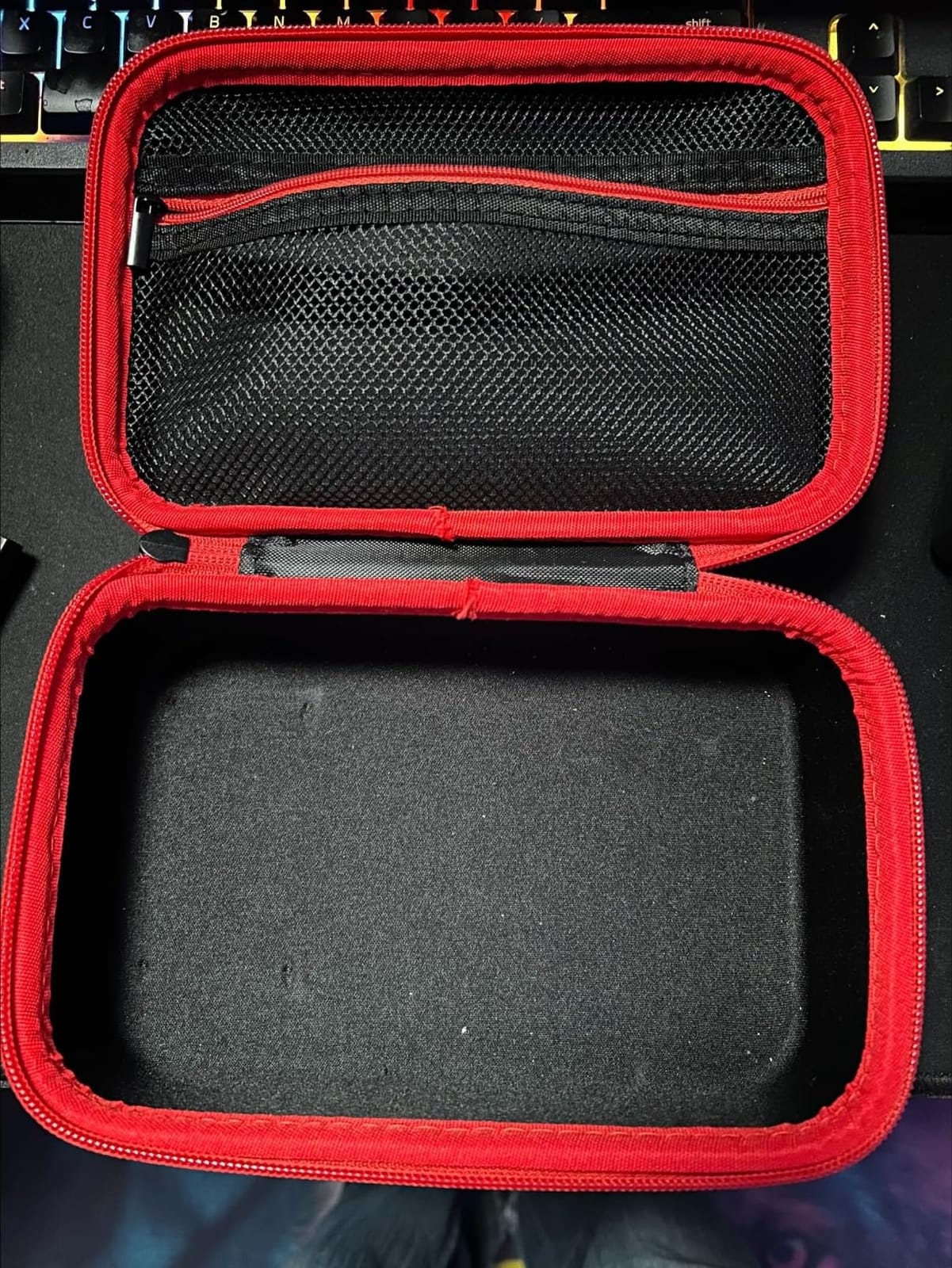
Sometimes a telescope case for travel needs to fit inside a daypack, and that is what this one is for. At 9 by 6.5 by 3 inches it is built around compact monoculars and binoculars rather than optical tubes, and it is the smallest thing in this roundup that still offers rigid shell protection.
The hard EVA exterior resists shock, shake and scratches better than any fabric bag here, and the detachable divider separates the optic from its accessories. An inner mesh pocket holds a charger, an adapter or a mini tripod without them cutting into the body of the instrument.
It is designed around the Gosky 12×55 and fits a range of similar compact monocular and binocular models, and it is small enough to disappear into luggage rather than dictate what you pack. Case only: the optic is not included, which trips up a lot of first-time buyers.
What fits inside it?
Compact monoculars, small binoculars, finders, adapters and a mini tripod. Anything with a 12×55 class form factor, which is the category of optic you would actually carry onto a night flight rather than check.
It will not hold a Dobsonian, a Newtonian, an SCT or any refractor with a meaningful aperture. If you need a bag for those, start with the tube cases later in this list.
Who should skip it?
Owners of expensive high-end glass who plan to drop the bag should skip it. Reviewers describe the shell as thin enough to dent on a hard impact, and a dented shell is a compromised shell for delicate optics.
One reviewer also reported a strong chemical smell on first opening, and the exterior marks easily with fingerprints and dirt. Air it out before a trip if you are sensitive to that.
4. bagmate 39 inch Multipurpose Telescope Bag — the light car-travel option
bagmate Multipurpose Telescope Bag – Shock-Absorbent Telescope Carrying Case with Adjustable Shoulder Strap and Extra Storage – Military-Grade, Water Repellent Camera Case (39 inches)
39 x 12.3 x 12.3 in
Water-repellent polyester
1.66 kg
Shoulder and hand strap
Pros
- Roomy 39 inch body fits tube
- mount and accessories
- Shock-absorbing foam on sides and bottom
- Water-repellent fabric suits field use
- Removable shoulder strap and hand strap
Cons
- Soft shell gives less protection against drops or stacking
- Single large compartment is harder to organize
This is the bag to pick if your observing trips are all within a couple of hours by car and you are tired of lugging a hard shell around. It weighs 1.66 kg, which is a little over half the weight of the molded case at the top of this list, and it folds rather than holding a fixed shape.
The 39 by 12.3 by 12.3 inch main compartment takes an optical tube, a mount and accessories together, with shock-absorbing foam along the sides and bottom. The fabric is water-repellent military-grade polyester, which matters more than it sounds when a case sits in a wet car park before dawn.
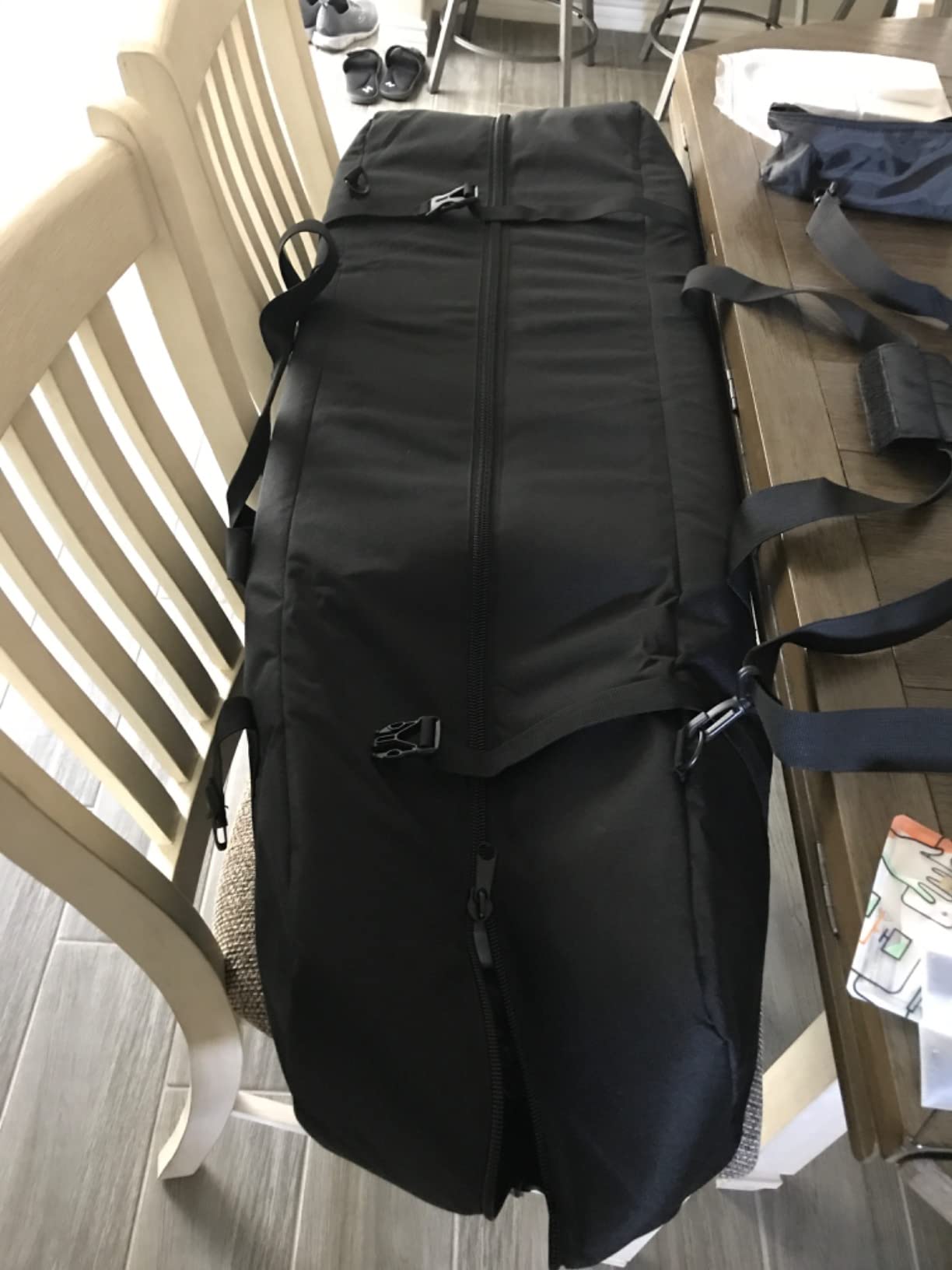
Carry options are a removable adjustable shoulder strap plus a hand-carry strap, so you can move it from the boot to a picnic table without unpacking. Owners rate it highly on capacity and on how much lighter it feels than a hard case, which is the entire point of buying a soft case.
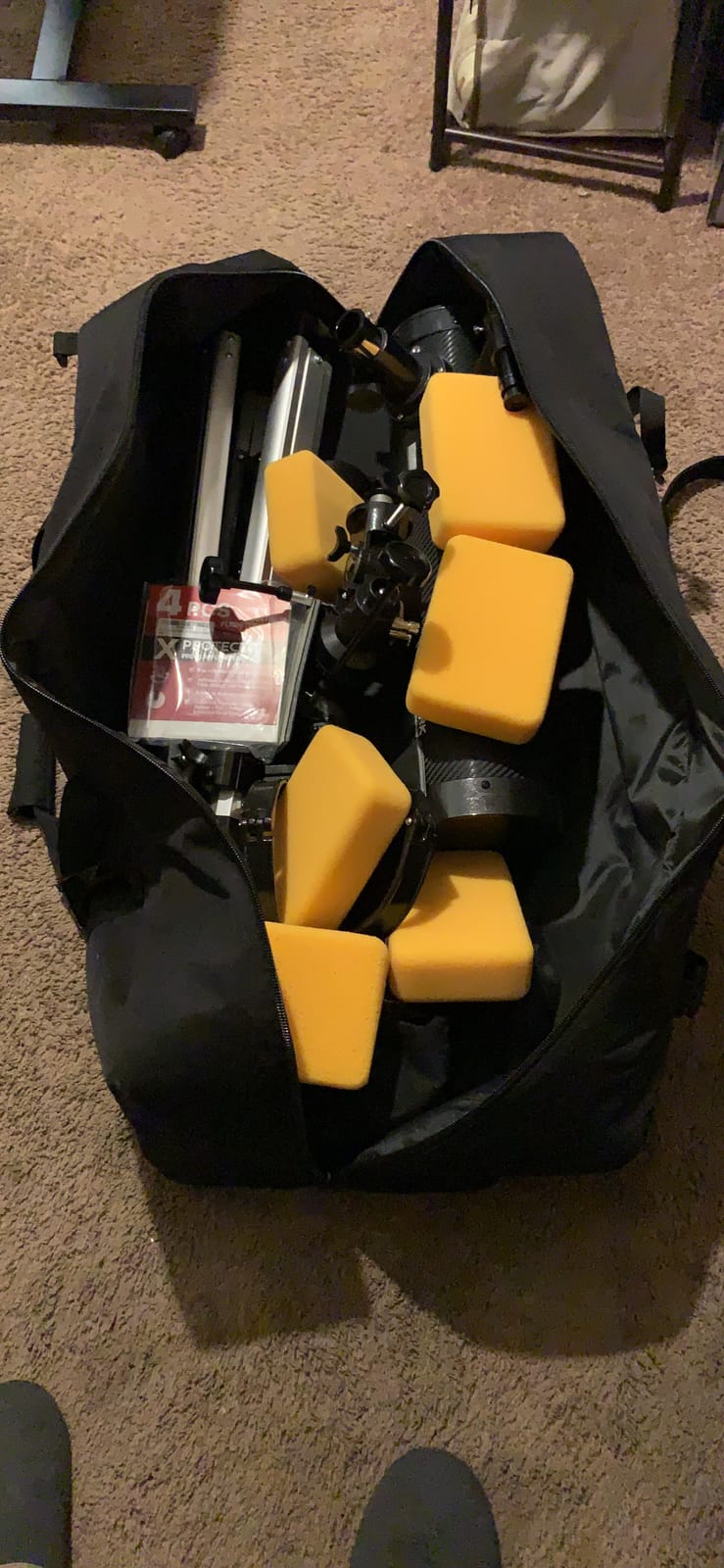
What fits inside it?
Optical tubes up to roughly 39 inches long with their mounts and accessories. That covers 8 inch Dobsonians, 6 inch and 8 inch Newtonians, mid-size refractors and 8 inch Schmidt-Cassegrains without their tripods.
External accessory pouches keep eyepieces and cables in view rather than loose at the bottom. The same family is also offered in a 34 inch width for smaller scopes, which is worth checking if your tube is on the short side.
Who should skip it?
Flyers and anyone who checks a scope should skip it. A soft bag with side and bottom padding handles routine bumps, not conveyor belts or a dropped case, and that is a consistent theme in reviews of this class of bag.
It also has a single large compartment with no internal dividers, so if you care about finding a specific eyepiece in the dark at a remote site, you will be unpacking the whole bag. Look at the divided models later for that.
5. Celestron 40 inch Protective Carrying Bag — tube, mount and tripod in one bag
Celestron 40″ Protective Carrying Bag for Telescope & Accessories
40 x 15 x 15 in
900 denier with 16mm foam
520 g
PVC-reinforced base
Pros
- Generous 40 inch capacity fits tube
- mount and tripod
- 16mm EPE foam with a reinforced PVC bottom
- Two zipper access points
- External pocket plus bonus padded accessory bag
Cons
- Internal retaining straps are short for some equatorial mounts
- One reviewer reported an initial odor that faded
- Some found padding lighter than the photos suggest
This is the case we recommend to most people reading a roundup like this, because it is the rare bag that takes the whole rig in one go. The 40 by 15 by 15 inch body fits an optical tube, a mount and a tripod, which eliminates the two-trip problem that frustrates most travelling observers.
The build is specific: a 900 denier outer and smooth inner polyester, 16mm thick EPE foam sheets as the protective barrier, and a PVC-reinforced hard bottom panel that stops the case deforming on wet ground or in a car boot. At 520 g it is the lightest full-size bag here.
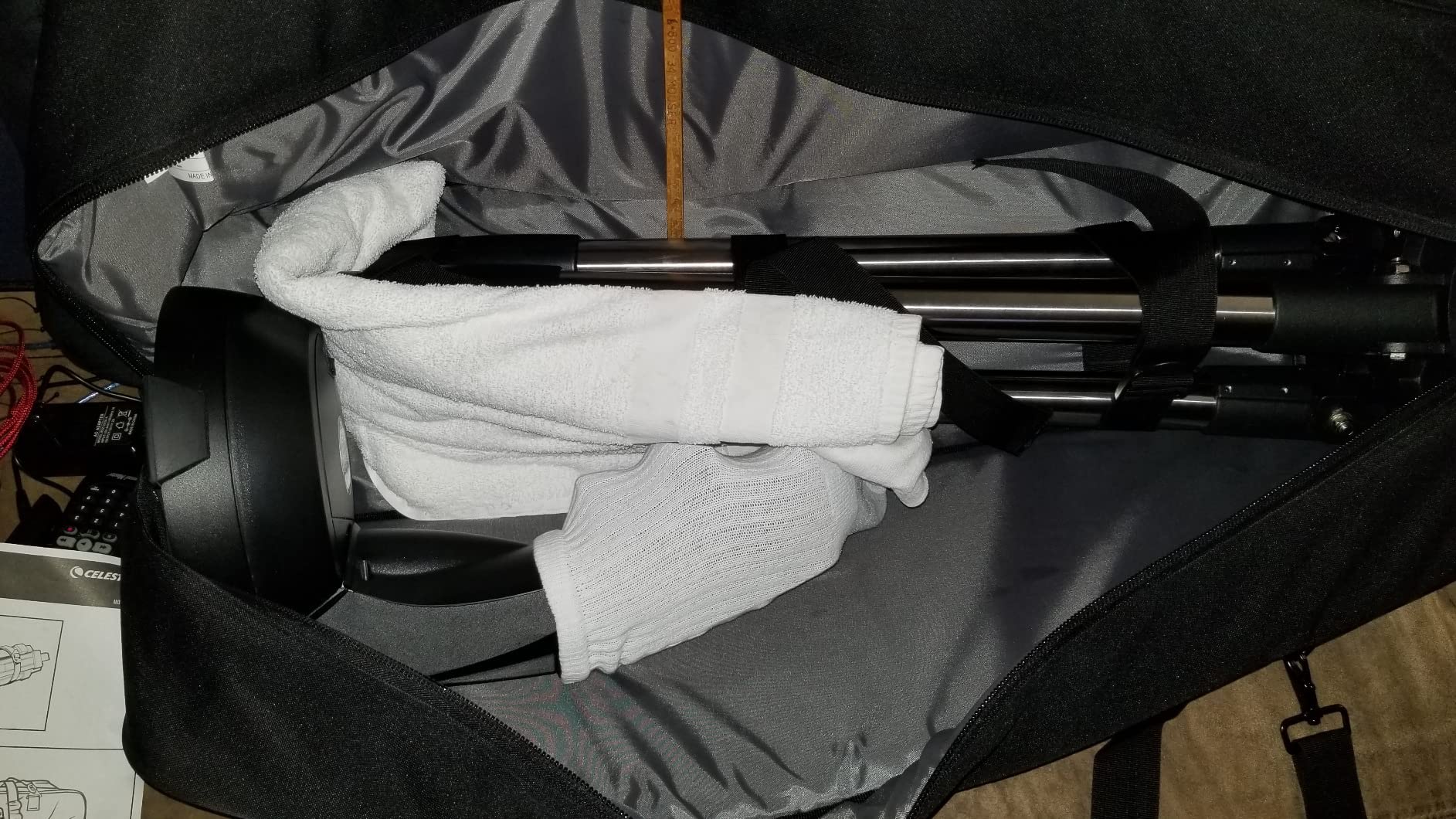
Two zipper access points are a detail worth more than they first appear, because you can unzip the end and slide a tube out without unpacking the tripod, or open the full side to load the whole thing. Reviewers regularly fit 5 inch Maksutovs, NexStar 8SE tubes, mounts and tripods inside.
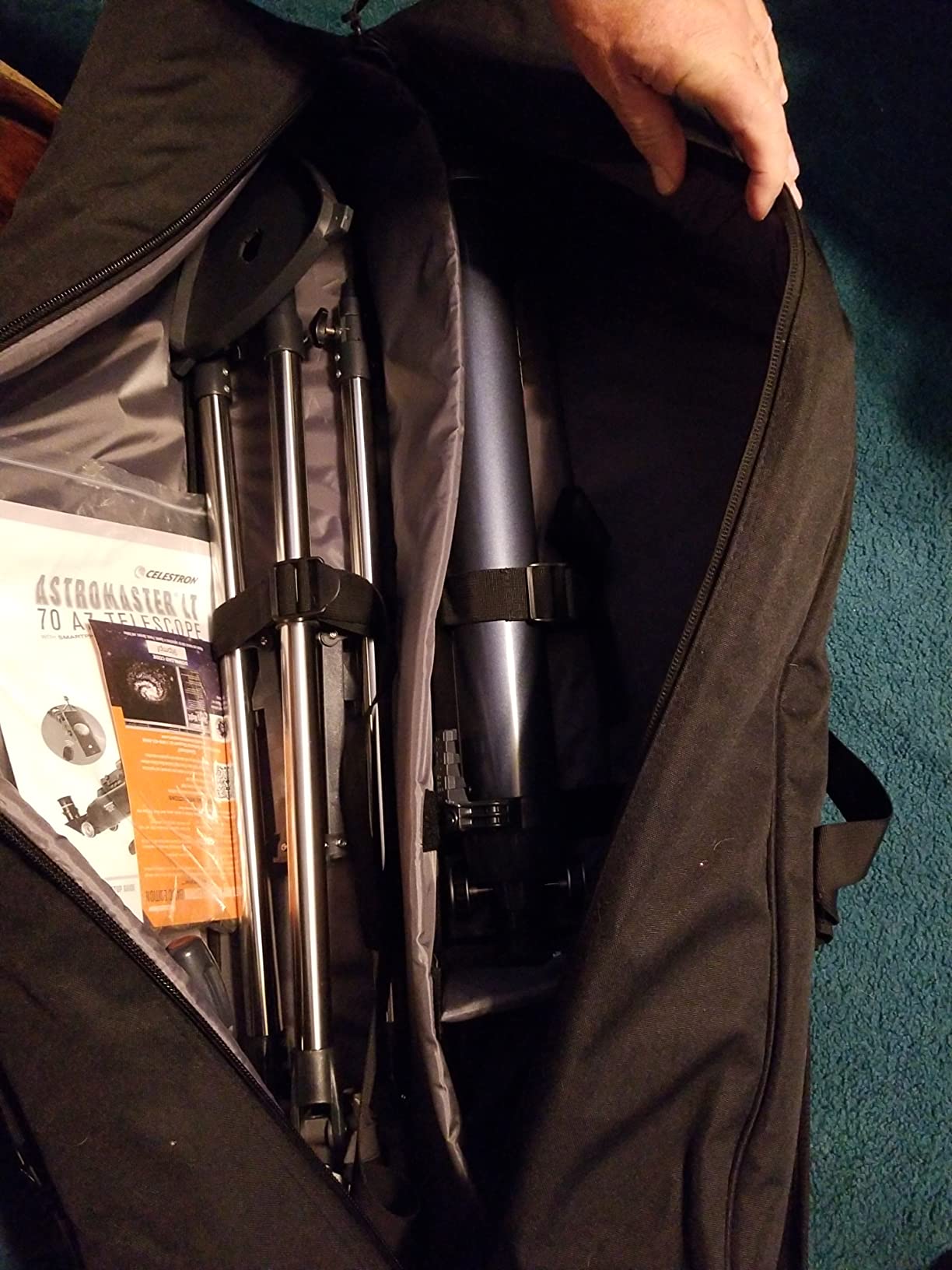
What fits inside it?
Almost anything up to 40 inches, including an 8 inch Dobsonian tube, a 6 inch or 8 inch Newtonian, an 8 inch SCT with its fork mount, and a compact tripod. It is the closest thing in this roundup to a genuinely universal travel case.
There is an external zippered pocket and a bonus padded accessory bag for eyepieces and a finder. The internal retaining straps, though, are reported to run about 6 inches short for some equatorial mounts, so bring your own strap if that is your setup.
Who should skip it?
Anyone checking a telescope as baggage should look at the hard shell instead. Soft fabric with 16mm foam protects against vibration and handling, not against a drop onto concrete or a heavy case stacked on top of it.
Some buyers also found the padding lighter and the layout less segmented than the listing photos imply, and one reported an initial odor that faded after airing out. Ventilate it after unpacking.
6. Celestron 8 inch Optical Tube Carrying Bag — form-fit protection for an SCT tube
Celestron 8″ Optical Tube Carrying Bag for Schmidt-Cassegrain & EdgeHD
Custom fit for 8 inch SCT
900 denier with 16mm foam
1.1 kg
Internal restraining strap
Pros
- Form-fitting design for 8 inch SCT and EdgeHD tubes
- Two zipper access points
- End-cap compartment for eyepieces
- Wrap-around handles take the assembly weight
Cons
- Padding is thinner than some buyers expected
- Very snug fit with a 2 inch diagonal
- Zippers can be stiff when new
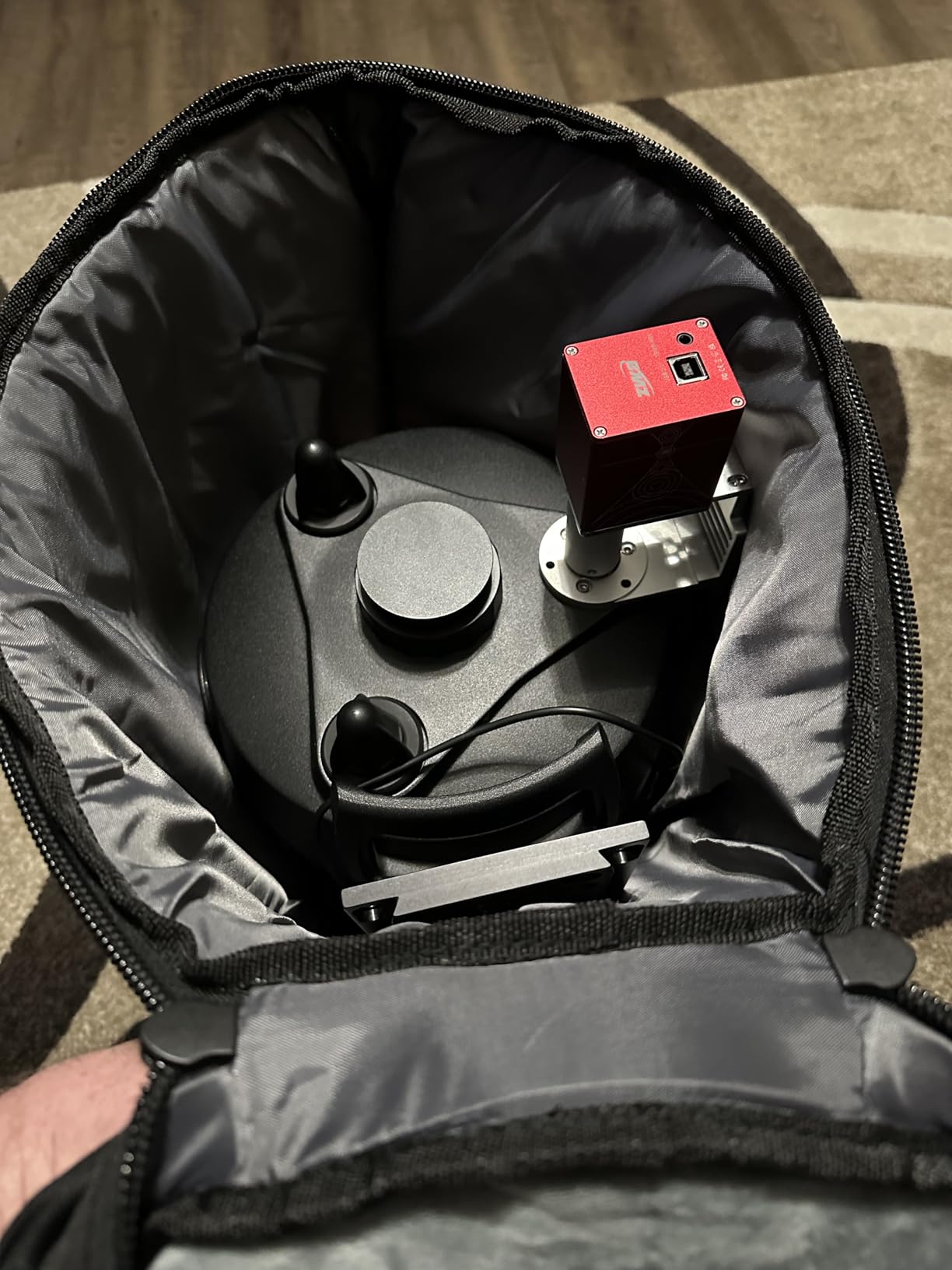
This bag exists because a Schmidt-Cassegrain tube is a distinct shape that generic 40 inch duffels swallow awkwardly. It is a purpose-built soft case for 8 inch SCT and EdgeHD optical tubes, using the same 900 denier and 16mm EPE foam construction as the larger Celestron bag.
The feature we like most is two ways in. You can unzip the end cap for quick access at a star party, or run the full-length side and bottom zipper open with an internal restraining strap holding the tube while you slide it out. Neither method means wrestling a tube through a partially open duffel.
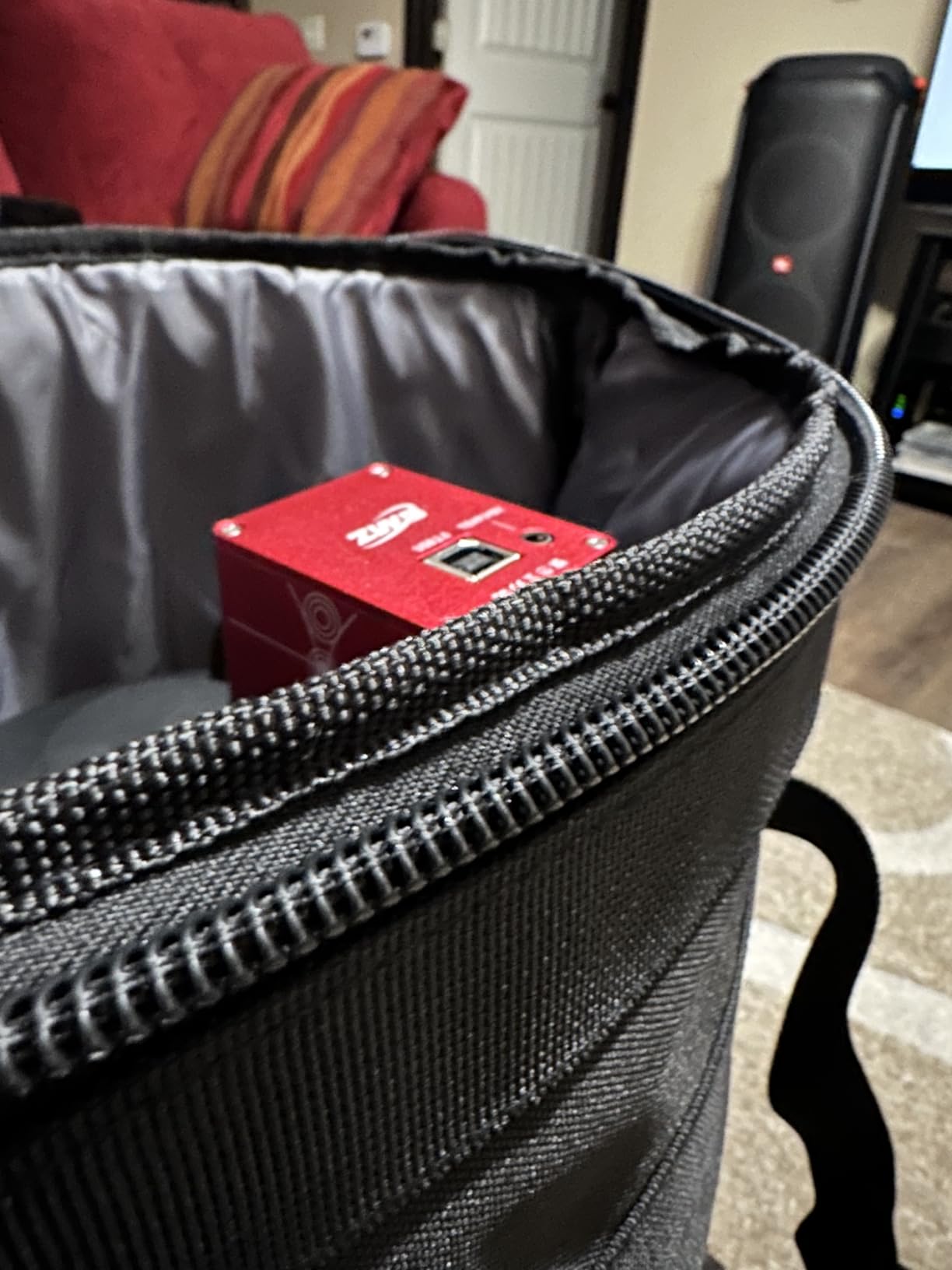
Carry hardware is properly thought out: a padded shoulder strap and wrap-around handles sized for the weight of a loaded 8 inch tube. There is a hidden zippered pocket and sewn-on fabric loops for accessories, plus an end-cap compartment for eyepieces.
What fits inside it?
8 inch Schmidt-Cassegrain and EdgeHD optical tubes, and owners of C8, C9.25, C11 and even 5 inch Maksutov and Evolution 6 setups report a tight, protective fit. An 11 inch version of the same case also exists for larger optical tubes.
Because the fit is form-specific, check your diagonal. Owners with a 2 inch diagonal report the tube pressing against the bag, and the sensible move is to size up rather than force it.
Who should skip it?
It is a tube case, not a rig case, so anyone who wants the mount and tripod in the same bag should look at the 40 inch options. It also is not rated to survive a drop, and several reviewers wanted more padding for heavy travel.
If you fly regularly, pair it with a hard shell or a roller case rather than relying on it alone. Zippers can also be stiff when the bag is new, so open it fully once before a trip.
7. samdew 40.8 inch Telescope Case — built around the counterweight
samdew 40.8″ Telescope Case Bonus Counterweight Bag & Dividers, Soft Bag
40.8 x 12.7 x 10 in
Four-layer cushioned build
5 lb
Counterweight pouch included
Pros
- Large compartment fits tube
- tripod and counterweight
- Four-layer padding with pearl cotton
- Counterweight pouch and dividers prevent collisions
- Many zipped pockets
Cons
- Soft-sided build gives less drop protection
- 40.8 inch body is bulky to store
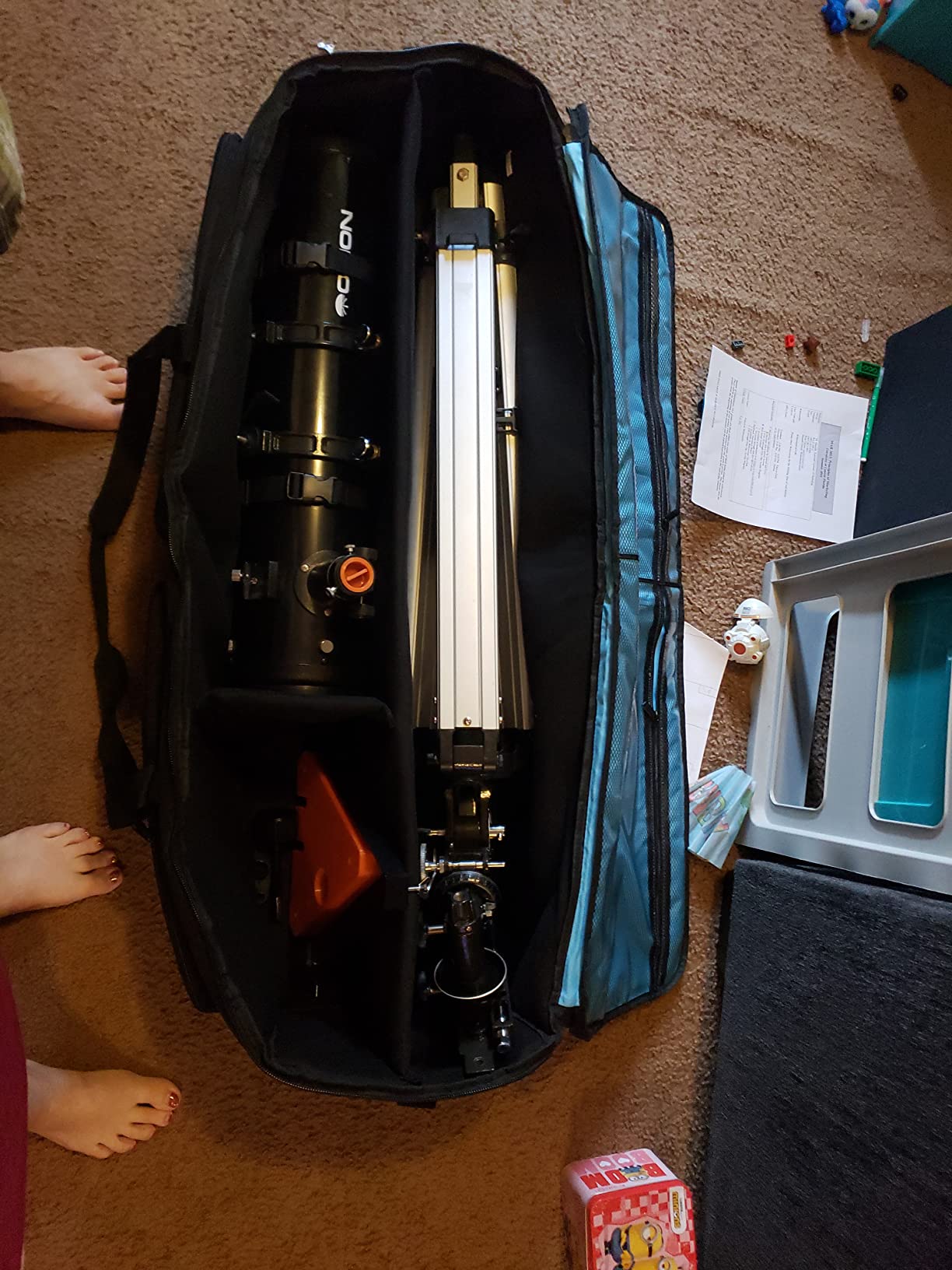
Most soft telescope bags ignore the part of your kit that damages everything else: the counterweight. This samdew case includes an attached counterweight pouch, a hollow plate and a short sponge divider, so a heavy steel weight travels in its own space rather than landing on the back of an optical tube.
The main compartment measures 40.8 by 12.7 by 10 inches and takes a tube plus a tripod mount, and adjustable buckles hold both in place against the interior. Compatibility is listed for Celestron 130EQ and NexStar, Orion StarBlast II 4.5 and AstroView 90mm, and similar mid-size scopes.
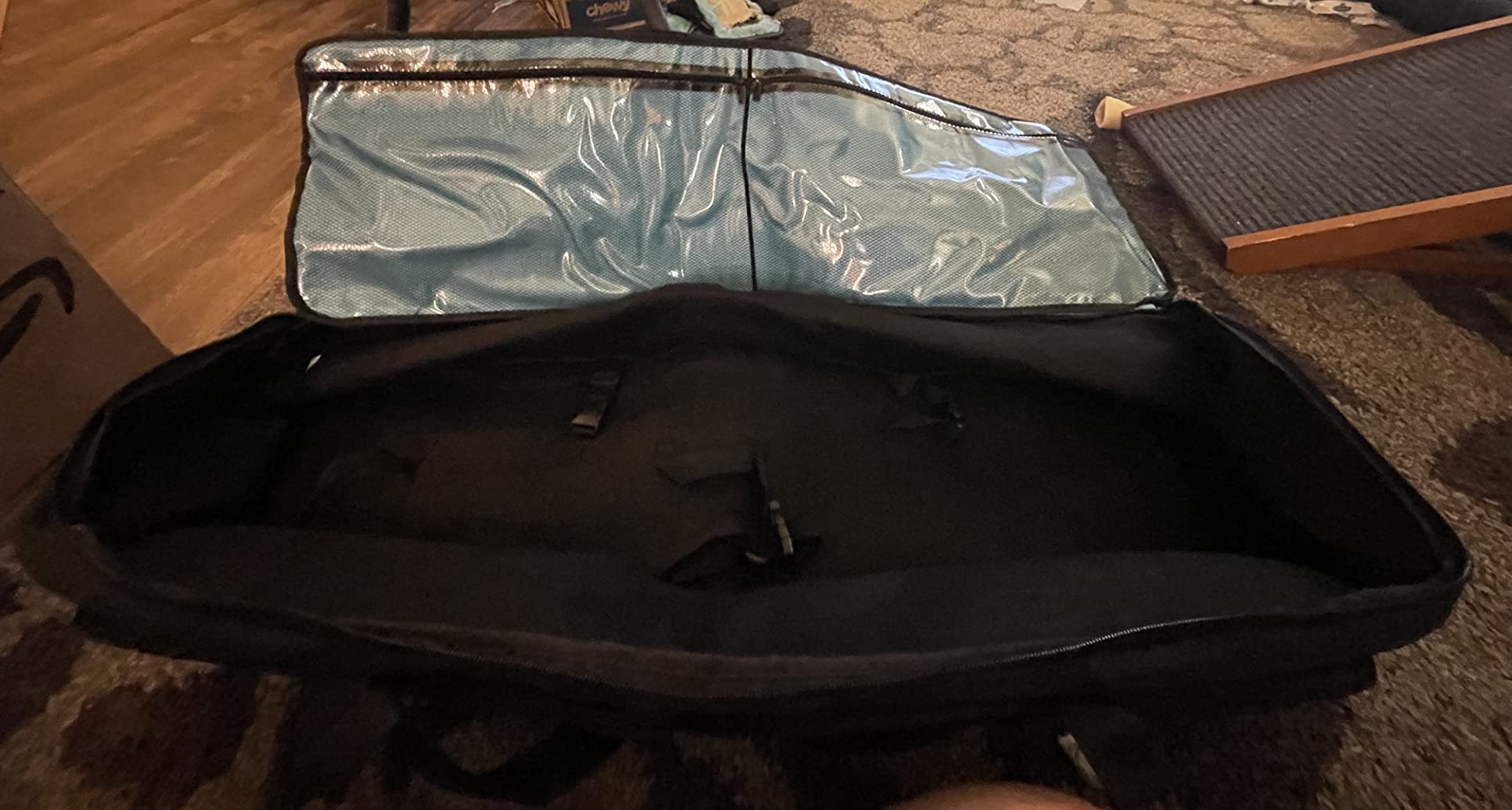
Construction is four layers: soft velvet against the optic, shock-absorbing sponge, thick pearl cotton, and a water-resistant polyester outer. Inner top cover pockets and front zippered pockets give you somewhere for finders, tools and eyepieces that would otherwise rattle.
What fits inside it?
Mid-size German equatorial setups where the counterweight and the tube travel together, plus 130mm reflector-class instruments and compact refractors. Two portable handles and a detachable non-slip shoulder strap cover solo and two-person carrying.
If you do not use a counterweight, you are paying for a feature you will not use, though the extra dividers still help. Check whether the tube-only bags later in this list fit your setup better.
Who should skip it?
Anyone who cares about drop protection should skip it, because the soft exterior will not do anything meaningful if the bag lands on a hard surface. At 5 pounds and 40.8 inches long, it is also awkward to store in a flat between trips.
It is a car case. For baggage handling, choose something with a rigid shell, and for air travel under an overhead bin, something considerably smaller.
8. samdew Double-layer Telescope Bag — separate spaces for tube and tripod
samdew Double-layer Telescope Bag with Counterweight Bag & Dividers, Soft
40.8 x 14 x 11 in
Double-compartment layout
4.4 lb
600D water-resistant shell
Pros
- Separate compartments keep tripod apart from the tube
- Counterweight bag and sponge divider stop collisions
- Four-layer cushioning with 600D water-resistant polyester
- Plenty of front pockets
Cons
- Soft build gives limited drop or crush protection
- 40.8 inch length is unwieldy for air travel
This is the samdew double-layer layout, and the difference from its single-compartment sibling is structural: the tripod lives in one space and the optical tube in another. That separation is the whole argument, because a bare tripod leg pressing into a tube wall is a common way to scratch a coating.
Adjustable external buckles, a short sponge divider and a counterweight bag handle the parts that would otherwise collide inside. The four-layer material stack is velvet, shock-absorbing sponge, pearl cotton and a 600D water-resistant polyester outer.
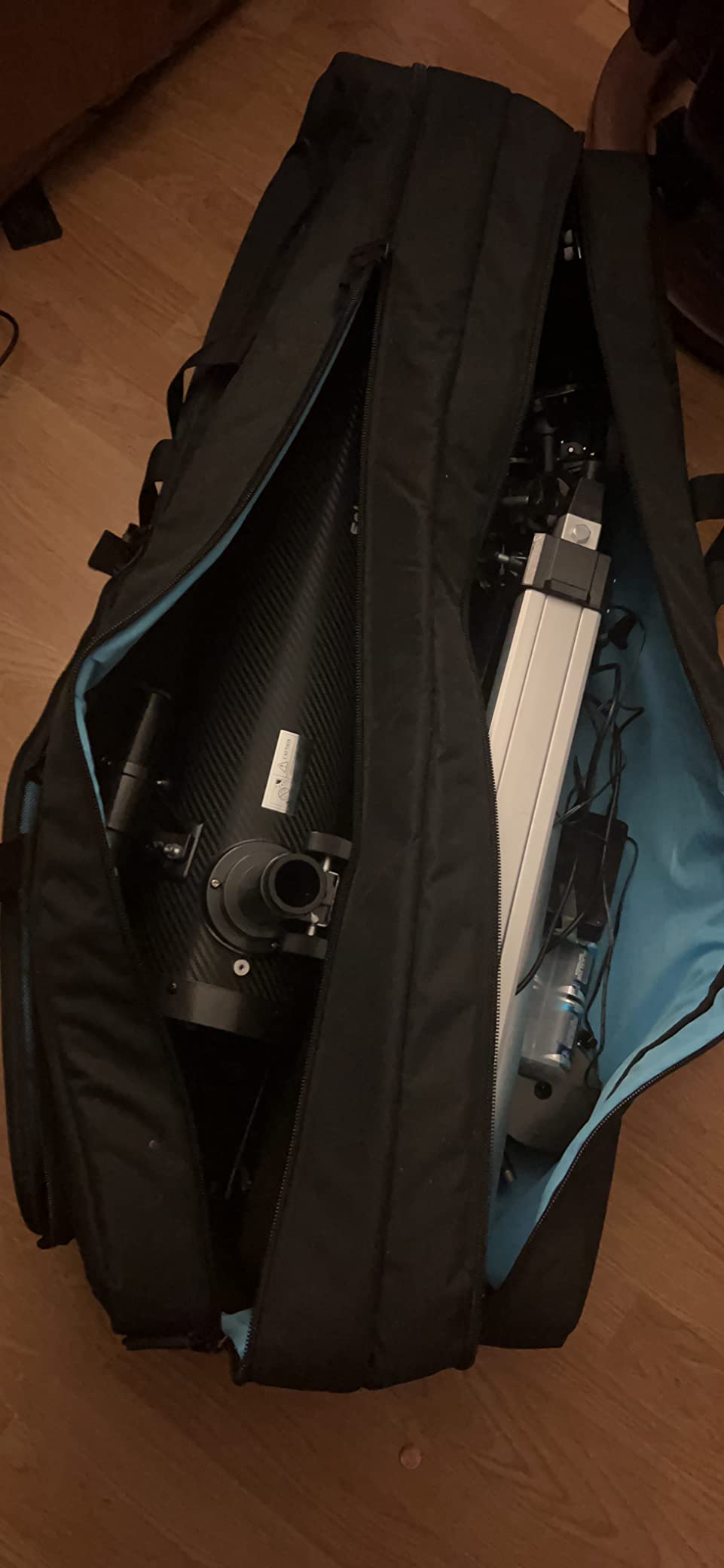
Compatibility covers common Celestron AstroMaster and NexStar models, PowerSeeker, GSkyer 130EQ and Orion AstroView 90mm scopes, which is a broad slice of the beginner-to-intermediate market. A detachable non-slip shoulder strap and padded handles make it manageable at 4.4 pounds.
What fits inside it?
A 40.8 by 14 by 11 inch footprint with separate areas for tube and tripod, plus a counterweight bag and multiple front zippered pockets for eyepieces and small tools. It is a genuine one-bag solution for a mid-size rig in a car.
For a Dobsonian with a large base, check the width carefully: 14 inches is roomy but a full 8 inch tube plus a mount assembly can exceed it once counterweights are on.
Who should skip it?
Flyers should skip it, because 40.8 inches is a checked-baggage shape at best and impractical in an overhead bin. So should anyone whose primary concern is a dropped case, since the protection here is cushioning rather than structure.
If you only carry the tube and the tripod separately anyway, the added division costs you internal volume in a single bag. Value buyers should weigh that against the tube-only options further down.
9. samdew Telescope Tube Bag for 4 to 9.25 inch Tubes — the compact budget option
samdew Telescope Tube Bag for 4″, 5″, 6″, 8″ & 9.25″ Optical Tube, Bag Only
28 x 12 x 12 in
Fits 4 to 9.25 inch tubes
Four pockets
Foldable
Pros
- Covers common 4 to 9.25 inch tube sizes
- Wrap-around pad with fastener holds the tube stable
- Four zipper pockets for eyepieces and cables
- Folds flat for closet storage
Cons
- Padding is thin for rough handling
- 28 inch size is a tight fit for 8 and 9.25 inch SCTs
- Pockets are not internally organized
At 28 by 12 by 12 inches this is the smallest general telescope tube bag in the roundup, and that is both its strength and its limit. It fits 4, 5, 6, 8 and 9.25 inch optical tubes, but tube only: no tripod and no mount.
The retention system is better than the price suggests. A soft protective pad with a secure fastener wraps around the optical tube rather than just sitting under it, and a detachable inner divider lets you reshape the main compartment for whatever you have actually put inside.
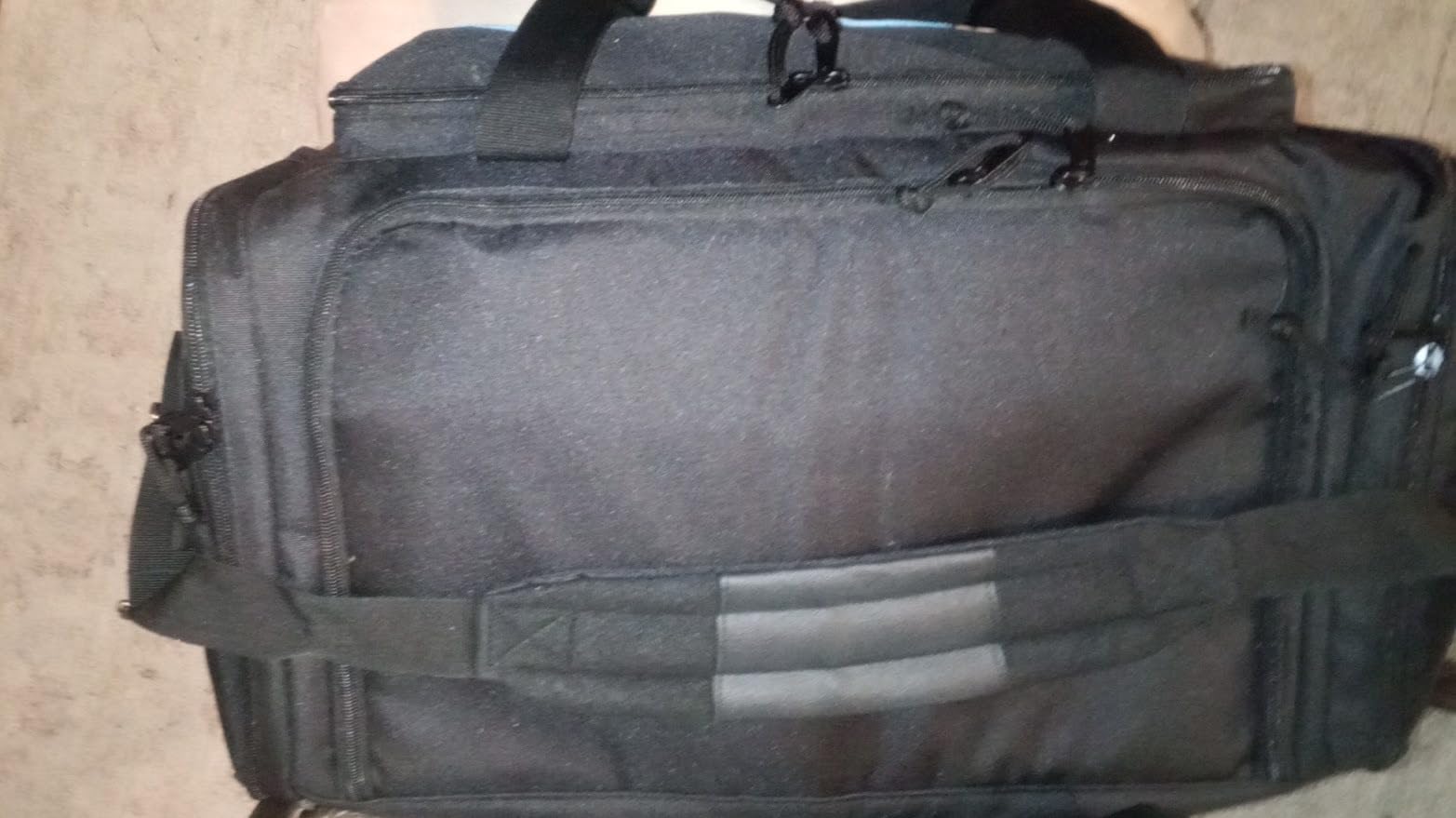
There is a transparent top zipper pocket, a large front pocket and two side zipper pockets, which covers eyepieces, a dew heater, cables and a tablet. It also folds flat for storage, has a detachable shoulder strap, padded handles and a back trolley strap, and it arrives rolled in a small pouch.
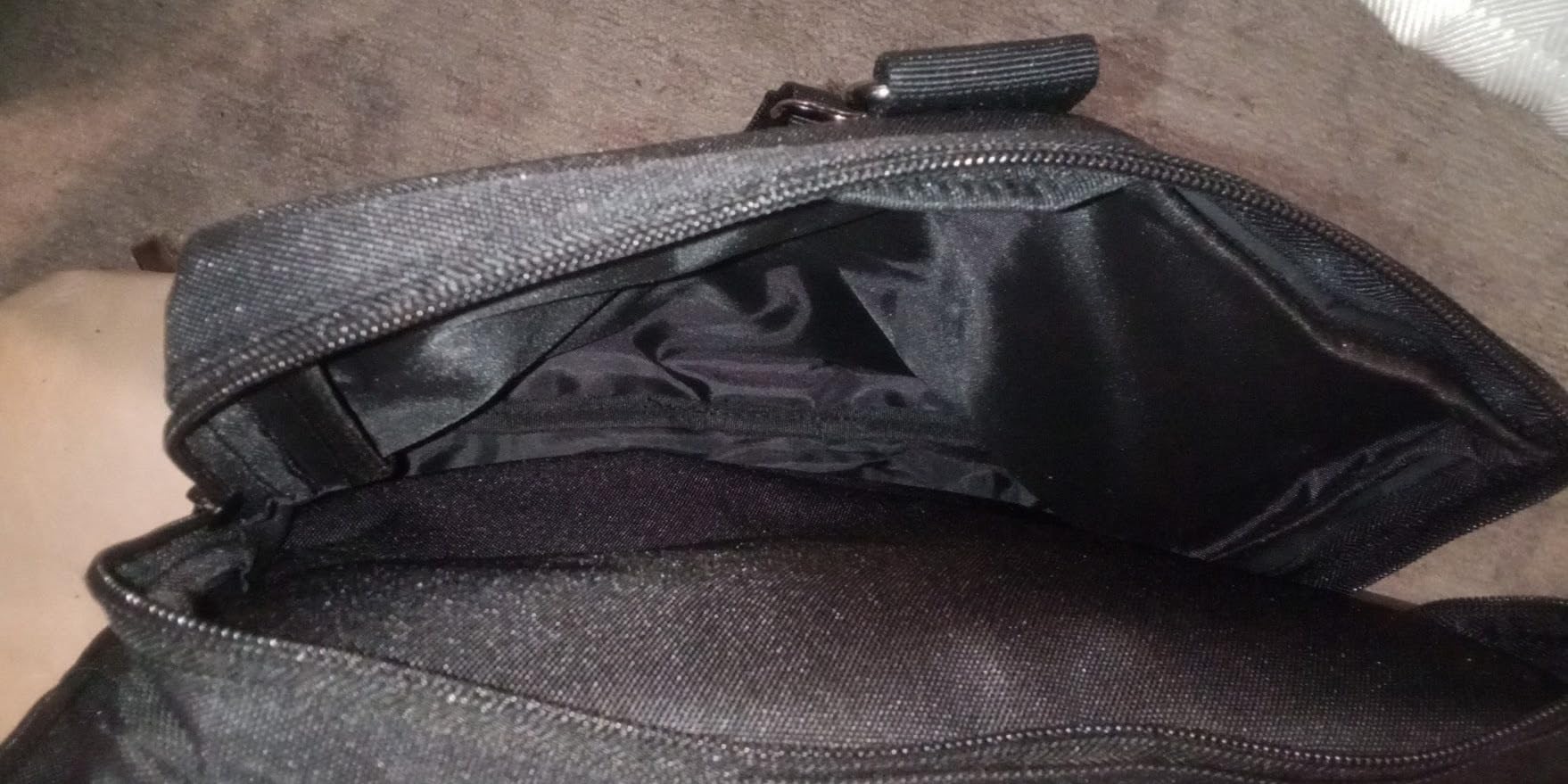
What fits inside it?
6 inch Schmidt-Cassegrains and tabletop Dobsonians with the finder attached are the sweet spot, along with small and mid-size refractors and Maksutovs. Four layers of cushioning material wrap the tube for everyday transport.
Owners of 8 inch and especially 9.25 inch Schmidt-Cassegrains report a very tight fit, and some reviewers describe it more as a duffel than a protective case. If your tube is at the top of that range, step up a size.
Who should skip it?
Anyone who drops cases, stacks luggage on them, or travels with gear that gets thrown should skip it. Several buyers add their own foam, which tells you the built-in padding is on the thin side for rough handling.
Backpackers will find the shoulder strap and trolley strap useful, but the pockets are not internally organised, so small parts migrate to the bottom of the bag during a long walk.
10. HODRANT Large Telescope Carrying Case — built for two people to lift
HODRANT Large Telescope Carrying Case Compatible with Celestron Telescope
40 x 12.5 x 10.5 in
Four-layer nylon
Five pockets
Four carry handles
Pros
- Fits most telescopes up to 40 inches
- Four-layer nylon with a wrapping pad and buckles
- Two transparent top windows plus flap and zip pockets
- Two long handles plus two side handles
Cons
- Soft build gives little drop or crush protection
- 40 inch body is bulky on public transport
- Buckle system is more involved than a zip case
Where most soft cases give you one shoulder strap and two handles, this one gives you two long padded handles, two short side handles and a detachable padded shoulder strap. That is not padding for its own sake: a loaded 8 inch Dobsonian base is an awkward two-person lift, and the side handles are what make it one.
The body is 40 by 12.5 by 10.5 inches and fits most telescopes within 40 inches in length. Compatibility is listed across Celestron, Orion, Gskyer, Meade and Solomark, which is broad enough that it rarely matters which brand you own.
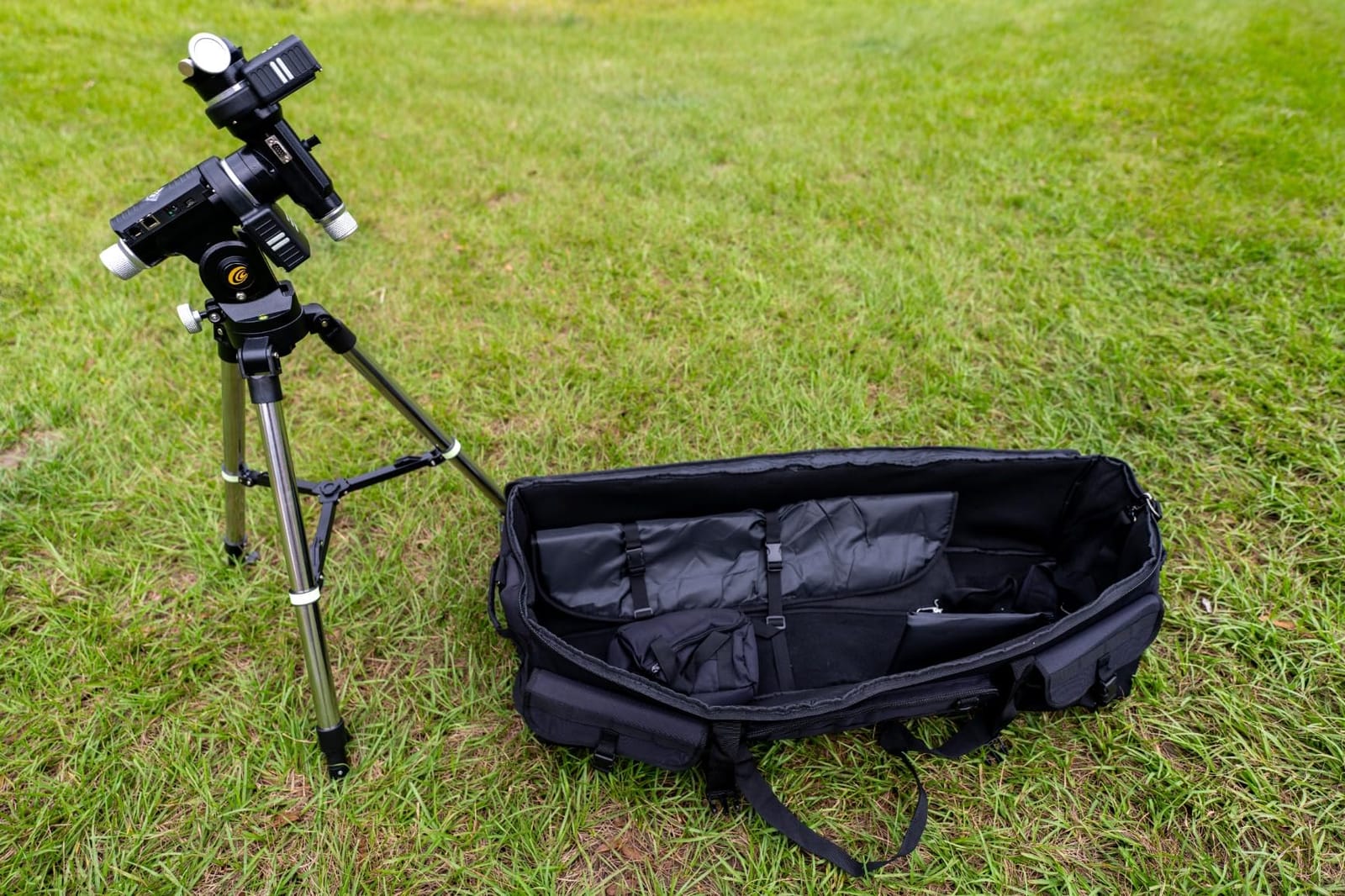
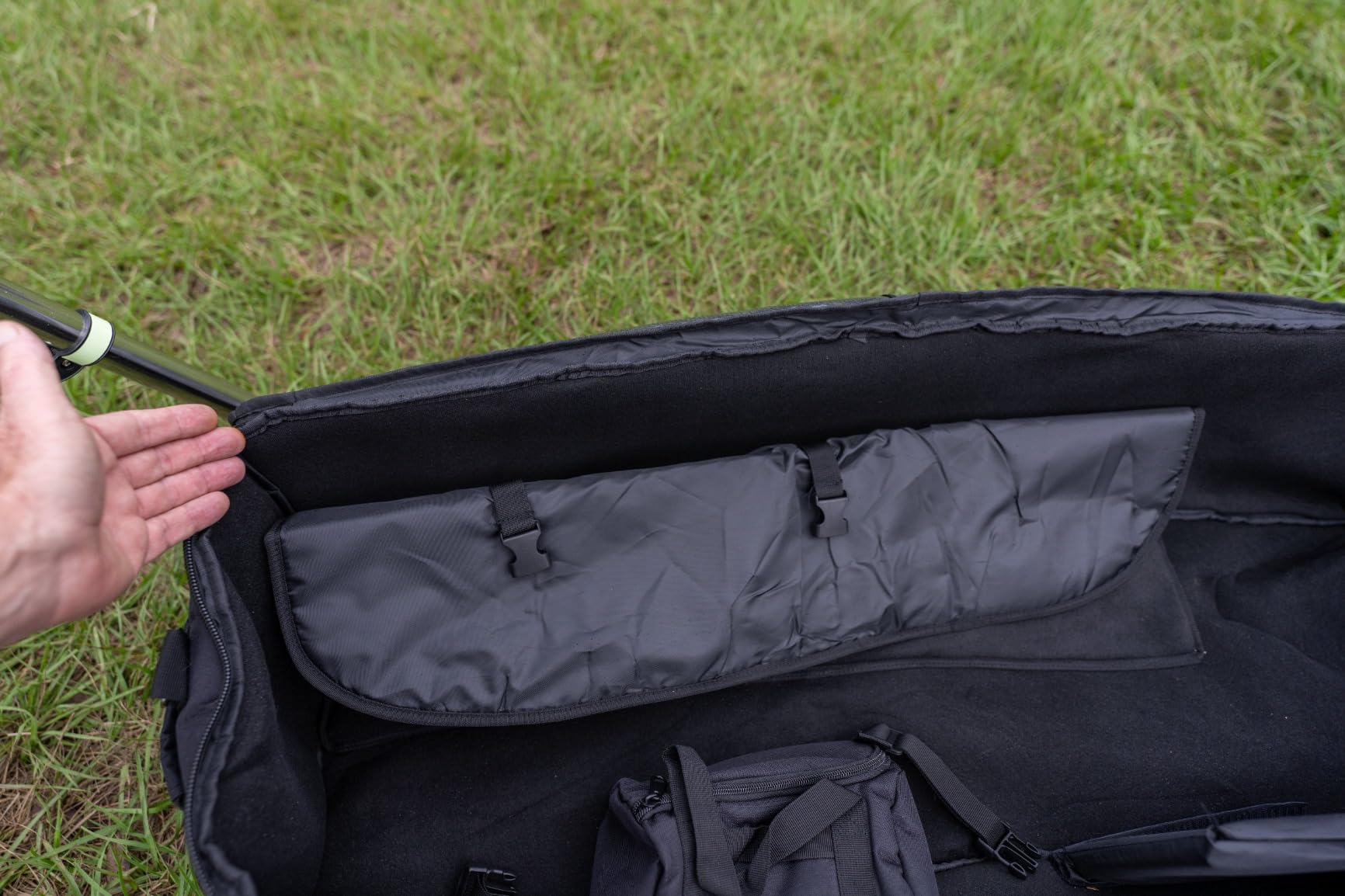
Construction is four-layer nylon with a soft protective pad that wraps the optical tube, plus adjustable buckles to secure it. A sewn-in divider separates the counterweight pouch, and there are five pockets in total: two transparent zipper windows on the top cover, two flap pockets and an outer zipper pocket.
What fits inside it?
Tubes, mounts and counterweights up to 40 inches, which covers 8 inch Dobsonians, 6 inch and 8 inch Newtonians, mid-size refractors and 8 inch SCT tubes with a fork mount. The wrapping pad and buckles keep the tube still during the walk from car to field.
The pocket layout is unusually generous for a soft case, so eyepieces, a finder, a planisphere and a torch can all live in the bag rather than in coat pockets. That matters more than it sounds at a remote site in the dark.
Who should skip it?
People on public transport should skip it. A 40 inch soft bag is bulky in a carriage, and the buckle-and-wrap system takes longer to pack and unpack than simply zipping a duffel shut.
It also offers little protection in a drop or a crush. Use it for car travel and site transfers; put a hard shell around the tube if the journey includes air freight.
11. Astromania Deluxe Telescope Accessory Case — the eyepiece organiser
Astromania Telescope Bag Deluxe Telescope Carrying Case Shock-Absorbent Big
Foam grid for eyepieces
18 compartments
2.4 lb
Water-repellent polyester
Pros
- Foam grid holds 15 x 1.25 inch and 3 x 2 inch eyepieces
- High-density foam with silk-covered padding
- Water-repellent wrinkle-resistant shell
- Full-length zip pocket plus small pockets
Cons
- Accessory organiser only
- not an optical tube case
- Soft construction is not for rough transport
- Bulky when fully loaded
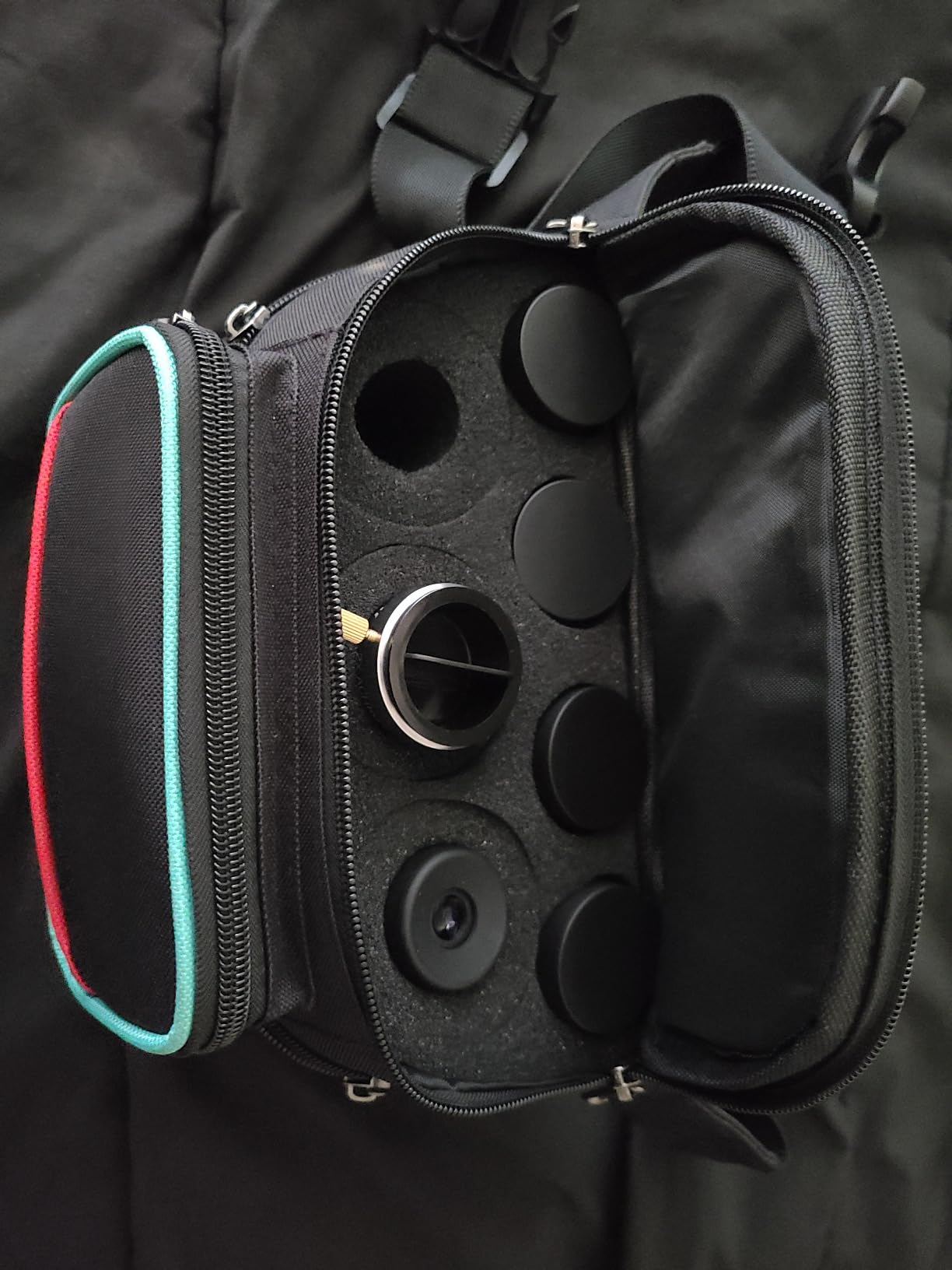
Every tube case in this roundup is a potential tube case, but only one of these is a dedicated accessory case. The Astromania bag has a foam grid with 15 slots for 1.25 inch eyepieces and 3 slots for 2 inch eyepieces, plus deep cutouts that keep barlows and diagonals from knocking against glass.
That matters on trips. A diagonal left loose in a duffel taps against a coated lens in every pothole, and a chipped or scratched diagonal surface is a repair bill. Foam slots cost nothing to add and remove the problem entirely.
Padding is high-density foam under silk-covered rubber, rated in reviews for moderate impact rather than drops. A full-length zip pocket and several small pockets hold filters, a phone and keys, and water-repellent polyester wipes clean after a dusty field session.
What fits inside it?
Eyepieces, barlows, diagonals, filters and small adapters, in Large and Small versions. A top carry handle plus an adjustable non-slip shoulder strap means it can go over one shoulder while your other hand carries the tube bag.
It does not carry an optical tube, so it pairs rather than competes with the cases above. Owners of 18 eyepieces report that the Large version becomes genuinely bulky once filled, which is a packing-planning point rather than a flaw.
Who should skip it?
Anyone with two eyepieces and a Barlow does not need a grid organiser, and there are better uses for the space in a small bag. It is also not a hard shell, so it is a poor choice for checked baggage containing delicate glass.
If you want one container for everything, look at the 40 inch soft cases with integrated pockets instead. If you want your eyepieces to survive a rough trip in a separate small container, this is the pick.
12. SVBONY SV212 Multipurpose Telescope Bag — compact, heavily rated, small-scope focused
SVBONY SV212 Multipurpose Telescope Bag, Shock-Absorbing Telescope Case
20.47 x 10.43 x 8.46 in
1680D polyester with PVC liner
1.36 kg
Removable partitions
Pros
- Highest average rating in this roundup
- 1680D polyester with double-layer PVC liner
- Removable padded partitions adapt to different gear
- ABS D-rings and double-seam straps
- 10 kg load capacity
Cons
- Sized for small to mid scopes only
- Some buyers added extra foam
- Compact size means fewer tubes at once
The SV212 is the highest rated case we tested, at 4.8 across 51 reviews, and the reason is that it is honest about what it is: a compact multipurpose bag for Maksutovs, small refractors and astrophotography kits, with removable padded partitions that reshape the interior as your kit changes.
The fabric is 1680D polyester with a double-layer high-density PVC liner, which is the thickest outer material in this roundup and the reason it shrugs off splashes and drizzle better than a standard 900 denier bag. At 1.36 kg it is also light enough for a mixed carry-on.
Carry options include a removable shoulder strap and hand straps, and the hardware is properly rated: rugged ABS D-rings, double-seam reinforced straps, and a stated 10 kg load capacity. It also comes with a one-year warranty and 30-day returns.
What fits inside it?
At 20.47 by 10.43 by 8.46 inches, owners fit Maksutovs such as the MAK 127 and SkyMax 150, small refractors like the AT72 and 80mm models, and general astrophotography gear. It is one of the few cases here that genuinely suits a carry-on weight budget.
6 inch to 8 inch Maksutovs are the practical maximum, and the compact size means you cannot pack two tubes at once. If your optics are larger than that, this is the wrong shape of bag.
Who should skip it?
Owners of 8 inch scopes or long refractors should skip it, since neither the length nor the cross-section will take them. Reviewers of larger instruments consistently point to this as the limit rather than the quality.
A few buyers also added their own foam for rough travel, so treat the padding as good for car and airline handling rather than for a drop onto concrete. With only 51 reviews behind the rating, weigh the owner photos carefully before committing.
How to choose a telescope travel case?
Choose by trip first and by telescope second, because the same case that protects a scope in a car boot can be the wrong tool in a baggage hold. The first three questions narrow almost every decision: how does the case get to the site, how long is your optical tube, and how much of the rig travels with it.
Measure, do not assume. The number on the outside of a bag is the outer dimension, and the useful number is the inside. Compare the internal length against your tube plus its focuser and diagonal, and add a few inches. The same discipline applies to other fragile gear you move: we apply it to crossbow cases for hunters as well.
Count what travels together. Tube only, tube plus mount, or tube, mount and tripod. A full 40 inch bag handles all three, a 28 inch tube bag handles the first, and a specialist OTA case handles the first with a much tighter fit around the tube’s actual shape.
Check the retention system. Forum users consistently report that bags without internal straps let the optical tube slide and knock against fittings in transit. Buckles, a wrap-around pad with a fastener, or a compression strap all solve it, and a case with none of them is a soft suitcase in disguise.
Weigh it empty. Cases here range from about 520 g to 10 pounds. Add the mount, the counterweight and the tripod, then check the total against your own carry limit rather than the airline’s, because a case that passes on its own can fail with contents.
Plan for moisture and temperature cycling. A car boot in winter and a hot desert site are both condensation risks, and a sealed hard shell traps that moisture instead of releasing it. Leave a bag open overnight at a hotel before repacking, and consider a desiccant pack for long trips. Water-resistant fabric helps against rain, not against damp air trapped inside.
Padded soft bag vs hard shell: which trip needs which?
A padded soft bag is right for car travel to a dark site; a hard shell is right when the case is checked, shipped or handed over. That is the short version, and it is the conclusion most experienced observers reach — on r/telescopes, members usually call a padded carry case plenty for car transport and reserve hard cases for flying.
Soft bags win on weight, price and packability. The 40 inch Celestron soft bag at 520 g is a fraction of the weight of a molded EVA shell, folds flat, and fits a car boot or a rucksack without complaint. They lose on crush and drop protection, because foam absorbs vibration and a soft shell does nothing if the case lands on concrete.
Hard shells win on structure. The Celestron EVA case keeps its shape under a stack of luggage and shrugs off a conveyor, and foam on every wall is a real barrier for a focuser or a corrector plate. They lose on volume, weight and cost, and a moulded case that fits your tube exactly is still awkward on public transport.
There is a third path that experienced owners use constantly: buy a hard shell for the optical tube and a soft bag for the tripod and accessories. Two lighter loads beat one impossible one, and the tripod survives a soft bag perfectly well. The best rifle cases for traveling hunters follow the same logic — the fragile component gets structure, the rest gets a lighter bag.
For eyepieces, the community consensus is a hard case with cut foam rather than a fabric pouch. Members on Cloudy Nights repeatedly recommend foam-lined cases for eyepiece storage, and budget builders cut their own from basic hard cases. Our bow case guide makes the same argument about accessories that must not rattle.
Match the case to your telescope class
Match by telescope class, not by brand, because aperture and length decide the case. A 60 to 80mm refractor fits almost anything, an 8 inch Dobsonian fits only a 40 inch bag, and a smart telescope or monocular wants something that fits inside a daypack.
60 to 80mm tabletop refractor. Fits the 28 inch samdew tube bag comfortably, or the SVBONY at 20.47 inches if you want the smallest footprint. Both leave room for a small mount and a star chart.
Monocular and smart telescope kits. The Comecase EVA case is the dedicated answer, and the SVBONY works if you also carry astrophotography accessories. Both are small enough to sit inside luggage rather than in it.
6 inch to 8 inch Newtonian. The 39 inch bagmate bag and the 40 inch Celestron bag both fit comfortably, and the samdew 40.8 inch cases add a counterweight pouch if you use one. Keep ratchet straps on hand for a car boot, which is standard advice on forums for moving larger reflectors.
8 inch Dobsonian. You need the full 40 inch capacity, so the Celestron 40 inch bag, the bagmate, or the HODRANT. Expect two people to carry it, which is exactly why the HODRANT’s four handles are useful.
6 inch and 8 inch Schmidt-Cassegrain and EdgeHD. The Celestron 8 inch OTA bag is the tightest fit, and the Celestron EVA hard shell is the protective one. Check your diagonal length before choosing the smaller bag, and size up if you have a 2 inch diagonal.
130 to 150mm SCT and larger. A 40 inch bag for the tube and a separate long tripod bag, or a hard shell if the scope flies. Do not attempt to fit the mount and tripod into a 28 inch tube bag at any price.
Flying with a telescope: carry-on, checked baggage and security
A telescope can go through airport security, and screening is rarely the problem. Optical tubes, eyepieces, filters and mounts are permitted items; the issue is size, weight and how the instrument is packed once it clears the belt.
Keep the case closed and packed like luggage. Screening officers open bags to look inside, and a telescope in an open soft bag with loose eyepieces is a longer conversation than the same scope in a zipped hard case. Declaring the tripod and the mount is normal and expected; do not leave a scope in a bag that looks like an undeclared second item.
Carry-on works when the case is genuinely small. The SVBONY at 20.47 inches and the Comecase at 9 inches are the realistic candidates here, along with small tabletop refractors. Most airlines measure carry-on by linear dimensions rather than weight, so a long but slim case can pass where a heavy one fails.
Checked baggage is where hard shells earn their place. Pad the empty space inside a molded case so the tube cannot shift, keep the case inside a larger duffel if the shell has exposed edges, and remove any loose counterweight. Free-standing counterweights and metal poles are more likely to draw attention at the belt than a telescope tube does.
Insurance and declared value are worth checking before you check a scope. Photograph the collimation, the tube and the serial numbers before you fly, because a damage claim without evidence of prior condition is difficult. And keep the case in the cabin if you possibly can: the single most common piece of travel advice on astronomy forums is that checked baggage is where telescopes get broken.
Frequently Asked Questions
Do I need a hard case or a padded bag to travel with a telescope?
A padded soft bag is enough for car travel to a dark sky site, because it handles vibration and bumps well at a fraction of the weight. Choose a hard shell case when the case is checked, shipped or handed over as baggage, because a molded shell survives conveyor handling and stacking that a soft bag cannot. Many owners use both, putting the optical tube in a hard case and the tripod and accessories in a soft bag.
Can I take a telescope through airport security?
Yes. Optical tubes, eyepieces, filters, mounts and tripods are permitted through security, and screening is rarely the obstacle. Pack the case closed and zipped so officers are not unpacking loose accessories in front of you, declare the tripod and mount, and expect the size of the case rather than the optics to determine whether it goes in the cabin or the hold.
Will my telescope fit in an airline carry-on?
It depends on the telescope class. Small tabletop refractors, monocular kits and smart telescopes fit the compact cases in this roundup, including the 20.47 inch SVBONY and the 9 inch Comecase. An 8 inch Dobsonian, a long Newtonian or a 40 inch soft bag will not, and will need to be checked. Measure the case against your airline’s carry-on dimensions rather than its weight allowance.
What size case do I need for an 8 inch Dobsonian?
A 40 inch case is the practical minimum for an 8 inch Dobsonian, and you should look for a model that takes the tube, base, mount and counterweight in one load. The Celestron 40 inch bag, the bagmate 39 inch bag and the HODRANT large case all fit that class. Bring ratchet straps and keep the case flat in the back of the car so the tube cannot slide.
How do I prevent condensation inside a telescope case on a long trip?
Ventilate the case before you close it. A case sealed in a warm car and then carried into cold air traps moisture that condenses on the optics, and a hard shell traps it more effectively than a soft bag. Leave the case open overnight at your accommodation, add a desiccant pack for long or humid trips, and keep optics in their own padded sleeves inside the case rather than bare against the foam.
Conclusion
The best telescope cases for travel are the ones that match the trip and the tube length, and no single bag wins every scenario. Our editor’s choice, the Celestron EVA hard shell, is the pick for anything that flies or gets handled roughly, because molded foam on every wall is the only protection in this roundup that survives a baggage conveyor.
For car-based observing the Celestron 40 inch soft bag is the better buy, since it carries tube, mount and tripod in one 520 gram load. The SVBONY handles small scopes in a genuine carry-on footprint, and the Astromania eyepiece case is the low-cost fix for the accessory chaos that causes most in-trip damage.
Measure your internal length before you buy, count what travels together, and make sure something inside the case holds the tube still. That single detail prevents more broken optics than any amount of padding. Use the buttons above to check current listings, and pick the case that fits the journey rather than the one that looks the most impressive in the packshot.