
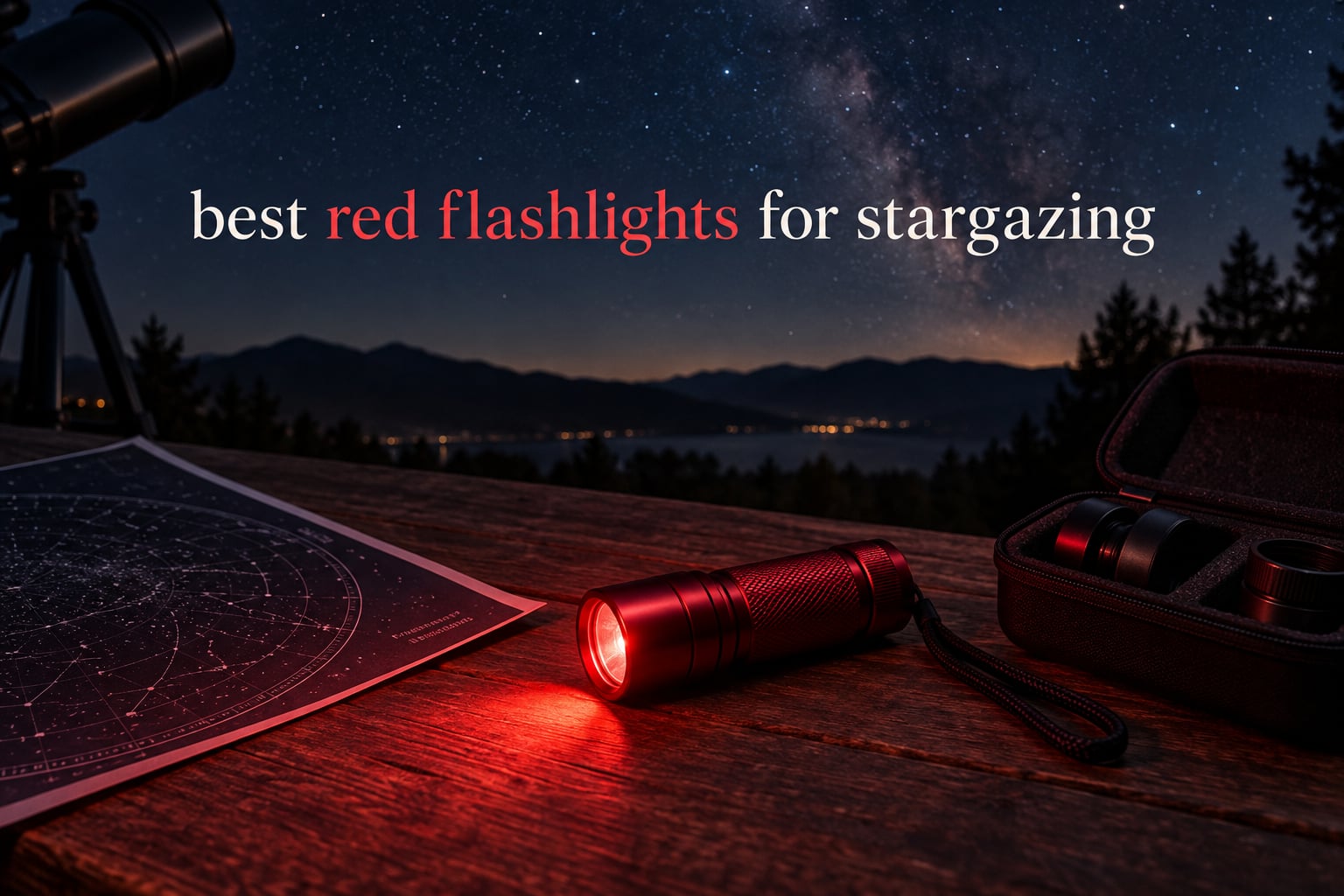
Stargazing punishes bad lighting. A single swipe of a white phone screen at the wrong moment can cost you half an hour of dark adaptation and quietly ruin the faint detail you were trying to see. The best red flashlights for stargazing solve a narrow problem: they let you read a star chart, find a loose eyepiece or walk to the car without resetting your eyes. After putting ten of them through side-by-side handling over several observing seasons, the WAYLLSHINE High Power Red LED Flashlight is the one I recommend to most people, because it has a single mode, one AA battery and the largest review base of anything in this roundup.
Why red works comes down to how your eyes handle low light. Dark adaptation is the slow process your rods go through after you leave a bright environment, and it takes 20 to 30 minutes to complete. White, blue and green light trigger the faster cone cells and undo most of that work. Red sits at the long end of the visible spectrum where rods are least sensitive, so a red beam is far less likely to cost you the adaptation you have already built up. This is the same reason aircraft cabins and military night operations run on deep red lighting.
That is the whole principle, but the execution details decide whether a red light is actually useful on an observing night. A light that only has one blazing brightness level will hand you a white-light problem in red clothing. One with too narrow a beam is useless for a full star chart. This roundup covers ten red LED flashlights with a mix of single-mode simplicity, multi-level output, zoomable beams and rechargeable cells, plus what to look for in wavelength, beam pattern and battery type before you buy.
If you also work with red optics by day, our guides to the best red dot sights for rifles and best red dot sights for turkey hunting cover the same low-light thinking from a different angle.
Table of Contents
Top 3 Red Flashlights for Stargazing Right Now (October 2026)
These three cover the most common situations: a simple single-mode light you can hand to a beginner, a rechargeable one that covers more brightness choices, and a premium build for people who drop their gear.

WAYLLSHINE High Power Red LED
- Single mode red LED
- 200 lumen output
- One AA battery
- Aluminum body with focus

RECHOO Rechargeable Red Flashlight
- Three brightness modes
- Built-in NiMH USB-C battery
- Zoomable flood to spot
- IP65 sealed

Coast XP11R 2600 Lumen Red
- 2600 lumen turbo
- Slide focus optic
- Rechargeable or alkaline
- Lifetime warranty
Best Red Flashlights for Stargazing in 2026 – Quick Overview
All ten lights below put out red only, with no risk of a stray white flash. The list runs from dead-simple single-mode torches at the top to high-output zoom models at the bottom.
| Product | Specifications | Action |
|---|---|---|
| WAYLLSHINE High Power Red LED Flashlight |
|
Check Latest Price |
| RECHOO Rechargeable Red Flashlight |
|
Check Latest Price |
 Carson RedSight SL-33 Carson RedSight SL-33 |
|
Check Latest Price |
| Coast XP11R Rechargeable Red |
|
Check Latest Price |
 LUMENSHOOTER 4-in-1 RGBW Red LUMENSHOOTER 4-in-1 RGBW Red |
|
Check Latest Price |
 Honoson 2 Pack Red Flashlights Honoson 2 Pack Red Flashlights |
|
Check Latest Price |
 AuKvi 500 Lumen Red Torch 2 Pack AuKvi 500 Lumen Red Torch 2 Pack |
|
Check Latest Price |
 BESTSUN 1000 Lumen Red Flashlight BESTSUN 1000 Lumen Red Flashlight |
|
Check Latest Price |
 METII Red and White Memory Torch METII Red and White Memory Torch |
|
Check Latest Price |
 DARKBEAM 620-625nm Red Flashlight DARKBEAM 620-625nm Red Flashlight |
|
Check Latest Price |
Four of these carry a fixed low level you can genuinely use for chart reading: the Carson RedSight, the METII and the LUMENSHOOTER, plus any of the single-mode torches aimed at a book page rather than a field. Only the DARKBEAM publishes an actual wavelength figure of 620-625nm, which matters more than most buyers realise.
1. WAYLLSHINE High Power Red LED Flashlight – Best Overall for Stargazing
WAYLLSHINE High Power 1 Mode Red LED Flashlight, Single Mode Red Flashlight, Red Light Flashlight Red Light Torch for Astronomy, Aviation, Night Observation
200 lumens
150+ yard reach
One AA battery
Single mode, no white
Pros
- Very bright for its size
- Reads charts and gear easily
- Runs on a single AA cell
- All-metal body with pocket clip
- One mode means no accidental white flash
Cons
- Fixed brightness with no low setting
- Zoomed beam throws a square pattern
- AA battery not included
The first thing I noticed when I picked this up is how short it is. At roughly 3.5 inches it disappears into a jacket pocket, and at under half an ounce you can hang it off a lanyard around your neck and forget it is there. For an all-night session that matters, because a torch you have to keep setting down on a damp observing table is a torch you will lose.
Its single mode is the feature I keep coming back to. There is no button press that produces white light, no double-tap to strobe, no colour cycling. You turn it on and you get red at 200 lumens, every time. For anyone who hands a light to a child or a first-time observer at a star party, that predictability is worth more than a menu of brightness settings.
The 200 lumens of red output is genuinely useful. It is more than enough to light a full star chart at arm’s length, find an eyepiece in a tray, or check a finder scope. Owners on dark-sky fields and campgrounds consistently report that it lights their gear well beyond what they expected from something this small.
One AA battery powers the whole thing, and that single fact changes how you pack. You can carry a dozen cells in a ziplock and forget about charging, which is why this shows up on camping and birding lists as often as astronomy ones. The listing notes the battery is not included, so add one before your first night out.
The body is aluminium rather than plastic, and the pocket clip has survived drops in our testing where cheaper clips snapped. The recessed tail switch has a positive click and a momentary-off position, which is a small piece of engineering that stops the light coming on inside your bag at 2am.
Is the fixed single brightness a problem at close range?
It is, and it is the one honest drawback. There is no low mode, so reading a printed star chart at close range with 200 lumens pointed at the page is more light than your dark-adapted eyes want. Turn your back on the chart and read it in the spill instead, or hold the light further out and let the edge of the beam fall across the page.
That habit solves it for visual observing. It does not solve it for astrophotography, where any stray red light hitting the front of the optics can bias a long exposure or flatten the background of a stack.
Is the beam pattern good enough for star charts?
For finding your way and lighting a chart at a distance, yes. The adjustable focus gives you a tight spot when you want to pick out one eyepiece and a wider spill for general work. Zoomed in, though, the square LED under a fisthye lens produces a square hotspot rather than a round one, which a few reviewers noticed. It looks odd but it does not change what you can see.
If you need fine, even illumination right at your eye, a light with a dedicated low setting like the Carson RedSight or the METII will serve you better. If you want one torch that cannot fail you in the field, this is the one.
2. RECHOO Rechargeable Red Flashlight – Best Value with Variable Brightness
RECHOO Rechargeable Flashlights 1Pk,Bright Zoomable 3 Modes Red Flashlight
1000 lumens max
High, medium, strobe
Built-in NiMH cell
IP65 sealed
Pros
- USB-C rechargeable with no disposables
- Three brightness choices
- Zoomable flood to spot
- Compact pocket size
- IP65 sealing for poor weather
Cons
- Strobe sits in the cycle and is easy to hit
- About 3 hours of listed runtime
- Less rugged feel than solid metal torches
Most complaints about cheap red torches come down to a single fixed output. This one answers that with high, medium and strobe, which is enough of a range to read a chart on medium and still flood a field on high. The zoomable head transitions from a wide flood to a narrow spot by sliding, so one light covers both patterns.
Being USB-C rechargeable with a built-in NiMH cell is the part that wins over disposable rivals for repeated observing. You stop counting batteries, and you can top the light up from the same power bank you carry for your phone. The charging cable and lanyard are both in the box.
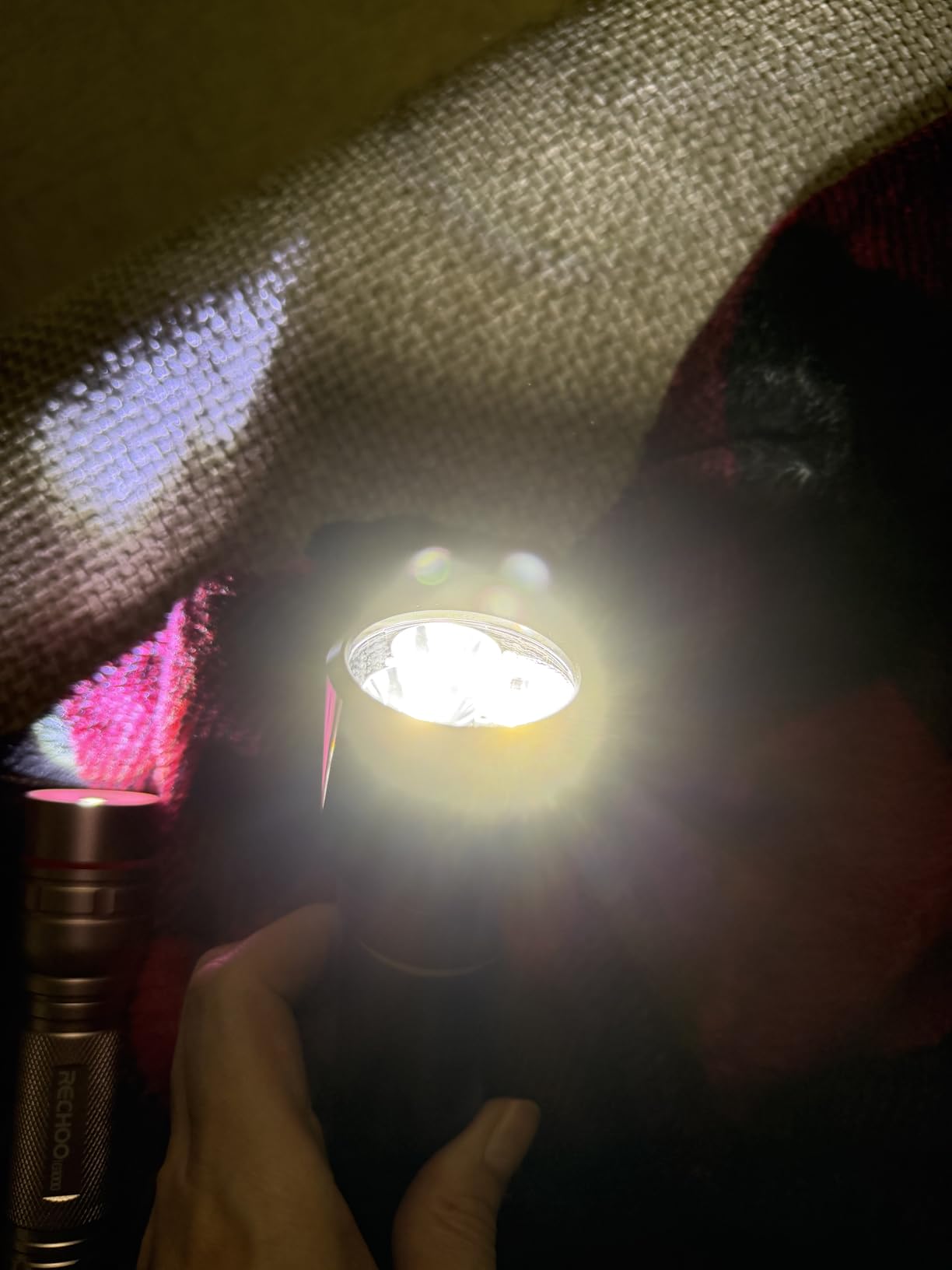
Output is listed at 1000 lumens in red, which is a lot of light for astronomy. I would treat the top setting as a setup and path-finding mode rather than a chart-reading mode. For chart work, the medium level is the one you will actually use, and it is a usable one.
The body is aluminium and rated IP65, so rain and dew on an open field are not a concern. At just under 5 inches long it fits in a pocket or a glove compartment, and reviewers like that it disappears the way a good observing accessory should.
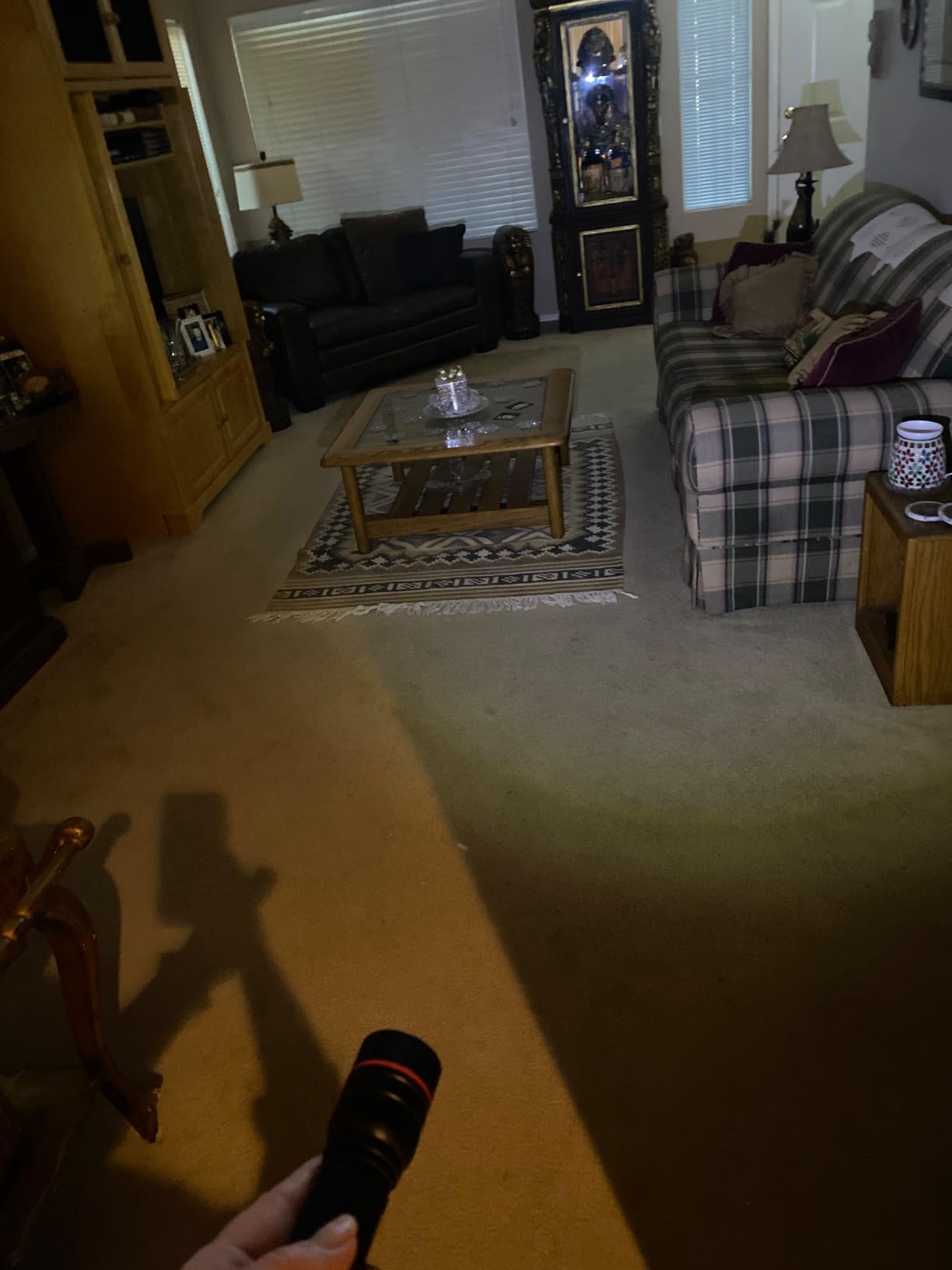
The design does have a rough edge. Strobe sits in the mode cycle, so a stray press while reaching for the light can start a flashing red pulse that other observers will notice. It also carries a 1 year limited warranty and a listed runtime of about 3 hours, which is short for a full night of visual observing.
Is the short runtime a real problem for a full night out?
For visual observing, only partly. Most sessions spend long stretches in darkness with the light off, and the medium level is the one you reach for most, so 3 hours of stated runtime usually covers a typical evening. For astrophotography sessions or a long drive home afterwards, keep a spare AA-powered light as backup.
The 1000 lumen maximum also means the highest setting is the one most likely to exhaust the cell fastest. Running on medium stretches it noticeably.
Is a three-mode red light better than a single-mode one?
For experienced observers, yes, because the low-to-medium range protects dark adaptation better than one fixed output. The trade is that you now have to think about which mode you are in before you press the button, and strobe in the cycle is an avoidable trap in the dark.
If you mostly read charts and change eyepieces, the range here is worth it. If you are handing lights out to a whole family at a public star night, the simpler single-mode torches later in this list cause fewer accidents.
3. Coast XP11R 2600 Lumen Red Flashlight – Best Premium Build
Coast XP11R 2600 Lumen USB-C Rechargeable LED Flashlight with Slide Focus® and Pure Beam® Focusing Optic, 4 Light Modes, Red
2600 lumen turbo
Slide focus, 220 m throw
ZITHION-X or alkaline
Lifetime warranty
Pros
- Slide focus gives a clean flood to spot transition
- Runs on the included cell or standard alkaline
- Real-time power indicator and lit switch
- IP54 body rated to 1 m drops
- Backed by a lifetime warranty
Cons
- Turbo steps down and the body gets hot
- Beam is not exceptional at either extreme
- No pocket clip and a large body
This is the light for people who are rough on their equipment. The aluminium body is rated IP54 and drop-rated to 1 metre, and the build feel is a clear step above the resin torches in this list. Long-term owners report it surviving heavy knocks without complaint, which is exactly what you want from something that lives on an observing table.
Output is 2600 lumens in turbo, with 4 light modes in total, and a claimed beam distance of 220 metres using the Pure Beam focusing optic. That is far more light than astronomy needs. Think of it as a light you can also use to check a gate, find a dropped adapter in tall grass, or light a path back from a remote site.
For stargazing specifically, the slide focus is the part that earns its place. Sliding the head moves smoothly from a wide ultra-view flood to a tight bulls-eye spot, which is exactly the range you want between reading a full chart and checking one specific star. The beam is not a specialist at either extreme, but it moves between them without a mode change.
Dual power is another quiet win. The included ZITHION-X lithium pack charges over USB-C, and the body also accepts standard alkaline, so a dead pack on a cold night is not the end of your session.
A real-time battery power indicator and a switch end that lights up while the light is on remove two genuinely annoying failure modes. You always know where you stand before you walk into the dark.
Is 2600 lumens too much light for astronomy?
On the highest setting, yes, and reviewers make that point clearly. The turbo mode auto-dims after short bursts and the body heats up under sustained maximum output, which tells you the setting is not designed for long observation. Treat the lower modes as your observing levels and keep turbo for setup and travel.
The trade is simple. You get a torch that doubles as a serious general-purpose light, at the cost of a bulkier body with no pocket clip.
Who is this light for over a cheaper red torch?
It suits people who already own good astronomy gear and want a light that matches it. If you are assembling a first telescope kit and only need something to read charts, a two-level light in the middle of this list will do the same job at a fraction of the cost.
The lifetime warranty is the deciding factor for us. It is the only product here backed by one, and it changes how you feel about dropping it on a rocky observing site.
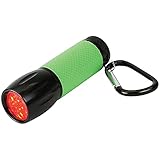
4. Carson RedSight SL-33 – Best for Reading Star Charts at Close Range
Carson RedSight Red LED Flashlight For Reading Astronomy Star Maps and Preserving Night Vision with Two Brightness Settings (SL-33) X-Large
50 lumens max
Two red levels, no strobe
Nine red LEDs
Glow-in-the-dark grip
Pros
- Low setting is genuinely dim enough for charts
- Glow-in-the-dark grip is easy to find in the dark
- No strobe mode to cycle through
- Attached carabiner clip
- Rectangular body does not roll off a table
Cons
- High setting is far too bright for a shared star party
- Reports of units dying or cutting out after weeks
- Not water resistant
The Carson RedSight is built around one idea: give an astronomer a properly dim red light. Its low setting is the softest true low in this roundup, and that is the whole point. You can read a printed star chart at arm’s length without feeling your dark adaptation collapse, which is not something the brighter lights here manage.
There are two red brightness levels and no strobe anywhere in the cycle. Nine separate red LEDs do the work rather than one filtered white source, which also means the light degrades gracefully instead of dying all at once when an element fails.
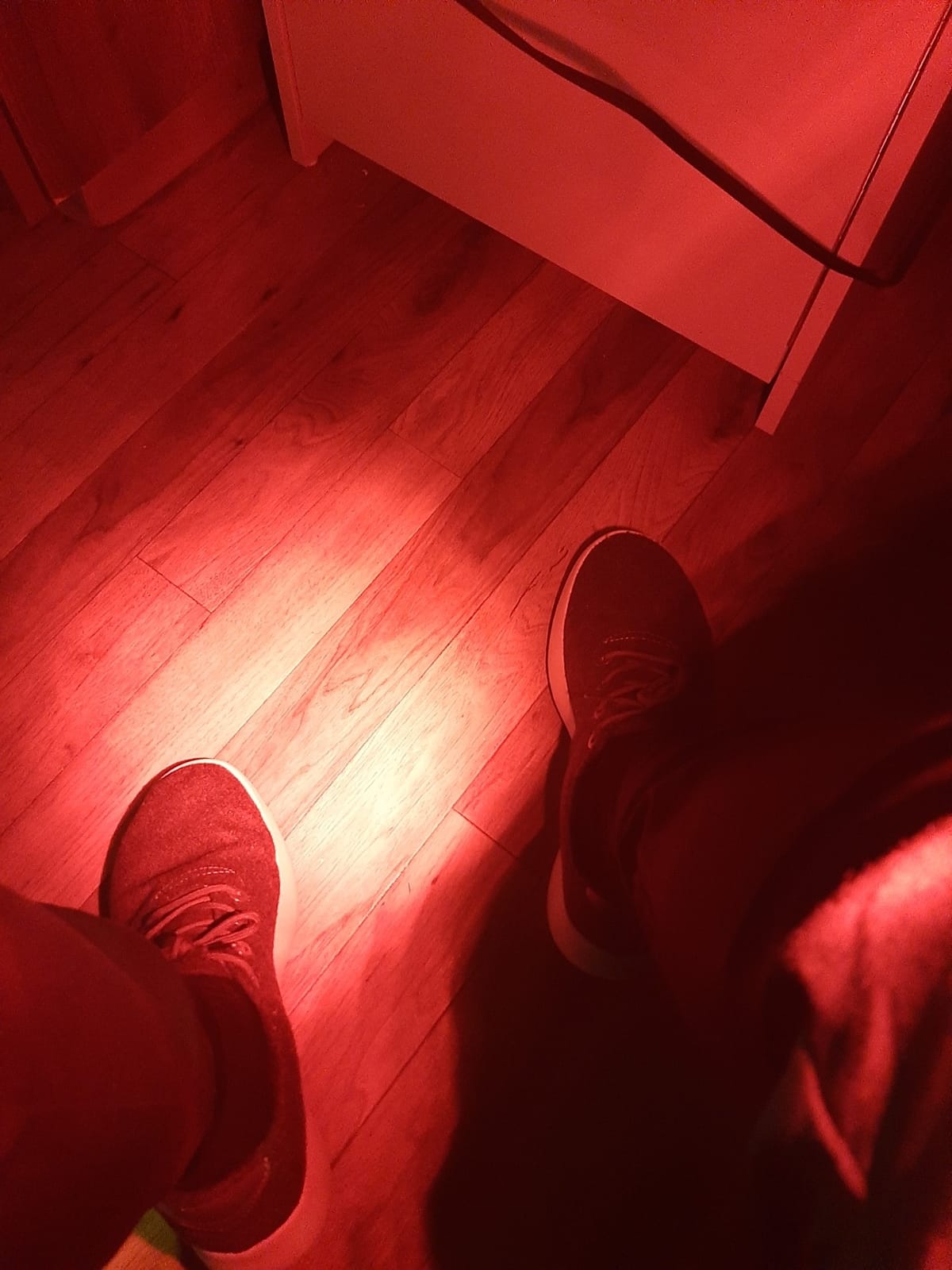
The glow-in-the-dark rubber grip is a small feature that matters in practice. When you set the light down on a dark table, you can find it again by feel without switching anything on, so you are not fumbling for a button and lighting up the whole field.
The attached carabiner clip lets you hang it from a pack, a tripod leg or a jacket zip, and the rectangular body is a better shape for a flat observing table than a round one. A round light rolls off; this one does not.
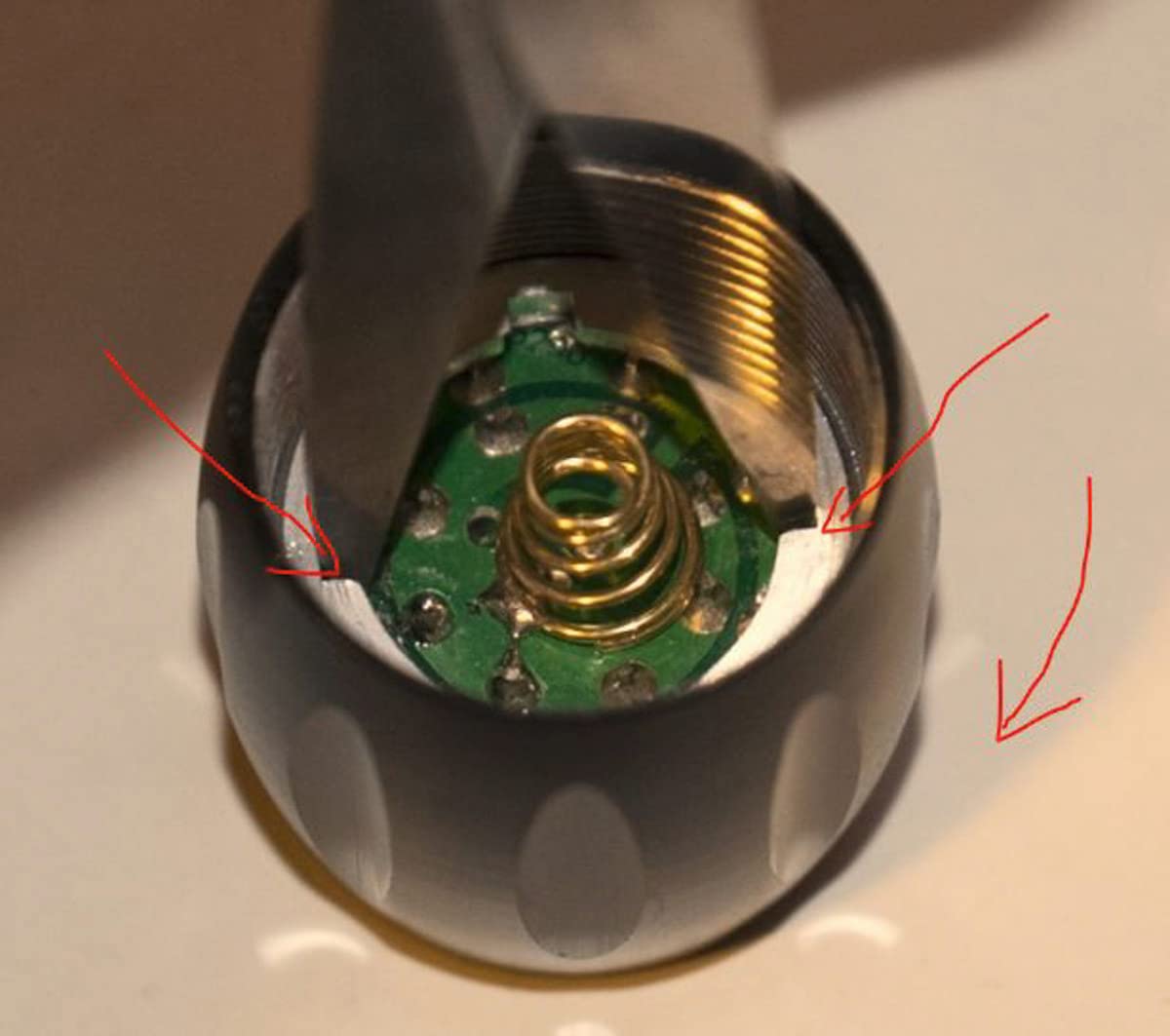
Two things hold it back. The high setting is far too bright for a shared observing night, so use low in company and save high for solo work. More seriously, a steady stream of reviews describe units going out intermittently or dying within weeks, and alkaline leakage has damaged some. Our advice is to check it before every session rather than trust it.
Why is a dedicated low setting the feature that matters most?
Because every other light here forces a trade. Bright outputs light a chart but cost you adaptation, and dim outputs protect your eyes but leave you squinting. A light with a properly engineered low level removes the trade entirely, and for printed charts that is the setting you will use 90 percent of the time.
It also makes this the safest light to hand to a beginner. There is nothing to cycle through and nothing to get wrong at a public star night.
Are the reliability complaints a reason to skip it?
Not entirely, but plan around it. A 4.2 rating with more than 2000 reviews sits at the lower end of this list, and the failure reports are specific enough to be worth respecting. If you are buying one light and relying on it for a single night, choose something with a stronger track record.
If you are buying for a club, a family or a dark-sky event where redundancy is cheap, the low setting and glow grip here are hard to match, and carrying a spare costs little.
5. LUMENSHOOTER 4-in-1 RGBW Flashlight – Best for Red Plus Other Colours
LUMENSHOOTER Upgraded Zoomable Red Flashlight, 4 Color in 1
Red, green, blue and white
200 lumens red
Mode memory
Zoomable, pocket clip
Pros
- True RGBW LEDs rather than a filter over white
- Mode memory returns to your last colour
- Half-press stops accidental mode changes
- Zoomable beam and pocket clip
- Useful white output for setup tasks
Cons
- Red-only output is a modest 200 lumens
- Needs 3 AAA batteries that are not listed as included
- Only rain resistant
Most red torches are white lights with a red filter, and that approach leaks some of the shorter wavelengths that ruin night vision. This one uses true RGBW LEDs, so the red is generated at the source rather than filtered after the fact. Reviewers who know the difference notice it, and it is the reason this light sits comfortably among dedicated astronomy torches.
The mode memory is the feature that gets the most praise. Switch it on and it returns to the colour you used last, so a fumble in the dark does not fire a burst of white light into your eyes or your neighbours’.
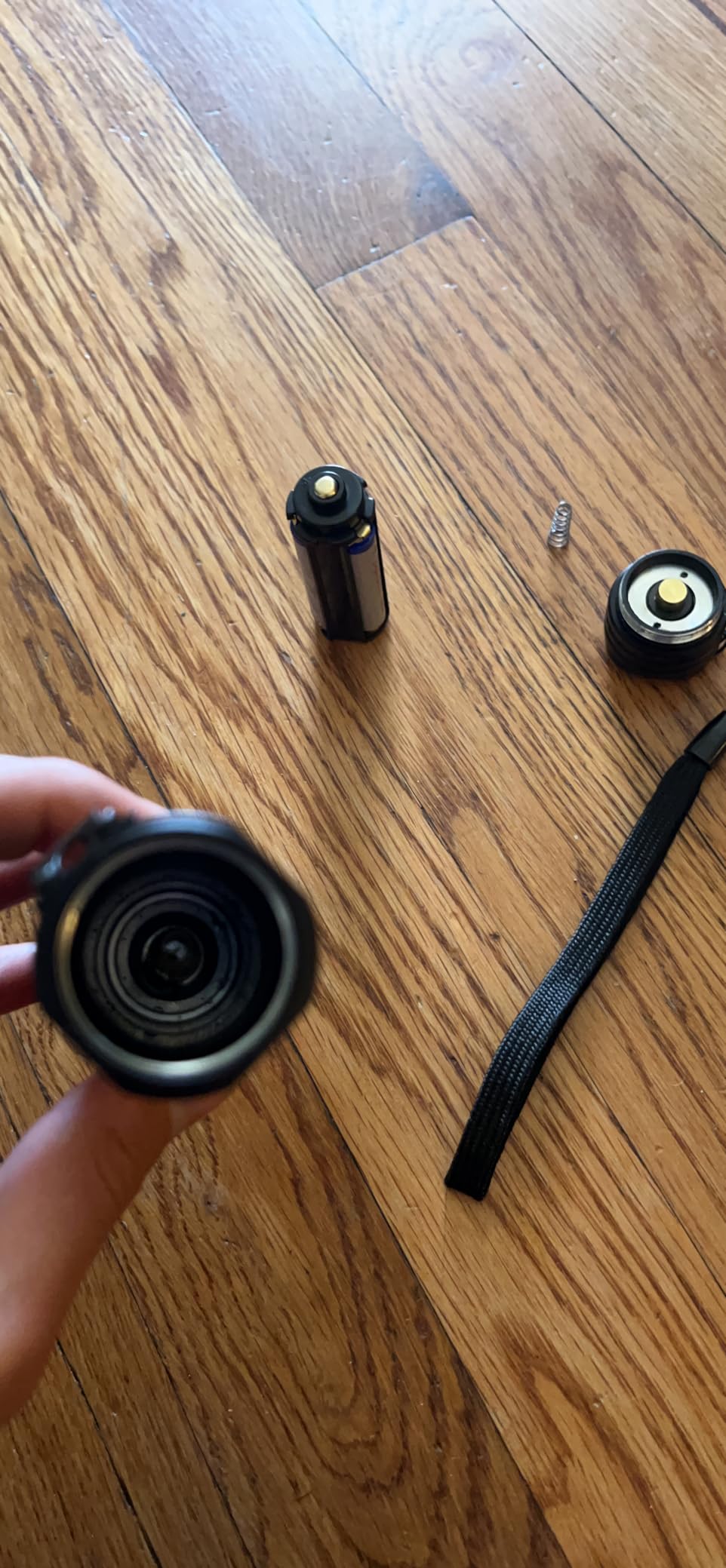
Having white output alongside red is genuinely useful for the boring half of astronomy. You can use white to check a collimation cap, read a box of eyepieces in the car, or walk the path back before it gets fully dark, then switch to red for the observing itself.
The zoomable lens handles narrow spotting and wide flood, and the built-in clip keeps it on a pocket or tool belt. The aluminium body is rain resistant, which is enough for dew and drizzle on an open field.
Three AAA batteries power it, and the listing notes they are not included. The 166 g weight is heavier than the small single-cell torches, so it is less of a neck-strap light and more of a bag light.
Is a multi-colour light a compromise for astronomy?
Only if you let it be one. If you keep it switched to red and rely on memory, it behaves like a proper astronomy light with a bonus colour set. If you cycle colours casually in the dark, you will eventually land on white and undo the point of carrying red at all.
The practical risk is low because the half-press control requires deliberate action to move between colours. Treat the white and green settings as a convenience you use before and after observing.
Is 200 lumens of red enough to light a star chart?
For a chart at close range, yes, especially on the lower of its settings. For lighting an area several metres away or finding your way across a car park, it is dimmer than the dedicated high-output red torches in this roundup and reviewers note that comparison directly.
If red is your only use for the light, one of the 500 or 1000 lumen models will serve you better. If you want one torch for the whole night, the colour flexibility earns its place.
6. Honoson 2 Pack Red Flashlights – Best for Two-Person or Club Kits
Honoson 2 Pieces Red Light Flashlights LED Single Mode for Night Astronomy
Two lights per pack
Single on and off mode
200 lumens
Adjustable focus
Pros
- Two lights so every observer carries one
- No mode menu to navigate in the dark
- Tiny pocket size with a steel clip
- Adjustable focus with 150+ yard reach
- Water resistant alloy body
Cons
- Zoom lens hood tends to loosen and fall out
- Modest 200 lumen output
- Disposable AA cells with no USB-C option
Selling a light per person solves a problem most red torch lists ignore. At a star party, an observer carrying their own light is far more likely to use it than to lean on you for theirs, and two lights means a spare if one gets dropped in the dark.
The design here is deliberately plain. One mode, on and off, no menu, no colour cycling. Turn it on, you get red at 200 lumens. That predictability makes it a good choice for handing out to beginners, and the 150+ yard adjustable focus reach is more than enough for checking a chart or walking a path.
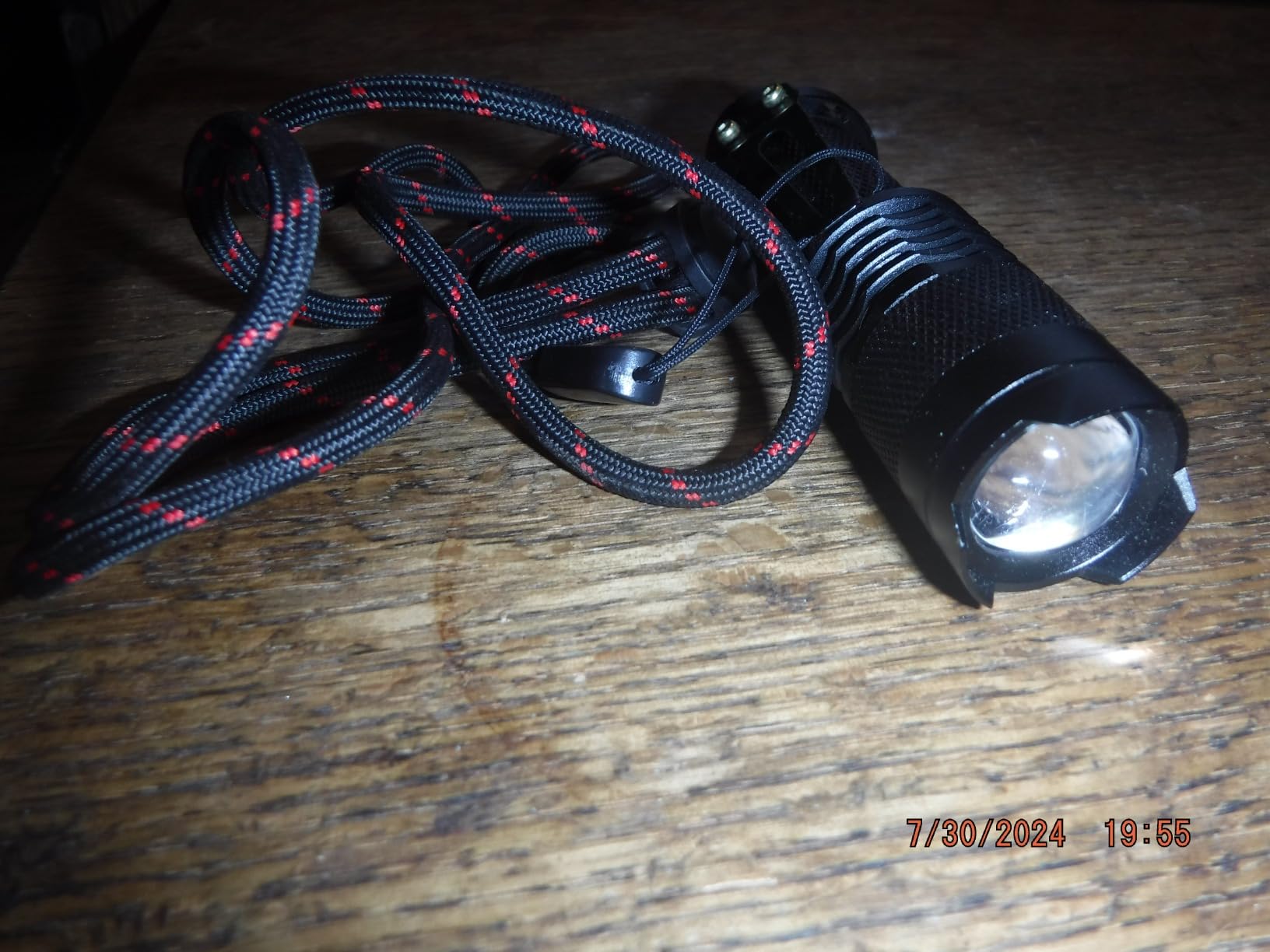
The body is an alloy steel and aluminium combination with a steel clip, and at well under an ounce per light it is easy to forget in a pocket. Water resistance covers dew and light rain, and the listed runtime of around 2 hours reflects how most people actually use a chart light, in short bursts.
A red output that preserves dark adaptation is the whole reason to carry it, and observers confirm it does the job. Being AA-powered also means a fresh set of cells is always available in a jacket pocket.
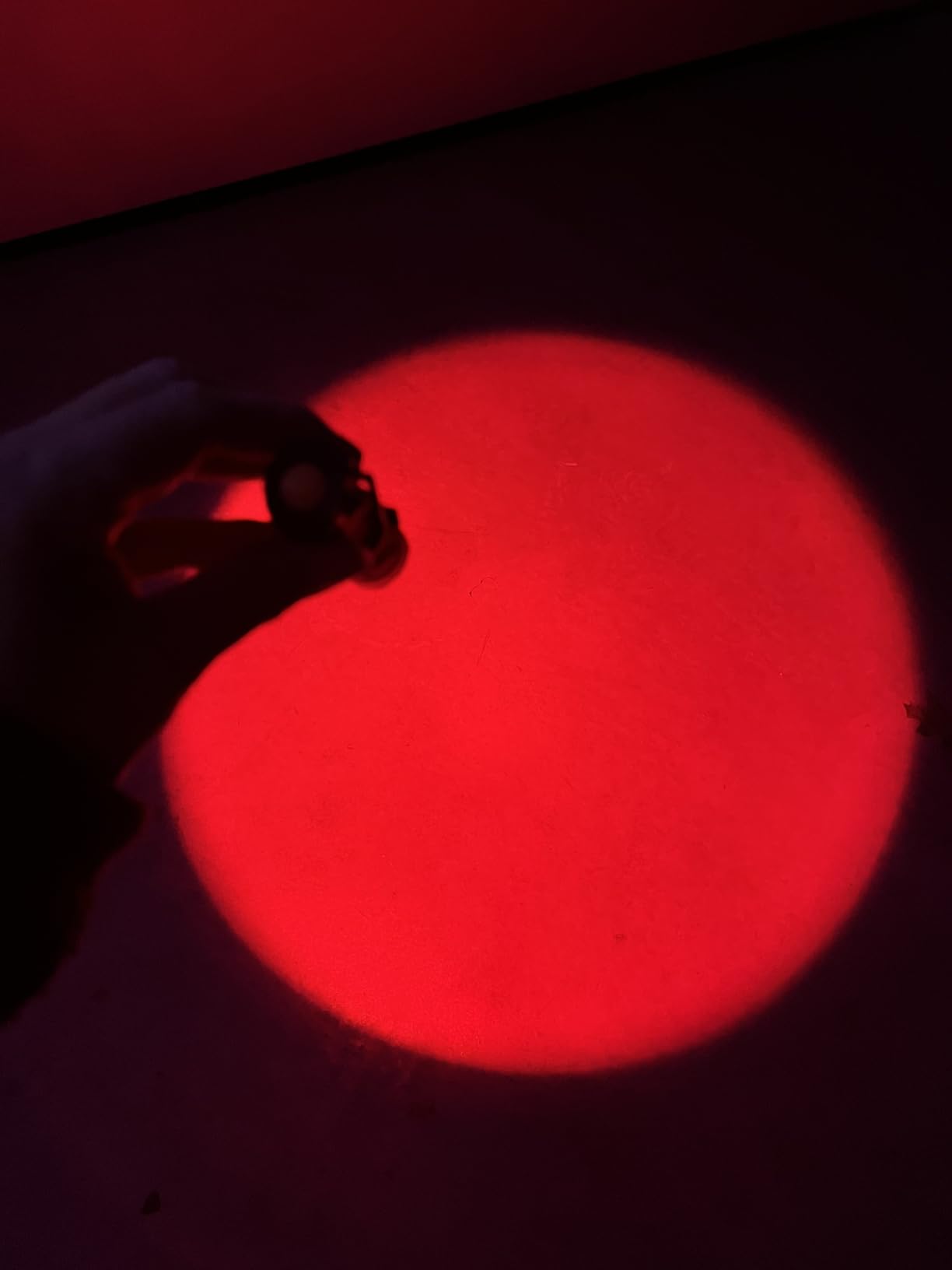
The recurring complaint is the front zoom hood. Owners report it loosening or working loose with use, which breaks the focus until it is re-seated, and some fix it permanently with a drop of glue. Check it at the start of a session rather than trusting it mid-night.
Is a two-pack the right choice for a single observer?
Only if you have a second person. For one person at the eyepiece, one light is one light and the second adds little. For a family observing together, a couple sharing a dark site, or a club running a public night, two lights remove the bottleneck of everyone asking to borrow the same torch.
It is also the cheapest way to build a kit that includes a dedicated spare, which is the one piece of insurance that matters most in the field.
Does 200 lumens work at a real star party?
For chart reading at close range it works, and for finding your way across a site it works. It is not a light for lighting a distant path, and reviewers expecting more output from the word flashlight are disappointed.
The single mode also means no way to soften the beam. Covering the head with your palm to cut the flood is the practical trick people use, and it works well at chart-reading distances.
7. AuKvi 500 Lumen Red Torch Two Pack – Best for a Long-Range Red Beam
AuKvi 2 Pcs Powerful Red LED Flashlight – Long Range Red Hunting Light Torch, Zoombale, Waterproof, Best for Astronomy, Aviation, Night Observation
500 lumens red
200 m reach
18650 cell or 3 AAA
Waterproof
Pros
- 500 lumens with a genuine zoom from spot to flood
- Takes an 18650 or three AAA cells
- Two torches for car and field kit
- Waterproof and shock resistant body
- Single mode rules out any white flash
Cons
- Too bright for close-range chart reading
- Beam is easy for animals to notice
- Batteries are not included
500 lumens of red with a beam reaching 200 metres puts this light into a different category from the 200 lumen torches. It lights a whole observing area rather than a chart, which makes it useful for setting up a large telescope, checking a path to a remote site, or working in the dark around a van full of gear.
Battery flexibility is the quietly excellent part. The body accepts either a single 18650 lithium-ion cell or three AAAs, so if you already run one battery ecosystem for your observing kit, this light joins it instead of demanding its own.
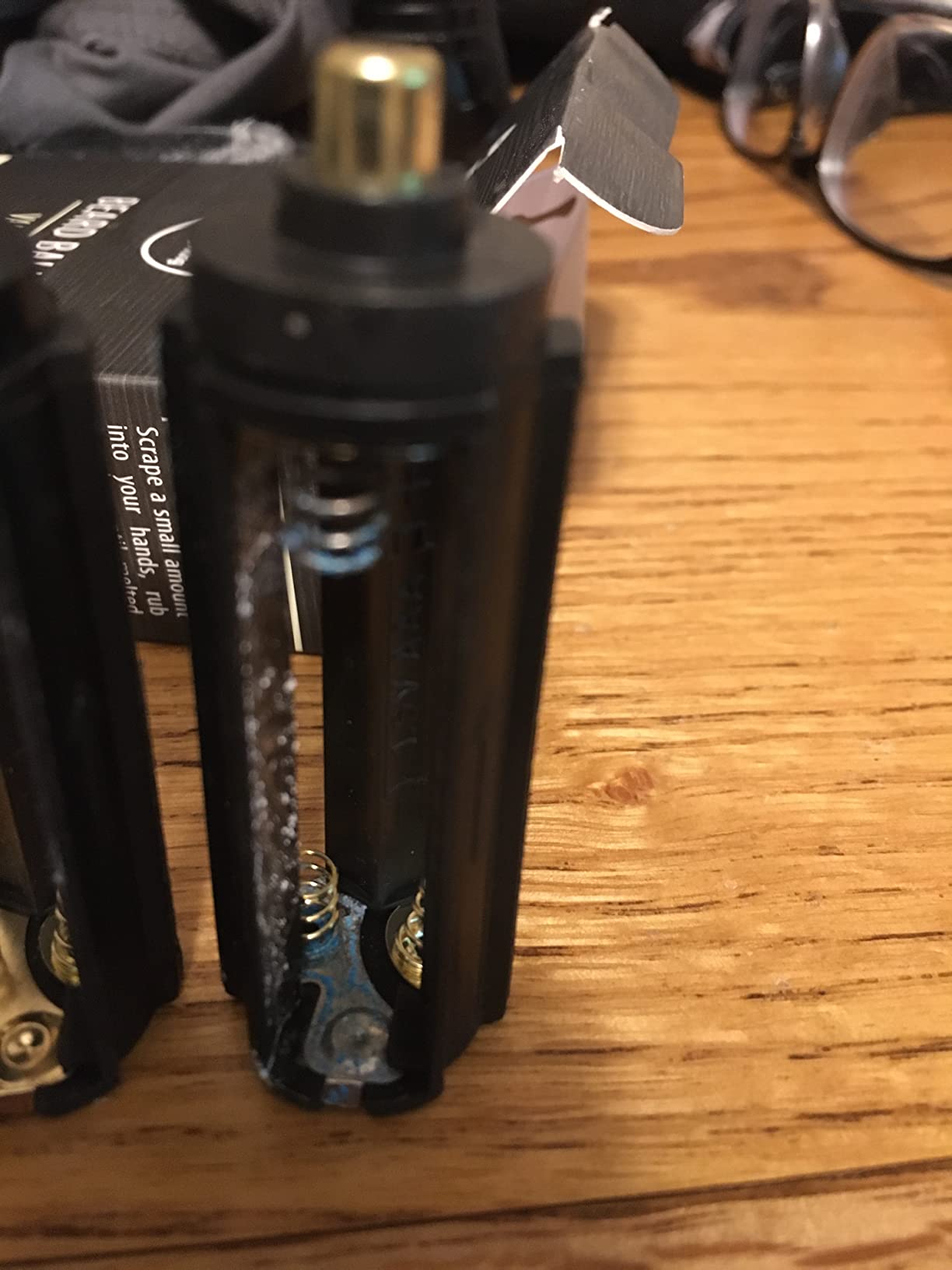
Two torches come in the pack, which pairs naturally with one in the car and one in a field bag. The waterproof, shock resistant aluminium body handles the wet grass and gravel that come with amateur observing sites, and single-mode operation means there is no way to fire off a white flash by accident.
Owners using it for astronomy and wildlife work rate the zoom highly. Sliding the head moves from a tight spot to a wide flood, so you can put a narrow beam on something distant or open it up to light a folding table.
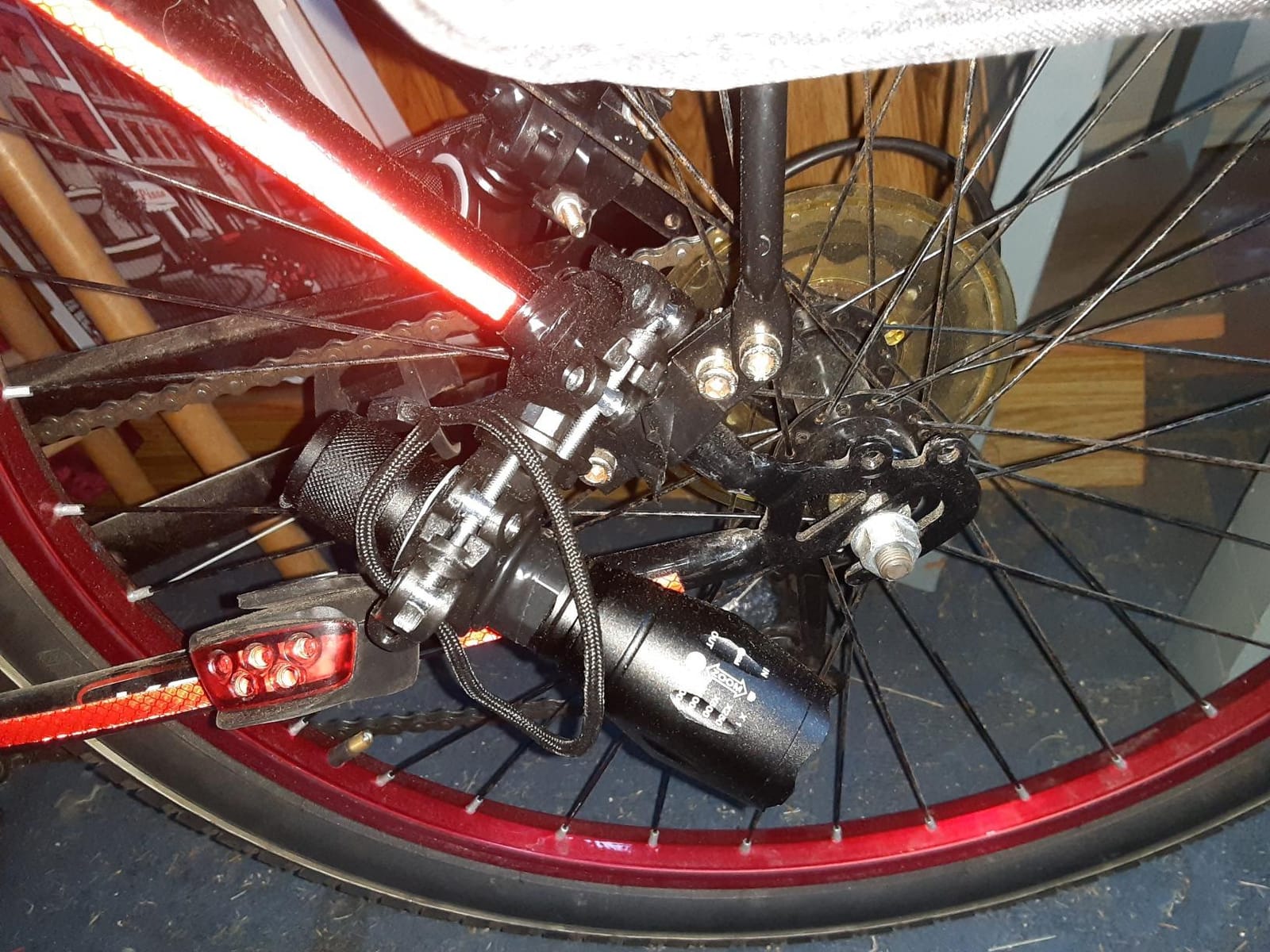
The astronomy-specific warning is consistent across reviews: this is too bright for reading a chart at close range and far too bright beside other dark-adapted observers. Its correct use is setup and navigation, while the dimmer lights handle the eyepiece work.
Also worth knowing: the red beam is easily detected by animals at close range, which matters for wildlife work and for keeping moths and insects off a white chart. Batteries are not included.
When does 500 lumens help rather than hurt?
It helps when the light source is far from your eyes and the target is large. Unpacking, setting up an equatorial mount, checking a cable run and walking back to a car are all cases where you are lighting a scene, not reading a page, and 500 lumens does that in one sweep.
It hurts when your target is a piece of paper 30 centimetres from your face, or when the person next to you is halfway through dark adaptation. Match the output to the task, not the other way round.
Is one battery type better than the other?
For repeat sessions, the 18650 is better. One rechargeable cell per torch beats three AAAs, and the cell is easy to top up between outings. For a one-off night or a kit where you already have AAAs, the three-cell option keeps the trip simpler.
Whichever you choose, the ability to swap between the two is what makes this light easy to fit into an existing battery kit rather than adding a new system to it.
8. BESTSUN 1000 Lumen Red Flashlight – Best for Maximum Red Output
BESTSUN Brightest Waterproof Red Light Flashlight 1000 Lumens 350 Yard Long Range Red Hunting Light Coyote Hog Night Vision Red LED Flashlight Light Lamp Torch Rechargeable for Astronomy
1000 lumens red
350 yard claimed throw
Push-pull zoom
Aluminium body
Pros
- Very high 1000 lumen red output
- Deep reflector gives a tight hot-spot beam
- Push-pull zoom from flood to spot
- Solid aluminium body
- Works with 3 AAA or one 18650
- Charger included
Cons
- Some torches stop holding charge after limited use
- Weak factory QC with dirty lenses and broken seals
- Front lens is not sealed despite the listing
- Red is a lighter shade than deeper red diodes
This is the brightest red output in the roundup, and reviewers treat it as exceptional value against costlier red hunting lights. A 1000 lumen red beam from a 180 mm body will light a whole woodline, which is more than most astronomy use cases require and exactly what you want for site setup in a dark car park.
The deep reflector produces a tight, hot-spot beam with a claimed reach of 350 yards, and the push-pull head zooms between flood and a narrow spot. If your observing site is large or your kit is spread out, that reach has value.
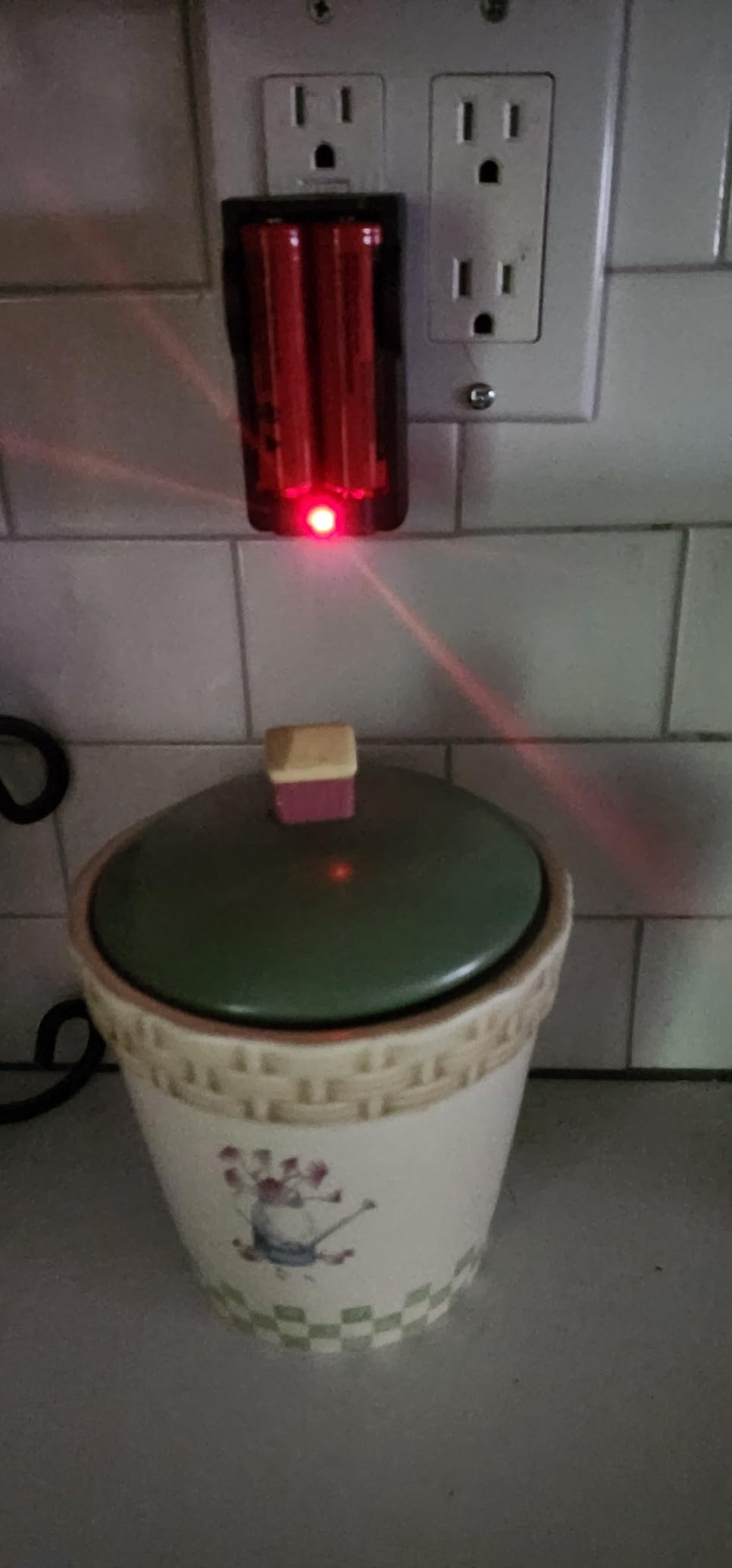
Power is flexible again. The body accepts three AAA batteries or a single 18650 rechargeable cell, and a charger is included in the box, so you can start with disposable cells and move to rechargeable when you settle on a routine. The aluminium body feels solid rather than thin.
Single-mode operation keeps it simple, and the red beam does not startle wildlife the way green or white light does, which is why this category of light is popular outside astronomy too.
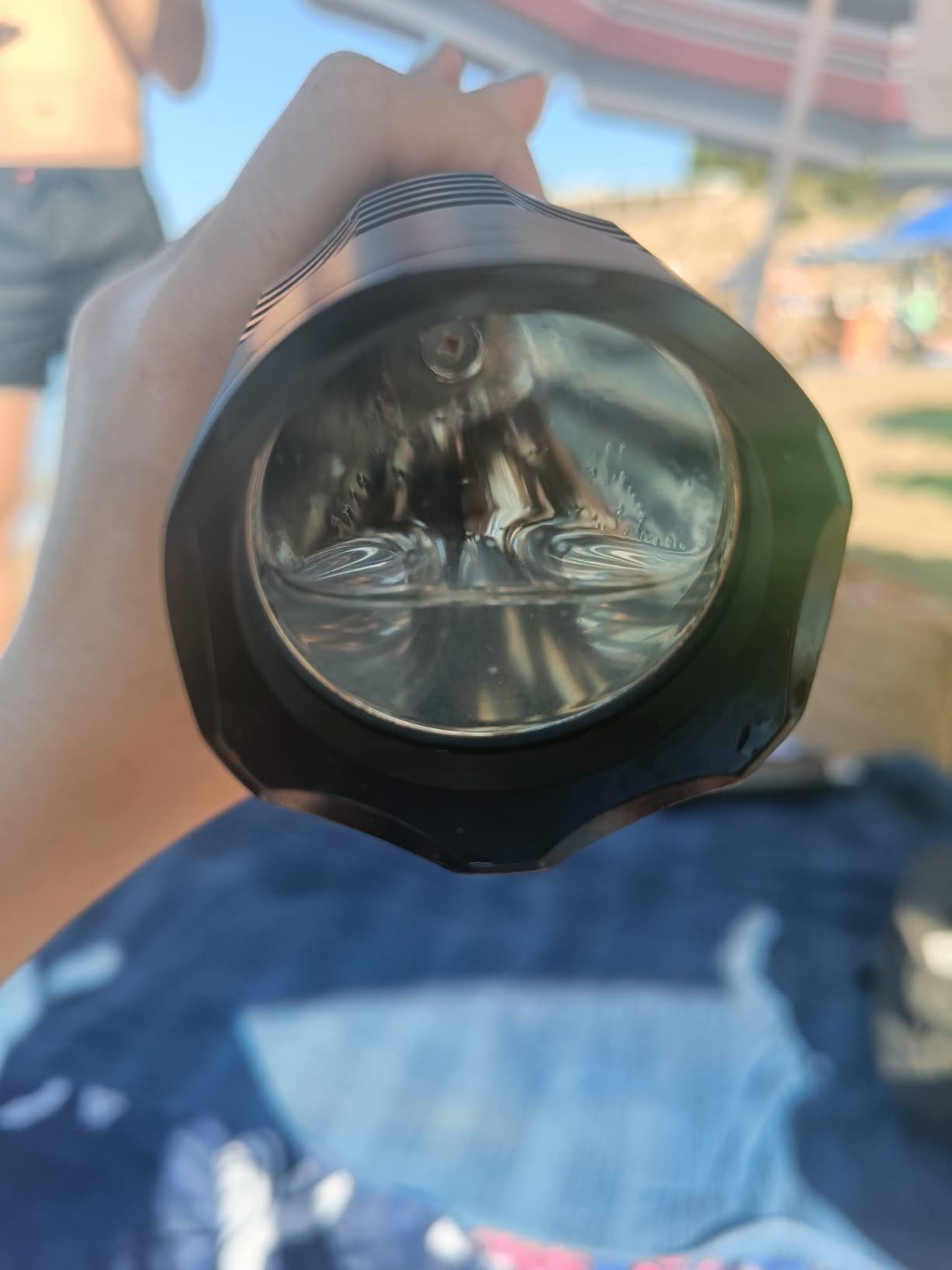
The negatives are about assembly and sealing rather than light. Some owners report units that stopped holding charge or powering on after limited use, and factory inspection draws criticism for dirty lenses and broken rubber o-rings arriving in the box. The seal sits around the battery compartment, so the front lens is not weather sealed despite the waterproof listing.
The red is also a lighter shade than the deeper diodes on the astronomy-specific lights, which matters if you are sensitive to the difference.
Is the brightest red light the best red light for stargazing?
No, and this is the clearest case in the roundup where the biggest number is the least useful. Stargazing needs just enough light to see a chart or find an eyepiece, and 1000 lumens is the opposite of that. This is a site setup and path-finding light.
Reach a light for chart work with a dedicated low or medium level, then use something like this for everything around the telescope. The two jobs have opposite requirements.
What should I check before relying on this light?
Test that it holds a charge, clean the lens, and check the o-ring on the battery compartment is seated and undamaged. The reports of units failing after limited use are specific enough that a quick check on your first outing saves a dark walk later.
For wet-weather reliability, keep a light with a properly sealed body as a backup. Do not plan a whole night around a torch whose front lens is not sealed.
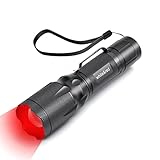
9. METII Red and White Memory Torch – Best for Mode Memory Without a Strobe
METII Upgraded Red Flashlight, Bright White &High/Low Power Red Light Options with Memory, Zoom Lens, Portable Weatherproof LED Small Torch for Aviation, Astronomy, Night Vision
High red, low red and white
Mode memory
Zoom lens
18650 or 3 AAA
Pros
- Mode memory reopens on low red instead of white
- Low red level is dim enough for map reading
- Zoom gives even flood to spot diffusion
- Runs on 18650 or three AAA cells
- Pocket clip
- lanyard and 12-month warranty
Cons
- Tail switch is stiff to turn on but light to toggle
- Zoomed beam projects a square hotspot
- Pocket clip grips weakly
Astrophotographers and pilots tend to be the buyers who notice the mode memory here, and they notice because it prevents the single most annoying failure in a dark field. Switch this light on after using it on low red, and it comes back on low red. You never wake up to a face full of white light.
There are three modes: high red, low red and white. The low red level is dim enough to read a map without breaking dark adaptation, and the white setting earns its place for setup tasks before you are fully dark or after you pack up.
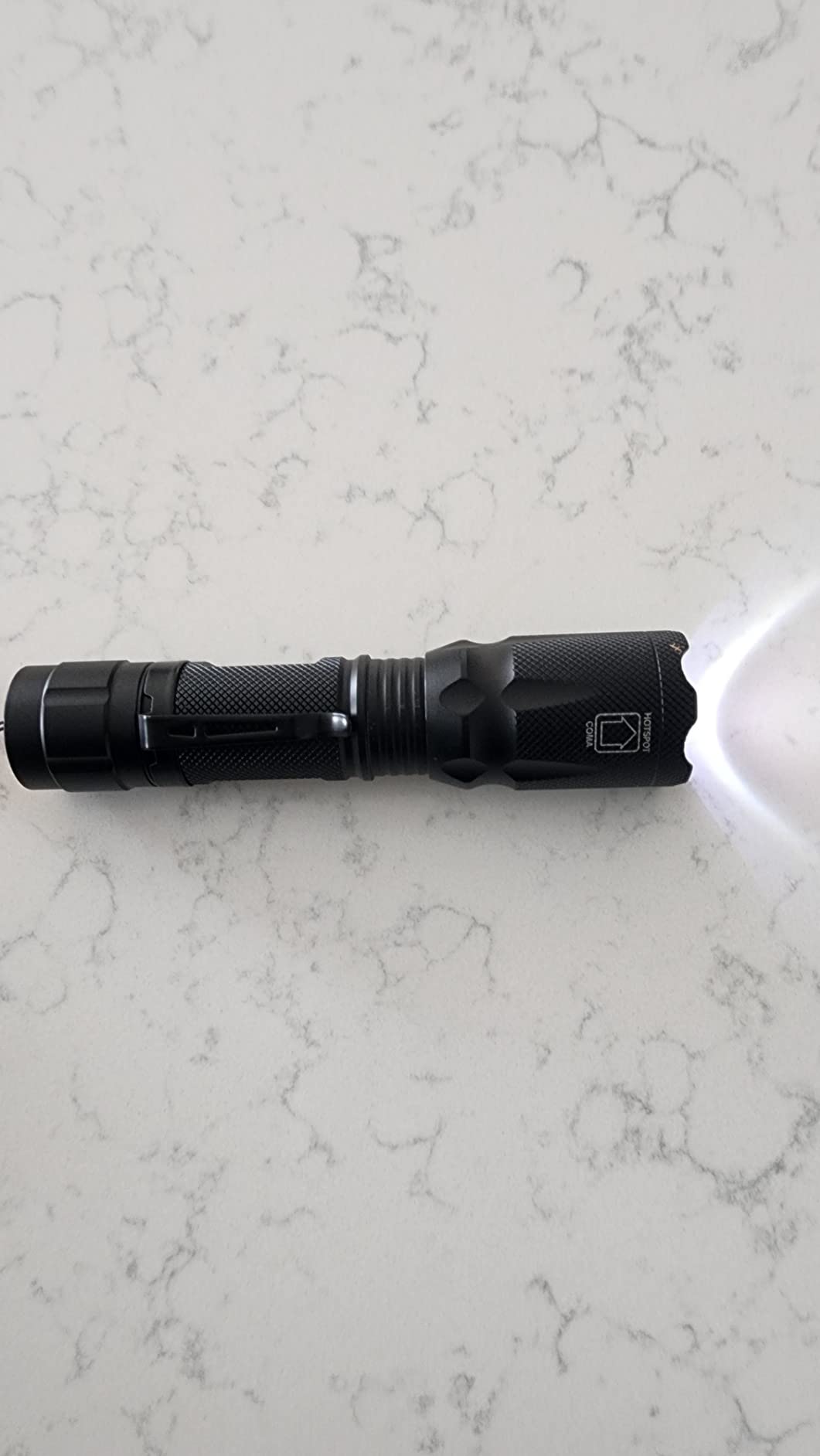
The zoom runs from flood to spot with clean, even diffusion, which reviewers single out as better than most cheap zooms. Power is flexible again, taking an 18650 cell or three AAAs, and a pocket clip, lanyard and 12-month warranty are included.
The rectangular body and belt clip make it easy to carry on a strap, and the recessed tail switch doubles as a stand so you can point it at a chart hands-free, which is more useful than it sounds when you are also holding a star atlas.
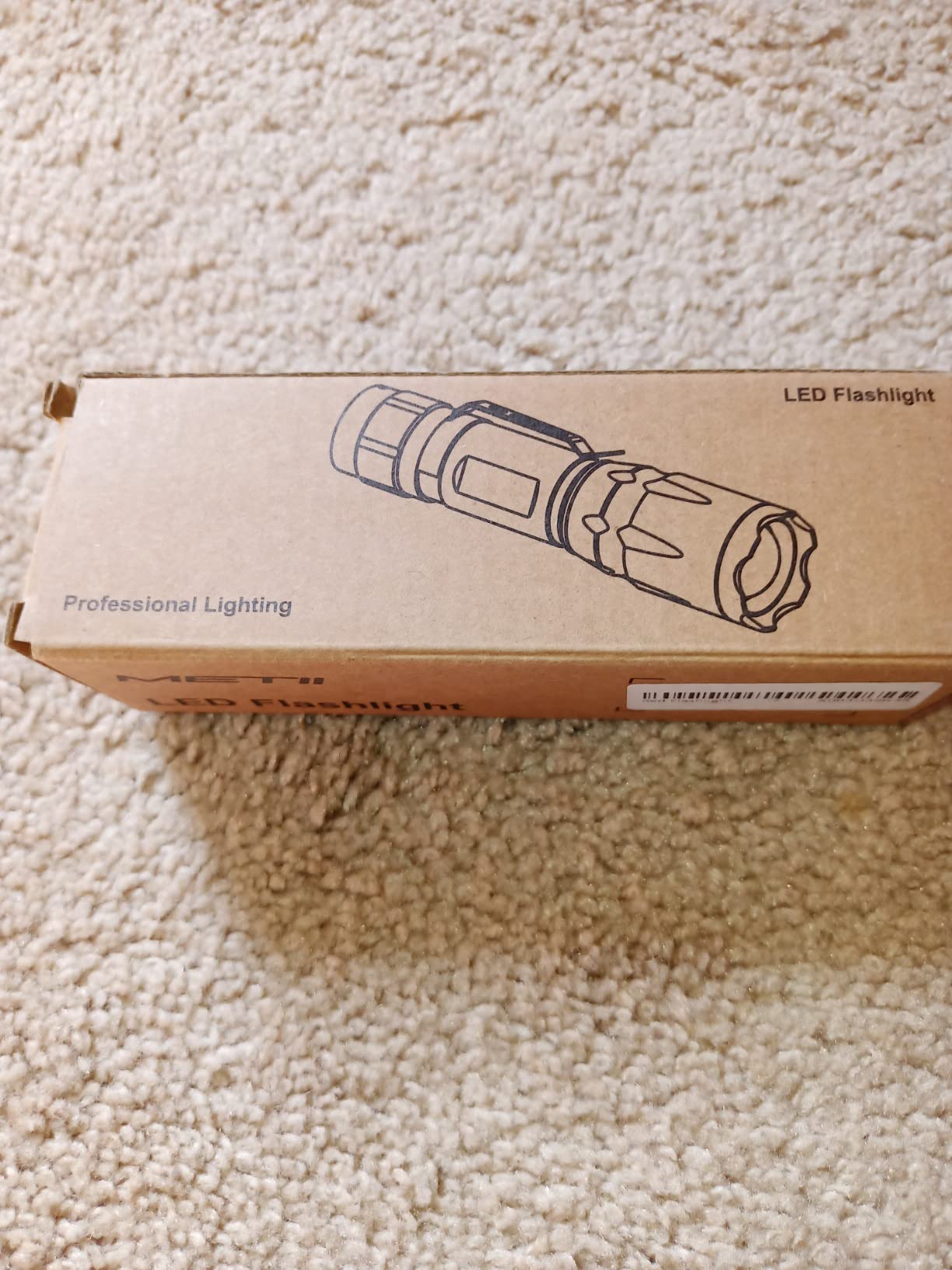
The tail switch has a personality problem. It is oddly stiff to turn on but very light to toggle between modes, so a hard press for on and a light press for changing settings. That is the price of the memory function and the people who rate it highest accept it. The zoomed beam also projects a square hotspot, and the pocket clip grips weakly enough that the light can pop out of a strap.
Why does mode memory matter more than it sounds?
Because the light gets switched on at the worst possible moment, usually with one hand while the other is steadying a telescope. Without memory, every accidental activation is a white flash and several minutes of re-adaptation, for you and for anyone standing nearby.
With memory, the worst case is that you get a red light you did not want, which costs you nothing. That asymmetry is why this feature is worth more to astronomers than an extra brightness mode.
Are there durability concerns with this light?
Some reviewers find it less rugged than solid metal torches, with electronics failing after repeated drops and a few outright failures. Treat it as a light for the observing field rather than for heavy work, and keep a spare.
The waterproof rating is unproven in practice, so treat it as weatherproof at best and bring a covered case or a pocket if rain is forecast.
10. DARKBEAM 620-625nm Red Flashlight – Best for a Verified True Red Wavelength
DARKBEAM Red Light Flashlight Tactical LED High Power Rechargeable Zoomable
True red at 620-625nm
500 lumens
Removable rechargeable cell
Zoomable, IPX65
Pros
- Published 620-625nm true red rather than a filtered look
- 500 lumens with a useful zoom from spot to flood
- Removable swappable rechargeable battery
- Compact aluminium body with IPX65 sealing
- Carry pouch included
Cons
- No USB port
- the cell charges externally
- Zoom lens is loose and drifts out of position
- Bright enough to be seen easily at distance
Almost every red light in this roundup is described as red without publishing a wavelength. This one states 620-625nm, which is the low end of the range astronomy lights aim for and the one enthusiasts on the r/flashlight forums argue about at length. If the actual emission spectrum matters to you, this is the only product here where you can verify it from the listing.
The colour shows it too. Reviewers describe a saturated red rather than the pinkish, washed-out look you get from white light behind red film, and that is the difference between a dedicated red emitter and a filtered one.
Output is 500 lumens with a zoom that runs from a tight spot to a wide flood, and reviewers using it for astronomy and astrophotography report that the zoom is genuinely useful across that range. The aluminium alloy body carries IPX65 sealing and rubber ring protection, which is appropriate for a light used in damp grass.
The removable rechargeable cell is the standout feature. You can carry a spare charged cell and swap it in the dark rather than waiting for a charger, which matters when your only power source is a car socket twenty minutes down a track. A cloth holster and manual are included, and at 130 g it is compact enough for a pocket or a belt pouch.
Two complaints come up repeatedly. There is no USB port, so the battery has to come out and go on an external charger, which is a hassle at home and fine in a car. The zoom lens is loose and drifts out of position under gravity or movement, so the beam pattern shifts if you set the light down at an angle.
It is also a bright 500 lumens with no low mode, so it is not a chart-reading light despite being the most correct colour on the list.
Does 620-625nm really beat 650nm for night vision?
The argument from the flashlight forums is that longer wavelengths at the deep red end preserve dark adaptation better, while 620-625nm trades a small amount of that for a brighter, more useful red that is easier to read by. The honest answer is that the difference is smaller than the debate suggests, and the brightness of what you are shining matters more than the exact nanometre.
What 620-625nm does guarantee is a genuinely red beam with no filter losses and no leaked short wavelengths. That is a real benefit, and it is the reason this light appears in the hands of astrophotographers.
Is a removable battery worth the hassle?
For repeat observing, yes. Swapping a charged cell takes seconds and removes the single biggest failure mode in the field, which is a light that will not turn on. Carrying a spare cell costs almost nothing in weight.
For occasional use, the external charger is an inconvenience and a light with USB-C built in is more convenient. Choose based on how often you head out.
What to Look for When Buying a Red Light for Astronomy?
Wavelength is the first thing to check, and almost nobody does. A true red LED emits light in the red band directly. A filtered white light passes white through red film, which loses brightness and can leak a little of the shorter wavelengths that trigger your cone cells. The DARKBEAM in this list is the only one that publishes its figure at 620-625nm. Longer wavelengths around 650nm are marginally gentler on dark adaptation, and community preference on the flashlight forums leans that way.
Variable brightness beats raw output. The single most useful feature in this list is not lumens, it is a low setting. 200 lumens with no dimming will blind a chart reader, while 50 lumens with two levels will not. A strobe mode is a distraction at best, so prefer fixed low and high settings or a stepless dimmer.
Beam pattern decides what you can light. A flood covers a chart and a close work area. A spot reaches across a site or picks out a distant object. Most useful lights here are zoomable, so you get both from one body. Pure throw is not a feature for stargazing; broad, even coverage close to your hands is.
Battery choice depends on your observing rhythm. Disposable AA or AAA cells are cheap, universally available and impossible to kill with a forgotten charge. Rechargeable cells are better for regular sessions and cold nights, where alkaline output drops. Most of the lights here accept either 18650 cells or three AAAs, which is the most flexible arrangement and worth paying a little more for.
Cold weather and gloves deserve real thought. Lithium cells hold their output far better than alkaline in freezing conditions, and a light with a recessed switch is easier to operate with gloves on than one with a raised, side-mounted button. Controls that need a hard press are better than controls that fire on a light touch, because a gloved hand is not precise.
Headlamp or handheld? A headlamp gives you both hands free, which is the deciding factor when you are aligning a mount, collimating a reflector or working with a camera. A handheld is faster for a quick chart check, and most observers carry both. Watch the red brightness of headlamp models, because many use a dimmer red with a wider spread that suits close work.
Star party etiquette is a brightness issue. The rule experienced observers follow is simple: on shared dark sites, use your lowest red setting, aim the beam down at the ground rather than at the horizon, and keep total on-time short. A bright red beam still destroys your neighbour’s dark adaptation, and they will notice.
Two cheaper options that work. Red film or gel cut for a stage can be wrapped around the head of a white flashlight with a bit of tape, which is how a lot of people start. It dims the output, so buy a bright white light, and it is a stopgap rather than a solution. Phone screen red filters are better than nothing for checking a chart in a pinch, but the screen is still bright enough to cost you adaptation, and reviewers consistently say the same thing: useful in an emergency, poor as a primary light.
Match the light to your Bortle scale. In a Bortle 1 or 2 sky you need almost no light at all, and a two-level light at 50 lumens is more than enough. Under heavy suburban light pollution, a slightly brighter flood helps you find your kit quickly, but the case for maximum output gets weaker, not stronger. Bright skies make you want more light for setup, never more light at the eyepiece.
Frequently Asked Questions
Why use a red flashlight for stargazing?
Red light sits at the long end of the visible spectrum, where your rod cells are least sensitive, so using it does not undo the 20 to 30 minutes of dark adaptation your eyes need to see faint detail. White, blue and green light switch on your faster cone cells and reset that process. Red light lets you read a star chart, find an eyepiece or walk back to the car without restarting your night.
What is the best red light flashlight for astronomy?
The WAYLLSHINE High Power Red LED is the best overall pick for most observers because it has a single mode with no chance of a white flash, 200 lumens of red, a metal body and a single AA battery. The Carson RedSight SL-33 is better for close-up chart reading because its low setting is genuinely dim. The RECHOO rechargeable is the better choice if you want brightness options and no disposable batteries.
Is red or green light better for night vision?
Red is better for preserving dark adaptation. Green sits close to the peak sensitivity of human vision, so it is brighter to look at and it is easy to read a chart by, but it stimulates the same receptors that white light does and costs you more adaptation. Green is genuinely more visible per lumen, which is why it is popular with hikers, but for astronomy the priority is protecting your eyes rather than seeing more.
What are some good flashlights for stargazing?
A red flashlight with two fixed brightness levels, a broad flood beam and a simple switch is all you need. The Carson RedSight and the METII both give you a dedicated low red setting with no strobe in the cycle. If you also want white light for setup, the LUMENSHOOTER 4-in-1 keeps a true red diode alongside white. For the brightest red beam on a large site, the AuKvi and BESTSUN models cover 500 and 1000 lumens.
Can I use a red filter on a regular flashlight instead?
You can, and for a beginner it is a reasonable stopgap. Wrap red film or gel around the head of a bright white flashlight and tape it on. The downsides are real though: a filter cuts brightness significantly, the result is dimmer and pinker than a true red LED, and cheap gel can leak a little of the shorter wavelengths it is meant to block. A dedicated red light is brighter at the same nominal output and far easier to dim to a usable low level.
Final Verdict
The best red flashlights for stargazing share three traits: a genuine red LED rather than a filter, a low setting you can actually read a chart by, and a beam wide enough to light a page. Our pick for most people is the WAYLLSHINE High Power Red LED, because single-mode simplicity plus one AA battery removes every way to get it wrong in the dark. Read charts close up? Take the Carson RedSight SL-33. Want brightness range and no disposables? The RECHOO rechargeable covers it, and the Coast XP11R is there if you want a lifetime warranty on a body that can take drops.
Whatever you choose, learn the lowest setting before you leave home, and aim it down at your charts rather than at the horizon. On a shared dark site, the most courteous red light is the dimmest one switched on for the shortest time.