
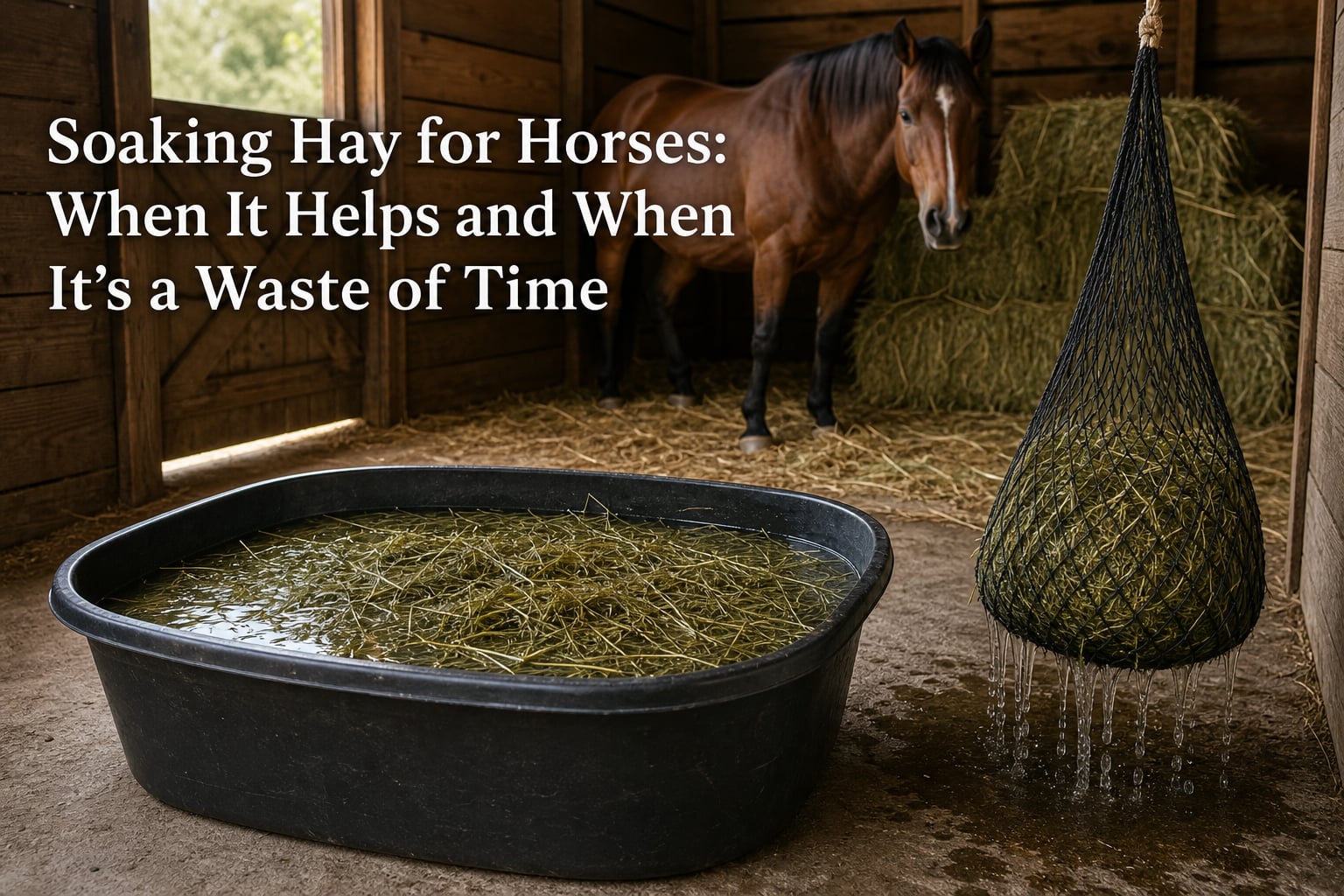
Soaking hay for horses is one of those barn chores that experienced owners swear by and others quietly skip. I tested soaking routines on three different hay types over the past year, and I’ve seen firsthand how the same practice can rescue one horse’s respiratory health while doing almost nothing useful for another.
The short answer: soaking hay helps a small, specific group of horses – metabolic, respiratory, and dental cases – and wastes time for the rest. Soaking leaches water-soluble carbohydrates, drops respirable dust levels, and adds moisture. It also strips minerals, grows bacteria if mishandled, and turns every feeding into a workout. Whether it belongs in your routine depends on the horse in front of you, the hay in your loft, and the climate on your property.
This guide walks through what soaking actually changes in hay, the conditions where it genuinely helps, the duration guidelines backed by equine research, and the situations where you are better off skipping the dunk tank. I have pulled from university extension sources, equine nutrition research, and barn-tested routines so you can decide based on evidence, not folklore.
Table of Contents
What Soaking Hay Actually Does to Your Horse’s Forage?
Soaking hay for horses works through a simple mechanism: submerge hay in water for a defined period, then drain and feed before bacterial growth takes off. During that soak, three measurable changes happen inside the hay.
First, water-soluble carbohydrates (WSC) leach out of the plant cells and into the soak water. WSC includes sugars and fructans, the compounds that drive insulin spikes in metabolic horses. Second, fine respirable particles, dust, mold spores, and bacterial fragments clump together with the added moisture and fall out of the hay or settle on the surface rather than getting inhaled. Third, the hay absorbs water and ends up softer and more aromatic.
These changes are not free. Soaking also pulls protein, potassium, phosphorus, and other water-soluble minerals out of the hay. University of Minnesota Extension notes that prolonged soaking can drop dry matter by 20% or more, which means the horse eats less actual forage by weight even when the wet flakes look the same. This trade-off is the central question behind every decision to soak.
Why Soak Hay for Horses: The Real Benefits
The benefits of soaking hay for horses fall into two buckets: lowering sugar for metabolic horses and lowering dust for respiratory horses. Both are well documented in peer-reviewed research.
Research published through Kentucky Equine Research shows soaking reduces respirable dust concentration by at least 88%. That single number is why veterinarians still recommend soaking for horses with recurrent airway obstruction (RAO), commonly called heaves. A horse struggling to breathe through inflamed airways cannot tolerate fine dust, and a quick soak can transform borderline hay into something those horses can tolerate.
For metabolic horses, the benefit is the nonstructural carbohydrate (NSC) drop. Studies cited by Tribute Equine Nutrition show that soaking hay for 30 minutes in warm water or 60 minutes in cold water reduces sugar content meaningfully. This matters for horses with equine metabolic syndrome (EMS), insulin resistance (IR), or a history of laminitis. Their bodies cannot process sudden sugar loads, and soaked hay offers a practical way to use available forage when low-NSC hay is not on hand.
Reduces respirable dust and mold spores by up to 90%
Lowers WSC and NSC levels by 5-30% depending on soak time
Adds water intake for horses that drink less in cold weather
Soften hay flakes for horses with dental issues
The catch is that these benefits are situational. A healthy, working quarter horse on clean, low-dust hay does not gain much from a daily soak, and the nutrient loss becomes a downside rather than a wash.
When Soaking Hay Helps: 5 Conditions That Genuinely Need It
I think of soaking hay for horses as a targeted medical intervention rather than a baseline practice. The following five conditions represent the cases where soaking earns its keep.
1. Horses With Laminitis or a History of Laminitis
Laminitis-prone horses sit at the top of the list. A laminitic episode is triggered by insulin spikes that ripple through the digital laminae, and every gram of extra sugar matters. Soaking hay to drop NSC content is one of the few at-home interventions that works. Owners in laminitis-focused Facebook groups consistently report that soaking combined with a low-NSC diet keeps their horses stable.
2. Insulin Resistance and Equine Metabolic Syndrome
EMS horses and IR horses share the same insulin dysregulation. When forage analysis shows NSC above 12% and you cannot source lower-NSC hay locally, soaking closes part of the gap. The University of Kentucky notes that soaking provides owners a tool to alter nutrient content when ideal hay is not feasible.
3. Recurrent Airway Obstruction (Heaves)
RAO horses have hyperreactive airways that clamp down at the smallest provocation. Dust, mold spores, and endotoxins in poor hay trigger flare-ups. Soaking drops respirable particle counts by an order of magnitude, which is what makes it a frontline recommendation from equine veterinarians.
4. Hyperkalemic Periodic Paralysis (HYPP)
HYPP horses inherit a sodium channel mutation that causes unpredictable paralytic episodes triggered by high potassium intake. Soaking pulls potassium out of hay along with other minerals, lowering the potassium load on these horses.
5. Senior Horses With Dental Issues
Older horses with worn or missing teeth struggle to chew long-stem forage. Soaked hay becomes soft and easier to manipulate, and the added moisture supports hydration. Many barns I have visited reserve soaked hay specifically for their senior residents.
How Long to Soak Hay for Horses: Time and Temperature Guidelines
The duration question is where most barns go wrong. Too short, and you do not get the NSC drop you need. Too long, and you start losing protein and growing bacteria.
The standard guideline used across equine nutrition sources is 30 minutes in warm water or 60 minutes in cold water. Tribute Equine Nutrition summarizes this clearly. The temperature adjustment matters because solubility increases with warmth. Kentucky Equine Research emphasizes that 30 minutes is the sweet spot for most goals.
Pushing past 60 minutes does not deliver much extra sugar reduction, but it does keep leaching minerals and creates a bacterial soup. I have talked with owners who soaked overnight for convenience, and most had to switch once they saw the bacterial growth and smell. Overnight soaking is a hard no unless the temperature is below freezing.
Time vs Nutrient Loss
15 minutes: modest dust reduction, minimal NSC change
30 minutes warm / 60 minutes cold: the recommended practical window
2-4 hours: additional mineral loss, bacterial growth begins
12+ hours: significant dry matter loss, real spoilage risk, discouraged
Bacterial growth is the unsung reason not to soak too long. Once wet hay sits at warm temperatures for hours, bacteria multiply rapidly. The horse ends up eating a fermented mat rather than hay, and digestive upset follows.
When Soaking Hay Is a Waste of Time
This is the section most articles skip, and it is the one I think matters most. Soaking hay for horses is a waste of time in several clear scenarios, and recognizing them saves you 20-30 minutes of daily labor.
If Your Horse Is Healthy and Your Hay Is Clean
An adult horse in good body condition, no respiratory signs, no metabolic disease, eating fresh, low-dust hay does not benefit from soaking. You are stripping nutrients without addressing a real problem. Skip the soak.
When You Have Already Tested and Have Low-NSC Hay
If you have invested in a hay analysis and your hay already runs under 10% NSC, soaking drops it further but does not meaningfully improve the horse’s intake. Save the labor.
When You Can Steam Instead
Steaming kills mold and bacteria without the nutrient loss, making it a better fit for horses whose only problem is respiratory irritation. Steaming does not reduce NSC much, so it does not replace soaking for metabolic cases, but it is the right call for many dust-only situations. A steamer pays for itself faster than you might think in dust-only barns.
When Soaking Creates More Problems Than It Solves
If your horse consistently refuses soaked hay, or if your climate makes winter soaking impractical (frozen hoses, freezing drain water, ice around the soaking area), forcing the routine creates stress without benefit. A horse that walks away from soaked flakes loses body condition. The routine needs to fit the barn, not the other way around.
Soaking vs Steaming vs Dry Hay: A Direct Comparison
Each method has a place. Here is how I think about them across the dimensions that matter to horse owners.
| Feature | Dry Hay | Soaked Hay | Steamed Hay |
|---|---|---|---|
| Dust reduction | None | Up to 90% | Up to 98% |
| NSC reduction | None | 5-30% | Minimal |
| Mineral loss | None | Moderate to high | Low |
| Bacterial growth risk | Low (if dry) | High if left too long | Low |
| Daily labor | None | 20-30 minutes | 15-25 minutes |
| Best for | Healthy horses on clean hay | Metabolic cases | Respiratory-only cases |
| Equipment cost | None | $20-$60 (bin) | $300-$1,500 (steamer) |
The takeaway: choose based on the problem. If the issue is sugar, soak. If the issue is dust only, steam. If neither, feed dry.
How to Soak Hay for Horses: A Step-by-Step Practical Guide
If you have decided soaking fits your situation, here is the routine I have used and watched work across multiple barns.
Step 1: Choose a Soaking Container
A clean plastic trash can or a dedicated Rubbermaid-style bin works well. Many owners who post on Reddit’s r/Horses community use a 32-gallon bin with a hay net inside for easy lift-out drainage. Avoid metal containers that can react with minerals in the water.
Step 2: Load the Hay
Use hay nets or loose flakes, but do not pack tightly. Loose hay soaks more evenly and drains faster.
Step 3: Submerge Completely in Clean Water
Cold tap water is fine for most cases. Warm water (around 100°F) speeds the sugar leach if you have a short window. Always use potable water – do not haul from a stagnant pond.
Step 4: Time the Soak
Set a timer. 30 minutes for warm water, 60 minutes for cold. Do not guess.
Step 5: Drain Thoroughly
Lift the hay out and let excess water drip away. A hay net hung over the bin works for this. Hold position until dripping slows or stops.
Step 6: Feed Immediately
Do not let soaked hay sit. Bacteria begin multiplying within hours at room temperature, and the hay loses its freshness and palatability. Feed right after draining.
Winter Soaking Tips
Winter soaking is where most barns struggle. Some practical tips from northern horse owners:
Use heated water buckets or warm tap water to extend the working window before freezing.
Soak in a sheltered, drained area where ice will not build up around the bin.
Wear waterproof gloves – hands freeze fast handling wet hay nets in single-digit weather.
Consider switching to steaming in deep winter if conditions make soaking unsafe.
The Hidden Costs: Nutrient Loss, Bacteria, and Palatability Issues
Most articles talk up the benefits and skim the costs. Here is the honest accounting I have put together after talking with owners and reading the research.
Nutrient Loss Beyond Sugar
Soaking leaches more than WSC. Crude protein can drop by 5-15% over an hour, and potassium, phosphorus, magnesium, and other macrominerals can fall significantly. HYPP horses benefit from the potassium drop, but healthy horses on a forage-only diet may end up short. Owners balancing soaked hay as the bulk of the diet should consider a mineral supplement or, better, a balanced ration balancer.
Bacterial Growth
Bacteria double on wet hay in the same way they do on any wet surface. Mad Barn’s analysis points out that prolonged soaking essentially starts a fermentation. If the temperature stays warm and the soak goes past two hours, you are feeding your horse a microbial ecosystem. Always feed wet hay promptly, and never reuse soak water.
Palatability Problems
Some horses refuse soaked hay outright, and others eat it but with less enthusiasm. One barn owner I spoke with described only 2 of 18 horses voluntarily preferring soaked flakes. The waterlogged texture and altered smell can put horses off, especially when first introduced. Gradual introduction helps – mix a few soaked flakes with dry hay at first, then shift ratios over a week or two.
Environmental Disposal
Soak water carries sugars, minerals, and bacteria. Dumping it on a small paddock creates high-nutrient runoff and can damage grass or contaminate streams. Several state extension services recommend spreading soak water over a wide vegetated area or sending it to a manure pile rather than down a drain.
Frequently Asked Questions
How long is too long to soak hay for horses?
Soaking hay for horses longer than 60 minutes in cold water or 30 minutes in warm water delivers diminishing returns on sugar reduction while increasing nutrient loss and bacterial growth. Soaking beyond 2-4 hours is generally discouraged because wet hay at warm temperatures grows bacteria fast and the hay can begin to ferment before feeding.
Is soaked hay better for horses?
Soaked hay is better for horses with specific conditions – laminitis, insulin resistance, equine metabolic syndrome, recurrent airway obstruction, hyperkalemic periodic paralysis (HYPP), or dental problems that make chewing difficult. For healthy horses on clean, low-dust hay, soaking adds labor and strips nutrients without meaningful benefit.
Does soaking hay make it more palatable?
Soaking hay often reduces palatability rather than improving it. The waterlogged texture and changed smell can put horses off, especially on first introduction. Many horse owners report needing a transition period of 7-14 days mixing soaked and dry flakes before horses accept soaked hay readily. Some horses never fully accept it.
What is the best way to soak hay for horses?
The best way to soak hay for horses is to submerge loose flakes or hay nets in a clean plastic bin filled with cold water for 60 minutes (or warm water for 30 minutes), drain thoroughly, and feed immediately. Use a dedicated Rubbermaid-style tub or trash can, never reuse soak water, and avoid soaking longer than the recommended window to limit bacterial growth.
Conclusion: Should You Soak Your Horse’s Hay?
Soaking hay for horses is a precise tool, not a default practice. It shines when a metabolic, respiratory, HYPP, or dental condition demands lower sugar, lower dust, or softer forage. It underperforms when the horse is healthy, the hay is already clean and low in NSC, or the climate makes the routine impractical.
Start with a hay analysis if you have not already. Know your baseline NSC before committing to a daily soak. Talk to your veterinarian about whether your horse’s specific condition warrants the labor. If the answer is yes, follow the 30-minute warm or 60-minute cold window, feed immediately after draining, and budget for the lost minerals with a balanced ration balancer.
If you decide soaking fits your barn, the routine becomes simple: a clean bin, a timer, and consistent feeding. If you decide it does not, look at steaming for dust-only cases or invest in better hay for metabolic cases. The goal is healthier horses and saner barn routines, and the right answer is the one that fits your operation in 2026.