
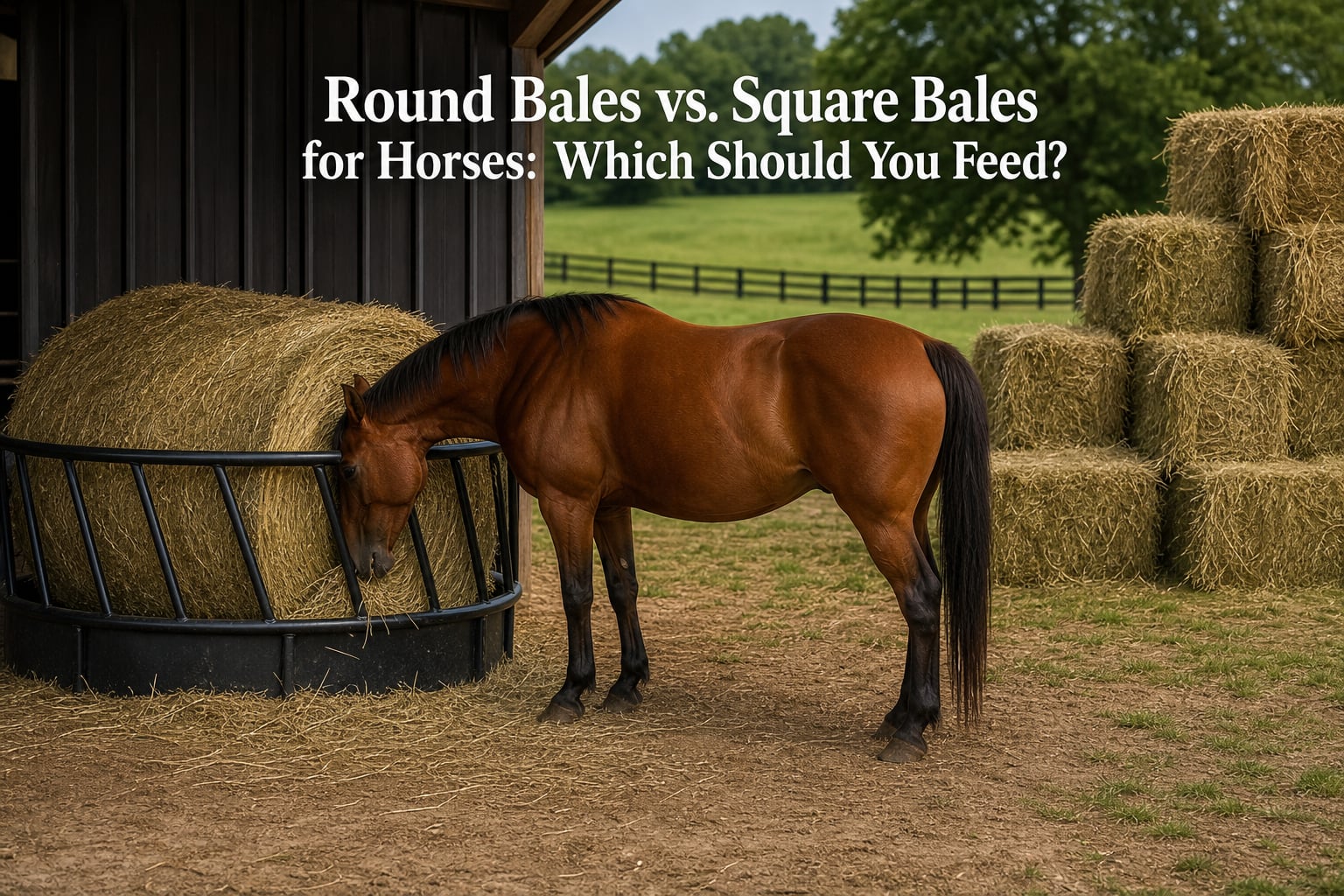
Round bales vs square bales for horses comes down to management, not one universally better bale. Small square bales give the strongest portion control and simple handling; round bales can suit a larger group when you have equipment, protected storage, and a feeder that limits hay waste.
Hay format affects daily labor, feed access, storage space, and how easily you can inspect what a horse is eating. The hay itself still has to be clean, properly cured, and appropriate for the individual horse.
I would make the choice only after checking three things: how many horses share the hay, whether a tractor or suitable loader is available, and how the bale will stay dry from delivery through feeding. Those practical details matter more than the bale’s shape.
Table of Contents
Round bales vs square bales for horses: square bales fit smaller, hands-on feeding programs, while round bales fit equipped group feeding.
For one to five horses, especially horses fed in stalls or on individualized rations, small square bales are usually the easier format to manage. A person can carry, open, inspect, and divide them without moving a very heavy bale.
For a larger group living outdoors, a round bale can reduce the frequency of hauling and opening hay. That benefit only holds when the bale can be moved safely and fed from equipment that keeps it off muddy ground and discourages trampling.
Choose small square bales when individual portions, frequent quality checks, and manual handling are central to the routine.
Choose round bales when several horses can share hay, a tractor is on hand, and a suitable feeder plus dry storage are part of the plan.
Choose hay quality first because neither rectangular bales nor cylindrical bales makes moldy, dusty, or poorly cured hay safe.
Quick answer: Square hay bales are often better for horse owners who need portion control and easy visual inspection. Round hay bales can be cost-effective in labor for a properly equipped large-herd setup, but they need more attention to feeder design, weather exposure, and spoilage.
Small square bales are rectangular packages that make daily horse-feed portions easier to control.
Small square bales are tied rectangular bales, commonly with twine. The supplied research places their typical weight around 40 to 60 pounds, though actual weight changes with bale size, density, forage type, and moisture level.
That manageable scale is the key advantage. You can pick up one bale, examine the interior as it opens, and allocate flakes to each horse according to the feeding plan.
Square bales make individual feeding and inspection more practical.
A stall-fed horse, a senior horse, or an easy keeper may need a measured amount of horse hay rather than free-choice access. Small square bales let you separate feed by horse and adjust the amount without exposing the entire supply at once.
This format also makes it easier to notice changes in color, smell, leafiness, dust, or moisture as each bale is opened. That inspection does not replace good purchasing and storage practices, but it gives you frequent opportunities to catch a problem.
Square bales require more repeated lifting, stacking, and opening.
The trade-off is labor. Moving many 40- to 60-pound bales into a barn, stacking them safely, and opening bales several times a day can add up quickly.
Loose flakes can also create hay waste when horses pull hay onto bedding or wet ground. A rack, slow feeder, or another feeder designed for the setting can help, but it must be checked for safe construction and appropriate openings.
Tip: When comparing small square bales, compare usable dry, clean hay by weight and condition rather than judging by bale count alone. Two bales that look alike can differ substantially in density and moisture.
Round bales are dense cylindrical bales designed for bulk feeding and machinery handling.
Round hay bales are cylindrical and commonly secured with net wrap or twine. The supplied research gives a broad typical weight of 1,000 to 1,500 pounds, which explains why safe handling equipment is normally part of a round-bale program.
The format works well for pasture-kept horses that can share a bale over time. It can keep forage available with fewer delivery trips to the field, but free-choice access is not automatically right for every horse.
Round bales reduce handling frequency when the setup supports them.
A round bale may be appealing when a herd needs continuous forage access and a person cannot hand out many small portions during the day. Horse owners in forum discussions often describe a round bale lasting two horses roughly two to three weeks, but that is an experience, not a feeding formula.
Intake varies with bale weight, forage quality, weather, waste, horse size, workload, and how many horses have access. I would use actual bale weights and the herd’s observed consumption to plan delivery intervals instead of relying on another farm’s timeline.
Round bales need a tractor, a suitable feeder, and active monitoring.
A bale weighing 1,000 pounds or more is not a manual-lifting task. Use equipment matched to the bale and ground conditions, keep people clear during transport, and place the bale before horses crowd the feeding area.
Feeding a round bale loose on the ground often leads to more contamination and trampling. A feeder can reduce that loss, yet the feeder must be stable, free of sharp edges, and compatible with the horses’ size, shoes, and social behavior.
Warning: Do not treat round-bale access as a substitute for checking each horse. Watch body condition, competition at the feeder, manure changes, and the condition of the hay as the bale is consumed.
Hay quality and dry storage matter more than bale shape for horse safety.
Round and square bales can both be excellent horse feed hay, and both can be unsafe if moisture and storage are mishandled. Proper curing before baling and protection from later moisture help preserve hay quality.
Look for hay that smells fresh rather than musty and does not show visible mold, unusual heat damage, or obvious wet areas. Dust, discoloration, and a sour or moldy odor are reasons to stop and assess the hay instead of feeding through the concern.
Mold risk rises when hay takes on moisture or sits against wet ground.
Forum discussions repeatedly flag round bales stored outside as a source of worry, especially when the outer layer is exposed to rain and ground moisture. A round bale’s wrap can help hold its shape, but it is not a promise that the bale will remain dry in poor storage conditions.
Square bales are also vulnerable when they are stored directly on concrete, soil, or a damp barn floor. Airflow underneath, a dry roof overhead, and space away from wall moisture protect either hay bale type.
Nutrition depends on forage and testing, not whether hay is round or square.
Bale shape does not establish nutritional value. Grass species, maturity at cutting, leaf retention, curing, weather, and storage all influence the forage a horse receives.
For horses with medical needs, major weight changes, or a restricted diet, work with the veterinarian or qualified equine nutrition professional and consider a forage analysis. This is especially helpful when a large round bale represents many days of one forage source.
Slow feeders and clean feeding areas can reduce waste from either bale type.
Hay waste is often a management problem rather than a fixed property of round or square bales. When horses can pull hay out, step on it, urinate on it, or drag it into mud, more forage becomes unusable.
Small square bales can be fed in a rack, net, or slow feeder that matches the horse and setting. Round bales need a feeder designed around the bale’s diameter and the herd’s behavior, with adequate room so less dominant horses are not shut out.
Slow feeders should match the horses, the hay, and the supervision level.
Forum users frequently point to nets as a way to make round-bale feeding more efficient. That may be true in a suitable system, but net openings, attachment points, shoeing status, and horse behavior deserve a careful safety review.
I would introduce any new feeder while someone can observe how every horse approaches it. A feeder that works for a quiet group may not work for a herd with resource guarding or playful horses.
Put the feeder on a well-drained surface where the herd can approach from more than one direction.
Remove loose strings, damaged twine, and discarded net-wrap material before horses reach it.
Check the feeding area daily for mud, trapped hay, broken parts, and signs that one horse is being excluded.
Keep enough feeding space and, when needed, more than one feeding point to reduce crowding.
Dry, raised, covered storage protects both round and square hay bales.
The best hay storage plan keeps precipitation off the bales, limits ground moisture, and allows the stack to stay dry. A roofed structure is preferable when available, especially for hay intended for horses with respiratory sensitivity.
Store small square bales on pallets or another raised base rather than directly on the floor. Stack them so they are stable and so you can inspect for leaks or heating, with room to move safely around the stack.
Round bales need a storage plan before delivery day.
Decide where the tractor can place the bale, where water will drain, and how the bale will be protected before ordering a load. Moving a round bale repeatedly after it arrives can be inconvenient and creates unnecessary handling risk.
Regional weather and local supply affect this decision. In a wet climate or season, a sheltered storage arrangement may matter more than the convenience of bulk delivery; in a dry region, outdoor management can still require raised placement and regular checks.
Warning: Never feed hay that is visibly moldy, smells musty, or has been badly wet and deteriorated. A questionable bale is not made acceptable by removing only the obvious outer section.
Bale equivalents should be calculated by weight because a bale count alone is unreliable.
There is no single accurate answer to how many square bales equal one round bale. A small square bale may weigh about 40 to 60 pounds, while the broad round-bale range in the research is 1,000 to 1,500 pounds.
Using those ranges, the arithmetic can span roughly 17 to 38 small square bales for one round bale. That wide spread is precisely why the actual weight of both bale types is more useful than a standard count.
Feed planning starts with pounds of hay offered and pounds left over.
Ask the grower or supplier for bale dimensions and, when available, a reliable weight. Then record how much hay enters the feeding area, how much remains clean and edible, and how quickly the group consumes it.
This approach shows the difference between intake and waste. It also gives you a better basis for deciding whether a round bale, small square bale, or a large rectangular bale fits the operation.
Small herds usually benefit from square bales, while large equipped herds may benefit from round bales.
For a small herd without tractor hay equipment, small square bales are usually the more manageable choice. They simplify moving hay by hand, sorting bales, and changing portions for an easy keeper, a hard keeper, or a horse on a special feeding plan.
For ten or more horses living outdoors, round bales may reduce routine handling if the horses can share safely and the farm has the needed equipment and feeder. The labor advantage can disappear if the bale spoils, gets trampled, or must be moved through unsafe footing.
Stall-fed horses usually need the control that small square bales provide.
Stall routines often call for separate amounts at separate times. Square hay bales make that division straightforward, and the open bale gives the caregiver regular chances to assess the forage.
Pasture-kept horses can use round bales when waste and competition are controlled.
A pasture group can benefit from a round bale during limited grass growth, cold weather, or periods when continuous forage access is appropriate. Provide a dry feeding area and observe whether every horse can eat without being chased away.
Are round or square bales better for horses? The better choice matches the horse, the herd, and the farm setup.
Square bales are generally better for small herds and individualized feeding because they support portion control, handling, and frequent inspection. Round bales can work well for an equipped outdoor herd, but only when dry storage, safe machinery use, a suitable feeder, and close monitoring limit waste and spoilage.
Frequently Asked Questions
Are round or square bales better for horses?
Small square bales are usually the easier choice for individualized portions, stall feeding, and manual handling. Round bales can suit larger outdoor groups when the owner has safe handling equipment, dry storage, and a feeder that limits waste and keeps each horse able to eat.
Should horses eat round bales?
Horses can eat round bales when the hay is clean, properly cured, dry, and managed in a safe feeding system. Use a suitable feeder, monitor access and body condition, and reject hay that is moldy, musty, badly wet, or otherwise questionable.
Is it cheaper to feed round bales or square bales?
A round bale may reduce routine handling for a large equipped herd, while small square bales can reduce waste and make individual portions easier to manage. Compare usable hay by actual weight, storage losses, feeder performance, labor, and equipment needs rather than bale shape alone.
How many square bales of hay is equal to one round bale?
There is no fixed conversion because bale weights vary. With small square bales around 40 to 60 pounds and round bales around 1,000 to 1,500 pounds, one round bale can represent roughly 17 to 38 small square bales; use actual weights for a reliable comparison.
Round bales vs square bales for horses work best when you choose the format your feeding system can manage well.
Use small square bales when you need precise portions, frequent inspection, and manual handling. Use round bales when a larger group, proper equipment, dry storage, and a well-managed feeder make bulk feeding practical.
Before committing, weigh a representative bale, inspect the hay, walk the storage and feeding route, and watch how every horse accesses forage. That short review turns a broad round-bales-versus-square-bales decision into a safer plan for your own horses.