
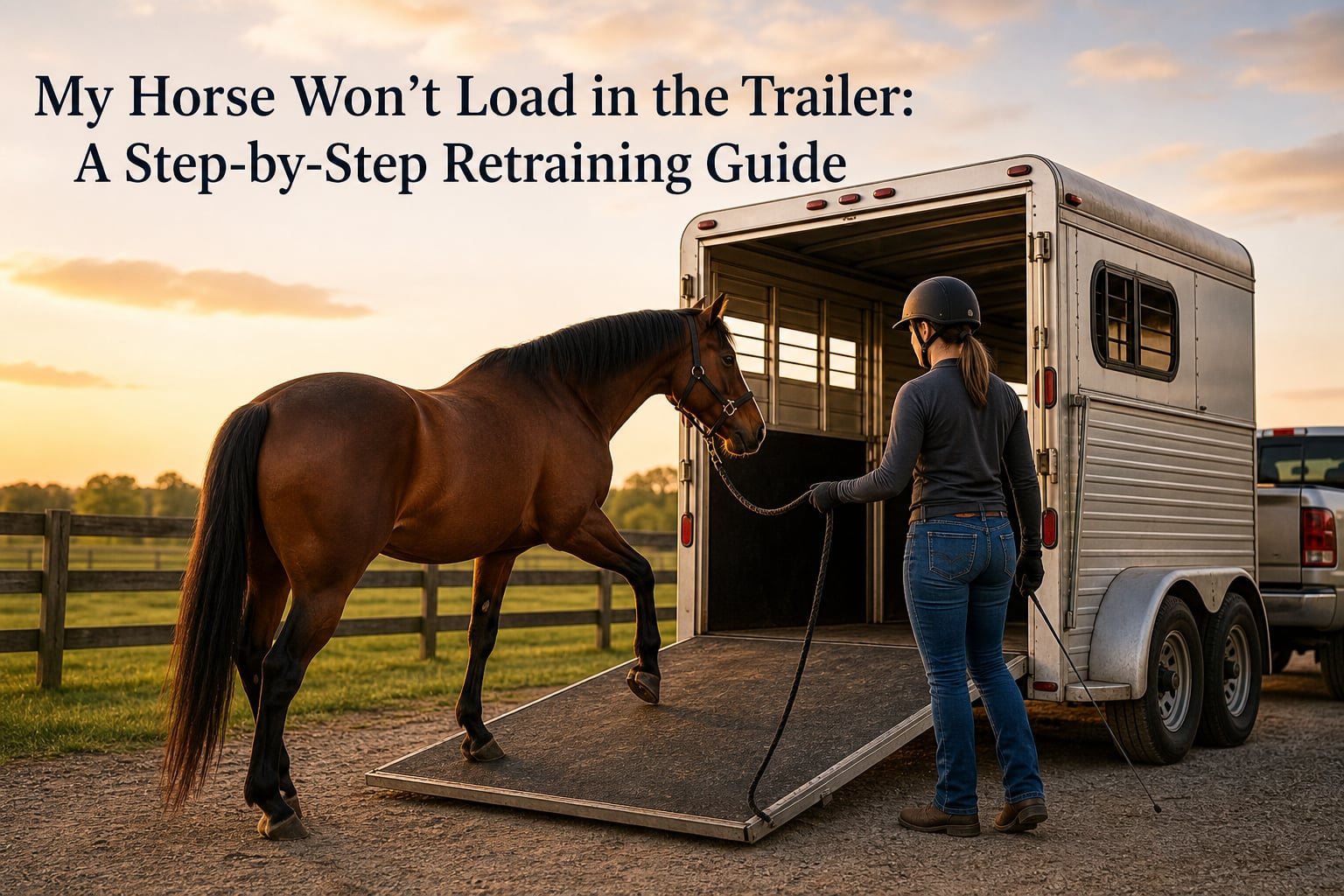
I have stood in a parking lot with a halter in one hand and a lunging whip in the other, watching a horse plant all four feet and refuse to step onto a trailer. If your horse won’t load in the trailer right now, I want you to know something first: this is one of the most common problems in the equestrian world, and it is solvable.
Trailer loading resistance is not a sign of a “bad horse.” It usually points to fear, confusion, or a bad past experience that needs patient retraining. In this guide, I will walk you through the exact process I have used, including the groundwork, the pressure and release timing, and the mistakes I have made so you do not repeat them. Most horses will load calmly within two to six weeks of consistent work.
We will cover why horses refuse to load, the essential groundwork you need first, a step-by-step retraining process, common mistakes that set you back, and the safety gear that protects both you and your horse. By the end, you will have a clear plan to follow on your next training day.
Table of Contents
Why Your Horse Won’t Load in the Trailer?
Understanding the root cause is the first step to fixing trailer loading problems. Horses refuse to load for predictable reasons, and identifying which one applies to your horse shapes your retraining plan.
Most horses that won’t load in the trailer fall into one of three categories: fearful, confused, or learned avoidance. A fearful horse has had a bad experience, like a slippery ramp, a hard stop while riding in the trailer, or a panic moment alone in the dark. A confused horse does not understand what you are asking, often because previous handlers gave mixed signals. A horse practicing learned avoidance has figured out that planting his feet, rearing, or pulling back makes the pressure go away.
Common reasons horses refuse to load
Loss of balance is a huge reason horses balk at the trailer threshold. The ramp or step forces them to shift weight backward and forward in an unfamiliar way, and many horses instinctively refuse. Tight spaces also trigger claustrophobic responses, especially in horses that have not been desensitized to enclosed areas.
Past negative experiences stick in a horse’s memory. One hard ride, one fall in the trailer, or one panicked handler can create a permanent association in the horse’s mind. Some horses have only ever been loaded by force, and they have learned to dread the sight of the trailer ramp.
Signs of fear versus stubbornness in horses
Distinguishing fear from stubbornness changes your approach. A fearful horse shows wide eyes, flared nostrils, a raised head, and trembling. He may snort, sweat, or try to back away before reaching the trailer. A horse showing learned avoidance or stubborn behavior plants his feet, pins his ears, and may swing his hindquarters toward you.
I have learned to watch the eye. A soft, worried eye with a tense body tells me I am dealing with fear, and I slow everything down. A hard eye with a planted stance tells me I am dealing with a horse that has trained his handler, and I need to be more consistent with pressure.
How past experiences shape loading behavior
Horses have excellent memory for situations that caused them stress. A horse that was loaded quickly and driven roughly once will remember the trailer for years. Each subsequent loading attempt can layer new fear on top of the old fear, especially if the handler becomes frustrated or uses force.
The good news is that horses also remember positive experiences. A horse that loads calmly five times in a row after retraining will start expecting calm loading. This is how we use repetition to overwrite old patterns.
Essential Groundwork Exercises Before Trailer Work
Groundwork is the foundation of every successful trailer loading session. If you skip groundwork and go straight to the trailer, you will fight the same battle every time. Spend two to three weeks on these exercises before attempting another loading.
The principle behind every groundwork exercise for trailer loading is simple: straight and forward. If your horse will move forward willingly and stay straight on a lead rope, you have already won half the trailer loading battle.
The 1-2-3 pressure rule explained
The 1-2-3 rule is a pressure-and-release timing system that gives your horse a clear window to respond. Step 1 is the lightest ask, often just a feel on the lead rope. Step 2 increases pressure with a rhythmic bump or a tap from a lunging whip behind the drive line. Step 3 is the strongest cue before correction.
The rule is this: if your horse responds to step 1, you must release immediately. If he responds to step 2, release. Never increase pressure when he is trying. The instant he tries, even slightly, the pressure disappears. This is how horses learn to look for the release rather than fight the pressure.
Teaching forward movement on the lead rope
Stand at your horse’s shoulder with the lead rope in your inside hand. Apply the 1-2-3 pressure rhythm toward his hindquarters. The instant he takes a step forward, drop the pressure completely and praise him.
Do this in a round pen or arena first, away from the trailer. You are building the forward response into muscle memory. Most horses learn this in three to five short sessions. Once your horse walks forward on a verbal cue or light pressure, you have the foundation for trailer work.
Working on straightness with fence exercises
Straightness prevents the crooked loading that causes many horses to refuse at the last second. Set up next to a solid fence or wall. Lead your horse along it, keeping his body parallel to the fence. Reward him for walking calmly in a straight line without drifting toward you or swinging his hindquarters away.
This fence exercise mimics the narrow channel of a trailer. When your horse can walk straight along a fence on a loose lead, transferring that behavior to the trailer ramp becomes much easier. I like to practice this on both sides so the horse is equally comfortable loading from either direction.
Step-by-Step Retraining Process for Trailer Loading
This is the heart of the retraining plan. Follow these steps in order, and only move to the next step when your horse is calm and willing at the current step. Rushing the steps is the number one reason retraining fails.
Each session should last 15 to 30 minutes. End on a good note, even if that means repeating step 1 for the entire session. Consistency over weeks matters more than intensity in one day.
Step 1: Desensitize your horse to the trailer
Park the trailer in a familiar area where your horse lives, not at a show or event. Let your horse graze near the trailer with the ramp down for several days before any loading attempt. Bring his feed bucket near the trailer. Lead him past it on your regular walks. You are building the association that the trailer is part of his normal environment.
Once your horse is calm near the trailer, start touching the ramp with your foot while he watches. Reward calm behavior with a scratch on the withers. The goal here is curiosity, not fear.
Step 2: Approach and retreat training
Lead your horse toward the trailer and stop three feet away. If he stands calmly, praise him and walk him away. Repeat this ten times, gradually closing the gap by one foot each repetition. This is the approach-and-retreat technique, and it builds confidence without forcing contact.
Most horses will reach the ramp by the end of the second session at this exercise. The key is that the retreat is the reward. Your horse learns that standing near the trailer calmly means he gets to walk away, which lowers his anxiety about the trailer itself.
Step 3: Loading one foot, then two feet
When your horse is calm at the ramp, ask him to put one foot on the ramp using your forward cue. The instant that foot touches the ramp, release all pressure and praise. Walk him away. Repeat until he offers one foot without hesitation.
Then ask for two feet on the ramp. Same pattern: ask, release the instant he complies, praise, walk away. Do not ask for more until he is volunteering two feet consistently. This stage often takes three to five sessions for a horse that previously refused to load.
Step 4: Full loading with positive reinforcement
Once two feet are easy, ask for the full load. Apply forward pressure with the lead rope. The moment your horse steps onto the trailer, drop the pressure and offer a reward: a withers scratch, a verbal “good boy,” or a small food treat if that fits your training style.
Many horse owners have success feeding their horse a small meal inside the trailer after loading. This creates a positive association that speeds up future loading attempts. Just be sure your trailer is safe for eating, with no loose dividers or sharp edges.
Step 5: Standing quietly inside the trailer
The final step is teaching your horse to stand calmly once loaded. Close the divider gently, secure the butt bar or chain, and stand at the front of the trailer talking softly. Reward any calm standing. Open the divider and back him out slowly before he gets restless.
Practice this step several times without driving anywhere. Your horse needs to learn that loading does not automatically mean a stressful trip. Short, positive loading-only sessions build the confidence that makes actual travel calm.
Common Mistakes to Avoid When Loading a Stubborn Horse
Most loading problems are made worse by well-meaning handlers. Knowing what not to do is just as important as knowing what to do.
The biggest mistake I see is handlers escalating pressure without releasing at the right moment. They pull harder, swing the whip, or raise their voice, and the horse digs in deeper. Pressure without release teaches a horse to fight harder.
Why circling makes the problem worse
Circling a refusing horse to “tire him out” is one of the most common recommendations on the internet, and it usually backfires. Circling increases the horse’s anxiety, depletes his energy before loading, and teaches him that the trailer is a punishment waiting at the end of work.
If you need to move your horse’s feet to reset his thinking, a few changes of direction in the round pen works better. Save his energy for the trailer itself.
The danger of dragging or pulling
Never wrap a lead rope around your hand, your arm, or any part of your body when loading a resistant horse. If he bolts backward, you can be dragged, thrown, or seriously injured. This is one of the most common ways handlers get hurt during loading attempts.
Use a longer lead rope so you can let slack run if the horse pulls back. Better yet, use a rope halter with a 12 to 15 foot lead so you have distance and control at the same time.
Using punishment and why it backfires
Striking a horse that refuses to load, yelling, or using mechanical aids like a chain shank over the nose may force a horse onto the trailer, but it also confirms every fear he had about loading. The next time you bring the trailer out, his resistance will be stronger.
Punishment creates a horse that loads fast out of fear, then panics during travel, then refuses even harder next time. Pressure and release, applied correctly, produces a horse that loads calmly because he has learned the trailer is safe.
Safety Tips and Equipment for Trailer Loading
Safety is not optional when retraining a horse to load. The right equipment and a safe environment protect both you and your horse during what can be a stressful process.
I have seen too many handlers injured by lead rope burns, kicks, and being crushed against trailer dividers. Most of these injuries are preventable with the right setup.
Choosing the right halter and lead rope
A rope halter with knots at the pressure points gives clearer communication than a flat nylon halter. The knots apply focused pressure that the horse can feel and learn to release from. Pair it with a 12 to 15 foot cotton or polyester lead rope for handling distance.
Avoid lead ropes with heavy clips or chains during retraining. The extra weight flutters against the horse’s legs and creates a new distraction at the worst possible moment.
Protective gear for loading sessions
Always wear closed-toe boots or shoes when loading a horse. I wear a helmet for any loading session with a horse that has a history of rearing or striking. Gloves protect your hands from rope burns if the horse pulls suddenly.
Consider shipping boots or standing wraps on your horse for the actual loading practice to prevent scrapes if he slips on the ramp. Bell boots protect the front heels from stepping on the edge.
Setting up a safe loading area
Choose a flat, well-lit area free of debris and other horses. Park the trailer straight rather than at an angle so the horse cannot escape sideways if he backs out. Make sure the ramp has non-slip footing, and never load in mud or ice.
Have an escape route planned for yourself. If the horse bolts backward, you need to step aside, not be cornered between him and the trailer. Practicing your own footwork before bringing the horse to the trailer is a smart habit.
When to Call a Professional Horse Trainer
Some loading problems go beyond what an owner should handle alone. Knowing your limits keeps both you and your horse safe.
If your horse has injured himself or someone else during loading, the problem has escalated beyond a simple training exercise. A professional trainer with trailer loading experience can assess the specific behavior and create a custom retraining plan.
Red flags that require expert help
Severe behaviors like rearing, striking, or throwing himself down at the trailer are serious safety concerns. A horse that has loaded for years and now refuses violently may have a medical issue, like a back problem or vision loss, that a vet should rule out first.
Horses with deep trauma, such as those rescued from neglect or involved in trailer accidents, often need weeks of professional handling before an owner should attempt loading. This is not a failure on your part. It is good judgment.
What a professional retraining program looks like
A good trainer will start with groundwork assessment, then progress through desensitization, approach and retreat, and full loading over multiple sessions. They will communicate clearly with you about what to practice between sessions and when to back off.
Expect a professional program to take two to eight weeks, depending on the horse’s history. The cost is far less than a vet bill from a loading injury, and the result is a horse you can confidently take anywhere.
Frequently Asked Questions About Horses That Won’t Load
How do I get a stubborn horse to load in a trailer?
Start with groundwork to teach forward movement and straightness, then desensitize your horse to the trailer by parking it in his normal environment. Use the 1-2-3 pressure rule, asking once lightly, bumping rhythmically on the second cue, and applying stronger pressure only on the third cue. Release the instant your horse tries, even slightly. Approach the trailer gradually using retreat as a reward, ask for one foot on the ramp first, then two feet, then full loading over multiple short sessions.
Why is my horse refusing to load in the trailer?
Most horses refuse to load because of fear, confusion, or learned avoidance. Fear often comes from a past bad experience like a slippery ramp, rough ride, or panic moment in the trailer. Confusion happens when handlers give mixed signals or rush the horse. Learned avoidance develops when the horse figured out that planting his feet, rearing, or pulling back makes the pressure stop. Loss of balance at the ramp and tight enclosed spaces also trigger balking in many horses.
What is the 1 2 3 rule for horses?
The 1-2-3 rule is a pressure-and-release timing system for horse training. Step 1 is the lightest cue, usually just a feel on the lead rope. Step 2 is a rhythmic bump or tap behind the drive line. Step 3 is the strongest cue before correction. The rule is that you release pressure the instant the horse responds to any step. This teaches horses to look for the release and try on the lightest cue rather than fight the strongest pressure.
Why does a horse suddenly not travel well in a trailer?
A horse that suddenly stops traveling well may have a medical issue like a back problem, vision loss, or ulcers that worsen under stress. It may also be a training breakdown, where inconsistent handling has eroded the horse’s confidence in the trailer. New stressors like a different truck, a louder road, or a recent bad ride can create new fear associations. Always have a veterinarian rule out pain before assuming the problem is purely behavioral.
Final Thoughts on Retraining a Horse That Won’t Load
If your horse won’t load in the trailer, the problem is solvable with the right approach. Start with groundwork, build forward and straight responses, then desensitize your horse to the trailer itself before asking for a full load. Use the 1-2-3 pressure rule and release at the right moment. Avoid circling, dragging, and punishment, which all make the problem worse.
Most horses load calmly within two to six weeks of consistent, patient retraining. If your horse shows severe behaviors or you feel unsafe, call a professional trainer. Your safety and your horse’s trust are worth more than saving a few training sessions. Pick up your halter, lead rope, and patience, and start with groundwork on your next training day.