
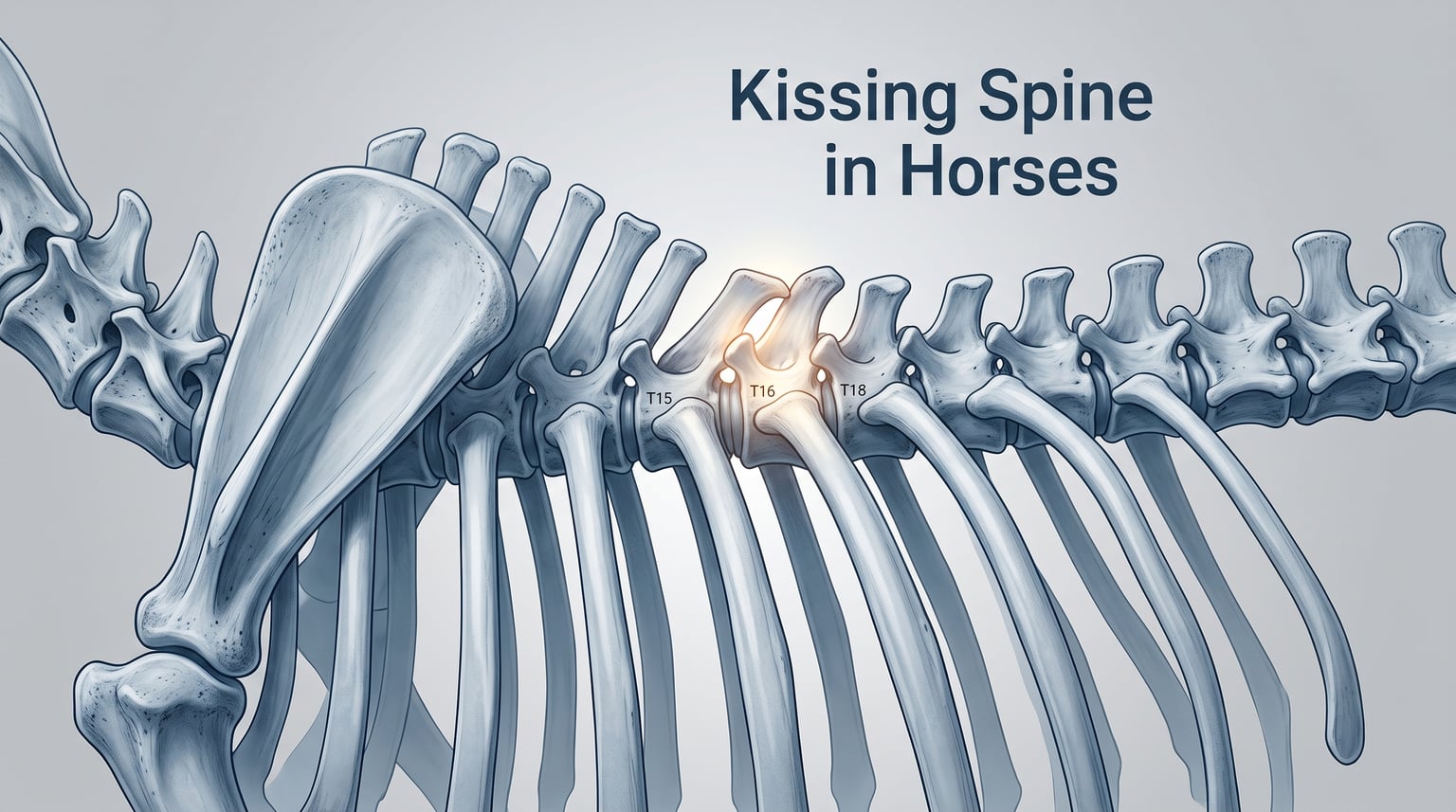
When my mare started refusing fences last spring, I assumed it was attitude. Within three weeks, the vet’s X-rays told a different story. The dorsal spinous processes at T15 and T16 were touching, a classic case of kissing spine in horses, and the bony contact was producing real pain every time she rounded her back over a jump.
Kissing spine, technically called overriding dorsal spinous processes (ORDSP or ORDSP), is one of the most common causes of primary back pain in riding horses. It happens when the bony projections along the top of the vertebrae grow close enough to touch or rub. The good news is that modern veterinary medicine gives owners real options. Most horses return to work after the right combination of treatment, rehabilitation, and management.
This guide covers everything I wish I had known at the start: what kissing spine actually is, why some horses develop it, the warning signs to watch for, how vets confirm the diagnosis, and the full range of treatment choices from injections to surgery. We will also walk through rehabilitation timelines, real prognosis data, and the questions owners ask me most often.
Table of Contents
What Is Kissing Spine in Horses?
Kissing spine is a condition in which the dorsal spinous processes (DSPs) of adjacent vertebrae along a horse’s back come into painful contact. Under normal anatomy, these bony peaks sit parallel with a small gap of soft tissue between them. When that gap narrows or disappears, the tips of the DSPs collide, rub, or overlap, producing inflammation, bone remodeling, and chronic discomfort.
The condition most often affects the thoracic vertebrae between T13 and T18, where the orientation of the spinous processes angles slightly backward and the saddle sits directly overhead. T15 and T16 are the most commonly implicated sites. Lumbar vertebrae can occasionally be involved, but thoracic kissing spine accounts for the majority of clinical cases that vets diagnose in sport and pleasure horses.
Why the Term “Kissing Spine”?
The phrase comes from the visual on radiographs, where the tips of two adjacent spinous processes appear to “kiss” each other. Vets also use the older terms “Baastrup’s disease” or simply “dorsal spinous process impingement.” All three names describe the same anatomical problem.
How Common Is It?
Recent radiographic studies have shown something that surprised me when I first read it. The bony changes associated with kissing spine appear in untrained yearlings at almost the same rate as in mature riding horses. That finding suggests kissing spine has a strong developmental or conformational component rather than being purely a wear-and-tear injury from work.
Despite that prevalence, not every horse with radiographic changes shows clinical pain. Many horses with mild DSP overlap move and perform normally their entire lives. The condition only becomes a problem when the bony contact produces inflammation, muscle guarding, or behavioral resistance.
Causes and Risk Factors of Kissing Spine
There is no single cause of kissing spine. Instead, the condition develops from a combination of conformation, development, and mechanical load. Understanding which factors apply to your horse helps you and your vet build the right management plan.
Breeds Most Often Affected
Thoroughbreds, Warmbloods, and Quarter Horses account for the majority of diagnosed cases. Their sport use, saddle placement, and typical conformation all contribute.
Thoroughbreds: Often diagnosed as off-track horses start second careers. Long, sometimes lordotic backs and a history of race training both play a role.
Warmbloods: Tall frames with long spinous processes, popular in dressage and show jumping where collection and round frames increase DSP contact.
Quarter Horses: Frequently used in reining and cutting, disciplines that demand significant lumbar flexion and roll-back maneuvers.
Stock-type and Pony breeds: Less commonly affected, though conformation still matters.
Age and Developmental Factors
Kissing spine can show up in horses as young as two, especially when X-rays are taken for pre-purchase or performance reasons. The condition tends to worsen with cumulative work, particularly under saddle with poorly fitted equipment.
Horses under five years old are overrepresented in clinical case loads. Young horses with developing top-line musculature and immature bone may struggle to stabilize the vertebrae under the rider’s weight, which increases mechanical stress on the DSPs.
Conformation and Biomechanics
Long-backed horses, those with sway or roach conformation, and horses with weak core musculature are at higher risk. The biomechanics of a hollow or unstable back narrow the interspinous spaces, which sets up the contact pattern that defines kissing spine.
Saddle Fit and Riding Factors
A poorly fitted saddle is one of the most common aggravators I see in practice. Saddles that bridge (do not contact the middle of the back), perch on the loins, or sit too wide all concentrate pressure on the affected DSPs. Repetitive work in a round frame without sufficient conditioning can also intensify contact.
Signs and Symptoms of Kissing Spine
The first signs of kissing spine in horses are often behavioral. Many affected horses never become obviously lame. Instead, they tell us they are uncomfortable through resistance, evasion, and changes in performance. Spotting these early can save months of frustration.
Behavioral and Performance Red Flags
Common warning signs include:
Girthiness or pinned ears when the girth is tightened
Bucking, especially after jumping or during transitions
Refusing fences or rushing jumps
Resistance to leg aids, especially behind
Cold-backed behavior or dipping away when mounted
Cross-cantering, disunited canter, or difficulty striking off on the correct lead
Generalized stiffness, particularly in the canter
Reluctance to collect or work in a frame
Physical Signs to Look For
On physical exam, horses with kissing spine often show epaxial muscle wasting along the back, hollow topline, and pain on palpation of the affected DSPs. They may drop away from pressure over the saddle region or twitch the skin in response to a fingertip press. Some horses hold their tail rigidly or guard one side of their back more than the other.
What Owners Notice First
When I asked fellow owners about their first clue, the most common answers were “he stopped wanting to go forward,” “she started throwing her head up when I asked for canter,” and “he was fine at the walk but ugly under saddle.” A sudden change in attitude under saddle is almost always worth investigating, especially if saddle fit has been recently changed or the horse is in heavier work than usual.
How Veterinarians Diagnose Kissing Spine?
Diagnosing kissing spine takes more than one tool. Vets combine a thorough clinical exam, diagnostic imaging, and often a nerve block to confirm that the DSP changes are actually causing the pain. Skipping any of those steps risks misdiagnosis.
Clinical Examination
The first step is a full lameness and back evaluation. Your vet will watch the horse move in hand and on the lunge, palpate the spine and surrounding musculature, and apply pressure to specific DSPs. They are looking for pain responses, muscle atrophy, asymmetry, and reduced range of motion in the back and pelvis.
Diagnostic Imaging
Imaging confirms the diagnosis. Common modalities include:
Lateral radiographs (X-rays): The most widely available tool. They show the interspinous spaces clearly and reveal bone remodeling, sclerosis, and overlap.
Bone scan (scintigraphy): Highlights areas of active bone remodeling. Useful when X-rays are ambiguous or to identify active painful sites.
Thermography: Detects heat patterns from inflammation over the back. It is a useful adjunct, particularly for screening.
Ultrasound: Shows the interspinous ligaments and soft tissue involvement, including impingement-related damage.
Diagnostic Nerve Blocks
The gold standard for confirming clinical relevance is a positive response to an interspinous nerve block. The vet injects local anesthetic between the affected DSPs. If the horse’s pain and resistance resolve, the diagnosis is confirmed and a targeted treatment plan can follow.
Treatment Options for Kissing Spine
Treatment for kissing spine falls into two categories: medical management and surgical intervention. Most horses start with medical options, and many improve enough to return to full work without surgery. Surgical treatment is reserved for horses who do not respond to conservative care.
Medical Management
Conservative treatment aims to reduce inflammation, relieve pain, and rebuild core strength so the horse can support itself without DSP contact.
NSAIDs: Short courses of phenylbutazone or similar anti-inflammatories reduce acute pain and let the horse start rehabilitation.
Corticosteroid injections: Interspinous injections of cortisone directly into the affected spaces reduce localized inflammation and can produce relief lasting weeks to months.
Extracorporeal shockwave therapy (ESWT): Pulsed sound waves stimulate healing and reduce pain in affected soft tissue and bone surfaces.
Mesotherapy: A series of small intradermal injections along the back that interrupt pain signals from the spine.
Muscle relaxants: Used short term to break muscle spasm cycles and allow better movement.
Corrective shoeing and saddle refit: Often essential. A balanced hoof and a properly fitted saddle remove two of the biggest aggravators.
Surgical Treatment
When medical management is not enough, two main surgical options exist.
Interspinous ligament desmotomy (ISLD): A minimally invasive procedure in which the interspinous ligaments are cut to create space between the DSPs. Performed under standing sedation with endoscopic guidance, ISLD has a reported success rate of around 70 to 95 percent for return to previous work, depending on the study.
Partial resection of the dorsal spinous processes: A more invasive surgery in which the tips of the affected DSPs are removed under general anesthesia. Reserved for severe cases with significant bony remodeling.
Treatment Cost Considerations
Owners often ask what surgery costs. The honest answer is that pricing varies widely by region, hospital, and case complexity. As a general range that the American Association of Equine Practitioners and several teaching hospitals have referenced in client materials, ISLD typically falls in the low-to-mid four figures, while partial resection surgeries with general anesthesia and hospital stay run considerably higher. Diagnostic imaging, repeated injections, and shockwave sessions add to total cost as well. Always request a written estimate from your veterinary team.
Choosing the Right Path
The decision between medical and surgical treatment depends on severity, financial considerations, and the horse’s intended use. Mild cases often respond to injections and rehab alone. Severe cases with extensive bone remodeling and unrelenting pain typically need surgery to give the horse a chance at a comfortable working life.
Rehabilitation and Physical Therapy
Treatment alone rarely solves kissing spine. Long-term success depends on rebuilding core strength, stabilizing the back, and changing the biomechanical conditions that created the problem in the first place. Rehabilitation is where most of the actual recovery happens.
Core Strengthening Exercises
The goal is to build the epaxial and abdominal muscles so they hold the spine in a stable, slightly rounded position during work. Common rehab tools and exercises include:
Pessoa lunging system: Encourages the horse to engage the core and lift the back through gentle pressure on the quarters and poll.
Cavaletti poles: Walking and trotting over raised poles activates core and hindquarter muscles.
Hill work: Slow walking up and down slopes strengthens topline without loading the spine heavily.
Ground poles and raised trot poles: Encourage the horse to lift and engage the back.
Hydrotherapy and Aqua Treadmill
For horses with significant pain, an aqua treadmill is one of my favorite rehab tools. The water supports body weight, reduces concussion on the DSPs, and forces the horse to engage core muscles to stay balanced. Many centers offer 4 to 8 week programs of regular aqua treadmill sessions.
Return-to-Work Timeline
A typical timeline after medical management or ISLD surgery looks like this:
Weeks 1 to 2: Stall rest with hand walking, short turnout if pain allows.
Weeks 3 to 6: Increase hand walking, introduce Pessoa work or in-hand hill walking.
Weeks 6 to 10: Add longe work with rehabilitation equipment.
Weeks 10 to 16: Begin light riding, focusing on relaxed forward motion.
Months 4 to 6: Progressive return to full work, including discipline-specific schooling.
Every horse heals at its own pace. Pushing the timeline almost always sets back recovery.
Prognosis and Long-Term Outlook
The prognosis for kissing spine is generally good when the condition is properly diagnosed and treated. Many horses return to their previous level of work, and the majority are at least pasture-sound even in less successful cases.
Success Rates by Treatment
Reported outcomes vary by study, but a fair summary from published research and case series is:
Medical management (injections, shockwave, rehab): 60 to 80 percent of horses return to intended use, with many competing successfully.
ISLD surgery: 70 to 95 percent return to previous or higher level of work, particularly in horses with clear localized pain.
Partial resection surgery: 60 to 85 percent return to work, with longer recovery and higher complication risk.
When Retirement Is the Best Answer
Some horses do not respond to treatment despite the best efforts of the owner and veterinary team. For these horses, full retirement to pasture can be the kindest option. Pain-free turnout is a perfectly valid outcome, and many owners find that their “retired” horse enjoys light hacking or therapy work once pressure is removed from the spine.
Long-Term Management
Even after successful treatment, kissing spine requires ongoing management. Saddle fit should be checked at least annually. Core-strengthening work should remain part of the weekly routine. Owners who commit to those habits report the best long-term soundness in their horses.
Frequently Asked Questions
Can a horse recover from kissing spine?
Yes. Most horses recover well after appropriate treatment and rehabilitation. Medical management such as corticosteroid injections combined with core strengthening returns 60 to 80 percent of horses to their previous work. Surgical options like interspinous ligament desmotomy (ISLD) push success rates higher, with most studies reporting 70 to 95 percent of horses returning to full work within six months.
What are the first signs of kissing spine in horses?
The earliest signs are usually behavioral rather than lameness. Watch for girthiness, bucking or rushing under saddle, reluctance to go forward, hollow-backed posture, sudden refusals at fences, cross-cantering, and pain response when the affected area of the back is pressed. A previously willing horse that starts resisting work is one of the most common first clues owners report.
Is it okay to ride a horse with kissing spine?
It depends on the severity. Mildly affected horses can usually continue light work once treatment begins and core strength improves. Severely affected horses need rest and targeted treatment before any ridden work. Riding a horse with active, untreated kissing spine pain is neither safe nor ethical. Always work with your vet to design a realistic exercise plan.
At what age does a horse develop kissing spine?
Kissing spine can be identified in horses as young as two. Recent studies show that yearlings have DSP changes at rates similar to older horses, suggesting a developmental component. Clinical cases are most often diagnosed between four and ten years of age, when horses are in active training and the condition starts producing performance problems.
Is kissing spine genetic?
Research into a hereditary component is ongoing. Studies have shown that certain conformational traits linked to kissing spine, such as long backs and specific DSP angles, do run in families. While no single gene has been identified, breeding from horses with severe kissing spine is generally discouraged, particularly in stallions whose offspring may inherit similar conformation.
Final Thoughts
Kissing spine in horses is no longer the career-ending diagnosis it once was. Modern imaging confirms the diagnosis accurately. Medical and surgical treatments address the underlying pain. And structured rehabilitation rebuilds the core stability that protects the spine long term.
If your horse is showing back pain or performance changes, do not wait. Talk to your vet about a full workup including radiographs of the dorsal spinous processes. With early diagnosis and a thoughtful treatment plan, the vast majority of horses with kissing spine return to comfortable, productive work.
For more educational guides on common equine health and performance topics, keep reading Hay Net. We cover the conditions, management choices, and welfare questions that matter to every horse owner, in 2026 and beyond.