
If you own or care for horses, equine gastric ulcers are one condition you need to understand deeply — not because they are rare, but because they are remarkably common and easy to miss. Research consistently shows that gastric ulcers affect between 50 and 90 percent of all horses, with rates climbing even higher in performance and racehorses.
The tricky part is that many horses with painful ulcers show only subtle behavioral changes, or sometimes no outward signs at all. A horse that seems “a bit off” under saddle or has lost interest in food could be dealing with significant stomach damage.
In this guide, we cover everything you need to know about equine gastric ulcer syndrome — what causes it, how to recognize the signs, how diagnosis works, treatment options (including the cost concerns that horse owners frequently raise), and the most effective prevention strategies.
Table of Contents
What Are Equine Gastric Ulcers?
Equine gastric ulcer syndrome, commonly abbreviated as EGUS, is the umbrella term used to describe erosions, ulcerations, and lesions that develop on the lining of a horse’s stomach. The condition was formally defined in 1999 and has since become one of the most researched topics in equine veterinary medicine.
Unlike humans, horses produce stomach acid continuously — roughly 1.5 liters per hour — regardless of whether they are eating. In the wild, horses graze for 16 to 18 hours a day, which means food is nearly always present to buffer that acid. When modern management practices reduce grazing time or increase grain feeding, that acid goes to work on an empty or semi-empty stomach with damaging results.
The horse’s stomach is divided into two distinct regions separated by a distinct border called the margo plicatus. Understanding this anatomy is key to understanding the two different types of ulcers that can develop.
Equine Squamous Gastric Disease (ESGD)
The upper portion of the horse’s stomach is lined with squamous mucosa — the same type of tissue found in the esophagus. This region has no protective mucus layer and no ability to neutralize acid. It is particularly vulnerable when acidic stomach contents splash upward during exercise, eating concentrated feed, or simply when the stomach is empty.
Squamous ulcers (ESGD) are the most commonly diagnosed type and are strongly associated with management factors like high-grain diets, intermittent feeding, and intense exercise. Studies in racehorses find ESGD in roughly 80 to 90 percent of animals in active training.
Equine Glandular Gastric Disease (EGGD)
The lower glandular region of the stomach does produce its own protective mucus and bicarbonate. Despite this, ulcers in the glandular region do occur, and they tend to be more resistant to treatment than squamous ulcers.
Glandular disease (EGGD) is less well understood, but stress, NSAID use, and the presence of certain bacteria are believed to compromise the protective barrier. These ulcers often require a different treatment approach, which is one reason why veterinary diagnosis — rather than guesswork — matters so much.
Both types can occur simultaneously in the same horse, and their presence does not always correlate with the severity of outward symptoms.
Causes and Risk Factors for Equine Gastric Ulcers
Gastric ulcers in horses develop when something tips the balance between acid production and the stomach’s ability to protect itself. There is rarely a single cause — usually several risk factors combine to create conditions where ulcers can form.
The following are the most well-established risk factors, drawn from peer-reviewed equine research and consistent across veterinary sources including UC Davis and the Merck Veterinary Manual:
- Intermittent or infrequent feeding: When horses go without food for more than four to six hours, stomach acid accumulates with no feed to buffer it. This is one of the most significant contributors to ulcer development.
- High-grain, low-forage diets: Grains are rapidly digested and do not buffer acid the way long-stem forage does. Horses fed large grain meals with limited hay access are at substantially higher risk.
- Intense exercise and training: During strenuous exercise, the stomach contracts and acid splashes into the non-glandular squamous region. Racing, showjumping, and endurance competitions are all linked to elevated ulcer prevalence.
- Stall confinement: Horses that spend most of their time confined to a stall without access to continuous forage show higher ulcer rates than pastured horses. Confinement also limits natural foraging behavior that helps keep acid buffered.
- NSAID use: Non-steroidal anti-inflammatory drugs — particularly phenylbutazone (bute) — reduce the production of protective prostaglandins in the stomach lining. Regular NSAID use increases both squamous and glandular ulcer risk.
- Transport and travel stress: Horses trailered or transported for long distances consistently show elevated stress hormones and increased ulcer incidence. The combination of stress, no food access during travel, and altered routine is particularly damaging.
- Competition and performance schedules: The irregular schedules, stress, and dietary changes that accompany show or race seasons create prime conditions for gastric ulcers to develop.
- Foals: Young foals are another high-risk group. Their developing digestive systems and natural suckling patterns can be disrupted, leading to gastric ulcer incidence of up to 50 percent in the first few months of life.
Horses on pasture with free access to quality forage and minimal stress have the lowest ulcer rates — sometimes under 10 percent. The contrast with performance horses highlights how much management practices influence gastric health.
Signs and Symptoms of Gastric Ulcers in Horses
One of the most challenging aspects of EGUS is that the clinical signs vary enormously between horses. Some horses with severe ulcers appear almost entirely normal. Others show dramatic symptoms with relatively minor ulceration on scope.
I hear this regularly from horse owners in forums: “My horse just seemed off — not quite right under saddle but nothing I could point to.” That vague, nagging sense that something is wrong is often the only warning sign. This is why awareness of the full range of potential symptoms matters so much.
The most common signs of gastric ulcers in horses include:
- Poor appetite or reluctance to finish grain: A horse that suddenly loses enthusiasm for feed — especially grain — is often experiencing gastric discomfort. The act of eating increases acid production and can cause pain.
- Weight loss and poor body condition: Chronic gastric pain reduces feed intake over time, leading to noticeable weight loss and a generally thin or wasted appearance.
- Dull or rough coat: Poor nutrient absorption combined with chronic low-grade illness often shows up in coat quality. A horse with a dull, staring coat despite adequate nutrition warrants investigation.
- Recurrent or low-grade colic: Stomach ulcers are a recognized cause of colic in horses. If a horse experiences repeated mild colic episodes that resolve without intervention, ulcers should be on the differential list.
- Girthiness: Resistance or sensitivity when being girthed is one of the more specific behavioral signs. The pressure of the girth over the glandular region of the stomach can cause direct pain in ulcerated horses.
- Decreased performance: A horse that was previously willing and able but now underperforms, refuses jumps, or lacks its usual impulsion may be experiencing pain-related performance decline.
- Behavior changes under saddle: Pinning ears, head tossing, bucking, reluctance to work forward, or general sourness are frequently reported by horse owners who later discover their horse had significant ulcers.
- Teeth grinding (bruxism): Grinding the teeth is a classic sign of abdominal discomfort in horses. When observed in a horse that is not eating, it often signals gastric pain.
- Lying down more than usual: Horses with chronic abdominal pain sometimes spend more time recumbent, shifting posture to relieve discomfort.
- Excessive salivation: Particularly in foals, hypersalivation can accompany gastric ulcers, sometimes combined with intermittent nursing or appearing to be in pain after nursing.
A critical point worth repeating: horses can have grade 3 or grade 4 ulcers — the most severe categories on the diagnostic scale — while showing only mild behavioral changes. The absence of dramatic symptoms does not mean the stomach is healthy.
When in doubt, have your veterinarian perform a proper evaluation. A combination of clinical history, response to treatment, and endoscopic examination gives the clearest picture.
How Equine Gastric Ulcers Are Diagnosed
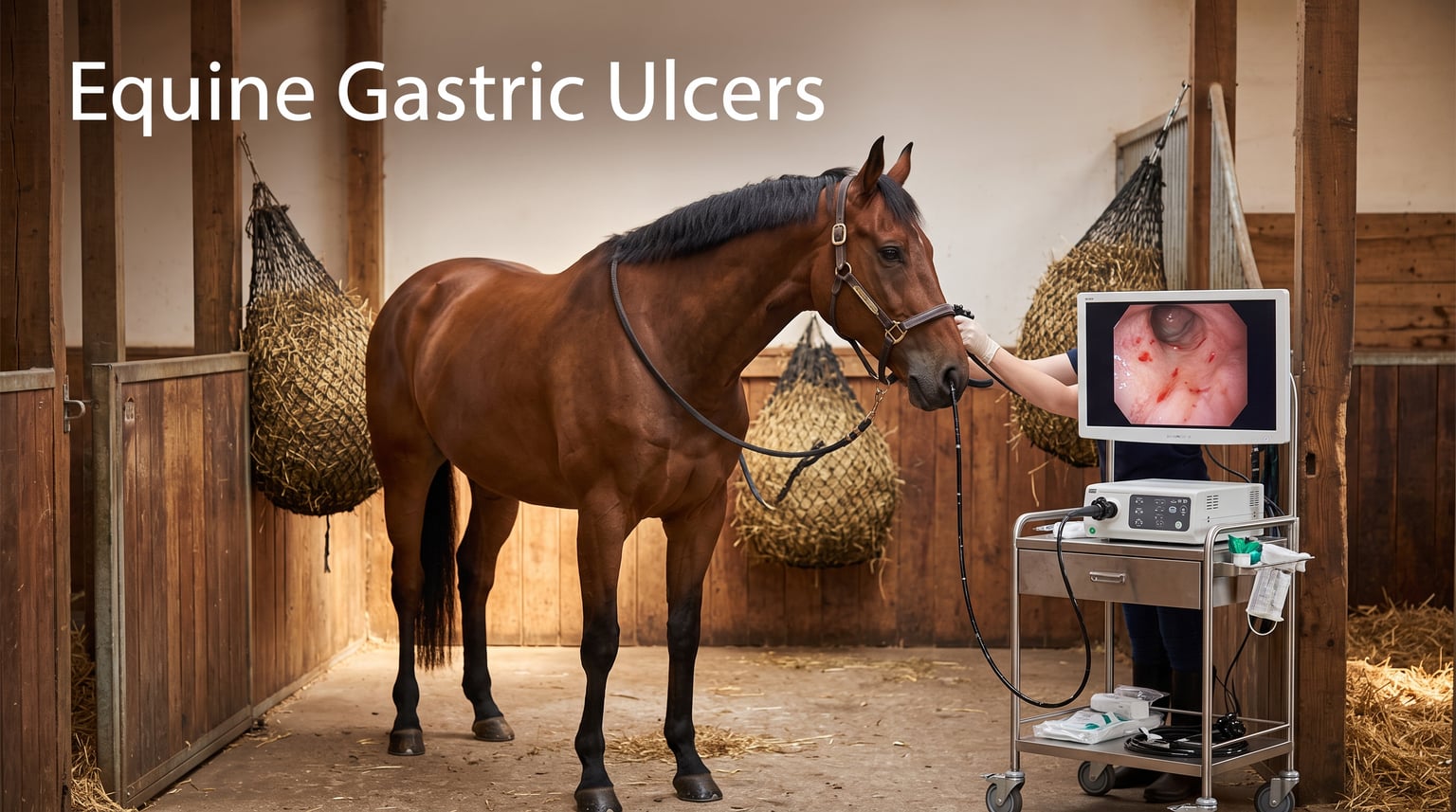
Gastroscopy — also called endoscopy — is the only definitive way to diagnose equine gastric ulcers. No blood test, urine sample, or external examination can confirm the presence or severity of ulcers with the same reliability as looking directly at the stomach lining with a camera.
The procedure involves passing a flexible endoscope (typically 3 meters long) through the horse’s nostril, down the esophagus, and into the stomach. The horse is fasted for 12 to 18 hours before the scope to ensure the stomach is empty enough to visualize the mucosa clearly. Light sedation is usually given to keep the horse comfortable and still during the examination.
Once inside the stomach, the veterinarian examines both the squamous and glandular regions and assigns a grade based on the severity of any lesions found:
- Grade 0: No lesions — the stomach lining is normal and intact
- Grade 1: Intact mucosa with areas of redness or discoloration
- Grade 2: Small, single or few lesions with a clear margin
- Grade 3: Large single lesion or multiple lesions with some depth
- Grade 4: Extensive lesions with deep ulceration, often with active bleeding
The grading system allows your vet to recommend appropriate treatment intensity and monitor response over time. A re-scope after a treatment course is the best way to confirm healing and guide decisions about dose tapering or maintenance therapy.
In some situations — particularly when scoping is not immediately accessible or affordable — veterinarians may recommend a diagnostic trial with omeprazole. If symptoms improve significantly within 7 to 14 days of treatment, EGUS is strongly suspected. This approach does not replace endoscopy but can be a practical first step when a definitive scope is not immediately available.
Call your veterinarian if your horse is showing any combination of the symptoms described above, particularly recurrent colic, significant performance decline, or weight loss that does not respond to increased feed.
Treatment Options for Equine Gastric Ulcers
Treatment for equine gastric ulcers has become considerably more effective over the last two decades, largely due to the widespread availability of omeprazole. However, treatment choices do depend on the type of ulcer present and the severity of the disease.
Omeprazole (GastroGard and Ulcergard)
Omeprazole is the gold standard treatment for equine squamous gastric disease. It works as a proton pump inhibitor, blocking the hydrogen-potassium ATPase enzyme responsible for acid secretion in gastric parietal cells. In practical terms, it dramatically reduces stomach acid production and allows the damaged squamous mucosa to heal.
GastroGard is the FDA-approved omeprazole paste formulation for horses, dosed at 4 mg/kg once daily. A standard treatment course for active ulcers runs 28 to 60 days, depending on severity confirmed on scope. Studies show healing rates of 70 to 90 percent with consistent treatment at therapeutic doses.
Ulcergard contains the same active ingredient at half the treatment dose and is labeled for prevention rather than active treatment. It is sold over the counter and is used for maintenance dosing or for horses going through high-stress periods like shows and transport.
Sucralfate and Misoprostol for Glandular Ulcers
Glandular ulcers (EGGD) respond less predictably to omeprazole alone. The current veterinary consensus recommends adding sucralfate — a medication that forms a protective coating over ulcerated tissue — to the treatment protocol for glandular disease.
Misoprostol, a prostaglandin analog, is also gaining acceptance as a treatment for EGGD. It stimulates mucus production and bicarbonate secretion in the glandular region, addressing the protective barrier deficiency that characterizes glandular ulcers. Misoprostol is typically used in combination with omeprazole for resistant or recurrent glandular cases.
The GastroGard Cost Concern and Compounded Omeprazole
The cost of GastroGard is one of the most frequently discussed topics in horse owner forums, and for good reason. A full 28-day treatment course of FDA-approved omeprazole paste can cost several hundred dollars, which puts it out of reach for some owners.
Compounded omeprazole products exist at significantly lower prices, but their efficacy is genuinely debated among veterinarians. The concern is that compounded products may not achieve adequate plasma concentrations due to differences in formulation and bioavailability compared to the FDA-approved paste. Some studies have found compounded omeprazole to be significantly less effective than GastroGard at equivalent label doses.
Some horse owners in online communities report success using human omeprazole tablets (such as Prilosec) at calculated equine doses, which brings the monthly cost down substantially. However, this approach lacks the same evidence base and should always be discussed with your veterinarian before trying. Your vet can advise on appropriate doses and whether this strategy makes sense for your horse’s specific situation.
The most important thing is to complete the full treatment course. Stopping omeprazole treatment early is a common reason ulcers recur quickly after treatment ends. Many horses also benefit from a tapering dose in the final week of treatment rather than stopping abruptly.
Expected Treatment Timeline
For squamous ulcers treated with therapeutic omeprazole, most horses show symptom improvement within 7 to 14 days of starting treatment. Full endoscopic healing typically takes 28 to 60 days depending on initial severity.
Glandular ulcers generally take longer to heal and may require 60 to 90 days of combined therapy. Some horses with severe or recurrent glandular disease require ongoing maintenance doses to prevent relapse.
Horses that do not respond as expected to first-line treatment should be re-scoped to reassess severity and rule out other diagnoses. Persistent non-healing ulcers occasionally indicate an underlying cause — such as ongoing NSAID use or pyloric abnormalities — that needs to be addressed.
Prevention and Management of Equine Gastric Ulcers
Prevention is where management practices make the biggest difference. Many horses that respond well to treatment will relapse if their diet and environment are not adjusted to address the underlying causes. The good news is that effective prevention strategies are well-understood and largely within any horse owner’s control.
Maximize Forage Access
Providing horses with continuous access to quality hay is the single most impactful prevention strategy. Forage acts as a physical and chemical buffer against stomach acid. When horses chew long-stem fiber, they produce large amounts of saliva — which is alkaline and helps neutralize acid.
Slow feeders and hay nets can extend hay consumption time for stalled horses, reducing the periods when the stomach is empty and acid is splashing around unchecked. Aim for horses to never go more than four to six hours without access to forage.
Alfalfa hay is particularly beneficial for horses prone to ulcers. Research shows that alfalfa’s higher protein and calcium content provides superior acid buffering compared to grass hay. Even mixing a portion of alfalfa into the diet can measurably reduce ulcer prevalence in at-risk horses.
Adjust Grain and Concentrate Feeding
If your horse requires grain or concentrate, divide it into at least two small meals per day rather than one large feeding. Smaller, more frequent concentrate meals produce less acid surge than a single large grain bolus.
Give hay before grain whenever possible. Feeding forage first ensures the stomach is already partially filled and buffered before the acid-stimulating effects of grain kick in. Even 20 to 30 minutes of hay access before grain makes a measurable difference.
Avoid feeding large grain meals to horses in heavy work. The combination of high concentrate intake and intense exercise is one of the highest-risk scenarios for squamous ulcer development.
What Not to Feed Horses With Ulcers
Certain feeds should be avoided or minimized in horses with active or recurrent gastric ulcers:
- Large grain or starch meals: Rapidly fermentable carbohydrates increase volatile fatty acid production in the stomach, which can damage the squamous mucosa directly and at low pH levels.
- Citrus fruits and high-acid feeds: Highly acidic feeds add to the stomach acid load and are not appropriate for ulcer-prone horses.
- Bran mashes as a regular feed: Despite being popular, wheat bran has a poor calcium-to-phosphorus ratio and does not provide the buffering benefits many owners believe it does.
- Feeds with added molasses in large quantities: High-sugar feeds rapidly ferment and can contribute to volatile fatty acid production that damages the squamous region.
- NSAIDs unless absolutely necessary: Phenylbutazone and other NSAIDs impair the stomach’s protective prostaglandin production. If your horse must take NSAIDs, discuss stomach protection strategies with your vet.
Reduce Stress and Increase Turnout
Pasture turnout is one of the most effective prevention tools available. Horses at pasture naturally graze continuously, keep their stomachs buffered, and experience far less stress than stalled horses. Even a few extra hours of turnout daily can meaningfully reduce ulcer risk.
For horses that must be stalled — particularly during show seasons or training — managing stress is important. Social contact with other horses, consistent routines, and environmental enrichment (like a window with a view, or a companion animal) all reduce the stress hormone load that contributes to ulcer development.
During transport, allow horses to eat hay freely during travel when safe to do so. Pre-treating horses with omeprazole for two to three days before a long journey is a strategy many veterinarians recommend for horses with a history of ulcers.
Supplements and Supportive Care
A wide range of digestive supplements are marketed for horses with ulcer risk. The evidence behind them varies considerably, and this is an area where forum discussions become heated. Some supplements with documented benefit in research include those containing calcium carbonate (which buffers acid), aloe vera extract, and specific prebiotic formulations.
Supplemental support should never replace veterinary treatment for diagnosed ulcers. However, in horses that have responded well to omeprazole treatment and are now in maintenance mode, a well-chosen digestive supplement alongside good management may help maintain gastric health. Always discuss supplement choices with your vet, who can help you sort evidence-based options from marketing hype.
Frequently Asked Questions
What is the best treatment for gastric ulcers in horses?
The most effective treatment for equine squamous gastric ulcers is omeprazole (GastroGard), an FDA-approved proton pump inhibitor dosed at 4 mg/kg daily for 28 to 60 days. For glandular ulcers, sucralfate and misoprostol are often added to the protocol. A veterinarian should determine the appropriate treatment based on endoscopic diagnosis.
Can equine gastric ulcers heal on their own?
Squamous gastric ulcers may show some natural healing if the underlying cause — such as stress or poor feeding management — is removed. However, without treatment, healing is slow and unreliable, and ulcers often worsen. Active glandular ulcers almost never resolve on their own and require veterinary treatment. Most veterinarians recommend against waiting and treating as soon as ulcers are diagnosed.
What not to feed horses with ulcers?
Horses with gastric ulcers should avoid large grain or starch-heavy meals, high-sugar feeds with added molasses, acidic or citrus-based treats, and regular wheat bran mashes. NSAIDs like phenylbutazone should only be used when medically necessary. Instead, prioritize constant access to grass hay or mixed alfalfa hay, which buffers stomach acid naturally.
What are the first signs of gastric ulcers in horses?
The earliest and most common signs of gastric ulcers in horses include reduced appetite or reluctance to finish grain, subtle behavioral changes under saddle, girthiness, mild recurrent colic, and a dull coat. Some horses show only vague performance decline or general sourness before more obvious signs develop. Because horses can have severe ulcers with minimal outward symptoms, any combination of these signs warrants veterinary evaluation.
How long does it take for gastric ulcers to heal in horses?
With consistent omeprazole treatment at therapeutic doses, most squamous ulcers show endoscopic healing within 28 to 60 days. Symptom improvement is often noticeable within the first 7 to 14 days of treatment. Glandular ulcers may require 60 to 90 days of combined therapy. A follow-up gastroscopy is the best way to confirm complete healing before discontinuing treatment.
What are the red flags of gastric ulcers?
Red flags that suggest severe or rapidly progressing gastric ulcers include frequent or worsening colic episodes, significant rapid weight loss, complete loss of appetite, profuse sweating associated with abdominal pain, teeth grinding at rest, and signs of internal bleeding such as pale gums or black tarry manure. Any of these signs requires urgent veterinary attention.
Can gastric ulcers in horses be cured?
Yes, gastric ulcers in horses can be successfully treated and healed, particularly squamous ulcers, which respond very well to omeprazole therapy. Studies report healing rates of 70 to 90 percent after a full treatment course. However, without changes to the underlying management factors — diet, feeding schedule, stress — ulcers frequently recur after treatment ends. Long-term prevention requires addressing the root causes.
Conclusion
Equine gastric ulcers are one of the most common health challenges in horses, affecting the majority of animals in performance work and a significant portion of the broader horse population. The good news is that with proper diagnosis, appropriate treatment, and thoughtful management changes, most horses recover well and can stay healthy long-term.
The most important step any horse owner can take is to recognize that subtle behavioral changes deserve veterinary attention — not just a label of “being difficult.” Gastroscopy remains the only reliable way to confirm equine gastric ulcers and guide treatment decisions.
Prioritize forage access, reduce stress where possible, work closely with your vet on treatment protocols, and don’t cut treatment short to save money — that’s the path to recurrence. With the right approach, managing gastric ulcers in horses is entirely achievable.