
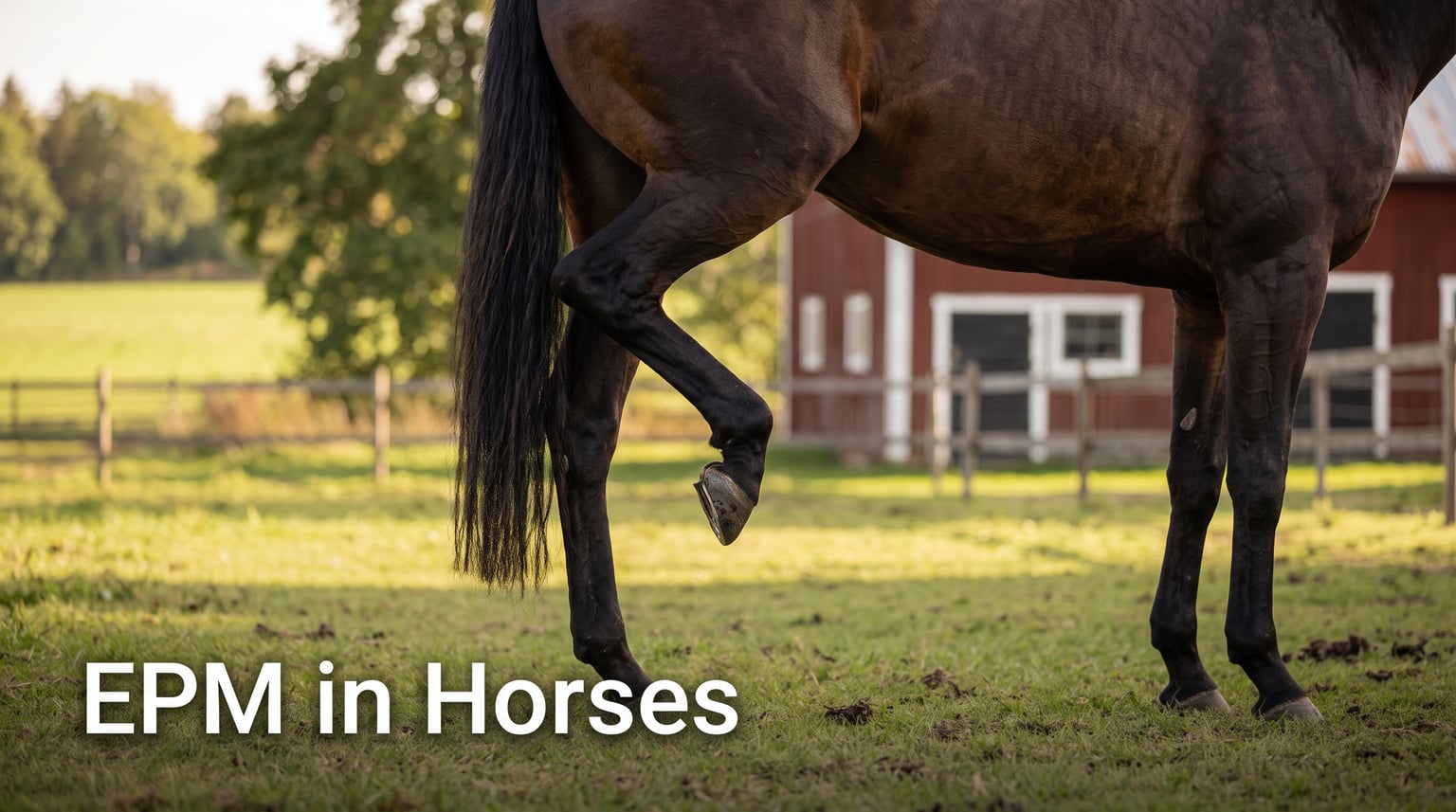
EPM in horses — equine protozoal myeloencephalitis — is one of the most frustrating diagnoses a horse owner can receive. The disease can look like almost anything, strike horses of any age or breed, and leave you second-guessing whether that stumble last week was a symptom or just an off day.
I’ve talked to enough horse owners over the years to know that most had no idea what EPM was until their vet said those three letters. This guide covers everything you need to know: what causes it, what it looks like, how it gets diagnosed, what treatment involves, and what you can realistically expect for recovery.
The good news is that with early diagnosis and the right treatment, many horses improve significantly. The bad news is that time matters — a lot.
EPM Quick Facts
Caused by the protozoan parasite Sarcocystis neurona (or less commonly Neospora hughesi)
Horses become infected by eating opossum feces that contaminate feed, water, or pasture
EPM affects the central nervous system — brain, brainstem, and/or spinal cord
Signs include incoordination, muscle wasting, weakness, and cranial nerve deficits
Blood tests alone cannot confirm EPM — cerebrospinal fluid testing is the gold standard
Three FDA-approved antiprotozoal drugs are available for treatment
Approximately 60-70% of treated horses show neurological improvement
Early treatment leads to better outcomes — don’t wait on neurological signs
Table of Contents
What Is EPM in Horses?
EPM in horses stands for equine protozoal myeloencephalitis — a neurological disease caused by infection of the central nervous system with protozoan parasites. The two organisms responsible are Sarcocystis neurona and, much less commonly, Neospora hughesi.
Of those two, Sarcocystis neurona accounts for the vast majority of cases throughout the Americas. It belongs to a group called apicomplexan protozoa — the same broad family as the organisms behind malaria and toxoplasmosis in other species.
What makes EPM particularly tricky is that horses are what scientists call a “dead-end host.” They accidentally ingest the infectious sporocysts, develop disease, but cannot transmit the parasite onward to another animal. The horse gets all the neurological damage and none of the role in the parasite’s reproductive cycle.
EPM can affect any part of the central nervous system: the spinal cord, the brainstem, or the brain itself. This is exactly why the clinical picture is so variable and why EPM earned the nickname “the great imitator” among equine vets — the location of the infection in the nervous system determines what symptoms appear, and no two horses necessarily look the same.
EPM is considered one of the most common neurological diseases in horses across North and South America. Any horse living in or traveling through areas where Virginia opossums are present is potentially at risk, which covers most of the continental United States.
How Do Horses Get EPM?
The definitive host for Sarcocystis neurona is the Virginia opossum (Didelphis virginiana). Opossums become infected by eating intermediate hosts — raccoons, skunks, armadillos, or sea otters — that carry the asexual parasite stages in their muscle tissue.
Once infected, opossums shed sporocysts in their feces continuously. When a horse accidentally ingests contaminated hay, grain, feed, water, or pasture grass, those sporocysts enter the digestive system.
Inside the horse, the sporocysts release infectious stages that cross the intestinal wall, enter the bloodstream, and eventually reach the central nervous system. There, the parasites undergo a process called schizogony — rapid replication — which causes direct damage to nerve tissue and triggers an inflammatory response. That combination of physical damage and inflammation is what produces the neurological signs owners and vets observe.
One important fact that surprises many horse owners: not every horse exposed to Sarcocystis neurona develops EPM. In some parts of the United States, a large proportion of horses are seropositive — meaning they’ve been exposed and developed antibodies — without ever showing clinical signs of disease. The factors that push a horse from exposure into active infection aren’t fully understood, but stress, concurrent illness, high parasite loads, and immune suppression all appear to contribute.
Signs and Symptoms of EPM in Horses
The symptoms of EPM in horses vary widely depending on which part of the central nervous system is affected. This is what makes it so difficult to recognize early — there’s no single textbook presentation that every horse follows.
Asymmetry is one of the most important distinguishing features. Unlike many neurological diseases that affect both sides equally, EPM often affects one side of the body more than the other. If a horse seems noticeably weaker or more uncoordinated on the left than the right, that asymmetry is a meaningful red flag.
Subtle Early Signs of EPM
The first signs of EPM are the ones owners most often dismiss as minor issues or blame on something else entirely. They’re easy to miss because they’re often intermittent and not dramatic.
Subtle early signs to watch for include:
Stumbling or tripping more often than normal, especially on the hind end
Weakness or unsteadiness that seems worse on one side of the body
A gait that’s hard to describe — just something “off” that you can feel more than see
Reluctance to move forward or unusual stiffness during work
Subtle loss of muscle tone in the hindquarters or along the topline
Dragging a toe or scuffing a hind foot when moving
Forum discussions among horse owners who’ve been through EPM diagnoses are full of the same refrain: “I noticed something wasn’t right for weeks before things got worse.” That early gut feeling is worth acting on.
Advanced Neurological Signs
As EPM progresses, or in horses that present with more severe disease from the start, the signs become harder to miss and more alarming to watch.
Advanced signs of EPM include:
Significant incoordination (ataxia) — the horse sways, crosses its legs, or nearly falls when turning
Obvious muscle atrophy, particularly in the hindquarters, shoulders, or topline — this can develop fast and be dramatic
Weakness severe enough that the horse leans on walls or fences for support
Loss of sensation in patches of skin — the horse doesn’t react normally to touch in certain areas
Difficulty rising from lying down, or refusing to lie down at all
Inability to bear weight on one or more limbs
Horse owners in online communities consistently note being shocked by how quickly a horse can lose significant muscle mass — sometimes visibly within just a few weeks of symptom onset.
Cranial Nerve and Brainstem Signs
When EPM affects the brainstem rather than the spinal cord, the clinical signs shift entirely to the head and face. These presentations are often the most alarming for owners to witness.
Cranial nerve involvement can produce:
Drooping of the ear, eyelid, or lip — usually on one side
Facial paralysis affecting expression and muscle tone
Head tilt
Difficulty swallowing (dysphagia) — feed dropping from the mouth, or the horse “qudding” (dropping partially chewed hay)
Abnormal eye movements or a glazed, unfocused appearance
Behavioral changes that seem out of character
Dysphagia deserves particular attention because a horse that can’t swallow properly is at serious risk for aspiration pneumonia — a secondary complication where feed material is inhaled into the lungs. Aspiration pneumonia can become life-threatening quickly and should be treated as an emergency.
When to Call the Vet: Emergency Warning Signs
Most EPM cases don’t present as true emergencies, but some can escalate rapidly. Don’t wait for a scheduled appointment if your horse shows any of the following — call your vet immediately:
The horse has gone down and cannot get up
Sudden severe ataxia — the horse is nearly falling with each step
Complete or near-complete inability to swallow
Seizures or sudden disorientation, panic, or unprovoked aggression
Rapid progression of any neurological sign over 24-48 hours
A horse already being treated for EPM that suddenly gets significantly worse
A horse that deteriorates quickly can reach a point where treatment is no longer viable or humane. Early and aggressive intervention genuinely makes a difference — both in terms of survival and in the quality of neurological recovery.
If you’re unsure whether what you’re seeing qualifies as an emergency, call anyway. Your vet would rather take the call and tell you it can wait than have you wait on something serious.
How EPM Is Diagnosed?
Diagnosing EPM requires combining a thorough neurological examination with appropriate laboratory testing. There’s no single perfect test, and this is one area where horse owners — and sometimes vets — get confused or take shortcuts that lead to misdiagnosis.
Neurological Examination
Before any blood draw or spinal tap, your vet will perform a systematic neurological examination. This includes the tail pull test (assessing hindquarter strength and resistance), trotting the horse in circles, walking on uneven ground with and without a blindfold, and testing cranial nerve responses like menace reflex and facial sensation.
The neurological exam serves two purposes: it confirms that genuine neurological dysfunction is present, and it helps localize where in the nervous system the problem is originating. Localization guides which diagnostic tests make the most sense and helps the vet build a differential diagnosis list.
EPM is not the only neurological disease in horses. Wobbler syndrome (cervical vertebral stenotic myelopathy), equine herpesvirus-1 myeloencephalopathy, West Nile virus, botulism, and other conditions can produce similar signs. A careful neurological exam is the starting point for sorting through those possibilities.
Blood Testing for EPM
A serum blood test can detect whether a horse has antibodies to Sarcocystis neurona or Neospora hughesi. Common test formats include the Western immunoblot, IFAT (indirect fluorescent antibody test), and ELISA-based assays that target SAG (surface antigen) proteins.
Here’s the critical thing to understand: a positive blood test does not confirm active EPM. Studies have found that a significant proportion of horses in the United States are seropositive — they’ve been exposed to the parasite and mounted an antibody response — without having active neurological disease. A positive blood test tells you the horse has encountered the parasite. It does not tell you the parasite is currently damaging the nervous system.
This is where misdiagnosis happens. A horse presents with neurological signs, a blood test comes back positive for antibodies, and everyone assumes it’s EPM. But if another condition is actually causing the signs, treating for EPM won’t help the horse at all and delays finding the real problem. Blood testing should be interpreted alongside a full clinical picture, not in isolation.
Cerebrospinal Fluid Analysis
The gold standard for diagnosing EPM is cerebrospinal fluid (CSF) analysis collected by spinal tap. Your vet collects CSF from either the atlanto-occipital space (requiring general anesthesia) or the lumbosacral space (which can be done with sedation in a standing horse).
The key measurement is the serum-to-CSF antibody ratio. When the ratio of antibodies in the CSF is higher than what could be explained by simple leakage from the bloodstream, that indicates intrathecal antibody production — meaning the horse’s immune system is actively responding to an infection inside the central nervous system itself. That’s much stronger evidence of active EPM.
CSF testing is considerably more meaningful than blood testing alone. That said, it’s not perfect — some horses with confirmed EPM can have a negative CSF result, and clinical judgment remains essential. Your vet may recommend treating based on strong clinical suspicion even when test results are equivocal.
The cost of a spinal tap, including sedation or anesthesia, veterinary time, and laboratory fees, typically runs from $500 to $1,500 depending on your region and which laboratory is used for analysis.
Treatment Options for EPM
The treatment landscape for EPM has improved significantly over the past two decades. Three FDA-approved antiprotozoal drugs now exist, and when used correctly with appropriate supportive care, they give horses a real chance at meaningful recovery.
FDA-Approved Antiprotozoal Drugs
Ponazuril (Marquis) is an anticoccidial drug that directly targets Sarcocystis neurona. It’s given as an oral paste, typically at a dose of 5 mg/kg daily for 28 days. Ponazuril is widely used because it’s easy to administer and generally well-tolerated by most horses.
Diclazuril (Protazil) works through a similar mechanism to ponazuril and is given as a pelleted top-dress mixed into feed, also for 28 days. Some vets and owners prefer it because horses tend to accept it readily in their feed without fuss.
Sulfadiazine/pyrimethamine combination (ReBalance) works by a different mechanism — it blocks folate synthesis in the parasite, which ultimately kills it. This combination is given orally for 90 to 180 days, which means a longer treatment commitment and higher total cost. It also requires periodic monitoring for bone marrow suppression, a potential side effect of pyrimethamine.
Your vet will choose a treatment based on disease severity, the horse’s ability to swallow oral medication, your management situation, and cost. In severe or non-responsive cases, some vets combine drugs or add adjunct therapies to the protocol.
Supportive Care
Antiprotozoal drugs target the parasite, but supportive care addresses the inflammatory damage already done to the nervous system and helps the horse’s body recover.
Vitamin E supplementation is one of the most commonly recommended additions to EPM treatment. Vitamin E has antioxidant properties that support nerve tissue health, and horses being treated for neurological disease are often supplemented at higher-than-maintenance levels. Horses on dry lots without access to fresh grass are at particular risk of vitamin E deficiency, which may affect their recovery capacity.
Anti-inflammatory medications — typically NSAIDs — are sometimes used short-term to manage the inflammatory component of CNS damage. Corticosteroids are more controversial because while they reduce inflammation, they can also suppress the immune response that helps control the parasite. Your vet will weigh these factors for your individual horse.
Immunomodulators such as mycobacterial cell wall derivatives have been used as adjunct therapy in some EPM cases. The evidence for their benefit continues to accumulate, and some vets include them particularly in severe or relapsing cases.
What Does EPM Treatment Cost?
This is the question horse owners ask constantly in forums and one that almost no educational resource addresses honestly.
For the antiprotozoal drugs alone, a 28-day course of Marquis or Protazil typically costs $400 to $700 depending on the horse’s weight and current drug pricing. A full course of ReBalance over 90 days runs approximately $300 to $500, but the extended treatment period means higher total veterinary monitoring costs.
Add in initial diagnostics (neurological exam, blood testing, and possibly a CSF tap), vitamin E supplementation, and follow-up visits, and a complete EPM workup and treatment often totals $1,500 to $4,000. Severe cases requiring hospitalization, extended monitoring, or repeated treatment courses can exceed $6,000.
These figures are estimates — costs vary significantly by region, horse weight, and chosen diagnostic approach. If cost is a concern, talk to your vet early about prioritizing the most essential diagnostics and whether a trial of treatment based on clinical suspicion is appropriate in your situation.
Prognosis and Recovery from EPM
The prognosis for EPM is genuinely mixed, and I think being honest about that serves horse owners better than false optimism or unnecessary pessimism.
Multiple studies report that approximately 60 to 70% of horses treated for EPM show measurable neurological improvement. Of those that improve, many don’t return to 100% of their pre-illness function — they stabilize at a lower level, particularly when signs were moderate to severe before treatment started. A smaller percentage — roughly 10 to 15% in some studies — show no improvement despite treatment.
Horses with mild-to-moderate disease caught early have the best outlook. Those that are severely affected before treatment begins — barely able to stand, rapid progression, significant brainstem involvement — have a more guarded prognosis and a higher risk of permanent deficits.
Recovery timelines are longer than many owners expect. Some improvement may be visible within two to four weeks of starting antiprotozoal treatment, but significant neurological recovery typically takes three to six months. Some horses continue to show slow, gradual improvement for up to a year after finishing their drug course — nerve tissue heals slowly.
Relapse is a real concern. Horses that have had EPM appear to be at higher risk of recurrence, particularly if they’re re-exposed to opossum sporocysts or experience immune-suppressing stress or illness. Some horses require more than one treatment course over their lifetime. This is one reason why ongoing opossum management around the barn matters even after a horse has recovered.
Day-to-Day Care During EPM Treatment
If your horse is being treated for EPM at home, there are practical things you can do to support recovery and prevent secondary injuries — and most resources don’t cover this piece at all.
Make the environment as safe as possible. A horse with neurological impairment is a horse at risk of falling. Remove sharp corners, tripping hazards, and anything the horse could injure itself on in the stall and in turnout. Thick rubber mats reduce injury risk if the horse does go down. Deep shavings can actually increase stumbling risk for ataxic horses — keep bedding manageable rather than deep.
Restrict exercise appropriately. Your vet will guide specific activity limits, but most horses on EPM treatment should have work significantly reduced. The goal is preventing falls and giving the nervous system time to heal. Don’t push groundwork or ridden work until you and your vet agree the horse’s neurological function has improved enough to handle it safely.
Monitor swallowing and daily intake carefully. If your horse has any dysphagia, watch for early signs of aspiration: nasal discharge, coughing after eating, or any respiratory changes. Provide soaked hay cubes or mashes if dry hay is difficult. Report any changes in swallowing or respiratory status to your vet immediately — aspiration pneumonia can develop quickly.
Document progress with video. Recording your horse on a consistent surface — walking in hand, trotting in a straight line, turning in circles — every week or two gives you and your vet objective evidence of whether the disease is responding to treatment, staying the same, or progressing. It’s much more reliable than memory alone when you’re trying to track subtle changes over months.
Preventing EPM in Horses
Complete prevention of EPM is not realistic because you can’t eliminate opossums from the landscape — but you can meaningfully reduce your horse’s exposure risk through consistent management practices.
Control opossum access to feed and water sources. This is the single most impactful prevention step you can take.
Store all hay, grain, and supplements in covered, opossum-proof containers or secured rooms
Use covered or elevated water troughs that opossums can’t easily access or fall into
Clean up spilled grain and dropped hay promptly — don’t leave food sources that attract wildlife overnight
Consider motion-activated lights or other deterrents around barn areas
Manage the barn environment to reduce opossum attraction.
Keep the barn and feed room clean — opossums are attracted to garbage, fruit, and any accessible food
Seal gaps in feed room walls, hay storage areas, and anywhere opossums could enter and nest
If opossums are a persistent, significant problem, contact your local wildlife management authority about legal trapping and relocation options
Support your horse’s immune health year-round. Immune suppression appears to increase the risk that exposure becomes active disease, so reducing unnecessary stressors matters.
Ensure adequate vitamin E in the diet — horses on dry lots without access to fresh grass are at higher risk of deficiency
Minimize unnecessary stressors: transport, major management changes, and prolonged periods of heavy training all take immune toll
Maintain a regular veterinary health program, including appropriate deworming and vaccination protocols
If you’re in a high-risk geographic area — particularly the eastern United States where Virginia opossum populations are dense — discuss EPM risk with your vet as part of your horse’s routine health planning.
There is currently no licensed EPM vaccine available in the United States. Research into vaccine development continues, but until an effective vaccine reaches the market, management and feed security remain the primary prevention tools.
Frequently Asked Questions About EPM in Horses
What are the first signs of EPM in horses?
The first signs of EPM in horses are often subtle and easy to attribute to other causes. These include stumbling or tripping more than usual, mild incoordination especially on the hind end, and weakness that seems worse on one side of the body than the other. Asymmetrical signs — where one side is more affected than the other — are characteristic of EPM and worth reporting to your vet promptly.
Is EPM in horses curable?
EPM cannot always be fully cured, but it can often be successfully treated. Approximately 60-70% of horses treated for EPM show neurological improvement, though many stabilize at a level below their pre-illness function rather than returning to 100%. Horses treated early in the course of disease generally have better outcomes. Some horses require more than one treatment course if the disease relapses.
What are the symptoms of EPM in horses?
Symptoms of EPM in horses include incoordination (ataxia), muscle wasting especially in the hindquarters and topline, asymmetrical weakness, loss of skin sensation in patches, difficulty swallowing, head tilt, facial drooping or paralysis, and in severe cases, inability to rise from lying down. Specific signs depend on which part of the central nervous system — spinal cord, brainstem, or brain — is most affected.
What is the life expectancy of a horse with EPM?
Life expectancy with EPM depends heavily on disease severity and response to treatment. A horse with mild EPM that responds well to antiprotozoal therapy can live a full, normal life. Horses with severe, rapidly progressive disease that does not respond to treatment face a much poorer outlook. There is no single answer — work closely with your vet to assess your individual horse’s trajectory based on how they respond over the first weeks of treatment.
How do horses get EPM?
Horses get EPM by accidentally ingesting sporocysts shed in the feces of infected Virginia opossums. Opossum feces can contaminate hay, grain, feed buckets, water sources, or pasture grass. Once ingested, the parasites eventually migrate to the horse’s central nervous system, where they replicate and cause the inflammatory damage that produces neurological signs. Horses cannot get EPM directly from other horses.
How long does EPM treatment take?
The drug treatment course depends on which medication is used. Ponazuril (Marquis) and diclazuril (Protazil) are given for 28 days. Sulfadiazine/pyrimethamine (ReBalance) is given for 90 to 180 days. Neurological recovery, however, continues long after the drug course ends — most horses continue to improve over 3 to 6 months following treatment, and some show gradual progress for up to a year after finishing antiprotozoal therapy.
Can EPM come back after treatment?
Yes, EPM can recur after treatment. Horses that have had EPM appear to be at increased risk of relapse, particularly if they are re-exposed to opossum sporocysts or experience stress or illness that affects their immune function. Some horses require multiple treatment courses over their lifetime. Reducing opossum access to feed and water sources is the most effective way to lower the risk of re-exposure and relapse.
Conclusion
EPM in horses is a serious disease, but it’s not an automatic death sentence. The more you understand about equine protozoal myeloencephalitis going in — what causes it, what it looks like, and how treatment works — the better your chances of catching it early and giving your horse a real shot at meaningful recovery.
If your horse is showing any neurological signs, don’t wait and watch. Call your vet, describe exactly what you’re seeing, and push for a proper diagnostic workup. Blood tests alone are not enough to confirm EPM — make sure the conversation includes CSF testing if there’s genuine suspicion of active disease.
Your horse’s best chance at recovery comes down to fast diagnosis, the right antiprotozoal treatment, good supportive care, and a safe environment during the months it takes for nerve tissue to heal. All of those are things you and your vet can control together.