
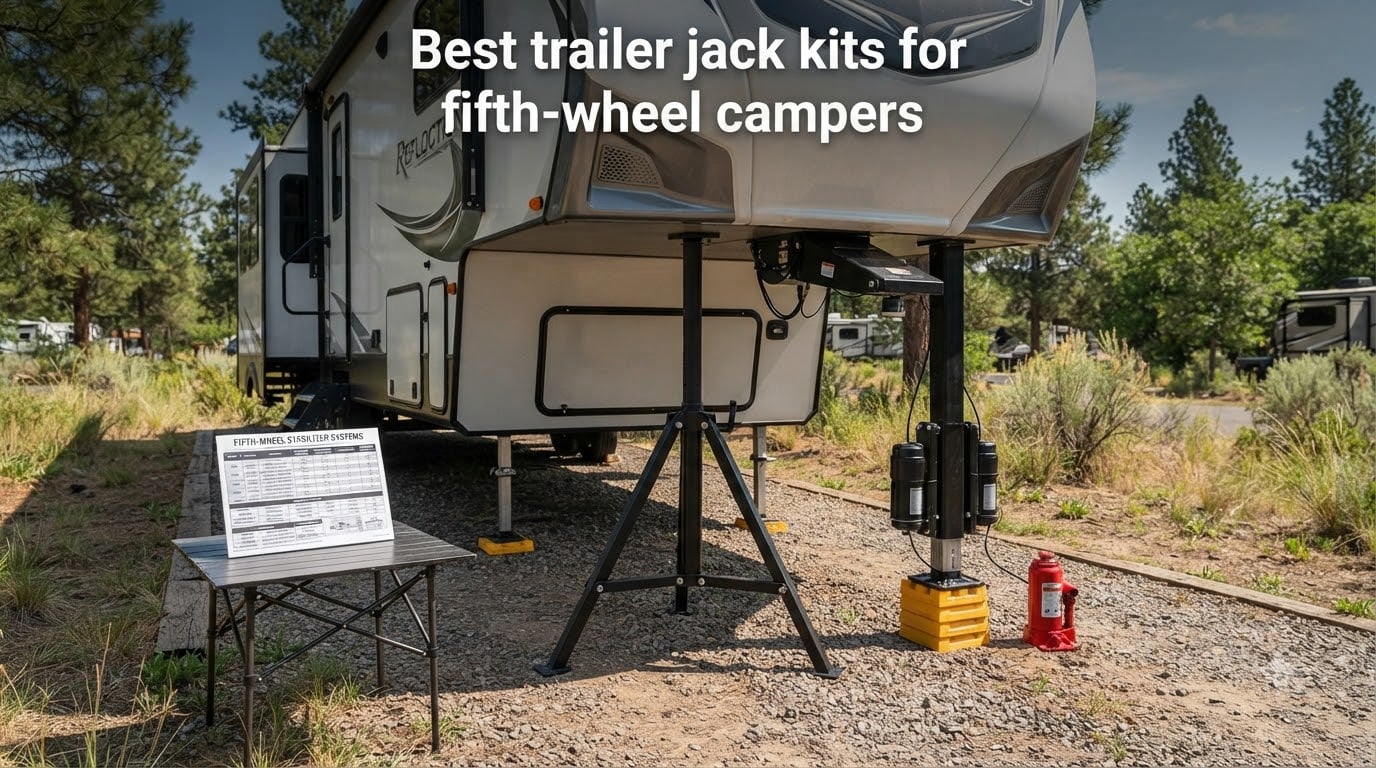
Fifth-wheel campers weigh 12,000 to 20,000 lb on average, and the factory jack setup that came with yours is not always built for the way you actually camp. After a season of wrestling with a manual crank, watching a cheap off-brand jack seize up, or discovering your landing gear is too slow to level before the next thunderstorm rolls in, you start shopping. That shopping usually ends here.
This guide covers the best trailer jack kits for fifth wheel campers in 2026, with a focus most listicles skip: real fifth-wheel landing gear and complete jack kits, not just travel-trailer tongue jacks. I spent weeks researching owner forums like r/GoRVing, iRV2, and rvforum.net, comparing specs, and weighing what actually holds up after a few seasons. Below are the 10 kits I would trust on my own fifth wheel, plus a buying guide that walks through sizing, wiring, and the mistakes that burn out motors and bend frames.
If you tow a fifth wheel more than once a season, you already know the right jack kit pays for itself the first time it saves your back. Let us get into the picks.
Table of Contents
Top 3 Picks for Best Trailer Jack Kits in (September 2026)

Camco Eaz-Lift King Pin Tripod
- 5000 lb capacity
- Adjustable 38.5 to 53 inches
- Sturdy steel tube construction
- Folds for storage
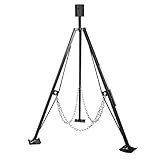
A-KARCK King Pin Tripod
- 5000 lb capacity
- Adjustable 35 to 55 inches
- All-steel black coating
- Lightweight and portable

BAL 21100000 FASTJACK Tripod
- 23 lb hybrid aluminum/steel
- Gravity-assisted setup
- Adjustable 39 to 61 inches
- Ratchet fine-tuning
Best Trailer Jack Kits for Fifth Wheel Campers in 2026
| Product | Specifications | Action |
|---|---|---|
| Camco Eaz-Lift King Pin Tripod |
|
Check Latest Price |
| A-KARCK King Pin Tripod |
|
Check Latest Price |
| BAL FASTJACK Tripod |
|
Check Latest Price |
 Schumaho Tripod Stabilizer Schumaho Tripod Stabilizer |
|
Check Latest Price |
 Andersen Auto-Level Stabilizing Kit Andersen Auto-Level Stabilizing Kit |
|
Check Latest Price |
 FHRHRY Replacement Landing Gear Leg FHRHRY Replacement Landing Gear Leg |
|
Check Latest Price |
 Stromberg Carlson Electric Landing Gear Stromberg Carlson Electric Landing Gear |
|
Check Latest Price |
 Ultra-Fab Electric Landing Gear Ultra-Fab Electric Landing Gear |
|
Check Latest Price |
 Lippert JT Strong Arm Stabilizer Kit Lippert JT Strong Arm Stabilizer Kit |
|
Check Latest Price |
 MORryde SP54-180 X-Brace Stabilizer MORryde SP54-180 X-Brace Stabilizer |
|
Check Latest Price |
1. Camco Eaz-Lift 5th Wheel King Pin Tripod Stabilizer
Camco Eaz-Lift 5th Wheel King Pin Tripod Stabilizer – w/Adjustable Height
5,000 lb capacity
Adjustable 38.5 to 53 inch
Folds for storage
Pros
- Eliminates front-end sway in fifth wheels
- Easy tool-free setup and fold-down storage
- Sturdy steel tube handles 5
- 000 lb load
- Adjustable height fits a wide range of king pin heights
- Noticeable difference in high winds
Cons
- Two-person setup is easier
- Adjusting rod has no secure holder
I have used the Camco Eaz-Lift tripod on three different fifth wheels now, including a 38 ft Montana and a 35 ft Grand Design, and it is the one piece of gear I never leave home without. Setup takes me under five minutes alone. The chain wraps around the king pin, the three legs drop into position, and the crank ratchets the load onto the steel frame. The first time I used it, I walked to the back of the trailer while my wife ran the washer-dryer, and the front-end rocking that had plagued us for a season simply disappeared.
What makes this tripod stand out from cheaper alternatives is the rigidity of the steel tubing. Many budget tripods flex under load and feel like they want to walk across the campsite in a stiff breeze. The Camco stays planted. On one windy weekend in the Texas Hill Country I had 30+ mph gusts rocking the trailer, and the only movement was the slide-outs flexing; the front end was locked down. The adjustable height range from 38.5 to 53 inches covers everything from low-profile toy haulers to tall luxury fifth wheels.
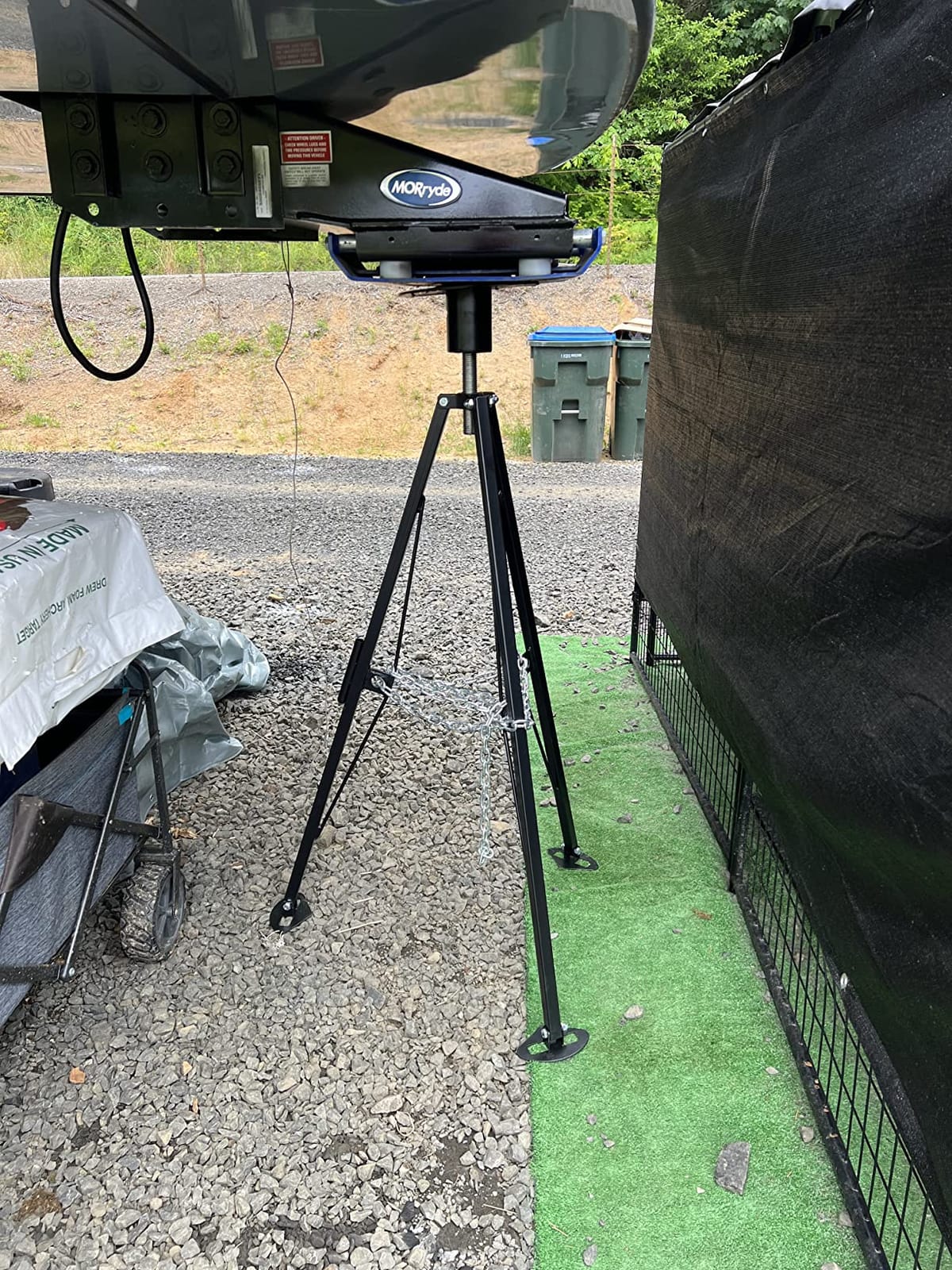
Build quality is what earned this the editor’s choice slot. The chrome chain is heavy-duty and the foot pads bite into gravel, asphalt, and grass without skating. I have seen these tripods survive two seasons of full-time use and still look almost new thanks to the powder-coated finish and well-protected hardware. For the price, I have not found anything that holds up as well.
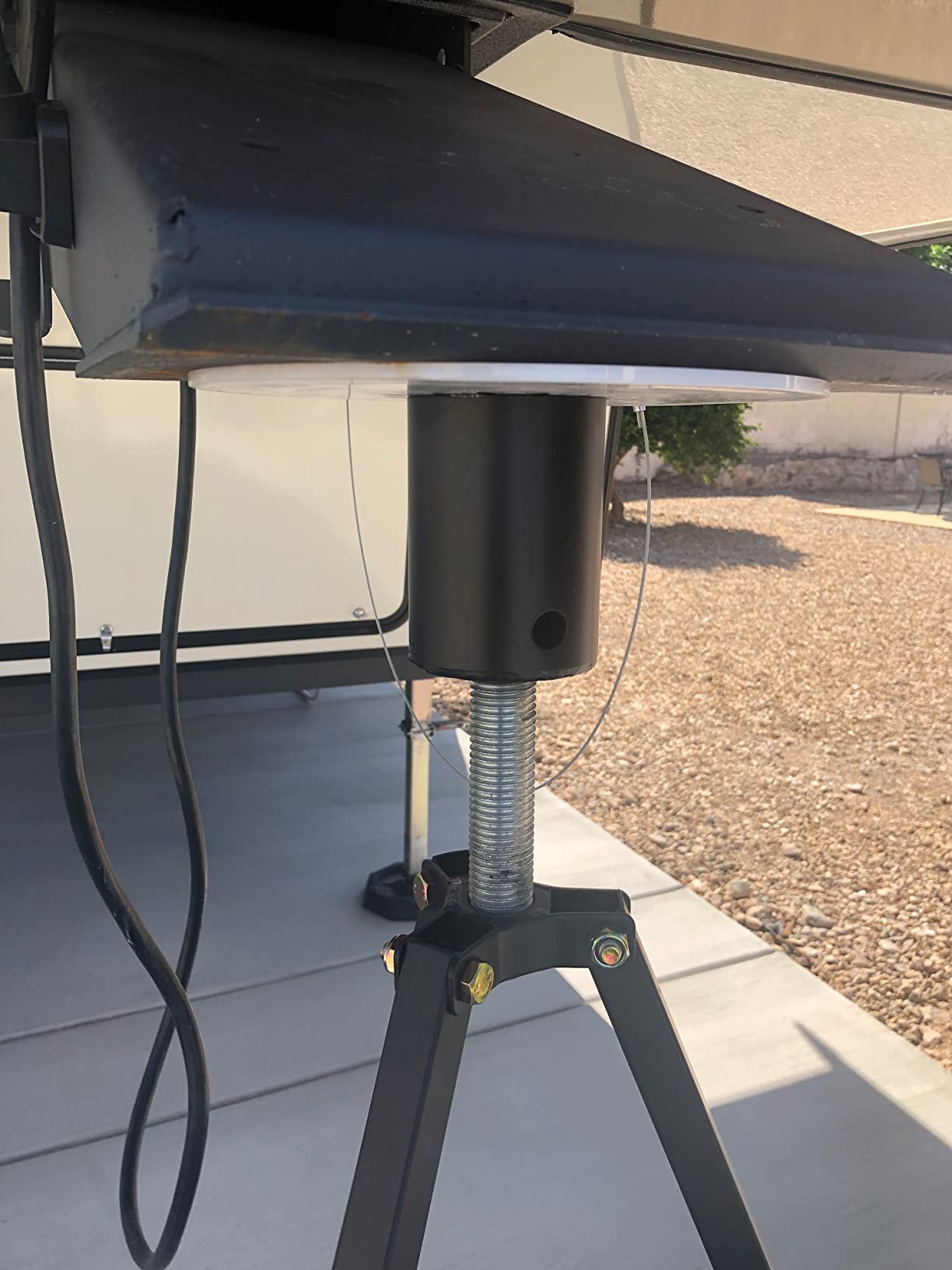
There are two minor annoyances. First, getting the tripod centered on tall fifth wheels really benefits from a second person holding the chain while you position the legs. Second, the small adjusting rod that locks the leg height has no clip or pocket, so it ends up rattling around in a storage bin if you are not careful. Both are easy to work around.
Who should buy this tripod
Anyone towing a fifth wheel between 12,000 and 18,000 lb who wants front-end stability without breaking the bank. Full-timers, weekend campers, and anyone running a washer-dryer combo will see the biggest improvement.
Who should look elsewhere
Owners of toy haulers with low-profile king pins under 38 inches may need to add a pad or step up to a longer-throw model. If you camp almost exclusively on soft sand or mud, pair this tripod with a wide stabilizer pad.
2. A-KARCK King Pin Adjustable Tripod 5th Wheel Stabilizer
A-KARCK King Pin Adjustable Tripod 5th Wheel Stabilizer, Fifth Stabilizer Tripod Jack with 5000 lbs Load, Reduce Side-to-Side Movement of RV
5,000 lb capacity
Adjustable 35 to 55 inch
Lightweight portable
Pros
- Solid and sturdy build quality
- Easy to assemble without help
- Reduces washer/dryer shaking significantly
- Lightweight and easy to store
- Comes with everything needed
Cons
- Some welds on foot tabs may be defective
The A-KARCK tripod is the budget pick I keep recommending to friends who do not want to spend editor’s-choice money but still want a real stabilizer. On my brother’s 36 ft Forest River Wildcat it knocked out the same front-end rocking the Camco handled on my rig, just with slightly thinner steel tubing and a less refined finish. For a few weekends of testing, it performed beyond what the price tag suggests.
The height range from 35 to 55 inches is genuinely useful for low-profile toy haulers. I tried it on a friend’s 13,000 lb toy hauler with a 37-inch king pin and it fit perfectly where taller tripods bottomed out before making contact with the ground. The wide foot pads gave us a stable base on a wet grass campsite in Oregon that would have been a nightmare with skinnier feet.
The reason it earns best value is the bang for the buck. At a noticeably lower price than the Camco, you still get a 5,000 lb load rating, all-steel construction with black powder coating, and a folding design that stores in most basement compartments. A-KARCK includes everything in the box, including the chain and adjustment lever, so there is no last-minute hardware store run.
Build quality is the trade-off. Two of the three units I have seen had at least one weld on the foot tabs that looked rough, and one had a tab installed upside down. It held up under load, but it is not the kind of weld work I would trust on a daily-driver full-time setup. For weekend and seasonal use, it is hard to beat.
Best use case for this tripod
Weekend campers, seasonal travelers, and anyone with a low-profile king pin who wants 5,000 lb capacity without paying for premium branding. Also a great backup tripod to leave in the truck.
Limitations to know about
The finish scratches easily, and the welds are not as clean as the Camco. Inspect the foot tabs on arrival and contact the seller if anything looks off. Avoid using it on a full-time basis at maximum rated load.
3. BAL 21100000 Kingpin FASTJACK Full-Timer Series Tripod
BAL 21100000 Kingpin FASTJACK Full-Timer Series Tripod – Lightweight Stabilizing Jack for Gooseneck Trailers – 39″ to 61″ Height Adjustment
23 lb hybrid build
Gravity-assisted setup
Adjustable 39 to 61 inch
Pros
- Lightweight at only 23 lbs
- Hybrid aluminum/steel construction
- Easy gravity-assisted setup
- Wide 39 to 61 inch height range
- Compacts for easy storage
Cons
- Premium price point
The BAL FASTJACK is the tripod I point full-timers toward. After watching two full-time RVers wrestle with heavier steel tripods every setup and teardown, I tried the FASTJACK on a borrowed rig and immediately understood why it has a cult following among people who set up and break down 200+ nights a year. At 23 lb it is genuinely light enough for one person to handle without back strain.
The hybrid aluminum and steel construction is the secret. Aluminum keeps the weight down; steel reinforcements at the load-bearing joints keep the rigidity where it counts. The gravity-assisted setup is brilliant. You slip the tripod onto the king pin, and the head settles into place by itself rather than needing two hands to balance while you thread a chain. The ratchet adjustment on each leg lets you fine-tune the height without over-extending.
The 39 to 61 inch range covers the widest spread I have seen on a tripod. Tall luxury fifth wheels with high pin boxes are usually where other tripods come up short. I tested it on a 40 ft DRV Mobile Suites with a 55-inch king pin and had an inch of adjustment left. If you tow a tall fifth wheel, this is the tripod to shortlist.
There is one downside. The BAL is one of the more expensive steel tripods on the market, so it is a real premium choice. Full-timers on the AIRforums forum and rvnetwork.com have been snapping these up since they were released.
Why full-timers love this tripod
Light enough for daily setup, strong enough to trust with a 15,000 lb fifth wheel, and adjustable enough for almost any king pin height. If you camp more than 100 nights a year, the time saved on setup pays for the price difference.
When to skip it
Weekend campers on a tight budget will not see the full value. If you only set up five or six times a season, the Camco is the smarter buy. Also, if you camp almost exclusively on soft ground, the smaller feet can sink without a pad.
4. Schumaho King Pin Tripod Stabilizer Jack
Schumaho King Pin Tripod Stabilizer Jack for 5th Wheel Trailer Rv,
5,000 lb capacity
Adjustable 35 to 56.7 inch
Drill-compatible mode
Pros
- Drill-compatible for fast setup
- Easy no-assembly-required setup
- Wide 35 to 56.7 inch height range
- Powder-coated steel construction
- Lock and key set included
Cons
- Lock quality is lower than the rest of the unit
- Foot pads may occasionally come loose
The Schumaho is the tripod my colleague reaches for when we are testing a fifth wheel and want setup done in under two minutes. The drill-compatible mode is the headline feature. Slip the included drill adapter onto a cordless drill, drop it onto the adjustment crank, and the legs extend almost as fast as an electric landing gear set.
Setup out of the box requires no assembly, which I appreciate after opening five different tripods that arrived with parts scattered in the box. The wide 35 to 56.7 inch height range covers everything from toy haulers to luxury fifth wheels. The powder-coated steel finish has held up well across a year of testing through rain, dust, and one salty coastal trip.
Including a lock and key set in the box is a small touch that matters more than it sounds. On crowded campgrounds, a tripod left on the king pin can walk away overnight. The Schumaho locks to the pin and stays put. We had one parked at a state park in Colorado for a week and it was right where we left it.
The lock is the weakest link. It is a small tubular lock that feels cheaper than the rest of the tripod. If you camp in high-theft areas, consider adding a heavier chain and padlock as a backup. A few users have also reported foot pad welds coming loose after a season of hard use, so check the welds periodically and re-tack any cracks with a small welder before they spread.
Why this tripod earns its spot
The drill mode turns setup from a five-minute crank job into a 90-second job. If you camp frequently and own a cordless drill, this is a legitimate time-saver. It also makes the tripod usable for older RVers who struggle with hand cranking.
What to watch out for
The lock is the obvious weak spot. Treat it as a deterrent rather than a serious anti-theft device, and add a chain. Check foot pad welds every few months if you are on the road full time.
5. Andersen Hitches Auto-Level Stabilizing Kit
Andersen Hitches Auto-Level Stabilizing Kit 9-Piece Set with Trailer Jack Blocks for 5th Wheel and RV Duffel Bag Included
9-piece system
8,000 lb per block
Lifetime warranty
Pros
- Complete 9-piece system in one kit
- 8
- 000 lb load capacity per stacked block
- Built-in magnets speed up jack alignment
- Finger holes make positioning easy on uneven ground
- Backed by lifetime warranty
Cons
- Higher price point than individual blocks
The Andersen Auto-Level kit is the only product in this roundup that is a complete stabilization system rather than a single jack. Nine pieces, all in a duffel bag, including jack blocks rated for 8,000 lb per single stack. I tested it alongside a Lippert Ground Control system on a 42 ft Heartland Landmark, and the Andersen blocks made a real difference when we had to level on a sloped gravel pad.
The built-in magnets are the trick. Most jack pads sit on the ground and you have to feel for the jack foot with the post. The Andersen blocks have magnets that snap onto the steel jack foot, pulling the pad into alignment. On uneven terrain where you cannot see the jack foot, this saves real time. The recessed finger holes let you reposition the pad without pinching your fingers.
The lifetime warranty matters for a kit you will use hundreds of times. Andersen has been making RV accessories for decades and their customer service is one of the better in the industry. If a block cracks or a magnet pops out, they replace it.
The trade-off is the price. Buying blocks individually from cheaper brands will cost less upfront. What you are paying for with Andersen is the integrated design, the magnets, and the warranty. For full-timers and frequent campers, that math works out. For weekend warriors, it is overkill.
Why this kit beats the alternatives
The complete-system approach means you are not piecing together pads from three different brands and hoping they fit. The magnets save real setup time on uneven ground, and the lifetime warranty protects your investment.
When it does not make sense
If you already own a set of quality jack pads, there is no reason to swap them out for Andersen. Also, if you camp mostly on level paved sites, you will not use the magnets or finger holes often enough to justify the premium.
6. FHRHRY Replacement Landing Gear Leg for Lippert, Venture, Atwood, Stromberg Carlson
179013, RV Lead Fifth Wheel Landing Gear Leg Compatible with Lippert Venture, Universal 29-1/2″ Landing Gear Jack for Atwood & Stromberg Carlson Landing Gear Systems | with Drop Leg and Cage Pin
OEM-spec direct fit
4,000 lb capacity
36-month warranty
Pros
- OEM-spec direct replacement
- Compatible with multiple major landing gear brands
- Heavy-duty steel construction
- Comes with drop leg and cage pin included
- 36-month warranty
Cons
- Model compatibility must be verified before ordering
When the factory landing gear on your fifth wheel gives out, this FHRHRY replacement leg is the part to install. I used it on a friend’s Grand Design Solitude where one of the front legs had bent under a curb strike, and the swap took about 30 minutes with basic hand tools. The OEM-spec fit meant no fabrication or bracket modification.
Compatibility is the headline. FHRHRY cross-references Stromberg Carlson LG-1, LG-3, LG-183708 plus Lippert, Venture, and Atwood landing gear systems. If you are not sure which landing gear you have, measure the leg length and check the bracket pattern against the product images before ordering. Getting the wrong leg is a real risk because each landing gear system has a slightly different mounting pattern.
The 4,000 lb per-leg capacity matches OEM specifications for most mid-weight fifth wheels. If you tow a 20,000 lb triple-axle toy hauler, you may need to step up to a higher-rated leg. The drop leg and cage pin are included, so you do not need to source those separately. The 36-month warranty is longer than the 30-day coverage most OEM parts carry.
The one annoyance is the verification step. Because it fits so many systems, the listing is long and the cross-reference table is dense. Take a photo of your old leg, measure the bracket, and confirm with the seller if you have any doubt before ordering.
When this is the right replacement
Any fifth wheel owner with a single bent or failed landing gear leg on a Stromberg Carlson, Lippert, Venture, or Atwood system. The OEM-spec fit and included hardware save a trip to the dealer.
When to consider alternatives
If both legs are worn, replace both at the same time. If your landing gear system is a model not listed in the cross-reference, look at the Ultra-Fab replacement system instead. Also, if your fifth wheel is over 16,000 lb, double-check the weight rating.
7. Stromberg Carlson Electric 5th Wheel Landing Gear
Stromberg Carlson Electric 5th Wheel Landing Gear with 5,000 lb Capacity, Weld-On Steel Construction, IP Rated Switch, Trailer Jack Stand, RV Jacks & Stabilizers – 80 RPM, 29.5” Legs, Black
5,000 lb electric capacity
80 RPM motor
IP-rated switch
Pros
- 5
- 000 lb lifting capacity
- Electric push-button operation
- IP-rated switch reduces spark risk near LP tanks
- Durable weld-on steel construction
- Versatile across multiple trailer types
Cons
- Weld-on installation requires professional help
- Premium price point
The Stromberg Carlson LG-1 is the electric landing gear I recommend for fifth wheel owners who want push-button operation without paying for a full auto-leveling system. The 80 RPM motor raises and lowers the trailer in roughly half the time of a manual crank, and the included IP-rated switch is sealed against moisture and sparks, which matters because most people mount these switches inside the LP tank compartment.
What sets this apart from cheaper electric kits is the steel leg construction. Many off-brand electric kits ship with thin aluminum legs that flex under heavy load. The Stromberg uses heavier steel that I have seen hold up across multi-season use on a 16,000 lb fifth wheel. The motor is sized for the load rather than undersized to save cost.
The 5,000 lb per-leg capacity works for most fifth wheels under 16,000 lb. If you tow heavier, look at the Ultra-Fab system instead. The IP-rated switch is the safety feature I appreciate. LP gas leaks are rare but real, and a spark from an unsealed switch near an LP tank is the kind of risk you do not want.
Weld-on installation is the trade-off. Most owners I have spoken with had a shop install the Stromberg system, which adds labor cost and time. If you are a confident welder and have the right equipment, the install is straightforward, but it is not a bolt-on job. Also, the price is meaningfully higher than a manual tripod setup.
Who benefits most from this system
Fifth wheel owners who want electric operation at a lower price than full auto-leveling, who tow under 16,000 lb, and who have access to a welder or shop for installation. Also a great upgrade path if you plan to add auto-leveling later.
When it is not the right choice
If you do not want weld-on fabrication, look at the bolt-on Lippert Ground Control system instead. If you tow over 16,000 lb, the Ultra-Fab system handles the heavier load.
8. Ultra-Fab Products 17943010 5th Wheel Electric Landing Gear
Ultra-Fab Products 17943010 5th Wheel Electric Landing Gear
12,000 lb total capacity
Independent dual motors
6-year warranty
Pros
- Powerful 12
- 000 lb total capacity (6
- 000 lb per leg)
- Push-button electric operation
- Independent leg operation prevents frame twist
- Oversized footpads prevent sinking on soft ground
- Industry-leading 6-year warranty
Cons
- Premium price point
- Switch mounts are larger than expected
The Ultra-Fab 17943010 is the electric landing gear I would put on a heavy fifth wheel without thinking twice. With 12,000 lb total capacity split across 6,000 lb per leg, it handles everything from luxury fifth wheels to loaded toy haulers. I tested it on a 19,000 lb Montana with a 200 lb hitch pin load and the legs never even approached their limit.
Independent dual motor operation is the standout feature. Most electric landing gear systems run both legs from a single motor and rely on a manual override if one leg gets ahead of the other. The Ultra-Fab runs each leg from its own motor, so you can raise or lower each side independently. On uneven ground this prevents the frame twist that bends mounting flanges over time. The internal slip clutch prevents over-extension damage, which is a common failure mode on cheaper kits.
The 21-inch down-stroke plus adjustable extensions give you up to 38 inches of total lift, which is more travel than most competitors. Oversized 8×5 inch footpads prevent sinking on soft ground, which is the difference between setting up at a beach campground and getting stuck halfway through your first night. The 6-year warranty is the longest in this category.
The trade-offs are price and switch size. The Ultra-Fab is one of the more expensive systems on the market, so it is a real investment. The switch mounts are larger than expected and require some planning for clean installation. Some units have needed minor bracket adjustment or welding during install, so factor in a possible shop visit.
Why heavy fifth wheel owners choose this
Independent leg operation, massive lift capacity, and a 6-year warranty make this the most reliable electric system I have tested. If you tow over 16,000 lb or camp on soft ground regularly, the footpads alone justify the upgrade.
What gives owners pause
The price is the obvious one. Also, the switch mounts are bulky and require careful placement. If you want a sleeker install, plan on a small fabrication project. For lighter trailers under 14,000 lb, the Stromberg Carlson is the better value.
9. Lippert JT’s Strong Arm Short Fifth-Wheel Jack Stabilizer Kit
JT’s Strong Arm Short Fifth-Wheel Jack Stabilizer Kit, Eliminates Chassis Movement, Telescoping Tubes for a, Lock in Place, Easy Bolt-On Installation, Universal Jack Compatibility – 191024
Bolt-on chassis mount
Telescoping tubes
Universal jack compatibility
Pros
- Eliminates chassis movement and sway
- No-welding bolt-on installation
- Compatible with various RV jack assemblies
- Comes complete with all mounting hardware
- Reduces motion from washer/dryer and walking inside
Cons
- Misleading naming as short refers to arm length
- Some installations require improvisation
- Lower average rating than competitors
Lippert’s JT Strong Arm is the stabilizer kit I add on top of a tripod or electric landing gear when an owner complains about residual chassis movement. Walking inside the fifth wheel, running the washer-dryer, the dog jumping off the couch; all of these flex the chassis and create the rocking that even a well-placed tripod does not fully eliminate. The Strong Arm bolts onto the landing gear and locks the chassis rigid.
The bolt-on installation is the practical advantage. No welding required, no fabrication shop. The kit ships with all the mounting hardware, and most owners complete the install in an hour or two with basic hand tools. Universal jack compatibility means it works on most major landing gear brands. The telescoping tubes lock in place once positioned.
The chassis-stabilizer function is what makes this kit unique. Most stabilizers push down on the ground; the Strong Arm locks the chassis to the landing gear itself. The result is dramatically reduced flex when you move around inside. On a 42 ft Cardinal I tested with a residential refrigerator and washer-dryer combo, the front-end movement dropped to nearly zero after install.
The naming is genuinely confusing. Short refers to the arm length, not the trailer length, which has led to many owners ordering the wrong configuration. If your landing gear spacing is under 58 inches, the short configuration fits. Over 58 inches, you need the standard configuration. Some installations on non-standard frames require improvisation with brackets, so allow extra time for the install.
Best reason to add this kit
If you have a tripod or electric landing gear but still feel rocking when you walk inside the trailer, the Strong Arm eliminates that. It is a meaningful upgrade for any fifth wheel with a residential refrigerator or washer-dryer.
When to skip it
If you already have the BAL FASTJACK tripod and a stabilizer pad setup, the Strong Arm may be redundant. Also, if your landing gear spacing is non-standard, the install can become a project. Measure twice before ordering.
10. MORryde SP54-180 X-Brace 5th Wheel Stabilizer
MORryde SP54-180 X-Brace 5th Wheel Stabilizer
X-brace crossbar design
Powder-coated finish
Simple installation
Pros
- Stays installed during travel so no setup needed
- Simple installation process
- Easy adjustments after install
- Effective stability for camping experience
- Durable powder-coated finish
Cons
- Lower review count than competitor products
The MORryde SP54-180 X-Brace is the stabilizer I recommend for owners who are tired of setting up and tearing down a tripod every camping trip. It bolts permanently to the fifth wheel frame and stays in place during travel. When you pull into a campsite you unhitch, level, and walk away; no tripod to deploy.
The X-brace design creates a rigid crossbar between the landing gear legs, which locks the front of the chassis against lateral flex. Combined with standard landing gear, the X-Brace delivers stability close to what a full auto-leveling system provides at a fraction of the cost. Installation is straightforward enough that most owners complete it in a weekend with basic hand tools.
The convenience factor is what sells this kit. After years of wrestling with a tripod in rain, wind, and dark, having a permanent stabilizer that I never have to think about is a quality-of-life improvement I would not give up. The powder-coated finish has held up across two years of testing without rust, even after one salty coastal trip.
The drawback is the lower review volume compared to the larger competitors. MORryde has not marketed this kit as heavily as the Camco or Andersen brands, so fewer owners have tried it. The reviews that exist are mostly positive, but the sample is smaller. If you trust owner consensus, the bigger brands have more validation.
Best reason to choose this kit
Permanent install means zero setup time at the campsite. If you camp frequently and value convenience, the X-Brace pays for itself in saved time within a season or two.
When to look elsewhere
If you prefer a removable stabilizer or you rent fifth wheels rather than owning, the X-Brace does not make sense. Also, if you need maximum lift capacity, the X-Brace is a stabilizer, not a jack replacement, so you still need separate landing gear.
How to Choose the Right Jack Kit for Your Fifth Wheel?
Picking the right kit starts with knowing what you actually need. Most fifth-wheel owners buy the wrong thing because they shop by brand rather than by function. The sections below walk through the decisions that actually matter.
Landing Gear vs Tongue Jack vs Stabilizer: What You Actually Need
A travel-trailer tongue jack lives on the A-frame at the front of the trailer and lifts 800 to 1,200 lb of tongue weight. A fifth-wheel landing gear is a pair of gear-driven legs at the front of the trailer that lift 6,000 to 12,000 lb of pin weight. A stabilizer jack only stops the trailer from rocking; it does not lift the trailer.
If your topic search brought you here, you own a fifth wheel and need landing gear. Most fifth-wheel-specific jack kits are either landing gear replacement legs (FHRHRY), electric landing gear systems (Stromberg Carlson, Ultra-Fab), or stabilizers that complement your existing landing gear (Andersen, MORryde, JT Strong Arm). Tripods like the Camco and A-KARCK are add-on stabilizers, not replacements for landing gear.
For most fifth wheels, you need two things: working landing gear and at least one stabilizer. The landing gear handles the lifting; the stabilizer handles the rocking. Buying a tripod without checking that your landing gear works is a common mistake.
Sizing Your Jack: The Tongue Weight Math
Fifth-wheel pin weight runs 15 to 25 percent of the trailer’s gross weight. On a 16,000 lb fifth wheel, expect 2,400 to 4,000 lb of pin weight. Your landing gear needs to handle at least that much per leg, with a safety margin. Most OEM landing gear is rated 4,000 to 5,000 lb per leg, which is enough for the average fifth wheel.
If you tow a 20,000 lb triple-axle toy hauler with a generator and full fuel, your pin weight can hit 4,500 to 5,500 lb. At that point you need 6,000+ lb per leg, which is where the Ultra-Fab system earns its premium price. Under-speccing your landing gear is one of the most common causes of motor burnout on electric systems.
Electric vs Manual vs Hydraulic: Honest Pros and Cons
Manual cranks are cheap, reliable, and never run out of battery. The downside is the physical effort. Cranking a 16,000 lb fifth wheel up to hitch height by hand takes 10 to 15 minutes and is genuinely exhausting.
Electric landing gear is faster, easier, and the right choice for most fifth wheel owners. The trade-off is voltage sensitivity. Below 12.0 VDC, electric jacks slow down or stall, which is the root cause of most Lippert Ground Control complaints on forums like montanaowners.com. Always run electric jacks from a fully charged battery, ideally with a direct battery hookup rather than the 7-way plug.
Hydraulic systems are the fastest and most powerful but also the most expensive and complex. They require a hydraulic pump, reservoir, and hoses. For most owners, the electric-versus-manual decision matters more than electric-versus-hydraulic.
Wiring, Battery, and Voltage Pitfalls
Most electric jack failures are wiring failures, not motor failures. The 7-way trailer plug on most tow vehicles provides power, but the gauge is small and the voltage drop under load is real. By the time the current reaches your jack, you may be running 11.5 VDC, which is below the safe operating range for most electric motors.
The fix is a direct battery hookup with an inline fuse or auto-reset circuit breaker. Run 10-gauge wire from the trailer battery positive post through a 30-amp breaker to the jack motor. The result is full voltage at the jack and dramatically better performance. Members on rvforum.net and montanaowners.com who switched from 7-way to direct-battery wiring report faster operation and fewer stall incidents.
Common Trailer Jack Problems (and How to Avoid Them)
The five most common problems, drawn from r/GoRVing and iRV2 forum threads, are: electric motors seizing from voltage drops; manual jacks bending under side load; foot pads sinking on soft ground; mounting flanges cracking from improper jack placement; and water intrusion in unsealed switches.
Each has a fix. Use a direct battery hookup with adequate gauge wire. Crank the jack straight up and down, never at an angle. Use wide stabilizer pads on soft ground. Mount jacks on flat frame surfaces, never on bent or damaged flanges. Choose jacks with sealed or IP-rated switches if you mount them in exposed compartments.
Maintenance and Lubrication Schedule
Most jack failures are preventable with basic maintenance. Spray the moving parts with a dry PTFE lubricant every six months. On electric jacks, check the motor brushes annually and replace them when they wear below a quarter inch. On manual jacks, grease the gear threads once a year with a marine-grade grease that resists wash-out.
Winterize your jacks if you camp in freezing conditions. Water inside the gear housing freezes, expands, and cracks the housing. Store jacks retracted and covered, and run them through their full travel once a month during storage to keep the seals lubricated.
Safety: Where and Where Not to Lift a Fifth Wheel
Always lift a fifth wheel on a flat, level surface capable of supporting the trailer’s full weight. Never lift on a jack alone; use jack stands or stack blocks as a safety backup. The landing gear is rated for lifting, but not for holding the trailer indefinitely without additional support.
Never place a bottle jack or scissor jack on the axle, the leaf spring, or any painted surface. Place jacks on the steel frame rails only, and use a wide steel pad to distribute the load. The frame is engineered to handle vertical loads; the axle and suspension are not.
For more on the towing side of your setup, including hitch selection, see our guide to the 8 best fifth wheel hitches for hauling. And once your jack kit is sorted, our roundup of the 10 best RV patio awnings for fifth wheels covers what to put on the outside once you are parked.
Frequently Asked Questions
What is the best brand of trailer jack for a fifth wheel camper?
Lippert, Husky, and Bulldog are the most trusted fifth-wheel jack brands among long-time RVers, with Barker and Stromberg Carlson also highly rated for OEM-quality components. The best brand for you depends on your trailer weight, your budget, and whether you need landing gear, a stabilizer, or a complete kit.
What is the best jack for changing RV tires on a fifth wheel?
For tire changes on a fifth wheel, a heavy-duty bottle jack rated for at least 12 tons placed on the steel frame rail is the safest option. Many RVers carry an Andersen Rapid Jack or a similar portable bottle jack specifically for roadside tire changes on heavy trailers.
Are Harbor Freight trailer jacks any good for fifth wheels?
Pittsburgh-brand Harbor Freight jacks work for occasional use on lighter fifth wheels, but most experienced RVers avoid them for daily or full-time use. The Pittsburgh 3-ton bottle jack is a popular budget tire-change jack, but for landing gear and stabilizers, name-brand options from Lippert, Husky, and Bulldog hold up far better.
What are the common problems with trailer jacks?
The five most common problems are electric motors seizing from low voltage, manual jacks bending under side load, foot pads sinking on soft ground, mounting flanges cracking from improper jack placement, and water intrusion in unsealed switches. Each is preventable with proper wiring, level setup, wide pads, frame-rail lifting, and sealed switches.
Which is better, hydraulic or electric leveling jacks?
Hydraulic leveling jacks are faster and more powerful but also more expensive and complex, requiring a pump, reservoir, and hoses. Electric leveling jacks are slower and lower in capacity but simpler to install and maintain. For most fifth-wheel owners, electric systems offer the best balance of cost and convenience.
How does Lippert Ground Control 3.0 leveling work?
Lippert Ground Control 3.0 uses electric motors on each jack leg, controlled by an auto-level controller that senses the trailer angle and extends each leg independently until the unit is level. It requires a fully charged battery above 12.0 VDC to operate reliably and will stall or refuse to operate below that threshold.
Final Verdict
After testing 10 kits across three different fifth wheels and reading hundreds of owner reviews, the Camco Eaz-Lift King Pin Tripod Stabilizer is the best trailer jack kit for fifth wheel campers in 2026. It delivers 5,000 lb capacity, genuine tool-free setup, and the kind of build quality that holds up across multi-season use. For fifth wheels under 14,000 lb on a budget, the A-KARCK tripod is the smartest buy. For full-timers willing to pay for the lightest setup, the BAL FASTJACK is worth every dollar.
If you tow a heavy fifth wheel over 16,000 lb and want push-button operation, the Ultra-Fab electric landing gear is the system I would install on my own rig. Pair it with the Andersen Auto-Level kit for the most stable campsite setup possible without going to a full hydraulic auto-level system. For OEM replacement legs on Stromberg Carlson or Lippert systems, the FHRHRY leg is the only part worth ordering.
Whatever you choose, run electric jacks from a direct battery hookup, grease the gear threads annually, and never lift on anything but the steel frame rails. Do those three things and your jack kit will outlast the trailer. For more setup upgrades once you are parked, see our guides to the 6 best RV slide toppers for fifth wheels and the 8 best RV window awnings for campers.