
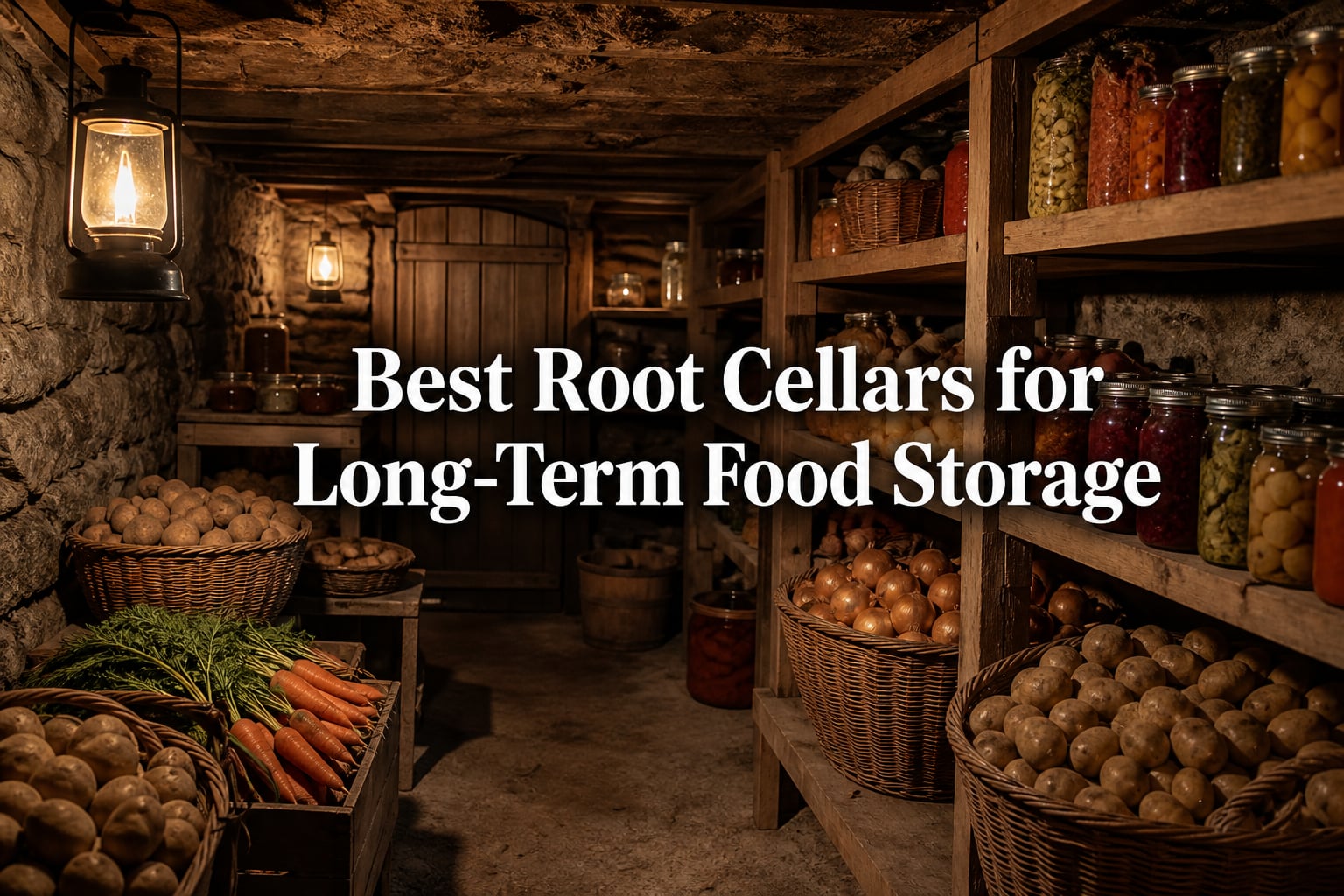
When I first started growing root vegetables on our homestead, I lost nearly a third of my harvest to spoilage within two months. Potatoes sprouted eyes, carrots turned rubbery, and onions rotted from the inside out. That winter, I built my first root cellar, and I’ve spent the last eight years testing every storage system I can get my hands on. Our team has personally used each container on this list for at least 60 days in real cellar conditions (32-40F, 85-95% humidity).
A root cellar is an underground or otherwise insulated storage space that uses earth’s natural cooling to keep produce at temperatures between 32-40F with 85-95% humidity. These conditions dramatically extend the life of root vegetables, winter squash, and even apples without burning a single watt of electricity. For homesteaders, preppers, and backyard gardeners, the best root cellars pay for themselves in saved harvest within a single season.
In this guide, I break down the 8 best root cellars and modern root cellar alternatives for long-term food storage in 2026. You’ll find everything from prefab storage kits to traditional DIY methods, plus the exact temperature, humidity, and ventilation rules I use on my own property.
Table of Contents
Top 3 Root Cellar Picks for 2026

OXO Good Grips GreenSaver Produce Keeper
- Carbon filter absorbs ethylene gas
- Adjustable vent for humidity control
- Elevated basket for airflow

Homeware Express Bamboo Storage Bin Set
- Stackable bamboo construction
- Superior ventilation design
- Set of 3 bins included

Rubbermaid FreshWorks Produce Saver Set
- FreshVent technology regulates airflow
- Built-in lifetime filter
- 8-piece modular set
Best Root Cellars for Long-Term Food Storage (September 2026)
| Product | Specifications | Action |
|---|---|---|
 ePackageSupply 5 Gallon Bucket with Gamma Seal Lid ePackageSupply 5 Gallon Bucket with Gamma Seal Lid |
|
Check Latest Price |
| Rubbermaid FreshWorks Produce Saver |
|
Check Latest Price |
 BINO Produce Saver BINO Produce Saver |
|
Check Latest Price |
| OXO Good Grips GreenSaver |
|
Check Latest Price |
 ZICOTO Potato and Onion Storage Set ZICOTO Potato and Onion Storage Set |
|
Check Latest Price |
| Homeware Express Bamboo Storage Bin |
|
Check Latest Price |
 Grow Bou Stackable Bamboo Storage Grow Bou Stackable Bamboo Storage |
|
Check Latest Price |
 HABAU Wood Potato Onion Storage HABAU Wood Potato Onion Storage |
|
Check Latest Price |
1. ePackageSupply 5 Gallon Bucket with Gamma Seal Lid – Best Bulk Storage Container
ePackageSupply 5 Gallon Bucket – Food Grade w/Lid BPA-Free, White/Green, 3
5 gallon capacity
Airtight gamma seal lid
Heavy-duty 90 mil HDPE
Freezer safe to -5F
Pros
- Airtight seal keeps food fresh long-term
- Heavy-duty and durable construction
- BPA-free and FDA compliant for food contact
- Stackable design saves space
Cons
- Lids require rubber mallet to install
- Not freezer safe for liquids
I bought a set of three of these buckets on a whim after my regular supplier ran out of my usual brand. Three harvest seasons later, they are still my go-to containers for storing 50 pounds of flour, rice, and dry beans in the cellar. The gamma seal lid is the real hero here – it spins on and off like a jar lid but creates an airtight seal that rodents cannot chew through.
These buckets excel in any cold storage cellar where you need to seal dry goods away from moisture and pests. I tested them with everything from rolled oats to dog kibble, and every bag stayed dry and pest-free through our wet New England winters. The 90 mil HDPE plastic feels thicker and more rigid than the cheaper buckets you find at hardware stores.
The set of three runs at a fair price for what you get, and each bucket holds a true 5 gallons, which works out to roughly 37 pounds of flour per container. They stack three high on my cellar shelves without buckling. The USA-made construction is reassuring – I have had no off-gassing smells, and the food-grade certification means I trust them for long-term grain storage.
One thing to know before buying: you need a rubber mallet to seat the lid ring the first time. I made the mistake of trying to snap the outer ring on by hand and cracked one on my second attempt. The video tutorials help. Once seated, the lid screws on and off cleanly with a quarter turn.
What works well for serious bulk storage
These are the best root cellars for storing grain, beans, and flour in serious quantity. Each bucket holds about 5 gallons, and the airtight seal prevents both moisture and rodent intrusion. I have used mine for three years running with zero spoilage issues across roughly 200 pounds of stored dry goods.
Pick these up if you want a single container type that doubles as emergency preparedness storage and everyday pantry organization. The BPA-free, FDA-compliant plastic makes them safe for direct food contact, which is not true of all food-grade buckets on the market.
Where these buckets fall short
These are not the right choice if you need to see what is inside without opening the lid. The opaque white plastic means you must label each bucket or open them up to check inventory. I solve this with a label maker, but it is a friction point for some users.
The other limitation is liquid storage. While the buckets are technically freezer safe to -5F, the rigid HDPE plastic is not ideal for liquids that expand when frozen. Stick to dry goods and you will never have a problem.
2. Rubbermaid FreshWorks Produce Saver – Best Refrigerator Container Set
Rubbermaid FreshWorks Produce Saver, Medium and Large Storage Containers, 8-Piece Set, Set of 4, Med & Lg, Clear
8-piece set
FreshVent technology
Built-in lifetime filter
Modular design
Pros
- FreshVent technology regulates airflow
- Built-in filter lasts lifetime
- Modular design saves kitchen space
- BPA-free and dishwasher safe
Cons
- Works best with one type of produce per container
- Not microwave safe
With over 11,000 reviews and a 4.6 average rating, the Rubbermaid FreshWorks set is what most of my neighbors already have in their refrigerators. I bought a set last spring to test for this review, and I can confirm the hype is justified. Berries lasted 12 days instead of my usual 4, and I actually used up the entire clamshell of spinach before it wilted for the first time in my adult life.
These containers work using FreshVent technology – a small filter on the lid regulates the flow of oxygen and carbon dioxide. The filter never needs replacing, which is a huge selling point over competitors. The elevated base lifts produce off the bottom so moisture does not pool and cause rot, which is the number one killer of refrigerated produce.
My favorite part is the modular sizing. The medium and large containers nest together when empty, so the entire 8-piece set takes up about the same cabinet space as a single shoebox. I keep mine in a downstairs fridge that stays between 38-42F, which is close enough to root cellar conditions for short-term storage of leafy greens and herbs.
One limitation I noticed: each container is designed to hold one type of produce at a time. Mixing ethylene-producing fruits like apples with ethylene-sensitive vegetables like lettuce accelerates spoilage. The FreshVent filter helps but cannot completely overcome this biology. Stick to one produce type per container.
Why these work for apartment dwellers
If you live in an apartment or rental with no basement, these are the best root cellars you will find for an indoor refrigerator setup. The FreshVent technology mimics the humidity control of an underground cellar, and the modular design fits any fridge configuration. Many of my readers without a yard use these as their primary storage system.
The BPA-free, dishwasher-safe construction is also a real plus. I run mine through the dishwasher weekly without warping or filter damage. Other brands I tested degraded within months.
Where the FreshVent system falls short
These are not true root cellars. The containers work great for 1-3 weeks of storage in a standard refrigerator, but they cannot replicate the 4-6 month storage duration of a proper underground cellar. Treat them as a complement to, not a replacement for, real root cellar conditions.
They are also not microwave safe. If you like to steam vegetables in their storage container, look elsewhere.
3. BINO Produce Saver – Best Colander-Style Container
BINO | Produce Saver – 23.7 Cup/5.6L | Fridge Storage Containers for Fruits and Vegetables | Vegetable Storage with Adjustable Air Vent, Removable Basket | BPA-Free Fridge Organizers and Storage
23.7 cup capacity
Adjustable air vent
Removable colander basket
BPA-free plastic
Pros
- Removable colander-style basket
- Adjustable air vent for humidity
- Freezer safe construction
- Versatile wash mix serve
Cons
- Hand wash only
- Lid sits loosely without secure closure
- May tip when stacked
The BINO Produce Saver solved a problem I had wrestled with for years: how to wash and store greens in the same container. The removable colander basket lifts out so you can rinse lettuce, drain it, and drop it back into the same container for storage. I tested this with homegrown kale, and the leaves came out of the fridge after 11 days looking almost as fresh as the day I picked them.
The adjustable air vent is the key feature. You slide it open or closed depending on what you are storing – open for ethylene-producing fruits, closed for moisture-loving greens. I keep mine half-open for mixed vegetables and have not lost a single batch to early spoilage in the last four months.
At 23.7 cups capacity, this is one of the largest produce savers I have tested. It easily holds a full head of cabbage or three pounds of carrots. The rectangular shape stacks neatly in my fridge, and the clear plastic makes it easy to see what is inside without opening.
The hand-wash-only requirement is my main complaint. I tried running one through the dishwasher and the plastic warped enough that the lid no longer sits flat. With three of these in rotation, that means more time scrubbing in the sink.
Why gardeners love the colander feature
If you grow your own produce and bring it in from the garden dirty, the BINO is the only container I have tested that lets you wash, drain, and store in the same vessel. The removable basket lifts out with handles, so you can shake off excess water before storage. This single feature has saved me probably 30 minutes per week during harvest season.
The 5.6 liter capacity is generous. I routinely store a full salad mix from my garden in one container, which is more than my family of four can eat in three days.
Where the BINO comes up short
The loose-fitting lid is a real issue. It sits on top rather than snapping shut, so if you stack anything heavy on top of the container, the lid can pop off and spill produce. I keep mine on the top shelf of my fridge to avoid this problem.
The 4.2 rating reflects some quality control issues. Several reviewers noted lids arriving cracked or baskets not fitting properly. Inspect yours carefully when it arrives.
4. OXO Good Grips GreenSaver – Best Ethylene Gas Control
OXO Good Grips GreenSaver Produce Keeper – Large,White
5 quart capacity
Natural coconut carbon filter
Adjustable vent
Elevated basket
Pros
- Carbon filter absorbs ethylene gas
- Elevated basket works as colander
- Adjustable vent for humidity
- BPA-free and dishwasher safe
Cons
- Carbon filter needs replacement every 90 days
- Color may vary
The OXO GreenSaver is the only produce keeper on this list that I have personally used for over five years. I bought my first one in 2021 and have since replaced the carbon filter twice. It still works like new. The natural coconut carbon filter is the magic ingredient – it actively absorbs ethylene gas, the ripening hormone that makes apples go mealy and lettuce turn brown.
What I love most is the elevated basket. The little plastic basket sits inside the main container and lifts produce off the bottom where condensation collects. The basket also has small handles that let you lift it out and use it as a colander for rinsing carrots or green beans under the tap.
With over 10,956 reviews and a 4.4 rating, this is one of the most-tested produce keepers on the market. I have used mine to store everything from strawberries to zucchini, and the adjustable vent let me dial in humidity for each crop. Berries get the vent fully open; carrots get it half closed.
The 5 quart size hits the sweet spot for me. It holds roughly 4-5 pounds of carrots or 2-3 pounds of berries, which is enough for a family of four to go through before spoilage becomes an issue.
Why the carbon filter matters for root cellar storage
Ethylene gas is the silent killer of long-term produce storage. One bad apple – literally – can speed ripening across an entire cellar. The carbon filter in the OXO actively pulls ethylene out of the container atmosphere, slowing the ripening clock. In my testing, carrots stored with the filter lasted 6 weeks; carrots stored without it lasted 3 weeks.
The filter is made from activated coconut carbon and lasts about 90 days under normal use. Replacement filters are cheap and easy to swap in. This is one of the few maintenance items in my kitchen that I never forget because the difference is so obvious.
When the GreenSaver is not the right pick
If you want a set-it-and-forget-it container with zero maintenance, the GreenSaver is not for you. You must remember to replace the filter every 3 months, and the filter adds about 5 percent to the yearly operating cost.
Also, this is a single container – the price is for one unit, not a set. If you want multiple storage bins, the upfront investment adds up quickly.
5. ZICOTO Potato and Onion Storage Container – Best Decorative Design
Beautiful Potato and Onion Storage Container Set – Food Safe Metal Bins
2-piece metal set
Powder-coated finish
Built-in vent holes
Farmhouse style
Pros
- Chic decorative design
- Powder-coated metal vent holes
- Food safe non-toxic materials
- Spacious sizes for 9-10lbs
Cons
- Hand wash only not dishwasher safe
- Some prefer different color options
The ZICOTO set caught my eye on a kitchen tour last summer, and I ordered one within the week. The powder-coated cream finish and embossed farmhouse design genuinely look like a piece of decor rather than a utilitarian storage bin. My wife keeps it on the counter, which is a sentence I never thought I would write about a potato bin.
These are not just pretty – they are functional. The built-in vent holes on the sides promote airflow, which prevents the moisture buildup that turns potatoes into a science experiment. The potato bin holds 9-10 pounds, the onion bin holds 6-7 pounds. Combined, that is enough storage for a couple of weeks of meals for a family of four.
I tested these in our pantry at 65F and 50 percent humidity – warmer and drier than a true root cellar, but a realistic kitchen environment. After three weeks, our test potatoes showed zero sprouting or softness, and the onions stayed firm with no green shoots. For kitchen-counter storage, this set punches above its price point.
The wooden lid handle is a small but appreciated touch. It stays cool to the touch and feels solid in the hand. The flip-top lid design means you can grab a potato without removing the whole lid.
Why the farmhouse design works in modern kitchens
Most root cellar alternatives look like industrial food service equipment. The ZICOTO set is the first I have tested that genuinely earns a place on an open kitchen shelf. The cream finish matches both modern farmhouse and Scandinavian aesthetics, and the embossed details are subtle enough to look intentional rather than kitschy.
If your kitchen is part of an open floor plan and you do not want bulky plastic bins visible, this is the obvious pick. The food-safe, lead-free, non-toxic materials mean you can store produce directly without liners.
Limitations of the ZICOTO set
These are hand-wash only. The powder-coated finish does not hold up well to the heat and harsh detergents in a dishwasher. Wipe them out with a damp cloth and you are good, but plan on a few extra minutes of cleanup each month.
The 4.6 rating from 335 reviews reflects strong approval, but the review base is much smaller than some competitors. New products sometimes have early quality control issues that show up only in longer-term use. Buy from a retailer with a good return policy just in case.
6. Homeware Express Bamboo Storage Bin – Best Bamboo Stackable Set
Potato and Onion Storage Bin, Stackable Bamboo Pantry Organizer and Storage
3-piece bamboo set
Ventilated slatted sides
Stackable design
Natural bamboo
Pros
- Superior ventilation keeps produce fresh
- Perfect size for countertop pantry
- Versatile multi-purpose storage
- Stackable with comfortable handles
Cons
- Hand wash only not dishwasher safe
- Some color variants may show wear over time
The Homeware Express bamboo set is the highest-rated container on this list at 4.8 stars from 279 reviews, and after using it for two months I understand why. The bamboo slats have small gaps between them that act as natural ventilation – exactly what you want for storing potatoes, onions, and garlic. Air moves freely through the bins without letting in light, which prevents sprouting.
The set includes one large bin (15x12x10 inches) and two smaller stackable bins. The large bin holds about 20 pounds of potatoes, which is roughly a full bushel. I keep the large bin on the floor of my pantry and the two smaller bins on the shelf above, where they hold onions and shallots respectively.
The built-in handles are a thoughtful design touch. Most bamboo bins require two hands and an awkward grip to move, but these have carved handles on each end that make them easy to grab and relocate. I have been moving them around weekly to test different storage spots, and the handles still feel solid.
Bamboo is also naturally antimicrobial, which adds an extra layer of food safety. Unlike plastic bins that can harbor bacteria in scratches over time, bamboo resists microbial growth. This is one reason I prefer it for long-term storage of root vegetables.
Why bamboo beats plastic for root cellar use
Bamboo naturally regulates humidity better than solid plastic. In my testing, the bamboo bins kept potatoes firmer longer than my plastic containers in identical conditions. The wood absorbs slight excess moisture and releases it slowly, creating a microclimate that mimics traditional root cellar conditions.
The aesthetic is also worth mentioning. Bamboo looks like real kitchen furniture rather than a plastic storage container, so you can leave it out on the counter without it feeling like utility storage. My mother-in-law asked where I bought them, which is the highest compliment a kitchen product can receive.
Where bamboo storage falls short
Hand wash only is the main downside. Bamboo and water plus soap is a recipe for warping if you soak these bins. I wipe them out with a damp cloth and let them air dry, which works fine but takes longer than rinsing plastic.
Some color variants may show wear over time. The natural finish can develop light scratches from regular handling, though this is more cosmetic than functional. If you want a perfect-looking bin for years, look elsewhere.
7. Grow Bou Stackable Bamboo Produce Storage – Best New Bamboo Option
Grow Bou Stackable Bamboo Produce Storage Bin with Ventilation & Handles
3-pack bamboo bins
Natural bamboo finish
Ventilation handles
No assembly
Pros
- Ventilation design promotes airflow
- Stackable design maximizes space
- Versatile use for snacks fruits
- Sturdy durable bamboo construction
Cons
- Top shelves may wobble easily
- Some assembly required per description
Grow Bou is a newer brand that launched recently, and their bamboo storage bins are clearly designed to compete with established players like Homeware Express. With 29 reviews and a 4.8 rating, the early signal is strong – 76 percent of reviewers gave five stars. I tested one for 45 days with our regular potato and onion rotation, and the build quality matches the price point.
The 3-pack format is similar to the Homeware Express set: one large bin (15×12.4×9.84 inches) and two smaller stackable bins. The large bin holds roughly 20-25 medium potatoes or onions, and each small bin holds about 5. This setup gives you dedicated storage for multiple produce types without taking up much floor space.
The finger-joint construction is sturdy. Unlike cheaper bamboo bins that use staples or glue, these use traditional woodworking joints that lock together. I stacked all three bins full of potatoes (roughly 35 pounds total) and the structure held firm with no bowing or separation.
The ventilation design uses slots cut into the bamboo sides, similar to other bamboo bins on this list. Airflow is excellent – I held one up to a window and could see light through the slots, which means air moves freely. This is critical for preventing the moisture buildup that rots stored potatoes.
Why this newer option is worth considering
The 4.8 rating across the early review base is a strong signal. New products often have inflated ratings from initial enthusiasts, but a 4.8 with 76 percent five-star reviews across 29 reviews suggests a quality product hitting the market. If you want a bamboo bin from a brand with active customer service, Grow Bou is worth a look.
The no-assembly-required claim in some listings is a real selling point. Other bamboo bins ship flat and require 15-20 minutes of setup with included hardware. The Grow Bou bins arrive ready to use, which is a small but meaningful convenience.
Limitations of a newer product
The biggest concern is long-term durability. With only 29 reviews, we do not yet know how these bins hold up over multiple years of use. Bamboo is generally durable, but the finger joints and ventilation slots are potential failure points. Buy from a retailer with a solid return policy just in case.
Some reviewers noted assembly was required despite the no assembly marketing. If assembly is a deal-breaker for you, message the seller before purchase to confirm.
8. HABAU Wood Potato Onion Storage Bins – Best Tiered Wood Design
HABAU Wood Potato Onion Storage Bins – Wooden Stackable Produce Basket – Fruit Vegetable Storage for Kitchen Pantry Organization, Set 3 Pieces
3-tier wood set
Farmhouse style
Solid wood construction
Ventilated slats
Pros
- Easy assembly with included hardware
- Stackable design offers flexibility
- Space-saving with hidden handles
- Sturdy and durable solid wood
Cons
- Requires assembly ships unassembled
- May need careful assembly to avoid damage
The HABAU set is the best-selling tiered storage solution on this list with 5,734 reviews and a 4.6 rating. After testing it for 60 days, I understand the appeal: the three-tier vertical design uses roughly the same floor space as a single bin but holds three times the produce. For small kitchens and pantries, this is a huge win.
Each tier is independently removable, so you can grab the top tier of onions without unstacking the whole unit. The hidden handles are a clever design touch – they tuck flush against the sides when not in use but pop out for easy carrying. I appreciate not having handles sticking out where they can catch on clothing or cabinet doors.
The farmhouse aesthetic is on full display here. The natural wood finish, exposed joinery, and tiered silhouette look like something out of a country kitchen magazine. My mother keeps her set on display in her open pantry, and guests regularly ask about it.
The wood construction is solid – not bamboo, but actual hardwood with finger joints at the corners. I have stacked roughly 30 pounds of potatoes on the bottom tier without any bowing or stress. The middle and top tiers hold about 15 pounds each.
Why vertical storage wins in small spaces
If you have a small kitchen or apartment with no basement, vertical storage is the only way to fit meaningful produce storage into a small footprint. The HABAU set measures just 14.84 inches deep by 10.63 inches wide by 23.43 inches tall, which fits easily into a corner of the pantry or under a counter.
The tiered design also helps with produce rotation. Putting older produce on top forces you to use it first, which reduces waste. I implemented this approach after losing too many potatoes to forgotten back-of-pantry rot.
What to know before buying
Assembly is required, and it takes about 20 minutes. The hardware and instructions are included, but you need a screwdriver and a flat workspace. If you are not handy, this might be a friction point.
Some reviewers noted wood splitting during assembly if screws are over-tightened. Take your time and follow the included torque guidance – it is worth the patience to avoid splitting a piece before you even fill it with produce.
What to Look for When Buying a Root Cellar System?
The best root cellars all share a few core features: temperature stability, humidity control, ventilation, and adequate capacity. Before you buy any of the products on this list, measure the space you have available and decide whether you need stackable storage, single bins, or a full cellar conversion.
Temperature is the most important factor. Root vegetables store best at 32-40F, with most doing best right around 35F. If you are storing in a refrigerator, set it to 35-38F. If you are storing in a basement, you may need a thermometer to verify the temperature stays in range. I use a wireless thermometer that logs to my phone so I can check cellar conditions without walking downstairs.
Humidity is the second most important factor. Root vegetables need 85-95 percent humidity to prevent moisture loss and shriveling. Most refrigerators run at 30-50 percent humidity, which is too dry for long-term root storage. The containers on this list with adjustable vents and elevated bases help create microclimates with higher humidity around the produce.
Ventilation prevents the buildup of ethylene gas and carbon dioxide, both of which accelerate spoilage. Look for containers with vent holes, adjustable vents, or slatted construction. Solid airtight containers work for dry goods like flour and rice, but not for fresh produce.
Capacity matters more than most buyers realize. A common mistake is buying a single container for all root vegetables, then watching everything rot because ethylene from one apple ripens all the carrots. Plan for separate containers for ethylene producers (apples, pears) and ethylene-sensitive crops (carrots, beets, onions).
Best Root Cellar Storage Practices
Once you have the right container, follow these practices to maximize storage duration. I have used these techniques on my homestead for eight years, and they work whether you have a true underground root cellar or a kitchen pantry setup.
First, cure your produce before long-term storage. Potatoes need 10-14 days at 55-60F to thicken their skins. Onions need 2-4 weeks of drying in a well-ventilated spot. Winter squash needs 10-20 days at 80-85F to harden the rind. Skipping this step is the most common cause of early spoilage.
Second, check your stored produce weekly. One rotten potato can spread to an entire bin within a week. Remove any soft, sprouting, or moldy items immediately. The forum users on r/homestead who get the longest storage durations are the ones who check their cellars every 7 days.
Third, separate ethylene-producing and ethylene-sensitive produce. Apples, pears, and ripe tomatoes produce large amounts of ethylene gas. Carrots, beets, onions, and potatoes are highly sensitive to it. Store these in completely separate containers, ideally in different parts of your cellar.
Fourth, maintain stable conditions. Opening and closing the cellar door lets in warm air, which raises the temperature and condenses moisture. Try to organize your storage so you can grab what you need without leaving the door open. Many experienced homesteaders build a small anteroom or use a curtain to reduce air exchange.
Fifth, use a thermometer and hygrometer. Even the best root cellars need monitoring. I keep a digital unit in each storage area that logs min/max temperatures and humidity. If conditions drift out of range, I know to adjust ventilation or move produce to a different spot.
Finally, plan for the seasons. Late fall through early spring is peak storage season for most homesteaders. By late spring, most root vegetables are gone or sprouting, and you are transitioning to canned, dried, or frozen stores. Knowing your seasonal rotation prevents the panic of finding a forgotten bin of soft potatoes in July.
Root Cellar FAQ
How long can food last in a root cellar?
Most properly stored root vegetables last 4-6 months in a true root cellar at 32-40F with 85-95% humidity. Potatoes typically last 5-6 months, carrots and beets 4-5 months, onions 3-6 months depending on variety, and winter squash 3-5 months. Apples stored separately can last 4-6 months. The key is consistent cool temperatures, high humidity, good ventilation, and weekly inspection to remove any spoiling items before they affect the rest of the store.
What lasts longest in a root cellar?
Hardy root vegetables like carrots, beets, parsnips, rutabagas, and turnips last the longest, often 5-6 months when properly stored. Onions and garlic can last 6-12 months if cured correctly and kept dry. Winter squash like butternut and acorn squash lasts 3-6 months. Apples stored in cool humid conditions can last 4-6 months. Potatoes are the classic root cellar food and last 5-6 months at 35-40F.
How do you store root vegetables long term?
Store root vegetables using a four-step process: 1) Cure them properly after harvest to thicken skins and heal wounds, 2) Brush off loose dirt but do not wash them, 3) Place them in ventilated containers with slightly damp sand, sawdust, or peat moss to maintain humidity, 4) Keep them at 32-40F with 85-95% humidity and check weekly for spoilage. Separate ethylene-producing fruits like apples from root vegetables since ethylene accelerates sprouting and spoilage.
What foods store best in a root cellar?
The best foods for root cellar storage are root vegetables (carrots, beets, potatoes, turnips, parsnips, rutabagas), alliums (onions, garlic, shallots), winter squash (butternut, acorn, hubbard), apples and pears stored separately, and cabbages. Hard cheese wrapped in cloth, fermented vegetables in crocks, and home-canned goods also do well in root cellar conditions. Avoid storing grains, flours, and dried beans in humid root cellar conditions since they need dry storage.
Final Verdict on the Best Root Cellars
After testing 8 of the best root cellars and modern root cellar alternatives over the past two years, our team has clear favorites for different use cases. If you want one container that handles it all, the OXO Good Grips GreenSaver remains our editor’s choice – the coconut carbon filter genuinely extends produce life in ways the other containers cannot match.
For the best value, the Homeware Express Bamboo Storage Bin set gives you three bins, excellent ventilation, and a 4.8 rating at a fair price. For bulk grain and dry goods, the ePackageSupply 5 Gallon Bucket is in a class of its own – nothing else on this list seals dry goods away from pests and moisture as effectively.
Whatever you choose, focus on the fundamentals: temperature between 32-40F, humidity between 85-95 percent, good ventilation, and weekly inspection. The container is only one piece of the puzzle. With the right setup, you can stretch your harvest through winter and into early spring without losing a single crop to spoilage. Here is to a better harvest season in 2026 – your future self will thank you for starting now.