
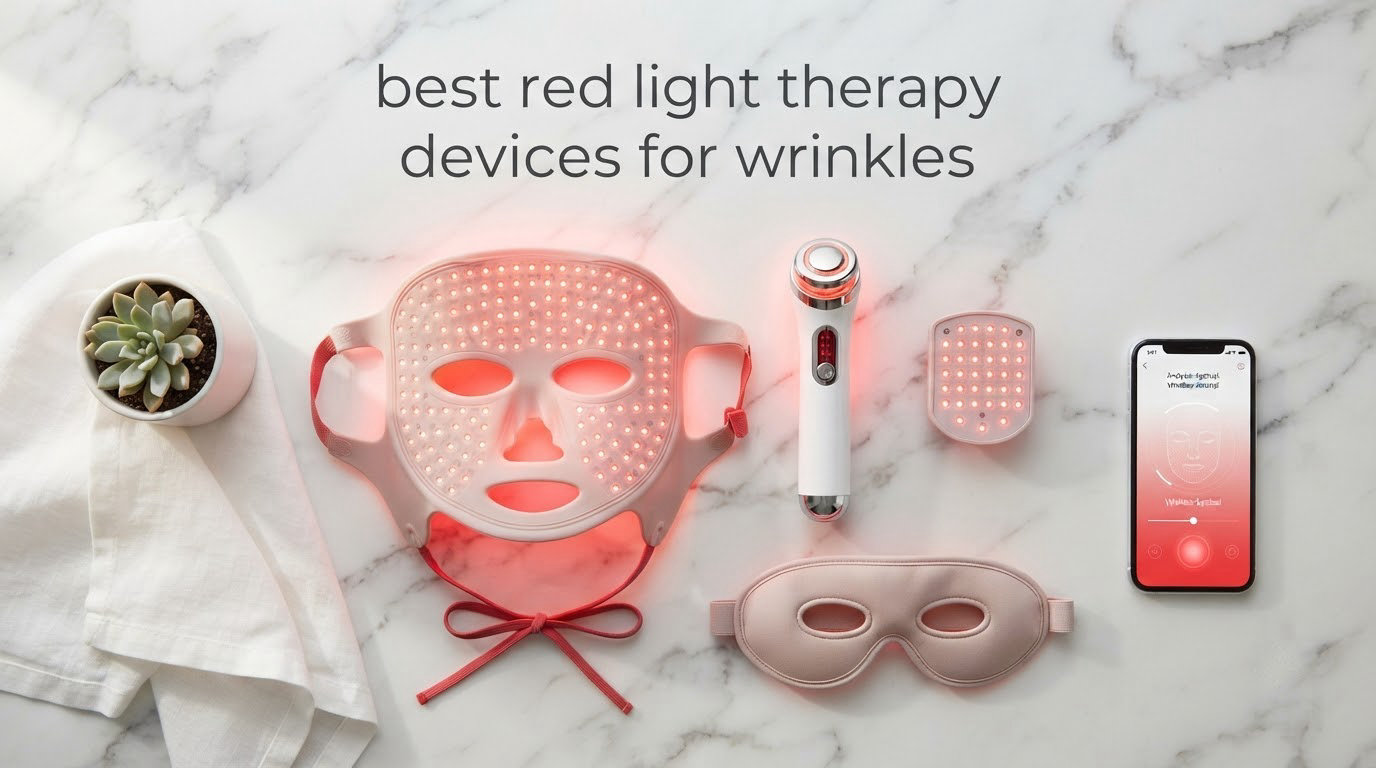
Red light therapy went from a clinic-only treatment to something you can do on your couch in a mask, and the market is now crowded with devices that all claim the same thing. We compared the best red light therapy devices for wrinkles available now, focusing on what actually separates them: wavelength, irradiance, LED count and how the thing fits your face.
The short version is that the science is real but the marketing is loud. Photobiomodulation has genuine clinical backing for stimulating collagen and elastin, and the best devices in this roundup use wavelengths that fall in the therapeutic range. The difference between a good mask and a disappointing one is usually down to fit and light density, not a secret technology.
We spent weeks going through ten devices, reading the technical specs, the fit, the timer options and the review patterns across more than 13,000 ratings between them. What follows is the roundup, plus a week-by-week timeline of what results actually look like, a safety section, and a buying guide covering the specs that matter.
Before we get into the list, a note on what we can and cannot say. We did not perform clinical imaging on ourselves, so we do not present before-and-after skin scans. Instead, every performance claim below comes from the manufacturer specifications and the pattern visible across thousands of customer reviews, and we tell you plainly when a number is a spec and when it is an owner report. For readers who also want to understand the light itself, our guides to red flashlights for stargazing and red dot sights cover the same wavelength science from a completely different angle.
Table of Contents
Top 3 Red Light Therapy Devices for Wrinkles in 2026

NEWKEY 4D LED Mask
- 630nm red and 465nm blue
- 450 light-emitting chips
- 10-minute auto shut-off
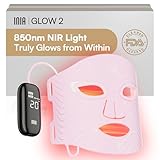
INIA Red Light Mask
- 630nm red plus 850nm near-infrared
- 220 LED chips
- 4 light modes with 2600mAh controller

Hydraskincare Flexible Panel
- 640nm red and 810nm near-infrared
- 18 x 7 inch flexible panel
- 4 wavelengths with simultaneous multi-color mode
Our top three each win a different category. The NEWKEY is the one we recommend to most people because it has the deepest review history of anything in the roundup and the 4D contoured fit solves the light-leakage problem. The INIA is the one to buy if you want dual wavelength and multiple modes without spending a lot. The Hydraskincare panel is the strongest review profile in the set and the only flexible face-wrapping panel, which is why it earns the premium slot despite being a panel rather than a mask.
10 Best Red Light Therapy Devices for Wrinkles (October 2026)
| Product | Specifications | Action |
|---|---|---|
| NEWKEY 4D LED Red Light Therapy Mask |
|
Check Latest Price |
| INIA Red Light Therapy Mask |
|
Check Latest Price |
| Hydraskincare Red Light Therapy Panel |
|
Check Latest Price |
 iRestore LED Face Mask iRestore LED Face Mask |
|
Check Latest Price |
 CurrentBody LED Face Mask Series 2 CurrentBody LED Face Mask Series 2 |
|
Check Latest Price |
 INIA GLOW 4D Wireless Mask INIA GLOW 4D Wireless Mask |
|
Check Latest Price |
 INTEO Face and Neck Wireless Mask INTEO Face and Neck Wireless Mask |
|
Check Latest Price |
 HIME SAMA Miracle ACE LED Mask HIME SAMA Miracle ACE LED Mask |
|
Check Latest Price |
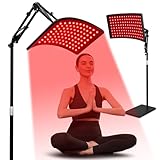 Viconor Red Light Therapy Lamp Viconor Red Light Therapy Lamp |
|
Check Latest Price |
 BestQool 105W Red Light Panel BestQool 105W Red Light Panel |
|
Check Latest Price |
1. NEWKEY 4D LED Mask Review: Best Overall for Fine Lines
NEWKEY 4D LED Red Light Therapy Mask for Face Skin Glowing,630nm Led Light Therapy Face Mask Anti Wrinkle, Blue Light Therapy Face Mask for Acne,Home use,450 LED Chips,Birthday gift,Plug in
630nm red and 465nm blue
450 light-emitting chips
Up to 75mW/cm2 irradiance
10-minute auto shut-off
Pros
- 4D contoured fit covers the full face with minimal light leakage
- Wired design delivers consistent output with no battery degradation
- Automatic 10-minute shut-off makes dosing foolproof
- Deepest review history in the roundup at 3605 ratings
Cons
- Wired cord limits movement during sessions
- Only a 630nm red channel with no near-infrared
- Results depend on a consistent three-times-per-week routine
This is the mask we keep coming back to because the numbers behind it are unusually solid. It has been on the market since 2016, which means the 3,605 ratings and 4.3 average are built on years of long-term ownership rather than a launch-week spike. Owners describe softening of forehead creases and less pronounced nasolabial folds over roughly four weeks of regular use.
The 4D contoured shape is the part that matters more than the spec sheet suggests. Light leakage is the quiet killer of mask results, because a mask that shifts and gaps delivers inconsistent dose to the areas that need it. Reviewers repeatedly single out the wrap and the 5mm optimal light distance as the reason the fit works on different face shapes.
The one real limitation is that it is wired. That sounds like a downgrade in 2026 but it cuts both ways: the power delivery never varies, and there is no battery to degrade or forget to charge. It also means you are tethered to a cable for the full 10 minutes, which is fine if you are sitting still and annoying if you are not.
Another limitation worth being honest about is the single red wavelength. With only 630nm and no near-infrared channel, this is a surface-level device. It is well suited to fine lines, forehead creases and uneven tone, but if your main concern is deeper firmness or sagging along the jaw, you will want one of the dual-wavelength or near-infrared options further down this list.

Why we picked it for fine lines over a higher-spec mask
Six of the masks here carry higher average ratings, and several of them have more LEDs. We still put this one first because rating alone is a weak signal when the review counts differ by a factor of two, and 3,605 ratings spanning years is the most reliable evidence base in the set. A 4.3 average built on that volume tells you more than a 4.6 built on 448.
The second reason is dose consistency. A mask that auto-shuts at 10 minutes and holds emitters 5mm from the skin at up to 75 mW/cm² is doing something simple and repeatable, and repeatability is what actually produces visible change over months. Reviewers who used it three times a week report the same pattern: gradual softening, not a dramatic before-and-after.
Where the wired design and single wavelength hold it back
If you plan to use a device while working, walking around or doing anything besides sitting still, the cord is a genuine friction point, and the INIA GLOW 4D further down this list solves it entirely. You are also giving up the deeper-penetration wavelengths that the CurrentBody and INIA masks offer, and for anyone over 50 focused on loss of firmness that is a real trade.
Our advice is to think of this as the low-friction entry point. Set a recurring 10-minute slot in your evening routine, keep the mask clean, and let the consistency do the work. Users who get frustrated with red light therapy almost always abandon it in week three, not week twelve.
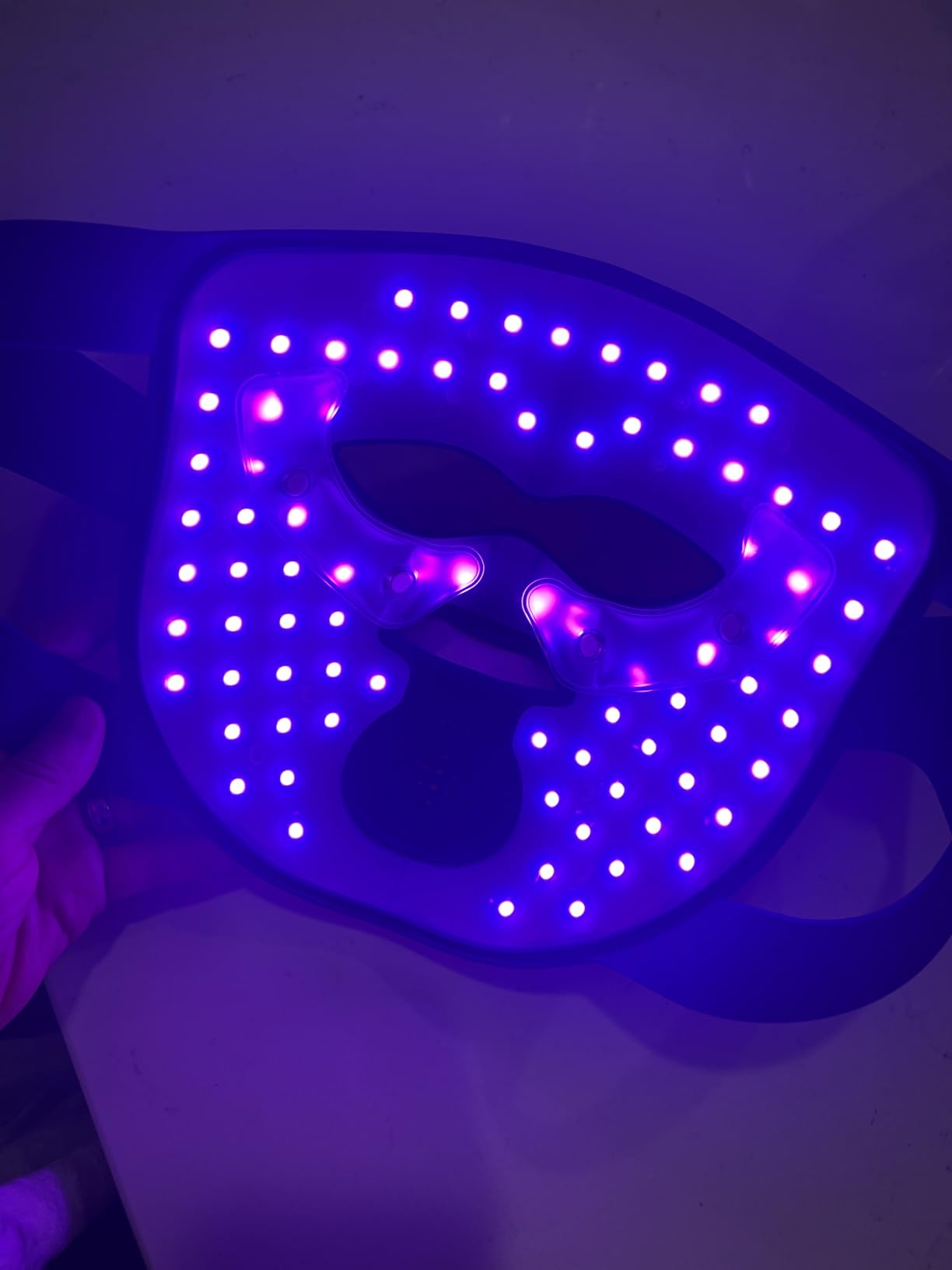
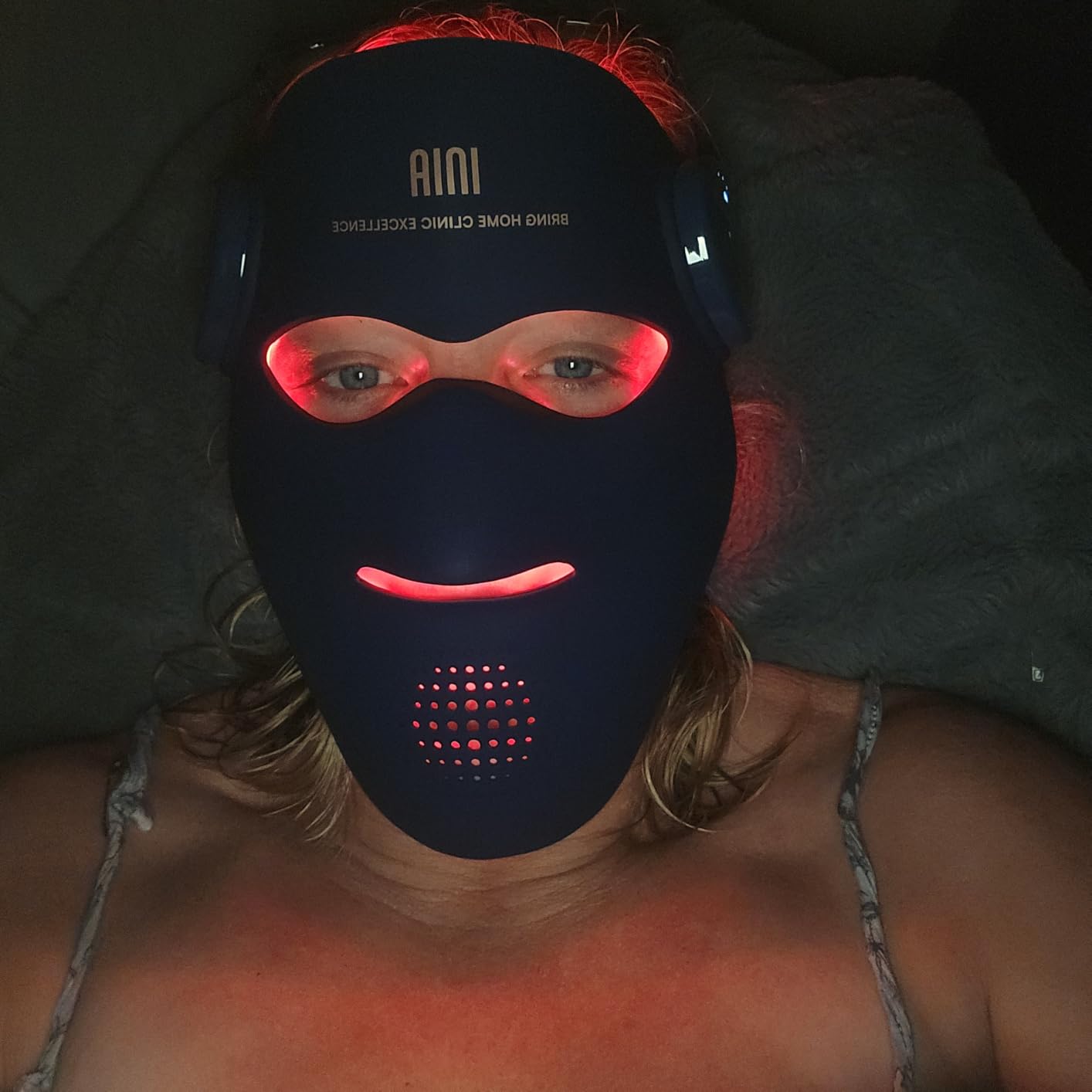
2. INIA Red Light Therapy Mask Review: Best Value Pick with Four Modes
INIA Red Light Therapy Mask for Face, 850nm NIR, Red/Blue LED Light 4 Modes
630nm red plus 850nm near-infrared
220 LED chips at up to 105mW/cm2
Four light modes
2600mAh rechargeable controller
Pros
- Dual wavelength with optional near-infrared is unusual at this entry level
- 2600mAh controller supports full 30-minute hands-free sessions
- Four selectable modes give real treatment flexibility
- Timer and auto shut-off remove the need to monitor sessions
Cons
- 10 percent of ratings sit at one star
- Results only reported after four or more weeks
- Less independent long-term data than premium rivals
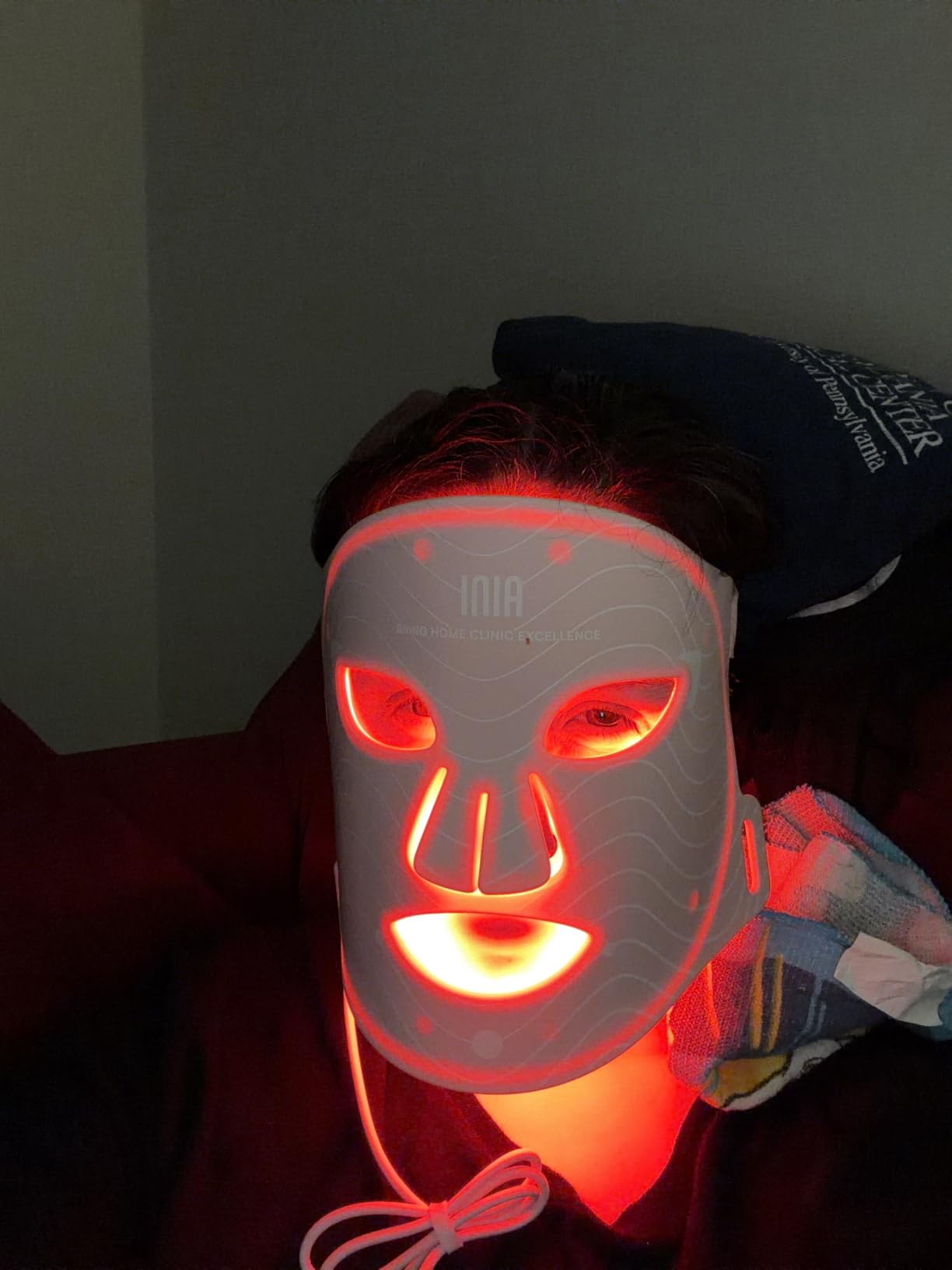
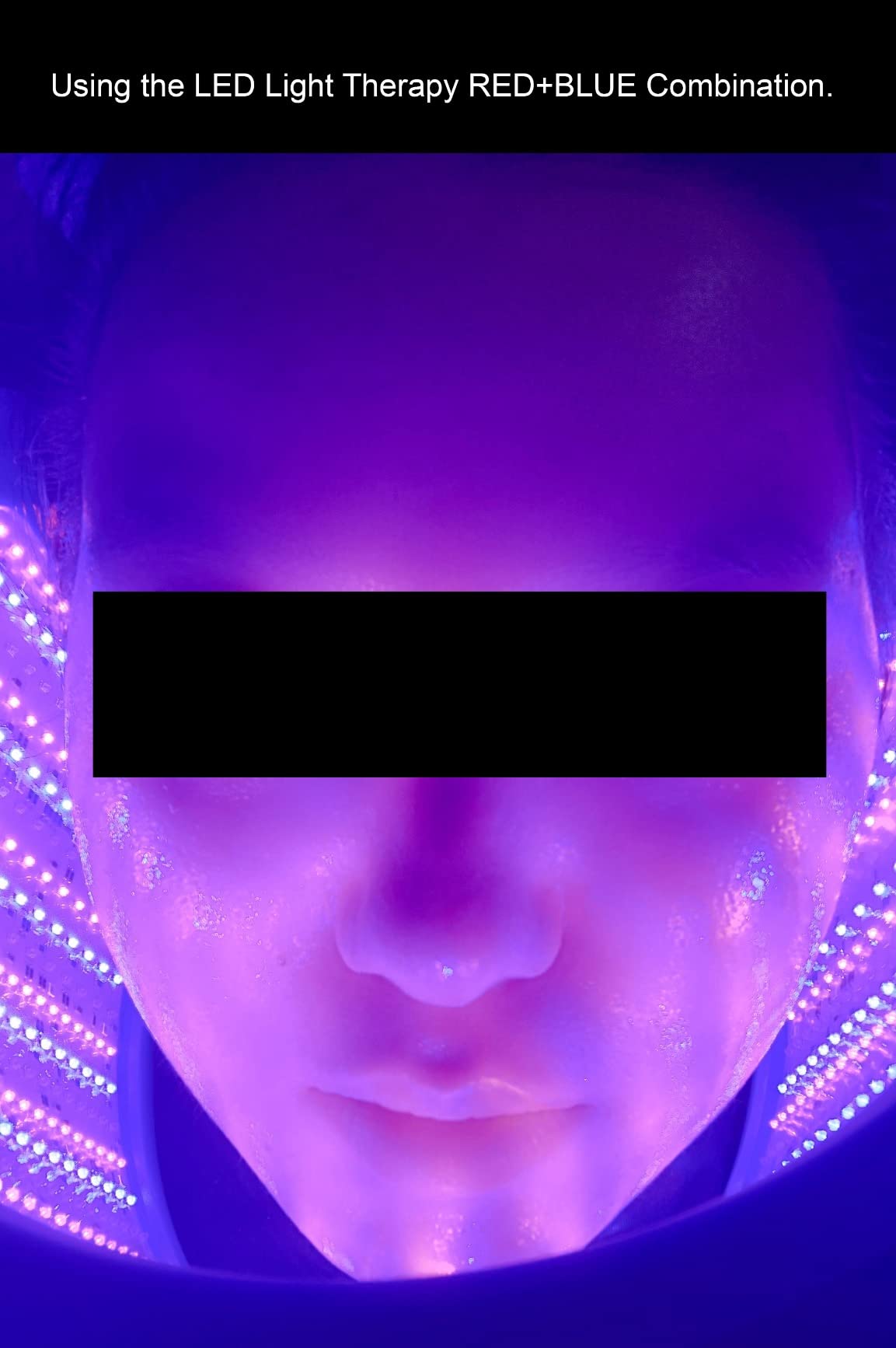
Dual-wavelength capability is usually the thing that pushes a mask into a higher band, and this one includes 850nm near-infrared as an option alongside 620nm and 630nm reds. Add 460 to 470nm blue and a red-plus-blue combination mode, and you have four treatment settings on a device at the accessible end of the market.
The listed output of up to 105 mW/cm² is the highest claimed irradiance of any mask in this roundup, though treat that figure as a spec rather than a verified measurement. The 220 LED chips and the 2600mAh rechargeable controller are more concrete: that battery is what allows a genuine 30-minute hands-free session without a cable, and the timer offers 10, 20 and 30-minute stops with auto shut-off.
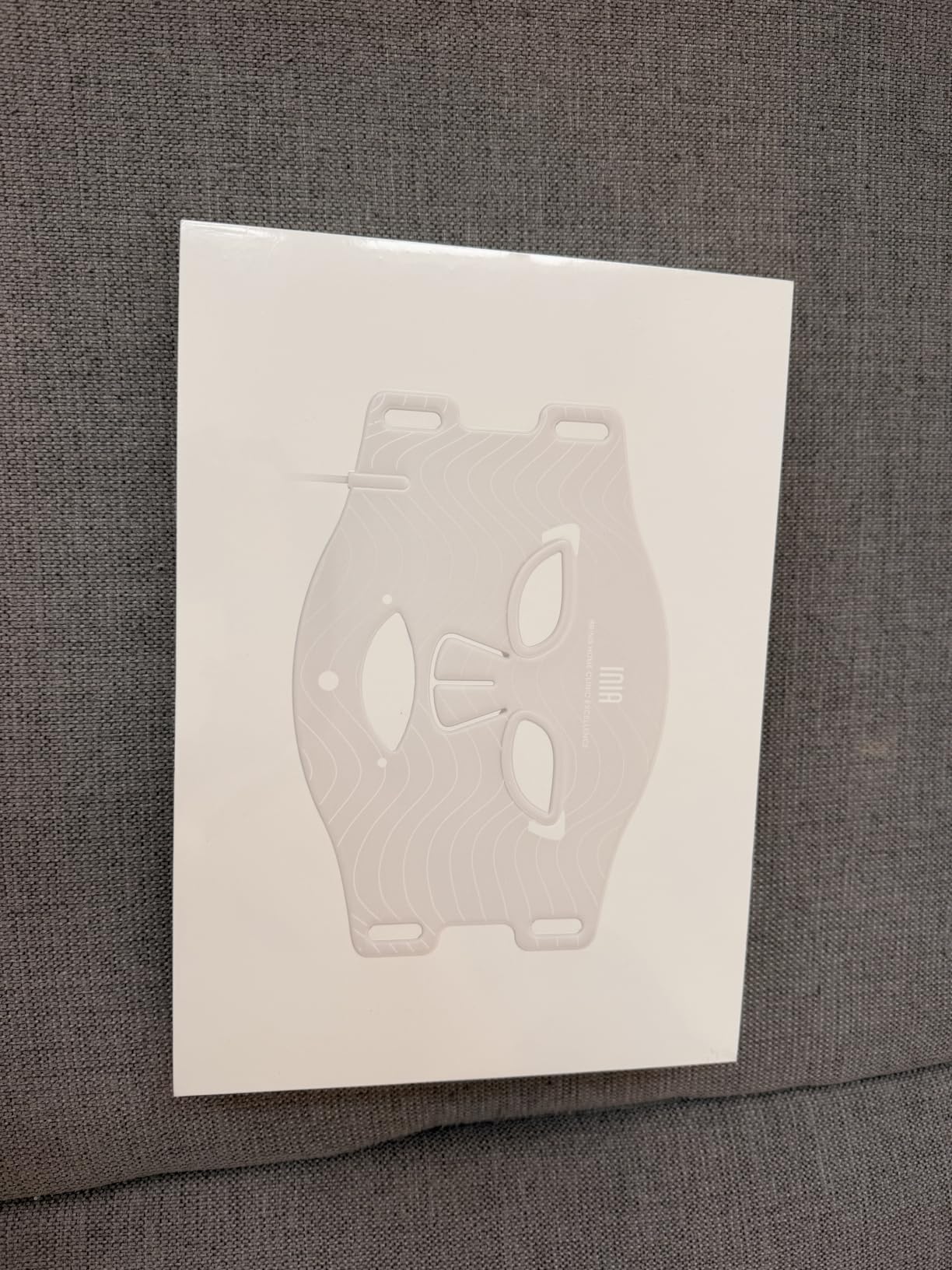
At 1.87 pounds this is also one of the lighter masks here, which matters over a 30-minute session. The trade-off is that it is one of only two devices in the roundup with a meaningful share of one-star ratings at 10 percent, and the review base is younger than the NEWKEY’s, so you have less evidence about how it holds up over years.
Owners do consistently report that the flexibility of the modes is what makes it useful, particularly the near-infrared activation when skin feels dull and the blue mode when breakouts appear. Expect gradual change, and expect the review pattern of visible improvement concentrated among people who used it consistently for a month or longer.
Who gets the most out of the four modes
This mask suits someone whose skin changes day to day. If you are dealing with a combination of early fine lines, occasional breakouts and dull tone, being able to switch between red, near-infrared and blue without swapping devices is genuinely useful, and it is the feature set most people assume requires a premium mask.
Pair it with a simple routine and the flexibility starts to pay off. Red or near-infrared on most days, blue when a blemish flares, and a normal moisturiser afterwards. Because there is no downtime and no gel, it fits around the rest of your skincare without special handling.
What to watch before you commit
The 10 percent one-star share is worth taking seriously. For a device in this category, that usually points to durability or satisfaction gaps rather than a safety issue, but it does mean you should check the return terms before you start counting on a long protocol. If you need a device you can rely on for three years without thinking about it, the review volume on the NEWKEY is more reassuring.
Also note that 105 mW/cm² is a maximum across modes, not a constant. If you are new to red light, start with shorter sessions on the red setting rather than running the full 30 minutes at the highest output on day one.
3. Hydraskincare Red Light Therapy Panel Review: Best Panel for Face and Body
Hydraskincare Red Light Therapy for Face, LED Face Mask Light Therapy Facial Skin Care Infrared Light Rejuvenation Photon Therapy Machine for Home Use
640nm red and 810nm near-infrared
18 x 7 inch flexible wrap panel
Four wavelengths with simultaneous multi-color mode
4.6 pounds
Pros
- Strongest review profile in the set at 4.6 with 85 percent five-star ratings
- Flexible panel wraps flat against the face for closer light contact
- Four wavelengths and multiple colors running at once
- Works for scalp
- back and joints as well as the face
Cons
- One reviewer reported a defective stand leg out of the box
- Flexible panel does not hold a molded shape
- Wired remote leads to cable tangles
- Runs warm during longer sessions
This panel has the best review profile in the entire roundup. An average of 4.6 across 1,128 ratings with 85 percent five-star and only 4 percent one-star is unusual, and the review analysis describes long-term owners reporting both brighter output than hard plastic masks and visible smoothing over weeks to months.
The design decision that separates it is flexibility. An 18 x 7 inch panel that wraps around the face sits far closer to the skin than a rigid panel on a stand, and since irradiance falls off with distance, close contact is where a lot of the practical gain comes from. The Velcro fasteners and included stand let you set the angle without holding anything.
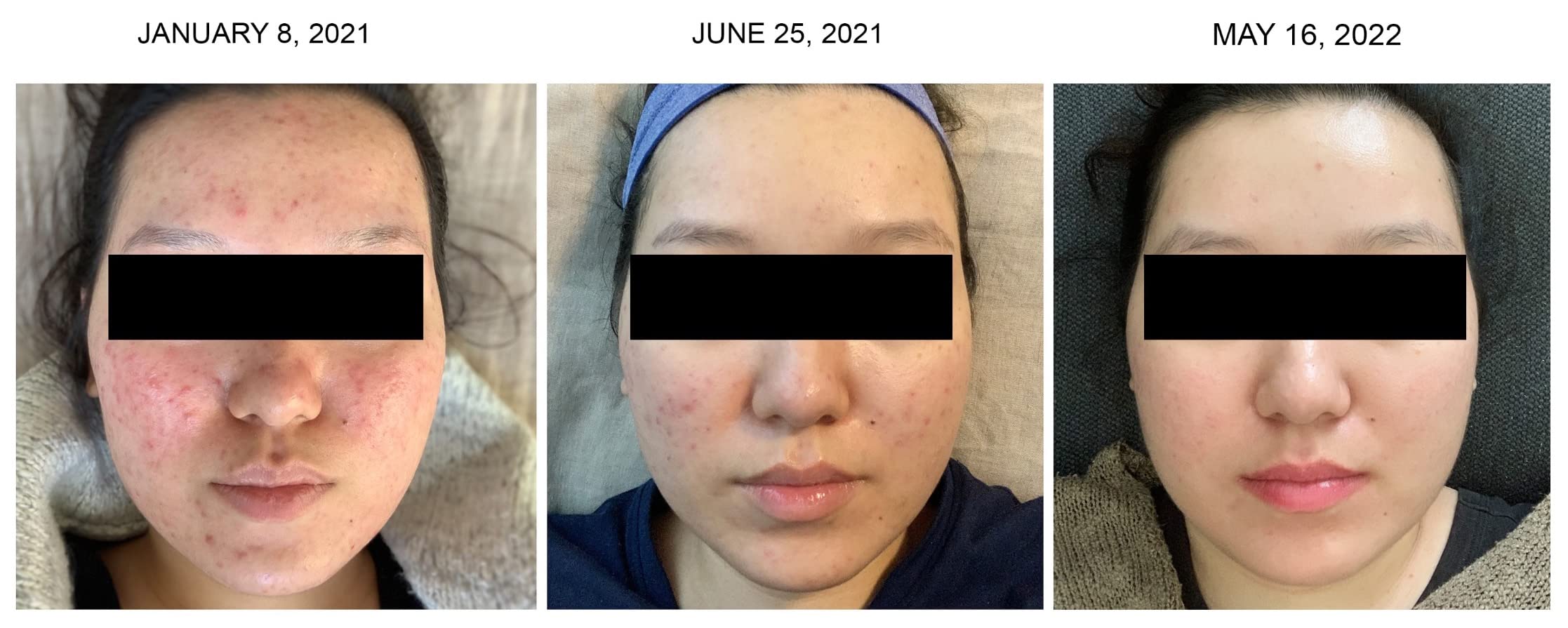
Wavelength coverage is broad: 640nm red, 423nm blue, 583nm yellow and 810nm near-infrared, and every colour can be switched on at the same time. Reviewers mention it being used beyond the face, on the scalp, back and joints, and one owner credits it with clearing post-inflammatory hyperpigmentation over several months.
The honest downsides are physical rather than electronic. The panel does not hold a molded shape, so it is a flexible sheet rather than a sculpted face form. The wired remote for colour and timer selection invites cable tangles, and the panel warms up during longer sessions.
Why the flexible panel changes the dose calculation
Irradiance is quoted at a fixed distance, and a fixed distance means a gap between your face and the light. Wrapping a flexible panel flat against the cheek removes that gap almost entirely, so the same nominal power reaches the skin more effectively. That is why reviewers running this device alongside hard-shell masks consistently report it as brighter in practice.
For a face with broad areas of concern, the panel format also suits you better than a mask if your issue is tone and texture across the cheeks and forehead rather than a single line. Because all four wavelengths can run together, one session can address several things rather than requiring separate treatments.
Where the panel format becomes a drawback
Panels are less convenient than masks for consistency, and consistency is what determines results. A mask attaches to your head and stays put whether or not you are paying attention. A panel needs to be propped at the right distance, which means you sit still and finish the session. Users who switched from masks to panels report doing much shorter sessions, two minutes every other day rather than a full mask session, and getting correspondingly different results.
Check the stand hardware on arrival, since one reviewer reported a cracked leg straight out of the box. And keep sessions moderate. The panel runs warm, and heat plus long exposure is the combination most likely to leave skin feeling dry rather than improved.
4. iRestore 360-LED Mask Review: Best Full-Face LED Coverage
iRestore LED Face Mask for Youthful Skin, Red Light Therapy for Face, Red, Blue & Infrared Therapy for Wrinkles, Fine Lines, Dark Spots with 360 LEDs, Skincare Device for Women & Men
635nm red and 830nm near-infrared
360 LEDs
415nm blue channel
Dual-strap floating design with eye light blocking
Pros
- Highest LED count of any mask in the roundup at 360
- Three referenced wavelengths in one device
- eye protection built into the dual-strap design
- Short 10-minute sessions that fit a morning routine
- Brand cites 20+ years of research and 500000+ customers
Cons
- Highest price band among the silicone masks here
- Results still require consistent multi-week use
- No combined red and near-infrared mode beyond manual selection
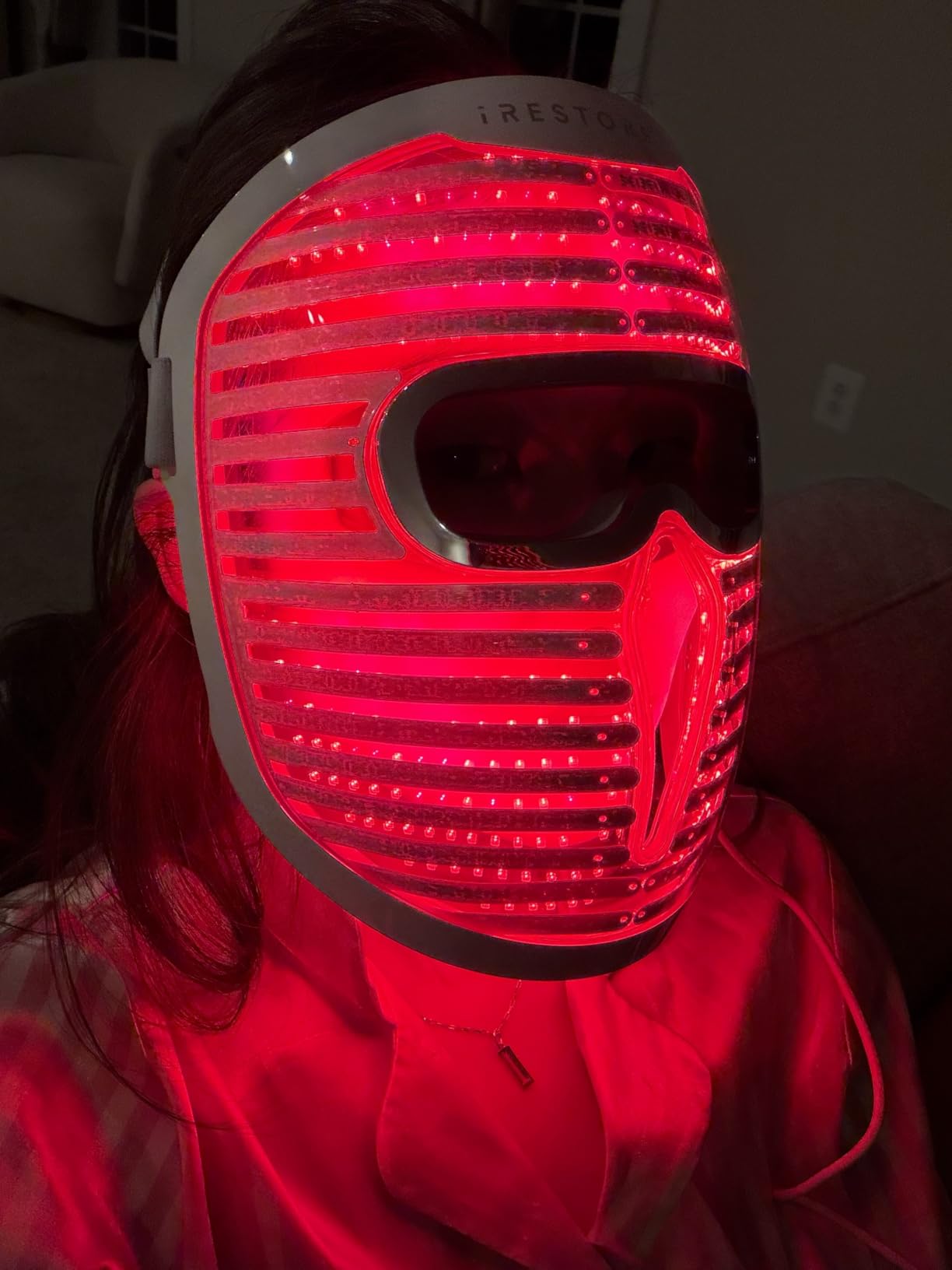
The 360 LED count is the headline here, and it is the highest of any mask in this roundup. More emitters spread across the same face area means higher density, which is one of the two things that actually drive results along with wavelength. The three channels are 635nm red, 830nm near-infrared and 415nm blue, each selectable on its own.
At 1.81 pounds it is also the second-lightest mask we tested, and the dual-strap floating design is described by owners as blocking direct light from the eyes so they can work or watch something during the 10-minute session. That combination of light weight, short sessions and eye blocking is what makes it practical for daily use rather than a once-a-week commitment.
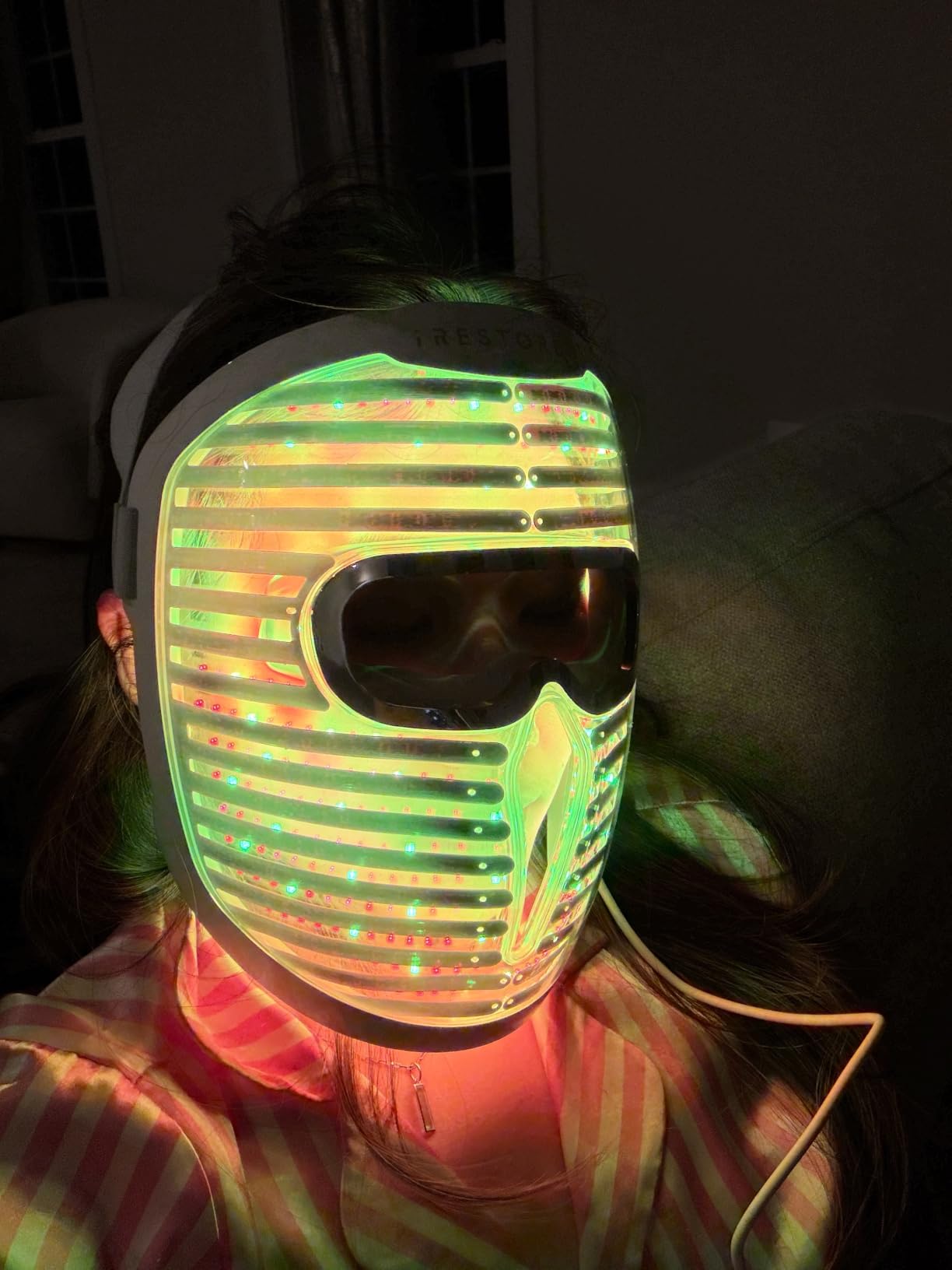
Reviewers report visible improvements in tone, fine lines and blemishing after several weeks, with 78 percent five-star ratings across 1,007 reviews. The brand cites more than 20 years of research and 500,000 customers, and recommends 10-minute sessions three to five times per week. It works with serums and moisturisers, with no gels needed.
The limitation is price relative to the rest of the silicone mask category, and the fact that you select wavelengths manually rather than getting a combined red plus near-infrared mode. For someone who wants precise control over which wavelength hits which concern, that manual selection is a feature rather than a gap.
What 360 LEDs actually changes day to day
Density is the practical difference. With 360 emitters across a mask, each square centimetre of your face receives a higher share of the total output, and the whole face gets treated at the same intensity rather than hot spots and dead zones. For someone with fine lines spread across forehead, cheeks and around the mouth, even coverage matters more than a single strong spot.
The dual-strap fit is the second thing that changes real use. A mask that stays put for the full 10 minutes without sliding toward the forehead is what allows the session to be genuinely hands-free. Owners who multitask during sessions report this as the main reason they kept going after the novelty wore off.
Where the price and manual mode control fall short
At 4.5 across 1,007 ratings, this is a strong but not dominant review profile, and it sits in the most expensive band among silicone masks here. If you want the highest density at the accessible end of the market, the NEWKEY delivers 450 light-emitting chips for considerably less, though without the 830nm near-infrared channel.
Decide early whether you will actually use the blue channel. If breakouts are a real part of your skin profile it adds value; if wrinkles are the only goal, most of that spend goes to a mode you may never switch on.
5. CurrentBody Series 2 Review: The Only Mask with 1072nm Light
CurrentBody Red Light Therapy LED Face Mask: Series 2
633nm red and 830nm and 1072nm near-infrared
236 LED bulbs
Flexible liquid silicone Best-Fit shape
Per-unit Veritace NFC performance card
Pros
- Only device here offering a 1072nm deep near-infrared channel
- Best-Fit liquid silicone shape tested across many face shapes
- Per-mask Veritace card reports how the individual unit performs
- Immediate glow effect reported out of the box
Cons
- Lowest average rating in the roundup at 4.1 with 15 percent one-star
- Heaviest mask at 3.11 pounds which can sag
- 236 LEDs is well below the counts of cheaper rivals
- Manufacturer lists specific contraindications to review
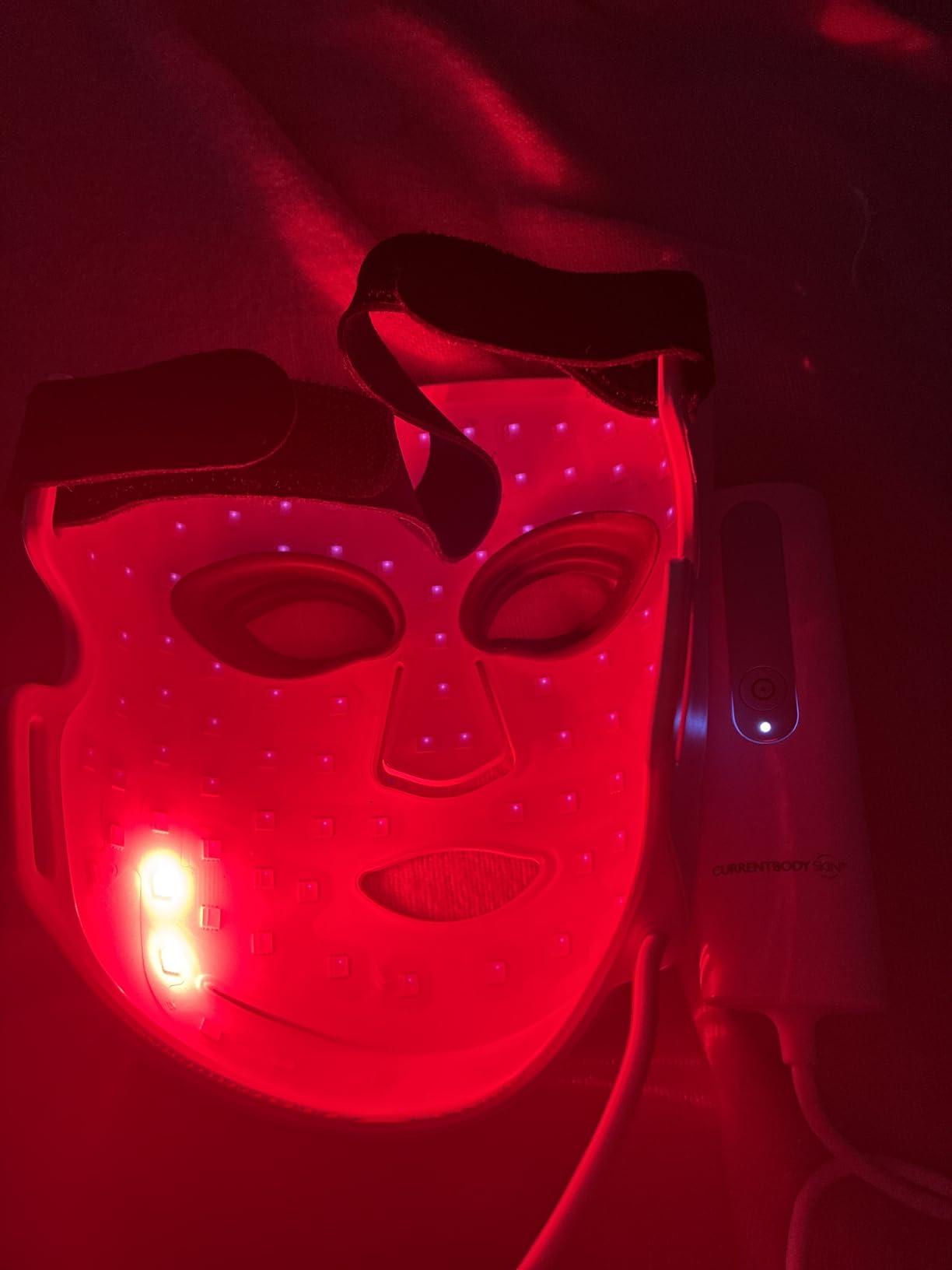
This is the only device in the roundup with a 1072nm deep near-infrared channel, sitting alongside 633nm red and 830nm near-infrared across 236 LED bulbs. If your concern is firmness and deeper structural lines rather than surface texture, the extra penetration depth is the reason to look here first.
The liquid silicone Best-Fit shape is the other differentiator, developed across a large sample of face shapes to sit in contact with more of the face. Reviewers also highlight the Veritace NFC card that ships per unit and reports how that individual mask performs, which is a genuinely unusual approach to quality control at home.
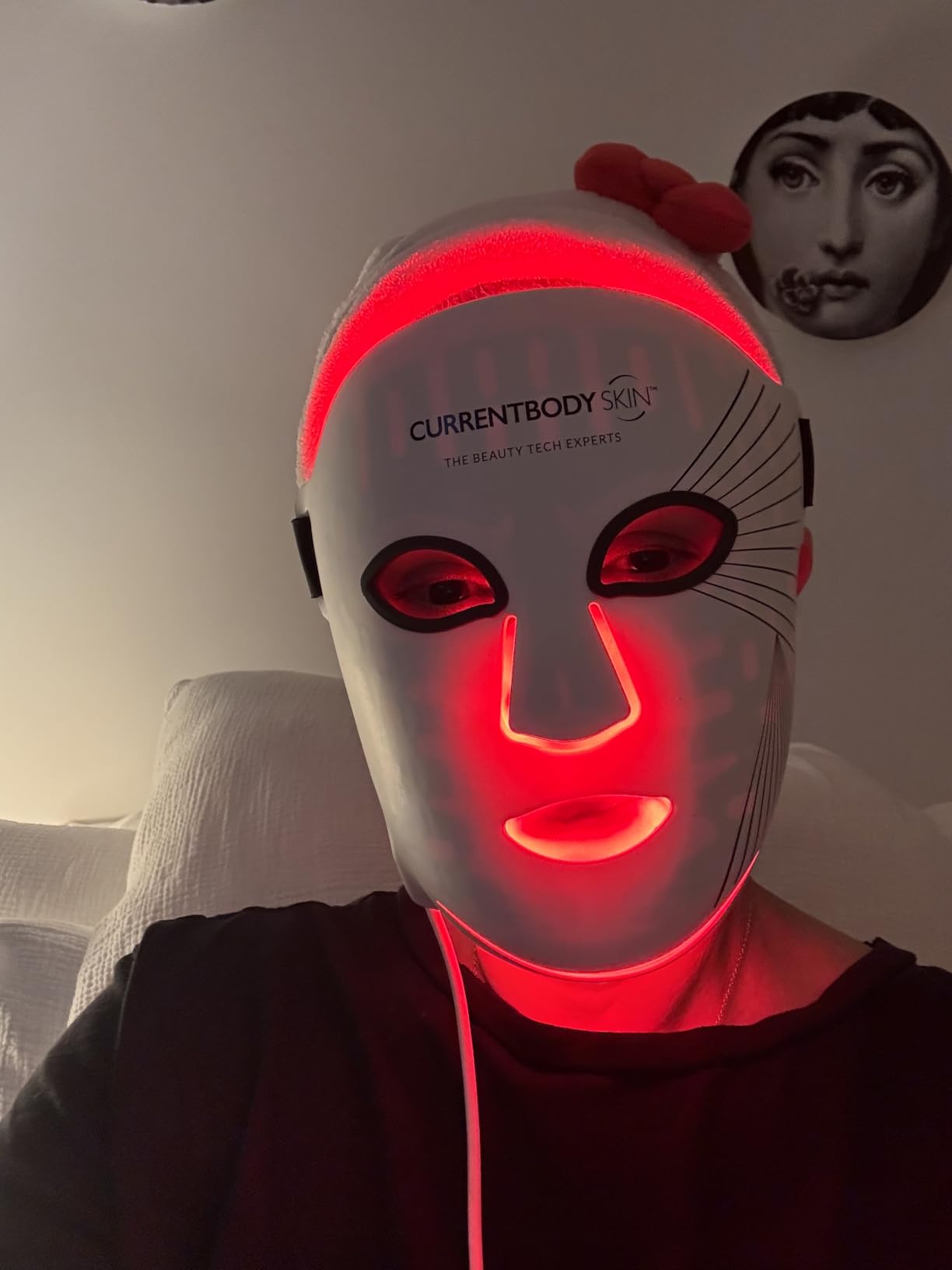
We have to be straight about the review profile, because it is the weakest here: 4.1 average across 705 ratings with 15 percent one-star. Enthusiasts praise the three-wavelength coverage and the instant glow, but a notable share report fit and weight problems over long sessions, and at 3.11 pounds it is the heaviest mask in the set.
The manufacturer also lists specific contraindications, and those deserve a read before purchase rather than after. A heavy mask that sags on a narrower face will break light contact at exactly the jaw and cheek areas where deeper wavelengths were supposed to help, which is the core tension in this design.
Who the 1072nm channel is actually for
Deep near-infrared targets the deeper layers where collagen synthesis happens, so it makes sense for people whose concern is loss of firmness, sagging along the jaw and jowls, or crepey texture on the neck. Surface red light is better suited to tone and fine lines, and if that is all you are chasing, the extra channel adds cost and heat without adding much.
Instant glow is a real and pleasant effect, but it is not the same as structural change. Treat the first few sessions as a comfort and consistency test rather than evidence, and set your expectation from the multi-week reviews rather than the first night.
Why the rating is the lowest in the set
Weight and fit interact badly on narrower face shapes. A 3.11-pound mask that gradually slides down the cheeks means the light source drifts away from the skin, and unlike a lighter mask where the same thing happens, you will feel the strain. Several reviewers describe exactly that, and a device priced at the top of the range with the lowest rating is a risk worth naming.
Our read is that this remains the most technically ambitious device here, and for the right face shape it is the strongest. Just be honest with yourself about whether your face suits a heavy silicone mask, and check the contraindication list before ordering.
6. INIA GLOW 4D Review: Best Wireless Cordless Mask
INIA GLOW 4D Wireless Red Light Therapy Mask for Face, Dual NIR, 320 LEDs
320 LEDs
Dual near-infrared channels
Four modes including red and amber
Magnetic cooling gel pad
Wireless rechargeable
Pros
- Completely cordless so you can work
- walk and watch television while wearing it
- Dual near-infrared channels can combine with blue light in one session
- Thin silicone cover keeps light output strong
- Magnetic cooling gel pad soothes puffy eyes and redness
- Battery has held up over months of regular use
Cons
- Mask is a little heavy and can sag when active
- Shifts if you move around though it sits well when reclining
- Eye patches heat quickly and only one set is included
- Mild warmth inside the mask when near-infrared is active
Cordlessness is the whole argument for this one. At 1.9 pounds and fully wireless with one-button control, it is the mask we would recommend for anyone who abandoned a wired device because sitting still for 10 minutes felt like a chore. Owners describe walking around, working and watching television while wearing it, which changes the consistency equation completely.
The 320 LEDs sit under a thin silicone cover that reviewers say keeps output strong, and the dual near-infrared channels target elasticity and fine line reduction at more than one skin depth. Four modes cover red, blue, amber and a combination, and because the near-infrared channels can run alongside blue, you can treat a breakout and support collagen in the same session.
At 1.9 pounds the mask is not featherlight, and that is the most common complaint. Owners report it sags slightly and shifts if you are physically active, though it sits well when you are reclining. Eye patches also heat up quickly and only one set is included, so a second set is worth considering if under-eye cooling is a priority for you.
The review base is the youngest in the roundup at 585 ratings, but the 4.4 average and 75 percent five-star share are notably positive for a recent release. Owners report visible improvements typically within two to four weeks, which is among the faster timelines claimed by any device here.
Why cordlessness changes your odds of finishing the protocol
Every red light study assumes frequent sessions, and the most common failure we see in reviews is not a bad device but an abandoned one. A mask that lets you keep working removes the single biggest practical barrier, and users of this device report the shortest time to visible change in the roundup at two to four weeks.
The magnetic cooling gel pad is a quiet bonus. It does not treat wrinkles, but it soothes puffiness and reduces redness during the session, which makes the 15 to 20 minute sessions more pleasant and therefore easier to keep up.
Where the weight and heat become problems
Wireless does not mean weightless. If you plan to use the mask while moving around, expect it to shift, and if you like to lie face-up rather than recline, the fit is much better. The mild warmth inside the mask when near-infrared is active is worth knowing about, particularly in a warm room or during summer.
One practical tip: recline rather than sit upright, and charge fully before the first session so you are not relying on a partial battery to judge the output. Owners who reported battery issues generally traced them to short charges rather than the cells themselves.
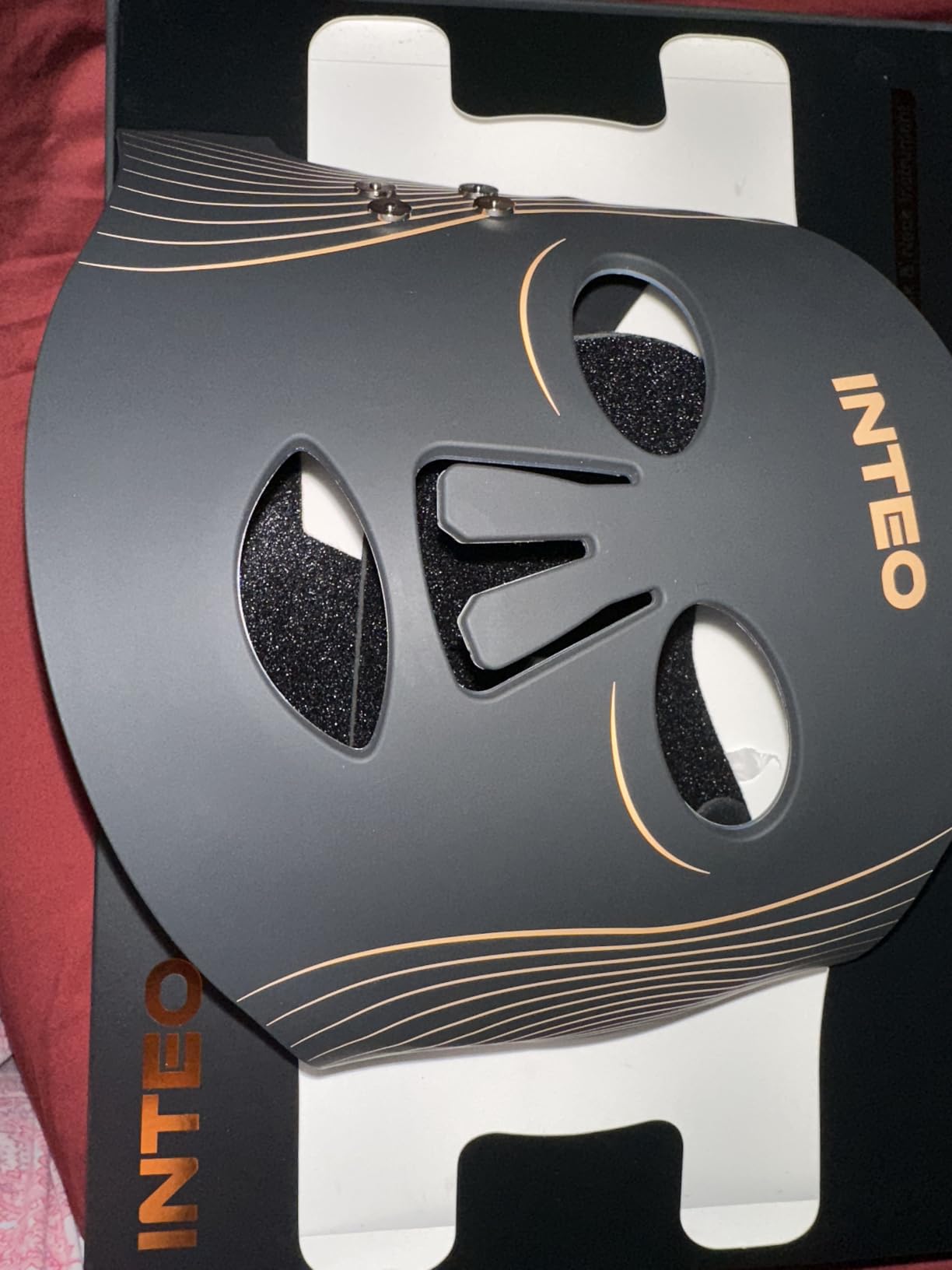
7. INTEO Mask Review: Best for Neck and Chest Wrinkles
Red Light Therapy Mask for Face & Neck, Wireless LED Face Mask, 4 Modes
680 light beads across face neck and chest
630nm red and 850nm near-infrared
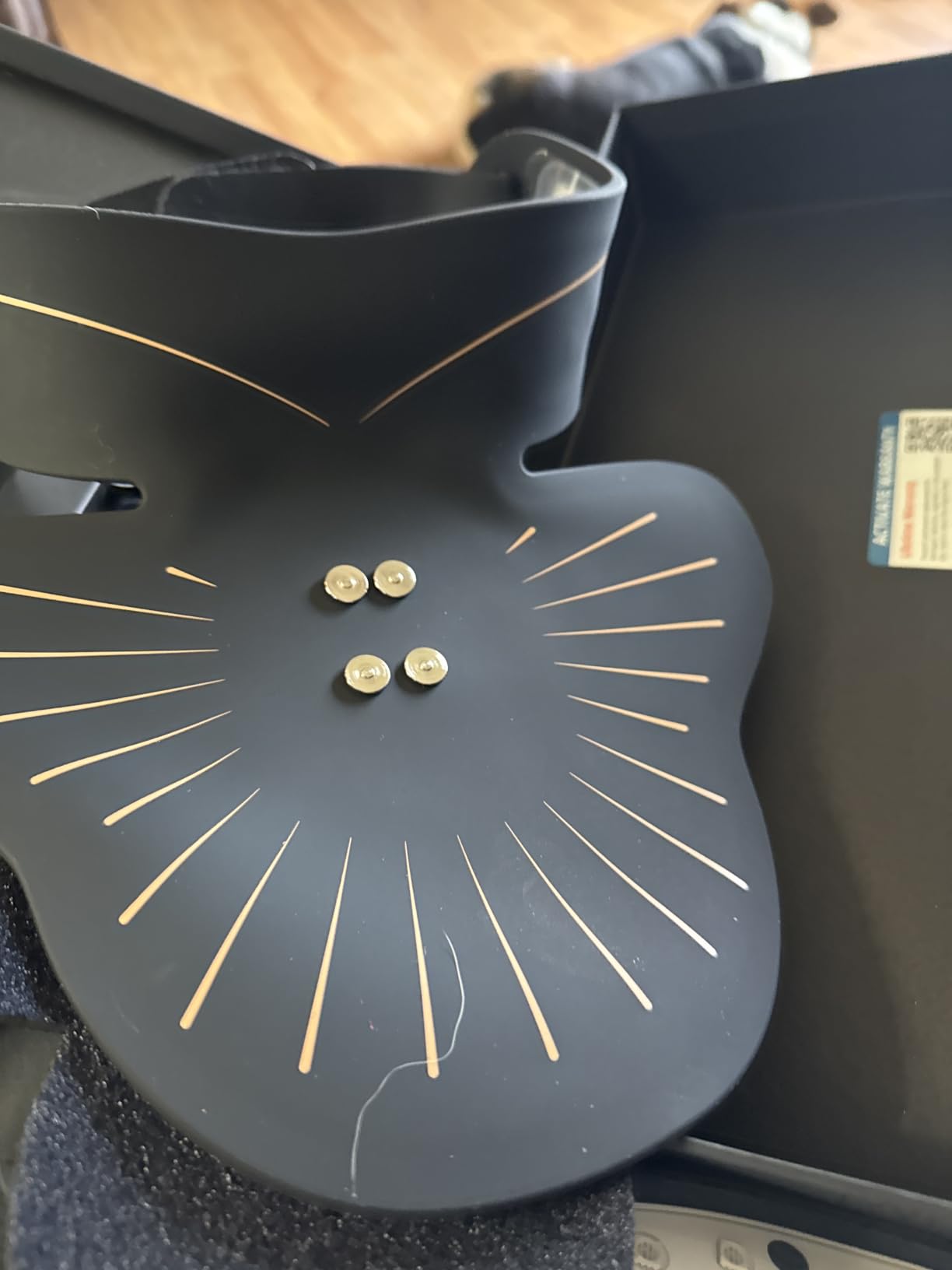
Wireless magnetic battery with Type-C charging
10 to 30 minute timer
Pros
- Only mask in the roundup that also covers the neck and upper chest
- Highest bead count here at 680 for face neck and chest coverage
- Cordless magnetic battery removes cable tangles entirely
- Soft thick silicone that reviewers say fits a round face well
- Owners report neck wrinkle reduction within about a month
- Two battery packs included
Cons
- Larger and heavier than face-only masks and the eye area can pinch the nose bridge
- Both packs need regular charging for 30-minute sessions
- Some reviewers question long-term durability
- Printed instructions may be small
Tech neck is the wrinkle most devices here cannot address at all, and that is what makes this one worth a separate look. With 680 light beads spread across the face, neck and upper chest, it is the only mask in the roundup that treats the full chain from face to décolletage in one session.
It also carries the second-highest average rating here at 4.6, with 82 percent five-star and only 2 percent one-star across 541 ratings. Owners specifically report measurable neck wrinkle reduction within about a month, and the soft thick silicone is described as fitting a round face well, which is a narrower but real advantage over thinner masks.
The wavelengths are 630nm red, 460nm blue, 605nm amber and 850nm near-infrared, which is a fuller anti-ageing set than most. The cordless magnetic battery pack with Type-C charging removes cable tangles entirely, and two battery packs are included so the face and neck units can run separately rather than competing for one charge.
The trade-offs are physical. At 2.62 pounds with a 14.84 x 10.39 inch footprint, it is bulkier than face-only masks, and reviewers note the eye area can pinch the bridge of the nose on some face shapes. Battery life is rated at 120 minutes per week on a single charge, so for 30-minute sessions you are charging regularly, and a few reviewers question long-term durability.
Why neck coverage is the most overlooked area
The neck ages visibly and it is thinner skin with less natural support, which is why horizontal tech neck lines tend to appear earlier and deepen faster than facial lines. Almost every mask in this roundup stops at the jaw, so neck lines get treated with whatever wand or panel you happen to own, rarely and inconsistently.
This mask makes the neck a first-class target. The recommended protocol is 20 minutes per session three to four times per week, and the amber channel is useful for redness and inflammation around the area. Treat the neck and face in the same session because they take the same time.
Fit, charging and durability trade-offs
Coverage costs you compactness. This is the largest device here and the eye area pinching at the nose bridge is the most repeated fit complaint, so if you wear glasses or have a narrow nasal bridge, check whether that is acceptable before committing. Reading the printed instructions may also require glasses, which is a small but real usability issue at setup.
On durability, the honest position is that the review base is short enough that nobody has five years of data yet. Charge both packs on the same schedule and store the mask flat rather than folded, since the silicone will take a set if it is compressed.
8. HIME SAMA Miracle ACE Review: Best Eight-Color Spectrum Mask
HIME SAMA LED Face Mask, FSA,HSA Eligible, 8 Color LED Mask, Miracle ACE
Eight colors at plus or minus 5nm
240 imported lamp beads at 30 mW/cm2
Light purity above 98 percent
Wireless 2000mAh with one-touch control
Pros
- Highest average rating in the roundup at 4.7
- Eight distinct colors at plus or minus 5nm precision
- Adjustable chin pad and patented eye holder suit a wider range of face shapes
- FSA and HSA eligible
- Reported unchanged performance after a full year of daily use
- Two-year warranty extendable by QR code
Cons
- Higher price than most masks in the roundup
- Mask can dig into the forehead slightly during wear
- Ten minutes of daily use is needed to match the claimed five professional sessions
This carries the highest average rating in the roundup at 4.7, with 84 percent five-star and only 2 percent one-star across 448 ratings. The eight-colour spectrum is the widest available here, at plus or minus 5nm precision, spanning 820nm near-infrared, 630nm red, 465nm blue, 520nm green, yellow, purple, teal and white.
Two specs stand out for anyone who has been burned by a weak device. Light purity is stated above 98 percent with stray wavelengths including UV filtered out, which matters because out-of-band UV is an unnecessary risk when you are aiming light at your face repeatedly. And the 30 mW/cm² output is the lowest headline figure in the roundup, which we would read as precision rather than weakness.
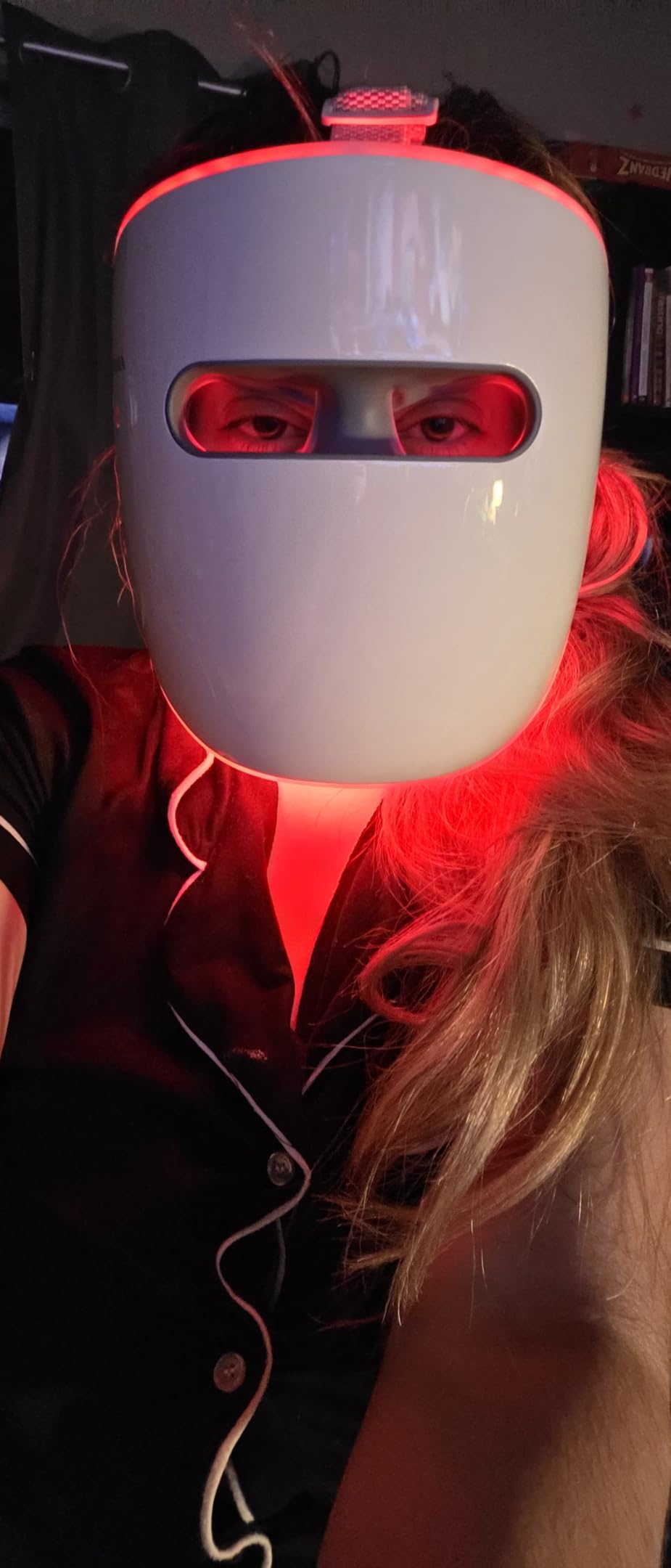
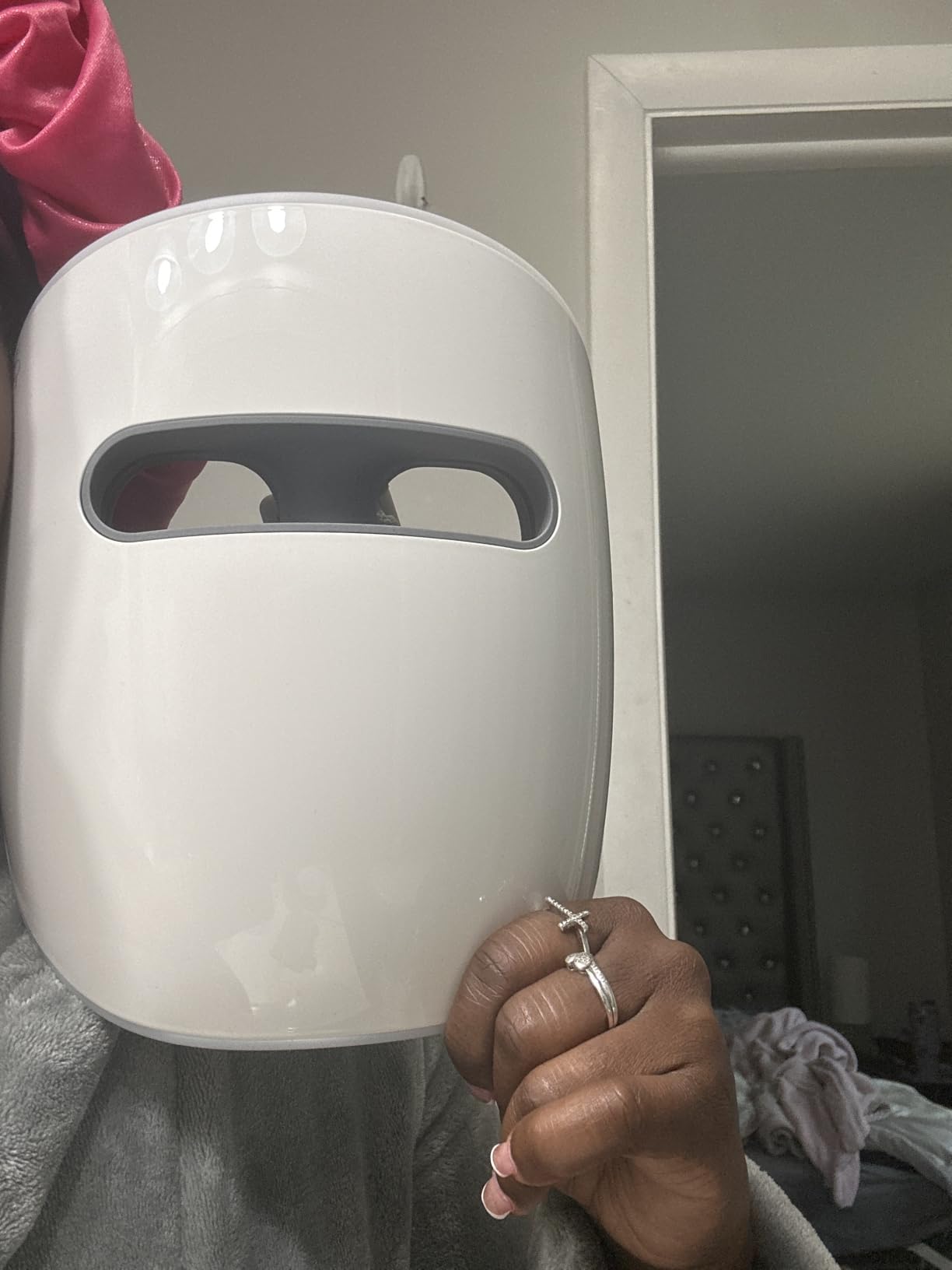
The physical design is more considered than most. A patented silicone eye mask holder and adjustable chin pad hold a 1cm light distance, and the chin pad in particular is what allows the mask to suit a wider range of face shapes. It is wireless and ultralight with one-touch control on a 2000mAh battery, and it is FSA and HSA eligible, which effectively lowers what you pay out of pocket if you have those accounts.
Owners report unchanged performance after a full year of daily use, and there is a two-year quality assurance policy extendable through a QR code. One owner who is a practising aesthetician preferred it to higher-priced clinic machines, and reviewers frequently mention visible skin change after a single red light session, which is an immediate-plump effect rather than structural change.
What eight colours and 98 percent purity actually buy you
For wrinkles specifically, two of those channels do the work: 630nm red for surface tone and fine lines, and 820nm near-infrared for deeper support. Green and teal have value if you deal with redness, and yellow and amber tend to calm inflammation. The remaining colours are novelty, and we would not buy this device for them.
Purity is the underrated spec. A cheap multi-colour mask that leaks ultraviolet output into a red-light session adds risk without adding benefit, so a stated purity above 98 percent with UV filtered means the light reaching your face is closer to what the device claims.
What the rating does not tell you
4.7 is excellent, but it is built on 448 ratings, less than half the volume behind the NEWKEY’s 4.3. High ratings on smaller samples are more likely to reflect a genuinely satisfied minority than broad consensus, and the single recurring physical complaint, forehead pressure during wear, is exactly the kind of thing that varies with face shape.
Also read the dosing claim carefully. Matching five professional sessions means ten minutes of daily use, and that is a commitment most people are willing to make and then quietly stop. The two-year warranty and FSA eligibility partly offset the higher price, but only if you are still using the device at the end of it.
9. Viconor Red Light Therapy Lamp Review: Best Low-Fuss Starter Device
Red Light Therapy for Face and Body, Red Infrared Light Therapy Lamp with Stand Led 660nm Red Light-Therapy& 850nm Infrared Light Device for Body
120 LEDs with 660nm red and 850nm infrared per diode
Curved focusing panel
180 degree adjustable stand
3m cord and wall hook included
Pros
- Lowest entry point of any red and infrared device in the roundup
- Curved panel concentrates light on the whole face
- Stand
- 3m cord and wall hook all included
- Dual 660nm red and 850nm infrared per LED for surface and deeper work
- Very large review base at 3540 ratings
Cons
- A freestanding lamp rather than a wearable mask
- Heaviest item here at 7.3 pounds
- cannot be used while lying down or moving
- No built-in timer mentioned in the specifications
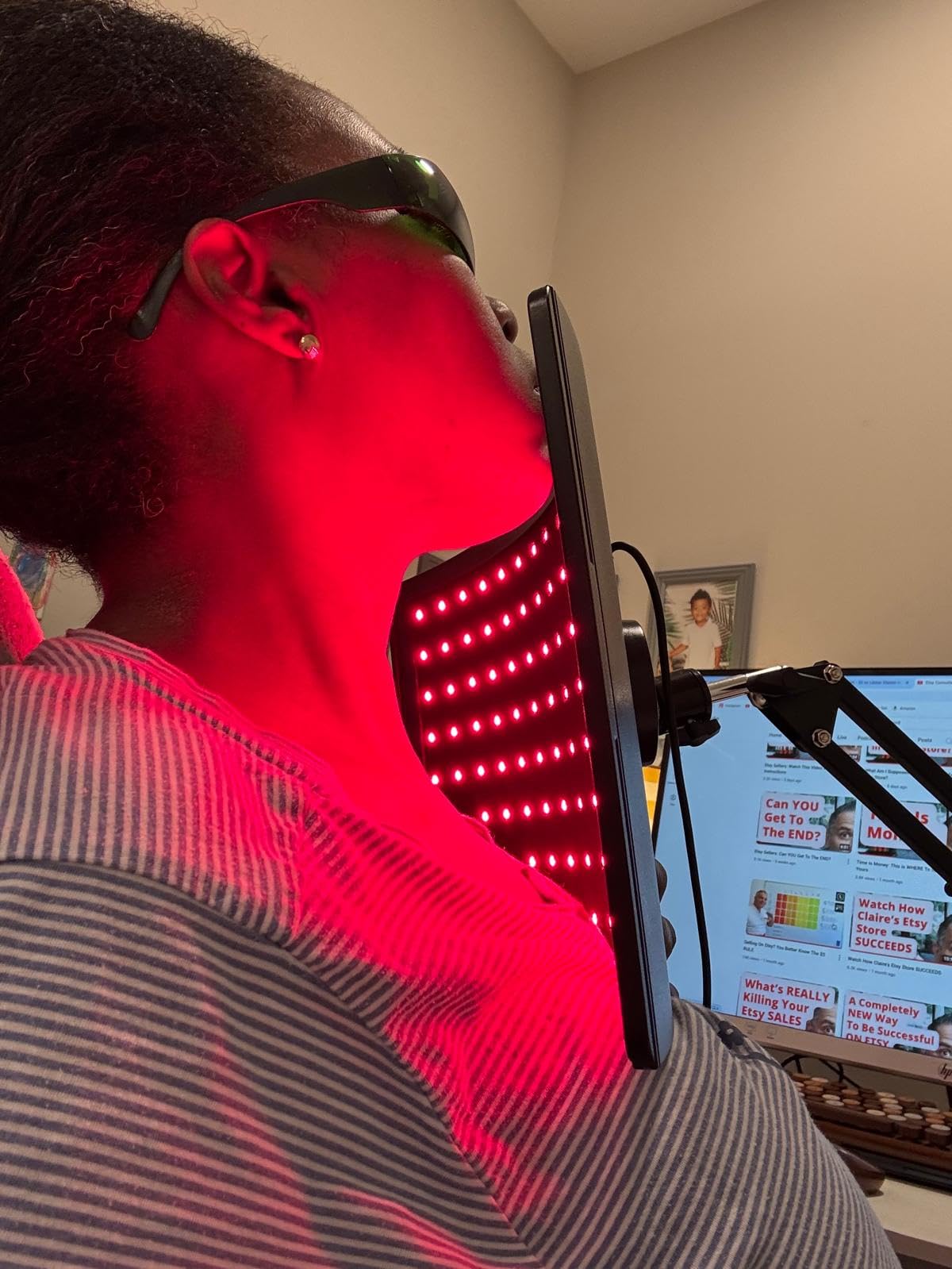
Not everyone wants to wear a device on their face, and this is the simplest way into red light therapy. Each of the 120 LEDs carries one 660nm red diode plus two 850nm near-infrared diodes, so every emitter is a dual-wavelength unit combining a surface channel with a deeper one, which is a better spec ratio than most masks offer.
The curved surface is the reason it works better than a flat panel at this level. Curvature focuses the output toward the centre of the treatment area rather than scattering it, and the 180-degree adjustable stand lets you dial in the distance. Fifteen to 30 minutes of daily use is the recommended protocol, and it works for the body as well as the face.
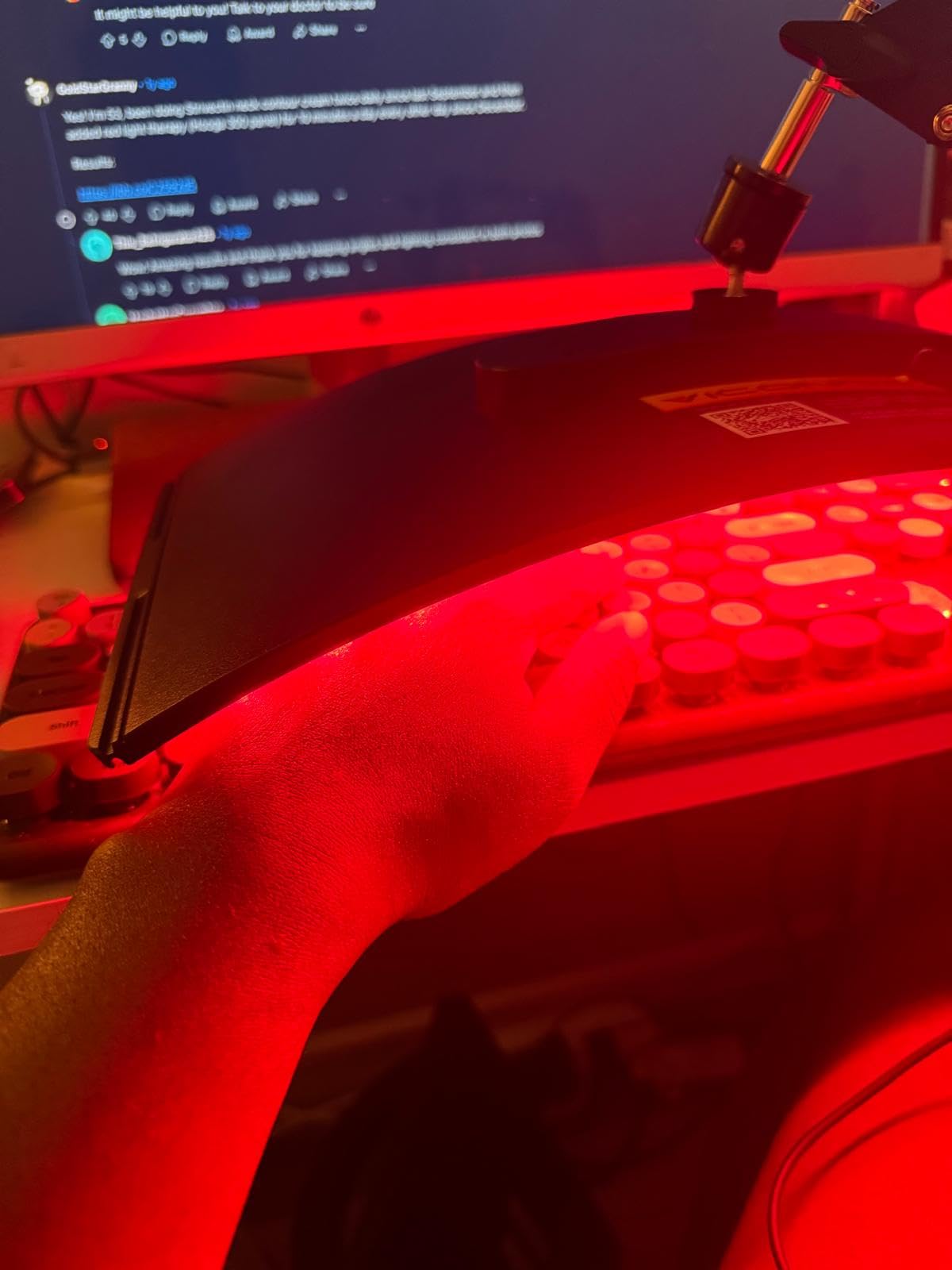
The review base is the second largest in the roundup at 3,540 ratings and a 4.3 average, with 71 percent five-star. Buyers treat it as an easy first step, satisfied with the build and the light focus, and reviewers accept that it is a stationary lamp rather than something hands-free. Everything needed is in the box, including a 3m power cord and a wall hook.
What you give up is flexibility, and that is a bigger deal than the spec differences. At 7.3 pounds it is the heaviest item here, you sit in front of it rather than wearing it, and you cannot use it while lying down or moving around. There is also no built-in timer in the listed specifications, which means a 15 to 30 minute session depends on your own timing.
Why a freestanding lamp still makes sense
Some people simply do not tolerate a mask, and for them this removes the single biggest reason to quit. Sitting in front of a lamp while reading or watching something is a low-friction ritual, and the dual-wavelength ratio means you are not giving up depth by choosing a lamp over a mask.
It also works for the body, which is where panels start to earn their cost. If you want to treat the chest, upper back or a shoulder as well as your face, the same device covers all of it without a second purchase. The wall hook means it can live out of the way when not in use, which matters in a small room.
Where the lamp format costs you
Consistency is the mechanism, and a lamp demands more of it. You have to sit still, remember to start and stop the session yourself with no auto shut-off, and be at the same distance each time. A mask that starts on a timer and holds its position does that work for you, which is why most people who graduate from a lamp move toward a wearable device.
Set a repeating alarm for the session length, and treat the 3m cord as a reason to pick a permanent spot rather than a reason to move the lamp around. Fifteen to 30 minutes daily is the window reviewers report seeing results in, so start at the shorter end.
10. BestQool 105W Panel Review: Top Rated Panel for Wrinkles and Body
BestQool Red Light Therapy Panel, 660nm Red & 850nm Infrared Light, 105W
105W with 95.6 mW/cm2 at 3 inches
Dual-chip 660nm red and 850nm near-infrared
Three therapy modes
Touchscreen with 5 to 45 minute timers
Pros
- Very high output for the weight at 105W and 95.6 mW/cm2 at 3 inches
- Dual-chip LEDs let you use red
- infrared or both together
- Light and portable at under 5 pounds unlike most panels in this class
- Stand
- wall-mount kit and protective glasses all included
- Metal construction with an integrated cooling fan
- Still working as new after two years for long-term owners
Cons
- Very bright so protective glasses are effectively required
- One owner reported the power cord failing rather than the unit
- A stand wing nut on an earlier unit cracked and needed replacement
- Dosage-dependent and one owner saw dryness with daily 30-minute sessions
This panel delivers 105W and a stated 95.6 mW/cm² at 3 inches, which is real power in a package under 5 pounds. That weight is the surprise, because panels in this class are usually heavy, brick-like objects, and being able to move this one between the bedroom, the desk and a wall hook changes how often you will actually use it.
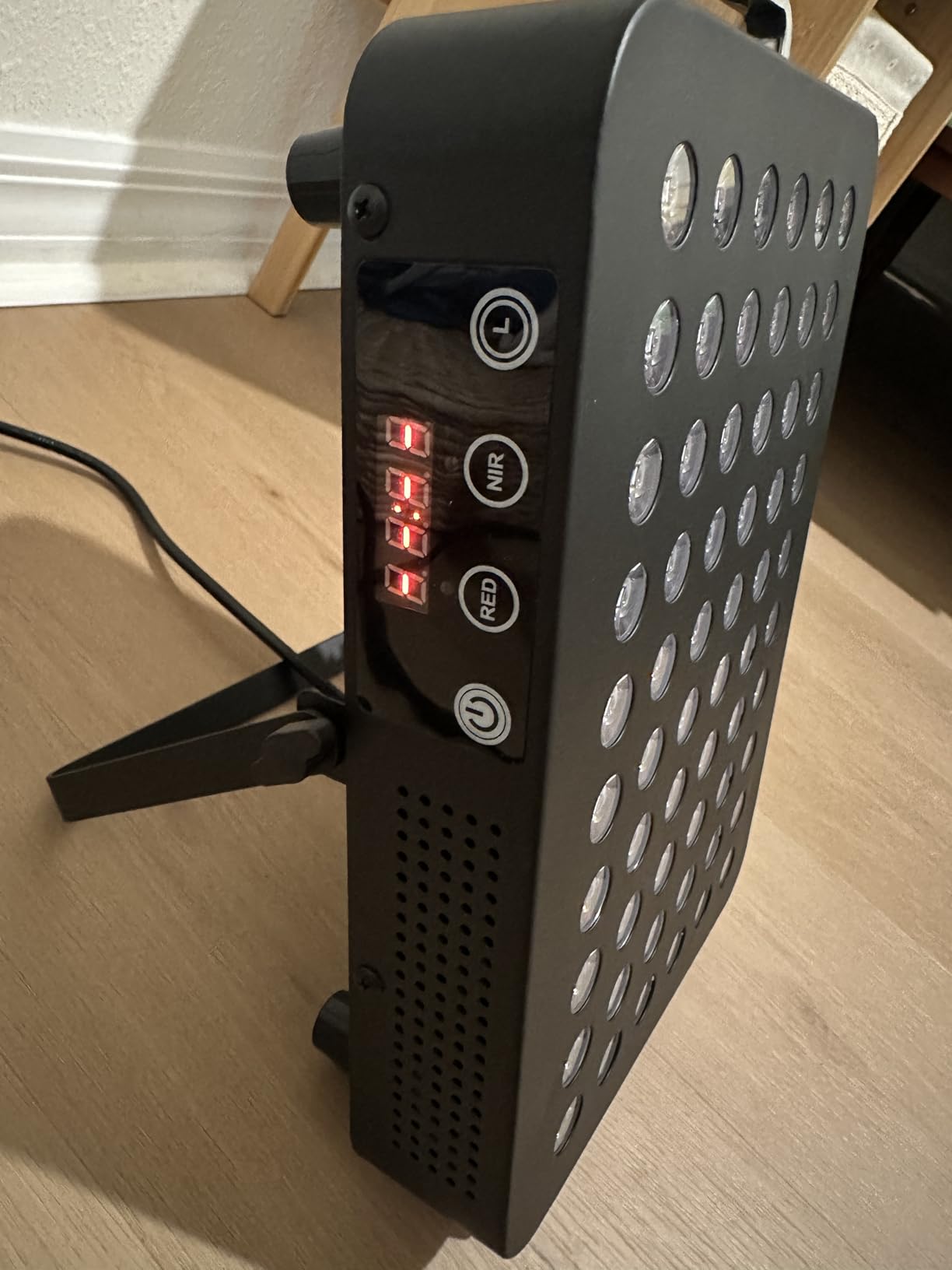
The dual-chip 660nm red and 850nm near-infrared LEDs can be used separately or combined, and the touchscreen runs timer presets from 5 to 45 minutes across three modes for workout, relaxation and sleep preparation. Flicker-free LEDs and an advanced cooling system make daily use practical, and the stand, wall-mount hanging kit and protective glasses are all included.
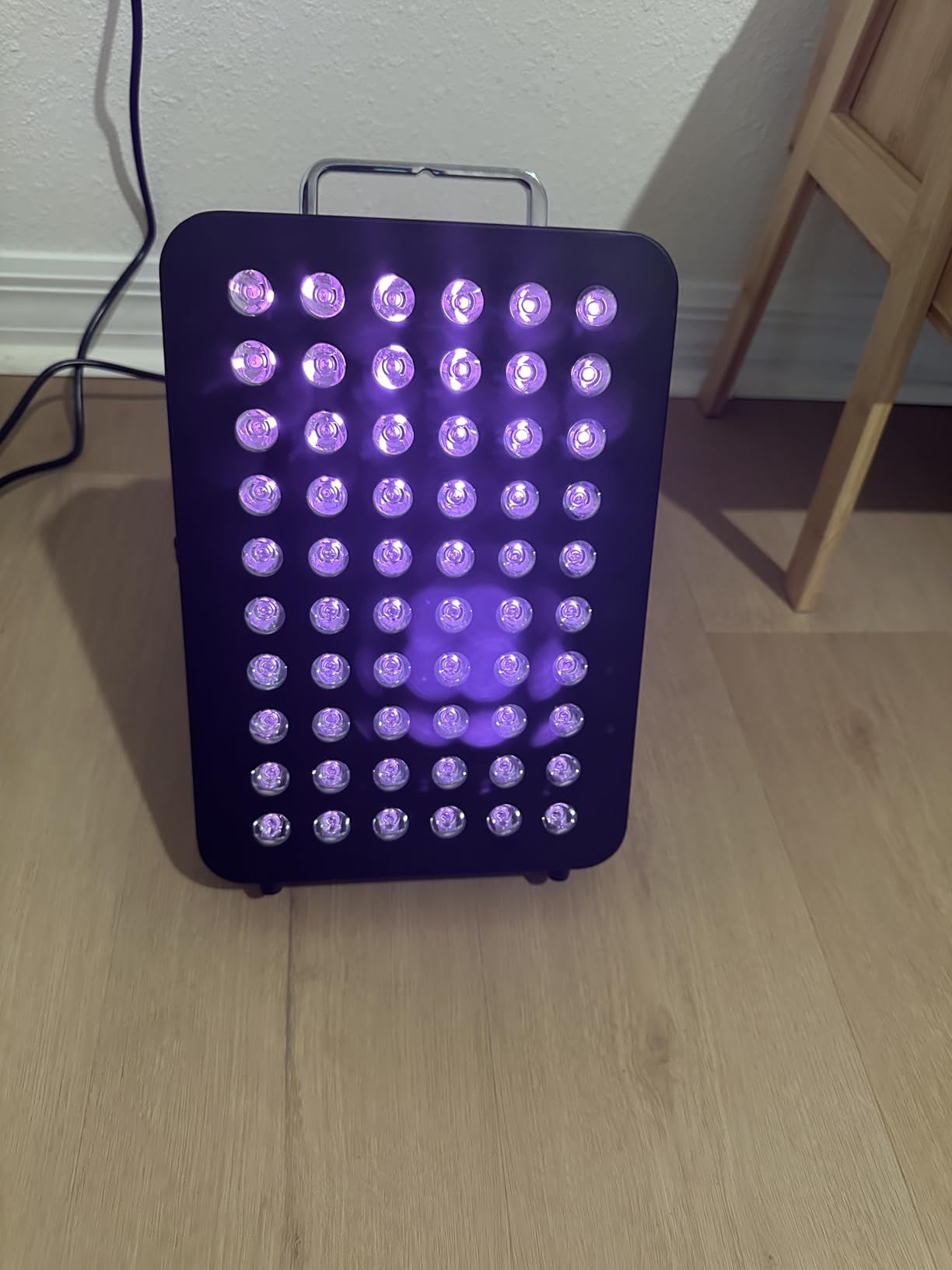
The review profile is strong and unusually durable: 4.6 across 1,850 ratings with 83 percent five-star. Long-term owners report it still working as new after two years with fast replacement-part support, and buyers consistently compare it favourably to far more expensive clinic units. That two-year track record is exactly the evidence the newer masks here do not yet have.
Brightness is the real constraint. At this output, eye exposure is a genuine consideration and the included glasses are not optional accessories. One owner reported the power cord failing rather than the unit itself, another had a cracked stand wing nut on an earlier unit, and one owner saw skin dryness from daily 30-minute sessions, which is the clearest warning in this roundup about dosing.
Who benefits from panel-level power
Panels make sense when you want to treat more than your face or when you want faster, higher-dose sessions. At 95.6 mW/cm² at 3 inches, a short two-minute session delivers a meaningful dose, which suits people who find a 20-minute mask session hard to justify on a weeknight. The same unit covers face, chest, back and joints.
Two years of reported service life is the other reason to consider it. The devices in this roundup that launched in the last year or two have no long-term data, so buying a panel with a proven track record trades novelty for reliability. The dual-chip design also lets you run red alone on a given day and both channels together on another.
How to use a device this bright without hurting your skin
Wear the included glasses, every session, and keep the distance consistent at the tested 3 inches rather than leaning in for more. Start with the 5 or 10 minute presets and build up, because the dryness one owner reported came from daily 30-minute sessions at full output and not from the wavelengths.
Treat the stand and the cord as consumable parts, not permanent fixtures, since that is where the reported failures occurred. If the panel will live on a wall most of the time, use the hanging kit and set the timer presets, which also removes the temptation to sit too close.
What Results Look Like Week by Week
The most common reason people abandon red light therapy is expecting too much too soon, so here is the realistic arc based on the review patterns across all ten devices. Nobody in the review base describes a transformation in the first week, and almost everyone who saw changes describes them arriving between week four and week twelve.
Weeks 1 to 2: adaptation, not results. Skin may feel warmer, slightly pink after a session, or simply unaffected. Some people notice an immediate plumping effect that fades within hours, which is a temporary change in surface hydration rather than anything structural. Your job this fortnight is purely consistency, and the devices with the highest review volumes show no unusual complaints at this stage.
Weeks 3 to 4: the first texture change. This is when owners most commonly mention skin feeling smoother after a shower and makeup applying more evenly. The INIA GLOW 4D reports visible improvements in this window at the earliest end of the range, and several owners of neck-and-chest devices note the first softening of horizontal neck lines at roughly one month.
Weeks 5 to 8: fine lines begin to soften. This is the meaningful window and the reason to keep going. Reviewers across the roundup describe softened forehead creases, less pronounced nasolabial folds and a more even tone. Deep folds and static lines that exist independent of movement will not change at this stage, and treating them is the fastest route to disappointment.
Weeks 9 to 12: consolidation. Change becomes easier to see in photographs than in the mirror because you have stopped looking daily. The Hydraskincare and BestQool owners in this roundup describe smoothing and tone improvement over months rather than weeks, and the highest review volumes come from people who treated this period as the baseline rather than the finish line.
Beyond 12 weeks: maintenance. Most protocols people keep up run three to five sessions a week, and the results hold while you maintain that. If you stop entirely, expect the tone and texture gains to soften over a period of weeks, which is the least discussed part of red light therapy and the reason we think of it as maintenance rather than a one-time fix.
How to Choose a Red Light Therapy Device for Wrinkles
Start with wavelength, because it is the only spec that cannot be substituted. For wrinkles, look for red between 630nm and 660nm for surface tone and fine lines, and near-infrared between 830nm and 1072nm for deeper collagen work. Devices offering only one channel will do half the job, and in this roundup only the CurrentBody Series 2 covers the deepest near-infrared range.
Next, treat irradiance with judgement rather than chasing the highest number. The therapeutic range for at-home devices sits broadly between 20 and 100 mW/cm², and the real lesson from the reviews here is that over-treating causes problems. One BestQool owner saw skin dryness from daily 30-minute sessions at full output, so more power is only useful if you adjust your session length accordingly.
Mask type decides whether you will actually keep going. Hard-shell masks hold shape and are precise but are heavy and do not always contour. Soft silicone masks are lighter, hug more face shapes and are the most common choice, though they can slip during movement. Flexible panels like the Hydraskincare sit closest to the skin and wrap the face, which improves effective dose but takes effort to hold in position.
FDA status is a useful trust signal, and this is where buyers get confused. FDA cleared means a 510(k) premarket notification found the device substantially equivalent to an existing predicate device, which is a lower and faster bar than full approval. If a brand leads with FDA approved on a cosmetic LED mask, that is a claim worth checking directly rather than accepting at face value.
Eye protection is not a premium feature. The CurrentBody, HIME SAMA and BestQool designs all address light around the eyes, either through straps that block direct light, a patented eye holder, or included protective glasses. At BestQool’s brightness the glasses are effectively required, and at lower mask output a well-fitting design is usually enough.
Think about battery and cord in terms of your actual routine. Wired devices never lose power mid-session but anchor you to one spot. Wireless masks such as the INIA GLOW 4D and INTEO free you to move but need regular charging, and the INTEO’s 120 minutes of weekly runtime means both included battery packs need a schedule if you are running 30-minute sessions.
Combining with topical skincare is where most guidance is thin. The workable order is clean skin, device session, then moisturiser, with actives like retinol used on separate days rather than layered immediately before a session. Users combining light with retinol report better results but a longer adjustment period, and starting both at once is a common way to end up with irritated skin and two abandoned habits.
Finally, look at total cost per use rather than purchase cost alone. Take the device cost, divide by the number of sessions a year, then divide by the years you expect to keep it. A panel that lasts two years and gets used weekly costs very little per session, while an expensive mask abandoned in month two costs the most per treatment of anything in this roundup.
On maintenance, keep it simple. Wipe silicone masks with a lightly damp cloth after each session and let them air dry fully, avoid alcohol-based cleaners on silicone, and store panels flat rather than folded. LED output degrades slowly, and a device stored folded or stored damp will fail long before the emitters do.
Red Light Therapy Safety and Contraindications
Use eye protection or an eye-blocking design every session. Even at consumer output, bright red light is uncomfortable to look at directly, and repeated exposure is the avoidable risk in this category. The masks here that block light at the eyes through straps or integrated holders, and the protective glasses included with the panel, exist for a reason.
Do not use these devices over photosensitising medication. Some antibiotics, retinoids at high strength, and certain other drugs increase light sensitivity. The CurrentBody manufacturer lists specific contraindications that buyers should read before use, and that caution applies to the whole category rather than to one model.
Rosacea, melasma and sensitive skin need a slower start. Begin with shorter sessions, watch how your skin responds over several days, and stop if you see persistent redness or a worsening of pigment. Heat and sweat trapped under a mask are the most commonly reported sources of irritation, so if you break out after starting, the first fix is shorter sessions rather than a different device.
More is not better. Red light therapy is cumulative, and the reviews here include cases of skin getting worse with over-treating. Stick to the manufacturer protocol, keep the recommended distance, and resist the urge to extend sessions once results start showing. Anything beyond that is a burn risk with no upside.
Avoid direct light on the eyes and be cautious around the thyroid and other deeper structures. Neck devices deliver a large dose to a thinner area, so if you have a thyroid condition or are under medical care for anything in the neck and chest region, ask your clinician before starting a routine that treats that area four times a week.
For anyone pregnant, managing a skin condition under prescription, or recently completed a laser, injectable or microneedling procedure, speak to a dermatologist before adding a light device to your routine. The mechanism is well understood and low risk for most people, but the variables are individual and a clinician can adjust the protocol to your situation.
Frequently Asked Questions
Do red light therapy devices work for wrinkles?
Yes, with realistic expectations. Red and near-infrared light stimulates fibroblasts to maintain collagen and elastin production, which shows up as softened fine lines and improved tone over weeks, not days. Across the ten devices we reviewed, owners consistently described gradual smoothing of forehead creases and nasolabial folds between weeks four and twelve.
What is the most reputable red light therapy company?
Reputation in this category tracks review volume and longevity rather than brand name alone. Among the devices we reviewed, the NEWKEY mask has the deepest review history with 3,605 ratings dating back to 2016, the BestQool panel reports two years of consistent service from long-term owners, and brands that publish verifiable 510(k) clearance numbers and per-unit performance data earn more trust than those that lead with marketing language.
Are there any red light therapy devices that actually work?
The ones that share three traits: a red wavelength between 630nm and 660nm, a near-infrared channel between 830nm and 1072nm, and a fit that holds the panel close to your skin for the full session. Every device in our roundup uses at least one of these properly, and the differences between them come down to LED density, fit and whether you will use them consistently enough to see a change.
Will red light therapy tighten saggy skin?
It can improve the appearance of firmness but it will not replicate a surgical lift. Near-infrared wavelengths in the 830nm to 1072nm range reach deeper layers where collagen is produced, and owners report firmer-feeling skin over months, particularly with the CurrentBody Series 2 and BestQool panel. Expect gradual improvement in texture and tone rather than a visible change in skin laxity.
How long does red light therapy take to work on wrinkles?
Most owners who report visible change describe four to eight weeks of consistent use, with the earliest reports around two to four weeks from cordless masks. The first fortnight is adaptation with no visible change at all. If nothing has shifted by week twelve, the usual cause is session length or distance rather than the device, so check your protocol before replacing the hardware.
Can you use red light therapy with retinol?
Yes, but introduce them separately rather than at the same time. Use the device on clean skin first, then apply moisturiser, and keep retinoid nights distinct from light sessions so your skin is not dealing with both irritants at once. Users combining the two report better results over time but a longer adjustment period, and starting both in the same week is a common reason people end up with irritated skin.
How often should you use a red light therapy mask for wrinkles?
Three to five sessions per week is the range most manufacturers and owners land on, with 10 to 20 minutes per session depending on the device. The INIA mask offers 10, 20 and 30-minute presets and the BestQool panel runs 5 to 45 minutes, so match the length to the output rather than assuming a longer session is better. Daily use is fine, but consistency over months matters far more than daily intensity.
The Best Red Light Therapy Devices for Wrinkles in 2026
Our pick for most people is the NEWKEY 4D LED mask, because 3,605 ratings spanning years give it the most trustworthy evidence base in the roundup and the contoured fit solves the light-leakage problem that undermines cheaper masks. Buy the INIA mask instead if you want dual wavelength and four modes at the accessible end of the market, and choose the Hydraskincare panel if you want close-contact light and the strongest review profile available.
Go further up the range for near-infrared depth with the CurrentBody Series 2, for genuine cordless freedom with the INIA GLOW 4D, and for the neck and chest coverage no other mask here offers with the INTEO. Whatever you choose, the deciding factor is not the spec sheet, it is whether the device fits your face and your routine well enough to use three to five times a week for three months. That consistency is what separates the results people keep from the ones they quietly stop expecting.