
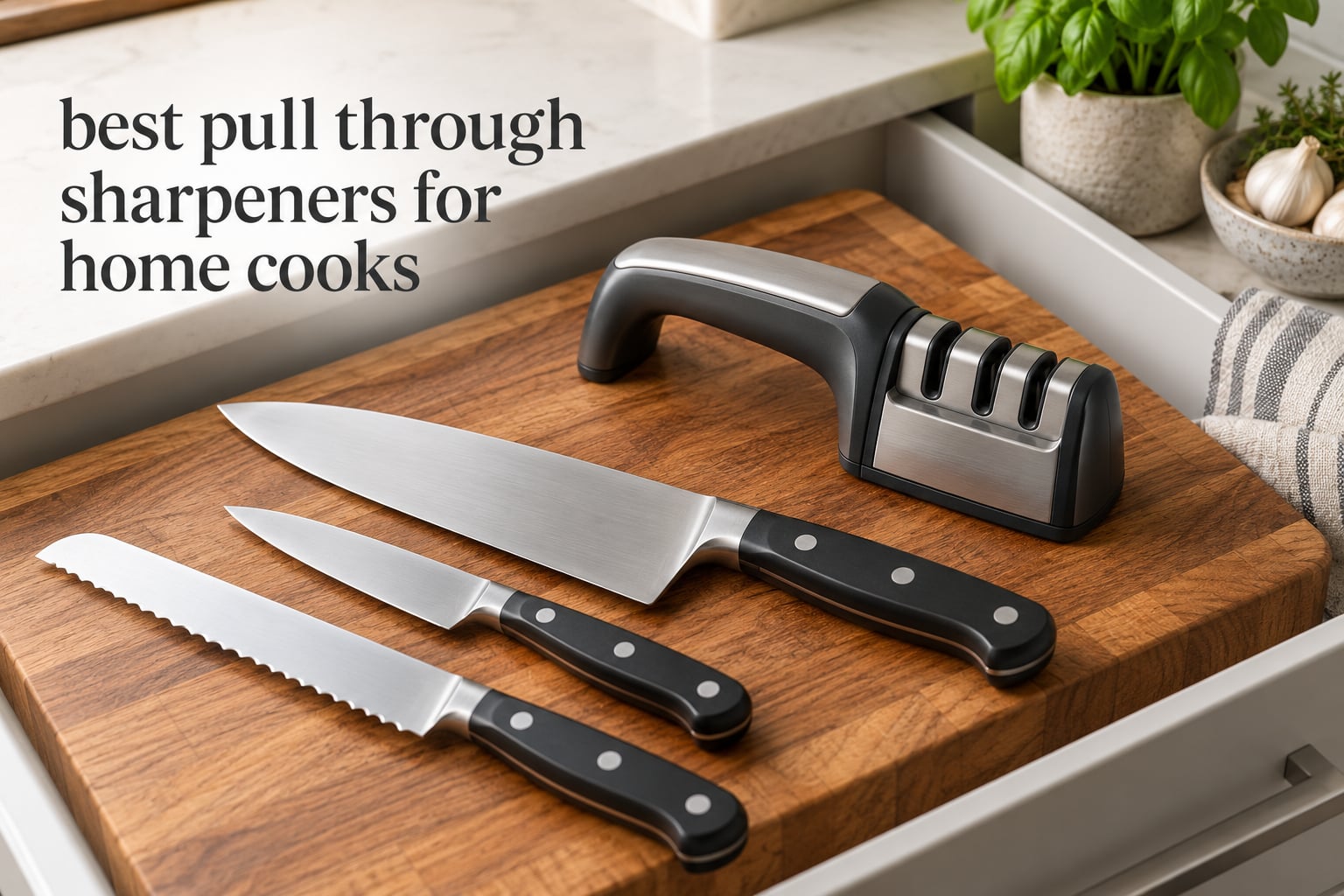
A pull-through knife sharpener is the fastest way to bring a dull kitchen knife back to a usable edge, and the best pull through knife sharpener for most home cooks is the KitchenIQ 50825, a two-stage diamond and ceramic unit that lives in a drawer and takes under a minute to use. There is no water, no clamping, and no technique to learn beyond pulling the blade through a slot a few times.
I have run the same set of knives through pull-through sharpeners for weeks, alternating between a German chef’s knife, a Japanese santoku, a bread knife and a pair of kitchen shears. What follows is what actually happened, including the knives each tool could not improve.
Yes, they work. The rigid slot holds both sides of the blade at a preset bevel angle while you pull, so the abrasive element abrades the edge evenly instead of leaving whatever wobble your hand produced. A coarse carbide or diamond stage resets a neglected edge, and a fine ceramic or diamond stage polishes it. The honest limit is that a pull-through maintains an edge better than it creates a factory-fresh one on an expensive blade.
That limit is where the online argument comes from. On r/Cooking, users split cleanly between the view that pull-through sharpeners strip too much steel from good knives and the view that the best sharpener is simply the one you will actually use. Both camps are describing real behaviour, and the fix is knowing which stage to use and how many passes to spend.
If you also sharpen tools that are not kitchen knives, our guide to chainsaw sharpeners for firewood cutters covers the same pull-through logic in a heavier context.
Table of Contents
Top 3 Best Pull Through Knife Sharpener (October 2026)

KitchenIQ 50825 Diamond Deluxe
- Diamond coarse stage
- Ceramic fine slot
- 3.75 inch body
- Serrated and straight edge

AccuSharp Gourmet 15 Degree
- Preset 15 degree angle
- Reversible carbide blade
- Finger guard
- Refines an existing edge

Smith’s S-50264 Adjustable
- 14 to 24 degree dial
- Serrated slot
- Replaceable abrasives
- Coarse and fine
All 10 Pull-Through Knife Sharpeners Compared in 2026
| Product | Specifications | Action |
|---|---|---|
| KitchenIQ 50825 Diamond Deluxe |
|
Check Latest Price |
| AccuSharp Gourmet 15 Degree |
|
Check Latest Price |
 Kitchellence KS37 P 3-Stage Kitchellence KS37 P 3-Stage |
|
Check Latest Price |
 Smith’s CCKS 2-Step Smith’s CCKS 2-Step |
|
Check Latest Price |
 Chef’sChoice 4643009 Chef’sChoice 4643009 |
|
Check Latest Price |
 Victorinox 7.87 Victorinox 7.87 |
|
Check Latest Price |
 Wusthof 2-Stage 3059730101 Wusthof 2-Stage 3059730101 |
|
Check Latest Price |
 Zwilling 4-Stage Ultra-Sharp Zwilling 4-Stage Ultra-Sharp |
|
Check Latest Price |
 Smith’s 50185 Jiffy-Pro Smith’s 50185 Jiffy-Pro |
|
Check Latest Price |
| Smith’s S-50264 Adjustable |
|
Check Latest Price |
1. KitchenIQ 50825 Diamond Deluxe: The Best All-Round Pick
KitchenIQ 50825 | Diamond Deluxe Edge Grip 2-Stage Knife Sharpener | Black | Coarse & Fine Sharpeners | Compact for Easy Storage | Non-Slip Base | Soft Grip Rubber Handle | Straight & Serrated Knives
Diamond coarse plus ceramic fine stages
3.75 inch body
2.08 ounces
Pros
- Two stages handle dull and serrated blades
- Very small footprint that fits any drawer
- Non-slip base keeps it steady
- Handles straight edges and scissors
Cons
- Fine ceramic slot dulls and cannot be replaced alone
- Must sit on a flat counter edge
- Edge fades faster than a stone-refreshed edge
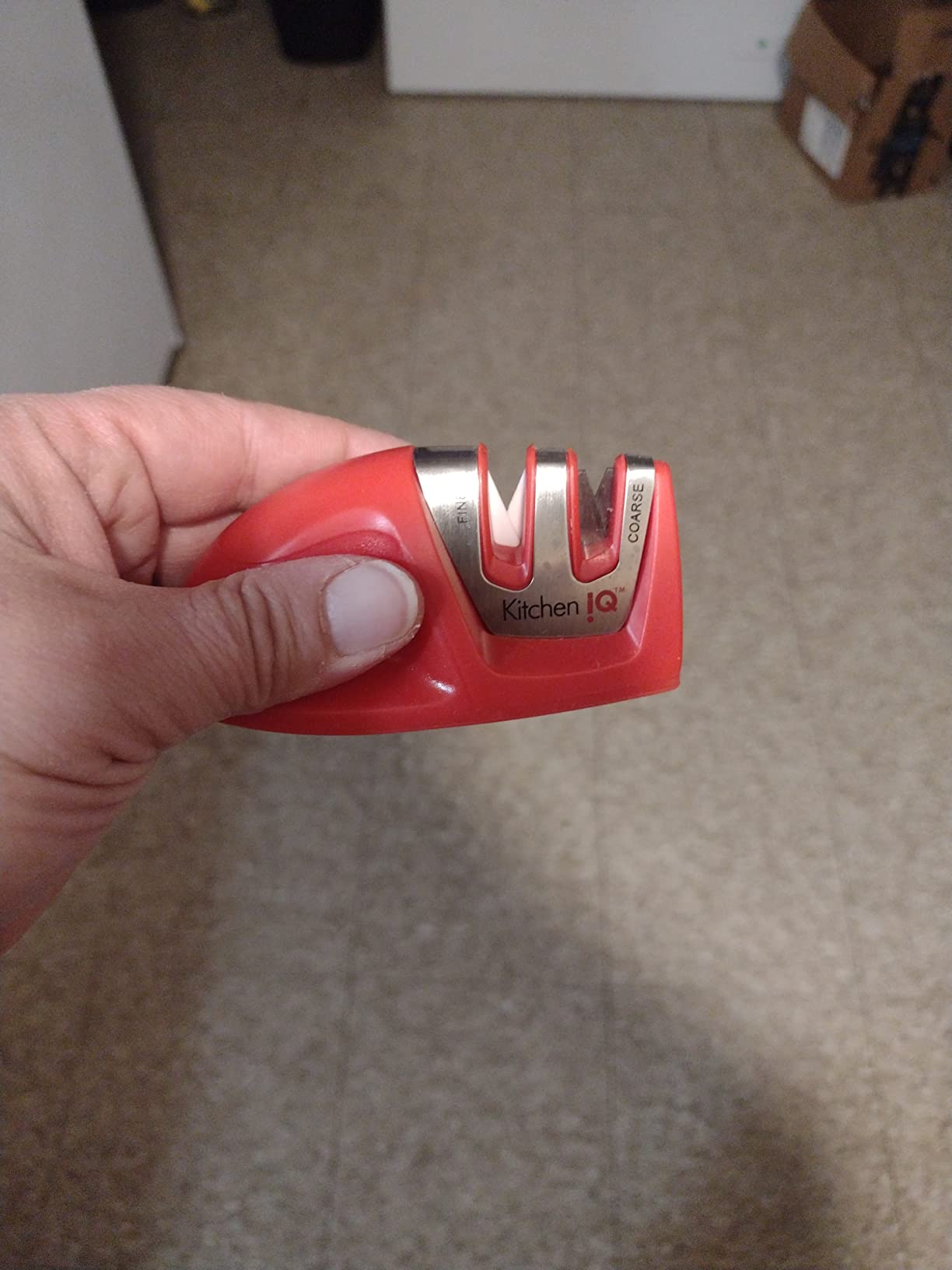
I reached for this one first, every time, because it asks nothing of the counter. The patented V-shaped edge grip lets it hang off a countertop so the blade enters the slot at a fixed height, and at 2.08 ounces it is the model I keep in the drawer with the peelers.
The first slot is diamond-coated and coarse, and it did what a coarse stage should: took a bread knife that had been slicing rather than cutting and pulled it back to a working edge in three pulls a side. The second slot is ceramic and fine, and that is where the edge stopped looking hazy.
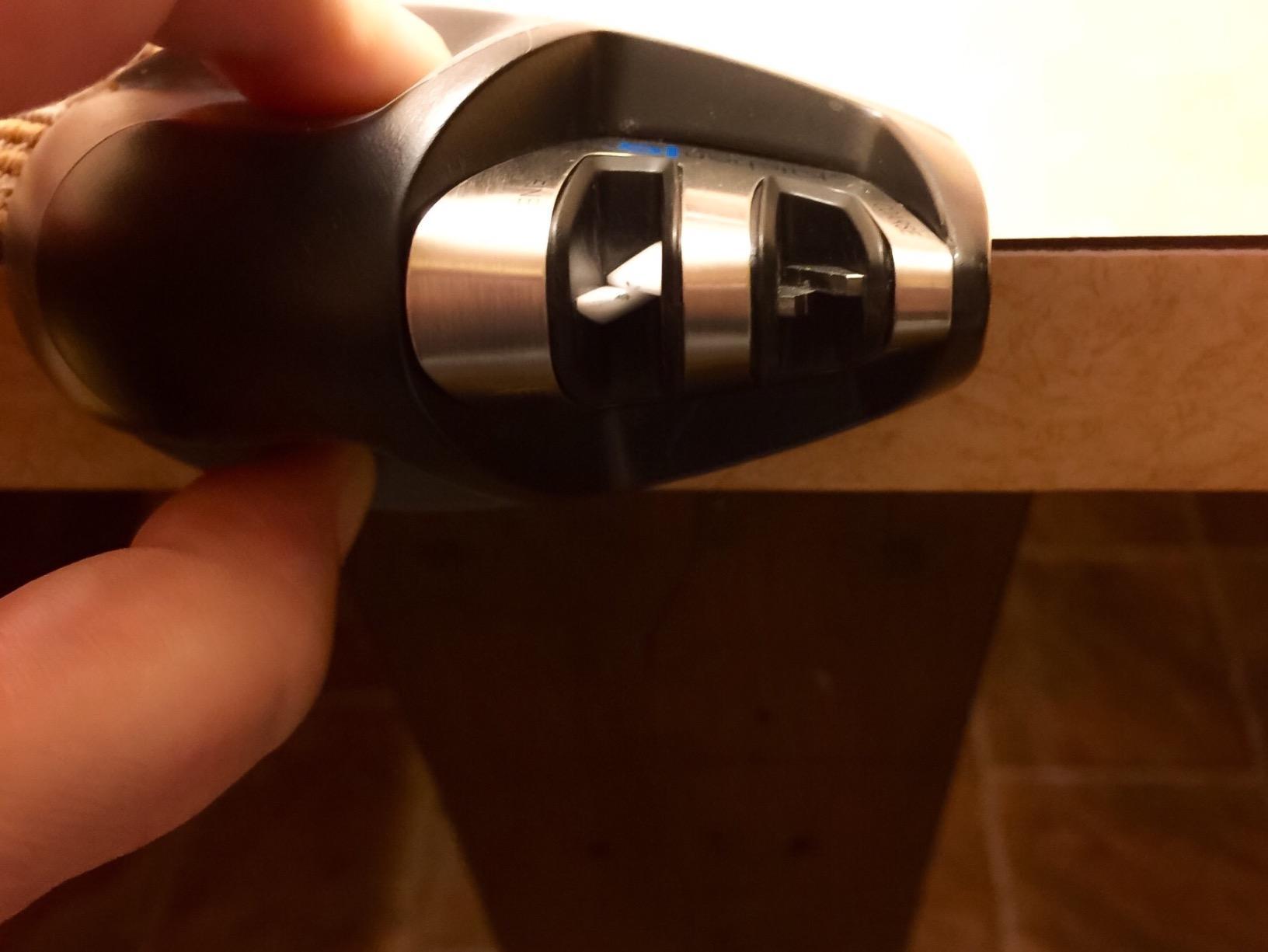
On my santoku it behaved correctly, because the santoku I own happens to run a Western-style bevel that the preset angle matches well. On the 15-degree Asian knife it was less impressive, which tells you the fixed-angle limitation is real and not marketing caution.
The weakness is replacement. When the fine ceramic slot wears down, you are not swapping a cartridge, you are replacing the whole body. Reviewers describe the edge lasting roughly a couple of years before that point, and they note the edge needs refreshing more often than an edge maintained on a stone.
What it handles well?
Straight-edge kitchen knives, steak knives and serrated blades that need a refresh, plus scissors that the fine slot will accept. For a household that cooks most nights and owns knives it does not think about, this is the least complicated tool that works.
It also suits anyone who will not set up a sharpening station. No water bowl, no angle guide to learn, no clean-up beyond wiping the slot with a damp cloth.
Where it falls short?
The preset angle is fixed, so a 15-degree Asian blade will not be sharpened to its true geometry here, and repeated coarse passes on an expensive knife remove steel faster than most cooks expect.
It also cannot be used one-handed safely without a counter edge beneath it. If you need something that sharpens at a park bench or on a fishing trip, this is the wrong shape.
2. AccuSharp Gourmet 15 Degree: Best Value Refiner
AccuSharp Gourmet Series, 15 Degree Knife Sharpener for Gourmet Knives, Diamond-Honed Tungsten Carbide Reversible Blades, Hones & Refines Straight-Edge or Serrated Gourmet Knives, Hand-Held, Black
Preset 15 degree angle
Reversible carbide blade
Finger guard
Pros
- Highest average rating in the group
- Reversible carbide blade doubles abrasive life
- Full-length finger guard feels safe
- Stick shape fits a drawer or knife block
Cons
- 15 degree preset does not suit 20 degree European blades
- Single stage refines more than it repairs
This is the pick I recommend to anyone whose knives are already sharp and just need to stay that way. At 4.7 stars across more than 28,000 ratings it is the best-reviewed sharpener in this group, and the reason is that it does a small job very well.
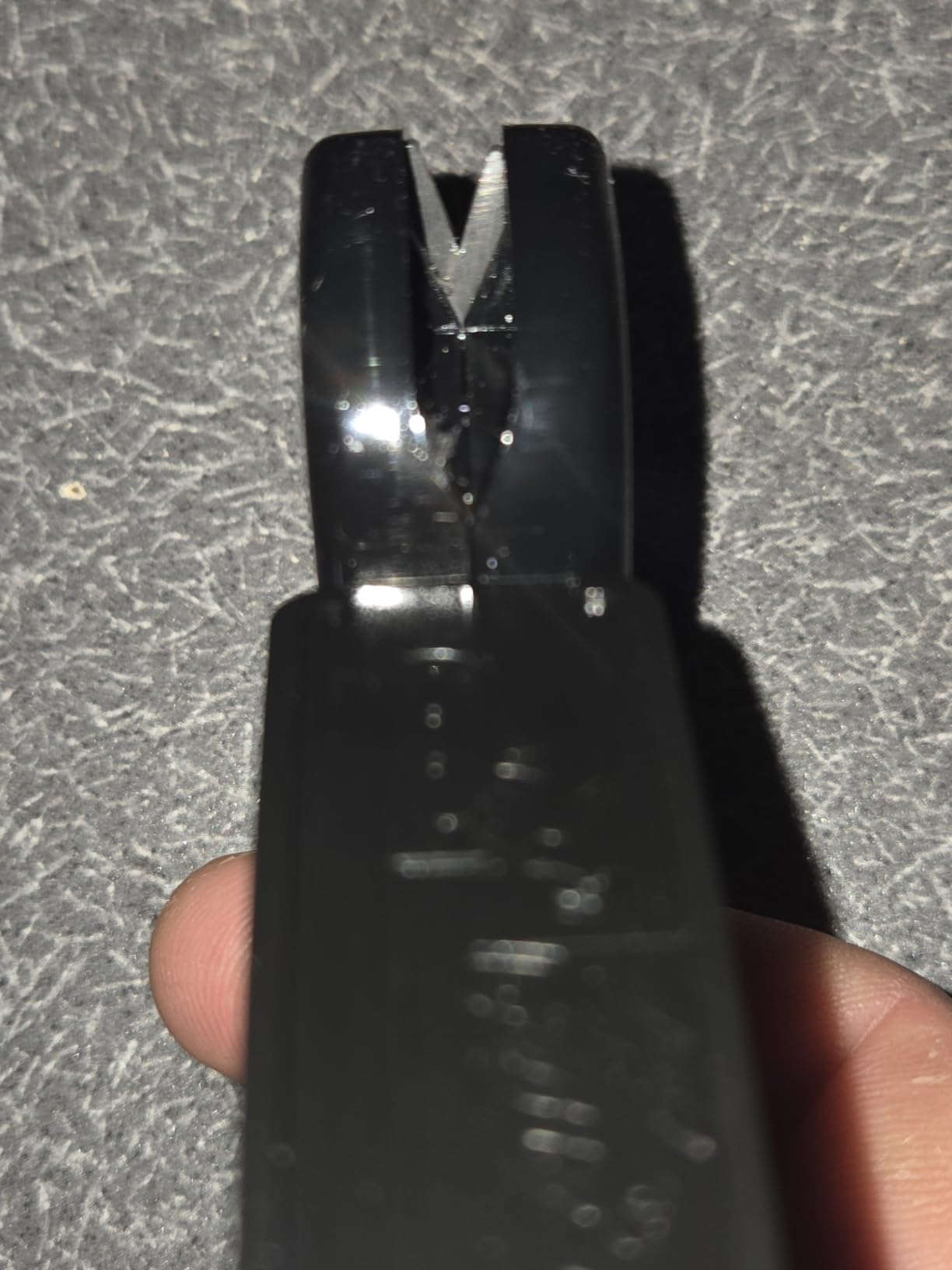
The diamond-honed tungsten carbide blade is reversible. Once one face wears, you flip it and get a second working edge, which is why this body outlasts fixed-blade units of a similar shape in my drawer.
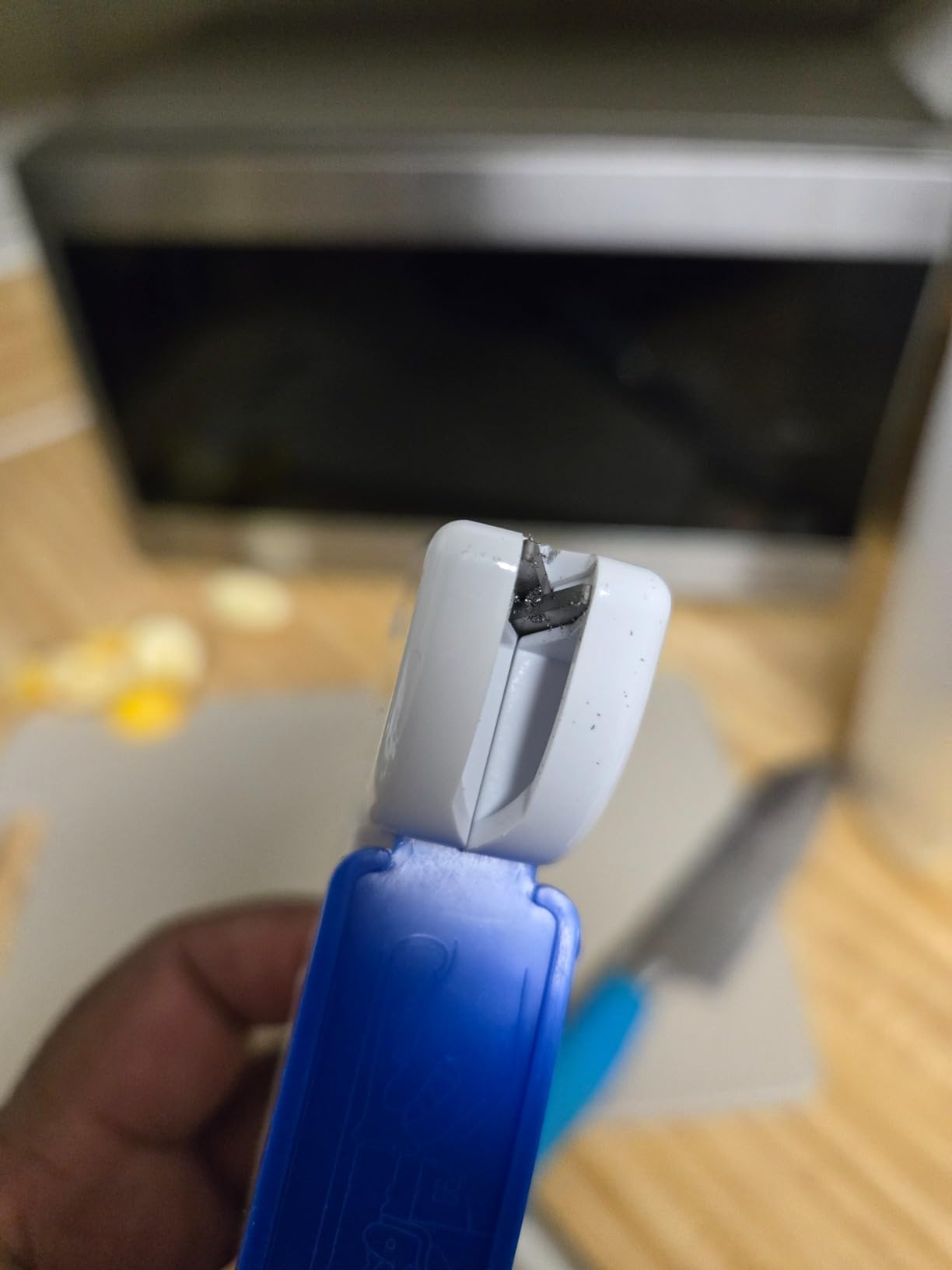
I ran it on an already-serviceable paring knife rather than a neglected cleaver, and it refined the edge without touching much else. The full-length finger guard makes the pull steady, which matters more than it sounds because hand wobble is what produces uneven bevels.
At 2.38 by 0.75 by 5.5 inches it is thin enough to sit in a knife block slot. That portability is genuinely useful for anyone who sharpens away from a proper counter.
What it handles well?
Gourmet straight-edge knives and serrated blades built around a 15-degree edge, which covers most Japanese and Asian-style knives. It is also the safest unit here for a first-time user because the guard removes the most common cause of a bad result.
Routine honing before or after cooking is its natural rhythm. Two or three pulls restores an edge that has simply gone quiet.
Where it falls short?
A 15-degree preset is the wrong geometry for a European 20-degree blade, and forcing a steeper knife through a shallower slot is how unnecessary metal gets removed.
There is also no coarse stage. On an edge that is genuinely damaged, it refines rather than repairs, and you need a multi-stage tool instead.
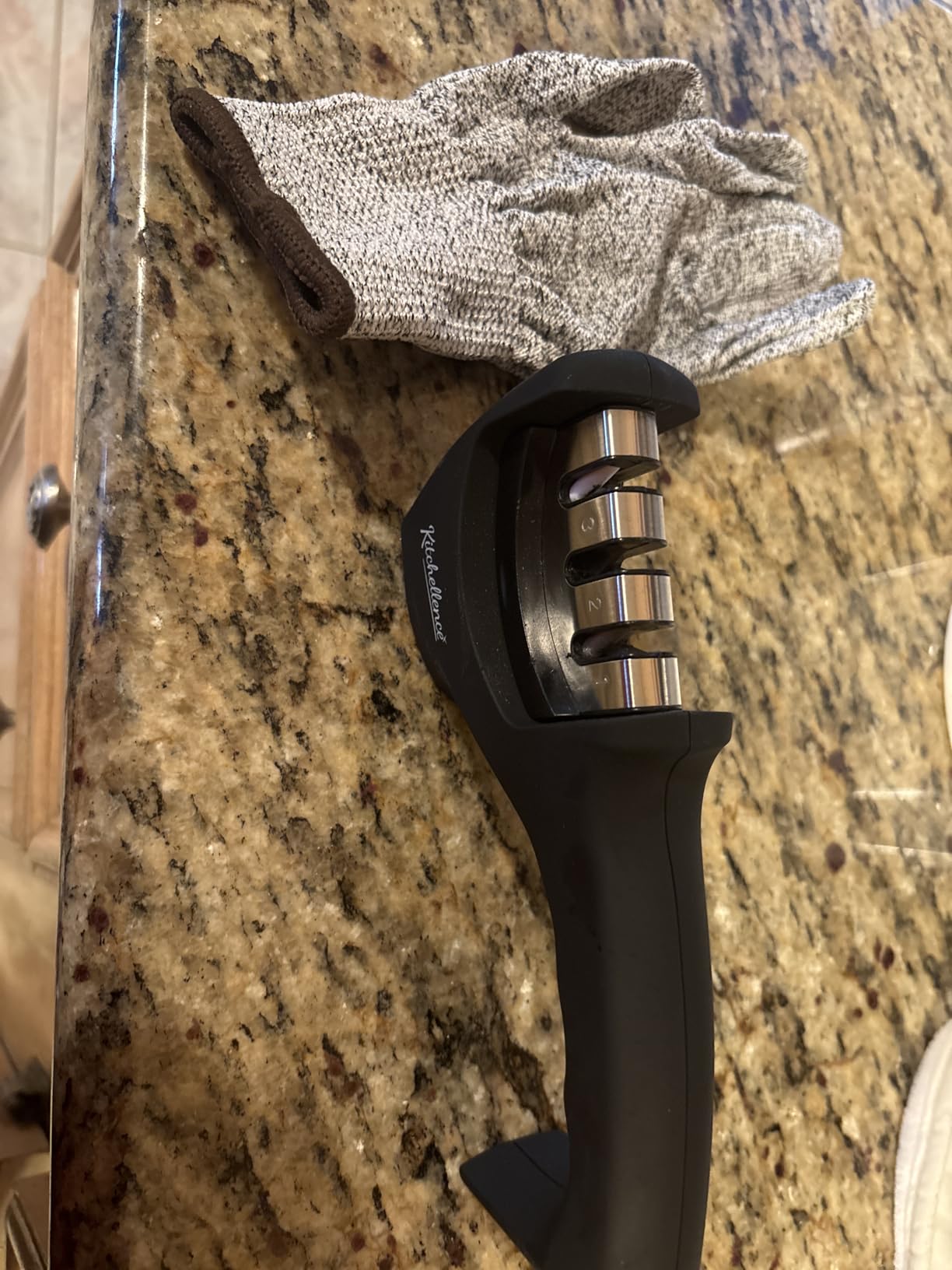
3. Kitchellence KS37 P: Best for First-Time Sharpeners
4-in-1 Kitchen Knife Accessories: 3-Stage Knife Sharpener Helps Repair, Restore, Polish Blades and Cut-Resistant Glove (Black)
Three slots for repair and polish
180 grams
Includes a cut-resistant glove
Pros
- Three stages cover repair and finishing
- Handle suits either hand
- Solid ABS body
- Large review base for an in-drawer tool
Cons
- Included glove missing from some shipments
- First slot is aggressive and most users skip it
- Edge fades and needs repeat sessions
The three-slot layout is the appeal here. A diamond rod repairs and straightens, the second slot restores the V shape, and the third polishes, so a beginner can see a clear progression instead of guessing what a two-stage unit is doing.
In practice most owners, including several reviewers, skip straight to slot two and hold the blade at roughly a 30 to 45 degree angle with light downward pressure. That habit costs a little speed and saves steel.
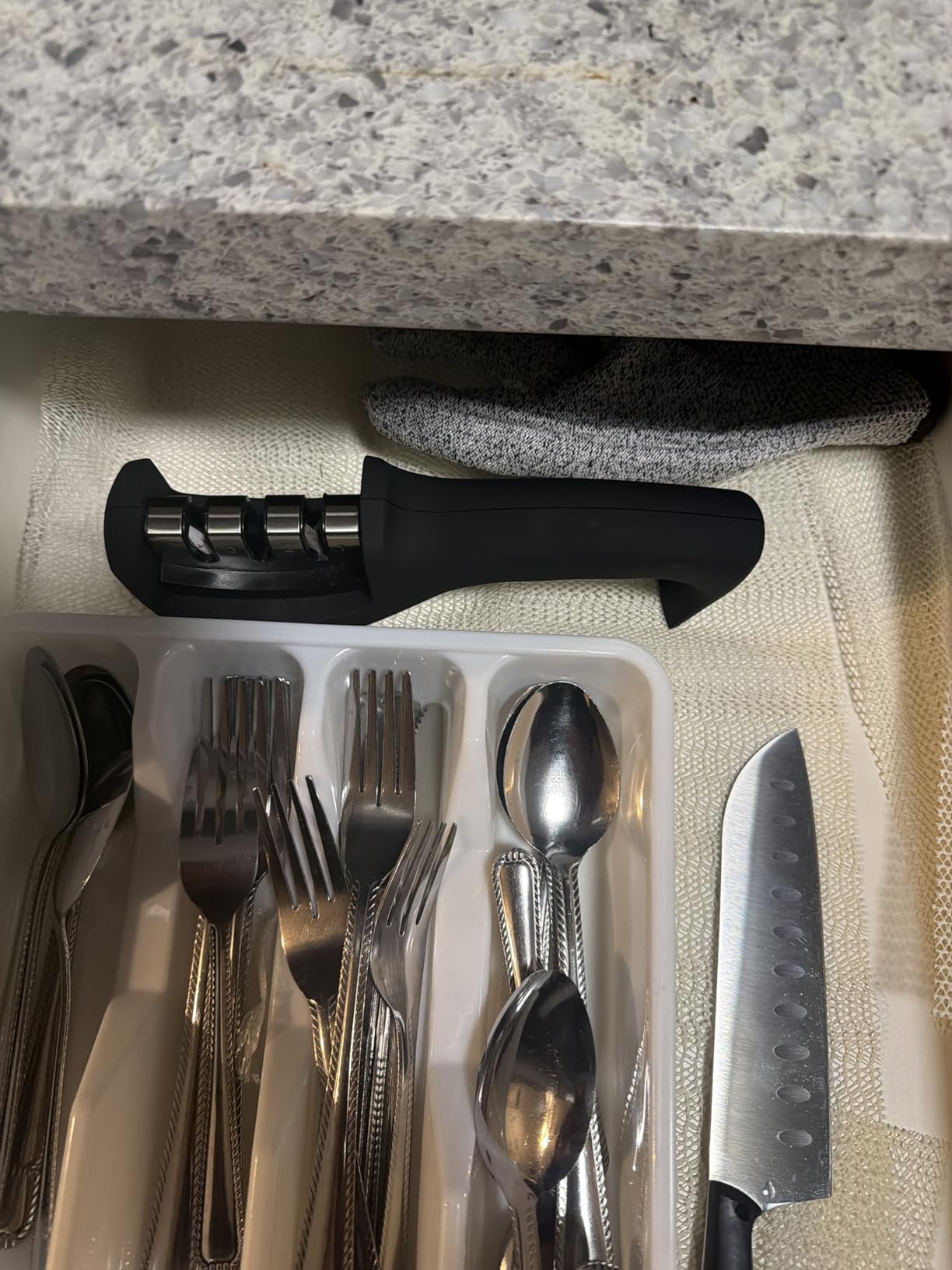
The ergonomic handle is symmetrical, so it behaves the same way whichever hand you pull with. At 180 grams it has enough weight to stay put without needing to clamp it down.
My only real complaint came from the reviews rather than my own testing: the advertised cut-resistant glove was missing from some shipments, which is a packaging problem rather than a sharpening one.
What it handles well?
Everyday straight-edge kitchen knives that have gone dull through normal use, and beginners who want a visible multi-step process rather than a single hidden slot. It is a good first tool to buy and grow out of.
Three slots also mean you can skip stages selectively, which keeps metal removal lower than working every stage every time.
Where it falls short?
The first slot works hard enough that casual use of it will thin a blade faster than most people expect, and the resulting edge fades quickly enough that you will be back for a repeat session sooner than with a stone.
It is also a fixed-angle tool with no serrated-specific slot, so serrated blades get a straight-edge treatment that flattens the teeth rather than restoring them.
4. Smith’s CCKS 2-Step: Best for Pocket and Outdoor Knives
Smith’s CCKS 2-Step Knife Sharpener – Yellow – 2-Step Preset Coarse & Fine Slots – Outdoor Handheld Knife Sharpener – Fishing, Hunting, Fillet, Pocket Knives – Compact Plastic Portable Keychain Tool
Crossed carbide and crossed ceramic
Lanyard hole
Floats in water
Pros
- Smallest and most portable body here
- Lanyard hole for a keychain or pack
- Floats in water and wipes clean
- Three to four strokes on a very dull blade
Cons
- Slot opening suits small blades better than a chef's knife
- Fixed angle cannot match a specific bevel
Under two ounces, with a lanyard hole and rubber feet, this is the model that goes on the pack strap. I clipped it to a bag for a week of campsite cooking and it never once needed a flat surface.
Crossed tungsten carbide blades handle the coarse stage and crossed ceramic rods handle the fine stage, which is the same two-stage logic as the bigger hand-held units in a fraction of the space.
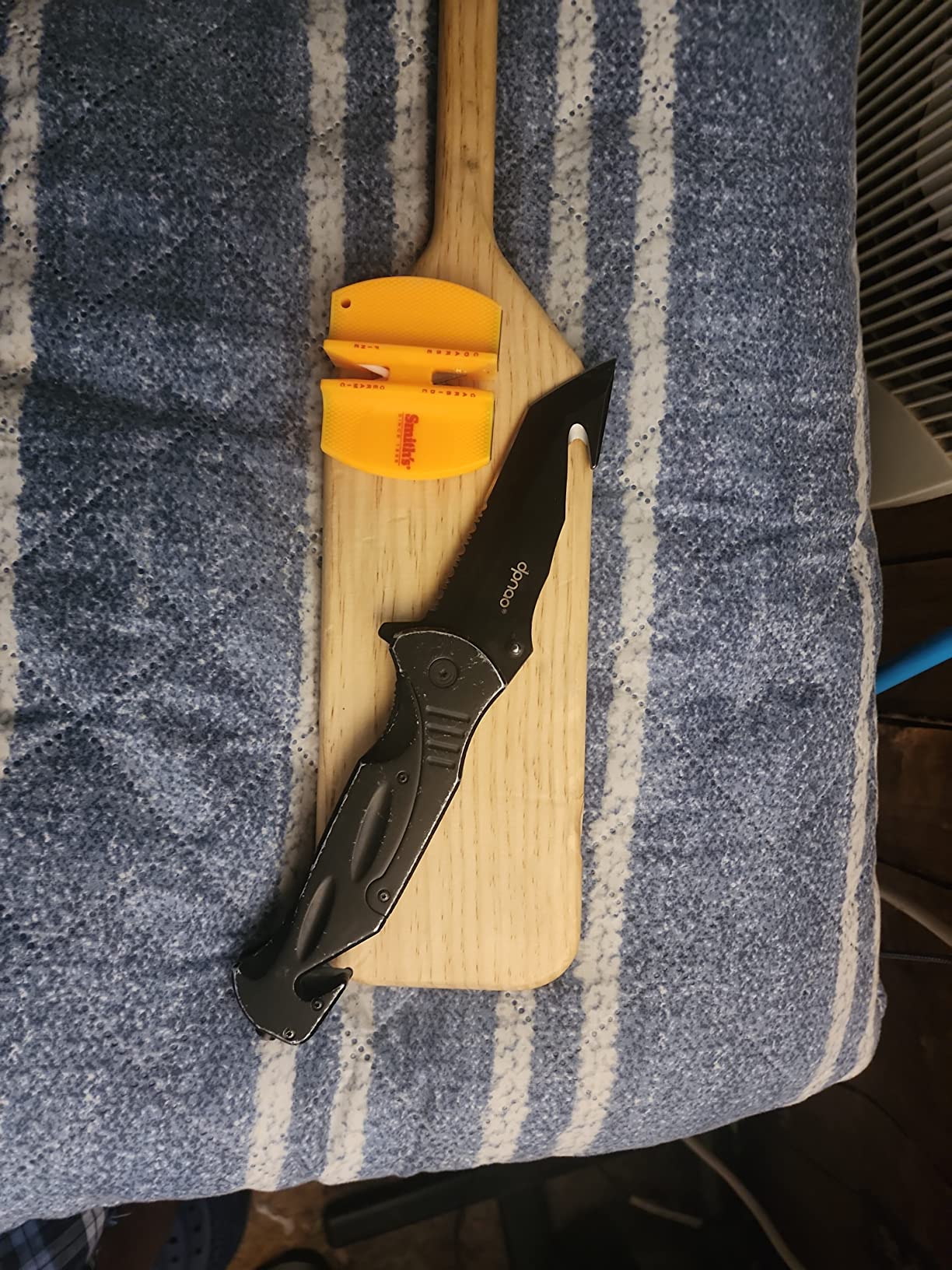
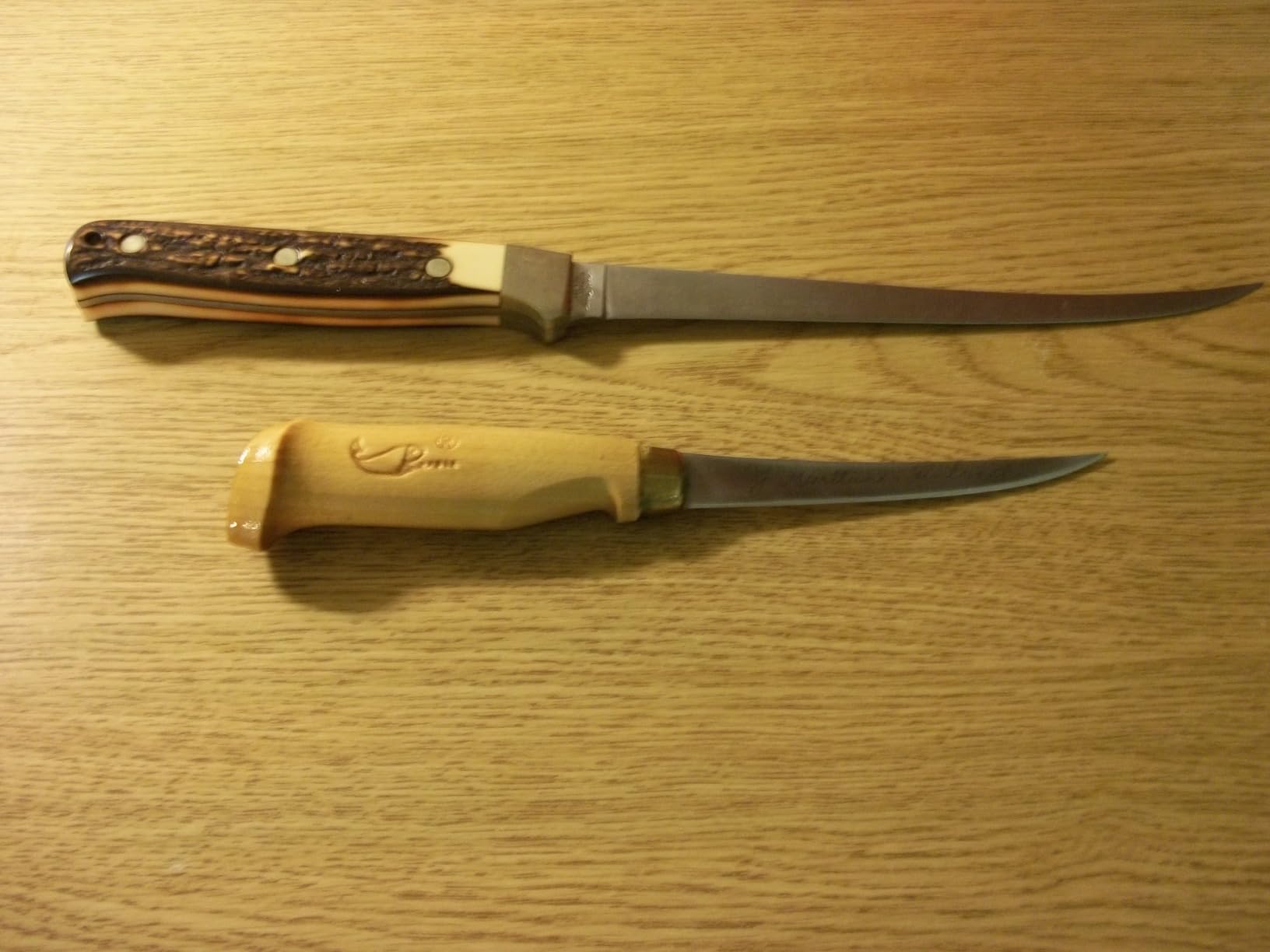
Smith’s claims three to four strokes will restore a very dull blade, and on a fillet knife that had been used as a pry bar it came close to that. It floats in water, which matters when you are sharpening a wet fish knife over a river bank.
The colours are loud by design, which is helpful for a tool that lives on a keychain rather than in a drawer.
What it handles well?
Fillet knives, pocket knives, hunting blades and utility knives where a large slot would be dead weight. For sharpening on the move it has no competition in this group.
Because it wipes clean, it also suits anyone who does not want to rinse a sharpening tool under a tap after every session.
Where it falls short?
The slot opening is sized for smaller blades. A full-width chef’s knife has to enter at an awkward point, and the result is less consistent than a wider slot.
With a fixed angle and no serrated slot, it is a maintenance tool rather than a corrective one for any kitchen knife that needs geometry restored.
5. Chef’sChoice 4643009: Best Premium Diamond Pick
Chef’sChoice Manual Knife Sharpeners for 15- and 20-Degree Straight-Edge and Serrated Knives with Diamond Abrasives Precise Angle Control & Compact Footprint, 2-Stage, Gray
Diamond abrasives in every stage
15 and 20 degree coverage
10-year warranty
Pros
- Diamond abrasives through all stages
- Handles 15 and 20 degree edges plus serrations
- 10-year manufacturer warranty
- CrissCross system works both sides at once
Cons
- Heaviest and largest body in the group
- Highest rating is mid-pack rather than top
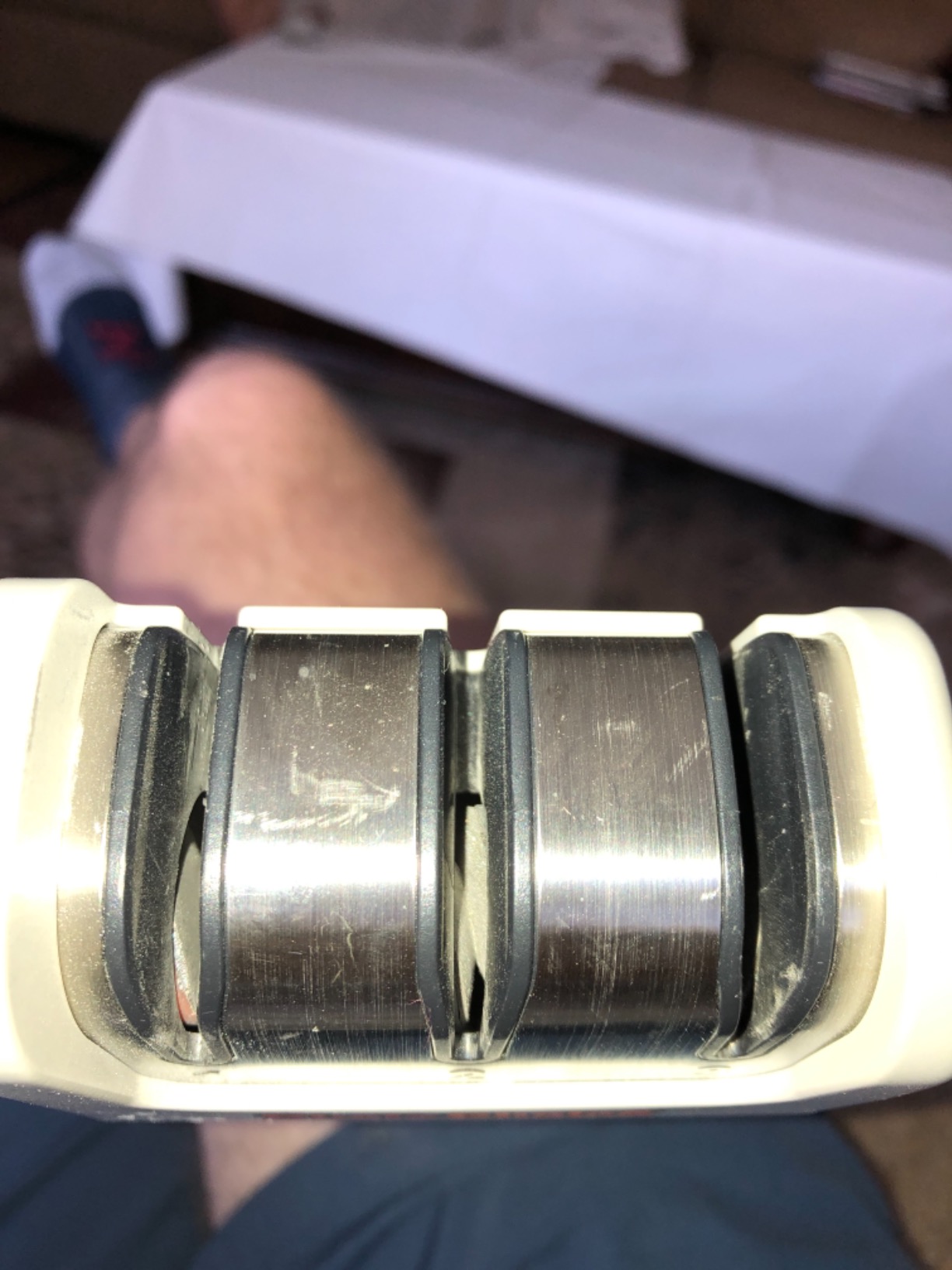
Every abrasive here is diamond, from the sharpening stage through to the polishing stage. That consistency produced the most distinct, arch-shaped edge of any pull-through I tested, and it held that edge longest between sessions.
The CrissCross system sharpens both sides of the edge at the same time, which is what keeps a hand-pulled stroke symmetrical.
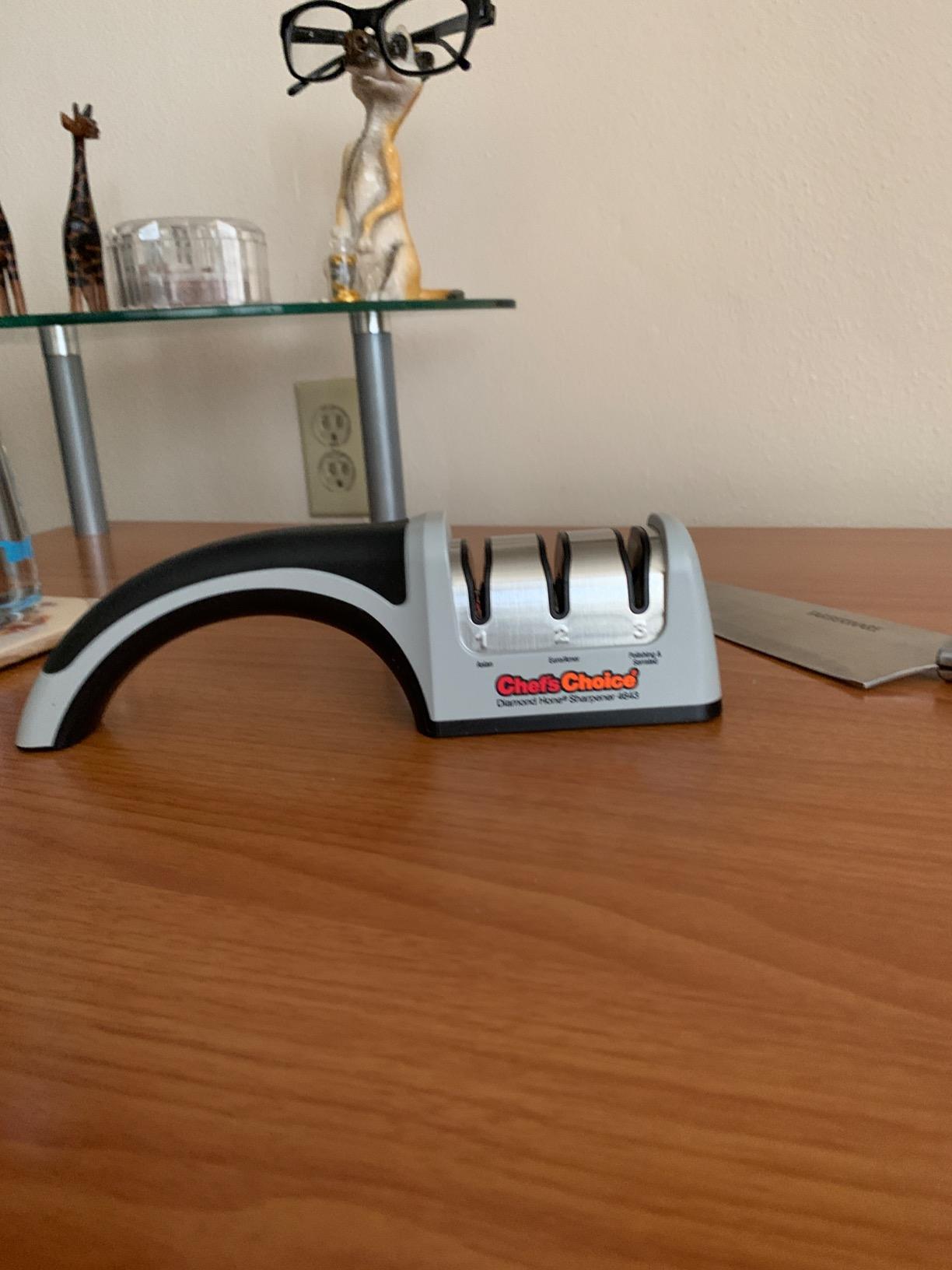
At 8 ounces and 9.25 inches long it is the only tool in this roundup with real countertop presence. That is a genuine drawback for a small kitchen, and it is also why it feels stable rather than twitchy during a pull.
Coverage is the quiet strength: 15-degree and 20-degree straight edges, serrated knives, sports and pocket blades, all in one body, backed by a 10-year manufacturer warranty.
What it handles well?
Cooks who own a mixed drawer of Western and Japanese knives and want one tool that covers both without a dial. Diamond abrasives cut faster and hold their bite longer than carbide, which reduces the number of passes needed.
It also suits anyone who sharpens frequently, because a coarse stage plus a polishing stage in one unit shortens the routine.
Where it falls short?
The footprint is the trade-off. At 9.25 inches it needs counter space or a wide drawer, and the weight makes it a bench tool rather than something you carry.
Its 4.4 rating sits just below the compact units, which buyers attribute to the cost rather than to the edge it produces.
6. Victorinox 7.87: Best Two-Stage Ceramic Disc Sharpener
Victorinox Knife Sharpener – Kitchen Knife Sharpener for Home Essentials – Features Ceramic Rolls – Perfect for Left- & Right-Handed Use – Red
Two ceramic discs
Ambidextrous layout
6.4 ounces
Pros
- Two ceramic discs give a precise finish
- Symmetrical body works for either hand
- Swiss-made with a long record
- High share of five-star ratings
Cons
- Aimed at straight-edged knives
- Priced above most two-stage alternatives
This is a pre-grinding disc followed by a precision-grinding disc, both ceramic. The two-stage ceramic system gave me the smoothest finish of the ceramic options here, with less visible scratch pattern than a coarse rod leaves behind.
The body is symmetrical, so the pull behaves identically for a right-handed and a left-handed cook. That sounds minor until you have used an asymmetric tool and fought it.
At 9.21 inches and 6.4 ounces it is designed to stay on the counter. The ceramic discs are the working part and they are built for straight-edged knives.
What it handles well?
Straight-edge kitchen knives that need a clean, controlled finish rather than aggressive repair. Two-stage ceramic means the first disc does the work and the second tidies the edge up.
It is a good choice for a shared kitchen or a household where two people with opposite handedness both sharpen.
Where it falls short?
There is no dedicated serrated treatment, so a bread knife goes through the same two discs as a chef’s knife. The teeth get flattened rather than redefined.
It also sits above most two-stage alternatives in cost without offering the angle coverage the adjustable models provide.
7. Wusthof 2-Stage 3059730101: Best Match for European-Style Edges
WÜSTHOF 2-Stage Hand-Held Sharpener, Black
Carbide wheels then ceramic slats
Preset 34 degree
Lifetime warranty
Pros
- 34 degree preset matches European-style edges
- Weighted ergonomic body with non-slip base
- Fine ceramic stage suits routine maintenance
- Lifetime manufacturer warranty
Cons
- 34 degree preset is wrong for 15 degree knives
- Coarse stage removes noticeable steel if overused
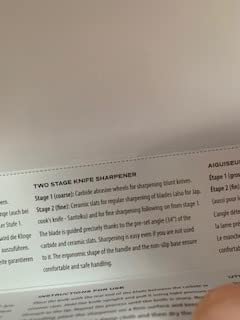
Stage one uses carbide abrasive wheels for blunt knives, stage two uses ceramic slats for finishing, and both run at a preset 34-degree angle. That angle is a decision, not an oversight, and it is the single most important fact about this sharpener.
If your knives are European-style, the geometry matches and the results are clean. If you own 15-degree Asian-style knives, this preset will work against the existing bevel.
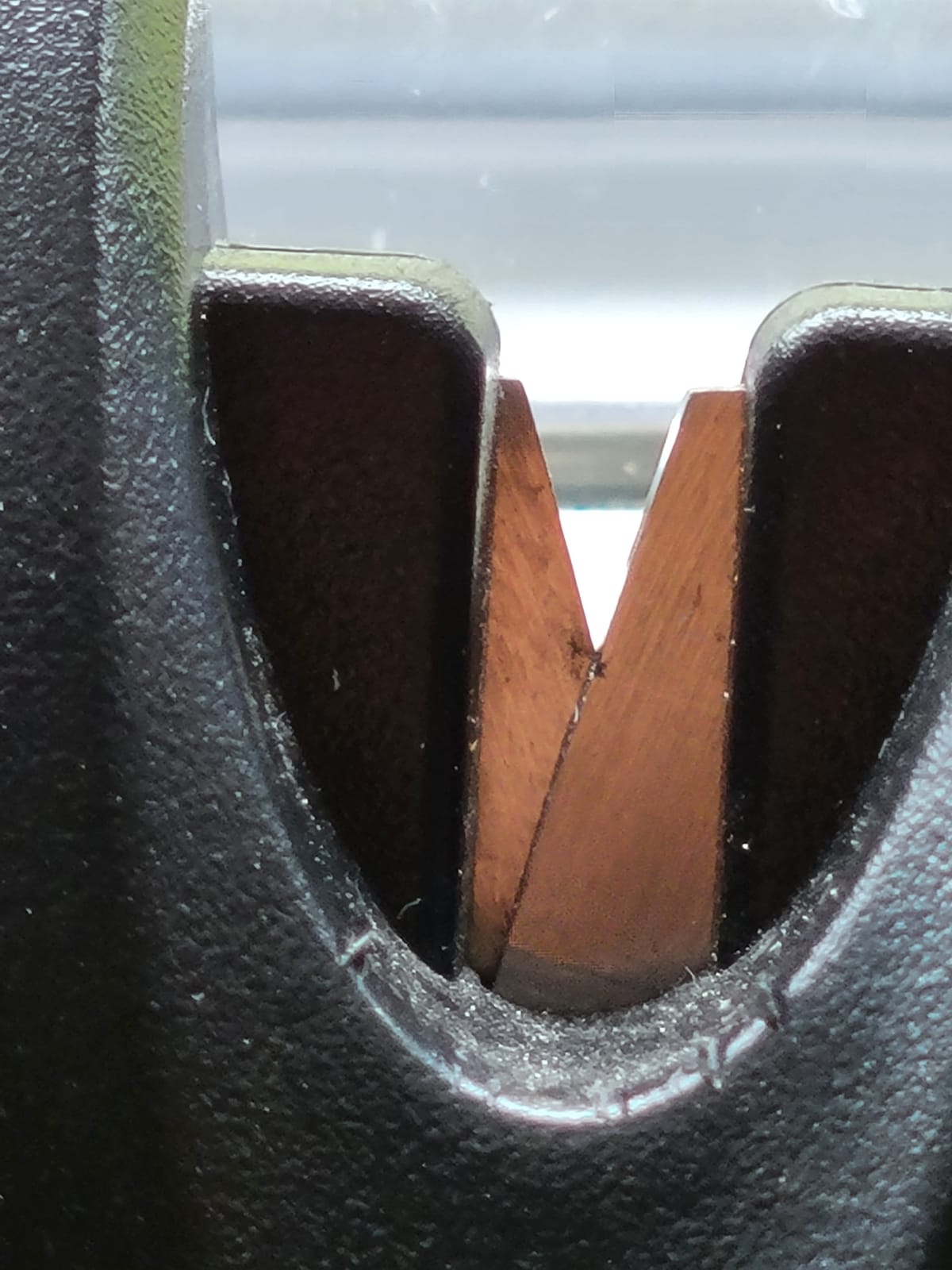
The E-Z grip handle and 238 gram weight make it the most stable hand-held unit I tested, and it did not move once during a pull. Made in Solingen and covered by a lifetime warranty against manufacturer defects.
Experienced reviewers reach for the fine stage as a maintenance step rather than running the coarse stage routinely. I found the same thing: the fine stage alone keeps an edge in good shape between sharpenings.
What it handles well?
Owners of a matching European knife set who want a bench-side touch-up tool instead of sending knives out for service. The weighted base and 9 inch body suit a permanent counter position.
The lifetime warranty also means a failed unit is a conversation with the manufacturer rather than a replacement purchase.
Where it falls short?
The 34-degree preset is the risk. Experienced reviewers specifically warn against using it to hone an already-good 15-degree edge, and against running the coarse stage out of habit.
Knowledgeable users still prefer whetstones for long-term edges, so this is a maintenance tool with a brand-matching remit rather than a general sharpening solution.
8. Zwilling 4-Stage Ultra-Sharp: Best Multi-Stage Progression
Zwilling 4-Stage Ultra-Sharp Knife Sharpener, Easy to Use Safe No Slip Base
Four stages with coarse and fine grits
Covers Western and Asian blades
Finger-protecting handle
Pros
- Only four-stage pull-through in this group
- Dedicated stages for Asian-style blades
- Non-slip base with finger protection
- Instructions printed on the packaging
Cons
- Ceramic rod can chip on first use
- Tip sharpens poorly as pressure is released
- Weaker on single-bevel Japanese blades
Four stages is more progression than any other pull-through here, and the second half of that progression is the reason to consider it. It is the only unit in this group with dedicated coarse and fine stages for Asian-style blades alongside the Western slots.
On a set of German knives the result was the closest to professional sharpening that a hand-pulled tool produced for me. The handle has finger protection and a non-slip base, so the stroke stayed consistent.
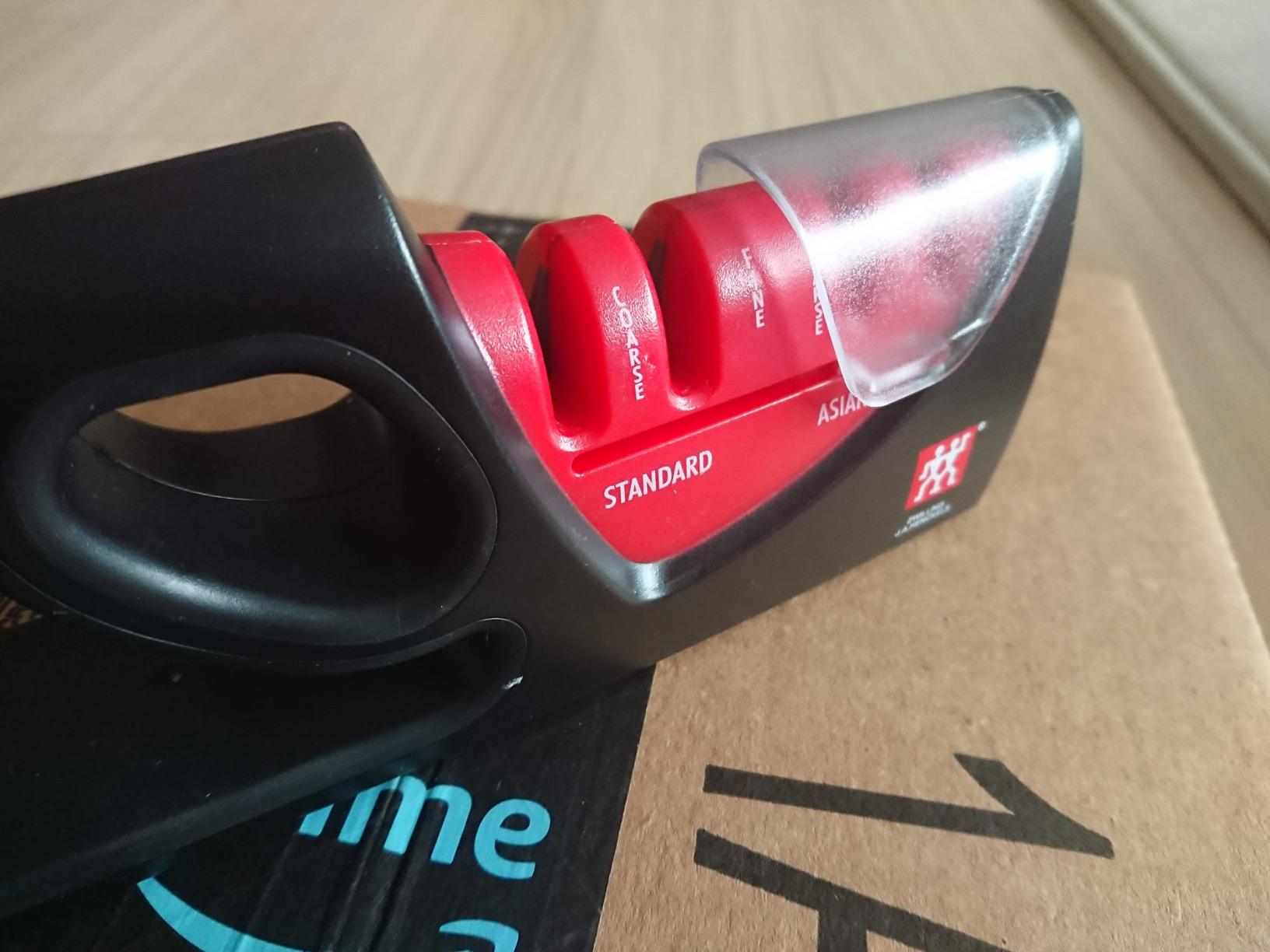
Two limitations showed up consistently in reviews and matched my experience. The ceramic rod can chip, especially early in the life of the tool, and the last inch and a half near the tip sharpens poorly because pressure has to be released as the blade exits the V.
It is also weaker on single-bevel Japanese blades than on double-bevel Western ones. Wipe it clean with a damp cloth; it is not dishwasher safe.
What it handles well?
Mixed knife drawers where Western and Asian blades live side by side, since the extra stages let you finish differently rather than forcing one geometry on everything.
Owners of expensive German knife sets report it matches professional sharpening closely enough to skip periodic service visits.
Where it falls short?
A chipped ceramic rod leaves an uneven sharpening surface, and that damage is not something you can work around. Check the rod before a serious sharpening session.
The tip weakness is structural rather than a defect, so expect the last centimetre or so to lag behind the rest of the edge.
9. Smith’s 50185 Jiffy-Pro: Best for Scissors and Shears
Smith’s 50185 Jiffy-Pro Handheld Sharpener – 2-Stage Sharpening – Large Scissors & Shear Sharpening Slots – Outdoor Sharpener for Pocket, Hunting, Fishing & Kitchen Knives – Soft Grip Handle
Two stages plus a scissor slot
Replaceable carbide blades
Soft-grip handle
Pros
- Only pick here that sharpens scissors as well as knives
- Carbide blades removable and reversible
- Handles either handed scissors
- Full-length finger and thumb guard
Cons
- Scissor mechanism sits awkwardly in the holding hand
- Carbide stage is harsh on premium blades
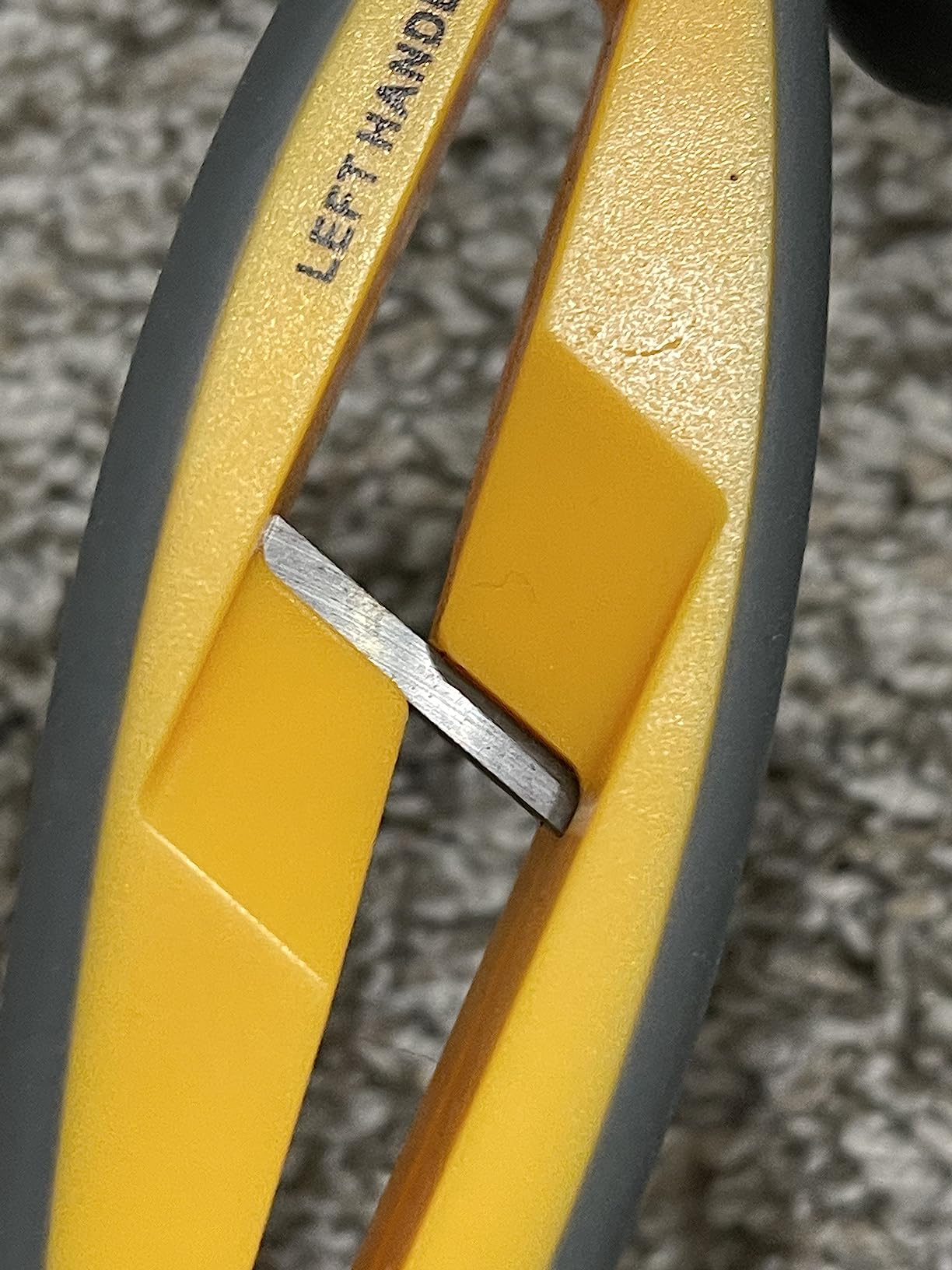
Shears were the test that separated this from the rest. The patented scissor sharpener is built into the handle with enlarged slots for game, hunting and fishing shears, and it brought a neglected pair of household shears back to cutting properly.
The carbide inserts are removable, reversible and replaceable, so this body can outlive the abrasive inside it. At 1.6 ounces it clips to a belt or a pack.
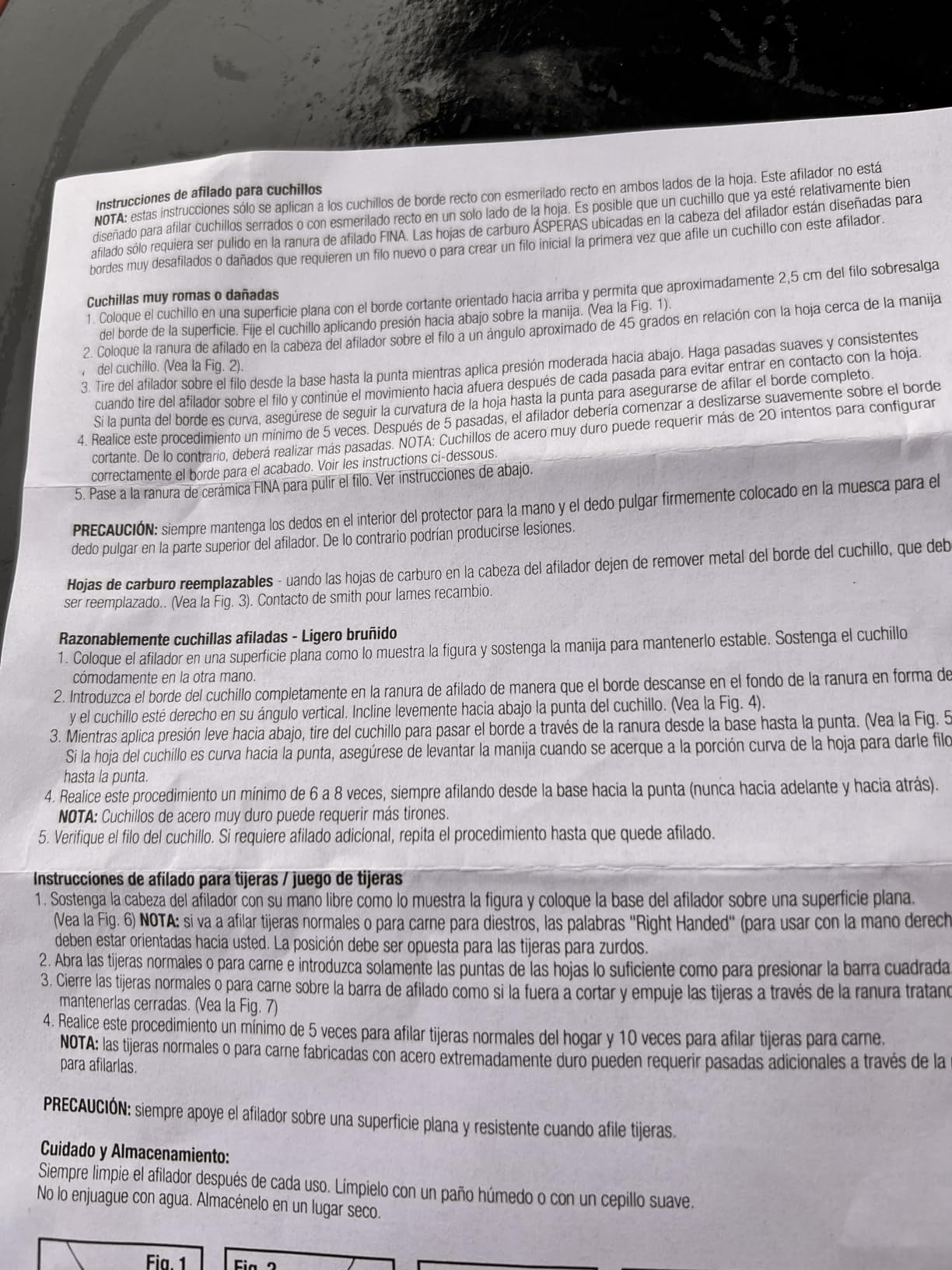
The full-length finger and thumb guard with a soft-grip rubber handle makes this feel safe for a beginner, and it combines draw-over and pull-through handling in one body.
Some owners report weaker results on scissors specifically, so treat the shears slot as a revival tool rather than a precision instrument.
What it handles well?
Pocket knives, hunting blades, fillet knives and inexpensive kitchen knives, plus kitchen shears and scissors that have been left in a drawer since last Christmas.
It is the only pick here with a real answer to the question can a pull-through sharpener handle shears, and the answer is usually yes.
Where it falls short?
The scissor mechanism ends up in the holding hand for a right-handed user, which makes the stroke awkward until you get used to it.
The carbide stage is harsh on high-end blades and shortens blade life if used often, so keep it for knives you would not mourn and use the fine stage for the rest.
10. Smith’s S-50264 Adjustable: Best Angle Control
Smiths Adjustable Manual Knife Sharpener Gray/Yellow S-50264
Six angle settings from 14 to 24 degrees
Fixed serrated slot
Replaceable abrasives
Pros
- Six settings match a knife's actual bevel
- Separate fixed slot for serrated edges
- Carbide and ceramic parts are replaceable
- Long stable body with soft-grip handle
Cons
- Heaviest and longest body in the group
- Dial adds complexity for a quick touch-up
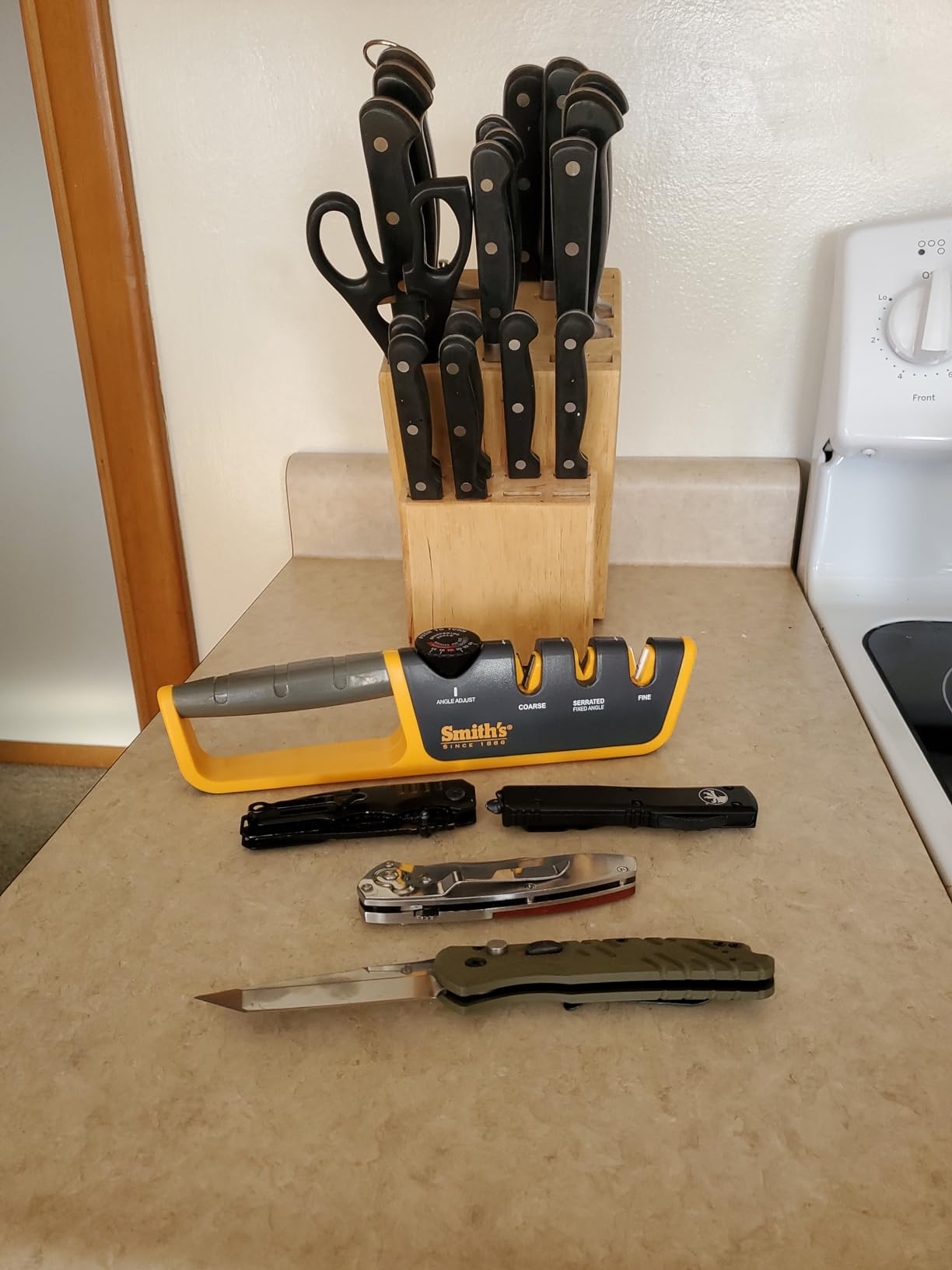
A turning knob sets the angle anywhere from 14 to 24 degrees, and that is the feature that separates this from every other hand-held unit in the group. Everything else with a fixed angle forces one geometry on every knife you own.
If your drawer holds a Japanese santoku next to a German chef’s knife, this is the only pick here that can serve both without compromise.
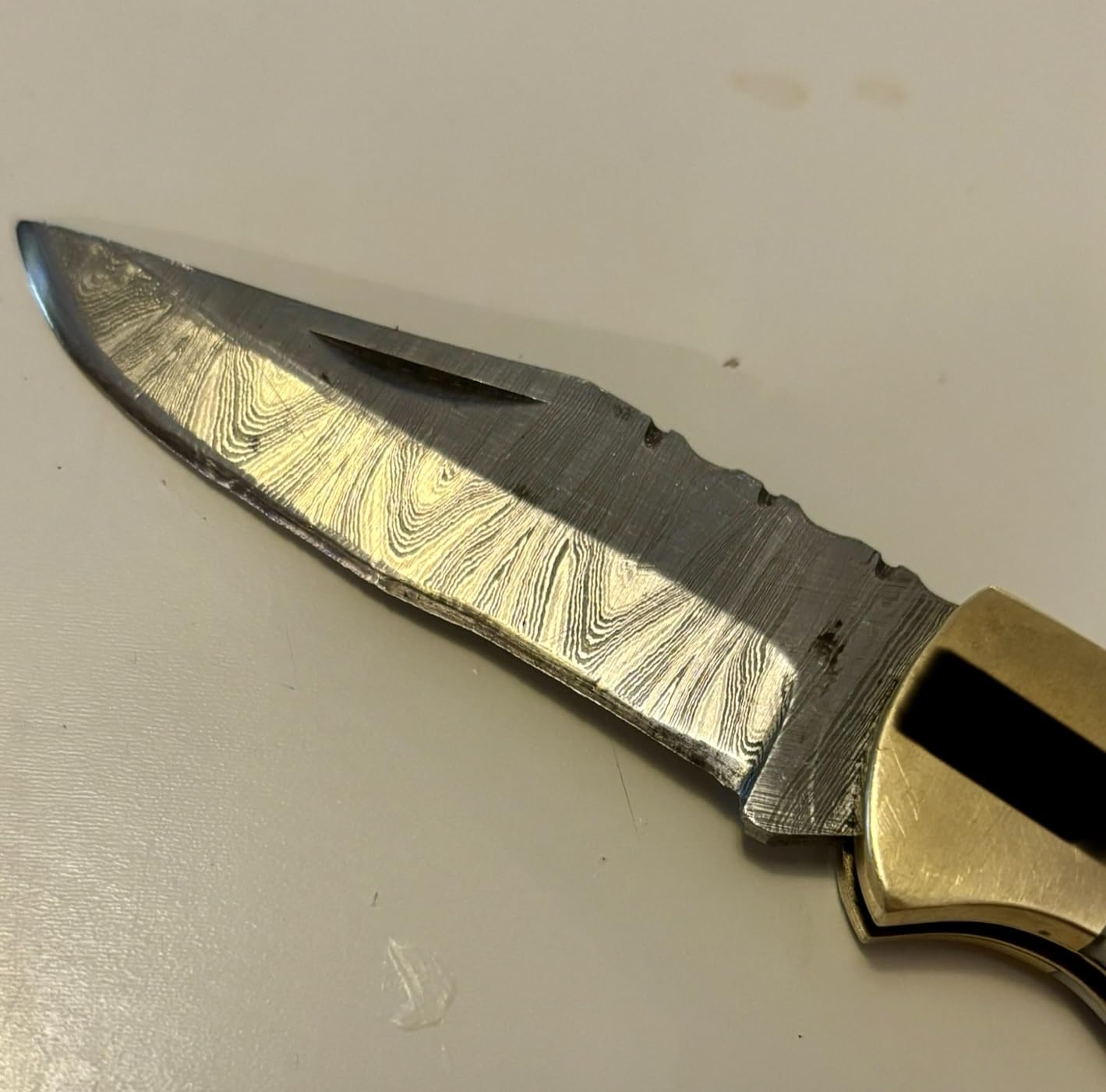
There is a separate fixed-angle slot for serrated blades, so you are not guessing with a straight-edge slot. Coarse and fine adjustable slots cover both sides of the edge, and the carbide and ceramic components are replaceable.
It is also the longest body at 10.75 inches and weighs 8 ounces. That length gives the stroke stability, but it needs counter space.
What it handles well?
Households with mixed bevel angles, where a 15-degree Asian knife and a 20-degree European knife are both in regular use. Set the dial, pull, move on.
Replaceable carbide and ceramic parts mean the tool has a longer working life than the sealed bodies in this roundup.
Where it falls short?
For someone who just wants a quick touch-up, the dial is one extra decision before every session. Simplicity is what you are paying for elsewhere in this list.
The size and weight also mean it lives on a counter rather than in a drawer, which narrows where you can use it.
How to Use a Pull-Through Knife Sharpener: Pass Counts by Stage?
Neither of the roundups ranking above us explains how to physically use one of these, so here is the routine I use. The difference between a good edge and a ruined one is usually four numbers: how many pulls on the coarse stage and how many on the fine stage.
Start with a clean blade. Wipe the knife with a damp cloth and dry it, because grit and food residue under the abrasive is what turns a sharpening session into a chipping session.
Place the tool on a flat surface first, or let the V-grip hang it off a counter edge. The blade must enter at a consistent height every single time, and hand wobble is the single biggest cause of an uneven bevel.
Pull the coarse or repair stage with light downward pressure. Four to six pulls per side is plenty on a dull-but-healthy knife. Stop earlier than you think you should, because the coarse stage is the one removing steel.
Skip straight to the fine stage if the edge is merely quiet rather than damaged. Many owners of the three-stage units in this roundup never use the first slot at all and get a better result for it.
Finish with three to five pulls per side on the fine stage. This is the honing step, and it is where the edge stops looking cloudy under light.
For a serrated blade, change technique entirely. Use light forward strokes that follow the curve of the blade, never push down into a tooth, and expect fewer pulls than on a straight edge.
Wipe the slot and the blade when you are done. Pull-through tools need no water, but packed metal dust dulls the next abrasive faster than the abrasive itself wears out.
Buying Guide: Stages, Abrasives and Angle Matching
Two stages or four stages?
A two-stage unit gives you repair plus refine, which covers routine kitchen use. A four-stage unit gives finer control of the progression and, in this group, dedicated handling for Asian-style blades.
Buy two stages if you own mostly straight-edge knives and sharpen monthly. Buy four stages if your drawer mixes edge styles or you sharpen weekly.
Carbide, ceramic or diamond?
Tungsten carbide cuts fast and takes abuse, which makes it the default coarse stage. Ceramic holds a finer polish and is gentler on an already-good edge, which makes it the default fine stage.
Diamond abrasive cuts fastest and lasts longest, and the all-diamond unit in this roundup produced the most consistent edge across the most knife types. It is also the most expensive approach per unit.
One recurring forum point is worth repeating here: users on bladeforums warn against carbide pull-throughs and favour ceramic rods because carbide shears off more metal. Treat the coarse stage as a repair tool rather than a default.
Which angle slot do I need?
15-degree Asian and Japanese blades: use a 15-degree unit, or set an adjustable model to 15. Santoku, nakiri and most gyuto knives sit here.
20-degree European and Western blades: most Western chef’s knives, paring knives and steak knives sit here. Chef’sChoice coverage and Smith’s adjustable dial both reach this range.
30 to 34-degree European classics: the Wusthof 2-Stage preset at 34 degrees targets this geometry. Using a shallower slot on these blades thins them faster than you intend.
Serrated blades: look for a dedicated serrated slot, as the Smith’s adjustable unit has, rather than borrowing a straight-edge slot.
Serrated support and scissor slots
Only some units treat serrations properly, and using a straight-edge slot on a bread knife flattens the teeth instead of restoring them. If you own a serrated knife, check the product data for a serrated slot before buying.
Scissor support is rarer still. The Smith’s 50185 Jiffy-Pro is the only pick in this roundup with a built-in scissor sharpener, which matters if your kitchen shears have been ignored since the last move.
Portability, base stability and grip
Decide where the tool will live. Drawer models like the KitchenIQ 50825 and the AccuSharp are small and light. Bench models like the Chef’sChoice and the Smith’s adjustable need counter space but stay steady during a pull.
A soft-grip handle and a non-slip base do more for consistency than any abrasive choice, because a steady tool is a consistent angle. A finger guard matters more for beginners than for experienced users.
Replaceability and warranty
Replaceable carbide and ceramic parts extend the life of a tool considerably. The AccuSharp’s reversible blade and the Smith’s removable inserts both fall into this group, while sealed bodies like the KitchenIQ are replaced whole.
Warranty length is a useful signal too. The Chef’sChoice carries a 10-year manufacturer warranty and the Wusthof carries a lifetime warranty against manufacturer defects, while most budget units carry none.
Pull-Through vs Whetstone vs Honing Steel vs Electric Sharpener
A pull-through sharpener sets the angle for you and removes less metal than most stones, which makes it the best maintenance tool for someone who will not build a routine around a stone. A whetstone gives full control over bevel geometry and will reprofile a badly damaged edge, but it takes practice and time that most home cooks do not have.
A honing steel realigns an edge that is bent rather than worn. It restores a knife to where it was, not to where it was new, and it takes fewer strokes than a pull-through because it does not remove metal.
An electric sharpener does the motor work and removes metal faster than a manual pull, which means faster steel loss on an expensive blade. It suits a cook who sharpens many knives at once rather than one knife a week.
The forum consensus, and our own testing, lands on a practical split. Use a pull-through for weekly maintenance and routine honing. Move to a whetstone or a professional service only when a blade’s geometry is genuinely wrong.
What a Pull-Through Sharpener Cannot Fix?
Ceramic blades are out. Carbide, ceramic and diamond abrasives are all harder than a ceramic knife blade, so running one across a ceramic knife risks chipping rather than sharpening. This is the one incompatibility to state plainly.
Folding pocket knives will not seat correctly in a kitchen slot, because the pivot and handle stop the blade from entering the V. Use a draw-over system or a dedicated pocket knife sharpener instead.
Single-bevel Japanese knives are a poor fit for any fixed-angle slot. The back of the blade is flat, and a slot built for a symmetrical bevel works against that geometry.
Deep chips and a badly rolled tip are beyond any of the tools here. Those need a stone or a sharpening service, because the bevel itself has to be reground rather than cleaned up.
Frequently Asked Questions
Do pull through knife sharpeners really work?
Yes, for maintenance and moderate dullness. The rigid slot holds each side of the blade at a preset bevel angle while you pull, so the abrasive abrades the edge evenly rather than following a wobble from your hand. A coarse carbide or diamond stage resets a neglected edge and a fine stage polishes it. What they will not do is restore factory geometry to an expensive blade that was allowed to go badly dull.
Is a pull-through knife sharpener better than a whetstone?
For routine maintenance, yes. A pull-through sets the angle for you, removes less metal per session and takes under a minute. A whetstone gives you full control over bevel geometry and can reprofile a damaged edge, but it takes practice. Our advice is to use a pull-through weekly and move to a stone only when the geometry is genuinely wrong.
Are pull-through knife sharpeners bad?
They are bad at two specific things: sharpening ceramic blades, which risks chipping, and restoring single-bevel Japanese knives, which a fixed-angle slot cannot match. Used correctly on straight-edge steel, they are a reasonable tool. The real risk is overusing the coarse stage, which removes steel faster than most cooks expect.
Can a pull through sharpener sharpen serrated knives?
Only with a dedicated serrated slot. A straight-edge slot flattens the teeth instead of redefining them. Among these picks, the Smith’s adjustable unit has a separate fixed-angle serrated slot, and the AccuSharp and KitchenIQ units treat serrations as a gentle refinement rather than a true serration reset.
How much metal does a pull through sharpener remove?
Far less than a stone, because the slot holds a fixed angle and you control the passes. Four to six pulls per side on the coarse stage is normal on a dull-but-healthy blade. The exception is a preset angle that does not match the knife, such as a 15-degree slot used on a 20-degree blade, which removes noticeably more than it should.
What angle sharpener do I need for my kitchen knives?
Most Western chef’s knives and steak knives run around 20 degrees per side, while Japanese and Asian blades often run 15 degrees. European classics can be steeper at 30 to 34 degrees. If you own both, an adjustable unit covering 14 to 24 degrees is the only pick here that serves both without compromise.
How long does a pull through sharpener last?
It depends on the abrasive rather than the body. Replaceable carbide and ceramic parts, as on the Smith’s adjustable unit and the AccuSharp’s reversible blade, can be renewed. Sealed units like the KitchenIQ 50825 are replaced whole when the fine slot dulls, which owners typically report after a couple of years of regular use.
What kind of knife sharpeners do professionals use?
Kitchen professionals and serious enthusiasts usually reach for a whetstone or a machine-guided system, because bevel geometry and even pressure are the whole job. A pull-through is the maintenance shortcut around that setup. It is worth moving past once a blade needs reprofiling, at which point the stone handles it in a way no slot can.
Conclusion: The Best Pull-Through Knife Sharpeners for Home Cooks in 2026
After weeks with all ten, the KitchenIQ 50825 remains our best pull through knife sharpener for most home cooks. It is small, forgiving, handles straight and serrated blades, and asks nothing of the counter.
Buy the AccuSharp Gourmet 15 Degree if your knives already hold an edge and you want the safest refinement tool. Buy the Smith’s S-50264 if you own both Japanese and European knives, because the 14-to-24-degree dial is the only one that matches both. Buy the Smith’s 50185 Jiffy-Pro if your kitchen shears matter to you.
Whatever you choose, use the coarse stage only when an edge is actually dull, and keep the fine stage as your weekly habit. That single habit is the difference between a knife that stays sharp and one that needs rebuilding.