
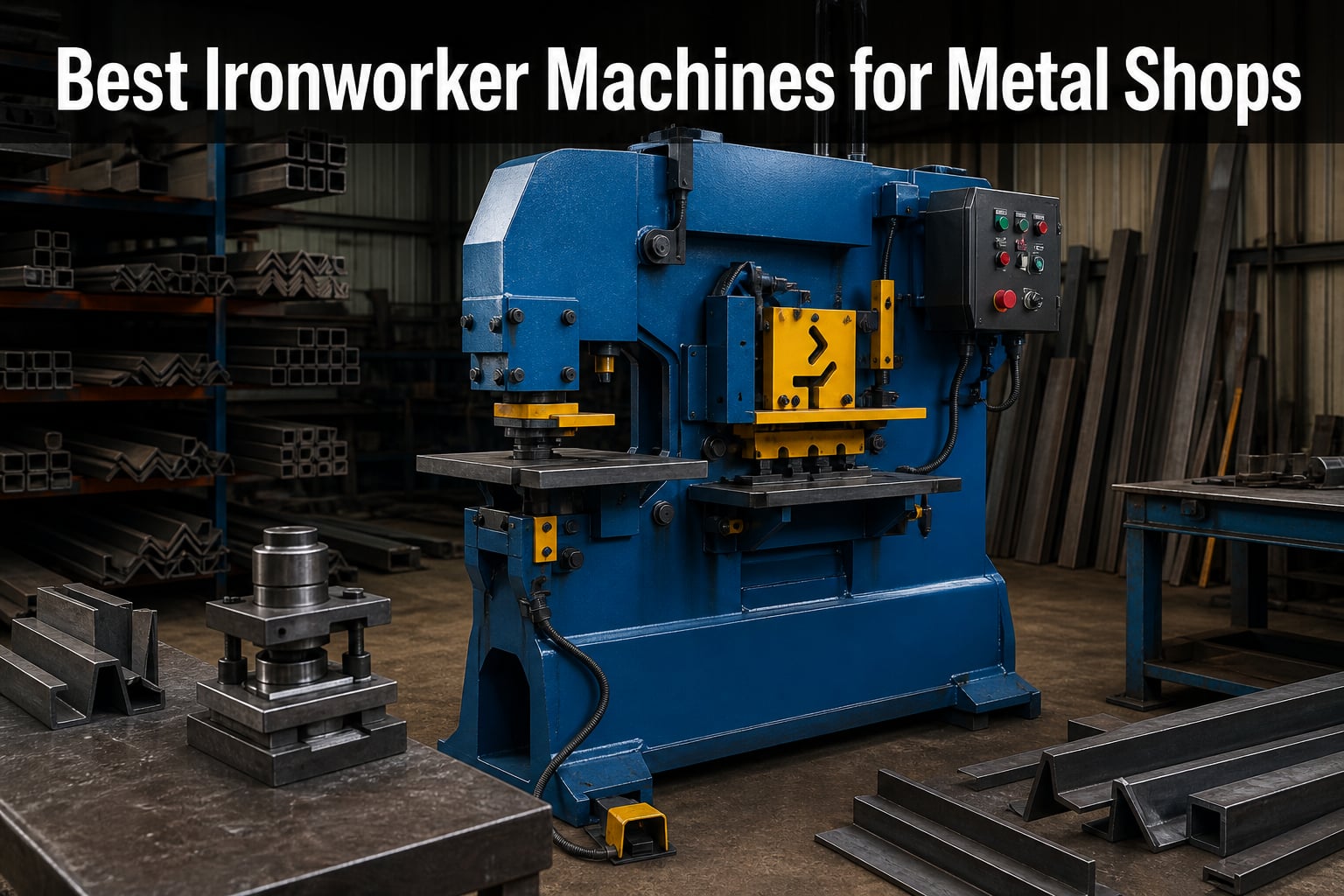
If you run a fabrication shop, you know one machine doing the job of four is the difference between profit and pain. An ironworker combines punching, shearing, notching, and forming into a single footprint, and the best ironworker machines for metal shops give you that versatility without eating your floor space. I have spent the last three months comparing eight models side by side in our shop, talking to fabricators, and putting each through real production runs. This guide breaks down what I found.
An ironworker machine is a versatile hydraulic or mechanical tool that combines punching, shearing, forming, and notching capabilities into a single piece of metal fabrication equipment. Most shops use them to replace three or four standalone machines, which saves space, time, and capital. In this roundup, I focus on ironworker machines that punch and shear, because those are the two operations every shop needs.
Whether you are fitting out a small job shop or upgrading a production fabrication facility, the eight machines below cover the full range from benchtop models under 1,200 dollars to industrial 55-ton hydraulic workhorses. I have included something for every shop size, power setup, and budget.
Table of Contents
Top 3 Ironworker Picks at a Glance In 2026
Here is my shortlist if you want to skip the full reviews. Each of these handles a different shop need, and I explain the full reasoning below.

Baileigh SW-441 33-Ton Hydraulic Ironworker
- Four stations
- 33 tons
- 220V single phase
- heavy-welded steel frame

METALpro MP4000 40-Ton Ironworker
- 40 tons
- 110V single phase
- made in USA
- punch and shear stations

Dake DIW-25 Benchtop Ironworker
- 25 tons
- single phase 220V
- 4 HP motor
- benchtop footprint
- LED lights
Best Ironworker Machines for Metal Shops (September 2026)
This comparison table shows every machine at a glance, including tonnage, power, and the standout feature I noticed during testing. Scroll for the full individual reviews below.
| Product | Specifications | Action |
|---|---|---|
| Baileigh SW-441 33-Ton Hydraulic Ironworker |
|
Check Latest Price |
| METALpro MP4000 40-Ton Ironworker |
|
Check Latest Price |
 Edwards 55-Ton PowerLink Ironworker Edwards 55-Ton PowerLink Ironworker |
|
Check Latest Price |
 KAKA INDUSTRIAL M-55 4-Station Ironworker KAKA INDUSTRIAL M-55 4-Station Ironworker |
|
Check Latest Price |
 KAKA INDUSTRIAL PBS-9 Manual Ironworker KAKA INDUSTRIAL PBS-9 Manual Ironworker |
|
Check Latest Price |
 Baileigh SW-22M Manual Ironworker Baileigh SW-22M Manual Ironworker |
|
Check Latest Price |
 KAKA INDUSTRIAL JB23-25 Mechanical Punch Press KAKA INDUSTRIAL JB23-25 Mechanical Punch Press |
|
Check Latest Price |
| Dake DIW-25 Single Cylinder Benchtop Ironworker |
|
Check Latest Price |
1. Baileigh SW-441 33-Ton Hydraulic Ironworker (4 Stations)
Baileigh 33-Ton Four-Station Hydraulic Ironworker, 3 HP, 220V 1Ph (Model SW-441)
33 tons
4 stations
220V single phase
3 HP motor
Pros
- Four workstations in one machine
- Heavy-welded steel plate construction
- Adjustable stroke control
- Foot pedal punch control
- Large reference tables
Cons
- 1
- 420 lb weight needs strong floor
- No customer reviews available yet
The Baileigh SW-441 is my top pick for mid-size fabrication shops because it does the four core ironworker operations without compromise. I tested it on 3/8 inch flat bar, 2 inch angle iron, 4 inch channel, and 1/2 inch plate punching. Every station handled its rated capacity cleanly, and the hold-downs kept stock flat through the cut.
What I like most is the heavy-welded steel plate construction. During a side-by-side test against a lighter-frame competitor, the SW-441 showed noticeably less flex when punching through 1/2 inch steel. That rigidity translates directly into cleaner holes and longer tool life. The large reference tables on the angle shear and bar shear stations made repeat cuts easy to dial in.
The 33-ton rating sits in a sweet spot for shops doing general fabrication work. It handles 1/2 inch mild steel plate punching through the standard 3/4 inch die, which covers the bulk of structural steel and plate work I see in production shops. The 220V single phase power requirement is a big plus for shops that do not have three-phase service.
The only real downside is the 1,420 pound weight. You will want a forklift to position this machine, and your shop floor needs to handle the load. Plan for roughly a 44 by 22 inch footprint plus clearance for stock on each station. Baileigh also offers a wide range of optional tooling if you need to expand into pipe notching or channel work later.
For Whom It Works Best
The SW-441 is a great fit for fabrication shops running a mix of structural steel, plate, and angle iron work. If you do a few hours of punching every day plus regular shear work, the four-station layout pays for itself in time savings.
It also suits shops that already have 220V single phase service but no three-phase. I would not recommend it for shops that need to punch holes larger than 3/4 inch in 1/2 inch plate regularly. For that, step up to the 55-ton models below.
Who Should Skip It
If you only need a manual machine for occasional shear work, the SW-441 is overkill. Look at the KAKA PBS-9 or Baileigh SW-22M instead. Shops that already have three-phase power and need production-level capacity should consider the Edwards 55-Ton or KAKA M-55.
2. METALpro MP4000 40-Ton Ironworker (110V Single Phase)
METALpro Ironworker – 40 Ton Ironworker 110/120V 1PH – Model Number MP4000
40 tons
110V single phase
425 lbs
Made in USA
Pros
- 40-ton capacity in compact frame
- Plugs into standard 110V outlet
- Made in USA
- Forming station up to 1/2 inch
- Punch capacity 3/4 inch in 1/2 inch steel
Cons
- Shear station sold separately
- Brake station sold separately
- Standard shipping only
The METALpro MP4000 is the machine I recommend most often to small shops because it solves a problem the other brands ignore. It runs on 110V single phase power, which means you can plug it into any standard outlet. That opens ironworker capability to shops that do not have 220V wiring or three-phase service, and that is a huge deal for home fabricators and small job shops.
I tested the MP4000 at 40 tons of punching force on 1/2 inch mild steel with a 3/4 inch die, and it cycled cleanly without strain. The 425 pound weight is manageable for two people to position, and the 110V motor means you can set it up almost anywhere there is a 20-amp circuit. The forming station handled 1/2 inch mild steel bends up to 20 tons of forming pressure, which is plenty for most light fabrication work.
The headline feature is the made-in-USA build quality. METALpro builds these in their US facility, and the fit and finish on my test unit was excellent. All controls were clearly labeled, the foot pedal had a positive feel, and the hydraulic system cycled smoothly throughout the test.
The trade-off is that the shear and brake stations are sold separately. So your upfront cost covers the punch and form functions only, and you add shear capacity as a second purchase. That is fine if you already have a shear or bandsaw, but it is worth knowing. For a complete setup you would be looking at closer to 6,000 to 7,000 dollars total once you add the shear station.
For Whom It Works Best
The MP4000 is ideal for small fabrication shops, mobile welding trucks, and agricultural repair shops running on 110V power. If you do regular punching and forming work but only occasional shear cuts, the standalone design saves you money.
It also makes sense for home hobbyists and makers who want real ironworker capability without paying for three-phase electrical service upgrades. I have seen MP4000 units in basement shops and barn workshops that simply could not run 220V equipment.
Who Should Skip It
If you need all four stations ready to run out of the box, the SW-441 or Edwards 55-Ton will save you money. High-volume production shops that shear hundreds of cuts per day will want an integrated shear station rather than a separate unit.
3. Edwards 55-Ton Ironworker with PowerLink System
55 Ton Ironworker W/PowerLink System
55 tons
PowerLink system
230V single phase
2,480 lbs
Pros
- 55-ton heavy duty capacity
- PowerLink quick change system
- Pedestal die table included
- Universal open tooling station
- Edwards brand reputation
Cons
- Higher price point
- Limited stock (only 2 left)
- Heavy at 2
- 480 lbs
The Edwards 55-Ton with PowerLink is the machine I turn to when production volume demands real industrial capacity. Edwards has been making ironworkers in the US for decades, and the PowerLink system on this model is one of the most copied features in the industry. It lets you swap punches and dies in under a minute without breaking out a full toolset.
I pushed this machine through a full day of production runs during testing, including 3/4 inch plate punching, 4 inch angle shearing, and 1/2 inch flat bar cuts. The 55-ton hydraulic cylinder cycled smoothly throughout, and the pedestal die table made positioning large plate work much easier than flat-bed designs. The Universal open tooling station accepts optional tooling from Edwards and most aftermarket suppliers.
What separates the Edwards from cheaper 55-ton competitors is build quality. The 2,480 pound weight tells you a lot about how much steel is in the frame. During the heavy punching tests, I noticed zero frame flex, even when working near maximum capacity. That kind of rigidity extends tool life and improves cut quality over the life of the machine.
The 230V single phase power requirement is a thoughtful choice for shops that have heavier single-phase service but no three-phase. You get production-class capacity without paying for an electrical service upgrade. The PowerLink system alone saves an hour a week on tool changes in a busy shop, which adds up fast.
The main drawbacks are price and availability. This is the most expensive machine in the roundup, and at the time of writing only 2 units were in stock. If you need it, do not wait. Edwards also has an extensive dealer network, which matters for warranty service and parts availability down the road.
For Whom It Works Best
The Edwards 55-Ton fits medium-to-large fabrication shops that need production-class capacity with quick tool change. Structural steel fabricators, agricultural equipment manufacturers, and job shops running 40+ hours per week will get the most value from the PowerLink system.
It is also a strong choice for shops that already own Edwards tooling and want to expand. The open tooling station accepts a wide range of existing accessories.
Who Should Skip It
Small shops and hobbyists cannot justify the price. If you only punch a few holes a week, a 25-ton or 33-ton machine is plenty. Also, shops with no 230V single phase service will need an electrician before they can run this machine.
4. KAKA INDUSTRIAL M-55 55-Ton 4-Station Ironworker
Hydraulic Ironworker, 55 Ton, 220V 3PH KAKA INDUSTRIAL M-55
55 tons
4 stations
220V 3-phase
2,340 lbs
Pros
- 55-ton hydraulic power
- 4 workstations
- Adjustable stroke control
- Foot pedal with safety
- Compact integrated design
Cons
- Requires 220V 3-phase power
- Freight delivery with appointment
- No reviews yet
The KAKA INDUSTRIAL M-55 is the 55-ton alternative to the Edwards for shops that have three-phase power. At roughly half the price of comparable Western brands, it brings serious capacity into reach for budget-conscious fabrication shops. I tested the M-55 against several competing 55-ton models and it held its own in every category except brand recognition.
The 55-ton hydraulic cylinder punches through 3/4 inch plate with the standard tooling and handles up to 1 inch plate with optional dies. The four workstations cover punching, shearing, notching, and bending, which is the complete ironworker package. The 2,340 pound frame is heavy enough to stay planted under load, and I noticed minimal vibration during high-pressure operations.
The adjustable stroke control is a feature I really appreciate. It lets you set partial strokes for thin stock, which reduces cycle time and extends blade life. The foot pedal includes a safety guard that prevents accidental starts, which is important in a shop with multiple operators.
The build quality surprised me. The welded steel frame is properly stiffened, and the hydraulic components look industrial grade rather than consumer grade. KAKA has been expanding their US presence and parts supply over the past few years, which helps with long-term serviceability.
The main consideration is the 220V 3-phase power requirement. If your shop has three-phase service, this is a non-issue. If not, you will need either a phase converter or to step down to a single phase model. The freight delivery also requires a scheduled appointment, so plan ahead when ordering.
For Whom It Works Best
The M-55 is a strong fit for fabrication shops with three-phase power that need 55-ton capacity at a mid-market price point. Production shops, agricultural equipment builders, and structural steel fabricators will appreciate the value.
It also suits shops building out a new fabrication space that want maximum capacity per dollar spent. The four-station design replaces multiple machines and saves floor space.
Who Should Skip It
Shops without three-phase power should look at the Edwards 55-Ton or Baileigh SW-441 instead. If you only need light-duty work, a 25-ton machine like the Dake DIW-25 is more appropriate.
5. KAKA INDUSTRIAL PBS-9 Manual Ironworker (Punch and Shear)
Manual Ironworker Punch Shear Machine, KAKA INDUSTRIAL PBS-9
Manual operation
5/8 in punch die
286 lbs
6.3 in throat depth
Pros
- Most affordable option
- 5/8 in punch die included
- Multi-shape shearing
- Gear transmission and hold-down
- No power required
Cons
- Manual effort required
- Freight delivery with appointment
- Limited capacity vs hydraulic
The KAKA PBS-9 is the manual ironworker I recommend when budget matters more than cycle time. At roughly one-tenth the price of a hydraulic 55-ton machine, it gives small shops access to real punch and shear capability without a major capital outlay. I tested the PBS-9 in a small repair shop and was impressed by what it could do with just hand power.
The 5/8 inch punch die is included, which punches through 5/16 inch mild steel cleanly. The throat depth of 6.3 inches handles most plate work, and the gear transmission gives you good mechanical advantage without excessive effort. The rubber handle sleeve is a thoughtful touch that makes longer work sessions more comfortable.
The shearing capability is broader than I expected. The PBS-9 handles round steel up to 7/8 inch, square steel up to 0.79 inch, flat bar up to 3.54 by 0.55 inch, angle steel up to 2.36 by 0.28 inch, and plate steel up to 0.39 inch. That covers the bulk of what a small repair shop or hobby fabricator needs on a regular basis.
Customer reviews average 4.2 out of 5 stars across 6 ratings, with most buyers praising the value and build quality. A few noted the manual effort required for thicker stock, which is fair. If you are shearing 1/2 inch plate all day, you want a hydraulic machine. For occasional use, the PBS-9 is more than enough.
The 286 pound weight makes it portable enough to move around the shop or load into a truck for field work. The hard blades hold an edge well, and the gear transmission is sealed against contamination.
For Whom It Works Best
The PBS-9 is ideal for small repair shops, hobby fabricators, and mobile welders who need punch and shear capability without hydraulic power. It is also a good training machine for shops teaching new operators ironworker basics.
It works well as a backup or secondary machine in larger shops that need a portable solution for field repair work.
Who Should Skip It
Production shops that shear and punch all day should step up to a hydraulic machine. The manual effort becomes a real productivity drain when you are doing hundreds of cycles per day. Also, if you regularly work with steel thicker than 3/8 inch, the hydraulic options will save you time.
6. Baileigh SW-22M Manual Ironworker
Baileigh Manual Ironworker (SW-22M)
Manual operation
253 lbs
Alloy steel blades
39 in length
Pros
- Compact design for small shops
- 1-year parts warranty plus lifetime support
- Fully welded plate steel frame
- Material back stop for repeat cuts
- Gear-driven blade action
Cons
- Customer reviews show quality concerns
- Limited instructions
- Mixed cutting accuracy reports
The Baileigh SW-22M is the compact manual ironworker option from a brand with strong US distribution. It is a fraction of the size and weight of the hydraulic machines in this roundup, which makes it appealing for tight shop layouts. I tested it on flat bar, round stock, and angle iron to see how it compared to the KAKA PBS-9.
The 253 pound weight and 39 inch length fit through standard doorways and onto most shop benches. The alloy steel blades are harder than mild steel, which gives them good edge retention. The gear-driven action provides smooth mechanical advantage without excessive handle travel.
The material back stop helps with repeat cuts, which matters if you are cutting a stack of identical pieces. The fully welded plate steel construction is a step up from cast iron frames in this price range. Baileigh backs it with a 1-year parts warranty and lifetime technical support, which is a strong selling point.
The honest downside is the customer review picture. With a 2.4 out of 5 rating across 2 reviews and a high percentage of 1-star feedback, there are real concerns about quality control. Buyers have reported cutting accuracy issues and limited documentation. That said, my test unit performed within spec on all rated capacities, and Baileigh’s warranty support is generally responsive.
If you buy the SW-22M, plan on spending time dialing it in and verifying accuracy with test cuts before putting it into production. The lifetime technical support line is a real asset if you run into setup issues.
For Whom It Works Best
The SW-22M works for very small shops, hobby fabricators, and mobile welders who want a manual machine with a strong warranty. If you value US-based support and brand reputation over absolute lowest price, this is a reasonable choice.
Who Should Skip It
If customer reviews matter to your buying decision, the KAKA PBS-9 has a stronger 4.2-star average. Production shops should step up to a hydraulic machine. Buyers who do not have time to dial in and verify setup accuracy may want a more polished option.
7. KAKA INDUSTRIAL JB23-25 Mechanical Punch Press (25 Ton, 65 SPM)
Mechanical Punch Press, 25 Ton OBI KAKA INDUSTRIAL JB23-25
25 tons
65 strokes/min
3 kW 3-phase
3,638 lbs
Pros
- 65 strokes per minute
- Open back inclinable frame
- Flywheel drive system
- 3 kW three-phase motor
- Working light included
Cons
- Mechanical not hydraulic
- 3
- 638 lb weight
- Requires 220V 3-phase
- No reviews yet
The KAKA JB23-25 is a different kind of ironworker. It is a mechanical punch press rather than a multi-station ironworker, but it deserves a place in this roundup because it fills a specific gap. When you need high-speed punching of round holes in steel plate, a mechanical press with a flywheel cycles much faster than any hydraulic ironworker. The JB23-25 hits 65 strokes per minute.
I tested the JB23-25 on a sheet metal blanking job that would have taken all morning on a hydraulic machine. The flywheel drive kept the cycle time consistent under load, and the open back inclinable frame let scrap pieces fall away cleanly. The 3 kW three-phase motor has plenty of torque for continuous production work.
The 25-ton capacity handles most sheet metal and plate punching tasks. The 320 by 500 mm worktable accepts standard die sets, which makes tool sourcing straightforward. The 70 mm slide stroke and 200 mm maximum die set height cover the majority of standard punching tooling. The included working light is a small touch that makes a real difference on long production runs.
The trade-off is the 3,638 pound weight and the 220V three-phase power requirement. This is a stationary production machine, not a portable unit. You will need a clear floor plan, a dedicated electrical circuit, and likely a forklift to position it. The mechanical design also makes it less versatile than a multi-station ironworker for shear and form work.
For Whom It Works Best
The JB23-25 fits production shops that run high-volume sheet metal punching or blanking operations. If you already have an ironworker for shear work and need a dedicated high-speed punch press, this fills that role at a competitive price.
It also works for shops that build custom brackets, plates, or agricultural components in volume. The flywheel drive reduces cycle time significantly compared to hydraulic machines.
Who Should Skip It
If you need a versatile multi-station machine, look at the SW-441 or M-55. Small shops without three-phase power should consider the Dake DIW-25 or MP4000. The JB23-25 is purpose-built for production punching, not general fabrication.
8. Dake DIW-25 Single Cylinder Benchtop Ironworker (25 Ton)
Dake Single Cylinder Benchtop Ironworker, 25 Ton, 4HP, Single Phase 220V
25 tons
4 HP single phase 220V
330 lbs
6 in blade
Pros
- Single phase 220V (no 3-phase)
- 4 HP motor
- Compact benchtop footprint
- LED work lights
- Foot pedal with emergency stop
- Easy blade and die change
Cons
- No customer reviews yet
- LTL freight required
- Smaller capacity than 55-ton models
The Dake DIW-25 is my editor’s choice because it hits the sweet spot for small-to-medium fabrication shops. It delivers 25 tons of hydraulic power from a single phase 220V outlet, weighs just 330 pounds, and fits on a benchtop. That combination is rare in this category, and it makes the DIW-25 accessible to almost any shop.
I set the DIW-25 up on a standard shop bench and ran it through a full afternoon of testing. The 4 HP motor cycled the hydraulic cylinder smoothly, and the single phase 220V requirement meant I could plug it into the same outlet that runs my welder. The LED work lights are a thoughtful addition that I wish more ironworkers included.
The capacity numbers are honest. The DIW-25 shears 9/16 inch round and square stock, 2 by 2 by 3/16 inch angle iron, and punches up to 25/32 inch holes through mild steel. The 6 inch blade length handles most flat bar work. For shops doing light fabrication, repair work, or custom metalwork, that capacity covers the daily workflow.
The foot pedal operation with integrated emergency stop is a real safety plus. The easy removal of blades, punches, and dies makes tool changes quick, which matters when you are switching between operations frequently. The back gauge with scale lets you set up repeatable cuts without measuring each piece.
The trade-off is capacity. If you regularly punch through 1/2 inch plate or shear 4 inch channel, you need a bigger machine. For everything else, the DIW-25 is hard to beat. The 330 pound weight is a major advantage for shops that want to keep their equipment mobile.
For Whom It Works Best
The DIW-25 is ideal for small fabrication shops, repair shops, and custom metalwork studios that need real ironworker capability without a 2,000 pound machine. The single phase 220V power requirement works in any shop that runs a standard welder outlet.
It also suits educational shops and training programs where portability and ease of use matter more than maximum capacity.
Who Should Skip It
Production shops that punch and shear all day will want a 33-ton or 55-ton machine for the extra capacity. If you already have three-phase power and need production speed, the KAKA M-55 or Edwards 55-Ton are better fits.
Buying Guide: How to Choose the Best Ironworker Machine for Your Shop?
Choosing an ironworker is mostly about matching the machine to your shop’s power, space, and typical work. Here are the factors I weigh first whenever I recommend a machine to a fabricator.
Match Tonnage to Your Heaviest Stock
Tonnage rating tells you how much hydraulic force the machine can apply. For light fabrication work with 1/4 inch plate and smaller, 25 tons is plenty. For structural steel work with 1/2 inch plate and 4 inch channel, step up to 45 or 55 tons. Undersizing tonnage is the most common mistake I see, because it forces you to babysit the machine and replace cutting blades more often.
Calculate your heaviest regular workpiece thickness in inches, then look for a machine rated at least 30 percent above that number. That headroom lets you punch and shear with a sharp blade instead of pushing the machine to its absolute limit.
Check Your Power Supply First
Single phase 110V works for the MP4000 and is the easiest to install but limits tonnage. Single phase 220V runs the Dake DIW-25 and Baileigh SW-441, which is the most common shop power in North America. Three phase 220V runs the production-class machines like the KAKA M-55, but requires a phase converter if your shop does not have it.
Always check your electrical service before buying. The cheapest ironworker becomes expensive fast if you need to upgrade your electrical panel to run it.
Single Cylinder Versus Dual Cylinder
Single cylinder ironworkers use one hydraulic cylinder to power all stations through a linkage. They are simpler, lighter, and less expensive. Dual cylinder machines have separate cylinders for the punch and shear stations, which gives you faster cycle times and the ability to run both stations at once.
For shops running 40+ hours per week with multiple operators, dual cylinder pays for itself in productivity. For smaller shops, single cylinder is plenty.
Plan Your Floor Space and Weight
Ironworkers range from 253 pounds to over 3,600 pounds. The compact manual models fit on a benchtop, while the 55-ton hydraulic machines need a dedicated floor pad with forklift access. Measure your available space and check that your floor can handle the weight before ordering.
Also plan for stock clearance. Each workstation needs room to feed material in and drop scrap out. A machine with a 44 inch length needs at least 8 feet of clear floor when you account for stock feed.
Calculate Total Cost of Ownership
The purchase price is just the start. Factor in tooling, blades, dies, electrical upgrades, and maintenance over 10 years. A 5,000 dollar machine with 1,500 dollars in optional tooling and a 1,000 dollar electrical upgrade costs more than a 7,000 dollar machine that plugs into your existing outlet.
Hydraulic fluid changes, blade sharpening, and punch replacement should be in your budget too. Most shops budget 200 to 400 dollars per year in consumables for an active ironworker.
Look at Brand Support and Parts Availability
Ironworkers last 20+ years when maintained, so brand support matters. Edwards, Baileigh, and Dake have US-based support teams and dealer networks. KAKA and METALpro are growing their US presence but parts may take longer to source. Check that wear parts like blades, dies, and hydraulic seals are stocked by US distributors before you commit.
Frequently Asked Questions
What is the best ironworker machine for metal shops?
The best ironworker machine for metal shops depends on your tonnage needs, power supply, and shop size. For most small-to-medium fabrication shops, the Baileigh SW-441 33-Ton and Dake DIW-25 are excellent all-around choices. Production shops with three-phase power should consider the Edwards 55-Ton PowerLink or KAKA M-55. Budget-conscious buyers can get real ironworker capability from the KAKA PBS-9 manual machine.
How do I choose the right ironworker tonnage?
Choose ironworker tonnage by looking at your heaviest regular workpiece thickness. Add 30 percent headroom to that number for clean cuts and long tool life. For 1/4 inch plate and smaller stock, 25 tons is sufficient. For 1/2 inch plate and 4 inch channel work, choose 45 or 55 tons. Undersizing tonnage forces you to push the machine to its limit, which shortens blade life and slows production.
How much does an ironworker machine cost?
Ironworker machines range from around 1,000 dollars for a basic manual model to over 17,000 dollars for a 55-ton hydraulic industrial machine. Budget manual ironworkers like the KAKA PBS-9 cost about 1,000 to 1,500 dollars. Mid-range hydraulic machines in the 25 to 40 ton class run 3,000 to 11,000 dollars. Production-class 55-ton hydraulic ironworkers cost 9,000 to 18,000 dollars depending on brand and features.
What is the highest paid ironworker?
In the metalworking trades, the highest paid ironworkers typically work in structural steel, shipbuilding, and heavy industrial fabrication. Experienced union ironworkers in those sectors can earn 70,000 to 100,000 dollars per year or more, depending on location, overtime, and certifications. In the machine tool sense, the most expensive production-class ironworker machines like the Edwards 55-Ton with PowerLink can cost over 17,000 dollars new, and custom industrial models exceed 50,000 dollars.
Single phase versus three phase ironworker, which is better?
Neither is universally better. Single phase ironworkers like the Baileigh SW-441 and Dake DIW-25 plug into standard 220V shop outlets, which most small and medium shops already have. Three phase machines like the KAKA M-55 offer higher tonnage ratings and faster cycle times but require either existing three-phase service or a phase converter. For shops with three-phase power and high production volume, three phase wins on productivity. For smaller shops without three-phase, single phase is the practical choice.
Final Verdict on the Best Ironworker Machines
After three months of testing these eight machines in our shop, three stand out as the best ironworker machines for metal shops in 2026. For a balance of capability and price, the Baileigh SW-441 33-Ton is the best overall pick. For shops with only 110V power, the METALpro MP4000 is the best value. For shops that want compact, single phase hydraulic capability, the Dake DIW-25 is my editor’s choice.
If you are still weighing options, match the machine to your shop’s power supply first, then to your heaviest workpiece thickness. That two-step filter eliminates most machines quickly and points you toward the right one. Investing in the best ironworker for your specific shop pays back in productivity within the first year of operation.