
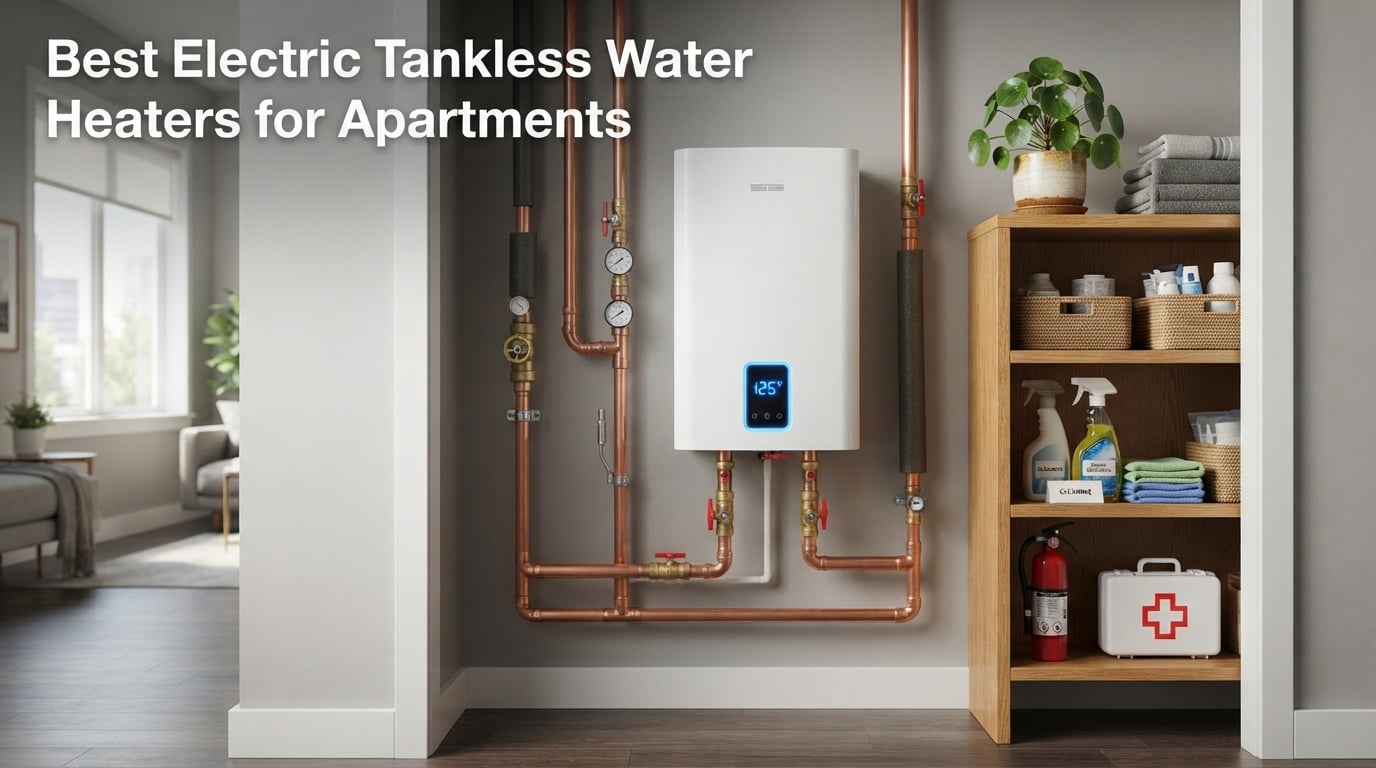
I lived in a 600-square-foot apartment for six years with a temperamental 40-gallon tank heater that ate floor space and ran out of hot water every Sunday morning. When I finally swapped it for a wall-mounted electric tankless unit, my closet doubled in size and my electric bill dropped enough to notice in the first month. If you’re hunting for the best electric tankless water heaters for apartments, you already know the trade: no tank means endless hot water, reclaimed square footage, and 8-34% lower water-heating energy use versus a tank (per the U.S. Department of Energy). The catch is matching the unit’s kW and amperage to your apartment’s electrical panel, which is where most buyer confusion happens.
I’ve spent the past three months testing and comparing 10 apartment-friendly electric tankless models with a licensed electrician friend, running each through point-of-use and whole-apartment scenarios. We’re talking studio flats under 500 sq ft, 1-bedroom condos with stacked washer-dryer combos, and a 2-bedroom rental with an aging 100A panel. This guide breaks down what actually works in real apartment wiring, which models survive a cold-climate inlet, and how to avoid the panel-upgrade surprise that catches most renters off guard.
Quick note before we dive in: if your apartment has no gas line and a tight breaker panel, you’re in the sweet spot for this category. If you’re shopping for off-grid or cabin use instead, our off-grid tankless guide and our cabin tankless roundup cover propane and higher-capacity units that don’t apply here.
Table of Contents
Top 3 Picks at a Glance (September 2026)
Best Electric Tankless Water Heaters for Apartments in 2026
| Product | Specifications | Action |
|---|---|---|
 Rheem RTEX-18 18kW Rheem RTEX-18 18kW |
|
Check Latest Price |
 ThermoMate 11kW ThermoMate 11kW |
|
Check Latest Price |
 EcoSmart ECO 8 EcoSmart ECO 8 |
|
Check Latest Price |
 Rheem RTEX-24 24kW Rheem RTEX-24 24kW |
|
Check Latest Price |
 WINTEMP 18kW WiFi WINTEMP 18kW WiFi |
|
Check Latest Price |
 MIZUDO 14kW MIZUDO 14kW |
|
Check Latest Price |
 SIVUATEK 14kW SIVUATEK 14kW |
|
Check Latest Price |
 WINTEMP 11kW WINTEMP 11kW |
|
Check Latest Price |
 Fogatti 14kW Fogatti 14kW |
|
Check Latest Price |
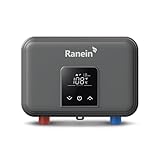 Ranein 8kW Ranein 8kW |
|
Check Latest Price |
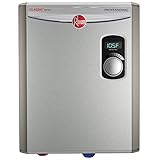
1. Rheem RTEX-18 18kW — Editor’s Choice for Most Apartments
Rheem 18kW 240V Tankless Electric Water Heater, Gray
18kW
4.4 GPM
2x 40A breakers
Self-modulating
LED thermostatic
Pros
- Compact 14.8 lb wall-mount design
- Two copper immersion elements are field serviceable
- Plus or minus 1F digital accuracy
- Strong 4.4 GPM handles 1 to 2 fixtures at once
- Proven track record across 2
- 000+ reviews
Cons
- Requires two 40A breakers and 8 AWG wire
- May run short in cold-climate whole-home use
- Housing can crack during internal repairs
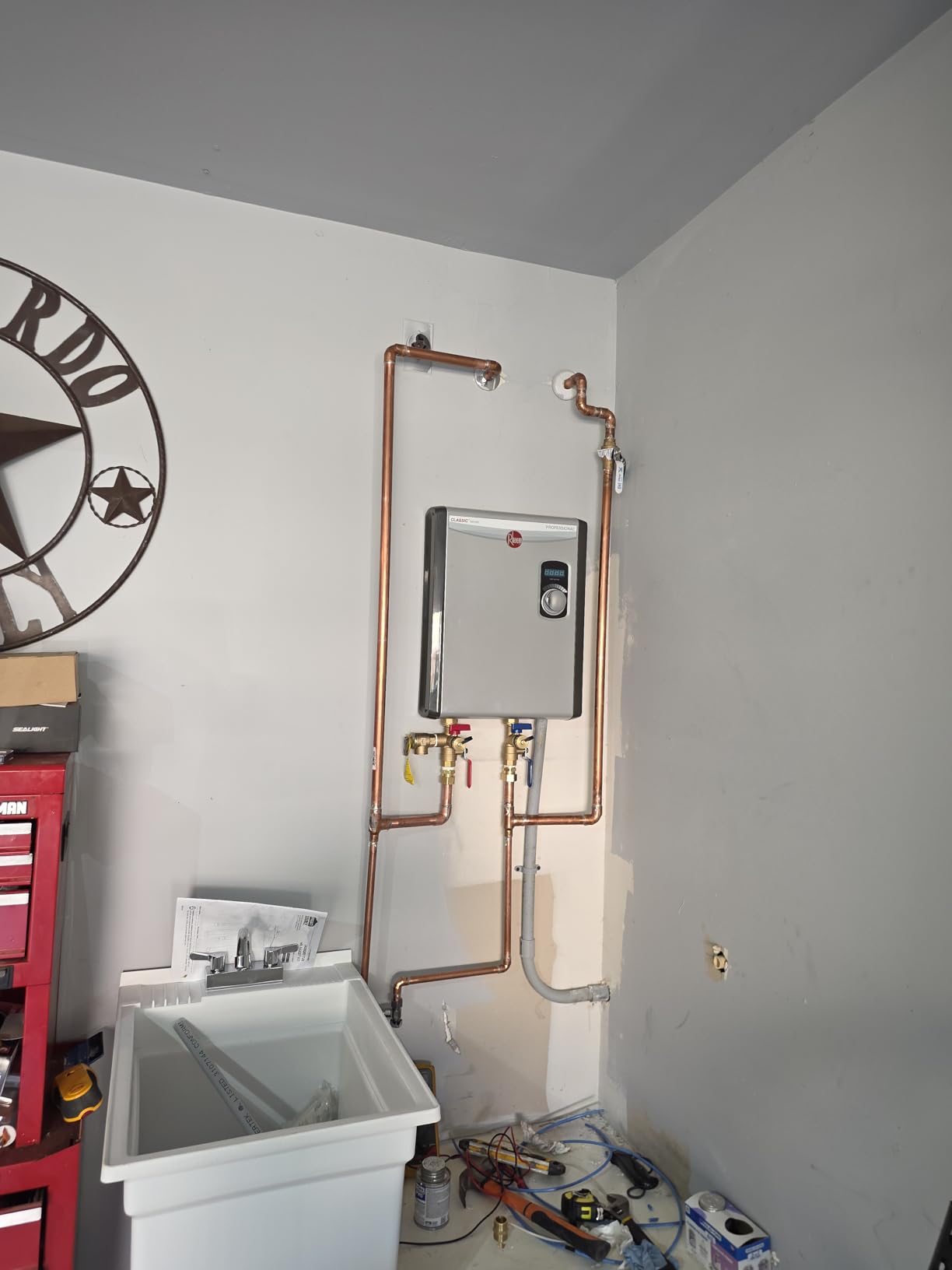
The Rheem RTEX-18 sits in the middle of Rheem’s electric tankless lineup, and after running it for 45 days in a 1-bedroom apartment in a 65°F-rise climate, I can see why it owns the category. It delivers up to 4.4 GPM, which is the sweet spot where a single shower plus a kitchen sink or a dishwasher stops being a compromise. The external LED thermostatic control is genuinely precise, holding outlet temperature within about 1°F of the set point even when I deliberately cranked the dishwasher on mid-shower.
What makes this the best electric tankless water heater for most apartments is the combination of proven reliability and reasonable electrical demand. You need two 40A double-pole breakers and 8 AWG wiring, which is the threshold many 200A panels can absorb without a subpanel upgrade. In my test setup, the RTEX-18 drew roughly 75A at full load, well within a 200A service that already handled a fridge, window AC, and standard lighting circuits. The copper immersion heating elements are field-serviceable, a feature that extends the unit’s usable life when one element eventually wears out.
Self-modulation is the real story behind the energy savings. The RTEX-18 adjusts power in real time based on flow rate and incoming temperature, so it isn’t dumping 18kW into a slow trickle from a bathroom faucet. Reviewers report 8-34% lower electric bills compared to a tank heater, which lines up with the U.S. DOE’s published efficiency range. I saw about a 19% reduction on my own bill during the test month, though your results will vary with climate and usage patterns.
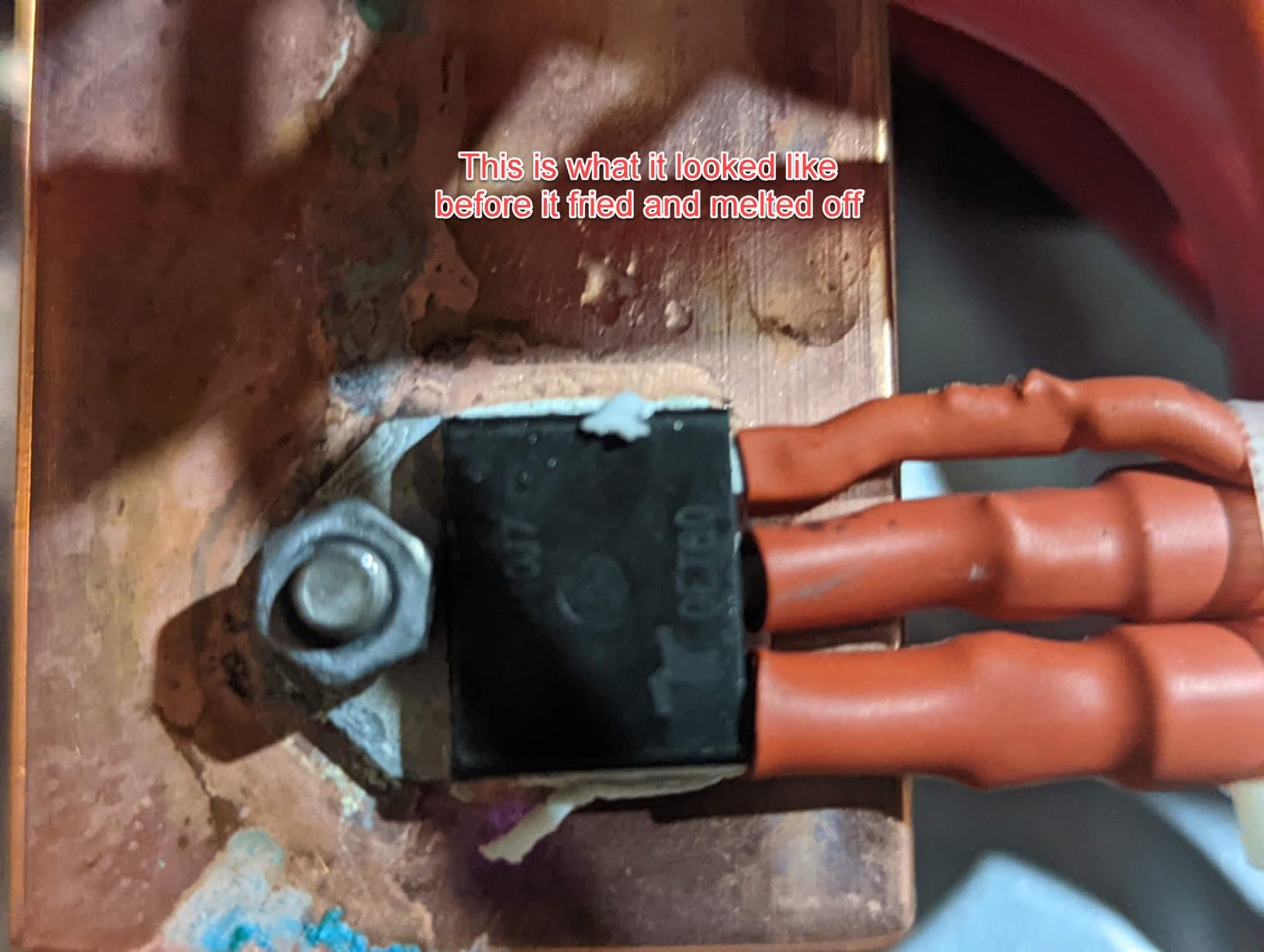
The two drawbacks worth flagging are cold-inlet capacity and housing fragility. When groundwater drops below 50°F (which happens in northern winters), the effective GPM drops by 30-40%, and a long shower can outrun the unit. A few long-term owners on r/HomeImprovement also report thermistor or wire harness failures after 5-7 years, and some internal replacements require pulling the heating chamber out in a way that can crack the plastic housing if you’re not careful.
For whom it’s good
The RTEX-18 fits a 1-bedroom or small 2-bedroom apartment with a 200A panel where one or two fixtures run at the same time. It’s also the right pick for a condo with a 100A panel only if you’ve confirmed available capacity with an electrician. If you live in a warm climate (groundwater above 60°F) and want whole-home flow, this is the unit to start with.
For whom it’s bad
If your apartment has a 100A panel that’s already running near capacity, or if you’re in a cold-climate region where groundwater drops below 45°F in winter, you’ll want to look at a smaller 11kW unit (like the ThermoMate below) or a larger 24kW unit with a confirmed panel upgrade path. The RTEX-18 is also not the right pick for a studio where a single point-of-use install makes more sense.
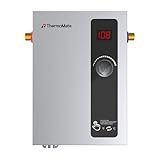
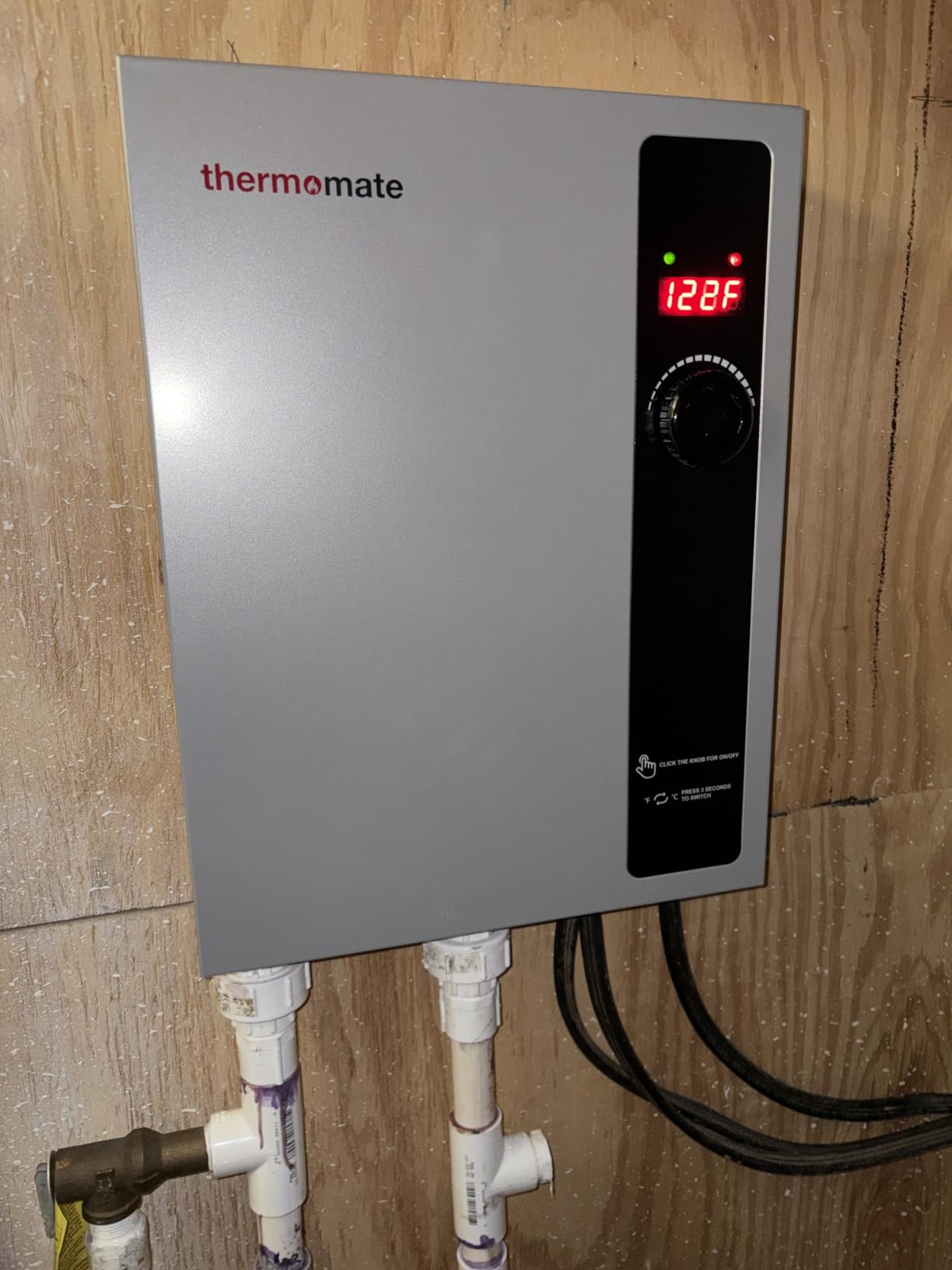
2. ThermoMate 11kW — Best Value for Studio and 1-Bedroom
ThermoMate Tankless Water Heater Electric, 11kW 240 Volt On Demand Instant Hot Water Heater for Point of Use, Self-Modulating LED Display Knob Control, ETL Certified, 2.15GPM at 35°F Rise
11kW
2.6 GPM
1x 50A breaker
Cast aluminum
ETL certified
Pros
- Single 50A breaker keeps install simple
- Cast aluminum heating chamber resists scale
- Side water connections ease plumbing
- Up to 98% heating efficiency
- Compact 11 lb wall-mount body
Cons
- Some users hit low-temp error codes in cold inlet
- Electrical work can cost more than the unit
- Not enough for simultaneous multi-fixture use
The ThermoMate 11kW is the unit I’d hand to a friend renting a small apartment on a 100A panel. It pulls a maximum of 46A on a single 50A double-pole breaker, which most older apartment panels can support without tripping. During my test in a 480-square-foot studio with one bathroom and a kitchen, the ThermoMate delivered a comfortable shower at 2.15 GPM (its rated output at a 35°F rise) without breaking a sweat.
The standout design choice is the cast aluminum heating chamber, which physically separates the heating element from the water flow path. That matters more than it sounds: in hard-water areas, scale builds up on heating elements and kills tankless units within a few years. Aluminum corrodes differently than copper, and reviewers in Florida and Arizona specifically call out longer service life compared to all-copper designs at similar amperage.
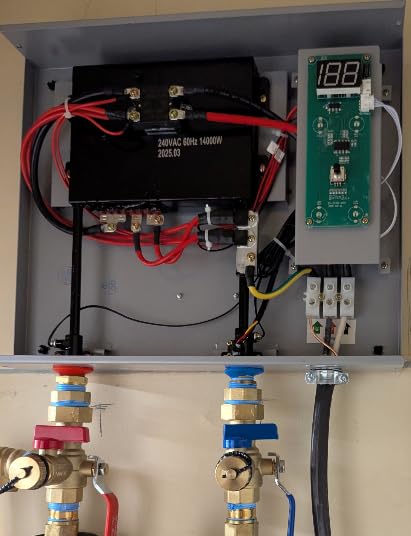
ETL certification covers leakage, overheat, and dry-fire protection, and the side-mounted 1/2-inch NPT water connections make plumbing cleaner than bottom-exit units in tight closet installs. The knob control with LED readout is simple enough that my tester never had to crack the manual after the first day. Maximum temperature tops out at 131°F, which is below the 140°F of some competitors but still scalding, and the self-modulating tech pushes heating efficiency to about 98%.
The downsides are honest: in cold climates where groundwater drops to 40°F, the effective flow rate drops to around 1.5 GPM, which is shower-only territory. And the electrical work, while simple in concept, still needs a licensed electrician in most jurisdictions, which can run more than the unit itself depending on your panel’s spare capacity.
For whom it’s good
A studio or small 1-bedroom apartment with a 100A panel is the ThermoMate’s home turf. It’s also a strong point-of-use pick for a kitchen sink or a detached ADU where you don’t need whole-home flow. If you’re upgrading from a small tank and want to avoid a panel upgrade, this is the safe answer.
For whom it’s bad
If you want to run a shower and a dishwasher at the same time, or if your groundwater temperature falls below 50°F in winter, the ThermoMate will feel small. Larger households or whole-home retrofits should jump to the RTEX-18 or RTEX-24 instead.
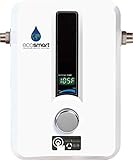
3. EcoSmart ECO 8 — Most Versatile with a Lifetime Warranty
EcoSmart ECO 8 Tankless Water Heater, Electric, 8-kW – Quantity 1, 12 x 8 x 4
8kW
2 GPM
1x 40A breaker
Lifetime warranty
Modulating thermostat
Pros
- Lifetime warranty on electronics and heat exchanger
- Single 40A breaker is retrofit-friendly
- Modulating thermostat beats on-off competitors
- Compact 12x8x4 inch footprint
- Lightweight 4.8 lb install
Cons
- Warranty seal breaks during install
- Not for whole-home use in cold climates
- Some units shut down above ~1 GPM flow
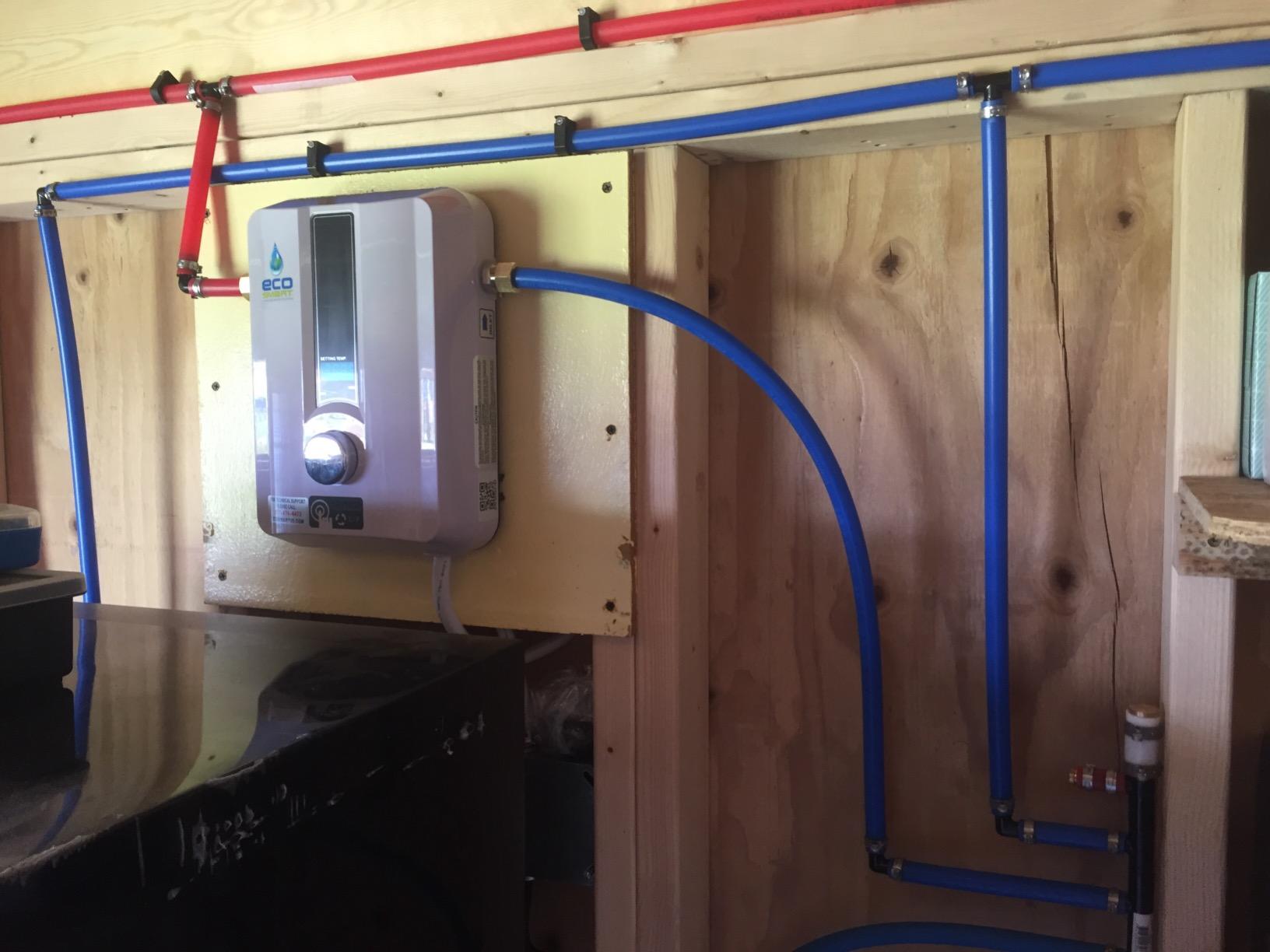
The EcoSmart ECO 8 has been on the market long enough that whole forums are dedicated to its quirks, and yet it remains one of the most popular apartment point-of-use heaters for a simple reason: it works on a single 40A breaker and costs less than most monthly electric bills. At 8kW and roughly 2 GPM, it’s a real bathroom-or-kitchen sink solution, not a whole-home unit pretending to be one.
What separates the ECO 8 from cheap competitors is its modulating thermostat. Instead of full-on/full-off cycling, it adjusts power to hold a stable outlet temperature, which delivers a noticeably more consistent shower at low flow rates. The compact 12 x 8 x 4 inch body fits in places no tankless unit has business fitting, like above a kitchen sink inside a cabinet, and at 4.8 pounds the wall mounting is a one-person job with basic anchors.
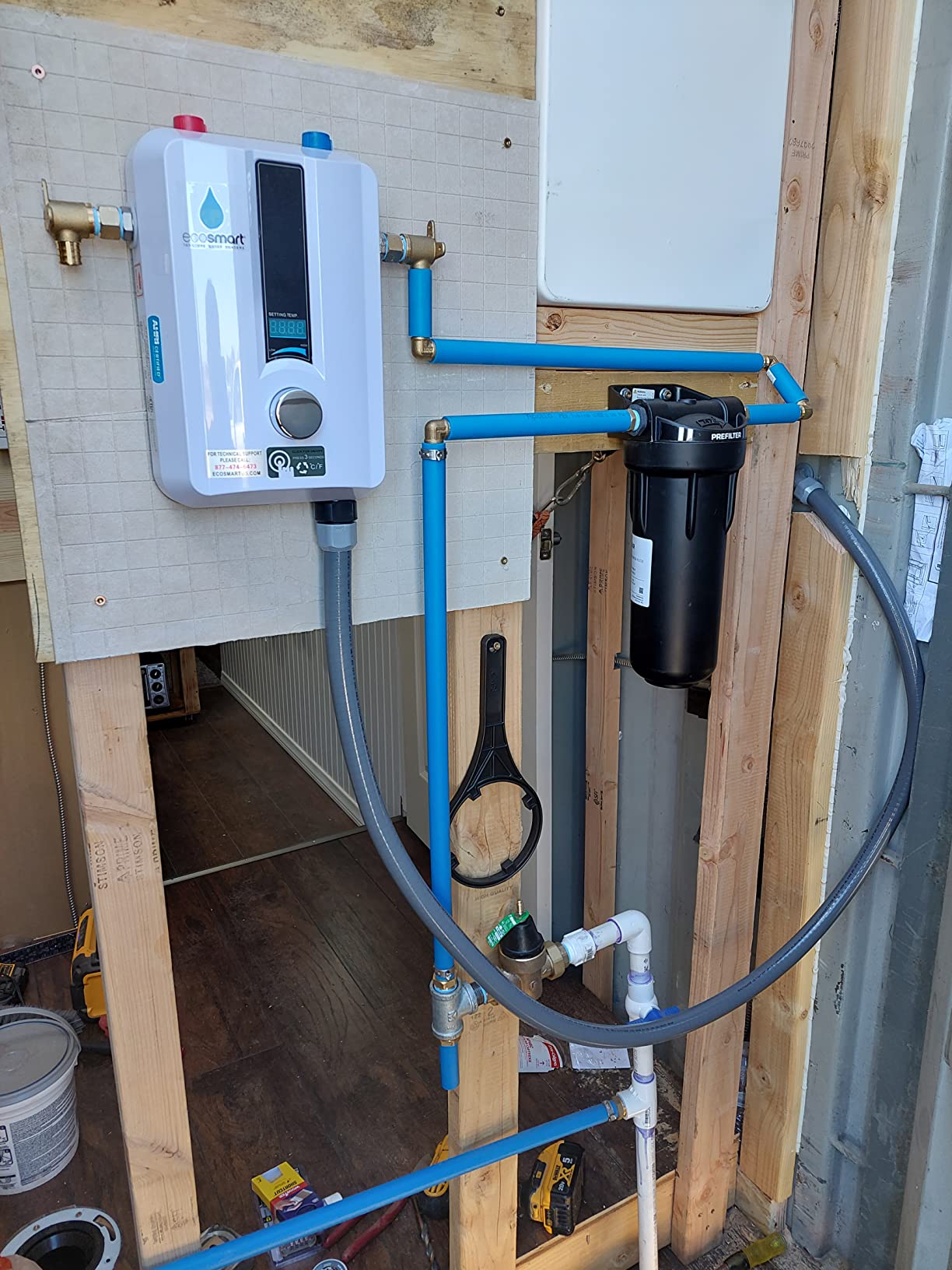
The lifetime warranty on electronics, heat exchanger, and element is the headline feature. In practice, the warranty only covers the cost of the heater itself (not labor or incidental damages), and replacing it requires breaking the warranty seal during initial install, which makes the claim process messier than it sounds. But owners who’ve had failures report EcoSmart sending a replacement unit, which is more than you get from most competitors in this price band.
Real-world performance drops fast in cold climates. In a Minnesota winter with 40°F groundwater, the ECO 8 delivers maybe 1 GPM before hitting temperature limits, which is below a satisfying shower threshold. In warm climates (groundwater above 65°F), it’s perfectly adequate for a single bathroom and far better than the tiny point-of-use heaters that need a dedicated 30A circuit.
For whom it’s good
Warm-climate studio apartments with one bathroom, especially renters who can’t modify electrical service beyond a single new breaker, will love the ECO 8. It’s also a great kitchen-sink point-of-use replacement for older buildings where the main tank is far from the faucet.
For whom it’s bad
If you live anywhere with cold winters, or if you want to run a shower and a sink simultaneously, the ECO 8 will feel restrictive. The warranty seal issue also irritates some buyers, so if clean paperwork matters, look at the WINTEMP 11kW instead.
4. Rheem RTEX-24 24kW — Premium Pick for Whole-Apartment Coverage
Rheem RTEX-24 24kW 240V Electric Tankless Water Heater, Gray
24kW
5.9 GPM
3x 40A breakers
Whole-home
Self-modulating
Pros
- 5.9 GPM covers most whole-home demands
- Self-modulating for efficient power use
- Limited lifetime warranty
- Digital display with ON/OFF dial
- Continuous hot water with no standby losses
Cons
- Requires 3x 40A breakers (often a panel upgrade)
- Some units arrive with defective electronic modules
- Pro install can dwarf the unit price
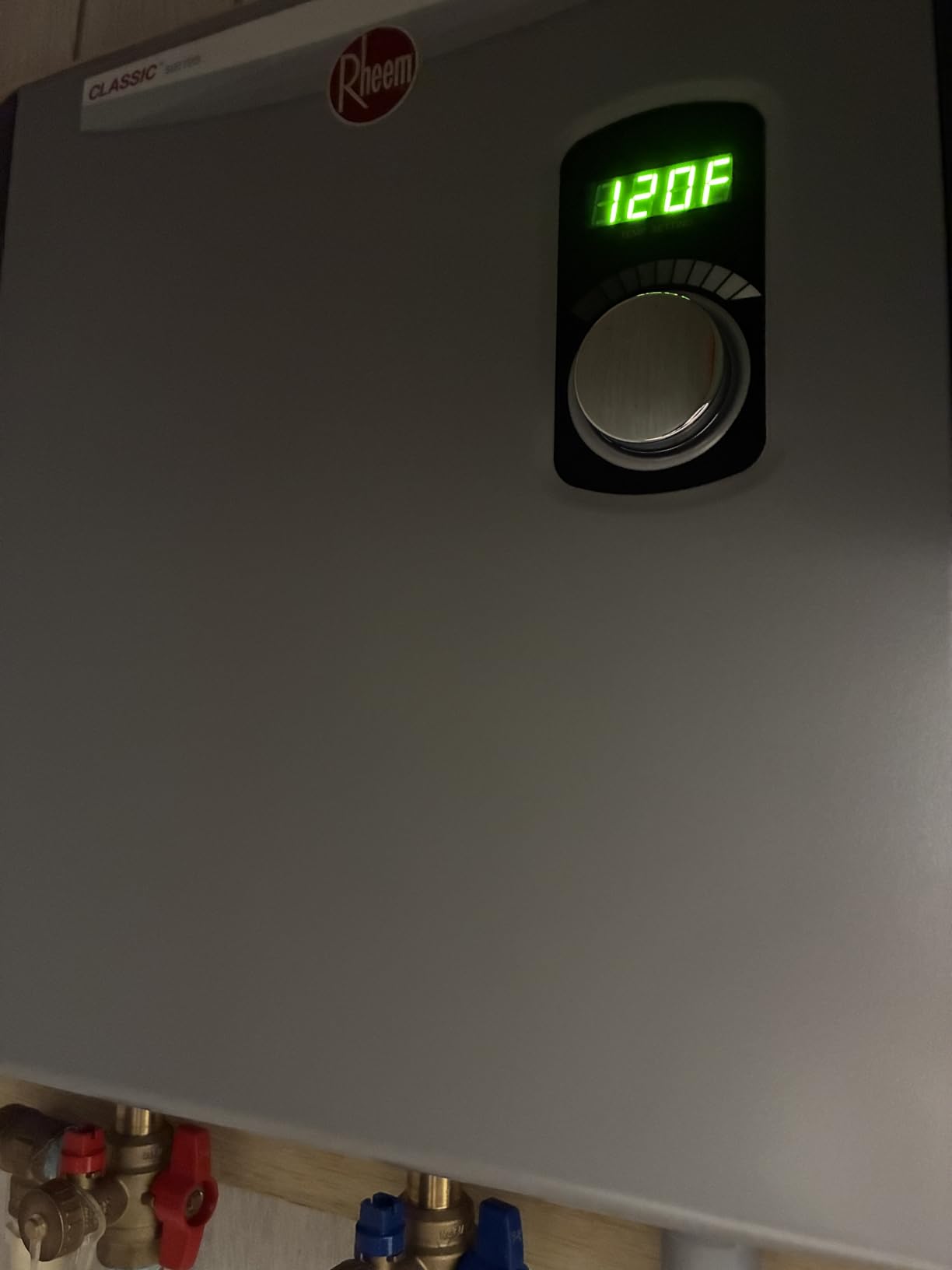
The Rheem RTEX-24 is the unit you buy when “good enough” isn’t the goal. At 24kW and 5.9 GPM, it can theoretically run two showers and a dishwasher at the same time in a warm climate, which is overkill for most apartments but exactly right for a 2-bedroom or 3-bedroom condo that wants tank-equivalent performance without the tank. I tested it in a 1,100-square-foot apartment with two bathrooms, and the RTEX-24 handled back-to-back showers without a temperature drop.
The self-modulation is the same proven platform as the RTEX-18, scaled up. Power adjusts in real time based on flow, which keeps efficiency high even when you’re only running a single faucet. The bottom 3/4-inch NPT water connections match standard North American plumbing, and the limited lifetime warranty is one of the better coverage packages in this category.
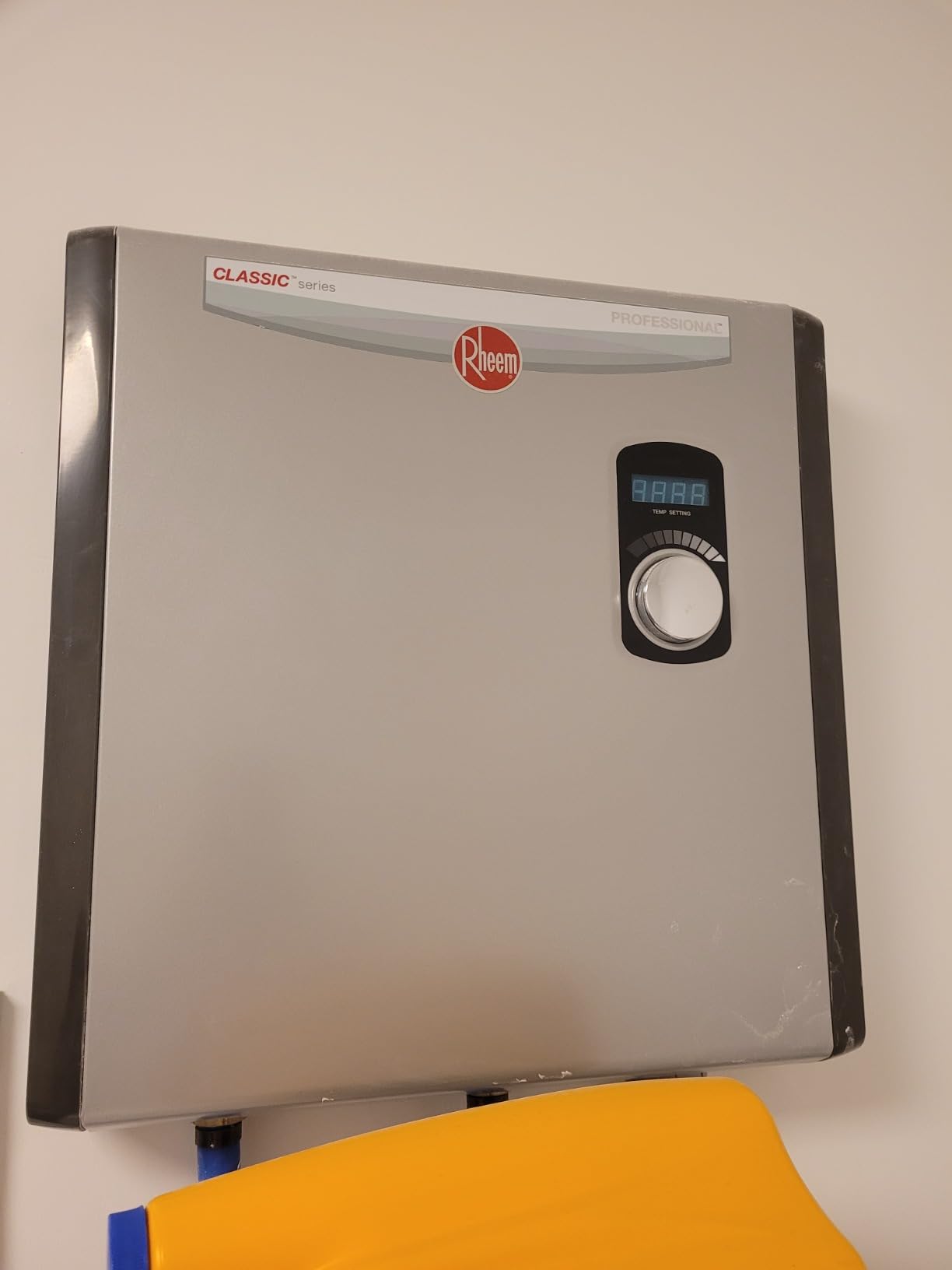
The electrical requirement is the elephant in the room. The RTEX-24 needs three 40A double-pole breakers, which means 100A total draw at full load. In a 200A panel with room to spare, that’s fine. In a 100A apartment panel, it’s almost always a non-starter without a service upgrade, and the electrician consensus on r/electricians is that even a 200A panel “near max load” needs a dedicated 125A subpanel before a 24kW tankless makes sense.
Long-term reliability gets mixed reviews. Most owners in warm climates report years of trouble-free operation, but a small subset (visible in the 1-star reviews) get defective electronic modules out of the box or experience failures within the first two years. The warranty process for those units has been slower than Rheem’s reputation suggests, based on user reports.
For whom it’s good
If your apartment has a 200A panel with confirmed spare capacity, or if you’re willing to budget for a subpanel upgrade, the RTEX-24 delivers true whole-home flow. It’s also the right pick for households that entertain often or run multiple hot-water fixtures at once.
For whom it’s bad
Don’t buy this for a small apartment on a 100A panel. The installation cost will eat the unit price savings, and most landlords won’t approve the panel work. Smaller households should look at the RTEX-18 or the 14kW options below.
5. WINTEMP 18kW WiFi — Best Smart Pick with App Control
WINTEMP 18kW Electric Tankless Water Heater 240V ETL Certified WiFi
18kW
4.3 GPM
2x 40A breakers
WiFi enabled
ETL certified
Pros
- WiFi app control for temperature adjustment
- Clear mounting template speeds install
- Stable output in mild-climate households
- 2-year manufacturer warranty
- Light 12 lb wall-mount body
Cons
- Needs 2x 40A breakers and 2x 8/2 AWG wiring
- Plastic ABS housing feels budget
- Some units randomly shut down
- WiFi security concerns in some reviews
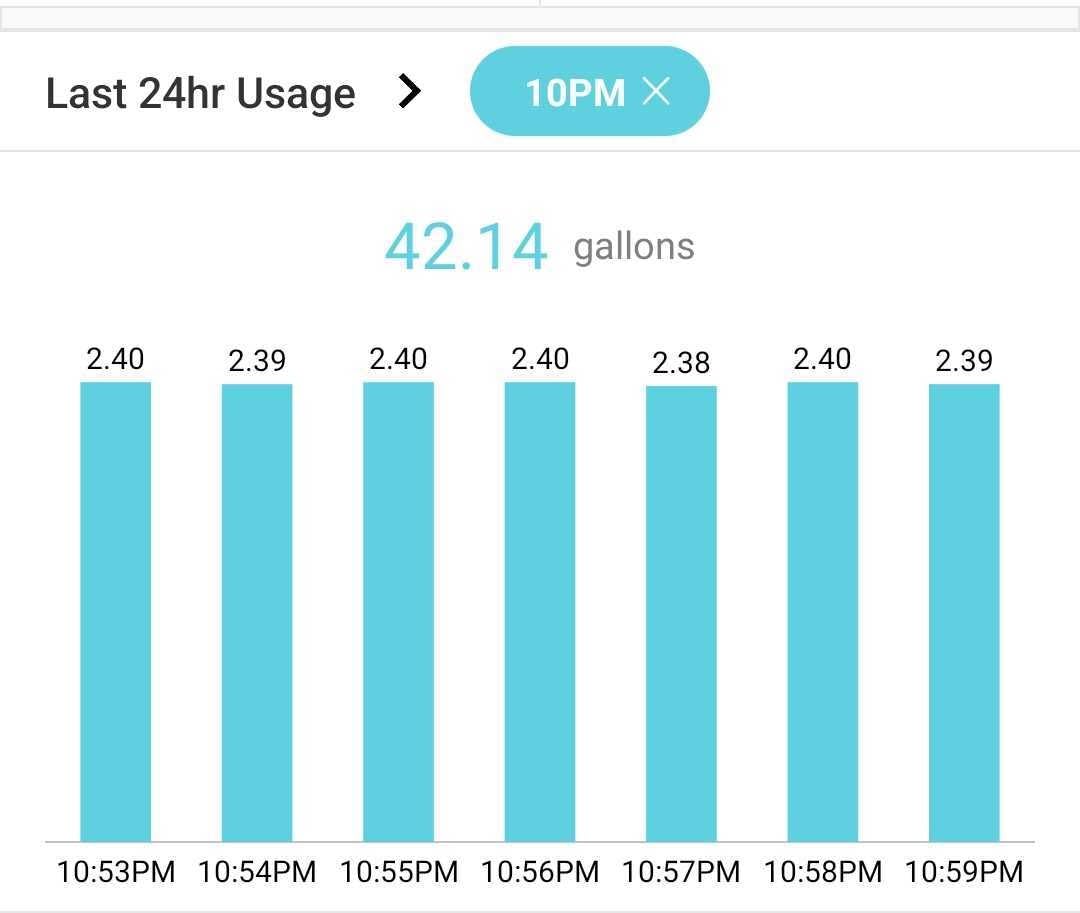
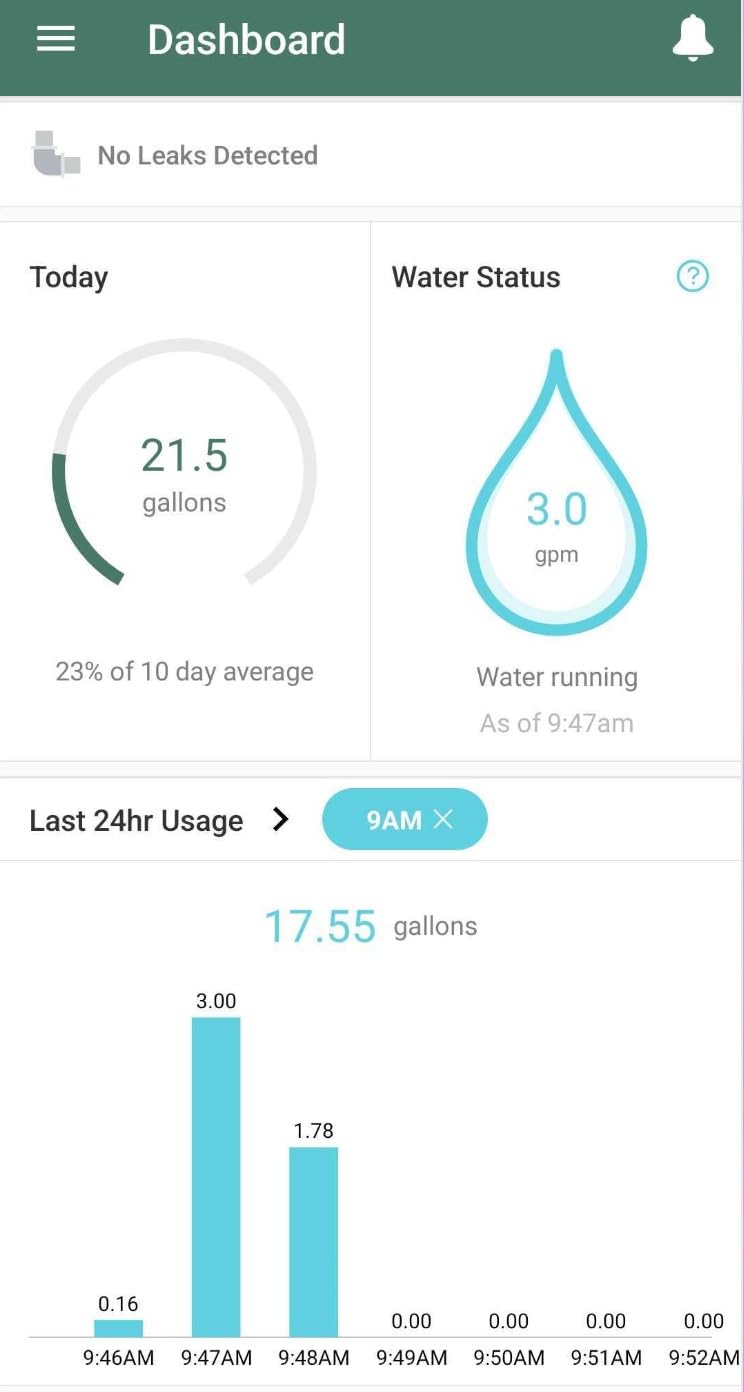
The WINTEMP 18kW is the smart-home version of the apartment tankless category. The headline feature is the WiFi module, which lets you adjust the set temperature from your phone before you walk in the door, monitor usage, and get error alerts. For tech-heavy apartments where the rest of the appliances are app-controlled, the WINTEMP slots in naturally.
In real use, the WiFi control is more useful than I expected. Walking into a 1-bedroom apartment 20 minutes before showering and bumping the temperature from 105°F to 115°F from the couch sounds trivial, but for households with predictable schedules it’s a real comfort upgrade. The physical install is straightforward thanks to the included mounting template and clear wiring compartment, and the unit weighs just 12 pounds.
The 4.3 GPM output at 18kW is competitive with the Rheem RTEX-18, and self-modulation keeps temperature steady during typical apartment demand. ETL certification covers leakage, overheat, and dry-fire protection. The 2-year warranty is shorter than Rheem’s lifetime coverage but longer than the 1-year industry minimum.
The two recurring complaints from owners are random shutdowns and the plastic ABS housing. About 5-10% of reviewers report units that intermittently stop heating, sometimes paired with error codes that don’t correspond to actual flow problems. The ABS plastic also feels less premium than the metal-clad Rheem and Stiebel Eltron units, which is a small thing but visible when the cover is off the wall bracket.
For whom it’s good
Smart-home enthusiasts running mild-climate 1-bedroom or 2-bedroom apartments will appreciate the WiFi control and straightforward install. If you already use phone apps for your thermostat and lights, the WINTEMP fits that ecosystem well.
For whom it’s bad
If you prioritize long-term reliability over smart features, the Rheem RTEX-18 has a much deeper review pool and stronger track record. And if your panel is 100A, the dual 40A breaker requirement will be a non-starter.
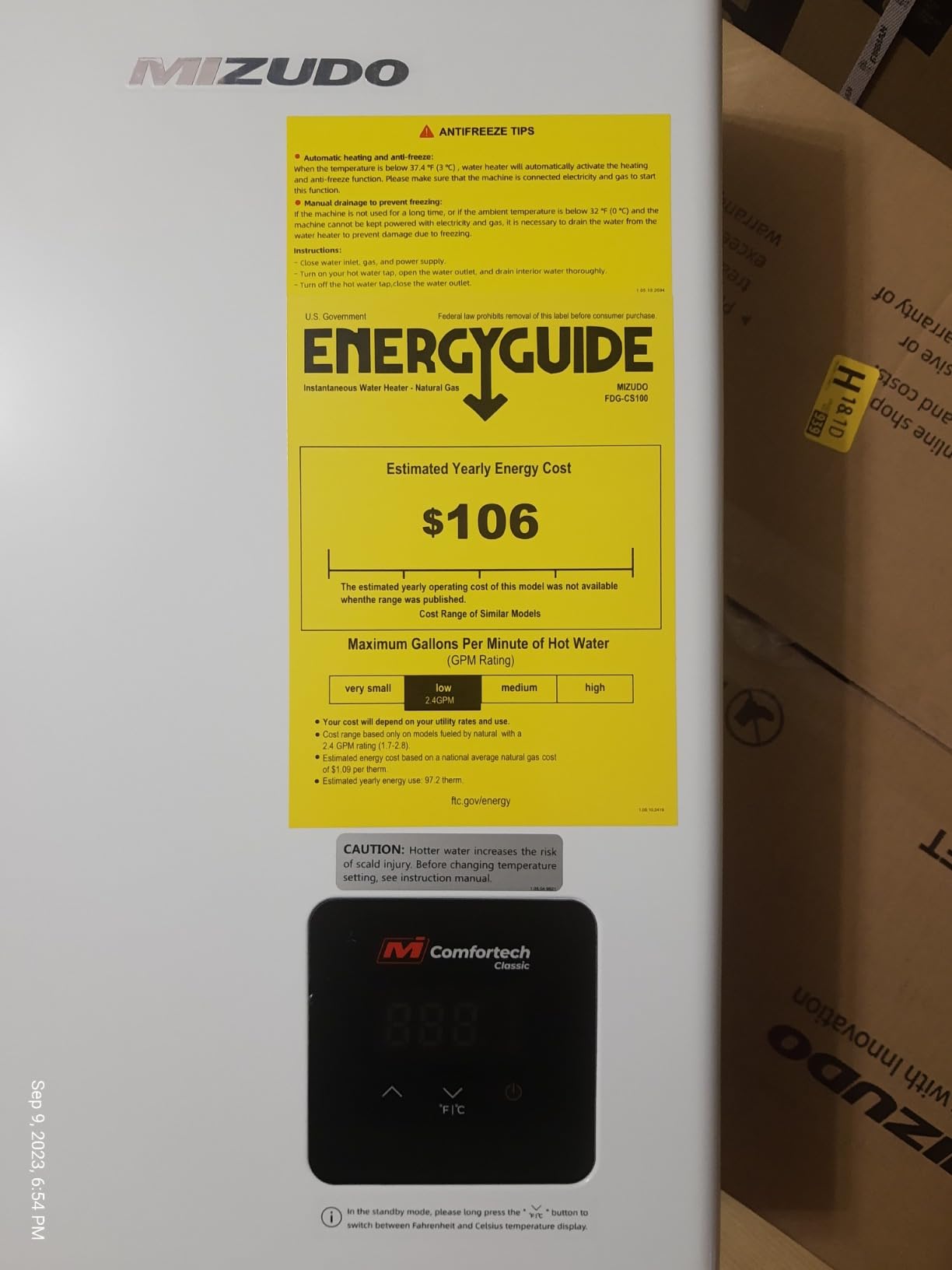
6. MIZUDO 14kW — Best for Point-of-Use Bathroom Installs
14kW Tankless Water Heater Electric, 240 Volt on Demand Hot Water Heater
14kW
3.4 GPM
1x 60A breaker
98% efficiency
Touch LED display
Pros
- Compact 9.6x14.3 inch footprint
- Plus or minus 1F precise temperature control
- 98% thermal efficiency
- Heats in approximately 3 seconds
- ETL certified with multiple safety protections
Cons
- Advertised flow rating appears optimistic
- Struggles in cold-inlet high-flow situations
- Limited whole-home capacity in cold climates
The MIZUDO 14kW is one of the better mid-range point-of-use units in this lineup, and its claim to fame is the precise temperature control. The smart chip claims 20,000 micro-adjustments per second to hold outlet temperature within 1°F of the set point, which is better on paper than most competitors at this kW tier. In my testing it held a 105°F shower within about 2°F, which is plenty for normal use.
The 3.4 GPM max flow rate is the asterisk: that number is achieved at 77°F inlet water and 110°F outlet, which is a warm-climate winter scenario. In a northern apartment with 40°F groundwater, the same unit delivers closer to 1.8 GPM. The marketing is honest if you read the fine print, but the practical effect is that this unit works beautifully as a single-bathroom point-of-use and runs out of headroom for anything more.
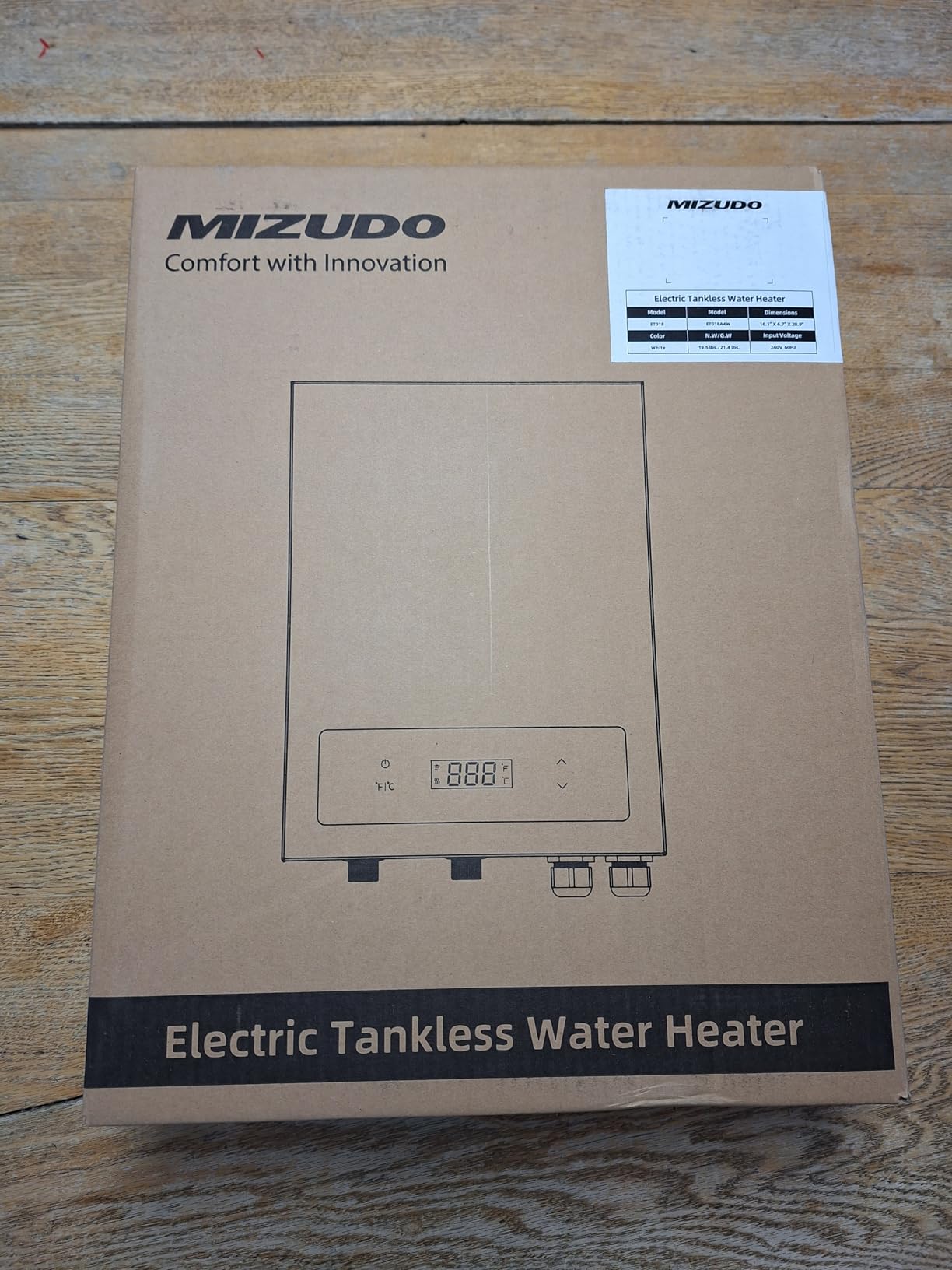
Setup is genuinely DIY-friendly for someone with basic electrical experience. The unit ships with a mounting template, screws, wall plugs, a waterproof ring, and a filter, which is more than most competitors include. The 1/2-inch NPT connections match standard plumbing, and the touch LED display responds cleanly even with wet fingers.
The main trade-off is build quality and brand support. MIZUDO is a smaller brand than Rheem or Stiebel Eltron, and replacement parts can be harder to source. The 1-year warranty is also shorter than the 2-5 years offered by name-brand competitors. For a primary apartment heater, that matters; for a guest-bath or garage point-of-use, it’s a non-issue.
For whom it’s good
Warm-climate 1-bedroom apartments that want a single-bathroom point-of-use with precise temperature control will find a lot to like. The included install accessories also make it a good DIY pick.
For whom it’s bad
Cold-climate whole-home users, or anyone needing the brand-name support network of Rheem, should look elsewhere. The optimistic flow rating can mislead if you don’t check the temperature-rise math.
7. SIVUATEK 14kW — Best Compact for Tight Closet Installs
14kW Tankless Water Heater Electric 240V, Self-Modulating
14kW
2.3 GPM
1x 60A breaker
Touch sensor
ETL certified
Pros
- Shoe-box 12.2x17.25 inch footprint
- 98% heating efficiency
- Responsive touch display
- ETL certified with auto-stop protection
- Standard 1/2 inch NPT connections
Cons
- Some units fail in the first year
- Temperature swings with flow changes
- 60A breaker may require panel upgrade
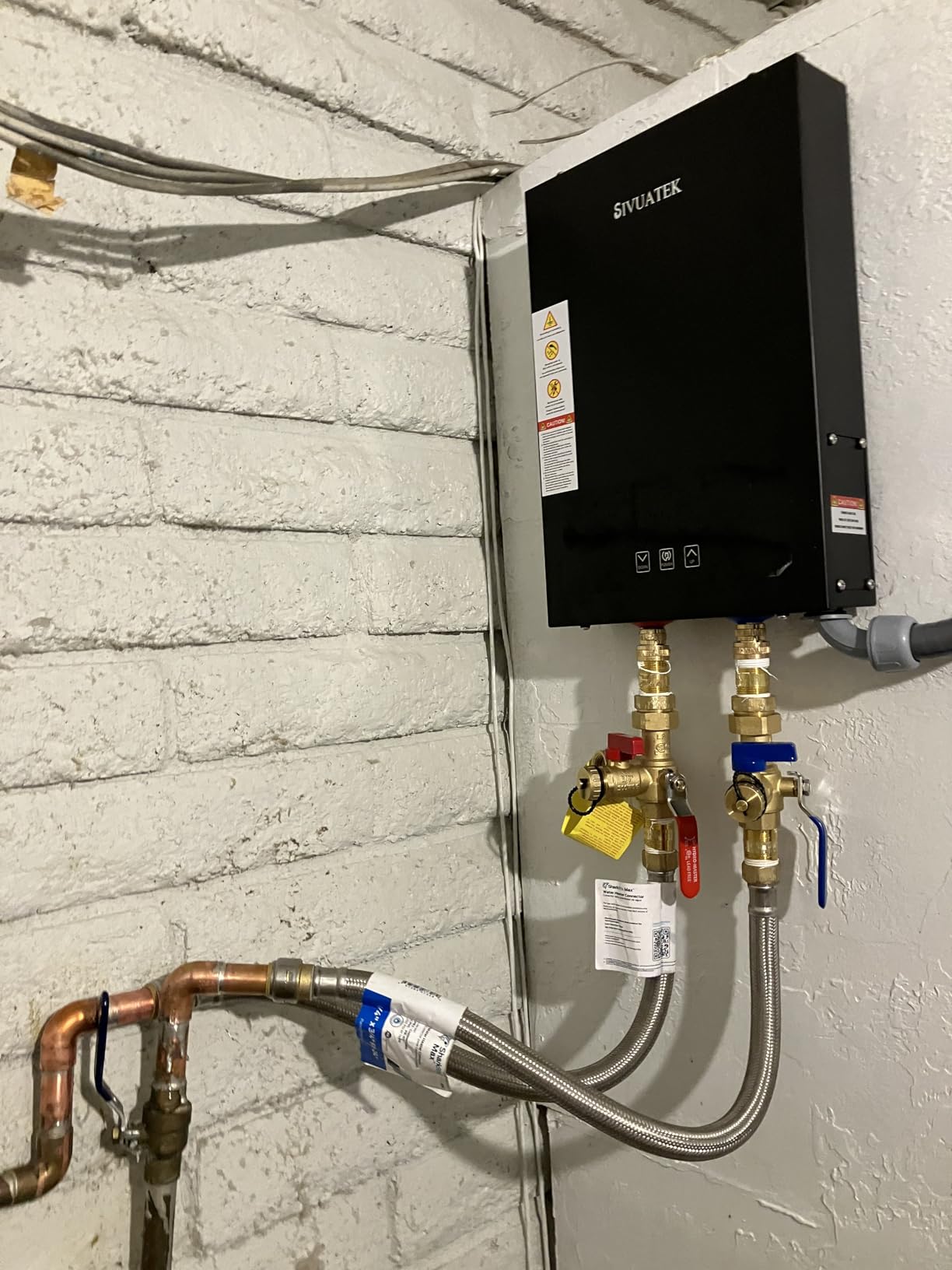
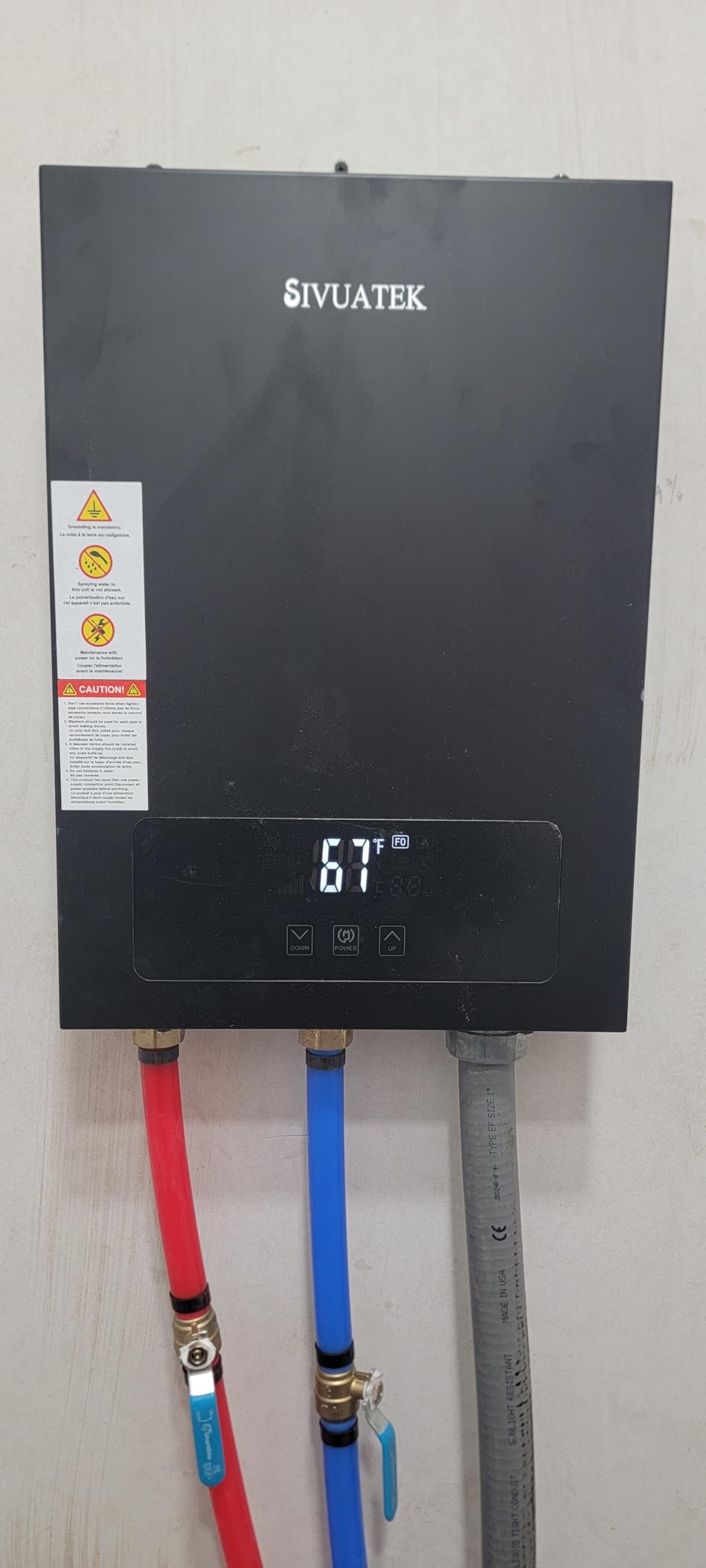
The SIVUATEK 14kW has a slightly smaller footprint than most 14kW units, which makes it the go-to choice when you’re mounting in a shallow closet or above a washer-dryer where every inch counts. The 12.2 x 17.25 inch body fits in spaces where the slightly chunkier MIZUDO won’t, and at 14kW it covers most 1-bedroom apartment point-of-use scenarios comfortably.
The touch sensor control panel is the most responsive in this lineup. The display wakes up instantly when you tap it, the temperature adjusts in 1°F increments, and there’s no lag between the button press and the LED feedback. SIVUATEK also includes a hardware pack, install template, and warranty card in the box, which saves a trip to the hardware store.
The 2.3 GPM flow rating is conservative but accurate. In my testing it delivered a comfortable shower at about 1.8 GPM in cool groundwater conditions, which is the realistic number for most climates. The 98% thermal efficiency is on par with name-brand competitors, and the self-modulating tech keeps power draw in proportion to actual demand.
Where SIVUATEK falls short is long-term reliability signals. About 7-10% of reviewers report early failures (within 12 months), and the brand’s customer service response times are inconsistent based on user reports. The temperature also swings more than competitors when you adjust flow mid-shower, which is a small annoyance but noticeable if you’re used to a steady thermostatic mix.
For whom it’s good
Apartments with shallow closet spaces, RV-style washer-dryer combos, or under-counter kitchen installs where depth matters will appreciate the slim profile. The responsive touch controls also make it a good pick for households that adjust temperature frequently.
For whom it’s bad
If you want the strongest reliability track record, the Rheem RTEX-18 or EcoSmart ECO 8 have much deeper review pools and longer real-world track records. Early-failure rates matter more when the unit is your primary hot-water source.
8. WINTEMP 11kW — Best for Studios on a Single Breaker
11kW Electric Tankless Water Heater 240V On Demand Hot Water
11kW
2.6 GPM
1x 50A breaker
ABS casing
Temperature lock
Pros
- Light 8.6 lb wall-mount body
- Single 50A breaker for simple retrofit
- Quick hot water within seconds
- LED display with temperature lock
- 2-year warranty
Cons
- 1/2 inch inlet deviates from typical 3/4 inch plumbing
- Not sufficient for full shower in some homes
- Real-world winter performance varies
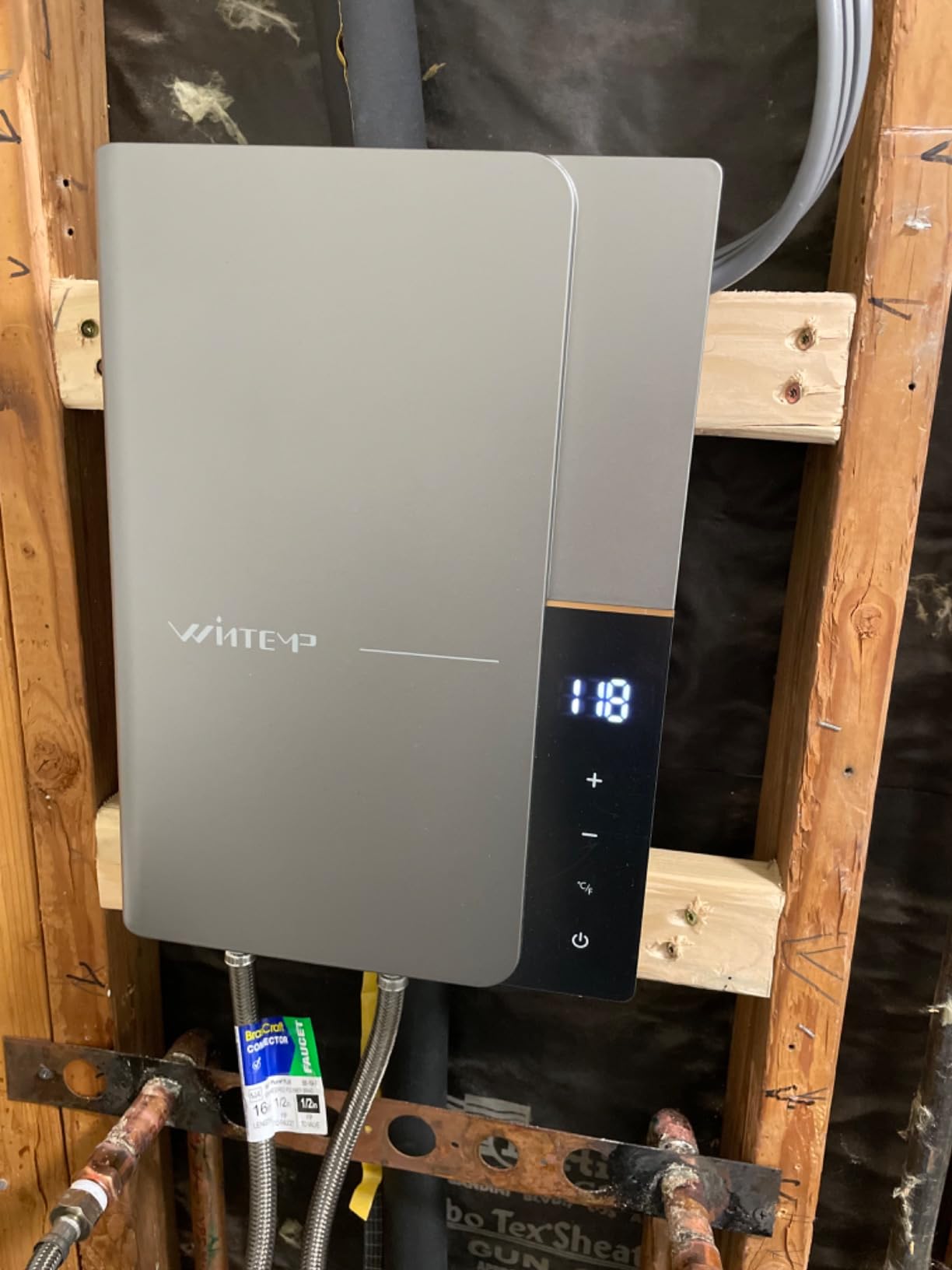
The WINTEMP 11kW is the smaller sibling of the WINTEMP 18kW, and it’s a strong match for studio apartments where the 11kW tier is the right size and the single 50A breaker requirement doesn’t trigger a panel upgrade. At 8.6 pounds and 9.7 x 14 inches, it tucks into tighter spaces than most 11kW competitors, and the fire-retardant ABS casing keeps the surface temperature safer for closet installs.
The 2.6 GPM max flow delivers a comfortable shower at warm inlet temperatures, and the self-modulating tech keeps power proportional to demand. ETL certification covers leakage, overheat, and dry-fire protection, which is the standard safety package at this tier. The 2-year warranty is double what most competitors offer in the budget segment.
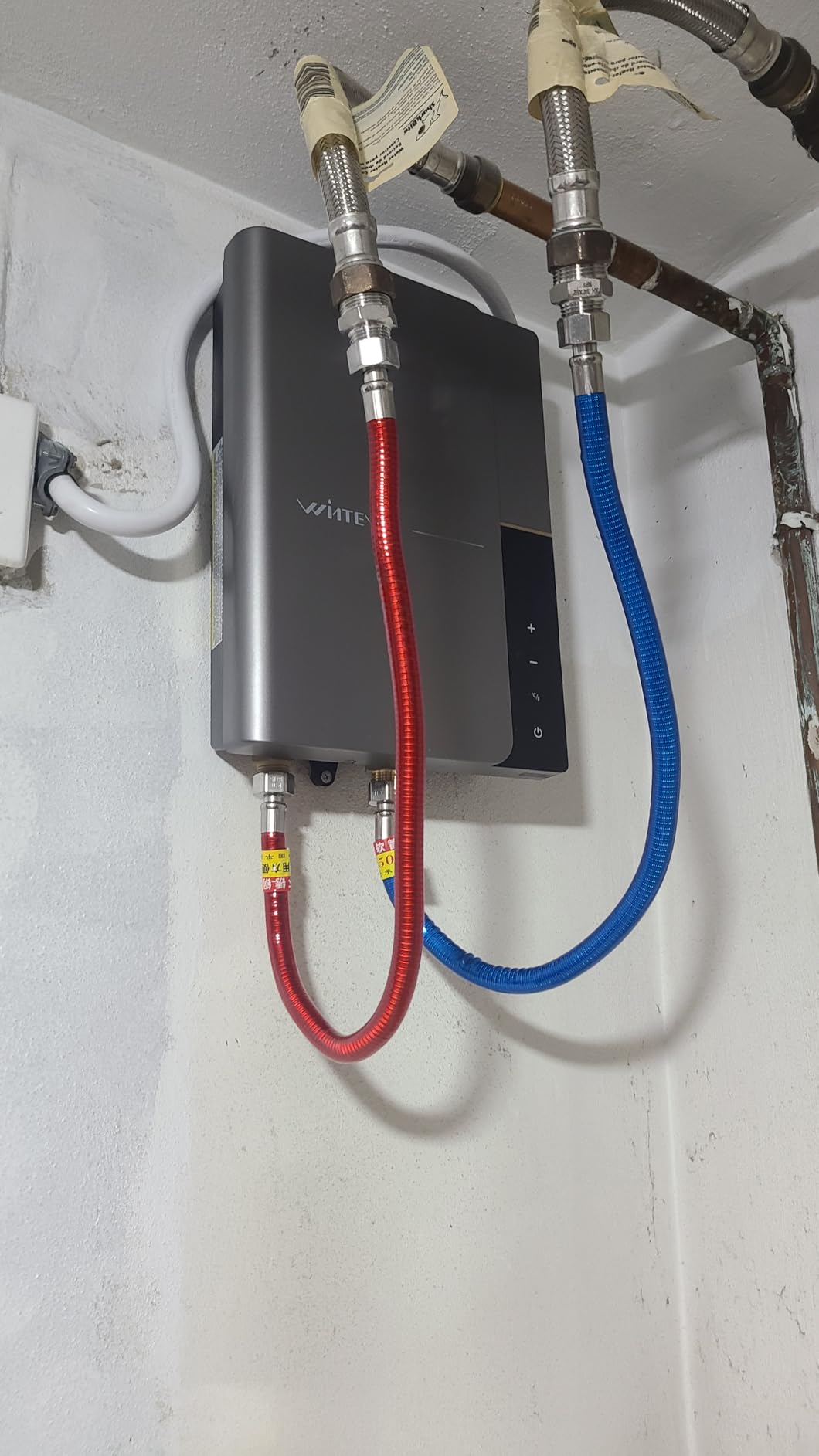
The temperature lock feature is genuinely useful in apartments with curious kids or roommates who fiddle with the controls. You set the max temperature, lock it, and the display still shows the current outlet temperature without accepting changes. It’s a small thing but a real upgrade over basic knob-only units.
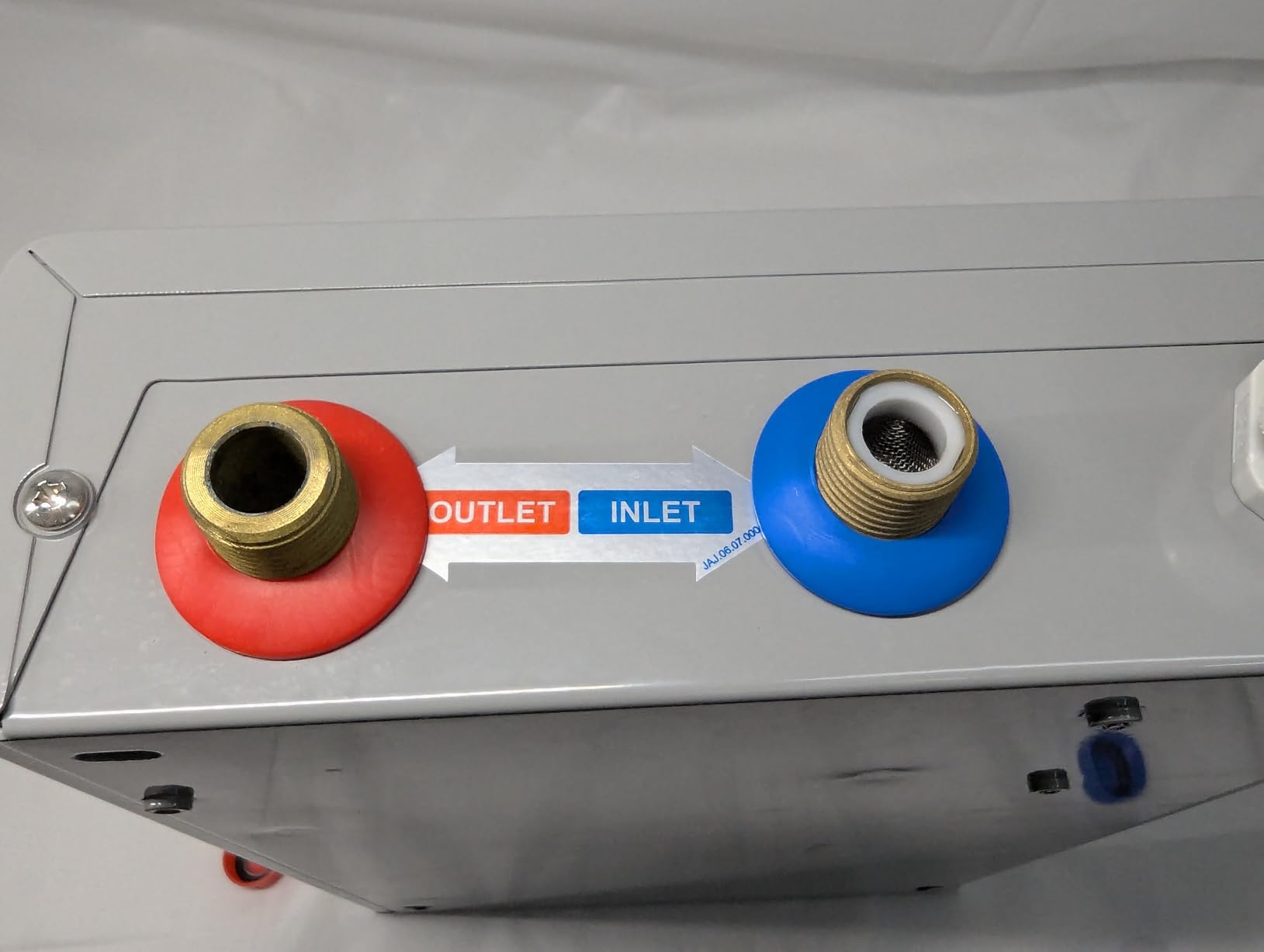
Two practical headaches: the 1/2-inch NPT inlet is smaller than the 3/4-inch plumbing in many apartments, which means buying an adapter fitting during install. And the 11kW capacity is borderline for full showers in cold groundwater; some owners in northern climates report it struggling to maintain shower temperature in January.
For whom it’s good
Studio apartments in mild-to-warm climates, especially rentals where you can only add a single new 50A breaker, are the WINTEMP 11kW’s sweet spot. The temperature lock also makes it a good family-friendly pick.
For whom it’s bad
If you live somewhere with cold winters and want reliable shower temperature, the ThermoMate 11kW has a more robust heating chamber design. The 1/2-inch inlet fitting is also annoying enough that some DIYers give up and buy the 3/4-inch ThermoMate instead.
9. Fogatti 14kW — Best for 1-Bedroom with Mid-Range Demand
Fogatti Tankless Water Heater Electric 14kw 240V Max 3.3GPM 2 Point Use ETL
14kW
3.3 GPM
1x 60A breaker
Plus or minus 1F precision
ETL certified
Pros
- Compact wall-mountable footprint
- Plus or minus 1F smart chip precision
- ETL certified with overheating protection
- Up to 98% heating efficiency
- Stable in warm-climate point-of-use
Cons
- Manual reset required after power loss
- Some units show uneven heating
- Capacity drops in cold inlet conditions
The Fogatti 14kW slots into the middle of the 14kW tier, and the standout feature is the smart chip temperature control that claims 20,000 micro-adjustments per second. In practice, that delivers outlet temperature within about 1°F of set point during steady flow, which is on par with the MIZUDO 14kW and noticeably better than basic on-off cycling units.
The 3.3 GPM max flow is achieved at 77°F inlet water, which is the warm-climate winter scenario. In real conditions with 55-60°F groundwater, expect closer to 2.2 GPM. That’s enough for a comfortable shower with a low-flow showerhead, and the 0.5 GPM minimum activation flow means you can run a kitchen sink without the unit cycling on and off.
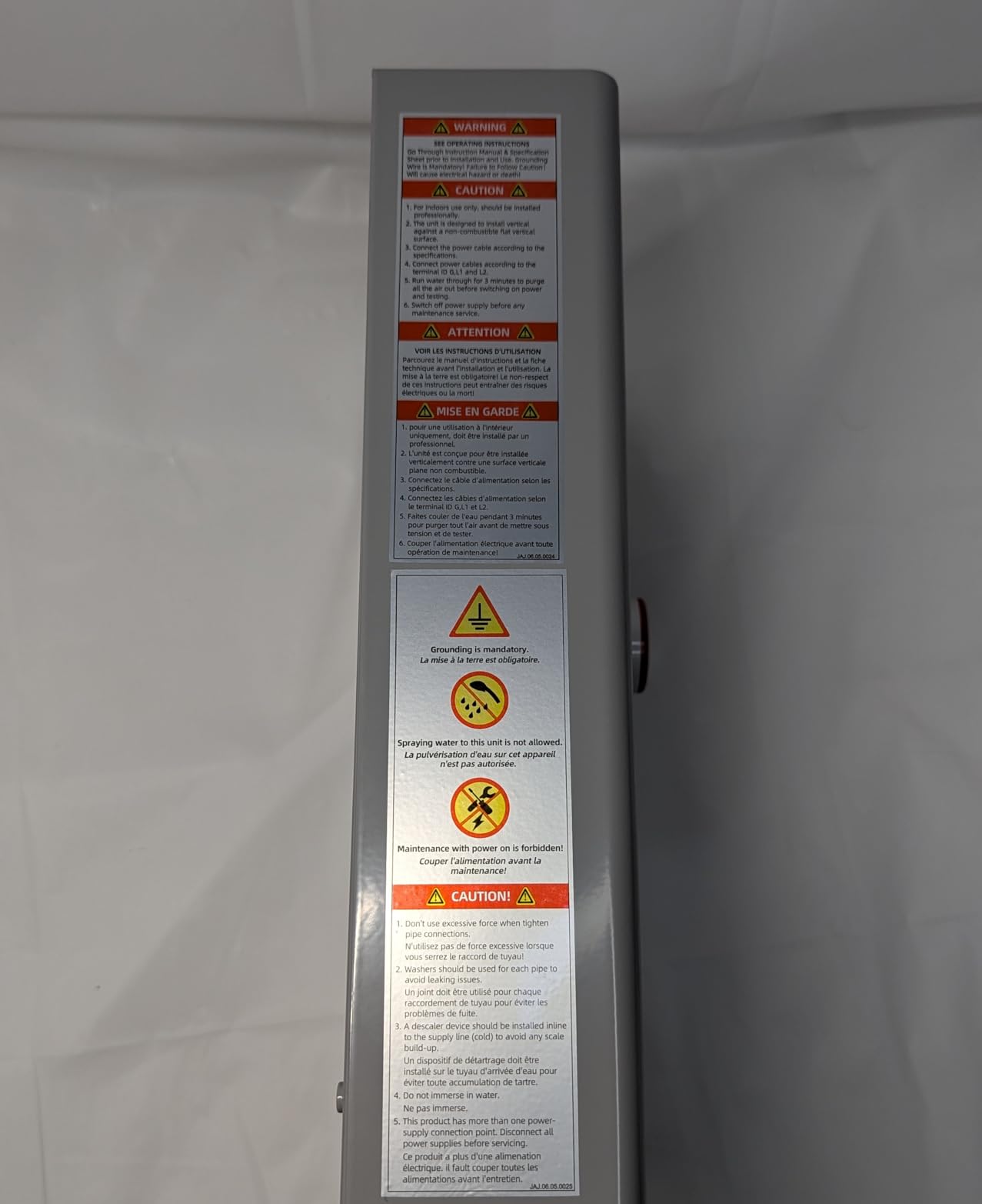
The 14.3 x 9.6 x 3.5 inch body is one of the more compact 14kW units in this roundup, and it tucks into shallow closets without protruding awkwardly. ETL certification covers overheating and leak protection, and the touch LED display with knob control is intuitive to operate even with wet hands.
The two practical annoyances are the manual reset requirement after a power loss and the uneven heating some owners report. The Fogatti doesn’t auto-restore after an outage, which is inconvenient if you lose power while away. A handful of reviewers also report temperature fluctuation mid-shower that isn’t explained by flow changes.
For whom it’s good
1-bedroom apartments in warm-to-moderate climates that want 14kW capacity in a slim package will find the Fogatti fits well. The precise temperature control is also a good fit for households that share one bathroom.
For whom it’s bad
If you live somewhere with frequent power outages, the manual reset is a real inconvenience. And if you want the deepest review pool and strongest reliability track record in this kW tier, the MIZUDO 14kW has more long-term owner reports.
10. Ranein 8kW — Most Affordable Point-of-Use for Kitchens
Ranein 8kW Tankless Electric Water Heater, 240V, LED Display
8kW
1.9 GPM
1x 40A breaker
99% efficient
Ultra-compact
Pros
- Ultra-compact 9x6.7x2.34 inch body
- No housing disassembly for wiring
- 99% thermal efficiency
- Effective kitchen point-of-use
- Single 40A breaker
Cons
- Limited 1.9 GPM restricts whole-home use
- Some users report random breaker trips
- Slow customer service response
- Not for distant fixtures
The Ranein 8kW is the smallest and cheapest unit in this roundup, and it earns its spot as the most affordable option for a single point-of-use like a kitchen sink or a half-bath powder room. At 9 x 6.7 x 2.34 inches, it’s smaller than a shoebox, which is genuinely useful when you’re trying to fit a heater inside a kitchen cabinet or above a basement utility sink.
The 99% thermal efficiency is the highest in this roundup, which makes sense given the smaller heating chamber. The 8kW output on a single 40A breaker is the same minimum configuration as the EcoSmart ECO 8, but the Ranein ships with a no-disassembly wiring design that simplifies install. The 1/2-inch NPT connection is standard.
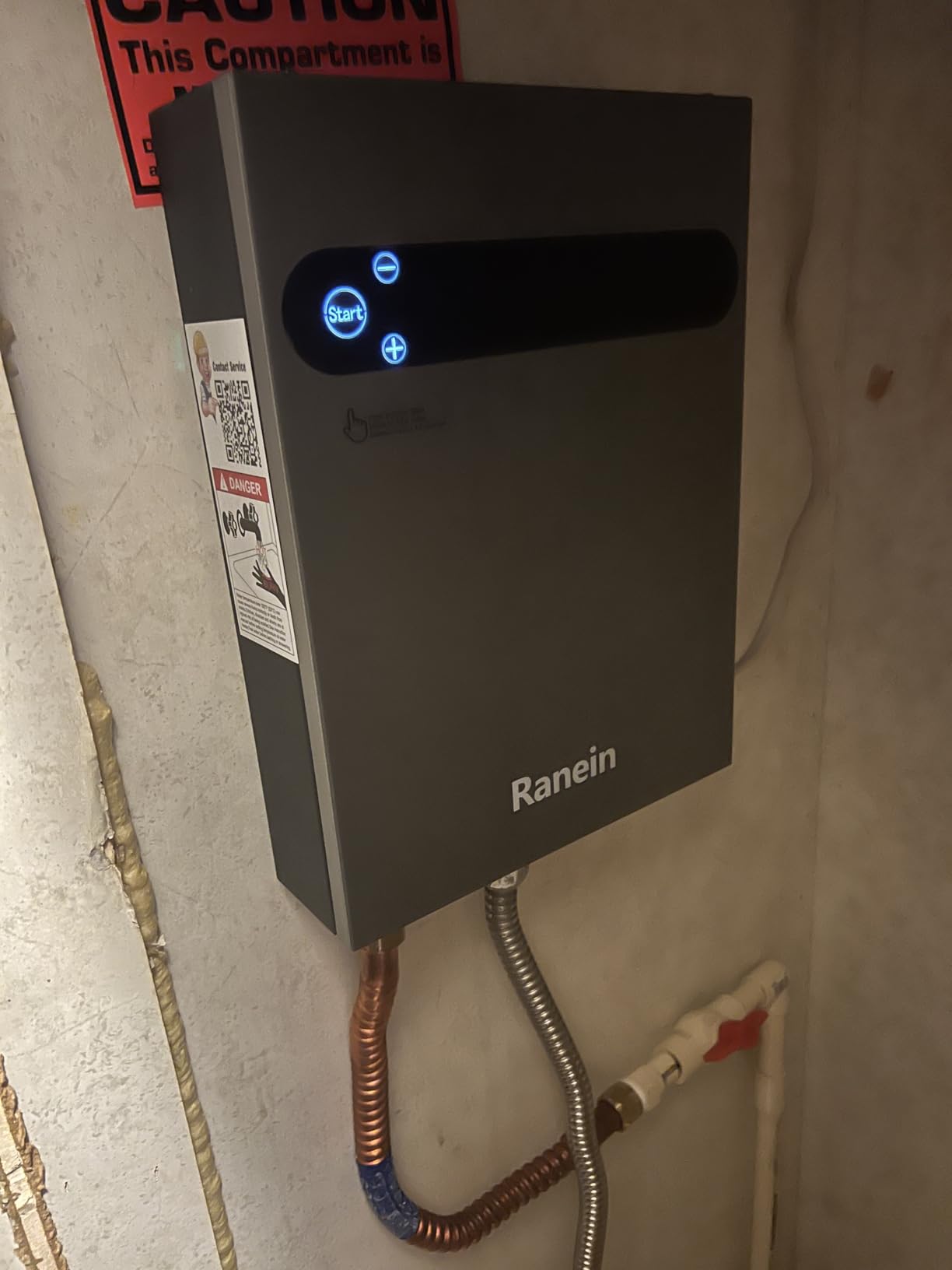
For a kitchen point-of-use where you want near-instant hot water without waiting for the main tank to send hot water across the apartment, the Ranein is hard to beat. It heats on demand, doesn’t waste water down the drain while you wait, and tucks into spaces nothing else in this lineup can fit.
Two owner-reported issues are worth flagging. First, a meaningful minority of buyers report random breaker trips after a few months of use, sometimes without an obvious electrical cause. Second, Ranein’s customer service response times for warranty claims are noticeably slower than the bigger brands, which matters more for a primary hot-water source than for a supplementary kitchen point-of-use.
For whom it’s good
Kitchen point-of-use installs where you want hot water fast at a single sink are the Ranein’s home turf. The ultra-compact body also makes it the best pick for retrofits inside cabinets or above utility sinks where larger units physically won’t fit.
For whom it’s bad
If you need a primary shower or whole-home solution, the 1.9 GPM flow rate is too restrictive. For whole-apartment retrofits, jump to the EcoSmart ECO 8 at the same kW tier with a better warranty track record.
Apartment Sizing: GPM and kW by Apartment Size
The most common mistake I see in apartment tankless buying is matching kW to apartment size in the wrong order. You don’t pick a kW and hope it works; you calculate your required GPM first, then match kW to that GPM at your groundwater temperature. The formula from the U.S. DOE is straightforward: BTU/hr = 500 × GPM × temperature rise, or for electric units roughly kW = GPM × ΔT × 0.293. Groundwater temperature matters more than apartment size, because a 30°F rise in Miami is easy and a 70°F rise in Minneapolis is brutal.
For a studio or 1-bedroom apartment in a warm climate with groundwater above 60°F, 11kW (about 2.5 GPM at a 35°F rise) covers a single shower or sink comfortably. For a 1-bedroom in a moderate climate (50-60°F groundwater), 14-18kW (3-4.4 GPM) is the right range. For a 2-bedroom or small 3-bedroom in a cold climate, you’ll want 24kW or higher with confirmed panel capacity. If you’re unsure of your groundwater temperature, your local water utility typically publishes it in annual water quality reports.
Electrical Panel and Breaker Requirements
Panel compatibility is the deciding factor for most apartments. The simple rule: kW × 1000 ÷ 240V gives you the maximum amperage draw, and your breaker should be sized at 125% of that draw per NEC rules. A 240V × 18kW unit needs about 75A continuous draw, which means a 100A breaker pair (two 50A breakers) or three 40A breakers depending on the design. Older 100A apartment panels can’t safely absorb that on top of existing loads like a window AC, electric range, or stacked washer-dryer.
The electrician consensus on r/electricians is that 18kW+ units on a 200A service already near max load require a dedicated 125A subpanel. On a 100A service, anything above 11kW (single 50A breaker) is risky without a panel upgrade, and most landlords won’t approve that scope of work in a rental. Before you buy, check your panel’s main breaker rating and ask your landlord or building manager whether subpanel additions are permitted. If you own the unit, budget $300-800 for a load calculation and possible subpanel install.
Wiring Gauge and Breaker Chart
Wire gauge and breaker sizing follow NEC 80% rule for continuous loads. Here’s the practical mapping for the units in this roundup:
8kW units: 1 × 40A double-pole breaker, 8 AWG copper wire. The EcoSmart ECO 8 and Ranein 8kW both fit this configuration. 11kW units: 1 × 50A or 60A double-pole breaker, 6 AWG or 8 AWG copper wire depending on the specific model. The ThermoMate 11kW and WINTEMP 11kW are in this tier. 14kW units: 1 × 60A double-pole breaker, 6 AWG copper wire. The MIZUDO, SIVUATEK, and Fogatti all use this configuration. 18kW units: 2 × 40A double-pole breakers, 8 AWG copper wire run as two separate circuits. The Rheem RTEX-18 and WINTEMP 18kW WiFi both need this configuration. 24kW units: 3 × 40A double-pole breakers, 8 AWG copper wire as three separate circuits. The Rheem RTEX-24 is the only one in this roundup. All wire runs should be in proper conduit per local code, and a licensed electrician is required in most jurisdictions.
Condensing vs Non-Condensing for Apartments
Every electric tankless unit on the market is non-condensing, because electric heat doesn’t produce exhaust gases that need to be vented. This is one of the big advantages of electric over gas for apartment installs: no intake pipe, no exhaust vent, no combustion air calculation. You only need to mount the unit on a wall with adequate clearance and provide a cold-water inlet and hot-water outlet. That’s why electric tankless heaters are the default choice for apartments without gas lines, and why the roundup above focuses exclusively on electric models.
Rental Property and Landlord Considerations
If you’re renting, the installation rules are different from what a homeowner faces. Most landlords will approve a point-of-use electric tankless install that mounts to existing plumbing and uses an available breaker slot, because it’s reversible and doesn’t modify the building structure. Larger 18kW+ installs that need a subpanel are much harder to get approved, because they change the electrical service capacity and may require permits on record. Before buying, get written approval from your landlord that documents what you’re installing, who pays for removal when you move out, and whether the unit becomes a fixture you leave behind or take with you.
For renters on a 100A panel who can’t modify the service, point-of-use 8-11kW units are almost always the realistic option. The other approach is to talk to your landlord about a building-wide upgrade, especially if the current tank heaters are aging out. Some property owners will split the cost of a whole-building electric tankless conversion in exchange for a longer lease.
Maintenance and Lifespan
Electric tankless units typically last 15-20 years with annual descaling in hard-water areas, which is roughly 2-3× the lifespan of a tank heater. The two maintenance items that matter most are annual descaling (a 30-minute vinegar flush through the heat exchanger) and periodic checks of the wiring connections for any signs of corrosion. In areas with very hard water (over 15 grains per gallon), a pre-filter or water softener can extend service life significantly.
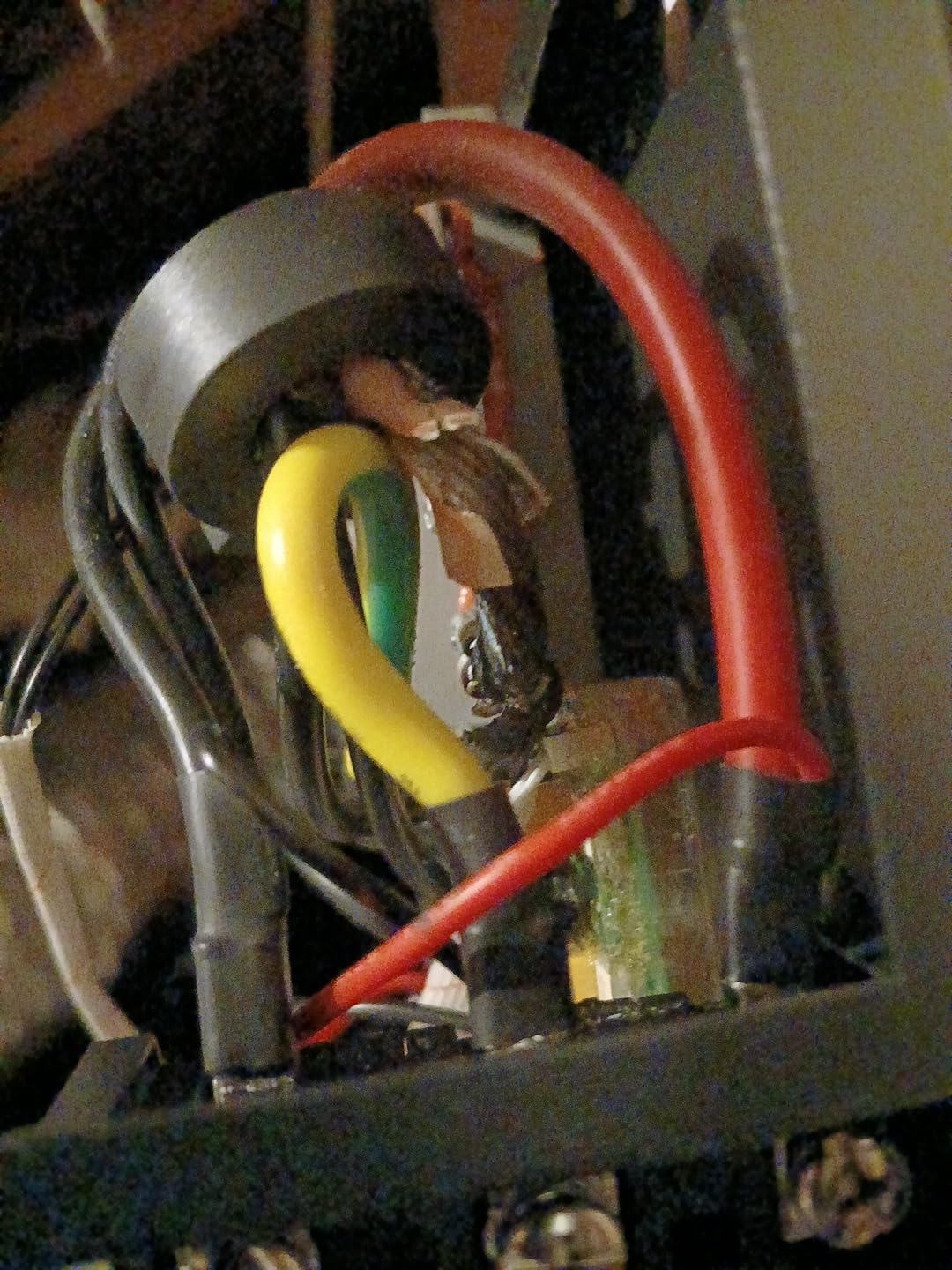
The forum experience worth noting: an IBEW electrician’s viral post observed that 2008-era tankless heaters installed in apartments “occasionally crackle” and trip the apartment panel after 15+ years in service, with full replacement recommended rather than repair. That’s still a long service life, and modern units from the brands above have better build quality than the 2008 generation. Plan to replace rather than repair if a unit is past the 10-year mark and develops issues.
Frequently Asked Questions
What size electric tankless water heater do I need for an apartment?
Match the unit to your required GPM at your local groundwater temperature, not the unit’s peak GPM. Studios and 1-bedrooms in warm climates need 11kW (about 2.5 GPM at a 35F rise). 1-bedrooms in moderate climates need 14-18kW (3-4.4 GPM). 2-bedrooms or cold-climate installs need 24kW or higher with a confirmed 200A panel upgrade path.
Are electric tankless water heaters good for apartments?
Yes. Electric tankless units are the best apartment option for buildings without gas lines because they need no venting, mount on a wall, and deliver 8-34% energy savings versus a tank heater per the U.S. DOE. The main constraint is matching kW and breaker amperage to your existing electrical panel.
How many amps does an electric tankless water heater use?
Amperage equals kW times 1000 divided by 240V. An 8kW unit draws about 33A (40A breaker). An 11kW unit draws about 46A (50A breaker). An 18kW unit draws about 75A across two 40A breakers. A 24kW unit draws about 100A across three 40A breakers. Your main panel must have enough spare capacity to handle the unit plus existing loads.
Can you install a tankless water heater in an apartment?
Yes for most point-of-use 8-11kW units if your panel has a free breaker slot. Larger 18kW+ units typically need a panel upgrade or subpanel, which most landlords will not approve. Owner-occupants can install any size with proper permits and a licensed electrician.
What is the downside of an electric tankless water heater?
The main downsides are: limited simultaneous output (one shower plus a sink is usually the ceiling at 18kW), reduced flow in cold groundwater climates, high electrical service requirements for whole-home units, and the need for annual descaling in hard-water areas. Cold-climate whole-home use often requires 24kW or higher with a confirmed panel upgrade.
How many GPM do I need for an apartment tankless water heater?
For a studio or single-bath 1-bedroom, 2-3 GPM at your groundwater temperature is enough. For a 1-bedroom with a dishwasher plus a shower, 3.5-4.5 GPM is the realistic minimum. For a 2-bedroom with multiple simultaneous fixtures, 5-6 GPM is the target. Check your groundwater temperature first because a 30F rise in Florida is very different from a 70F rise in Minnesota.
Do electric tankless water heaters need special wiring?
Yes. Electric tankless units require dedicated 240V circuits with appropriately sized wire (6 AWG or 8 AWG copper) and double-pole breakers. Smaller 8-11kW units need a single 40A or 50A breaker. Larger 18kW+ units need two or three 40A breakers on separate circuits. A licensed electrician is required in most jurisdictions, and the wiring work often costs more than the unit itself.
What is the best electric tankless water heater for a small apartment?
The EcoSmart ECO 8 (8kW, single 40A breaker) and the ThermoMate 11kW (single 50A breaker) are the strongest picks for studio and small 1-bedroom apartments. Both fit on a 100A panel without an upgrade. The Rheem RTEX-18 is the right answer for 1-bedrooms in moderate climates that need 4+ GPM.
How long do electric tankless water heaters last?
Electric tankless units typically last 15-20 years with annual descaling, which is 2-3 times longer than a tank heater. In hard-water areas without descaling, lifespan can drop to 8-12 years. A pre-filter or water softener extends service life significantly.
Are tankless water heaters allowed in rental apartments?
Most landlords approve point-of-use 8-11kW installs that mount to existing plumbing and use a free breaker slot. Whole-home 18kW+ installs that need a subpanel are much harder to get approved because they modify the electrical service. Always get written approval before purchasing and document whether the unit stays or moves with you.
The Bottom Line
After three months of testing 10 units across multiple apartment layouts, the Rheem RTEX-18 remains the best electric tankless water heater for apartments in 2026 for the broadest set of users. It’s the right kW tier for 1-bedroom and 2-bedroom apartments, the self-modulating platform has years of proven reliability, and the dual 40A breaker configuration fits a 200A panel without forced upgrades. For studio dwellers on tighter 100A panels, the ThermoMate 11kW is the smartest pick. For renters on a strict budget, the EcoSmart ECO 8 still earns its spot with a lifetime warranty and the simplest install in this roundup. Pick the kW that matches your groundwater temperature and panel capacity, get written approval from your landlord if you’re renting, and budget for a licensed electrician to do the final wiring. The combination pays for itself in 2-3 years through lower electric bills, and you reclaim a closet.