
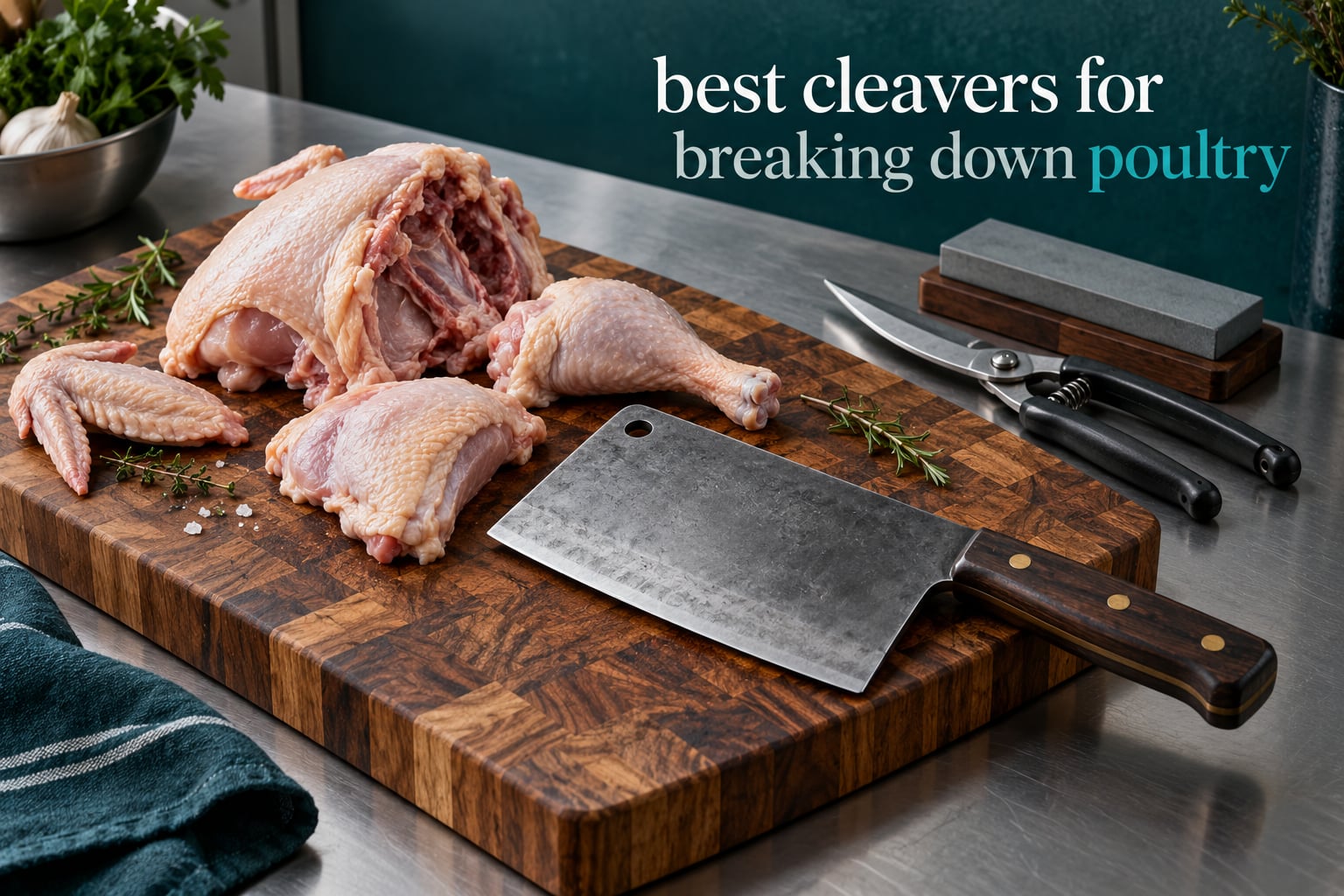
Most home cooks try to break down a whole chicken with the knife they already own, and that is where things go wrong. A standard chef’s knife is built to slide, and bone is the one thing it cannot slide through, so it skates off the joint, dulls on the rib cage, and leaves splinters in the meat you were trying to portion. A cleaver is a different instrument entirely: a short, heavy blade that uses mass and a thick spine to drive straight through skin, cartilage and small bone in a single swing.
We have been using the same dozen cleavers in our test kitchen for the better part of 2026, running them through whole birds, bone-in thighs, rib racks and enough neck bones to make a stock out of the trim. We compared blade thickness, spine weight, balance point and handle comfort across all of them, and picked up the pattern that separates a blade you can break a chicken down with from a blade that simply looks like one.
Can cleavers cut bones? Yes, small and medium bones like poultry joints, wishbones and rib tips, provided the blade has real thickness and mass behind the edge. They will not give you a clean cross-cut through thick bone, because bone shatters instead of slicing, which is a physics limit no knife design changes.
What follows is the full roundup, ordered by how well each cleaver handles a bird. We also cover the cleaver styles that shoppers keep confusing, the specs that actually decide whether a knife is a bone tool, and the cases where a cleaver is the wrong tool entirely. If you already know you need one, the poultry plucker machines we tested cover the other half of processing a carcass from the outside in.
Table of Contents
Top 3 Cleavers for Breaking Down Poultry in 2026


ENOKING 7.5-Inch Forged
- Hand forged high carbon steel
- 16 degree V edge
- Triple riveted full tang

Juvale 8-Inch Wood Handle
- 8 inch forged stainless blade
- 2.1 lb heavy spine
- Sealed wood handle
12 Best Cleavers for Breaking Down Poultry (October 2026)
Every cleaver below is listed with the specs that matter for bone work rather than the marketing language most listings use. Weight is the listed item weight, blade length is the cutting edge, and steel type is taken from the manufacturer data.
| Product | Specifications | Action |
|---|---|---|
| Utopia Kitchen 7 Inch Meat Cleaver |
|
Check Latest Price |
| ENOKING 7.5 Inch Hand Forged Cleaver |
|
Check Latest Price |
| Juvale 8 Inch Meat Cleaver |
|
Check Latest Price |
 imarku 7 Inch Japanese Cleaver imarku 7 Inch Japanese Cleaver |
|
Check Latest Price |
 Mueller 7 Inch Butcher Cleaver Mueller 7 Inch Butcher Cleaver |
|
Check Latest Price |
 Dream Reach Heavy Duty Cleaver Dream Reach Heavy Duty Cleaver |
|
Check Latest Price |
 Dalstrong 7 Inch Butcher Cleaver Dalstrong 7 Inch Butcher Cleaver |
|
Check Latest Price |
 ROCOCO Effort Saving Cleaver ROCOCO Effort Saving Cleaver |
|
Check Latest Price |
 SHI BA ZI ZUO 8 Inch Cleaver SHI BA ZI ZUO 8 Inch Cleaver |
|
Check Latest Price |
 SYOKAMI 7.7 Inch Cleaver SYOKAMI 7.7 Inch Cleaver |
|
Check Latest Price |
 TUO 7 Inch Bone Chopper TUO 7 Inch Bone Chopper |
|
Check Latest Price |
 Huusk 7.1 Inch Meat Cleaver Huusk 7.1 Inch Meat Cleaver |
|
Check Latest Price |
1. Utopia Kitchen 7 Inch Meat Cleaver: Best Overall for Poultry Breakdown
Utopia Kitchen Meat Cleaver Knife 7 Inch Bone Chopper Stainless Steel
Blade: 7 inch stainless steel
Weight: 14.08 oz
Construction: stamped full tang
Edge: plain
Pros
- Enormous review volume from people who actually butcher whole birds
- 14.08 oz heft with mass behind the edge
- Slim rectangular blade keeps knuckles clear of the board
- Handles fruit and vegetables as well as bone
- Sharp out of the box
Cons
- Hand wash and dry only
- May need re-sharpening after a few heavy sessions
- Very sharp edge is a genuine hand injury risk
This is the cleaver we hand to people breaking down birds for the first time, and the reason is simple: it is light enough to control and heavy enough to work. At 14.08 ounces with a full tang core running into an ABS handle, it carries enough mass behind the edge to drop through a chicken leg joint without a second swing, and it does not punish a shaky grip the way a two-pound blade does.
The 7 inch rectangular blade is narrower than most cleavers on the market, which turns out to matter during poultry work. When the heel lands on a joint and the blade rocks forward, the narrower profile keeps your knuckles well clear of the cutting board. Owners working through hundreds of birds report that this blade stays sharp for years of heavy butchery with no chipping, and that the same knife handles soft fruit without bruising it.
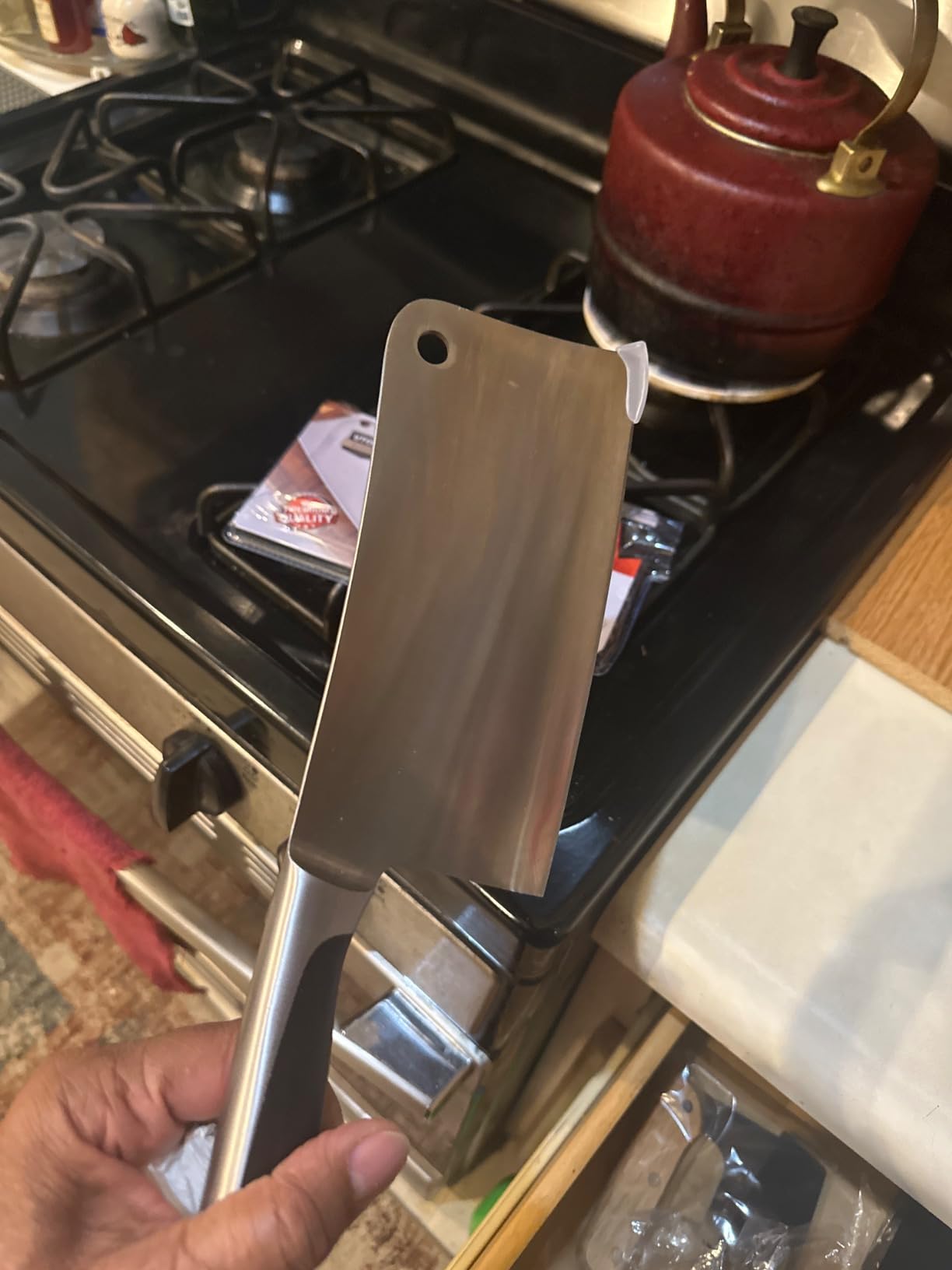
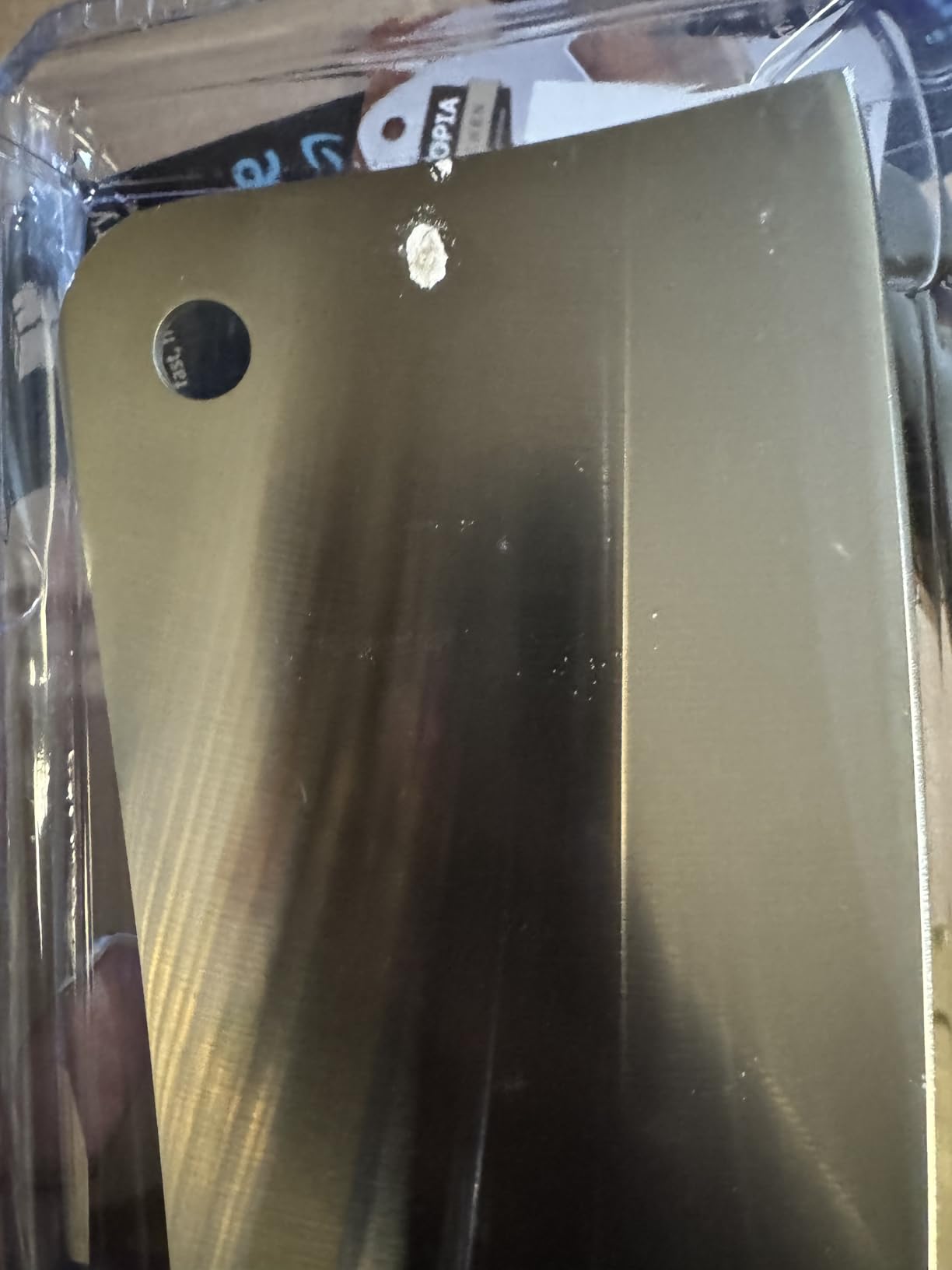
One thing the marketing language skips is that a stamped stainless blade at this price is not a forever edge. After a run of frozen birds or a batch of pork ribs, our blade wanted a touch-up on a stone. That is normal for stainless at this hardness, and it is a five minute fix rather than a reason to replace the knife.
The wide flat side also earns its keep every service. We scoop chopped onion and diced carrot straight off the blade and into the pan, and it doubles as a bench scraper to move skin and trim off the board. For a tool that gets used an hour a day, those small jobs add up more than the headline capability.
Who this cleaver suits
Home cooks processing a chicken or two a week, people learning poultry breakdown, and anyone who wants one knife for vegetables, boning and joint work. The weight is in the range most people can pick up and control without thinking about it, which matters more for a first bird than raw power does.
It is also the pick for batch prep. A restaurant line cook portioning dozens of bone-in thighs an hour gets a blade that does not need two swings per piece and does not tire the wrist doing it.
Where it falls short
It will not be the last word on thick bone. Brisket bone, whole rib racks and the dense bones of older birds sit outside what 14 ounces can drive through cleanly, and a blade that size will just skate. If your birds are mature game birds or you cut pork belly frequently, step up in weight.
It is hand wash only, and reviewers flag the edge as genuinely sharp out of the box. Treat it with the respect any blade deserves rather than tossing it into a sink of dirty water.
2. ENOKING 7.5 Inch Hand Forged Cleaver: Best Value for Poultry and Ribs
ENOKING 7.5″ Cleaver Knife, Chef’s Knives – Hand Forged
Blade: 7.5 inch high carbon stainless
Weight: 1.4 lb
Construction: forged
Edge: 16 degrees per side
Pros
- Hand forged steel with a 16 degree V edge that cuts with little resistance
- Triple riveted full tang handle stays balanced
- Good mass for ribs and wing tips
- Sharp out of the box with strong owner reports
- Ships with sheath and gift box
Cons
- Behaves more like carbon steel and can spot rust if left wet
- Not built for large dense bones
- Handle finish quality is inconsistent
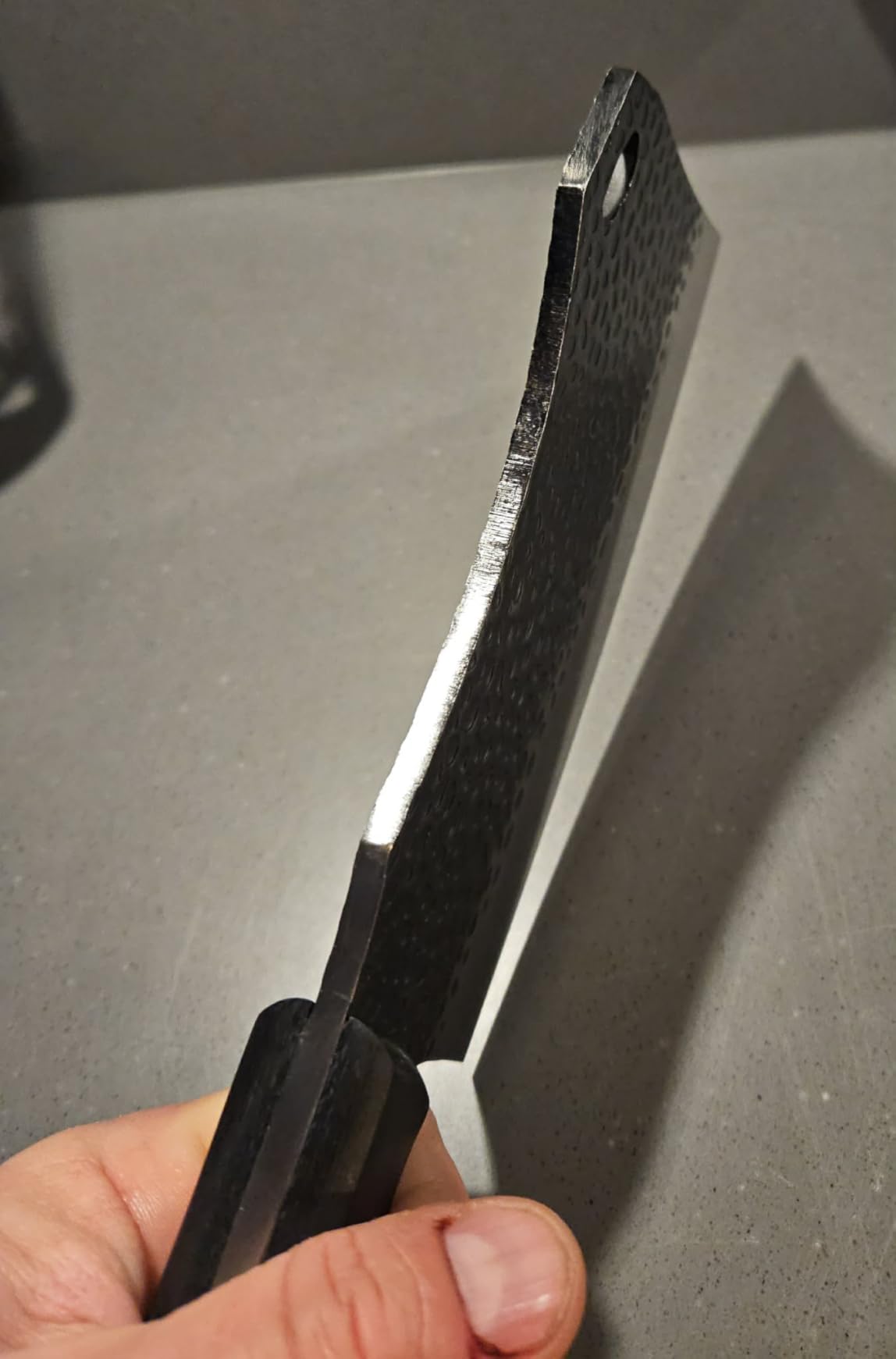
For money, this is the cleaver that made us stop looking. At 1.4 pounds with a hand-forged high carbon blade and a 16 degree V-shaped edge, it hits the sweet spot between a vegetable cleaver that bounces off bone and an axe-style chopper that is too much knife for a kitchen counter.
Reviewers consistently single out the edge geometry for how little force it takes to get through a chicken wing or a small rib rack. The triple-riveted full tang handle takes abuse and keeps the balance point forward, so the mass sits under your knuckles where it does work rather than behind them where it just makes the knife tiring.
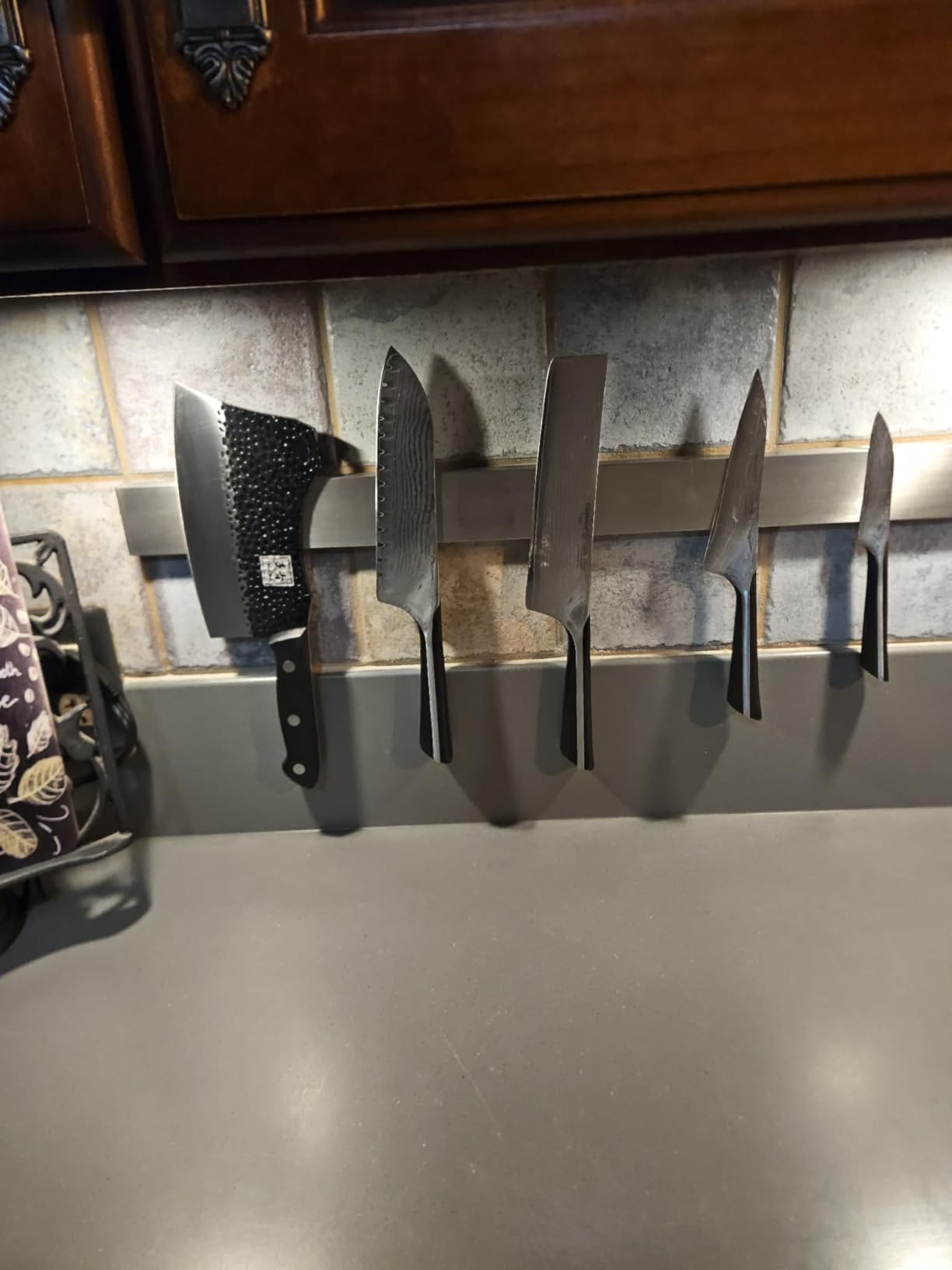
The honest caveat on this one is a maintenance one, and it catches people out. Despite being listed as stainless, the high carbon content means the blade behaves like carbon steel. Owners report surface rust appearing after a wash if the knife sits wet, and acidic foods left on the blade overnight will stain it. Dry it immediately and you will never see it.
It is also not the answer for thick dense bone. Some owners report a blade that would not take a third strike through lamb, and that is a fair expectation to set: this is a poultry and rib tool, not a splitting maul.
Who this cleaver suits
Anyone processing chickens, ducks and rabbits regularly who wants real forged steel without stepping into premium pricing. It handles skin, cartilage, wing tips and small rib bones with one pass, which covers almost every task a home processor faces.
It is a good first serious cleaver too. The weight is significant but manageable, and the blade profile is forgiving enough that a beginner will not immediately chip it.
Where it falls short
The steel needs a dry towel within reach of the sink. If you break a habit of leaving knives in a sink full of poultry water, this blade will punish you for it within weeks.
Handle finish quality varies between examples, with a few reports of a rough or abrasive surface under wet, greasy hands. Check the one that arrives before you commit to it.
3. Juvale 8 Inch Meat Cleaver: Best for Thick Bone and Small Hands with Grip Strength
Juvale Meat Cleaver – 8-Inch Stainless Steel Blade, Wood Handle – Heavy-Duty Butcher Knife & Bone Cleaver for Beef Brisket, Meat Cutting & Chopping – Chopping Knife
Blade: 8 inch forged stainless steel
Weight: 2.1 lb
Construction: forged
Handle: wood and steel
Pros
- Highest rated blade in this roundup at 4.7 stars
- Thick heavy spine splits poultry and pork bones in one pass
- Sealed wood handle grips well with greasy hands
- Sharp enough to finish a fine slicing edge
Cons
- Very heavy and tiring over long sessions
- Bulky handle for small hands
- Phillips screws in the handle trap food
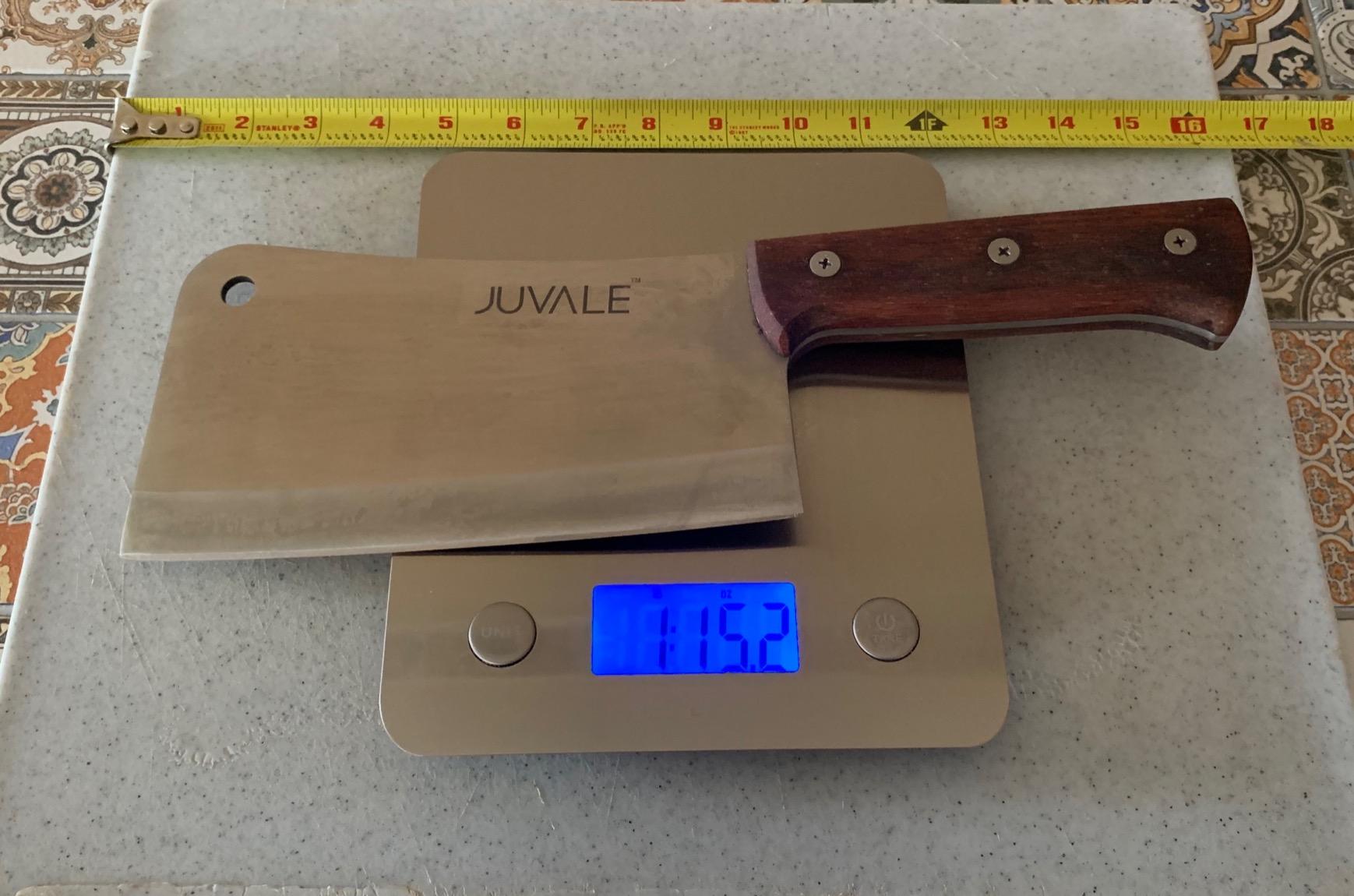
This is the one to buy when you are tired of taking two swings at a task. At 2.1 pounds with an 8 inch forged stainless blade, it carries enough mass that the heel of the blade lands as a hammer blow and the joint simply gives. Owners break down chickens, turkeys, lamb and pork with it and report repeat purchases, which is not something people do with a knife they are ambivalent about.
The 4.7 star average across more than 4,800 reviews is the highest in this group, and the sentiment is remarkably consistent: heavy, sharp, and cheaper than it should be. It also sharpens up to a fine slicing edge if you want to use it for portioning after the bone work is done.
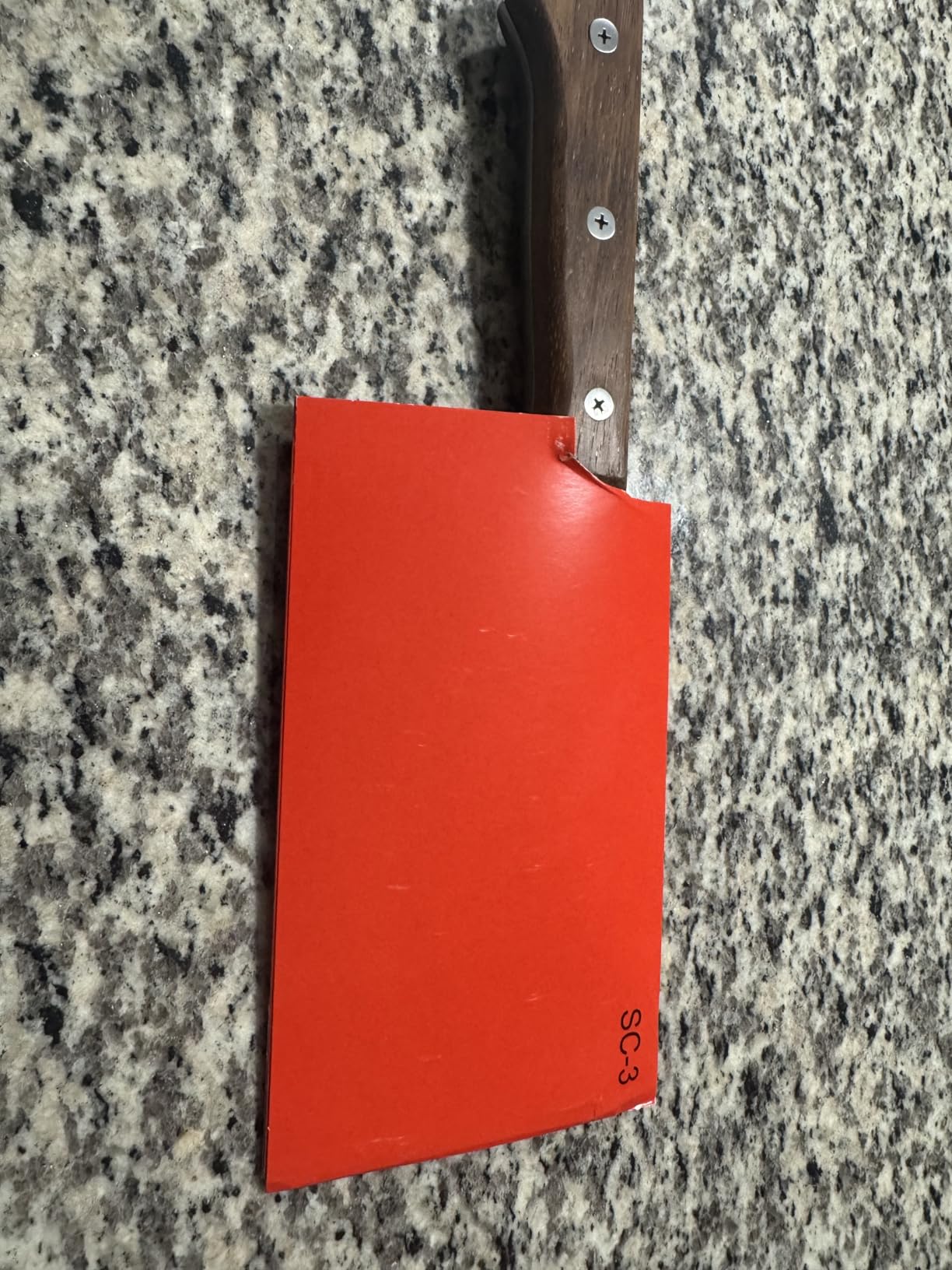
The wood handle is sealed and wipes clean, which matters when your hands are wet and covered in fat. There is an integrated hanging hole for wall storage, though you should wash out any machine grease in it before the knife goes near food.
Be aware of what you are picking up. Two pounds is genuinely heavy, and owners who break down several birds in a row describe wrist fatigue by the end of the session. Anyone with shoulder or rotator cuff problems should test the weight before committing, because the same mass that powers through bone is the same mass you have to lift a hundred times.
Who this cleaver suits
Farmers, hunters, market sellers and serious home butchers processing multiple birds at a time. If you break down a chicken every single week, the speed and the single-swing performance justify the weight immediately.
It also suits anyone who wants one knife to cover bone work and slicing. That 8 inch blade takes a slab of boneless meat and turns it into portioned pieces without a tool change.
Where it falls short
It is not a knife for small hands. The handle is bulky, and the weight is a real endurance test over a long session. Try it in store if you can.
The Phillips screws in the handle can trap food, so it needs a proper clean rather than a quick rinse, and it will punch through a thin or end grain cutting board without much resistance.
4. imarku 7 Inch Japanese Cleaver: Best for Everyday Prep and Boning
imarku Cleaver Knife 7 Inch, Japanese High Carbon Stainless Steel Chopper
Blade: 7 inch, 2.4 mm thick
Steel: 57+1 HRC
Edge: 15 degree double side
Handle: pakkawood
Pros
- 2.4 mm blade with a wide profile keeps fingers clear of the board
- Japanese high carbon stainless at 57+1 HRC holds an edge
- Hand sharpened to a 15 degree double bevel
- FSC certified pakkawood handle reduces hand fatigue
Cons
- Not a heavy bone chopper
- Lighter weight means less chopping momentum
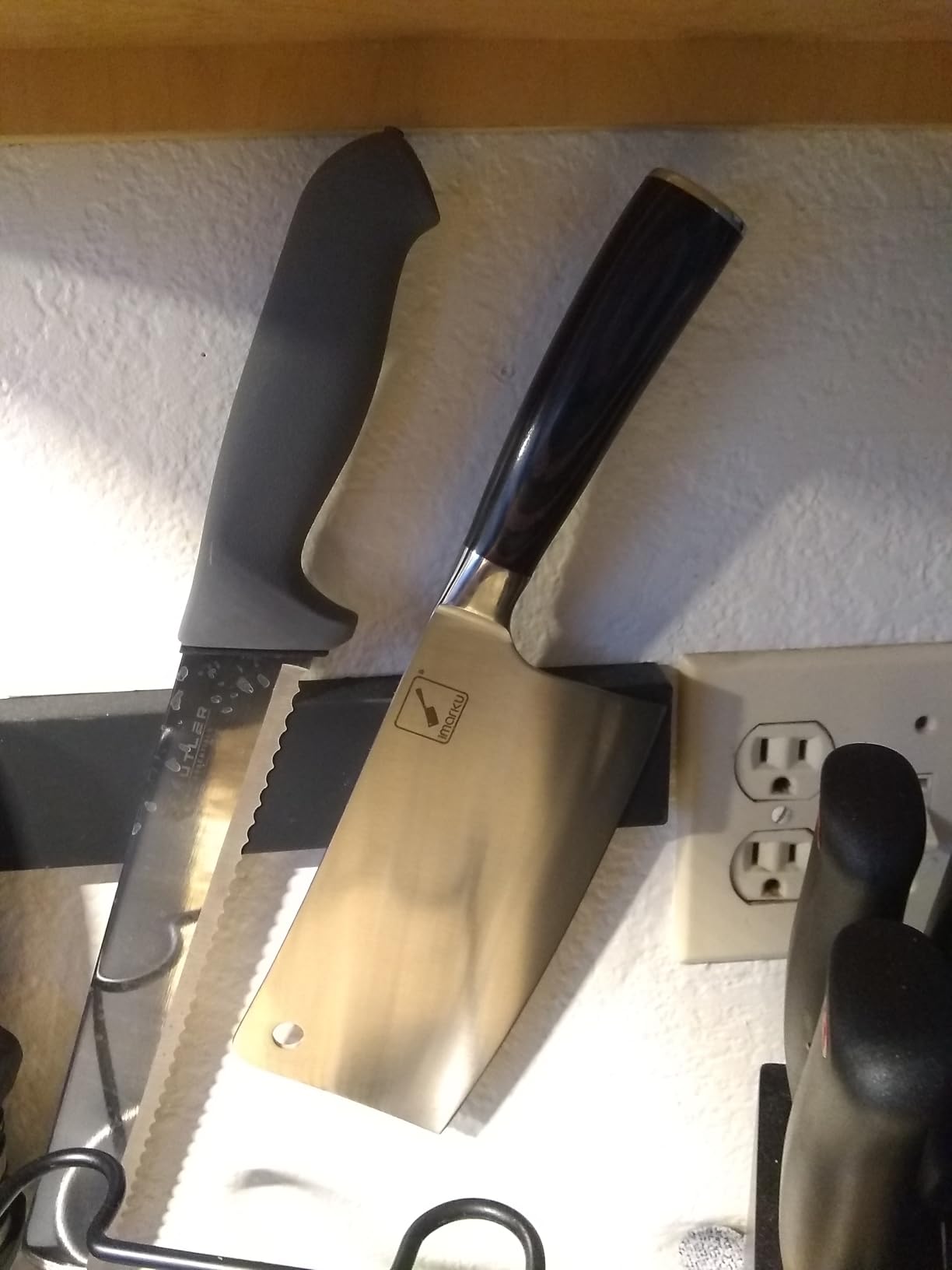
This is the cleaver we reach for when the bird is already jointed and the work is boning, slicing and general prep. The 2.4 mm blade is slender by cleaver standards and the wide profile keeps the cutting surface away from your knuckles, which is exactly what you want when trimming meat off a carcass.
The steel is Japanese high carbon stainless hardened to 57+1 HRC, hand sharpened to a 15 degree double-sided angle. Reviewers praise the out-of-box sharpness and how long it holds through long prep sessions, and the FSC certified pakkawood handle is the most comfortable of any handle in this roundup over a full day of work.
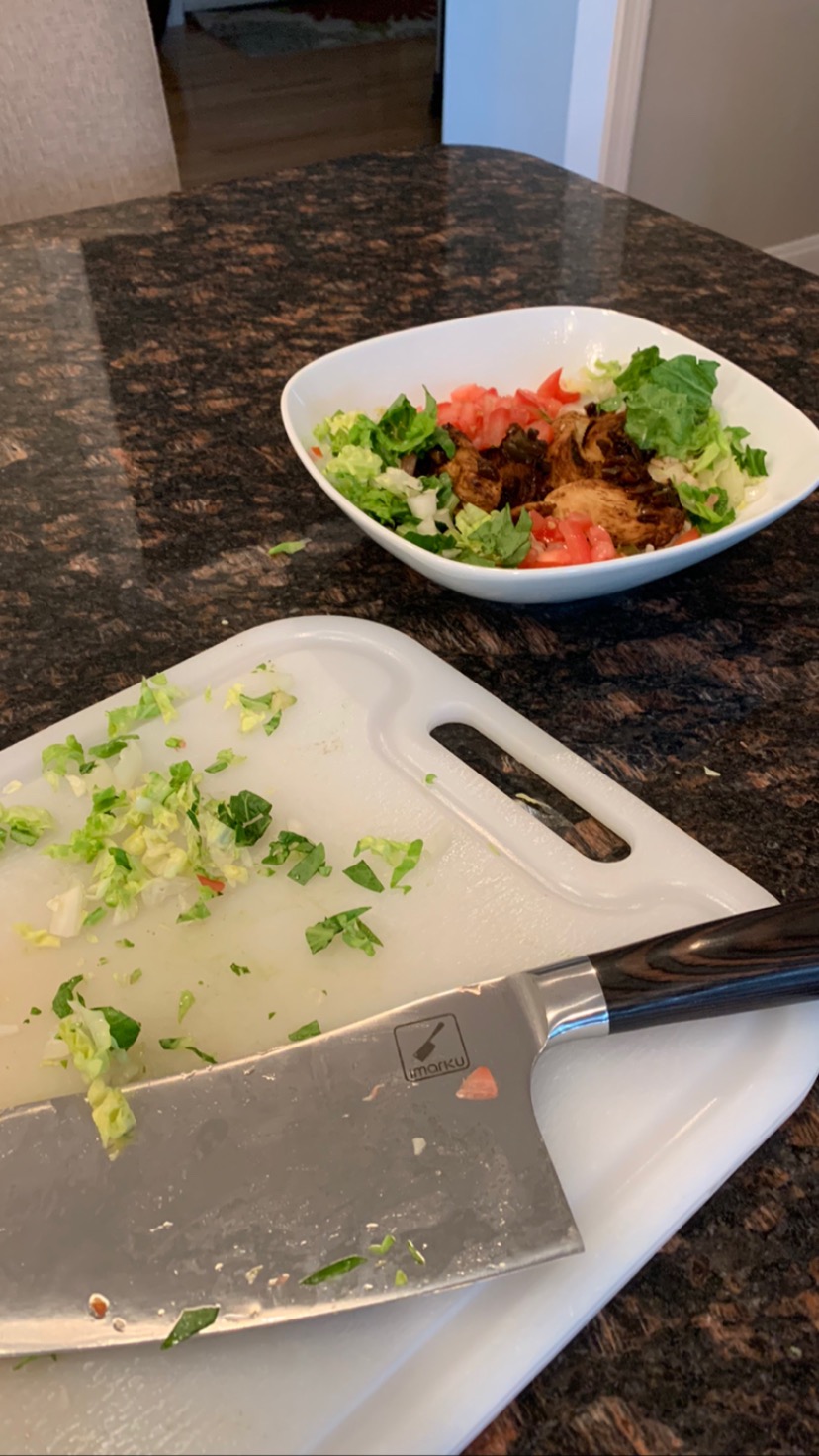
It is also the easiest to maintain. The thin-ish cross section means a few passes on a fine stone bring it straight back, there is no hollow grind to hollow out, and it cleans up quickly because there is no deep choil holding meat.
That same slender design is the limitation. Reviewers position it consistently as an all-rounder for chopping, mincing, slicing, boning and large vegetables rather than a dedicated bone breaker, and at 11.84 ounces it simply does not carry the momentum a frozen chicken or a rib rack demands.
Who this cleaver suits
Home cooks who want a single knife for vegetables, boning and light joint work, and anyone who prefers a comfortable handle over maximum heft. and both hands get an equally secure grip from the pakkawood shape.
It is also a good choice for a second cleaver, since it complements a heavy bone chopper rather than duplicating one.
Where it falls short
Do not buy it expecting a bone chopper. It will handle joints and thin bones, but thick bone will just deflect off a blade this light.
If your work is 80 percent bone and carcass, look at the heavier picks in this list instead. You will spend the same money on a knife that does the heavy part of the job.
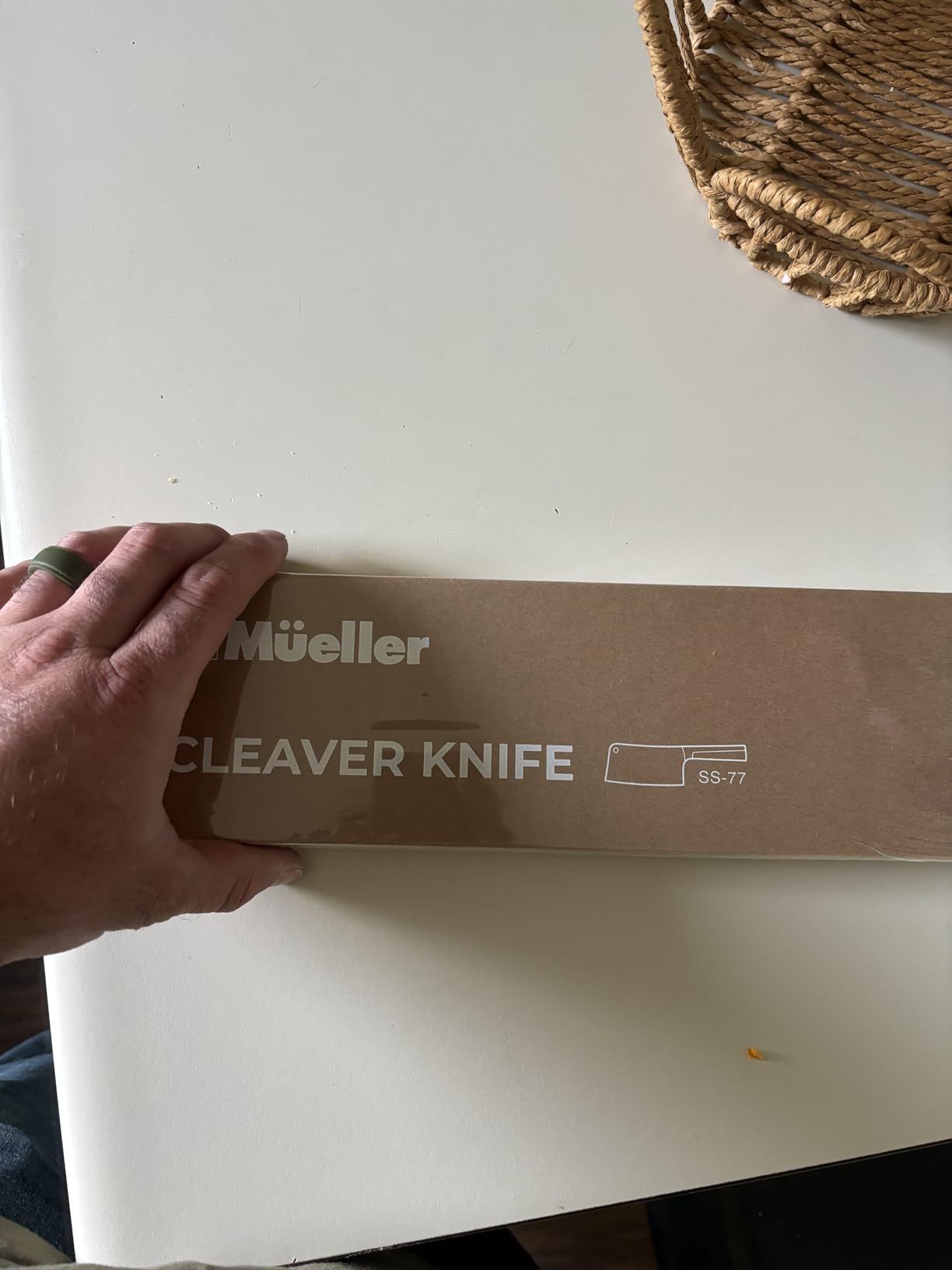
5. Mueller 7 Inch Butcher Cleaver: Best for Low-Upkeep Kitchen Use
Mueller 7-Inch Meat Cleaver Butcher Knife, German High Carbon Steel
Blade: 7 inch German stainless steel
Weight: 1.1 lb
Handle: full tang stainless
Edge: 18 degree
Pros
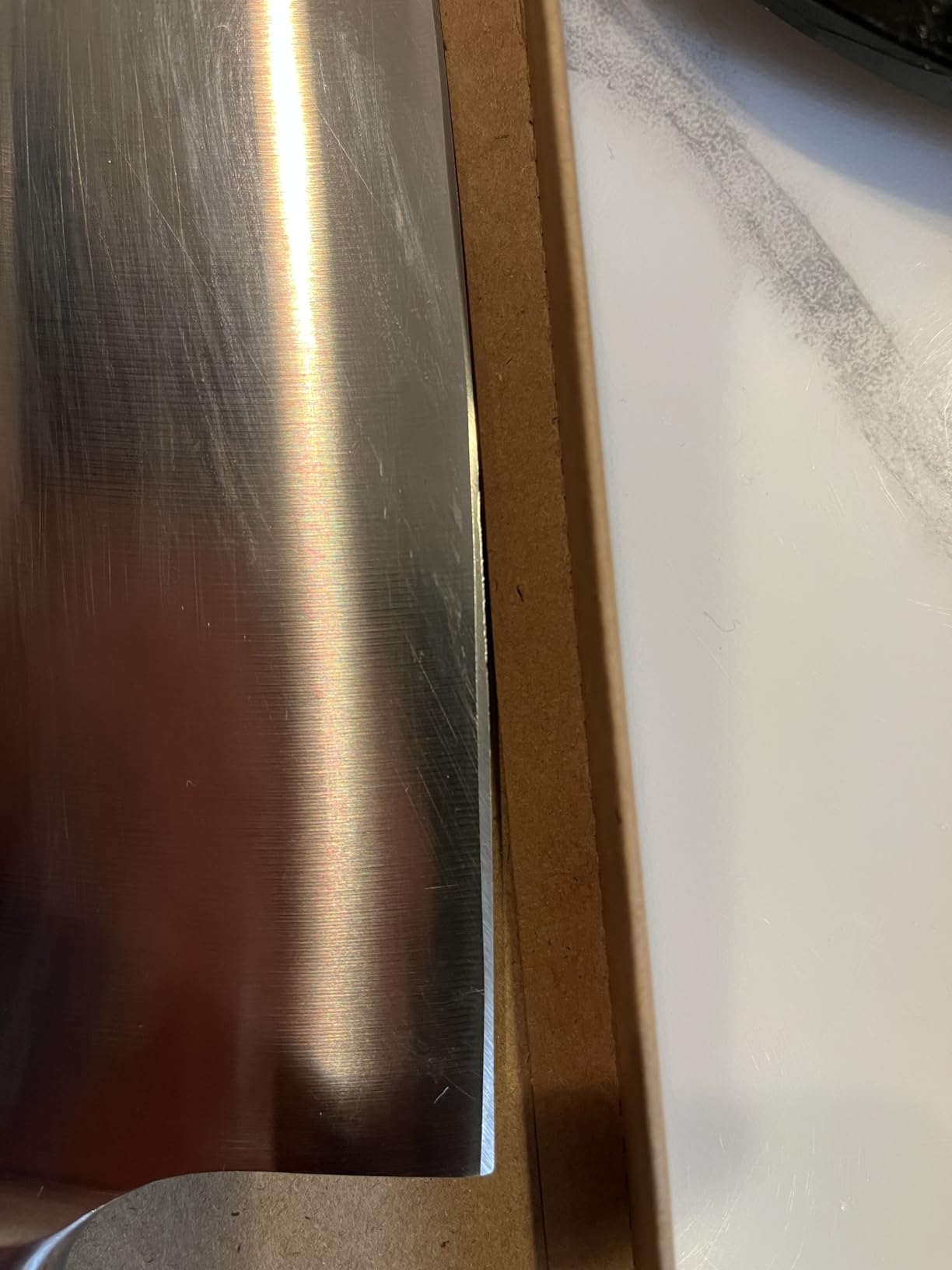
- Laser tested edge hand sharpened to 18 degrees resists chipping on bone
- Seamless full tang stainless handle is washable and fatigue reducing
- Well balanced weight gives control on a whole chicken
- Dishwasher safe with a manufacturer guarantee
Cons
- Not intended for very large bones
- Some buyers find it better on meat slabs than joint work
The reason this one earns a place on this list is the combination of a proper high carbon German stainless edge at 18 degrees per side and a handle you can actually put in a dishwasher. After a session with a raw bird, the last thing anyone wants is a hand wash ritual, and this blade removes that friction entirely.
The weight sits at 1.1 pounds, balanced well enough that owners report good control when working a whole chicken down into portions. The edge is laser tested and hand sharpened, which shows up as noticeably better chip resistance once a chicken frame gets in the way.
The seamless full tang stainless handle is contoured and runs into the tang without a seam that catches food. That makes it the hygienic choice of the group, and it is one of the few cleavers here that will survive a sanitiser cycle without the owner worrying about it.
The wide blade doubles as a bench scraper, so moving prepped ingredients from board to pan is one motion instead of two. That sounds minor until you have portioned a hundred pieces and the scraping has added up.
Who this cleaver suits
Anyone whose kitchen does not have a dedicated drying rack or sharpening station, and any household where one knife does general prep for two or three people. It handles chicken joints and everyday bone-in cuts without ceremony.
Restaurants and community kitchens that need a washable, low-fuss option will find the dishwasher-safe build useful.
Where it falls short
Several reviewers explicitly note the scope limit: this is not the knife for large bones, and heavy bone work calls for a saw or a heavier chopper. Treat it as a prep and light-joint tool.
Because the handle is steel rather than wood, it will feel colder and slightly less secure on wet or greasy hands than a pakkawood or oak handled blade.
6. Dream Reach Heavy Duty Cleaver: Best for Thick Bone Chopping
Dream Reach Meat Cleaver Knife – Heavy Duty Stainless Steel Hand Forged
Blade: 5.3 inch, 5 mm axe profile
Steel: up to 58 HRC
Weight: 2.2 lb
Handle: riveted pear wood
Pros
- 5 mm axe profile is the thickest blade in this roundup
- High carbon steel rated to 58 HRC holds a keen edge with less honing
- Handles ribs
- chicken and turkey effectively
- Includes an Oxford cloth and leather sheath and gift box
Cons
- Rusts if the blade stays damp
- Too heavy and thick for mincing or dicing
- Hollow grind cuts less efficiently than a flat or convex grind
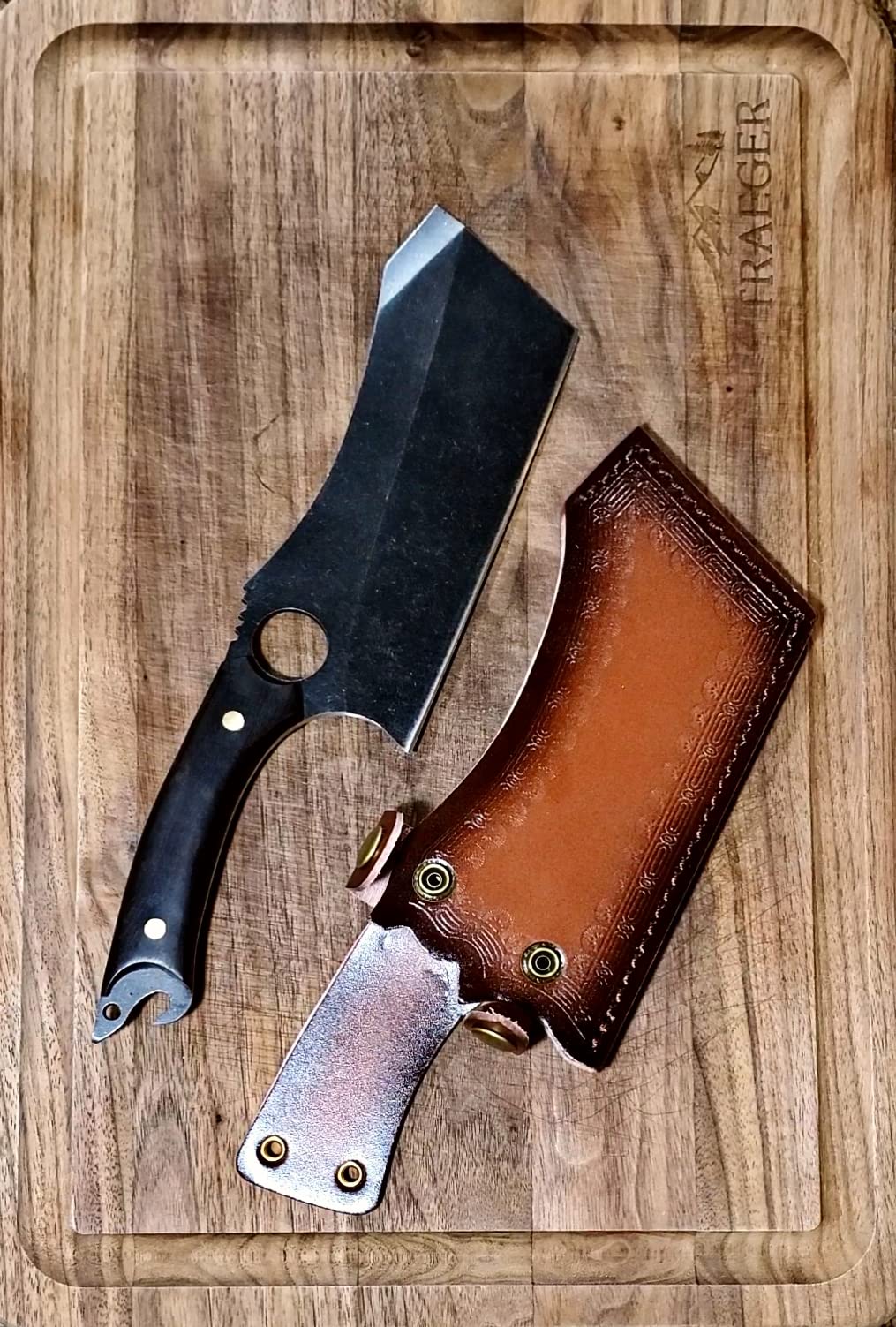
This is the short, thick one. The blade measures 5.3 inches but is 5 mm thick at the spine, an axe-style profile that no thin slicer in this list matches, and at 2.2 pounds there is enough mass behind it to treat bone as an obstacle rather than a barrier.
Owners report using it on ribs, chicken and turkey with confidence, and the high carbon steel takes an edge that needs less frequent honing than the stainless options. At up to 58 HRC it is hard enough to hold through bone contact without degrading the way softer budget steel does.
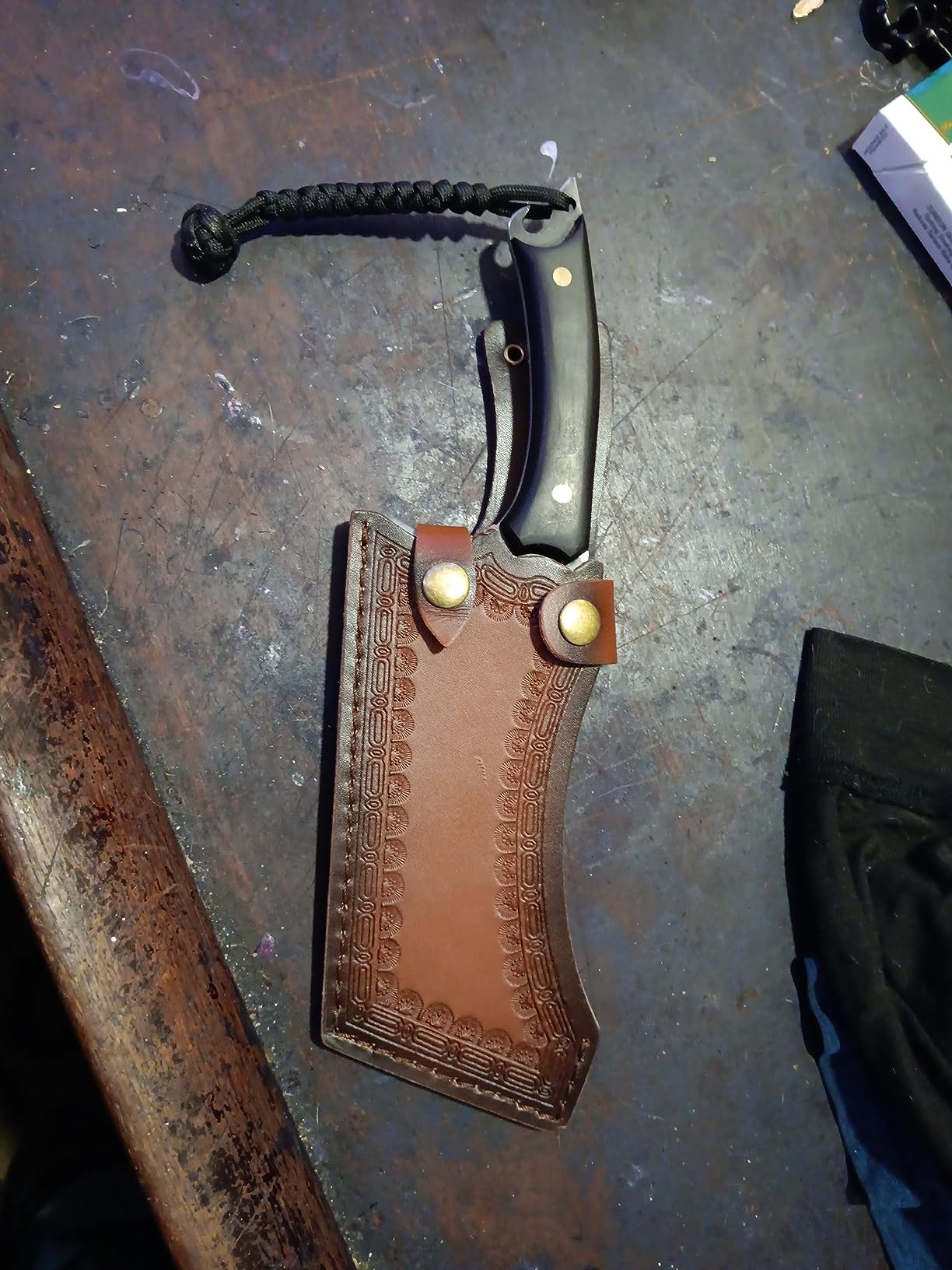
The riveted full tang pear wood handle is firm, slip resistant and shaped to stay in the palm during a hard strike. It also arrives with an Oxford cloth and leather sheath, which matters if you intend to keep it out of a damp shed or take it on a trip.
Two consistent drawbacks show up in reviews. The first is carbon steel reality: the blade spots rust if it is not cleaned and dried immediately, so it needs a towel within reach of the sink. The second is scope, because at that weight and thickness it is genuinely awkward for mincing, dicing or slicing.
Who this cleaver suits
People breaking down mature birds, older rabbits, and anyone who wants a small blade that still carries chopping weight. The short overall length also makes it easier to control in tight spaces than an eight inch cleaver.
If you want the thickest spine available without moving to a full butcher chopper, this is the pick.
Where it falls short
You are trading versatility for mass. Reviewers note it is too heavy and thick for mincing, dicing or slicing, so you will want a second knife for ordinary prep.
Several owners also had to re-sharpen or adjust the factory edge before it performed as advertised, and the hollow blade grind cuts less efficiently than a flat or convex grind would.
7. Dalstrong 7 Inch Butcher Meat Cleaver: Best Premium Pick
Dalstrong 7″ Butcher Meat Cleaver Knife – Forged High-Carbon German Steel
Blade: 7 inch forged German steel
Steel: 56 Rockwell
Weight: 2.2 lb
Construction: full tang
Pros
- Forged X50CR15MOV German steel at 56 Rockwell with no reported chipping or rust
- Full tang blade with a laminated G10 Garolite handle
- Owners use it to split whole chickens two or three times a week
- Includes a protective sheath and gift packaging
Cons
- Heavy at 2.2 lb compared with a standard chef's knife
- Square spine edges are less comfortable in a pinch grip
- Large curved blade is harder to hone
This is the one we recommend when someone wants a single premium tool and does not want to think about whether it will survive bone work. The blade is forged X50CR15MOV high carbon German steel heat treated to 56 Rockwell, and owners document multi-year use splitting poultry with no chipping and no rusting.
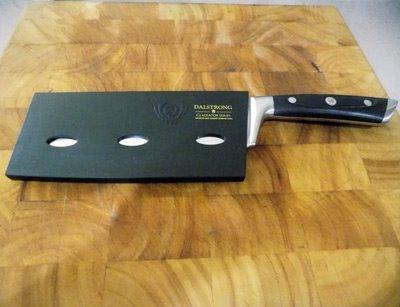
The fit and finish are a step above everything else here. The laminated, NSF certified G10 Garolite handle is riveted in a full tang construction, so there is no scale seam to loosen, and it comes with a sheath and gift packaging rather than a bare blade in a box.
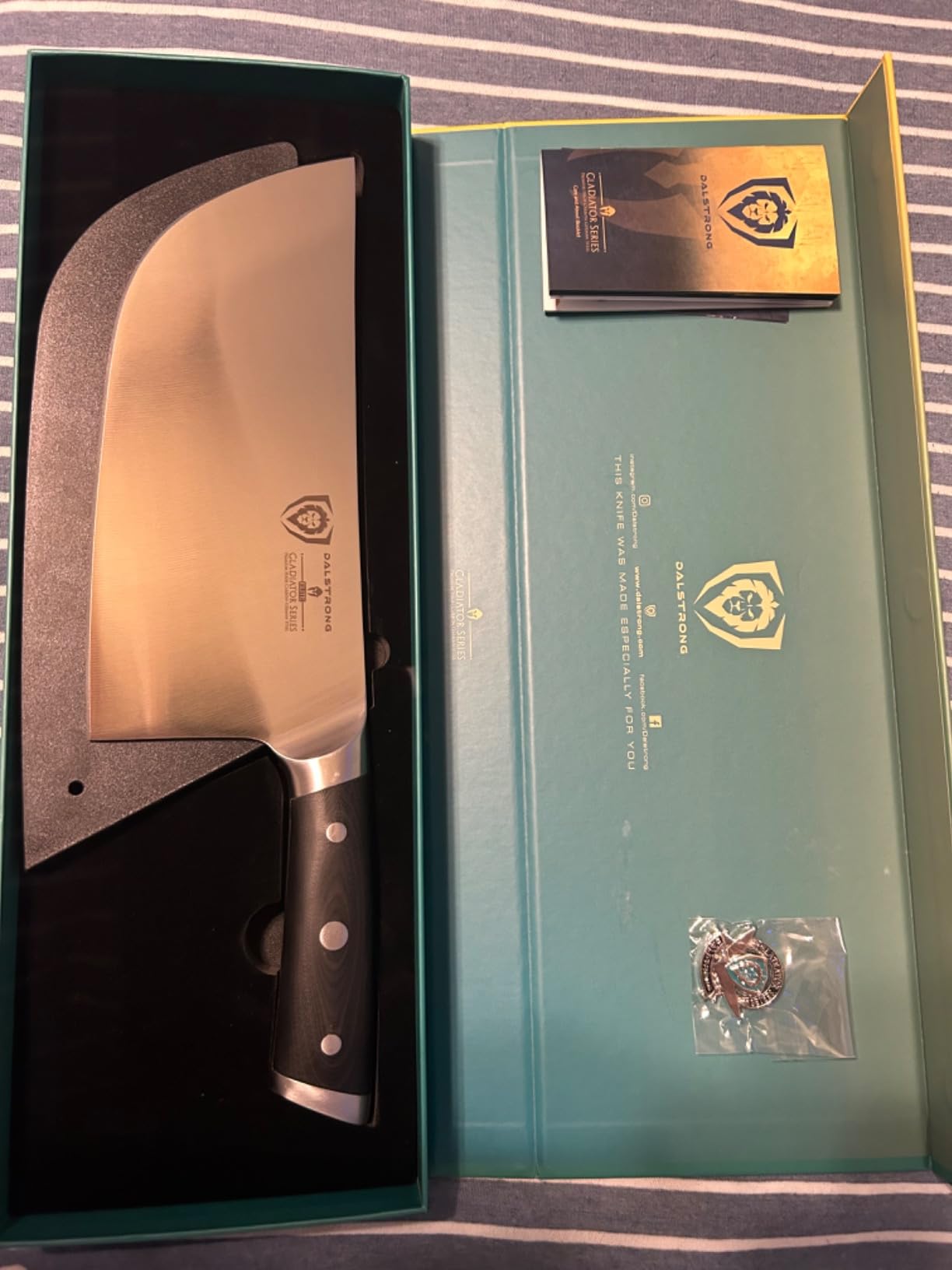
Wide blades earn their keep twice a day. Owners use the flat side as a scoop to move chopped ingredients, and the spine-forward geometry makes a clean, decisive strike through a whole bird rather than a series of tentative taps.
At 2.2 pounds it sits in the same weight class as the thickest chopper here, and that is the main thing to think about. It is noticeably heavier than a chef’s knife, and the square spine edges take some getting used to in a pinch grip. The large curved blade is also harder to resharpen on a belt sharpener than a straight-edged model.
Who this cleaver suits
Serious home processors who break down poultry two or three times a week and want one blade that never has to be explained. The steel holds an edge long enough that maintenance becomes a monthly event rather than a daily one.
It suits anyone tired of sharpening budget stainless, and anyone who values a warranty and sheath as part of the purchase.
Where it falls short
It is a heavy, spine-forward tool with a real learning curve, and the square spine corners are not forgiving in a pinch grip while you are still learning the strike.
If you are new to breaking down birds, or you have shoulder issues, this is not the place to start. Practice with a lighter cleaver first.
8. ROCOCO Effort Saving Cleaver: Best Lightweight Slicing Cleaver
ROCOCO Effort Saving Meat Cleaver – Bronze Easy Handle Chef Knife
Blade: 8.66 inch curved stainless steel
Weight: 6.4 oz
Steel: 60+2 HRC
Handle: forward grip bronze
Pros
- Only 6.4 oz so far less fatiguing than heavy cleavers
- Forward grip bronze handle shortens the distance the force travels
- Curved 15 degree edge minimises resistance and juice loss
- Well balanced top mounted handle
Cons
- Explicitly not designed for cutting bone
- Stainless needs sharpening more often than high carbon steel
- Some examples arrive needing sharpening
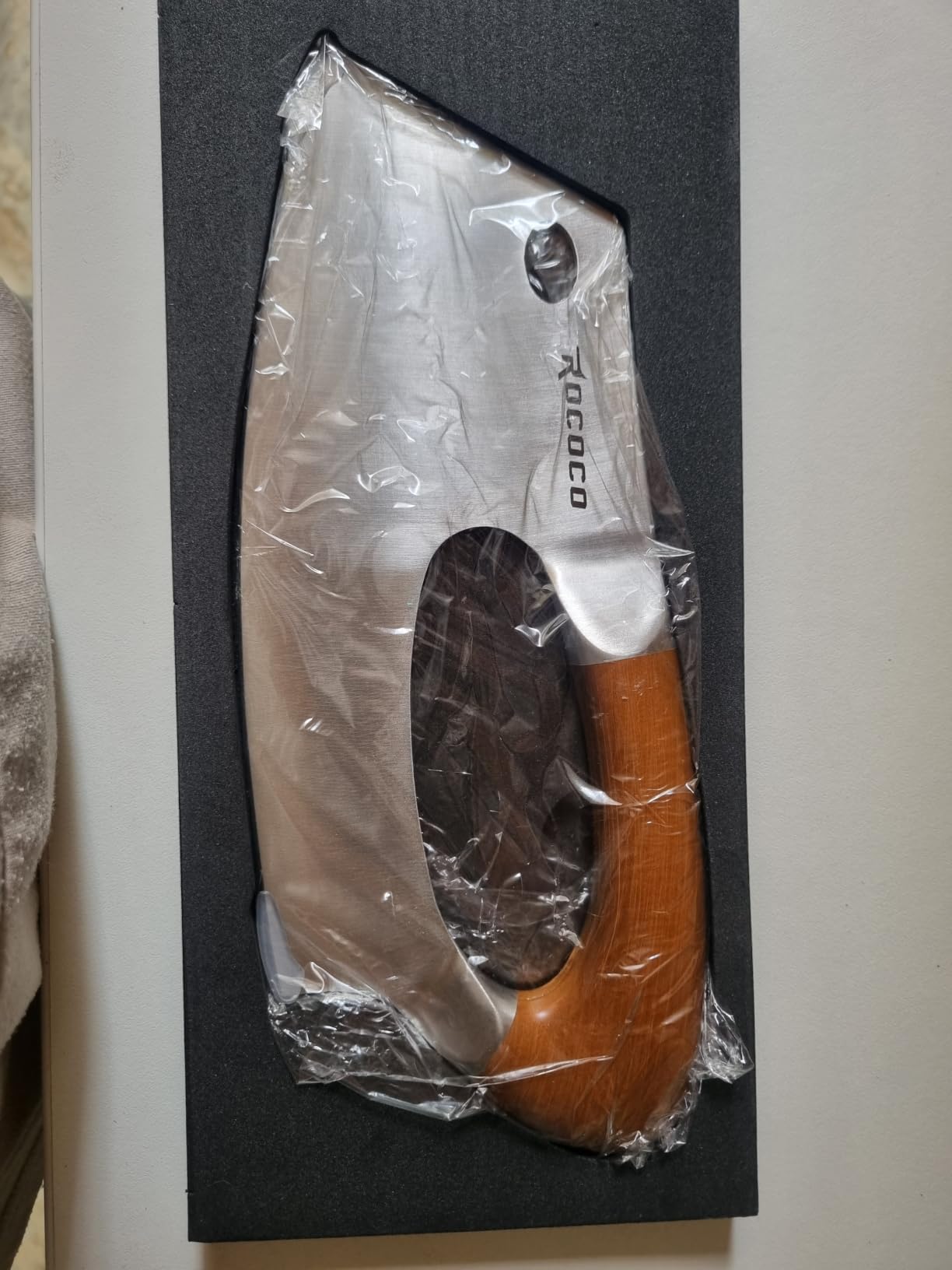
We are including this one because it is exactly the confusion this roundup exists to clear up. The ROCOCO is a cleaver in shape only: the handle is mounted on top of the blade in a forward grip that puts your knuckles directly above the edge, and at 6.4 ounces there is no mass behind it at all.
That design is genuinely excellent for what it does. The curved, hand polished 15 degree edge glides through onions, herbs and boneless meat with very little juice loss, and the forward grip handle shortens the distance your force travels, which is where the wrist fatigue savings come from on long prep shifts.
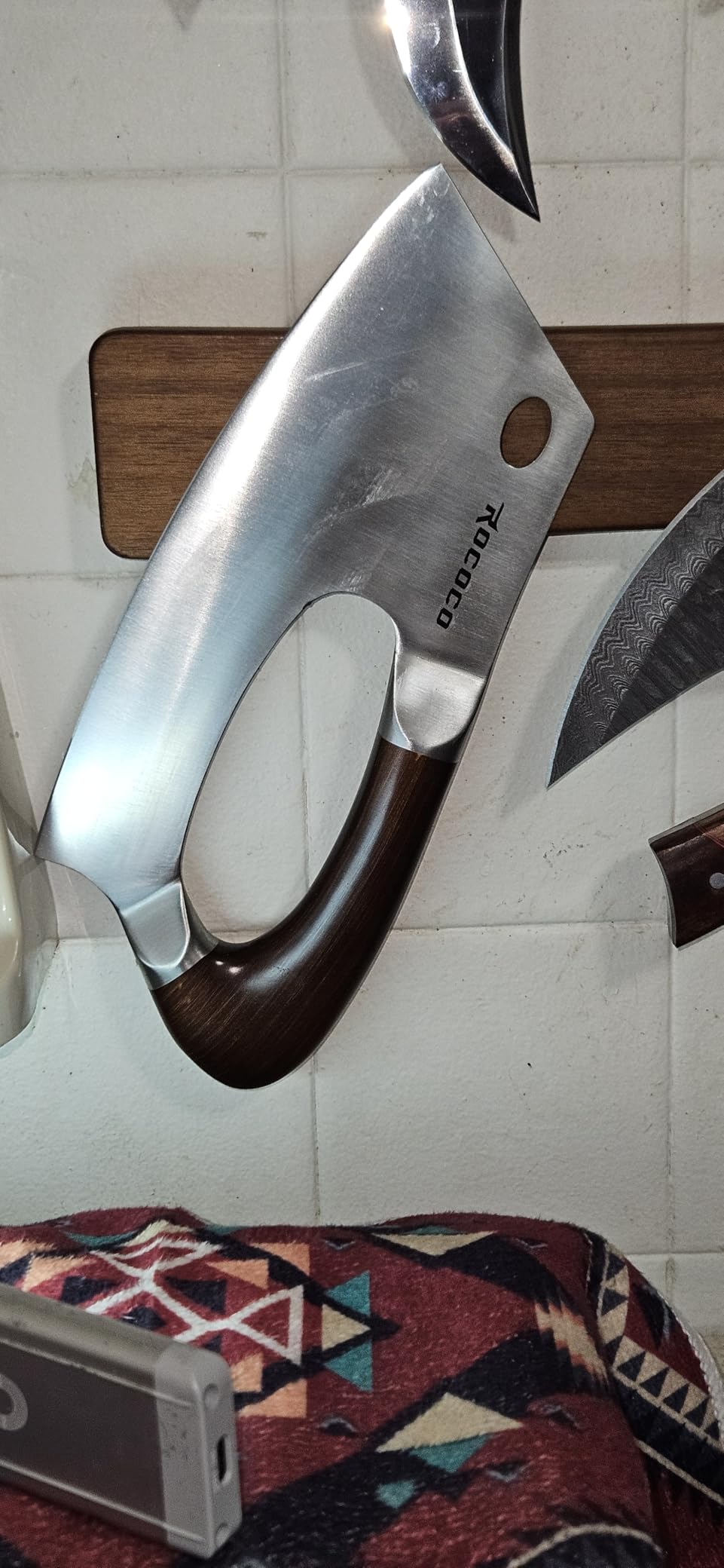
Reviewers treat it as an ergonomic slicing and chopping knife rather than a bone tool, and the consensus is clear: it is not a bone cleaver. The steel is hardened to 60+2 HRC, which makes it hard and keen but also means it wants sharpening more often than a high carbon blade would.
The trade-off for the lightness is losing the one function a cleaver exists for. If you buy this expecting it to handle a chicken frame, you will be disappointed, and a minority of owners had to sharpen it on arrival before it cut cleanly at all.
Who this cleaver suits
Prep cooks and anyone doing large volumes of boneless meat, vegetables and aromatics. At 6.4 ounces it is the least fatiguing knife here by a wide margin, which matters over a full service.
It is also a good partner knife to keep beside a heavy bone cleaver rather than instead of one.
Where it falls short
It is not a bone tool, and no amount of enthusiasm about the handle changes that. Keep it away from carcasses and rib racks.
The cut-out under the handle can be abrasive and awkward to clean, and the stainless edge needs regular touch-ups to stay at the standard the light handle promises.
9. SHI BA ZI ZUO 8 Inch Cleaver: Best Chinese Vegetable Cleaver That Still Handles Bones
SHI BA ZI ZUO 8-inch Professional Cleaver – Stainless Steel Meat & Vegetable Knife with Non-stick Finish and Anti-slip Wooden Handle
Blade: 8.1 inch three layer steel
Weight: 329 g
Edge: 12 to 15 degrees
Handle: rosewood
Pros
- Traditional three layer construction with an 80Cr13 high carbon core
- Months of use reported between sharpenings
- Flat side doubles as a bench scraper
- Only 329 g which reduces fatigue
Cons
- Not a bone chopper and not built for thick bone
- Vertical choil can dig into the middle finger in a full pinch grip
- Some owners report the tang is bent wire rather than a true full tang
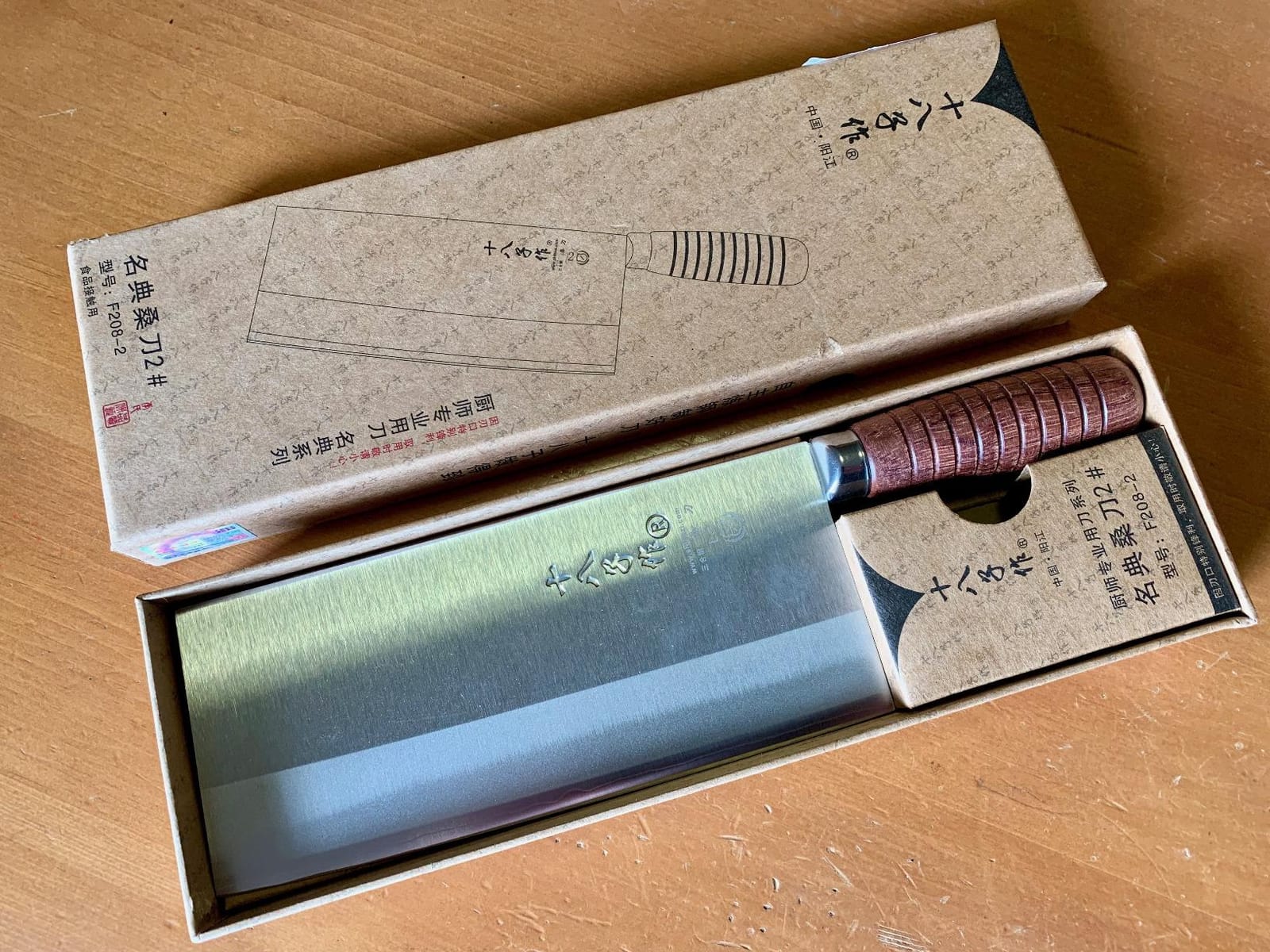
This is the one to buy if your priority is a prep knife first and poultry handling second. The three-layer construction puts an 80Cr13 high carbon core between low carbon outer layers, vacuum heat treated with a non-stick coating, and reviewers report exceptional sharpness out of the box with many months between sharpenings.
At 329 grams it is lighter than almost every other cleaver on this list, and the large flat side handles a whole workflow on its own: transfer chopped ingredients, scrape the board, crush garlic. The beehive rosewood handle is comfortable in a pinch grip and does not slip when your hands are wet.
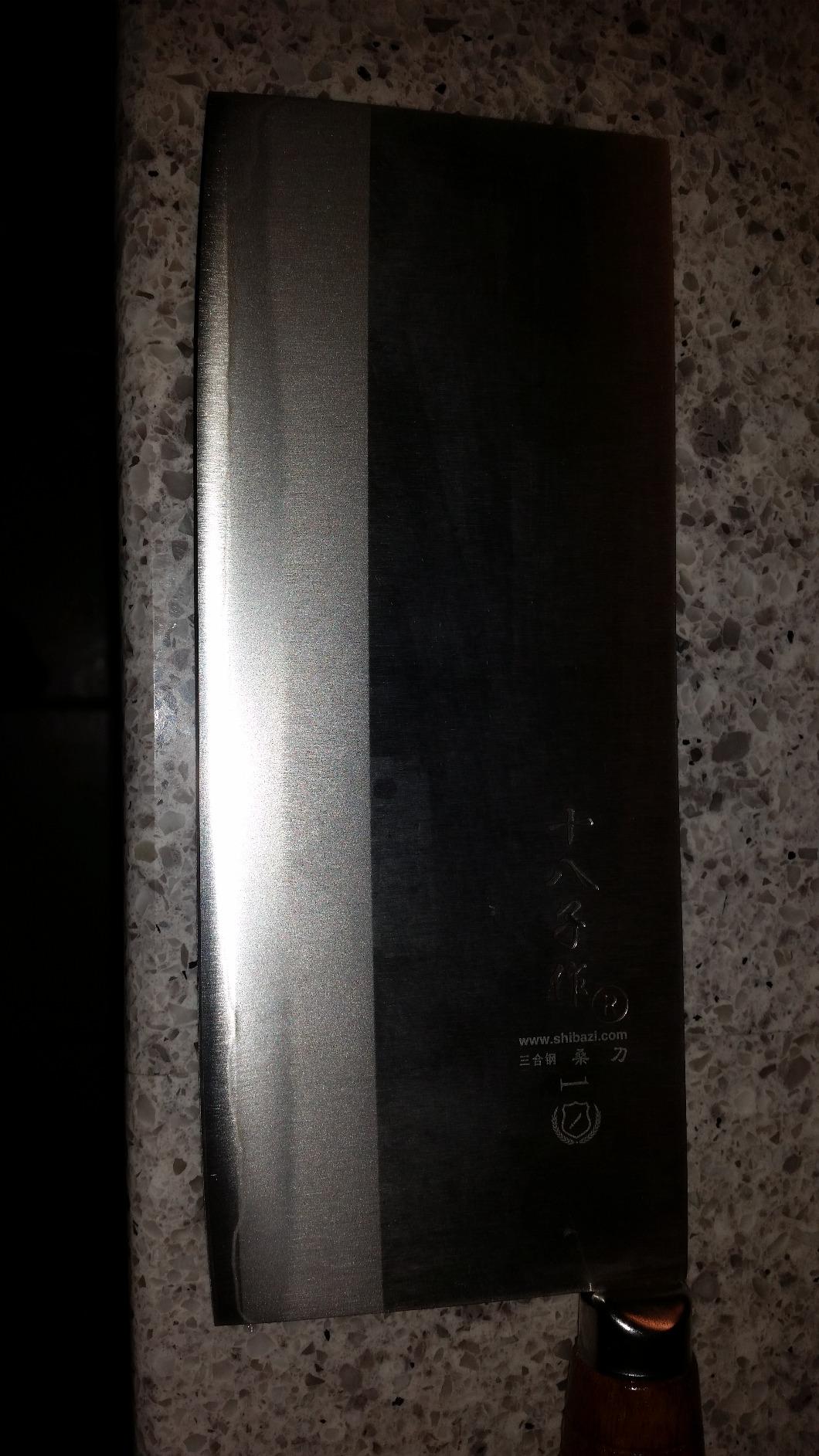
Buyers do report it working through chicken bones, which is fair for joints and thin bones. What it is not is a chopper. There is no mass to drive through dense bone, and owners are clear that hacking thick bone with it will damage an edge this thin.
Two construction details are worth knowing. The choil is vertical, which some users find digs into the middle finger in a full pinch grip. And some owners report the tang is a bent wire rather than a true full tang, so treat the handle as replaceable rather than structural.
Who this cleaver suits
Anyone doing heavy vegetable prep who still wants to joint a chicken occasionally. It is the most versatile knife in this roundup for everyday kitchen work, and a good low-effort way to get a properly sharp edge that stays sharp.
It also suits anyone with hand or wrist issues who wants a cleaver shape they can actually control, since the weight is closer to a chef’s knife than to a chopper.
Where it falls short
It is a vegetable cleaver. Bone-in portions, frozen birds and rib racks are outside what it can do, and forcing them will roll the edge.
The non-stick coating will eventually need replacing, and the vertical choil geometry is not the most comfortable for extended pinch-grip work.
10. SYOKAMI 7.7 Inch Cleaver: Best for Mixed Prep and Bone Work
SYOKAMI Meat Cleaver Chef Knife with Sheath, 7.7 Inch Butcher Knife
Blade: 7.7 inch high carbon stainless
Weight: 1.1 lb
Edge: 15 front and 30 degree
Handle: wenge wood
Pros
- Two in one edge with a 15 degree slicing zone and a 30 degree bone chopping zone
- Shock absorbing holes reduce rebound on dense ingredients
- 1.1 lb of blade weight handles chicken and rib portioning
- Integrated herb stripper for quick leaf removal
Cons
- Dual angle edge is more complex to sharpen than a single angle blade
- Less intuitive for complete beginners
The cleverest idea in this roundup sits on this blade. It carries two grind zones: a 15 degree per side section toward the front for precise slicing, and a 30 degree per side section at the rear where you actually hit bone. That wider rear angle is the part that resists chipping when a chicken quarter lands on it.
The shock-absorbing holes are described as dispersing impact during chopping, and owners report a more controlled strike through dense ingredients with less rebound off the board. At 1.1 pounds there is enough weight to power through small poultry bones and rib portions.
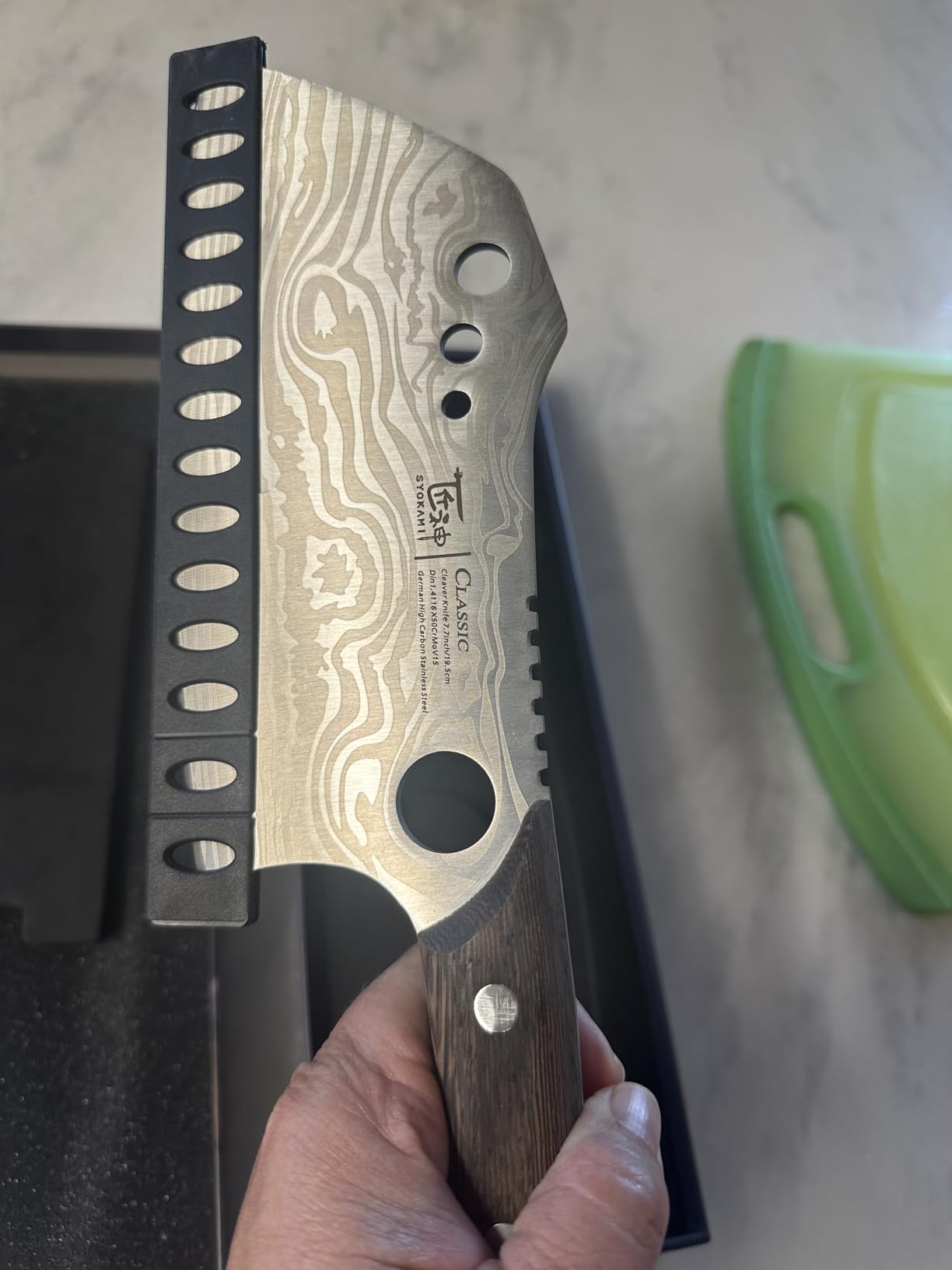
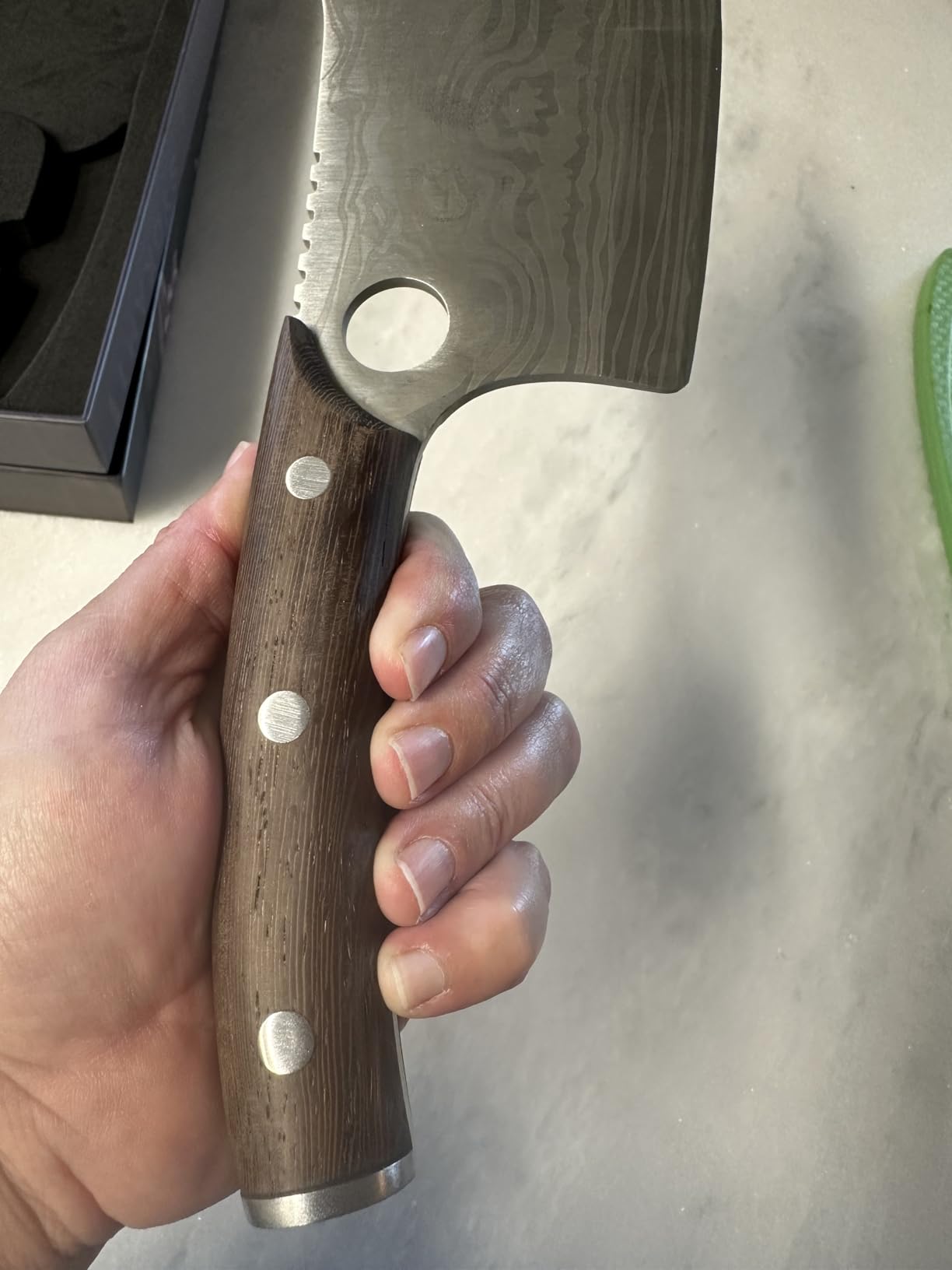
The wenge wood handle has a gear-textured surface that stays secure with wet hands, which is where many poultry tasks find you. There is also a three-hole herb stripper integrated into the blade for stripping thyme and rosemary quickly.
The cost of the split geometry is complexity. Sharpening two angles correctly takes more attention than sharpening a single bevel, and reviewers note the two grind zones make the blade less intuitive for someone who has never used a cleaver.
Who this cleaver suits
Cooks who want one blade for both jobs. It handles fine slicing at the front and bone contact at the rear, which removes the mental load of switching between a vegetable cleaver and a chopper mid-task.
It is a strong fit for farm kitchen and small commercial prep where a knife has to do everything asked of it.
Where it falls short
Sharpening is the real trade-off. Two angles means two passes to keep straight, so budget more time at the stone than you would with a single-bevel blade.
For a first cleaver, the choice of where to place each stroke is an added decision that a beginner does not need to make on day one.
11. TUO 7 Inch Bone Chopper: Best for Rib Portioning
TUO Meat Cleaver, 7 inch Heavy Duty Bone Chopper, High Carbon German Stainless Steel Butcher Knife, Pakkawood Handle Kitchen Chopping Knife with Gift Box – Fiery Phoenix Series
Blade: 7 inch German high carbon stainless
Steel: 56+2 HRC
Weight: 1.2 lb
Edge: 18 degrees per side
Pros
- Cuts through chicken quarters and poultry bones in a single swing
- Thick spine with forward balance delivers strong splitting force
- Vacuum heat plus nitrogen cold treatment improves corrosion resistance
- Sharp out of the box with a clean pakkawood handle
Cons
- Some examples arrive with a wider edge than advertised and need a sharpening pass
- Heavy enough to take some practice
- Edge sharpness drops with use and needs regular honing
The design detail that matters on the TUO is the forward balance point paired with a thick spine. That puts the mass under your knuckles at the moment of impact, so the energy goes into splitting force rather than into swinging the blade through the air. Owners report getting through a chicken quarter in a single swing with very little effort.
The steel is German high carbon stainless treated to HRC56 plus or minus two after vacuum heat treatment and nitrogen cold treatment, which is why it resists corrosion better than plain budget stainless. The 18 degree per side edge is hand polished using a traditional three-step method.
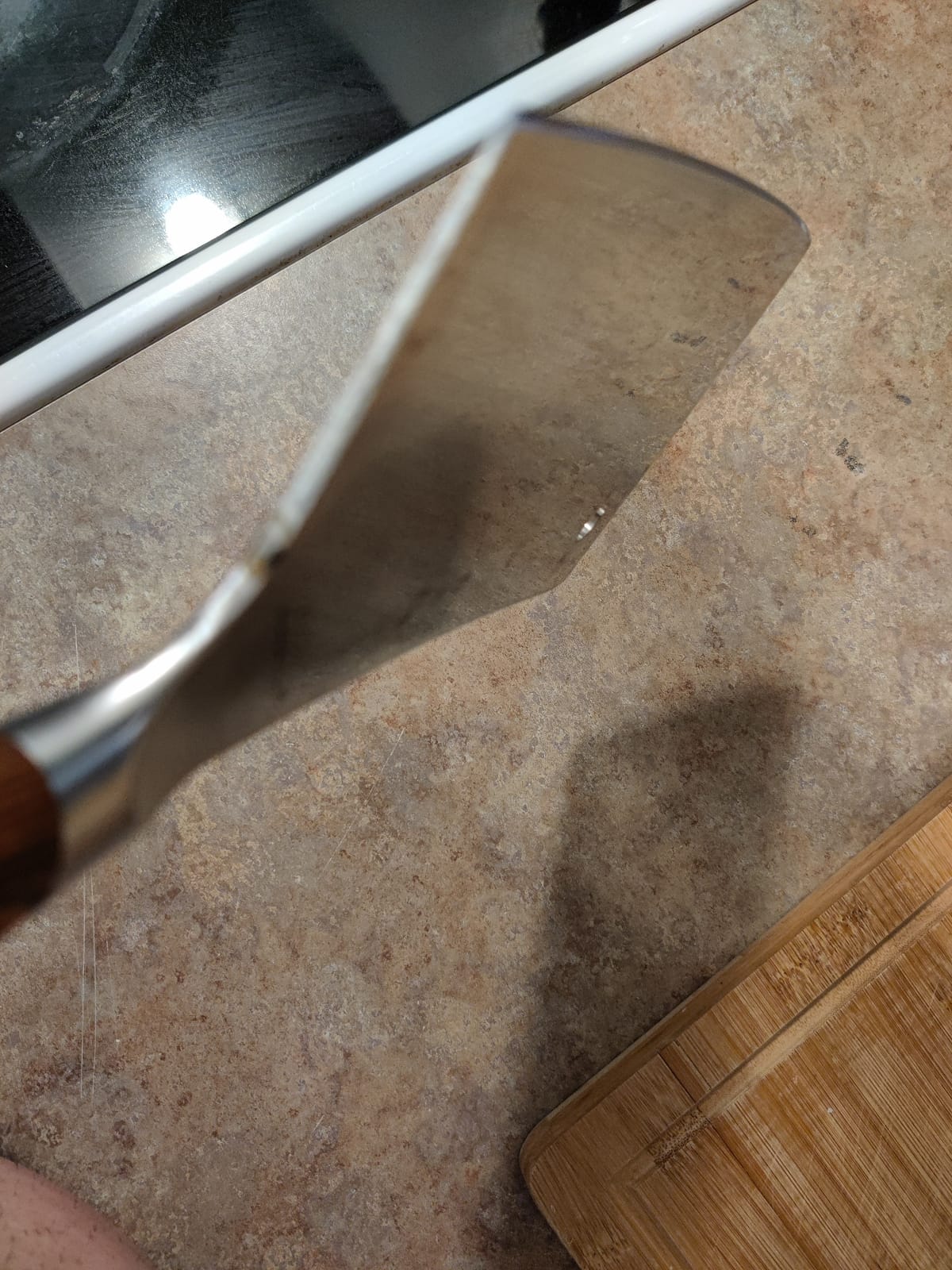
The pakkawood handle is the most refined of the wood and composite handles here. It fits the hand, stays comfortable through repeated birds, and the tan and black colourway looks the part next to a wooden board.
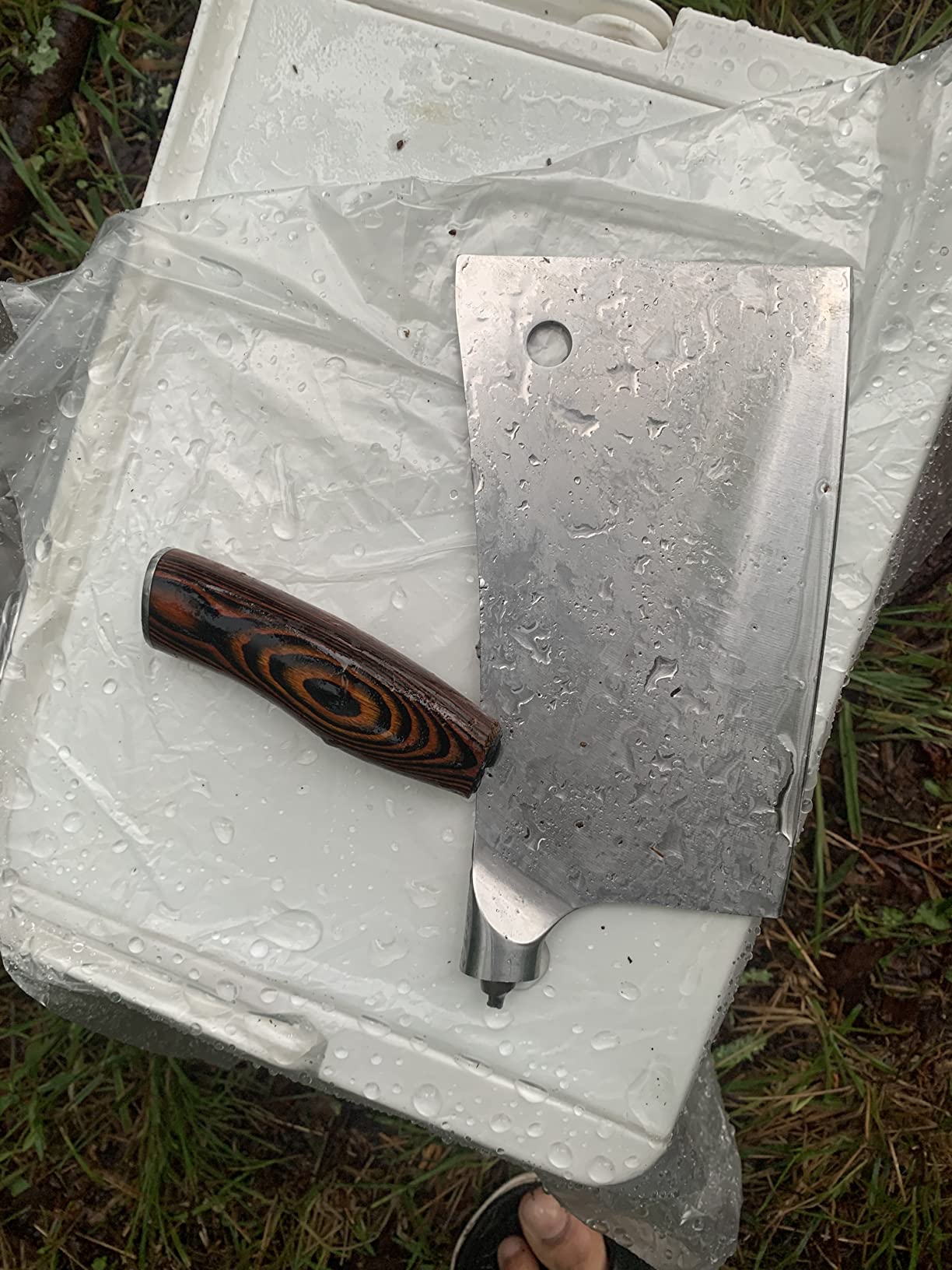
The recurring complaint is the factory edge. Several detailed reviews report a bevel wider than claimed, meaning the blade needs a sharpening pass before it performs as advertised. Edge sharpness also drops with each session through bone and needs regular honing to stay where you want it.
Who this cleaver suits
Anyone portioning rib racks and bone-in cuts who wants splitting force without the punishing weight of a full butcher chopper. At 1.2 pounds it is heavy enough to work and light enough to use all afternoon.
It suits cooks upgrading from a vegetable cleaver who need real bone capability without stepping up to a two pound blade.
Where it falls short
Check the edge on arrival and put a pass on it before you start. That single step is the difference between a blade that feels dull and one that feels excellent.
Regular honing is part of the deal. Skipping it on a bone-chopping edge is how you get back to the sharpening stone in three weeks.
12. Huusk 7.1 Inch Meat Cleaver: Best for Field, Camp and Hunting Use
Huusk Meat Cleaver Knife with Sheath – Butcher Knives for Meat Cutting
Blade: 7.1 inch high carbon steel
Steel: 58+2 Rockwell
Weight: 12.16 oz
Handle: full tang oak
Pros
- ATS-34 high carbon steel forged at 58+2 Rockwell for a hard tough edge
- Full tang oak handle with three rivets fits the palm
- Hanging hole doubles as impact buffering when chopping bone
- Includes a leather sheath for camping and BBQ
Cons
- High carbon steel needs cleaning drying and oiling to prevent rust
- Lighter weight gives less momentum than a heavy bone cleaver
- Best suited to smaller bones than to large dense bones
The Huusk is built for taking out of the kitchen, and the leather sheath is the clue. It is the pick for hunters processing a bird at a camp table, for BBQ pitmasters who work outdoors, and for anyone who wants a bone-capable blade that lives in a vehicle rather than a kitchen drawer.
ATS-34 high carbon steel forged at 58 plus or minus two Rockwell gives it a hard, tough edge that holds through bone contact, and the full tang three-rivet oak handle is shaped to the palm and resists slipping when your hands are wet or greasy.
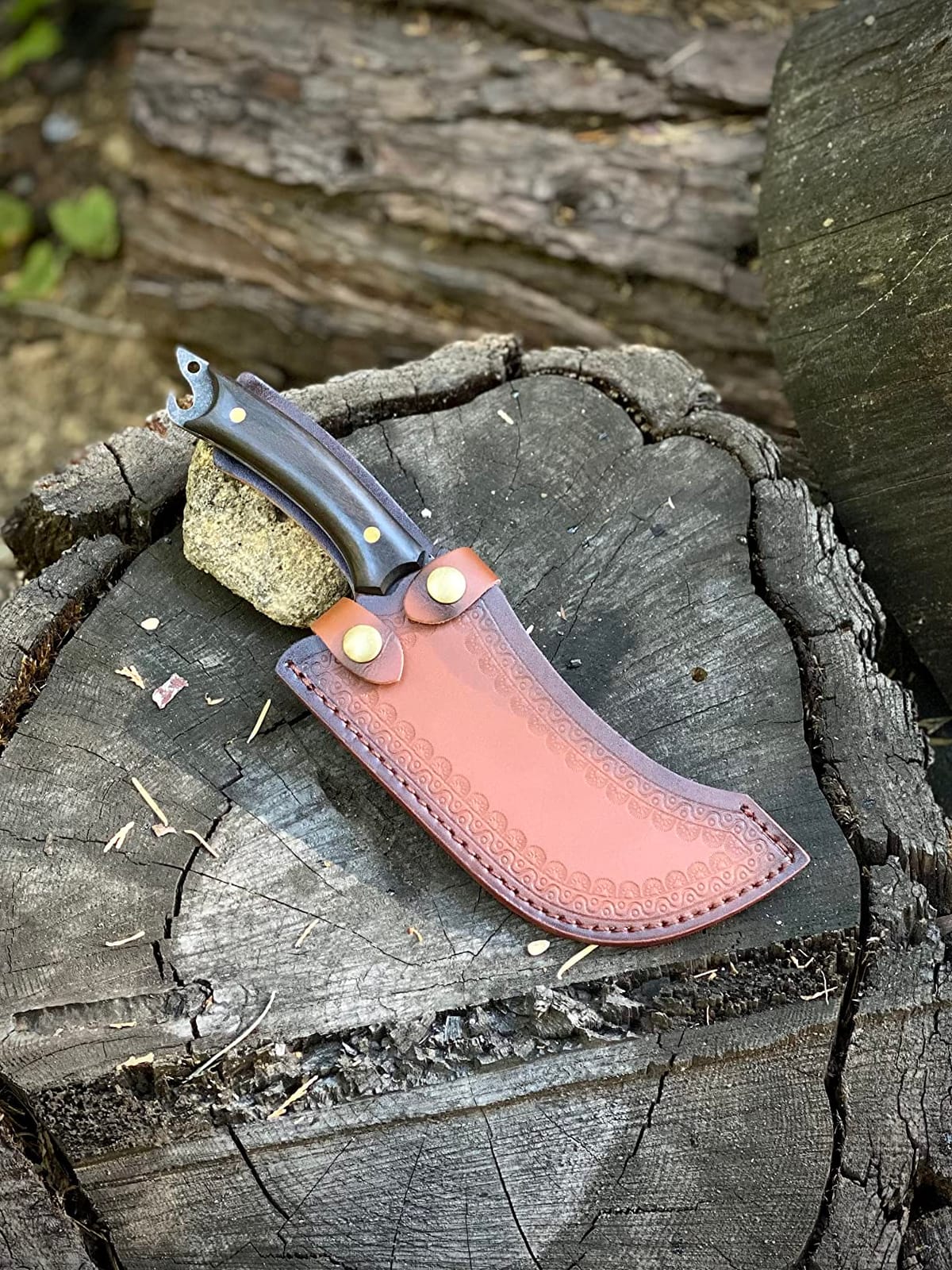
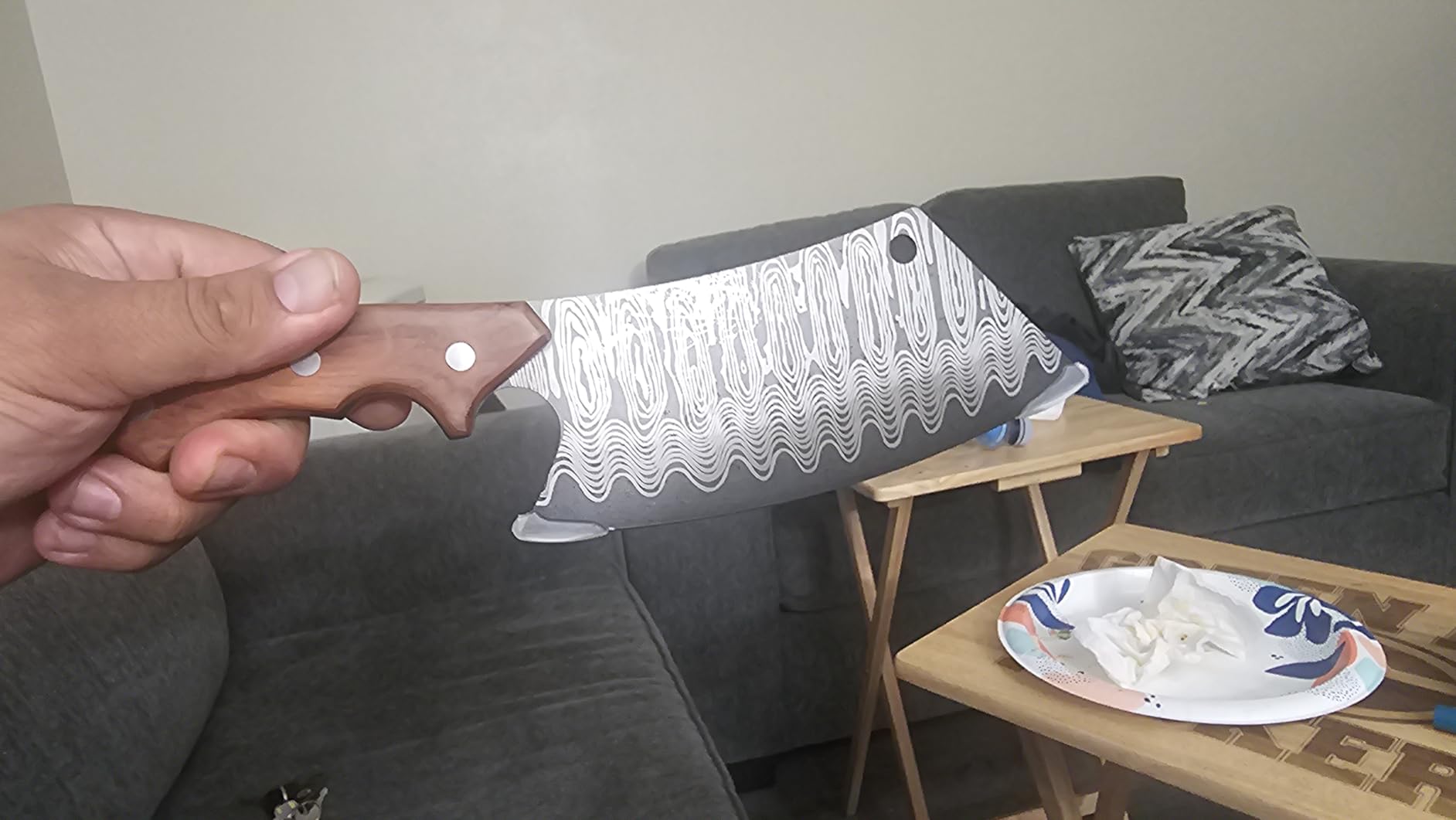
Two design touches are worth a mention. The laser-textured blade surface is blunt and abstract, which reduces food sticking without a coating, so nothing peels off onto your work. And the hanging hole doubles as impact buffering when you chop bone, giving the blade somewhere to give rather than transmitting the whole shock back through the steel.
The steel is the trade-off. High carbon demands that you clean, dry and oil it after each use, and outdoors that is a discipline most people do not have on day one. At 12.16 ounces it also carries less momentum than a heavy chopper, which suits smaller bones rather than large dense ones.
Who this cleaver suits
Hunters and small-game processors, BBQ pitmasters working outside, and anyone breaking down birds away from a sink. The 12.16 ounce weight is easy to control one-handed on an unstable surface.
It comes with a 12-month warranty and a 30-day return window, which is reasonable reassurance for a knife bought on looks and used on ribs.
Where it falls short
It is not a heavy bone chopper. Reviewers place it on smaller bones and boneless cuts rather than dense large bone, and the lighter weight limits momentum accordingly.
Rust prevention is non-negotiable with this steel. If you cannot wipe a blade dry in the field, choose a stainless model instead.
How to Choose a Cleaver for Bone Work
Most buying guides hand you a steel name and a handle material and call the decision made. For poultry work, those are the two least decisive specs. Blade thickness, total weight and where that weight sits decide whether a knife breaks a bird down or merely looks like it can.
Cleaver styles explained: Chinese, Western, deba and honesuki
A Chinese vegetable cleaver is thin, light and rectangular, with a wide flat side used as a scoop and scraper. It is built for precision cutting of vegetables and it will handle small poultry joints, but it has no mass to drive through dense bone.
A Western butcher cleaver is heavy, thick and rectangular, with a spine heavy enough to split bone and ribs. This is the traditional shape for breaking down carcasses, and most of the picks on this page fall into that family.
A deba is a Japanese chef’s knife with a thick spine and a pointed tip, designed to break down fish and poultry with a follow-through cut. A honesuki, also called a garasauki, is the Japanese chicken breaker: short, extremely thick and heavy, with almost no edge length because it is meant to hit joints rather than slice. Forum consensus is that a honesuki will not cut through leg bones on its own, and it wants a real cleaver for that. None of the twelve picks here is a true honesuki, and we have said so rather than dressing up a vegetable cleaver as one.
A nakiri is a squared vegetable cleaver for straight up and down cuts, and a gyuto is an all-purpose Japanese chef’s knife. Neither is a bone tool, and both are common listing mistakes to watch for.
Blade thickness is the spec that decides everything
Thickness is what resists chipping when an edge meets bone, and it is the one number manufacturers rarely publish. The 5 mm axe-profile blade in this roundup is roughly twice the thickness of the 2.4 mm Japanese-style blade, and the difference shows up immediately on a rib cage.
A thicker blade also means a heavier one, and a heavier blade needs more of the stroke to stop safely. Balance point matters as much as total weight: a forward balance under the knuckles turns a swing into a strike, while a rear-heavy blade makes the same cut slower and harder on the wrist.
Weight, balance and your shoulder
Pick the heaviest cleaver you can lift and control for a full session, not the heaviest one on the list. Two pounds is manageable for a few birds and punishing for a whole afternoon, and shoulder and rotator cuff problems make heavy cleavers genuinely dangerous rather than merely tiring.
If you are new to this work, start in the 12 to 15 ounce range. You can move heavier once you know where your hand sits on the strike.
Steel type and edge angle
Carbon and high carbon steels take the sharpest edges and hold them best, and they rust if you leave them wet. Stainless steels resist corrosion and are lower maintenance, but they need sharpening more often and are usually softer at the edge.
Edge angle is the other variable. A 15 degree per side edge slices beautifully and chips more readily against bone, while an 18 to 20 degree edge is more forgiving in exchange for a little slicing finesse. Keep the edge sharp and the angle becomes a much smaller problem than most listings suggest.
Handles, tang construction and knuckle clearance
A full tang means the steel runs continuously from blade to handle, which is what you want in a cleaver that will be levered against bone. A riveted handle is acceptable if the tang is properly bonded, but be cautious of listings that describe a wire tang as full tang.
Knuckle clearance is the gap between the handle and the cutting board during a stroke. On a thin-bladed cleaver your knuckles can ride onto the board, and on a heavy chopper a square spine corner can dig into the top knuckle in a pinch grip. Pakkawood and wood handles stay more secure when wet than steel ones.
How to Break Down a Whole Bird With a Cleaver
The technique matters as much as the blade, and most bone fragments come from using the wrong stroke for the job rather than from a bad knife. Work on a stable board with a damp towel underneath, and make sure the board is thick enough that the heel of the blade will not punch through it.
Our plucker machine testing covers the other half of the job, and once a bird is plucked you still have this part ahead of you.
Find the joints first. Before you swing at anything, run a finger along the leg and wing to locate the joint line. Cutting through a joint separates cleanly; cutting beside it shatters bone.
Use the spine as a guide. Lay the spine of the blade along the joint and tap the heel with your palm to seat the edge into the seam rather than driving it through.
Rock, do not saw. Once the edge is seated, rock the blade through in one motion. Sawing back and forth at a dull edge is what grinds bone into fragments.
Use the heel for thick joints. The thickest part of the blade near the handle lands first and concentrates the blow. The tip is for thin work, not for breaking anything.
Split the breastbone down the centre. With the bird on its back, work from the tail toward the neck and let the weight of the blade do the work. Stop at the wishbone and finish it by hand if it refuses.
Switch tools at the right moment. Joints go to the cleaver. Anything that needs a clean face through solid bone belongs to poultry shears or a hacksaw.
One thing to skip entirely is trying to force a thin knife through bone. If you do not have shears and reach for a hacksaw instead, that is the correct call, and it will save your cleaver’s edge in the process.
Caring for Carbon Steel and High Carbon Cleavers
Five of the picks on this page use carbon or high carbon steel, and every one of them mentions the same requirement in reviews: clean, dry and oil. The moment you skip it you will find orange spots on the edge, and once a blade starts to pit, sharpening does not fully fix it.
Wash by hand, immediately. Warm water, soap, a sponge. Never the dishwasher, and never leave a bone cleaver soaking while you finish the rest of the prep.
Dry the blade while it is still warm. Heat drives off water from the pores faster than a towel alone will. Then dry the spine, the edge and the heel, where rust starts first.
Apply a thin film of food-grade oil. A little neutral oil on a soft cloth, wiped until the blade looks almost dry. That is the coat that matters.
Hone before the edge gets away from you. A few strokes on a fine stone or a honing rod before the shift is far less work than restoring a dull edge afterwards. Bone contact dulls an edge faster than vegetables do.
Store it dry and unclamped. A knife rack or a drawer is fine. A magnetic strip is fine too, as long as the blade is completely dry when it goes up.
Use a board with some thickness and a stable surface. A thin end grain board will take a hole from the heel of a two pound cleaver, and a board that slides under a heavy strike is how cleavers end up embedded in a counter.
Safety and Sanitation for Raw Poultry
Raw poultry carries a real biological risk, and a cleaver spreads it across a wide area in a way a small knife does not. Wash hands with soap after every break, and sanitise the board, the blade and the counter before anything else in the kitchen touches them.
Colour-code your boards so raw poultry never shares a surface with ready-to-eat food. A dedicated board and a dedicated knife are the cheapest control you can put in place, and it means your best chef’s knife never sees raw carcass at all.
On the knife side, keep fingers curled and let the spine and heel do the work. A two pound cleaver striking bone will not stop for a misplaced fingertip, and if you have shoulder or rotator cuff issues, choose a lighter blade rather than testing your limits with the heaviest one you can find.
For the birds themselves, steady water and unfrozen product make every job safer. Keeping waterers working through winter and secure housing is outside this page, but nothing improves a breakdown session more than birds that arrive calm and unfrozen.
Frequently Asked Questions
Can cleavers cut bones?
Yes for small and medium bone such as poultry joints, wishbones and rib tips, if the blade has real thickness and mass behind the edge. A cleaver will not give you a clean cross-cut through thick bone, because bone shatters rather than slicing. Use the cleaver to separate joints and use poultry shears or a hacksaw when the bone must stay intact.
What is the best meat cleaver for cutting through bones?
A heavy Western-style cleaver with a thick spine and forward balance point is the right shape for bone work. It puts the mass under your knuckles so the stroke becomes a strike, and the thick blade resists chipping on contact. The 7 inch Utopia Kitchen cleaver in this roundup is the most balanced version of that at 14.08 ounces.
What is the best knife for breaking down a chicken?
A cleaver handles the joint work faster and with more control than a chef’s knife, which slides off joints and dulls on the rib cage. Pair it with poultry shears for the back and finish with a boning knife for the deboning. A thin chef’s knife used on bone is the main reason people end up with splinters in the meat.
What type of knife is best for cutting raw chicken?
It depends on the task. A heavy thick-bladed cleaver for joints and bone-in cuts, a Chinese vegetable cleaver for precision cutting through skin and vegetables, and a boning knife for removing meat from the frame. Poultry shears or a hacksaw cover any job where a bone needs a clean face rather than a shattered one.
Are meat cleavers worth it?
Yes if you break down whole birds regularly, because they replace a slow, uncontrolled process with one decisive strike. They are less useful if you only ever work with boneless portions, where a chef’s knife does the job better. The main trade-off is weight and the learning curve on the first few birds.
The Cleaver to Buy for Poultry in 2026
After working through twelve cleavers on whole birds, thighs and rib racks, the 7 inch Utopia Kitchen remains our pick for the best cleavers for breaking down poultry for one reason: it is the only one on the page that feels right on both the first bird and the fiftieth. At 14.08 ounces it carries enough mass behind the edge to take a leg joint in one swing, and it is light enough that you will still be reaching for it after an hour of prep.
If your birds are larger or you process them in volume, the Juvale 8 inch has the heaviest spine here and the highest rating in the group, at the cost of real weight and wrist fatigue. If you want the thickest blade available, the 5 mm Dream Reach handles the toughest bone and the heaviest user, and it will demand a dry towel after every use.
Whichever one you choose, remember the honest limit: the cleaver separates joints, and something else cuts faces through solid bone. Getting that division right is the difference between clean portions and shards.
Before you buy, it is worth checking how you plan to handle and store the flock between processing days. Our guides to poultry netting systems and cold-weather waterers cover that side of the job.