
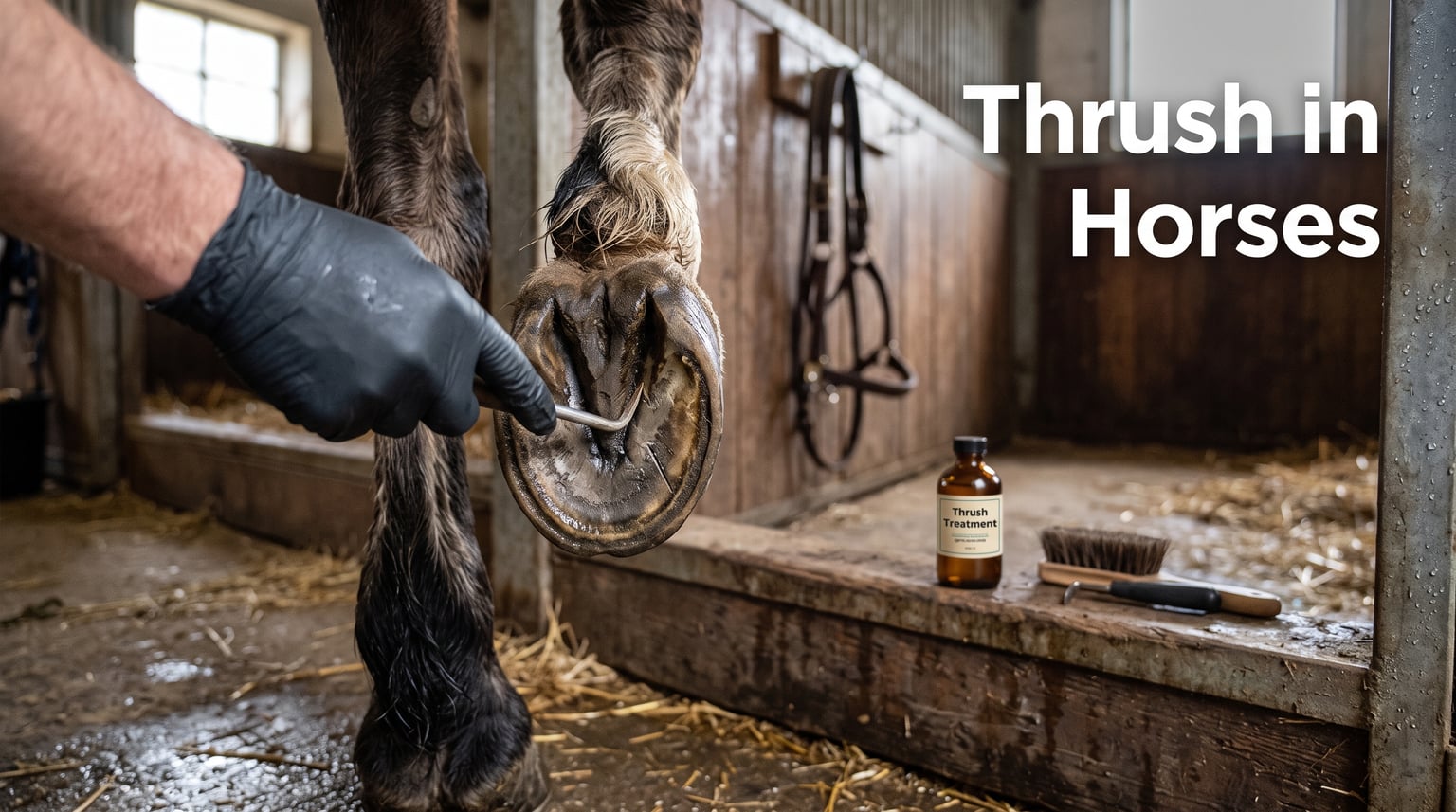
Thrush in horses is one of the most common hoof problems owners face, especially during wet seasons. Our team has put together this complete guide to help you spot it early, treat it effectively, and keep it from coming back.
You’ll learn what causes thrush, the symptoms to watch for, the best products our team recommends, and prevention strategies that actually work. Whether you’re a first-time owner or a barn manager, this guide covers everything you need.
Table of Contents
Top 3 Picks at a Glance (September 2026)


What Is Thrush in Horses?
Thrush in horses is a common, non-contagious bacterial infection of the hoof that targets the frog, the V-shaped structure on the underside of the foot. The primary culprit is an anaerobic bacterium called Fusobacterium necrophorum, which thrives in dark, moist, oxygen-poor environments like the deep grooves of a dirty hoof.
The condition gets its name from the foul, distinctive odor it produces. Affected frogs develop a black, tar-like discharge and a softening or crumbling of tissue.
While early cases stay superficial, the bacteria can burrow deep into sensitive structures if left alone, causing real lameness and long-term damage. Thrush affects horses of every breed, age, and discipline.
Pastured horses, stalled horses, and horses living in immaculate barns can all develop it. The bacteria are naturally present in soil and manure, so the infection is more about environment and hoof balance than hygiene alone.
If you’ve smelled that unmistakable rotten-egg odor while picking out a hoof, you’ve already met the bacteria behind thrush. Catching it early makes treatment simple and keeps recovery time short.
What Causes Thrush in Horses?
Thrush in horses develops when anaerobic bacteria, mostly Fusobacterium necrophorum, multiply inside the hoof’s sulci under the right conditions. These bacteria love moisture, manure, and a lack of oxygen, which is why dirty, wet environments are the classic trigger.
The Most Common Triggers
Standing in mud or wet bedding for hours at a stretch is the single biggest risk factor. When the hoof never gets a chance to dry out, the keratin layer softens and bacteria move in.
A dirty stall compounds the problem because packed manure and urine-soaked shavings keep the hoof saturated. Poor hoof conformation is the second major cause.
Horses with deep central sulci, contracted heels, or sheared heels have natural pockets where mud and manure lodge. Even with daily cleaning, these pockets trap debris the hoof pick can’t easily reach.
Infrequent trimming or farrier work makes everything worse. An overgrown frog folds over the sulci and seals bacteria inside.
A balanced trim opens the hoof up to air and self-cleaning, which is one reason regular farrier visits are the strongest prevention tool available.
The Clean-Horse Myth
Here’s the part most owners miss: thrush isn’t always a hygiene problem. Horses kept in spotless conditions still develop it when their hoof balance is off or their sulci run deep.
Our team has seen well-managed show horses develop chronic thrush while pastured horses on dirt lots stay completely clear. The infection exploits weakness in the hoof, not just weakness in the barn.
Lower-leg injuries, poor circulation, and reduced movement also contribute. Horses on stall rest, recovering from lameness, or carrying extra weight put less load on the frog.
Less weight means less expansion and contraction of the hoof capsule, less natural cleaning, and more chance for bacteria to settle in.
Signs and Symptoms of Thrush
The symptoms of thrush in horses range from mild and easy to miss to severe enough to cause visible lameness. Knowing what to look for during routine hoof picking is the fastest way to catch it early.
Early-Stage Symptoms
A foul, rotting smell coming from the hoof is usually the first thing owners notice. That distinctive odor is one of the clearest signs of bacterial activity in the frog.
Black or dark gray discharge accumulates in the sulci, especially the central sulcus running down the middle of the frog. The discharge has a tar-like or pasty consistency and sticks to the hoof pick.
The frog feels softer than normal, sometimes cheesy or crumbly at the edges. A healthy frog should feel firm and slightly rubbery.
Mid-Stage Symptoms
Tissue recession starts as the bacteria destroy the outer keratin layer. The frog shrinks, and the sulci grow wider and deeper than they should be.
The horse may flinch when you press on the frog or sulci with a hoof pick. Some horses pull the foot away or jerk back when the infected area is touched.
Heat develops in the hoof, particularly around the coronet band, as inflammation sets in.
Advanced Symptoms
Visible lameness is the red-flag symptom that thrush has reached sensitive tissue. The horse may take short strides, point the toe, or refuse to bear full weight on the affected foot.
Bleeding from the sulci means bacteria have eaten through to live tissue. This is an emergency that needs a veterinarian.
Swelling of the lower leg and digital cushion area signals the infection has reached deeper structures and may be tracking up the leg.
How to Treat Thrush in Horses
Treating thrush in horses at home works well for mild to moderate cases. The process is simple: clean the hoof, apply treatment, repeat daily until the infection clears.
Severe cases need a veterinarian for systemic support and possible debridement. Below is the step-by-step process our team recommends for home treatment.
Step 1: Clean the Hoof Thoroughly
Pick out the hoof with a stiff brush and hoof pick, removing every trace of mud, manure, and old discharge. Pay special attention to the sulci along either side of the frog and the central groove running down the middle.
Use a stiff toothbrush or dental pick to dig out packed debris from deep crevices. Rinse the hoof with clean water if needed and dry it thoroughly with a rag or paper towel.
Step 2: Apply Treatment Product
Apply your chosen thrush treatment directly to the affected sulci and any soft or damaged tissue. Most products come with applicator tips designed for this exact purpose.
Work the product into the sulci rather than just dabbing the surface. The goal is to get medication into every pocket where bacteria hide.
Step 3: Repeat Daily
Treat once or twice daily for 7 to 14 days. Mild cases clear up in about a week. Moderate cases take two to three weeks of consistent treatment.
Track progress by taking photos every few days. The frog should slowly regain firmness and the discharge should fade.
Severe Cases
If the infection has reached sensitive tissue, the horse is lame, or you see bleeding, stop home treatment and call your veterinarian. Severe thrush often requires systemic antibiotics, deep debridement of dead tissue, and pain management.
Your vet may also recommend radiographs to check whether the infection has damaged the coffin bone or digital cushion.
Best Products for Treating Thrush in Horses (September 2026)
After reviewing dozens of thrush treatments and comparing owner feedback, our team picked three products that consistently perform well across different severity levels. Each one suits a slightly different need, so you can match the product to your horse’s situation.
| Product | Specifications | Action |
|---|---|---|
 Durvet Thrush Rid for Horses Durvet Thrush Rid for Horses |
|
Check Latest Price |
| Thrush Solution by Grooms Hand |
|
Check Latest Price |
 Artimud Hoof Putty by Red Horse Artimud Hoof Putty by Red Horse |
|
Check Latest Price |
Durvet Thrush Rid for Horses — Budget Pick
Durvet Thrush Rid for Horses
2 oz liquid
Precise application tip
Suitable for weekly prevention
Pros
- Works as well as pricier options
- Great for weekly prevention
- Effective in wet conditions
- Precise applicator tip
Cons
- Packaging can clog
- Can stain heavily
- Small bottle
Durvet Thrush Rid is our top pick for budget-conscious owners who want a dependable liquid treatment for routine prevention and minor cases. The 2 oz bottle delivers a powerful formula that punches well above its price point.
The applicator tip makes daily treatment simple. You dab a small amount directly into the sulci without waste or mess.
Most owners report clearing minor thrush in one to two applications, which is impressive for any product at this size. One trade-off: the formula can stain gloves, hands, and clothing.
We recommend wearing disposable gloves during application. The bottle is also on the small side, so if you’re managing multiple horses or a chronic case, expect to reorder frequently.
For owners who want effective weekly prevention without spending a fortune, this product is hard to beat. It’s the kind of staple worth keeping in your tack room all year.
Thrush Solution by Grooms Hand — Editor’s Choice
Grooms Hand Thrush Solution
4 oz spray
Built-in hoof pick
All-angle coverage
Pros
- Stays on for days even in rain
- Built-in hoof pick design
- All-angle spray coverage
- Works on stubborn cases
- Farrier recommended
Cons
- Purple color stains
- Trigger can clog
- Some spray blowback
Thrush Solution by Grooms Hand stands out because of its clever design. The bottle combines a treatment spray with a built-in hoof pick, so you can clean and treat in one motion without switching tools.
For owners who pick out hooves daily, this saves real time. The spray nozzle produces a fine mist that reaches into the sulci at any angle, including upside down.
That kind of coverage matters because the bacteria hide in places a dauber can’t reach. Owners consistently report that the formula stays active for days, even when the horse is turned out in rain or mud.
That staying power is what makes it work on stubborn, long-term infections where other products have failed. The main drawback is the staining.
The purple-blue formula will mark hands and clothing if you’re not careful, so wear gloves. A few owners have also reported occasional trigger clogging, though this is more common with inconsistent use.
For most horse owners dealing with active thrush cases, this is our top recommendation. The combination of smart design, proven staying power, and 831 owner reviews averaging 4.8 stars makes it the most reliable option on the market.
Artimud Hoof Putty — Best for Deep Sulcus Thrush
Artimud – Horse Hoof Putty Thrush Treatment 10 oz (300g) | Eucalyptus Horse Hoof Clay | Equine Frog & Sole Protection | Red Horse Products | Natural Hoof Mud | Non-caustic | All Equines
10 oz eucalyptus clay
Non-caustic natural
Stays for several days
Pros
- Sticks well and stays put
- Pleasant eucalyptus scent
- Non-caustic natural formula
- Clears deep sulcus thrush
- Farrier recommended
Cons
- Higher price point
- Can harden in jar after weeks
- Best applied by hand
Artimud is a different kind of treatment. Instead of a liquid or spray, it comes as a moldable eucalyptus-based clay that you press directly into the sulci.
The putty stays in place for several days, releasing active ingredients slowly into the infected tissue. For deep sulcus thrush or hard-to-reach infections, this delivery method works better than liquids.
The putty fills the entire pocket, displaces oxygen, and keeps medicine in contact with bacteria around the clock. Owners love the natural, non-caustic formula.
The pleasant eucalyptus scent is a welcome change from harsh chemical smells. The putty won’t damage live tissue even if applied liberally.
The trade-off is price. At a higher cost per ounce than liquid treatments, Artimud is more of a targeted solution than a daily driver.
It’s also best applied with bare hands since gloves interfere with the molding process, which some owners find messy. Farriers frequently recommend this product for chronic cases and horses with deep hoof conformation.
If your horse has sheared heels, contracted frogs, or thrush that keeps coming back, Artimud is worth the investment.
How to Prevent Thrush in Horses?
Prevention is where most owners win the long game against thrush. Once a horse gets it, the bacteria will return whenever conditions favor them.
Building a few daily habits into your routine is the most reliable way to keep thrush away for good. The five habits below cover everything our team has seen work in real barns.
Daily Hoof Picking
Pick out your horse’s hooves every day, ideally twice during wet weather. Remove every trace of manure, mud, and bedding from the sole and sulci.
The few minutes it takes is the single most effective prevention step you can take. A hoof pick with a stiff brush on one end makes this faster.
Work from heel to toe, paying extra attention to the collateral sulci on either side of the frog and the central sulcus running down the middle.
Keep Stalls Clean and Dry
Muck stalls at least once daily. Wet, urine-soaked bedding is a perfect environment for the bacteria behind thrush.
In damp climates or seasons, consider adding extra bedding or using drying agents like barn lime under the shavings. Standing water in paddocks is even worse than mud, so address drainage issues around gates and high-traffic areas.
Regular Farrier Visits
Schedule trims every 6 to 8 weeks. A balanced trim keeps the frog in contact with the ground, encourages natural hoof expansion and contraction, and prevents the overgrown tissue that traps bacteria.
Ask your farrier to check sulci depth during each visit. Deep sulci need extra attention and sometimes corrective trimming to open them up.
Exercise and Movement
Regular turnout and exercise improve hoof circulation. Movement helps the hoof capsule expand and contract, which works like a natural pump to flush debris out of the sulci.
Horses on long-term stall rest are at higher risk for thrush, so if your horse is laid up, plan to clean and treat the hooves proactively at least every other day.
Nutrition’s Role
Strong hooves resist infection better than weak ones. A balanced diet with adequate biotin, zinc, copper, and methionine supports healthy hoof growth and tissue integrity.
Most quality feed programs cover these needs, but horses with chronic hoof issues may benefit from a hoof supplement. Talk to your vet or equine nutritionist about whether your horse’s diet is up to par.
When to Call the Veterinarian?
Most mild cases of thrush respond well to home treatment within two weeks. But some situations require professional help, and waiting too long can turn a treatable problem into permanent damage.
Call your vet if you see visible lameness, meaning the horse is taking short steps, pointing the toe, or refusing to bear weight. Lameness is the clearest sign the infection has reached sensitive tissue and needs medical support.
Bleeding from the frog or sulci is another emergency sign. So is swelling of the lower leg, heat that doesn’t resolve with treatment, or a foul odor that intensifies rather than fading after 7 to 10 days of home treatment.
Recurring thrush is also worth a vet visit. If the infection keeps coming back despite good prevention, your vet can check for underlying issues like hoof imbalance, navicular problems, or systemic illness that make your horse more vulnerable.
Severe thrush that has penetrated deep tissue may need surgical debridement, antibiotics, and pain management. Trying to manage these cases at home delays proper treatment and can cause lasting damage to the digital cushion, coffin bone, or deeper structures.
Frequently Asked Questions
How do you cure thrush in a horse?
Cure thrush by cleaning the hoof thoroughly, applying a topical treatment product daily for 7 to 14 days, and addressing the wet or dirty conditions that caused it. Most mild cases clear up within a week of consistent treatment.
What happens if thrush in horses is left untreated?
Untreated thrush can penetrate deep into sensitive hoof structures including the digital cushion and coffin bone. This causes increasing lameness, tissue destruction, and in severe cases permanent hoof damage or systemic infection.
Does apple cider vinegar cure thrush in horses?
Apple cider vinegar diluted 50:50 with water can help mild cases by acidifying the hoof environment, but it is not as effective as dedicated thrush treatment products for moderate to severe infections. Use it as a supplement to, not a replacement for, proven treatments.
How do you know if your horse has thrush?
The most common signs are a foul rotting smell from the hoof, black tar-like discharge in the sulci, a soft or crumbly frog, and tenderness when pressure is applied. Visible lameness indicates a more advanced infection that needs prompt treatment.
How long does it take for a horse to recover from thrush?
Mild cases of thrush typically clear within 7 to 14 days of daily treatment. Moderate cases take 2 to 4 weeks, and severe cases involving deep tissue may require a month or more of veterinary-supervised care.
What is the best product for thrush in horses?
The best product depends on the severity of the infection. For budget-friendly prevention, Durvet Thrush Rid is a top pick. For active cases with a smart applicator design, Grooms Hand Thrush Solution leads the pack. For deep sulcus infections, Artimud Hoof Putty delivers medicine around the clock.
Final Thoughts on Thrush in Horses
Thrush in horses is one of those conditions every owner will face eventually. The good news is that with the right knowledge, daily habits, and proven products, it’s also one of the easiest hoof problems to manage.
Catch it early, treat it consistently, and keep your horse’s environment clean, and you’ll stay ahead of it. Your horse’s hooves will thank you.