
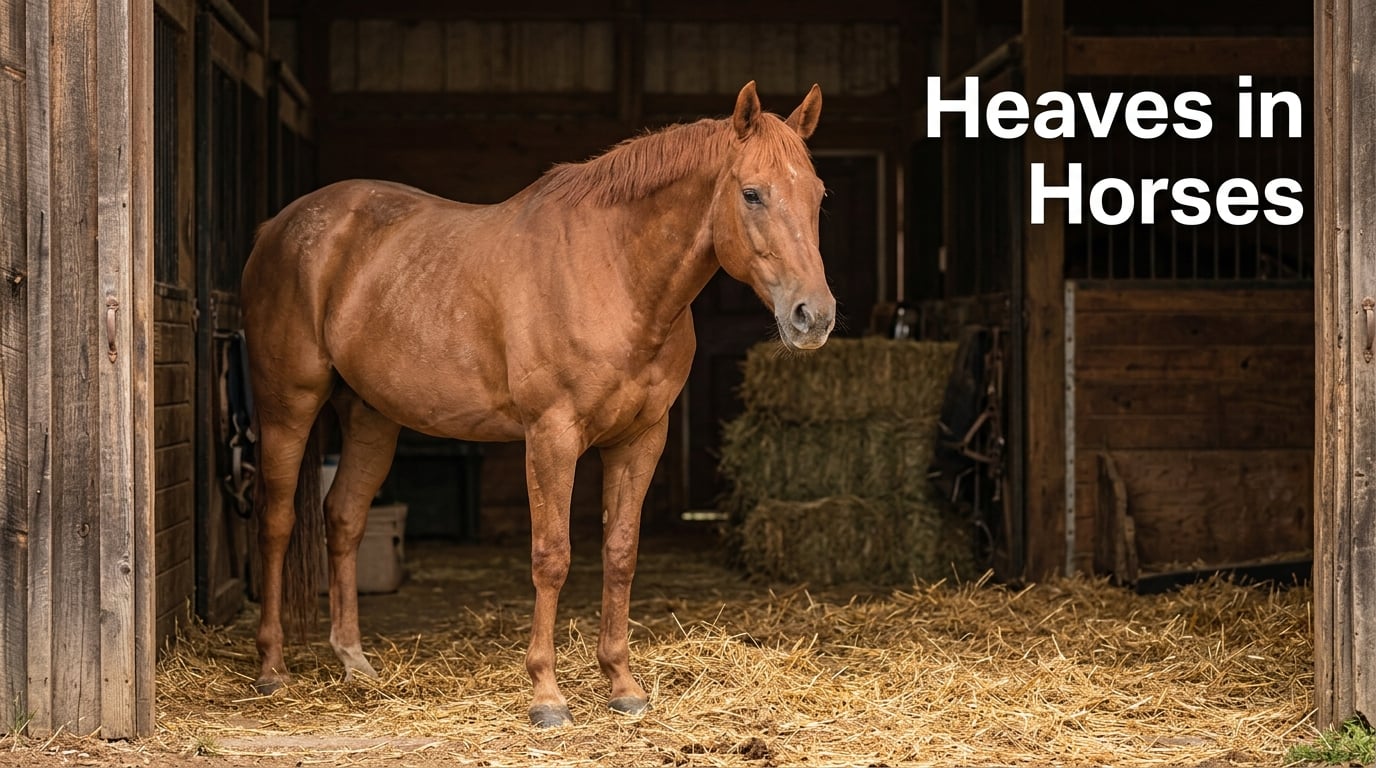
Heaves in horses is one of the most common and frustrating respiratory conditions horse owners face. If your horse coughs frequently, breathes harder than normal after light work, or has developed a visible muscular ridge along its belly, you may be dealing with heaves.
The condition goes by several names — recurrent airway obstruction (RAO), equine COPD, broken wind, and now most precisely, severe equine asthma. No matter what you call it, the impact on a horse’s daily life can range from mild performance limitations to serious, visible breathing distress at rest.
I’ve spoken with many horse owners who spent months trying to figure out why their horse was coughing, losing weight, or struggling to finish a ride. The answer often traces back to the barn environment, the hay, and a combination of allergen exposures that build up over time.
This guide covers everything you need to understand about heaves in horses — what it is, how to spot it early, what sets it off, and most importantly, what you can do right now to help your horse breathe more easily.
Table of Contents
What Is Heaves in Horses?
Heaves is a chronic, non-infectious allergic respiratory disease that affects roughly 12% of mature horses. It develops when a horse repeatedly inhales airborne allergens — primarily dust particles, mold spores, and pollens — that trigger an exaggerated inflammatory response in the small airways deep in the lungs.
The condition was commonly called Chronic Obstructive Pulmonary Disease (COPD) in horses for many years, but that term has been largely phased out. Today, veterinarians most often use recurrent airway obstruction (RAO) or equine asthma, since those terms more accurately reflect the immune-mediated nature of what’s happening in the airways.
When a horse develops heaves, three things happen simultaneously in the airways. First, inflammation causes the walls of the small bronchioles to swell and thicken. Second, the smooth muscle surrounding those airways contracts — this is called bronchoconstriction — narrowing the available airspace.
Third, the airways produce excessive mucus that partially blocks airflow. The combination of all three effects dramatically reduces how much air can move through the lungs with each breath.
Unlike people with asthma who typically struggle most with breathing in, horses with heaves have the most difficulty exhaling. The result is a horse working visibly hard to push stale air out of its lungs — that labored double push you see in the belly muscles is the most recognizable sign.
There are two main clinical forms of heaves that affect horses in different ways.
The barn-associated form — sometimes called winter heaves — is by far the most common. It’s triggered by indoor allergens, particularly the dust, mold spores, endotoxins, and fine particles that come from hay and bedding. Horses kept in stalls during cold months with limited ventilation face the highest risk, and symptoms typically improve dramatically when horses are turned out on pasture.
Summer pasture-associated obstructive lung disease (SPAOPD) is a less common but distinct form triggered by outdoor allergens like grass pollens and mold in the environment. Horses with this form show worse symptoms in summer and often improve when brought inside — the opposite of the barn-associated pattern. Identifying which form your horse has matters because the management strategies differ significantly.
Most horses develop heaves between the ages of 9 and 12, though it can appear at any age. There’s a heritable component as well — certain bloodlines appear more prone to developing airway hypersensitivity.
Symptoms of Heaves in Horses
The symptoms of heaves in horses develop gradually and can be subtle in the early stages. Early on, you might only notice an occasional cough or a slight drop in exercise tolerance. Over months and years, as the airway changes become more established, the signs become harder to miss.
Here are the key symptoms to watch for:
Chronic cough — A persistent, low-grade cough is typically the first sign. It may be more noticeable at the start of exercise, when the horse enters the barn, or when it first starts eating hay. Some owners dismiss this as a “normal” cough for months before recognizing the pattern.
Labored breathing at rest — In moderate to severe cases, you can watch the horse actively working to exhale. The ribcage and flank muscles visibly contract with each breath, pushing air out. This effort should not be present in a healthy horse at rest.
Flared nostrils — Even at rest, a horse with active heaves may hold its nostrils wider than normal. The horse is trying to reduce the resistance to airflow at every point it can.
Nasal discharge — A thick, cloudy or yellowish mucus discharge from both nostrils is common. This is excess mucus being cleared from the lower airways. Bilateral discharge that’s consistent with hay feeding or barn time is a significant clue.
Exercise intolerance — A horse that once performed well may start refusing jumps, lagging behind on trail rides, or needing a much longer recovery time after work. This is one of the earliest signs in horses that are regularly exercised, since the reduced airway capacity becomes apparent under demand.
The heave line — This is the most distinctive physical sign of established heaves. A visible, defined muscular ridge develops along the lower border of the abdomen, running from the flank area toward the groin.
It forms because the horse uses its abdominal muscles so consistently to push air out that those muscles hypertrophy over time. Once a heave line is visible, you’re looking at a horse with a significant and usually long-standing case of heaves.
Wheezing and crackles — A veterinarian listening to the lungs with a stethoscope typically hears abnormal breath sounds — wheezes from air moving through narrowed airways, and crackles from mucus in the bronchioles. In severe cases, these sounds can sometimes be heard without a stethoscope.
Weight loss and poor body condition — Horses with chronic heaves burn significant extra calories simply from the ongoing effort of breathing. Many owners with heaves horses report needing to feed substantially more to keep their horse at a healthy weight. The combination of increased caloric need and reduced appetite during respiratory distress makes weight management genuinely difficult.
If your horse shows several of these signs — particularly if they’re worse in winter, worse in the barn versus at pasture, or worse after hay feeding — heaves should be near the top of your list of concerns.
What Causes Heaves in Horses?
Heaves in horses is an allergic condition, which means the immune system overreacts to normally harmless environmental substances. The horse’s airways become sensitized over time, and subsequent exposures to the trigger produce an increasingly strong inflammatory response.
The primary triggers include:
Hay dust — This is the single biggest culprit in barn-associated heaves. Even high-quality, well-cured hay contains microscopic dust particles, fungal spores, and bacterial endotoxins. When a horse puts its nose into a pile of dry hay to eat, it inhales a concentrated cloud of these particles directly into the airways.
Round bales are particularly problematic — they tend to harbor significantly more mold throughout the interior than smaller, properly dried bales. Horse owners consistently identify switching away from round bales as producing the fastest improvements in their heaves horses.
Mold spores — Improperly stored or damp hay and straw bedding can harbor significant mold colonies. Aspergillus and other common barn molds produce spores that are tiny enough to reach deep into the lungs and trigger strong immune reactions in susceptible horses. Mold isn’t always visible — a bale can look and smell acceptable and still contain problematic spore counts.
Endotoxins from bacteria — Bacteria living in hay, dust, and organic debris release endotoxins that drive neutrophilic inflammation in the airways. Research has identified these bacterial components as a significant part of what makes barn dust so problematic for heaves horses, beyond just the physical irritation from dust particles.
Barn environment — Even beyond the hay itself, enclosed barns accumulate dust from multiple sources: bedding breakdown, dried manure particles, feed dust, and skin flakes from multiple horses. Poor ventilation concentrates all of these allergens at the level where horses breathe.
Ammonia from urine-soaked bedding — High ammonia levels irritate and inflame the airways directly, lowering the threshold for allergen-triggered inflammation. A barn that smells strongly of ammonia is a problem environment for any horse with respiratory sensitivity.
Pollen and outdoor molds — For horses with the summer pasture-associated form of heaves, grass pollens, tree pollens, and outdoor environmental molds are the primary triggers. These horses typically show no improvement — or actually worsen — when turned out to pasture.
Owners with barn-associated heaves horses often notice a clear seasonal pattern: symptoms worsen during winter months when horses spend more time inside, and improve noticeably when horses get more turnout time in spring and summer. That pattern of improvement with outdoor exposure and worsening with barn confinement is one of the strongest diagnostic clues pointing toward heaves.
How Veterinarians Diagnose Heaves?
Your veterinarian will diagnose heaves based on a combination of the horse’s history, physical examination findings, and diagnostic tests. A careful history — including when symptoms began, whether they’re seasonal, how much time the horse spends in a stall, and what type of hay it eats — provides important context before any testing begins.
The physical examination typically reveals labored breathing, abnormal lung sounds on auscultation, and the heave line if the condition has been present for some time. Flared nostrils and bilateral nasal discharge during rest support the diagnosis.
Key diagnostic tests include:
Rebreathing examination — The veterinarian briefly places a bag over the horse’s nostrils to cause deeper breathing. This amplifies lung sounds and makes abnormal airway noises much more audible, helping assess the degree of obstruction.
Bronchoalveolar lavage (BAL) — A tube is guided through the trachea into the lower airways, fluid is flushed in and recovered, and the resulting sample is analyzed in a laboratory. BAL cytology is the gold standard for confirming heaves — it reveals the characteristic pattern of significantly elevated neutrophils (inflammatory white blood cells) in the airway fluid.
IAD, by contrast, shows elevated mast cells and eosinophils rather than neutrophils. This distinction matters because the two conditions call for somewhat different management approaches.
Endoscopy — A camera passed down the trachea and into the airways allows direct visualization of mucus accumulation and airway changes. It also helps rule out other causes of coughing such as infections or anatomical abnormalities.
Response to bronchodilator — Administering a bronchodilator and observing whether breathing improves significantly within minutes can help confirm that reversible bronchoconstriction is present. It’s a practical, in-the-field confirmation step that complements laboratory testing.
Blood work alone is not diagnostic for heaves. The inflammatory changes are localized to the airways, not reflected in routine blood panels.
Treatment Options for Horses with Heaves
Treatment for heaves in horses works best as a two-pronged approach — environmental management combined with medication when needed. The most important point to understand is that medication alone rarely controls heaves long-term if the horse continues living in a high-dust, high-allergen environment. Treating symptoms while ignoring the underlying trigger is fighting a losing battle.
Bronchodilators — These medications relax the smooth muscle around the airways, rapidly opening up constricted bronchioles. Clenbuterol (a beta-2 agonist) is the most commonly prescribed oral bronchodilator for horses with heaves. Inhaled bronchodilators like albuterol can be delivered directly to the airways via a nebulizer or equine-specific inhaler for faster, more targeted relief during acute episodes.
Corticosteroids — Corticosteroids reduce the airway inflammation that underlies heaves. Dexamethasone is widely used and effective, typically administered by injection or as an oral solution for acute management. For longer-term control, inhaled corticosteroids like fluticasone or beclomethasone are increasingly preferred — they deliver anti-inflammatory effect directly to the airway tissue while reducing the systemic side effects that come with repeated oral or injectable steroids.
Aerosol and nebulizer therapy — Delivering medication as a fine mist directly into the airways allows smaller doses to achieve good local effect with reduced systemic exposure. Purpose-built equine nebulizers and mask systems are available for horses, and owners who manage horses with frequent flare-ups often find systems like the Flexineb worth the investment despite the upfront cost.
Antihistamines — Some horses respond to antihistamines, though the evidence is less robust than for bronchodilators and corticosteroids. Cetirizine — the active ingredient in Zyrtec — given at 150 to 300mg daily is discussed among horse owners as one of the more effective options. Always discuss antihistamine use with your veterinarian before starting, including appropriate dosing for your horse’s weight.
Prognosis — Heaves is a chronic condition — it cannot be cured, and a horse that develops it will always carry some degree of underlying airway sensitivity. With consistently applied environmental management and appropriate veterinary care, most horses with heaves can live comfortable, reasonably active lives.
Horses with good allergen reduction often need only minimal medication to stay stable. Those that continue living in high-dust environments despite treatment tend to develop progressive airway changes — including thickened airway walls and fibrosis — that limit how much improvement is possible, which is why starting management early makes a real difference.
Environmental Management: The Core of Heaves Control
Environmental management is the single most important component of heaves control — more impactful than any medication. Every hour spent reducing allergen exposure pays dividends in your horse’s comfort and in reduced medication needs.
Maximum turnout — Getting your horse out of the barn and onto pasture as much as possible is the most powerful single change you can make for barn-associated heaves. Many horses with moderate heaves improve to nearly normal breathing with consistent 24/7 outdoor turnout. If full-time turnout isn’t possible, prioritize as many hours outside as your facilities allow.
Hay management — Hay is the primary allergen source for most horses with heaves, so how you feed it makes an enormous difference. You have several options to reduce allergen exposure at the source.
Soaking hay means submerging it in water for 30 to 60 minutes before feeding. This wets down dust particles so they don’t become airborne and washes out some water-soluble allergens.
Soaking is low-cost and reasonably effective, though it’s labor intensive and can reduce the nutritional value of the hay if overdone. It also does not kill mold — spores survive soaking — which limits its effectiveness for horses reacting to mold-heavy hay.
Steaming hay with a purpose-built hay steamer is more effective than soaking. Steaming kills mold spores and bacteria while wetting down dust, addressing the two main allergen categories at once.
Quality steamers are a meaningful upfront investment, but many owners of horses with serious heaves find them worth it. The process also preserves the nutritional content of the hay better than soaking does.
Switching to complete pelleted feeds or hay cubes eliminates conventional hay from the diet entirely, removing the primary allergen source. Dampening pellets or cubes before feeding eliminates any remaining dust. This approach requires attention to nutritional balance and fiber intake, so work with your vet or an equine nutritionist if you make this shift.
Avoid round bales — Round bales consistently rank as the worst hay choice for horses with heaves. The interior of large round bales creates ideal conditions for mold growth, and their sheer size means horses spend prolonged periods with their faces buried in dense, often dusty material.
Bedding choices — Replace straw bedding with paper bedding, wood pellets, or rubber matting with minimal bedding. Even good-quality straw can harbor significant mold and dust. Wood shavings vary widely in dust content — kiln-dried shavings are considerably cleaner than green or dusty ones.
Barn ventilation — Open stall windows and barn doors whenever weather permits to maximize airflow. Avoid storing hay directly above stalls — hay dust and mold spores fall through ceiling gaps and concentrate right in the breathing zone.
Feed from ground level — Horses naturally graze with their heads down, and the downward position helps drain mucus from the airways. Hay racks, nets, or elevated feeders force horses to eat with their heads up, which can worsen respiratory signs by reducing drainage and increasing inhalation of displaced dust.
Minimize exposure to neighboring horses’ dry hay — Even if your horse is eating wet, soaked hay, dry hay being fed to neighboring horses in a shared barn creates airborne allergens that can maintain airway inflammation. This is a frustrating but real factor in shared boarding environments.
IAD vs Heaves: Two Ends of the Same Spectrum
Inflammatory airway disease (IAD) and heaves are related conditions on the same spectrum of equine airway inflammation, but they differ meaningfully in severity, age of onset, and clinical presentation.
IAD typically affects younger horses — most commonly horses between 2 and 8 years old, including performance horses in active training. Horses with IAD have lower-level airway inflammation that causes reduced performance, mild coughing, or excess respiratory secretions without the dramatic breathing difficulty seen in heaves. A significant number of performance horses have IAD without their owners ever suspecting a respiratory problem — the first sign is often simply that the horse isn’t reaching its expected performance level or recovers more slowly from hard work.
Heaves represents the severe end of the equine asthma spectrum. It typically affects mature horses, causes visible breathing difficulty even at rest during flare-ups, and shows the characteristic neutrophilic inflammation pattern on BAL testing.
One way to picture the difference: a horse with IAD is like a person with managed allergic rhinitis — functioning reasonably well, but not at full capacity. A horse in a serious heaves episode is more like a person mid-asthma attack — the airways are significantly compromised and require active intervention.
Understanding where your horse sits on this spectrum influences both the urgency of management and the type of veterinary workup that’s appropriate. A horse showing reduced performance in 2026 deserves evaluation even if it never shows the dramatic breathing signs of classic heaves.
Can a Horse with Heaves Be Ridden?
Whether a horse with heaves can be ridden depends on where the condition stands at any given time and how well it’s currently managed.
A horse in active respiratory distress — showing labored breathing at rest, flared nostrils, and visibly struggling — should not be exercised. Exercise sharply increases oxygen demand and respiratory effort. Working a horse when it’s already struggling to breathe at rest can turn a manageable situation into a serious one.
A horse with well-managed heaves — stable on environmental management and any needed medications, showing no signs of distress at rest — can often continue working. Many pleasure horses, trail horses, and some lower-level performance horses with well-controlled heaves maintain long, active careers.
The key is ongoing monitoring: watch your horse’s breathing before and after work, track recovery rate, and be ready to ease back during high-dust periods or allergy seasons. Work with your veterinarian to define what “well-controlled” looks like for your specific horse and agree on clear guidelines for when riding is and isn’t appropriate.
Frequently Asked Questions
What is the prognosis for horses with heaves?
Heaves is a chronic condition with no cure, but the prognosis for quality of life is generally good with consistent management. Horses managed well — with reduced allergen exposure and appropriate veterinary treatment — can remain comfortable and active for many years. Horses with long-standing, poorly managed heaves can develop permanent airway changes including fibrosis that limit how much improvement is possible, which is why early management matters.
Can a horse recover from heaves?
Horses cannot fully recover from heaves in the sense that the underlying airway sensitivity does not go away. However, with consistent environmental management — particularly reducing dust and allergen exposure — most horses can reach a state where symptoms are minimal or absent, and they can perform at a good level. The condition tends to return if management lapses.
Is dexamethasone good for heaves in horses?
Yes, dexamethasone is one of the most commonly used corticosteroids for managing heaves in horses and is effective at reducing airway inflammation during flare-ups. It can be given by injection or orally. For long-term management, veterinarians often prefer inhaled corticosteroids like fluticasone to reduce the risk of systemic side effects from repeated dexamethasone use. Always use corticosteroids under veterinary guidance.
Is heaves in horses contagious?
No, heaves is not contagious. It is an allergic, immune-mediated condition — not an infectious disease. You cannot spread heaves from one horse to another through contact, shared equipment, or shared environment. However, multiple horses in the same dusty barn can all develop heaves independently because they are all exposed to the same allergen triggers.
What is the best hay for a horse with heaves?
Steamed hay is generally the best option for horses with heaves because steaming kills mold spores and reduces allergens more effectively than soaking. Soaked hay is a lower-cost alternative that reduces dust effectively. Hay cubes or complete pelleted feeds dampened with water are also good choices for horses that need to avoid conventional loose hay entirely. Round bales should be avoided, as they tend to harbor the most mold and dust.
Final Thoughts
Heaves in horses is a manageable condition, not a death sentence. The most meaningful change you can make is reducing the allergen burden your horse faces every day — through better hay management, maximum outdoor turnout, cleaner bedding, and improved barn ventilation. Medication is a valuable tool, but it works best alongside good environmental management, not as a substitute for it.
If you suspect your horse has heaves, work with a veterinarian to get a proper diagnosis and rule out other causes of respiratory signs. Starting early — before permanent airway changes set in — gives your horse the best chance at a comfortable, active life in 2026 and beyond.