
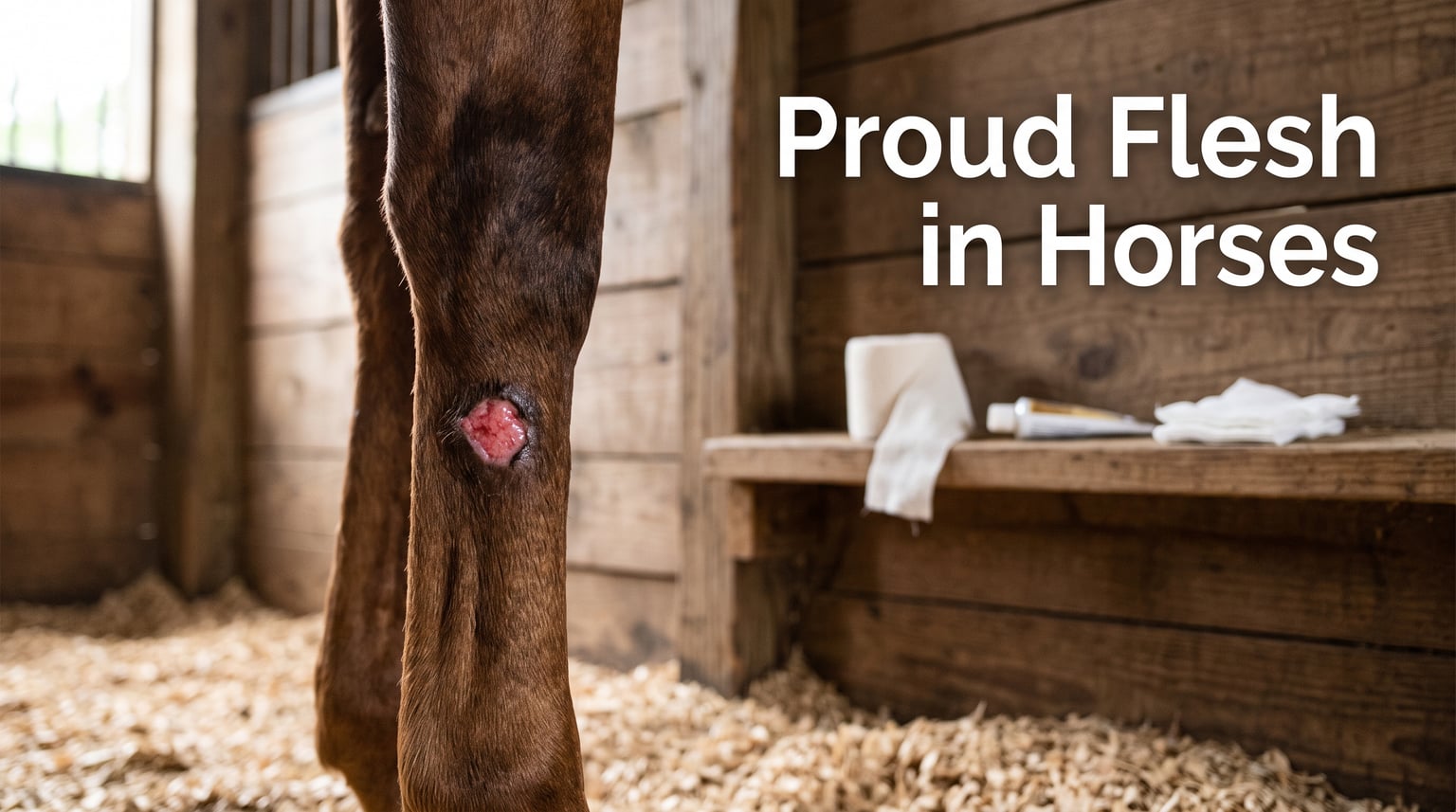
Proud flesh in horses is a frustrating wound healing complication that turns what should be a simple recovery into months of careful management. It’s also the most common reason leg wounds on horses refuse to close properly, and I have seen owners spend entire summers treating one stubborn spot.
This guide pulls together what I have learned from veterinarians, farriers, and fellow horse owners who have battled this condition on real working horses, sport horses, and pasture pets. You will learn what proud flesh actually is, why horses get it more than any other animal, how to spot it early, and the practical steps our team uses to treat and prevent it.
Table of Contents
What Is Proud Flesh in Horses?
Proud flesh, clinically called exuberant granulation tissue, is the overgrowth of normal healing tissue that rises above the skin surface during wound repair. It is the body’s wound healing machinery working overtime, producing so much new tissue that it actually blocks the skin from closing over the wound.
Granulation tissue is meant to be a temporary scaffold. Picture a delicate pink cobblestone surface filled with tiny blood vessels that ferry oxygen and nutrients to build new skin. When healing goes well, this tissue stays level with the surrounding skin and skin cells crawl across it to close the wound. When proud flesh develops, the granulation tissue keeps growing upward until it bulges above the wound edges.
Horses are uniquely prone to proud flesh because of how their legs are built. Below the knee and hock, there is almost no muscle or soft tissue cushioning between skin and bone. Skin tension is high, blood supply is limited compared to the body, and the constant movement of walking makes it hard for skin edges to knit back together. Veterinary studies confirm that wounds on the distal limbs heal far slower and develop proud flesh far more often than wounds on the body or upper limbs.
The Medical Term Explained
Veterinarians use the term “exuberant granulation tissue” to describe the condition. Exuberant means excessive or overgrown, granulation refers to the type of healing tissue, and this tissue is your body’s normal response to a wound, just cranked up too high.
Symptoms and Appearance of Proud Flesh
The visual identification of proud flesh is something most horse owners learn to recognize quickly once they have seen it. I always tell people to look for three things: location, color, and texture.
Proud flesh almost always appears on the lower leg, particularly the cannon bone, pastern, or around the fetlock. It starts as a moist pink or red bump pushing up from a wound that should have been healing flat. As it grows, the surface takes on a distinctive cobblestone or cauliflower-like appearance made up of tiny rounded nodules.
The texture is firm but pliable. When you press it gently, it often bleeds easily because the tissue is loaded with capillaries. This bleeding tendency is a key feature, normal healing tissue does not bleed when touched, but proud flesh does.
Can Horses Feel Proud Flesh?
Horses do not feel pain in proud flesh the way they feel pain in healthy skin. The overgrown tissue contains almost no nerve endings, which is why trimming it does not require anesthesia in most cases. Horses may still react to handling near the wound because the surrounding healthy tissue is sensitive.
Early Stage Warning Signs
Catching proud flesh early saves weeks of treatment. The first warning sign is granulation tissue that puffs above the skin surface rather than remaining flat. Wounds that look “pillow-like” or have a swollen, rounded mound in the center are heading toward trouble.
Early stage wounds also tend to drain more than expected and may develop a yellow-tinged discharge. If you see tissue starting to dome up rather than lay flat, it is time to start treatment.
Causes and Risk Factors for Proud Flesh
Proud flesh develops when the inflammatory phase of wound healing drags on too long. Horses have evolved an aggressive inflammatory response that helps them fight off infection in muddy, bacteria-heavy environments, but in the lower leg, that same response can derail normal healing.
The biggest risk factor is location. The lower leg has poor blood supply compared to the upper body, which means white blood cells and healing factors arrive slowly. Combine that with constant motion from walking, and you have a wound environment where inflammation lingers instead of resolving cleanly.
Wound Characteristics That Increase Risk
Some wounds are more likely to develop proud flesh than others. Full-thickness wounds that go all the way through the skin are at high risk. Wounds contaminated with dirt, manure, or bedding debris stay inflamed longer and have a much higher proud flesh rate.
Wounds near joints, including the knee, hock, fetlock, and pastern, are particularly vulnerable because the skin moves constantly with each step. A wound on the upper body might heal closed in three weeks, while the same wound on a horse’s cannon bone could still be open at eight weeks.
Other Contributing Factors
Several management factors increase the chance of proud flesh developing:
- Repeated motion at the wound site from walking or work
- Poor bandaging that allows the wound to dry out or get dirty
- Muddy paddocks or wet bedding that keep the wound contaminated
- Dead tissue left in the wound that prolongs the inflammatory phase
- Excessive movement of the horse during the early healing period
Horses that are worked on hard ground or rough terrain are also at higher risk simply because they suffer more lower leg injuries in the first place. Sport horses, working ranch horses, and trail horses that cover uneven ground all see more of these wounds than horses kept mostly in stalls.
Treatment Options for Proud Flesh in Horses
Treatment for proud flesh follows a clear sequence: reduce the overgrowth, control the inflammation, and protect the wound so skin can finally close. The approach varies based on how severe the proud flesh has become and how long the wound has been open.
For minor proud flesh caught early, topical treatments alone are usually enough. For larger or long-standing proud flesh, surgical removal followed by careful management is the standard of care. Most horses need a combination of both over the course of treatment.
Topical Treatments That Work
Several topical products can shrink proud flesh and bring the wound back to a level surface. Each works a little differently, and what works best depends on your wound, your horse, and how much time you have to manage the bandage changes.
Corticosteroid ointments are the most commonly prescribed veterinary treatment. Products like Panalog and Animax contain a steroid that reduces the inflammation driving the overgrowth. Applied once or twice daily under a bandage, they can flatten proud flesh in one to two weeks.
Wonder Dust is a powdered caustic dressing that many horse owners and barns have used for decades. It works by chemically cauterizing the proud flesh surface, which both kills excess tissue and keeps the wound dry. Owners on equestrian forums report good success with Wonder Dust on minor cases, though it does require careful application to avoid damaging healthy surrounding skin.
Manuka honey has become popular in recent years for its antibacterial and anti-inflammatory properties. Applied as a thick layer under a bandage, medical-grade manuka honey can reduce proud flesh while keeping the wound bed clean. Studies in veterinary journals support its use as an adjunct therapy, though most veterinarians use it in combination with other treatments rather than alone.
Surgical Debridement
When proud flesh has grown substantially above the skin surface, trimming it back is often necessary. A veterinarian performs this with a sterile scalpel blade, cutting the overgrown tissue down to or just below the level of the surrounding skin.
The procedure is quick and most horses tolerate it without sedation. Because proud flesh contains few nerve endings, trimming itself is not painful, though the horse may still need a twitch or light sedation to stand still. After trimming, treatment shifts to preventing regrowth while the skin finally has a chance to close.
Bandaging Techniques
Proper bandaging is just as important as the topical treatment. The goal is to apply gentle, even pressure that discourages proud flesh from regrowing while keeping the wound clean and moist enough for skin cells to migrate across.
A standard approach includes a non-stick pad directly over the wound, a layer of conforming gauze, then a standing wrap or stable bandage to hold everything in place. Pressure should be firm but not tight enough to cut off circulation. The bandage is changed daily or every other day depending on drainage.
Several owners I have spoken with emphasize that bandaging is the hardest part of treating proud flesh. Horses in work, horses that paw, and horses turned out in groups can undo a careful wrap in minutes. Planning for this, whether with a protective covering like a duct tape boot or by restricting turnout, makes the difference between treatment success and frustrating setbacks.
When to Call the Veterinarian
Knowing when to handle proud flesh at home and when to involve a veterinarian prevents both wasted time and unnecessary complications. Some proud flesh is well within an experienced owner’s ability to manage. Other cases need professional care from day one.
Call your veterinarian promptly if the wound is close to a joint, tendons, or the hoof. Proud flesh in these areas can affect underlying structures if it grows unchecked or becomes infected. Wounds that have been open more than a week without showing signs of healing also deserve a professional look.
Emergency Warning Signs
Some situations call for urgent veterinary care regardless of how experienced you are with wound management:
- Swelling that spreads up the leg or hot to the touch
- Fever, loss of appetite, or signs of systemic illness
- Foul-smelling discharge that indicates deep infection
- Proud flesh that bleeds heavily when touched
- Any wound showing exposed bone, tendon, or joint
If your horse is suddenly lame or refuses to put weight on the leg, treat it as an emergency. Infection in the deeper tissues can progress quickly in horses, and waiting even 24 hours can mean the difference between a treatable wound and a life-threatening situation.
Home Treatment Versus Veterinary Treatment
For small areas of proud flesh on a young wound, home treatment is reasonable. Clean the wound, apply an appropriate topical product, bandage it carefully, and reassess every few days.
For larger growths, wounds older than two weeks, or any wound showing signs of infection, schedule a vet visit. Surgery, prescription-strength medications, and proper debridement are not always within an owner’s ability to provide safely. The cost of a vet visit is usually less than the cost of weeks of ineffective home treatment.
Prevention Strategies for Proud Flesh in Horses
Preventing proud flesh is far easier than treating it. Because the condition develops when inflammation lingers and the wound stays open too long, the prevention strategy focuses on moving through the healing phases quickly and supporting proper skin closure.
Early veterinary involvement is the single biggest prevention step. Wounds examined within 24 hours can be properly cleaned, debrided of dead tissue, and closed with sutures if appropriate. Wounds that heal by second intention, meaning they are left open to heal from the inside out, are the ones most likely to develop proud flesh.
Bandaging Best Practices
Once a wound exists, consistent bandaging becomes the cornerstone of prevention. The bandage protects the wound from contamination, applies gentle pressure to discourage tissue overgrowth, and keeps the wound bed moist enough for skin cells to migrate across.
Change bandages on a consistent schedule. Most lower leg wounds benefit from bandage changes every one to three days depending on drainage. Letting a bandage stay on too long allows bacteria to multiply, while changing too often disrupts healing tissue.
Environmental Management
Where your horse spends time during healing matters as much as what you put on the wound. Dry, clean stall rest is best for the first two weeks of open wound healing. Muddy paddocks, sand lots, and dusty arenas all carry contamination that sets healing back.
Limit movement during early healing. Stall rest or a small pen prevents the constant flexing of the lower leg that disrupts fragile new tissue. Turnout can usually resume once the wound has a healthy bed of granulation tissue and skin is starting to edge in from the sides.
Supporting Healthy Inflammation
Counterintuitively, suppressing excessive inflammation early helps prevent the overgrowth that becomes proud flesh. Cold hosing or ice in the first 48 hours brings down swelling. Anti-inflammatory medications prescribed by your veterinarian for severe wounds reduce the inflammatory cascade that drives granulation tissue overproduction.
Good nutrition also supports wound healing. Adequate protein supplies amino acids for tissue repair, while vitamins A, C, and zinc support skin cell regeneration. Horses on a balanced diet typically heal faster than those on marginal rations.
A Prevention Checklist
Use this checklist to reduce the chance of proud flesh developing in your horse’s lower leg wounds:
- Call your vet within 24 hours of any significant lower leg wound
- Keep the wound clean and bandaged from day one
- Change bandages on a consistent schedule
- Provide dry, clean turnout during healing
- Limit movement during the first two to three weeks
- Watch for tissue that starts to dome up above the skin line
- Start topical anti-inflammatory treatment at the first sign of overgrowth
Recovery and Long-Term Outlook
Most horses make a full recovery from proud flesh with appropriate treatment, though it requires patience. Minor cases treated early may resolve in two to three weeks. Established proud flesh that has been growing for weeks can take two to three months to fully close and heal.
Scarring is common at the wound site. The skin that grows over a proud flesh wound is usually thinner and less elastic than surrounding skin, and may stay hairless or have white hairs growing through it. These scars rarely cause long-term problems but are worth noting if you plan to show or sell the horse.
Recurrence is rare once a wound has fully closed and the new skin has matured. I tell owners to monitor the scar carefully during the first year, but most horses return to full work without restrictions. The key is finishing treatment completely rather than stopping as soon as the wound “looks better.”
Frequently Asked Questions About Proud Flesh in Horses
Horse owners have asked these questions about proud flesh repeatedly on forums and to their veterinarians. Here are clear answers based on current veterinary guidance.
How do you get rid of proud flesh on a horse?
Proud flesh is treated by combining topical anti-inflammatory medications like corticosteroid ointment with surgical trimming when needed, then keeping the wound carefully bandaged to prevent regrowth. The overgrowth must be reduced to or below skin level before skin cells can close the wound.
Will proud flesh go away on its own?
Proud flesh will not go away on its own. Without treatment, it continues to grow above the wound edges and prevents skin from closing. Treatment is required to bring the tissue level down and allow normal healing to resume.
What spray can I use on my horse to treat proud flesh?
There is no single approved spray that reliably treats proud flesh. Most effective treatments are ointments or powders like corticosteroid preparations or Wonder Dust. Your veterinarian can recommend the best topical product for your specific wound.
Does manuka honey stop proud flesh?
Medical-grade manuka honey has anti-inflammatory and antibacterial properties that can help reduce proud flesh when used as part of a complete treatment plan. It works best alongside other therapies rather than as the only treatment for established proud flesh.
Can horses feel proud flesh?
Horses do not feel pain in proud flesh itself because the overgrown tissue contains few nerve endings. Horses may still react when the area is handled because the surrounding healthy tissue and skin remain sensitive to touch.
What are the symptoms of proud flesh in horses?
Proud flesh appears as a pink or red, moist, cobblestone-textured tissue that grows above the wound edges rather than staying level with the surrounding skin. It bleeds easily when touched and almost always appears on the lower leg, particularly the cannon bone or pastern area.
Final Thoughts on Managing Proud Flesh
Proud flesh in horses is one of the most common wound complications we deal with on the lower leg, but it is also one of the most manageable when caught early. The path to healing is straightforward: identify the overgrowth early, reduce it with appropriate topical treatments or surgical trimming, and maintain consistent bandaging until skin finally closes.
The biggest mistake I see horse owners make is waiting too long to act. A wound that looks “a little puffy” today can become a stubborn patch of proud flesh two weeks from now. Treating it early with the right product and a properly applied bandage saves weeks of frustration.
Work closely with your veterinarian, follow the bandaging plan consistently, and stay patient through the long healing phases. Horses recover well from proud flesh when their owners commit to the full treatment course.