
I learned to age a horse by teeth the way most horse owners do: standing in a pasture, trying to guess the age of a rescued mare with no papers. The barn owner pointed at her front teeth and said “see that long one in the corner? She’s about six.” I was hooked. Since then I have spent the better part of a decade comparing dental markers against registration papers on dozens of horses.
Aging a horse by its teeth works because horse teeth follow predictable schedules. Baby teeth erupt and fall out on a tight timeline. Permanent teeth show specific wear patterns at specific ages. Cups, dental stars, grooves, and hooks all appear and disappear at fairly predictable points. If you know what to look for and at what age each marker should appear, you can estimate a horse’s age within a couple of years – sometimes within six months for young horses.
This guide walks you through every marker used by equine veterinarians and seasoned horse owners. I cover the tooth eruption timeline from birth through five years, the cup and dental star progression through midlife, Galvayne’s groove as the classic ten-year landmark, and the hooks and slopes that signal senior years. You will also learn how diet changes wear patterns, why aging gets harder after fifteen, and when to call a vet instead of guessing.
Table of Contents
How to Age a Horse by Teeth: A Step-by-Step Visual Guide
Start at the front of the mouth and work backward. Open the lips and look at the incisors first, then the canines, then the premolars if you can reach them.
Step 1: Count the teeth. Foals are born with no visible incisors. The first baby incisors arrive within the first week. A horse with all twelve deciduous (baby) incisors and all twelve molars is a young horse, almost always under three. By five years, every deciduous tooth has been replaced by a permanent one.
Step 2: Look at tooth shape. Deciduous teeth are short, wide, and bright white with a defined neck. Permanent teeth are taller, more rectangular, and creamy to yellowish. If you see a mix – some white baby teeth next to longer yellow adult teeth – the horse is between two-and-a-half and five.
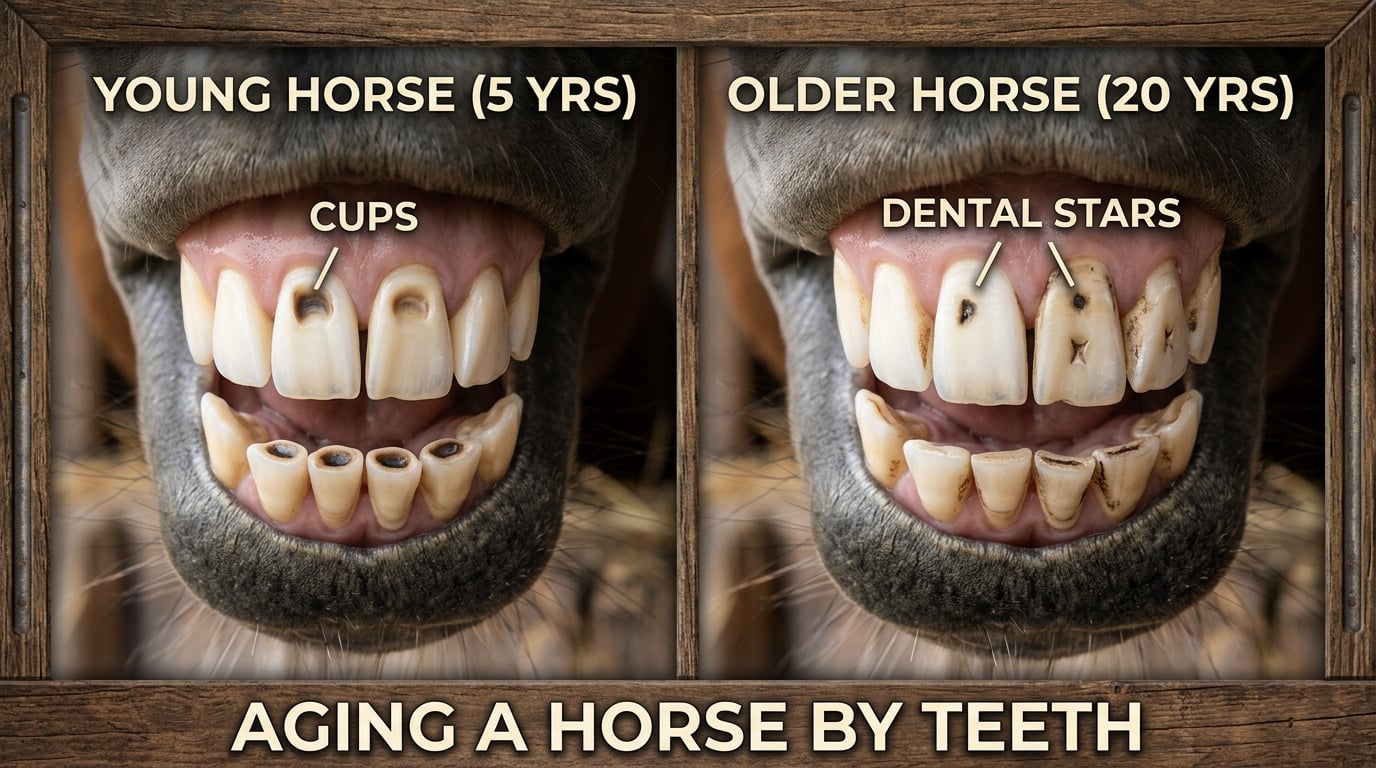
Step 3: Check the cups. Cups are the dark hollows in the center of the incisor surface. They appear in permanent teeth around age one and disappear in a predictable order – centrals first, intermediates next, corners last – usually between six and eleven.
Step 4: Find the dental star. The dental star is a creamy yellow star-shaped mark on the incisor surface, just in front of the cup’s original position. It first appears around age five as a dark dot, grows paler and larger through middle age, and becomes a smooth line by the time the horse is in its twenties.
Step 5: Trace Galvayne’s groove. Look at the upper corner incisor for a vertical groove. It appears at the gum line at ten years, reaches halfway down the tooth at fifteen, runs the full length at twenty, and disappears from the top down between twenty and twenty-five.
Step 6: Note the angle and shape. Young horses have nearly vertical upper and lower incisors that meet flat. By the teens, the angle becomes oblique. By the twenties, the surfaces slope sharply and may form a seven-year hook in the upper corner. By twenty-four, the horse is “smooth mouthed” – all cups, dental stars, and grooves have worn away.
Horse Tooth Anatomy: What You Are Looking At
Adult horses have between 36 and 44 teeth, depending on whether you count wolf teeth and canine teeth. Horses are hypsodont, meaning their teeth erupt continuously through life to compensate for years of grinding rough forage. Understanding the basic anatomy helps you know which tooth tells you what.
The 12 Incisors
Incisors are the front teeth. Horses have six upper and six lower incisors. From the centerline outward, each side has three:
Central incisors – the two teeth closest to the midline
Intermediate incisors (laterals) – the middle pair on each side
Corner incisors – the outermost pair, where most age-related markers appear
Canine Teeth and Wolf Teeth
Canine teeth (also called “tushes”) sit between the incisors and the cheek teeth. They appear in male horses around four to five years old and rarely, sometimes never, in mares. Wolf teeth are small, often pointed vestigial teeth that sit just in front of the premolars. Many horses have them, many have them removed.
The confusion between canines and wolf teeth catches nearly every beginner. A canine is a fairly thick, curved tooth in a male horse’s mouth, present on each side, upper and lower, around age four to five. A wolf tooth is a small peg, often blind or barely erupted, sitting just ahead of the first upper premolar. Both are useful, but neither is what ages a horse – the incisors are.
Deciduous vs Permanent Teeth: The First Clue
The single most useful distinction for the first five years of a horse’s life is baby teeth versus adult teeth. You can usually tell them apart at a glance once you see a few in person.
| Feature | Deciduous (Baby) Teeth | Permanent Teeth |
|---|---|---|
| Color | Bright white | Cream, yellow, or brownish |
| Size | Smaller and shorter | Larger and longer |
| Shape | Shovel-like, wider than tall | More rectangular |
| Neck | Visible neck where crown meets gum | No defined neck |
| Surface | Shallow cup | Deeper, more defined cup |
| Number | 12 incisors, 12 cheek teeth (24 total) | Up to 44 total with canines and wolf teeth |
A horse that shows both baby and adult incisors at the same time is in transition. The most common sight is a yearling with adult central incisors and baby intermediates and corners, or a three-year-old with all adult teeth except for the corner baby teeth about to drop out.
Tooth Eruption Timeline: Birth to 5 Years
The first five years of a horse’s life offer the most precise aging possible. Tooth eruption follows a strict biological clock. The table below summarizes when each deciduous and permanent incisor erupts. Times are tight enough that an experienced observer can call a horse’s age within a few months.
| Age | Tooth Event | What You Will See |
|---|---|---|
| Birth to 1 week | First deciduous central incisors erupt | Two small teeth in front, top and bottom |
| 4 to 6 weeks | Deciduous intermediate incisors erupt | Six visible baby incisors in front |
| 6 to 9 months | Deciduous corner incisors erupt | All 12 baby incisors visible |
| 2.5 years | Permanent central incisors erupt | Longer, yellower teeth in the center |
| 3.5 years | Permanent intermediate incisors erupt | Lateral incisors replaced |
| 4.5 years | Permanent corner incisors erupt | All permanent incisors in place – “full mouth” |
| 4 to 5 years | Canine teeth erupt in males | Small tushes appear between incisors and cheek teeth |
If a horse is described as having a “full mouth,” it means all permanent incisors are in place. That is a five-year-old. If you see baby caps loosely attached or recently fallen out, the horse is shedding its last baby teeth, somewhere between four and a half.
Aging Horses Under 5 Years Old
For foals, yearlings, two-year-olds, three-year-olds, and four-year-olds, eruption timing is your best tool. Forget cups and stars at this age. They have not appeared yet.
Foals (Birth to 1 Year)
A newborn foal has either no visible incisors or just two in front. Within the first week, two more appear. By six months, all twelve baby incisors are in. The first year is also when the first permanent molars erupt, around nine to twelve months, though you usually cannot see those.
Yearlings (1 to 2 Years)
A yearling has twelve deciduous incisors that look small, white, and shovel-shaped. Cups are present in all baby incisors. No permanent incisors have erupted yet. There is a clear neck visible at the gum line.
Two-Year-Olds (2 to 3 Years)
A two-year-old shows the first permanent central incisors. The centers are noticeably longer and yellower than the intermediates and corners still present. This is the most dramatic transition point in the mouth – you can spot it instantly once you have seen it once.
Three-Year-Olds (3 to 4 Years)
The central incisors are now in full wear. The intermediate incisors erupt around three-and-a-half, replacing the baby intermediates. By the time a horse reaches four, the centrals and intermediates are permanent, with baby corners still in place.
Four-Year-Olds (4 to 5 Years)
A four-year-old has the full adult “four-year-old bite.” All twelve baby incisors are still present, but the four-year-old corner baby teeth are loose and may even have the permanent corners visible underneath. A horse that drops a baby cap during dinner is almost certainly right around four-and-a-half.
Aging Horses 5 to 15 Years: Cups, Stars, and Surface Shape
Once a horse has a full permanent mouth, the markers shift. Cups, dental stars, and grinding surface shape become the main tools. Each of these changes on a fairly predictable schedule.
Cup Disappearance
Cups are the dark hollows in the center of the incisor surface. They are made of cementum and stain darker than the surrounding enamel. They are present in all permanent incisors by age one but disappear at the gum line as the tooth wears.
The disappearance order matches the eruption order: centrals first, then intermediates, then corners. Cups typically disappear from the lower centrals at six years, lower intermediates at seven, lower corners at eight. Upper cups disappear a year or two after each lower set.
By eleven years, all cups are usually gone from the lower incisors and almost gone from the uppers. A horse with no cups in the lower centrals and intermediates but still-visible cups in the corners is between nine and eleven.
Dental Star Formation
The dental star is the round or star-shaped mark that appears as the cup wears past and exposes the underlying dentin and pulp. It starts small, dark, and creamy. As the horse ages, the dental star moves forward in the tooth, becomes paler, and turns more linear.
The dental star appears in the centrals around age five as a small dark dot. By eight, it is clear and oval. By twelve, it appears in the intermediates. By fifteen, it shows in the corners. By twenty, it is well-defined and elongated in all incisors. Past twenty-five, it loses definition and blends into the surrounding tooth.
Grinding Surface Shape
The shape of the incisor surface tells you a great deal about the wear pattern. Young horses have a flat or slightly oval surface. By seven or eight, the surface becomes more rounded. By twelve, it is distinctly triangular. By eighteen, it is triangular and flat. By twenty-four, the surface is again flat – but now sloped, often severely so.
Angle of Incidence
The angle at which the upper and lower incisors meet changes with age. In young horses, the upper and lower incisors meet at a nearly vertical angle. By middle age, the upper incisors begin to angle forward. By senior years, the angle is oblique – you can measure it with a fingernail.
Galvayne’s Groove: The 10-Year Landmark
Galvayne’s groove is one of the most famous dental markers, named after the nineteenth-century veterinarian who first described it. It is a vertical groove on the labial (front) surface of the upper corner incisor. The groove’s position and length give a precise age marker.
The groove appears at the gum line at about ten years of age. By fifteen, it has grown halfway down the tooth. By twenty, it runs the entire length of the visible tooth. By twenty-five, the top portion begins to disappear from the gum line downward. By thirty, only the bottom half remains.
Galvayne’s groove is most useful for distinguishing horses around the ten-year mark. Before ten, no groove. By fifteen, halfway. By twenty, full length. It is harder to use reliably past twenty-five because wear patterns can blur the groove.
Aging Horses Over 15 Years: Hooks, Slopes, and Smooth Mouth
After fifteen, the incisors begin to show clearer signs of wear. Hooks, sloped surfaces, and the smooth mouth become the main markers.
The Seven-Year Hook
The seven-year hook appears in the upper corner incisor around age seven or eight and disappears around age eleven or twelve. It is caused by the corner incisor wearing unevenly where it meets the opposing tooth. After disappearing, it often reappears around thirteen and remains, growing more pronounced with age. A persistent corner hook in a horse beyond age fifteen usually signals the latter version.
Sloping Surfaces
Beyond twenty, the incisor surfaces begin to slope forward at a sharp angle. The upper and lower incisors no longer meet edge-to-edge; they meet at an angle resembling a beak. The slope gets more pronounced each year.
Smooth Mouth
A smooth-mouthed horse is one in which all cups, dental stars, and Galvayne’s groove have worn away from the visible incisors. The incisor surface is smooth. Smooth mouth typically appears around age twenty-four and remains for the rest of the horse’s life. It does not tell you exactly how old a horse is, only that the horse is at least twenty-four.
Age 25 and Beyond
Past twenty-five, estimating age precisely is difficult. Teeth may become triangular, dental stars may disappear, and the surface becomes progressively smoother. By thirty, only the shape of the remaining tooth and the angle can guide you. Many equine veterinarians will not give an age estimate past twenty-five because the error bars get too wide.
Horse Age vs Human Age: How to Convert Horse Years
Horse owners often want to convert horse years to human years for two reasons: comparing life stages and understanding how to relate to an older horse. The conversion is not linear. Horses mature faster than humans early in life and more slowly later.
| Horse Age | Approximate Human Equivalent |
|---|---|
| 1 year | About 6.5 human years |
| 2 years | About 13 human years |
| 3 years | About 18 human years |
| 4 years | About 20.5 human years |
| 5 years | About 23 human years |
| 7 years | About 28 human years |
| 10 years | About 36 human years |
| 13 years | About 45 human years |
| 15 years | About 50 human years |
| 20 years | About 60 human years |
| 25 years | About 70 human years |
| 30 years | About 78 human years |
A thirteen-year-old horse is roughly equivalent to a forty-five-year-old human – solidly midlife, not old. A twenty-year-old horse is comparable to a sixty-year-old human. Keep in mind that larger breeds tend to age slightly faster than smaller breeds and ponies.
How Accurate Is Aging a Horse by Its Teeth?
Aging by teeth is most accurate for young horses. From birth to five years, you can call a horse’s age within three to six months using eruption timing alone. From five to ten, you can usually get within a year. From ten to twenty, accuracy drops to within two to three years. Past twenty, you are looking at ranges of three to five years.
Several factors affect reliability. Diet is the biggest. Horses on hard, sandy, or rough pasture wear their teeth faster than horses on soft hay or pasture with minimal grit. A horse on rocky desert pasture may look five years older than its actual age. Conversely, a horse on lush grass with little abrasive forage may look younger than its actual age.
Other factors include vices like cribbing, which cause uneven wear on the incisors. Parrot mouth (overshot upper jaw) and sow mouth (undershot lower jaw) cause abnormal wear and can throw off every marker. Previous dental floating by a vet or equine dentist smooths the surface and removes cups artificially, making aging nearly impossible until enough wear rebuilds.
If the horse had any teeth pulled (commonly wolf teeth or even incisors), that asymmetry makes estimation harder. And finally, individual variation matters – some horses’ teeth wear unevenly by nature.
Common Mistakes to Avoid When Aging Horses
Most of the errors I have seen in aging horses come from a handful of recurring mistakes. Avoid these and your estimates will be more accurate.
Don’t confuse deciduous and permanent teeth from a distance. Always look at the tooth shape, size, and color, not just the head-on view. A baby tooth can look yellowish under certain lighting but is fundamentally smaller and more shovel-shaped than a permanent tooth.
Don’t rely on a single marker. Cups, dental stars, Galvayne’s groove, and surface shape all matter. Use at least two to three markers together.
Don’t generalize cup timing to all teeth. Cups disappear in sequence. A horse can have lost cups in the centrals but still have deep cups in the corners. That is normal at eight or nine.
Don’t ignore Galvayne’s groove because it is hard to see. Many people skip it because it requires good light and a quiet horse. It is one of the best ten-year markers.
Don’t forget to look at the angle of incidence. The angle between upper and lower incisors shifts steadily with age and gives you a quick reality check against the other markers.
Don’t estimate older horses too confidently. Past twenty, the markers blur. Acknowledge the uncertainty and give a range rather than a precise number.
When to Call a Veterinarian
A self-check aging is fine for general curiosity, but some situations call for a professional. Reach out to an equine veterinarian or equine dental technician if the horse shows sharp enamel points causing pain, dropping feed, or resistance to the bit. Any time a horse needs an accurate age for legal documents, registration, sale, or insurance, schedule a professional dental exam.
Veterinary dental professionals can use dental mirrors, picks, and radiographs to see markers you cannot see from outside the mouth. A vet can also detect dental disease such as periodontal pockets, fractured teeth, or sinus involvement that no amount of surface observation will reveal.
If you are buying an unregistered horse and the seller’s stated age does not match what you see in the mouth, get a veterinary exam before paying. A ten-year age discrepancy can change everything from feed requirements to resale value.
Frequently Asked Questions
How accurate is aging a horse by its teeth?
Aging by teeth is most accurate for young horses. From birth to five years, you can usually estimate within three to six months. From five to ten, accuracy drops to about a year. From ten to twenty, you are looking at a two to three year range. Past twenty, expect a three to five year range. Diet, dental work, and individual variation all affect reliability.
What does a 20 year old horse’s teeth look like?
At twenty, a horse typically shows sloped incisor surfaces, well-defined and elongated dental stars in all incisors, a full-length Galvayne’s groove, persistent hooks on the upper corner incisors, and triangular tooth shapes. All lower cups are gone. Upper cups may still be partially visible. The angle between upper and lower incisors is clearly oblique.
What happens to horses’ teeth when they age?
As horses age, their incisors gradually wear down and the angle between upper and lower jaws increases. Cups disappear in sequence, dental stars form and migrate forward in the tooth, Galvayne’s groove appears and progresses down the corner incisor, and hooks form on the upper corners. Eventually the surfaces smooth out entirely, giving the smooth-mouthed appearance of advanced age.
Do older horses have longer teeth?
Yes and no. Older horses often show more visible incisor length because the teeth erupt continuously through life to compensate for wear. The visible crown looks longer in older horses. Eventually, however, the reserve crown wears down and the tooth can become shorter overall in very old horses (late twenties and beyond).
How old is a 13 year old horse in horse years?
A thirteen-year-old horse is roughly equivalent to a forty-five-year-old human – solidly midlife. The first three years of a horse’s life age them by about eighteen human years, then the rate slows. A thirteen-year-old riding horse is usually in its prime working years.
What is Galvayne’s groove on a horse?
Galvayne’s groove is a vertical groove on the front surface of the upper corner incisor. It appears at the gum line at about ten years of age, reaches halfway down at fifteen, runs the full length at twenty, and disappears from the top down between twenty and twenty-five. It is one of the most reliable single markers for the ten-year mark.
What is a smooth-mouthed horse?
A smooth-mouthed horse is one whose permanent incisors have worn smooth – all cups, dental stars, and Galvayne’s groove have disappeared from the visible surface. Smooth mouth usually appears around age twenty-four and remains for the rest of the horse’s life. It indicates the horse is at least twenty-four but not a precise age.
When do horses get their permanent teeth?
Horses get their permanent incisors between two-and-a-half and four-and-a-half years of age. Permanent central incisors erupt at two-and-a-half, intermediates at three-and-a-half, and corners at four-and-a-half. Canine teeth erupt in male horses around four to five years. Permanent molars and premolars erupt on a separate schedule starting before birth and continuing through age four.
Conclusion
Aging a horse by teeth is a skill built from comparing real horses against reference markers and a willingness to admit the limits of what you can see. For young horses, eruption timing gives you month-by-month precision. For horses in their teens, cups, dental stars, surface shape, and Galvayne’s groove together will get you within a couple of years. For senior horses, plan to give a range rather than a single number and acknowledge the uncertainty.
Use the eruption table for any horse under five, check the Galvayne’s groove at ten, watch the cups and stars for the middle years, and look for hooks and slope past fifteen. Combine multiple markers, account for diet and dental history, and bring in a vet when accuracy really matters.