
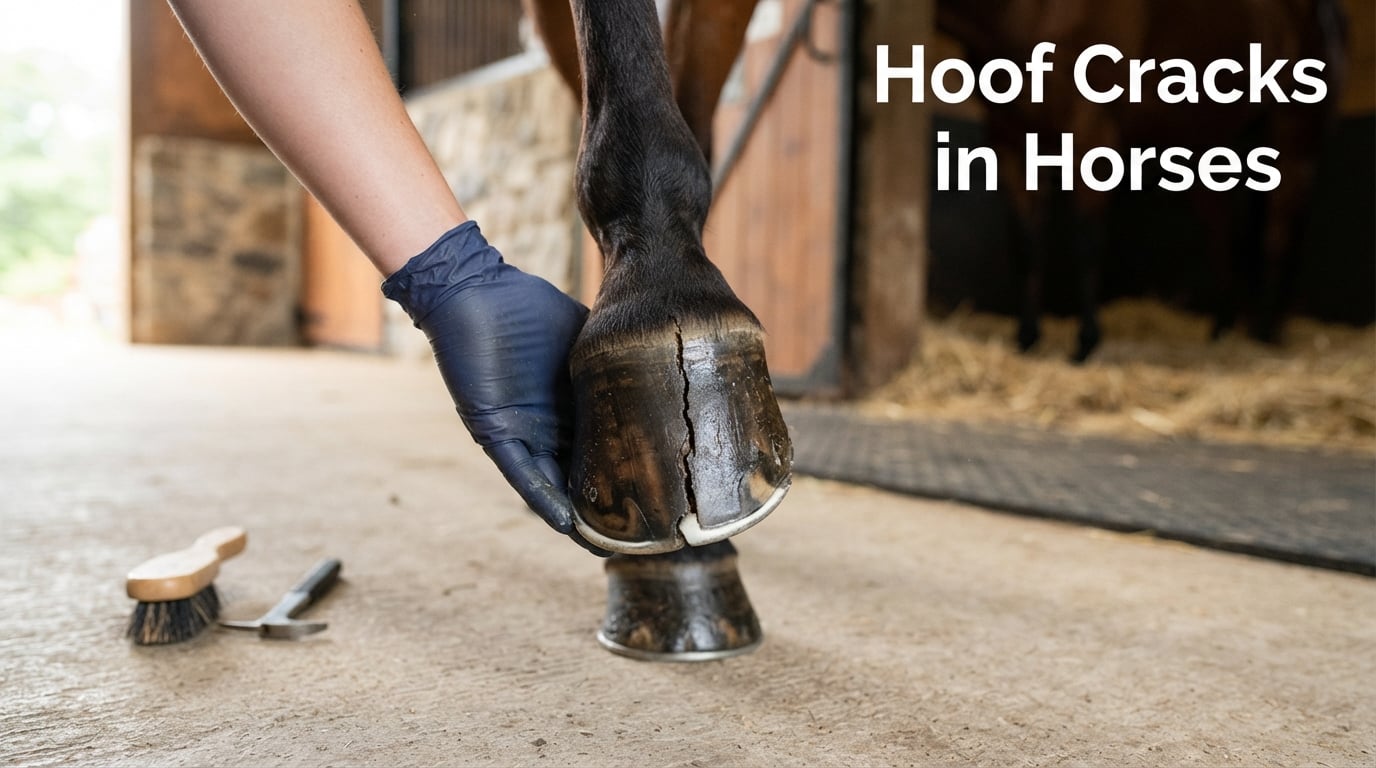
You’re picking your horse’s hooves on a quiet Tuesday morning when you spot it — a thin dark line running up the hoof wall that definitely wasn’t there last week. Your stomach drops a little.
Is it serious? Will it get worse? Do you need to cancel the weekend ride?
Hoof cracks in horses are one of the most common concerns I hear from riders at every level, from first-time horse owners to experienced competitors. And for good reason — a crack that looks minor one week can become a significant problem if left unmanaged.
The good news is that most hoof cracks are manageable, and many are entirely preventable with the right approach to care. But understanding what you’re dealing with is the first step. In this guide, I’m going to walk you through every type of hoof crack, explain exactly what causes them, and give you a clear framework for deciding when to handle something yourself and when to call your farrier or vet.
By the end, you’ll know how to assess the severity of any crack you find, what treatment actually looks like, what to expect during recovery, and how to set your horse up so that cracks become much rarer in the future.
Table of Contents
What Are Hoof Cracks in Horses?
Hoof cracks in horses are splits, breaks, or fissures in the hoof wall — the hard outer structure that encases and protects the sensitive inner tissues of the foot. They can range from hairline surface marks that pose no real risk to deep fissures that penetrate through to sensitive laminar tissue and cause significant pain or lameness.
The hoof wall is made primarily of keratin, the same protein that forms human fingernails and hair. It grows continuously from the coronary band — a soft tissue ring at the top of the hoof — and grows downward toward the ground at roughly 6 to 9 millimeters per month. When the integrity of this keratin structure is compromised, cracks can form.
Cracks are typically categorized by their location on the hoof wall, their direction (vertical or horizontal), and their depth (superficial or deep). A superficial crack affects only the outer layers and is largely cosmetic. A deep crack can reach the sensitive inner structures, the coffin bone, or the coronary band — and that’s when things become medically significant.
Understanding which type of crack you’re dealing with is the single most important first step, because treatment and urgency vary enormously depending on the answer.
Types of Hoof Cracks in Horses
Not all hoof cracks are created equal. Here is a breakdown of the most common types, where they occur, and what typically causes each one:
Grass Cracks
Grass cracks start at the ground surface of the hoof and grow upward. They’re usually superficial, affecting only the outer hoof wall, and are common in unshod horses whose hooves have become overly dry and brittle.
The name comes from their frequent appearance in horses kept on dry pasture during summer months. They tend to be thin, multiple, and spread across the toe or quarters. While grass cracks look alarming in a cluster, they’re generally the least serious type and rarely cause lameness on their own.
That said, they shouldn’t be ignored entirely. Multiple grass cracks signal that the hoof wall is losing structural integrity, which makes deeper cracks more likely if the underlying dryness or neglect isn’t addressed.
Sand Cracks and Quarter Cracks
Sand cracks — often called quarter cracks when they appear on the side of the hoof — are among the most serious types you’ll encounter. Unlike grass cracks, these start at the coronary band and travel downward toward the ground surface.
Quarter cracks are particularly common in performance horses, racehorses, and horses with conformational issues that cause uneven loading on one side of the hoof. The quarter of the hoof is a high-stress zone, and when the hoof wall in this area is compromised, the crack can deepen with every step the horse takes.
Deep sand or quarter cracks can cause lameness, bleeding, and significant pain. They require prompt farrier attention and sometimes veterinary involvement depending on severity.
Toe Cracks
Toe cracks run vertically at the front of the hoof and are often linked to an overly long toe, a broken-back hoof-pastern axis, or excessive toe-first landing. The toe is under enormous compressive stress with every step, and when the hoof wall is weakened or the balance is off, a crack can form in this high-pressure zone.
These cracks are more common in horses with flat feet or low heels. They tend to be stubborn because the constant stress at the toe makes stabilization challenging. A good farrier will address the underlying balance issue first, then stabilize the crack itself.
Heel Cracks
Heel cracks appear at the heel bulbs and can be quite painful given how sensitive the heel area is. They’re frequently associated with underrun heels — a conformation issue where the heels slope too far forward under the horse — which places abnormal stress on the soft tissue and hoof wall in this region.
Horses with contracted heels are also at higher risk. Because the heel is a sensitive, flexible part of the hoof, even a moderate crack here can cause discomfort during movement. Corrective shoeing is often needed to relieve pressure and allow healing.
Bar Cracks
Bar cracks occur in the bars of the hoof — the inward-folding extensions of the hoof wall that run alongside the frog. These cracks are often caused by excessive bar growth that isn’t trimmed regularly, creating pressure points that eventually cause the bar to split.
Bar cracks can also result from bruising or trauma to the sole. They may not always be immediately visible during a routine inspection, so your farrier’s trained eye during a trim is often what catches them first.
Horizontal Cracks
Horizontal cracks run across the hoof wall rather than up and down. They’re distinctly different in origin from vertical cracks — they almost always result from a traumatic event or illness that temporarily disrupted normal hoof wall growth at the coronary band.
A hoof abscess that burst at the coronary band, a serious illness with a high fever, or a physical injury to the coronary band can all leave a horizontal groove or crack that grows down the hoof wall over time. As it moves toward the ground surface, it may cause a section of hoof wall to become loose or detach — this is sometimes called a blowout or false quarter.
The good news about horizontal cracks is that, unlike vertical cracks, they don’t tend to deepen. They’re a record of a past event, and they’ll grow out over time. The main risk is the structural weakness they create as the crack approaches the ground surface.
What Causes Hoof Cracks in Horses?
The Merck Veterinary Manual identifies excessive forces placed on the hoof wall as the primary driver of most hoof cracks. But what actually creates those excessive forces? The causes are more varied than many people realize.
Hoof imbalance and poor trimming are the leading causes in the horses I’ve seen. When a hoof is trimmed or shod in a way that doesn’t distribute weight evenly, certain areas of the hoof wall bear far more stress than they’re designed to handle. Over time, that concentrated stress causes cracks.
Environmental extremes play a huge role. Prolonged dry conditions dry out the keratin in the hoof wall, making it brittle and prone to cracking — especially grass cracks. Constant wet conditions, on the other hand, can soften and weaken the hoof wall, making it vulnerable to mechanical damage.
The worst scenario is rapid cycling between wet and dry conditions, which is exactly what many horses experience in unpredictable climates. As one horse owner on Reddit put it: “Living out 24/7 in inconsistent British summer weather is a recipe for cracking.” This repeated expansion and contraction of the hoof wall accelerates fracturing over time.
Poor nutrition weakens the keratin structure of the hoof from the inside. The hoof wall can’t maintain its integrity if the horse’s diet is deficient in the building blocks of keratin — particularly amino acids, biotin, zinc, and copper. Importantly, nutrition alone rarely causes serious cracks without some other contributing factor.
Conformational problems — things like club feet, low heels, or asymmetrical limbs — create inherent biomechanical stress that predisposes horses to cracking in specific locations. These horses need particularly attentive farrier work to compensate for the stress patterns their conformation creates.
Trauma to the coronary band or hoof wall can trigger crack formation. A kick from another horse, a wire cut, or even repeated concussion on very hard surfaces can damage the growing tissue and interrupt normal hoof wall development.
Genetics also matter. Some horses are simply born with thinner, softer, or more brittle hoof walls than others. This doesn’t mean cracking is inevitable, but it does mean these horses need more diligent management.
How to Treat Hoof Cracks in Horses
Treatment depends heavily on the type and severity of the crack, but here’s the general approach our team recommends working through systematically.
Step 1: Assess before you act. Before cleaning or treating anything, take a good look at the crack in good lighting. Note its location, direction, length, and depth.
Ask yourself whether the crack is superficial (you can’t fit a fingernail in it) or whether it has real depth. Is there any bleeding, discharge, or heat around it? Is your horse showing any discomfort? These observations will determine every decision that follows.
Step 2: Clean the area thoroughly. Use a hoof pick and stiff brush to remove all dirt and debris from and around the crack. If there’s any possibility of infection — which you’d suspect if you see discharge, smell something off, or feel heat — your vet needs to assess before you proceed with any topical treatments that could trap bacteria.
Step 3: Contact your farrier for anything beyond superficial. For grass cracks that are genuinely hairline and not deep, you may simply need to keep the hoof clean and address the underlying dryness. But any crack that’s wider than a hairline, extends more than an inch, or shows any depth deserves a farrier visit. Don’t wait for the next scheduled appointment — call ahead.
Step 4: Farrier stabilization techniques. A qualified farrier has several tools for stopping a crack from propagating further. These include:
- Polymer or acrylic patching — the farrier uses a two-part adhesive to fill and seal the crack, restoring the structural integrity of the hoof wall
- Wire lacing or screws — for serious cracks, especially quarter cracks, small wires or screws may be placed across the crack to hold the edges together while the hoof grows
- Grooving — a small groove is cut at the top of the crack to stop it from traveling further upward
- Corrective shoeing — the shoe is modified or a specific shoe type is applied to relieve stress at the site of the crack and redistribute weight
Step 5: Address the underlying cause. This is the step that most people skip, and it’s the reason so many horses have recurring cracks. Patching a quarter crack without correcting the hoof balance that caused it is like painting over a crack in a wall without fixing the structural issue.
Your farrier should identify and address what’s driving the crack — whether that’s trimming angle, shoe placement, or overall balance. A crack that keeps returning is almost always telling you that the root cause hasn’t been fixed.
Step 6: Home care between farrier visits. Keep the hoof clean and dry. If environmental dryness is a factor, apply a quality hoof moisturizer to the hoof wall (not the sole) to support flexibility. Don’t pick at or try to open the crack further at home — this risks introducing bacteria and destabilizing a repair your farrier may have applied.
How to Tell If a Hoof Crack Is Serious: A Severity Guide
One of the most common questions horse owners ask is “when should I actually worry?” Here’s a practical severity framework that helps you decide how quickly to act.
Low severity — monitor and maintain: The crack is hairline thin, shorter than 1 inch, located at the ground surface only (grass crack pattern), and your horse is completely sound. There’s no heat, no discharge, and no bleeding. This crack can wait for your next scheduled farrier visit, though you should mention it and keep the hoof clean and moisturized in the meantime.
Moderate severity — schedule a farrier visit soon: The crack is wider than a hairline, extends more than an inch up the hoof wall, or starts at the coronary band and travels down. Your horse is still sound but the crack is clearly visible and has some depth. This warrants a call to your farrier within the week — don’t wait a month for the next scheduled trim.
High severity — call your vet or farrier today: Any of the following demand same-day action:
- Your horse is lame or showing any reluctance to bear weight on the affected foot
- There is blood or discharge coming from the crack
- The crack extends all the way from the coronary band to the ground surface
- There is heat, swelling, or pain when you apply light pressure to the hoof wall near the crack
- The crack is wide enough to see soft tissue or appears to be moving with each step
- You can see or feel the two sides of the crack shifting relative to each other when the horse bears weight
If you’re unsure which category your horse’s crack falls into, default to calling your farrier. A quick phone call with a photo sent via text can help them advise you without requiring an emergency visit in most cases.
Farrier vs. Veterinarian: Who Should You Call?
Most hoof crack treatment falls under the expertise of a skilled farrier, not a vet. But there are situations where you need your vet involved — and sometimes both professionals working together.
Call your farrier first when: the crack is structural but not infected, your horse is sound or only mildly uncomfortable, you need stabilization or corrective shoeing, or you want a balance assessment to address the root cause. The farrier is your first line of defense for the vast majority of hoof cracks.
Call your vet when: your horse is genuinely lame, there are signs of infection (discharge, heat, swelling, or a bad odor), the crack appears to involve the coronary band or sensitive inner structures, or you need a definitive diagnosis of what’s causing the crack. Your vet may take radiographs to assess the position of the coffin bone and understand how the crack relates to internal structures.
The best outcome often involves both. A vet can diagnose whether there’s infection, nerve involvement, or a structural problem with the coffin bone. A farrier can then execute the shoeing and stabilization work based on that information. In complicated cases like a severe quarter crack with infection, this collaboration is not optional — it’s essential.
Never assume that because a crack “looks okay” it means the inside is fine. What’s visible on the outside of the hoof wall doesn’t always reflect what’s happening in the laminar tissue underneath.
How Long Does It Take for a Horse Hoof Crack to Heal?
The honest answer is: longer than most people expect. The hoof wall doesn’t repair itself from within the crack — instead, new healthy hoof wall grows down from the coronary band and gradually replaces the damaged section. At roughly 6 to 9 millimeters of growth per month, a full hoof replacement takes 9 to 12 months.
That doesn’t mean your horse will be out of action for a year. Once a crack is stabilized — properly patched, wired, or supported with appropriate shoeing — most horses can return to normal work within weeks, even if the crack itself takes months to grow out completely.
Superficial grass cracks near the ground surface can grow out in 3 to 4 months if the underlying cause is addressed promptly. A moderate sand crack that starts an inch below the coronary band might take 6 months to fully grow out. A severe quarter crack that begins right at the coronary band will take the full 9 to 12 months to replace completely.
The key takeaway: stabilization and addressing the cause is what gets your horse comfortable and working again quickly. Full structural replacement takes time, and that’s completely normal. Don’t expect a repaired crack to disappear in a few weeks — look for it to slowly migrate downward and grow out over several trim cycles.
Nutritional Support for Healthy Hooves
Nutrition is the foundation that the hoof wall grows from. If your horse’s diet is deficient in the nutrients needed to produce strong keratin, the hoof wall that grows from the coronary band will be structurally weaker — more prone to cracking, chipping, and slow growth. Nutrition repairs the hoof from the inside out, but it takes months to see meaningful results.
Biotin is the most studied and widely recommended nutrient for hoof health. Research consistently supports daily supplementation of 15 to 30 milligrams as beneficial for horses with poor hoof quality. It supports keratin synthesis and is considered safe at these levels.
That said, biotin won’t fix a crack caused by imbalance or trauma on its own. It improves the quality of new hoof growth coming from the coronary band — not the structural integrity of existing wall that’s already cracked.
Methionine is an essential sulfur-containing amino acid that’s integral to keratin production. Many horses on forage-only or low-protein diets may be marginally deficient. Methionine is found in most comprehensive hoof supplements and works synergistically with biotin.
Zinc and copper both play important roles in keratin cross-linking — the process that gives the hoof wall its strength and hardness. Many hay-based diets are deficient in zinc relative to iron, and this imbalance can contribute to soft, weak hoof walls. Having your forage analyzed and balancing the mineral ration is a highly effective but often overlooked step.
Omega-3 fatty acids from sources like flaxseed or fish oil support hoof wall hydration. They can help prevent the brittle dryness that leads to grass cracking, especially in horses on dry-lot or hay-based diets.
Set realistic expectations with any supplement program. You need at least 6 to 9 months of consistent supplementation before you can fairly judge the impact on hoof quality. Start a supplement in spring, and by the following spring you should see a meaningful difference in the quality of new growth coming from the coronary band.
How to Prevent Hoof Cracks in Horses
Prevention is genuinely more effective than treatment when it comes to hoof cracks. Most cracks I’ve seen in horses could have been avoided with consistent, thoughtful management. Here’s what actually works:
Maintain a regular farrier schedule. Most horses need trimming or shoeing every 6 to 8 weeks — this is non-negotiable. Letting the schedule slip to 10, 12, or 14 weeks allows the hoof to become unbalanced and the walls to flare, crack, and chip.
Regular trimming also removes existing damage before it can deepen into something serious. Forum users and experienced horse people universally agree: daily care and regular farrier visits are the baseline, not a bonus.
Manage moisture carefully. Avoid the extremes in both directions. Prolonged dryness dries out the hoof wall and causes brittleness — during dry seasons, apply a quality hoof moisturizer to the outer hoof wall after cleaning. Prolonged wet conditions can soften and weaken the wall — ensure your horse has access to dry standing areas and avoid waterlogged paddocks.
The most challenging situation is rapid cycling between wet and dry conditions — wet all week, dry at weekends for competitions, back to wet by Monday. This repeated expansion and contraction stresses the keratin structure significantly. A hoof conditioner that maintains moisture balance (rather than just adding moisture) can help horses in these environments.
Feed a balanced diet. Don’t wait for a crack to appear before addressing nutrition. Have your forage analyzed, balance the mineral ration, and consider whether a quality hoof supplement is appropriate for your horse’s specific needs.
Avoid excessive work on hard, abrasive surfaces — particularly during dry weather when the hoof is already under hydration stress. Hard packed roads and arena surfaces increase the compressive and abrasive forces on the hoof wall significantly.
Address conformation and shoeing proactively. If your horse has known conformational issues, discuss management strategies with your farrier before cracks appear. Corrective shoeing, specific shoe types, or modified trimming angles can compensate for structural predispositions.
Don’t neglect barefoot horses. Horses without shoes are fully dependent on the quality of their hoof wall and a well-executed trimming program. Regular barefoot trims, proper conditioning, and careful attention to the footing they work on are all essential.
Building a Daily Hoof Care Routine
The most effective prevention strategy is simple and costs nothing: consistent, attentive daily care. Here’s what a solid routine looks like in practice.
Every day: Pick out all four hooves thoroughly — this isn’t just about hygiene, it’s your daily inspection. While picking, look and feel for anything that has changed since yesterday.
Check whether the walls are smooth and solid or whether new cracks are developing. Look for heat, sensitivity near the frog or white line, and any unusual smell that could signal thrush or white line disease. This 5-minute daily habit is how you catch problems early, before they become expensive emergencies.
Several times per week: Assess the overall condition of the hoof wall by running your hand down each wall. Note whether the surface feels smooth or rough and dry. Check that shoes are sitting flat and haven’t shifted — a shifted shoe changes how weight is distributed and can create new stress points overnight.
Before and after each ride: Check for stones lodged in the frog and check the white line area for any dark staining or separation. After riding, check for any new sensitivity or persistent heat that wasn’t there before the ride.
At every farrier visit: Tell your farrier everything you’ve noticed since the last visit — any cracks, any new sensitivity, any changes in how your horse is moving. A good farrier builds on your observations between visits, and the more information you share, the better the outcomes.
Seasonally: Reassess your moisture management and supplementation program as conditions change. Horses who need more moisturizing in summer may need a different approach in winter. Your farrier can advise on what’s appropriate for the coming season in your area.
Frequently Asked Questions About Hoof Cracks in Horses
Can a horse recover from a cracked hoof?
Yes, horses can and do fully recover from hoof cracks in most cases. Superficial cracks often resolve within a few months once the underlying cause is addressed. Deep or serious cracks require farrier repair and sometimes veterinary treatment, but with proper stabilization and management, most horses return to full work and grow out the damaged section of hoof wall completely over 9 to 12 months.
When should I worry about a hoof crack?
Worry immediately if your horse is lame, if there is blood or discharge from the crack, if the crack runs the full length of the hoof wall from coronary band to ground, if you feel heat or swelling around the area, or if the crack appears to move when your horse bears weight. Any of these signs mean you should call your vet or farrier the same day rather than waiting for a scheduled appointment.
How do you fix a cracked hoof on a horse?
Fixing a hoof crack involves several steps: first, assess and clean the crack; second, contact your farrier to stabilize the crack using polymer patching, wire lacing, or corrective shoeing; third, address the root cause such as hoof imbalance, environmental dryness, or nutritional deficiency; and finally, maintain consistent care between visits. Serious cracks involving lameness or infection also require veterinary evaluation alongside farrier work.
Is it okay to ride a horse with cracked hooves?
It depends entirely on the severity of the crack. A superficial grass crack in an otherwise sound horse generally does not require rest from riding. However, if your horse is showing any lameness, if the crack is deep, or if it has been recently stabilized by a farrier, you should follow your farrier’s or vet’s specific guidance on return to work. When in doubt, call before you ride.
How long does it take for a cracked hoof to heal?
Full healing depends on how far the crack is from the coronary band. Since hoof wall grows at roughly 6 to 9 millimeters per month, a crack that starts near the coronary band may take 9 to 12 months to fully grow out. A crack closer to the ground surface may resolve in 3 to 4 months. Stabilization allows the horse to return to work sooner, but the structural replacement of the damaged wall takes the full growth period.
What causes hoof cracks in horses?
Hoof cracks are caused by excessive forces on the hoof wall, commonly from hoof imbalance or poor trimming, environmental extremes (very dry or very wet conditions, or rapid cycling between both), nutritional deficiencies that weaken keratin, trauma to the hoof wall or coronary band, conformational problems, or genetics. Most serious cracks result from a combination of factors rather than a single cause, which is why addressing the underlying issue is as important as repairing the crack itself.
Final Thoughts
Hoof cracks in horses run the full spectrum from completely harmless to genuinely serious, and knowing which end of that spectrum you’re dealing with is the skill worth developing. Most cracks are manageable when caught early, addressed with qualified farrier help, and supported by consistent daily care and good nutrition.
The three habits that make the biggest difference are simple: pick and inspect those hooves every single day, keep your farrier on a regular schedule, and feed a diet that supports strong keratin growth from the inside out. These habits don’t guarantee you’ll never see a crack — but they dramatically reduce the risk and mean you’ll catch any problem early enough to handle it easily.
If you’re ever genuinely unsure about a crack you’ve found, err on the side of calling your farrier. A two-minute phone call with a photo is almost always enough to get good guidance, and it’s far less costly than an emergency that could have been prevented.