
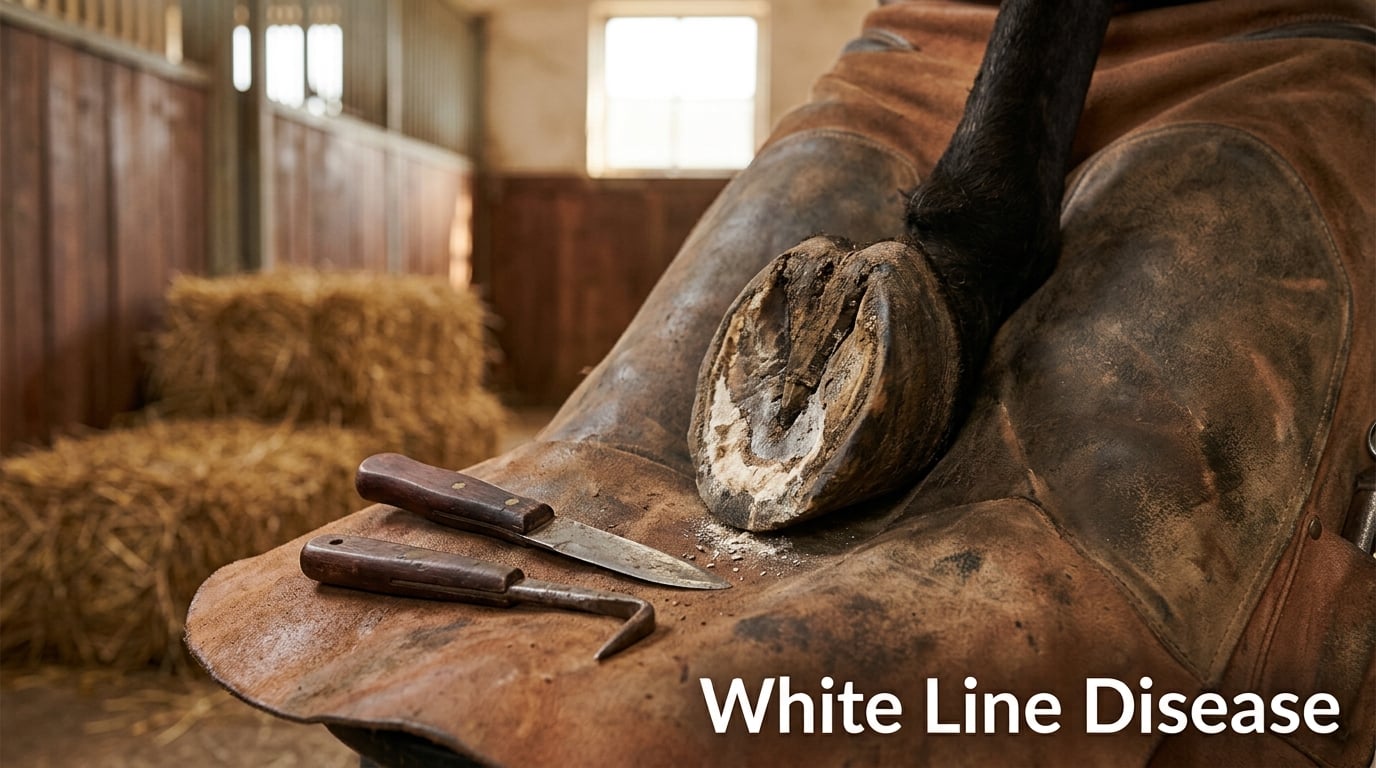
One morning you’re picking out your horse’s feet and something feels off. The hoof wall sounds hollow when you tap it — a dull thud instead of a solid knock. There’s chalky, crumbly residue along the white line where you’d normally see clean horn tissue. That gap between the outer hoof wall and the inner structures is exactly what it looks like: White Line Disease.
White Line Disease is one of the most common hoof problems in horses, yet it’s frequently misidentified or caught too late. Owners often mistake it for normal chipping or confuse it with thrush. That’s a problem, because White Line Disease has its own specific causes, its own pattern of progression, and a treatment approach that requires removing all infected tissue — not just applying a topical and hoping for the best.
This guide covers everything you need to know about White Line Disease: what it is, how the infection takes hold, what signs to look for, and what treatment actually involves from the first debridement through full recovery. Whether you’re managing an active case right now or trying to prevent one from starting, you’ll find practical, detailed information here.
Table of Contents
What Is White Line Disease in Horses?
White Line Disease is an anaerobic bacterial and fungal infection that invades the inner layers of the equine hoof wall, breaking down keratin and causing separation between the outer hoof wall and the underlying structures. It gets the “white line” name from the zona alba — the thin, pale junction visible at the bottom of the hoof between the hard wall and the sole — which serves as the primary entry point for the organisms responsible.
The condition goes by several names depending on region and tradition: seedy toe, hollow foot, wall thrush, and stall rot all describe the same process. These names have accumulated over decades of equine practice, and you’ll see them used interchangeably in older literature and among farriers.
What makes White Line Disease dangerous isn’t the initial infection site. It’s the direction it travels. Once organisms enter at the white line level, they move upward through the non-pigmented stratum medium — exactly the kind of dark, oxygen-deprived environment where anaerobic bacteria and fungi thrive. The farther they travel toward the coronary band, the more structural tissue they destroy along the way.
Is White Line Disease Contagious?
No. White Line Disease is not contagious between horses. The bacteria and fungi responsible are environmental organisms found naturally in soil, manure, and bedding. One horse developing the condition doesn’t directly put stable mates at risk. That said, shared environments with poor hygiene create conditions that make every horse in that environment more susceptible.
How Serious Is White Line Disease?
A small, early case caught at a routine farrier visit is a manageable problem. A neglected case that has tracked three-quarters of the way up the hoof wall is a much bigger deal. Left untreated, White Line Disease can progress to involve the sensitive laminae — the tissue that connects the hoof capsule to the coffin bone — and in severe cases, it can lead to rotation of the coffin bone, causing permanent structural damage and ongoing lameness.
This is why the consistent message from veterinarians and experienced farriers is the same: early detection and aggressive treatment matter far more than any specific topical product you choose.
Understanding Hoof Anatomy and the White Line
You don’t need a veterinary degree to understand White Line Disease, but a basic picture of hoof structure helps explain both why it happens and why treatment looks the way it does.
The hoof wall is made up of three distinct layers, each with a different structure and function:
Stratum externum: The thin outermost layer, sometimes called the periople. This waxy coating protects the hoof from moisture fluctuations. It can be worn away or compromised by repeated wet-dry cycling, reducing the hoof wall’s natural defense.
Stratum medium: The main structural layer. This is where the bulk of the keratin tubules run vertically from the coronary band down to the ground surface. It’s also where White Line Disease does its damage — the organisms destroy the tubules and intertubular horn, hollowing out the wall from inside.
Stratum internum (epidermal laminae): The innermost layer. This connects to the sensitive dermal laminae, which anchor the hoof capsule to the coffin bone beneath. When infection reaches and compromises this layer, the structural integrity of the entire hoof is at risk.
The white line itself — the zona alba — sits at the solar surface and represents the junction between the stratum medium and the stratum internum. Under a healthy hoof, it appears as a thin, slightly waxy, pale yellowish line running parallel to the hoof wall. When you see gray, black, or chalky white material there instead, that’s a sign organisms have already moved in.
The architecture of the hoof creates a natural pathway for infection to travel. Once organisms breach the white line, they work their way upward through the stratum medium, tracking between the tubules in an environment that’s dark, low in oxygen, and rich in the keratin they consume as a food source. A significant infection may travel centimeters up the hoof before any outward sign is visible at ground level.
This internal progression is why treatment can look alarming to horse owners who haven’t seen it before. Removing the infected material requires cutting away the overlying hoof wall to expose the full extent of the problem — and that extent is almost always larger than what was visible from the outside.
What Causes White Line Disease?
White Line Disease doesn’t appear randomly. Specific environmental, management, and horse-level factors make infection far more likely. Understanding these risk factors is the first step toward meaningful prevention.
Environmental Risk Factors
Prolonged wetness: Constant moisture softens the white line, making it physically easier for organisms to penetrate the tissue.
Wet-dry cycling: Alternating between wet and dry conditions often does more damage than constant moisture alone. The repeated swelling and contraction micro-cracks the hoof wall at the white line, creating entry points that wouldn’t exist in a stable environment.
Muddy or manure-heavy turnout: High organic matter in the environment means a high pathogen load constantly pressing against the hoof surface.
Poor stall hygiene: Ammonia from urine softens horn tissue, and bacterial populations in dirty bedding can directly attack the white line with prolonged contact.
Management Risk Factors
Irregular farrier care: Overgrown hooves develop uneven weight distribution, flares at the toe and quarters, and micro-cracks at the white line — all of which create open invitations for infection.
Hoof wall flares and imbalance: A flared toe creates mechanical stress at the white line that physically separates the wall from the sole even before any biological organisms are involved. Once that gap opens, infection follows.
Previous trauma: Cracks, splits, bruising, or old nail holes that aren’t properly cleaned and managed create localized entry points.
Inadequate hoof picking: Not cleaning hooves daily allows debris, moisture, and organisms to accumulate in exactly the zone where White Line Disease starts.
Horse-Specific Risk Factors
Flat soles or thin hoof walls that offer less structural protection
Poor hoof conformation overall, particularly horses with very upright or very low-angled hooves
Nutritional deficiencies that weaken horn quality (more on this in the prevention section)
Horses recovering from laminitis, whose altered hoof structure and disrupted lamellar connections make them more vulnerable
Horses with any systemic condition affecting their immune response or metabolic function
One pattern you’ll hear repeatedly from horse owners who’ve dealt with White Line Disease: wet springs and muddy winters dramatically increase the number of cases they see. You can do everything right and still get a case in a particularly harsh season. The difference is that horses with good hoof balance, consistent farrier care, and clean living conditions tend to get much milder cases — and catch them much earlier.
Symptoms of White Line Disease: What to Watch For
Early White Line Disease is nearly symptom-free from the horse’s perspective. Horses frequently show no pain or lameness until infection has progressed significantly, which is exactly why daily hoof care and regular farrier visits are the primary means of catching it early.
Early Signs (What You Can Find at Home)
A hollow sound when you tap the hoof wall: Use a hoof pick or knuckle to tap along the hoof wall. Solid, healthy horn has a distinctive dense sound. An area undermined by White Line Disease produces a dull, hollow thud — sometimes described as the difference between tapping a solid wall versus a door. This is the most reliable early sign you can detect yourself.
Chalky, white, or crumbly material at the white line: When picking out hooves, you may notice powdery residue along the white line rather than clean, solid horn tissue.
Gray or black discoloration at the white line or sole junction: The infected zone takes on a gray or black color from the organisms and debris filling the space.
Visible separation between the hoof wall and sole: In more developed cases, you can see an actual gap or tunnel at the white line when looking at the solar surface of the hoof.
Mild earthy odor: White Line Disease can produce a slightly musty smell, but it’s much milder and less offensive than the sharp ammonia smell characteristic of thrush.
Later-Stage Signs
Hoof wall that feels slightly flexible or “gives” under finger pressure in the affected zone
Visible tunneling — a gap that extends well up into the hoof wall, sometimes visible from the side
Lameness, especially on hard or rocky ground, indicating coffin bone support has been compromised
Separation visible on the side of the hoof wall, not just at the sole
How Your Farrier Diagnoses White Line Disease
At a farrier visit, diagnosis is typically straightforward. Your farrier will tap the hoof wall systematically to locate hollow areas, then use a hoof knife to probe the affected zone and assess how far the separation has traveled up the wall. In some cases, a hoof tester may be used to check for pain response in specific areas.
X-rays are warranted in any case where the infection appears to have reached the lamellar zone, where the horse is lame, or where significant hoof wall has already been lost. Radiographs tell you whether the coffin bone has shifted — information that directly shapes treatment decisions about therapeutic shoeing.
White Line Disease vs. Thrush: Telling Them Apart
These two conditions share similar risk environments (wet, dirty conditions) and both involve microbial infection. The key differences are location and appearance.
Thrush affects the frog — the soft, V-shaped structure at the back of the hoof — and produces a distinctive wet, black, foul-smelling discharge in the frog clefts.
White Line Disease affects the hoof wall junction, produces dry, chalky, or powdery material, and smells much less strongly if at all.
Both can exist in the same hoof at the same time, and both respond to improved hygiene as part of management. But they have different primary treatments and different structural implications.
How to Treat White Line Disease
Treatment for White Line Disease follows four steps. This isn’t a process where you can skip ahead to topical treatment — each step depends on the one before it, and the first step is the one most critical to success.
Step 1: Debridement (Hoof Wall Resection)
Debridement is the foundation of treatment and cannot be substituted by any topical product. Your farrier needs to cut away all infected, separated tissue until only clean, solid horn remains. This typically involves resecting part of the hoof wall — literally removing the overlying wall to expose the entire affected zone to air.
Here’s the biology behind why this matters: the bacteria and fungi causing White Line Disease are anaerobic organisms. They cannot survive in the presence of oxygen. Exposing the affected area to air doesn’t just enable topical treatment — it is itself part of the treatment. Every piece of infected material left behind is a shelter where organisms will continue to thrive and expand.
The extent of resection surprises many horse owners the first time they see it. A large section of hoof wall may be removed, leaving the horse with an open, exposed area that looks alarming. Trust the process. Leaving behind infected material is the single most common cause of treatment failure and recurrence.
Depending on the size and location of the resected area, many horses can continue to be ridden in light work during treatment. Your farrier and veterinarian will advise you based on the individual case.
Step 2: Topical Treatment
Once the infected material has been fully removed and the area is exposed to air, topical antimicrobial treatment begins. Common options include:
Copper sulfate: Highly effective against both fungi and bacteria. Typically applied as a diluted solution, paste, or powder. Horse owners on equestrian forums consistently report success with daily copper sulfate applications wrapped with cotton and secured with a hoof boot. It’s inexpensive and widely available.
Iodine (7% tincture): Applied directly to exposed horn. Provides antiseptic action and helps dry the tissue, which further discourages anaerobic organisms.
Hydrogen peroxide (3%): Useful for cleaning debris out of the affected area. Less effective as a primary ongoing treatment than copper sulfate or iodine, but helpful in the initial cleanup phase.
Diluted bleach (1:10 with water): Some practitioners use this as a cleanser, though it can be harsh on surrounding healthy tissue if used repeatedly.
The goal of topical treatment is to eliminate remaining organisms and create a dry environment inhospitable to re-infection. Most protocols recommend daily application for at least the first two to four weeks post-resection, then reassessment at each farrier visit thereafter.
Step 3: Mechanical Support (Therapeutic Shoeing)
For moderate to severe cases — particularly where significant hoof wall has been resected or where coffin bone stability is a concern — your farrier or veterinarian may recommend therapeutic shoeing. Options include:
Egg-bar shoes: Extend behind the heel to provide additional caudal support and reduce stress on the toe area where infection most commonly occurs.
Heart-bar shoes: Provide direct support to the frog and coffin bone, reducing the load on compromised lamellar tissue.
Glue-on shoes: Used when nailing into the hoof wall is not appropriate due to compromised or resected wall structure. Glue-on options avoid placing nails in weakened tissue.
Hoof reconstruction: Polyurethane or acrylic materials can be used to fill resected areas, protecting the exposed sensitive tissue while new horn grows down.
Therapeutic shoeing isn’t always necessary. Mild cases treated early may only need proper trimming and topical care. But in cases where the coffin bone has lost significant lamellar support, mechanical protection is essential to prevent further rotation and allow healing.
Step 4: Ongoing Management and Monitoring
New hoof wall grows down from the coronary band at roughly 1 centimeter per month in a healthy horse. A large resection can mean 9 to 12 months before a complete new hoof capsule has grown in. That’s a long treatment window, and what happens during that window determines the final outcome.
During the recovery period:
Keep the treated area as clean and dry as possible — moisture is the primary risk for re-infection.
Increase farrier visit frequency to every 4 to 6 weeks rather than the typical 6 to 8.
Pick out hooves daily and inspect the treated area each time.
Report any signs of warmth, swelling, odor change, or renewed hollowness to your farrier immediately.
Maintain clean, dry turnout and stall conditions throughout.
Recovery monitoring is where many cases succeed or fail. The horses that do best — based on both clinical outcomes and owner experiences reported in equestrian communities — are those whose owners stayed consistent throughout the full recovery period rather than backing off once the immediate crisis seemed resolved.
Preventing White Line Disease
Prevention is significantly easier and less expensive than treatment. Most cases of White Line Disease are preventable with consistent, routine management — and even horses in high-risk environments can be protected through the right combination of hoof care, environment management, and nutrition.
Regular Farrier Care
Scheduling farrier visits every 6 to 8 weeks is the single most important prevention measure. Proper, balanced trimming prevents the hoof wall flares and uneven loading that mechanically separate the white line. Your farrier also sees early changes that you might miss — a slight discoloration, the early hollowness of an area no bigger than a thumbnail — and can address them before they become significant infections.
Daily Hoof Care
Pick out all four hooves daily. This removes debris, exposes the white line for visual inspection, and is the simplest early detection tool available.
When picking, pay attention to the white line — note any chalky material, discoloration, or change in texture.
Report hoof wall cracks, chips, or irregularities to your farrier rather than waiting for the next scheduled visit.
Environment and Stall Management
Clean stalls at least once daily. Wet, manure-saturated bedding pressed against the hoof for hours at a time is one of the most consistent risk factors across all cases.
Use highly absorbent bedding that wicks moisture away from the sole surface.
Provide dry, firm footing in turnout areas where possible. Avoid prolonged standing in deep mud or saturated ground.
Manage water sources to prevent chronically muddy areas around troughs.
In wet seasons, consider increasing farrier frequency to every 4 to 5 weeks.
Hoof Barrier Products
If your horse lives in consistently wet conditions, a hoof hardener or barrier product applied after each hoof picking can help reduce moisture absorption through the white line zone. These aren’t substitutes for good management, but they add a layer of protection in high-moisture environments.
Nutrition for Hoof Quality
Strong, dense horn tissue resists invasion better than weak, brittle horn. Nutrition matters for hoof quality, though results take months to show — horn grows slowly, and it takes several months of supplementation before the improvements reach the ground surface where infection starts.
Key nutrients for hoof health:
Biotin: The most studied and well-supported hoof supplement. Research consistently points to a minimum of 15 to 20mg daily to produce measurable improvement in horn quality. Lower doses produce little to no effect.
Methionine: A sulfur-containing amino acid essential for keratin synthesis. Sulfur cross-links are what give horn its strength and rigidity.
Zinc: Important for cell division and protein synthesis in hoof horn. Many horses on hay-heavy diets run low on zinc without targeted supplementation.
Lysine: An essential amino acid that supports overall protein synthesis. Hoof horn is primarily protein, so adequate lysine availability matters.
Nutritional supplementation won’t resolve an active case of White Line Disease — only debridement and topical treatment can do that. But improving hoof quality over time makes horses meaningfully less susceptible to future cases and supports faster, stronger regrowth after treatment.
What to Expect: Recovery Timeline
How long recovery takes depends almost entirely on how advanced the disease was when treatment started. Here’s a realistic picture based on typical case progression:
Mild Cases (Small Area, Caught Early)
These are the best-case scenarios — a small area of separation, perhaps a few centimeters at the toe, caught at a routine farrier visit before any lameness developed. Topical treatment is usually only needed for 4 to 8 weeks. New hoof wall grows to fill the resected area in 3 to 6 months. The horse often remains sound throughout and returns to full work without interruption.
Moderate Cases (Significant Resection, Some Coffin Bone Instability)
When infection has tracked 4 to 6 centimeters up the hoof wall, or when coffin bone position shows some change on radiographs, recovery takes longer. Expect 6 to 9 months for full hoof wall regeneration. Therapeutic shoeing is likely required for several shoeing cycles. More frequent farrier and veterinary monitoring is needed throughout, and the horse may need reduced work during the active recovery phase.
Severe Cases (Extensive Separation, Coffin Bone Rotation)
In cases where infection has reached close to the coronary band, or where significant coffin bone rotation has occurred, recovery is measured in a year or more — and full return to previous athletic function is not guaranteed. These are the cases that reinforce why early detection matters so much. Some horses with severe cases make complete recoveries; others require ongoing management and reduced workloads permanently. Prognosis in severe cases should be discussed directly with your veterinarian based on current radiographs.
When to Call the Vet vs. the Farrier
This is one of the most common questions horse owners have, and the answer depends on what you’re seeing.
Call your farrier first if:
You notice a hollow sound, chalky material at the white line, or visible discoloration
The horse is sound and the change appears limited to a small area
You’re scheduling a routine visit within the next 1 to 2 weeks anyway
Call your veterinarian (or farrier plus vet together) if:
The horse is lame, even mildly
Warmth or swelling is present around the hoof or coronet
You can see visible separation extending well up the side of the hoof wall
The horse has a history of laminitis
Initial treatment doesn’t seem to be resolving the problem after 4 to 6 weeks
For any moderate or severe case, having your farrier and veterinarian working together — with radiographs to guide decisions about coffin bone position and therapeutic shoeing choices — gives the best treatment outcomes. This isn’t a situation where one professional alone is always sufficient.
Frequently Asked Questions
Can a horse recover from white line disease?
Yes, horses can fully recover from white line disease, particularly when it is caught early and treated aggressively. Mild to moderate cases treated promptly typically result in complete recovery with full return to work within 6 to 9 months. Severe cases involving coffin bone rotation have a more guarded prognosis, but many of those horses also recover well with proper veterinary and farrier management.
What to feed a horse with white line disease?
Focus on nutrients that support hoof horn quality: biotin at a minimum of 15 to 20mg daily, methionine, zinc, and lysine. Check that the horse’s overall diet provides adequate protein and trace minerals. Nutritional support won’t resolve the active infection, but it supports stronger regrowth once treatment is underway. Consult your veterinarian or an equine nutritionist for a diet review if hoof quality is chronically poor.
Is white line disease contagious?
No. White line disease is not contagious between horses. The bacteria and fungi responsible are environmental organisms present in soil, manure, and bedding, not pathogens spread directly from horse to horse. However, a shared environment with poor hygiene increases every horse’s susceptibility to developing the condition.
What kills white line disease in horses?
Debridement — physically removing all infected tissue — is the primary treatment. The organisms causing white line disease are anaerobic and cannot survive exposure to air. Topical antimicrobials like copper sulfate and iodine are applied to eliminate remaining organisms after debridement and prevent re-infection. No topical product alone can resolve white line disease without removing the infected material first.
Can you ride a horse with white line disease?
It depends on the severity. Horses with mild cases and no lameness can often continue light work during treatment. Horses with moderate to severe cases, significant hoof wall resection, or any degree of lameness should rest or have workload significantly reduced until the farrier and veterinarian confirm it is safe to return to work.
Does white line disease go away on its own?
No. White line disease does not resolve without treatment. The infection will continue to spread upward through the hoof wall until all infected tissue is removed and the area is exposed to air. Early cases that seem minor can become severe if left alone. Prompt intervention from a qualified farrier is always required.
Conclusion
White Line Disease is a serious but very treatable condition when caught at the right time. The fundamentals don’t change: thorough debridement, consistent topical care, appropriate mechanical support where needed, and a clean environment throughout recovery. The horses that recover most completely are the ones whose owners stayed consistent and didn’t back off once things started looking better.
Daily hoof picking, regular farrier visits, and decent stall hygiene prevent the majority of cases from ever starting. If you do spot early signs of White Line Disease — that hollow sound, the chalky residue at the white line — call your farrier. The earlier you move, the better the outcome.