
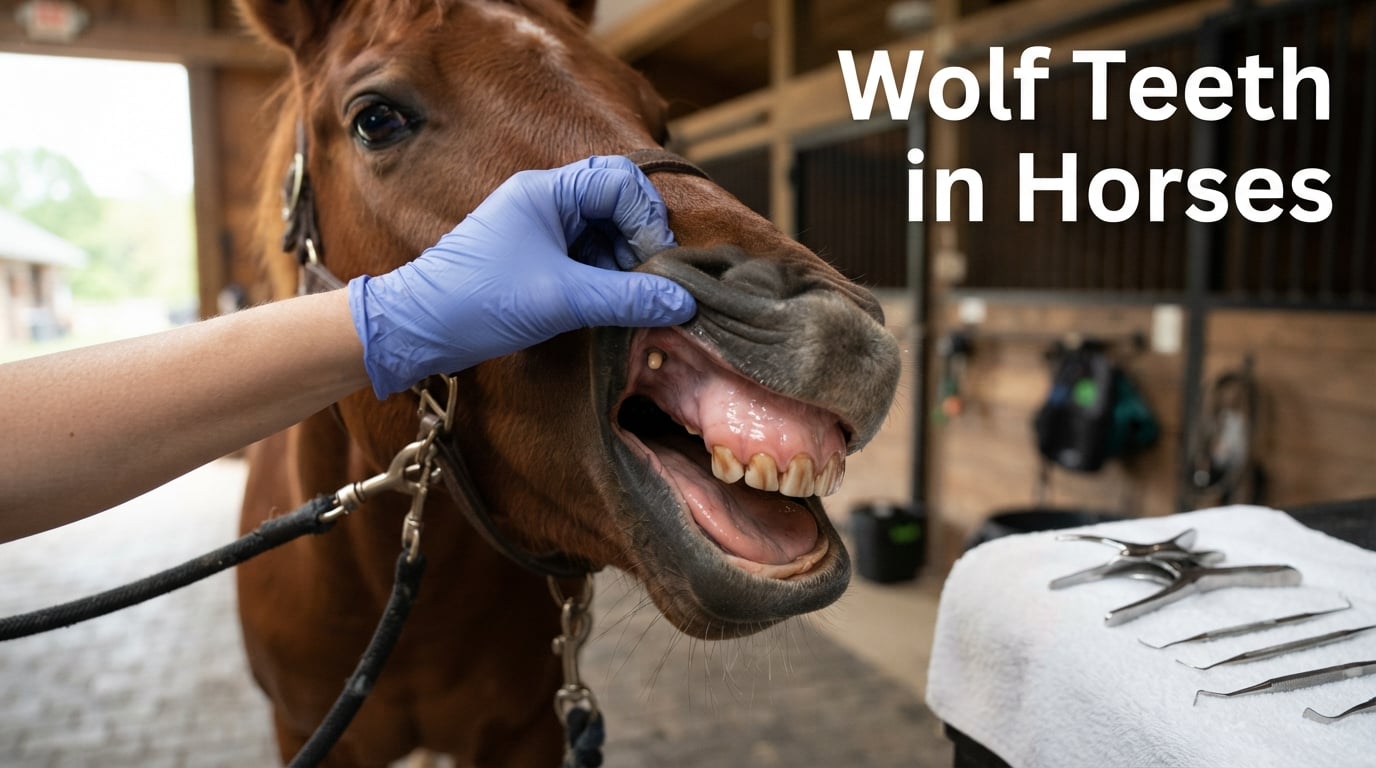
Wolf teeth in horses are small, vestigial first premolars that sit in the interdental space (the gap between the front incisors and the cheek teeth), most often in the upper jaw. They serve no chewing function and are evolutionary leftovers from ancestors that browsed on tougher forage. About 50 to 70 percent of horses will develop at least one wolf tooth during their lifetime, and the rest have none at all.
I have spent years around sport horses and backyard ponies alike, and the topic of wolf teeth comes up almost every spring when young horses start their first real work. Some owners swear by routine removal before any bit goes in the mouth. Others leave them alone and never see a problem. Our team wanted to write the guide I wish I had when I started: a clear, evidence-based overview of what wolf teeth are, when they cause trouble, and how the decision to extract actually plays out.
Table of Contents
What Are Wolf Teeth in Horses?
Wolf teeth are the first premolars in the horse’s dental arcade, even though most modern horses never use them for grinding. Veterinarians and equine dentists call them “Triadan 105 and 205” in the upper jaw and “305 and 405” in the lower jaw, but you will rarely hear those numbers in the barn aisle. You will hear “wolf tooth” (singular) and “wolf teeth” (plural, meaning the tooth on each side, or in some horses a cluster of two or three per side).
These teeth are short, peg-shaped, and usually only a few millimeters in crown height. Most erupt flush against the second premolar in the upper jaw. They have a short root, often only loosely attached to the surrounding bone via a thin periodontal ligament, which is part of why they can be relatively easy to lift out compared to a full cheek tooth.
Wolf Teeth vs Canine Teeth
Owners often confuse wolf teeth with canine teeth, but they are different structures in different locations:
- Wolf teeth — first premolars, sit just in front of the cheek teeth, usually in the upper jaw, appear in both males and females, often emerge around 5 to 18 months of age.
- Canine teeth — sit much farther forward, between the incisors and the cheek teeth, mostly develop in male horses (stallions and geldings), erupt around 4 to 5 years of age.
If you lift your horse’s lip and see a small peg tooth next to a big grinding tooth, that is almost always a wolf tooth. If you see a curved tusk-like tooth closer to the corner incisor, that is a canine.
Why Do Horses Have Wolf Teeth?
Wolf teeth are evolutionary remnants. Fossil horse species like Mesohippus and early Merychippus had three or four functional premolars that helped them browse on shrubs and tougher plant material. As equines evolved into grazers that spend 16 to 18 hours a day eating grasses and soft hay, the first premolar lost its function and shrank.
Modern horses do not need wolf teeth to eat. Wild mustangs, Przewalski’s horses, and domestic breeds all carry the same genetic potential for these vestigial teeth. The trait persists simply because evolution has not selected against it strongly enough to remove it from the population.
That is also why roughly half of horses have them and half do not. There is no breed pattern that fully predicts wolf tooth presence. Even within a single breed and even between full siblings, one may develop two wolf teeth and the other may develop none.
When Do Wolf Teeth Erupt and How Common Are They?
Wolf teeth typically erupt between 5 and 18 months of age, with most appearing before the horse is a year old. By the time a foal becomes a yearling, any wolf teeth that are going to emerge have usually broken through the gum.
Some wolf teeth never fully erupt and remain under the gum tissue. These are called blind wolf teeth and they can be tricky to diagnose without careful palpation or dental imaging. A blind wolf tooth can still cause bit interference because the bit pressure pushes on the overlying gum tissue and inflames it.
Prevalence data from veterinary dental surveys puts wolf tooth occurrence at:
- 50 to 70 percent of all horses have at least one wolf tooth
- Upper jaw wolf teeth are far more common than lower jaw wolf teeth (roughly 75 to 80 percent of wolf teeth are in the maxilla)
- Mares and fillies can develop wolf teeth, though geldings and stallions show slightly higher rates in some studies
- Double or triple wolf teeth on one side occur in about 5 to 10 percent of affected horses
Some wolf teeth are “molarized,” meaning they grew larger than the typical peg shape and developed grinding surfaces similar to a cheek tooth. Molarized wolf teeth are more deeply rooted and significantly harder to extract.
How to Tell If a Horse Has Wolf Teeth
You cannot always see a wolf tooth just by looking at the outside of the horse’s mouth. The visual approach catches only the obvious ones that have erupted high enough to peek out of the gum. The reliable methods are:
- Visual inspection — gently lift the lips and look at the bars of the mouth (the gap between incisors and cheek teeth) for small white or grey peg-like crowns.
- Palpation — run a gloved finger along the gum line just in front of the upper cheek teeth. A wolf tooth feels like a hard bump under or above the gum, sometimes with a sharp point.
- Dental exam by a professional — an equine dentist or veterinarian using a full mouth speculum can examine every tooth and palpate blind wolf teeth that you would never find at home.
Signs that a wolf tooth may be causing a problem include:
- Head tossing or tilting when the bit is applied
- Reluctance to accept the bit or open the mouth for the bridle
- Resistance to turning in one direction
- Drooling, mouth opening, or tongue lolling while ridden
- Behavioral changes that appear suddenly in a previously quiet horse
- Bleeding from the mouth after work
If your horse shows one or more of these signs, schedule a dental exam before changing tack, training methods, or bitting. In our experience, owners often blame the bit or the rider when the actual cause is a sharp or loose wolf tooth pressing into soft tissue.
Should Wolf Teeth in Horses Be Removed?
This is the most debated question in equine dentistry, and the honest answer is: it depends. There is no single rule that fits every horse, and reasonable veterinarians and equine dentists disagree.
Arguments for Routine Removal
Many performance horse veterinarians recommend extracting wolf teeth before the horse starts any serious bit work, usually between 18 months and 3 years of age. Their reasoning:
- The tooth is easier to remove when the horse is young because the root is shorter and the bone is softer
- Removing them early avoids any future bitting problems and eliminates the need to revisit the issue later
- Extraction is a quick, low-risk procedure in young, healthy horses
- It is impossible to predict which horses will develop bit interference, so prophylactic removal prevents trouble
Arguments Against Routine Removal
Other practitioners, particularly those who follow the principles of conservative dentistry, argue against pulling wolf teeth that are not causing problems:
- Any extraction carries small risks of complications (broken root, infection, retained fragments)
- Many horses live their entire working lives with wolf teeth and never show a single sign of trouble
- The cost and stress of the procedure are not justified if the tooth is healthy and the horse is performing well
- Removing the tooth in older horses (over 7 or 8 years) is harder because the root fuses to the surrounding bone
Our Recommendation
Our team lands in the middle. We recommend an annual dental exam starting at yearling age, with extraction reserved for:
- Wolf teeth that interfere with the bit or show mobility
- Blind wolf teeth that cause inflammation under bit pressure
- Molarized wolf teeth that continue growing and damaging opposing tissue
- Any wolf tooth scheduled to be in the path of a bit seat in a performance horse
For young horses about to start under-saddle work, a prophylactic removal with the first dental float is also reasonable and very common.
Wolf Tooth Extraction Procedure, Recovery, and Cost
The Extraction Procedure
Wolf tooth extraction in horses is a routine dental procedure that takes 10 to 30 minutes per tooth:
- The horse is sedated with a short-acting sedative (often detomidine or a combination sedative) and given a local nerve block to numb the area.
- A full-mouth speculum holds the jaw open so the practitioner can see and access the tooth.
- The dentist or veterinarian uses an elevator instrument to loosen the periodontal ligament and lift the tooth from its socket.
- Forceps are used to gently rotate and pull the tooth out.
- The socket is flushed with sterile saline and the mouth is inspected for any retained root fragments.
Molarized wolf teeth require a more invasive surgical extraction, sometimes involving a flap of gum tissue and bone removal. This is rarer and usually done by an experienced equine dentist or veterinary surgeon.
Recovery and Aftercare
Recovery from a routine wolf tooth extraction is fast. Most horses are eating normally within a few hours and back to light work within 24 to 48 hours. The full socket heals in 2 to 4 weeks.
Standard aftercare steps include:
- No bit work for at least 5 to 7 days, ideally 10 to 14 days, to let the socket close over
- Soft feed only for the first 24 hours, then back to normal hay
- Flush the mouth with dilute antiseptic solution if your veterinarian recommends it
- Monitor for swelling, foul smell, or pus which can indicate infection
- Confirm tetanus vaccination is current — any oral procedure can introduce bacteria into the bloodstream, so a tetanus booster within the past 12 months is essential
- Schedule a follow-up exam at 2 to 4 weeks to confirm healing
How Much Does Wolf Tooth Removal Cost?
Cost varies by region, practitioner, and how many teeth are extracted. As a general range in 2026, horse owners can expect:
- Routine single or pair extraction: modest professional fee per tooth, often bundled with a yearly dental float
- Multiple or complex wolf teeth (including molarized): significantly higher fee, sometimes with separate sedation charges
- Surgical extraction (rare): the highest cost tier, often requiring a veterinary surgeon and possibly a clinic visit
Call your local equine dentist or veterinarian for an exact quote, since prices vary widely. Many practitioners will give you an estimate over the phone if you describe the horse’s age and history.
Finding a Qualified Equine Dental Practitioner
Choosing the right person to evaluate and possibly extract wolf teeth matters more than the procedure itself. Look for:
- A licensed veterinarian with equine dental experience, or
- A certified equine dental technician working under veterinary supervision
- Membership in organizations such as the International Association of Equine Dentistry or the American Association of Equine Veterinary Technicians
- Willingness to show you the extracted teeth, explain the procedure, and provide a written summary of findings
- Modern equipment including a motorized dental float, full-mouth speculum, and proper lighting
Avoid practitioners who insist on extracting every wolf tooth on every horse without examining the mouth, who cannot show credentials, or who recommend procedures without explaining the reasoning. A good equine dentist will tell you when extraction is genuinely needed and when the teeth can stay in place safely.
Common Wolf Teeth Problems and Complications
Most wolf tooth extractions go smoothly, but complications can happen:
- Root fracture — the tip of the root can break off and remain in the socket. Small retained fragments usually cause no problem, but larger pieces can lead to infection and may need surgical removal.
- Socket infection — bacteria entering the open socket can cause localized infection. Signs include swelling, foul breath, and reluctance to eat.
- Excessive bleeding — the palatine artery runs close to the upper wolf tooth area. Damage to this vessel is rare but serious and requires immediate veterinary attention.
- Damage to surrounding teeth — the elevator can slip and chip or loosen the second premolar, the tooth next to the wolf tooth.
- Need for repeat extraction — if a wolf tooth fragment is left behind, it can continue to erupt and cause problems later.
These complications are uncommon but real. They are also the main reason some practitioners prefer to leave healthy wolf teeth alone unless the horse is showing clear problems.
Wolf Teeth in Horses: Frequently Asked Questions
Do wolf teeth in horses need to be removed?
Not always. Wolf teeth in horses only need removal if they interfere with the bit, become loose, develop into molarized forms, or cause pain. Many horses keep their wolf teeth their entire lives with no issues. A dental exam by a qualified equine dentist or veterinarian is the best way to decide.
How can I tell if my horse has wolf teeth?
You can sometimes see a small peg-shaped tooth by lifting the lip and looking just in front of the upper cheek teeth. For blind wolf teeth that sit under the gum, you need to run a gloved finger along the gum line to feel a hard bump, or have an equine dentist examine the mouth with a speculum.
How much does it cost to remove wolf teeth in horses?
Costs vary by region and practitioner, but a routine single or paired wolf tooth extraction is usually bundled with an annual dental float. More complex cases involving multiple teeth, molarized wolf teeth, or surgical extraction cost more. Call your local equine dentist for a current quote.
At what age do wolf teeth come in horses?
Wolf teeth typically erupt between 5 and 18 months of age, with most appearing before the horse is a year old. By the time a foal becomes a yearling, the wolf teeth that are going to emerge have usually broken through the gum.
Are blind wolf teeth a problem?
Blind wolf teeth can be a problem because the bit pressure pushes on the overlying gum tissue and inflames it, even though the tooth itself never fully erupts. Many performance horse veterinarians recommend extracting blind wolf teeth before any bit work begins.
Do fillies and mares get wolf teeth?
Yes, fillies and mares can develop wolf teeth, although geldings and stallions show slightly higher rates in some studies. Roughly half of all horses regardless of sex develop at least one wolf tooth.
How long is recovery after wolf tooth extraction?
Most horses are eating normally within a few hours and back to light work within 24 to 48 hours. The socket fully heals in 2 to 4 weeks. Avoid bit work for 5 to 14 days after extraction to allow the socket to close.
Final Thoughts on Wolf Teeth in Horses
Wolf teeth in horses are a small but important part of equine dental care. The key takeaways: most horses either have them or they do not, they serve no function, and they only need to be removed when they cause real problems. Schedule an annual dental exam starting at yearling age, keep your horse’s tetanus vaccination current, and work with a qualified practitioner who can show you exactly what is happening inside your horse’s mouth.
Whether you decide to leave healthy wolf teeth alone or pull them as part of a pre-bitting dental preparation, the most important thing is that the decision is based on a real exam and not on guesswork. Our team has seen both approaches work well when they are made with good information, and both approaches fail when they are not.
If you found this guide on wolf teeth in horses useful, share it with another horse owner. The more informed owners there are about equine dental health, the fewer horses will end up with avoidable bitting problems or unnecessary extractions.